On & Off the International Falls Trail to Peak 6053, British Columbia, Canada (9-11-18)

Day 39 of Lupe’s 2018 Dingo Vacation to the Yukon, Northwest Territories & Alaska!

6:30 AM, Nares Mountain trailhead, Blattas Point Road – Nooooo!  Late last night, silver stars had shone overhead as the tired American Dingo settled in for a long snooze.  The sky had been 80 to 90% clear!  Hopes had been high for Peak 6053 this morning, but that was then.  Lupe had just woken up to a dreary uniformly overcast day.  SPHP was dismayed.  Loopster’s final chance for an ascent of Peak 6053 on this Dingo Vacation appeared doomed.

At least it wasn’t raining.  Maybe the situation would improve in the next hour or two?  Seemed unlikely, and certainly no sense sticking around if Peak 6053 simply wasn’t going to happen, but Loop could wait a little while before hitting the road home.  While SPHP straightened out the G6 and made breakfast, the Carolina Dog explored a nearby grove of trees.

8:00 AM – Hmm.  The clouds seemed higher and thinner than before.  Didn’t look like rain was likely at all.  Provided the mountains remained beneath the cloud cover, an attempt on Peak 6053 was actually worth considering!  Even if the sun never came out, Lupe might still enjoy some incredible views.  Now or never!  Lupe and SPHP piled into the G6.

Hopes soared during the drive S from Carcross on the South Klondike Highway.  Expecting darker skies closer to the Alaskan coast, conditions were improving instead!  Far from a perfect day, but the cloud cover was getting higher, lighter, brighter, and even tinged with blue!

9:41 AM, 41°F – Upon arriving at the International Falls trailhead just N of the Alaska border near White Pass, even the highest regions of what could be seen of Peak 6053 were out in the open.  That settled it!  Lupe was going give it a shot!

SE slopes of Peak 6053 from the International Falls trailhead. Photo looks NW.

The International Falls trail starts out with a short descent to Captain William Moore Creek.  The last part of this descent being nearly vertical, SPHP was glad to find 4 ropes in place to help prevent a fall.  Lupe had first taken the International Falls trail a year ago.  Back then, there had been only 1 rope.  4 was better!  Not that Lupe needed any help.  As usual, the American Dingo managed to get down all on her own.

At the bottom of the short, steep descent at the start of the International Falls trail. Photo looks NNE.

This late in the season, Captain William Moore Creek was very low, an easy rock hop for SPHP.  Loopster easily waded across.  Beyond a delta created by a tributary coming in from the W, the International Falls trail started up a slope full of bushes and stunted conifers.  After gaining 200 feet, the trail continued higher along the N side of the tributary taking Lupe past a series of waterfalls.

The waterfalls weren’t as impressive as they had been in early August, 2017.  The volume of flow had been much greater then, but they were still charming.

Captain William Moore Creek was an easy rock hop this time of year. Photo looks SW.
One of many waterfalls along the International Falls trail. Photo looks SW.

The trail kept climbing at a moderate pace.  Somewhere along the way, Lupe left British Columbia and crossed into Alaska, but exactly where wasn’t clear.  The border was unmarked.

Continuing up the slope, probably in Alaska by now. Photo looks NW.
None of the waterfalls were terribly high, but Lupe went by lots of them.
Approaching the tallest waterfalls. Photo looks NW.
This is it! The biggest waterfall along the International Falls trail! Photo looks W.

Just above the tallest of the waterfalls along the International Falls trail, the stream flowed over a wide area of exposed bedrock.  The water was so spread out, it was only inches deep, if that.

Above the biggest waterfall. Photo looks WSW.

The trail went on and on.  Lupe kept coming to more waterfalls, but the steepness of the slope she was climbing was diminishing.  The waterfalls were becoming smaller, and eventually deteriorated into mere rapids.

Looking back after getting beyond the biggest waterfalls. The South Klondike Highway where Lupe had started out from is in sight. Photo looks SE.
Smaller waterfalls ahead. Photo looks WNW.

Loop stayed on the International Falls trail until the terrain leveled out so much that the South Klondike Highway could no longer be seen back to the SE.  Ahead, the trail continued on to the NW, still following the stream and gradually gaining elevation.

Lupe had seen what was up there a year ago.  The trail would eventually disappear in a region of beautiful little lakes and small rocky ridges all down in a vast saddle between Feather Peak (5,889 ft.) and other high ground to the S, and Peak 6053 to the N.  At the far NW end, a gigantic boulder sat atop a final ridge.  Beyond it, the land sloped steeply away into the seemingly bottomless Taiya River canyon, where the famed Chilkoot Trail lay hidden below.

And beyond that?  An inaccessible vast wilderness of seldom seen, much less explored, mostly nameless glacier-clad Alaskan peaks.

Yes!  More than a year ago, Lupe had journeyed to that magical region of sparkling ponds and spectacular views on a sunny day of soft breezes.

As enticing as that magical place was, it wasn’t her destination today.  Lupe was leaving the International Falls trail here to climb Peak 6053, where, if successful, she would see those same incredible views from a lofty summit 2,000 feet higher than where she’d been before.

Peak 6053 from close to where Lupe left the International Falls trail. Photo looks NNW.
Zoomed in on some of the territory Lupe was going to be exploring. Photo looks NNW.
If you ever come to the International Falls trail and don’t feel like climbing mountains, just keep going this way to the magical land of sparkling ponds and spectacular views! Photo looks NW.
A final look back to the SE before leaving the International Falls trail.

Leaving the International Falls trail behind, Lupe began a long, easy trek NNW toward Peak 6053.  Wandering a boulder-strewn plain of spongy tundra, the American Dingo gained elevation steadily.  Upon reaching the SE end of the mountain, she came to a tiny rock-filled creek.

On the way across the boulder-strewn plain. Photo looks NNW.
At the tiny creek at the SE end of the mountain. Photo looks N.

Crossing the stream, Looper started climbing NNW much more steeply toward a big ravine coming down from the W.  Following narrow ramps and benches, Lupe gained a fair amount of elevation rather quickly.  She was already getting to some worthwhile views!  Feather Peak (5,889 ft.) in particular was looking awesome!

Feather Peak (L) and Mount Cleveland (6,362 ft.) (R). Photo looks S.
Feather Peak (Center) and Mount Cleveland (far R). Photo looks SSW.
Looking back. The South Klondike Highway is on the L. The broad valley the International Falls trail follows goes from the highway all the way to the R and well beyond. Photo looks SE.

Upon reaching the S side of the big ravine, Lupe could see a steep, rocky gully entering the ravine from the N.  High above and beyond this gully was a line of dark cliffs.  Near the upper end of the gully was a lower line of cliffs, but it looked like there were ramps leading up through breaks in this cliff wall.  Once above the lower cliffs, Loop ought to at least be able to scramble up to the base of the dark cliffs.

Crossing the ravine, Lupe climbed to the upper end of the gully without difficulty.  Here she turned W looking for an easy way to get above the lower cliffs.  However, this area was rougher than it had seemed from below.  What had appeared to be the best ramp higher, actually ended with a bit of an exposed scramble.

At the upper end of the gully after crossing the big ravine. Photo looks N.
Below the lower line of cliffs looking for an easy way up. Photo looks WNW.
Still along the base of the lower cliffs. Lupe went up to the R from here. Feather Peak (L) and Mount Cleveland (Center). Photo looks SW.

SPHP hates exposure!  After all, should a mishap occur, it takes very little exposure to kill or seriously injure, which might easily amount to the same thing way out here.  However, the exposed section appeared to be very short, and Lupe had no better prospect in sight.  Didn’t look that bad, so up she went.

The Carolina Dog showed off, easily scrambling above the tricky spot.  A couple of cautious moments later, SPHP joined her up on the brink.

Above the short exposed climb. Photo looks SW.

Excellent news!  No more exposure to deal with!  Breaks existed in the line of dark cliffs that still loomed considerably higher along the upper rim of a steep rocky slope.  Lupe had no problem scrambling clear to the top.  Above the dark cliffs, a rumpled flat area provided access to a somewhat easier climb NW up another slope.  Exploring ever higher, Lupe managed to get up to where this slope began to level out.

By now the American Dingo had gained a great deal of elevation!  Lupe had reached a world of rock, sky, and little else.  Lichens and sparse clumps of tundra were the only vegetation.  Magnificent views were on display!  Lupe could see much of the Tormented Valley to the NE and E, and fabulous mountains to the SE and S.  However, incredible snow and ice-draped peaks beyond the Taiya River canyon to the SW caught the eye more than any other scene.

In the rumpled area atop the dark cliffs. Photo looks NE.
Heading higher yet! Photo looks NW.
Looking W upon reaching more level territory after a big climb.
Same view with more help from the telephoto lens.
Jagged peaks to the SW with lots of help from the telephoto lens.

To the NW, Lupe could now see an enormous rocky slope rising toward Peak 6053’s massive main ridge.  Getting to this upper ridge proved more complicated than it looked.  A series of gashes running SW/NE sliced across this region perpendicular to the direction Loopster needed to go.  Exploring this rugged area was fun, but time-consuming.  The Carolina Dog often came to small cliffs, and had to go back and forth looking for ways into and out of the gashes.

Two steps up, one step down!  Lupe and SPHP repeatedly gained and lost the same elevation during a long, winding ascent.

An enormous rocky slope leads up to Peak 6053’s massive main ridge. Photo looks NW.
On rugged terrain. Photo looks WSW.
Looking down one of the gashes. Mount Cleveland on the L. Photo looks SW.
Crossing the same gash.
Searching for a way down into one of the deepest gashes. Photo looks NE.
At the bottom. Photo looks SW.

Finally nearing the E end of Peak 6053’s massive upper ridge, Lupe came to another sizable gash.  On the far side was a wall of white rock.  Loop crossed the gash, and found a way up onto it.

From a distance, more gashes had been evident up on the main ridge, so SPHP had been thinking maybe Lupe ought to skirt along the S side to get closer to the W end before climbing to the top.  That way Loop would gain the upper ridge much closer to the true summit of Peak 6053, which the topo map showed at the far NW end of the mountain.

However, from the wall of white rock, it was clear that this notion was totally impractical.  The terrain S of the main ridge was simply too steep and rough.  Loop’s only realistic option appeared to be to climb straight to the top of the E end of the main ridge, and take her chances from there.  A gully of light-colored rock looked like a possible route up.

Getting close to Peak 6053’s main ridge, Lupe comes to the gash with a wall of white rock on the opposite side. Photo looks NW.
Up on a darker part of the next little ridge connected to the wall of white rock after crossing the gash. Photo looks SW.
The E end of Peak 6053’s massive main ridge. Looked like Lupe could get up there via the light colored gully on the R. Photo looks N.

Staying on top of the wall of white rock, Lupe headed NNE toward the promising gully.  The wall ended near a snowbank next to a big pool of meltwater.  Loop had to down climb and work her way past these minor obstacles before scrambling up the gully.

At the NNE end of the wall of white rock. Lupe had to get past the snow bank and its meltwater before climbing straight up the gully on the L. Photo looks NNE.

At the top of the gully, Lupe found herself in a fairly flat area an acre or two in size.  Venturing N brought her to the edge of towering cliffs.  For the first time, Lupe could see the gigantic canyon between Peak 6053 and Taiya Peak (6,844 ft.) to the N.  She now also had a view to the NW.

Looking NW from the E end of Peak 6053.
Similar view with more help from the telephoto lens.

A tall dark rock outcropping sat at the NE end of the flattish area.  Lupe went over and climbed it.  Views of the Tormented Valley from here were fantastic!  Loop could again see the International Falls trailhead she had started out from way down at the South Klondike Highway.

The Tormented Valley from a high point at the E end of Peak 6053. Summit Lake is on the R. Bernard and Shallow lakes are farther away L of Center. Photo looks NE.
Looking back toward the International Falls trailhead (just about dead Center) along the South Klondike Highway. Photo looks SE.

One view in particular from here was of paramount importance.  For the first time, Lupe could see along the length of the N side of Peak 6053’s main ridge.  The mountain’s true summit was clear over at the far NW end completely opposite of where the American Dingo was now.

The view was worrying.  Felt like Lupe had already been climbing for a long time.  Peak 6053’s summit was a little less than 500 feet higher than where she was now, but it still looked far away.  Much closer, a big fin of rock jutted skyward.  Would Loop be able to get past it?  A deep gash might easily be on the other side.

Looking along the length of the N side of Peak 6053’s massive main ridge. The summit still looked far away, and SPHP was concerned about whether Lupe would be able to get beyond the big fin of rock on the L. Photo looks WNW.
Similar view from the NE high point. Photo looks WNW.

No choice, but to head over there and find out.  The terrain leading to the fin was rocky and sloped higher, but not difficult.  The N end of the fin was close to the gigantic cliffs, and trying to go over the top seemed a poor choice too.  However, going around the S end looked quite feasible.  The big question was what Lupe would find on the other side?

Another look NW before heading for the fin.
Looking back down at the way Lupe had made it up to the E end of Peak 6053’s main ridge. The snow bank she had passed before coming up the steep gully is seen below on the L. Photo looks SW.

Lupe got quite high on the S end of the big fin.  Going this way was a cinch!  Nothing to it!  Best of all was the view Loopster had once she got to where she could see the area W of the fin.  No big gashes or drop offs!  In fact, once beyond the fin, it didn’t look like a fin at all from the W.

The Carolina Dog now made rapid progress journeying WNW along the broad main ridge.  She crossed a series of gashes, but none presented any real difficulties.  Lupe actually lost elevation approaching a final big drainage that sloped down toward the SW.  Staying toward the N edge near the cliffs, Lupe had little difficulty getting past it.
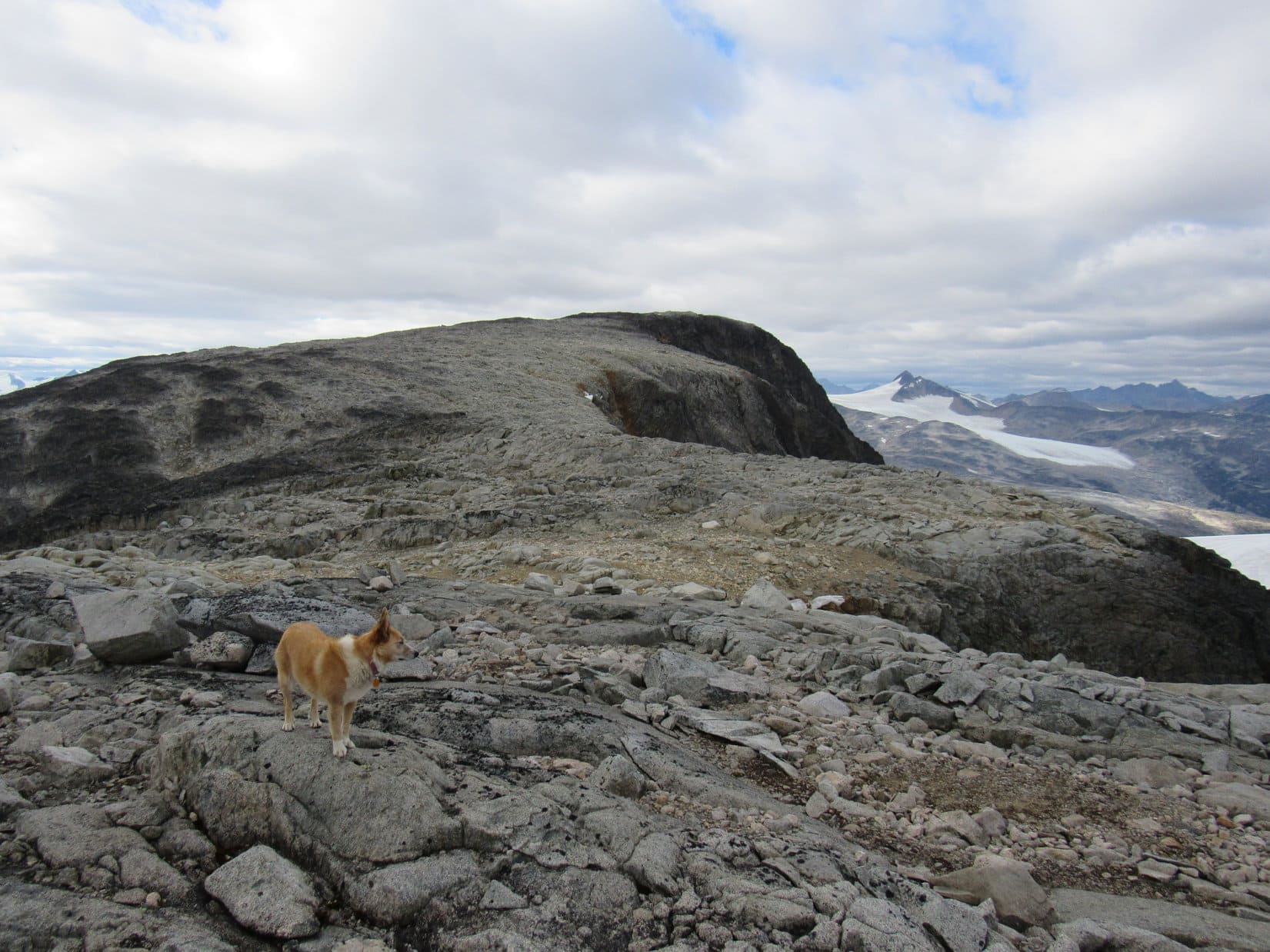
WNW of the fin approaching the last big drainage. Lupe stayed to the N (R) near the cliffs to get past it. Photo looks NW.
Taiya Peak (6,844 ft.) (R) from the N edge. Photo looks NNE.
Near the last big drainage. Photo looks NW.
Looking NE toward the Tormented Valley with help from the telephoto lens. Part of Summit Lake on the R. Bernard and Shallow lakes on the L.

Beyond the last big drainage, Lupe roamed freely heading NW on a broad slope.  A maze of benches and ramps led higher and higher.  This climb wasn’t hard at all; no more going down into gullies!  Loop was having fun, and SPHP was joyful knowing that the summit couldn’t be much farther.  Lupe was actually going to get to the top of Peak 6053!

The terrain finally leveled out in a rough area.  What?  Oh, no!  This wasn’t the top!  Quite close by, the highest point on the mountain was clearly visible a short distance off to the N.  Definitely higher, though not by much, than where Lupe was now, the true summit of Peak 6053 sat isolated beyond one more good-sized drop.  Whether the Carolina Dog could get over there or not wasn’t initially clear, but the situation didn’t look good.  Gah!  All this way, only to fail!

Some old wooden boards were toward the SW end of the rough area, part of a collapsed wooden tripod.  SPHP lifted a couple of rocks off a pile beneath the boards to reveal a survey benchmark dated 1936.

Loop by the wreck of a wooden tripod. Photo looks SW.
The survey benchmark hidden beneath rocks under the tripod.

Lovely.  Apparently the surveyor hadn’t thought it possible to get over to the true summit, and had settled for this location instead.  Discouraging!  After replacing the rocks over the benchmark, Lupe and SPHP went over to the edge of the final drop off to take a better look.

30 feet lower, a snow bank rested in a gash shorter than any others Lupe had come to.  Both ends dropped away into fearsome chasms.  At first, it didn’t look like there was any safe way to scramble down.  Loop had to do it, though, if she was ever going to get to the top of Peak 6053.

Overlooking the final short gash preventing Lupe from getting to the true summit of Peak 6053 (Center). Photo looks NNW.

There was a way down!  Looked like Loop ought to be able to get back up it again during the return, too – critically important, if there ever was going to be a return.  A quick, careful scramble, and Lupe was standing on the snow bank!

Success! Safely down on the snow bank in the last gash. Photo looks W.

The snow bank was more like ice than snow.  Staying away from the NE edge where the drop was almost vertical, Lupe crossed only a short icy section before completing her long journey to the top of Peak 6053.  The true summit was a light gray boulder.  The American Dingo hopped up onto it to claim one of her most remarkable peakbagging successes ever.

At the true summit of Peak 6053! The main ridge Lupe had come up is visible on the R. Photo looks ESE.
Taiya Peak (L of Lupe) from the true summit of Peak 6053. Photo looks NE.
Still at the true summit. Mount Cleveland is beyond Lupe.  Mount Carmack (6,808 ft.) is the high point in the distance on the L.  Photo looks SSW.

SPHP praised Lupe highly, but the Carolina Dog didn’t seem impressed.  Looper willingly participated in a few photos of some of the incredible glacier-clad peaks in Alaska to the W, but after that she just wanted to rest.  Using a jacket and a pullover, SPHP made a little bed where she could doze more comfortably on the rocky ground.

Looking W into Alaska. The summit of Peak 6053 is barely inside British Columbia.
View to the NW.
Lupe had been politely begging SPHP to stop for hours. Several short breaks had been taken, but this was her first real chance to snooze a bit. Photo looks SW.
Lupe’s 4th day of big climbs in a row, and it had taken 7 hours to get here.

While Lupe rested, SPHP gazed at the unbelievably beautiful remote peaks toward the W.

Looking SW with help from the telephoto lens.
The high point toward the L at the upper end of the glaciers in the foreground may be Mount Hoffman (6,079 ft.). The even higher mountain beyond it may be the Skagway High Point (8,239 ft.). Photo looks W.
The telephoto lens revealed an incredible world of spectacular peaks so inaccessible few have names.

Peak 6053’s summit area was about 40 feet wide E/W and 70 feet long N/S.  A similar sized area about 20 feet lower extended farther N.  So there was plenty of room to move around.  At the N end of the summit area, 35 feet from the boulder Lupe had been on, a less conspicuous rock looked equally high.  Might even be a tad bit higher?  SPHP went over to check it out, came to no definite conclusion, then ventured down to the lower region to the N where it was possible to look down on a glacier.

As tired as Lupe was, she wasn’t completely out of it.  Fearing she was being left behind, Loop came looking for SPHP.  Weary or not, the loyal American Dingo stuck closely to SPHP from then on.

On the rock at the N end that was in competition for title of true summit of Peak 6053. Taiya Peak beyond Lupe. Photo looks NE.
Still on the N high point. Photo looks S.
Looking down on the glacier. Photo looks N.
Upper end of the glacier and Taiya Peak (R). Photo looks NNE.
Looking over the Taiya River canyon and the glacier’s toe. Photo looks NW.
Nearly the whole glacier with a bit of help from the telephoto lens. Photo looks N.

Lupe was so lucky!  Although the sky had remained quite cloudy all day, conditions at the top of Peak 6053 weren’t bad at all.  Cool (low 40’s °F), but calm.  Importantly, the cloud deck was high enough to permit clear views of even the highest and most distant peaks.  Nothing was hidden.  Every now and then, the Carolina Dog stood in glimmers of sunshine.

Getting late.  Should be moving on, but Lupe and SPHP lingered in the splendor of Peak 6053.  Glory at every turn!

Peak 6053’s narrow SW ridge in the foreground. Photo looks SW.
What is that monstrous peak looming on the far horizon? It must have a name! Photo looks SW with maximum help from the telephoto lens.
Mount Carmack (6,808 ft.) (R of Center) looks dramatic through the telephoto lens. Photo looks S.
Way down at the bottom of the Taiya River canyon, the famed Chilkoot Trail from gold rush days passes from Skagway, Alaska to Chilkoot Pass at the Canadian border, then on to Carcross in the Yukon Territory. Photo looks W.
Another look at Peak 6053’s SW ridge. Mount Cleveland (L) with Mount Carmacks (far L) more distant. Photo looks SSW.
Simply no end of stunning peaks and glaciers!

7 hours to get here.  50 unforgettable minutes gone by up at the summit of Peak 6053!  3 hours until sunset.  Sadly, time to go.  Past time, actually.

Not far from the summit boulder, Lupe stood perched by the W edge of the mountain overlooking the unseen depths of the Taiya River canyon.  Beyond the gaping chasm, a fabulous world of pristine peaks cloaked in glacial ice – ancient, creeping ice still locking in the frigid cold of countless dark winters eons ago.

Fleeting last moments at the top of Peak 6053!

Looking into Alaska from the edge of British Columbia atop Peak 6053.
Moment of glory!

The race against time was on!  Back down to the short gash and its icy snow bank.  A careful scramble up to the rough area where the survey marker lay hidden beneath rocks and old boards.  Down the ramps and benches to the big drainage to the SW.

Now, a calculated, crucial gamble.  If it didn’t succeed, Lupe was going to be stuck on Peak 6053 all night.  No way on earth could she get down off the mountain before dark going back the way she had come up.  Lupe and SPHP turned SW heading down the big drainage.  If the American Dingo cliffed out, a very long night was ahead.

Starting down the big drainage near the W end of Peak 6053. Photo looks SSW.

Far, far below, Lupe could see the little lakes of the magical region she had visited beyond the end of the International Falls trail on a beautiful evening more than a year ago.  The lakes weren’t sparkling today, but if she could get down close to them, Loopster ought to be able to find the International Falls trail again before dark.

Down steep ramps and gullies, down rough loose rock, down scrambling around rock formations trying to avoid getting cliffed out.

Getting there, but still a long way to go.
Another chute. The far W end of the International Falls area at the edge of the Taiya River canyon is in sight.

At last, success was certain.  Loop’s gamble was going to pay off!  Once she made it down to where the slope became more gradual, SPHP turned and looked back up.  Lupe hadn’t cliffed out, but it sure looked like she should have.

The Carolina Dog was thrilled to be out of all the rock!  She wasn’t nearly as tired as she’d let on up on Peak 6053.  In fact, Lupe was energized!  She raced across the soft tundra far ahead of SPHP joyfully exploring a land of ridges and little streams, glancing back now and then to make sure SPHP was still coming.

Lupe never did get close to most of those once sparkling little lakes again.  However, in the distance, she did see the huge boulder on the far W ridge that she had visited a year ago.  Instead of going all the way to the lakes, Lupe took a shortcut turning SE as soon as it was practical.  The American Dingo roamed a long way.  She finally stumbled upon the International Falls trail again, as she passed by a couple of little ponds reflecting the last glowing beauty of the dying day.

On the International Falls trail again.
International Falls trail, Alaska.

Peak 6053 was the final and most difficult of 4 climbs on 4 consecutive days.  SPHP’s feet had become sore on the rough terrain even before Lupe had reached the summit.  Although the return trip was the easiest possible route back, it was still a long march.  Hobbling along, each step became more difficult to bear.

Darkness fell.  SPHP sometimes lost the trail.  Loopster usually found it again in just a minute or two.  The roar of the now invisible waterfalls the trail went by went on and on.  At last, it was over.  Across Captain William Moore Creek, and up the ropes.  The G6 sat waiting alone at the dark trailhead.  (10:46 PM, 47°F)

So sore!  So weary!  Yet, what a day!  As it turned out, Lupe had likely taken about the longest, hardest route to the top of Peak 6053 possible.  Clearly, the way she had taken back was the fastest, easiest way to go.  What an experience it had been though – the long treks higher on all that rough ground, wandering the wild gashes and gullies, then exploring along the whole massive main ridge.

And at the end of it all, the American Dingo had done what she had set out to do – Lupe had once more gazed over the depths of the enormous Taiya River canyon into a world of ice, snow, and jagged peaks, a world in sight, but forever beyond reach, this time seen from the lofty heights of Peak 6053.

On Peak 6053, British Columbia, Canada 9-11-18

Directions to the International Falls trailhead: The trailhead is a pullout less than a kilometer inside the Canadian border along the W side of the South Klondike Highway.  This pullout is located 7.5 miles (12 km) S of Canadian Customs.  Coming from Skagway, the trailhead is the 2nd pullout on the L shortly after crossing the high point of the highway near White Pass.  A small lake is visible down in the creek valley W of the highway.

There are no facilities or information at the trailhead other than a sign about avalanche dangers.  The trailhead is located between US Customs and Canadian Customs, so it will always be necessary to pass through one or the other on the way back to either Skagway or Carcross.  Remember to bring appropriate documentation!

Links:

Next Adventure                               Prior Adventure

International Falls, Canada to Alaska (8-8-17)

Fraser Peak, British Columbia, Canada (8-9-17)

Want more Lupe adventures?  Choose from Lupe’s 2018 Dingo Vacation to the Yukon, Northwest Territories & Alaska Adventure IndexDingo Vacations Adventure Index or Master Adventure Index.  Or subscribe free to new Lupe adventures.

The Upper Dewey Lake Trail to the Devil’s Punchbowl & meeting Chinese Explorer Bingc Gu, Skagway, Alaska (9-8-18)

Day 36 of Lupe’s 2018 Dingo Vacation to the Yukon, Northwest Territories & Alaska!

8:27 AM, 56°F, Skagway – On the SE edge of town, Lupe crossed the tracks of the White Pass & Yukon Route Railroad.  Immediately ahead, a wide well-beaten path went up a steep slope into the forest.  A sign confirmed that this was it – Loop was at start of the trail to both Lower & Upper Dewey Lakes, plus a number of other destinations as well.

By the railroad tracks on the SE side of Skagway.

After 3 days spent mostly on the road cooped up in the G6, the Most High Exalted Dingo of the Arctic Sisterhood was ready for action!  Although mostly cloudy out, enough blue sky could be seen to convince SPHP that the moment had arrived when Loopster could finally set off on a bigger adventure than her recent brief stops along the highway.

Up the trail Lupe went.  Almost right away, she came to a junction where another sign said she needed to go R.  A wooden stairway led down to a couple of water pipes hanging so low over the trail that SPHP had to duck.  Shortly thereafter, Lupe crossed a bridge over Dewey Creek.

At the first turn, which came almost immediately after starting up the trail. Lupe went under the water pipes from here.
This bridge over Dewey Creek appears shortly after going under the water pipes.

The trail now began switchbacking up a steep slope.  Due to dense forest, no views were available, but Lupe was quite happy barking at squirrels.  Once she had a good start on gaining the 500 feet of elevation required to reach Lower Dewey Lake, a small clearing appeared.  From here, Lupe could see the Skagway harbor, and Mount Harding (5,321 ft.) across Taiya Inlet.

Mount Harding (L) across Taiya Inlet. Photo looks SW.

Beyond the clearing, the trail resumed its steep climb in the forest.  As Lupe started getting close to Lower Dewey Lake, the terrain began to level out.  At a junction, a sign clearly indicated Loop needed to go L to get to the Upper Dewey Lake trail.  However, a number of trails existed in this area, and most were not well signed.  In SPHP’s confusion, Lupe somehow wound up at a small reservoir.

Sign at a trail junction not far from Lower Dewey Lake. Lupe went L here, but SPHP still managed to lose the way.
Unintentionally touring a small reservoir while looking for the Upper Dewey Lake trail. Photo looks E.

Backtracking to the sign and trying again, Lupe quickly arrived at the NW shore of long, narrow Lower Dewey Lake.  The Lower Dewey Lake trail follows the heavily forested shoreline all the way around the lake, but the lower lake wasn’t what Lupe had come to see.  Heading N, she reached a small wooden bridge where another sign again pointed out the way to the Upper Dewey Lake trail.

Lower Dewey Lake. Photo looks SSW.
Near the N end of Lower Dewey Lake another sign points out the way to the Upper Dewey Lake trail. Photo looks E.

Leaving the lower lake behind, Lupe followed the Upper Dewey Lake trail NE along a tributary of Dewey Creek.  She discovered a couple of brilliant mushrooms in this area.

Near a tributary of Dewey Creek after leaving Lower Dewey Lake. Photo looks NE.
Brilliant toadstools found along the tributary of Dewey Creek.

Less than 0.25 mile from Lower Dewey Lake, the trail divided.  Icy Lake and Upper Reid Falls were straight ahead.  Lupe turned SE (R) staying on the Upper Dewey Lake trail.  After making this turn, she came to no more intersections.

Lower Dewey Lake had been only a 500 foot climb.  However, getting to Upper Dewey Lake was a much more serious undertaking.  Lupe needed to gain another 2,500 feet of elevation!  The Upper Dewey Lake trail was soon climbing aggressively, and stayed that way for a long time.  Even the switchbacks were steep.  Once again, the dense forest hid all distant views, although Lupe often got to see Dewey Creek cascading straight down the mountain.

Near Dewey Creek as it plunges down the mountainside.
A rare glimpse back toward Skagway during the steepest part of the climb. Face Mountain (4,830 ft.) (L) and Parsons Peak (5,600 ft.) (Center) are beyond Taiya Inlet. Photo looks W.

The first 1,000 feet were the worst.  The slope gradually diminished after that.  Wooden stairways sometimes appeared.  One was quite long.  After a while, it often looked like Lupe was coming to some sort of a top, but that was merely an illusion.  The Carolina Dog climbed and climbed, yet never seemed to get there.  SPHP paused frequently to gasp for breath.

On the long stairway.

Finally, an open spot appeared.  A mountaintop was in sight ahead.  The trail went right back into the forest, but after seeing that mountain, the rate of climb was noticeably easier.

At the open spot where Lupe first caught sight of the mountain ahead. No longer as steep, the Upper Dewey Lake trail continued well beyond this point. Photo looks E.

For another 40 minutes, the trail went on and on, though less difficult and winding around more than before.  Then the forest began to thin out, permitting views from minor high points.

Looking back across Taiya Inlet as the forest thins. Mount Harding (L) in shadow. Face Mountain (far R). Photo looks W.

Lupe was getting close to treeline when she came to an orange meadow where she had a much more complete view of the mountain she had seen before.  The trail was nearly flat now.  Only a little farther, Upper Dewey Lake lay hidden in a vast amphitheater.

Almost there! At the orange meadow close to Upper Dewey Lake. Photo looks ENE.

A few more minutes, and Lupe was there!  Upper Dewey Lake occupied much of the lower level of a two-tier amphitheater.  Against a backdrop of mountains, forests, colorful tundra, and a small snowfield, Upper Dewey Lake was absolutely gorgeous!

Upper Dewey Lake. Photo looks SE.

A cabin with a view of the lake sat off to the L (NE) of the trail.  This was the City of Skagway rental cabin, the nicer of two cabins close to Upper Dewey Lake.  If the rental cabin hadn’t been occupied, Lupe would have gone over to peer in the windows to see what it was like inside.

The City of Skagway rental cabin. By far the nicest of two cabins at Upper Dewey Lake. Photo looks ENE.

The other cabin was free.  Anyone could stay there on a first come, first serve basis.  Lupe found the free use cabin tucked back against the trees SW of the trail.  This cabin was not occupied, so Loopster could snoop around.  The curious American Dingo even went inside.

By the free use cabin, which was … umm … rustic.

The free use cabin contained plywood bunk beds and an ancient wood stove.  Everything was filthy, except for two windows, crystal clear due to the absence of glass.  The words “primitive” and “rustic” came to mind, but then you get what you pay for.

The list of amenities did include a roof and 4 walls.  No view of the lake, but it was only a minute away.  Wipe away the dust, start a fire in the wood stove, and the rustic cabin wouldn’t be a bad port in a storm.

Inspecting the free use cabin.

It didn’t take an American Dingo long to inspect an old cabin.  Loop had come to see Upper Dewey Lake, not this!  Abandoning the free use cabin, she briefly stopped by a picnic table at a little high point overlooking the lake.  It was colder here than down in Skagway.  While SPHP layered up, Lupe sniffed with a couple of dogs that came running over from the rental cabin.

When her new-found friends got called back, Lupe went down closer to the lake.  What a magnificent scene!  Upper Dewey Lake was so pretty!

Lupe at Upper Dewey Lake. Photo looks ESE.
N end of Upper Dewey Lake. Photo looks NE.
S end. Photo looks SSE.

Exploring S along the W shore of Upper Dewey Lake, Lupe checked out the lovely views from several different boulders.

Looking E from another boulder.
More of the N end. Photo looks NE.
On a rock near a tiny sandy beach. Photo looks S.

Since leaving Skagway, Lupe had gained 3,000 feet of elevation.  The plan all along had been to continue another 600 feet higher to a ridge beyond the S end of Upper Dewey Lake.  From this ridge, Loop would be able to see the Devil’s Punchbowl.

From Upper Dewey Lake, Lupe headed for the notch seen in the ridge beyond her. The Devil’s Punchbowl is on the other side. Photo looks SW.

Once beyond the S end of Upper Dewey Lake, Looper started up a tiny creek.  SPHP was surprised when the trail she had been following faded rapidly.  Somewhere around here there was supposed to be an official trail to the Devil’s Punchbowl, but this didn’t seem to be it.

Didn’t really matter.  Although steep in places, this route wasn’t difficult, so the Carolina Dog just kept climbing.  The tiny creek vanished, as Lupe scrambled up a small boulder field.  As she got higher, the views looking back at Upper Dewey Lake became even more spectacular!

We don’t seem to be on quite the right path to the Devil’s Punchbowl, but don’t worry, we’ll get there! On the way up to the ridgeline. Photo looks SW.
Looking back at Upper Dewey Lake. Photo looks NE.
Pretty easy along in here! Photo looks SW.

Before Lupe quite made it to the saddle she was heading for, she did come across a better trail that had been farther W on a small ridge going up this same direction.   Venturing over to the W edge of the ridge, Loop had a tremendous view of Skagway and Taiya Inlet all the way to Dyea.

Skagway and Taiya Inlet from the W edge of the ridge. Photo looks NW.
Mount Harding (L) and Parsons Peak (R) beyond Taiya Inlet. Between them is the Burro Creek valley. Skagway is at far R. Photo looks W.
Zoomed in on mountains near the Burro Creek valley. Photo looks W.
Along the W edge of the ridge leading to the Devil’s Punchbowl. Photo looks SSW.

It wasn’t much farther to the top of the ridge.  When Lupe got there, she found a broad flat area strewn with rocks amid sparse tundra.  Crossing this region took only a couple of minutes.  From the far S edge, she had a grand view of the Devil’s Punchbowl nestled in a cirque below her.

Crossing the flat region at the top of the ridge. Photo looks S.
The Devil’s Punchbowl comes into view. Photo looks S.
Looking farther up the ridge between the Devil’s Punchbowl and Upper Dewey Lake. Photo looks ESE.
Nestled in an even remoter spot, the Devil’s Punchbowl was only a third of the size of Upper Dewey Lake, and a much deeper blue.
Devil’s Punchbowl with a bit of help from the telephoto lens.
Mount Harding (Center) beyond Taiya Inlet from the Devil’s Punchbowl overlook. Photo looks WSW.

Ready for a break, Lupe curled up beneath a stunted spruce tree, while SPHP relaxed gazing at the fabulous views.  Within 10 minutes, a young woman appeared, which is how Lupe met Chinese explorer Bingc Gu.

Bingc was friendly, and spoke English well.  Not perfectly, sometimes she searched for words, but compared to SPHP’s non-existent Chinese, Bingc was an absolute master of the English language.  Bingc was a 19 year old student from Beijing, where she studies Business Administration and English.  She is the oldest of 2 sisters and 1 brother, and had been living on her own since she turned 15.

Bingc had spent the summer working in Skagway as part of an exchange program.  She loved living in a small town, and the beautiful mountains here.  Bingc was quite sad that she was going to have to leave on the 16th, only 8 days from now, to return to her studies.

Her grandfather once had a yellow dog that had lived to be very old.  So Bingc liked dogs, and was quite taken with Lupe.

Bingc and Lupe.

As Bingc chatted with SPHP, two young men showed up, though not at the same time.  They both worked on cruise ships, and had come up to see the Devil’s Punchbowl while they still could.  The Skagway tourist season was ending.  At 8:00 PM tonight, their ships were sailing away, bound for Hawaii, the Fiji Islands and Australia.  Sounded like fun!

Neither of the young men stayed long.  Both had to get back to their ships.  Once they departed, Lupe and SPHP joined Bingc in going down to the Devil’s Punchbowl.  For a while, new friends Lupe and Bingc sat together on the E shore.

Bingc and Lupe along the E shore of the Devil’s Punchbowl. Photo looks N.
Loop and Bingc.
Relaxing by the Devil’s Punchbowl. Photo looks WSW.
Mount Harding (R) with help from the telephoto lens.

In the end, chatting with Bingc was so much fun, that when the time came to leave, Lupe and SPHP went with her.

A last look back at the Devil’s Punchbowl. Photo looks S.
Back along the W side of the ridge leading to the Devil’s Punchbowl.
Chinese explorer Bingc Gu with American Dingo explorer, Lupe.
The long ridge on the R is AB Mountain (5,036 ft.) which Lupe had climbed in 2017 to join the Arctic Sisterhood. Photo looks N.

On the way down to Upper Dewey Lake, Lupe and SPHP followed Bingc, who had actually come up the correct trail on the ridgeline W of where the Carolina Dog had been.  This route also went through some boulder fields, and didn’t seem much better or worse than the way Lupe had gone up to see the Devil’s Punchbowl.

Bingc leads the way back down to Upper Dewey Lake. Photo looks NE.
Upper Dewey Lake with help from the telephoto lens.

It turned out that the ridge route went to the picnic table near Upper Dewey Lake that Lupe and SPHP had stopped by earlier.  Bingc didn’t mind the company, and was happy to have Lupe come along on the rest of the way back down the Dewey Lakes trails to Skagway.

At a steady, but unhurried pace, slender, polite, soft-spoken Bingc led the way while talking about many things.  Lupe had been lucky to meet her.  During her summer in Skagway, Bingc had taken the trail up to and around Lower Dewey Lake many times, but today was the only time she had ever gone on to Upper Dewey Lake and the Devil’s Punchbowl.

Bingc was a serious student.  She liked languages, literature, and history.  She was interested in travel and other cultures, and in sharing Chinese culture.  While in Skagway, Bingc had made new friends, some of them Chinese, some not, another reason she was sad to be leaving soon.

However, Bingc felt Skagway had been good for her.  She thought more boldly now, considering the whole world as her home.  She wanted to keep exploring and climbing mountains.  On the only remaining day off work that she had left in Skagway, she planned on taking the train up to White Pass.  8 days from now, Bingc would be taking the ferry to Juneau hoping to see some whales, then fly on to Seattle and Beijing.  And some day, she intended to return to Skagway.

At last, the railroad tracks appeared.  End of the trail.  Bingc petted Lupe for the last time.  If Loopster ever made it to China on one of her Dingo Vacations, Bingc promised to take the American Dingo to the Great Wall of China!  Lupe and SPHP wished Bingc good fortune in her travels and adventures.  If Bingc ever comes to the Black Hills, Lupe would take her to Mount Rushmore.  Smiling, Bingc shook hands with SPHP, and said good-bye.  She then turned and walked away, bound for home in her beloved Skagway.  (6:18 PM, 64°F)

Upper Dewey Lake and the Devil’s Punchbowl had been a great day, a beautiful adventure.  Meeting Bingc had been fun.  However, Bingc was now on to other adventures, and Lupe was, too.  Returning to the G6, Lupe and SPHP were soon on the South Klondike Highway on the way out of Skagway.

Tomorrow’s plan was to revisit part of the wonderful International Falls trail, then leave it to climb Peak 6053.  However, when Lupe reached White Pass, the sky was dark and stormy looking.  A cold rain set in.  Not too encouraging.  Loop and SPHP stopped for the night in the Tormented Valley, to wait and see what the morning might bring.

Lupe and Chinese explorer Bingc Gu, Devil’s Punchbowl Lake, Skagway, Alaska 9-8-18

Links:

Next Adventure                       Prior Adventure

AB Mountain – Lupe Joins the Arctic Sisterhood! Skagway, Alaska (8-7-17)

International Falls, Canada to Alaska (8-8-17)

Skagway, Alaska Area Trails Map & Brochure

Want more Lupe adventures?  Choose from Lupe’s 2018 Dingo Vacation to the Yukon, Northwest Territories & Alaska Adventure IndexDingo Vacations Adventure Index or Master Adventure Index.  Or subscribe free to new Lupe adventures.