Black Hills, WY Expedition No. 179 – Warren Peaks, Black Hills, Sherrard Hill & Cook Lake (10-23-16)

Hah!  How’s this for peakbagging the easy way, Loop?  SPHP turned off the engine.  The G6 was parked at the base of the Warren Peaks fire lookout tower (8:23 AM, 38°F).  Lupe was already at the top of the mountain.  Feels like cheating, doesn’t it?  We didn’t have to do a thing.  Come on, Looper, lets take a look around!  Lupe was out of the G6 like a shot.

Lupe arrives at the base of the Warren Peaks, WY fire lookout tower.
Lupe near the Warren Peaks fire lookout tower. Photo looks WNW.

A light S breeze was blowing.  Clear skies and another unseasonably warm October day.  The panoramic views were terrific.  The Warren Peaks (6,656 ft.) fire lookout tower is atop the highest point in the Bear Lodge Mountains in NE Wyoming.  Lupe gazed out over miles and miles of high prairie far beyond the mountains.

When the light is right and the air is clear, you can see all the way to the Bighorn Mountains from here Loop!  The light wasn’t right.  A bit of haze was in the air.  Oh, well.

Looking SSW from Warren Peaks, the highest mountain in the Bear Lodge Mountains. The tower on the L is on High Point 6532.

Although Lupe was back to continue her peakbagging adventures in the Bear Lodge Mountains, Warren Peaks (6,656 ft.) wasn’t really one of her prime peakbagging goals for Expedition No. 179.  Lupe had been here twice before.  Warren Peaks was just a great viewpoint from which to start the day, conveniently located on the way to other objectives she’d never been to before.

Before leaving this terrific vantage point, SPHP stared off to the N trying to pick out Vision Peak (4,812 ft.) or Bald Mountain (4,800 ft.), where Lupe had been adventuring a week ago.  Nothing really stood out that SPHP could positively identify.  Neither did any of today’s objectives.  Most of the Bear Lodge Mountains just aren’t that rugged.

The big rounded hill seen beyond Lupe is Bull Hill. Photo looks N.
Bull Hill with a little help from the telephoto lens. Studying this photo after the fact, SPHP is 98.43% certain that Bald Mountain, where Lupe had been a week ago, is at the far L end of the most distant dark ridge seen on the R. (Not the faint ridge on the horizon.) Photo looks N.

Lupe and SPHP left Warren Peaks headed N on USFS Road No. 838.  At 9:04 AM (39°F), Lupe was leaping out of the G6 again, this time at the junction of USFS Roads No. 849 and 849.1A.  Lupe had two peakbagging objectives nearby.  They were two summits called the Black Hills.  (Not to be confused with the entire Black Hills range, which is hard not to do, since the identical names make it plenty confusing.)

Lupe set off for the Black Hills (East) (5,229 ft.) summit first, climbing toward the S in territory W of the N ridge.  At first, she encountered thickets of brush and small trees in a forest of mixed pine and aspen.  As Lupe gained elevation, the pines prevailed and most of the smaller stuff disappeared.  The terrain was unusually lumpy.  Lupe went up a series of small rises separated by little ravines or low spots.  Deer seemed to like this area, and Lupe saw quite a few of them.

The Black Hills (East) summit ridge runs roughly NW/SE.  Lupe reached a lower part of the ridgeline a bit WNW of a protruding rock outcropping of yellowish tan limestone, or perhaps sandstone.  This rock formation proved to be quite level on top, and runs the entire length of the summit ridge, which was hundreds of feet long.  Toward the SW, the rocks form a line of small cliffs.

Lupe sits on the yellowish tan limestone or sandstone rock outcropping at the NW end of the Black Hills (East) summit ridge.

From the NW end of the Black Hills (East) summit ridge, Lupe could see Black Hills (West) (5,323 ft.).  Black Hills (West) is almost 100 feet higher than Black Hills (East).  Lupe would be going over there next, but not until she finished exploring Black Hills (East).

Looking W toward the Black Hills (West) summit from the NW end of the Black Hills (East) summit ridge.

Lupe and SPHP traveled SE along the entire length of the Black Hills (East) summit ridge, staying near the line of cliffs.  Forest effectively hid the views in every direction, other than SW from the cliffs.  Even looking SW, higher forested ridges only a mile or two away were as far as Lupe could see.

Lupe at another viewpoint along the cliffs. Black Hills (West) is in view on the R. The scene seen here is typical of the only semi-distant views available from Black Hills (East). Photo looks W.

Close to the SE end of the Black Hills E summit ridge, a small pine tree was perched near the edge of the cliffs.  Ponderosa pines can grow in some of the most amazing places.  The little tree looked like it was growing straight out of the rocks!

Lupe near the SE end of the Black Hills (East) summit ridge. A small pine tree was growing right out of the rocks at the edge of the cliffs. Photo looks S.

The Black Hills (East) summit ridge was long, on the order of 800 feet long.  Having traveled the entire length of the ridge near the cliffs, it was time for Lupe to look for the true summit.  Since the entire area was quite flat, there wasn’t going to be any one easily identifiable point.

The summit ridge of Black Hills (East) was quite level and all forested. Parts of it were quite park-like as seen here. Photo looks WSW.

Although there was only a slight elevation difference, the highest area Lupe could find on Black Hills (East) seemed to be back closer to the middle of the summit ridge.  A somewhat elevated area was 50 to 100 feet NE of the cliffs.  This high ground was covered by a dense thicket of scrub oak trees.  Lupe had no views at all from here!

Lupe in the scrub oak thicket at the true summit (as near as she could find one) of Black Hills (East).

Having achieved her first peakbagging success of the day at Black Hills (East), it was time for Lupe to head for Black Hills (West).  To get there, she first had to go back down to the G6.

Lupe roughly retraced the same route she had taken up.  The many deer held Lupe’s attention much of the time, but she also found an interesting column of rock out in the middle of the forest.  Strangely enough, someone had drawn an odd face on it.

Lupe at a big column of rock she discovered going back down Black Hills (East). Although the column of rock was in an unlikely spot for visitors out in the middle of the forest, someone had drawn an odd face on it (seen right above Lupe in white).

Lupe reached the G6 at 10:36 AM.  She was surprised and puzzled when SPHP went right on by it.  However, her next peakbagging goal, Black Hills (West) was not far away.

Lupe and SPHP crossed USFS Road No. 849 and went down to Blacktail Creek.  Lupe reached the tiny creek near a tiny waterfall.  Of course, she paused for a not-so-tiny drink from the creek as she crossed it, prior to beginning her climb up Black Hills (West).

Near the tiny waterfall on Blacktail Creek.

Lupe’s path up Black Hills (West) was very direct.  She simply followed the long NE ridge, staying on the ridgeline a little above the cliffs to the SE.  Lupe’s entire climb was steadily up at a moderate pace.  As Lupe neared the summit, she found a big grassy meadow at the top of the mountain.  SPHP hoped the views would be better here than from Black Hills (East).

Lupe on top of Black Hills (West). Photo looks SSW.
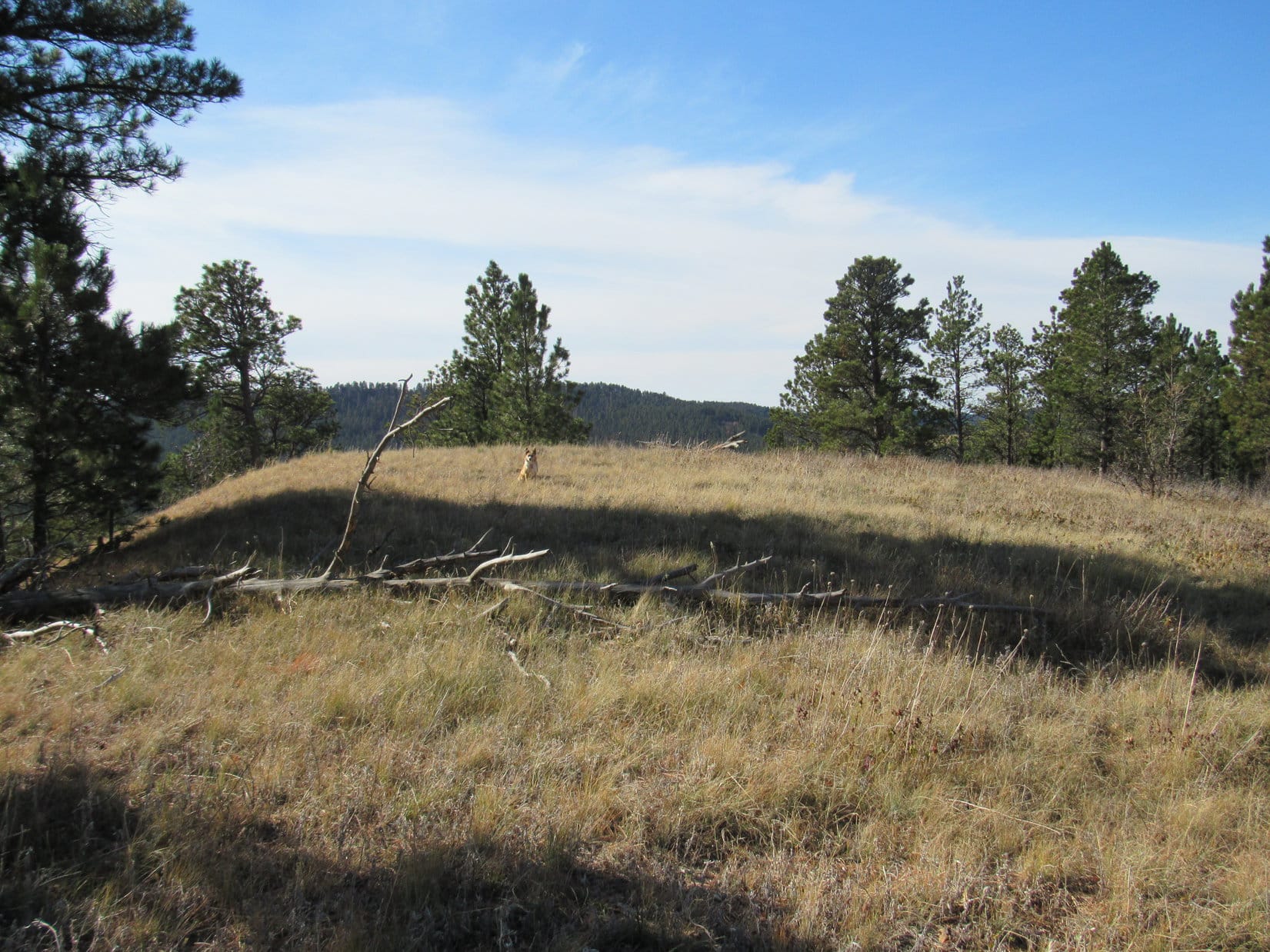
The summit of Black Hills (West) was a grassy meadow. Photo looks SSW.

Unfortunately, the views from Black Hills (West) were rather disappointing.  The mountain wasn’t quite high enough for a good look at the most interesting sight.  Off to the WNW, Lupe had only a partial view of the Missouri Buttes (5,374 ft.) and top of Devils Tower (5,112 ft.).

Black Hills (West) wasn’t quite high enough for a good look at Missouri Buttes and Devils Tower. Photo looks WNW.
Missouri Buttes (R) and the top of Devils Tower (L) from Black Hills (West). Photo looks WNW using the telephoto lens.

Lupe and SPHP wandered around the Black Hills (West) summit area for a little while, seeing what could be seen, before taking a break.  After the break, it was photo op time for Lupe before beginning the descent.

The Black Hills (West) summit as seen from the SW.
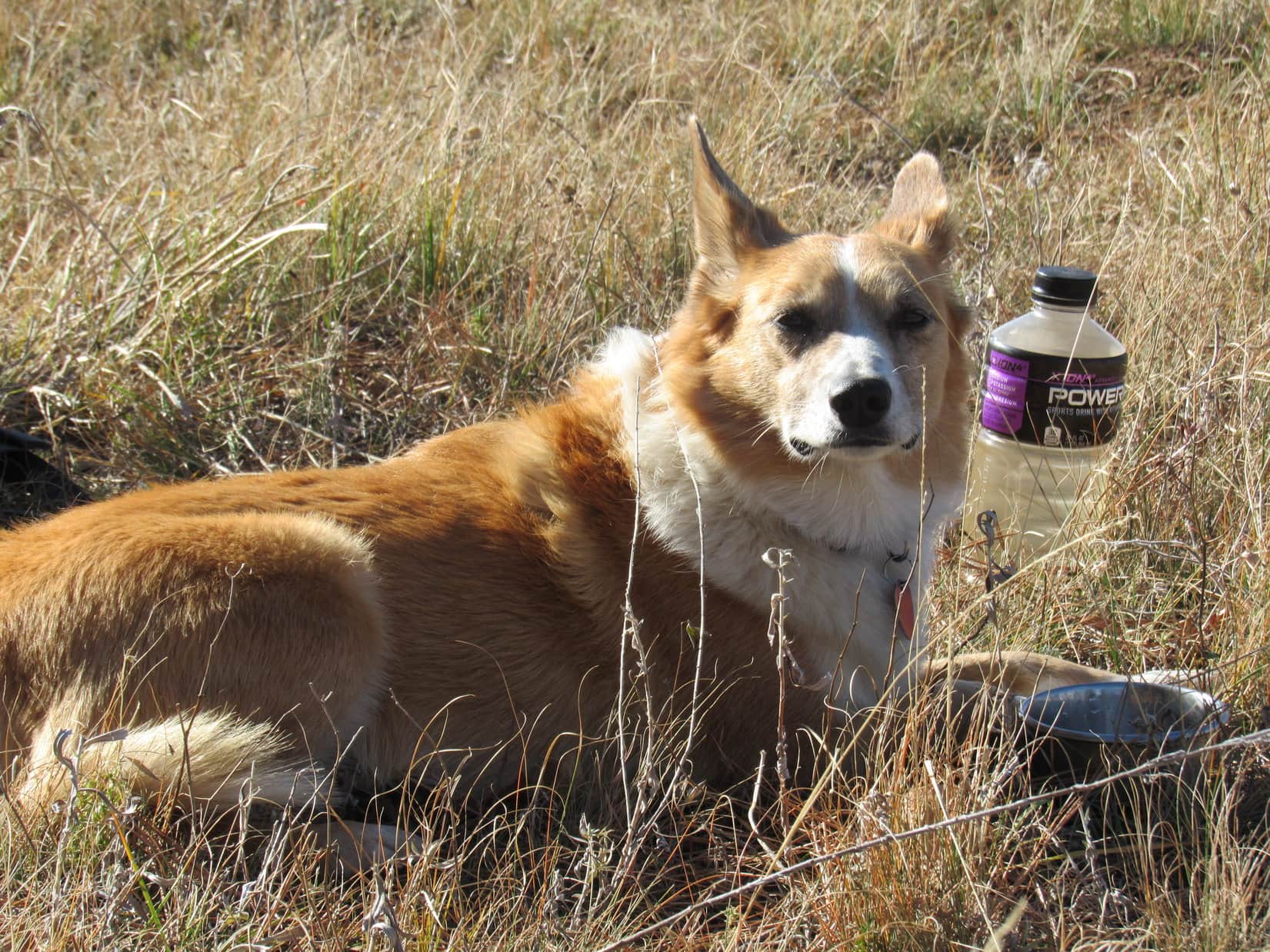
Lupe relaxes during her break time. She looks a bit serious here.
The Black Hills (West) summit. Photo looks SW.
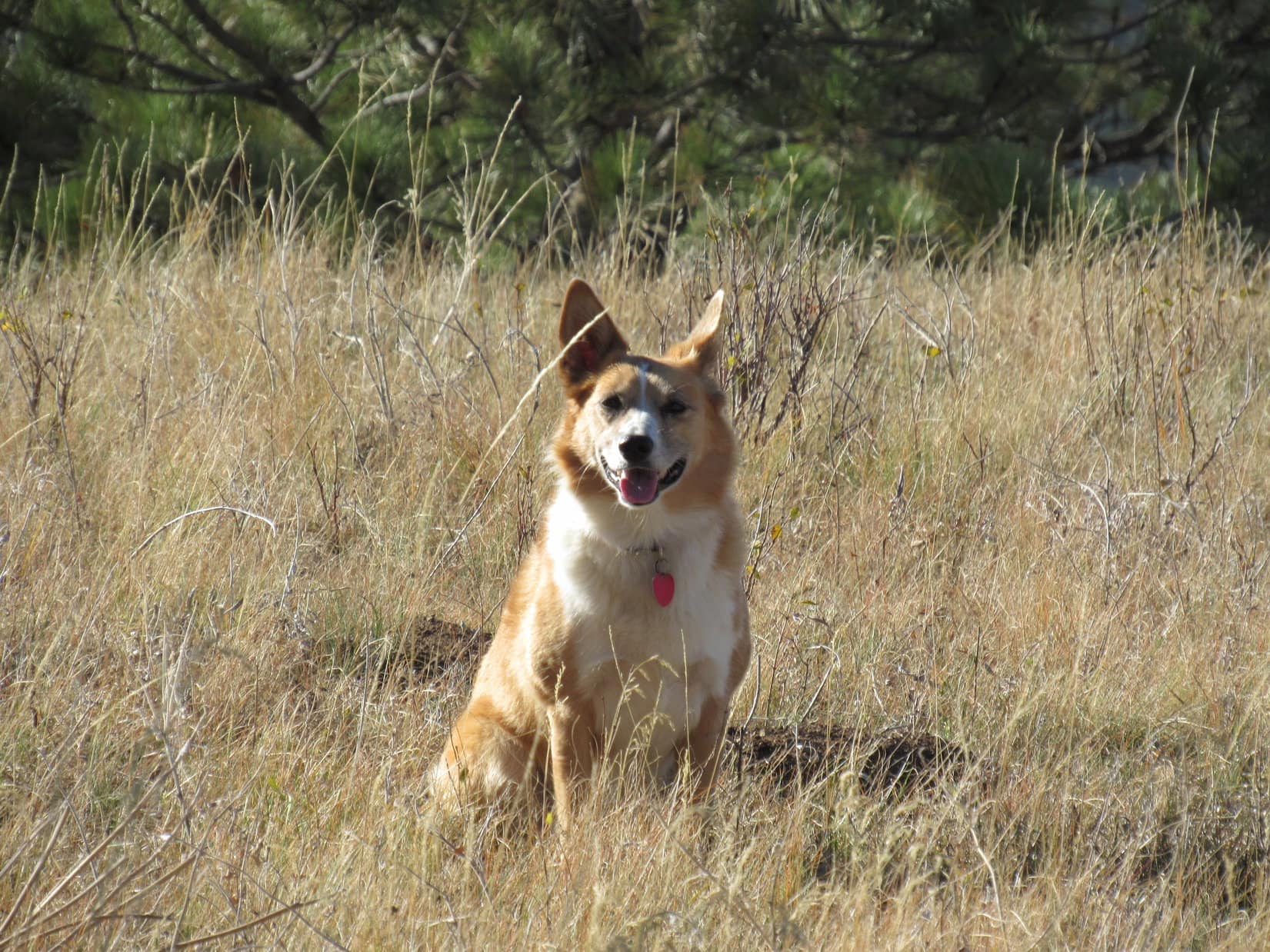
A happy Carolina Dog on the summit of Black Hills (West) having a good time in the Bear Lodge Mountains of NE Wyoming.

Lupe and SPHP returned to the G6 (12:01 PM) going back down the NE ridge of Black Hills (West).  Lupe had one more peakbagging goal for Expedition No. 179, Sherrard Hill.  Sherrard Hill (5,385 ft.) is a little higher than Black Hills (West).  SPHP had hopes that Lupe might find better views from Sherrard Hill than either of the two Black Hills summits had on offer.

SPHP drove a couple miles NNW on USFS Road No. 849 to its junction with USFS Road No. 860.1, before parking the G6 (12:09 PM, 57°F).  Lupe would start her trek to Sherrard Hill from here.

Much of Lupe’s journey to Sherrard Hill followed USFS Roads.  She started out going S on No. 860.1, which soon crossed Blacktail Creek.  Lupe came to many forks in the road.  At the first one, Lupe stayed to the R, avoiding side road No. 860.1A.  At the next junction, where an unmarked road to the L went down to a bridge across Hershey Creek, she stayed to the R again on a road marked as Trail No. 1042.

A week ago when Lupe had been to the Bear Lodge Mountains on Expedition No. 178, there had still been some fall colors on display. By Expedition No. 179, however, nearly all of the trees were bare. There were a few exceptions, however. Lupe saw these red berries and yellow leaves while following USFS Road No. 860.1 on the way to Sherrard Hill.

At a third junction, Lupe stayed to the R again, now following USFS Road No. 860.1F.

Lupe reaches USFS Road No. 860.1F, which was closed to motor vehicles. Photo looks S.

While on No. 860.1F, Lupe and SPHP kept hearing geese.  Finally, a flock of them flew by almost right overhead.  The geese were so high, Lupe didn’t pay much attention to them.

Geese flew by almost right overhead. Photo looks, umm, up using the telephoto lens.

As Lupe got closer to Sherrard Hill, she kept coming to more forks in the road.  She avoided taking USFS Roads No. 860.1R (to the R) or No. 860.1J (to the L).  The road she was on eventually turned W going up a valley.  When Lupe reached a saddle at the upper end of the valley, SPHP was pretty certain Sherrard Hill was the wooded hill immediately to the S.

Lupe stuck with the road she was on as it circled around to the NW side of Sherrard Hill.  She passed by USFS Road No. 860.1G on the way.  By now, the road Lupe was following had leveled out.  Lupe and SPHP turned SE and started climbing.

The climb up Sherrard Hill (5,385 ft.) was along quite a gentle slope.  The hill was heavily forested all the way up.  The summit area was large, and all heavily forested, too.  Lupe and SPHP went all the way to the SE end of the summit area.  There was little to be seen, but forest anywhere.

The top of Sherrard Hill. There was little to be seen except for the forest. Photo looks N.

Well, that was it.  None of Lupe’s 3 main peakbagging objectives of the day had provided much in the way of views, and Sherrard Hill, the highest of them all, had no views at all.  Sometimes that’s just the way it is in the mountains.

Lupe and SPHP took a short break for chocolate coconut granola bars and water at the SE end of the summit area.  Then Lupe got to explore the Sherrard Hill summit looking for the highest point.  Just like on Black Hills (East), the top of the mountain was so flat, it was hard to pin down an exact location of the true summit.  Once again, it appeared to be in a thick grove of scrub oaks.

Lupe among the scrub oaks at the true summit of Sherrard Hill. Photo looks E.
Lupe exploring the summit area on Sherrard Hill. Photo looks NNE.

Before completely abandoning Sherrard Hill to return to the G6, Lupe and SPHP wandered over to a slightly lower part of the mountain protruding to the W from the N end of the summit area.  From here, Lupe did catch a couple of glimpses of Missouri Buttes, but never had a really good look.

Lupe and SPHP continued NW to High Point 5255, but other than a ranch house to the W, there was nothing to see there either.  OK, that was it.  Time to give up and go back to the G6.  Lupe had a great time on the way back.  She saw many deer, and several squirrels.

On the way back to the G6 from Sherrard Hill, Lupe saw many deer in the woods. This one was out in the open near Hershey Creek.

When Lupe arrived at the G6 again (3:43 PM, 57°F), it was only a little over 2 hours until sundown.  Time enough to do something, but not go off climbing another mountain.  Since Lupe had never seen Cook Lake before, why not go see the little lake?

The Cook Lake Recreation Area features a campground, picnic area, loop trail around the lake, and another loop trail N of the lake called the Cliff Swallow trail.  Lupe arrived at Cook Lake (4:16 PM, 53°F) too late to both spend time at the lake and take the Cliff Swallow trail.  Since the main purpose was to see Cook Lake, Lupe stuck to the lakeshore trail.

Lupe arrives at Cook Lake, the only lake in the Bear Lodge Mountains. Photo looks S.
Lupe on her way around Cook Lake. Photo looks SE.
Looking NE toward the dam.
Nearing the S end of the lake. Photo looks SE.
Cook Lake from the S shore. Photo looks N.
Looking NNW.
Lupe on the lakeshore trail. Photo looks NW.
On the dock.
On the dock.

Although there had been a few people around when Lupe first arrived at Cook Lake, by the time Lupe completed her investigations along the shore (5:09 PM, 51°F), things were pretty quiet.  The lakeshore trail had been a relaxing way to end the day.

Lupe’s Black Hills, WY Expedition No. 179 wasn’t quite over yet, though.  On the way back home, while still in the Bear Lodge Mountains, Lupe made two more quick stops.  First, Lupe and SPHP took a short stroll from USFS Road No. 838 to a high point NW of Warren Peaks.  SPHP wanted to find out if Lupe could see Devil’s Tower and Warren Peaks from here.

She could!  The sun was low in the sky, and the light was weak, but there they were!  What’s more, Lupe could also see the outline of the Bighorn Mountains far to the W!

From a high point NW of Warren Peaks, not far from USFS Road No. 838, Lupe could see the Missouri Buttes and Devils Tower in the fading light. Photo looks NW.
Lupe could also see the faint outline of the Bighorn Mountains on the far W horizon.

Lupe’s final stop was back up on Warren Peaks (6,650 ft.).  The sun had either just set, or was hidden by clouds near the horizon.  Lupe went over to the highest rocks on the mountain a few feet W of the fire lookout tower.

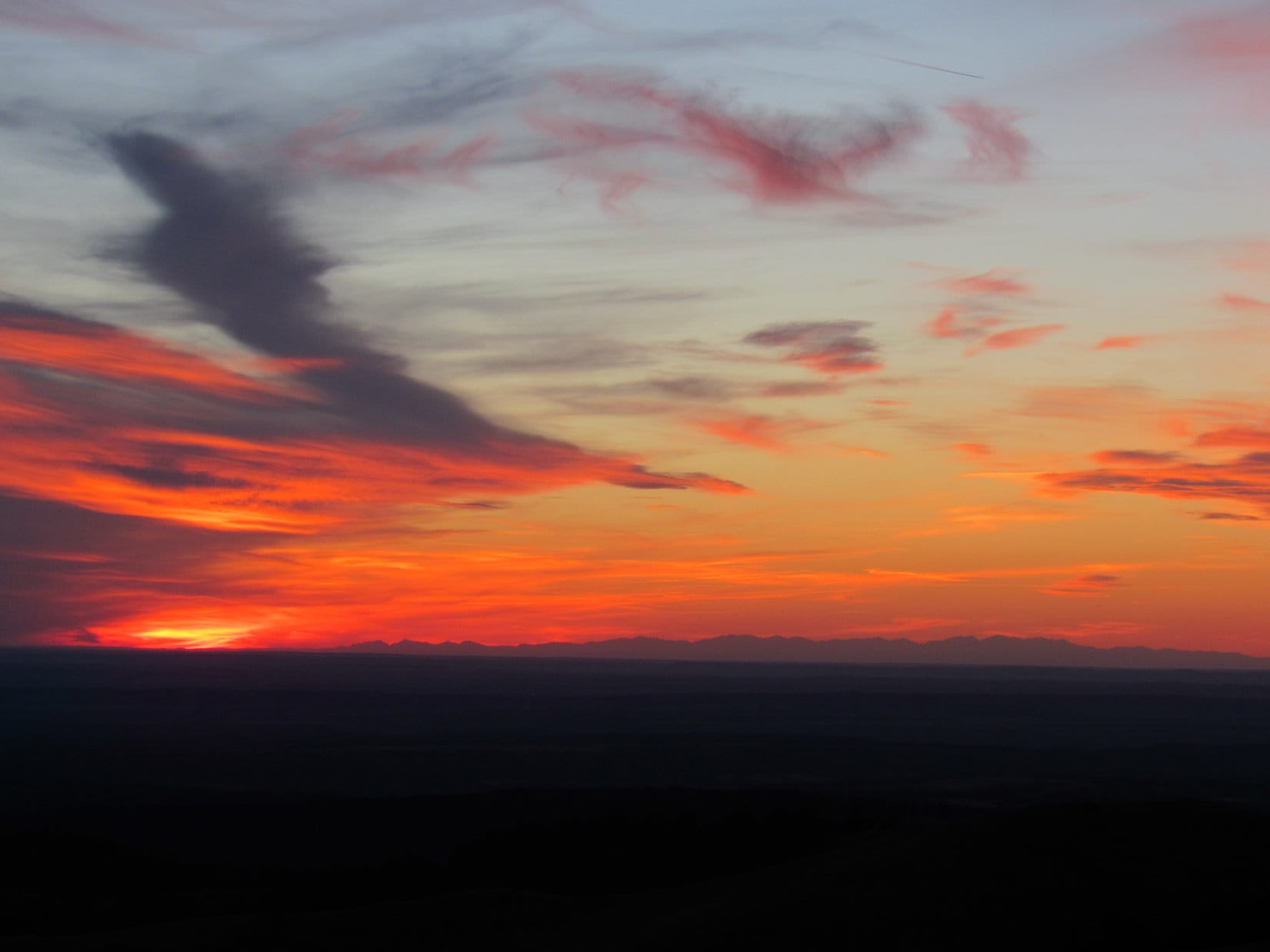
And so, Black Hills, WY Expedition No. 179 ended with Lupe standing atop the highest point in the Bear Lodge Mountains for the second time today, admiring the colorful sunset and distant outline of the lofty peaks of the glorious Bighorn Mountains.

Lupe at the highest point on Warren Peaks at sunset, her 2nd time here during Expedition No. 179. Photo looks WSW.
Bighorn Mountains from Warren Peaks.

Links:

Next Black Hills Adventure                    Prior Black Hills Adventure

Want more Lupe adventures?  Choose from Lupe’s Black Hills Expeditions Adventure Index or Master Adventure Index.  Or subscribe free to new Lupe adventures.

Sunwapta Falls, Athabasca Falls, Overlander Falls & Rearguard Falls in the Canadian Rockies (8-3-16 & 8-4-16)

Day 5 (Part 2) & Day 6 of Lupe’s 2016 Dingo Vacation to the Canadian Rockies, Yukon & Alaska

After an overcast, drippy morning, Lupe’s excursions to the toe of the Athabasca Glacier and Wilcox Pass had turned out great!  The weather had gradually cleared up as the day went on.  At mid-afternoon, as Lupe and SPHP headed N on Icefields Parkway Hwy 93 looking for the next adventure, sunny blue skies prevailed.

Why not go take a look at Sunwapta Falls?  These mighty falls contain the meltwaters of the Athabasca Glacier, which Lupe had just visited.

Well, one reason not to was that the Sunwapta Falls parking lot was packed.  It took a while for a parking spot to open up.  Lupe and SPHP went to see Sunwapta Falls along with the rest of the teeming throng.  No doubt about it, Sunwapta Falls was gorgeous.  A huge torrent of water plunged into a deep narrow gorge the Sunwapta River has carved over eons right through the rock.

Sunwapta Falls. This is upper Sunwapta Falls located near the parking lot. A trail leads downstream to a series of 3 more waterfalls in quick succession collectively known as lower Sunwapta Falls.

The bridge across the Sunwapta River below the falls was loaded with people.  More tourists lined the chain link fences along the edges of the gorge.  Lupe was lost and confused in the crowd.  Once before, Lupe had taken a trail to lower Sunwapta Falls, a series of three more waterfalls in close succession downstream.  The lower falls were equally impressive and worthwhile.

It wasn’t all that far to lower Sunwapta Falls.  Unfortunately, today that was probably a disadvantage.  The lower falls would likely be pretty busy, too.  Not nearly as crowded as the upper falls, perhaps, but still busy.  Lupe would have more fun somewhere else.  Fortunately, Lupe and SPHP’s favorite picnic ground in Jasper National Park wasn’t that far away.  Lupe and SPHP returned to the G6, and continued N.

Maybe Lupe’s favorite picnic ground in Jasper National Park is only intended for use by locals?  It’s right off the W side of Icefields Parkway Hwy 93, about 5 or 6 miles S of Athabasca Falls, but there is no sign for it anywhere along the highway.  The picnic ground features only a handful of picnic tables situated right up on the E bank overlooking the Athabasca River.  Across the giant river are beautiful peaks of the Canadian Rockies.

When Lupe and SPHP arrived, the picnic ground was empty.  Simply fantastic!  Lupe rushed down to cool off in the meltwater swollen Athabasca River.  She searched for squirrels in the forest, and found a few, too!  Lupe and SPHP played Dingo games.  No one came.  Lupe was free to be herself.  The American Dingo was having a blast!

Lupe shakes herself off after cooling down in the Athabasca River.
Happy times - looking for squirrels.
Happy times – looking for squirrels.
Found one! There's a squirrel in this tree!
Found one! There’s a squirrel in this tree!
Glacial meltwater tastes great when your barker gets dry!
In the Athabasca River next to her favorite picnic ground in Jasper National Park. Photo looks upstream (S).
View across the Athabasca River from Lupe’s favorite picnic ground in Jasper National Park. Not too shabby, aye?

When early evening arrived, it was time to leave the picnic ground to go take a look at Athabasca Falls.  There were still people around this very popular and impressive waterfall, but a big majority of the usual daytime crowds had by now departed.  A tremendous torrent of the combined Sunwapta and Athabasca Rivers roared over the falls.

Lupe at Athabasca Falls, Jasper National Park, Canada.
Mighty Athabasca Falls is located just off the W side of Icefields Parkway Hwy 93. The falls are reached via a turn onto Highway 93A.
Short trails and bridges lead to viewpoints on both sides of Athabasca Falls, and even down to a viewpoint in the gorge below. Lupe explored them all.
The frothy Athabasca River churns through the narrow gorge below the falls.

After visiting Athabasca Falls, Lupe and SPHP continued N to the tourist and railroad town of Jasper.  Lupe didn’t stay in Jasper long, though.  Soon Lupe and SPHP were heading NW on Yellowhead Highway No. 16 toward British Columbia.  It was a beautiful evening for a drive through the Canadian Rockies, but had been another long day, too.  As SPHP drove, the weary American Dingo snoozed on her pile of blankets and pillows.

In Mount Robson Provincial Park, SPHP stopped the G6 at a long pullout near Yellowhead Lake.  The lake was hidden by trees.  Lupe and SPHP got out to take a look.  A trail led through the forest and down a very steep bank to reach the shore of the lake.

Lupe by the shore of scenic Yellowhead Lake in Mount Robson Provincial Park. Photo looks SW.

Yellowhead Lake was gorgeous, but unfortunately, there was no trail along the shore.  After a few minutes spent down by the lake admiring the view, Lupe and SPHP scrambled back up the steep bank.  The dense forest blocked any view of the lake.  Lupe’s last brief adventure of the day was spent sniffing around in the woods near Yellowhead Lake.

Lupe and SPHP drove on, but it was getting late.  The long Canadian twilight was fading.  Day was done.  Time to stop for the night.

The next morning, Mount Fitzwilliam was in view, tall and impressive in the early light.

Mt. Fitzwilliam looked very tall and impressive in the early morning light on 8-4-16. Photo looks ESE.

However, Lupe and SPHP were already beyond Mt. Fitzwilliam.  Lupe wasn’t going back.  Today was a special day.  Today Lupe was going N, hundreds of miles farther N than she had ever been before!  Most of the day would be spent traveling, but not too far ahead were two more big Canadian waterfalls Lupe could visit along the way.  The first was Overlander Falls.

Overlander Falls on the Fraser River is in Mount Robson Provincial Park, within walking distance of the park headquarters.  SPHP parked the G6 at a trailhead along Yellowhead Hwy No. 16.  A sign at the trailhead displayed a simple map of the area.

This simple map was posted at the trailhead E of the Mount Robson Provincial Park headquarters.

Lupe was starting from the E end of the trail system, very close to Overlander Falls.  A wide, well-worn path led into the forest from the highway.  At first, the path lost elevation gradually, but as the roar of the falls grew louder, the trail started switchbacking down a steep slope.

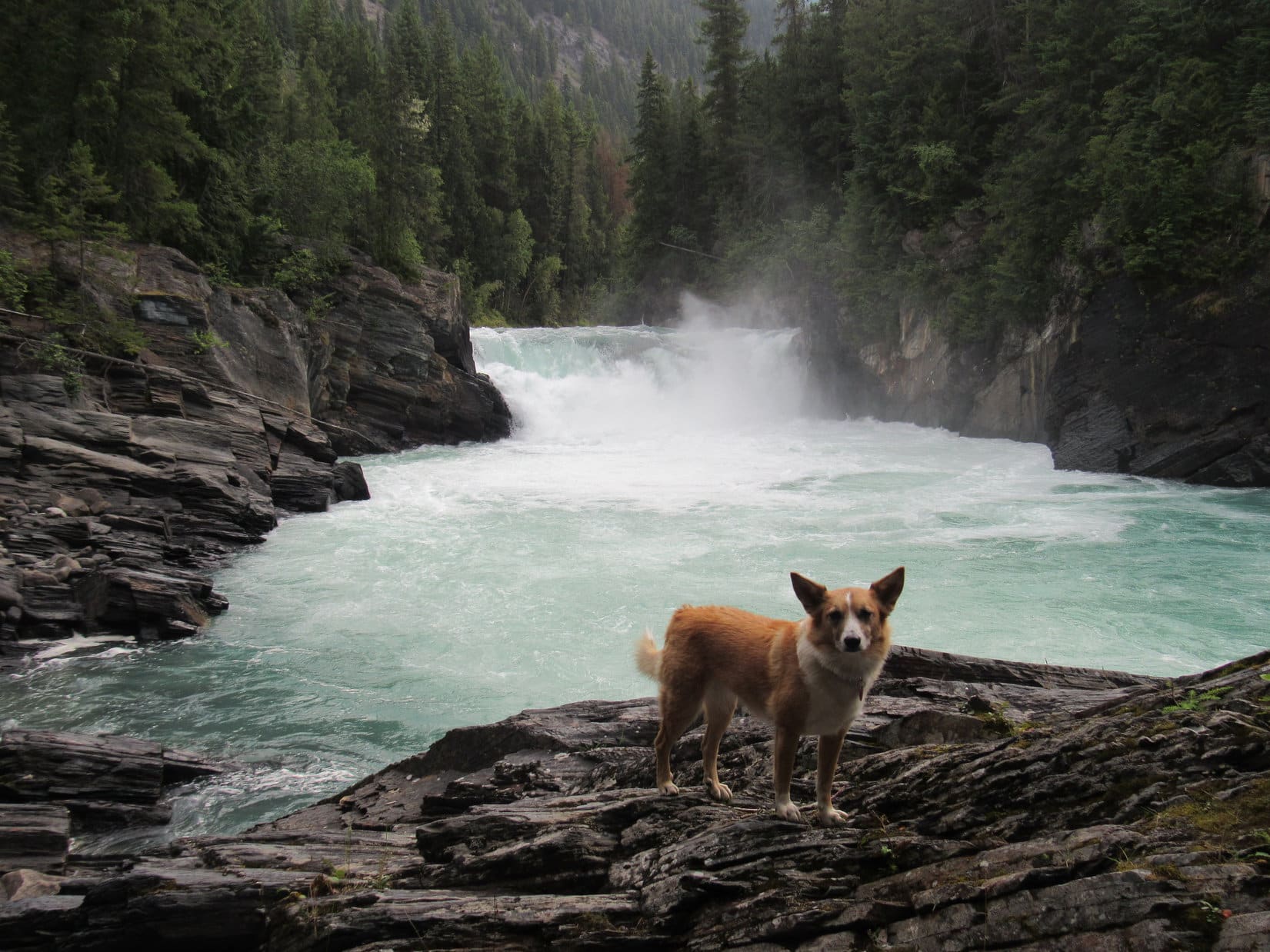
In only 10 minutes, Lupe was at Overlander Falls.  The falls weren’t high at all, but a tremendous volume of beautiful icy blue green water spilled over the brink into a vast swirling pool below.

Overlander Falls wasn't high, but a tremendous volume of beautiful icy blue green water spilled over the brink into a vast swirling pool below.
Overlander Falls wasn’t high, but a tremendous volume of beautiful icy blue green water spilled over the brink into a vast swirling pool below.
Overlander Falls is one of two significant waterfalls on the Fraser River. The other one is Rearguard Falls farther downstream.

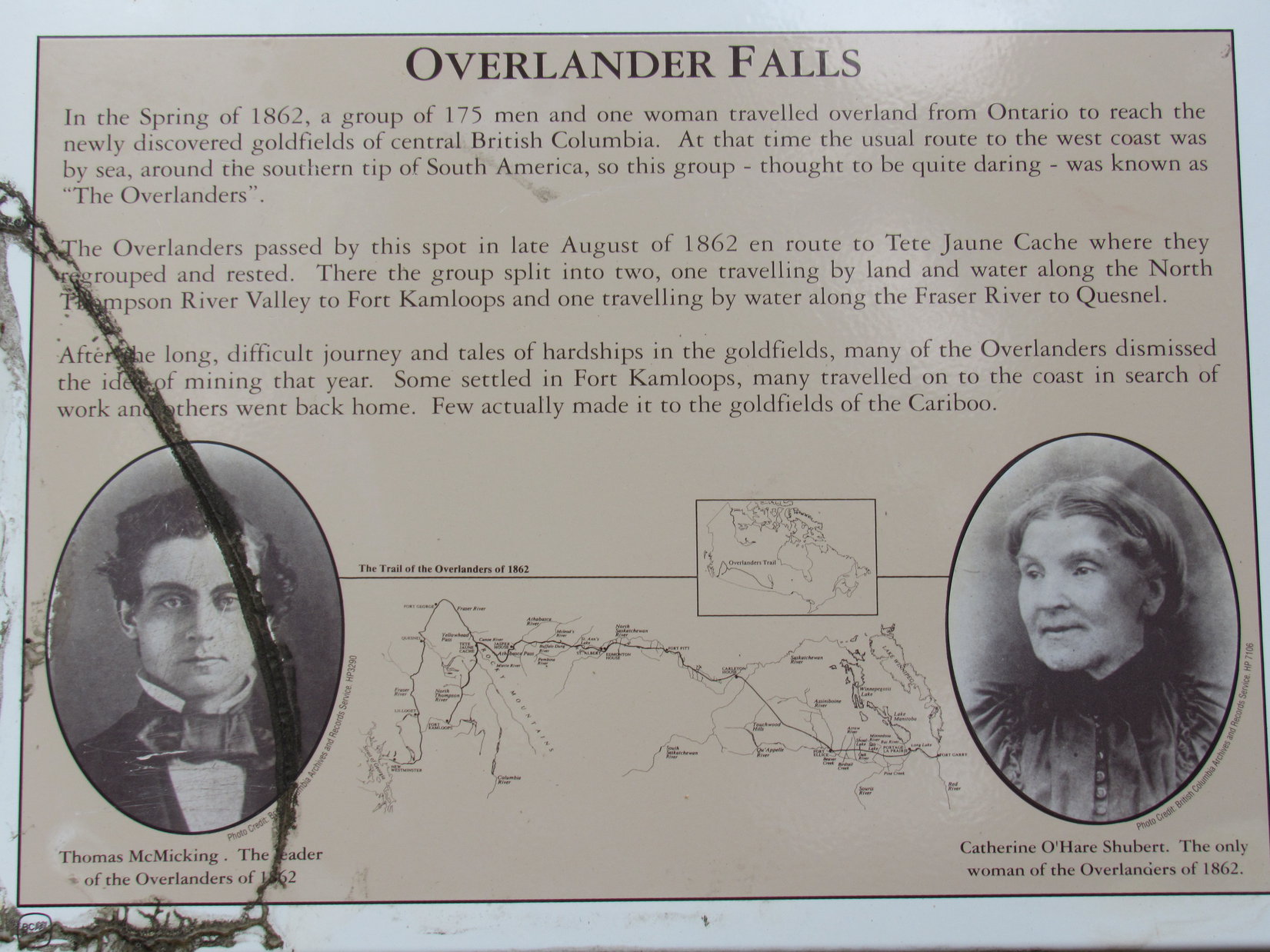
A plaque near the falls told the story of how Overlander Falls got its name.

This plaque at the falls relates the history of how Overlander Falls got its name.
Lupe at Overlander Falls, Mount Robson Provincial Park, Canada.
The cool mist from Overlander Falls felt good!

Since most of Lupe’s day was going to be spent traveling in the G6, the 1.6 km Overlander Falls trail along the Fraser River to the Mount Robson Provincial Park headquarters was an appealing option.  No one was around yet, and the trail would provide a peaceful, secluded path through the forest along the scenic blue green river.  Lupe could get some exercise, and SPHP would enjoy the views.  Lupe was most definitely in favor of the idea!

The Fraser River below Overlander Falls.

As it turned out, the Overlander Falls trail did not stay down near the river.  Instead, it paralleled the river mostly 40 to 80 feet above it on the forested slope.  The Fraser River was only occasionally in view.  The trail was in good condition, but didn’t look like it sees an awful lot of use, perhaps because there are trails to more dramatic destinations nearby.  (See Lupe’s fabulous hike to Mount Robson and Berg Lake in 2013 on the Berg Lake Trail!)

The Overlander Falls trail was fairly level most of the time, and an easy hike.  It passed Hogan’s camp, established way back when the railroad was being built.  The Carolina Dog was not too impressed.  Hogan’s camp now amounts to nothing more than a few rotting logs.  However, Lupe did enjoy sniffing and exploring in the forest along the trail.  She found a few squirrels to bark at, which made her day.

Lupe at one of the few viewpoints above the Fraser River along the Overlander Falls Trail.
Fraser River from the Overlander Falls trail.

At the W end of the Overlander Falls trail, Lupe came to a road at a bridge across the Fraser River.  There was no trailhead at this end, just a small sign near the bridge pointing out the trail.  Downstream from the bridge was a bend in the Fraser River.  Lupe and SPHP went down to the river’s edge so Lupe could get a drink.

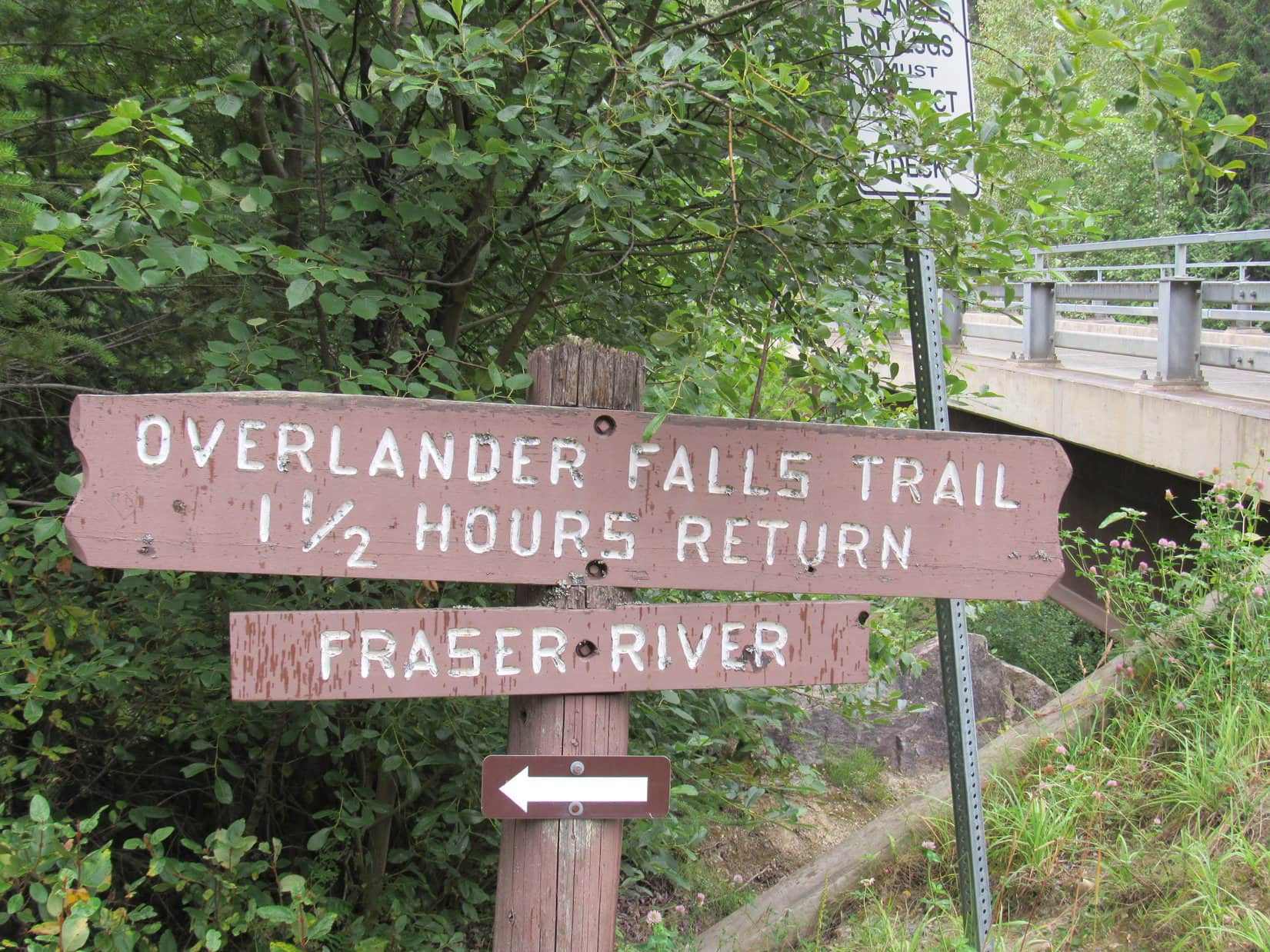
Lupe along the Fraser River. The Overlander Falls trail heads upstream from the N side of the bridge seen over the river. A small sign on the upstream side of the road at the start of the bridge is the only indication of the trail’s presence. Photo looks upstream.

Overlander Falls trail sign, Mt. Robson PP, Canada 8-4-16After the American Dingo had her drink from the Fraser River, Lupe and SPHP took the road another 0.25 km to the Mount Robson Provincial Park headquarters on the N side of Yellowhead Hwy No. 16.  Unfortunately, the sky had been clouding up.  The summit of Mt. Robson was hidden from view.

Lupe made it to Mount Robson Provincial Park headquarters, but sadly the summit of Mount Robson (behind the visitor center) was hidden in the clouds.

Lupe and SPHP returned to the Overlander Falls trail.  On the way back to the G6, tragedy struck.  Excited by a squirrel, while leaping around in the thick underbrush, Lupe got her right front dewclaw got hooked on something.  Her dewclaw snapped completely off!  It was painful and bled a little, but not much.  The wounded Carolina Dog looked to SPHP for help.

Lupe returns to the Overlander Falls trail.
Lupe in pain with a snapped off right front dewclaw looks to SPHP for help. This photo is typical of the Overlander Falls trail as it went through the deep forest near the Fraser River.

SPHP examined Lupe’s paw, kissed the terrible wound many times, and gave Lupe lots of attention.  When that didn’t cure it, SPHP carried Lupe along the trail.

Naturally, her right front paw hurt where the dewclaw had snapped off right at the base.  Lupe was certain she couldn’t go on.  Until she could.  After 15 minutes of being carted around like a sack of potatoes, at Hogan’s camp Lupe decided she could manage on her own just fine.  Back at the G6, Dr. SPHP applied anti-biotic ointment and a bandage (9:55 AM).

Lupe recuperating in the G6 with her right front paw with the snapped off dewclaw all bandaged up.

Lupe’s adventures (and misadventures) at Overlander Falls were complete.  Time to get back on the road again (10:12 AM), but only for a short stretch.  Lupe had very little chance to recuperate before reaching the trailhead for Rearguard Falls.  She did fine anyway.

This sign at the Rearguard Falls trailhead told of the end of the salmon’s struggle here in their quest to swim up the Fraser River.

The trail to Rearguard Falls wasn’t very long.  Lupe soon came to an elaborate system of walkways with metal railings near the falls.  Like Overlander Falls, Rearguard Falls wasn’t all that high.  Rearguard Falls was almost more like a cascade.  It was still impressive and very beautiful.  Lupe and SPHP stayed at Rearguard Falls for close to an hour.

Rearguard Falls on the Fraser River. Rearguard Falls is downstream from Overlander Falls.
Lupe on the boardwalks leading to Rearguard Falls.
Rearguard Falls in Rearguard Falls Provincial Park, British Columbia, Canada.
Lupe probably would have liked to soak her painful dewclaw wound in the cold waters of Rearguard Falls.
Looking downstream.

Part of the reason Lupe was at Rearguard Falls so long was that other people kept coming and going.  Some of them had very fancy cameras they set up on tripods.  At the closest viewpoint next to the falls, several photographers set up their tripods in succession, each one occupying the coveted spot continuously for 15 or 20 minutes.

It didn’t matter to Lupe or SPHP how long they took.  The stunningly beautiful river, the hypnotic roar of the falls both soothing and powerful, the mountain scenery, and perfect weather made Rearguard Falls a great place to be.  Waiting for a turn at the closest viewpoint, SPHP chatted with people, while Lupe relaxed or enjoyed being admired and petted by friendly tourists.

One lady was here with her husband (who was busy with his camera and tripod at the coveted spot) and two sons.  They were from the Netherlands.  She said they had saved money for 10 years to come to Canada.  Eventually they were going to sail up the inland passage on the Pacific Ocean near the end of their trip.  They loved Canada, and were having a fabulous time!

Finally, it was Lupe’s turn at the closest spot to Rearguard Falls.  Two photos, a final lingering look, and Lupe’s time at Rearguard Falls was over (11:31 AM).

Lupe at the coveted spot closest to Rearguard Falls.

Lupe and SPHP spent nearly all the rest of the day traveling on Yellowhead Hwy No. 16.  Both Lupe and SPHP were farther N than they had ever been before.  Lupe was entering a whole new world!

NW of the junction with Hwy 5, traffic on Hwy 16 greatly diminished.  Almost everyone else had turned S on Hwy 5 heading for Kamloops.  Lupe was in a valley miles wide, with a wall of high mountains on each side.  Nearly all the land was forested, but at first there were some farms and fields near the highway, too.  Haystacks were abundant, but curiously, not livestock.  Lupe watched diligently for a long time, but saw only one herd of cows to bark at.

After a while, the farms and fields disappeared.  On both sides of the valley, the high mountains were getting progressively smaller and more distant.  Unbroken forest stretched in every direction as far the eye could see.  Despite being in what appeared to be a complete wilderness, no wildlife was seen except for ravens picking at roadkill.

With no cows or horses to bark at, and no wildlife to hold her attention, Lupe’s eyelids began to droop.  Soon she was snoozing, as the countless miles of endless forest went by.  To SPHP, it was all increasingly magical, to be here, at last, with Lupe in a wilderness that stretched ahead for not only hundreds, but literally thousands of miles, heading toward the unknown.

With no cows or horses to bark at, and no wildlife to hold her attention, Lupe drifted off to a peaceful sleep on her way to more adventures as the miles flew by. Maybe her snooze wasn't all peaceful? While in Dingo Dreamland, sometimes her lips and paws twitched.
With no cows or horses to bark at, and no wildlife to hold her attention, Lupe drifted off to a peaceful sleep on her way to more adventures as the miles flew by. Maybe her snooze wasn’t all peaceful? While in Dingo Dreamland, sometimes her lips and paws twitched.

Granted, what lay ahead wasn’t completely unknown.  SPHP had maps and descriptions, had seen photos online, and had a general plan for Lupe’s 2016 Dingo Vacation adventures.  All that was helpful, necessary and informative to a degree, but only scratched the surface of the possibilities and realities in this gigantic new territory Lupe was traveling through.  And all the preparations weren’t the same as finally being here, actually seeing it all for the very first time.

The mountains were gone, replaced by distant blue ridges, by the time Lupe neared Prince George.  Lupe woke up as the G6 slowed entering the city.  Prince George turned out to be a lively and attractive city situated along the scenic Fraser River.  It was the only large town Lupe would see in all of British Columbia.  SPHP made a couple of stops for gas and groceries.

As Hwy 16 headed WNW from Prince George, farms and fields appeared again, carved out of the seemingly limitless forest.  To Lupe, the open fields meant cows and horses.  This time the Carolina Dog wasn’t disappointed.  Although most of the fields were full of haystacks and bales, Lupe did see lots of cows and horses.  She got plenty of most satisfying barking in.  Now and then she had to stop long enough to slurp up water to wet her poor overworked parched barker.

At a rest stop near Cluculz Lake, Lupe and SPHP devoured half of a whole roasted chicken purchased in Prince George, while a rain shower passed over.  Between the exciting cows and horses, and tasty roasted chicken, Lupe was very much revived.  Back on the road again, she remained awake and watchful.

The long drive was marvelously relaxing.  Lush green fields surrounded by dark forests appeared, and subsequently retreated from view.  Distant blue ridges defined the horizon.  Gray white clouds drifted across a partly sunny blue sky, trailing rain dark streaks of rain behind them.  For a long time, the G6 said it was a perfect 71°F out.

The green fields closer to Prince George gradually disappeared, swallowed by the primal forest.  Lupe passed through a few small towns of significance – Vanderhoof, Fraser Lake, and Burns Lake.  The farther Lupe went, the less traffic remained on the road.  The sun was low by the time Lupe reached Houston, a tiny, quiet community near the Bulkley River.

In Houston, right alongside Yellowhead Highway No. 16, was a very beautiful small park with a fountain, manicured lawn, and a profusion of vibrantly colored flowers.  Here Lupe and SPHP stopped to stretch their legs and admire Houston’s crown jewel, in the little time remaining while it was all still aglow in the sharply slanting rays of earth’s sinking star.

Lupe reached beautiful Steelhead Park in Houston, British Columbia near day's end.
Lupe reached beautiful Steelhead Park in Houston, British Columbia near day’s end.
Steelhead Park was full of a dazzling array of colorful flowers in perfect condition.
Lupe near the fountain.
It must take an enormous amount of work to keep Steelhead Park looking so immaculately manicured. The entire park was in tip top shape!
Rainbow trout and steelheads are the same species, but live very different lives. Rainbow trout live their lives entirely in fresh water, while steelheads are anadromous, meaning they spend part of their lives in the sea.

Lupe at Steelhead Park, Houston, British Columbia, Canada 8-4-16And so, for now, we leave American Dingo explorer and adventurer Lupe in the little town of Houston, deep in northern British Columbia, at the end of Day 6 of her super fabulous Summer of 2016 Dingo Vacation among the brilliant blossoms of Steelhead Park.

At Steelhead Park, Houston, British Columbia, Canada 8-4-16

Links:

Next Adventure                             Prior Adventure

Overlander Falls, Rearguard Falls & Ancient Forest, British Columbia, Canada (8-2-17)

Want more Lupe adventures?  Choose from Lupe’s 2016 Canadian Rockies, Yukon & Alaska Adventure IndexDingo Vacations Adventure Index or Master Adventure Index.  Or subscribe free to new Lupe adventures.