Black Hills, SD Expedition No. 238 – Centennial Trail No. 89: South Boxelder Creek to Dalton Lake (10-28-18)

Start – 8:53 AM, 28°F, South Boxelder Creek trailhead of Centennial Trail No. 89 one mile W of Nemo, SD

Chilly.  Frost on the grass.  Lupe didn’t mind the brisk morning air at all.  She was eager to begin a big day of adventures exploring another section of Centennial Trail No. 89.  Dalton Lake, her objective, was 6.1 miles away.  If the Carolina Dog got off to a good start, she ought to have time enough to visit a few minor Black Hills peaks along the way, too.

As soon as SPHP was ready, Lupe set off on a level path heading NW by the main road.  The path quickly led to a ford of Boxelder Creek.  Since SPHP didn’t feel like fording Boxelder Creek on a cold morning, Lupe skipped the ford, too.  Two bridges along the road got Lupe and SPHP over the creek twice in rapid succession.

Beyond the second bridge was an ATV trail on the R.  A sign indicated the ATV trail also served as part of Centennial Trail No. 89.  Loop followed it into the forest.

Lupe at the 2nd bridge over Boxelder Creek. This bridge is a short distance upstream of the South Boxelder Creek trailhead. Photo looks SW.
Leaving the main road. Boxelder Creek is on the R. Photo looks NE.

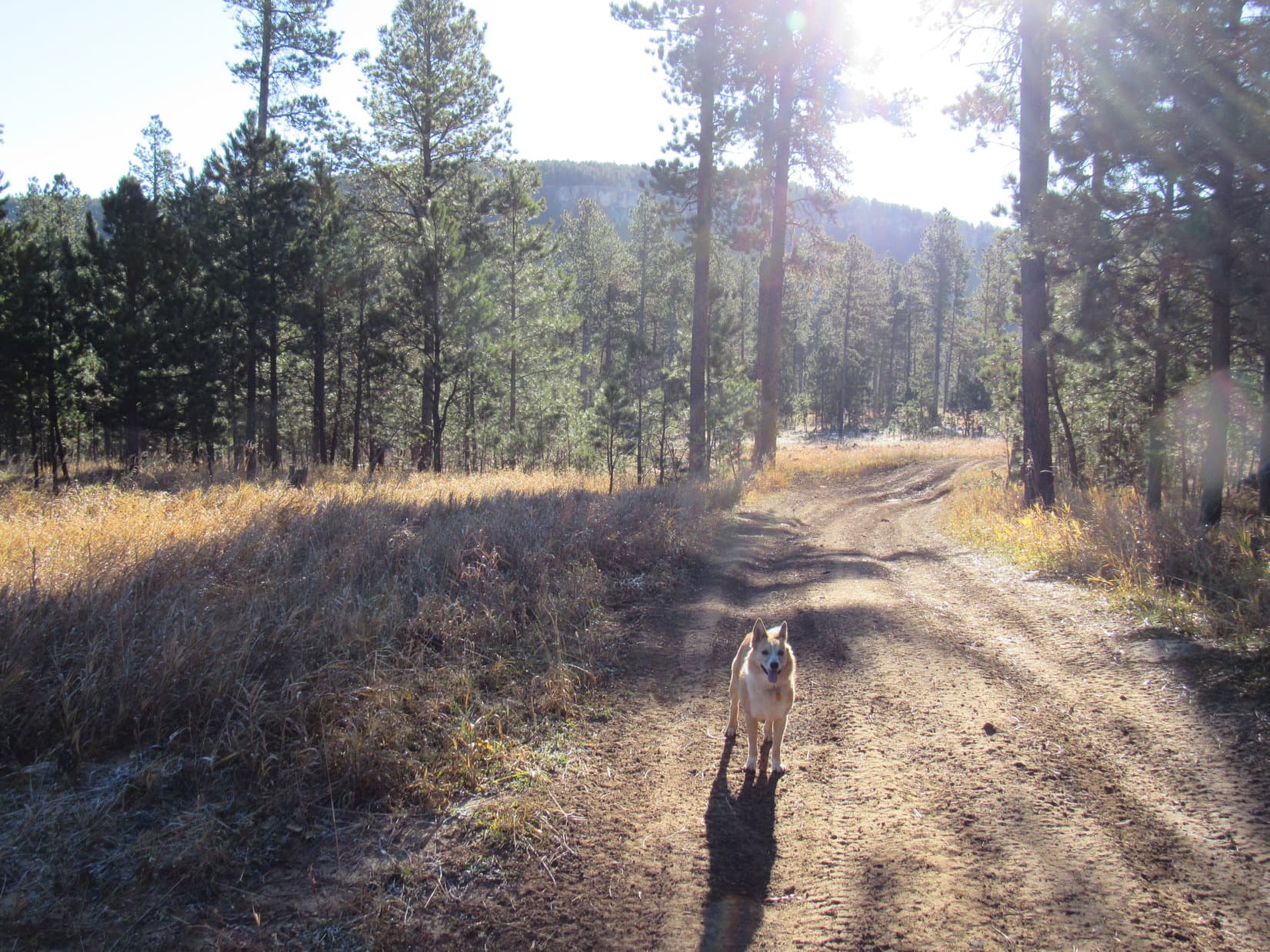
Centennial Trail No. 89 headed N gaining elevation at an easy pace.  Lupe passed through a fairly dense pine forest featuring occasional stands of white-barked aspens.

Following the ATV trail through the first stretch of forest. Photo looks N.

Over less than 0.5 mile, Lupe gained 200 feet of elevation before arriving at a minor pass.  Looper simply ignored an intersection with a dirt road and went straight on over the pass.  The trail lost elevation before turning E toward more open country.

After going over a minor pass, Centennial Trail No. 89 heads for more open country. Photo looks E.

Lupe passed through a big meadow where several dirt roads intersected the trail.  Just E of this meadow a small rise led up to another section of forest.  The trail leveled off, curved SE, then began dropping again.
Temporarily on higher ground after crossing the big meadow. Photo looks SE.

Lupe wasn’t far from Nemo.  She started seeing buildings through the trees.  However, instead of going on into Nemo, Centennial Trail No. 89 turned sharply N.  The trail crossed over to the E side of Nemo Road, then went N 200 yards to a junction with Vanocker Canyon Road.

Just off Centennial Trail No. 89 near Nemo. Photo looks ENE.
Lupe reaches the junction of Nemo Road & Vanocker Canyon Road. Peak 5237, which she hoped to climb a little later in the day, is on the R. Photo looks N.

The trail now turned NE following Vanocker Canyon Road.  After going over a small tributary of Boxelder Creek, the road curved N.  Centennial Trail No. 89 continued to parallel the road for a little way, but then began angling E up a large forested draw.  Lupe gained elevation steadily again on her way up to a second, somewhat higher pass.

Looking S down a minor tributary of Boxelder Creek from Vanocker Canyon Road. This was the last water Lupe would come to before reaching Dalton Lake.
On the way up to the second pass after leaving Vanocker Canyon Road. Photo looks S.

At the second pass Centennial Trail No. 89 ran alongside USFS Road No. 144, which also headed E just S of the trail.

Going over the 2nd pass. USFS Road No. 144 is on the R. Photo looks E.

Once over the pass, the trail lost a bit of elevation before turning N away from USFS Road No. 144.  Centennial Trail No. 89 made a long sweeping curve up a large draw, eventually rounding a sharp bend leading up to much flatter ground.

Lupe was now on a long ridge she would be following for the next 1.5 miles.  This was the start some of the most remote country she would travel through today.  Along the way she could expect a couple of minor peakbagging opportunities and occasional distant views.

Lupe reaches the high ground of a long ridge she would be following NW & N for the next 1.5 miles. Photo looks NNW.

Centennial Trail No. 89 headed NW.  Loop was still gaining elevation, but very slowly.  The forest in this area had been thinned by loggers.  It was possible to see quite a bit of local territory between the remaining pines.  This first part of the ridge was very broad and flat.  The trail stayed far from the unseen edge.

After going 0.33 mile NW, it appeared that Lupe might be nearing the W end of the ridge.  Her first peakbagging objective, Peak 5237 couldn’t be far from here, yet there didn’t seem to be any higher ground around.  What could be seen of the terrain was almost perfectly level.  SPHP called a brief halt to check the topo map.

Thinking Lupe couldn’t be too far from Peak 5237, yet seeing nothing but flat terrain, SPHP called a brief halt here to check the map. Photo looks SW.

The map showed that Peak 5237 was likely still a good 0.25 mile away.  Before Lupe would get there, the trail ought to swing N a short distance then turn WNW crossing a much narrower and slightly lower section of the ridge.  When the ridge started widening out again, Peak 5237 should be close by off to the SW.

It all worked out just as the map foretold.  Within minutes of returning to the trail, Lupe did come to a decidedly narrower part of the ridge.  She crossed it quickly, and as the ridge began to widen out again, the roar of engines was heard.  ATV’s were approaching from the N.  A forested slope with considerable deadfall timber and slash rose toward the SW.

Crossing the narrower part of the ridge. Photo looks WNW.
Lupe reaches the point where the ridge widens out somewhat again. Peak 5237 is close by up the slope to the L.

Lupe and SPHP left Centennial Trail No. 89, disappearing up the slope before the ATV’s arrived.  It wasn’t far to the highest ground, maybe 200 yards.  Lupe found the top of Peak 5237 covered with slash.  Not pretty, but a minor peakbagging success nonetheless.

So this is it, SPHP? The towering summit of Peak 5237? Not too impressive, but I’ll take credit for another peakbagging success anyway! Photo looks W.

Peak 5237’s actual high point might not have been much to look at, but only a few 10’s of feet away to the S and W were small cliffs from which Lupe could get some fairly nice views.  The Carolina Dog could see SSW toward Nemo.  To the NW she had a good look at Green Top (5,360 ft.).

Hey, SPHP! I can see the intersection of Nemo & Vanocker Canyon roads from here! We were down there just a little while ago! Photo looks SSW toward the Nemo area.
Green Top (Center) from Peak 5237. The more distant high point a bit to the L of Green Top is Terry Peak (7,064 ft.). Photo looks NW.

After a short break by the cliffs, Lupe and SPHP returned to Centennial Trail No. 89.  The trail wound down a steepish slope to the N losing 100 feet of elevation before reaching a saddle.  This was the lowest point along the ridgeline.  Almost immediately, the trail began regaining all the elevation it had just lost.

Before topping out, Lupe came to a rock platform along the W edge of the ridge.  This platform was very close to the trail and provided another good look at a broad expanse of territory to the W.

Lupe discovers another viewpoint Just W of the trail. Photo looks WSW.

After a quick look, Lupe continued N.  She soon reached the next high ground along the ridge.  The Carolina Dog was virtually as high as she had been at Peak 5237.  This region was quite broad and flat again for 0.25 mile.  Near the N end, the ridge narrowed and began to drop slightly.  Across a wide valley, Lupe caught glimpses of cliffs near the S end of her next peakbagging objective.

Continuing N, Lupe caught glimpses of this line of small cliffs near the S end of her next peakbagging objective. Photo looks WNW.

This next objective, which SPHP planned on naming Mile High Plateau, sat more than 0.25 mile off to the W of Centennial Trail No. 89.  That was within reason.  Mile High Plateau might be a fun place to explore.  Lupe wouldn’t be able to head toward it, though, until she got to High Point 5217 where the ridge she was following more or less ended, and split off into branches going E and W.

High Point 5217 wasn’t much farther.  The American Dingo was soon there.  A power line went over the edge of the ridge here, producing an opening where Loop had a view to the N.

Lupe reaches the power line in the vicinity of High Point 5217. The ridge Lupe had been following N ended here, splitting into branches that went E or W. Photo looks NE.

Centennial Trail No. 89 turned E here, but Mile High Plateau was W.  Looper left the trail, and picked up a faint road going NW.  She gained a little elevation.  Pretty soon the road curved W and leveled out near the N end of a spacious, level, open forest interspersed with meadows.

SPHP was about to congratulate Lupe on reaching Mile High Plateau when a check of the topo map showed that the name didn’t fit.  The highest contour was actually only 5,260 feet, a smidgen short of being a mile high.  Well, phooey!  Welcome to Peak 5260 then, Looper!

Even “Peak” 5260 didn’t seem like such an apt name for this pancake flat region, but SPHP wasn’t going to call it Plateau 5260.  In any case, it was what it was.

Lupe arrives at “Peak” 5260 more than 0.25 mile WNW of High Point 5217 and Centennial Trail No. 89. Photo looks SW.

Lupe seemed perfectly happy with Peak 5260.  She roamed SSW looking for an obvious high point, a big boulder or anything recognizable as the true summit.  Nothing.  Eventually the ground began to slope away.

No discernible true summit.  Not even any views without dropping down to wherever the cliffs might be along the edge.  While Lupe headed back N across the plateau, SPHP hatched another plan.  A little farther NW of Peak 5260 was another slightly higher mountain.  Since Lupe was in the vicinity, why not climb it, too?

An initial look at Peak 5300 was encouraging.  Lupe could climb it easily enough.  Shouldn’t take too long.

An initial look at Peak 5300 from Peak 5260 was encouraging. Lupe could climb Peak 5300 easily enough. Photo looks NW.

Loop and SPHP headed down into the saddle leading to Peak 5300.  The easiest route up the mountain appeared to be a forested slope right in the middle of the SE face flanked by small cliffs on either side.

Lupe would have headed straight for this slope, but a huge long pile of logs stacked across the saddle forced her clear around the NE end.  The Carolina Dog consequently wound up taking on a steeper portion of the slope more toward the NE.

A steep, but relatively short climb brought Lupe up onto flat, forested ground near the true summit of Peak 5300.

Peak 5300 (Center) from Peak 5260. Green Top is on the L. Photo looks NW.
Loop makes it to the top of Peak 5300, the highest mountain she would climb today. Photo looks E.

The top of Peak 5300 wasn’t nearly as vast as the top of Peak 5260 had been, but this smaller summit was also quite flat.  Although Lupe had come up near the highest end of the mountain, once again no one point stood out as the exact location of the true summit.

Peak 5300 was as high as Loopster was going to get today, but she still couldn’t see much due to the forest.  The one fairly decent view was of Vanocker Canyon Road off to the NW.

Vanocker Canyon Road (R) from the N end of Peak 5300. The ridge toward the L is part of White Mansion (5,340 ft.). Photo looks NW.

The topo map showed more high ground only slightly lower than the summit near the S end of Peak 5300.  Lupe and SPHP headed that way in search of better viewpoints.  The Carolina Dog found some, too!  She came to a good spot to take another short break along the W edge.

Green Top (L) & White Mansion (R) from close to the S end of Peak 5300. Custer Peak (6,804 ft.) is much more distant between them. Photo looks W.
Lupe near the W edge of of Peak 5300 where she took a short break. This was a nice spot. Photo looks SSW.

It was the usual fare.  Lupe had Taste of the Wild.  SPHP consumed an apple.  Contemplating the views W of Peak 5300 was relaxing.  However, Lupe still had a long way to go to get to Dalton Lake.  Better get a move on.  Before leaving Peak 5300, Loop went to the far S end.  This was a somewhat lower area, but featured the most dramatic viewpoint.

Lupe on a limestone outcropping at the far S end of Peak 5300. Photo looks S.

Having explored the top of Peak 5300 from one end to the other, Lupe left the mountain by the easiest route down the middle of the SE slope.  She traversed the saddle leading back to the N end of Peak 5260, ultimately returning to Centennial Trail No. 89 near High Point 5217.

Loop on her way back to Peak 5260. Photo looks SE.

The time for peakbagging and any other dillydallying was over.  Lupe headed E on Centennial Trail No. 89.  To SPHP’s surprise, the trail did not stay on the high ground of the ridge to the E, but dropped into the forest a little down the N side.

Back on Centennial Trail No. 89 descending into the forest on the upper N slope of a long ridge going E. Photo looks E.

The trail quickly led to a cool gap between limestone formations.  Lupe emerged from the gap seemingly back on top of a ridge.  However, the trail almost immediately made a very sharp turn to the NW and started a long descent.  This jog NW proved to be a single long switchback.  At the lower end, Centennial Trail No. 89 veered sharply E again.

Passing through the limestone gap. Photo looks E.

Centennial Trail No. 89 maintained a course heading ENE for more than a mile.  Still well up on a vast forested slope, Lupe lost net elevation only gradually.  She could occasionally see the top of the ridge to the S as little as 100 feet higher than the trail.  Little Elk Canyon was off to the N, but the forest seldom permitted more than a glimpse.

Centennial Trail No. 89 stayed well up on the N side of a ridge for more than a mile, but Lupe couldn’t see much due to the forest. Photo looks ENE.
A glimpse of the upper end of Little Elk Canyon. Photo looks NW.
A partial view across Little Elk Canyon. Photo looks N.

Mid-afternoon was approaching, the busiest part of the day.  Several groups of ATV’s went by.  Eventually the trail split.  ATV’s were routed onto a lower track.  Lupe and SPHP continued ENE on the upper track.

The trail went on and on. Sometimes ATV’s went by. Photo looks E.
Centennial Trail No. 89 eventually divided. Motorized vehicles were directed onto the lower track on the L. Lupe & SPHP stuck with the upper track on the R. Photo looks E.

The trail went on and on without losing much elevation.  Dalton Lake was down in Little Elk Canyon, and couldn’t be much farther E.  Finally, just beyond a No Motorized Vehicles sign, Centennial Trail No. 89 left the roadbed it had been following and veered L (NE) down into the forest.

Centennial Trail No. 89 heads down into the trees on the L just beyond this sign. This is where the real descent to Dalton Lake begins. Photo looks NE.

For the first time today, Centennial Trail No. 89 was a single track trail instead of an ATV trail.  The descent into Little Elk Canyon now began in earnest.  The trail wasn’t really steep, but Lupe was losing elevation a lot faster than before.  She descended a series of tight switchbacks.  Lower down the switchbacks were longer and more gradual.

Loop begins the descent into Little Elk Canyon on the single track trail. Photo looks NE.
Getting close to the bottom. Photo looks NW.

The American Dingo passed through a gate as Centennial Trail No. 89 emerged from the forest.  This was it, Little Elk Canyon!  To Lupe’s R (E) was an outhouse.  Ahead was USFS Road No. 224.  On the other (N) side of the road was the Dalton Lake trailhead.

Of course, having come all this way, Lupe wanted to see more than just the trailhead.  She wanted to see Dalton Lake itself, which was 500 feet farther W.  Loop and SPHP trudged up USFS Road No. 224 to the Dalton Lake campground.

Loop arrives at the Dalton Lake campground along USFS Road No. 244. Photo looks W.

A walking path led to an arched bridge over the Dalton Lake spillway.  Emerald green Dalton Lake sparkled in the afternoon sunlight.

Dalton Lake. Photo looks W.
Lupe crosses the bridge over the Dalton Lake spillway. Photo looks SSE.
Lupe at emerald green Dalton Lake sparkling in afternoon sunlight. Photo looks WSW.

Dalton Lake is small, a glorified pond really.  Several docks exist along the shore.  Lupe and SPHP headed for the dock on the N side of the lake intending to take another short break.

Well, we made it! All the way to Dalton Lake! Photo looks E.
As low as the sun was getting, it was clear that Lupe couldn’t stay at Dalton Lake very long before beginning her journey back to the South Boxelder Creek trailhead. Photo looks WSW.

Lupe didn’t take much of a break at the dock.  A chipmunk among the cattails along the N shore caught her attention.  She spent the rest of her break time puzzling over how to get at that tricky, tiny squirrel.  Meanwhile, SPHP enjoyed the lake.

Looking toward the S shore from the N dock. Photo looks SE.

The sun was sinking.  SPHP encouraged the American Dingo to abandon her unsuccessful chipmunk quest.  Before leaving the area, Loop and SPHP took a stroll through the empty campground on the S shore.

Lupe at the Dalton Lake campground. The campground was closed and empty this time of year, but looked like a fun place to stay. Photo looks WSW.
Cattails near the W end of Dalton Lake. Photo looks NW.
The N shore. Photo looks ENE.

Late afternoon.  6.1 miles back to the South Boxelder Creek trailhead.  Lupe and SPHP headed back to Centennial Trail No. 89.

With the exception of the peakbagging side trips, Lupe had to retrace her entire route.  The Carolina Dog made great progress.  The sun was still up when she went through the limestone gap shortly before reaching High Point 5217.

Back at the limestone gap. Photo looks W.

The sun had just set as Loop reached Peak 5237 again.  Thinking there might be a great sunset, SPHP led Looper back to the summit, then on to the nearby W-facing cliffs.  However, the sun had disappeared behind a bank of clouds.  The whole sky was gray.

Lupe returns to Peak 5237 at sunset, but the sky is gray. Photo looks SW.

Rather than wait to see what would happen, Lupe and SPHP returned to Centennial Trail No. 89.  May as well use the fast diminishing twilight to get as far as possible before having to bring out the flashlight.

10 or 15 minutes later, the forest back to the W was on fire.  An orange glow highlighted the dark pines.  The sunset had developed after all.  Should have waited.  Oh, well.

Darkness descended upon the Black Hills.  By the time Lupe crossed Nemo Road to begin the final leg of the journey back to the South Boxelder Creek trailhead, a black, moonless, and nearly starless night had taken over.  An hour to go?  Something like that.  Tramp, tramp.  Sniff, sniff.  Puppy ho!  Onward!  (End – 7:36 PM, 35°F)

Dalton Lake, Centennial Trail No. 89, Black Hills of South Dakota, 10-28-18

Links:

Next Black Hills Expedition                Prior Black Hills Expedition

Next Trail Section N

Black Hills, SD Expedition No. 273 – Centennial Trail No. 89: Dalton Lake to Elk Creek (4-5-21)

Next Trail Section S

Black Hills, SD Expedition No. 237 – Centennial Trail No. 89: Pilot Knob to South Boxelder Creek (10-18-18)

Centennial Trail No. 89 map & brochure

Want more Lupe adventures?  Check out Lupe’s Black Hills, SD & WY Expeditions Adventure Index, Master Adventure Index, or subscribe free to new Lupe adventures!

Prospect Benchmark, Bighorn Mountains, Wyoming (6-9-18)

Day 1 of Lupe’s 2018 Dingo Vacation to the Bighorn Mountains of Wyoming & Beyond!

6-9-18 – Early afternoon found Lupe streaking across the border into Wyoming riding high in air-conditioned comfort upon her pile of gear, pillows and blankets.  The G6, all shined up for the occasion, raced W on I-90.  Oh, yeah!  It was on!  The glorious Summer of 2018 was officially underway!

Lupe was thrilled!  After nearly 9 long months spent close to home in the Black Hills of South Dakota, it seemed like forever since she’d headed off to new adventures in faraway places.  Yet the American Dingo clearly remembered exactly what Dingo Vacations are all about.

Furious barking, mostly – at least en route!  Loopster eagerly scanned the fields along I-90 for the next herd of cows or horses she was rapidly bearing down upon.  Barking at cows, horses, sheep, antelope, barns, outbuildings and suspicious haystacks is a joyous game that never gets old!  The decibel level in the G6 seldom meets safety standards while in cattle country.

The first respite from the din came at the Moorcroft, WY rest area.  Loop and SPHP both got out to stretch.  Lupe sniffed about the grounds, which featured big, shady cottonwood trees.  Sadly, no cows or horses were right here today, but SPHP read an interesting true story to Lupe about some mighty fine days long ago in the Old West when there had been plenty of cows in Moorcroft.

Oh, what a wonderful day! I can hardly believe it’s really summer again and we’re setting off on another Dingo Vacation!
Lupe liked this true story about thousands of cows and sheep! SPHP said the cowboys must have had a bunch of horses, too. Those were the days!

The Bighorn Mountains of N central Wyoming were Lupe’s destination for most of this first Dingo Vacation of 2018.  The Bighorns are only a few hours from the Black Hills.  Despite an afternoon start, Lupe would easily arrive by evening.

Even before getting to the Bighorns, though, Loopster had one quick peakbagging possibility SPHP wanted her to check out along the way.  At Gillette, SPHP turned S on Hwy 59.  Antelope Butte (5,073 ft.), a hill with 30 miles of isolation (minimum distance to a higher point) was only 6 or 7 miles S of I-90.  Curiously, it was seldom climbed according to statistics on Peakbagger.com.

The map showed Antelope Butte was situated only a mile W of Hwy 59.  A side road went to towers on top of it.  If hardly anyone was getting to the summit of a hill so close to town with a road to it, access issues were likely.  A long shot, perhaps, but maybe it was worth a short side trip to check it out?  Lupe liked the notion that there might be antelopes.

Antelope Butte was easily spotted before Loop was even out of Gillette.  It wasn’t anything too impressive, just a grassy hill with towers on it.  Disappointingly, not a single antelope was in sight, either.  The Carolina Dog would still climb it, though, if she could.  Why not?

Antelope Butte from Hwy 59. Photo looks WSW with help from the telephoto lens.

SPHP turned W on a promisingly located side road SE of Antelope Butte.  A 0.5 mile drive past a couple of businesses brought Lupe to a locked gate.  Looked like this was the right place, alright.  It wouldn’t have taken Looper long to get to Antelope Butte and back from here.  However, in addition to the locked gate there were other subtle hints that maybe it was best not to.

Hmm. This was the road to Antelope Butte. Photo looks WSW.
Frustrating! Antelope Butte was right over there! Photo looks NW.
Zoomed in on Antelope Butte. Photo looks NW.

A lot of equipment was stacked around, apparently related to the energy industry.  Lupe had passed some sort of Halliburton shop on the way in from Hwy 59.  SPHP drove back to see if Lupe might be able to obtain permission to climb Antelope Butte.

Saturday afternoon.  The Halliburton shop was closed.  No one at all around.  Posted signs weren’t the least bit encouraging.  The gist of them was that if you weren’t an employee or officially invited, just go away.  OK.  Whatever.  Antelope Butte wasn’t happening.  Not today.  Lupe and SPHP returned to I-90 and headed W.

3 hours later, Lupe was at the Sand Turn overlook along Hwy 14 on her way up into the Bighorn Mountains.  Lupe could see the town of Dayton in the distance and a long way out onto the prairie.

Looking NNE from the Sand Turn overlook.

At Burgess Junction SPHP veered S staying on Hwy 14.  Another 9 or 10 miles brought Lupe to road construction at Prospect Creek.  Here SPHP turned W on USFS Road No. 10.

No. 10 climbed steadily and wound around quite a bit.  After a couple of miles, Lupe had her first look at Prospect Benchmark (9,774 ft.).

Prospect Benchmark (Center) from USFS Road No. 10. Photo looks WNW.

Even though Antelope Butte hadn’t worked out, Lupe was still going to get to log a peakbagging success on her first day of this Dingo Vacation.  Prospect Benchmark looked like a snap!

So far, most of USFS Road No. 10 had been fairly rough.  It deteriorated further as SPHP drove on.  The last stretch of road leading to a cattle guard was deeply rutted, and would have been impassible if wet.  Nevertheless, the G6 managed to make it up to a broad, gentle saddle 4 miles from Hwy 14.

Lupe on USFS Road No. 10. The last stretch of road to get to this cattle guard had been the worst, and would have been impassible for the G6 if wet. Photo looks SE.

After crossing the cattle guard, SPHP parked the G6 by a barbed wire fence.  Prospect Benchmark was now only a ridiculously easy 0.33 mile away to the S.  This was going to be cake!

This is it? Looks like you’re starting us out mighty easy on this Dingo Vacation, SPHP! Loop standing by USFS Road No. 217 ready to start for Prospect Benchmark, the ridge in sight beyond the snowbank. Photo looks SSW.

Although the temperature had hit 95°F while traveling across the Wyoming plains on I-90, the evening was pleasantly cool way up here in the Bighorns as Lupe set off for Prospect Benchmark.  (7:19 PM, 62°F)  Loop started out following USFS Road No. 217, a simple dirt road which headed SW up a long, gentle incline.

Once beyond a large snowdrift, Lupe abandoned No. 217 near the road’s high point just N of the summit area.  She scampered S up the remaining grassy slope to a partially broken down escarpment.  A mere 5 or 10 foot scramble among the rocks brought Loop up onto the N edge of Prospect Benchmark’s vast, flat, barren summit area.

That had been easy!  All Lupe had to do now was find the actual survey benchmark.  A cairn of white rocks not too far away along the edge of the escarpment seemed like a logical place to begin.  The Carolina Dog found nothing near the cairn, however, except a nice view back toward the saddle where the G6 was parked.

Lupe reaches a cairn near the N edge of Prospect Benchmark‘s summit area. The G6 is parked down at the intersection seen in the saddle. USFS Road No. 10 crosses the saddle, while USFS Road No. 217 is seen heading this general direction, and No. 220 winds away up the distant hill. Photo looks NE.

A check of the topo map showed that the survey benchmark ought to be located toward the SE end of Prospect Benchmark’s huge summit area.  Loop and SPHP traveled SE along the escarpment forming the NE edge of the summit keeping a lookout for the benchmark.

Looking SE along the minor escarpment forming the NE edge of Prospect Benchmark’s summit area.

Lupe found nothing of interest until she got close to the end.  A 2nd cairn of white rocks sat perched upon a high spot right along the escarpment’s edge, but the survey benchmark wasn’t here, either.

Loop reaches a 2nd cairn near the SE end of the escarpment. Photo looks NE.

However, Loop could see a metal rod sticking up from a smaller 3rd cairn 20 feet to the SW.  That seemed promising!  Lupe went to check it out.

Nothing here, either, SPHP! Lupe checks out the 3rd cairn with the metal rod sticking out of it. Still no luck. Photo looks SW.

Still nothing!  Hmm.

The far SE end of the summit area was now quite close, so Lupe went to it.  Again nice views, including a distant view of Cloud Peak (13,167 ft.), the highest mountain in the Bighorn Range, but no survey benchmark.

A distant view of Cloud Peak from the SE end of the Prospect Benchmark summit. Photo looks SE.
Looper at the SE end of the Prospect Benchmark summit area. Photo looks NE.
Cedar Mountain (9,813 ft.) (L) from Prospect Benchmark. Photo looks SW.

Lupe and SPHP wandered back toward the NW still looking for the benchmark.  Even though the terrain was flat and exposed, if the survey benchmark really wasn’t somewhere close to this SE end, it was going to be hard to find.  The summit area was just that big.

Could you be a little more specific, SPHP? “It’s gotta be up here somewhere!” isn’t much of a clue! Photo looks WNW.

Maybe Lupe wasn’t going to be able to find the benchmark?  Maybe it wasn’t even up here anymore?  Even if it was, finding the benchmark might be like looking for a needle in a haystack.  Then suddenly, there it was, right in the general vicinity shown on the topo map.

Prospect survey benchmark.

The benchmark was on exposed rock, which made it easy to spot.  The marker was only 20 feet NW of the 3rd cairn Lupe had come to, the one with the metal rod sticking up out of it.  A fair number of loose white rocks were nearby.  SPHP used them to build a cairn.  The largest rock had a stiff wire wrapped around it.

The survey benchmark is seen right in front of the big cairn SPHP built. The smaller 3rd cairn with the metal rod is beyond it. Cloud Peak (Center) is on the distant horizon. Photo looks SE.

Well, that was that!  SPHP congratulated Lupe on her now completely successful ascent of Prospect Benchmark (9,774 ft.).  It was an easy start to her Dingo Vacation, but this was just the beginning.

At any rate, the sun wouldn’t be down for a little while yet.  Lupe could spend this extra time exploring the area.  Just for fun, the Carolina Dog and SPHP wandered 0.33 mile off to the W and SW.  The temperature was dropping, but it was a pleasant trek on a beautiful evening with mostly clear skies and only a light SW breeze.

Lupe at the endpoint of her wanderings W of the Prospect Benchmark summit. Photo looks WSW.
Looking NE back toward Prospect Benchmark.
Sweet Lupe on a beautiful evening in the Bighorns.

The sun sank toward the horizon.  Time to head back to the G6.  Lupe had fun sniffing and exploring along the way.  She crossed snowbanks, and returned to Prospect Benchmark once more.

Crossing a snowbank near sunset. Photo looks ENE.
Lupe back at Prospect Benchmark next to the cairn SPHP built. The actual survey benchmark is hidden behind the cairn. Photo looks NW.
Here it is!
Cloud Peak (Center) from Prospect Benchmark late in the day. Photo looks SE.
Crossing a snowbank on the way back to the G6. Photo looks SSE.
A look back at the escarpment. Photo looks S.

As Lupe’s adventures go, Prospect Benchmark had been a pretty short one  less than 2 hours, even including wandering off to the W.  Loopster arrived back at the G6 still all corked up and full of Dingo energy.  (End – 9:00 PM, 54°F)

As twilight faded, SPHP threw a tennis ball for Lupe to chase, then joined in the fun chasing her back and forth around the G6.  As far as Lupe was concerned, this exciting game of chase was the highlight of the whole day!  She got to show off how fast, agile, and tricky she is, while making a complete fool of SPHP.

Thankfully, it was getting dark.  SPHP can only put up with so much abuse.  Yet seeing Lupe having so much fun really was the best part of the day, a great finish to the first day of her 2018 summer adventures way up here in the beautiful Bighorn Mountains at almost 10,000 feet by Prospect Benchmark.

Sunset from Prospect Benchmark, Bighorn Mountains of Wyoming, 6-9-18

Links:

Next Adventure

Want more Lupe adventures?  Choose from Lupe’s 2018 Dingo Vacation to the Bighorn Mountains of Wyoming & Beyond Adventure IndexDingo Vacations Adventure Index or Master Adventure Index.  Or subscribe free to new Lupe adventures.