Beyond the Mountain of the Midnight Sun – Atigun Pass, Galbraith Lake & the Edge of the North Slope (8-18-17)

Day 19 of Lupe’s 2017 Dingo Vacation to the Yukon & Alaska!

6:02 AM, 37°F – The sky had been almost clear before sunset.  SPHP expected to wake to blue skies.  No such luck.  Nothing but gray overhead.  Lupe was famished.  She gobbled down generous helpings of Alpo and Taste of the Wild before going back to sleep.  The Carolina Dog was still exhausted after yesterday’s Cathedral Mountain (3,350 ft.) adventure.  SPHP worked on the trip journal while rain showers came and went.

10:15 AM – Loop was awake again.  Not raining now.  Scattered patches of blue could even be seen.  May as well hit the road.  Lupe and SPHP left Cathedral Mountain heading N on the Dalton Highway.

As it turned out, Coldfoot (milepost 175) was only half a dozen miles away.  SPHP gassed up the G6.  Only $4.599 per gallon!  Same as last year, and a bargain compared to the $5.50 per gallon they wanted back at the Yukon River.  Be grateful for what you can get in the Arctic.  Especially when they’re practically giving it away!

25 miles N of Coldfoot was a thrilling sight.  Sukakpak Mountain was dead ahead!  Lupe had climbed Sukakpak in 2016.  As far as SPHP was concerned, Sukakpak Mountain (4,459 ft.) had been one of her most memorable adventures ever!

Sukakpak Mountain came into view 25 miles N of Coldfoot. The beautiful mountain was a thrilling sight! In 2016 Lupe had one of her most memorable adventures ever on Sukakpak. Photo looks NE.

A repeat of Lupe’s 2016 Sukakpak Mountain adventure would have been great fun, but the weather was just too iffy for that.  Too little blue sky, and too many rain showers around.  A huge effort that might easily wind up totally socked in and wet didn’t seem worth the risk.

Although Lupe and SPHP would have enjoyed a repeat of last year’s exploits up on Sukakpak Mountain, the weather seemed too iffy today. Too many rain showers around and not enough blue sky. Photo looks NE.
Lupe along the Middle Fork of the Koyukuk River with Sukakpak Mountain in the background. Photo looks SE.

However, there was an easy adventure near Sukakpak Mountain that Lupe and SPHP would both love to do again.  This part of the Brooks Range was the farthest N Lupe had ever been.  In 2016, Lupe had gone on her Last Mile North adventure.  This involved only a relatively short walk along the Alaska oil pipeline to a creek N of Dillon Mountain (4,820 ft.), then W to its nearby confluence with the Dietrich River.

From that confluence, Lupe had seen a mysterious dark mountain 10 miles farther N.  She had seen it the day before from the top of Sukakpak Mountain, too.  Not knowing its real name, or if Lupe would ever in her whole life be this far N again, SPHP had named that dark mountain the Mountain of the Midnight Sun.

Both to commemorate last year’s achievement getting so far N in the Brooks Range, and to celebrate her return, Lupe was going to repeat her Last Mile North trek to see the Mountain of the Midnight Sun again.  Upon return, Loop was then going to go farther N than she had ever been before, exploring new territory and shattering her old record.

It was raining again when SPHP parked the G6 at a pullout on the W side of the Dalton Highway right before the bridge over the Dietrich River shortly before noon.  After a bite to eat, and finishing catching up the trip journal while Loop napped, the rain was over.  Still overcast and cool, but conditions were fine for the Last Mile North trek.  SPHP donned a jacket and the rain poncho, and Lupe was underway.  (1:01 PM)

The morning’s inactivity and early afternoon nap had done Lupe a lot of good.  She was ready for action again!  She crossed the bridge over the Dietrich River continuing N to milepost 207 on the Dalton Highway.  In 2016, a small pullout slightly N of this point was as far N as the G6 had made it.  Milepost 207 was exactly halfway along the 414 mile trip on the Dalton Highway from Livengood to Deadhorse at Prudhoe Bay.

Lupe crosses the bridge over the Dietrich River. Sukakpak Mountain is on the R. Photo looks SSE.
Lupe visits milepost 207, the halfway point on the Dalton Highway. Milepost 207 is as far N as the G6 made it in 2016, and is just N of the Dietrich River. Dillon Mountain is in the background. Photo looks E.

Near milepost 207, Lupe took a short gravel access road W to the service road along the Alaska oil pipeline.  Here, SPHP turned N following the service road.

Following the Alaska oil pipeline N was fabulous!  For once, a nice level hike.  Better yet, one surrounded by wonderful, remote mountains way up here in the unspoiled Brooks Range of N Alaska.  It was an incredible feeling.  And as much as SPHP liked this place, Lupe adored it.  Her enthusiasm was boundless!  The Carolina Dog ran, and ran, and ran.

Lupe repeating one of her easiest and favorite adventures of 2016, her Last Mile North trek along the Alaska oil pipeline W of Dillon Mountain. Photo looks NE.

Looper spent nearly all of her time out of sight in the bushes and forests just off the pipeline service road.  She raced back and forth across the road as the mood struck her.  Periodically she suddenly appeared a great distance away, and would streak back along the service road to check on SPHP’s progress.  Her joy could be measured by the size of that huge pink tongue dangling from her open mouth.

Lupe on the oil pipeline service road coming back to check on SPHP. Photo looks N.
Looking back at Sukakpak Mountain. Photo looks S.

After following the Alaska oil pipeline a little more than a mile N, Lupe reached a creek flowing W from the region N of Dillon Mountain.  A huge area gets washed out by this creek when water levels are much higher in late spring and early summer.  Now the creek was quite low, and occupied only a small portion of its rocky riverbed.

Lupe reaches the wide rocky stream bed now only partially occupied by the stream flowing W from the region N of Dillon Mountain (R). Photo looks SE.

The sun had come out.  Lupe must have been hot.  She drank deeply from the clear, cold creek.  She plunked herself right down in the water numerous times.  The current was so strong some places that it swept her downstream.  Looper didn’t seem to care.  The water wasn’t deep.  She could get out whenever she pleased.

This Last Mile N adventure is just the best, isn’t it SPHP? I’m so glad we came back! Photo looks E.
Hey, SPHP! We could stay right here the rest of my Dingo Vacation and do this every day! Great idea, aye?
Loopster cools off in one of the stream’s main channels. This stream flows W to the Dietrich River from N of Dillon Mountain. Photo looks NE.
Oh, yeah! My case of hot paws is cured!

Lupe and SPHP followed the creek downstream toward its confluence with the Dietrich River about 0.33 mile W of the Alaska oil pipeline.  When the stream moved to its far S bank, SPHP was forced up into forest and stands of tall bushes.  This slowed SPHP’s progress down a great deal.  Meanwhile, Loopster returned to the forest to resume her free roaming adventures.  SPHP had to call her back periodically so she didn’t wander too far away.

Approaching the confluence with the Dietrich River (coming in from the R). The mountain on the L is Peak 4363. Photo looks WNW.

Suddenly Lupe was there, back at the confluence of the Dietrich River and the clear stream she’d been following.  This was the farthest N Lupe had ever been.  A year and four days ago, she had been here.  Off to the N, Lupe could see the Mountain of the Midnight Sun again.  The top of the mountain was hidden by clouds.

Lupe in the clear stream she has been following W from the Alaska oil pipeline near its confluence with the much larger Dietrich River. The Mountain of the Midnight Sun is in the distance on the R. Photo looks N.
The top of the Mountain of the Midnight Sun (R) is hidden by clouds. It felt wonderful, natural, and strange all at the same time to be seeing this view again. Photo looks N.
Once again, a year and 4 days after the only other time she’d ever been here, Lupe stands at the confluence of the clear creek and the Dietrich River. The Mountain of the Midnight Sun (Center) is partially obscured by clouds. This was as far N as Lupe had ever been in her whole life. It was wonderful to be back! Photo looks N.

Being back here was an emotional experience.  When Lupe had left this place last year, it was with a feeling that she would probably never ever be here to see this fabulous view and the mysterious Mountain of the Midnight Sun again, it was so far N and so far from home.  Yet here she was, only a little over a year later.  And Lupe had returned as the Most High Exalted Dingo of the Arctic Sisterhood!  Being here seemed both so familiar and so natural, yet at the same time strange and incredibly remote again.  It was wonderful to be back!

This time was going to be different, though.  The plan SPHP had eventually put together for Lupe’s 2017 Dingo Vacation was that she would indeed return to the Yukon & Alaska.  Lupe would come back here, to this very spot, but this time she would go even farther.  Lupe was going to continue N beyond Atigun Pass, crossing the spine of the mighty Brooks Range.  She was going to see Galbraith Lake beyond the end of the mountains, and climb Lake Benchmark Mountain (5,000 ft.) where she would have a tremendous view of the North Slope of Alaska.

Yes, Lupe was going to see that distant far N land beyond Alaska’s last mountain range!  The Carolina Dog would get to see the North Slope’s vast empty boreal tundra extending beyond vision to the Arctic Ocean at the top of the world.

SPHP had learned something since Lupe had last been here.  For many months after Lupe returned home from her 2016 Dingo Vacation, SPHP had purposely not looked at the topo maps to see if they showed a real name for the Mountain of the Midnight Sun.  Finally though, SPHP did look.  Yes, the maps did show a name.  The Mountain of the Midnight Sun’s real name was Snowden Mountain (6,420 ft.).

The topo maps confirmed one other thing.  SPHP had hoped Lupe might be able to climb the Mountain of the Midnight Sun if she ever returned, but feared that the mountain was probably too difficult.  The topo maps concurred.  It wasn’t likely SPHP would be able to climb such a rugged peak, which meant Lupe never would either.  Still, Lupe could drop by for a look at the mountain today when she went by it heading N.  A slim chance still existed an ascent might look feasible.

Lupe and SPHP lingered at the confluence of the Dietrich River and the clear stream a while.  Loop relaxed on exposed riverbed next to the river, while SPHP pondered this place and this moment.  For more than a year, this had been the farthest N Looper and SPHP had ever been.  For more than a year, it had been a dream, at first only faintly held, to come back some day.  Now, after today, this hike and this confluence would no longer be Lupe’s last mile N.  However, it would forever be a special place.  The Carolina Dog and SPHP both loved being here.

Lupe relaxes on exposed riverbed next to the Dietrich River with Sukakpak Mountain in the distance. Photo looks S.

The long dreamed of moment passed.  Lupe was ready.  Time for action!  New adventures, glorious ones, were ahead!  First things first, though.  The American Dingo was eager to relive all the great fun of coming here on the way back to the G6 again.

The forest rang with the shrill, excited barking of the Happiest Dingo on earth.  Lupe sped through the forests following whatever secret paths her nose led her to.  She didn’t waste a single minute.  It was another grand time for both Loop and SPHP, and like all grand times, over too soon.  There seemed to be little doubt that Lupe would have rated the past two hours the very best of her entire Dingo Vacation so far.

Oh, yeah! I got to enjoy this bliss all over again. Am I the luckiest Dingo on earth, or what? Sukakpak Mountain dead ahead. Photo looks S.
Back at the Dietrich River again with only the bridge to cross to get back to the G6. Sukakpak Mountain in the background. Photo looks S.
Sukakpak Mountain in the Brooks Range from the Dietrich River. Photo looks S.

The sun was out.  The temperature had soared to 66°F by the time Lupe reached the G6.  (3:06 PM)  This was a rare opportunity to dry some things out on the roof.  Lupe rested in the shade, listening to the rippling Dietrich River with a beautiful view of Dillon Mountain (4,820 ft.), still the northernmost mountain Lupe had ever climbed.

While wet stuff dried on the roof of the G6, Lupe rested nearby in the shade listening to the Dietrich River with a view of Dillon Mountain, still the northernmost mountain she had ever climbed. Photo looks E.

Rain showers were visible not too far away the whole time.  The sunny half hour ended as clouds returned.  At least some things had dried off.  SPHP took everything off the roof of the G6 and put it all away.  It was time.  (3:45 PM, 59°F)

Come on, Loopster!  Our time’s up here.

Oh, are we really going N now?  Farther than ever before?

Yes ma’am.  The Most High Exalted Dingo of the Arctic Sisterhood is going to see some territory she’s never seen before.  With a title like that, it’s almost an obligation for you to explore more of the Arctic, you know.

Are we going to climb the Mountain of the Midnight Sun?

We’ll see.  Probably not.  Don’t think it’s anything we can do, but we’ll stop and take a look just in case.  It’s not that far away from here.  At least you will get to see your Mountain of the Midnight Sun up close.

And then what?

Well, we’ll have a beautiful drive through the Brooks Range along the Dietrich River valley.  Eventually we’ll get to another mountain Richard Carey wrote a trip report about on Peakbagger.com.  He hasn’t steered us wrong yet.  I’m hoping you’ll be able to climb it.

What mountain is that, SPHP?

Table Mountain.  We should be able to see it from the Chandalar Shelf.

Table Mountain?  Sounds kind of boring.  Plenty of Table Mountains, but there’s never a Chair Mountain, is there?  Chandalar Shelf sounds sort of exotic, though.  I like it here, but I suppose you’re right, as Most High Exalted Dingo of the Arctic Sisterhood, I ought to explore more of the Arctic.  It would be hard to explain to the rest of the sisters, if I didn’t.

Clever, Loop, but actually you have climbed a chair mountain.  Remember Kings Throne Peak near Kathleen Lake back in the Yukon?  A throne is a fancy chair.

Oh, I never thought of that, SPHP.

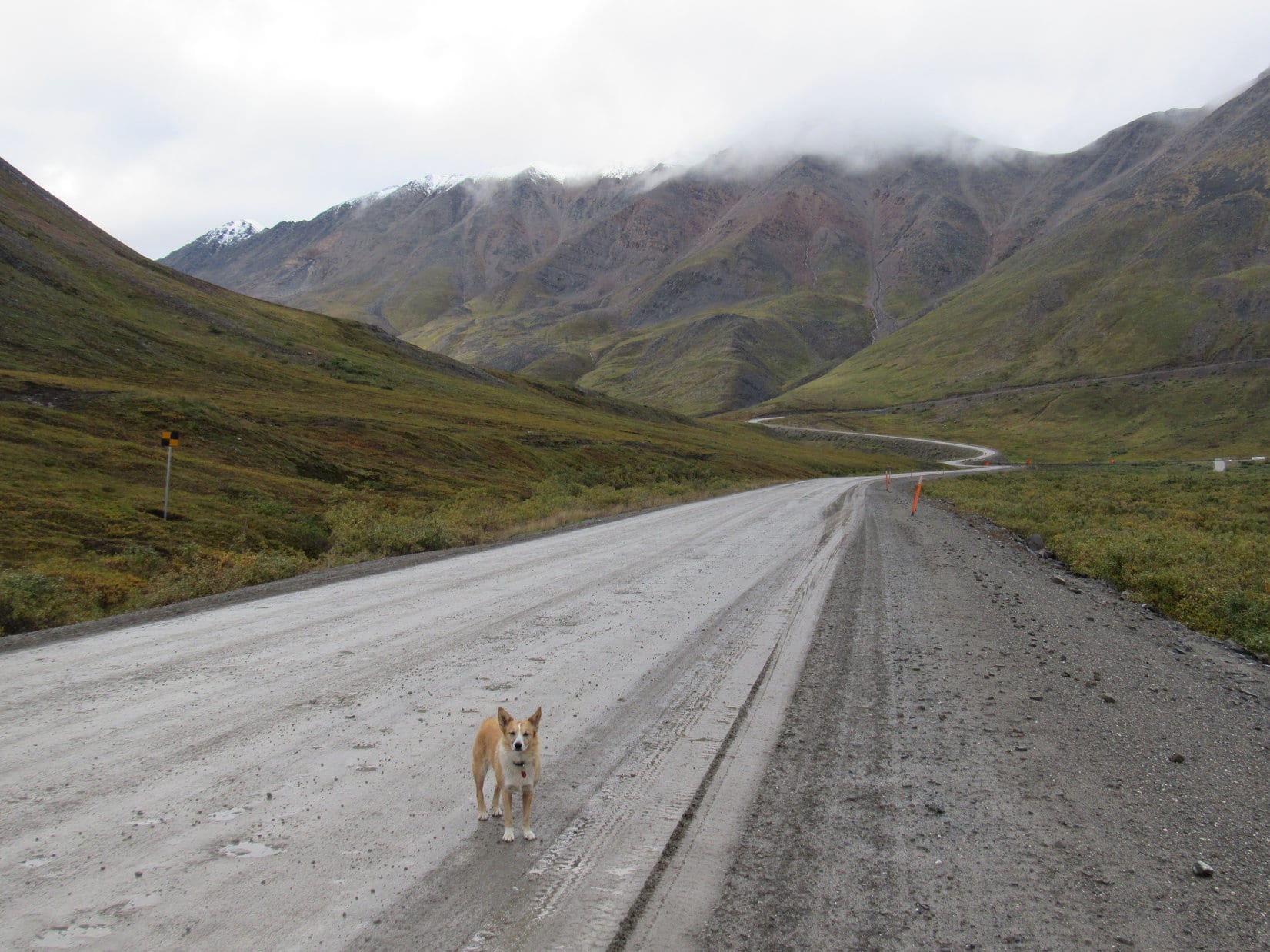
The Dalton Highway’s beautiful pavement ended even before Lupe reached milepost 210 a couple miles N of Dillon Mountain.  That was a shame.  The highway was now mud, gravel, and potholes.  Only a few miles farther, as Lupe was nearing the Mountain of the Midnight Sun, SPHP saw an impressive view of Dillon Mountain in the rear view mirror.  It was worth a quick stop.

Lupe near milepost 213. Her Mountain of the Midnight Sun (R) is only a few miles away now. Unfortunately, the Dalton Highway has already reverted to mud and gravel. Photo looks NNW.
An impressive view of Dillon Mountain from milepost 213 of the Dalton Highway. Photo looks SSE.

Lupe reached the Mountain of the Midnight Sun at milepost 216.  A glance told the story.  It was a great mountain, but SPHP wasn’t prepared to tackle anything like that.  Despite the mountain having been a dream goal for over a year, Loop and SPHP paused only briefly before continuing on.

The summit of the Mountain of the Midnight Sun is hidden in the clouds somewhere to the R, perhaps off the edge of this photo. SPHP could tell at a glance that this just wasn’t happening for Lupe. Disappointing, but not unexpected. Photo looks NE.

The drive up the Dietrich River valley was as beautiful as SPHP had promised it would be.  The Dalton Highway eventually left the river, climbing fairly steeply up the side of a ridge.  Near the top, the road curved to the R.  A broad plain flanked by mountains came into view ahead.  SPHP parked the G6 at a large pullout on the R (milepost 237).  Lupe had reached the Chandalar Shelf.

Clouds prevailed over most of the sky, but Lupe stood in weak sunshine when she got out of the G6 for a look.  (6:00 PM)  The Chandalar Shelf was gorgeous!  A treeless tundra of colorful low bushes stretched away for miles.  The flanking mountains were dark beneath the clouds, but weren’t rough or particularly high.

Loopster arrives at the Chandalar Shelf. Photo looks E.

Table Mountain (6,314 ft.) was in view more than 4 miles S of the pullout.  Though the summit was partially obscured by clouds, and looked like it might have a dusting of new snow on it, SPHP was excited to see that Table Mountain looked like an eminently climbable peak for Lupe!

It was much too late, and weather conditions weren’t right anyway, to consider an ascent today.  If she stuck around, Lupe could climb Table Mountain tomorrow, though, if the weather would cooperate.  If Loop stayed here overnight, she could get an early start in the morning.

Beyond the Chandalar Shelf, the summit of Table Mountain (R of Center) is partially obscured by clouds. SPHP could see enough to tell that Lupe ought to be able to climb Table Mountain easily enough, if the weather would cooperate. Photo looks S.

Lupe was interested in making a brief foray out onto the Chandalar Shelf.  It seemed like a good idea.  Loop and SPHP quickly learned that the ground was soggier than expected.  When the time came, the best route to Table Mountain across the Chandalar Shelf would likely be on the highest terrain possible.  Fortunately, this was pretty much the most direct line to the mountain, anyway.

Lupe makes a brief foray out onto the Chandalar Shelf. Photo looks E.
Lupe discovered this faint set of vehicle tracks heading straight for Table Mountain. When the time came to climb the mountain, she intended to start out for it this way. Photo looks S.

Perhaps Lupe and SPHP should have stayed at the Chandalar Shelf overnight.  Then Lupe might have climbed Table Mountain the next day, but the prospect of seeing new territory made continuing on exciting and attractive.  The Arctic stays light a long time, even in mid-August.  Lupe had hours of daylight left.  Besides, she would eventually have to return this way.  She could climb Table Mountain then.

Looking back at Table Mountain (L) as Lupe continues N on the Dalton Highway. Photo looks SSW.

Lupe was only a few miles beyond the Chandalar Shelf when it became apparent that the Dalton Highway would soon start climbing to Atigun Pass (4,739 ft.).  The road was wet, soft, and slick, and the tops of the mountains here were definitely sporting new snow.  What would the road be like?  Could the G6 even make it to Atigun Pass?

Lupe on the Dalton Highway only a few miles N of the Chandalar Shelf. The highway would soon start its ascent of Atigun Pass. Photo looks NNE.
The Dalton Highway starts up to Atigun Pass ahead on the R. Photo looks NNW.
18th of August, and the mountaintops were sporting a dusting of new snow. Photo looks NW with help from the telephoto lens.

The climb up to Atigun Pass initially seemed daunting.  The road was steep, wet and slick.  A light rain was falling, and the possibility of snow on the road ahead was worrisome.  However, the G6 was doing fine.

The Dalton Highway climbs to the R toward Atigun Pass. Doesn’t look scary from here. Photo looks NNW.
Lupe stands on the Dalton Highway partway up to Atigun Pass. So far, so good. Photo looks NE.
Looking back down. The G6 was doing fine despite the wet road. Photo looks SW.

The top of Atigun Pass (milepost 245) was only 2.5 miles from the big curve where the Dalton Highway began gaining elevation in earnest.  Despite initial trepidation, the ascent had gone quickly and smoothly.  The pass was 38°F when Lupe arrived.  There was a huge pullout on the E side of the highway.  Sadly, and rather surprisingly, Loop found no commemorative sign of any kind.

Lupe arrives at Atigun Pass for her first time ever to find 38°F weather on August 18th, light rain, a huge wet pullout, and no commemorative Atigun Pass sign of any kind.

Atigun Pass (4,739 ft.) is the high point of the Dalton Highway, and on the continental divide along the spine of the Brooks Range.  S of the pass, water drains W to the Bering Sea, part of the North Pacific Ocean.  N of the pass, water flows N to the Arctic Ocean.

As geographically significant as Atigun Pass might be, it didn’t take a Carolina Dog long to conclude her inspection of cloudy mountains, cool damp weather, and a muddy parking lot.  After a few minutes, Loop was ready to go see whatever was N of the pass.

The drive down the N side of the Brooks Range was fascinating!  For a couple of miles, the Dalton Highway seemed steeper here than it had been S of Atigun Pass.  The road wound around making big curves along the sides of the mountains.  Up high, a heavy mist was coming down.  Fog drifted among mountains capped with new snow, most summits hidden in the clouds.

SPHP drove slowly so Lupe could take it all in.  The American Dingo stopped a couple of times on the way down, too, just to better appreciate being N of Atigun Pass for the first time ever.

Lupe on a little side road just off the Dalton Highway. Wow! Here she was, N of Atigun Pass in the Brooks Range!
Though it would have been fun to see these mountains in bright sunshine, the chill mist and fog only added to the sense of mystery and remote solitude.
Looking up at the new snow on the mountaintops, SPHP was struck by the notion that maybe Lupe shouldn’t stay too long N of Atigun Pass. It wouldn’t take much of a snowstorm to make the Dalton Highway impassable to the G6, and apparently it was already autumn here in mid-August!

After a couple of miles of steep, wide turns, Lupe could see she was now down close to where the road’s grade was about to moderate.  The Dalton Highway was heading into a long valley.  Small streams by the road were some of the headwaters of the Atigun River beginning a long journey to the Arctic Ocean.

A couple miles from Atigun Pass, the Dalton Highway headed for a long valley. Creeks near the road were the beginnings of the Atigun River. Photo looks N.

The Dalton Highway began straightening out.  It made gentle curves along lower slopes of the mountains following the newly forming Atigun River down the valley.  A dozen miles from Atigun Pass, a major tributary came in from a big valley to the SW.  The Atigun River was already getting big, and the valley was widening out.

Lower down, the Dalton Highway started leveling out making long gentle curves along the base of the mountains as it followed headwaters of the Atigun River downstream. Lupe was beyond the rain and mist she’d experienced at Atigun Pass. Photo looks N.
The Atigun River was much larger and the valley widened out after a major tributary of the river joined in from a big valley to the SW. Lupe stands in sunshine within sight of a few encouraging patches of blue sky in the widened valley. Photo looks N.

Not a tree grew anywhere.  Tall bushes were uncommon, though plenty of low ones grew.  The Atigun River valley was a starkly beautiful boreal tundra flanked by some of the northernmost mountains in Alaska.

Before too long, it began to look like the Dalton Highway would soon be approaching the end of the Brooks Range.  SPHP didn’t realize it yet, but Loopster could already see Lake Benchmark Mountain (5,000 ft.), the mountain she would try to climb tomorrow hoping for a glorious view of Alaska’s vast North Slope.

The Dalton Highway is starting to approach the N end of the Brooks Range here. SPHP didn’t realize it yet, but Lake Benchmark Mountain (far L in the distance), which Lupe hoped to climb tomorrow, is already in sight. Photo looks N.

Where the Atigun River came closer to the Dalton Highway, SPHP parked the G6.  Being here was a dream come true!  Time to get out and enjoy!  Loop happily explored the tundra, while SPHP walked over to the river.

Lupe stopped here where the Atigun River flows close to the Dalton Highway. Alaska’s North Slope starts beyond the mountains seen in the distance. Photo looks N.
Lupe visits the fabled Atigun River in the northern Brooks Range. Photo looks N.
The Atigun River really is beautiful, SPHP! However, I have a feeling I won’t be barking at any squirrels around here. I haven’t seen a single tree since before we reached Atigun Pass! Photo looks N.
Hi, there! This is Lupe, the Most High Exalted Dingo of the Arctic Sisterhood reporting in from the E bank of the Atigun River on the N side of the Brooks Range, just in case any of you other Arctic sisters are thinking of coming up here and would like to know what to expect. Photo looks SSW.

Lupe enjoyed a short romp near the Atigun River, but she was getting very close to being as far N as SPHP had planned for her big 2017 Dingo Vacation.  She would soon be close to Lake Benchmark Mountain and Galbraith Lake where her journey N would end.  In fact, a dark cluster of peaks up ahead must be where Lake Benchmark Mountain was!

It was exciting being here, nearing a new even more northerly last mile N record for Lupe.  What would she see there?  Lupe and SPHP returned to the G6 to keep going.  Soon a gap appeared in the mountains ahead.  Beyond the gap was a distant flat land.  The North Slope!  That was where it began!

Only a little farther on, this gap appeared in the mountains ahead. Beyond the gap, Lupe could see the beginning of the North Slope (Center)! Photo looks NW.
SPHP was certain that the highest ridge R of Center in this cluster of dark mountains was Lake Benchmark Mountain, the peak at the N end of the Brooks Range that Lupe had come all this way to climb! However, Lupe later discovered SPHP was in error. (Hardly a first!) Photo looks N with help from the telephoto lens.
Mountains W of the Dalton Highway beyond the Atigun River. Photo looks W.
A look back to the SSW. The Atigun River valley is on the L.

The Atigun River did not flow N through the gap Lupe had seen directly out onto the North Slope.  Instead, shortly before reaching the gap, the river turned E entering a narrow valley between high mountains.  Near this E bend, the Dalton Highway crossed a bridge over the Atigun River, leaving it behind and continuing N toward the gap.

The highway was going uphill now, bordered on one side by the Alaska oil pipeline and a high ridge Lupe would climb tomorrow on her way to Lake Benchmark Mountain somewhere to the E.  On the W side of the highway, Lupe ought to be seeing Galbraith Lake any moment now.  Sure enough, Galbraith Lake quickly came into view.

The Dalton Highway continues N after crossing a bridge over the Atigun River where the river turns E. The Alaska oil pipeline parallels the highway below the last mountains of the Brooks Range. Photo looks N.
A couple miles N of where the Dalton Highway crossed a bridge over the Atigun River, Lupe reaches a view of Galbraith Lake. Only the S end of the large lake is seen here. Photo looks SW.

Galbraith Lake lies at the base of the N side of the Brooks Range.  The S end of the lake is in a wide plain near high mountains, but the N end of Galbraith Lake extends out into the beginning of the North Slope.  Lupe could see the entire lake from the Dalton Highway.  She was now about as far N as SPHP had planned for her to go – at the end of her northern explorations.

Lupe stands on the Dalton Highway with a view of the N end of Galbraith Lake. This was about as far N as SPHP had planned for her to go. Photo looks W.

Standing there on the Dalton Highway, with glistening Galbraith Lake in full view beneath a gray sky, SPHP was seized with the notion that Lupe ought to go farther.  Yes, Loop could see the beginning of the North Slope at the N end of Galbraith Lake from here, but the sky was lighter over that way, and the Dalton Highway was still going up as it continued N.

Maybe by going a few miles farther, Lupe could get to some higher point where the light would be better, and she could see much more of the North Slope?  It seemed worth a shot.  It was late in the day.  Lupe and SPHP had nothing better to do before sunset.

It was a good decision.  As SPHP drove N, the light did improve, and so did the views of the North Slope.  The Dalton Highway reached the top of the hill it had been climbing.  SPHP continued driving N over a couple minor rises looking for a place to park the G6.  Several miles beyond the last hills of the Brooks Range, a wide side road appeared on the W side of the Dalton Highway near milepost 236 or 237.  Yes!

Loopster, Loopster, come on!  Hurry!  This is it!  What you’ve come so far to see!  We’re in the nick of time!

Lupe was almost alarmed by SPHP’s excited, wild behavior, but being a bold American Dingo, leapt out of the G6 ready for anything.

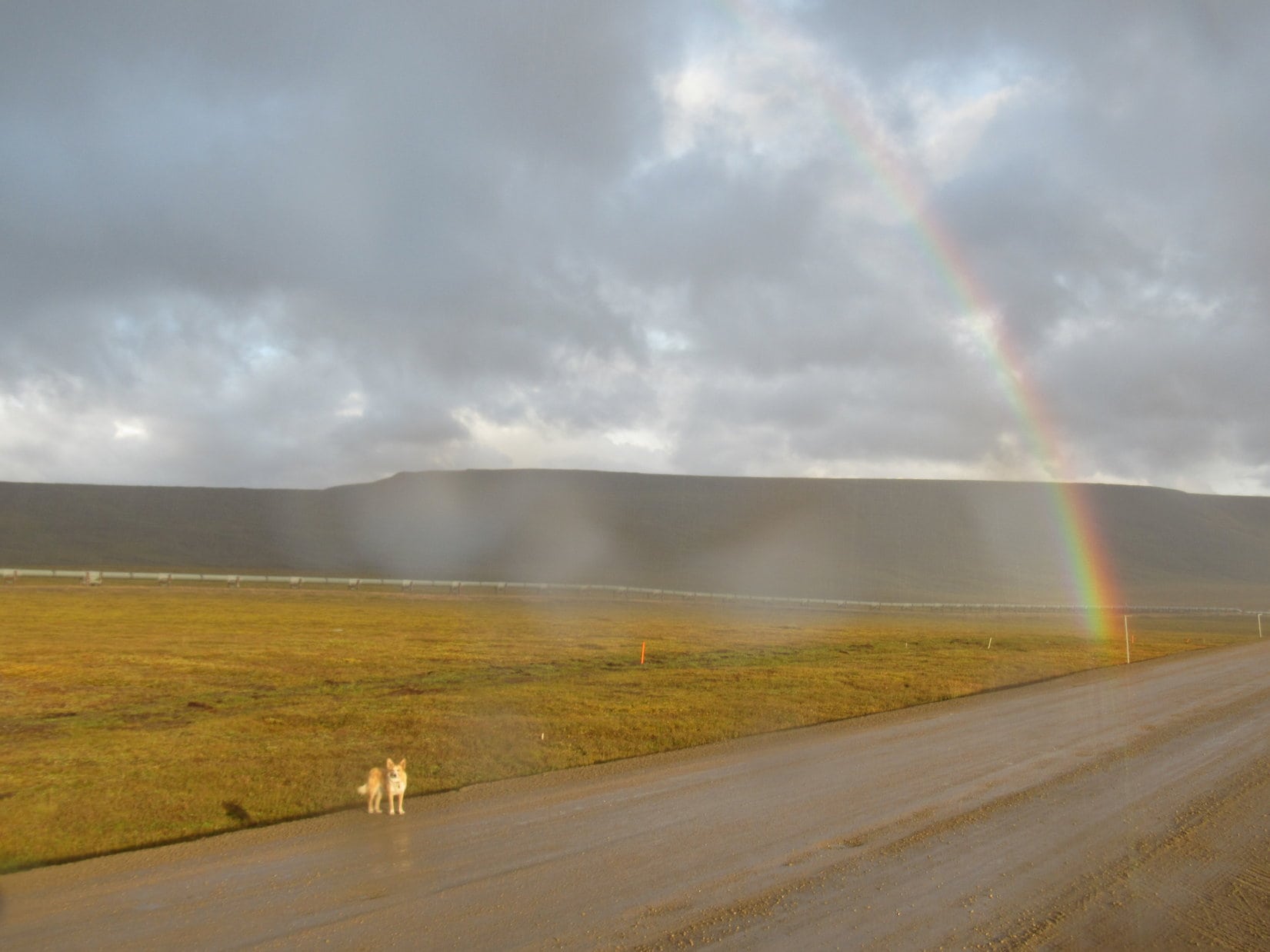
It was raining.  And sunny.  Gentle rolling fields of gold extended N as far as Lupe could see toward big hills bordering on small mountains on the horizon.  To the W a line of much higher mountains marked the N edge of the lonely, remote Brooks Range.  To the SE, a last ridge stood high and dark in a shadowy gloom.  In sunlight, before this forbidding ridge, extending down to the golden boreal tundra, glowed a double rainbow.

It was raining. Photo looks NW.
Gentle golden slopes extended as far as Lupe could see to high hills and small mountains on the horizon. Photo looks N.
And sunny. Remote peaks along the N edge of the Brooks range appear miles beyond the North Slope’s billowing sea of gold. Photo looks WSW.
In front of the last high, shadowy ridge of the Brooks Range, glowed a double rainbow. Photo looks SE.
Loop in dazzling sunlight at the end of the rainbow on Alaska’s North Slope.

It was an amazing moment, so full of joy!  This was it!  This was the unbelievable North Slope even better than any dream.  Lupe had arrived when the whole world appeared as a boundless treasure.  The North Slope’s limitless tundra was a promised golden land at the end of the rainbow.

Such magical moments can’t last.  They flit away, never to return, like carefree butterflies blown far and wide, lost wherever soft breezes take them.  The rainbow, the dazzling sunlight, the glistening raindrops would all quickly fade or pass by.  Yet for a few wonderful fleeting moments, it was all so very real, as real as anything ever was.

On the Dalton Highway in the promised land of Alaska’s North Slope. Photo looks E.
Sweet Loop near the end of the rainbow. Photo looks SSE.
N of the Brooks Range. Photo looks SE.

Chasing rainbows, Lupe got cold and wet.  She was tired and hungry.  SPHP turned the G6 to face the sunset.  Alpo for Lupe, then her warm blankie.  At evening’s end, a pale sun sank into a bank of gray clouds.  No colors, no beauty, simply gone.  The vast gray tundra stretched away to infinity.  Lupe snoozed as SPHP watched the North Slope fade away.  (10:30 PM, 41°F)

In North Slope Dingo Dreamland.
So this is it? The promised land of the North Slope with a rainbow and everything? I’m going to close my eyes and make a wish. Maybe there will be squirrels here when I open them!
A magical moment on the North Slope, Alaska 8-18-17

Want more Lupe adventures?  Choose from Lupe’s 2017 Dingo Vacation to the Yukon & Alaska Adventure IndexDingo Vacations Adventure Index or Master Adventure Index.  Or subscribe free to new Lupe adventures.

Cathedral Mountain, Brooks Range, Alaska (8-17-17)

Day 18 of Lupe’s 2017 Dingo Vacation to the Yukon & Alaska!

6:18 AM – Light out, sort of.  Lupe sniffed around near the G6 in a thick fog.  It had rained bunches yesterday evening and most of the night.  No rain now, just this gray gloom.  The air was dead calm.  Little hope existed that conditions would change anytime soon.  May as well snooze a few more hours.

8:44 AM – Awake again.  The Carolina Dog was starting the morning off right, barking at a squirrel in the spruce trees nearby.  Still foggy, but the fog was thin enough now so that a bright spot revealed the position of the sun.  Slightly encouraging, but nothing to get excited about yet.

In the meantime, why not get a photo of Looper by the big red metal gate she’d gone by yesterday to start her fabulous adventure to Caribou Mountain (3,179 ft.)?  As long as the fog persisted, there wasn’t much else to do anyway.  SPHP joined Lupe outside the G6.

The foggy morning after climbing Caribou Mountain, Lupe stands near the red metal gate she’d gone past yesterday to start that adventure. The G6 had been, and still was, parked close by. This gate provides access to the Alaska oil pipeline service road, and is located on the W side of the Dalton Highway about a mile S of the Kanuti River. Photo looks W.

Lupe was still standing next to the red gate, when suddenly the sky brightened so much it actually seemed sunny out.  Overhead, the fog was tinged with blue!  Maybe this was only a ground fog that would burn off before long?

9:31 AM – Well, well!  It was true!  The early morning’s gloom had only been a ground fog after all.  First, a tiny patch of blue sky appeared.  It had spread with incredible speed.  Within only 15 minutes, 80% of the sky was clear and bright.  Sort of amazing to watch!  This Arctic weather was so different from back home.  Suddenly, things were looking up for Loopster!  Adventure was back in today’s forecast now!

The fog had only been a ground fog. The morning sun was burning it away at a tremendous pace. Suddenly, adventure was in today’s forecast for Lupe!

And then, unbelievably, the whole process reversed itself.  The sun had only been shining on the dewy tundra for a few minutes, when the additional warmth caused moisture from last night’s rain to evaporate, making the air more humid again.  As quickly as the fog had burned away, it reformed.  Dense fog engulfed the land again.  The sun no longer existed.

Huh.  Weird.  Really strange.  Lupe had never seen anything quite like that before.  Now what?

Apparently anything at all might happen today.  Since Lupe had finished the adventures planned for around here, she might as well continue N.  She would just have to be flexible, and see how things worked out.

The fog and sun continued their battle as SPHP drove N.  Lupe’s first stop was at an important landmark, one that was even more significant since Lupe had recently become the Most High Exalted Dingo of the Arctic Sisterhood after climbing AB Mountain (5,036 ft.) near Skagway 10 days ago.  At milepost 115.5 on the Dalton Highway, Lupe reached the Arctic Circle.

Lupe reaches the Arctic Circle at milepost 115.5 along the Dalton Highway. She had been here in 2016, too, but this time she arrived as the Most High Exalted Dingo of the Arctic Sisterhood!

The sun had been winning its struggle with the fog, so Lupe and SPHP stuck around at the Arctic Circle for a while.  There was both a picnic ground and campground here.  SPHP used one of the picnic tables to prepare a meal.  Meanwhile, Lupe was entertained barking at squirrels in the forest.

Once the meal was consumed, Lupe continued N on the Dalton Highway.  It felt so incredible to be back in the Arctic again!  The drive through mile after mile of Arctic wilderness was like a dream.  Loop stopped briefly at Gobbler’s Knob (milepost 132) for a view of the Brooks Range, which she was rapidly approaching.

Even before reaching milepost 160, Cathedral Mountain (3,350 ft.) came into view.  It hadn’t rained at all on Loop yet this morning, but a shower had passed through here not long before.  The pavement was all wet.  Conditions were admittedly a bit iffy, and it was already getting a little late in the day for starting such a big adventure, but maybe Lupe could still climb Cathedral Mountain?

Only one person who uses Peakbagger.com had ever climbed Cathedral Mountain, and that had been more than 22 years ago.  Richard Carey had been there on 7-29-95.  Fortunately, Carey had written a concise trip report full of useful information.  Carey had mentioned a small pullout with room for only one or two cars at about milepost 168.5.  Nearing the area, SPHP slowed down to look for it.

SPHP didn’t see any small pullout, but there was a really large gravel pullout on the NW side of the Dalton Highway about where Carey had said to look.  Maybe things had changed in 22 years?  Certainly possible.  SPHP parked the G6.  The American Dingo shot out eager for action.  Things looked a bit iffy.  Cathedral Mountain was right across the Dalton Highway from here, but the sky overhead was looking mighty gray.

Cathedral Mountain from the Dalton Highway near milepost 168.5. Photo looks SE.

All was not gloom and doom, however.  A mix of blue sky and puffy clouds was off to the SW, and seemed to be heading this way.  Loop and SPHP were both in favor of taking a chance on Cathedral Mountain.  SPHP got everything ready, and the American Dingo set out on her next big adventure.  (1:56 PM, 53°F)

Water could be heard on the SE side of the Dalton Highway.  A stream was hidden over there in the forest.  By the looks of the terrain, the stream would pass under the highway a short distance back to the SW.  It would be nice to avoid a creek crossing.  Lupe followed the highway SW until she was past where the stream went under it, before turning S and plunging into the forest.

Loopster on the Dalton Highway somewhere near milepost 168.5. Photo looks SW.

Lupe immediately found herself in a densely packed spruce forest on thick, spongy tundra.  Tall, slender bushes were in the mix, too.  This was exciting stuff for the Carolina Dog!  Lupe ran sniffing and exploring, but was careful not to stray too far from SPHP.

Of course, the thick vegetation was still wet from last night’s rains and the recent shower in this area.  Before long, Lupe and SPHP were both soaking wet, too.  Not unexpected.  Onward!

Lupe was immediately impressed with the dense forest off the Dalton Highway. She ran this way and that, excitedly sniffing and exploring.

From the Dalton Highway, a high barren ridge had been visible to the S well above tree line.  That ridge appeared to be in the vicinity of Richard Carey’s successful line of ascent described in his trip report, so Loop needed to get up there.  The ridge couldn’t be seen from down in the dense forest, but Loop and SPHP headed in its general direction.

Before long, water could be heard again.  Another stream!  Lupe reached it, and found the stream wider and deeper than could be readily forded.  Both banks were lined with dense stands of tall bushes.  Just getting in or out of the stream was an issue, never mind across it.  No way!  Maybe if Loop continued upstream far enough there would be a better spot?  The stream might even bend off to the SW, in which case the Carolina Dog wouldn’t even need to cross it.

The terrain down by the stream was a difficult trek.  Too many bushes amid jumbled rocks.  Loop and SPHP turned E to climb onto a low ridge above the creek valley.  This ridge headed SE, which wasn’t the really the direction Lupe needed to go, but would be fine for a little way.  Climbing up onto and moving around on the ridge wasn’t all that easy, either.  Spongy tundra made each step more difficult.  While the spruce trees weren’t all that big, they were close together.

Lupe came to a few spots where the forest wasn’t so dense.  The high barren ridge she needed to get to could then be seen to the S.  Loop could also see farther up the creek valley.  The news wasn’t good.  The valley was turning SE instead of SW.  Sooner or later, Lupe was going to have to find a way across that darn stream.

A view of the ridge Lupe was trying to get to from a rare open spot in the forest. Photo looks S with help from the telephoto lens.
While SPHP fiddled around with maps worrying about streams and ridges and routes and terrain, Lupe was having a grand time in the forest on her first adventure N of the Arctic Circle since she became the Most High Exalted Dingo of the Arctic Sisterhood!
Another view of the ridge Lupe was trying to get to (Center) from a little farther along in the forest. Lupe eventually was able to climb up the closer hill (L of Center), which led her to the E (L) end of the higher ridge. Photo looks S.

Lupe and SPHP continued SE gaining elevation gradually on the low ridge for a while longer.  Finally, the time came to see how much of a problem it was going to be to get across the creek up here.  Lupe went SSW, leaving the ridge to look for the stream.

The stream wasn’t far away.  This time the news was unexpectedly good.  The stream was rushing along, but much smaller up here, only 3 feet wide and not very deep.  Easy squeezy!  SPHP swung across it with the help of an overhanging branch.  Lupe simply leapt across.

One problem solved.  However, an hour had already shot by since leaving the Dalton Highway.  Puppy, ho!  Time to get up on that barren ridge.

Lupe reaches the stream again 0.5 mile upstream of where she had first come to it. The news was good this time. The stream was much smaller up here than it had been down below. Lupe could easily leap across it.

Once beyond the stream, Loop headed S gaining elevation.  The barren ridge she was aiming for was soon in sight ahead.  The climb got steadily steeper and steeper.  Progress seemed slow.

Another big hill was closer than the barren ridge Lupe was heading for.  It looked like it might connect to the barren ridge much higher up than where the Carolina Dog was now.  Maybe Loop should climb this hill?  Getting above all the trees, bushes, and spongy tundra would be a huge help.  Seemed to make sense.  Yeah, Loop was going to try this closer hill instead of trudging through this difficult stuff all the way to the base of the barren ridge.

The climb up the nearer hill was quite steep.  The trees soon thinned out, though scattered trees and plenty of bushes remained for a while.  The hill narrowed.  Higher up, Looper started coming to rock outcroppings.  The rock formations were small, only 10 or 20 feet high.  The American Dingo always found a way around them, though they sometimes slowed progress.  Before she’d climbed terribly far, Lupe was beginning to get views of the Koyukuk River.

Only partway up the first big hill Lupe climbed she started getting views of the Koyukuk River. Photo looks N.
Rain showers are in progress beyond the Koyukuk River. Photo looks NW.

After what seemed like a long climb, Lupe managed to reached the top of the hill.  She found that this wasn’t a separate hill at all.  Loop was on a small level ridge protruding N from the rest of Cathedral Mountain.  There were no trees here, although some bushes were around.  Most of the ridge was covered with tundra and small rock outcroppings.  Lupe had plenty of room to move around, and the views were the best yet.

Loop had expended so much energy having a blast down in the forest, that she was ready for a rest break.  SPHP concurred.

Lupe curls up for a rest upon reaching the ridgeline at the top of the first big hill she’d just climbed. Her peakbagging goal, the summit of Cathedral Mountain, is beyond her at Center. Photo looks E.
Lupe relaxes near the end of the small ridge. The Koyukuk River is in view. Photo looks N.
Koyukuk River from the far end of the ridge. The Dalton Highway is on the near side of the river. Photo looks N.

While Loop rested, SPHP studied the topo map and read Richard Carey’s trip report again.  Carey hadn’t mentioned anything about a stream crossing.  As soon as Lupe had come to the stream, SPHP had suspected that she hadn’t started from the exact same place as Carey.

The topo map concurred.  It seemed fairly certain Lupe had started out about a mile farther NE on the Dalton Highway than Carey had.  Maybe more like at milepost 169.5 than 168.5.  Eh, whatever.  Looper must have started from just N of the streams shown in Section 12, and had left the Dalton Highway between them.  If the American Dingo had only gone a little farther SW on the highway before leaving it, she would have completely avoided both streams.

This little ridge Lupe was on right now was between the “A” and “L” at the end of “Cathedral” on the map.  The barren ridge Lupe was trying to get to was Carey’s “small hill” in the 2,500 ft. contour ENE of High Point 2545.  Carey had passed a little S of this hill on his way E from the “low saddle”, which couldn’t be seen from here.  All Loopster had to do now was gain the remaining 200+ feet of elevation required to reach the top of the barren ridge.  She would then be in position to intercept Carey’s route the rest of the way.

Simple enough.  The small ridge Lupe was already on connected directly to the slope leading up to E end of the barren ridge.  Best get on with it.  It had taken SPHP two hours just to get this far, and it was still a long way to the top of Cathedral Mountain.  The weather might put an end to things at any time.  Loop had been lucky so far, but rain showers were always in sight not terribly far away.

The ridge Lupe is on leads straight to the E end of the barren ridge she has been trying to get to all this time (Center). The top of the barren ridge is 200+ feet of elevation gain from here. Photo looks SSW.

Reaching the top of the barren ridge seemed to require more like 250 feet of elevation gain than 200 feet.  The upper slope was surprisingly steep.  Lupe had no problems, but SPHP was grasping for anything at all to hang onto, which wasn’t much.  Nevertheless, both Loop and SPHP made it to the top.

For the first time, Lupe could now see territory S of Cathedral Mountain.  A check of the topo map matched up with what Loop was seeing exactly as expected.  No doubt at all where she was now.

Lupe finally reaches the top of the barren ridge. Both the true summit of Cathedral Mountain (Center) and the slightly lower N summit (L) are in sight. Photo looks E.
Having reached the top of the barren ridge, Lupe could now see territory on the other side of Cathedral Mountain. The Dalton Highway is in view passing through low ground dotted with small lakes. Lake 1035 is the larger lake on the L. Photo looks SW.
The “low saddle” Carey had gone through on his ascent is seen between Lupe and the ridge at Center, which is High Point 2545. Twelvemile Mountain (3,180 ft.) is the multi-peaked mountain seen faintly beyond High Point 2545. Photo looks WSW.

From the barren ridge, Lupe could now join up with Carey’s route by heading SE toward an upper saddle at 2,750+ feet elevation.  Lupe had a good view of this upper saddle, though the camera produced a lousy one due to moisture on the lens.  A brief rain shower was sweeping over the area as the Carolina Dog was about to continue on again.

The upper 2,750+ ft. saddle (Center) from the barren ridge. Not such a hot shot due to a rain shower in progress, but still shows the overall lay of the terrain quite well. Lupe was heading for this upper saddle next. Photo looks SE.

The rain shower didn’t last long and was of no consequence.  Lupe lost a bit of elevation leaving the barren ridge for the upper saddle, but was soon regaining it traversing a steep slope well below a rocky ridgeline.  The slope was surprisingly tough going – slanty with minor drop offs, spongy tundra, and lots of bushes.  Lupe finally climbed higher up on the slope close to the lower rocks, and things were a bit better up here.

Looking back on the way to the upper saddle. High Point 2545 is the hill L of Center. Beyond it and a little more to the L is Twelvemile Mountain (3,180 ft.). The barren ridge Lupe had just left is on the R. The low saddle Carey had crossed is at Center. Photo looks W.
Lupe approaches the upper saddle. The rain shower has moved on. Photo looks SE.
Looking back again from near the upper saddle. High Point 2545 is in the foreground at Center. The low saddle is next to it on the R. Twelvemile Mountain is in the distance beyond the Koyukuk River on the L. Photo looks W.

Lupe passed slightly above and to the N of the upper saddle.  She was now heading E on the S side of Cathedral Mountain.  Ahead was another even slightly higher saddle at 2,800+ feet elevation.  On the S side of this highest saddle, High Point 2955 was in view.

Lupe at the N end of the upper saddle. An even higher saddle at 2,800+ ft. elevation is in view on the R along with High Point 2955. Cathedral Mountain’s main E/W ridgeline is on the L. Photo looks SE.

From here, Carey had continued E staying somewhat below and to the S of Cathedral Mountain’s main ridgeline.  The top of the ridgeline was to be avoided, since it was so rocky and jagged.  Actually, the way SPHP read it, Carey had probably bypassed this upper saddle staying quite a bit higher and closer to the ridgeline than where Loop was now.

That didn’t matter.  Lupe could easily angle up nearer the ridgeline as she kept going E.  She headed toward a big rock fairly high on the slope N of the 2,800+ foot saddle.

From here Lupe would head for the highest big rock seen R of Center. Photo looks ESE.
Lupe reaches the big rock on the slope N of the highest 2,800+ ft. saddle. The 2,750+ ft. upper saddle is in view on the R. The low saddle Carey had come though is at far R well beyond it. Twelvemile Mountain is in the distance on the R. Photo looks WSW.

From the big rock, Lupe continued E, slowly gaining elevation.  At first, this route was pretty easy.  However, the slope kept steepening.  As the tundra thinned out, Loop was more and more frequently traversing loose scree slopes.

Lupe continues E on Cathedral Mountain’s S slope not too far below the ridgeline. It was still easy going along in here. Photo looks WNW.
Making progress. Cathedral Mountain’s SE ridge is now in view on the R. Photo looks E.
The slope kept getting steeper as Lupe proceeded E. Vegetation thinned out and Loop began encountering more scree. Photo looks E.

For quite a long way, Lupe could see part of Cathedral Mountain’s SE ridge ahead.  A long slope on this side of it slanted steeply up to the N leading to the still unseen summit.  If Lupe could get over to that slope, SPHP was pretty certain she stood a good chance of reaching Cathedral Mountain’s summit, provided it could be reached without any technical climbing.  Carey hadn’t mentioned any.

However, it was still in question whether or not it would be possible to get over there.  The slope Loop was on kept getting steeper, and SPHP feared the Carolina Dog was going to come to an impassable point.  The views immediately below Lupe’s position were becoming incredible, and a bit intimidating.  SPHP quit looking down.

The mountain presented a series of minor “horizons” coming down the S slope that Lupe couldn’t see beyond until she got to them.  One by one she crossed them going E, but another always appeared a little farther on.  SPHP kept wondering if Loop was too high or low on the mountain?  The answer wasn’t obvious.  The Carolina Dog just kept going.

Finally, a much larger ragged line of rock appeared extending down the S slope from Cathedral Mountain’s main ridgeline.  What would Lupe find there?  Would she be able to get beyond it?  More to the point, could SPHP get beyond it?  Being able to turn that corner was critical to success.  Carey had done it, but he had genuine mountaineering experience.

Lupe needed to reach the greenish slope below Cathedral Mountain’s SE ridge seen on the R. That slope goes N (L) right up to the summit. Carey had done it, but he had real mountaineering experience. The line of rocks coming down from the ridgeline ahead on the L made it questionable whether SPHP could get over there. Photo looks ENE.
Lupe was feeling confident, even if SPHP had doubts. Just have to be able to turn this last corner! Photo looks ENE.

About the time Lupe reached the rocky spine coming down from the main ridgeline, a second rain shower appeared heading straight this way.  SPHP donned the rain poncho.  Once again, Lupe got wet, SPHP didn’t, and the shower passed by fairly quickly without putting a serious damper on things.

A second rain shower swept over Loop and SPHP at the hardest part of the climb up Cathedral Mountain, but fortunately didn’t last long before sailing away. Photo looks back to the SW.

Loop and SPHP had to down climb a bit to get around the rocky spine, but succeeded in getting by it. The worst part of the trek to Cathedral Mountain’s summit was now behind the American Dingo!  If the summit wasn’t technical, she was going to get there.  That wouldn’t be known until she climbed hundreds of feet up the steep scree slope ahead.

After getting by the rocky spine, Lupe still faced a long steep climb up to the ridgeline where she expected to find Cathedral Mountain’s summit. Photo looks NE.

Up, up, up!  Steep.  Real steep, but Lupe was finally approaching the ridgeline.  Big rock formations sat atop much of it, but Lupe could keep progressing E easily enough staying a bit below them.  The summit couldn’t be too far away!

After a long climb up the really steep scree slope, Lupe sits among rocks only slightly below Cathedral Mountain’s main E/W ridgeline. The summit is just beyond the high point in sunshine on the R. Photo looks ENE.
Near the top of the ridge not too far W of the summit. Lupe had come up the slope on the L. Photo looks WSW.
A look at Cathedral Mountain’s SE ridge. Photo looks ESE.

A little W of the mountain’s true summit, Lupe reached the top of the main E/W ridgeline.  Now she could see in almost every direction.  The views were stupendous!  So, so beautiful!

Right up on top of the main E/W ridge now. Photo looks WSW.
A rain shower sweeps through territory between Twelvemile Mountain (3,180 ft.) (L) and the Koyukuk River. Photo looks W.
Cathedral Mountain’s N summit from the main E/W ridgeline. Photo looks NNE.
The Koyukuk River and Cathedral Mountain’s slightly lower N summit. Photo looks N.

An easy stroll E along the main ridgeline brought Lupe to the summit of Cathedral Mountain.  Here she found two 10 foot high knobs of rock.  They were separated by 12 to 15 feet of level ground covered with vegetation.  The E knob appeared clearly higher by a foot or two.  Neither of the knobs was very large on top, but there was room for Loop to sit or stand comfortably.

Lupe scrambled up onto the higher E knob first.  She found a small cairn on top protecting two tin cans that were painted red.  The larger can was turned upside down over the smaller one to shield it from the weather.  The American Dingo had made it!  Despite SPHP’s fears and doubts near the end of the journey, she sat calmly and confidently at the true summit of Cathedral Mountain (3,350 ft.)!

Lupe sits by the cairn at the true summit of Cathedral Mountain! Photo looks ENE.
Loop on top of Cathedral Mountain. The red tin can protecting a smaller one inside containing a registry is in view as Loop found it. Photo looks ENE.
Cathedral Mountain was the first mountain N of the Arctic Circle that Lupe climbed after becoming the Most High Exalted Dingo of the Arctic Sisterhood by climbing AB Mountain (5,036 ft.) near Skagway 10 days ago. Photo looks ENE.

So was there a registry inside the smaller tin can?  Yes, there was!  Inside was a plastic bag containing a pencil and a small notebook serving as a registry.  A surprising number of entries were contained in it.  Far more people had been up on Cathedral Mountain than SPHP would ever have expected.

Inside the front cover was something amazing.  The notebook was in such good condition, it was hard to believe it was true.  Richard Carey himself had brought this very notebook to the top of Cathedral Mountain more than 22 years ago!  His was the first entry!

The notebook serving as a registry was in such great condition it was hard to believe Richard Carey had placed it up here more than 22 years ago. Inside the front cover, his was the very first entry.

SPHP entered Lupe’s name in the registry to make her ascent official.  Lupe received lots of praise for her valiant efforts to get here, and SPHP shook her sweet paw in congratulations.  SPHP recited how Cathedral Mountain was her 3rd summit ever N of the Arctic Circle and 1st of 2017, what memorable adventures each ascent had been, and how splendid each peak was!

Loop was pretty happy with all the richly deserved attention.  Of course, the notebook and pencil went back in the plastic bag and inside the little red tin can.  Everything got put back exactly as Lupe had found it.

Then, even though the day was getting so late it made SPHP nervous considering how long it had taken to get here, it was time to relax a bit up on Cathedral Mountain.  Picture time!  These were views Loop and SPHP would never want to forget.

Cathedral Mountain’s N summit with the Koyukuk River in the background. Photo looks NNE.
A rain shower sweeps over the Koyukuk River valley. Photo looks NNW.
Looking down on High Point 2955 in the foreground. Photo looks SW with help from the telephoto lens.
Cathedral Mountain’s SE ridge is on the R in shadow. Photo looks ESE.
Loopster up on the slightly lower W knob in competition for the title of true summit of Cathedral Mountain. Photo looks WSW.
On the W knob, only a foot or two lower than the true summit. Photo looks W.
Evening sunlight filters through clouds and rain showers down onto the Koyukuk River. Photo looks NW.
Looking NNE farther up the Koyukuk River valley. Cathedral Mountain’s N summit is in the foreground. Photo taken with lots of help from the telephoto lens.
Looking WSW over part of Cathedral Mountain’s main E/W ridge with lots of help from the telephoto lens.
Twelvemile Mountain (3,180 ft.) (Center) in evening sunlight. Photo looks W.

After nearly 40 minutes at the top of Cathedral Mountain, the sad moment of departure drew near.  What a magnificent peak!  Lupe climbed up on top of the summit’s W knob one more time.

Before departing, Lupe scrambled up on the W knob one more time. Photo looks E.
Loop’s last moments atop Cathedral Mountain. Photo looks E.

The return trip was marvelous!  It had seemed to SPHP that maybe Loop had been too low for too long on the ascent.  At times, things had looked easier higher up.  Of course, there was a lot of rock along the top of the ridgeline.  Maybe it wasn’t possible to stay so high, but on the way back, Loopster was going to try.

Staying high worked.  This was a faster route with amazing views.  Lupe was eventually forced down off the ridgeline, but not until she was getting close to the highest saddle N of High Point 2955.

Heading down, but staying high along the main ridgeline as long as possible. This was a better route than the way Lupe had come up. Twelvemile Mountain is on the R. Photo looks WSW.
Loop almost always had to stay on the S side of the main E/W ridgeline when forced to make a choice. The N side was usually cliffy. That wasn’t always true. Here she’s on the N side of the mountain with a fantastic view of the Koyukuk River. Photo looks N.
Done with the main ridge and descending to the highest saddle. High Point 2955 is on the L. Photo looks SW with lots of help from the telephoto lens.
Lupe explores the highest saddle. Photo looks WSW.

Instead of returning to the top of the barren ridge on the way back, Lupe skirted it to the S as Richard Carey had done.  She passed over the low saddle NE of High Point 2545 retracing Carey’s route.  She continued W along the mountainside a little beyond the saddle before turning N and descending between two rounded bald hills.

Lupe with a grand view of the Koyukuk River from the W end of the low saddle Richard Carey had crossed N of High Point 2545. Photo looks N.

Lupe’s route below the bald hills was steep, but was full of thick tundra, which made it soft and easy.  Going up here would have been tough, but Loop made rapid progress down the slope.  She never did have to cross a stream, although she did cross a long stretch of boggy terrain on a much more gentle slope nearing the Dalton Highway.

The light was almost gone by the time Lupe made it back to the Dalton Highway.  A 0.25 mile gradual uphill trek remained to Alpo and a warm blankie inside the G6.  What a wonderful day Cathedral Mountain had been!  (11:00 PM)

The Koyukuk River from the low saddle near day’s end, Cathedral Mountain, Brooks Range, Alaska 8-17-17

Want more Lupe adventures?  Choose from Lupe’s 2017 Dingo Vacation to the Yukon & Alaska Adventure IndexDingo Vacations Adventure Index or Master Adventure Index.  Or subscribe free to new Lupe adventures.