Black Hills, SD Expedition No. 188 – Peak 6181, Peak 6040 & Custer Mountain (1-18-17)

2017 was the pits!  Dullsville.  Cold, cold, cold.  And snowy.  Day after day, Lupe stared out the window.  She would heave a big sigh after a while, give up, and go lay on the couch looking like she’d lost her last friend.  Now and then she got to chase her new PupJoy flying disc across the glacier in the back yard, but that was about it for excitement.  With temperatures hovering near zero, she wasn’t even getting her usual evening walks.

However, temperatures had started creeping up the last few days.  The snow began to melt a little.  Finally, this morning’s forecast called for blue skies and unseasonable warmth.  SPHP asked if Lupe would like to go hiking in the mountains?  Lupe could hardly believe her big soft Dingo ears!  If barking, racing around in circles, and leaping for joy mean anything, she was more than ready!

Lupe had spent most of her Black Hills expeditions in 2016 climbing peaks around the SW, NE and NW perimeters of the Black Hills.  In the fall, she even ventured way up into the Bear Lodge mountains in NE Wyoming.  SPHP had expected that by the time 2016 was over, there wouldn’t be many named peaks remaining in the Black Hills that Lupe hadn’t climbed at least once – a handful, but not many.

However, Brian Kalet, a very active mountaineer from Colorado, had come through the Black Hills in May of 2016 to climb a curious set of peaks mostly concentrated in the southern Black Hills.  Brian had added all of them to the Peakbagger.com data base.  When Lupe is logged in to her account, these peaks show up as red circles on the topo map, meaning she hasn’t climbed them.  And Lupe doesn’t allow red circles in her Black Hills home base without a good reason!

Why had Brian come here?  And why had he climbed such an odd combination of mostly unnamed peaks?  The only clue SPHP could find was that all of Brian’s ascents here had over 300 feet of prominence.  Prominence is the vertical distance a peak rises above the highest col (meaning pass, ridge, or saddle) connecting it to a higher summit.

Perhaps Brian had been deliberately searching out mountains with at least 300 feet of prominence?  That’s a metric tracked on Peakbagger.com, and Brian Kalet has climbed over 3,100 different such peaks, the second most of any account holder.  Nothing else seemed to make any sense.

Whatever Brian’s reasons, now that it was 2017, it was time for Lupe to turn those annoying red circles on the map to green.  They had been taunting Lupe long enough!  She’d gotten a head start on the Brian Kalet peaks by climbing Peak 5688 and Peak 5440 in December.  Next up on her list was Peak 6181, located 1.5 miles NW of the town of Custer.

Mica Ridge Road goes very close to Peak 6181, but a quick scouting trip proved the property along the road was all privately owned.  SPHP resorted to parking the G6 at a pullout for an “interpretive site” on the E side of Hwy 385 (9:14 AM, 41°F).  From here, Lupe had USFS land access all the way to Peak 6181.

The mountain was only 1.25 miles off to the SSW.  Lupe crossed over to the W side of Hwy 385, and started climbing a fairly steep slope.  She had to leap through nearly foot deep snow, which easily came up to her belly.  Lupe likes snow, though.  She was excited to be out in the hills again, and having a good time.  Up the thinly forested slope she went, heading for the top of a ridge.  She reached it at a saddle between two minor high points.

The top of the ridge had less snow, only half a foot in most places.  Lupe crossed level ground leading to the nearest high point to the S.  After a short climb, she was there.  Thunderhead Mountain (6,567 ft.), where the Crazy Horse Memorial is located, was in view to the N.  Off to the SW, Lupe could see her objective, Peak 6181.

From the first minor high point Lupe reached, the Crazy Horse Memorial on Thunderhead Mountain was in view. Photo looks N using the telephoto lens.
Off to the SW, Lupe could see her objective, Peak 6181 (Center).

S of the minor high point, Lupe saw a thickly forested hill.  This hill was nearly as high as Peak 6181, but she didn’t need to climb it.  Instead, Lupe went S only far enough to reach a logging road that headed SW.  Near this road was a dramatic looking rock outcropping, the top of which leaned out into space.  It reminded SPHP of a petrified artillery gun, thereby acquiring the name Artillery Rock.

Lupe near the dramatic, overhanging rock outcropping known henceforth as Artillery Rock. Photo looks W.

Snow had drifted onto the logging road as much as 2 feet deep in places, which was pretty deep for Lupe.  Often there was less snow off the road.  Bare ground existed in a few places with a lot of S exposure.  Yet plentiful slash and debris left off-road by the loggers frequently made the road easier to deal with despite the snow.  Lupe continued SW toward Peak 6181 following the road closely, but not always right on it.

Although at times a bit of a struggle for Lupe, the trek along the road was pretty.  The snow was still quite frosty and crunchy.  In many places it was unspoiled by any tracks.  Snow crystals sparkled in the bright sunlight like tiny jewels.  Big granite rock formations nearby added scenic interest.

Lupe on the logging road. Peak 6181 is dead ahead. Photo looks SW.
Snow crystals sparkled like tiny jewels in the bright sunlight.
Getting closer! Granite rock formations near the logging road like those on the R added scenic interest to Lupe’s trek. Photos look SW.

The climb to the top of Peak 6181 was easy, and didn’t take long.  Lupe followed the NE ridge up.  Soon she was standing on the highest rocks at the summit.  Hah, success!  Another red circle on the Peakbagger.com topo map would turn green for Lupe!

Lupe stands on Peak 6181’s highest rocks! Photo looks W.

Lupe had surprisingly good views from Peak 6181.  Most of them were from points a little below the top of the mountain.  Too many trees blocked the views at the summit, although Lupe did have open views toward the W and NW from there.  Atlantic Hill (6,393 ft.) and Bear Mountain (7,166 ft.) were among the peaks she could see from the summit.

Looking NW toward Atlantic Hill and Bear Mountain.
Atlantic Hill is in the foreground slightly L of Center. Bear Mountain is the high, long ridge seen beyond it. Photo looks NW using the telephoto lens.
Looking SW using the telephoto lens.

Even though it hadn’t taken Lupe terribly long to get here, the snow had made the journey considerably more strenuous than it ordinarily would have been.  Lupe and SPHP took a short break at the summit.  Loopster wasn’t hungry yet, but SPHP munched on a few carrot sticks.  Lupe curled up on the ground near SPHP’s feet.

After break time, Lupe went to see the rest of the views from points a little lower down.

Northeast Cicero Peak (6,240 ft.) (Center). Photo looks SE using the telephoto lens.
Harney Peak (7,242 ft.), South Dakota’s highest mountain, was only visible between the trees from one little spot on the NE slope of Peak 6181. Photo looks NE.
Harney Peak using the telephoto lens.
Mount Coolidge (6,023 ft.) is the high point straight up from Lupe’s shoulder. Custer Mountain (6,089 ft.) is straight up from her tail. Photo looks SE.
Sylvan Peak (7,000 ft.) (Center). Photo looks NE.
Buckhorn Mountain (6,330 ft.) (R of Center). Photo looks ENE.

With her exploration of Peak 6181 complete, Lupe returned to the G6 by the same route (11:50 AM, 55°F).  Since it wasn’t even noon yet, Lupe had plenty of time to climb another mountain.  Her next objective was Peak 6040, located a couple miles SW of Custer.

The plan was for Lupe to also climb Custer Mountain (6,089 ft.), if there was enough daylight remaining after Peak 6040.  SPHP parked the G6 at the intersection of Lower French Creek Road and USFS Road No. 341, about 0.75 miles NNE of Custer Mountain (12:06 PM, 54°F).  Lupe set off heading W on No. 341, which was snow-packed.

For a mile, Lupe stayed on No. 341, gaining elevation gradually the whole time.  She then left the road to climb S toward a saddle between High Points 5900 and 5998 on the topo map.  She found a snowy logging road near the saddle, but did not follow it.  Instead, she turned SW toward High Point 5998.  For a while, she had an easy time climbing along a fairly broad, rounded ridgeline.

Lupe had an easy time climbing this fairly broad, rounded ridge on her way to Peak 6040. Photo looks SW.

Lupe tried to bypass High Point 5998, skirting it to the SE.  However, this side of the mountain became progressively steeper, and was littered with increasing amounts of deadfall timber.  Snow made things so slick, that SPHP started slipping.  After a few minor stumbles, SPHP decided Lupe had better head up to the ridgeline.

By now, Lupe was already close to the top of the ridge.  She reached it in only a couple of minutes.  Lupe had succeeded in bypassing High Point 5998 to some degree, but wasn’t far S of the very top.  Only a little farther S was a nice level spot with some grass, and a wide open view toward the town of Custer.

S of High Point 5998 on the way to Peak 6040, Lupe had a great view toward the town of Custer. Peak 6181, which she had climbed earlier, is seen beyond the town a little L of Center. Photo looks NW.

The ridge leading SSW toward Peak 6040 was narrow and rocky.  Peak 6040’s summit was only 0.33 mile away, but this route was very slow going.  Medium-sized rocks sitting at all sorts of angles dominated the whole length of the narrow ridge.  On both sides, the terrain was steep and full of trees, deadfall, and more rocks.  To the E there was also snow.

Lupe on a typical stretch of the narrow, rocky ridge leading SSW to Peak 6040. There weren’t any cliffs or other dangers, but the ridge was full of obstacles that made this route very slow. Photo looks SSW.

Lupe had no choice, but to pick her way forward through all the obstacles, while staying on or very close to the ridgeline.  Gradually, both sides of the ridge kept getting steeper and more difficult.  The rocks on top increased in size as Lupe continued S.  SPHP began to fear Lupe might come to rocks so big she couldn’t climb over or get around them.

The ridge kept getting steeper on both sides, and the rocks on top were getting bigger and harder to climb or maneuver around. Photo looks SSW.

Fortunately, that never happened.  Lupe managed to reach the top of Peak 6040.  The highest rock was only about 50 feet N of the S end of the ridge.  The skinny summit rock was standing on end.  It was barely wide enough for Lupe to balance on, but she hopped right up on it.

Lupe stands on the highest rock of Peak 6040 to claim another peakbagging success! SPHP had started to fear she might not be able to reach the summit from the ridge she had been following. Fortunately, the ridge became a little wider, and the rocks smaller, shortly before Lupe reached the top. Photo looks SSW.

There weren’t any views to speak of from the summit rock due to the forest.  Lupe and SPHP went on to the SSW end of the ridge, where there were at least some views to the S.  Due to the S exposure, the ground was snow-free and dry.  Lupe and SPHP stopped for a break.  Lupe still wasn’t hungry.  SPHP consumed the rest of the carrot sticks.  Lupe curled up with her head resting on SPHP’s leg.

From the end of the ridge, Lupe had a good view of Northeast Cicero Peak. Photo looks S.
Far to the SSW, Lupe could also see Parker Peak (4,848 ft.) (the small hill at Center). Parker Peak is the high point of Fall River County. Photo taken using the telephoto lens.

It had taken much longer to reach Peak 6040 than expected.  SPHP sat looking at the partial views, petting Lupe, and pondering what to do next.  The original idea had been that Lupe would follow the ridgeline all the way back over a series of high points around to Custer Mountain.

Clearly that wasn’t going to work.  The ridge route was too slow.  Lupe would run out of daylight.  Only two other options existed.  She could forget about getting to Custer Mountain today, or she could try going down the SW slope of Peak 6040 to see if there was a faster way lower down leading directly over to the last saddle NW of Custer Mountain.  That was a long shot, but might work.

After a 15 minute break, SPHP checked out that 2nd option.  Peering SW down from the end of the ridge, what little could be seen through the forest was encouraging.  Lupe would easily be able to go down that way, if it didn’t get any steeper.  May as well try it.

Before leaving Peak 6040, Lupe returned to the summit again.

A pensive Lupe sits among rocks a little S of the summit. Photo looks NNE.
Lupe surveys the situation from next to Peak 6040’s summit rock, seen beyond her tail. Photo looks NNE.
OK, I’ve done this mountain, what’s next?
A small opening between branches gave Lupe a glimpse of Harney Peak (R) to the N.
Near the actual summit, Lupe also had this pretty decent view to the SW.

With her photo duties complete, Lupe returned to the SSW end of the summit ridge and started down to the SW.  The forest hid all distant views, but the slope remained only moderately steep the entire way.  Lupe gradually turned S, then SE as the terrain permitted.  This route would have been a much easier way to the top of Peak 6040 than the NNE ridge she had actually followed.

Lupe finally arrived down at the top of an excavation into the side of the mountain.  Below was a flat open area, which might have had something to do with an old mine shown on the topo map.  From the open area, a primitive old road went E.  Lupe went down to the road and followed it.

At first there was a lot of snow, and later on deadfall timber was in the way at regular intervals, but the road was level and turned NNE, the direction Lupe needed to go.  Lupe was making good time again.  Despite a few obstacles, this was a much faster route than the ridge had been.

The road eventually ended, but not until it was almost to a large clearing.  On the opposite NE side of the clearing was the slope leading up to the saddle immediately NW of Custer Mountain.  The sun was low in the sky by the time Lupe gained the saddle, but she still had time enough to climb Custer Mountain!  Up she went.

Lupe had climbed Custer Mountain (6,089 ft.) once before, almost 2 years ago in March, 2015.  SPHP only remembered that the summit had been at some large rocks with virtually no views, but Lupe had found a way to the very top.

Little had changed in nearly 2 years.  After climbing the steep slope, Lupe arrived at the NE end of a narrow summit ridge consisting of large rocks with steep drops on both sides.  However, there was room enough to work SW among the rocks and trees for 100 – 150 feet all the way to the true summit.  Lupe was leery of getting right up on the exposed summit rocks, but finally relented.  The Carolina Dog stood faithfully waiting for the OK to come down.

The only real change at the top of Custer Mountain was that many pine trees had been killed by pine bark beetles and had lost all their needles.  Most of the dead trees were still standing, but it was a little easier than before to see off into the distance.

A slightly nervous Carolina Dog stands at the true summit of Custer Mountain. This was Lupe’s 2nd time here. Photo looks SSW.
Loopster waited up there long enough for SPHP to climb down to take this shot looking back up. Photo looks SSW.
Are you done yet, SPHP? The view is grand if you like dead trees, but I’ve seen enough!

Sunset was coming in 15 minutes.  Time to skedaddle!  SPHP gave the OK, and Lupe jumped down from the true summit.  The American Dingo paused twice going back along the summit ridge, once where there was an opening among the dead trees where she had a good view of Daisy and Kruger Peaks, and again at the very NE end of the ridge, where Harney Peak could be seen.

Daisy Peak (5,948 ft.) (R) and Kruger Peak (5,838 ft.) (L) from Custer Mountain. Photo looks SSE.
Loop at the NE end of the summit ridge. She liked standing on this nice flat rock. Photo looks NNE.
Harney Peak at sunset. Photo looks N.

Back down the steep NNW slope.  The sun was gone before Lupe reached the saddle.  As the light faded, the Carolina Dog turned NNE and continued down the mountain.  The snow was a foot deep in this part of the forest.  Lupe had to work getting through it.  Down, down.  At last USFS Road No. 314 came into view.  Lupe had it made now!  The G6 wasn’t far away.  (5:28 PM, 36°F)

Expedition No. 188 finally got 2017 off to a successful start.  Lupe had fun, and left with high hopes for more Black Hills adventures in the very near future.  After all, she still has a lot of Brian Kalet peaks she needs to climb!

Going down the steep NNW slope of Custer Mountain minutes before sunset.

Links:

Next Black Hills Expedition                   Prior Black Hills Expedition

Want more Lupe adventures?  Choose from Lupe’s Black Hills Expeditions Adventure Index or Master Adventure Index.  Or subscribe free to new Lupe Adventures.

Lupe’s Last Mile North, Brooks Range, Alaska (8-14-16)

Day 16 of Lupe’s Summer of 2016 Dingo Vacation to the Canadian Rockies, Yukon & Alaska.

Lupe barely stirred.  SPHP woke briefly several times.  Eventually, it was light out, a beautiful bright Arctic day, but weariness still overcame.  SPHP could hardly move.  The sandman prevailed.

After yesterday’s amazing, and ultimately triumphant, climb of Sukakpak Mountain (4,459 ft.), Lupe and SPHP had returned to the G6 a little after midnight, the N sky still aglow with twilight.  Lupe had been exceptionally lively on the return trip, but once back at the G6, she devoured an entire can of Alpo and promptly passed out, exhausted.

Twilight at 11:55 PM nearing the G6.
Twilight at 11:55 PM nearing the G6 on the return from Sukakpak Mountain the previous evening.

12:18 PM!  Good grief, it was afternoon already!  Both Lupe and SPHP felt better.  Time to get going.  SPHP drove N a mile or two from the pullout W of Sukakpak Mountain near milepost 203 to a rest stop on the E side of the Dalton Highway.

Lupe explored the bushes and forest nearby, while SPHP straightened up the G6 and picked up trash scattered around the rest stop.  Lupe was surprisingly energetic.  She acted like she could climb Sukakpak Mountain again, today!  SPHP didn’t feel ready for that, but it was a gorgeous day in the Arctic – pale blue skies, puffy white clouds and temperatures in the 60’s °F – something ought to be done with it!

Content with her investigations of the nearby forest, Lupe returned to rest in the shade of the G6.  Now it was SPHP’s turn to feel energetic.  Maybe another mountain ascent was possible?  Only 3 or 4 miles NNE of Sukakpak Mountain, was Dillon Mountain.  SPHP had brought along a Peakbagger.com trip report by Richard Carey, who had climbed not only Sukakpak, but Dillon Mountain, too.

That was it!  Lupe was going to climb Dillon Mountain (4,820 ft.)!  Lupe and SPHP piled back into the G6.  SPHP drove N another 2 or 3 miles, crossing the bridge over the Dietrich River before parking the G6 again at a little pullout a short distance beyond milepost 207.  At 1:42 PM (70°F), Lupe and SPHP set off to the SE for Dillon Mountain.

According to Carey’s trip report, Lupe’s first objective was to cross a swampy low plain for more than a mile while aiming for a low saddle N of High Point 2003, where Lupe might be able to find an old road.  High Point 2003 was in view from the Dalton Highway, so it was easy to see which way to go.

The first part of the low plain was open forest, and an easy march over dry land.  Lupe followed an old road a little way.  When the road faded away, there were animal trails to follow.  The forest was soon left behind.  Lupe had reached the swampy part of the plain.

In the middle of August, the swampy plain really wasn’t all that swampy, but it was surprisingly difficult to traverse.  The entire area was full of tussocks, each one surrounded by partially hidden narrow channels, normally full of water.  The channels were up to 2 feet deep, and some of them still did contain water, or were at least muddy.

Walking on top of the tussocks was hard.  Most of them leaned, or collapsed, in unpredictable directions as soon as stepped on.  Walking in the narrow, partially hidden channels between them wasn’t any good either, due to frequent wet or muddy surprises.  Although the plain looked flat as a pancake, progress across it was ridiculously slow and tiring.

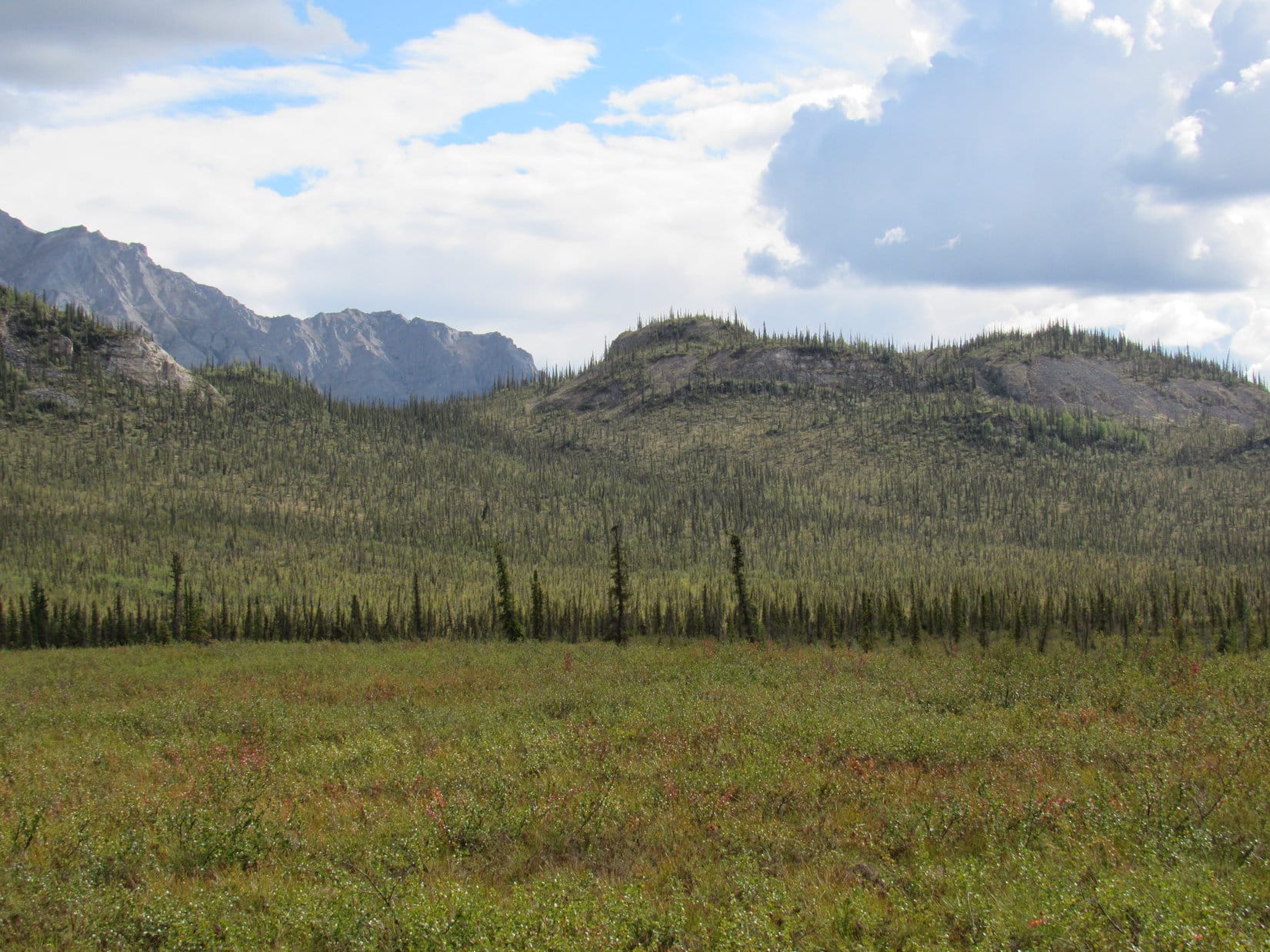
A stunted forest could be seen ahead, on the opposite side of the plain where the terrain started rising toward High Point 2003.  The plain became wetter and muddier as Lupe got closer to the forest.  Small ponds appeared.  Finding a dry route became tricky.

Approaching the stunted forest on the SE side of the swampy plain. High Point 2003 (Center) is in view, as well as part of Dillon Mountain (L). Tussocks made crossing this plain far more difficult and tiring than anticipated. Photo looks SE.

Lupe and SPHP found a way around the ponds and wet areas.  Lupe reached the forest.  She was about to start the gradual climb toward the saddle N of High Point 2003.  She never got there.  A little way into the forest, SPHP decided to take a breather, and sat down for a short rest.  Lupe laid down to rest, too.

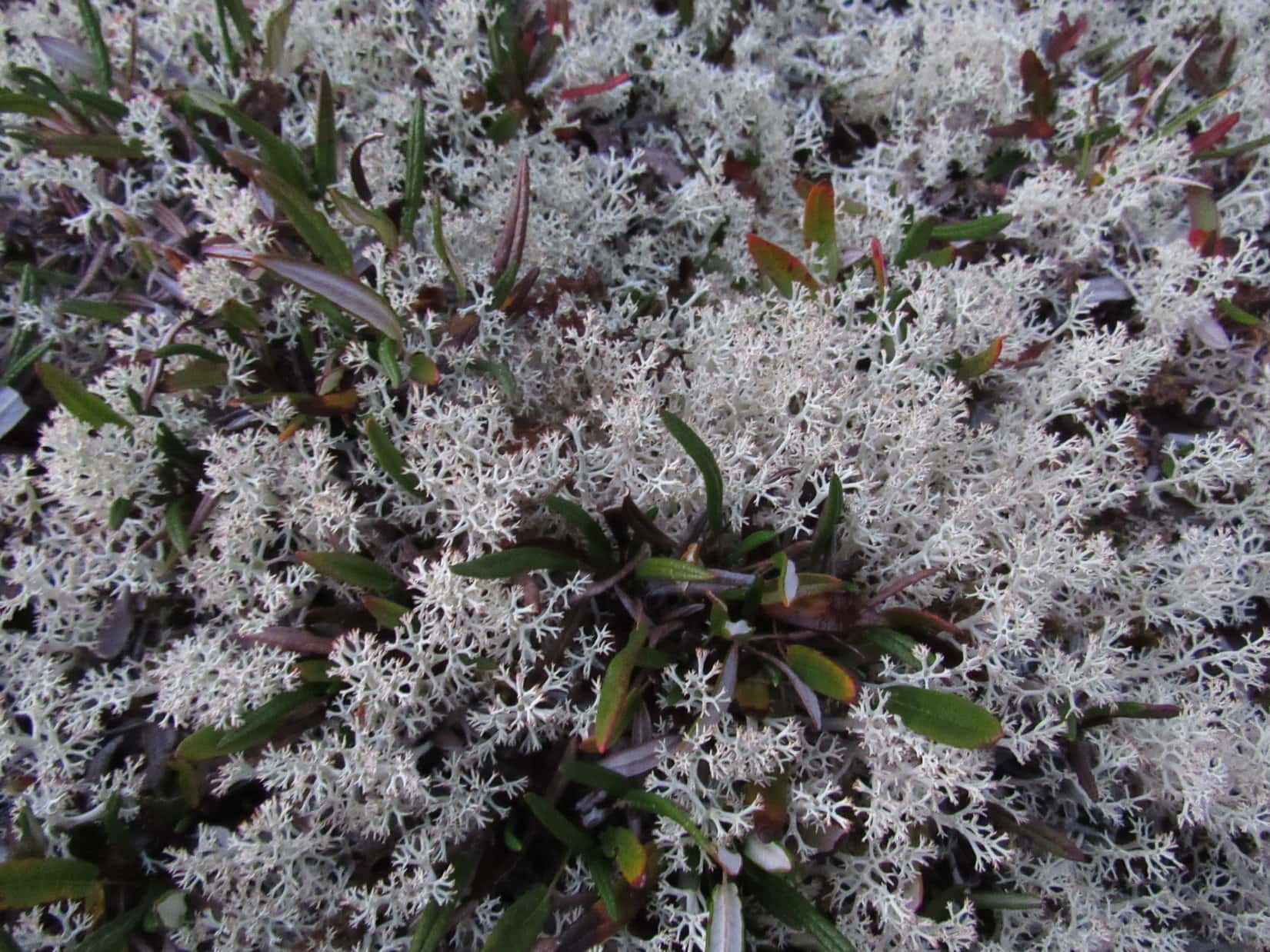
The forest floor was thickly covered with beautiful plants of the tundra.  The ground was spongy, soft and inviting.  Wild blueberries grew everywhere.  SPHP tried a few.  They were much smaller than blueberries sold in stores, but were an exquisite combination of sweetness and tartness.

The tundra was thickly covered with beautiful small plants. They made the forest floor incredibly spongy and soft. The white moss or lichens seen prominently in this photo, tended to grow where the ground was a little drier.
Lupe dozing on the soft tundra among the wild blueberries.

SPHP fell into the blueberry trap.  The wild blueberries were small, but oh, so delicious!  They hung on delicate low bushes so closely together that sometimes it was possible to pick 4 or 5 of them at a time.  They grew everywhere.  SPHP sat picking and consuming wild blueberries.  Lupe dozed nearby on the soft, comfy tundra.

Crossing the low plain was supposed to have been the very easy start to the difficult climb up Dillon Mountain.  Instead, it had been much more of a struggle than anticipated.  Neither Lupe nor SPHP had really recovered from Sukakpak Mountain yesterday.

As SPHP consumed blueberries, all ambition drained away.  Time slipped by.  Lupe was happy snoozing.  Soon it was apparent that Dillon Mountain wasn’t happening.  It was too late in the day to try it anyway.  Forget about it!  Maybe tomorrow.

The sky started clouding up.  Soon, raindrops sprinkled over the tundra.  It didn’t look serious, but maybe it was time to head back.  SPHP had noticed a small lake to the N on the way here.  Lupe might as well check it out on her way back to the G6.

Staying farther N helped avoid the worst of the tussocks.  Lupe did find the small lake, which proved to be quite close to the Dalton Highway.  The shore of the lake was swampy.  Lupe and SPHP passed SW of the lake, eventually reaching the dry ground and animal trails leading to the faint old road to the highway.

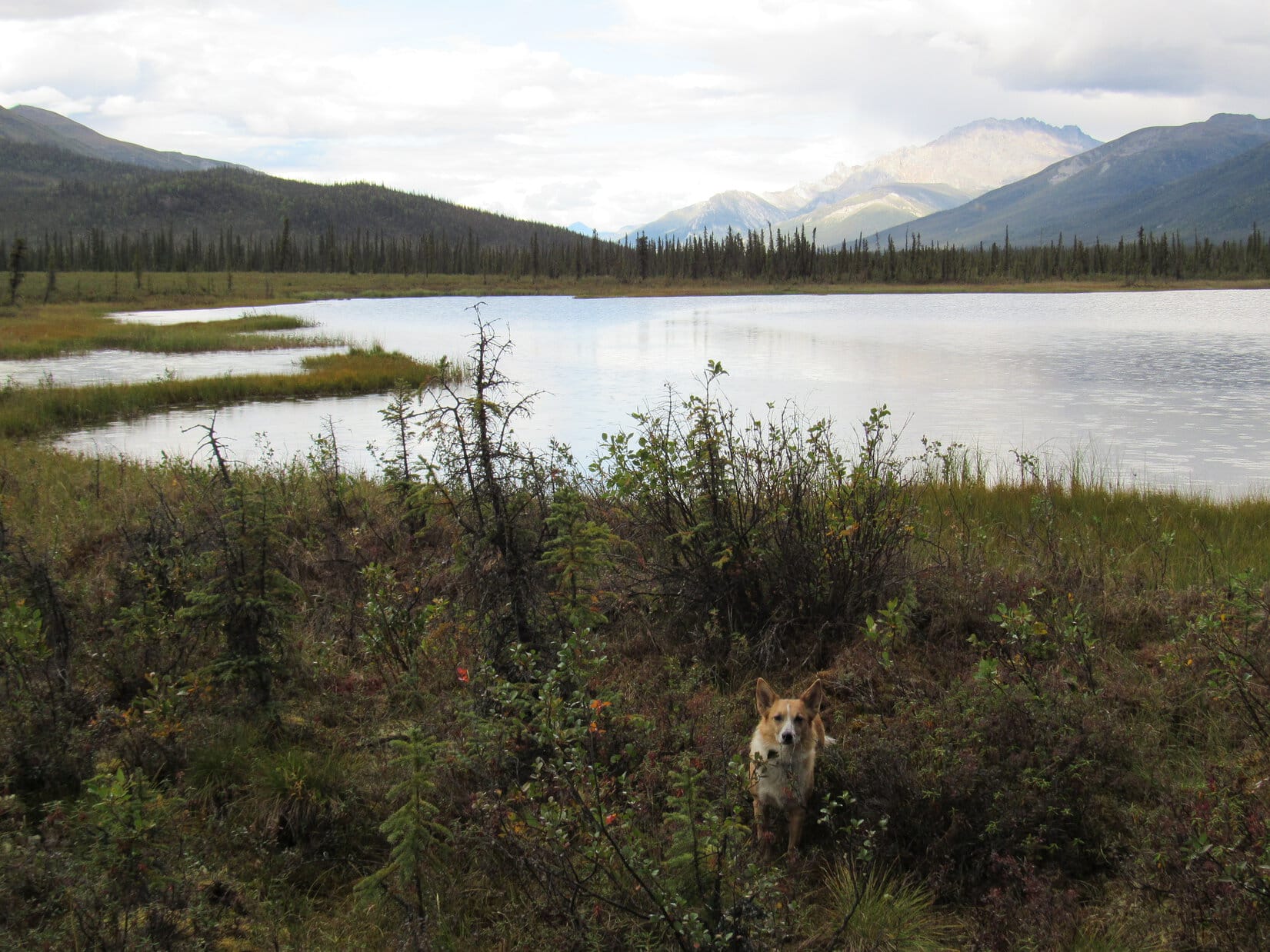
Lupe reaches the small lake near the swampy S shore. This lake (elevation 1,415 ft. on the Peakbagger.com topo map) is a mile W of Dillon Mountain. Photo looks NNW.
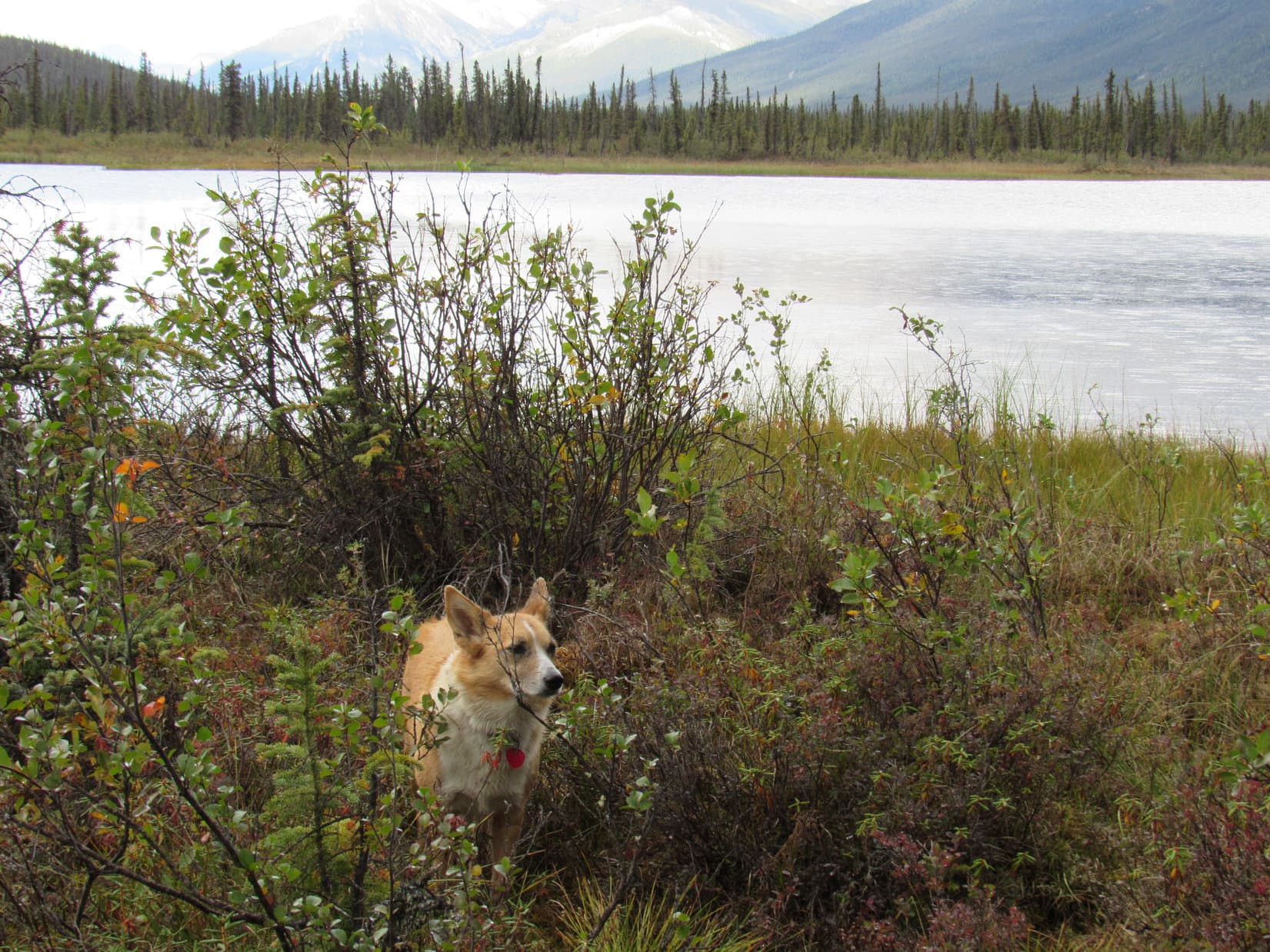
Lupe S of the lake. Photo looks NNW.
Dillon Mountain from the small lake. Photo looks E.
On the way back to the G6 after SPHP gave up on Dillon Mountain.

The rain showers hadn’t amounted to much, but about the time Lupe arrived back at the G6 (4:08 PM), she heard thunder.  The rain started in again.  This time it rained harder.  Lupe and SPHP took shelter in the G6, having a meal and then another nap, while the rain fell outside.

Two or three hours later, SPHP woke up to the sound of Lupe panting.  She was warm in the G6.  Outside it was a cool, comfortable 57°F.  The rain showers had passed on by.  Lupe and SPHP got out of the G6 for an evening stroll.  At first there was no plan.  Lupe and SPHP went N in the ditch on the E side of the Dalton Highway.  Machinery had recently churned the ground up, so it was a little rough.

Soon the small lake was visible again.  It was much closer to the Dalton Highway here, and bigger than SPHP had realized before.  The W shore was also swampy, but Lupe didn’t care.  She ran down into the lake for a drink, and to lay down and cool off.  In a couple of minutes, she came running back.

Lupe and SPHP wandered N in a band of trees W of the lake.  SPHP picked a few more blueberries.  The American Dingo sniffed the exotic unfamiliar smells of the Alaskan tundra.  It was still hard to believe Lupe was really here, 90 miles N of the Arctic Circle along the Dalton Highway in the Brooks Range of the Alaskan Arctic.  Slowly, a simple plan came to mind.

Before ever coming on this Dingo Vacation, SPHP had read online about the Dalton Highway.  It goes 414 miles N to Prudhoe Bay on the Arctic Ocean.  Right now, Lupe was almost exactly halfway there.  The G6 was parked just N of milepost 207.

If it had been possible to simply drive on to the Arctic Ocean, Lupe and SPHP would have done it.  However, access to the ocean is fenced off 8 miles short of the ocean.  Oil companies control the land near the shore.  Since arriving in Alaska, SPHP had heard there were tours reaching the Arctic Ocean from Deadhorse, but had no clue what they might cost, or whether a Carolina Dog would be allowed on them.

No, Lupe wasn’t going on to the Arctic Ocean.  In fact, on this gorgeous evening in the beautiful, remote Brooks Range of Alaska, maybe it was time for Lupe’s last mile N.  It seemed fitting to do it on paw and foot.  Lupe and SPHP returned to the ditch E of the Dalton Highway, and started N.  The torn up ground was rough and unappealing.  Lupe went up on the highway.

Traffic was light, so it would have been easy enough to just walk N along the Dalton Highway.  After 5 minutes, though, SPHP realized there was a dirt road following the Alaska pipeline about 200 or 300 yards off to the W.  Wouldn’t that be more fun?  Of course, it would!  Lupe and SPHP left the highway and headed for the Alaska pipeline.

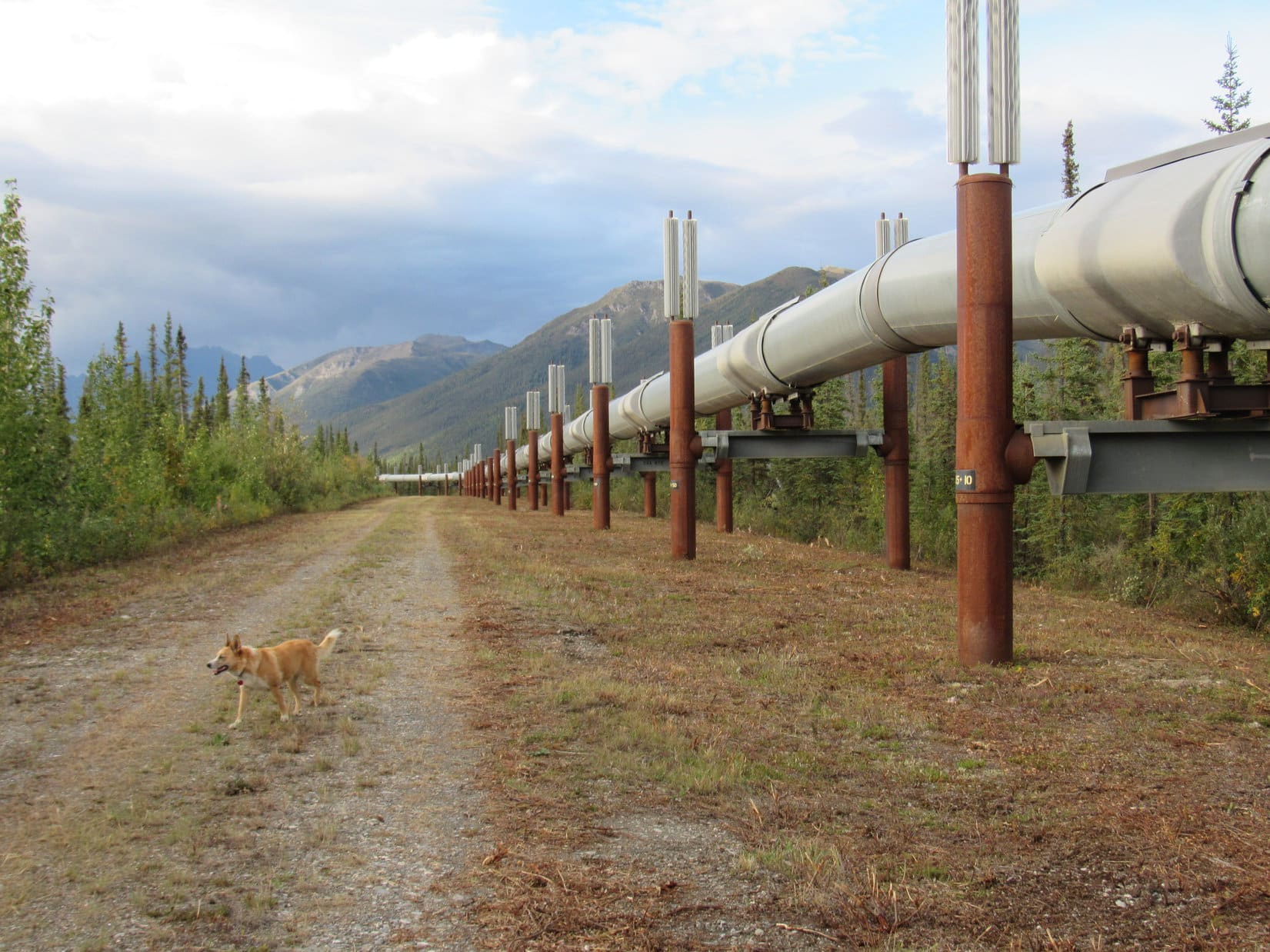
It was the right decision.  A broad swath of vegetation had been cleared beneath the pipeline, and along the dirt road just W of it.  Lupe had a ton of fun racing into and out of the forest on both sides of the pipeline.  There was no traffic at all.  The pipeline itself was no nuisance, just kind of a dramatic reminder of where Lupe was, as close to the top of the world as she had ever been, or likely ever will be.

Lupe having a blast running around near the Alaska pipeline W of the Dalton Highway and Dillon Mountain. Photo looks N.

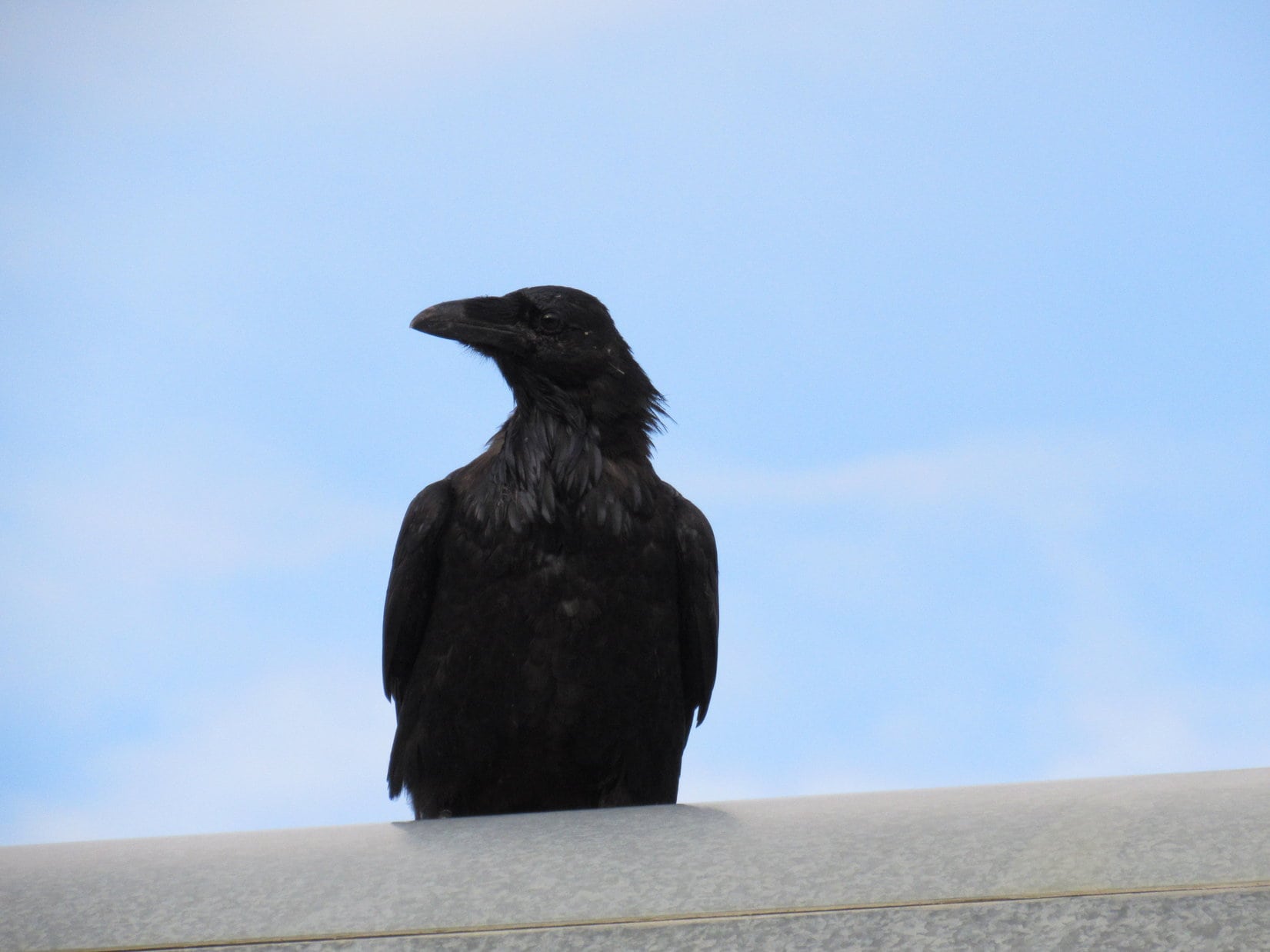
A raven appeared, and landed on the Alaska pipeline.  It was curious about what a Carolina Dog was doing way up here in Alaska?  The raven was joined by a few friends.  They seemed to like watching Lupe, and hopping along on top of the pipeline.  Sometimes they flew for short stretches, but they always landed on the pipeline again.  Four ravens flew and hopped, following Lupe on her way N.

One of four ravens that seemed to enjoy using the Alaska oil pipeline as a perch from which to monitor Lupe's activities on her last mile N.
One of four ravens that seemed to enjoy using the Alaska oil pipeline as a perch from which to monitor Lupe’s activities on her last mile N.

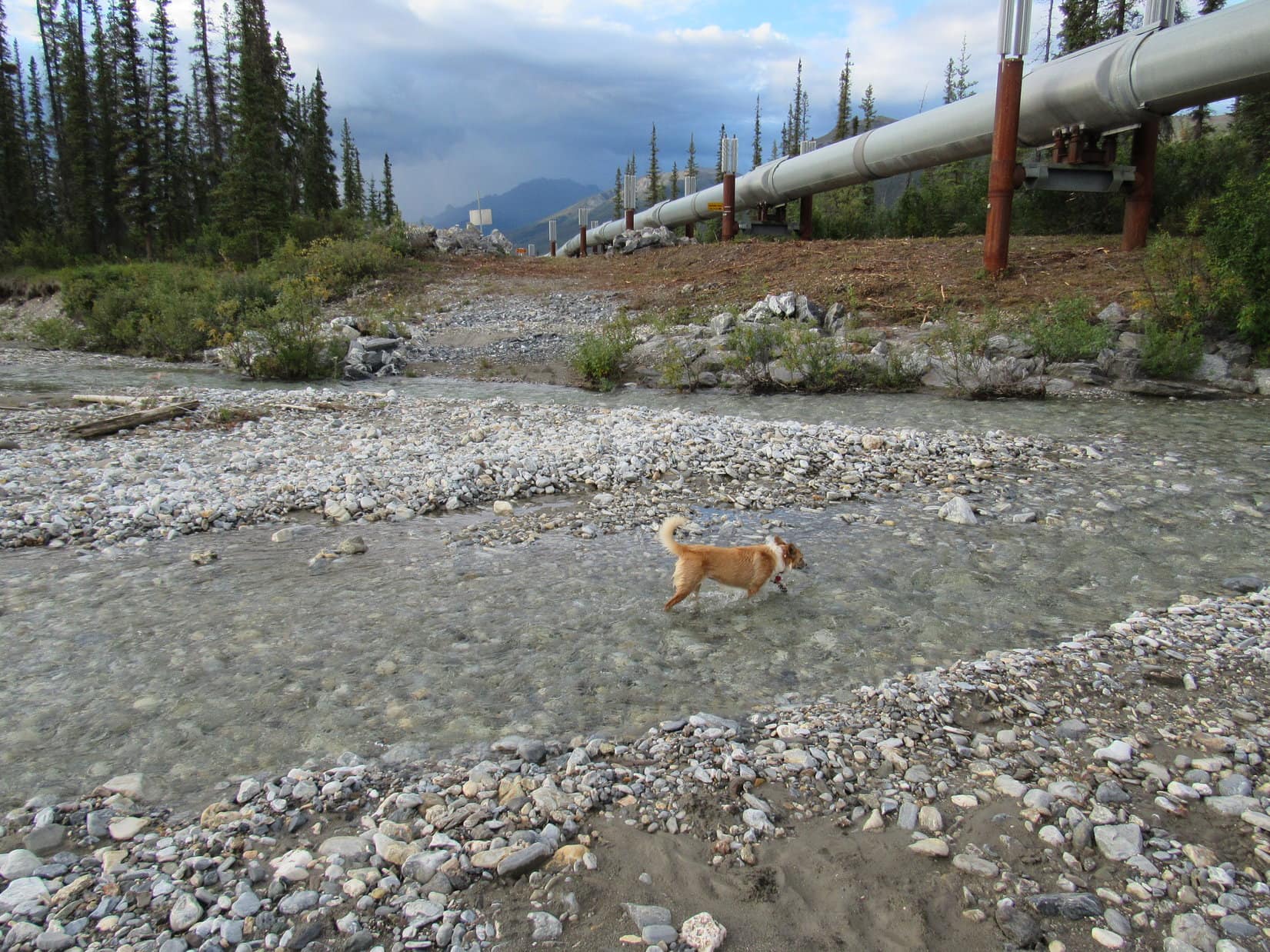
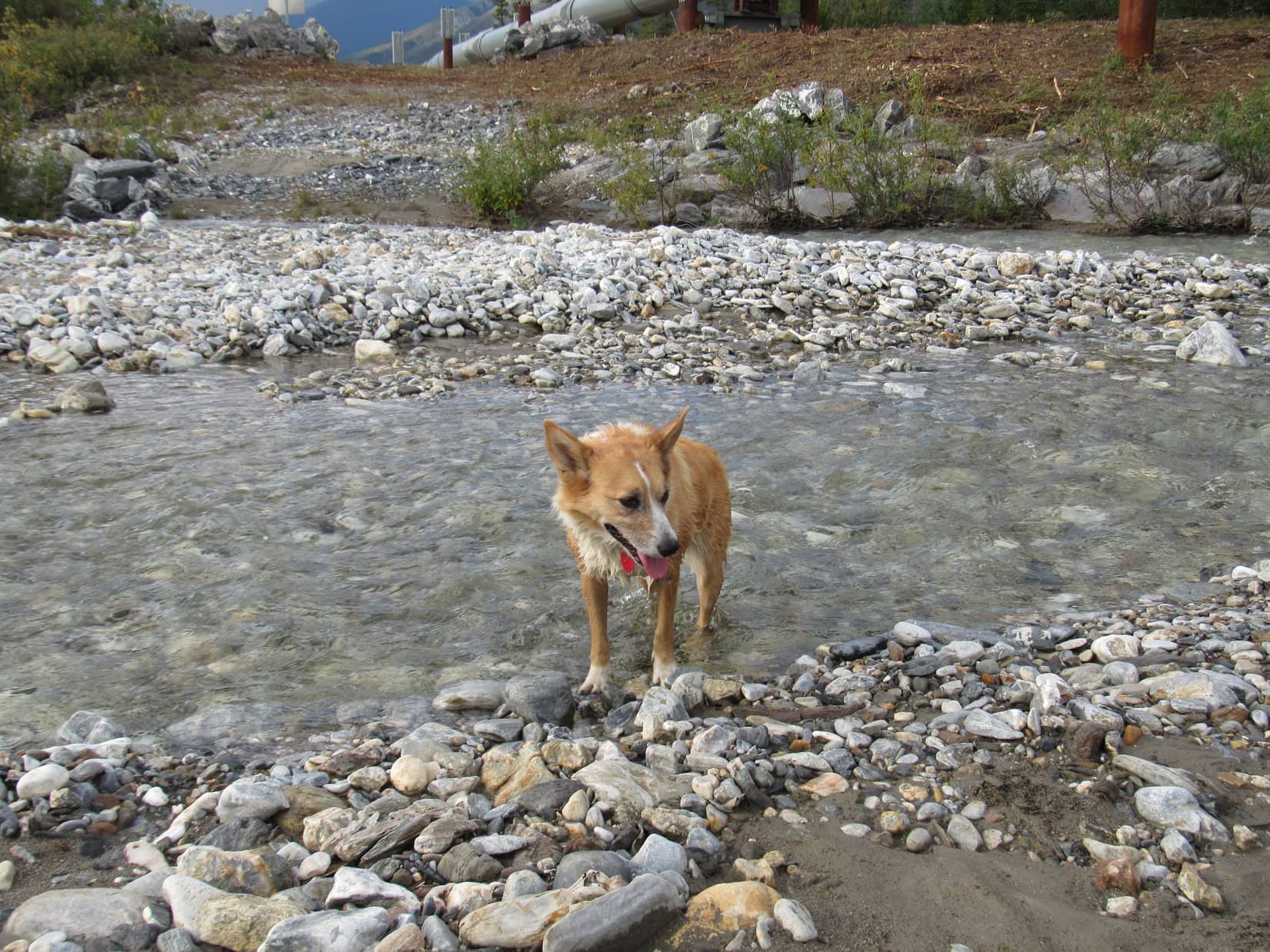
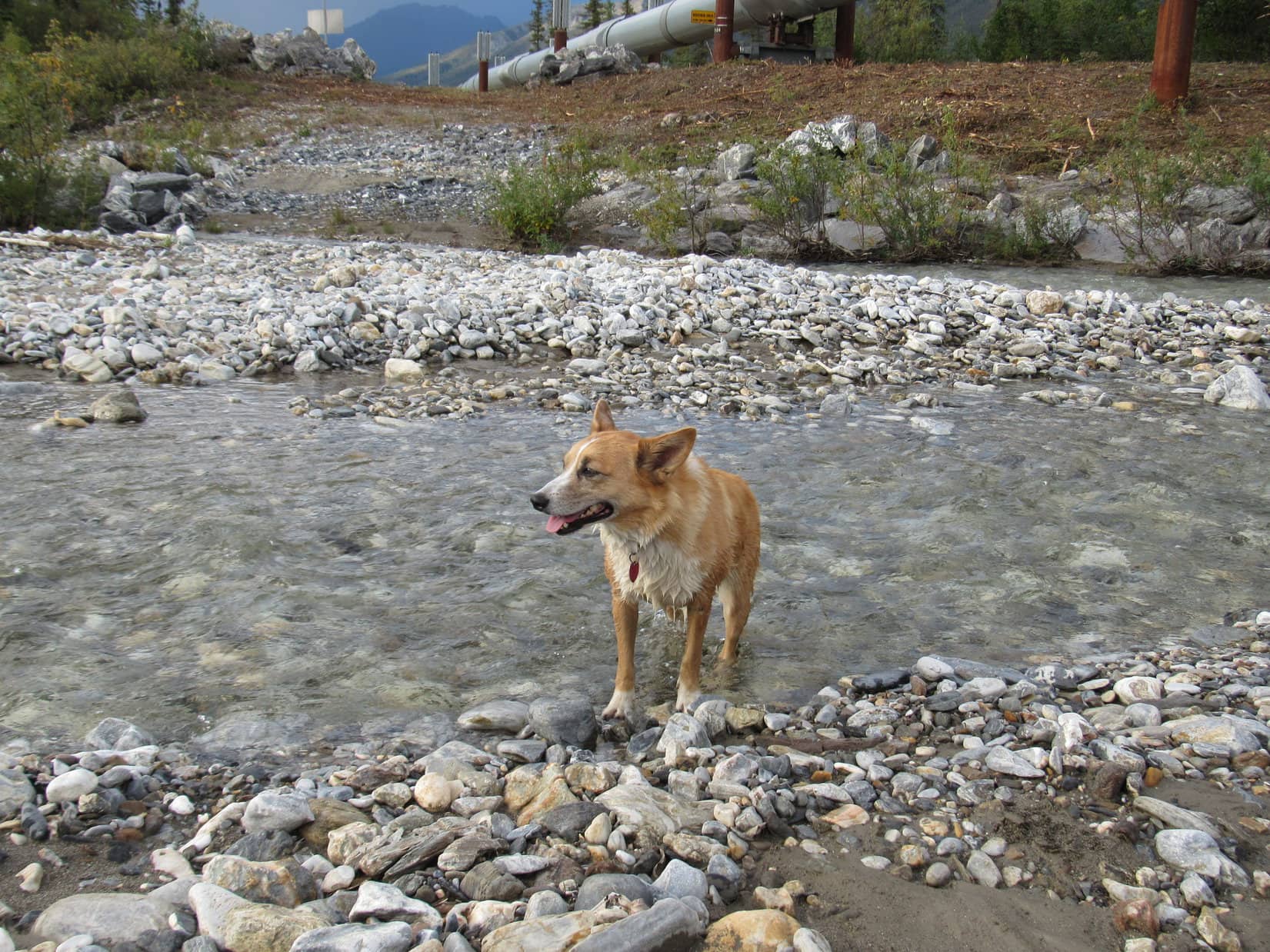
The easy stroll N along the pipeline was a wonderful way to spend the evening.  When Lupe had gone about a mile, she came to a clear, rushing stream.  It was flowing W from the valley N of Dillon Mountain toward the Dietrich River.  The water was incredibly clear, and must have been cold, but Lupe waded right in for a taste of the pure water.

Lupe waded right into the incredibly clear, cold stream flowing W from the valley N of Dillon Mountain. Photo looks N.
Whoooeeee! These clear waters are Carolina Dog tested and certified pure and cold!
Now that's refreshing! Photo looks N.
Now that’s refreshing! Photo looks N.

For Lupe to go any significant distance farther N, SPHP would have had to ford the stream, or gone E back to the Dalton Highway.  SPHP decided against it.

Lupe had already gone a mile N.  The stream was low this time of year.  Lupe could follow the mostly exposed streambed, which angled NW before reaching the stream’s confluence with the Dietrich River.  That confluence could be her point of farthest advance N.  For some reason, the idea appealed to SPHP.  Lupe had no objections.

Lupe on her way along the streambed to this stream's confluence with the Dietrich River. Photo looks NW.
Lupe on her way along the stream bed to this stream’s confluence with the Dietrich River. Photo looks NW.
Carolina Dogs range much farther than their name implies. This one is way up N of the Arctic Circle in Alaska! Carolina Dogs simply consider this extreme northern North Carolina. Of course, it also happens to be part of extreme western West Carolina.

It only took 10 or 12 minutes for Lupe to reach the clear stream’s confluence with the Dietrich River.  Lupe’s last mile N was complete.  She was as far N as she had ever been in her life.  So was SPHP.  Lupe and SPHP sat together for a while on the bank above the river, close to 90 miles N of the Arctic Circle in the Brooks Range of Alaska.

Lupe at the end of her last mile N at the confluence of the clear running stream and the Dietrich River. Photo looks N.

There’s a last time for everything.  Usually though, one doesn’t think about it at the time.  There’s a last day you will ever be in school, a last time you will ever leave the place where you work, or go out the front door of a house you’ve lived in for many years.

There is a last time you will see favorite places you’ve been to hundreds of time, or visit special friends.  There’s a last time you will say good-bye to your parents, your children, your spouse, your pets, and to everyone and everything you have known and loved, and perhaps too often taken for granted.  And there are some points beyond which you will never go.

SPHP stroked Lupe’s fur and praised her.  Lupe listened carefully.  Still farther N, were more beautiful mountains seen through the mist of more rain showers.  Lupe and SPHP had a conversation.  This was an important moment.

Still farther N beyond the Dietrich River were wild boreal mountains seen through the haze of rain showers. Photo looks N.

Well, Loopster, this is it.  This is as far N as we are ever likely to be in our entire lives.  We are only a little more than 200 miles S of the Arctic Ocean.  Perhaps less, as those ravens on the pipeline fly.  Once we leave this place, we will probably never, ever be this far N again.  Kind of sad to think about, but this is a gorgeous spot, isn’t it?

Yes, this place is fantastic, but why aren’t we going adventuring all the way to the Arctic Ocean?  Is there something wrong with it?

Well, I don’t know if they will let you on a tour to the Arctic Ocean.  Access is restricted.  It’s still a long way to go just to find out if they will take you.  Probably not worth it.  Remember the Lu-Lu Belle in Valdez?  You couldn’t go on the Lu-Lu Belle, and I doubt you can go to the Arctic Ocean.  Don’t worry, though, you have lots of other adventures lined up ahead of you in Alaska, but they are all farther S than this place.  Besides, I kind of like the idea of stopping here.

Unfair!  Sounds like discrimination against Carolina Dogs to me!  I’d like to see the Arctic Ocean!  Itch my belly would you?  Ahh, better.  Why do you want to stop here, anyway?  We are having such a great time going N!

Yeah, we are having a great time, the best ever maybe.  Perhaps it’s silly, but I guess I’m thinking of calling it good here for several reasons.  First, I don’t know if you can go all the way to the Arctic Ocean.  It doesn’t make any sense to me to drive way up to within 8 miles of it, only to get turned back.  It would be too frustrating, not to mention an unnecessary expense.

Second, even though I doubt we will ever be here again, I kind of want to leave a reason to come back.  See that cool mountain a few miles off to the N?

The dark blue one on the right where it’s raining now?

Yeah, that’s the one.  I like that mountain.  It looks mysterious.  We saw it from the top of Sukakpak yesterday, remember?  Something about me doesn’t want to see the end of the mountains.  Let’s not go all the way to the end of the Brooks Range, or any farther than we are right now.  That way we can still imagine that the mountains continue on forever, that there’s no end to them.

Oh, yeah, that sounds like human logic to me!  Can I interest you in some sweet swampland in Carolina?  The tooth fairy invested down there, you know!

Loop, I’ve been thinking about giving that mysterious mountain a private name.  We can always remember how beautiful it is, and still dream that someday we will return to climb it.  What do you think?

Geez, SPHP!  I think you have whole flights of bats in your belfry.  We are almost to it!  If you want to go climb that mountain, we can do it tomorrow!  Why leave and dream about it till the day you die, when you don’t think we will ever be back?

Well, because it leaves us a goal, a reason to return.  That way we can always tell ourselves we are coming back.  Who knows?  The future isn’t set in stone.  Maybe someday we actually will return.  Besides, we are in the Arctic.  I haven’t done any research on that mountain.  Maybe there’s no way we could climb it.  We might get ourselves in trouble wandering off into unknown territory without so much as a topo map.

Oh, I suppose that makes a little tiny amount of sense, SPHP.  If it makes you happy, whatever.  I still think we could go there tomorrow, and see if we could climb it without any harm done.  So what’s the real name of that mountain, and what name were you thinking of giving it?  By the way, keep petting me, don’t stop!  Dingoes love getting love.  We give lots of love, and expect a little in return, you know.

Of course, sweet puppy!  Let me kiss you on your furry nose.  All better?

Yes, that’s the idea!  Don’t stop!

OK, about that mysterious mountain.  I have no clue what its real name is.  At first I was thinking we could call it Northern Lights Mountain, but I’ve kind of settled on Mountain of the Midnight Sun.  We haven’t actually seen the northern lights by it, but we did see it in twilight last night at midnight on the way back from Sukakpak.

Twilight isn’t the same as seeing the midnight sun.

Well, we would have seen the midnight sun if we’d been here in June instead of August.

Yeah, but who knows how many nights of the year we might be able to see the Northern Lights, here?  Maybe most of them?

Perhaps.  Do you want it to be Northern Lights Mountain, then?

Doesn’t matter to me.  Mountain of the Midnight Sun is fine.  Just saying there wouldn’t have been anything wrong with Northern Lights Mountain.  If you leave it up to me, we’re calling it Squirrel Mountain – now that’s a mountain worth coming back to!  Speaking of the Midnight Sun, do you intend to wait for it right here?  I’d kind of like to go see if there are any squirrels in that forest S of here along the river.

OK, fine.  You can go look for squirrels, but it’s Mountain of the Midnight Sun, not Squirrel Mountain.  You can name the next mountain.  On this one, I’m calling the shots.

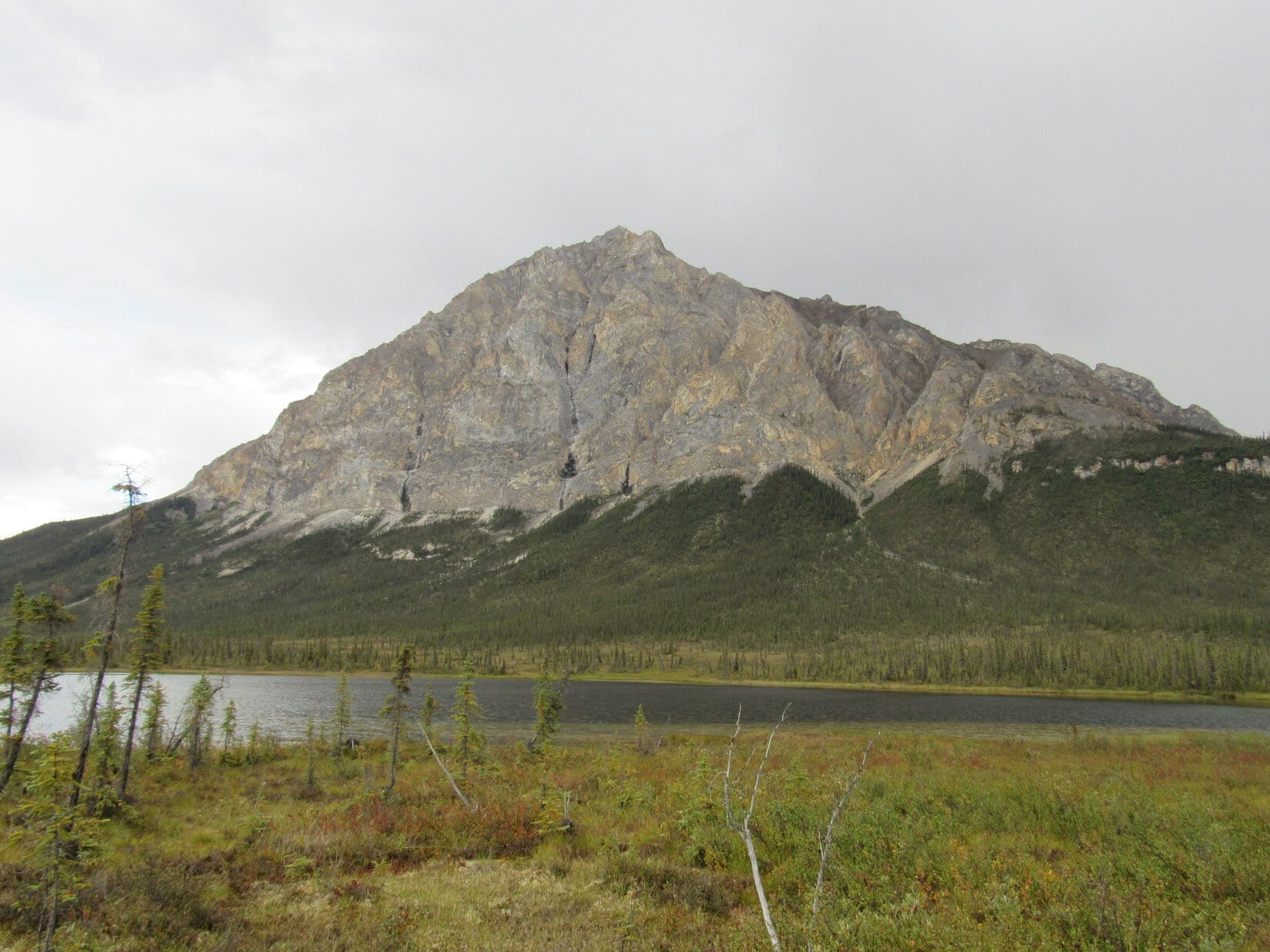
Squirrel Mountain - no, wait - Mountain of the Midnight Sun, as seen with help from the telephoto lens at the end of Lupe's last mile N. Brooks Range, Alaska. Photo looks N.
Squirrel Mountain – no, wait – Mountain of the Midnight Sun, as seen with help from the telephoto lens at the end of Lupe’s last mile N. Brooks Range, Alaska. Photo looks N.

Lupe and SPHP left the end of Lupe’s last mile N forever, heading S along the Dietrich River.  At first Lupe stuck with SPHP out on the rocks and sand exposed on the riverbed.  She wasn’t the least bit disappointed, though, when the river swung over the E bank, forcing SPHP up into the forest.

The forest was so exciting, Lupe took off running.  SPHP saw her dashing here and there, but soon she was out of sight.  When she didn’t return for a few minutes, SPHP started calling her before she got so far away she became disoriented and lost.  Lupe didn’t return.

Suddenly, there was shrill American Dingo yelping going on a long way off to the SE, followed by a chattering.  That crazy Carolina Dog actually had found a squirrel in the Arctic!  SPHP pressed on through the forest toward all the commotion.

The forest was dense and jungley.  As is often the case, SPHP made slow progress.  Before SPHP reached the squirrel tree, Lupe had given up on the alarmed and annoyed squirrel.  Most inconsiderately, the squirrel had refused to come down out of the tree to be devoured.  That’s squirrels, for you!  They’re a stubborn lot!  Lupe returned searching for SPHP.  She tracked that slowpoke down in nothing flat.

If the Dietrich River had stayed over by its W bank, it would have been fun to follow the river all the way S to its confluence with the Bettles River near the Dalton Highway, but SPHP had already seen that wasn’t going to work.  Best to just head E back to the Alaska oil pipeline.

Going E, Lupe and SPHP quickly arrived at an open area normally flooded when the Dietrich River ran high.  Ahead was a wide channel of nearly stagnant water.  This sluggish stream looked deep and mucky.  It must have surfaced from underground somewhere back upstream.  Clearly, there wouldn’t be any way to cross it to the S.  Lupe and SPHP turned N again.

45 minutes after Lupe and SPHP headed S forever from the confluence of the clear-running stream and the Dietrich River, Lupe was back!  Funny how things go.  Once again, Lupe and SPHP paused to enjoy this fateful spot.  Finally, it was time to start up the dry streambed of the clear-running stream, heading SE toward the Alaska pipeline.  Like a giant gold nugget, Dillon Mountain glowed in the late evening sunlight.

Golden Dillon Mountain glowing in the late evening sunlight. Photo looks SE.

Lupe reached the Alaska oil pipeline again.  The ravens had flown away.  Lupe and SPHP turned S, following the pipeline.  The evening was gorgeous.  Straight ahead was spectacular Sukakpak Mountain.  Only yesterday, Lupe and SPHP had been at the very top, looking down from a great height.

Lupe romped around in the forests near the pipeline.  As far as she was concerned, this hike was as fabulous as climbing any mountain.  With Sukakpak to admire, it was hard to disagree.

Lupe had a great time again romping around in the forests near the Alaska oil pipeline on the way back S. Spectacular Sukakpak Mountain was dead ahead on the return trip. Photo looks S.
Sukakpak Mountain, Brooks Range, Alaska. Lupe is still racing around at the lower L. Only yesterday, Lupe and SPHP had been at the summit of Sukakpak. Photo looks S.
Fun times in the Arctic!

Lupe and SPHP followed the Alaska oil pipeline all the way S to where it crossed the Dietrich River.  The Dalton Highway and the G6 weren’t far away now.  Lupe postponed going back to the G6.  The evening was simply too wonderful.  For a little while, Lupe and SPHP wandered NW along rocks and sandbars exposed along the river.

Lupe reaches the Dietrich River again near the Dalton Highway. Photo looks S.

Lupe and SPHP went as far along the exposed riverbed as the river permitted, before it flowed right up against the forested bank.  Well, this was it.  It really was time to go back to the G6.  Sadly, the evening of Lupe’s last mile N was almost over.  On the bright side, at least tomorrow was another adventure!

Lupe heads back to the G6, which is parked as far N as it would ever go beyond milepost 207 along the Dalton Highway. Photo looks NE.

In fact, Lupe wasn’t going any farther S tomorrow than where she was right now.  She was staying here, spending another full day in the far N.  Her ascent of Dillon Mountain was still to come!

Happy Lupe at the end of her last mile N, Brooks Range, Alaska 8-14-16.

Links:

Next Adventure                                Prior Adventure

Sukakpak Mountain, Brooks Range, Alaska (8-13-16)

Dillon Mountain, Brooks Range, Alaska (8-15-16)

Want more Lupe adventures?  Choose from Lupe’s 2016 Canadian Rockies, Yukon & Alaska Adventure Index, Dingo Vacations Adventure Index or Master Adventure Index.  Or subscribe free to new Lupe adventures.