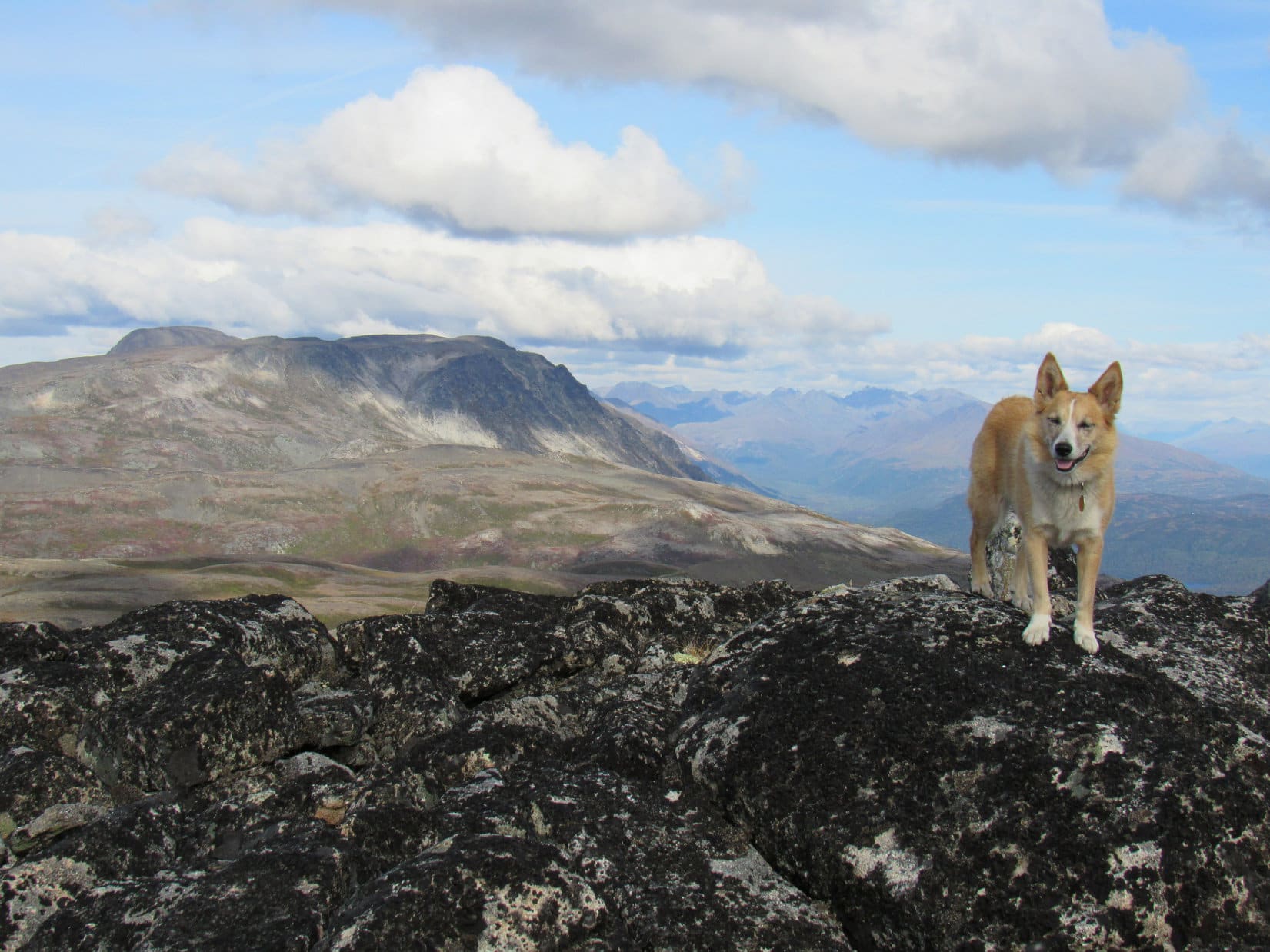
Little Mountain, the Sweetwater County, Wyoming Prominence Peak (7-24-18)

Lupe had already seen deer and wild turkeys on an exciting early drive from Sheep Creek Bay, when she dropped by the dam at Flaming Gorge Reservoir.  Last night had been her first in Utah in nearly 3 years, but the Carolina Dog wasn’t staying, just doing a bit of sight-seeing on the way to Little Mountain (9,131 ft.) in Wyoming.

The lake was beautiful.  This was going to be a great day!  Hardly any clouds in the sky, though.  Going to get hot!  Lupe took only a short stroll out by the reservoir before returning to the G6.

Lupe drops by Flaming Gorge Reservoir on a beautiful July morning. Photo looks NW.
The Flaming Gorge Dam. Lupe would go right over it on Hwy 191. Photo looks ESE.

SPHP drove E over the Flaming Gorge Dam.  Hwy 191 wound N, then NW for a while.  Before leaving Utah, Lupe made one more sight-seeing stop at Antelope Flats.  The name sounded promising, and there was plenty of room for antelope out there, but Looper didn’t see any.  However, she did have a distant view of another part of Flaming Gorge Reservoir.

Flaming Gorge Reservoir from the Antelope Flats pullout along Hwy 191 in N Utah. Photo looks WNW.

N of Antelope Flats, Hwy 191 crossed into Wyoming.  For the second day in a row, Lupe and SPHP were following excellent directions by peakbagging hero Edward Earl.  Little Mountain was supposed to be only 10 miles or so from the Utah border, and soon came into view.

As Edward noted, Little Mountain greatly resembles Pine Mountain (9,550 ft.), the Sweetwater County, Wyoming High Point, which Lupe had visited a year ago.  Like Pine Mountain, Little Mountain was a large, crescent-shaped mesa with a steep S slope.

Heading E on Hwy 191 just S of Little Mountain, SPHP watched for a sign for Clay Basin Road on the R (S).  A couple of small pullouts were close to the highway’s high point less than a mile before reaching the turn.  Lupe could have started for Little Mountain from one of these pullouts, but Earl had parked along Clay Basin Road.  Lupe and SPHP wanted to start from the same spot, then duplicate Earl’s trip up the mountain.

It would be fun to follow Edward’s footsteps from nearly 11 years ago!

Lupe along Hwy 191 just before the turn onto Clay Basin Road. Photo looks ENE.
Clay Basin Road is also known as Sweetwater County Road No. 62. Photo looks SE, away from Little Mountain.

After making the turn, SPHP parked at a big pullout on the E side of Clay Basin Road.  Edward Earl must have parked here in 2007.

Oh, here we are – right where Edward Earl parked years ago! That’s Little Mountain ahead. Only looks like a big hill from here, but it’s nearly 1,200 feet of elevation gain to the top! Photo looks NNW.

As soon as SPHP was ready, Lupe started for Little Mountain (9,131 ft.)(8:22 AM, 70°F).  The American Dingo followed Clay Basin Road back to Hwy 191, turned W along the highway for a short distance, then left the road heading up Little Mountain’s sagebrush-covered S slope.

Not far off to the NW was a higher escarpment topped by a line of gray rocks.  Looked interesting, but this whole region made SPHP nervous.  Too much vegetation!  Even though Lupe was already close to 8,000 feet elevation, SPHP was still worried about the possibility of encountering rattlesnakes.  For a short distance, Lupe followed a level cow path NE to a more barren-looking ridge.

The ridge wasn’t completely bare, but for a long way, it was covered by only short, sparse grasses.  Much easier to see what was on the ground here!  SPHP felt better about the situation as Lupe turned NW following this ridge toward High Point 8592 on the topo map.

Looking up the more barren short grass ridge toward High Point 8592, the lower hill on the L. Photo looks NW.

The more barren ridge was a long, steady, upward trudge.  Higher up, Lupe stayed W of a stand of bushes.  Upon reaching High Point 8592, she was already halfway up Little Mountain.  Loop saw several pronghorn antelope from here, but they were much farther up the mountain, and soon disappeared beyond the upper edge.

After visiting High Point 8592, Lupe crossed a patch of yellow dirt on the way N down into a small saddle leading to the second half of the climb.

Near the top of High Point 8592 looking at Little Mountain‘s upper S slope. Lupe would go straight up near the center, then angle L to arrive up on the ridgeline a bit R of the lone tree (L) near the top. Photo looks N.

The rest of the way up, Little Mountain became progressively steeper.  Lupe headed pretty much straight up the S slope from High Point 8592, until she was quite close to the top.  So much sagebrush grew on these upper slopes, that it couldn’t be avoided.  While SPHP was still leery of rattlesnakes, Lupe didn’t come to any.  By now she was approaching 9,000 feet, so perhaps there weren’t any around to begin with.

Start of the 2nd half of the ascent looking back at High Point 8592. Photo looks SSE.

The final part of the climb was the steepest.  Lupe angled NW (L) until she finally made it up to the rim of the summit plateau.

The top of Little Mountain was a vast flat to gently rolling mesa.  The highest terrain existed as a wide band of open ground along the S edge.  To the N, a slightly lower forest was in sight hundreds of feet away.  The topo map shows two separate 9120 foot contours on Little Mountain.  Lupe had come up between them closest to the larger E contour, which was where Edward Earl had noted that the true summit was located.

The terrain where Lupe had come up was dominated by medium-sized reddish, purplish rocks.  However, as she headed E looking for the true summit, the geology changed.  Loop only had to go 500 feet to reach a big flat area which appeared to be the summit of Little Mountain.  By the time she got that far, the reddish, purplish rocks had vanished.  At first glance, the parched barren ground looked light gray.

Upon closer inspection, the summit of Little Mountain was comprised of a conglomerate of a wide variety of pebbles.

The true summit was composed of a wide variety of pebbles and small stones.

Looking back to the W, it was clear that Earl was right.  Lupe actually was at the true summit of Little Mountain.  The whole summit area was enormous and so nearly flat that no one spot stood out as the absolute high point.  Lupe selected a group of slightly larger rocks that seemed to be at least as high as anything else for her official true summit.

There wasn’t a speck of shade here.  The Carolina Dog simply laid down on the rocky ground to take a break, while enjoying the magnificent panoramic views on offer toward all points S.

In brilliant sunshine, Lupe reaches the true summit of Little Mountain in the E 9120 foot contour. Photo looks SW.
Looking farther NE along the S edge.
The forest to the N was slightly lower.
Looking WSW in the direction Lupe had come from once she reached the top.

The air was hazy with the smoke of distant forest fires.  Despite the haze, Lupe could see the long blue ridge of Pine Mountain (9,550 ft.) more than 15 miles off to the ESE.

Pine Mountain, the Sweetwater County high point, is the long ridge on the L. Beyond it, just R of Center, may be Middle Mountain (9,559 ft.) in Colorado. Photo looks ESE.

The best views were closer by, looking due S.  Utah was only 5.5 miles away as the crow flies.  Lupe could easily see Clay Basin Road where she had started her ascent of Little Mountain from.

Clay Basin Road heads away from Hwy 191 on the L. The yellow N slope of High Point 8592 is seen below on the R. Photo looks SSE.
Richards Mountain (8,728 ft.) (R) is the closest big ridge. It is still in Wyoming, but everything beyond it is in Utah. Photo looks S.

The area over by the W 9120 foot contour was clearly lower.  Even so, when Lupe was done at the true summit, she headed that way exploring along the S rim.  The map showed that the 9,131 foot survey benchmark was over at the W high point.  Edward Earl hadn’t seen it, but maybe Lupe would?  A distant view of Flaming Gorge Reservoir might also be available from over there.

As the American Dingo wandered W, she sniffed many clusters of the reddish, purplish rocks that looked like they might mark the position of the 9131 foot survey benchmark, yet Lupe didn’t find it.  She went all the way to the W high point, finally stopping a little before reaching a fence.

There was more high ground to the NW, but it wasn’t quite as high as where Lupe was now.  She could see part of Flaming Gorge Reservoir, and would have had an even better view of it, if she had gone farther.  On a clearer day, that might have been worth doing.  However, with the smoke haze somewhat marring the scene, it didn’t seem necessary.

Along the S edge not far from the high point of the W 9120 foot contour. A portion of Flaming Gorge Reservoir is in view. Photo looks W.
Hwy 191 snakes away toward Flaming Gorge Reservoir (R). Photo looks SW with help from the telephoto lens.
Looking back toward the true summit from the W high point. Photo looks ENE.

In the end, Lupe headed back E again, still keeping an eye out for that wayward survey benchmark.  Like Edward Earl, she never did find it.  Loop left Little Mountain (9,131 ft.) starting back down from about the same spot she’d come up.

The Carolina Dog’s return route was about the same until she was below High Point 8592.  She then stayed more to the W, hoping to explore the top of the gray rock escarpment she’d avoided on the way up.  Going this way, Lupe came to some reddish, purplish boulders covered with bright orange lichens.  Their vivid appearance was striking.

Now that is one brightly decorated boulder!

The gray rock escarpment itself was a disappointment.  Tall bushes and cactus grew in great abundance upon it.  Lupe had to retreat, ultimately descending into the dense vegetation E and below the escarpment that SPHP had hoped to avoid.  The American Dingo scared up a deer and a jack rabbit, but never even knew it.  She wasn’t tall enough to see over all the grass, bushes and sagebrush.

Little Mountain had been a success, but marked the end of Lupe’s 2018 Dingo Vacation to the Bighorn Mountains and Wind River Range (and beyond as it turned out!).  (11:28 AM, 80°F)  All that remained was a scenic, air-conditioned drive home across Wyoming.

By early evening, the low, dark blue ridge of Lupe’s Black Hills of South Dakota appeared on the horizon.

Heading home. The Black Hills of South Dakota come into view from Highway 450 W of Newcastle. Photo looks NE.

Two summer of 2018 Dingo Vacations were now over.  Lupe had enjoyed great times, and explored many beautiful places on both.  The American Dingo wasn’t done yet, though!  In early August, Lupe would be setting off on her grandest Dingo Vacation of 2018 of all.

She hopes you will return soon ready for action, adventure, and more scenic peakbagging fun!

Well, this is about it for this time around from Little Mountain in SW Wyoming! Hope you will return soon to join me on my next big Dingo Vacation. It’s going to be a real doozy!

Links:

Directions & Trip Report by Edward Earl

Pine Mountain, the Sweetwater County, Wyoming High Point (6-15-17)

Flaming Gorge, The Little Hole Trail by the Green River & Spirit Lake, Utah (8-26-15)

Prior Adventure

Prior Dingo Vacation       This Dingo Vacation      Next Dingo Vacation

Want more Lupe adventures?  Choose from Lupe’s 2018 Dingo Vacation to the Bighorn Mountains & Wind River Range in Wyoming Adventure IndexDingo Vacations Adventure Index or Master Adventure Index.  Or subscribe free to new Lupe adventures.

Lupe in The SCREE! – the Mountaineering Club of Alaska’s monthly newsletter & the Story of Henry Pinkham

What!  How could that possibly be?  It defied imagination.  Yet, there it was.

In early April of 2018, Lupe had a new comment on her blog, a fairly rare occurrence.  The comment was from a name that SPHP recognized from Peakbagger.com.  From completely out of the blue,  Steven Gruhn, an active mountaineer in Alaska, had made the comment.  What Steven wrote was as astounding as it was unexpected:

Hi.  I stumbled across your blog after noting Lupe’s ascents of Slope Mountain and Lake Benchmark Mountain on peakbagger.com. I try to keep track of the earliest recorded ascents of every peak in Alaska and I hadn’t known of ascents to the summits of either of those peaks. Did you notice any evidence of a prior ascent on either peak? I also try to help drum up reports of noteworthy ascents for publication in the Mountaineering Club of Alaska’s monthly newsletter, the Scree. Would you be willing to submit a trip report on your ascents of those two peaks for publication in the Scree?

The whole notion was astonishing!  Had Lupe climbed 2 peaks in Alaska on her 2017 Dingo Vacation that no one else had ever been up, at least in recorded history?  No, that wasn’t true.  Slope Mountain (4,010 ft.) and Lake Benchmark Mountain (5,000 ft.) were the two northernmost peaks that Lupe had ever climbed, but there had been definite signs of prior ascents at both.

A little way W of the summit, Lupe had come to a survey benchmark on Lake Benchmark Mountain, and at the top of Slope Mountain there had been two cairns and a big tower.  Still, it made SPHP smile to think that an experienced mountaineer from Alaska, who tracked such things, did think it within the realm of possibility that the Carolina Dog had actually been the first ever to climb one or both of these peaks.

Loop at the true summit of Lake Benchmark Mountain along the N edge of the Brooks Range in N Alaska on a foggy day. 8-19-17

Steven certainly deserved a response!  SPHP sent an email thanking Mr. Gruhn for his comment, and then went on to explain the situation Lupe had found at each peak.  Of course, Lupe would be tickled pink to submit trip reports for publication in the Scree.  What a great honor it would be to have anything published in the Mountaineering Club of Alaska’s monthly newsletter!

However, did Steven still think that was appropriate?  After all, SPHP didn’t believe for a minute that Lupe had been the first to scale either mountain.  Furthermore, Lupe and SPHP aren’t real mountaineers by any stretch of the imagination.  Self-glorified day hikers, at best.  Anyone could climb Lake Benchmark Mountain or Slope Mountain.  Neither was difficult.  No special equipment or technical expertise required.

Lupe out on the N slope of Alaska on top of Slope Mountain.  Slope Mountain is the northernmost peak Lupe has ever climbed.  8-22-17

Gruhn responded almost immediately:

Despite the presence of human-placed objects on or near the summits, I’m still interested in reports on these two ascents. The benchmark west of the summit of Lake Benchmark Mountain was placed in 1971 by the USGS via helicopter, which landed at the benchmark site, so it’s quite possible that the geologists who placed it did not venture east from the helicopter landing site  …  Not all of the MCA members are hardcore mountaineers; many are hikers like yourself and I’d like the Scree to reflect all types of mountaineering from hardcore stuff to hiking and skiing.

Really?  So maybe Lupe actually was the first to visit the summit of Lake Benchmark Mountain?  The whole notion still seemed unbelievable, but who knows?  What the heck?  For the time being, the first ascent of Lake Benchmark Mountain could be Lupe’s claim to fame until someone came along with evidence to dispute it.  As for supplying trip reports on both peaks for publication in the Scree, apparently it was a go, with Mr. Gruhn’s blessing!  If the Mountaineering Club of Alaska was willing to consider publishing them, that was a tremendous honor the American Dingo had no intention of passing up!

During the process of submitting materials for the requested trip reports [actually condensed versions of original posts on The (Mostly) True Adventures of Lupe], SPHP emailed Mr. Gruhn asking if it was possible for Lupe to become an official member of the Mountaineering Club of Alaska?  She was more than willing to fill out an application form and send in her dues.

Steven responded with the story of Henry Pinkham:

Your query reminds me of the tale of Bill Putnam, who later served as President of both the Harvard Mountaineering Club and the American Alpine Club. In his youth Putnam petitioned the American Alpine Club for membership for his dog, Henry Pinkham. At the time, applicants for membership had to be sponsored by another AAC member and had to complete a certain number of climbs in a multiple mountain ranges. Henry Pinkham had met all such requirements and even had a Canadian mountain named in his honor (Mount Sir Henry in the northern Selkirks). And as Putnam reasoned, the AAC had already added several SOBs to its membership rolls. Henry Pinkham was voted into membership, but before his name could be officially added to the membership roster, Putnam’s ruse was revealed and Henry Pinkham’s membership was revoked.

Well, shucks.  Clearly the implication was that Lupe could not join the MCA unless she did so surreptitiously.  It would be ungrateful, to say the least, to break the rules of an organization about to bestow a great honor upon her.  So Lupe never has become a card carrying member of the Mountaineering Club of Alaska, though she would have liked to.

The Henry Pinkham tale was amusing!  SPHP found another account of it on a thread on SuperTopo.com in memory of Bill Putnam following his demise in 2014.  The following comment was made by “hamie”:

Soldier [2 purple hearts], scientist, explorer, climber, hut builder, writer, philanthropist and……..prankster!

Bill Putnam’s attempt to trick the AAC into accepting his dog Henry Pinkham as a member is a well known story, and has already been mentioned. Less well known is how he fooled the Canadian Geographic Features Naming Committee [or whatever it is called].

Way back in 1950 he and his companions made the first ascent of several mountains near Fairy Meadows in the Northern Selkirks. He decided to call these mountains the Nobility Group, and name them after himself and his friends, along with giving themselves honorary knighthoods. The results were:

Mt. Sir William. [Putnam]
Mt. Sir Andrew. [Kaufmann]
Mt. Sir Henry. [Pinkham, his dog!!]

The naming board was duly impressed, the names became official, and were duly printed on subsequent maps. About 10 years ago the hoax finally reached bureaucratic ears, and I believe that the official names were all revoked. Amongst other reasons it is not permitted to name mountains after living people [or mess with the bureaucracy]. Hopefully the name Sir William will now be reinstated, as it is well deserved. Sir Henry? Less likely.

On a historical note a similar, but more devious hoax was perpetrated by Kruszyna when he named the Chess Group in the Rockies.

In the end, with Mr. Gruhn’s help, everything turned out great!  Lupe did get published in the Scree.  Not twice, but three times!  For Steven Gruhn later asked about Peak 3750 up on K’esugi Ridge in Denali State Park which Lupe had climbed on her 2018 Dingo Vacation to Alaska.  More than happy to oblige, Loop submitted a trip report on it, too!

So there in the Scree, among all the stories by genuine mountaineers climbing some of the most challenging mighty peaks in Alaska with ropes, ice axes, crampons and all the rest, appears the Most High Exalted Dingo of the Arctic Sisterhood, with her tales of adventure on peaks that are simple strolls by comparison.  Honors perhaps undeserved, but each a cherished memory which Lupe and SPHP will never forget.

The SCREE – July, 2018 IssueLake Benchmark Mountain (Page 3)

The SCREE – August, 2018 IssueSlope Mountain (Page 18)

The SCREE – February, 2019 Issue  – Peak 3750 on K’esugi Ridge (P. 5)

The SCREE – June 2020 Issue  – Peak 4550 on K’esugi Ridge (Page 3) & Swede Mountain (Page 5)

The SCREEJuly, 2020 IssueCrazy Notch Ridge (Page 7)

The SCREE – April, 2021 Issue  Sukakpak (Page 13)

The SCREE – February, 2024 IssueWest Galbraith Peak (Page 9)

The SCREE – March, 2024 Issue – Peak 5050, Brooks Range (Page 4)

The SCREE – April, 2025 Issue Peak 4916, Brooks Range (Page 5)

Thank you!

Many thanks to Steven Gruhn for all his hard work and interest in making it possible for Lupe to appear in the SCREE, and to the Mountaineering Club of Alaska for accepting and publishing her submissions.

Related Links:

Mountaineering Club of Alaska

William Lowell Putnam III, 1924 – 2014

Original Post: Lake Benchmark Mountain, Brooks Range, Alaska (8-19-17)

Original Post: Slope Mountain & Highlights of the Dalton Highway Revisited, Alaska (8-22-17 & 8-23-17)

Original Post: K’esugi Ridge – Ermine Hill & Peak 3700, Denali State Park, Alaska (9-4-18)

Original Post: Little Coal Creek to K’esugi Ridge – Peak 4500, Denali State Park, Alaska (8-24-19)

Original Post: Swede Mountain, Alaska (8-29-19)

Original Post: Crazy Notch Ridge, Alaska Range, Alaska (8-26-19)

Original Post: Sukakpak Mountain, Brooks Range, Alaska (8-13-16)

Original Post: West Galbraith Peak, Brooks Range, Alaska (8-30-22)

Original Post: Peak 5050, Brooks Range, Alaska (8-30-22)

Original Post: Peak 4916, Brooks Range, Alaska (8-30-24)

Lupe on Peak 3750  on K’esugi Ridge, Denali State Park, Alaska 9-4-18

Want more Lupe adventures?  Choose from Lupe’s Dingo Tales IndexDingo Vacations Adventure Index or Master Adventure Index.  Or subscribe free to new Lupe adventures.