Black Hills, SD Expedition No. 256 – Deerfield Trail No. 40: Daugherty Trailhead to Signal Knob & Deerfield Lake (10-30-20)

8:36 AM, 26ºF, Mystic Road, Daugherty trailhead, Deerfield Trail No. 40

After that big storm last week, I never dreamed there would be so little snow up here, Loopster!  We could have gone up to the high country, if I’d realized it was going to be practically snow-free.

Still can if you want to, SPHP, but this is fine with me.

Eh, I didn’t plan anything out for up there thinking the G6 wouldn’t even be able to get close.  Maybe we should just go with the flow?  You can knock out a section of the Deerfield trail today.  We might even have time for a side excursion to Signal Knob (6,200 ft.) for some peakbagging fun!

You know I’m not picky, SPHP.  Happy just to be here!  If you are, too, let’s go!  Don’t want to keep the early squirrels waiting!

Somehow I doubt an American Dingo is what the squirrels are hoping for, but onward!  Puppy, ho!

Lupe was on it, anxious to make tracks and get in some long overdue sniffing action.  Sprinting ahead, she left the Daugherty trailhead of Deerfield Trail No. 40 following USFS Road No. 182 W up Whitetail Gulch.  Daugherty Gulch was 0.75 mile S of here, and why this wasn’t called the Whitetail trailhead instead of Daugherty had always been a mystery to SPHP.

However, it was more of a curiosity than a real mystery.  Whatever the answer was, it made no difference at all to Lupe.

Waiting impatiently at the Daugherty trailhead for the photo to get snapped so the day’s adventures can begin.
Starting up Whitetail Gulch.

Not a cloud in the sky!  Tiny sunlight diamonds sparkled on thin layers of frost and snow.  The air was crisp and clean, summer’s smoky skies at long last a thing of the past.  Deerfield Trail No. 40 wound gradually up Whitetail Gulch past ponderosa pine covered slopes and naked aspens.  A tiny creek trickled in the ditch next to the roadbed.  The road crossed it 10 minutes from the trailhead.

On USFS Road No. 182, which doubles as Deerfield Trail No. 40 in Whitetail Gulch.
Loop returning from one of her romps ahead.
At the tiny stream crossing 10 minutes from the trailhead.
A long straight stretch bordered by white-barked aspens.

All of the terrain Deerfield Trail No. 40 would take Lupe through today was pretty easy stuff.  Some variation, of course, but mostly a series of long gentle inclines and descents.  A good 0.5+ mile from the trailhead, Whitetail Gulch curved S.  The trail, however, continued W a little way before making a short steeper jog up to the N.  Turning W again, the road leveled out, reaching a high point shortly after passing No. 182.1D, a side road on the R (N).

Just beyond this high point, the Deerfield Trail curved SSW as it began a gradual descent.  Some open ground provided Lupe with her first views of nearby hills.  Nothing too spectacular, but pleasant enough.

At the curve beyond the junction with USFS Road No. 182.1D. Photo looks SW.

Lupe was soon past the open grassy region.  The trail now dipped more steeply down into a shady canyon, entering a different drainage.  At the bottom, the road crossed Crooked Creek, which was considerably larger than the tiny creek in Whitetail Gulch, but still a small stream.  Paving blocks in Crooked Creek made for a trivial stream crossing.

Immediately beyond Crooked Creek, the road forked.  A brown Deerfield Trail fiberglass wand was in sight ahead along the L branch.  Going that way, Loop quickly came to a second Crooked Creek crossing, also blessed with paving stones.

At the first Crooked Creek crossing. Stay L at the road fork ahead!
The second Crooked Creek crossing was only a few hundred feet farther.

Crooked Creek was a major low point.  From here, Deerfield Trail No. 40 climbed steadily following the creek valley higher.  Within 10 minutes, Lupe arrived at another place where the road forked.  She stayed to the R entering a shaded, narrower portion of the valley.  A snowy trek on a straight stretch led to a curve to the L where the road crossed Crooked Creek yet again, which this time flowed beneath it in a culvert.

Immediately beyond the culvert crossing, the road curved sharply R (NW), starting up a hill at a steeper pace.  However, Deerfield Trail No. 40 parted from the road at this curve.  SPHP nearly missed the trail as it headed off to the L.  The only sign was 25 feet from the road where a big ponderosa pine had a metal “40” diamond nailed to its trunk, and a pink ribbon could be seen behind it flapping in the breeze.

Heading W up the S side of the Crooked Creek valley after the 2nd stream crossing.
Looper at the fork 10 minutes W of the 2nd Crooked Creek crossing. Stay to the R here!
By the big ponderosa pine with the 40 diamond and pink ribbon. The trail has just left the road 25 feet back and is now a single track. Don’t miss this turn! Photo looks SW.

Deerfield Trail No. 40 now continued SW up Crooked Creek as a single track.  At first, the single track looked a little like an abandoned ATV trail, but soon lost that characteristic as it promptly entered a narrow, V-shaped valley.  The shady forest seemed dank and dark, but the trail was easy to follow.

Before long, Lupe came to another creek crossing.  This one was a bit of a mess.  A mostly frozen-over pool of water was surrounded by deadfall and tree trunks that had been cut to clear the trail, but which were still crowding the crossing.  The ice wasn’t thick enough to be trusted, and getting past this little spot was more trouble than it ought to have been.  On the far side, SPHP had to crawl under a downed spruce, but the Carolina Dog enjoyed plenty of clearance.

As it turned out, Loopster came to 3 of these stream crossings in quick succession.  None were significant obstacles, but they did slow SPHP down, which admittedly doesn’t take much.

First of the 3 Crooked Creek crossings that came in rapid succession.
Second crossing. The log next to Lupe would have made this one a cinch, if it hadn’t been icy.

Shortly after Lupe passed the third stream crossing, the valley turned S and began to open up.  The single track reached an old forest service road again, which continued up the valley at an easy pace, crossing Crooked Creek one last time at a point where the stream was a simple rock hop, almost a step-across.

The old road eventually began curving R (W), and soon arrived at a 3-way junction at a sunny clearing.  Another 3-way junction was just 150 feet away up a hill to the S.  A check of SPHP’s maps showed that all Lupe had to do was continue straight W on a road clearly marked as USFS Road No. 443.

The valley opens up after the 3 rapid succession stream crossings. Loop is approaching a final easy Crooked Creek ford just ahead. Photo looks SSW.
Still following Crooked Creek higher, but we won’t have to cross it again! Photo looks SW.
2 different 3-way junctions in this area. Stay straight W on No. 443! Photo looks WSW.

No. 443 headed W from the junction, then gradually curved NW.  What was left of Crooked Creek was still on the L (S) side of the road, but was now largely reduced to a strip of mucky terrain with only a little free flowing water among tufted grasses.  A little after No. 443 turned NW, Lupe reached an unmarked fork.

Directly ahead, a grassy slope lay between the two choices, either a road to the R (N) which went uphill into an area where several trees had pink plastic ribbons tied around them, or a road to the L (W).

The road to the L looked more heavily trafficked, as though it might be a continuation of No. 443.  After some debate, Lupe went that way.  She soon came to a place where the hillside N of the road had been carved away by a bulldozer.  In fact, the guilty bulldozer was still rusting away up in the scar.  Orange signs in the trees nearby said this was an “active” mine site, but it sure didn’t look like it.
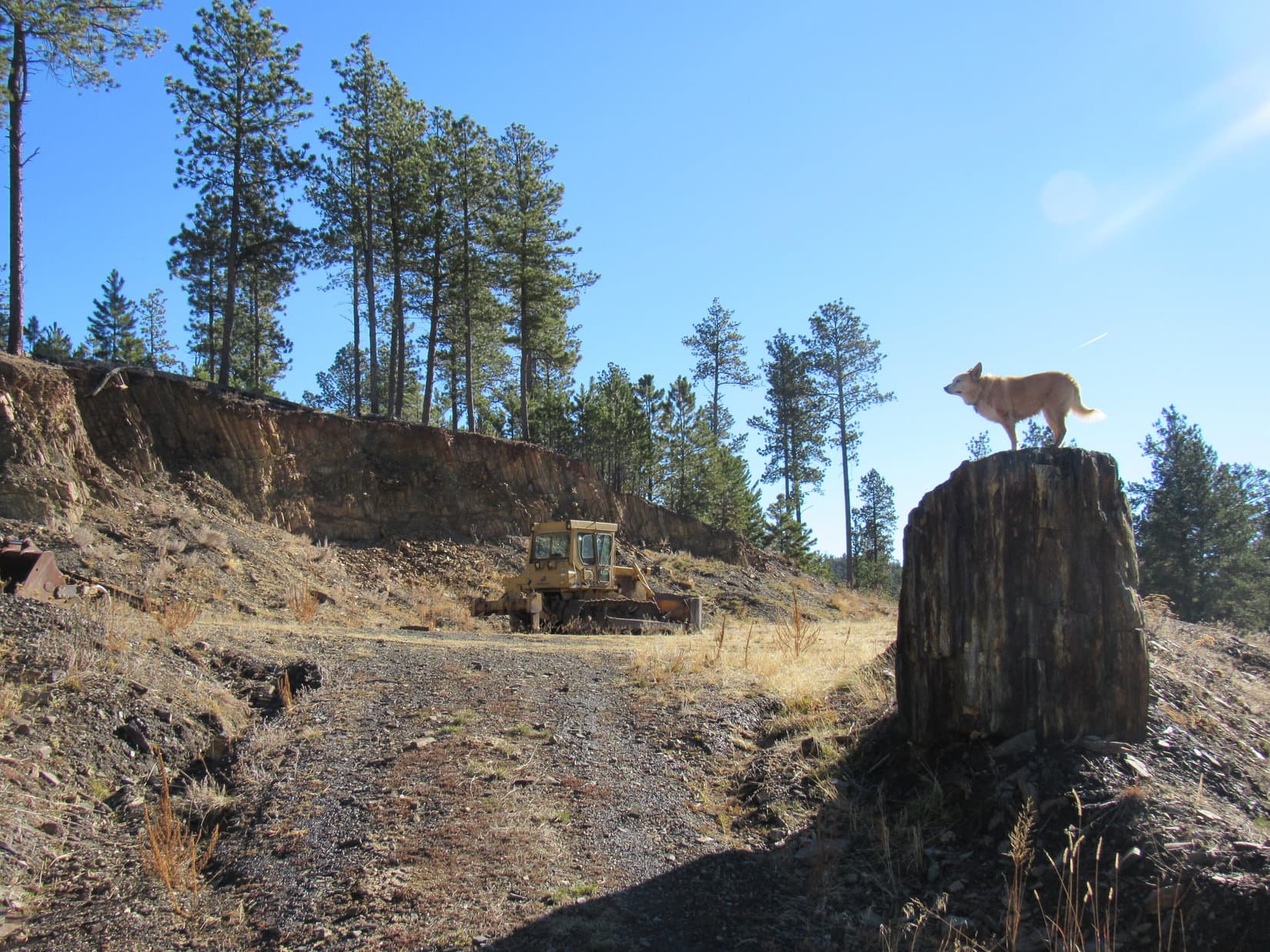
Part of the carved up hillside N of the trail. Photo looks E.
Looking ahead. No. 443, if that’s what it still was, continues W. Photo looks W.

Continuing W past the inactive active mine site, the road soon curved NW again, leaving the last remaining trickle of Crooked Creek behind for good.  Lupe came to a 3-way junction in a large clearing.  A tree on the E side of this junction had a 40 diamond nailed to it.  The positioning made it look like this meant the road heading NE up a little hill was actually the Deerfield Trail, not the way Loop had just come.

Wondering if the road from the NE was a continuation of the branch to the R that Loopster had not taken at the last fork before the mine, SPHP led her up to the top of the little hill.  Off to the L (N) was a somewhat higher ridge that looked like it might provide some distant views.  The road kept going NE, instead of bending around to the R (S) like it should have if it was going to head back to that last fork.

Inconclusive.  Didn’t really matter.  SPHP was certain Lupe needed to go back down and take the road going SW.  She sure didn’t need to be going NE.  Might as well forget this for now.  Maybe the Carolina Dog had taken a little shortcut by going past the mine, and maybe she hadn’t, but it was true that she hadn’t seen any 40’s along the road that went by the mine.

Lupe reached this junction from the R (SE). However, the 40 diamond on the pine at R seemed to indicate that this road to the NE (Center) had been the correct route. Photo looks NE.
On a brief foray to the NE to see if this was the route Lupe should have been on. Result: inconclusive. Photo looks NE.

Lupe turned around, went back down the little hill, and continued SW past the 3-way junction.  The road climbed gradually for a while, then leveled out.  Was this the place?  Nothing stood out, but then again, that was to be expected.  There wouldn’t be anything to make it stand out.  A brown fiberglass “40” wand confirmed Loopster was definitely on the Deerfield Trail again.

On the flat high ground. Photo looks SW.

A long time ago, the Carolina Dog had been this way.  In fact, back in the early days of her Black Hills expeditions she had traveled both the entire Deerfield and Centennial trails, among the longest in the Black Hills.  That was years before she had her very own adventure Dingo blog.  In the last few years, Loop had revisited some sections of both trails, which was more or less what this expedition was all about, too.

Today’s re-exploration had all seemed like a completely new voyage of discovery.  Nothing had triggered memories of having been here before until now.  Yet a growing eerie feeling of long lost familiarity still wasn’t conclusive.

Keep an eye out, Loop.  I think somewhere up here the trail veers off to the R, going downhill as a single track again.  If I remember right, the turn is marked, but still easy to miss.

I’ll try, SPHP, but I’m sort of busy watching for squirrels and deer, too.  Are we close to the turn you’re expecting, now?

Not sure.  Suddenly feel like I’m in an ancient dream walking in a real, but long forgotten land.  All I really remember is being up on a stretch of flat high country like this that didn’t offer any views, and subsequently missing the turn.  That scarred hill and rusting bulldozer we passed now seem vaguely familiar, too, but I could be confusing all this with some other completely different place.

Well, that’s really helpful, SPHP!  Let me know if your dream walk is due to turn into a nightmare somewhere up here.  Think I’ll stick to the squirrels and deer in the meantime.

The march SW went on and on, just like SPHP “remembered” it would, but Lupe still didn’t come to anything definitely recognizable, and no single track trail appeared veering off to the R.  Instead, Loop eventually came to a 3-way junction SPHP had no recollection of at all with USFS Road No. 429, which was marked with a brown wand and continued SW.

So here we are up in dreamland! Flat high ground, pine trees, no views, but an easy trek. Photo looks SW.
So far, so good, but still no single track off to the R (NW)! Photo looks SW.
Junction with USFS Road No. 429. (Near HP6006 on the topo map.) Photo looks SW.

No. 429 soon started dropping.  Slowly at first, but Looper hadn’t gone far before she was losing elevation at a good clip.  She came to a place where the road curved R (N) into a valley.  SPHP called a brief halt to check maps, and take a little break.  A building was off to the SW on a partially open hillside of mixed grasslands and pines.

Well, we’ve done it again, Looper.

Done what, SPHP?

Missed the turn onto the single track.  No harm done, though.  I suspect we’ll find it right around this bend.  That grassy hillside with the building makes me think we’re getting close to Slate Prairie.

Off the official Deerfield Trail a bit, but getting close to Slate Prairie. Photo looks SW.

Loop wasn’t hungry, but SPHP ate an apple.  Once it was gone, onward!

Apparently, the few brain cells that hadn’t suffered a memory dump were right.  Continuing around the curve down into the valley to the NNW, Deerfield Trail No. 40 crossed the road only a few minutes from the rest spot.

By the section of single track trail Lupe’d missed. It provides a little shortcut compared to following USFS Road No. 429 around a bend to the S. Photo looks E.
From USFS Road No. 429 (which Lupe is standing on), Deerfield Trail No. 40 continues as a single track up the ravine seen beyond her. Photo looks SW.

Leaving No. 429, Lupe turned WSW following a single track up a ravine.  This ravine was the upper end of the Bittersweet Creek drainage, a very small stream at this point.  The creek was a mucky mess where the trail first met it.  Loop avoided crossing it, staying along the S bank for a little way, waiting until SPHP found an easy spot to leap over.

A use path on the N bank led up to a boulder where it merged with the official Deerfield Trail.  The use path contained a hazard the official trail did not.  Several strands of rusty barbed wire from a downed fence were hidden in the grass just before the boulder.  Fortunately, Lupe did not get tangled in it.

An American Dingo forges ahead after successfully avoiding a barbed wire trap only a few feet from this rock. Photo looks SW.

Following the official trail up the ravine, Loop came to a flat region on the edge of Slate Prairie.  Signal Knob (6,200 ft.) could now be seen 0.6 mile to the SSE.

Heading up the ravine. Photo looks W.
Approaching Slate Prairie. Photo looks WSW.
Signal Knob from Deerfield Trail No. 40. Photo looks SSE.

Signal Knob wasn’t impressive, merely a small pine-forested hill isolated out in the Slate Prairie grasslands.  Lupe had been there before, more than 5.5 years ago.  SPHP remembered a deadfall timber laden summit due to a severe pine bark beetle infestation.

Noon already, but Looper had been making fairly decent time.  She was only a little over a mile from the Kinney Canyon trailhead, her minimum goal along the Deerfield Trail today.  No more significant peaks were close to this section of the trail, so SPHP figured the Carolina Dog might as well pay Signal Knob another visit.  The side trip would cost her an hour or so, but no more than that.

Leaving Deerfield Trail No. 40, Loopster struck out heading S across the rolling grasslands of Slate Prairie.  After crossing a ravine containing what remained of tiny Bittersweet Creek, she passed through a big field leading to County Road No. 307.  Ducking under a fence to cross the road, she was soon approaching Signal Knob from the NW.

Approaching Signal Knob. Photo looks SE.

The N end of Signal Knob was private property, but the S half was USFS land.  Lupe circled S partway along the W slope before turning toward the summit.  The entire W slope was a mess of deadfall and stickers, making what should have been a trivial romp higher a slow process.

Signal Knob is sort of a mess, but we knew that! Photo looks SE.

As expected, Signal Knob’s flat summit was still littered with deadfall, but patches of open ground existed, too.  Despite the pine bark beetles’ work, enough trees were still standing to interfere with the views.  The only really clear view was a nice one of Black Elk Peak (7,231 ft.) far to the SE.  The last time Lupe had been here, it had still been Harney Peak.

Black Elk Peak (L of Center) from Signal Knob. Photo looks SE.
Black Elk Peak with help from the telephoto lens.

12:29 PM, 55ºF, Signal Knob – A 10-15 mph breeze blew out of the W, but it was still nice up here for almost the end of October.  SPHP was glad Lupe had returned to Signal Knob.  However, if she was going to get as far along Deerfield Trail No. 40 as SPHP hoped, Loop couldn’t stay long.

Time enough for a relaxing light lunch, and that was about it.  Taste of the Wild for Lupe, who was somewhat hungry now.  Another apple for SPHP.  A small chocolate coconut bar served as desert.  Naturally, it got shared with the insistent sweet tooth Dingo.

Back on Signal Knob for the first time in more than 5.5 years. Photo looks NW.
Relaxing a bit before pressing on. Photo looks S.

A pleasant 20 minutes, and it was time to go.  At least the Carolina Dog had one minor peakbagging success to show for the day!  Bidding Signal Knob farewell, Lupe started down the W slope again.  The lower part wasn’t forested, and actually provided quite nice views of the E edge of the limestone plateau region off to the W.

A number of peaks Loopster had been to before were in sight, including South Castle Rock (6,840 ft.), Castle Rock (6,783 ft.) and Nipple Butte (6,800 ft.).

South Castle Rock (Center) and Castle Rock (R of Center), both part of the same ridge. Nipple Butte (far R). Photo looks NW over Slate Prairie and more distant Reynolds Prairie with help from the telephoto lens.
View to the SW from the lower W slope of Signal Knob.

Once down off Signal Knob, Lupe went NW intent upon getting back to Deerfield Trail No. 40 again.  She didn’t return to it at the exact same spot she’d left it, but picked the trail up somewhat farther W where it crossed USFS Road No. 187.

In Slate Prairie, almost back to Deerfield Trail No. 40. Flag Mountain (6,937 ft.) (far L), Peak 6962 (L), and White Tail Peak (6,962 ft.) (R) in the distance. Photo looks NW.
Back at the Deerfield Trail where it crosses USFS Road No. 187. South Castle Rock (straight up from wand). Photo looks WNW.

From USFS Road No. 187, the trail left Slate Prairie heading W into the trees.  Lupe soon came to a metal gate.  At roughly 6,220 feet elevation, this gate was the highest point along the entire Deerfield Trail.  From here the trail continued WNW on a long gradual descent.  At the bottom, Lupe popped out onto County Road No. 307 again, the same road she’d crossed near Signal Knob.

On the other side of No. 307 was a big grassy clearing, site of the Kinney Canyon trailhead.

At the metal gate W of USFS Road No. 187. This is the high point of the entire Deerfield Trail. Photo looks W.
Losing elevation after passing the gate. Photo looks WNW.
Looking back from County Road No. 307. Photo looks ESE.
At the Kinney Canyon trailhead. Photo looks W.

Not yet 2:00 PM, but close to it.  Looper had met her minimum goals for this Black Hills expedition.  Sure would be nice to continue far enough to link up with the Deerfield Lake Loop Trail No. 40L, though.  Another mile would almost do it.  SPHP actually hoped the American Dingo could get even farther than that.

Wha’dya think, Loop?  How are you feeling?

Great!  What’s up?

We can turn around here and call it a day, but want to keep going?  Be kind of fun to go all the way to the Deerfield Reservoir dam and see the lake.  On the other paw, the sun goes down mighty early these days.  We won’t get back to the G6 until well after dark, if we do all that.

I’m having a blast!  Let’s keep going!  You brought the flashlight?

Yup.  Extra batteries, too, if we need ’em.

So onward it was!  From Kinney Canyon, the Deerfield Trail continued SW up a little valley, now as a road again.  Shortly after the trailhead was out of sight, however, the trail veered off to the R as a single track.  A steady climb eventually leveled out in a young pine forest.

SW of the Kinney Canyon trailhead, the Deerfield Trail again becomes a single track as it splits off here from a short stretch of road it had been following. “40” trail wand beyond Lupe. Photo looks W.
In the young forest at the top of the next rise. Photo looks WNW.

A long descent was about to begin.  Beyond the young pines, Lupe went through a second metal gate.  Past the gate, she came to a big field.  On the far side was a road.  The last of the single track trail led over to it.

Last of the single track trail. The road leading to the junction with trail No. 40L is just ahead. Photo looks W.

Upon reaching the road, Lupe followed it R.  It immediately entered the shade of a forested valley.  The snowy road lost elevation more quickly than the single track had, but wasn’t steep.  Winding W down this valley, Loopster came to a sign for the Deerfield Recreation Area.  The junction with Lake Loop Trail No. 40L couldn’t be much farther.

A few more bends in the road, and there was the intersection at a small sunny clearing.

On the snowy road. Photo looks WNW.
Entering the Deerfield Recreation Area. Photo looks NW.
We’re getting close to the junction with Lake Loop Trail No. 40L now! Photo looks W.
This is it! W end of the official Deerfield Trail No. 40. Of course, it links up with No. 40L here, which goes clear around Deerfield Lake. Photo looks SW.

A couple of signs were at the junction of No. 40 & No. 40L.  One said Loop was now 7 miles from the Mystic Road trailhead, which is just another name for the Daugherty trailhead.  The other sign said the Custer Trails trailhead, accessible from No. 40L, was 2 miles away.

W end of Deerfield Trail No. 40. The E end links up with Centennial Trail No. 89.
Still at the junction, but on Deerfield Lake Loop Trail No. 40L now. Photo looks N.
The second sign.

Only one more objective left!  Lupe headed NW on Deerfield Lake Loop Trail No. 40L.  Castle Creek wasn’t as far as SPHP remembered, only 0.33 mile.  Another 0.33 mile past Castle Creek, and the Carolina Dog reached the top of the Deerfield Reservoir dam near its NW end.

Approaching Castle Creek below the Deerfield Reservoir dam. Photo looks NW.
Deerfield Reservoir from the NW end of the dam. Photo looks SSW.

A cool W breeze swept across the lake.  Trotting along the length of the dam, Lupe headed for a grassy region at its opposite SE end.  Leaving the dam, SPHP walked along a steep slope below a fence, stopping to rest where as much of the lake was in view as possible.  Loopster thought this slope was a little too steep, but SPHP helped her get comfortable.

Deerfield Lake from farther along the dam. Photo looks W.
Looking back along the dam. Photo looks NW.
The grassy slope. Photo looks W.

Tall strands of yellow grass danced in the wind.  Sunlight glittered on Deerfield Reservoir as an unceasing parade of shimmering blue waves rippled into the dam’s rocky shore.  Beyond the lake were ponderosa pine forested hills and ridges of the western Black Hills, dark green nearby, bluer in the distance.  Other than the wind sighing in the pines, silence.  Solitude.

Most of the rest of the Taste of the Wild disappeared.  The last chocolate coconut bar vanished.  Partially resting on SPHP’s lap, Lupe stayed a while, watching the waves.

3:11 PM, Deerfield Reservoir –  Two hours until sunset.  Nearly 8 miles to go.  Better get with it!  The American Dingo paused at the SE end of the dam for a final look, and was on her way.

Deerfield Lake.

The return was fun!  Such a beautiful evening!  Returning to Deerfield Trail No. 40, Lupe headed E.  Long uphill and downhill stretches, but never very steep, and more downhill going this way than uphill.  No rest breaks, no photo stops, no side trips, except a brief one that proved the road past the bulldozer and the inactive “active” mine site really was part of the official Deerfield trail.

Looper sniffed and explored to her heart’s content.  In Slate Prairie, she saw cattle grazing in the fields N of Signal Knob.  Later, she came upon several small groups of whitetail deer in the Crooked Creek valley.

Minus the stops, it all went by much faster than before, yet the last rays of sunlight vanished and dusk came on.  A bright star appeared, most likely a planet, and as the darkness grew, a circular glow highlighted the black outlines of pines in the E.

Tomorrow was Halloween, and October’s second full moon – a blue moon.  It was nearly full tonight.  As the moon rose above the treetops, Deerfield Trail No. 40 became a mix of shadows and moonlight, where a homeward bound Carolina Dog roamed at will.  (End 6:54 PM, 50ºF)

Signal Knob (R) from Deerfield Trail No. 40, Black Hills of South Dakota 10-30-20

Links:

Next Black Hills Expedition                   Prior Black Hills Expedition

Black Hills, SD Expedition No. 240 – Deerfield Lake Loop Trail No. 40L & Hat Mountain (11-14-18)

Deerfield Trail No. 40 – Map & Brochure

Want more Lupe adventures?  Check out Lupe’s Black Hills, SD & WY Expeditions Adventure Index, Master Adventure Index, or subscribe free to new Lupe adventures!

Black Hills, WY Expedition No. 255: Missouri Buttes & A Visit With Dave Covill, Lead Director of the Highpointers Foundation (5-27-20)

5-25-20 –  Lucky Dingo!  You’ve been granted a reprieve.

I have?  That’s good!  A reprieve from what, SPHP?

All this endless boredom laying around.  Apparently you’ve served your 6 month sentence.  Adventure is heading your way!  Remember Dave Covill and your Mighty Dingo Missile Launch?

How could I ever forget that?  I was sore for a week!

You’re lucky you weren’t crippled for life!  Anyway, Dave is coming up from Colorado in a couple of days to climb Devils Tower (5,112 ft.).  Says here he might have time to meet with us.

Devils Tower!  That’s straight up and down!  No one can climb that!

Actually, it is possible with the right equipment and skills, Loop.

Or a helicopter!

Hah!  Yeah, that’s the only way we’d ever get up there!  Don’t worry, we aren’t going to try to keep up with Dave.  Last year his first little starter peak was Aconcagua (22,841 ft.), the high point of South America!

5-27-20, 12:45 PM, Wyoming Hwy 24 – We’re almost there, SPHP!  There’s Devils Tower and the Missouri Buttes (5,374 ft.), too.  Can we stop and take a look from here?

Sure thing, Loopster!

Great to be back in Wyoming! There’s Devils Tower (R), and Missouri Buttes (L). Photo looks NNW.

At 1:02 PM, Lupe arrived at the Devils Tower Trading Post.  Dave was supposed to meet her here once he finished his final training session with his guide.

Dave won’t be free for another hour yet, so let’s have a look around! Photo looks WNW.
Mr. Covill’s been training on Devils Tower yesterday afternoon, and again today. Maybe he’s somewhere on the lower part right now?
I don’t see him, though. Maybe he’s already down, or on another side of the mountain?
The entrance to America’s first national monument is right next to the trading post and the Devils Tower KOA campground.
This sign at the KOA depicts an Indian legend about how Devils Tower came to be.

Dave finally showed up a little before 2:30 PM.  He was pleased with how quickly he had bonded with his guide, and the quality of training.  Despite Dave’s decades of peakbagging experience, Devils Tower was a tough and unique challenge!  One of his knees was scraped up and swollen, but he still intended to climb the mountain tomorrow.

Dave Covill, Lead Director of the Highpointers Foundation with Loop at the trading post.

Dave had a few hours to burn with Lupe, so what to do?  Two options!  First was a visit to Warren Peaks (6,650 ft.), the high point of the Bear Lodge mountains.  Warren Peaks was easy.  A USFS road went all the way to the fire lookout tower on top, so it was just a drive up.  The other option was to climb Missouri Buttes, which would take a few hours.

After a very early start on the long drive up from Colorado yesterday morning followed by two rigorous training sessions on Devils Tower, and faced with the prospect of climbing it tomorrow, Warren Peaks sounded like the sensible choice to Dave.  He jumped in the G6 with Lupe and SPHP.

On the way to Warren Peaks, SPHP naturally asked about Dave’s trip to Aconcagua, and also his return to Alaska in August, 2019 for a second attempt on Mount Isto (8,976 ft.), the high point of the Brooks Range.  Both were gripping tales.

(Dave’s Aconcagua trip report, Greg Slayden’s Mount Isto trip report.  Their mutual friend Edward Earl had drowned in the Jago River during a first trip to Mount Isto in June, 2015.)

Shortly before reaching Warren Peaks, SPHP parked on a hill expecting a view of Devils Tower, but only the Missouri Buttes were in sight.

Warren Peaks area. Missouri Buttes (L of Center) in the distance. Photo looks NW.

It was surprisingly cool up at Warren Peaks.  A massive cloud hung over the region hiding the view of the Black Hills way over in South Dakota.  Dave climbed the fire lookout tower as far as it was possible to go, but access to the platform around the ranger’s quarters was locked.  Not to be outdone, even Lupe climbed the tower, which she doesn’t normally like to do.

Dave and Lupe near the Warren Peaks lookout tower.
The Black Hills of South Dakota were hidden by a cloud. Photo looks SE.

During the return to Devils Tower, SPHP took the paved roads, a longer route, so Dave could get a look at the town of Sundance.

Shhh!  Quit talking, SPHP.

Hmm?  What, Loop?

Be quiet!  You’ve put Dave to sleep.

Oh!  Umm, yeah.  I often have that affect on people, don’t I, Looper?  Guess I’ve got quite a soothing personality.

I suppose that’s one way of putting it.

Back at Devils Tower, Dave introduced Lupe and SPHP to a couple of climbing guides he’d met who happened to come along, then he had other business to attend to.  The first of 3 more friends that were going to climb Devils Tower with him was due in this evening.  So that was it for now, although Dave said he might be free again in a couple of days.

5-27-20, 4:50 PM, Devils Tower Trading Post

Fun seeing Dave again, wasn’t it, SPHP?

Sure was, Loopster.  Mighty nice of him to want to include us in his plans.

So what now?  Are we just going home?

Oh, I don’t know.  Not even 5:00 PM yet.  We still have permission from the Nuckolls to climb Missouri Buttes.  I think there’s still time.  Want to do that?

Absolutely!  Let’s go for it!

From Devils Tower, the entrance to the Nuckolls Ranch was a few miles N on Hwy 24, then another mile N and 4 miles W on Barlow Canyon Road.

At the turn off Barlow Canyon Road into the Nuckolls Ranch. Photo looks SW.
Of the 4 main Missouri Buttes, the 2 highest are on the privately owned Nuckolls Ranch.

As instructed while getting permission from Will Nuckolls to enter the ranch in order to visit the Missouri Buttes, SPHP drove S past 2 homes and a number of outbuildings, ultimately parking the G6 beyond them nearly 1.5 miles S of Barlow Canyon Road.

A pickup truck full of Nuckolls driven by family matriarch, Thea Nuckolls, appeared within minutes.  Lupe was several hours later than SPHP had told them to expect her, but that wasn’t a problem.  A friendly conversation, and they were on their way.

Lupe was too!  She struck out for the Missouri Buttes following a dirt ranch road S.

Come on! The NE Missouri Butte is only 1.5 miles away!

The road curved slightly to the R as it went up a mostly forested valley.  Lupe quickly came to an old water tank.  The main road curved sharply R (NW) here, but the Carolina Dog continued SSW past the water tank a short distance into a more open part of the valley.  Within a few hundred feet, the valley branched.  Loop took the R (SW) branch instead of going straight ahead.

We’re not far beyond the water tank now. The valley divides here. We’ll take the branch to the R. Photo looks SSW.

After just a few minutes, Lupe turned S entering the forest and starting to climb.  The remnant of a road curved L around to a clearing on the E side of hill.  This looked like a good spot to leave the valley.  A quick romp up the hill got Looper up to a narrow, gently rounded ridge.

Starting up the hill. Photo looks SW.
Up on the ridgeline. Photo looks SSW.
View from the ridge. Photo looks E.

Following the ridgeline SSW, the Carolina Dog continued to gain a little elevation.  However, that didn’t last long.  The ridge soon leveled out as it widened out.  Lupe passed through an open forest.  A few minutes got her beyond the pines.  She was now on a broad plateau with a fenced field just ahead.  Well beyond the field stood the NW Missouri Butte (5,374 ft.), the highest one of all.

Thar she blows! That’s the NW Missouri Butte, our primary objective! Photo looks SW.

Without entering the big field, Lupe followed the fence line L (SE).  Along the way she went through another section of open woods.  Almost at the end, she crossed a little ravine before ducking under a fence.  Loopster wasn’t far at all from the NE Missouri Butte (5,212 ft.) now.

Approaching the NE Missouri Butte. Photo looks S.

Since it was getting late in the day, and climbing the higher NW butte was top priority, Lupe turned WSW heading for it instead.

Heading for the NW butte (R). Photo looks WSW.
We’re almost there! Photo looks WSW.

Lupe soon reached a stock pond at the base of the NW Missouri Butte.  Looking at the mountain from here, a large patch of orange lichens was visible near the top of the N face.

By the stock pond just N of the NW Missouri Butte. Photo looks W.
NW Missouri Butte from the pond. Photo looks S.

The American Dingo had been here once before.  In November 2016, back when J.W. Nuckolls was still alive, he had told SPHP the best way up the mountain.

The gist of it is this:  Climb the talus slope to the base of the rock wall on the N face just below the orange lichens.  From there go L (E) following a steep ramp of vegetation higher.  At the top of the ramp, a short trail wraps around to the E side where it goes 40 or 50 feet to a spot where it’s easy to clamber up onto the lower E end of the summit.  A short walk through junipers and cacti goes past a small tower to the true summit near the W end.

N face of the NW Butte. Best route – get as close to the orange lichens (Center) as possible, then follow the vegetation steeply up to the L. Photo looks S with help from the telephoto lens.
The NE Missouri Butte (R) from above the pond. Photo looks E.

Part of the talus could be avoided by staying to the NW close to a fence line, so that’s what Lupe did.  As it turned out, she could have avoided even more talus if she’d actually crossed the fence.  Not really a big deal, though, either way.  Soon the Carolina Dog was on the rocks.

Here we go! We’ll head toward the L from here, climbing all the way. Photo looks SSE.

Even though SPHP knew the best route, Lupe didn’t go quite far enough L (E) to come up below the orange lichens.  She wound up in a wide NW chute that was so steep SPHP almost felt compelled to retreat to correct the error.

In a steep, rocky chute on the NW flank. That’s the summit just above! Photo looks S.

Certainly not the best route, but the super steep part at the uppermost end of the chute went only 10 or 15 feet higher.  Without assistance, the Carolina Dog quickly scrambled to the top.  She’d come up right at the true summit rock!

Whew! That last bit was a little scary! Lupe at the true summit of the highest (NW) Missouri Butte. Photo looks NE.

A Missouri Butte survey benchmark No. 2 was visible along the W edge 10 or 15 feet from the true summit.

The survey benchmark is the bright spot near the big rock at far L. Photo looks NW.
Survey benchmark No. 2. No attempt was made to find any others.
Loopster at the true summit of Missouri Buttes. Photo looks NW.

5-27-20, 6:54 PM, 57ºF – Such a gorgeous evening!  The views from the NW Missouri Butte were tremendous.  Off to the W, Lupe could see a huge expanse of flatlands dotted with ponds gleaming in the sunlight.  To the N were pine-covered ridges, but nothing nearly as high as where the Carolina Dog was now.

Just as in 2016, the summit region harbored lots of cacti.  Lupe was aware of it, and didn’t want to move around much.  Between all the rocks and cacti, she had a hard time finding a comfortable spot, but did finally settle down for a while.  A light breeze blew out of the W.  Loop and SPHP shared several small chocolate coconut granola bars.

Taking it easy on Missouri Buttes. Photo looks NNW.

A pleasant half hour drifted by.  Unfortunately, the sun wouldn’t be up an awful lot longer.  Since Loopster still hoped to climb the NE Missouri Butte, it was time to get going.  Lupe returned briefly to the summit rock.

A shame Dave was too tired to join us here. I think he might have liked Missouri Buttes! Final moments on the summit rock. Photo looks ENE.

The NW butte’s summit region was a fairly large area.  Juniper bushes hid the views to the E and S from the true summit.  Before departing, it would be fun to see the two lowest Missouri Buttes and Missouri Butte Lake, which were all toward the S.  Due to all the cacti, SPHP carried Lupe more than 100 feet to the lower SW edge.

Missouri Butte Lake. Photo looks SW.
The 2 lowest Missouri Buttes. SE Butte (L) and SW Butte (R). Both are over 5,000 ft. Photo looks S.
Loop near the SW end of the summit region. Photo looks NNE back toward the top.

After a good look around from the SW end, SPHP subsequently had to cart the American Dingo back up to the summit.

Enjoying a few more moments at the top while SPHP takes a breather. Photo looks ENE.

No more dilly-dallying!  SPHP lugged the Carolina Dog to the E end of the summit.  This was even farther, a good 200 or 300 feet.  The view to the SE was certainly worth it!  Devils Tower (5,112 ft.) was in sight.  Lupe got to see the top of Devils Tower before Dave Covill did, albeit from more than 3.5 miles away.

The NE Missouri Butte (5,212 ft.) was also in sight much closer at paw.  Might still be time enough to climb it, if Loop hurried!

NE Missouri Butte (L) and Devil’s Tower (R). Photo looks ESE.
Devils Tower. The high point on the horizon is Warren Peaks. Photo looks SE.
Lupe could see the top of Devils Tower without having to scale that scary overgrown tree stump!
Lovely, but we better get with it and hurry over to the NE Missouri Butte! Photo looks E.

During the descent, Lupe took the slightly longer, but much safer route originally recommended by Mr. Nuckolls.

Loopster where the faint trail reaches the E end of the summit region. The trail extends toward the camera. Photo looks S.
At the NE pass. Photo looks NW.
The N face from the pass. Photo looks WSW.
Coming down the steep ramp. Photo looks ENE.
Descending the talus slope. Photo looks NE.

It took a while to get down.  By the time Lupe was approaching the W end of the NE Missouri Butte, the sun was on the horizon.

Approaching the NE Missouri Butte. Photo looks E.
Looking back. The NW Missouri Butte at sunset. Photo looks W.
Sunset in Wyoming.

The climb up the W end of the NE Butte was fairly steep, but nothing like the NW Butte had been.  Just a matter of how quickly SPHP could do it.  Once the terrain began to level out, Lupe roamed E in open forest.  The true summit was one of a couple of good-sized rocks near the far E end.  Light was fading fast by the time the Carolina Dog got there.

SPHP was glad to see that the old thin cross that had been here during Lupe’s first ascent more than 3.5 years ago was still standing.  Of course, the big attraction was the view of Devils Tower, which was 0.5 mile closer here than back at the NW Butte.

At the first of the two highest rocks. Photo looks SSE.
We’re 0.5 mile closer to Devils Tower (L) here. Photo looks SSE.
Made it just in time! The camera is still doing a good job of brightening the scene up in low light conditions. Photo looks SE.
Sweet view of Devils Tower! Hope you’ve enjoyed this tour of the Missouri Buttes!

Sadly, 5 minutes at the top was it.  Getting pretty dark now.  Lupe left the summit of the NE Butte.  The flashlight had to come out before she was even completely down off the mountain.  As stars began twinkling in the evening sky, Loop and SPHP headed back to the G6.  Between seeing Dave Covill and visiting the Missouri Buttes, it had been a memorable day!  (10:06 PM, 44ºF)

5-31-20, 8:52 AM, 68ºF, Sylvan Lake in Custer State Park, SD – Turned out the fun Dave Covill had initiated wasn’t over!  After a successful ascent of Devils Tower with 3 of his buddies, Dave came down to the Black Hills in South Dakota.  As Lead Director of the Highpointers Foundation, he had business to attend to inspecting the installation of a beautiful bench along Trail No. 4 in the the Black Elk Wilderness.  Dave kindly invited Lupe and SPHP to come along.

The plan was to go from Sylvan Lake up Trail No. 9, which went past an older, similar bench also provided by the Highpointers Foundation.  From there Lupe would get to summit Black Elk Peak (7,242 ft.) before making a loop back along Trail No. 4.

Dave Covill and Lupe at the first bench along Trail No. 9.
Black Elk Peak (R of Center in the distance) from the viewpoint close to the first bench. Photo looks NE.
At the only creek crossing along Trail No. 9.

Everything went as planned.  An hour later Lupe was approaching the old fire lookout tower on Black Elk Peak, the highest mountain in South Dakota.  The Highpointers Foundation had helped pay for restoration work, including new windows in the top of the tower.

Practically to the top now! Those are the Cathedral Spires (6,840 ft.) (L) and Little Devils Tower (6,960 ft.) is the big knob seen just L of my head. Photo looks SSW.
Approaching the old fire lookout tower on Black Elk Peak. Photo looks N.
On the rock wall around the lookout tower’s viewing deck. Photo looks W.

Dave maintained that the highest natural point on Black Elk Peak was just outside the N wall of the lookout tower.  Since the Highpointers Foundation is dedicated to education, support, and conservation of the highest point in each of the 50 U.S. states, Lupe figured Dave ought to know.  The Carolina Dog made the little scramble up to it.

Looper at South Dakota’s natural high point.

Black Elk Peak wasn’t crowded, but it was busy.  A nice 25 minute stay, and it was time to let others enjoy a bit more serenity.  Besides, Dave needed to get over to that new bench along Trail No. 4!

As South Dakota’s high point, Black Elk Peak is one of the most popular hikes in the Black Hills! Guess we’re about to head out again now. Photo looks SSE.
Heading down the metal stairway that used to freak Lupe out. After 9 ascents, she’s fine with it now. Photo looks SE.

Trail No. 4 passes between the Cathedral Spires (6840 ft.) and Little Devils Tower (6,960 ft.).  At a point with a view of Black Elk Peak a mile to the N, Lupe came to the beautiful new bench donated by the Maura and Karen Raffensperger families and the Highpointers Foundation in memory of Grace Underwood Raffensperger.  Many years ago, Grace had homesteaded in the Black Hills.

Lupe tests out the lovely new Grace Raffensperger bench along Trail No. 4.
The Cathedral Spires are this close to the Raffensperger bench!

5-31-20, 1:12 PM, 80ºF, Sylvan Lake – Back at Sylvan Lake, it was time for good-byes.  Dave had to hit the road home to Colorado, and was soon on his way.

Last day of May already!  Thanks to Dave’s visit, Lupe had finally gotten her 2020 mountain adventures off to a good, but much delayed start.  With June just hours away, the Carolina Dog once again had high hopes for a spectacular Summer of 2020!

With Dave Covill at the Raffensperger bench along Trail No. 4, Black Elk Wilderness, South Dakota 5-31-20
Dave Covill (L) on Devils Tower 5-29-20 with friends Justin Schaffer (L), Stephen Henry (R) in back, and Sheryl Lampert in front. Guide Lansdon Alcorn (far R). Missouri Buttes in the distance.

Links:

Next Black Hills Expedition                 Prior Black Hills Adventure

Black Hills, SD Expedition No. 181 – Missouri Buttes, WY (11-6-16)

Highpointers Foundation

Nuckolls Ranch on Facebook

Devils Tower National Monument

The Legend of Devils Tower

Climb Devils Tower!Devils Tower Lodge

Want more Lupe adventures?  Check out Lupe’s Black Hills, SD & WY Expeditions Adventure Index, Master Adventure Index, or subscribe free to new Lupe adventures!