Black Hills, SD Expedition No. 86 – Crow’s Nest Peak (5-3-14)

Snow!  In May!  So much of it the G6 would never get through.  Carefully, SPHP backed the G6 up to a place where it could be turned around.  Half a mile SE of the junction of County Road No. 303 and USFS Roads No. 110 & 117 in Manganese Draw, SPHP parked the G6 at a wide spot along No. 303 near a cattle guard where private property began.  Lupe would have to start for Crow’s Nest Peak from here.  (10:52 AM, 52°F).

So much snow on the road this late in the spring was unexpected, but Lupe was already at 6,500 ft. elevation, which is pretty high territory for the Black Hills of South Dakota.  Her destination, Crow’s Nest Peak (7,048 ft.), is one of only a handful of mountains in the Black Hills topping out at over 7,000 ft.

Despite it’s lofty elevation, Crow’s Nest Peak doesn’t have the appearance of even a notable small hill, much less a peak.  All of the nearby ground is gently rolling territory that’s nearly as high.  Lupe and SPHP certainly weren’t expecting any dramatic views today.

In fact, the big question wasn’t whether Lupe could climb the mountain, but whether she would be able to find it?  Lupe’s 2 prior attempts to reach Crow’s Nest Peak from the S and SE on Black Hills, SD Expeditions No. 72 and No. 84 respectively had both ended in failure.  Snow on the ground had played a role both of those times, too.  Although Lupe must have gotten close on Expedition No. 72, Crow’s Nest Peak had been so difficult to recognize SPHP hadn’t been certain if she had even seen the mountain.

This was a new day, though.  This time, Lupe was starting for Crow’s Nest Peak from a closer point and a new direction.  As the crow flies to it’s nest, the summit was only 2.5 miles to the SSW.  Lupe began her latest attempt on Crow’s Nest Peak by finding a place to leap over to the S side of Castle Creek.  She then turned NW up Manganese Draw.

Blue skies, pleasant temperatures – it was going to be a glorious spring day for a romp in the hills!  Lupe had an easy time trotting along sniffing through the meadows near the clear running stream.

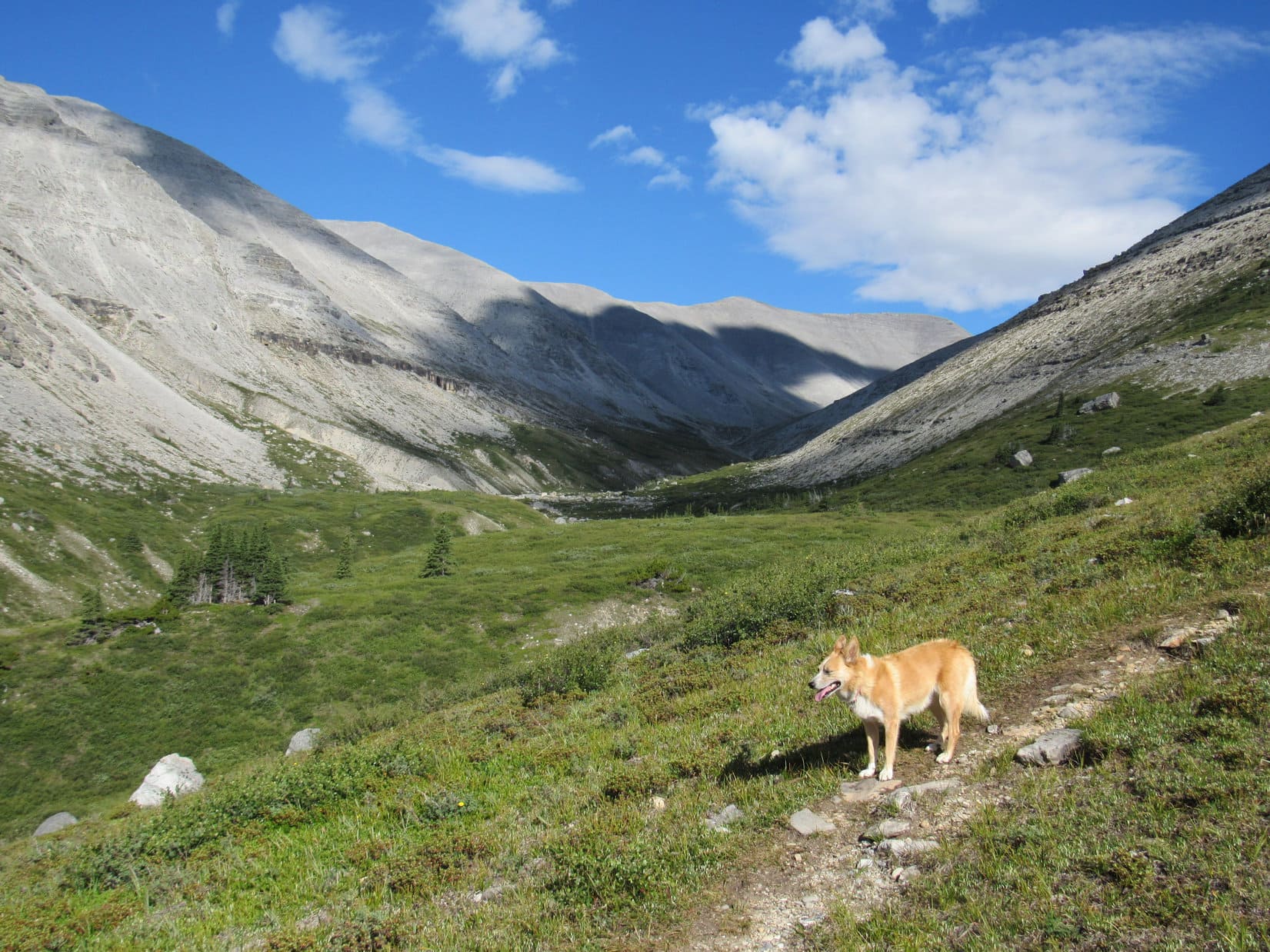
Looking WNW up Castle Creek in Manganese Draw.
Lupe in Manganese Draw as she starts out for Crow’s Nest Peak. Today’s adventure would be her 3rd attempt to reach the summit. The meadows along Castle Creek were easy territory to travel through, and an encouraging way to begin.

Lupe had to cross the creek several more times as it meandered through the valley, but there was always a way across.  Before long, Lupe was approaching the intersection of County Road No. 303 with USFS Roads No. 110 & No. 117.  Even if the G6 had been able to get this far, this would have been the end.  Lupe saw that No. 117 heading S from the intersection in the general direction of Crow’s Nest Peak was completely covered by a huge snowbank.

Lupe nears the intersection of County Road No. 303 and USFS Roads No. 110 & 117 in Manganese Draw. The big snow bank seen beyond her completely covered No. 117. Photo looks NW.

The plan was to follow No. 117 a couple miles S to get close to Crow’s Nest Peak.  From the intersection, Lupe avoided the big snow bank by returning to the meadow close to Castle Creek.  She crossed the creek one more time, and didn’t go back to the road until she was beyond the snow bank.  No. 117 climbed steadily as it wound around toward the SW.

Between the brilliant sunshine and fast warming temperatures, the steady upward trek along the road soon started feeling rather warm.  After going 0.5 mile SW on No. 117, an unmarked dirt side road headed SE up an even steeper slope toward the forest.  This was probably USFS Road No. 117.5D.  Getting out of the hot sun and up into the shady forest sounded good to both Lupe and SPHP.  Lupe would have a better time exploring the forest than following the main road anyway.

A short steep climb along No. 117.5D brought Lupe to the edge of the forest.  Much more snow was hidden here, still melting in the shade of the trees.  The snow wasn’t everywhere, but Lupe frequently encountered drifts 2 feet deep.  No. 117.5D continued climbing for a while, but eventually leveled out.  The road disappeared completely not long after reaching the high ground.

Crow’s Nest Peak was still 1.5 to 2.0 miles S.  According to SPHP’s old USFS map, Lupe should reach USFS Road No. 377 before she went half that far.  Dodging snow drifts as much as possible while staying on the highest ground, Lupe and SPHP wandered S through the forest.

Picking a way through the snowy forest was slow going.  Lupe went on and on, but came to no roads.  After what seemed like quite a while, Lupe came to a high spot in the forest.  SPHP wondered if this might even be Crow’s Nest Peak, but soon decided it couldn’t be.  (Note: Lupe was likely at the end of the ridge extending SE from High Point 7036 on the Peakbagger topo map.  Expedition No. 86 occurred shortly before Lupe discovered Peakbagger.com.  SPHP did not have a topo map along on this or any of Lupe’s earlier Black Hills expeditions.)

Little could be seen from the high spot.  The only distant view was toward the S or SE, but it wasn’t much of a view and there weren’t any apparent landmarks.  However, Lupe did have a glimpse between the tees of slightly higher ground off to the SW.

Lupe near the first high spot she came to in the forest.

The next small ridge to the SW wasn’t that far away, but progress toward it was slow due the snow drifts.  Lupe finally arrived up on this ridge, but it didn’t appear to be Crow’s Nest Peak, either.  Lupe could see even less from here (likely High Point 7034), but it looked like there might possibly be higher ground to the SE.

Lupe tried following the ridgeline SE, but didn’t seem to be losing or gaining any significant elevation.  However, she eventually came to a rocky ledge from which she had somewhat more of a view.  From here there appeared to be slightly higher ground off to the WSW.  Noticeably higher ground was off to the SSW, but farther away than SPHP thought Crow’s Nest Peak ought to be.  Still, nothing else around here could be any higher.

Lupe continued SE on the ridge, but soon had to give up on finding any better viewpoint.  She now left the ridge going toward the closer high ground to the WSW.  Another slow trek through the snow drifts brought Lupe to this new high ground.  She wasn’t really any higher than before back on the last ridge.  Not a thing could be seen except the forest.  The terrain in all directions was virtually flat.  Lupe turned S.

Only a few minutes after turning S, Lupe came to a road.  No. 377 at last!  Lupe followed the road WSW, and quickly arrived at a small clearing in the forest where she found a water trough surrounded by a pole fence.  Nearby was an unexpected intersection.  The new road was unmarked, but the road Lupe had been following was clearly marked as USFS Road No. 377.1C.

Lupe near the unexpected road junction. The marker for USFS Road No. 377.1C, which Lupe had already been following for a little way is seen on the right. The water trough surrounded by the pole fence is also in view. The intersecting road is out of sight behind the camera. Photo looks ENE.

Time to stop and check the USFS map again.  SPHP figured this new road must be USFS Road No. 377.  The map had surprising news.  The map confirmed the new road was No. 377, but Lupe was nearly 2 miles E of where she was supposed to be, a little N of Knutsen Spring!

It hardly seemed possible Lupe had gone this far E, but that was what the map showed.  How had SPHP gotten so badly turned around with the sun out in a cloudless sky?  Lupe was still far from Crow’s Nest Peak.  The map showed she had two options from here.  After a short jog S to Knutsen Spring on No. 377, the road would turn W, then NW for 2 miles.  At another junction, she would then have to turn SE following a different road for nearly another mile just to reach USFS Road No. 266.1A at a point 0.5 mile E of the mountain.

A shorter, more direct route was possible, too.  After reaching Knutsen Spring, if Lupe simply left No. 377 continuing S through the forest, she should find No. 266.1A less than 0.25 mile away.  No. 266.1A would then take Lupe 2 miles WSW straight to Crow’s Nest Peak.  That seemed like the thing to do.  Yet it was shocking to think that Lupe was still nearly as far away from Crow’s Nest Peak as when she’d left the G6.  Was Crow’s Nest Peak going to elude Lupe for a 3rd time?!

Lupe and SPHP left the junction with No. 377.1C heading W on No. 377.  This also seemed odd, since No. 377 was supposed to be going S to Knutsen Spring from here.  The only other choice, though, was to head E on what SPHP assumed was No. 377.1D, and for certain Lupe didn’t need to be going any farther E.  SPHP figured No. 377 would turn S soon, but it didn’t.  It kept going W.

With Lupe so far E of where she should have been, going W was probably OK, even though the road wasn’t going where it was supposed to according to the USFS map.  The next new development, however, was more disturbing.  Lupe started losing elevation, and losing it fast.  The road was going downhill!  Snow was plentiful, both on the road and in the surrounding forest.  Downhill or not, Lupe had best stick to the road and continue W.

Down, down, Lupe and SPHP went.  Before long, the forest ended.  The road entered a snowy meadow.  Another surprise!  A much better gravel road was in view ahead.  The gravel road was unmarked where Lupe reached it, but a marker confirmed Lupe had been traveling No. 377.  Nothing made any sense.  Why was this good gravel road even here?  It hadn’t been that long since Lupe had left No. 377.1C.  Lupe turned S on the gravel road, while SPHP pondered these mysteries.

Gradually, it began to dawn on SPHP that this good gravel road had to be No. 117 again.  Lupe was now somewhere farther S than where she’d originally left it.  Back at the marker for No. 377.1C, Lupe hadn’t actually been anywhere near Knutsen Spring, but much farther W, about where SPHP had originally thought she was before seeing the marker and consulting the map.  Within another 0.5 mile, Lupe should come to another road that would take her SE to Crow’s Nest Peak.

Before she’d gone another whole 0.5 mile, Lupe did come to another road.  This new road went ESE up a small draw, and was marked as No. 377.1A.  This seemed like it might be the right road.  At least it was going the right direction.  Lupe took it.

No. 377.1A steadily regained Lupe’s lost elevation, which was a good thing.  The road gradually turned SE, which seemed good, too.  The road was so soft and muddy from melting snow, Lupe and SPHP traveled much of the time off in snowy meadows nearby.

SPHP was watching for an expected junction with No. 377 again 0.5 mile from No. 117, but it never materialized.  Strange.  The map showed it, but no junction appeared.  Lupe continued on.  About 1.0 mile from No. 117, Lupe was approaching the top of a rise.  Off to the W in a meadow sat a large white plastic tank, presumably for water.  It was enclosed by another pole fence.  There wasn’t much snow up here.  Was Lupe coming to the top of Crow’s Nest Peak?

Coming up USFS Road No. 377.1A, Lupe saw a white plastic tank to the W of the road as she was approaching the top of a rise about 1 mile SE of USFS Road No. 117. Photo looks S.

A short distance beyond the white water tank at the top of the rise, Lupe found an unexpected road intersection.  If she stayed on No. 377.1A continuing SE, Lupe would start losing elevation at a good clip.  Turning SSW, she would lose less elevation following No. 377.1B.  Both roads were clearly marked.  Which way?  SPHP had no clue.

Lupe pricked up her ears listening to a wild turkey gobbling somewhere in the forest as SPHP sat on a log studying the USFS map.  It didn’t even show a road No. 377.1B.  Crow’s Nest Peak couldn’t be that far away, but where was it?  Lupe and SPHP went over to the white plastic water tank.  It bore no markings that shed any light on the situation.  Back to the log.  The question remained, which way to go?

SPHP remembered another map in the pack.  It was an old Black Hills National Forest “Travel Information Map”.  Maybe it would provide a clue?  SPHP took it out of the pack for a look.  The BHNF travel information map showed the USFS Roads in much greater detail than the old USFS map, although it contained absolutely no other details except section lines and numbers.

No wonder everything had been so confusing!  The BHNF travel information map was an enormous help!  It showed road patterns that matched up with what Lupe had been seeing on the ground.  The road numbers agreed with the markers Lupe had seen, too.  SPHP’s old USFS map, normally reasonably accurate, was riddled with inaccuracies.  It was a work of fiction in the area Lupe had been traveling through.

The BHNF travel information map showed the intersection of USFS Roads No. 377.1A and No. 377.1B where Lupe was right now.  She clearly needed to take No. 377.1B.  Although the BHNF travel information map didn’t show Crow’s Nest Peak, by comparing section lines on the two maps it was easy to see Lupe was only 0.5 mile NE of the summit.  Lupe and SPHP took off heading SSW on No. 337.1B.

As the roads went, Lupe would have more than 0.5 mile to go to reach Crows Nest Peak.  In fact, the BHNF travel information map led SPHP to believe she would have to go 0.5 mile just to reach the next intersection with USFS Road No. 266.  Well before Lupe had gone 0.5 mile, however, she came to a small clearing.  A road buried in snow disappeared going S into a dense forest.  There was no marker for it, but it was probably No. 266.

A less snowy road made a sharp turn to the W into another dense forest.  A marker showed this was still part of No. 377.1B.  Lupe did need to go W to get to Crow’s Nest Peak, so she left the small clearing staying on No. 377.1B.

Lupe didn’t go much farther before she reached a larger clearing.  This clearing wasn’t completely treeless.  Spruce trees were scattered around.  On the N side of the road was a good-sized pond.  Three ducks were paddling around on this pond, but they flew off as Lupe approached.
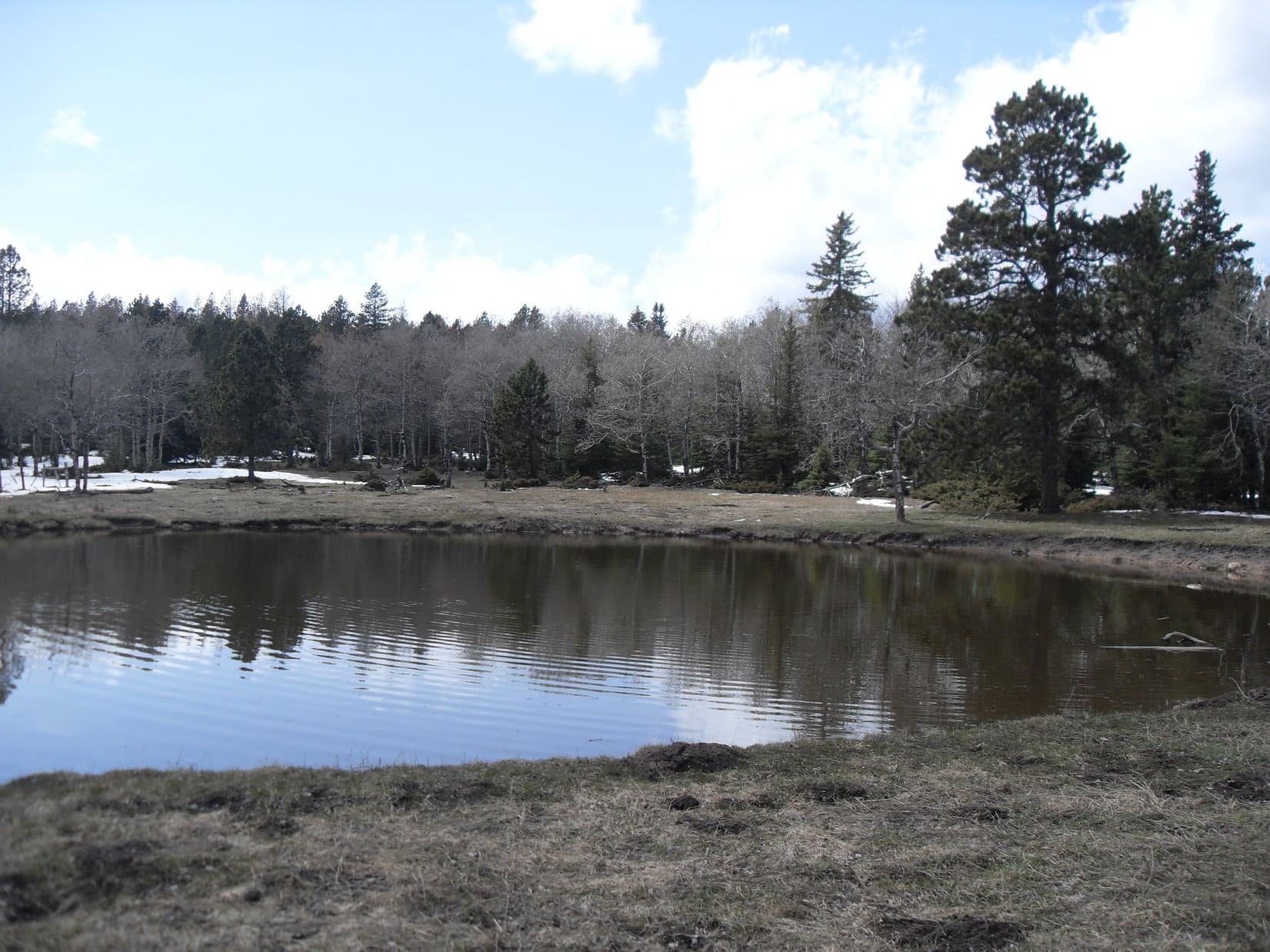
Three ducks paddling around on this pond on the N side of USFS Road No. 377.1B flew away as Lupe approached. Photo looks NW.

Although the pond contained rather murky, brown water, it still seemed like a relatively nice place to take a short break.  Lupe had Taste of the Wild, while SPHP munched an apple.

After finishing her Taste of the Wild, Lupe went down to the edge of the pond.  She saw a salamander trying to avoid detection by burying itself in the mud at the bottom of the pond.  Salamanders are a fairly unusual sight in the Black Hills.  Lupe wondered what that strange thing was?  Fortunately, as far as SPHP was concerned, she didn’t want to find out badly enough to enter the cold, dirty-looking water.

Lupe near Salamander Pond. Photo looks ENE.

The time came to press on from Salamander Pond, but SPHP had a hard time discerning where No. 377.1B went from here.  A foray to the S revealed nothing.  As it turned out, No. 377.1B continued W hidden under snow.  It seemed like Lupe was gaining a little elevation as she followed the road W.  Soon she was definitely gaining elevation.  The faint road climbed a small hill from the SE.

Lupe arrived on top of the little hill to find a small, flat, opening in the forest.  Part of the opening was buried beneath a large snow bank.  A big pool of snow melt water covered a portion of the road ahead to the W.  The whole area was so level, most of the ground was soggy.  Water trickled NE into a marshy area among the trees.

Was this Crow’s Nest Peak?  Lupe seemed to be at the top of the small hill, but saw no signs or markers anywhere.  To the E, lots of snow could be seen between the trees.  A spur of the road headed in that direction.  However, before going E, Lupe went W to check out the big pool of water.  Beyond it, SPHP thought it looked like there might be a view.

Going over to the big pool, the ground was sopping wet.  Beyond the pool, however, the ground was drier and Lupe did have a bit of a view off to the W.  The forest had been thinned enough in this direction so that she could see a few high hills that had to be well into Wyoming.  Closer by were blue ridges nearly as high as where Lupe was now.  SPHP thought Lupe must be on Crow’s Nest Peak, but found no proof.

Looking E at the pool of snow melt water that partially covered the road on top of the little hill.

Lupe traipsed back E past the snow melt water pool, crossing the soggy ground again to reach the trees at the E side of the clearing.  She explored the spur of the road that went E into the forest.  Only a few trees into the forest, Lupe found herself at the edge of another even smaller clearing.  This tiny clearing was full of snow.  The snow made it hard to tell, but it looked like the spur road ended already at a small turnaround circle in the clearing.

Out in the middle of the tiny clearing, a red and yellow metal post stuck up out of the snow.  Lupe and SPHP ran over to the post.  It said “Survey Marker”!  This had to be it!

The post in the middle of the tiny snow-filled clearing said “Survey Marker”! This had to be it!

Excitedly, Lupe and SPHP started digging in the snow around the post.  At first Lupe didn’t find anything.  SPHP found a few rocks close to the W side of the post.  Almost immediately, Lupe uncovered something metal about half a foot N of the post.  The survey marker!  SPHP brushed the rest of the snow away.  The marker said “1912”.  At the center of a circle rimmed with the usual propaganda a single joyful word was stamped: “Crow”.

After failing on two prior expeditions, Lupe had arrived!   She was now undeniably on Crow’s Nest Peak (7,048 ft.).  She had found the survey marker someone had set here 102 years ago!  SPHP took a picture of it, not realizing until later on how blurry it had turned out.  Oh, well.

The survey marker on Crow’s Nest Peak. SPHP didn’t realize until later on how blurry this photo had turned out. “Crow” can sort of be made out above the triangle.

There were no views from the tiny snow-filled clearing.  The clearing bore no resemblance to what one thinks of as a mountain top.  Lupe hadn’t had much in the way of a distant view anywhere along the way here, either.  Yet finding the survey marker felt like finding a treasure.  Lupe was actually at one of the highest points in the Black Hills.  Looking for the marker in this remote part of the western Black Hills had been fun!

Lupe at the remote, undramatic, summit of Crow’s Nest Peak for the very first time.

Lupe and SPHP left the summit feeling inexplicably happy.  Nothing wrong with being happy is there?  The American Dingo seemed to take it for granted.  SPHP decided happiness needs no weighty justification.  Take it when you can get it, and be glad!  If being too happy is a problem, it’s among the best problems you can have.  Enduring it is easy.  Lupe and SPHP were willing to tough it out!

The Carolina Dog’s peakbagging goal for the day had been achieved.  SPHP knew there was beautiful open land flanked by forests not too far off to the W.  Lupe could wander over that way, find USFS Road No. 117 again, and have fun exploring on her way back to the G6.  Lupe passed by the pool of snow melt water on the W side of Crow’s Nest Peak one more time.

Lupe near the pool of snow melt water for the final time on her first successful trip to Crow’s Nest Peak. Photo looks WSW.

After enjoying the view W of the pool for a few minutes, Lupe followed the road down the SW slope of the little hill.  The road was in poor condition here.  It led to an intersection where Lupe turned WNW.  After passing through a level clearing, Lupe resumed losing elevation as the road went downhill through a forest.  Emerging at the far end, Lupe could see the good gravel road, USFS Road No. 117, again.

USFS Road No. 117 came into view again from the snowy road WSW of Crow’s Nest Peak as Lupe emerged from the forest. Photo looks NNW.

When Lupe reached No. 117 again, SPHP was surprised there was no sign at all for Crow’s Nest Peak at the turn onto the minor road she had been following.  A short distance off to the W was a junction with another good gravel road.  Lupe went over to check out that junction.  She found a sign saying this other good gravel road heading N was No. 117.5K.

A stream with a strong current was flowing S on the W side of No. 117 from this junction.  Ordinarily, no stream exists here.  It was all snow melt.  Maybe Lupe could have some fun following the temporary stream S along the road?  SPHP kind of wanted to see if there were any more roads heading toward Crow’s Nest Peak from No. 117, and if any signs for Crow’s Nest Peak existed anywhere along the way.
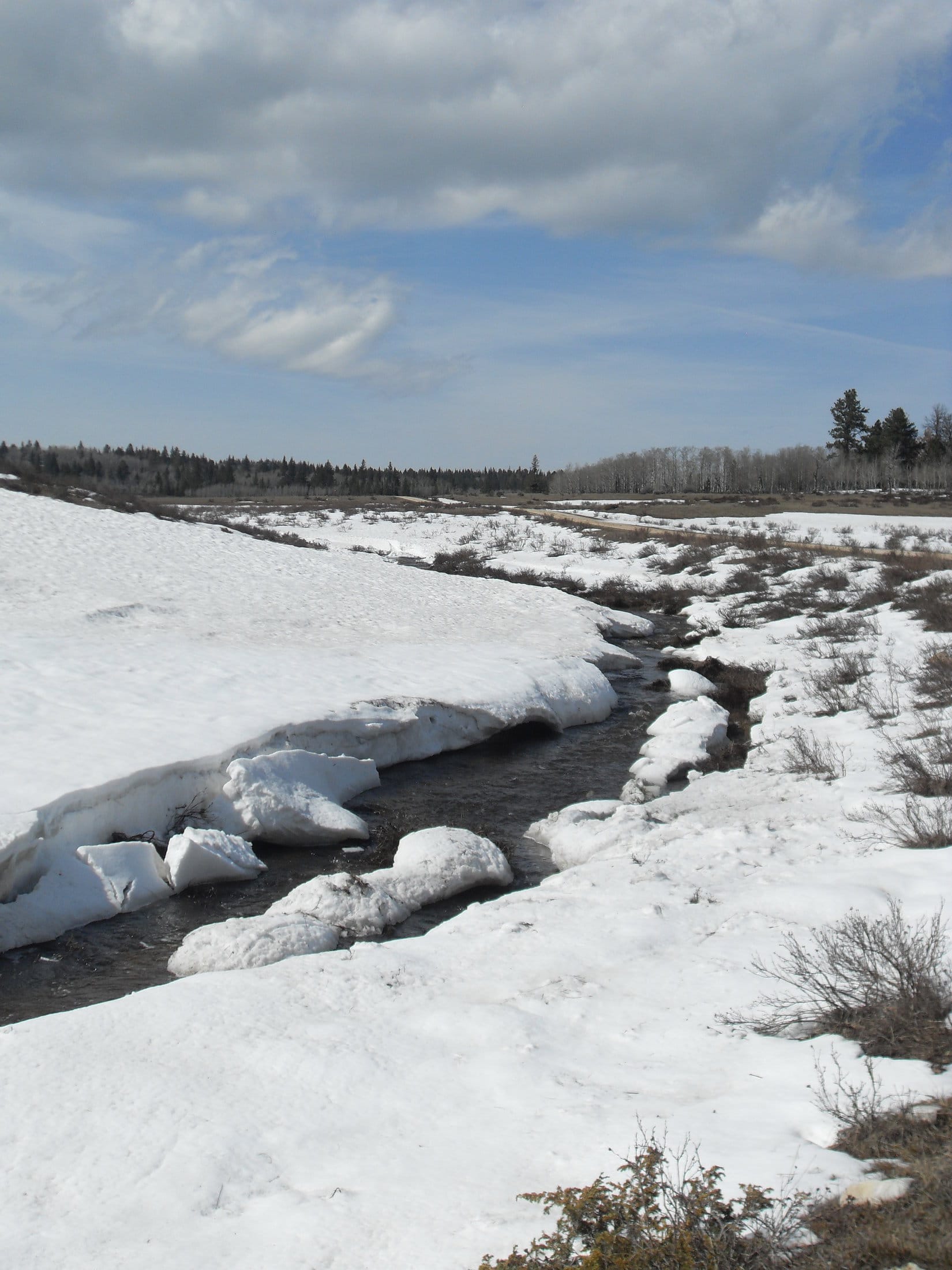
The snow melt stream flowing S along the W side of USFS Road No. 117.5K. Ordinarily there is no stream at all here. It was all snow melt that would eventually flow into Beaver Creek a few miles SW of here. Photo looks NNE.

Lupe had a good romp exploring the meadows near the snow melt stream as she followed No. 117.  The road wound around to the SW.  Lupe paralleled it for at least 0.5 mile before coming to a bend where two big truck tires had been turned into water troughs.  One was full to the brim, while the other was nearly empty.

Lupe sits near the truck tire water trough. This one was almost overflowing. Photo looks NE in the direction Lupe had come from.
Lupe enjoyed the shade next to the almost empty truck tire water trough while SPHP checked the maps again. Photo looks SSW.

SPHP checked the maps again.  Lupe hadn’t come to any more roads.  It wasn’t likely any roads would leave No. 117 for Crow’s Nest Peak from any farther S than where Lupe was here.  SPHP’s curiosity was satisfied.  May as well head back N.

The two truck tire watering troughs were as far SW as Lupe went along USFS Road No. 117.  The snow melt creek was pretty impressive down here.  Lupe started following it back upstream.

Near the two truck tires, the snow melt stream was impressive for the Black Hills. This was as far SW as Lupe went along No. 117 before turning around to go back N. Photo looks NE.

Lupe went all the way back to the junction with No. 117.5K.  The meadows W of No. 117.5K looked so beautiful and inviting, Lupe and SPHP left No. 117 to continue N in those meadows.  Lupe came to a pond along the snow melt stream that was mostly full of snow.  A small waterfall tumbled into the little pond.
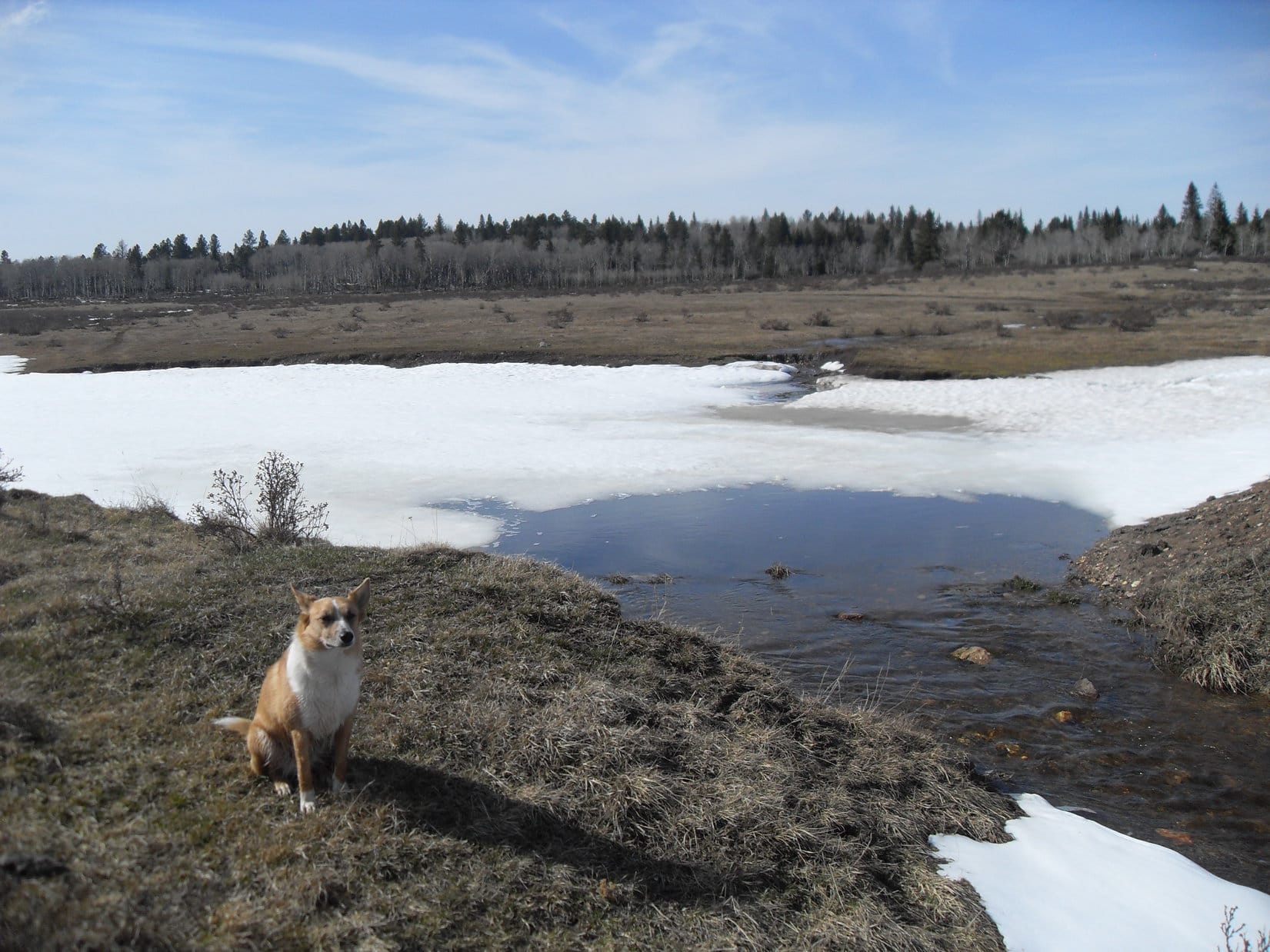
Lupe came to this cool little snow filled pond with a small waterfall tumbling into it in the meadows W of No. 117.5K. Photo looks NW.

No. 117.5K went almost straight N gaining elevation gradually.  Eventually the road went over a little pass.  Beyond the pass was another long beautiful valley off to the NNE.  SPHP continued marching along soggy, wet side roads in the fields W of No. 117.5K, while Lupe roamed to her heart’s content.  SPHP stayed toward the W side of the valley near the forest, since Lupe enjoys having a mix of open ground and forest to run around on and explore.

As No. 117.5K went over this pass, the next long beautiful valley to the NNE came into view. Lupe and SPHP followed it staying toward the W (L) near the trees. Photo looks NNE.
Lupe enjoyed being able to make forays into the nearby aspen forest from the meadows along No. 117.5K. Photo looks NW.

No. 117.5K ended as a good gravel road a little N of the pass.  Near a barbed wire fence, it veered off to the NW as a muddy minor road.  Lupe was hungry again by the time she reached this point.  She took another Taste of the Wild break near the fence where the good part of No. 117.5K ended.

By the time she reached the N end of the good part of No. 117.5K near the barbed wire fence, Lupe was ready for more Taste of the Wild. A long day roaming the Black Hills gives a Carolina Dog a healthy appetite!
Ahh, better!
Looking back to the S from the N end of the good part of No. 117.5K toward the little pass Lupe went over. The mucky part of No. 117.5K continued off to the NW (R) into the forest, but Lupe didn’t follow it that way.

From the fence at the N end of the good part of No. 117.5K, Lupe left the road to continue NNE down the long gentle valley ahead.  She roamed the W side of the valley, crossing many little snow melt streams.  SPHP found another dirt road, and followed it where it wasn’t too muddy.  The easy, gradual, downhill trek was beautiful.  The air grew chilly as the sun began to sink.  It was still early spring up at this elevation.
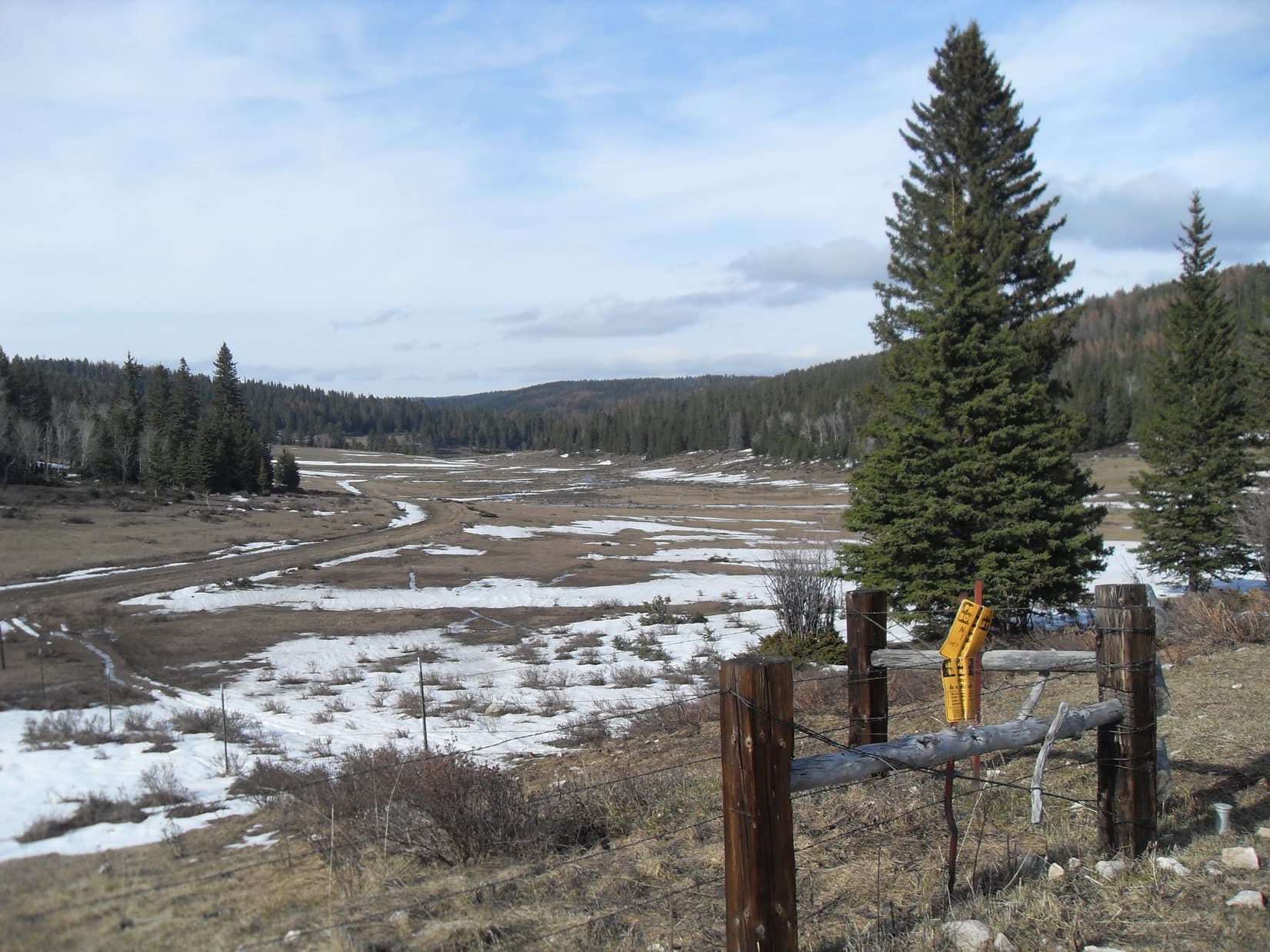
The easy, gradual trek down the long valley beyond USFS Road No. 117.5K was a beautiful time. Lupe crossed many little snow melt streams and roamed happily as the sun began to sink and the air grew chilly. Photo looks NNE.

Eventually, SPHP saw No. 117 reappear on the E side of the valley.  Soon No. 117.5D came into view, too, on the far side of No. 117.  This was the road where Lupe had originally left No. 117 to escape the heat and explore the forest on her way to Crow’s Nest Peak.  Lupe could have gone over to No. 117 again, but instead she stayed on the W side of the long valley.

SPHP led her along the dirt road even after it re-entered the forest, turned NW, and started gaining elevation.  This proved to be a mistake.  Soon Lupe and SPHP had to leave the road to plunge down the N side of a densely forested steep slope.  The snow was feet deep here.  Suddenly, Lupe was leaping and bounding through snow up to her neck.

After what seemed like a long struggle, Lupe escaped the snow when she reached the floor of a valley.  She came to another road, No. 117.5I.  The intrepid Carolina Dog was now a little farther W in upper Manganese Draw than she had been early in the day.  Her adventure to Crow’s Nest Peak and back was almost over.  Before long she was E of No. 117 again, following Castle Creek downstream.  At 6:38 PM, (44°F) Lupe reached the G6.

Lupe had enjoyed sunshine all day near Crow’s Nest Peak.  Surprisingly, on the way home it turned out the rest of the Black Hills only a few miles to the E was under dense cloud cover.  Lupe was tired.  She curled up on the G6’s passenger side front seat.  SPHP thought she might go to sleep as the light faded.

The Carolina Dog couldn’t relax, though.  She was too worried she was missing out!  She wound up standing and watching for cows, horses and deer to bark at all along the long road home.  For Lupe, the adventure never ends!

On Crow’s Nest Peak, 5-3-14

Links:

Next Black Hills Expedition              Prior Black Hills Expedition

Want more Lupe adventures?  Choose from Lupe’s Black Hills Expeditions Adventure Index or Master Adventure Index.  Or subscribe free to new Lupe Adventures.

Summit Peak & Mount Saint Paul, Stone Mountain Provincial Park, British Columbia, Canada (8-4-17)

Day 5 of Lupe’s 2017 Dingo Vacation to the Yukon & Alaska!

The sky was clear and bright, that pale arctic blue that promises rare adventure.  This was going to be a fantastic day!  Five days into her Dingo Vacation, Lupe was finally going to get to tackle her first major peakbagging objective.  She got a reasonably early start heading W on the Alaska Highway (6:41 AM, 50°F).  A sign said it was still 60 km to Summit Lake.

Summit Lake is situated at Summit Pass, the high point reached by the Alaska Highway as it goes through Stone Mountain Provincial Park in NE British Columbia.  There’s a campground and a picnic ground at the E end of the lake.  Lupe and SPHP had stopped there last year on the way through the park for the first time.

Lupe had been on her way home then at the tail end of her 2016 Dingo Vacation to the Canadian Rockies, Yukon & Alaska.  She was out of time and couldn’t stay, but there had been new snow on the mountains, so conditions hadn’t been right anyway.  However, Stone Mountain Provincial Park had been an impressive, gorgeous surprise.  SPHP had left convinced that Lupe ought to come back some day.

Now, only 11 months later, the American Dingo was on her way.  She would arrive within the hour!

Suddenly, Lupe spotted a fox next to the Alaska Highway!  A skinny, somewhat strange looking fox of the far N.  The fox had tall, thin black legs, a gray and tan coat, and the most amazingly luxurious tail, ever.  SPHP slowed down hoping to get a picture.

Lupe had a conniption fit, barking hysterically.  Oddly enough, the little fox wasn’t fazed in the least.  It seemed to take Lupe’s hysteria as a friendly greeting from a fellow canine.  After SPHP got a photo, the fox trotted down the highway following the G6, staring hopefully at Lupe and SPHP as if it would like to hitch a ride, or wished Lupe would come out and play.

This strange, skinny northern fox seemed interested in making friends with a hysterical Dingo.

SPHP watched it in the mirrors for a few moments before accelerating away.  Best not to encourage the precious little fox to stay on the highway.  Besides, the decibel level in the G6 was totally out of control.

As it turned out, the fox wasn’t the only cause for hysteria.  Next came 3 caribou.  The caribou seemed to be licking something off the road.  Salt?  There was actually some traffic, but the caribou pretty much ignored it.  They were reluctant to move for vehicles, but warily kept their distance from the foaming-at-the-mouth Carolina Dog.

Lupe saw 3 caribou on her way to Stone Mountain Provincial Park. They couldn’t help but notice the deranged Dingo, too.
The caribou stayed busy purposely licking the highway. Maybe they were after salt? It was the only explanation SPHP could think of.
Although traffic had a hard time persuading the caribou to get out of the way, they were far more wary of Lupe.

As far as Lupe was concerned, the day was off to an exhilarating start!  She arrived at Summit Lake in great spirits.  SPHP parked at the picnic area next to the lake.  After a quick bite to eat, it would be peakbagging time!

Lupe arrives at Summit Lake in great spirits on a beautiful summer morning. The day had gotten off to an exhilarating start! Photo looks SW.

The Summit Peak trail starts right across the Alaska Highway from the campground and picnic area.  After a quick breakfast, SPHP moved the G6 to the roomy trailhead parking lot.  Only a couple of other vehicles were around.  Before Lupe hit the trail, SPHP took a look at information and maps posted nearby.  (9:04 AM, 61°F)

Information posted at the trailhead across the Alaska Highway from Summit Lake.
A closer look at the trail description.
This more general map of the Summit Lake area shows other nearby trails, too.

The posted description for the Summit Peak trail was vague and somewhat misleading about the significance of 3 stars shown on the trail map.  Only by comparing the posted information with what SPHP had brought along was SPHP certain what each star must represent.

The first star was only the first high point at the closest end of what could be considered Summit Peak’s long summit ridge.  It was both a false summit and a great viewpoint where apparently many people call it good and turn around.  The second star was the location of Summit Peak’s true summit.  The third star was the summit of Mount Saint Paul.  The trail description barely mentioned Mount Saint Paul, and made it sound as though the third star was the summit of Summit Peak.

As far as Lupe was concerned,  Summit Peak (6,611 ft.) was only her first objective.  SPHP really hoped the American Dingo would make it all the way to Mount Saint Paul (6,985 ft.).

The first section of the Summit Peak trail was short.  The trail climbed a bit, then emerged from the forest at an open level area where it passed by the end of a ridge on the L (W).  Once Lupe was past the ridge, the trail dropped into a shallow ravine where it crossed a creek before climbing an embankment on the opposite side to enter a conifer forest.

Lupe near the start of the Summit Peak trail in Stone Mountain Provincial Park in NE British Columbia. The trail leveled out here passing around the end of the ridge seen on the L. Part of Summit Peak is seen directly ahead. Photo looks N.
Crossing the little creek early on. This creek was the only water source on the way up Summit Peak.

Lupe climbed steeply through the forest until she reached the rim of the creek valley.  Here the trail nearly leveled out and made a sweeping curve around to the W along the rim of the valley.  Lupe was already high enough to have some beautiful views.  SPHP was particularly intrigued by a mountain off to the S, which looked easily climbable.

Once beyond the creek, the trail climbed steeply to the rim of the valley before nearly leveling out. Here the trail sweeps around to the W along the rim. The trail ultimately goes up the rocky ridge ahead on the way to Summit Peak. Photo looks N.
Lupe was already high enough to have some beautiful views. SPHP was particularly intrigued by the mountain on the L, which looked like something Lupe could easily climb. Photo looks S.

The pleasant trek along the rim of the creek valley didn’t last long.  Soon Lupe was above treeline at the lower end of Summit Peak’s S ridge.  The trail turned N here and headed up.

Looking NW up the creek valley from the base of Summit Peak’s steep S ridge. The trail turns NNE here to begin climbing up to the false summit at High Point 6,500 (1,981 m).

The S ridge became progressively more rocky.  The low vegetation began to disappear.  Looper came to various rock formations.  Sometimes there was a bit of scrambling involved, but nothing significant, scary or long.  The trail became less obvious, and began to fade away.  Sometimes Lupe followed cairns, though the general direction the route had to take was never in doubt.

SPHP paused frequently to catch breath.  The views were incredible!  The higher Lupe went, the more spectacular they became.

Early in the climb up the long, rocky S ridge. The true summit of Summit Peak is seen on the L. Photo looks NNE.
Lupe’s route up the S ridge would take her first to the false summit at High Point 6,500 (1,981 m) seen on the R. The true summit is in view on the L. Photo looks NNE.
Summit Lake from partway up the S ridge. The campground and picnic area are visible on the L. The mountain beyond the lake and slightly to the right of Lupe is Mount Saint George (7,402 ft.). Photo looks SSW.
Puppy ho! Onward and upward! Lupe (L) leads the way. By now vegetation was scarce. Still a ways to go, though. Photo looks N.
The upper end of the creek valley Lupe had crossed much farther down is at lower L. Summit Peak (6,611 ft.) is in shadow on the R. Mount Saint Paul (6,985 ft.) is the high ridge in sunlight on the L. Photo looks NW.
Lupe sometimes passed over rock formations like this one on the way up. Once in a while there was a bit of scrambling involved. Never anything scary or serious, however. Photo looks N.
Getting close to the SE end of Summit Peak’s long summit ridge. The true summit is on the far L.

After a long climb, Lupe finally reached the upper end of the S ridge.  She was now at the far SE end of Summit Peak’s long summit ridge.  This was already a glorious viewpoint, but a somewhat higher point was in view not too far off to the NW.  That was the false summit, High Point 6,500 (1981 m), which corresponded to the first star on the trail map that was posted back at the trailhead.  The mountain’s true summit could be seen beyond High Point 6,500, still some distance away.

After the long climb up the S ridge, Lupe arrived here, at the far SE end of Summit Peak’s long summit ridge. High Point 6,500 is near at hand on the R. Beyond it, appearing in shadow straight up from Lupe’s rump, is Summit Peak’s true summit. Mount Saint Paul is the high ridge on the L. Photo looks NW.
Same view with help from the telephoto lens. High Point 6,500 (1,981 m) is on the R. The true summit is in shadow at Center. Photo looks NW.

After a pause to take in the views, Lupe and SPHP continued on to High Point 6,500 (1,981 m).  Getting there was cake.  Lupe stood by a cairn at the top, which she had seen from a distance.  This was the location of the first star on the trail map, and the place where most hikers supposedly turn around according to the information back at the trailhead.

Looper stands by the cairn at High Point 6,500 (1,981 m). The far SE end of the long summit ridge, where Loop had just been, is seen a bit lower at Center. Photo looks SE.
Looking down the long S ridge Lupe had just come up from High Point 6500 (1,981 m). Summit Lake close to where she’d started out from is in view below. Much smaller Flower Springs Lake can also be seen well beyond Summit Lake. Photo looks SSW.

All the hard work was done!  The weather was perfect.  No way on earth were Lupe and SPHP going to turn around here!  The American Dingo headed for the true summit.

Turn around here? No way! A fun, glorious, easy ridge walk to the true summit lies just ahead! The American Dingo was going for it! Photo looks NW.

The stroll along the ridge leading to the summit was pure joy.  So easy, such stupendous beauty on all sides, conditions absolutely perfect, and the happy realization that no obstacle was going to prevent Lupe from attaining her peakbagging success!

Loopster reached the summit cairn to claim her first Stone Mountain Provincial Park summit.

Loopster at the true summit of Summit Peak (6,611 ft.). Mount Saint Paul in the background. Photo looks WNW.
Summit Lake from the top of Summit Peak. The lower end of the S ridge Loop had come up is seen at lower L. Photo looks SSW.
Looking SE back at High Point 6,500 (1,981 m) (L). Upper portions of the S ridge are seen on the R.

Getting to the top of Summit Peak had been quite a trek.  Lupe and SPHP took a lengthy break at the summit.

There was so much to look at and admire from up here!  Many fabulous mountains of the Muskwa Range were in view.  Some of the highest, most dramatic peaks were on the far W or SW horizon, sporting big snowfields and glaciers.  SPHP had no idea what the names of those mountains might be.  They were simply beautiful, remote, and mysterious.

There was no lack of wonderful sights close by, either.

On the far horizon, mostly toward the SW & W, Lupe saw many mysterious high mountains with snowfields and glaciers. Photo looks WNW(?) with help from the telephoto lens.
Looking W(?) with help from the telephoto lens. SPHP had no idea what the names of any of these beautiful peaks might be.
Looking WSW(?)
Mount Saint George (7,402 ft.) in sunlight (R). Summit Lake (lower L) and Flower Springs Lake beyond it. Photo looks SSW.
View to the ENE. The mountains were lower in this direction.
Lupe wandering a bit down the N slope, the cairn at the top of Summit Peak in view beyond her. Photo looks S.
Back at the cairn. Although the day had started out totally clear, puffy white clouds were building. They didn’t seem threatening yet. Photo looks S.
An American Dingo surveys Stone Mountain Provincial Park from Summit Peak. Photo looks SSW.
View to the N.
Lupe stands at the N end of the summit area. Beyond this point the mountain dropped off very sharply. Photo looks ENE.

After 45 minutes on Summit Peak, it was time to think about starting for Mount Saint Paul.  Lupe and SPHP were about to leave when Lupe spotted movement.  People were coming!  They would arrive momentarily.  Lupe and SPHP waited, and met Dave & Nancy Leckschas.

The Leckschas were from the Okanagan region.  They were on a 2 month vacation, with plans to go up the Dempster highway.  Dave said he had climbed Mount Saint George once, some 31 years ago.  Summit Peak now seemed more difficult than that had been.  Encouraging news, since Lupe and SPHP were hoping to climb Mount Saint George tomorrow!

Lupe meets Dave & Nancy Leckschas from the Okanagan region on Summit Peak. The Leckschas were on a 2 month vacation which would include a trip up the Dempster Highway. Dave and Nancy were the only people Lupe saw all day, other than a couple of girls who had turned back early on.

When SPHP mentioned that Lupe intended to go on to Mount Saint Paul from here, Dave said there were already two people up there.  Dave lent SPHP his field glasses, and sure enough, two people could be seen very close to Mount Saint Paul’s summit.

After a nice chat with Dave and Nancy, Lupe and SPHP headed out, leaving the Leckschas to enjoy the solitude they had no doubt expected to find on Summit Peak.

Referring to the rest of the route to Mount Saint Paul from Summit Peak, although not in a very clear manner, the information at the trailhead had said “After this viewpoint there are no more rock cairns or a visible trail but the peak can be reached by continuing on along the ridge of the mountain.”

Well, maybe, but that’s not exactly how SPHP would have worded it.  Looking toward Mount Saint Paul (6,985 ft.) Lupe could see the ridge the sign was referring to alright.  There was one teensy detail that had been left out.  Continuing on along the ridge meant dropping more than 1,000 feet (330 m) down an extraordinarily steep rocky slope to a saddle leading to the next part of the ridge.

Looking toward Mount Saint Paul (L), Lupe could see the ridge leading to it (R), but getting to that ridge meant dropping 1,000 feet down the very steep, rocky slope seen at lower R. Not to quibble, but it seemed to SPHP that this was a detail that might have been worth mentioning on the signage back at the trailhead. Photo looks NW.

At first, “continuing on along the ridge” going NW from Summit Peak looked like such a challenge that SPHP hesitated.  This route was way steeper than anything the Carolina Dog had faced on the way up.  However, there was no doubt this had to be the way.  If others had done it, Lupe could too.  Lupe started down.

“Continuing on along the ridgeline”, a simple matter of a 1,000 foot steep rocky descent to the saddle below (green area on L) before having to subsequently regain it all immediately climbing back up onto the next part of the ridge (seen ahead also on the L). No choice, though. If Lupe was ever going to get to Mount Saint Paul from Summit Peak, she had to do it. Photo looks NW.

For a while, Dave and Nancy could be seen waving encouragement from up on Summit Peak as SPHP slowly, cautiously trudged down the steep slope.  It was soon evident this was actually going to work, although SPHP was clearly destined to chew up a bunch of time on the descent.  Finally the terrain began to level out.  Lupe reached the saddle leading to the next part of the ridge.

After a lot of waiting around for SPHP, Lupe reaches the saddle leading to the next ridge. Photo looks ENE.

The weather was suddenly starting to become questionable.  Each cloud was now sprinkling rain as it sailed by.  While Lupe traversed the saddle, the rain showers intensified.  SPHP grudgingly called a halt to dig the plastic rain poncho out of the pack.

Putting on the rain poncho worked wonders.  Within 10 or 15 minutes the rain showers were kaput.  Nada.  No more the rest of the day.  No doubt failing to have put on the rain poncho would have caused a cloudburst.  Life can be like that.  Anyway, the rain poncho had done its job.  Back in the pack it went.  Lupe and SPHP began the process of regaining the 1,000 feet the American Dingo had just lost, and started up the next steep ridge.

Lupe just past the saddle area. Photo looks W up the valley leading to the base of Mount Saint Paul (L). Lupe needs to climb the lovely little ridge on the R to get there.
Looking back at Summit Peak (R) and the ridge Lupe followed down to the saddle seen below to get here. That whiner, SPHP! Doesn’t look bad at all from this angle! Photo looks SE.
Starting to get high again! Summit Peak on the L. The ridge going down from Summit Peak to the R toward the far end of the valley is NOT the same S ridge Lupe climbed. That ridge is out of sight beyond the one seen here. Anyone interested in climbing only Mount Saint Paul might do well to skip Summit Peak entirely, and come up the valley on the R. Photo looks SSE.

At first, the climb up onto the ridge beyond the saddle was steeper and more challenging than anything on the way up Summit Peak had been.  Part of the way, SPHP found some use of hands advisable, even necessary.  Lupe regained a lot of elevation before the situation improved.

The ridge beyond the saddle didn’t become an easy trek until Loop was back up even with Summit Peak again.  She was still gaining elevation from here, though, because this ridge went higher than Summit Peak.

On the way up. The first part of the climb up this ridge beyond the saddle was steeper and more challenging than the S ridge Lupe had climbed going up Summit Peak. It’s starting to get easier here. Photo looks NW.
Lupe (a tiny brown speck not far from the green patch on the R) up on the easier, more level part of the ridge. Mount Saint Paul is not pictured, still off to the L of this photo. Photo looks WNW.
In addition to grand views all around, there was beauty in miniature, too. The delicate, colorful tiny plants of the tundra are always fascinating.
Way up high again! The high point of the ridge beyond the deep saddle coming from Summit Peak is seen on the L. However, a 2nd saddle Lupe would have to go over was still ahead beyond that high point. Photo looks W.

A second saddle existed along this ridge leading to Mount Saint Paul.  Even if Lupe followed the very top of the ridgeline the entire way, she wouldn’t lose nearly so much elevation going down to this second saddle from the next high point as she had on that first enormous drop from Summit Peak.  However, there didn’t seem to be any reason to gain more elevation than necessary only to lose and regain it again.

Lupe climbed far enough to get a little higher than the second saddle, which she could see ahead.  Here a faint, nearly level animal trail went directly across the slope S of the ridgeline straight to the saddle.  Following this trail allowed Loop to skip the next high point she’d been approaching on the ridge.

Once Lupe reached the second saddle, only the final steep climb to the summit of Mount Saint Paul remained.

Way up in NE British Columbia in Stone Mountain Provincial Park, intrepid American Dingo explorer Lupe continues up the ridge. Summit Peak is now far behind her on the R. Photo looks SE.
The second saddle is seen ahead on the R. Lupe headed straight for it from here following a faint animal trail across the rocky slope, enabling her to skip going all the way up to the high point on the far R. Mount Saint Paul, her ultimate objective, is on the L. Photo looks WSW.
Loopster getting close to the second saddle. Mount Saint Paul on the L. On the final climb to the summit, Loop would stay slightly to the L (SE) of the ridge leading to it. Photo looks WSW.
Lupe pauses at the second saddle for a look back at beautiful Summit Peak (Center). The ridge she has been coming up is on the L. Photo looks SE.

The final climb to the summit of Mount Saint Paul from the second saddle was steep enough so it wasn’t entirely clear if Lupe and SPHP would even make it to the top.  At last that happy moment arrived when Lupe popped up onto the summit plateau.  The Carolina Dog had made it!  SPHP was ecstatic!

An easy stroll brought Lupe to a cairn along the W edge of the summit plateau.  This was it, the summit of Mount Saint Paul (6,985 ft.)!

Made it! Lupe on the summit cairn on Mount Saint Paul. Photo looks SW.
Looking WNW. High Point 6831 (2,082 m) is nearby at far R.
Looking N.
Oh, yeah! I made it! All the way up Mount Saint Paul! Photo looks NW.

Reaching the summit of Mount Saint Paul was cause for celebration!  And a break, a fantastic hour long break.  Lupe relaxed by the summit cairn.  She had water and Taste of the Wild.  She toured all around the whole roomy summit plateau, which was highest toward the NW, but relatively level overall.

And of course, Lupe and SPHP gazed long upon the splendid glories of the Muskwa Range on display in every direction of the compass in Stone Mountain Provincial Park way up here in NE British Columbia.

Looking down the valley to the SW. A little section of McDonald Creek is seen way down at the far end. Photo looks SW.
Loop at the SW end of the summit plateau. Photo looks N back toward the true summit.
Loop still at the SW end of the summit plateau. The triangular high spot (R) at the end of the near ridge is High Point 6752 (2058 m) Photo looks SSW.
High Point 6722 (2,058 m) is now on the L. Photo looks SW with help from the telephoto lens.
Zoomed in on High Point 6752 (2,058 m) in the foreground now. Next we’ll zoom in on some of those distant snowy peaks. Photo looks SW.
Zoomed way in on the high peak straight out beyond High Point 6752 (2,058 m). Photo looks SW.
Now zoomed way in on the distant peak slightly more to the R (W). SPHP has no idea what the names of these gorgeous peaks are. Photo looks SW.
Two nearby ridges rise up to meet at Center of this photo. A more level sharp ridge continues farther from the meeting point sweeping around toward the R. The high point at the far R end is the summit of Mount Saint George (7,402 ft.). Photo looks SSW.
Zoomed in on Mount Saint George’s summit ridge. Tomorrow Lupe would try to climb Mount Saint George (7,402 ft.). She would go up the ridge seen at lower L to the meeting point reached with the ridge coming up from the lower R. From there, she would follow Mount Saint George’s sharp summit ridge as it sweeps around to the summit at the far end on the R. At least, that was the plan. Photo looks SSW.
SPHP no longer remembers what direction this distant snowfield was from Mount Saint Paul, but believes it was likely toward the W.
Looking back up toward the summit of Mount Saint Paul from near the SE edge of the summit plateau.
The ridge Lupe came up from Summit Peak is highlighted in sunshine (Center). The first deep saddle from Summit Peak is at far R. The second saddle before the final ascent up Mount Saint Paul is on the far L. Photo looks NE.
Beautiful Lupe taking it easy on Mount Saint Paul.
At the summit. Photo looks NW.

Lupe’s beautiful, joyous hour on Mount Saint Paul passed by.  It was a long way back to the G6.  Best get a move on.  Looper wasn’t going to return using the same route she had come up.  It was late afternoon now, and she didn’t have time to go all the way back to Summit Peak.

Back on Summit Peak, Dave Leckschas and SPHP had commented that Mount Saint Paul’s SE ridge looked like it ought to serve as a good shortcut back and a reasonably easy route down.  Now looking down on it from above, it didn’t look quite so amenable.  Most of the SE ridge was fine.  Getting down to the easy part was the problem.  The upper end of the ridge near the top of the mountain was steeper and more challenging than SPHP expected.

Lupe relaxes near the E edge of the summit plateau. Here she’s got a fantastic view of Summit Peak (6,611 ft.) (Center L) and High Point 6500 (1,981 m) (Center R) leading to it. The distant ridge on the R is the one Lupe climbed on the way up Summit Peak. The near ridge at lower R is part of Mount Saint Paul’s SE ridge SPHP had expected Lupe would be able to take back to the G6.
The upper end of Mount Saint Paul’s SE ridge is in the foreground. Doesn’t look bad from this angle. Photo looks E.
At the top of the long SE ridge (foreground) leading down from Mount Saint Paul. Summit Peak at Center. Photo looks SE.

Lupe and SPHP started down Mount Saint Paul’s SE ridge.  The upper ridgeline was pretty ragged with drop offs that had to be negotiated around.  Lupe always stayed on the less steep R (SW) side of the ridgeline when she couldn’t make progress right on it.

SPHP is always terribly, terribly slow on steep rocky descents like this.  After a while, SPHP became discontent with the rate of descent.  Everything was fine, Lupe would have gotten there, but it seemed like it was taking forever to reach the lower, easier part of the ridge.  SPHP got the numbskull idea that things looked easier off to the SW away from the ridgeline.

They weren’t!  Soon Lupe found herself far from the ridgeline heading down a slope so steep and rocky that even the Carolina Dog was becoming alarmed.  Lupe begged SPHP to stop.  She wanted to be held, petted, comforted, reassured.  SPHP periodically obliged her, but never for long.  It was imperative to get down to the easier terrain far below.

Zigzagging ever so cautiously down the slope trying to avoid drop offs at a series of horizontal rock bands was incredibly slow, and Lupe had to go a lot farther down this way to reach more reasonable terrain than she would have staying on the ridge.  The American Dingo made it, though.  Anxious to be out of the rocks, she sped ahead long before SPHP was able to move freely.

Deep in the shadow of the mountain, SPHP finally reached the floor of the upper valley.  How long had that descent taken?  It seemed like hours.  Crazy!  Pathetic!  Nerve-wracking!  Thankfully, it was all over now.  To SPHP, the trek ahead down the huge valley was just a relaxing end to the long day of peakbagging.  To Lupe it was the best part of the whole journey.

Lupe ran and ran, far from SPHP, wherever she pleased.  She sniffed, played, explored.  SPHP had to keep an eye on that fleet brown and white speck dashing across the countryside, to make sure it never disappeared from sight for very long.  Loop periodically returned, grinning ear to ear, panting hard.

It was still a long way back.  Lower down, Lupe came to hillsides full of bushes nearly as high as SPHP.  Pushing through them threatened to become a difficult, hopefully not impossible, task.  The sun was down, and the long twilight of the N country was slowly fading when finally a deep ravine appeared ahead.  A creek was at the bottom.  Lupe scouted the edge of the ravine until she found a way down to cross the creek.

A 75 foot descent and subsequent higher ascent up a steep embankment on the other side of the creek brought Lupe to a much anticipated link to civilization.  The trail!  Yes it was here!  Lupe was at the base of Summit Peak’s S ridge.  No worries now.  Puppy ho!  Onward!  Back to the G6.  What a fabulous day!  (9:50 PM)

Summit Peak (L). Mount Saint Paul’s SE ridge (Center). Lupe’s playground on the way back, the vast valley on the R. Photo looks SE.

Related Links:

Mount Saint George, Stone Mountain Provincial Park, British Columbia, Canada (8-5-17)

Stone Mountain Provincial Park, British Columbia, Canada

Want more Lupe adventures?  Choose from Lupe’s 2017 Dingo Vacation to the Yukon & Alaska Adventure IndexDingo Vacations Adventure Index or Master Adventure Index.  Or subscribe free to new Lupe adventures.