Day 29, Part 1, of Lupe’s Summer of 2016 Dingo Vacation to the Canadian Rockies, Yukon & Alaska
No sign along the Sterling Highway (Alaska Route 1) mentioned beach access. There had to be a way to get there, though, didn’t there? The first road W that SPHP tried in the small community of Anchor Point led to a housing subdivision on a bluff overlooking Cook Inlet. No way down. This couldn’t be right. Back to the Sterling Highway.
There had been a sign a little S of here for the Anchor River State Recreation Area. SPHP drove back to try that. This was it! The road wound downhill, crossed the Anchor River, and ended a mile or so later at a parking lot next to Cook Inlet. SPHP parked the G6 (8:10 AM), and Lupe jumped out.
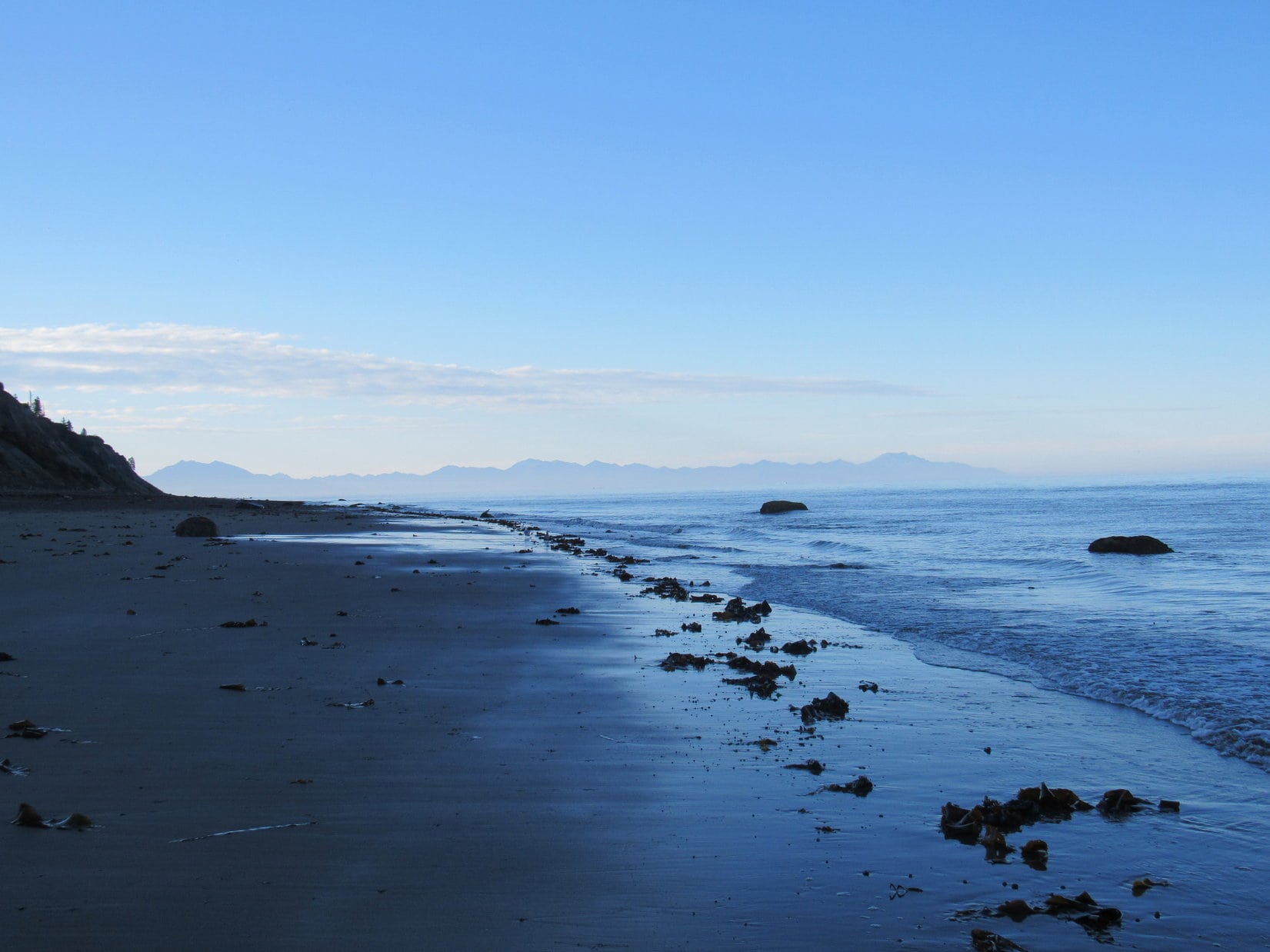
It was a beautiful morning – bright, mostly sunny, with a cool fresh ocean breeze. Lupe and SPHP headed down to the beach. A little to the N, a tractor was busy launching a boat into the ocean. Across Cook Inlet of the North Pacific Ocean, two massive volcanoes, Iliamna and Redoubt, white with ice and snow, stood out as giants among lesser peaks on the far shore.
Lupe arrives at Anchor Point on the shore of Cook Inlet, a huge bay of the North Pacific Ocean. Iliamna Volcano is visible on the far shore. Photo looks NW.A tractor was busy launching boats, one by one, into Cook Inlet.Iliamna Volcano(10,016 ft.). Photo looks NW using the telephoto lens.Redoubt Volcano(10,197 ft.), the highest mountain of the Aleutian Range, is less than 200 feet higher than Iliamna. Photo looks NNW using the telephoto lens.
According to legend, Anchor Point got its name in 1778 when famous explorer Captain James Cook of the British Navy lost an anchor somewhere near the mouth of the Anchor River.
Lupe wasn’t here to search for Captain Cook’s anchor. She was here to reach a personal milestone, one that would likely endure the rest of her life. No road connected to the North American highway system goes any farther W than the road she had just taken to Anchor Point. Somewhere along the gently curving stretch of beach to the S, a mile away or less, was the westernmost point on earth Lupe would ever reach.
Somewhere less than a mile beyond Lupe, this beach reaches its westernmost point and starts curving slightly back toward the E. At that point, Lupe would be as far W as she will likely ever be in her whole life. Photo looks SW.
Despite having had a huge adventure yesterday crossing Kachemak Bay aboard the water taxi XtraTuff to climb Grace Ridge(3,136 ft.), Lupe was energized! She raced along the deserted sand and mud flats exposed by low tide, seagulls swirling overhead. SPHP plodded along after her, enjoying every moment of the exhilarating seaside stroll.
Lupe streaks away over sand and mud exposed by low tide, seagulls swirling overhead. Photo looks S.Whee! Lupe was energized!
The shoreline headed only slightly W of S from where Lupe and SPHP started. It would gradually curve back to true S, and then slightly E of S. SPHP had no way of knowing which particular spot was the farthest point W along Lupe’s route. It would hardly matter, since the entire beach was only marginally farther E than the exact westernmost point.
Lupe posed nicely in the sun for a couple of shots looking W toward the open ocean. If Lupe wasn’t at her westernmost point here, she was very close to it.
Lupe on the shore of Cook Inlet very nearly as far W as she will likely ever be. Photo looks W.
Lupe and SPHP continued S, and perhaps a bit farther W along the shore. Seagulls took flight whenever Lupe or SPHP got too close, only to land again a short distance away to resume strutting about the beach.
Seagulls liked to strut about the beach picking at whatever they found of interest. Whenever Lupe or SPHP got too close, they took off, only to land again a short distance away. Another part of the Kenai Peninsula is seen in the distance, beyond Kachemak Bay. Some of it is farther W than Anchor Point, but access is limited. There are no roads over there. Photo looks SSW.
The exposed beach was very flat. Most of it was quite damp. In some places it was simply muddy. Lupe passed over large patches of seaweed left stranded by the ocean. Strange odors arose from the seaweed. Lupe sniffed to her heart’s content, learning about life in and near the ocean.
Lupe sniffs the strange odors given off by seaweed. Large stretches of the beach were completely covered with it.
Far to the SW, barely visible on the horizon, was another volcano. It was much smaller than Iliamna or Redoubt, and looked blue instead of white. This was Augustine Volcano(4,025 ft.), which sits on an island presumably of its own making, in Cook Inlet.
Augustine Volcano was barely visible on the far horizon. Photo looks SW using the telephoto lens.
Not a soul was around. The shoreline was deserted, except for the seagulls. The fresh ocean breeze blew. Waves rolled endlessly ashore. Lupe explored and sniffed. SPHP continued S. Finally, a long straight stretch of beach was ahead. To the E was a bluff. To the W, several large rocks could be seen at or near the edge of the water.
A busy Carolina Dog explores the shoreline along Cook Inlet. A long stretch of beach was ahead, with a bluff to the E. Photo looks S.Over near the end of the bluff, a few large rocks could be seen close to the shoreline. Photo looks S.
Beyond the bluff, the beach made a more noticeable turn E. If Lupe hadn’t already passed by her actual farthest point W, it was almost certainly near one of those big rocks W of the bluff. That was as far as Lupe needed to go. SPHP christened the largest, most distant rock as the “Rock of the West”.
Approaching the “Rock of the West” (R of Center).
Although the Rock of the West had appeared to be on shore when SPHP first spotted it, by the time Lupe reached it, the tide had come in further. The Rock of the West was now a small island.
This point on the beach was the end for Lupe. She must have been at least a mile from the Anchor Point parking lot by now. More of the Kenai Peninsula across Kachemak Bay to the S was gradually coming into view as Lupe had approached the Rock of the West. Either this was it, or Lupe had already completed her last mile W somewhere along the way.
Here, a few feet from the Rock of the West, Lupe was as far W as she would ever be in her whole life.
Lupe as far W as she will ever be, a few feet away from the Rock of the West at Anchor Point, Alaska. Photo looks W.
Only 13 days ago, Lupe had reached her farthest point N along the Dietrich River nearly 90 miles N of the Arctic Circle. Now she had reached another milestone in life. Both moments were beautiful and wonderful, but also bittersweet.
It was wonderful that Lupe had journeyed so far, and expanded her world so much. She had seen so many new places, and had so many memorable experiences. Yet it was sad to think that this was also an end, a boundary beyond which she would never go.
For a while, Lupe and SPHP stayed together, looking out to sea near the Rock of the West. The same sea encircles the globe. Far beyond the horizon was a world of exotic lands, entire continents to explore. Lupe would never see them.
So, Looper, if you had a ship like Captain James Cook did so long ago, where would you sail? What distant, exotic lands would you explore?
Squirrel island!
Oh, for Pete’s sake! Come on, let’s go!
The return trip along the beach was every bit as relaxing and beautiful as Lupe’s journey to the Rock of the West had been. Sea and sky were blue. Seagulls and mighty volcanoes were white. Boats bobbed on the water or zoomed away over the waves, no doubt in a rush to reach Squirrel Island. Surf exhausted itself uselessly against the edge of North America, but made the most calming, relaxing sound on earth doing so.
Right here, right now, was a glorious place to be!
Iliamna Volcano across Cook Inlet. Photo looks NW.Redoubt Volcano(L) on the way back. Photo looks NW.Blue sky, blue sea. White seagulls, white volcano.Seagulls with a grand view of Iliamna Volcano. Photo looks NW.Augustine Volcano(L). Wouldn’t it have been fun, if Lupe had only had a ship that would have taken her over to the island it’s on? Photo looks SW.American Dingoes are known to roam as far W as Anchor Point, Alaska. They seem to like it here! Photo looks NW.Another boat launched by the tractor gets underway. Redoubt Volcano in the background. Photo looks NNW.Someone sets off in search of fabled Squirrel Island.
Despite an unrushed, easy pace, Lupe’s last mile West hadn’t taken long. By 9:35 AM, she was back at the G6. A major milestone was now behind her, but more adventures were in store, this very day! This afternoon she would be on the Skyline Trail to the Mystery Hills, which certainly sounded like fun.
Yet it would be a long time before Lupe and SPHP would forget the Rock of the West and being here together at beautiful Anchor Point, the farthest W Lupe ever went, standing at the edge of the sea, gazing out toward the world of possibilities that lay beyond the restless waves.
(Start, 9:11 AM, 37°F, West Cascade Mountain Road a few miles S of Hot Springs, SD off Hwy 71.)
Well, that was easy! Except for the cactus, of course. Lupe hated the cactus! SPHP had had to carry her to the summit of Peak4340 for short stretches where the cactus was worst. Fortunately, the summit had only been a couple hundred yards W of West Cascade Mountain Road. Even carting a Dingo around, it had only taken minutes to get here.
Lupe at the summit of Peak 4340. This was actually the first of two high points she found that were true summit candidates. The other one was a couple hundred yards SW of here. Photo looks NW.
The topo map on Peakbagger.com showed only one contour where the true summit of the mountain could be, but things seemed a little different when actually here. SPHP thought another place a couple hundred yards farther SW looked possibly even a little higher. Naturally, Lupe had to visit that high point, too.
Loop at the 2nd possible location of the true summit. Due to the cactus threat, Lupe demanded that SPHP tote her part of the way over here, too. Photo looks S.
The top of Peak 4340 was a large area of gently rolling terrain and open forest, but offered only teaser glimpses of distant views. Close to a rural housing subdivision, it really wasn’t a terribly interesting place. With cactus around, Lupe didn’t think much of it either, but at least she could now cross another Brian Kalet peak off her list. She only had a couple of them left to visit in the southern Black Hills.
Lupe was happy to put a quick end to her visit of Peak 4340, and return to the G6 (9:41 AM, 38°F).
The trivial trek to both possible summits of Peak 4340 was only a warm-up exercise. Lupe had a much more interesting peakbagging goal in store. Flagpole Mountain(4,320 ft.) sits at the far SE end of the Black Hills, N of the Cheyenne River and W of Angostura Reservoir. Lupe might have some fantastic views far out across the prairies beyond the hills from there.
SPHP’s old USFS map showed that Flagpole Mountain was on USFS land, but surrounded by private property. Before Lupe could begin her climb, SPHP needed to find legal access. The shortest route up Flagpole Mountain would be from the SW. SPHP drove S on Hwy 71 intending to scout out the approach.
On the way, Lupe stopped briefly by Cascade Falls. She had been here before, but it’s always fun to see the falls!
Devil’s Slide Mountain(3,965 ft.) from the Cascade Falls picnic ground. Photo looks NE.Cascade Falls is more of a rapids. Wading in Cascade Creek which plunges into a deep swimming hole is a locally popular summer activity. Cascade Falls is only a mile N of the Cheyenne River at the far S end of the Black Hills.Devil’s Slide Mountain from Cascade Creek a little upstream of the falls. Photo looks NE.
For some reason, Cascade Creek always seems to have good flow, no matter what the season. Cascade Falls was looking good today, too, but it was too chilly out to stay and enjoy it. The middle of July is better for that! Lupe and SPHP continued S on Hwy 71.
Just N of the Cheyenne River, a gravel road headed ESE from Hwy 71. The road wound around to the SE for more than a mile. It deteriorated at the end of a short stretch that went E. A log-sided home was on the N side of the road. Before SPHP even got out of the G6, a man opened the door of the house.
His name was Mike. When SPHP told Mike that Lupe would like permission to cross his land to climb Flagpole Mountain, the answer was flatly “no”. Mike didn’t exactly come right out and say it, but his attitude was clearly “Get Off My Property”. Mike didn’t want to talk about it. The matter was not up for discussion.
Mike was still helpful, however. He told SPHP that 5 or 6 years ago, the state of South Dakota had purchased land leading to the national forest on the other side of the mountain. Lupe would have legal access from Sheps Canyon.
That was good news! Well, at least pretty good news. Sheps Canyon was an alternate route that SPHP had intended to check on if things didn’t work out here. The route to Flagpole Mountain from Sheps Canyon would be a lot longer than if Lupe had been able to start from Mike’s ranch.
No is no. SPHP thanked Mike for the tip. Lupe left his property.
Driving down Sheps Canyon was not initially encouraging. Lupe passed by housing developments and more ranches. “No Trespassing” signs were all along the S side of the road at frequent intervals. Lupe was all the way down to the lower end of the canyon not too far from Angostura Reservoir before SPHP spotted the Hill Ranch Game Production Area. This had to be the legal public access Mike had mentioned!
Lupe at the entrance to the Hill Ranch Game Production Area. This entrance is easy to spot on the S side of Sheps Canyon Road in the lower part of the canyon. Photo looks SSE and was taken late in the day.The Hill Ranch Game Production Area is mostly used by hunters, but is open to public access for other uses like hiking, too.
A good dirt and gravel road led into the Hill Ranch GPA. SPHP parked the G6 at a curve at the far E end of the road only a short distance from Sheps Canyon Road (10:48 AM, 43°F). Lupe could regain her confidence trotting along the cactus-free road for a while.
The road went steadily uphill at a moderate pace, heading W for the most part. Lupe passed by a parking pullout and then a small lodge. The lodge appeared to be closed. A couple of parking pullouts farther, Lupe had quite a good view of Angostura Reservoir.
Angostura Reservoir from the Hill Ranch GPA. Photo looks E.
The road went 2 miles before ending near a couple of gates at the edge of the national forest. (Even the G6 would have made it this far easily enough, if SPHP had chosen to drive to this point.) A map of the Hill Ranch GPA was posted here.
This map of the Hills Ranch GPA was posted at the end of the road. The national forest was just W of here beyond a couple of gates.
Lupe went through the smaller gate, continuing W into the Black Hills National Forest. The good road was behind her. She followed faint traces of an old jeep trail, still gaining elevation steadily.
Angostura Reservoir is still in view as Lupe continues W now on Black Hills National Forest ground. Photo looks E.
A ridge coming in from the ENE soon merged with the ground Lupe was traveling. Shortly after that, she came to a place where she had a great view to the N. She could see Peak4310, which she had visited only a couple of expeditions ago. Today the scene wasn’t all snowy like it had been then.
Lupe reaches the first viewpoint to the N. Peak 4310 is the barren distant high point extending farthest toward the center of the photo from the R. Lupe had been there only 2 expeditions ago. Photo looks N.
From this first viewpoint looking far to the N, the faint trail turned SW. It soon came to a saddle between two hills. Flagpole Mountain was in view!
Flagpole Mountain (Center) came into view at a saddle between two hills. It was only 1.5 miles away, but Lupe would have to go a lot farther than that to get there. Green Canyon was in the way! Photo looks SW.
Flagpole Mountain was only 1.5 miles off to the SW when Lupe first saw it. However, she would have to go a lot farther than that to get there. Green Canyon was in the way.
To get to Flagpole Mountain, the plan was to go around the W end of Green Canyon. Lupe would follow a couple of long ridges shown on the topo map. The first ridge went first W then NW for nearly 1.5 miles. The map showed a substantial part of this ridge as being very skinny. SPHP wasn’t certain what Lupe might encounter along the way.
Lupe turned W and started around the S side of the highest little hill in this area. The hill was the first part of the ridge leading W. The ridge wasn’t narrow here, but going around the S side of the hill quickly proved to be a mistake. The grassy open ground below the forested summit was full of cactus! Lupe was immediately seized with fear.
Although the hill wasn’t all that big, it took a while to get past it. Lupe was scared to move. The cactus had her mentally paralyzed. SPHP had to carry her repeatedly.
Once beyond the hill, the ridge narrowed considerably, but was still plenty wide. Cactus continued to be a near constant problem, but Lupe gradually made progress. SPHP had to carry her less and less.
Nearly a year ago, Lupe had developed a system on her way up Matias Peak(4,780 ft.) for dealing with cactus. She would wait in one spot while SPHP scouted the area ahead. When SPHP sat down, she considered it a signal that all the ground to that point was cactus-free. She then came running.
Now Lupe wanted SPHP to do the same thing. Doing a good job of scouting was important, so Loop would continue to have confidence in the system. This process was sort of slow, but much easier than carrying the Carolina Dog any significant distance. Stop, scout, go. Stop, scout, go. Lupe progressed along the ridge.
Lupe wasn’t any closer to Flagpole Mountain yet, but the route was beautiful. Loop could see Flagpole Mountain almost the entire time. She often had grand views to the N, or down into Green Canyon. She came to a place with huge boulders, and many more places with interesting rock formations. The route was up and down, but none of the elevation changes were too drastic.
Another look to the N from the ridge Lupe was following W.Looking across Green Gulch. The high point seen straight up from Lupe is not Flagpole Mountain, but Lupe would go by it on her way there. Photo looks SW.
The part of the ridge that angled NW was the skinniest. Up and down one narrow little hill or rock formation after another. At one point, Lupe had to do a teensy bit of scrambling, but only once and it hardly amounted to anything. Eventually, the much, bigger, wider hill at the NW end of the ridge came into view. Lupe was almost there!
The much bigger, wider hill at the NW end of the ridge came into view. Lupe was getting there! Photo looks NW.
Soon she was there. Lupe didn’t go quite all the way to the top. She stayed in the trees a little S of the summit. Loop went over to the W edge of another ridgeline heading S from here. She had her first look at a vast new territory to the W and SW.
Lupe could see a vast territory off to the W and SW after reaching the big hill at the NW end of the long ridge she had been following. Photo looks SW.
Going 1.5 miles along the skinny W and NW ridge hadn’t brought Lupe any closer to Flagpole Mountain as the crow flies, but she was now past the W end of Green Gulch and could turn S. A much broader ridge went SSW from here. The W edge of this ridge dropped steeply, but sloped much more moderately toward Green Canyon to the E.
Going S meant traversing several more drops and hills along the way. These were larger than the bumps Lupe had gone over along the skinny ridge, but she didn’t have climb to the top of each one. At the bottom of the first drop was good news. A dirt road climbed up to this point from the W. It turned S here, just the direction Lupe needed to go. Lupe could follow the road!
Reaching the road quickly restored Lupe’s confidence. She wasn’t afraid of cactus on the road. Suddenly she was making great progress. SPHP didn’t have to carry her, or play the scouting ahead game at all. Lupe trotted right along. It wouldn’t take her long to get to Flagpole Mountain at this pace!
Lupe was able to follow this road on the big ridge heading SSW. Unafraid of cactus on the road, she was making great progress! Her destination, Flagpole Mountain is in view on the L. Photo looks SSW.
The road stayed E of the top of the ridgeline most of the time, but was occasionally near it. At once place, Lupe went over to the W edge for another look at the big views.
The weather had been changing in the short time she’d been traveling S. The light NW breeze present earlier, had turned into a gale! Lupe did not like the fierce wind at the W edge of the ridge, but the views were still excellent.
Lupe did not like the fierce NW wind now gusting up the W side the of ridge, but the views were still excellent! The near slope is part of Horseshoe Bend. Photo looks W.Looking WNW.
The helpful road Lupe had been following ended a little before reaching the S end of the ridge, but had brought the Carolina Dog a long way. She was getting close to Flagpole Mountain, but now nervous about cactus again. She was right to be. More patches of dreaded cactus were scattered here and there. SPHP had to resume cactus scouting operations. Once again, Lupe got carried over the worst of it.
For the last 0.25 mile to the summit, the ridgeline turned SE. Lupe was high on broad open terrain where she had expansive views to the S. To the N was forest. The sight of several deer running on another minor ridge excited her so much she forgot all about the cactus and dashed about unsure how to get over there. Fortunately, she didn’t run into any cacti.
The top of Flagpole Mountain(4,320 ft.) appeared ahead. A short, grassy slope led to a summit crowned by big rocks, bare bushes and a few pine trees. In a flash, Lupe was there. She stood on the highest boulders at the very SE end of the Black Hills with a grand sweeping view of miles and miles of desolate territory stretching to the horizon.
Lupe reaches the summit of Flagpole Mountain! Photo looks ESE.Despite a long, winding route, countless cacti, and a wild NW wind, a bold American Dingo stood atop Flagpole Mountain for the very first time. Photo looks ESE.The grand view to the SW. Lupe had hoped to come up the mountain from this direction, which would have been a much shorter trek, but she was refused permission to cross Mike’s ranch. Part of Coffee Flat near the Cheyenne River is seen far below. Photo looks SW.Neither wind, nor miles, nor cacti can keep an American Dingo from its appointed peakbagging! Looper atop Flagpole Mountain. Photo looks SW.A series of snow squalls swept over Flagpole Mountain while Lupe was here. Another one is on its way. Each time a squall hit, Lupe took refuge at the base of these rocks, where she was sheltered from the raging NW wind. Photo looks WNW.
Although partially protected by pines trees to the N, the top of Flagpole Mountain was windy. A powerful NW wind was blowing a series of snow squalls over the mountain. Each time a line of clouds passed over, a brief, but exciting snowstorm developed. The wind raged at the height of its fury beneath an ominous sky.
When the squalls hit, Lupe took shelter at the base of the big rocks at the S end of the summit. She nestled on SPHP’s lap, wrapped in a fuzzy blue pullover sweater, enjoying the incredible views and dramatic weather.
Lupe relaxes sheltered from the wind as she awaits the start of the next exciting snow squall. Photo looks S.The next snow squall begins. Photo looks S.
Though each squall was exciting and began impressively, the snow flakes were tiny and melted as soon as they hit the ground. The squalls never lasted more than a few minutes. Gorgeous blue skies reappeared as soon as they were over, and the winds calmed down somewhat.
Between squalls, Lupe explored the summit area, while SPHP enjoyed the views from various vantage points. By going only a little down the S or SE side of the mountain, it was possible to almost entirely escape the wind. The day felt pleasant, warm and sunny.
Looking ESE toward the SW end of Angostura Reservoir. The Cheyenne River can be seen flowing into it from the R.Lupe back on the summit of Flagpole Mountain between squalls, though another one is in the works. Photo looks WNW.Your Carolina Dog guide to the Black Hills on another mountaintop! Photo looks WNW.Looking down on Coffee Flats (R) next to the Cheyenne River. The more distant flat, grassy highland on the L is Stage Hill. Photo looks SSW with a little help from the telephoto lens.Between snow squalls, the skies cleared to a gorgeous, fresh blue. Photo looks NW.
Lupe and SPHP stayed for an hour or more at the summit of Flagpole Mountain. Although the trek here had been amazing and beautiful, the presence of so much cactus meant it might be a long time, if ever, before Lupe would return. These distant views beyond the Cheyenne River across the vast, lonely prairies were a rare treat.
Taken from the summit of Flagpole Mountain, this photo looks SE down toward Tepee Mountain(3,790 ft.), the low forested ridge on the R beyond the Cheyenne River.Looking W from the summit.Lupe a little SE of the summit (R). Photo looks W.The SW end of Angostura Reservoir is in the distance on the L. The Cheyenne River flows into it from the R. Photo looks ESE.A closer look at where the Cheyenne River flows into Angostura Reservoir. Photo looks ESE using the telephoto lens.Distant snow squalls sweep the plains of western South Dakota beyond Angostura Reservoir. Photo looks E.Lupe at the far SE end of the greater Flagpole Mountain summit area. The low, darkly forested ridge is Tepee Mountain(3,790 ft.), which lies just on the other side of the Cheyenne River. Photo looks SE.Flagpole Mountain had a few cacti down the SE slope. Here Lupe waits for the all clear signal from SPHP before feeling safe to come this way. Photo looks S.Forest hid the views to the N from Flagpole Mountain’s summit, but by going down the SE slope a little way, Lupe came to this great viewpoint. (It was very windy here!) The long W and NW ridge she had taken on her way to Flagpole Mountain is seen extending nearly all the way across the photo. On the way back, Lupe would have to traverse it again going from L to R. Photo looks N.
An hour went by. It had been a while since the last snow squall had blown through. Apparently they were all over and done with. Sadly, it was time for Lupe to leave Flagpole Mountain. She had to take the same long route all the way back to the G6.
On the way back, SPHP took a few minor shortcuts, but they saved only a little time. More time was saved by staying on the N side of slopes where there were fewer cacti. Lupe’s increased confidence in SPHP’s cacti scouting skills saved the most time of all. She still appreciated being carried for short distances wherever the cacti was worst.
The trek back along the ridges was beautiful, and went faster the second time around. Lupe had time to stop and sniff the air at various places along the way.
On the way back, Lupe took the road going N along the first wider ridge. One of the bigger hills along this route is in view ahead. Lupe didn’t have to go all the way to the top of the hill. The road went around the E (R) side of it. Photo looks N.Looking down on Horseshoe Bend (the near slope) NW of Flagpole Mountain. Photo looks WNW.Looking over Horseshoe bend. The Cheyenne River is seen in the distance. The Cheyenne flows into South Dakota from Wyoming and winds around the S end of the Black Hills on its way to Angostura Reservoir. From Angostura it flows NE all the way to the Missouri River. Photo looks W.Making progress around Green Canyon. The S (R) side of the little high point L of Center is where Lupe encountered the worst of the cactus on the whole trek to Flagpole Mountain. On the way back, Lupe stayed in the forest going around the N (L) side of the hill. She came to a few snowbanks there, but almost no cacti. Definitely the way to go! Photo looks ENE.A final look back at Flagpole Mountain (seen above Lupe) from the area of big boulders on the first ridge Lupe had taken W, then NW. Photo looks SSW.In the area of big boulders. Lupe had originally reached this area fairly early on her way to Flagpole Mountain, but here she’s on her way back to the G6. Photo looks WNW.Looking N on the way back. Peak 4310 is the high bare ridge extending farthest toward Center from the R.
Lupe’s cactus worries were all behind her before she even reached the good dirt road at the Hill Ranch Game Production Area. The rest of the trek was a long, relaxing downhill stroll all the way. Lupe stopped by the same boulder with a view of Angostura Reservoir again.
Back in the Hill Ranch GPA, Lupe stopped by the same boulder with the view of Angostura Reservoir again. It was still windy out. Photo looks E.
Lupe was content to trot along the good road all the way through the Hill Ranch GPA to the G6 (5:38 PM, 37°F). Her Flagpole Mountain adventure was over, but it was the first day of Daylight Savings Time in 2017. The sun would still be up for another 1.5 hours.
SPHP used the extra hour of evening daylight to drive Lupe down to Angostura Reservoir. She had seen it from afar from several different mountains on recent expeditions. Now she would get to see it up close.
The drive was beautiful. SPHP was surprised to find a good gravel road winding S for miles along the W shore of the lake. Lupe stopped at a boat ramp. The wind was out of the NE here and still strong. The temperature was in the 30’s and dropping. It felt cold out. Waves crashed into the shore. Lupe drank a little water out of the lake, then got up on the swaying dock. Tepee Mountain, which she had seen earlier from Flagpole Mountain, was in view in the distance.
Lupe at Angostura Lake for the first time ever after having seen it in the distance from several mountains on recent expeditions. Tepee Mountain is in view in the distance. Photo looks SW.
SPHP was curious. How far did this road go? Lupe and SPHP drove farther SW. The road went by many great campsites up on the bank above the shore of the lake. Lupe stopped at another place offering lake access.
Looking NE across Angostura.The view to the SE.Looking SW.
Lupe and SPHP drove all the way to the end of the road. Surprisingly, at the end was a horse camp. Maps and information at the horse camp said a riding trail went 5.1 miles farther along the lake and up the Cheyenne River. Horses were restricted to the trail while in the Sheps Canyon Outdoor Recreation Complex, but the trail went all the way to the Black Hills National Forest, where horses could be ridden anywhere.
It was a beautiful area. The trail along the lake and up the river would be an awesome place to ride horses. Once to the national forest, maybe horses could even climb Flagpole Mountain? One thing was for certain, an American Dingo could!
With a new route to explore, maybe someday a Carolina Dog will stand in the breeze far above the Cheyenne River on Flagpole Mountain again.