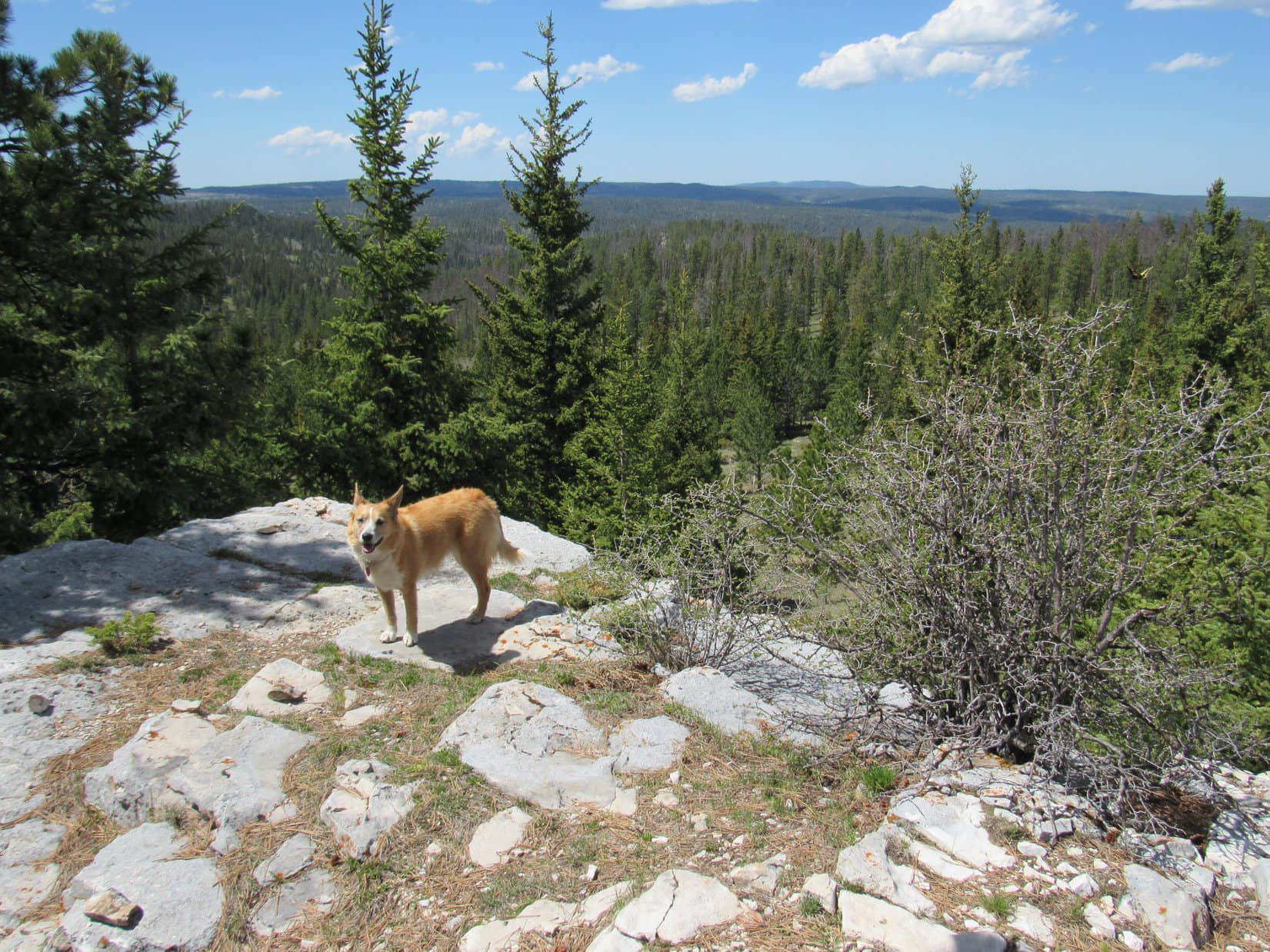
Leaving the Yukon & Northern British Columbia, Canada (9-3-16 & 9-4-16)

Days 36 & 37 of Lupe’s Summer of 2016 Dingo Vacation to the Canadian Rockies, Yukon & Alaska

Day 36, 9-3-16, 6:40 AM, 32°F – Time for Lupe’s last walk down to the shore to say farewell to Kluane Lake.  As soon as the G6 defogged, Lupe would be leaving.  Another 450 miles to go today.  By the end of the day, she would leave the Yukon and reach extreme northern British Columbia.

The huge lake was calm, the smoothest Lupe had ever seen it.  More exciting adventures remain for Lupe in Kluane National Park in this wild, remote corner of Yukon Territory, but not on this Dingo Vacation.  Who knew when, or if, Lupe would ever return to do them and see fabulous Kluane Lake again?  No matter.  It was time to go.
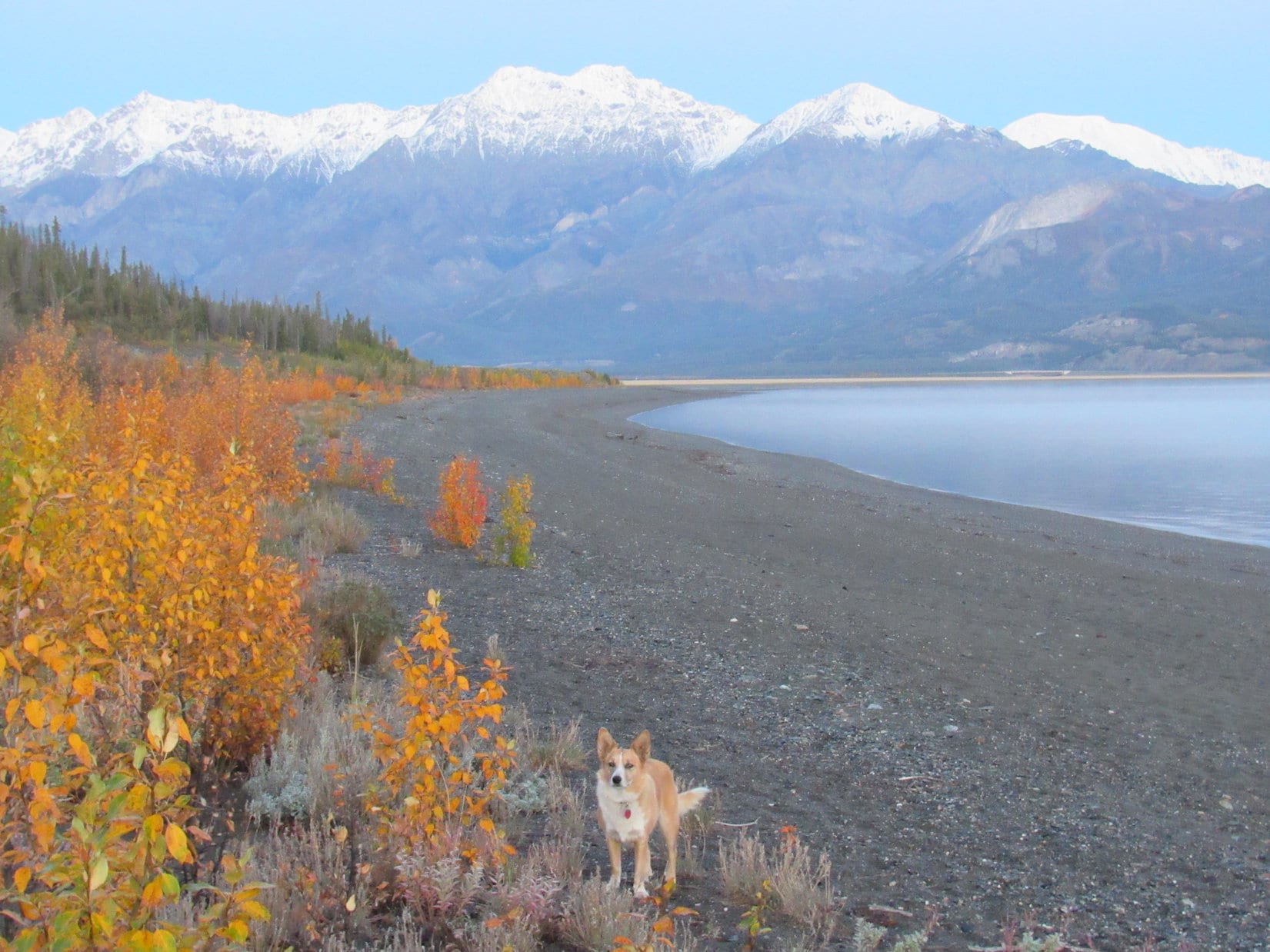
Last moments near fabulous Kluane Lake. Photo looks SW.

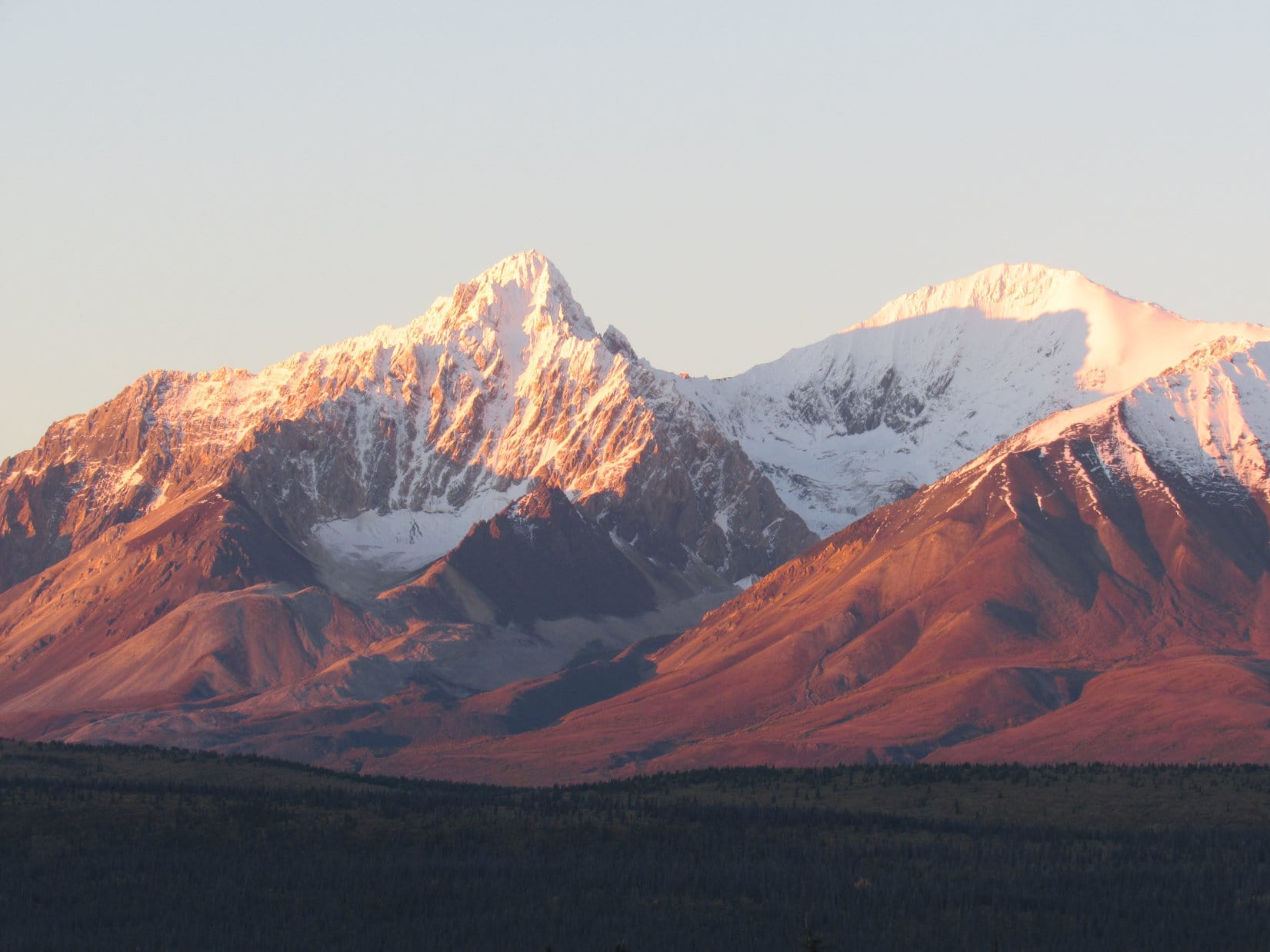
The sun wasn’t even above the horizon yet, as Lupe and SPHP started S in the G6, but would be illuminating the Kluane front range peaks of the Saint Elias mountains before long.

Yesterday evening, SPHP had seen Mount Decoeli (7,650 ft.) from afar.  Lupe climbed Mount Decoeli earlier on this Dingo Vacation.  What a tremendous adventure that had been!  Now Decoeli was sporting a cap of new snow.  The Alaska Highway would soon take Lupe only a few miles E of the mountain.  She wasn’t too many miles from Kluane Lake, before there it was, looking majestic, clean and white!
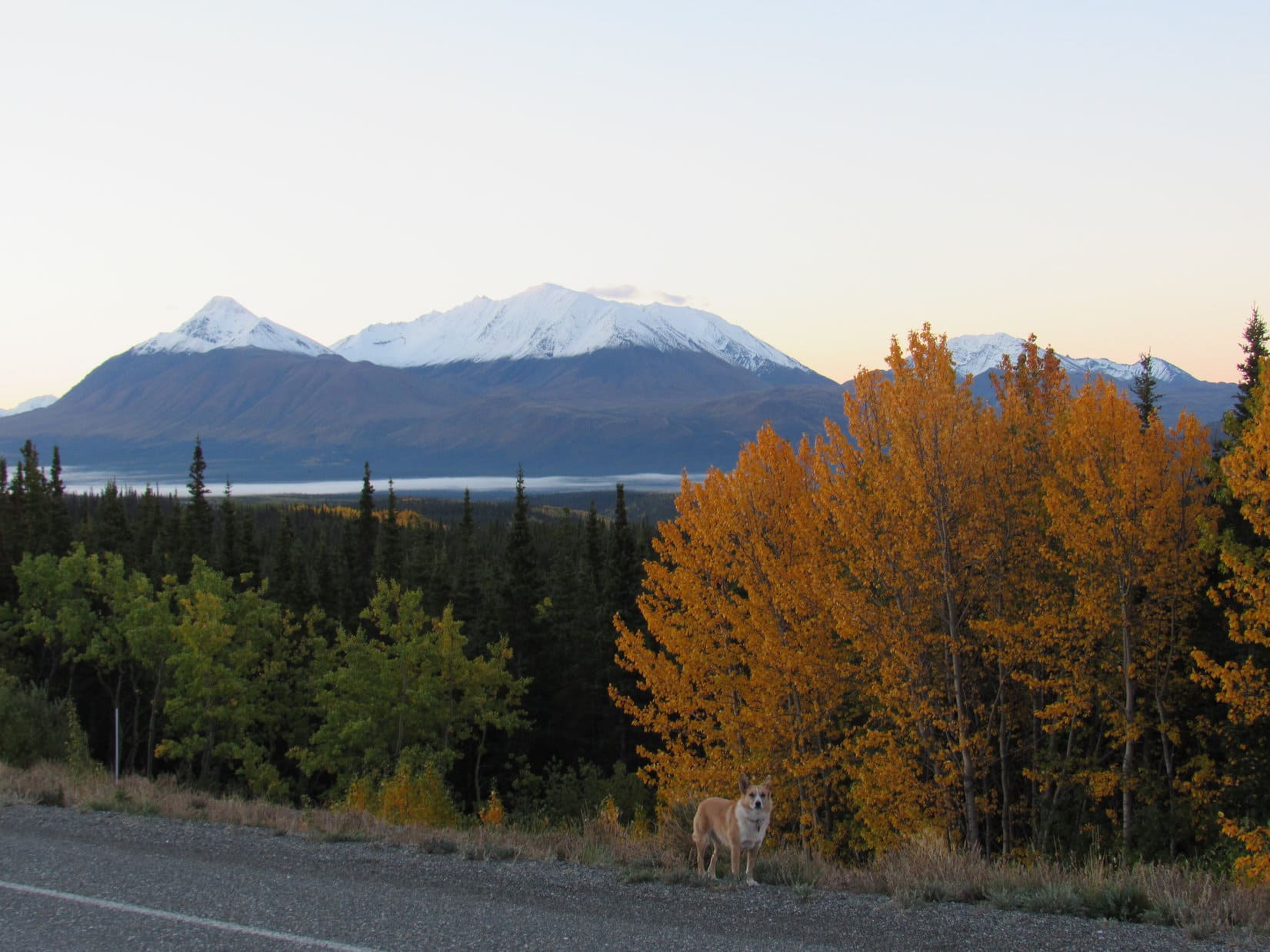
Lupe wasn’t too many miles away from Kluane Lake, when Mount Decoeli(L) came into view, now sporting a clean, white snowcap. Photo looks SE.
Mount Decoeli is the sharper peak on the L. Photo looks SE with a little help from the telephoto lens.

The Kluane front range mountains all looked even more impressive with snow on them, than when Lupe had been here in early August.  SPHP stopped frequently for photos.  These were the biggest, most gorgeous mountains Lupe would see all day!

Lupe enjoyed all the stops.  She didn’t mind posing for pictures.  Each stop was another chance, however brief, to explore fields and forests near the Alaska Highway.

Early light on the Kluane front range. The high point on the L is possibly Mount Cairnes (9,186 ft.). Photo looks SW.
Daybreak on Lupe’s last day in the Yukon.
Getting closer to Mount Decoeli (L). Photo looks SE.
Much closer now. Looking SW at Mount Decoeli.
Loop and Decoeli. She’d stood on top of the mountain earlier on this Dingo Vacation.
Mount Decoeli on the R. The white peak on the L in the distance is either Mount Archibald (8,491 ft.) or a peak very near it. Photo looks SW.
View along the Alaska Highway from E of Decoeli. Photo looks S in the general direction of Mount Martha Black (8,241 ft.) possibly one of the peaks seen here.
Come on! Let’s go! Lupe was ready to climb Decoeli(R) again! Sadly, there was no longer time for a repeat performance. Photo looks WSW.
Again looking S in the general direction of Mount Martha Black, likely pictured somewhere among these high peaks. The morning light on the tundra was amazing!
Mount Decoeli from the E.
Lupe in Yukon Territory still E of Mount Decoeli. Everything was ablaze with color in the early morning light! Photo looks SSW.
The Yukon was so beautiful, it was enough to make an American Dingo think about becoming a Yukon Dingo!

On the way to Haines Junction, SPHP decided Lupe ought to take the 14 mile (one way) detour S to have a look at King’s Throne (6,529 ft.) and Kathleen Lake.  King’s Throne was the first mountain Lupe had climbed in Kluane National Park, and another super adventure!  Maybe Lupe could get a great photo of King’s Throne covered with new snow and shining brightly in the morning light?

Lupe only got 10 miles S of Haines Junction, though, before it was apparent there wasn’t much point in going farther.  Clouds already screened King’s Throne from the sunlight, and more clouds were moving in fast.  From what could be seen, King’s Throne hadn’t received any of the recent new snow either, perhaps because it is lower than Decoeli.

Near Quill Creek, Lupe and SPHP turned around to head back N.  The mountains here were still in brilliant sunshine.  However, large clouds were moving in from the SE.  Lupe’s best bet was to enjoy these gorgeous mountains while they were still in view.  All the way back to Haines Junction, Lupe and SPHP stopped frequently to gaze upon the beautifully sunlit Kluane front range.

Lupe at Quill Creek, S of Haines Junction. Photo looks SW.
Looking up Quill Creek using the telephoto lens.
Although only a few miles N of King’s Throne, this distinctive pyramid-shaped mountain near Quill Creek was still in brilliant sunshine. King’s Throne was already cloaked in the gloom of a cloud bank. Photo looks SW using the telephoto lens.
Lupe S of Haines Junction, but N of Quill Creek. The Kluane front range is in dazzling sunshine to the SW.
Crisp, clean peaks on the way back N to Haines Junction. Photo looks SW.
Another fantastic peak of the Kluane front range.
Snow certainly adds a great deal of grandeur to almost any peak. Gorgeous!

At Haines Junction, Lupe headed E on the Alaska Highway.  The dazzling splendor of the Kluane front range of the Saint Elias mountains receded in the rear view mirror.  Within a few minutes, the mountains disappeared entirely as Lupe entered a dense fog bank.

For miles SPHP drove slowly in the fog.  Lupe finally emerged from the fog bank, but the mood of the morning was different here.  The sky was overcast.  The dull, gray clouds weren’t dark or threatening, but the cheerful sunshine was gone.  Lupe snoozed as the miles rolled by.  E of Whitehorse, Lupe crossed the Yukon River again.  By now it was 11:15 AM, and even SPHP was drowsy.

Lupe and SPHP stopped at a rest area on the E bank of the Yukon River.  Even though it was practically the middle of the day, and the Alaska Highway was busy, SPHP took a nap.  An hour later, feeling better, it was time to press on.  Before leaving, Lupe was ready for a short stroll down to the river.

Lupe checks out the Yukon River one more time before continuing E. Lupe had crossed the Yukon River much farther N, too, back when she was on the Dalton Highway before crossing the Arctic Circle. Photo looks W.

The clouds were lighter and starting to break up as Lupe continued E on the Alaska Highway.  After a slow start in the morning, Lupe was behind schedule on reaching her mileage quota for the day.  She needed to keep rolling.  She was allowed fairly frequent short stops at rest areas, but other than that, Lupe had little to do but continue dozing or watch the scenery go by.

Forests were everywhere.  Lupe saw many lakes and streams.  Although Lupe saw lots of mountains, too, they weren’t nearly as large or rugged as the ones back at Kluane National Park.  Hours went by.  Finally, a cluster of higher, more impressive mountains appeared in the distance ahead.  They had a good dusting of snow and were quite beautiful.
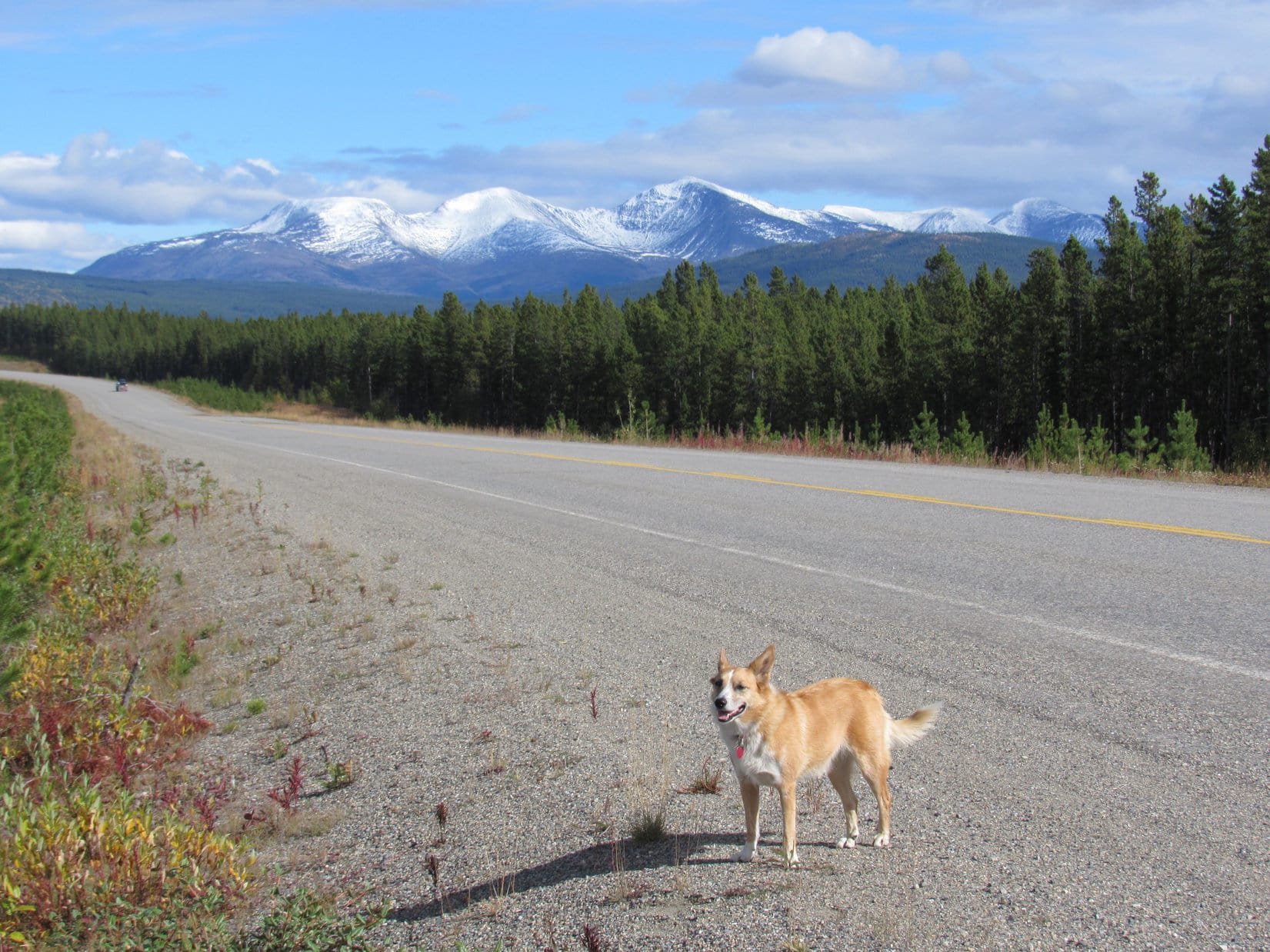
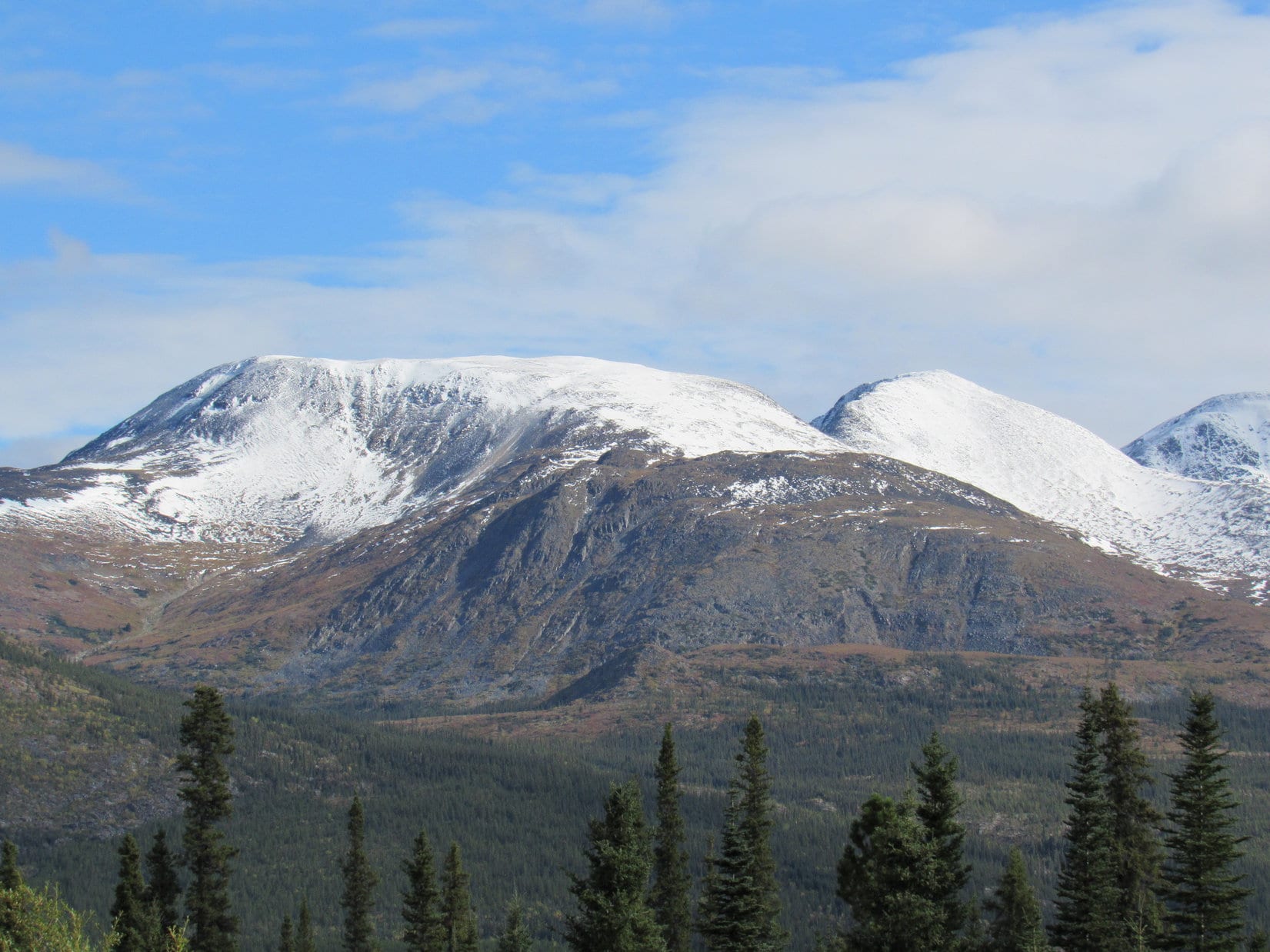
After hours heading E on the Alaska Highway, a small range of more impressive snowy peaks came into view. Photo looks E.
SPHP has no idea what mountains these are, but driving the speed limit they were about 3 hours E of the Yukon River on the S side of the Alaska Highway. They looked like something Lupe could climb easily enough some day. The views from the top must be amazing. These mountains were the highest around for a long, long way!

On the way to the Yukon near the start of her Summer of 2016 Dingo Vacation, Lupe had traveled up the Cassiar Highway (Hwy 37).  This time, when she reached the junction, Lupe stayed on the Alaska Highway going E instead of turning S.  This was an alternate route home.  Lupe was going to see a lot of new territory!

The new territory featured forests.  Trees stretched from horizon to horizon.  Mile after mile.  Not that there hadn’t been plenty of vast forests before.  Here, though, there were hills, ridges, and deep river valleys, but no real mountains, not like Lupe was used to seeing up to this point.  Everything was forested.  Nothing was above treeline.

E of Watson Lake, the Alaska Highway left the Yukon for good.  Lupe was now back in far northern British Columbia.  The highway wound around near the Liard River valley.  In many places, the forest was clear cut for 50 to 100 feet and mowed on both sides of the highway.  The resulting miles long skinny clearings proved attractive to wildlife.

Lupe sprang to life when she realized there were animals out there!  She’d been mostly resting in the G6 for two whole days.  The American Dingo was bursting with energy and enthusiasm.  Time for the barkfest to end all barkfests!  Many buffalo, 3 bears, and 1 fox were all cause for ear-splitting excitement.

Lupe near the Liard River. E of Watson Lake, Lupe left the Yukon for good when the Alaska Highway entered far northern British Columbia. The highway wound SE in or close to the Liard River valley for many miles.
Oh, yeah! Buffalo roamed the narrow clear cut strips of land along the Alaska Highway E of Watson Lake. Lupe was beside herself with joy! She barked like a Dingo-possessed, watching eagerly for the next buffalo to appear as she cruised by in the G6. She was seldom disappointed for long. SPHP wondered where else these buffalo would ever find any open ground? Except along the highway, trees extended horizon to horizon.
Bears! Lupe saw three small black bears in addition to the buffalo. They were every bit as exciting as the buffalo! In all her time in the Yukon and Alaska, Lupe never saw a single bear. She did see a few black bears in British Columbia both on the way N and going home.

A little after 8 PM, with light fading fast, Lupe arrived at Liard Hot Springs Provincial Park(Note:  The 6.5 minute video on the front page of this link is worth watching.  Be sure to expand it!)  SPHP drove in at the entrance finding no one at the entry booth.  It was Saturday night and lots of people were around.  SPHP parked the G6, and Lupe was happy to get out.

The main attractions at Liard Hot Springs are a couple of hot water bathing pools along a flowing stream.  A wide boardwalk led off toward the hot springs.  Lots of people were coming and going on the boardwalk, so Lupe and SPHP took it, too.

The boardwalk went through a forested swamp.  It was far longer than SPHP expected – 700 meters!  Lupe did get to see the hot springs, although, sadly, it was already too dark for pictures.  A couple of wooden changing rooms were next to a deck overlooking the hot springs, which had significant flow.  A warm fog rose from the waters where bathers were enjoying soaking in two natural pools.

SPHP asked around how this all worked?  As it turned out, there is normally a seasonal day use fee ($5.00 adult, $3.00 child, $10.00 family) charged for park admission at the entry booth at the front gate.  A camping spot costs $26.00.  However, the entry booth closes at 8 PM, and no day use admission is collected after that.  Somewhat oddly, the gates close at 10 PM, after which no entry or exit is permitted.

Of course, Lupe couldn’t go in the hot springs, but there was still time for SPHP to enjoy them.  Back to the G6, where Lupe was sad and worried about being abandoned.  SPHP tried to cheer her up, promising to return before too long.

The changing rooms at the hot springs were rustic, with only benches and hooks.  No lockers, showers, restrooms or anything like that.  Not even electricity or any lights.  The upstream pool was too hot for SPHP, but the downstream pool was great.  Despite the excellent flow, the water cooled off quickly going downstream, so it was easy to choose the temperature zone that felt best.

Liard Hot Springs was totally awesome!  Where else can you relax in soothing warm (hot, if you like!) waters outdoors in the middle of a boreal spruce forest in a giant swamp?  SPHP soaked and chatted with people, who were mostly from Fort Nelson.

At 9:15 PM, someone came to announce the time, and that the park’s gates closed in 45 minutes at 10:00 PM.  SPHP soaked for 10 more minutes, then got out into the chilly night air to get changed and return to Lupe.  After a joyous reunion, Lupe and SPHP left the park at 9:48 PM with 12 minutes to spare.  Onward!  But only for a little way.  Lupe had already made 500 miles today.

Day 37, 9-4-16, 6:19 AM, 35°F – Beneath a bright blue sky with thin little clouds, Lupe was underway early.  She was in far northern British Columbia, only a little S of Liard Hot Springs.  The terrain rapidly became increasingly mountainous as Lupe headed SE on the Alaska Highway.  For a while, a long stretch of road construction slowed progress to a crawl.

The morning sky held promise of a beautiful day ahead.
The terrain grew more mountainous S of Liard Hot Springs. Lupe was approaching Muncho Lake Provincial Park.

The road construction ended, and progress resumed at a normal pace, but not for long.  Lupe soon entered Muncho Lake Provincial Park.

SPHP hadn’t done a bit of research during pre-Dingo Vacation planning on Muncho Lake, and it was a real surprise.  This was an area of unspoiled, remote snow-capped peaks.  The Alaska Highway went right through it all, and hugged the E shore of beautiful Muncho Lake for miles.  Lupe was thrilled to see more buffalo, and even another black bear.

Lupe’s day was off to a thrilling start with lots more buffalo near the Alaska Highway in Muncho Lake Provincial Park. She even saw another black bear.

Such beauty was cause for several stops.  Lupe was only too glad to get out of the G6, if even only for a short time.  Too bad Lupe’s time was so limited now.  Muncho Lake Provincial Park was surely worth exploring!

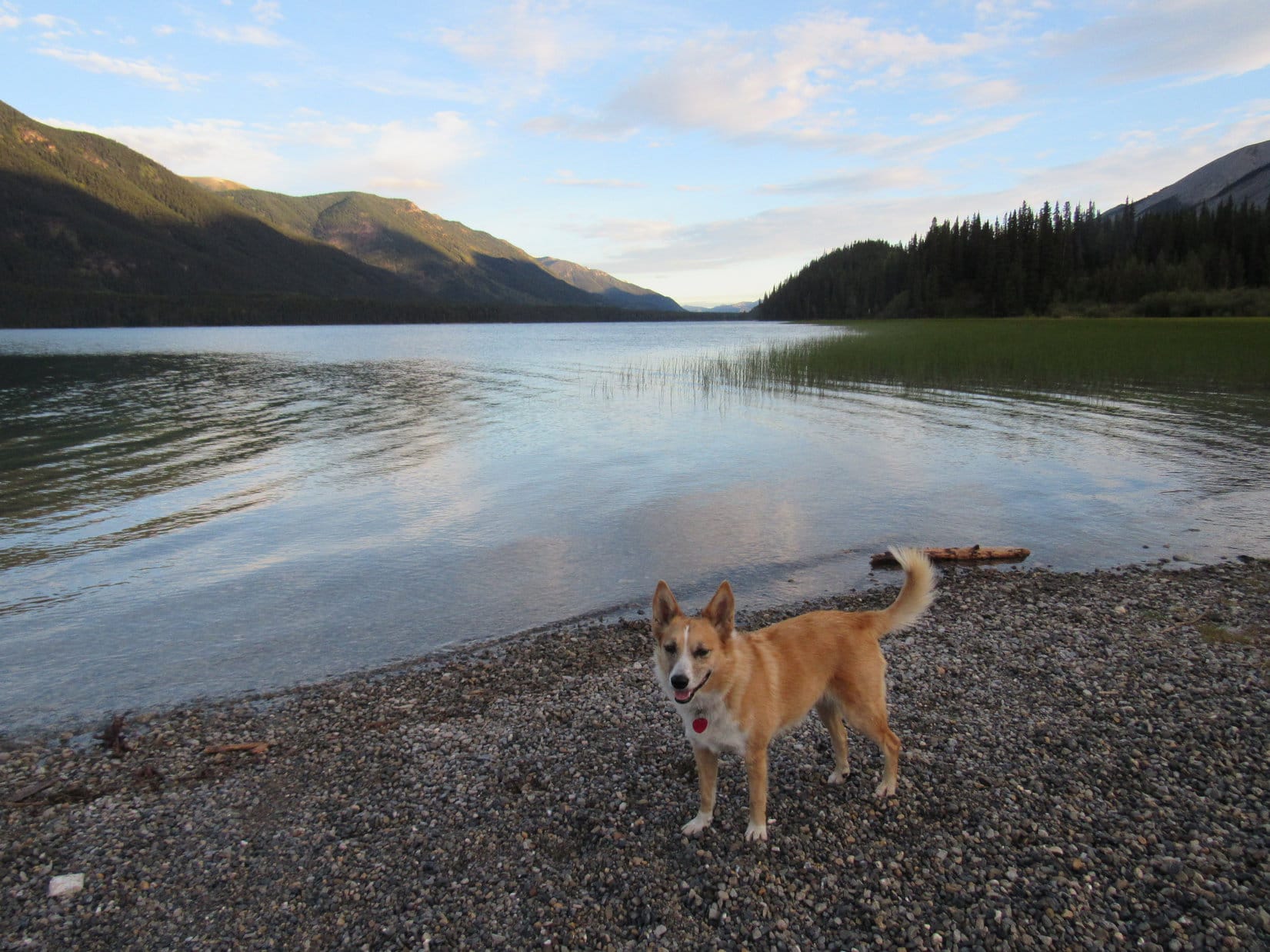
Lupe in gorgeous Muncho Lake Provincial Park. She was very happy to get out of the G6 to see the sights here, if only for a little while.
Looper at Muncho Lake.
Lupe at Muncho Lake with a splendid peak in the distance. Photo looks SSW.
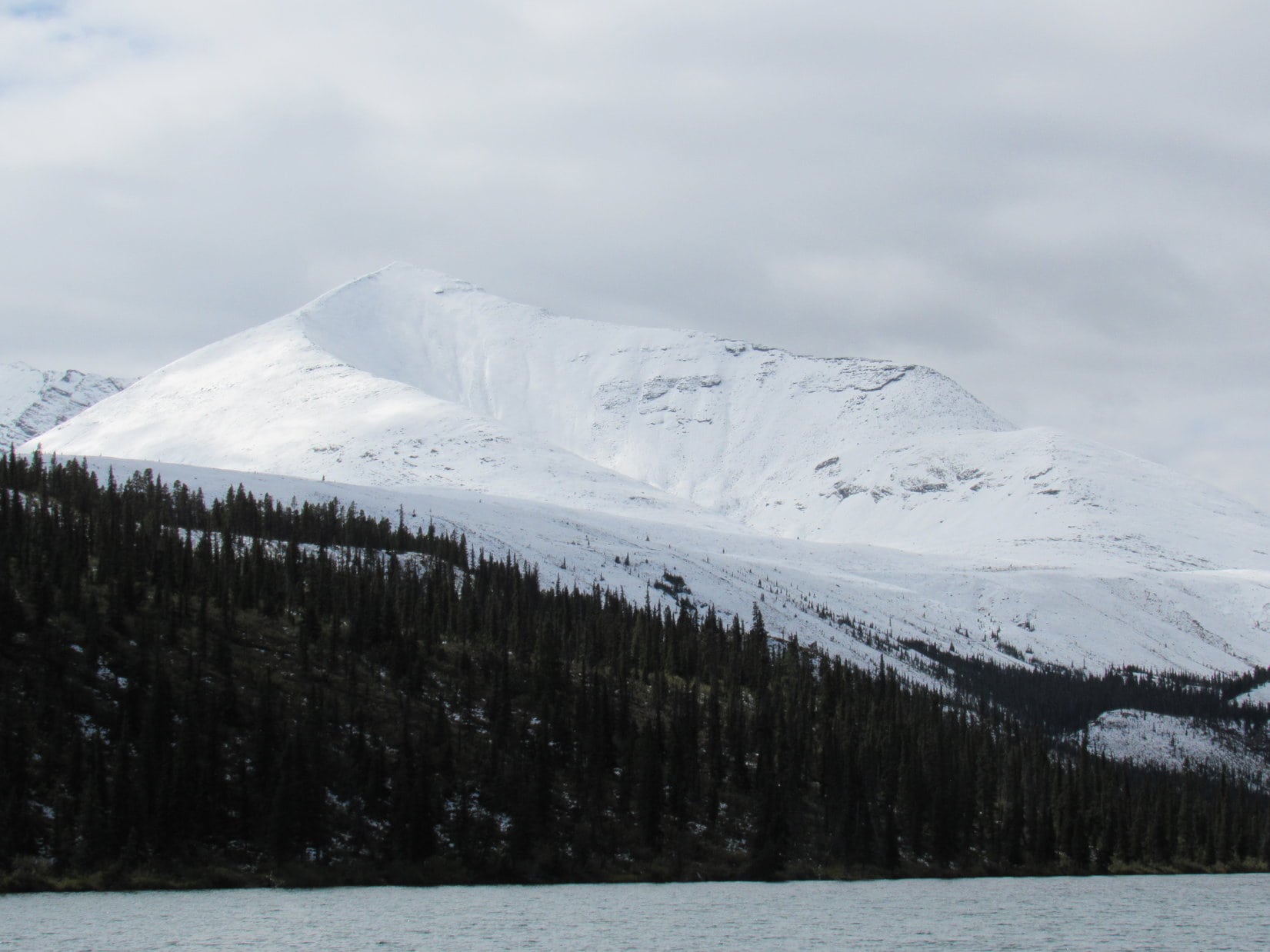
Muncho Lake Provincial Park in far NE British Columbia.
Wow! Now we’re talking adventure! This float plane was parked near a lodge on the E shore of Muncho Lake. Lupe loves to bark at airplanes, and especially helicopters. Not sure how she might react to flying away in one? Photo looks NNW.
Hmmm. The more SPHP pondered this glorious peak, the more it looked like something Lupe might be able to climb. Maybe some day? Photo looks SSW.
Wonder if there’s a trail? SPHP will have to look into it.

S of Muncho Lake, the Alaska Highway lost elevation and entered the beautiful Toad River valley.  Although it was still early in the day, SPHP was overcome by drowsiness.  Lupe and SPHP wound up taking a nap at a pullout along the highway.  Nearly two hours slipped by before SPHP woke up again, feeling much revived.

However, Lupe hadn’t needed reviving.  By now she was so bored, she was desperate to get out of the G6.  For the next half hour she had a great time sniffing around a young forest near the pullout while SPHP picked up copious amounts of trash.  People!  Trash containers were provided right at the pullout, yet way too many people don’t bother using them.  Totally disgusting!

A little farther on, Lupe left Muncho Lake Provincial Park.  Before long she crossed a bridge over another wonderful stream, the Racing River.  SPHP parked the G6 again at a pullout near the bridge.  Lupe found an old road leading through the forest.  The primitive road paralleled the Racing River downstream for a little way.  Evidently this route is sometimes used for dispersed camping.  Lupe passed several old campfire sites before the road turned and ended at the river.

The Alaska Highway bridge over the Racing River. Photo looks SW.
The Racing River was this incredible icy blue color, and certainly lived up to its name. The river did race right along.
Lupe was in great spirits. She enjoyed her visit to the Racing River! After all, she’d found a squirrel to bark at in the forest nearby!

After 25 minutes near the Racing River, Lupe and SPHP continued on.  The Alaska Highway quickly left the Racing River valley, going around the N side of a mountain into another big valley.  The highway now followed the course of McDonald Creek upstream toward impressive white mountains.  Lupe was nearing Stone Mountain Provincial Park.

Shortly after entering Stone Mountain Provincial Park, Lupe saw something she had never seen before.  A small herd of caribou were trotting across an open field toward a forest!  By the time SPHP could stop and turn around, they had vanished into the trees.  The field the caribou had crossed was at quite an elevation above McDonald Creek, and offered a good lookout point toward the mountains.  Lupe and SPHP got out of the G6 to take a look.

As Lupe approached Stone Mountain Provincial Park, impressive white mountains were visible ahead.
Lupe at the edge of the big field where she had seen caribou for the first time ever only a few minutes ago. This viewpoint overlooks the McDonald Creek valley. Photo looks SE.
The McDonald Creek valley. Mount Saint George (7,402 ft.) is on the R. Photo looks SE.
Mount Saint George using the telephoto lens. Photo looks SE.
A tower is seen at far R on the N flank of Mount Saint George. A trail leads to the tower from the Summit Lake area. Photo looks SE.
A little farther S on the Alaska highway from where Lupe saw the caribou, she made another quick stop for this grand view of the McDonald Creek valley. Photo looks S.

After getting a little exercise and seeing the grand view of Mount Saint George (7,402 ft.) and the McDonald Creek valley from Caribou Point, Lupe and SPHP drove on.   The Alaska Highway turned NE and in only a few miles reached Summit Lake at the top of a pass.  At the NE end of Summit Lake were a campground and picnic area.  Lunch time!  Lupe and SPHP pulled into the picnic area.

Lupe at Summit Lake in Stone Mountain Provincial Park. Photo looks SW.
Looking SW over Summit Lake using the telephoto lens.

Soup, sardines and crackers were on the menu.  While SPHP was heating the soup up, Lupe found a new friend.  A big dog arrived to sniff and wag tails with her.  A young woman from Fort Nelson came over to retrieve Grommet, which was the big dog’s name.  She stayed chatting with SPHP while Lupe and Grommet did dog stuff – sniffing, playing and growling.

The friendly young woman mentioned a trailhead over on the opposite (N) side of the Alaska Highway.  When lunch was over, Lupe and SPHP went over to check out the trailhead.  A map showed a 2.5 km (one way) trail going to Summit Peak (6,611 ft.) on the N side of the Alaska Highway, and several other trails S of Summit Lake.

Looking up toward a couple of white peaks N of the Alaska Highway from Summit Lake. The high point on the L is likely Summit Peak (6,611 ft.).  Photo looks N.

It all looked very interesting, but Lupe didn’t have time to explore any trails.  In fact, it was 2 PM already.  Lupe hadn’t even gone 100 miles yet today!  Definitely time to get underway again.

E of Summit Lake, the Alaska Highway lost elevation again on the other side of the pass.  Soon Lupe was out of Stone Mountain Provincial Park, leaving the big, snowy peaks of the Muskwa Ranges behind.  At Fort Nelson, the Alaska Highway turned S again.  Off to the W, Lupe could still see high mountains with snow.  The highway got close to them at one point, but then veered away.

After a great morning and early afternoon, with lots of little hikes and scenic stops along the way, the rest of the afternoon and evening proved disappointing for the intrepid American Dingo.  She spent nearly all of her time stuck in the G6, traveling through the endless forest.  The road wound over and around high ridges.  Sometimes the Alaska Highway dropped down into big valleys to cross rivers, but it never took Lupe back to the high mountains.

Lupe spent much of the rest of the day in the G6 traveling S along the Alaska Highway. The road wound along high ridges, and sometimes went down into big valleys to cross rivers. Off to the W were high snowy mountains, but the road never took Lupe up into them again.

Lupe had few chances to get out of the G6 again, but by evening she did make her 450 miles for the day.  Most of northern British Columbia was now behind her.  That feeling Lupe’d had for most of the past month of being in the far N, in Arctic lands, was fast slipping away.

Lupe in NE British Columbia leaving the far N on her way home.

Links:

Next Adventure                       Prior Adventure

Want more Lupe adventures?  Choose from Lupe’s 2016 Canadian Rockies, Yukon & Alaska Adventure Index, Dingo Vacations Adventure Index or Master Adventure Index.  Or subscribe free to new Lupe adventures.

Black Hills, SD Expedition No. 204 – Clayton Pond, Crooks Tower & Peak 6820 (5-13-17)

Start: 9:43 AM, 68°F, intersection of Long Draw Road (USFS Road No. 209) & USFS Road No. 209.2D

Loop barely got started on USFS Road No. 209.2D when it curved to the N and started going uphill.  Not the way she needed to go.  An unmarked grassy side road curved W continuing down the valley.  Lupe took it instead.

Lupe leaves USFS Road No. 209.2D to take the grassy side road seen beyond her down the valley to Merow Spring. Photo looks WNW.

As usual, Lupe was in a great mood!  She was ready for action on this gorgeous spring morning.  She trotted ahead of SPHP, frequently leaving the road to sniff and explore the narrow, forested valley.

The downhill grade gradually became steeper.  The road turned to dirt and rock.  After 0.5 mile, Lupe came to an ancient trough brimming with water.  A steady stream trickled out over one edge.  Below the trough was a muddy pool, where additional water seeped out of the ground.  A separate clear stream bubbled right up out of the road.

Lupe had reached Merow Spring.

Lupe reaches the ancient water trough at Merow Spring. It was completely full of water with a steady trickle overflowing the top of the edge on the L. Photo looks NE.
The muddy pool below the water trough. Loop started to venture into the pool for a drink, but sank into the mud so deeply that she backed off and drank from a tiny clear stream bubbling up right out of the road instead. Photo looks NE.

The Carolina Dog helped herself to a drink from Merow Spring, but finding nothing else of interest here, she continued on down the road.  For a little way, the tiny stream originating at Merow Spring wound around in the nearby forest, before sinking back underground.

The day was unseasonably warm.  Lupe and SPHP enjoyed the shade of the heavily forested valley.

Lupe on USFS Road No. 232.2C down in the narrow, shady valley W of Merow Spring. The morning was unseasonably warm with nearly cloudless skies, so the shade was nice to have. Photo looks W.

Less than 0.5 mile W of Merow Spring, the narrow valley merged with a wider valley of sunny green meadows.

Lupe reaches the wider valley W of Merow Spring. Photo looks SSW.

Lupe turned S, roaming freely through the bright meadows, exploring up the larger valley.  She soon discovered a stream.  The stream, though quite small, was much larger than the one at Merow Spring.

This stream was actually upper Spearfish Creek, the same Spearfish Creek that carved famed scenic Spearfish Canyon in the northern Black Hills.  This far upstream the valley did not exhibit the huge limestone cliffs present in Spearfish Canyon, but rock walls were exposed in a few places along the valley’s edge.

Lupe exploring the green meadows along the upper reaches of Spearfish Creek. The creek is small here, but has many tributaries farther downstream. By the time it reaches its more famous lower region in Spearfish Canyon, Spearfish Creek is one of the largest streams in the Black Hills. Photo looks S.
Limestone walls exposed along the edge of the valley. Photo looks WSW.

Loop was super excited when she heard a squirrel in the forest!  For some odd reason, the squirrel did not immediately climb a tree when it saw Lupe racing straight for it.  Instead, the squirrel waited until the last possible moment to scramble to safety beneath a large fallen tree.

The American Dingo was frantic to get at the poor squirrel!  The foolish squirrel was down on the ground, cornered beneath the fallen tree!  This was the opportunity of a lifetime!  Lupe bounded and danced around the tree, stopping to dig furiously in several places.  The dirt flew, but she couldn’t get at the squirrel, which was by now chattering loudly, thoroughly alarmed by the situation.
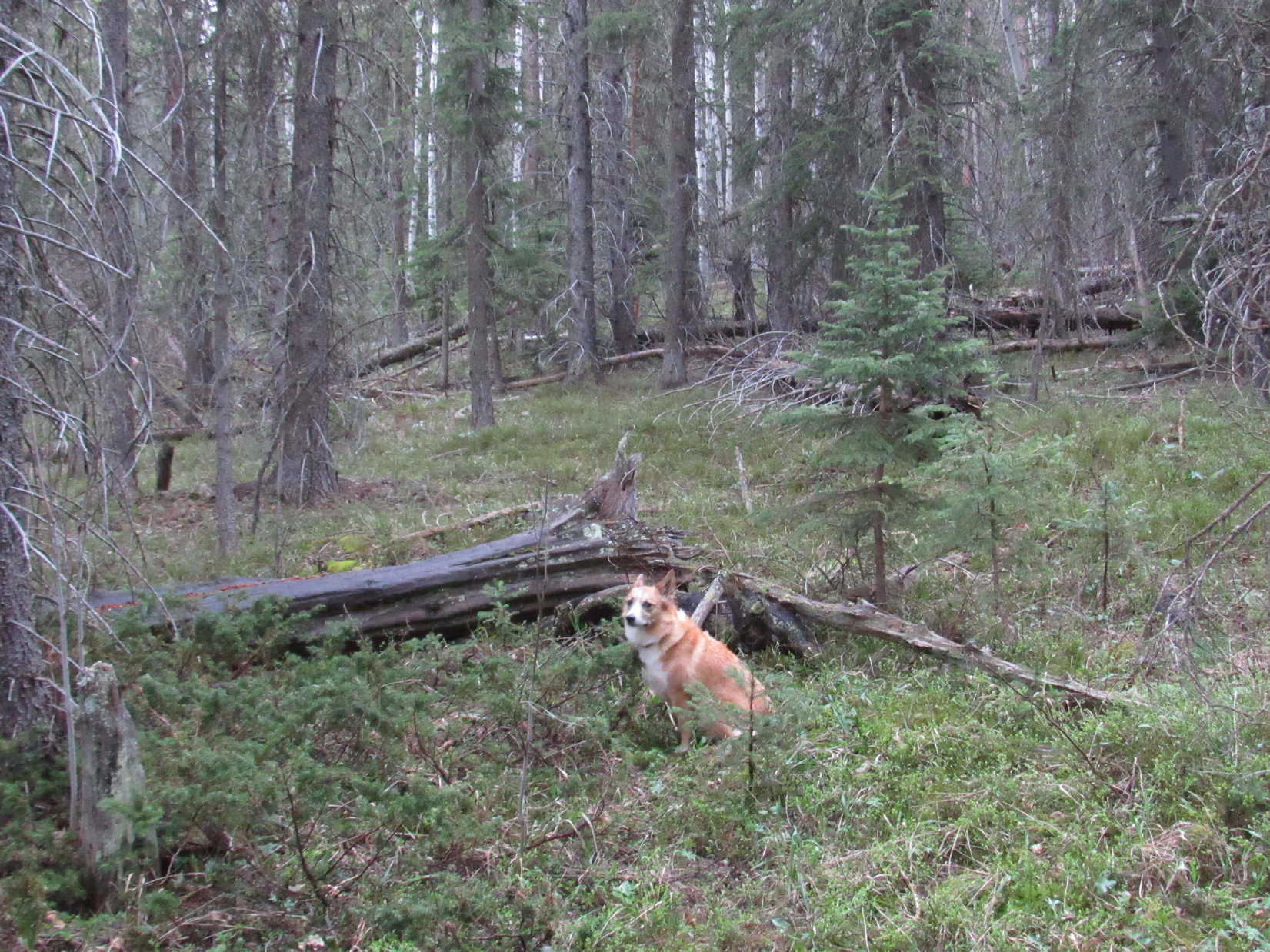
Lupe was keen on digging lunch out from under the fallen tree, but the squirrel proved elusive. How to get at it?

When digging didn’t work, Lupe decided to rip the tree apart!

The Carolina Dog resorts to ripping the dead tree apart!

SPHP called Lupe away, spoiling all the fun.

Loop, come on!  Leave that squirrel alone!

Don’t you humans have any survival instinct at all, SPHP?  Help me, don’t scold me!  Squirrels that aren’t smart enough to climb a tree are what we Dingoes call lunch!

Come!  Now!  I brought lunch, and you know it.  Taste of the Wild, good for Dingoes!

Yeah, but not as much fun!

Now!

Oh, all right.  Sheesh.

Lupe came.  Puppy ho!  Onward!  Meanwhile a greatly relieved nervous wreck of a squirrel made a mental note to climb way, way up a tall tree immediately if it ever caught so much as a glimpse of a ferocious Carolina Dog again.  Whew!

Loop trotted along happily for a few minutes before deciding to drag herself on her belly through Spearfish Creek to cool off.  She dried herself off on the green grass, then continued her upstream explorations.  About 0.75 mile from where she’d reached the Spearfish Creek valley, the terrain opened up where several valleys came together.  The creek curved away up into a small valley to the E.

Lupe along Spearfish Creek shortly before she left it where it turned and went up a smaller, steeper valley to the E. Photo looks S.

SPHP recognized this place.  Lupe had been here once before over 4 years ago on Expedition No. 57 way back on 5-4-13.  Back then she had come down Clayton Draw from the S looking for Clayton Pond.  She had found it, too, up in a side valley off to the NW.  Visiting Clayton Pond again was Lupe’s first real objective for today’s Expedition No. 204.

Where Spearfish Creek turned E, Lupe left it to follow the main valley curving W.  Soon she was going up a wide, shallow side valley to the NW.  Clayton Pond wasn’t much farther now.

When Lupe reached Clayton Pond, SPHP couldn’t help feeling a bit disappointed.  Clayton Pond hadn’t been very large at all when Lupe had first seen it on Expedition No. 57.  Now it was even smaller.  It was easy to see why.  A breach in the earthen dam showed where the pond had overflowed and eroded away part of the dam.  The water level was now permanently a foot lower than before.  Not much, but to the shallow pond, one foot made a huge difference.

Lupe returns to Clayton Pond for the first time in more than 4 years. SPHP was disappointed to see that the pond was smaller than before due to a breach in the earthen dam. Photo looks NW.

Loop and SPHP strolled completely around the pond before taking a break at the edge of the forest to the E.

The muddy part on the R was all under water last time Lupe was at Clayton Pond. The pond was 50% larger and had a more interesting shape back then. Photo looks SE.
Looking SSE.

Since squirrel wasn’t on the menu due to SPHP’s confounded interference, Lupe settled a little glumly for her usual Taste of the Wild snack.  SPHP relaxed while looking at the topo maps, and enjoying the view of what remained of Clayton Pond.  Who knew?  Another 4 years of erosion, and Clayton Pond might pass into history.  May as well appreciate what remained of it while one could.

After 15 minutes of laziness, Lupe was ready to press on.  She departed Clayton Pond going SE back to the main valley, where she followed a road S.  Her next objective was a mountain 4 miles S of Clayton Pond – Crooks Tower (7,137 ft.), one of the highest points in the Black Hills.

A mile S of Clayton Pond, Lupe reached a part of the valley where she’d had a strange experience back on Expedition No. 57 with a type of creature she’d never seen before or since.  At Yellow Jacket Spring she had been, if not pursued, at least vigorously followed, by an odd, fearless, furry black and white creature – a skunk!

The Yellow Jacket Spring skunk had headed straight for Lupe and SPHP the moment it became aware of Lupe’s presence.  Lupe began running over to greet it, but fortunately returned to SPHP when called.  The skunk followed (pursued?) Lupe for 10 minutes thereafter, but failed to catch her before giving up.

SPHP had thought the skunk’s behavior peculiar.  Maybe it was rabid?  Whether it was or not, a Dingo/skunk encounter was not likely to end well.  Much better to avoid any such event.  Now, as Lupe approached Yellow Jacket Spring again, SPHP couldn’t help but wonder if the Yellow Jacket Spring skunk or its relatives were still around, but Lupe passed through the area uneventfully.

Nearing Yellow Jacket Spring where Lupe had been pursued by a skunk on Expedition No. 57. The spring wasn’t flowing today or back then, but probably originates at the water tank barely visible here in front of the largest pine tree on the R. Photo looks W.

Lupe made good progress going S up the wide valley, but the day was sunny and warm.  No stream or pond was to be found.  SPHP stopped several times along the shady edge of the forest to give Lupe water.  Dingo explorations can be a thirsty business!

Lupe took one of her quick water breaks near this large limestone outcropping right along the road S of Yellow Jacket Spring. Photo looks SE.

Two miles S of Yellow Jacket Spring, Lupe came to an intersection with South Rapid Creek Road (USFS Road No. 231) near a couple of cabins and a big power line.  She was now half way to Crooks Tower from Clayton Pond.  She turned ESE on No. 231, but followed it only far enough to get E of private property associated with a cabin to the S.  Here she came across a side road heading SW into the forest.

The side road looked promising, so Lupe took it.  Being back in the shade of the forest again was nice.

On the shady side road S of South Rapid Creek Road. Having some shade again was nice! Photo looks WSW.

The road curved WSW for a little way, then bent back to the S.  Before long, the road divided.  Lupe took the L branch, which started a long climb up a moderately steep slope.  A couple of water breaks later, the road finally leveled out.  Ahead was a limestone platform that looked familiar.  SPHP was almost certain Lupe had been up there before on several other occasions.

The limestone platform wasn’t a bad viewpoint.  Lupe left the road.  She found a place where she could climb up onto the ridge, then went out to the far W end of the platform.  Yes, this was the same place!

Looking NW from the limestone platform. Lupe had been here before on several of her expeditions. The views aren’t bad to the N & W from here. Photo looks NW.
Looking N. This viewpoint is about a mile N of Crooks Tower.
A profusion of pink and white wildflowers were growing on the limestone platform.

The views were nice enough to entice Loopster and SPHP to take another 10 or 15 minute break here.  Crooks Tower was only a mile away to the S, but still couldn’t be seen.  All the views from the platform were toward the N or W.

Even though Crooks Tower wasn’t in view yet, Lupe knew the way when the time came to get going again.  She ran through the forest sniffing everywhere, as she worked her way S.  Finally, she could see part of the N ridge ahead.

This tree-broken view of the Crooks Tower N ridge is about as good as it gets on the approach from the N. Photo looks SSE.

Despite having a rather dramatic name and being one of the highest points in the Black Hills, Crooks Tower is in an area where much of the nearby terrain is heavily forested and almost as high.  Consequently, the views from the top aren’t dramatic, and there aren’t many places from which it is even possible to recognize the mountain from a distance.

Several nearby high points on the topo maps are enclosed by contours of the same elevation as the contour enclosing the true summit.  The N ridge led Lupe naturally SE up to the high point in the contour NE of the true summit.  Lupe found a crumbling limestone cairn.

Lupe reaches the top of the NE high point. The true summit of Crooks Tower was only a couple hundred yards to the SW, but could still barely be seen, even from here. Photo looks NW.
Lupe astride what appeared to be a disintegrating limestone cairn on Crooks Tower’s NE high point. Photo looks N.

Loopster didn’t dilly dally long at the NE high point.  She was going to get a good half hour break up on Crooks Tower’s true summit, which was only a couple hundred yards away.  She easily climbed the mountain’s 20 foot high limestone crest by circling around to the SW, where a short footpath leads right to the summit.

Ta da!  Lupe stood on Crooks Tower (7,137 ft.) for the 8th time, making it once again the peak Lupe has visited more often than any other.

Loopster taking it easy on Crooks Tower. Photo looks N.
Despite how high Crooks Tower is, this pleasant, but none too dramatic view is the best available from the true summit. Black Elk Peak (7,131 ft.) is seen on the far horizon on the L. Green Mountain (7,164 ft.) is the distant ridge on the R. Photo looks SSE.
On the tippy top of Crooks Tower. Photo looks N.
Crooks Tower is so easy! No wonder I like to come here. Photo looks N.
Loop on a slightly lower limestone ledge only a few feet NW of the true summit. Photo looks NNW at the other decent view from Crooks Tower.

What a beautiful day!  Loop and SPHP took it easy for a while.  The sun was still very high in the sky.  Puffy white clouds floated by.  Lupe had plenty of time.  SPHP ate the only apple.  Lupe had more Taste of the Wild.  Water for all.

Lupe chillin on Crooks Tower. Photo looks W at the lovely view, assuming you are a Ponderosa pine tree enthusiast.

This was Lupe’s 8th time on Crooks Tower.  It had been nearly 2 years since the last time she’d been here on Expedition No. 135.  Back then she had wound up getting injured down in Trebor Draw after leaving the summit.  SPHP had rushed her (sort of – it took hours to get there) to the the Animal Clinic of Rapid City where Emergency Veterinarian Dr. Erin Brown had patched her up late on a Saturday night.

Poor Lupe!  She’d come staggering back to SPHP after her operation looking drugged with tears in her eyes.  No more Trebor Draw today!  That wasn’t going to happen again.  Yet Lupe had so much time left in the day, a new plan was hatching in SPHP’s mind.  Why not go to another peak Lupe had been to a couple of times before?  Peak 6820 was less than 4 miles away to the NE as the crow flies.

Going to Peak 6820 would make for a long day, and there were no views at all from that forested hill, but so what?  May as well do something.  Lupe returned to the true summit of Crooks Tower for a final goodbye.

Back at the summit one more time. Photo looks SE.

SPHP tried to persuade Lupe to remain up on the summit block long enough for a bold American Dingo photo taken from below, but Lupe wasn’t having any of that.  If SPHP was starting for Peak 6820, she was too.  She did consent to a photo of a bold American Dingo beneath the summit block, but somehow it wasn’t quite the same.

Bold American Dingo, Lupe, poses undramatically beneath the not-so-towering limestone cliffs of Crooks Tower. Photo looks NNW.

Oh, well.  Onward!  Even though it was nearly 4 miles to Peak 6820 as the crow flies and Lupe knew a good shortcut, so many hours of daylight remained that SPHP led her on a long way around she had only taken once before long ago.  Lupe started off going SW instead of NE.  She ended up taking a considerably longer-than-SPHP-remembered tour of the entire region along USFS Road No. 631.

This route was scenic and easy, but time slipped by as Lupe traveled all the way from a valley SW of Crooks Tower around to the S, then E and NE sides of the mountain.  On the way, Lupe passed by the road leading NE into dangerous Trebor Draw.  A little later on, she discovered Dingo Arch.

On USFS Road No. 631 S of Crooks Tower. This route SPHP chose was scenic and easy, but miles longer than it needed to be. Photo looks E.
Looking NNE up the same hillside along USFS Road No. 631 S of Crooks Tower.
Lupe discovered Dingo Arch E of Crooks Tower, on a slope above USFS Road No. 631 near the road’s highest point. Arches are uncommon formations in the Black Hills. Photo looks WNW.

The long march on USFS Road No. 631 eventually brought Lupe to a valley leading all the way down to South Rapid Creek Road (USFS Road No. 231).  Lupe followed this major gravel road N until she was within sight of the junction with Besant Park Road (No. 206).  Many deer were grazing in a lovely green field here, but they fled at Lupe’s approach.

By now, the angle of the sun was noticeably lower.  The blue skies and puffy white clouds prevalent earlier in the day had given way to a more darkly overcast scene.

Many deer were grazing in this lovely green field when Lupe arrived, but they fled at Lupe and SPHP’s approach. The junction of South Rapid Creek Road & Besant Park Road is at the far end of this big field on the R. Photo looks N.

Lupe was still 1.5 miles from Peak 6820 as the crow flies.  She wouldn’t have the benefit of a road the rest of the way.  Was there still enough time remaining for all the bushwhacking she would have to do?  Yeah, Loop could make it.  She had been through parts of this region before.

Lupe and SPHP left South Rapid Creek Road, crossed the green field, and headed SE up into the forest.

The forest was a complete mess.  Deadfall timber everywhere.  Slow, slow, slow! After a long struggle, Lupe finally made it up to a clearing at the top of a ridge.  She was already almost as high as Peak 6820, but still quite a distance from it.  Exactly how far was impossible to tell.  The flat terrain and dense forest at the edge of the clearing made it difficult to see a thing.

Lupe reaches the clearing at the top of the ridge after a long struggle through copious deadfall timber. Although she was quite high, Peak 6820 was nowhere in sight. Photo looks SE.

Peak 6820 was somewhere to the NE.  Lupe and SPHP plunged into the forest again.  More deadfall.  Tons of it.  Zigging and zagging like drunks looking for a way through.  Nothing looked the least bit familiar.  Everything was just a jumble of dead trees beneath the still standing forest.

Lupe came to a higher, short rocky ridge.  High Point 6801?  Who knew?  No views were available even from here.  The only other time Lupe had come to Peak 6820 from this direction was her first time up it on 10-8-14, more than 2.5 years ago.  It hadn’t been this difficult then.  Lupe had at least caught a few glimpses of Peak 6820 from a distance to orient by.  Now, nothing.

N, E, SE – Lupe went which ever way seemed easiest to avoid the worst of the deadfall.  None of the strange structures she had seen on her first trip to Peak 6820 appeared.  She had to be getting close, but in the gloom of the forest, it was becoming confusing as to which way Lupe should even try to go.  Speaking of gloom, the forest seemed prematurely dark.

Thunder in the distance.  First drops.  Rain!  No matter.  Onward!  The rain was light, but even so, before long Lupe was wet.  She reached another high point.  Was this it?  Had Lupe stumbled upon Peak 6820?  It didn’t look right.  SPHP remembered a clearing with a mud hole where Lupe had bathed both times she’d been to Peak 6820 before.  Lupe searched all around the top of this hill for it.  Nada.  Wrong hill.

It must be farther N.  Lupe went N on the big hill until she began to lose elevation.  No sign of Peak 6820 here or anywhere else.  Had Lupe gone too far SE earlier?  SPHP led her NW down off the big hill.  The deadfall wasn’t quite as bad here, but Peak 6820 did not appear.  Lightning flickered in the clouds, thunder rumbled constantly.  The rain remained light and sporadic, but might become a cloudburst at any time.  The forecast hadn’t even mentioned rain today.  Figured.

The Carolina Dog wanted attention.

What’s wrong with your senses?  Don’t you hear or see anything, SPHP?  Lightning, thunder!  Let’s hide!  A storm is coming!  I’m already all wet.

Yeah, I know, but we’ll be OK.  Besides there isn’t any place to hide, and we need to get to Peak 6820 soon, or forget about it.  We can’t let it get dark while we sit around out here.  We’ll never find a way out of this deadfall at night.

Well then, let’s get there fast!  What’s in that water bottle of yours anyway?  You’ve been stumbling around out here like you’re totally wasted.

I’m trying to find it, Looper.

What, the mountain?

Yes, of course.  I’m just not totally sure which direction it is from here.

You mean it’s lost?

No, of course not, silly Dingo.  Mountains don’t move.  They always stay in the exact same place.

Oh, I get it.  You mean we’re lost.

No, well, I mean we are imprecisely located right now.  I know about where we are, just not exactly, which makes it hard to say where the mountain is from here, but I know it can’t be too far away.

Lupe wasn’t buying it.  The Carolina Dog looked worried.

Sweet! We’re lost in this wretched forest with night and a storm coming on. Any more good news, SPHP? The Carolina Dog looked worried.

Oh, OK!  I suppose you’re right Looper.  Apparently it’s later than I thought.  Maybe we better give up on Peak 6820.  I shouldn’t have taken the long way.  Let’s get out of here.

Lupe was in favor of that.  SPHP led her NW through the forest.  Even though this was the shortest way out, the Carolina Dog had at least a mile of bushwhacking ahead of her.

Ten minutes later, there it was!  Peak 6820!  SPHP saw it off to the NE.  That hill had to be it, and wasn’t too far away.  Lupe could make it.  There was still time.  SPHP turned on a dime.

Change of plans, Looper!  Forget NW, we’re going NE.  Peak 6820 is right over there.  Come on!

Lupe led the charge through the forest.  Apparently she wanted to get Peak 6820 over and done with fast.  The rains came more often and harder.  More lightning!  More thunder!  As the first tiny hailstones bounced on the ground, Lupe and SPHP both saw it.  Up a short slope at the base of a limestone outcropping was a perfect little Dingo Cave.  Lupe and SPHP scrambled up the bank to safety.

Lupe reaches the safety of the Dingo Cave somewhere on the upper W slope of Peak 6820. Photo looks NW.

It hailed briefly twice, but not hard.  The hail was only pea-sized at most, so it wasn’t that bad.  Rain poured down, though, for 20 minutes.  Never a deluge, but by the time it was all over, everything was sopping wet outside.  Lupe and SPHP watched it all happen from the bone dry shelter of the Dingo Cave.  Not a drop fell inside.  What were the odds?

Loopster, my friend, you are one lucky Carolina Dog!  We never would have found this place, even if we’d known it was here ahead of time.

Loop at the mouth of the Dingo Cave after the storm went by.

Pushing past soaking wet bushes on the forest floor, Lupe still got drenched, but the top of Peak 6820 was only 5 minutes from the Dingo Cave.  She did get there.  This was it!  The familiar mud hole in the clearing didn’t have much water in it, but what was there was fresh.  Heh.  As sopping wet as Lupe was, she felt no need for a bath this time around.

Lupe by the little mud hole in the clearing on top of Peak 6820. The glare beyond her is the sun low in the W.
No need for a mucky Dingo bath today!

The top of Peak 6820 is nearly level over a large area, but slightly higher ESE of the mud hole.  Lupe and SPHP went over that way to visit the true summit.  Someone else had been here!  Lupe came across a cairn she never seen before.

Lupe at the new cairn she discovered on Peak 6820. Photo looks E.

Lupe and SPHP continued E beyond the cairn.  Lupe went to the spot she has always considered the summit, even though it was scarcely any higher than where the cairn was.  And that was it.  Success!  Peak 6820 visited for a 3rd time!

At Lupe’s traditional Peak 6820 summit point, perhaps 30 or 40 feet E of the cairn. Photo looks W.

Sunset in 30 minutes.  Lupe now faced a race against time.  The shortest route back to the G6 was to the NW.  Lupe had been that way before, but it was too late to even try that direction.  It was a total bushwhack through forest and deadfall timber for more than a mile to any road.

The second time Lupe had come to Peak 6820, SPHP remembered she’d followed a faint road up from the E, arriving at the N end of the summit area.  Going E meant going away from the G6, but the faint road led to USFS Road No. 234, a better road which went around the W end of Swede Gulch.  If Loop could make it to No. 234, she wouldn’t get stuck out here in the deadfall all night.

The road to the E was even fainter now.  SPHP had a hard time even finding it at first, but it was there.  Good thing!  Hurry, hurry Dingo!  Lupe and SPHP followed the faint road as quickly as possible.  SPHP briefly lost track of the road a few times, but the American Dingo kept finding it again.  The road was longer than SPHP remembered.  The sun set, twilight was fading, but Lupe made it to No. 234.

Lupe on USFS Road No. 234 E of Peak 6820. By reaching this better road, Lupe escaped the possibility she might get stuck spending the night out here. Photo looks N.

Seven miles at least back to the G6.  The long march began.  It rained again, but not as hard as before.  Lupe and SPHP found partial shelter beneath a big pine along No. 234.  In 10 minutes it was over.  Lupe left the road to take a shortcut through big fields heading W along Tillson Creek.  On and on.  A couple miles later she reached Besant Park Road (USFS Road No. 206) near the SE end of Besant Park.

The rest of the way back was entirely along good gravel roads.  The Carolina Dog trotted along sometimes leading, sometimes at SPHP’s heels.  It was an amazing evening.  Lightning flashed among clouds in ever changing directions, but always some distance away.  Now and then a brilliant bolt struck the earth.  Thunder rolled louder, fainter, then louder again.  Dark rumbling clouds threatened rain, but never did more than sprinkle.

Once Lupe begged SPHP to stop for a rest along South Rapid Creek Road.  OK.  For 10 minutes, Lupe curled up next to a tree stump, wearily licking tired, muddy paws.  Rain threatened again.  Still nearly 4 miles to go.  Puppy ho!  Let’s get this over with!

At exactly 11:00 PM (50°F), Lupe made it back to the G6.  She was thirsty.  SPHP gave her a big drink.  Then she jumped in and curled up.  Her 13+ hour adventures on Expedition No. 204 were finally over.

Or were they?

Ten minutes later, heading E on South Rapid Creek Road, the high beams illuminated something scurrying along as fast as it could.  Big, furry, low to the ground, black and white.  SPHP shouted a word Lupe had never heard shouted before – skunk!

Lupe leapt to her paws in time to see it.  Dead ahead a huge skunk was racing E for the exact same spot where Lupe had taken her last rest break by the tree stump!  The Carolina Dog barked furiously as the G6 sped by, and the skunk dashed into the darkness.

By golly, Looper, that Yellow Jacket Spring skunk is still on your trail after all these years!

Clayton Pond in all its glory 4 years earlier. Photo taken on Expedition No. 57, 5-4-13.
At the hidden Dingo Cave on the W slopes of Peak 6820.

Links:

Next Black Hills Expedition                   Prior Black Hills Expedition

Want more Lupe adventures?  Check out her Black Hills, SD & WY Expeditions Adventure Index, Master Adventure Index, or subscribe free to new Lupe adventures!