Day 38 of Lupe’s Summer of 2016 Dingo Vacation to the Canadian Rockies, Yukon & Alaska
Lupe’s morning started at 7:00 AM with a quick side trip into nearby Fort St. John for fuel for the G6. Then it was back N a few miles to the turn SW onto Hwy 29 to Chetwynd. Making that turn, Lupe left the Alaska Highway for the final time on her Summer of 2016 Dingo Vacation.
Hwy 29 was a beautiful drive. For a while, the road followed a stretch of the Peace River valley. However, that feeling of being in the truly far N, which Lupe had while in the Yukon and Alaska, was fading fast. At Chetwynd, SPHP turned W on Hwy 97. It would eventually turn S and take Lupe to Prince George. This was still gorgeous, unspoiled territory, all wild, forested, and full of rivers and lakes, but Lupe saw no more snow-capped mountains, not even on the most distant horizon.
Nearly all day would be spent driving, but Lupe did have one adventure in store for her. She was going to take the trail up Teapot Mountain, sometimes touted as one of the best day hikes of central interior British Columbia. The trail isn’t long, only 0.9 mile (1.4 km). It climbs an ancient steep-sided basaltic plug which survived the last ice age, while gaining 650 feet of elevation (200 meters).
The sky clouded up. Light rain showers dampened the highway. Miles rolled by. Suddenly, ack! Talus Road! Wasn’t that it? Yes, and SPHP had missed the turn. Oh, well. At least the sign had been spotted. SPHP found a place to turn around. A few minutes later, Lupe was turning W onto gravel Talus Road.
A kilometer later, SPHP missed the R turn onto Caine Creek Forestry Road, too. The whole area seemed to be a maze of gravel roads, and the signage wasn’t great. Nevertheless, after a brief exercise in futility, Lupe did make it back to Caine Creek Forestry Road, which wound around for 2 miles (3 km) before crossing a bridge over a creek connecting a couple of skinny, swampy lakes on either side.
As the road started curving L after crossing the bridge, a sign could be seen tucked back at the edge of the trees near a dirt side road on the R. Nearby was enough parking space for several vehicles. The sign said Teapot Mtn. An arrow pointed into the forest along the side road. Not another soul or vehicle was around, but this had to be the trailhead.
SPHP parked, and Lupe got out of the G6. The sky was clearing a little again. The sun was trying to break through. On the way here, Lupe had seen densely forested Teapot Mountain a little to the W. It didn’t look very big after all the mountains Lupe had seen on this Dingo Vacation. The trip up Teapot Mountain(3,009 ft.) wouldn’t take long.
Lupe had plenty of time. Why not take a look at the swampy lakes and the creek from the bridge, before going up the mountain?
Lupe at the trailhead. There was room to park maybe half a dozen vehicles nearby.Lupe along Caines Creek Forestry Road near Teapot Mountain. Photo looks NNW at the larger of the two skinny, swampy lakes. The swampy lakes were actually part of the Crooked River, which flows N.
The water in the creek, which was actually the Crooked River, looked clean and clear. From the smaller skinny lake, it flowed N under the bridge. Both skinny lakes were part of the river system. Lupe didn’t see any fish in the river, but no doubt there must be some. The lakes had plenty of water and looked like great habitat.
In the 15 minutes Lupe spent sniffing around the Crooked River and the swampy lakes, 2 vehicles had arrived and parked at the Teapot Mountain trailhead. Hikers were already somewhere on the trail ahead of her by the time Lupe started out. The first part of the trail followed the side road, which curved NW as it led Lupe into the forest. The side road dead-ended after only a few hundred feet.
Lupe on the short side road which served as the first part of the Teapot Mountain trail. The road curved NW as it led Lupe into the dense forest. Photo looks W.
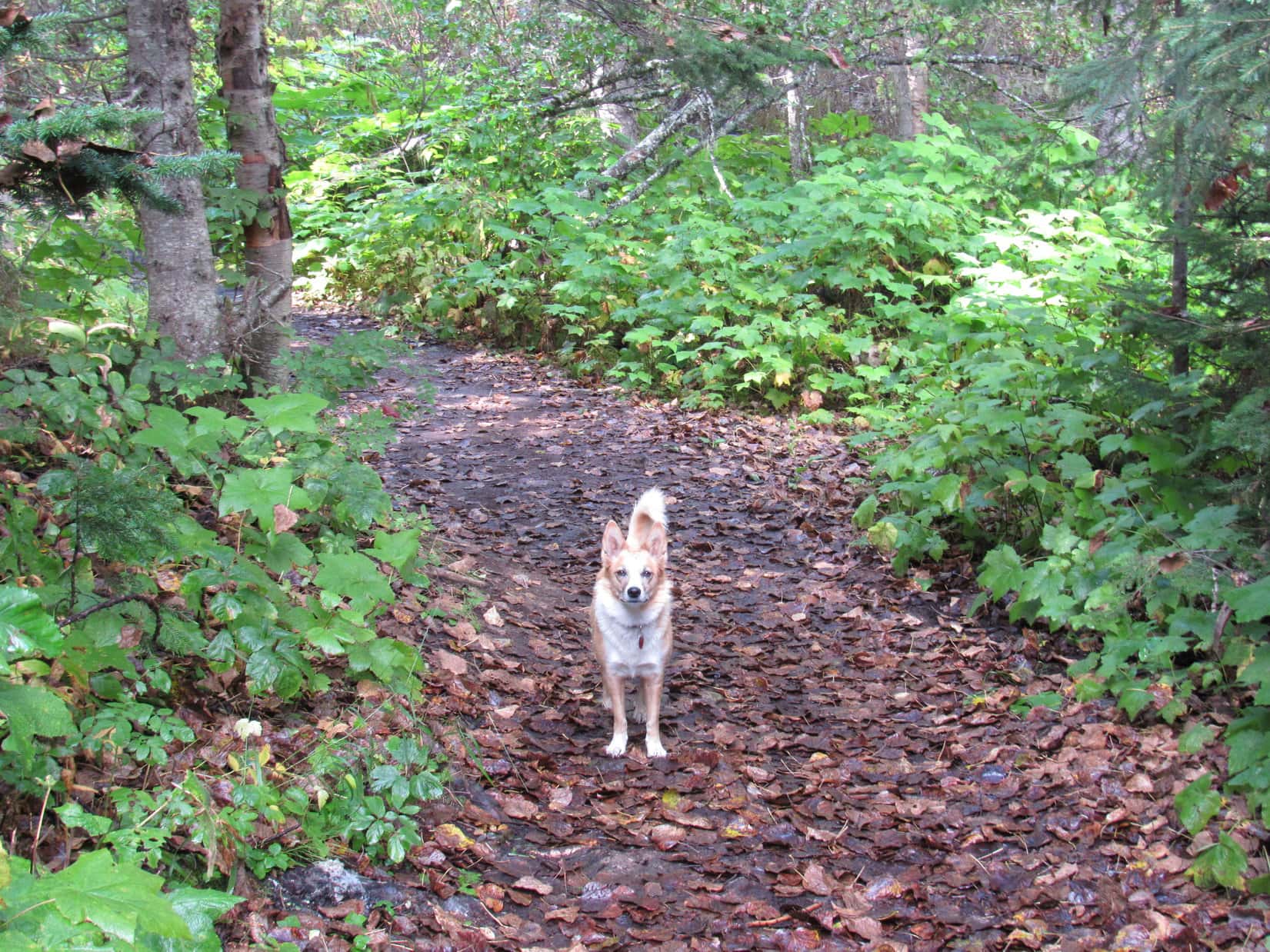
Where the side road ended, a wide path strewn with leaves led off to the W toward Teapot Mountain. Lupe hadn’t gained any elevation yet, but she was about to. The path started climbing steadily, slowly at first, but it quickly became steep.
Lupe near the start of the path to Teapot Mountain after the side road dead-ended. The path started out level as shown here, but quickly became quite steep. Photo looks W.
The well worn trail was easy to follow, but soon became a real challenge for heart, lungs and legs. It worked its way over to the SE face of Teapot Mountain, where it began to climb even more steeply heading almost straight up the mountain.
The dense, lush forest hid all views. Many tree roots and rocks were exposed on the trail, which was hard packed. This part of the Teapot Mountain trail must be very slick when wet, but it wasn’t bad as Lupe made her ascent.
Teapot Mountain hadn’t looked that big from below, but felt bigger with each step up. The relentless steep rate of climb continued until Lupe reached a junction close to the top of the mountain. Here, the trail divided. Lupe could go L or R. It didn’t really matter which way she went, since both directions were part of the circular loop trail around the upper rim of Teapot Mountain. Lupe went R (N), hoping to catch a view of the Crooked River below.
Just because Lupe had reached the loop trail didn’t mean she could see anything. The top of Teapot Mountain was as densely forested as all the rest of it was. The trail had come up near the SE end of the mountain, at a part of the rim that proved to be a little lower than most of it. The summit area contained within the loop trail was acres in size. The interior terrain sloped gradually and unevenly up toward some unseen high point.
The loop trail was an easy, almost level stroll. Lupe didn’t have to go very far N before she came to a break in the trees where she could see a long, skinny lake down along the Crooked River off to the NE.
Lupe could see one of the long, skinny lakes that was part of the Crooked River system from the loop trail. Photo looks NE.
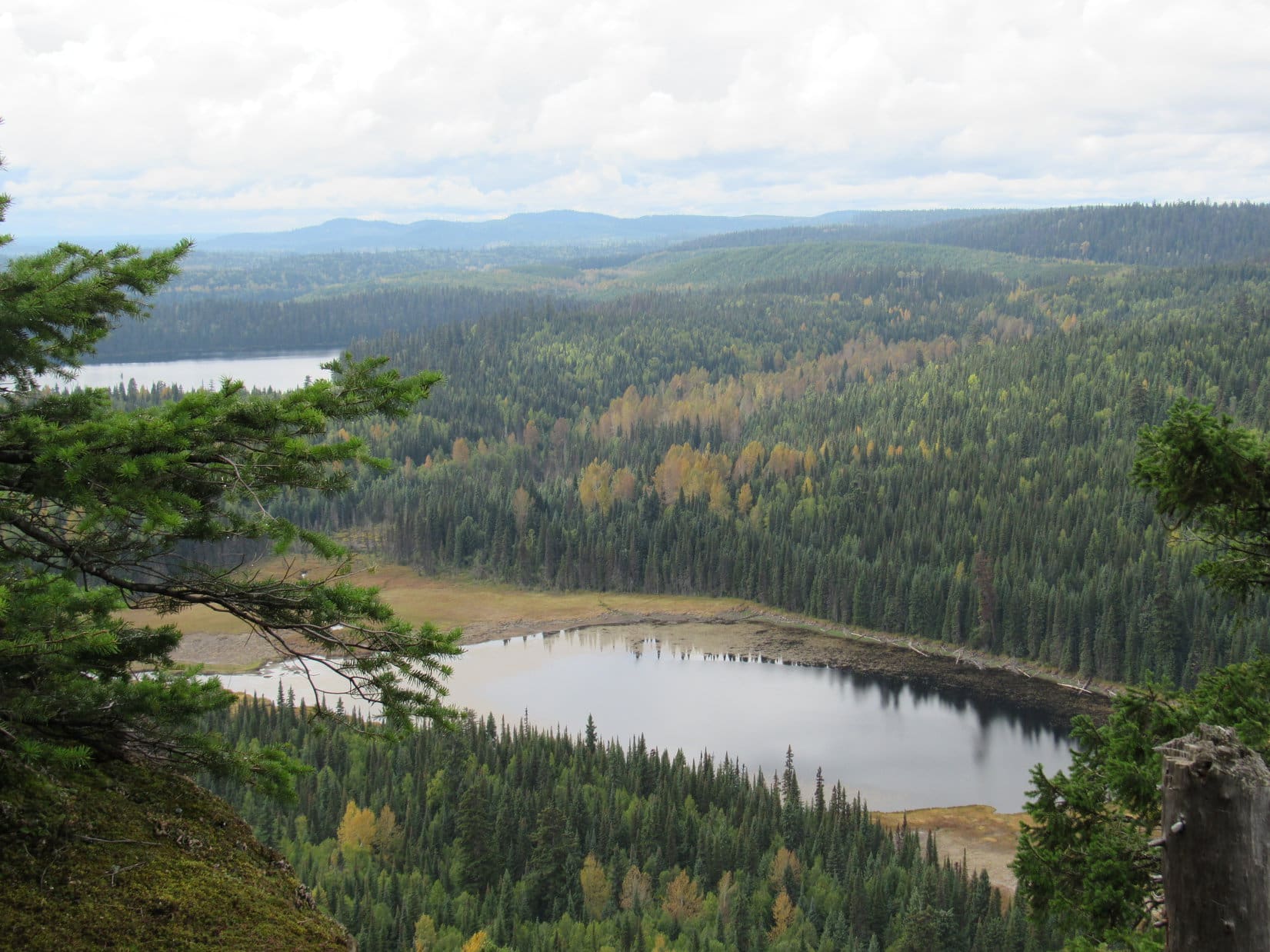
On her way around the N rim of Teapot Mountain, Lupe came to no more viewpoints until she reached some cliffs at the NW end of the mountain. Lupe could see a large shallow pond in a clearing far below.
From cliffs near the NW end of the loop trail, Lupe saw this shallow pond in a clearing below. Topo maps show that the top of Teapot Mountain is somewhat smaller than this pond. The loop trail around the perimeter really isn’t very long. Part of Jakes Lake, a much bigger body of water, is farther away on the L. Photo looks W.
From the cliffs at the NW viewpoint, Lupe didn’t have far to go to reach a big tan-colored rock formation at the SW end of the mountain. Up until now, Lupe hadn’t seen anyone along the trail. She found everyone here, congregated on the rock formation which offers the premier view from Teapot Mountain.
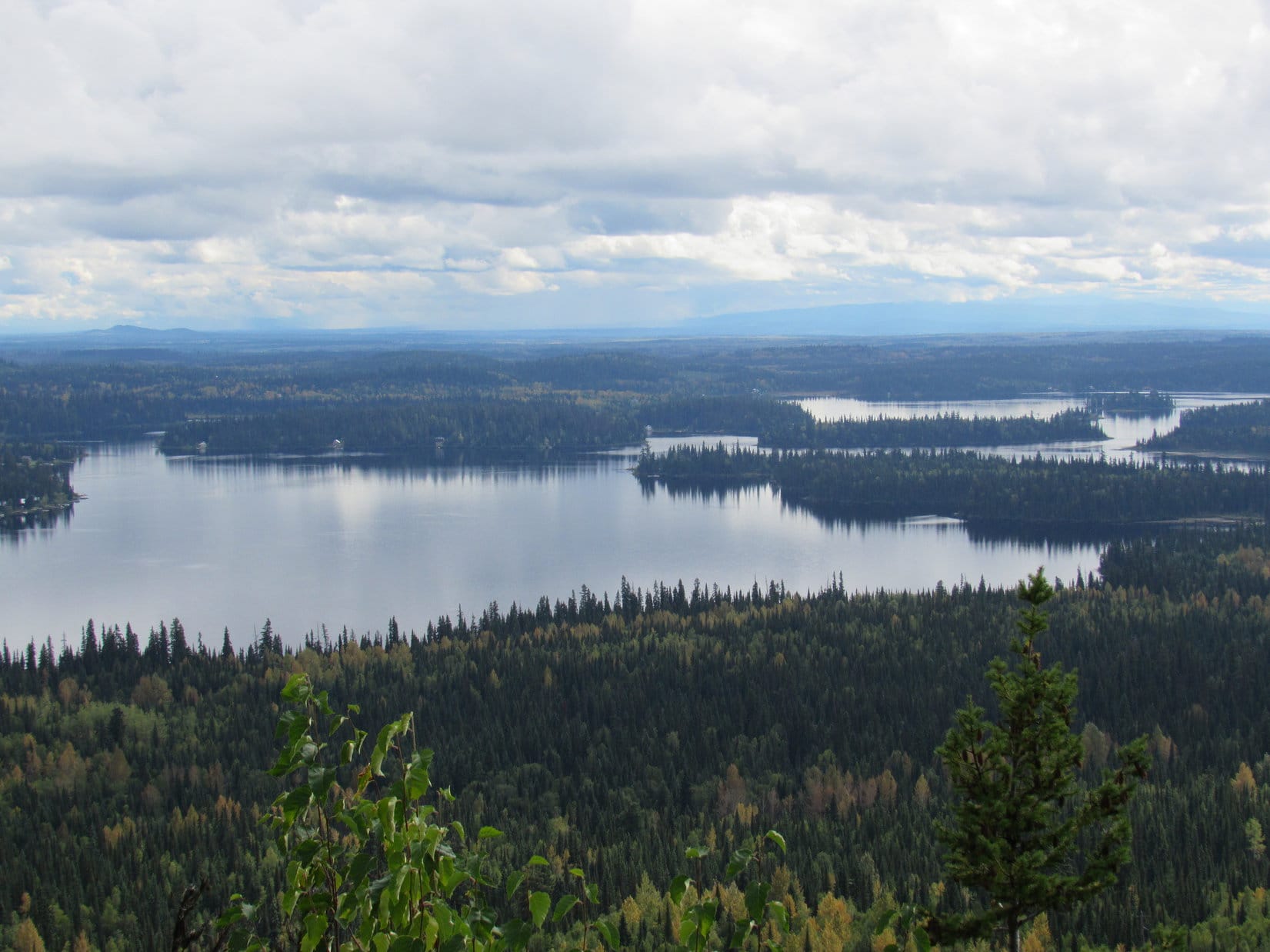
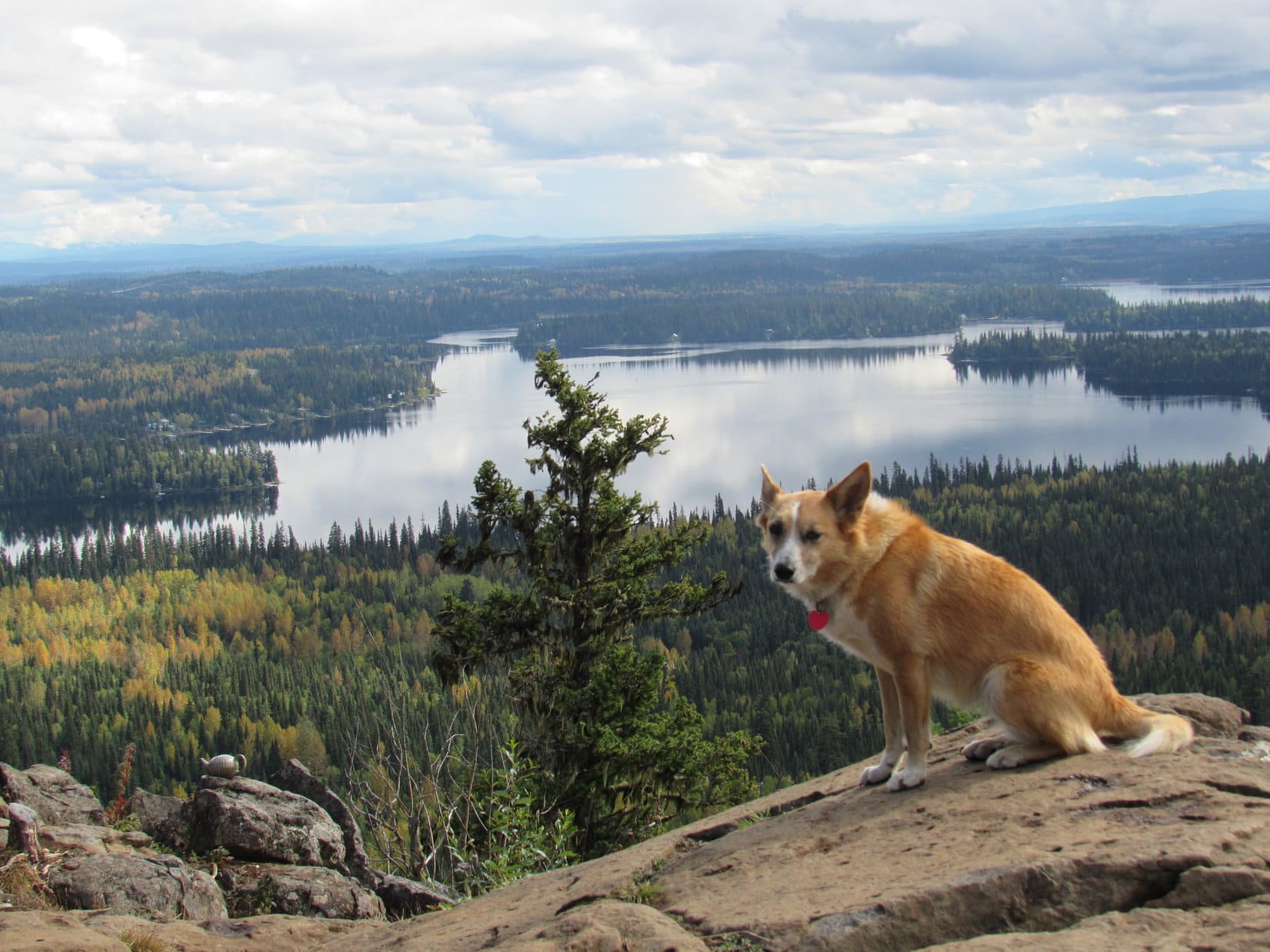
A friendly dog wanted to play with Lupe, but with cliffs so close by, the humans put a quick end to all the mad dashing and chasing around. A wooden bench was nearby to the E. Lupe got up on it for a look at the big view. Summit Lake, which is quite large and has an interesting irregular shape, was the main attraction. Lupe could see the N end of Summit Lake dotted with forested islands not too far away to the S.
From the SW viewpoint, Lupe could see Summit Lake dotted with forested islands. Photo looks S.Summit Lake through the telephoto lens.
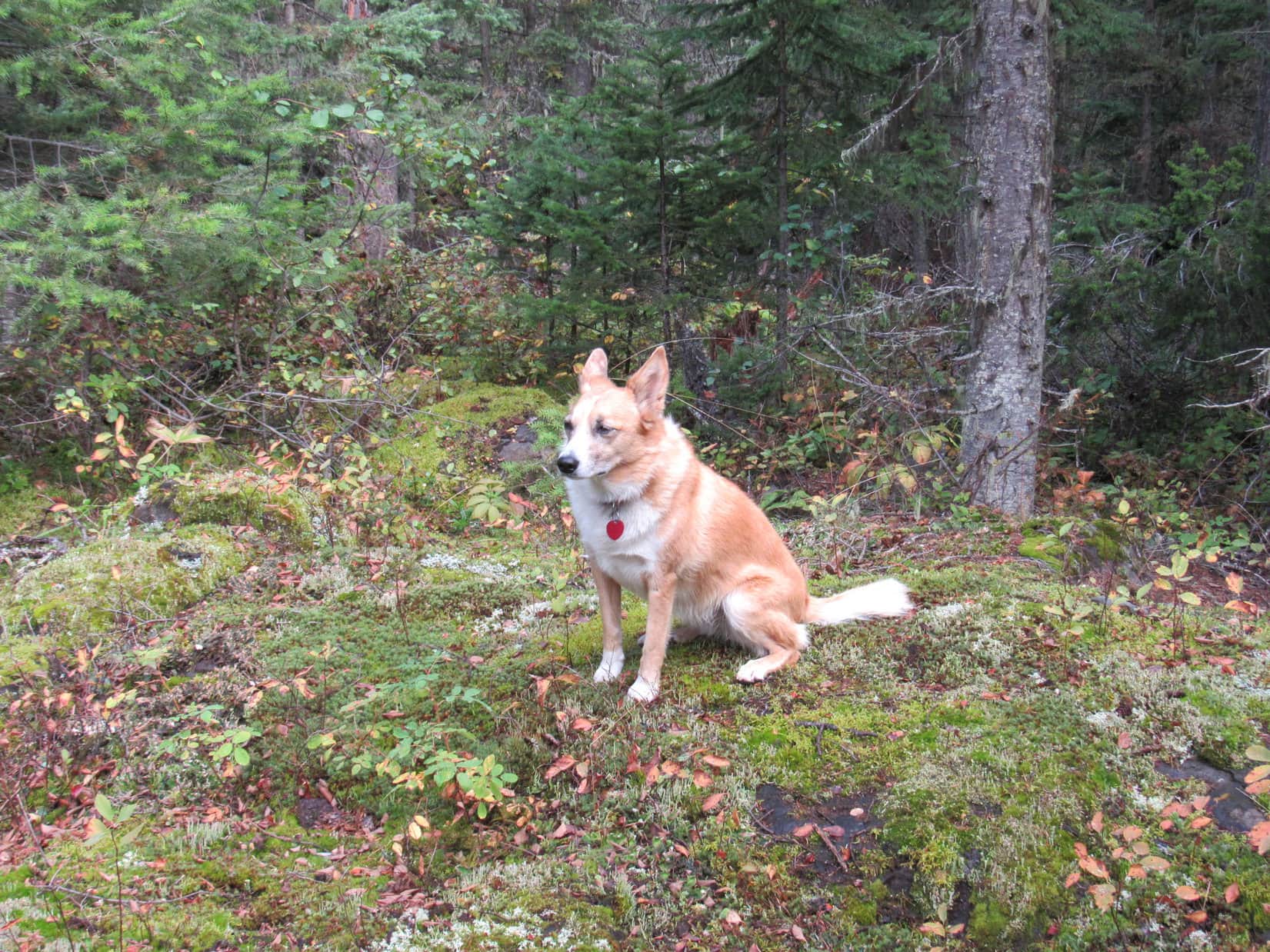
While everyone else remained congregated on the tan rock formation, Lupe and SPHP went off in search of the true summit of Teapot Mountain. The highest point Lupe found was a nice mossy spot at the end of a very faint trail into the interior. The summit wasn’t far from the SW viewpoint at all.
Lupe sits comfortably on the mossy spot at the true summit of Teapot Mountain. Photo looks N.
Lupe returned to the loop trail. People were getting ready to depart. Before long, Lupe had the premier viewpoint on Teapot Mountain all to herself.
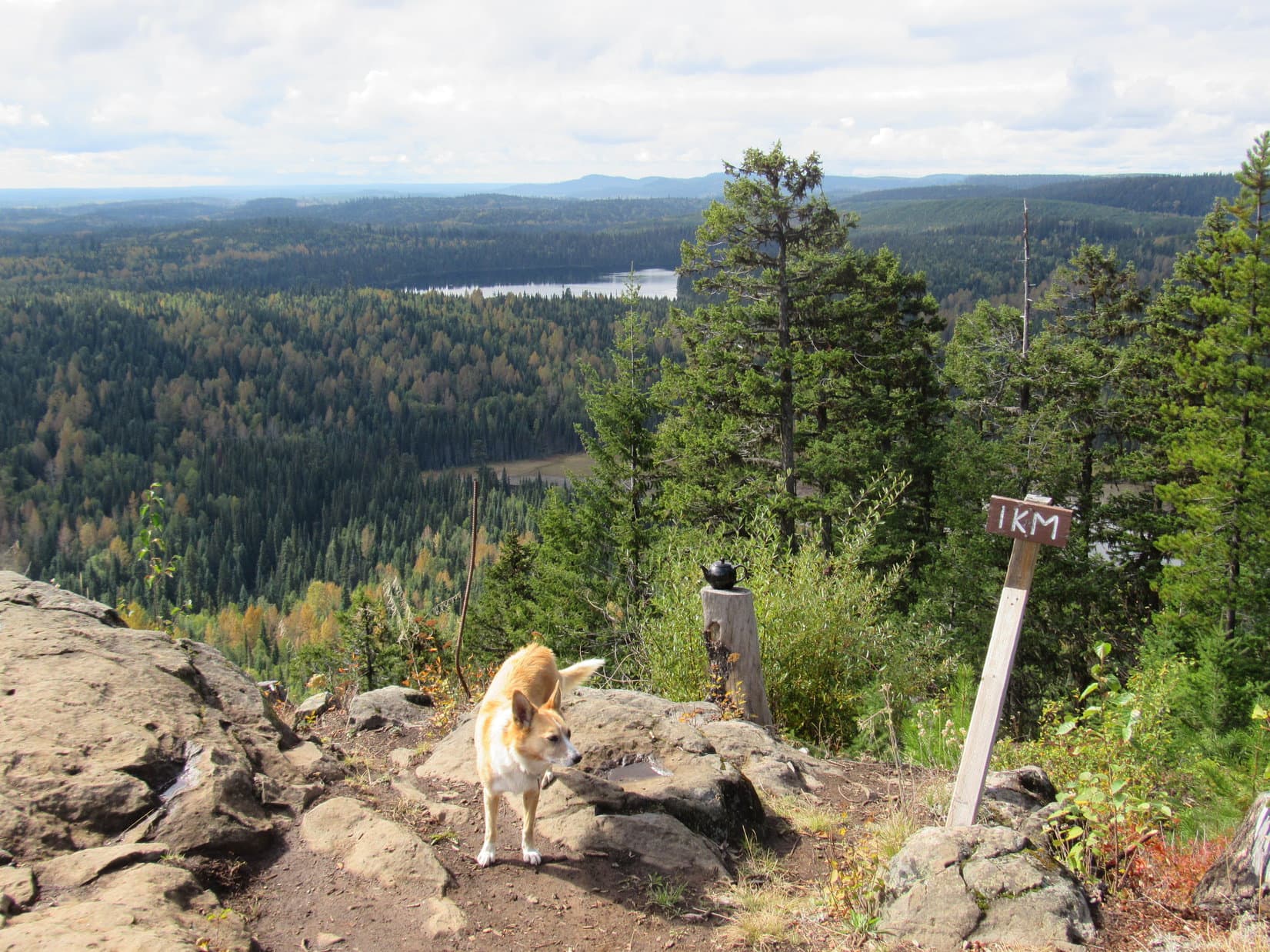
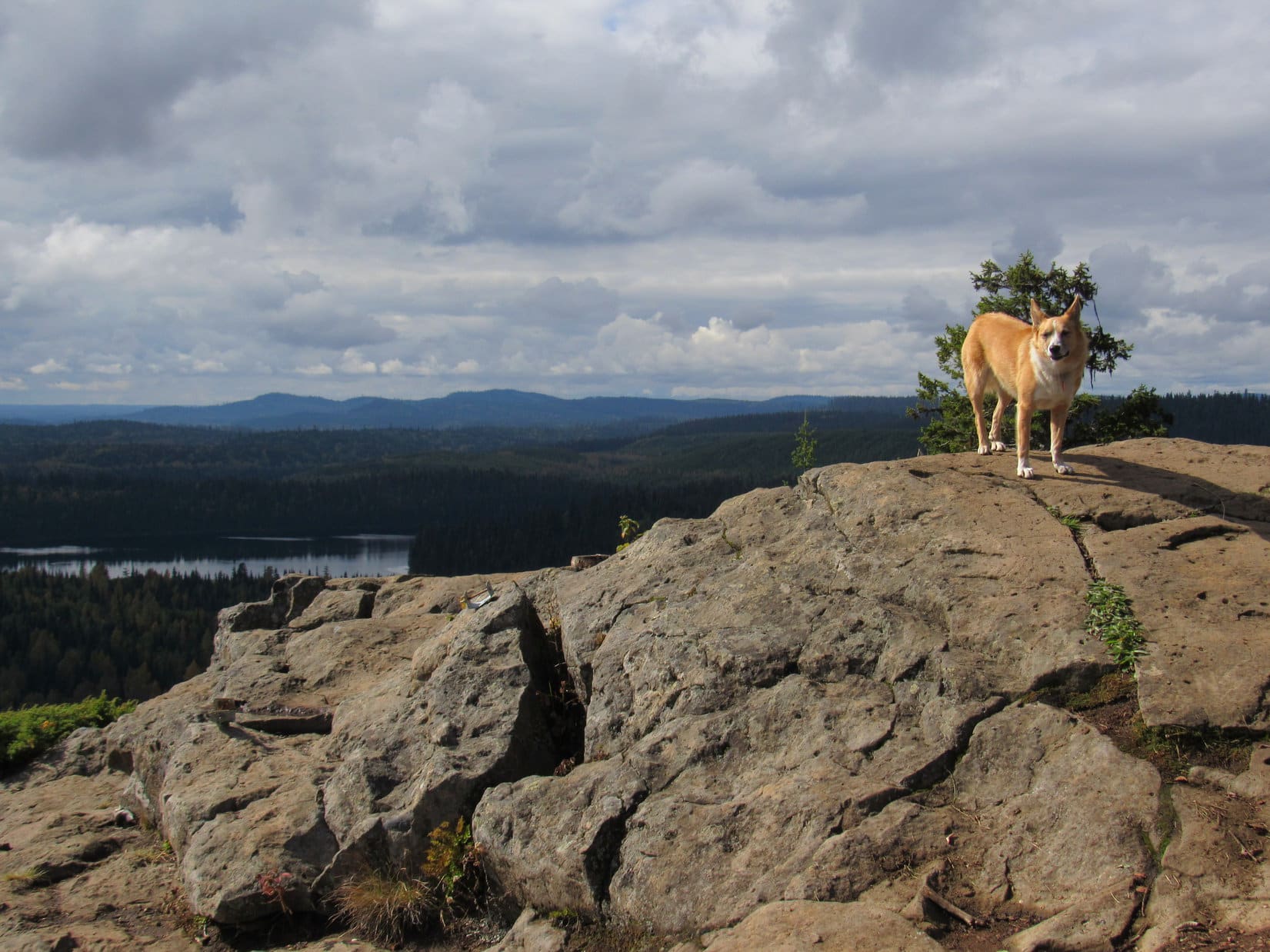
Lupe conducts her initial investigation of the premier viewpoint on Teapot Mountain. She discovers a sign indicating she is 1 km from the trailhead (by the most direct route), and aptly enough, a teapot. Part of Jakes Lake is seen in the distance. Photo looks W.So, SPHP, is it tea time? What kind of tea are we having? Did you bring any crumpets? …… Umm, heh, sorry Looper, I didn’t remember to bring any tea. Kind of short on crumpets, too, to tell the truth. Guess I wasn’t thinking.Loopster astride the big tan rock formation, with Jakes Lake on the L. Photo looks W.
For a little while, Lupe and SPHP stayed together up on the tan rock formation enjoying the view of the lakes and forests of central British Columbia. Before long voices were heard approaching from the E. More hikers. Time to go and let them enjoy this beautiful spot in peace. Loop still had many miles to go today anyway.
Lupe saw more teapots placed on rocks and in trees along the S rim of Teapot Mountain as she completed the loop back to the trail down. The clouds hadn’t so much as sprinkled any rain for a while. On her way down, Lupe encountered several more groups of people who had decided to come up. Apparently, Teapot Mountain really is quite a popular hike.
It was mid-afternoon by the time Lupe arrived back at the G6 (2:55 PM, 50°F) ready to resume the long drive S. Teapot Mountain had been a pleasant break from being cooped up. The whole trek had taken a little over 2 hours at a leisurely pace.
By evening, Lupe was far SE of Prince George near the small town of McBride. Her day ended with a pleasant twilight stroll exploring a quiet park next to the Fraser River. Up until her Summer of 2016 Dingo Vacation, Lupe had never been even this far N before in her whole life. Tomorrow she would return to more familiar territory in Jasper and Banff National Parks in the fabulous Canadian Rockies!
Note: The L (W) turn off Highway 97 onto Talus Road is about 31 miles (50 km) N of Prince George. Follow Talus Road 1 km to a R turn onto Caine Creek Forestry Road (poorly marked). Follow Caine Creek Forestry Road 3.3 km. The Teapot Mountain trailhead is at the start of the first side road to the R after crossing the bridge over Crooked River.
Start, 11:04 AM, 33°F, intersection of USFS Roads No. 189, 189.4A & 631.2C about 0.33 mile WSW of Crooks Tower
This was supposed to be an expedition to celebrate the rapid approach of a glorious new summer! Lupe would explore mysteriously named Balm of Gilead Gulch before continuing on to Cement Ridge. There, beneath cotton ball clouds sailing a crystal blue sea, the Carolina Dog would sniff colorful wildflowers swaying in warm breezes. She would gaze upon panoramic views of Inyan Kara, the Bear Lodge Mountains, and far into eastern Wyoming.
Hah! Dream on. Even before leaving home, SPHP knew the forecast didn’t include much in the way of warm breezes.
A week ago on Expedition No. 204, Lupe had visited Crooks Tower(7,137 ft.), one of the highest points in the Black Hills. She’d made a day of it coming up from Merow Spring and Clayton Pond, and subsequently continuing on to Peak6820. Now, driving W on South Rapid Creek Road (USFS Road No. 231), it occurred to SPHP that Loop was very close to Crooks Tower again. Why not go back for a good look at how much conditions had changed?
It wasn’t necessary to spend a whole day on foot and paw to get to Crooks Tower. In fact, a 2 mile detour S on USFS Road No. 189 would bring Lupe to a point only 0.33 mile WSW of the summit. Let’s do it! SPHP made the turn. Five minutes later, Lupe sprang out of the G6 into a world where the mood was better suited to Rudolph the Red-Nosed Reindeer than 4th of July fireworks.
Sooooo, let me get this straight. We’re here to celebrate the imminent approach of summer, right? Did you get a really big discount for booking early SPHP, or what? At the W end of USFS Road No. 189.4A. Photo looks SSE.
Although the forecast called for 0% chance of precipitation, the sky was heavily overcast. Any more overcast, and Lupe would have been in a fog. Humidity filled the air. It felt like it could rain buckets at any time. Or snow. At a chilly 33°F, snow seemed equally plausible. The ground was already white with the stuff.
Lupe concealed her disappointment with summer’s non-arrival well. In fact, she seemed thrilled and energized by the snow. She charged through fields and forests as SPHP began a mucky march E along USFS Road No. 189.4A.
USFS Road No. 189.4A leads ENE from the junction with No. 189 & No. 631.2C. About 0.33 mile later, it passes just S of the summit of Crooks Tower. Photo looks E.
About 0.33 mile from the G6, the road passed just S of the summit of Crooks Tower. Lupe and SPHP left the road to take the short path leading to the top from the SW. Only a week after her 8th ascent, Lupe was here for the 9th time.
Back on Crooks Tower for the 9th time! Photo looks SE.On the summit, looking WSW.Each pine needle was beautifully flocked, but that wouldn’t last long this time of year. The snow already looked like it was starting to melt.Looking NW from the summit.Loopster at the highest point. Photo looks N.
Having been here only a week ago, Lupe and SPHP dawdled only a little while on Crooks Tower. It was fun to be there again, but the plan was still to explore Balm of Gilead Gulch and reach Cement Ridge today. Lupe returned to the G6 (11:35 AM, 33°F), and SPHP drove onward.
N of Highway 85, a little W of O’Neill Pass, SPHP parked the G6 again (11:53 AM, 39°F) near corrals S of the junction of USFS Roads No. 175 (Willow Springs Road) and No. 106 (Riflepit Canyon Road). Here Lupe was only 0.67 mile W of Laird Peak(6,906 ft.), another mountain along the way. SPHP figured she might as well climb it, too, since it was an easy peak and wouldn’t take long.
An unmarked grassy road led E from the parking area up a little valley past Tom Spring. This area was hundreds of feet lower than Crooks Tower, so there wasn’t nearly as much snow around. What snow there was in the pines was melting fast. Snowmelt dripped to the ground in such abundance, Lupe was getting rained on beneath the trees.
In the valley leading E to Tom Spring on the way to Laird Peak. There wasn’t nearly as much snow here as there had been at Crooks Tower. Photo looks S.Loop had a good time exploring on the way to Laird Peak. Photo looks E.
Tom Spring was a muddy area. Water poured from a pipe into a circular water trough. Not too exciting. Lupe didn’t seem interested. She pressed on up the valley. The road faded somewhat beyond Tom Spring, but could still be followed.
Upon reaching a ridgeline where several better dirt roads intersected, Lupe took a road going N. She stayed on it for only 100 feet or so to get past a fence running E/W. She then turned E following the N side of the fence line. Laird Peak’s summit was only a couple hundred yards ahead. The summit appeared only as a small hill in the forest.
Approaching the summit of Laird Peak from the W. The summit appears to be just another small hill in the forest. Photo looks E.
Lupe quickly reached the top. The summit area was easily the size of a modest yard in town and quite flat. Deadfall timber lay scattered about the perimeter of a small clearing. A sign marking the location of the survey benchmark was in sight near the N edge of the clearing.
Lupe at the survey benchmark on Laird Peak(6,906 ft.). A little less than half of the flat summit area is in view. Photo looks N.This was Lupe’s 3rd ascent of Laird Peak. Other than having to deal with a little deadfall timber, it’s a quick easy climb from the W via Tom Spring. Photo looks N.The Laird Peak survey benchmark.
Pine bark beetles had damaged the surrounding forest enough to provide tree-broken glimpses of distant views in various directions, but only enough to tantalize. Lupe couldn’t really see much from here other than the immediate area. With no clear views to contemplate, the American Dingo was soon ready to go.
Lupe ready to head back down the W slope. Photo looks WNW.
The sky was still overcast, but not as darkly as before. Now and then a small patch of blue sky appeared. SPHP kept expecting the clouds to burn off, but they didn’t. Instead the clouds kept closing up the gaps, and the sunshine would disappear. Nothing had really changed by the time Lupe reached the G6 again (12:45 PM).
A winding drive NW down Grand Canyon ensued. USFS Road No. 175 turned to No. 875 at the Wyoming border. By the time SPHP parked the G6 at the intersection of No. 875 & No. 804, it was already 1:23 PM (47°F). If Lupe was going to explore Balm of Gilead Gulch and still have time to reach Cement Ridge, she had best get on with it. The Carolina Dog and SPHP took off heading E up Rattlesnake Canyon on No. 804.
Dandelions prospered along No. 804 on the way up Rattlesnake Canyon. Nuisances in yards, dandelions are amazingly resilient plants.
The stroll up Rattlesnake Canyon was easy. A couple of miles E of the G6, SPHP started looking for a R (S) turn on USFS Road No. 804.1A which would take Lupe up into Balm of Gilead Gulch. A road going S up a hill did appear. There weren’t any signs at the turn, but a forest service gate was in view a little way up the hill.
Was this No. 804.1A? It didn’t seem quite right. The topo map showed a 4WD trail heading S up a smaller valley about 0.5 mile before (W of) the turn to Balm of Gilead Gulch, and this was the first side road Lupe had come to. SPHP almost led Lupe past this road, but decided she might as well check out the forest service gate for any clues first.
Good thing! Nearing the gate, Lupe found a marker showing this was USFS Road No. 804.1A.
Nearing the forest service gate, Lupe found a marker showing this was USFS Road No. 804.1A after all. She was bound for Balm of Gilead Gulch! Photo looks S.
So this was it! Lupe was bound for Balm of Gilead Gulch! Except for one thing that raised doubts again. As the Carolina Dog trotted past the gate, SPHP noticed large white letters on the round metal swivel housing on the L. The letters read OLDB 05. What did that mean? SPHP was suspicious.
It might mean that this road had been renumbered. USFS Road No. 805 went up Wagon Canyon 1.5 miles to the S. Was this possibly a connecting spur, formerly known as No. 805.B? Seemed like a possibility, but who knew? May as well try it. After all, the official sign did say this was No. 804.1A, which was supposed to be the road into Balm of Gilead Gulch.
Lupe continued up No. 804.1A. The road turned SE and led up a small forested valley. The day had warmed up some, and Lupe was still considerably lower here than she had been at either Crooks Tower or Laird Peak, so she didn’t find any snow in this area. There had been some, though. The road was damp, nearly muddy.
Although no tire tracks were to be seen, an amazing number of animal tracks crisscrossed the soft road. It wasn’t long before Lupe started seeing wildlife – whitetail deer and Lupe’s giant deers – the elk.
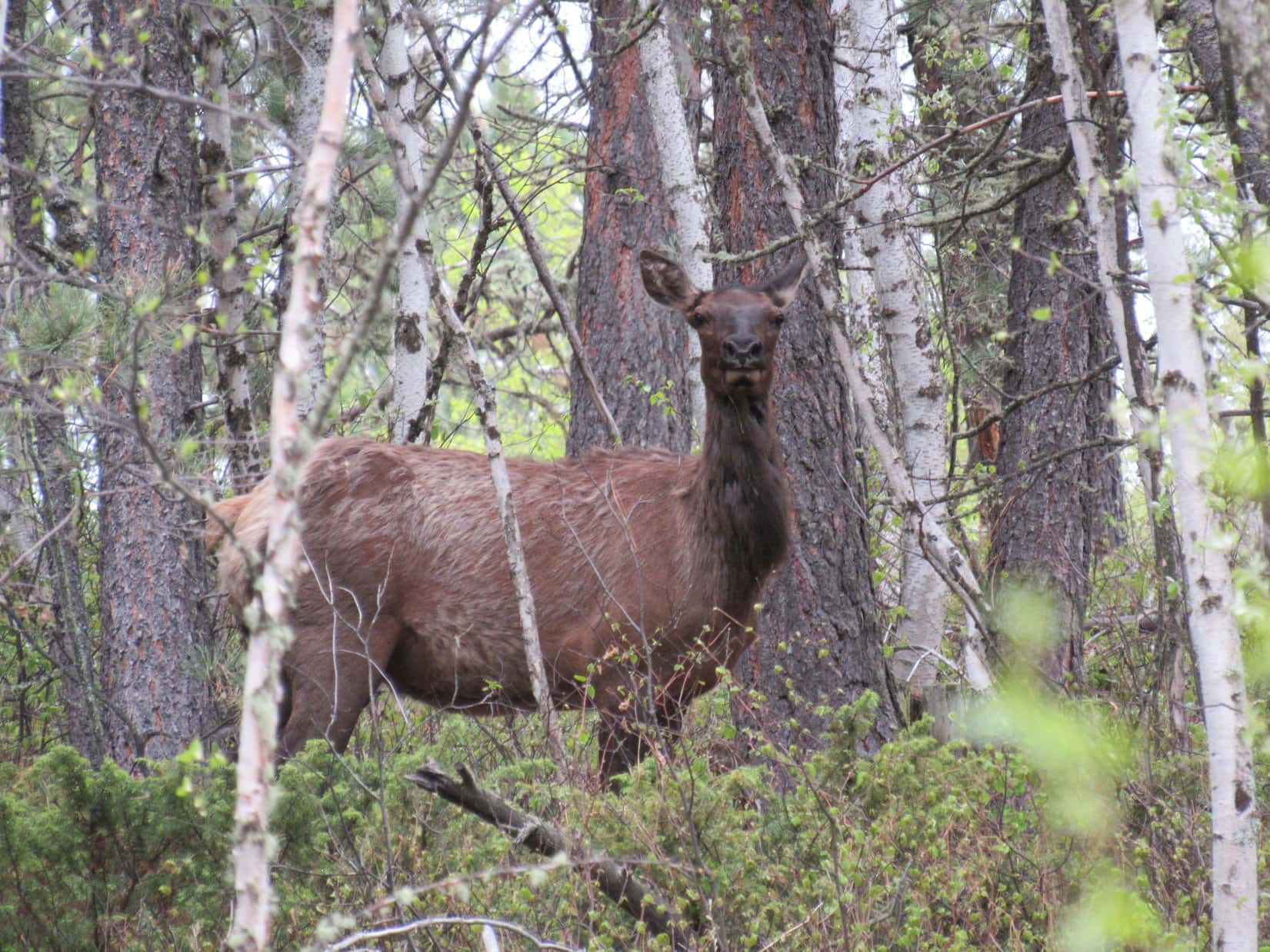
Lupe saw many whitetail deer and a number of her giant deers (elk), too, as she traveled up USFS Road No. 804.1A.
It was fun being where there were so many animals in the forest, and sort of easy to see why they were here. No tire tracks on the road at all meant people seldom come here. The forest was full of hidden grassy glens. This was a good place to hide and hang out.
Lupe at a grassy glen along USFS Road No. 804.1A. There seemed to be plenty more such glens hidden back in the forest, making this area popular with deer and elk.
Lupe gained elevation steadily for perhaps a mile before the road leveled out. Here, the main road turned SW and started going downhill. A fainter road curved ESE. Lupe needed to go E, so she took the fainter road. When she wanted to stop for a water break 5 or 10 minutes later, SPHP took a look at the maps.
Hmmm. SPHP was soon convinced that Lupe hadn’t been traveling through Balm of Gilead Gulch at all. Where the main road had turned SW, it almost had to be headed for Kirley Gulch on its way down to Wagon Canyon. Apparently the road numbers really had been changed. The old No. 804.1A leading into Balm of Gilead Gulch that Lupe had been looking for was no more. The new No. 804.1A actually was a road connecting No. 804 in Rattlesnake Canyon and No. 805 in Wagon Canyon.
The inescapable conclusion was that Balm of Gilead Gulch was 0.5 mile N or NE of where Lupe was now. She could have gone through the forest looking for it, but that would have meant losing elevation she’d already gained. Furthermore, she would only get to travel through part of the gulch. Instead of doing that, SPHP decided Lupe might just as well continue on to Cement Ridge. She could hit Balm of Gilead Gulch on the way back.
Break done, Lupe roamed happily in the forest along a series of remote USFS roads. She traveled E or SE, and once in a while NE. She was generally still gaining elevation, but at a slow rate. Sometimes there were markers at the road junctions, but even when there were, usually only one road was marked. It wasn’t always clear which road the marker was meant for.
This was pretty high country, but due to the forest, Lupe seldom had any distant views. Some ridges did eventually appear off to the S and SW. Loop was already nearly as high as they were.
Roaming the back roads on the way to Cement Ridge. Photo looks E.The light green of the newly emerging aspen leaves contrasted nicely with the dark green of the Ponderosa Pines. Lupe loves wandering back roads like this one. Photo looks ESE.This was a 3 way intersection (roads also went to the L & R) where Lupe found a marker for USFS Road No. 805.3J, but which road it was meant for was impossible to tell. She had reached this point coming up the road seen on the R. Photo looks W.
On her explorations, Lupe either traveled along or passed by USFS Roads No. 805.3J, 805.3G, and 805.3A. About two miles E of where she’d left No. 804.1A, she came down a side road marked No. 105.1B to arrive at the first major gravel road she’d seen since leaving No. 804 down in Rattlesnake Canyon.
A check of the maps revealed that Loop was now only 0.25 mile S of No. 105’s junction with No. 804. Cement Ridge(6,674 ft.) was only 1.5 miles NNW beyond the intersection. Before setting out again, Lupe was ready for more water and Taste of the Wild. SPHP ate the only apple, which was supposed to have been saved for Cement Ridge, but, oh well.
All tanked up again, Lupe set off along No. 105 for Cement Ridge. Upon reaching the junction with No. 804, she followed No. 804 NNW a good 0.5 mile to its high point, then plunged into the forest. The American Dingo loves being off road most of all, so she had a grand time. Gradually things got steeper, but it was never more than a straightforward trudge up a hill.
When Lupe reached the ridgeline along the N face, she turned W and followed the ridge a short distance to a pathetic little limestone cairn at the high point. This was it, the true summit of Cement Ridge!
Lupe next to the pathetic little limestone cairn at the true summit of Cement Ridge. Photo looks WNW.Crow Peak is seen faintly on the horizon beyond Lupe. The sky was still cloudy and rather hazy. Loop found a small amount of snow remaining here on Cement Ridge, but only close to the true summit. Photo looks NE.
Virtually no one from the Black Hills region would recognize this place where Lupe was now as the summit of Cement Ridge. This might be the true summit according to the topo maps, but only a handful of peakbagging Dingoes would even be aware of its existence. Cement Ridge is well known locally as one of the Black Hills’ premier viewpoints, but what everyone around here is referring to are the views from the Cement Ridge fire lookout tower.
The fire lookout tower is located on a barren highpoint near the NW end of Cement Ridge over a mile from the true summit. According to the topo map, the lookout tower is 27 feet lower than the true summit. Nevertheless, the views from the tower are far superior to those available from the heavily forested true summit.
Lupe could see the lookout tower from the true summit. Perhaps it was only an illusion, but it actually looked higher to SPHP.
The Cement Ridge fire lookout tower (L) was visible from the cairn where the true summit is supposed to be. SPHP thought the lookout tower actually appeared higher, but perhaps its an illusion. Lupe offered no opinion. Photo looks NW.
Lupe had no comment on which point she thought might be highest, the lookout tower or this pathetic little cairn. She was content to let surveyors battle that one out. However, when SPHP asked if she wanted to go see the fabulous views at the tower, she was all for that!
A 10 minute trek N down through an aspen forest brought Lupe to a saddle where USFS Road No. 850 coming up from the W turns N. Loop followed the road all the way to the lookout tower. Not a soul was around.
Lupe reaches the Cement Ridge Lookout Tower. Photo looks E.This survey benchmark is located at the base of the flag pole NW of the lookout tower.The Cement Ridge fire lookout tower in eastern Wyoming is only 1 mile W of the South Dakota border. The true summit is even closer to South Dakota, only 0.5 mile away.
Instead of cotton ball clouds sailing a crystal blue sky, Lupe saw scattered tiny patches of blue lost in a gray-white ocean. She felt no warm breezes. There were wildflowers to sniff, but they tossed about tormented by a chilly N breeze. The views were wonderful, but felt remote and forlorn, not bright and inspiring.
Looking SE along the length of Cement Ridge. The access road is seen below. The true summit (R) is the high point in the distance appearing almost straight up from Lupe’s head.Inyan Kara(6,360 ft.) (R) from Cement Ridge. Photo looks SW with help from the telephoto lens.George Armstrong Custer reached the summit of Inyan Kara on July 23, 1874, less than 2 years before his death in the Battle of the Little Bighorn (Custer’s Last Stand) on June 25-26, 1876 in Montana. Lupe reached the summit on November 9, 2014, more than 140 years after Custer.Crow Peak(5,787 ft.) (R) is the most prominent peak W of Spearfish, SD. Photo looks NNE.Looking NW toward the Bear Lodge Mountains. Warren Peaks(6,650 ft.) is the high point where another fire tower exists.
With sweeping views in nearly all directions, Lupe saw a great many Black Hills peaks she had been to before. The wind was coldest and strongest, though, up near the fire tower. Lupe and SPHP retreated a bit down the W slope to an old picnic table. Conditions were only slightly better here, and only the views to the W could still be seen, but they were grand.
Looper and SPHP stayed at the lower picnic table soaking it all in.
Loopster up on the old picnic table. Inyan Kara is on the horizon to her R. Photo looks SW.Warren Peaks again. Lupe made a number of expeditions to peaks in the Bear Lodge Mountains in the fall of 2016. Photo looks NW.Looking E back toward the lookout tower from the lower picnic table. Two newer picnic tables were located up close to the tower.
Cement Ridge would be a great place to see the sunset, but Lupe was here too early for that. The sun wouldn’t set for another couple of hours. Even if she waited, the sky was so overcast, it wasn’t likely she would see much. Besides, if she was ever going to see Balm of Gilead Gulch, she needed to get going.
Puppy ho! After a little rest curled up beneath the old picnic table, Lupe set out for Balm of Gilead Gulch again. The first part of the journey took her SE back along the length of Cement Ridge. This time, instead of following the access road, she stayed up on the highest parts of the ridge where she could see the terrific views to the E.
A glance back at the Cement Ridge fire lookout tower. Photo looks NW.Tiny wildflowers grew in profusion. These pretty little purple/pink flowers were SPHP’s favorites.A final look back. Photo looks WNW.
On her way, since she had to pass so close to it again, Lupe returned to Cement Ridge’s true summit.
Approaching the true summit again, this time from the N. Photo looks S.Looper returns to the true summit. She was now in a hurry to get to Balm of Gilead Gulch, so this time she didn’t dilly dally here more than a few minutes. Photo looks WNW.
Since Looper was now in a hurry to get to Balm of Gilead Gulch before the sun set, she stayed only a couple of minutes at the summit before pressing on to the S. She came across a dirt road going SSE, which was faster for SPHP than traveling through the forest.
Going down this road, suddenly sunshine was filtering through the trees. The sky, which had been 90%+ overcast all day long, was almost completely clear! SPHP was astonished at how fast this transformation had taken place. Only a few clouds remained. The rest hadn’t floated on by, they had simply dissipated into thin air.
The sun was noticeably lower now, but would still be up for a while. The evening light brought out even more wildlife. Lupe saw more whitetails and giant deers.
Elk S of Cement Ridge. Photo looks SSE.
The road eventually reached USFS Road No. 105, this time a little E of its junction with No. 804. A marker showed Lupe had been coming down USFS Road No. 105.1A.
Lupe at the marker for USFS Road No. 105.1a where it reaches No. 105. Lupe had just followed No. 105.1A SSE nearly all the way down from Cement Ridge’s true summit. Photo looks NNW.
A short trek to the W on No. 105 brought Lupe to the junction with No. 804 again. This time she turned S on No. 105, following it back to the turn W onto No. 105.1B.
Earlier in the day, before ever reaching No. 105 on her way to Cement Ridge, Lupe had reached a broad gentle saddle where there was a 4-way intersection. This was probably where she’d gotten on No. 105.1B as she continued E at the time. However, SPHP had seen that the road going NW from there sloped gradually into a wide valley. That wide valley was likely the upper end of Balm of Gilead Gulch.
With the sun getting ever lower, Lupe and SPHP hurried back along No. 105.1B, hoping to reach the broad saddle before the sun was down. Even hurrying along, it was hard not to appreciate the beauty of the sunlight filtered by the trees. What a wonderful evening trek! Lupe was enthusiastic. She raced through the forest exploring everything.
Sunlight filters through the forest nearing Balm of Gilead Gulch.
Lupe did make it to the broad saddle before the sun was down. She turned NW on the road leading through the wide valley. She followed the road a little way, but left it to follow a single track trail W down into Balm of Gilead Gulch.
Lupe reaches the beautiful broad valley at the upper end of Balm of Gilead Gulch. The sun wouldn’t be up much longer. Photo looks WNW.On the single track trail after leaving the road.
Lupe traveled the entire length of Balm of Gilead Gulch, as sunlight left the valley floor to linger on the forested hillsides. The pale golden light of day retreated to the uppermost treetops, and was lost. Lupe saw deer. She saw elk. A hawk screeched and flew away. Lower down where the valley narrowed, the Carolina Dog came to a tiny stream.
It was all beautiful, but though she sniffed and looked everywhere she could, the Carolina Dog never found it. If a different road to a different place hadn’t been relabeled as USFS Road No. 804.1A, she would have been here much earlier and had more time. Maybe, maybe then, she would have found it. As it was, twilight faded, darkness descended, stars glittered in the night sky.
But Lupe never did find the fabled Balm of Gilead. (End 9:32 PM, 32°F)
“Prophet! said I, “thing of evil! – prophet still, if bird or devil! –
Whether Tempter sent, or whether tempest tossed thee here ashore,
Desolate yet all undaunted, on this desert land enchanted –
On this home by Horror haunted – tell me truly, I implore –
Is there – is there balm in Gilead? – tell me, tell me, I implore!”
Quoth the Raven “Nevermore.”
from The Raven, Edgar Allen Poe
In Balm of Gilead Gulch
Note: The Cement Ridge fire lookout tower is accessible by road from the W or SE by following USFS Road No. 804 to No. 850. The true summit is the hill immediately S of where No. 850 reaches a saddle on the ridgeline, and turns N to continue on to the lookout. Another route exists from the E on USFS Road No. 103 to this same point, but requires a high clearance vehicle.