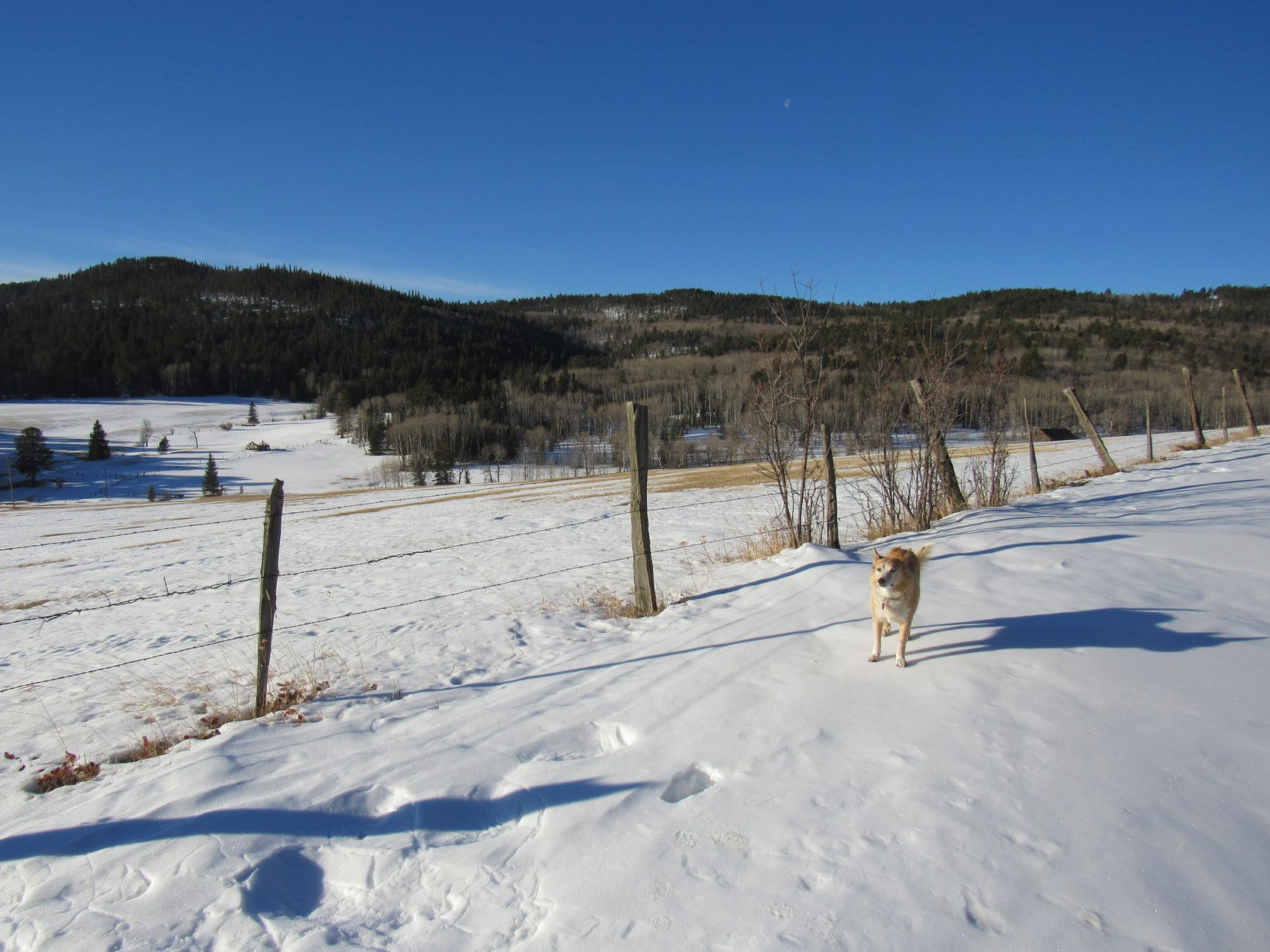
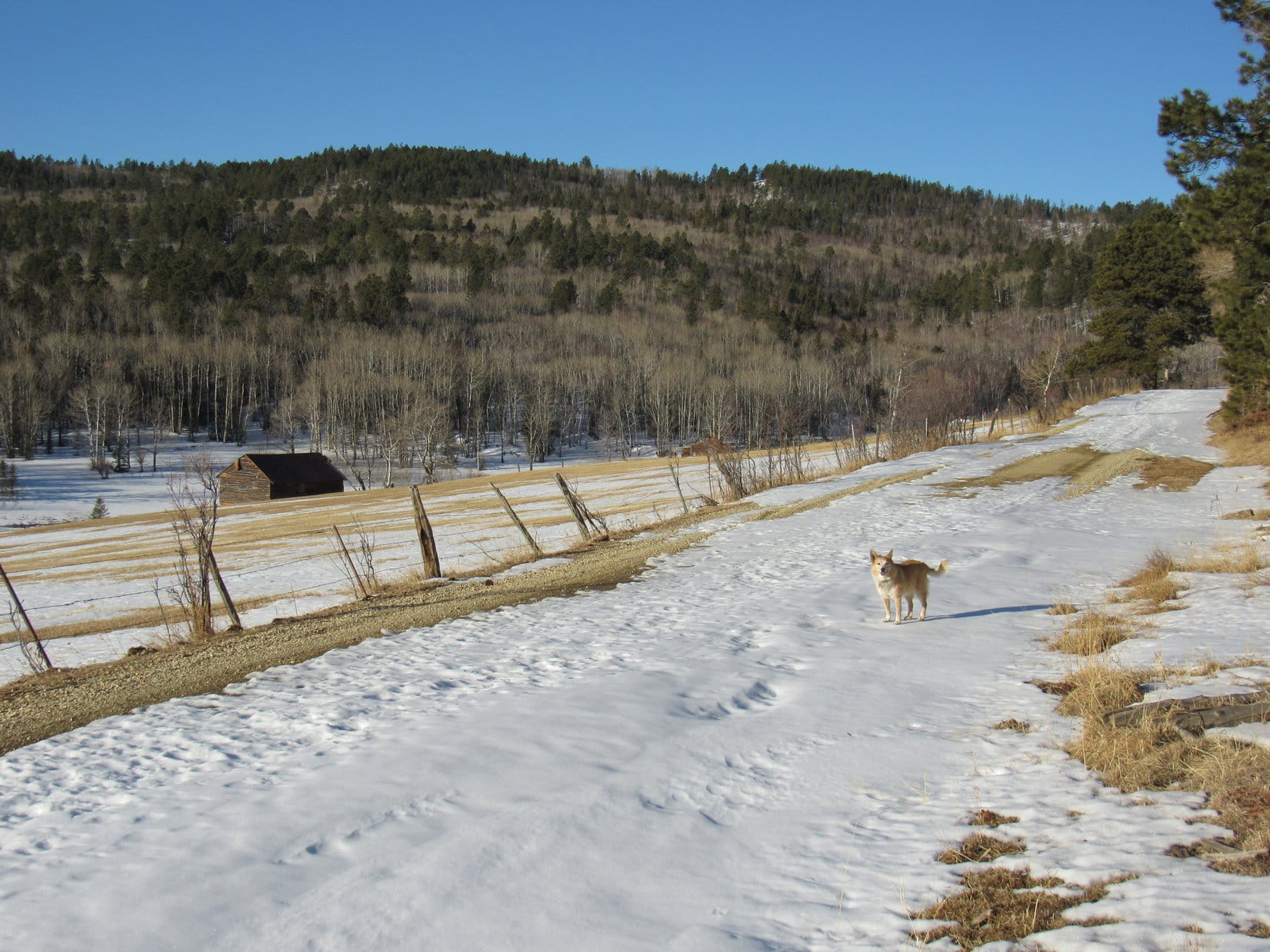
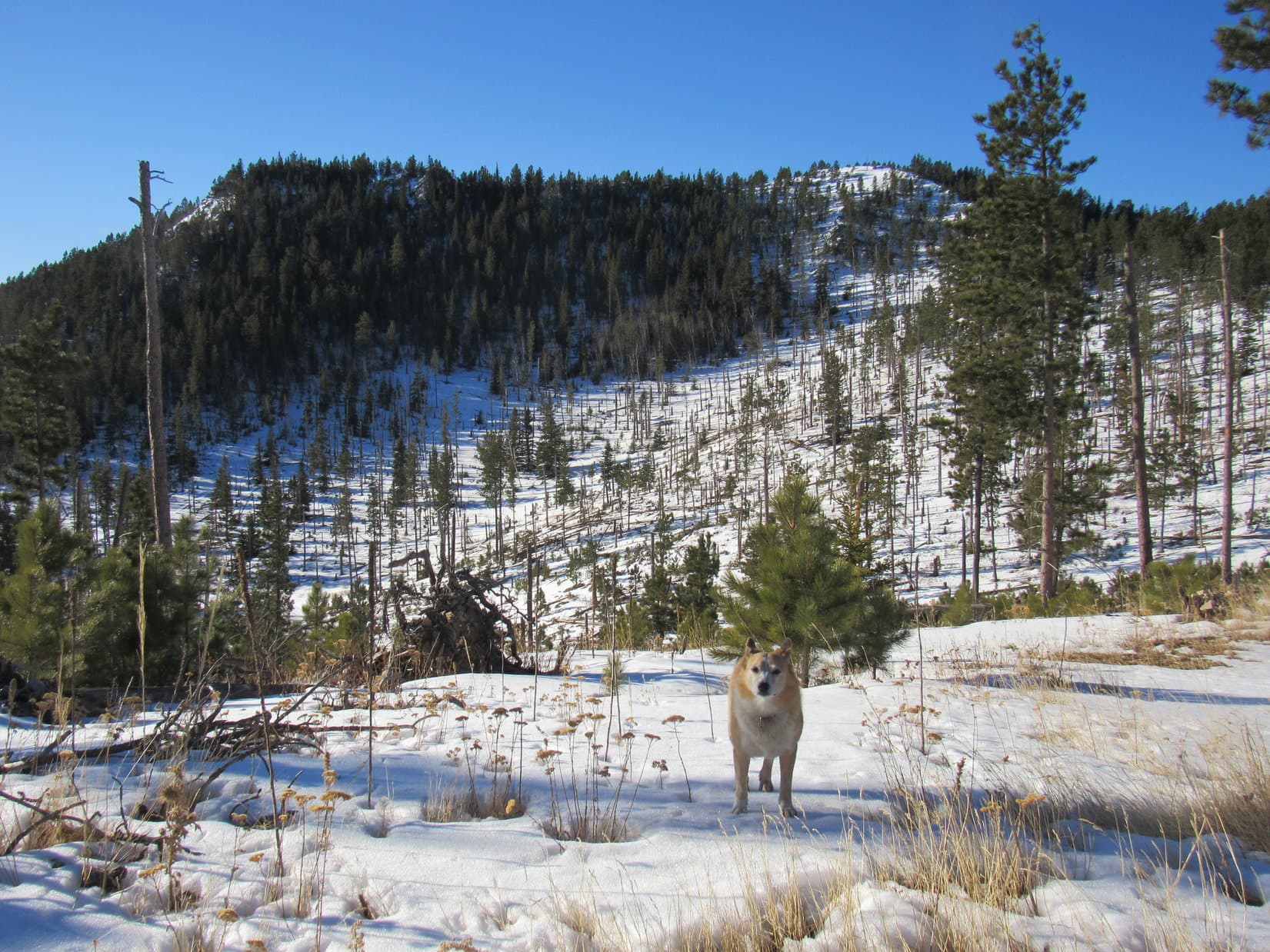
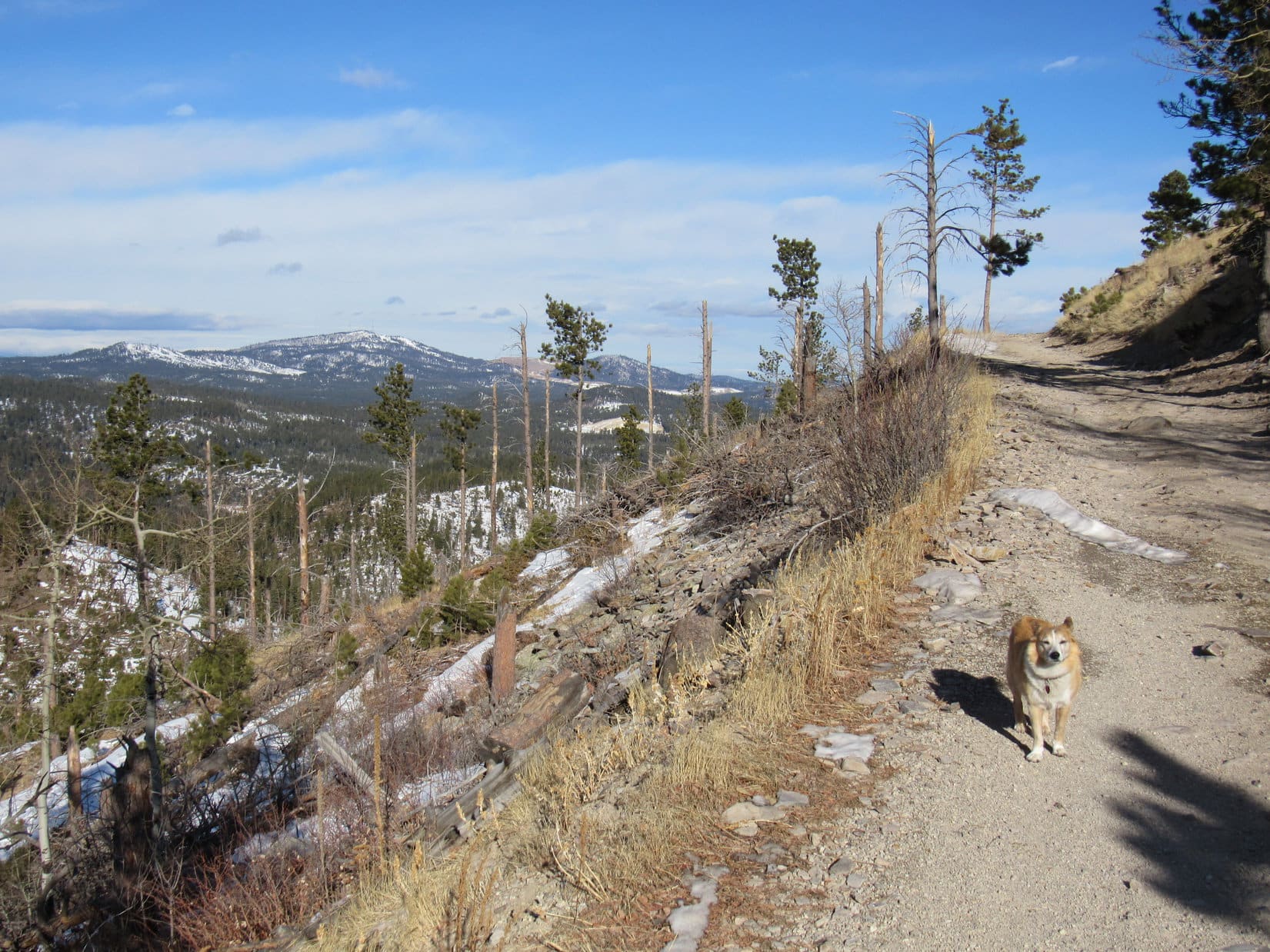
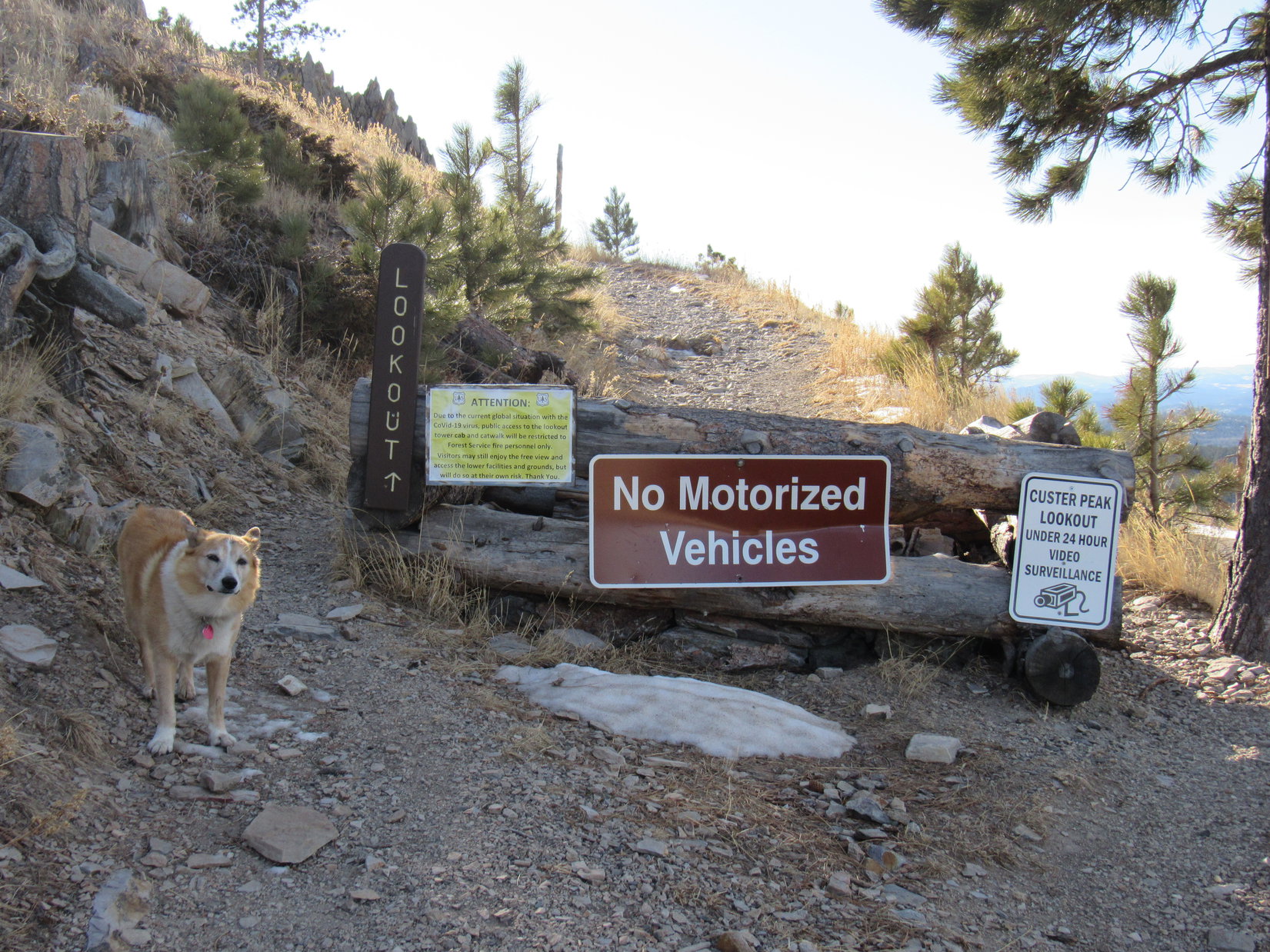
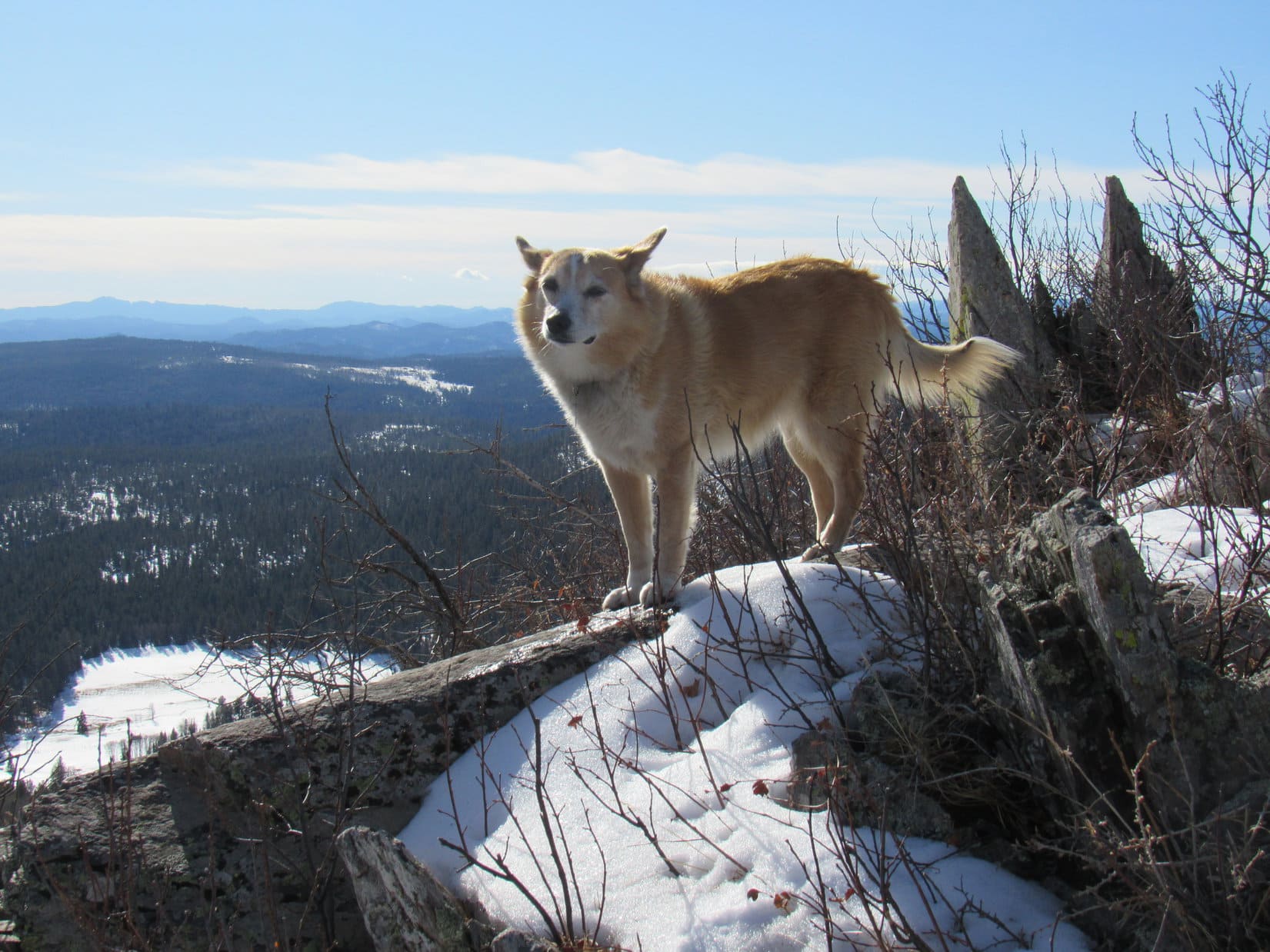
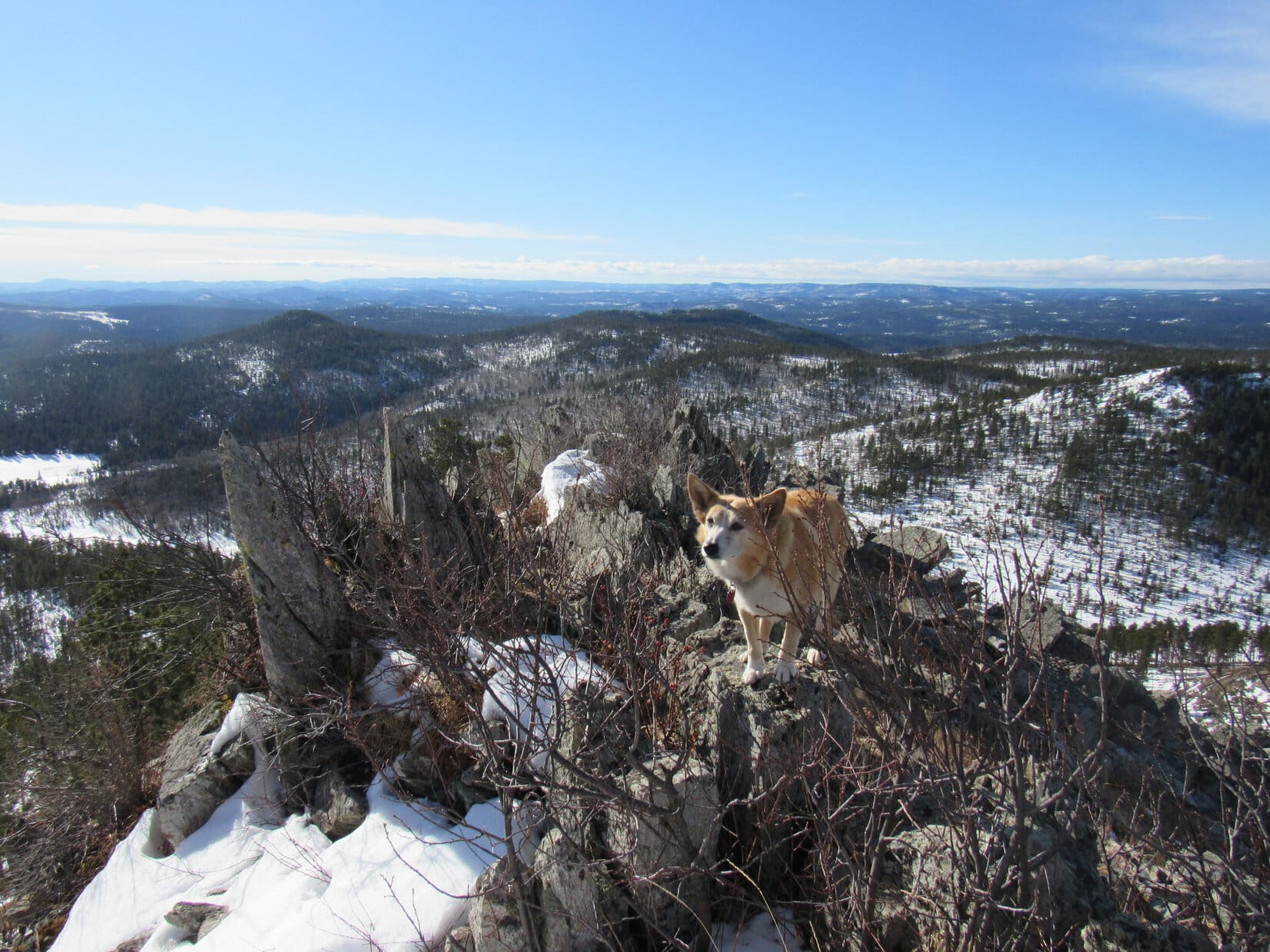
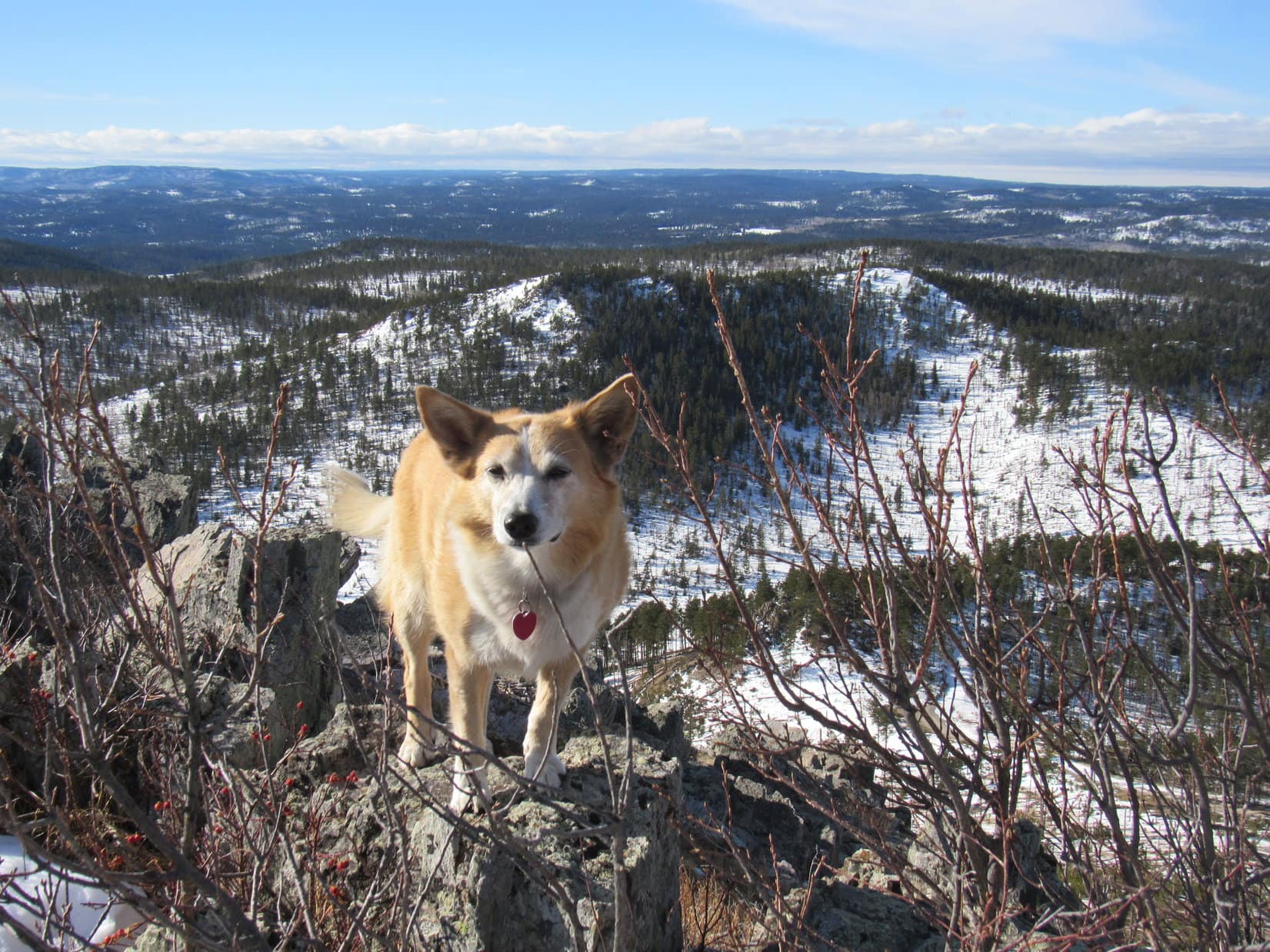
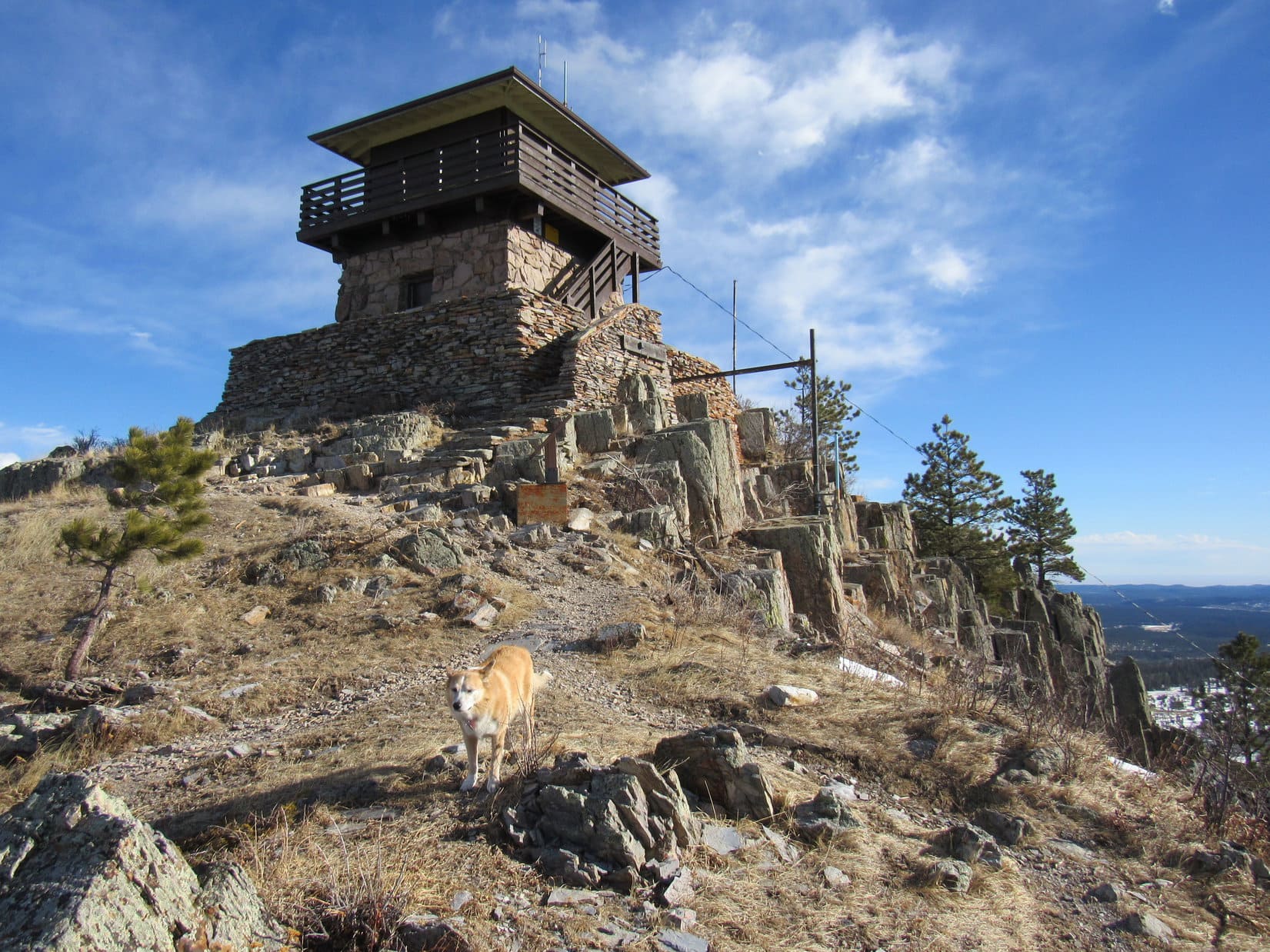
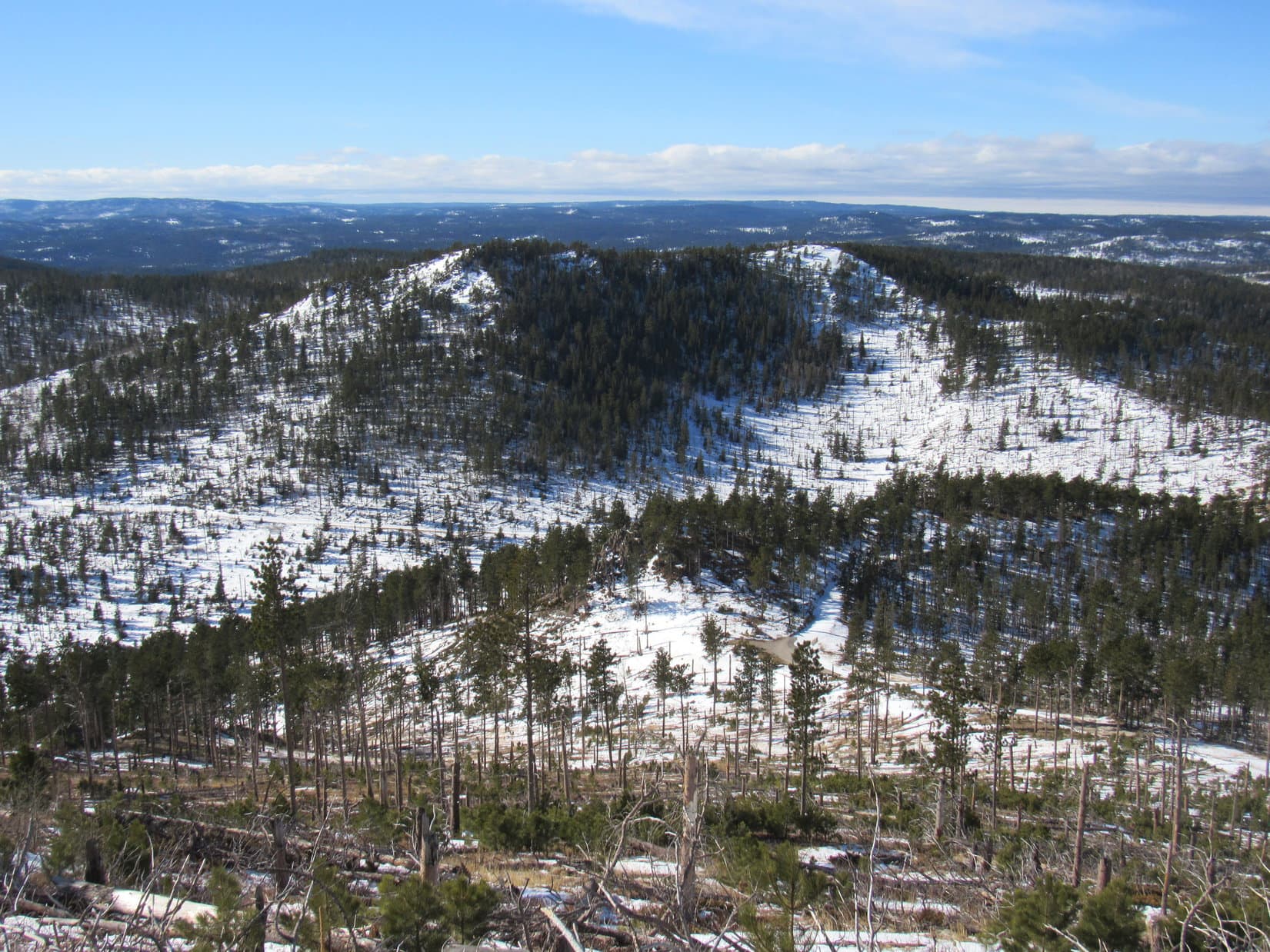
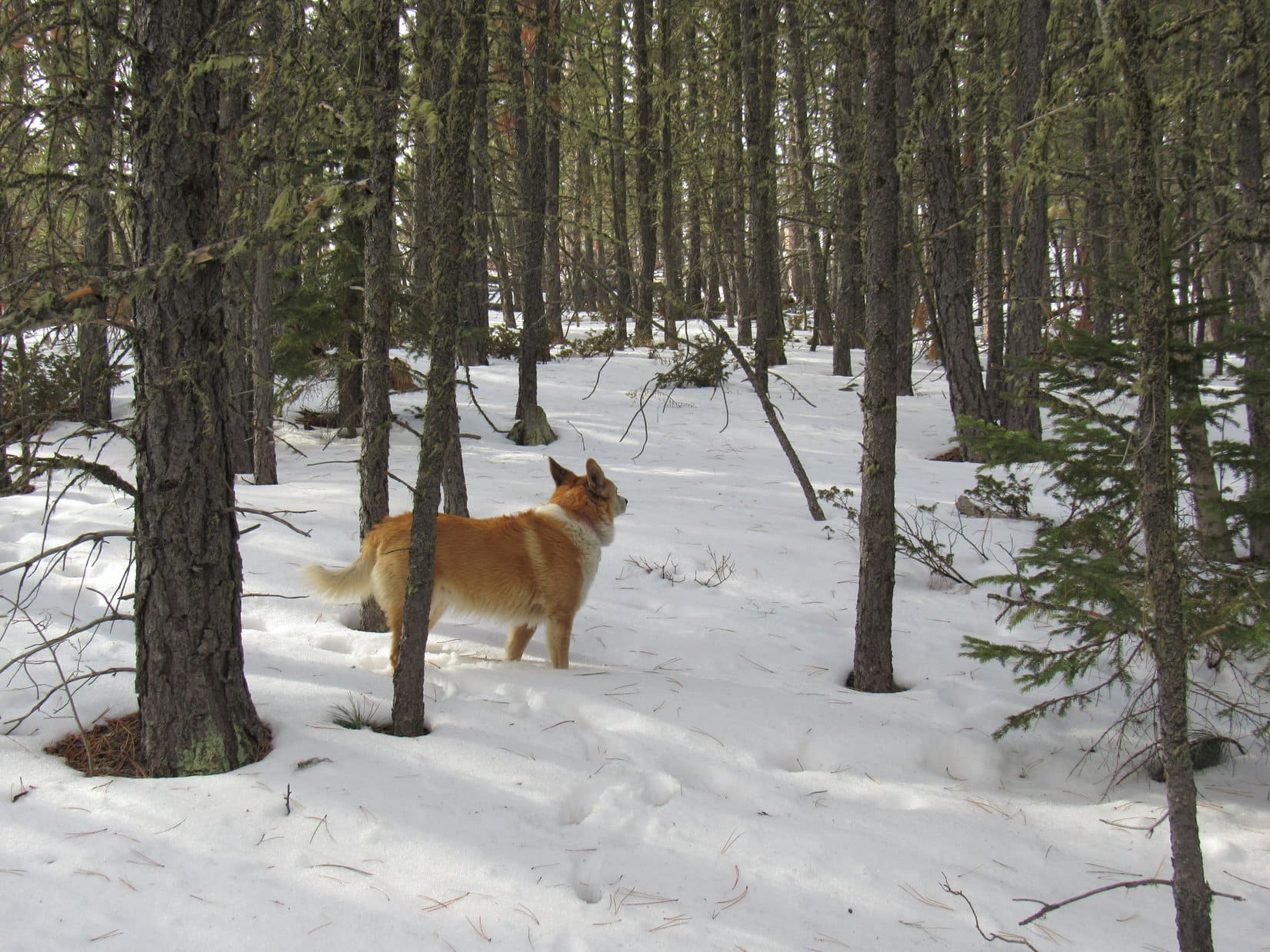
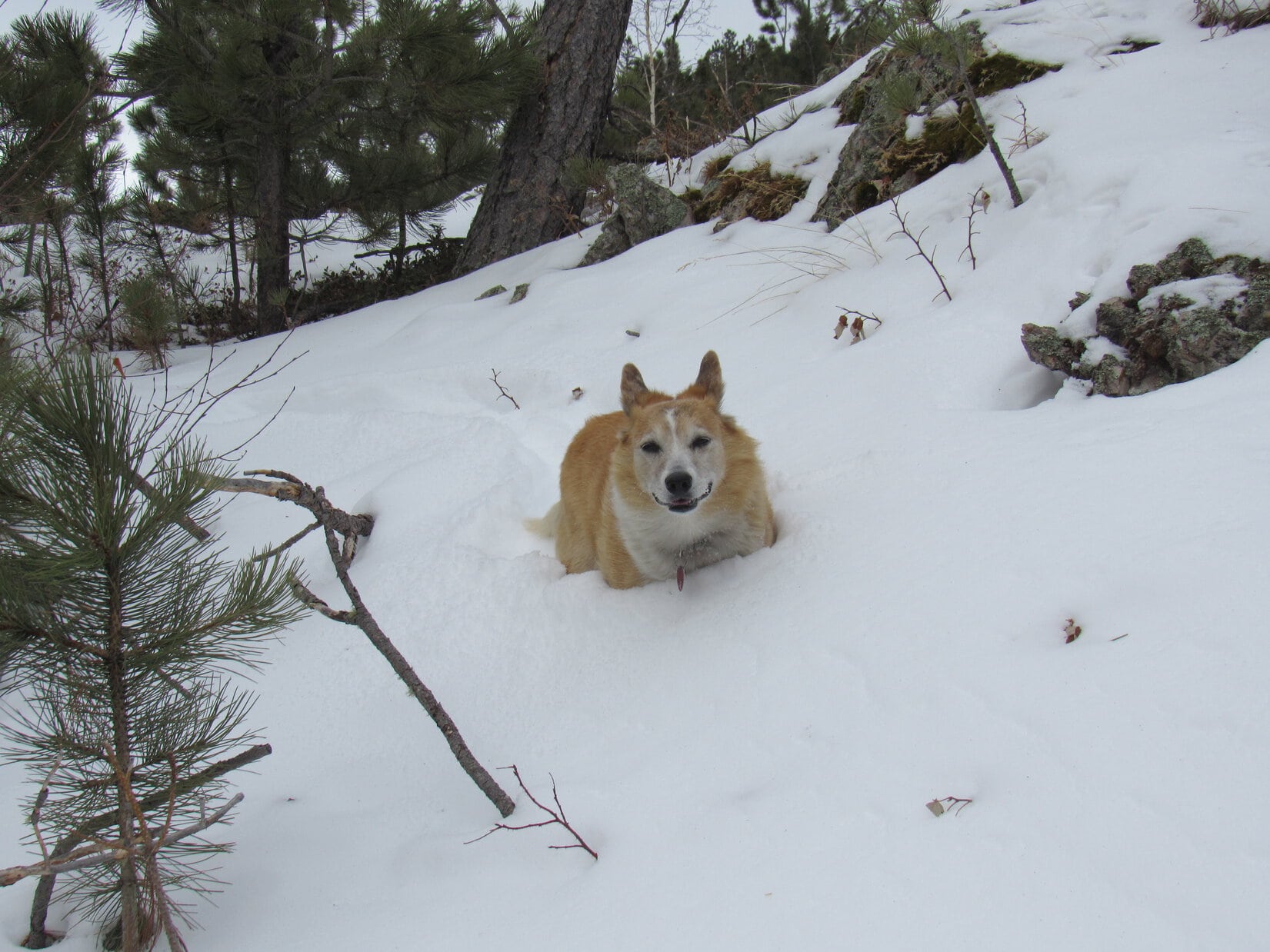
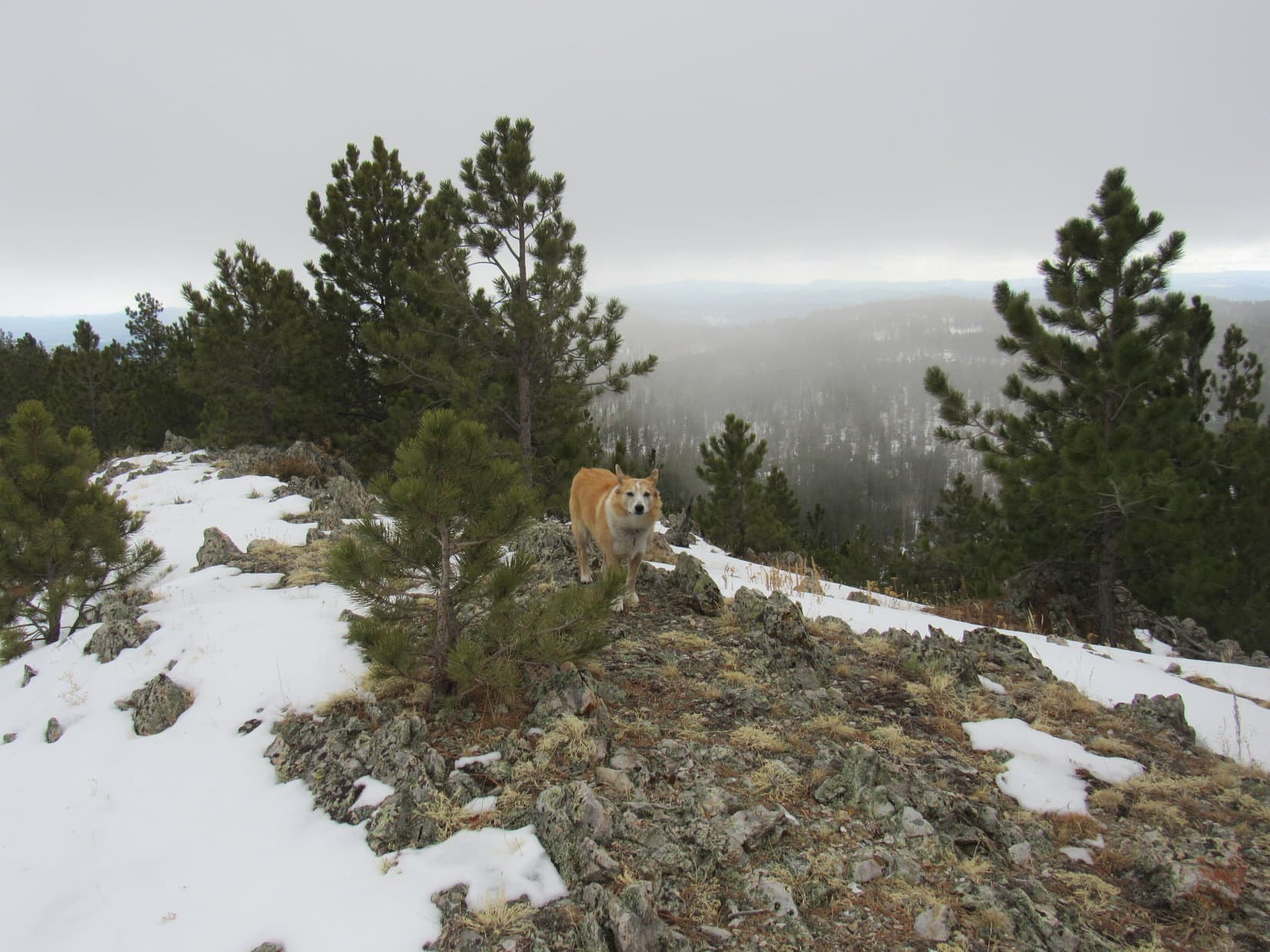
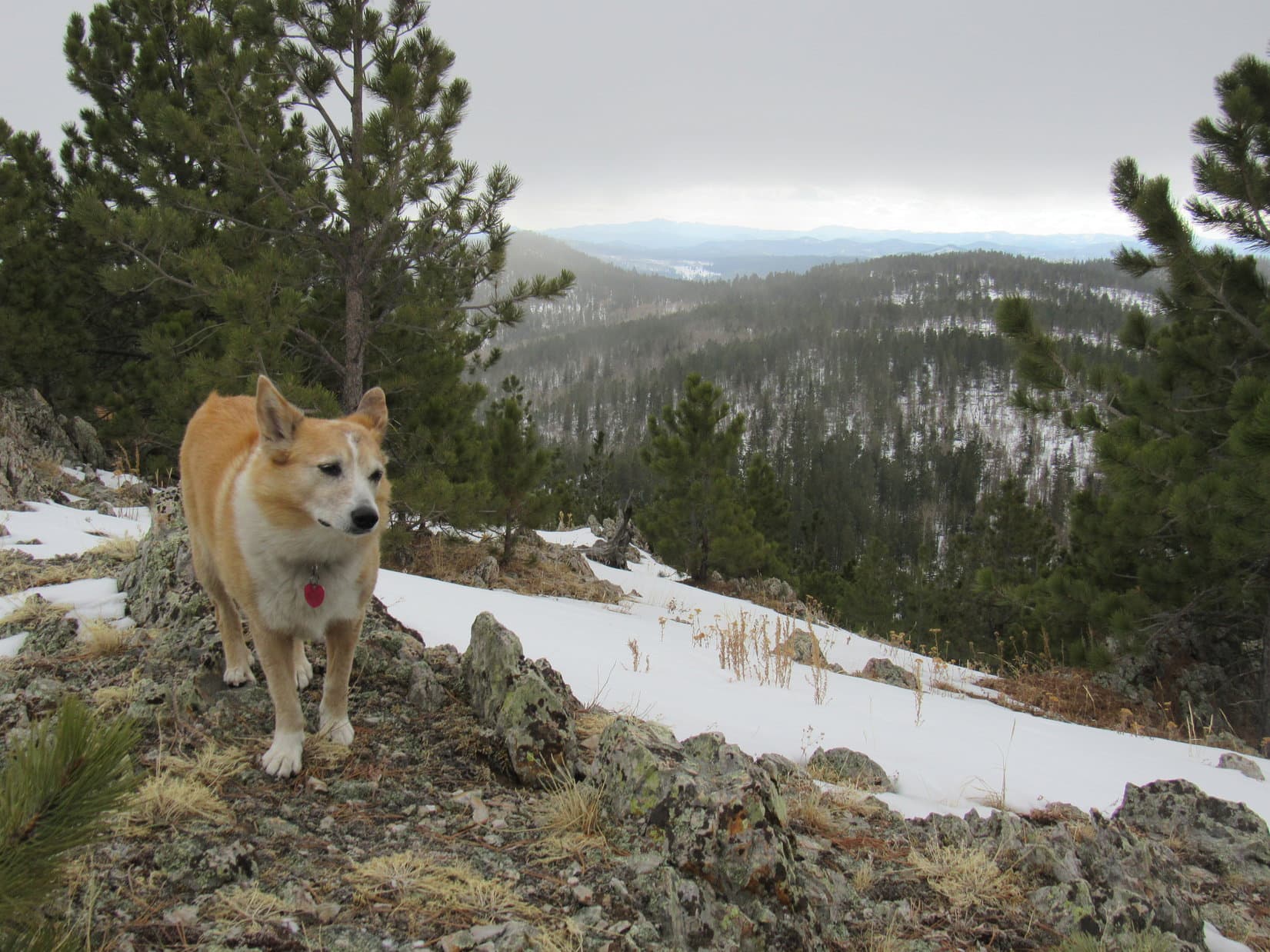
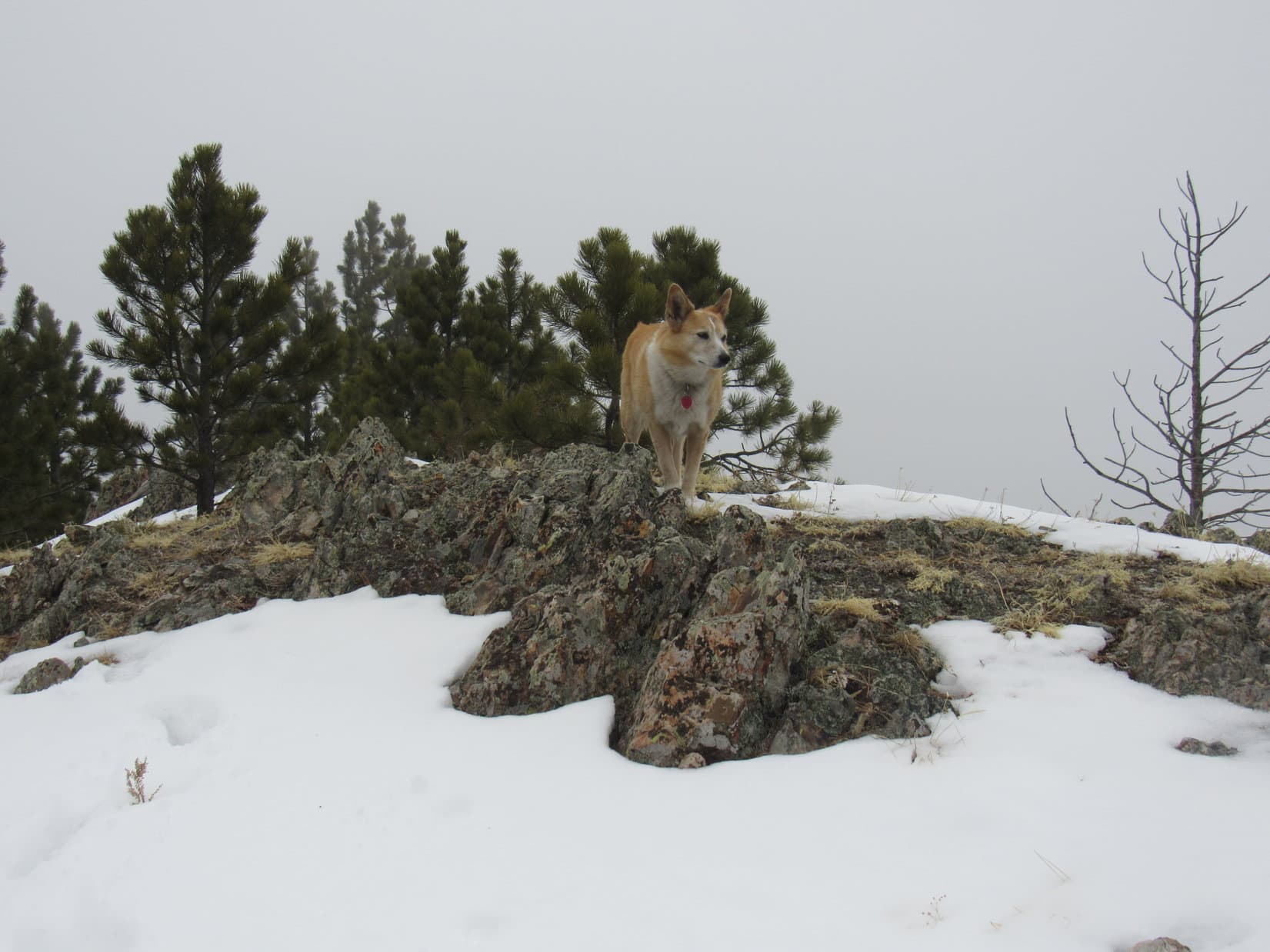
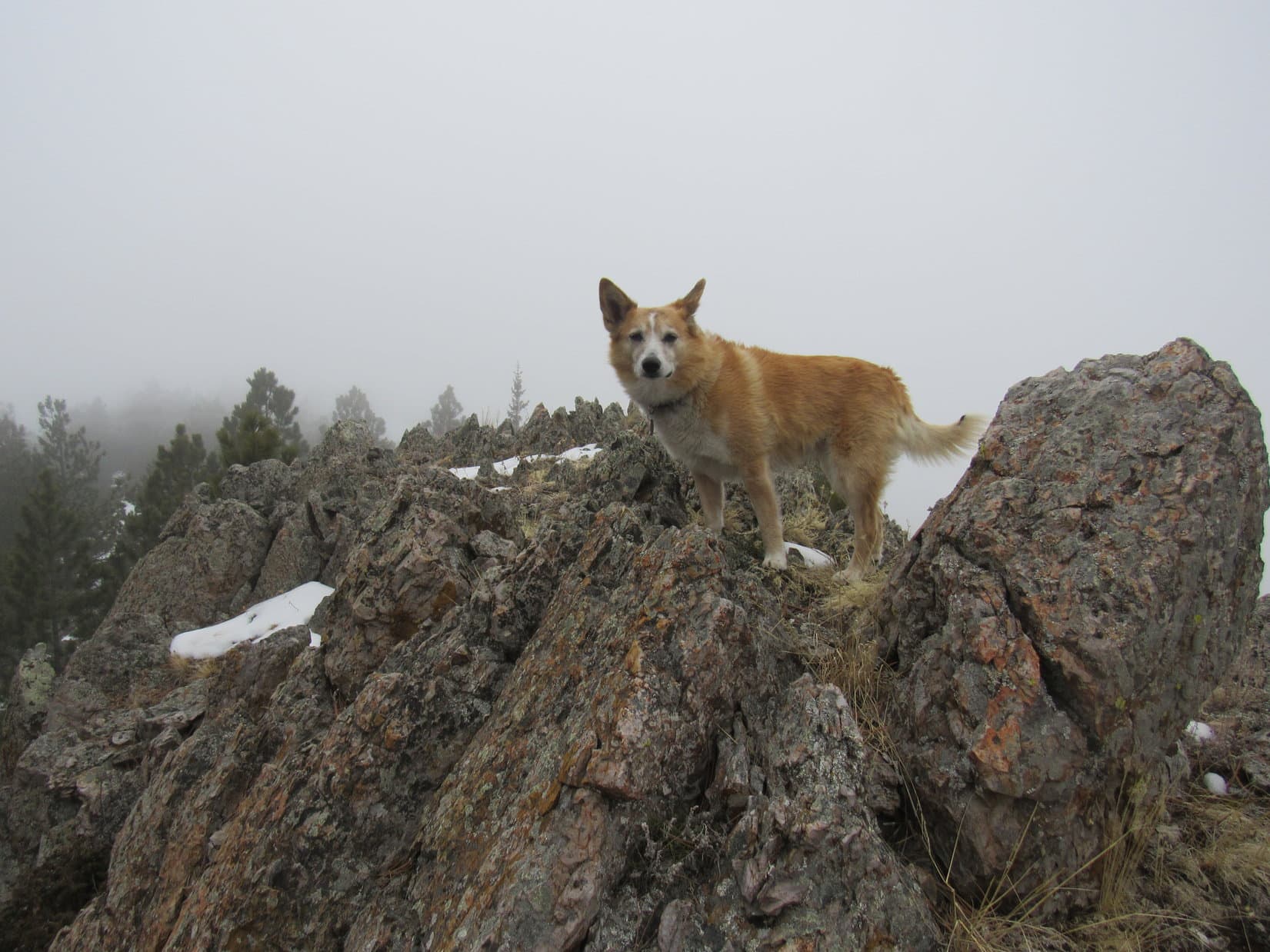
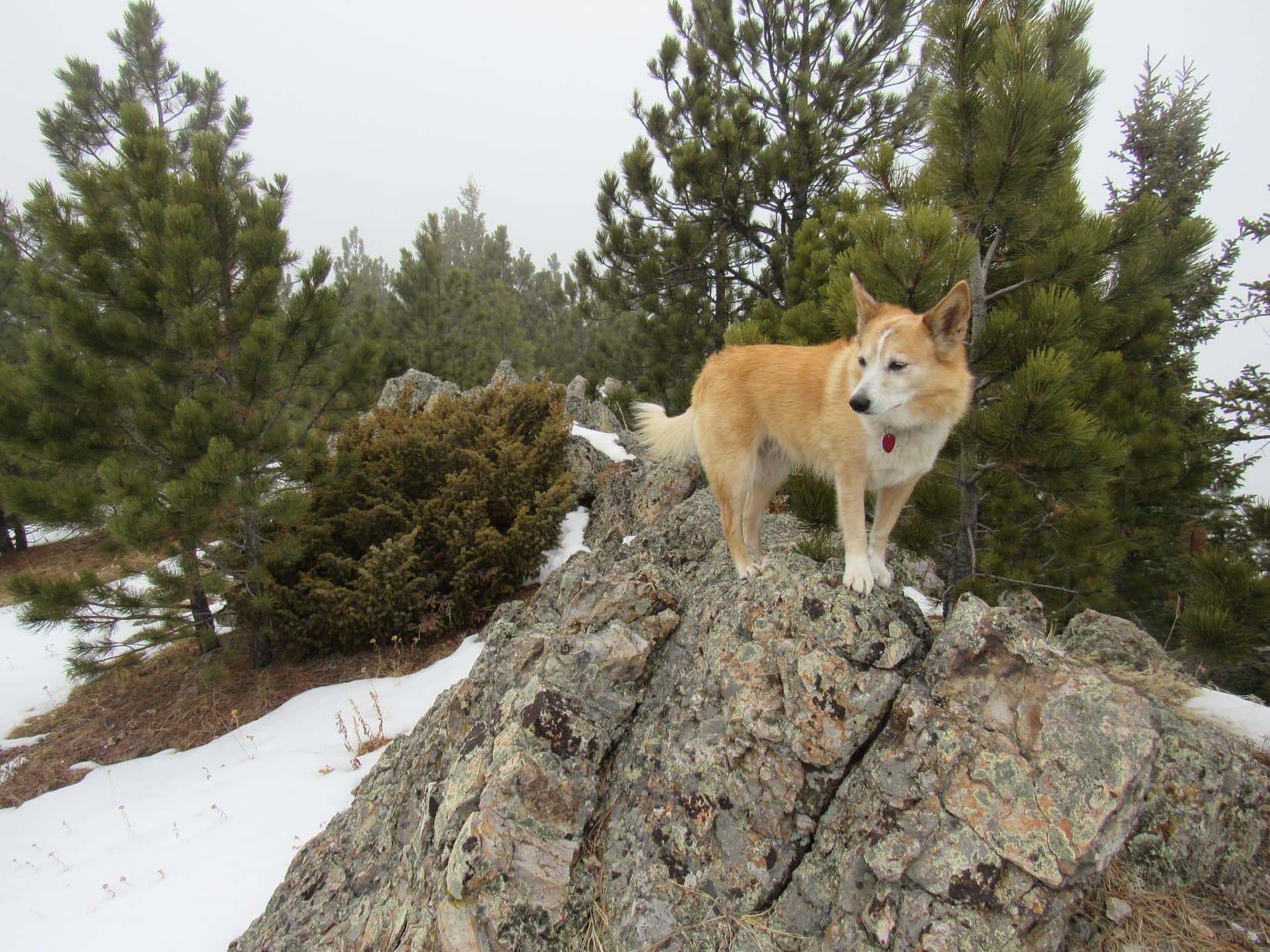
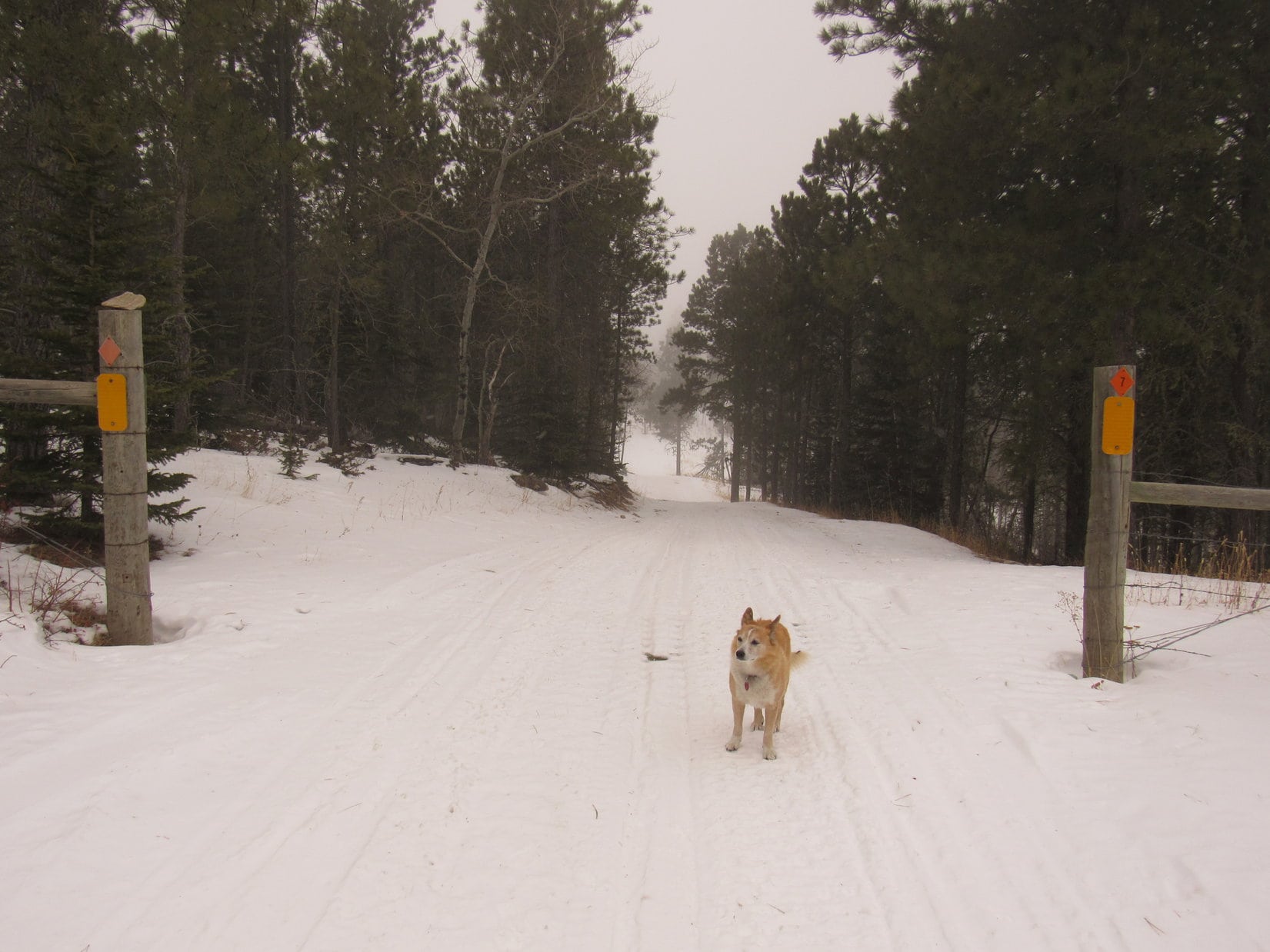
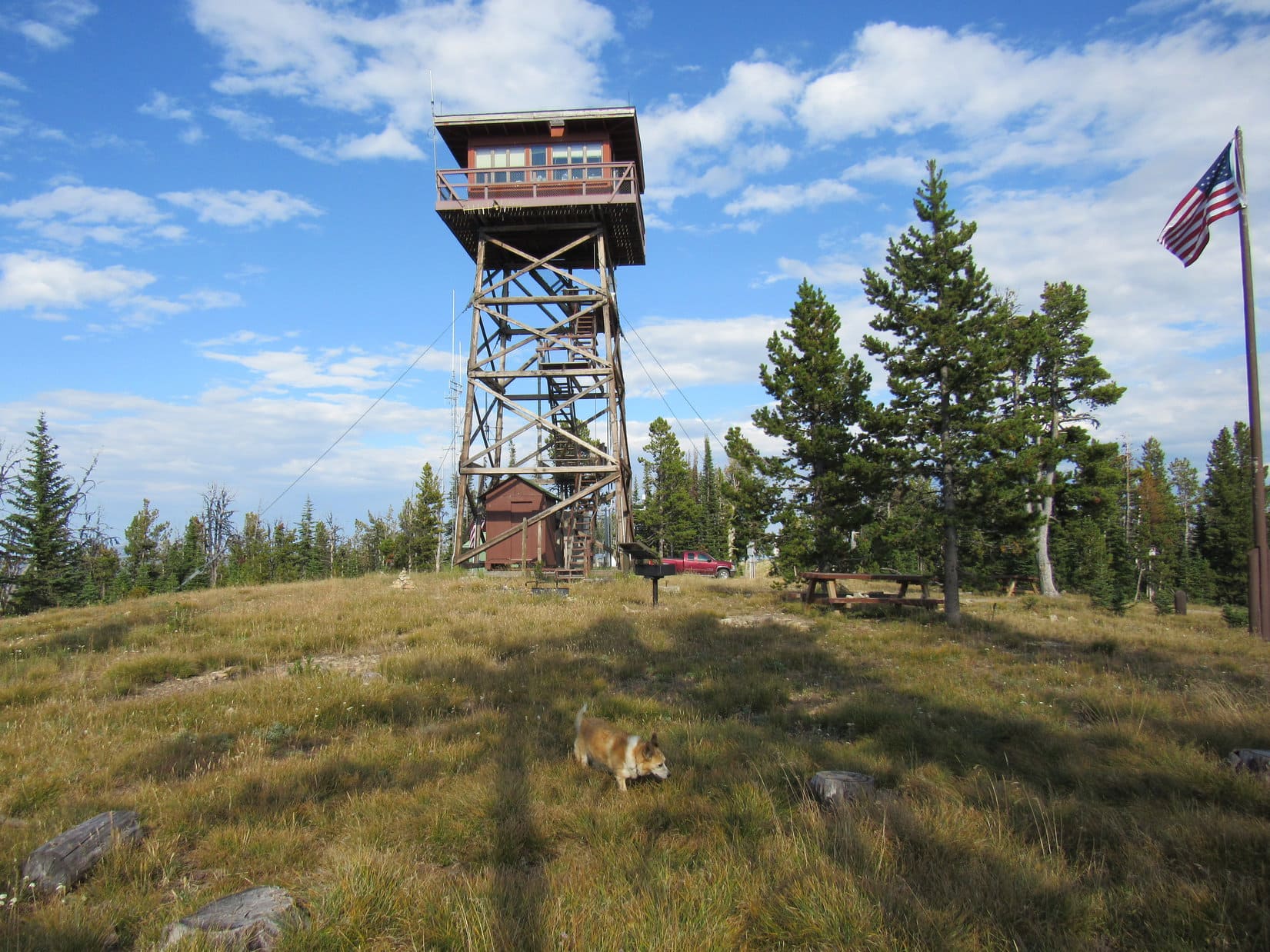
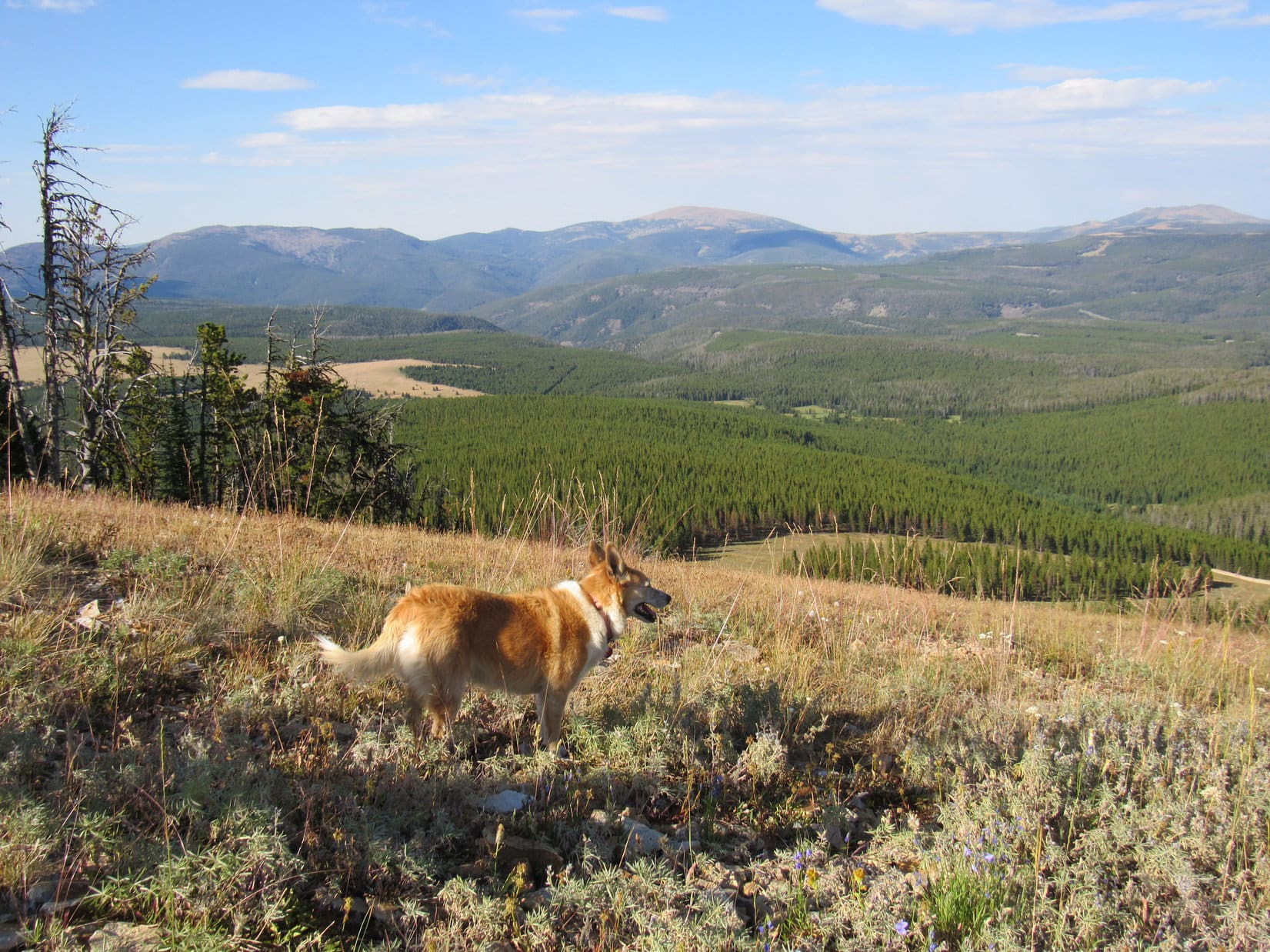
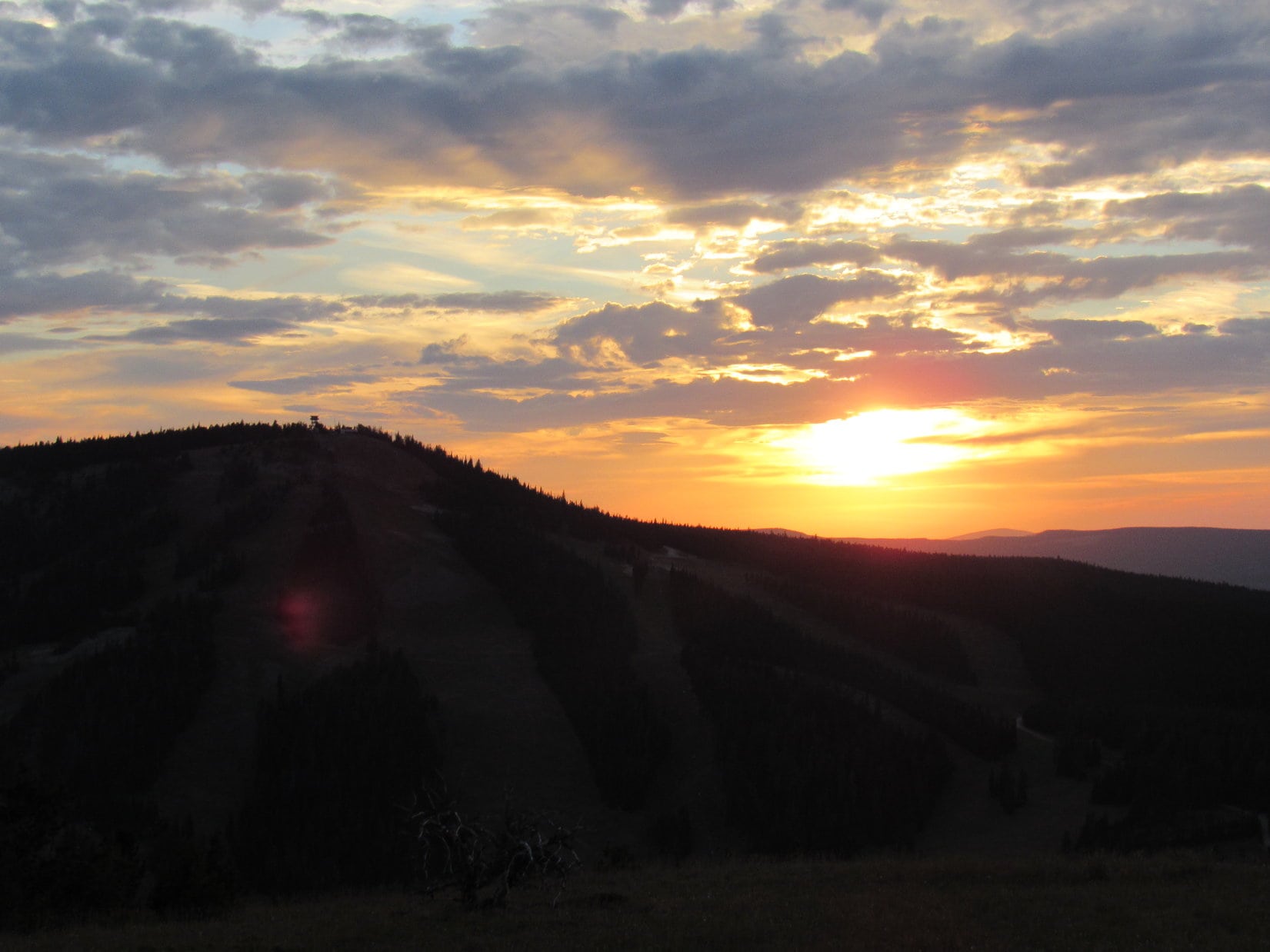
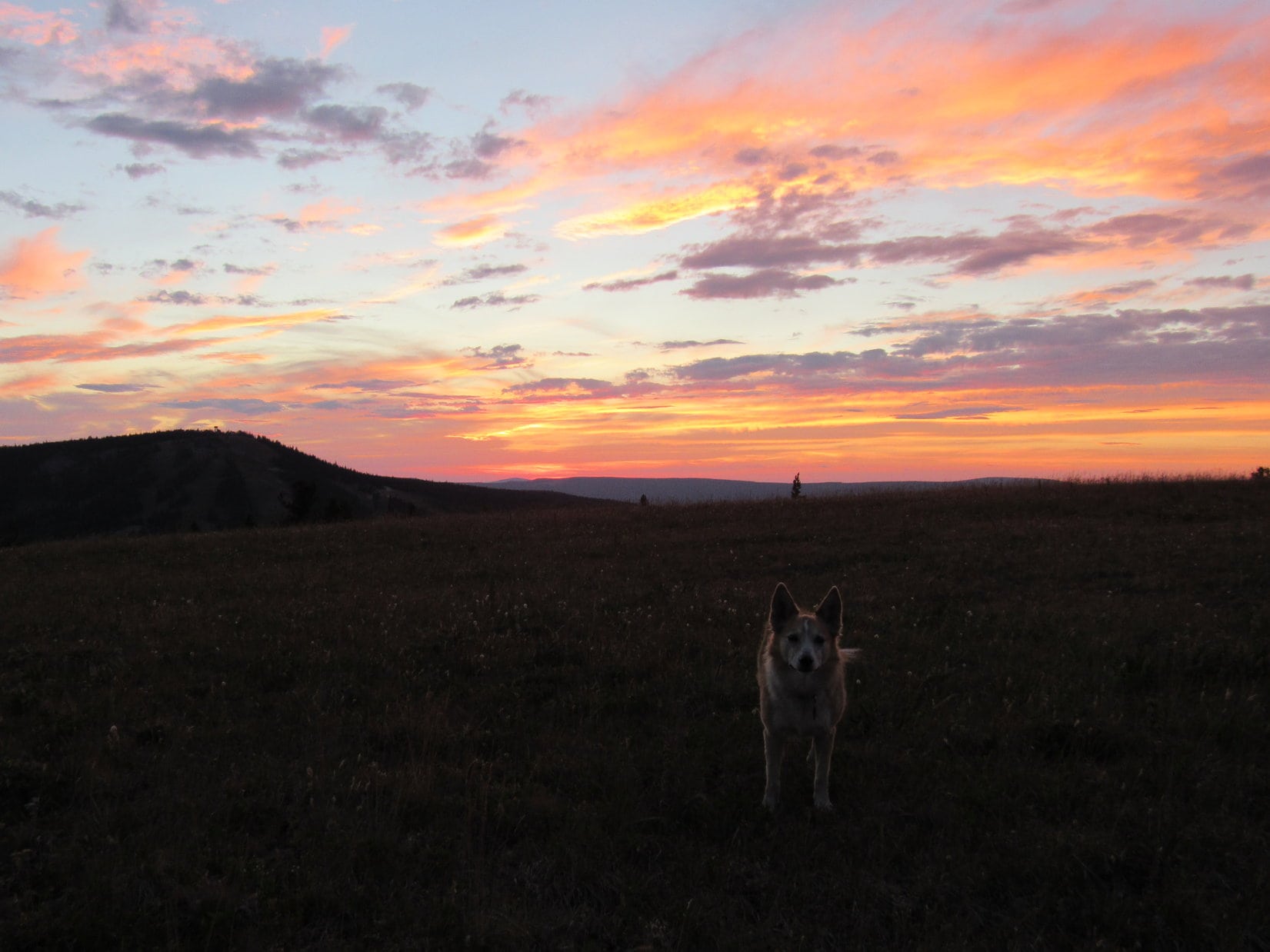
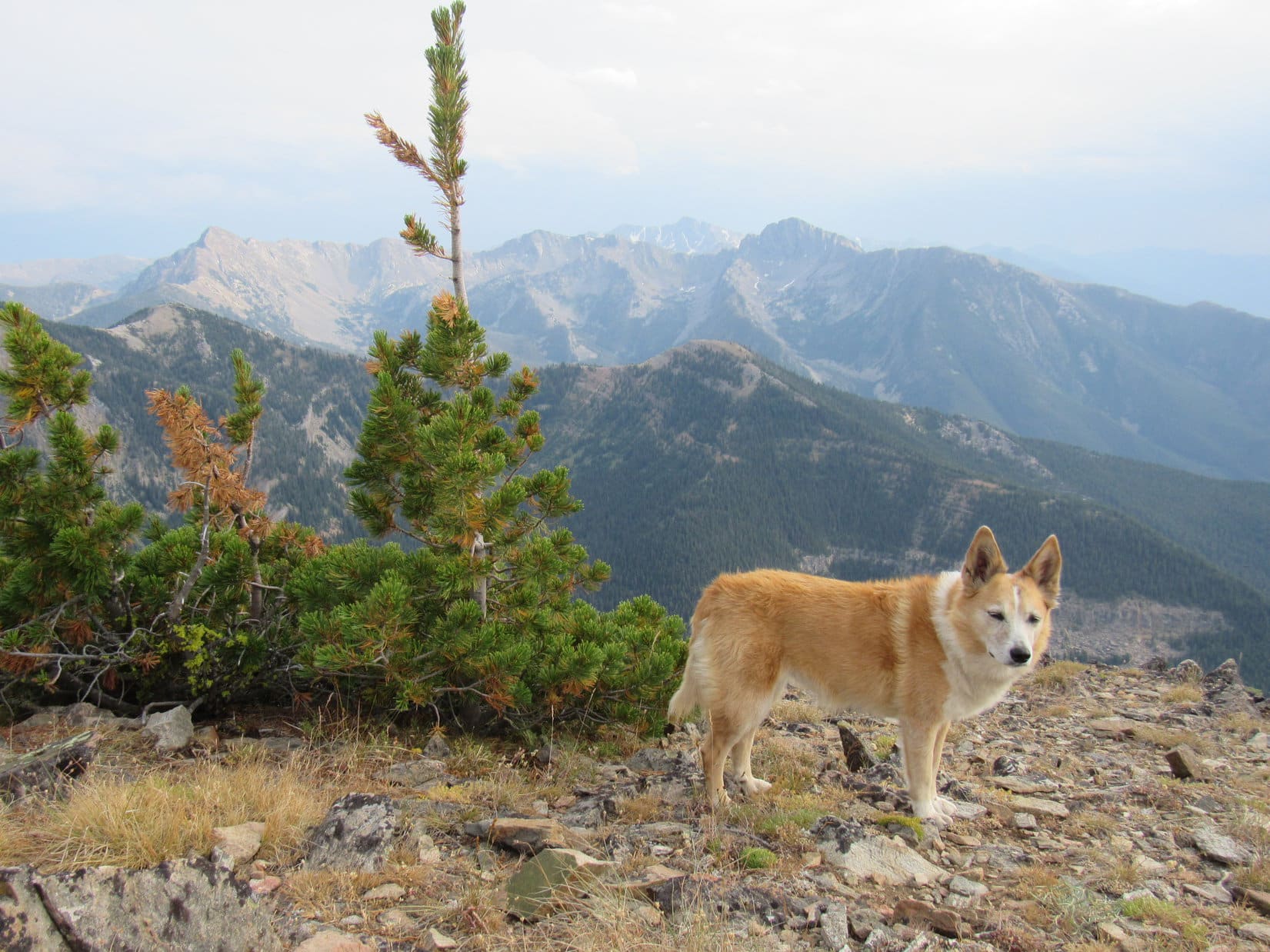
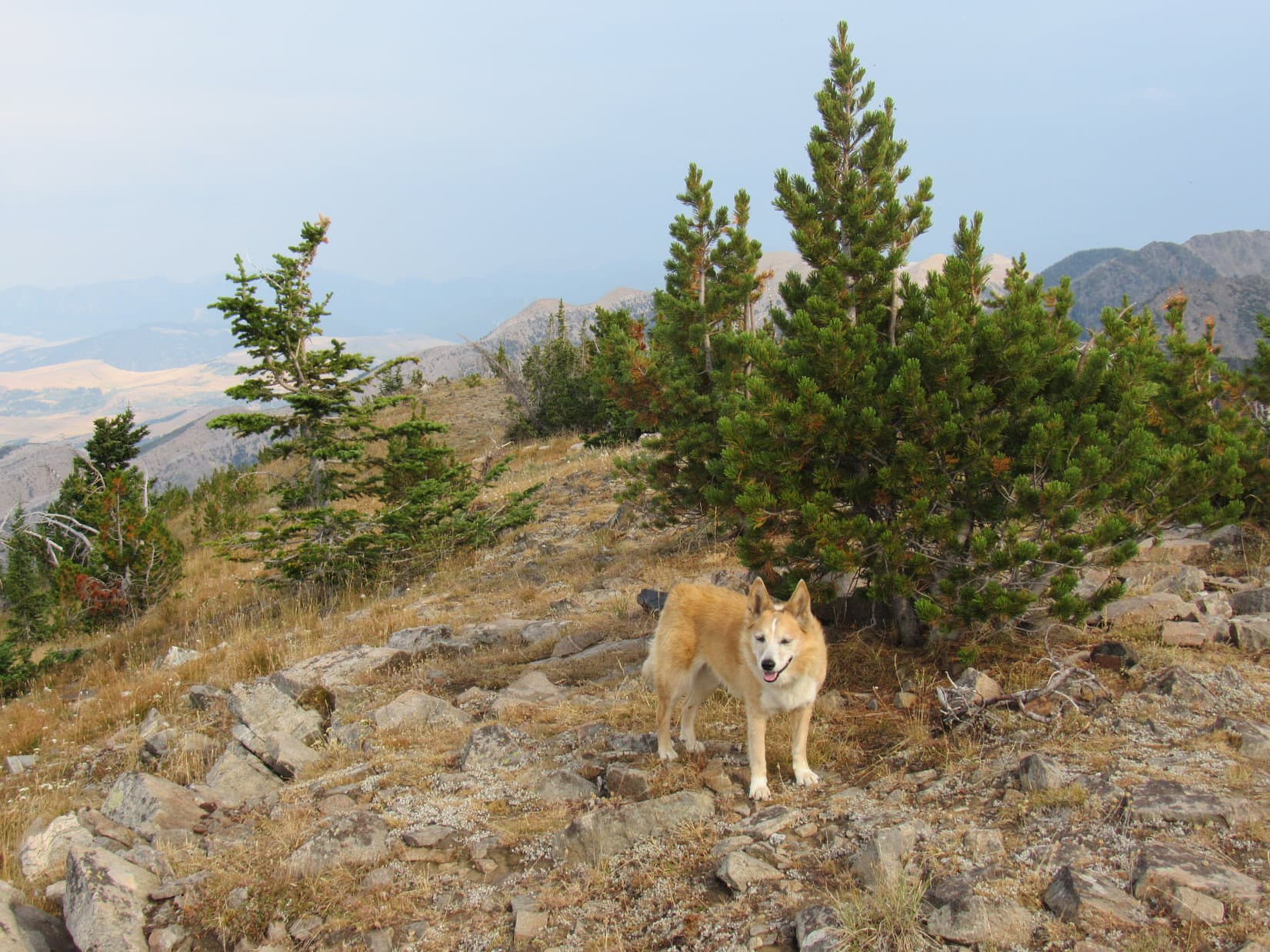
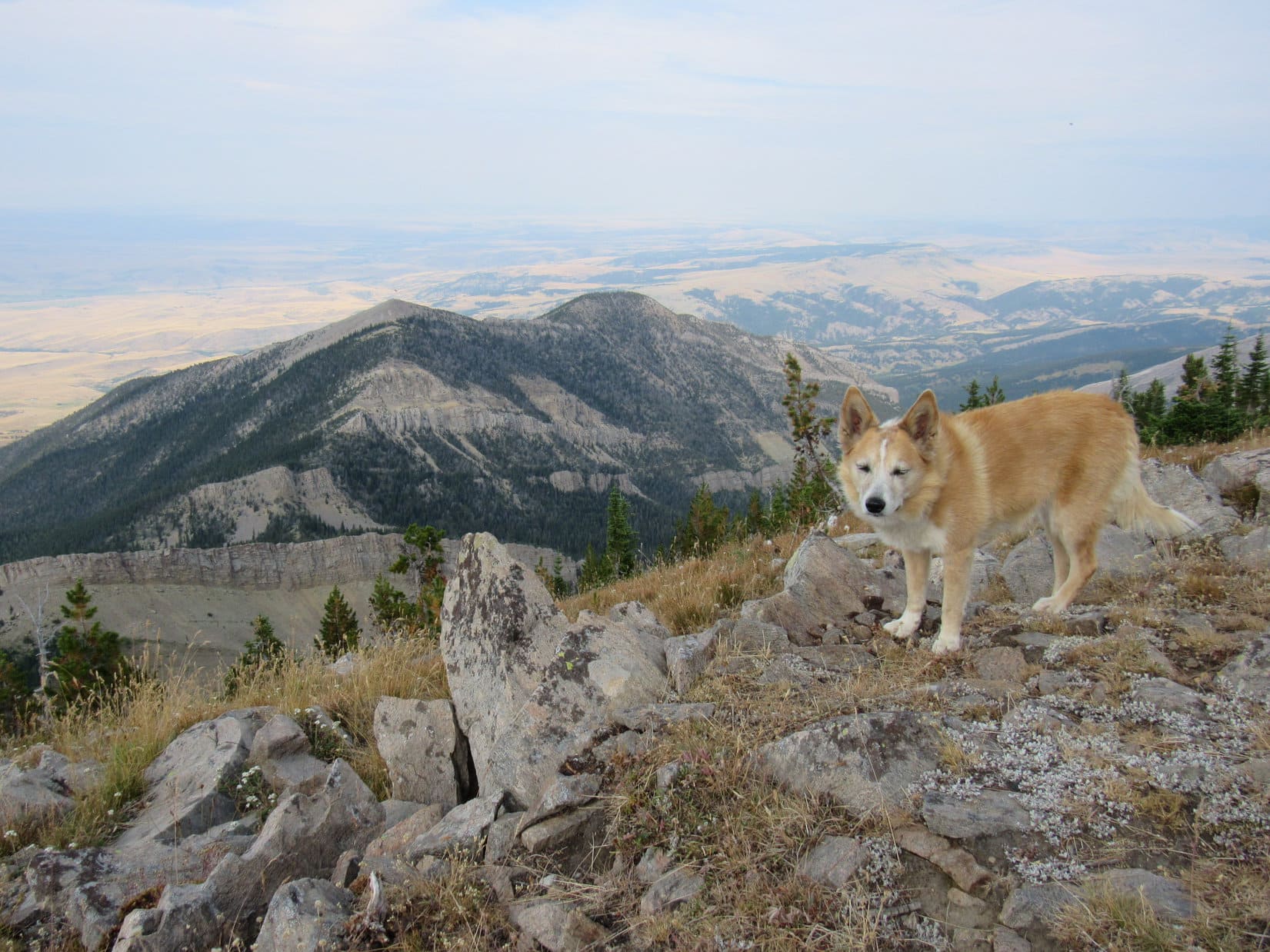
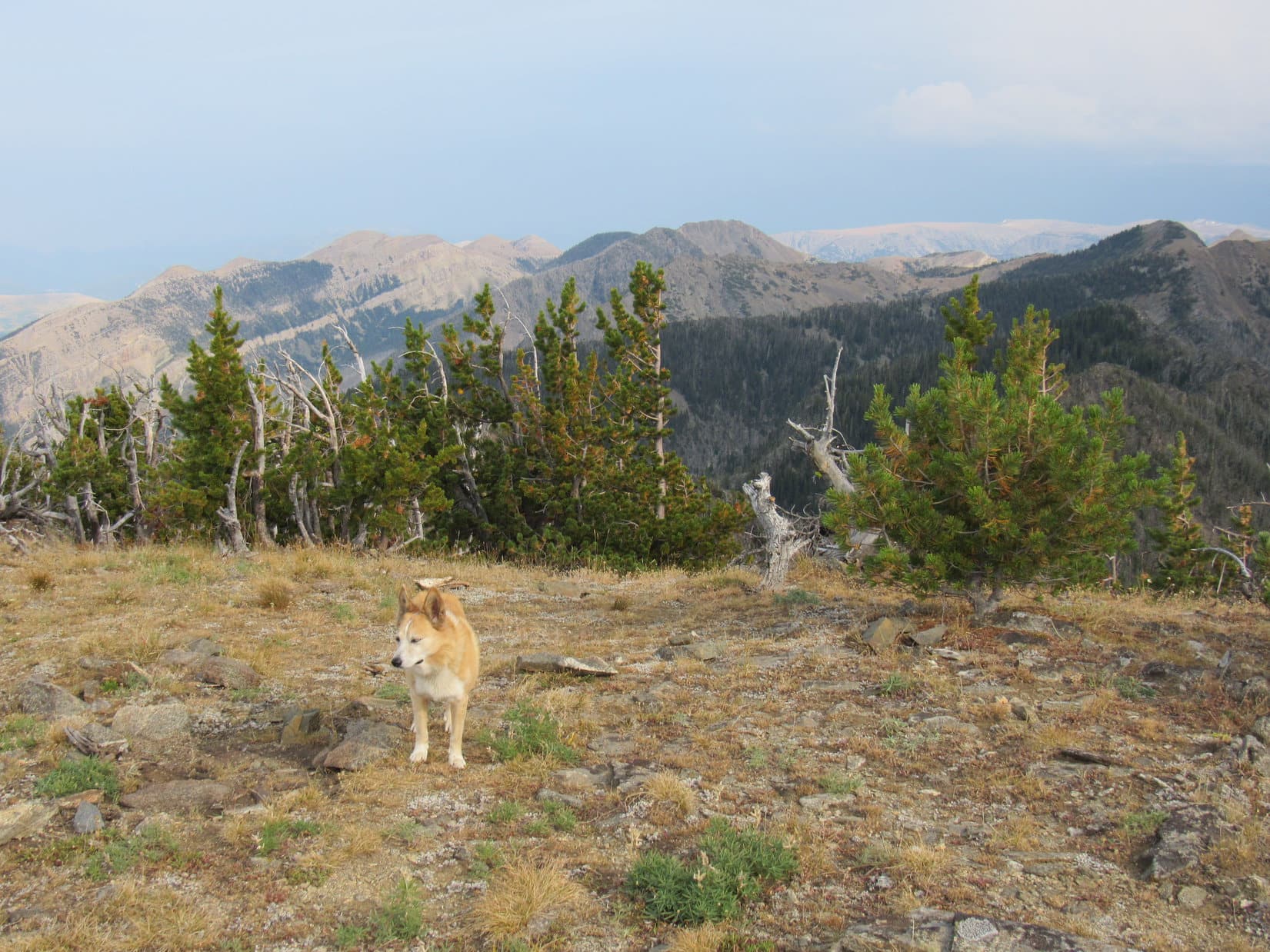
8:28 AM, 41ºF, start of USFS Road No. 216.1, 0.5 mile SE of Custer Peak – Bright and breezy when Lupe hopped out of the G6. Such a long time since she’d been here! Snow! Only yesterday, deadfall had been her bane on the way to Peak5316 in the southern Black Hills. Snow was much more to the American Dingo’s liking.
Cool, clear, and breezy at the start of USFS Road No. 216.1. Photo looks WSW.
To what do I owe this great honor, SPHP?
What honor is that, Loop?
2 Black Hills Expeditions in a row. Been forever since we’ve done that!
Ahh! Easily explained. This is the last warm day before a long cold snap moves in. We’ve been spoiled! Real winter is on the way. Subzero every night! A few more days until it gets that bad, but the deterioration is supposed to start this evening with a chilly wind out of the NW. Sort of surprised at how breezy it is already.
Well, whatever the reason, I’m glad we’re here! C’mon, SPHP, I’ll race you to the top!
Heh. Might as well chalk another one up for the Carolina Dog right now. SPHP started the trudge WNW, snow crunching underpaw.
C’mon, slowpoke! Loopster with her usual early lead. Photo looks WNW.
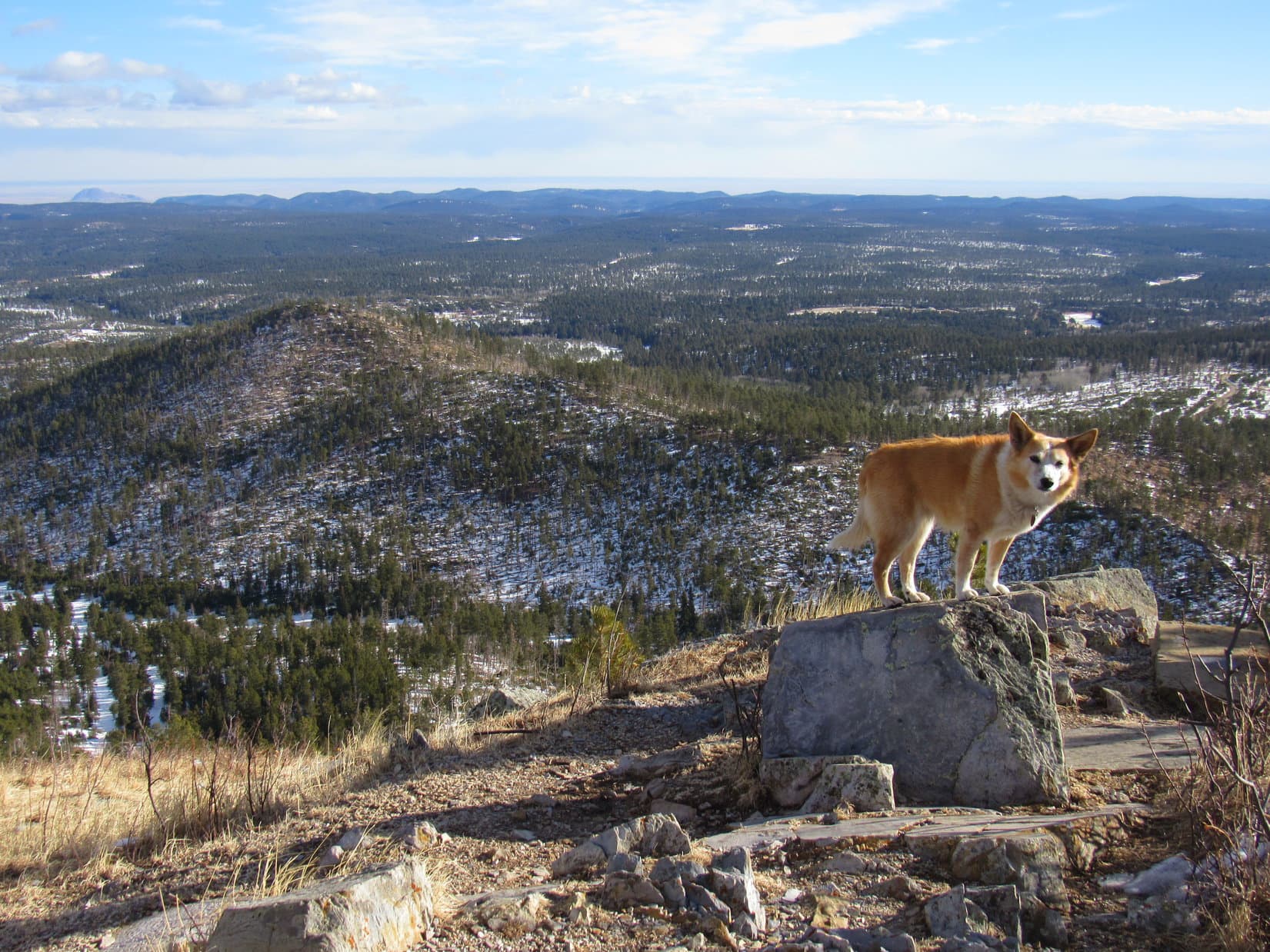
This was familiar territory. Looper’s 7th ascent of Custer Peak, in fact. Want the best views in the N central Black Hills? The under 2 mile road trek up to the fire lookout tower on Custer Peak(6,804 ft.) is where to go. Dominant views of the entire region! Judging by how breezy it was down here, though, might be a gale up there today.
For nearly a mile, USFS Road No. 216.1 gradually steepened as it curved NW on the way to the saddle between Peak 6600 and Custer Peak. The E face of Peak6600 came into sight less than halfway there. It wasn’t until Lupe got to the saddle region that she had her first really good look at Custer Peak.
Peak 6600 comes into view early on. Photo looks WNW.Custer Peak from a knoll near the saddle leading to Peak 6600. Photo looks ENE.
USFS Road No. 216.1 curved sharply SSE shortly before Lupe got to the saddle. However, No. 216.2A continued right on up to the saddle, where SPHP was surprised to see a new outhouse. New in the 4.5 years since Lupe had last been here, that is. At the saddle, No. 216.2A turned toward Custer Peak. The road would go nearly all the way to the top.
At SPHP’s insistence, Lupe paused early on the No. 216.2A trek for a good look at the NE face of Peak 6600.
Peak 6600 from USFS Road No. 216.2A. Photo looks SW.
Didn’t take Loopster long to get to where No. 216.2A approached the base of Custer Peak. From here, the road climbed steadily, ultimately completing a clockwise circuit of the entire mountain. The views were fabulous where unobstructed, as they were most of the way up.
Terry Peak(7,064 ft.) to the NW was the most impressive sight, but the Carolina Dog was happier on the E and S sides of the mountain, where she was protected from the gusty wind which continually strengthened as she gained elevation.
Approaching Custer Peak on USFS Road No. 216.2A. Photo looks NE.On the much calmer E side of the mountain. Photo looks N.Getting close to the end of the road. Terry Peak (L). Photo looks NW.
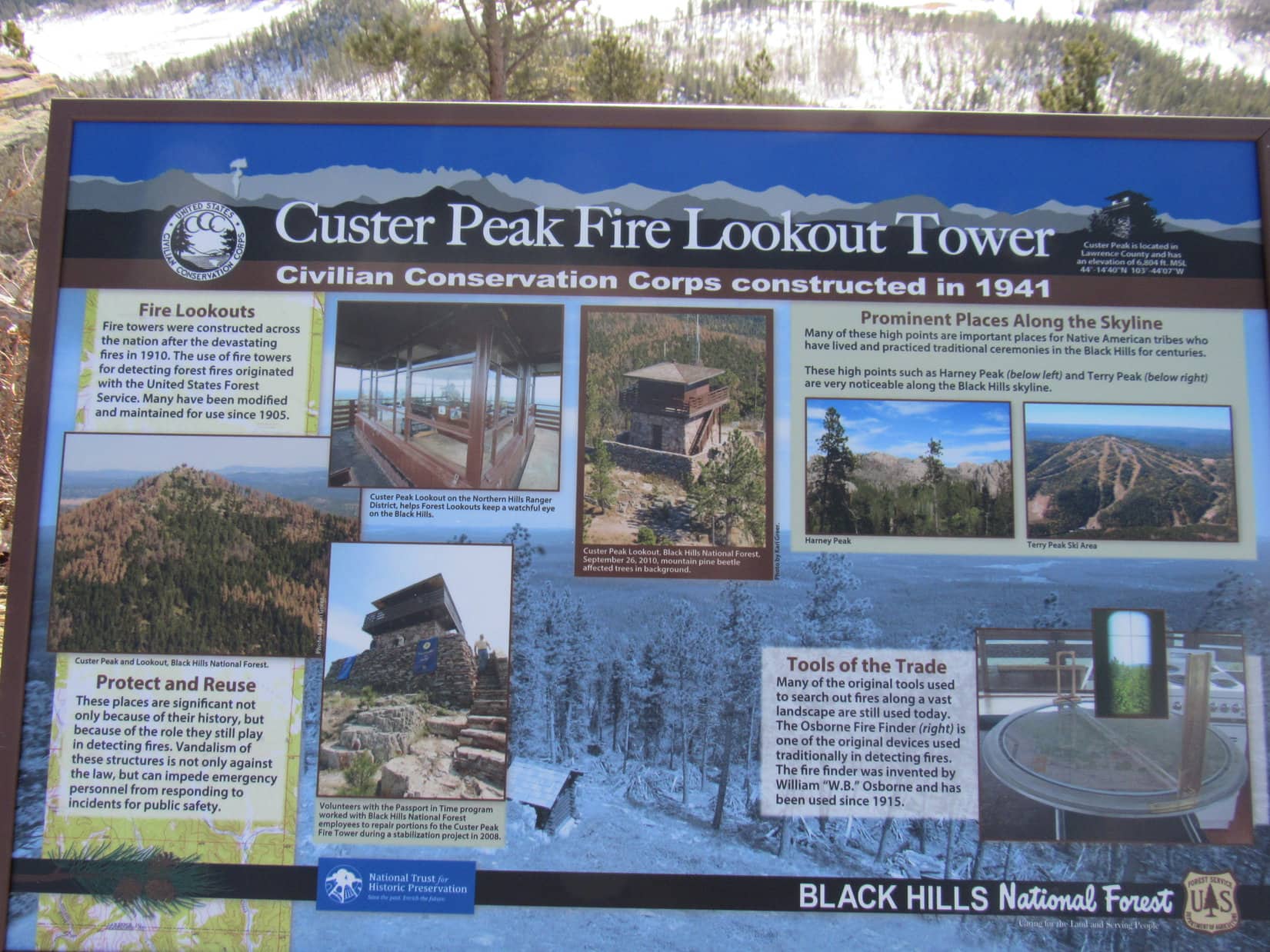
No. 216.2A dead-ended 100 feet below the summit. Exposed to the wind, Lupe did not enjoy the path that switchbacked the rest of the way to the top. SPHP paused to examine a new plaque near the fire lookout tower, but the Carolina Dog was anxious to get out of the breeze.
Start of the short path that switchbacks to the summit. Photo looks SSW.The new information plaque near the lookout tower.Come on, SPHP! Let’s get out of the wind!
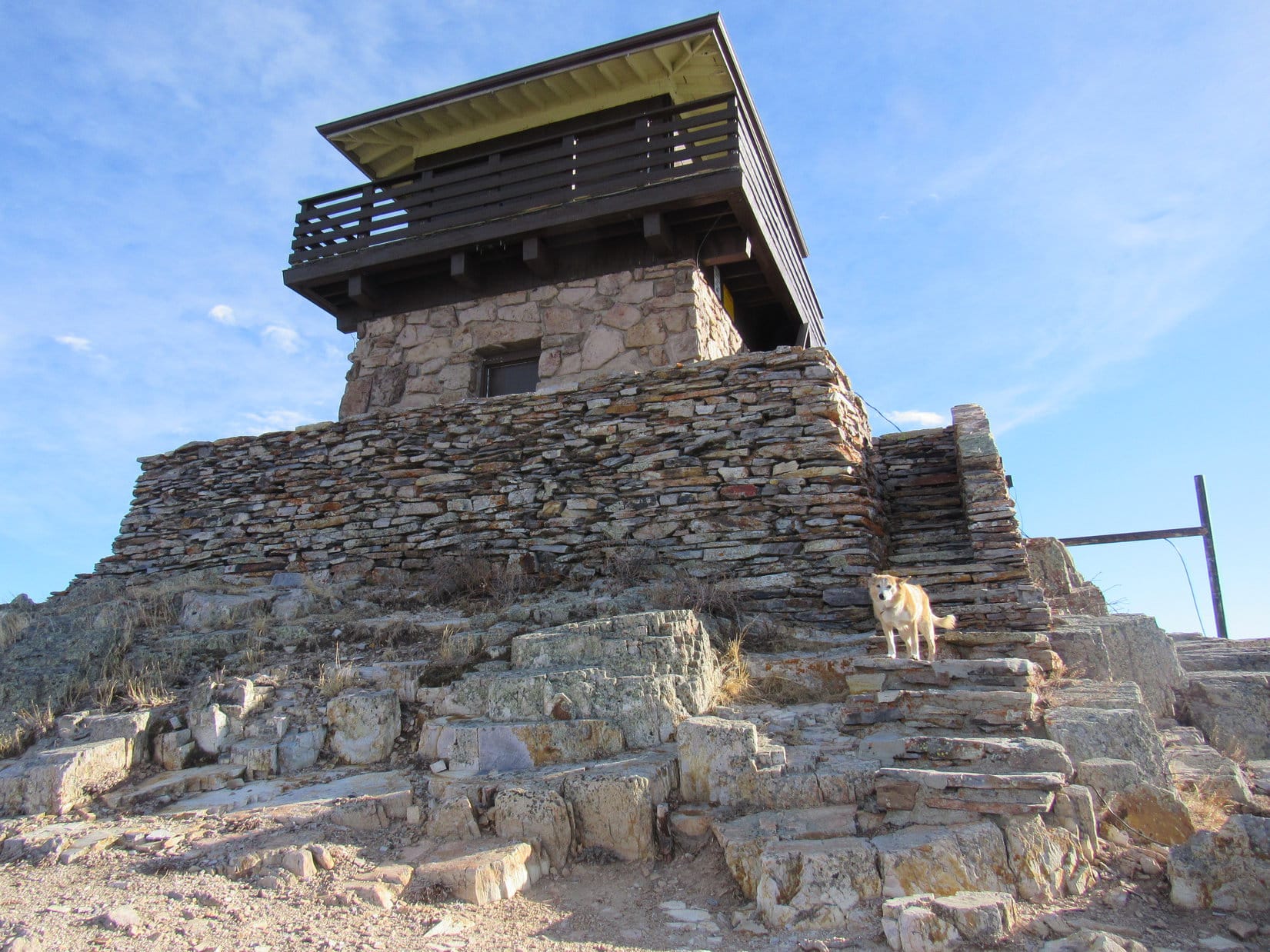
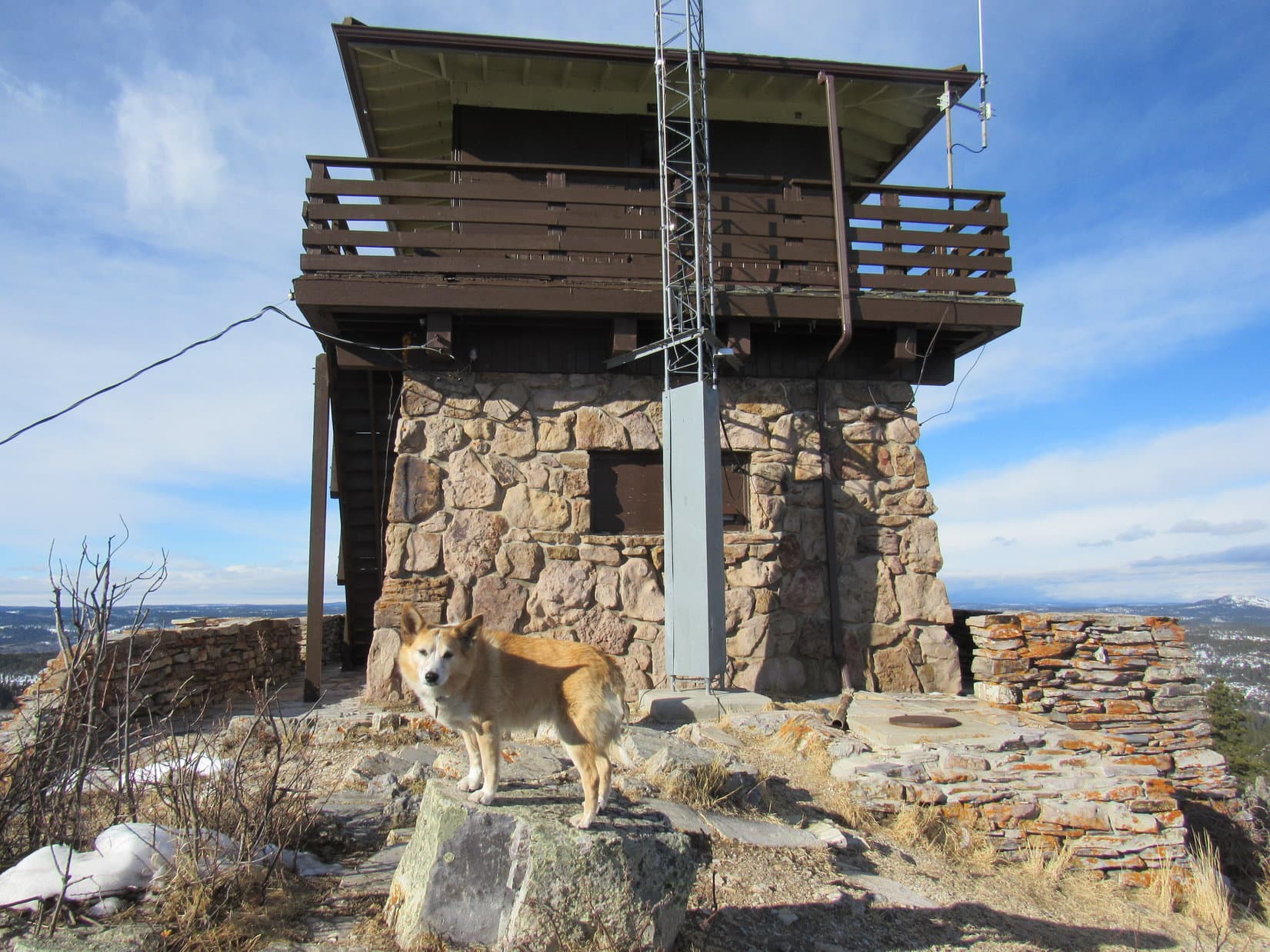
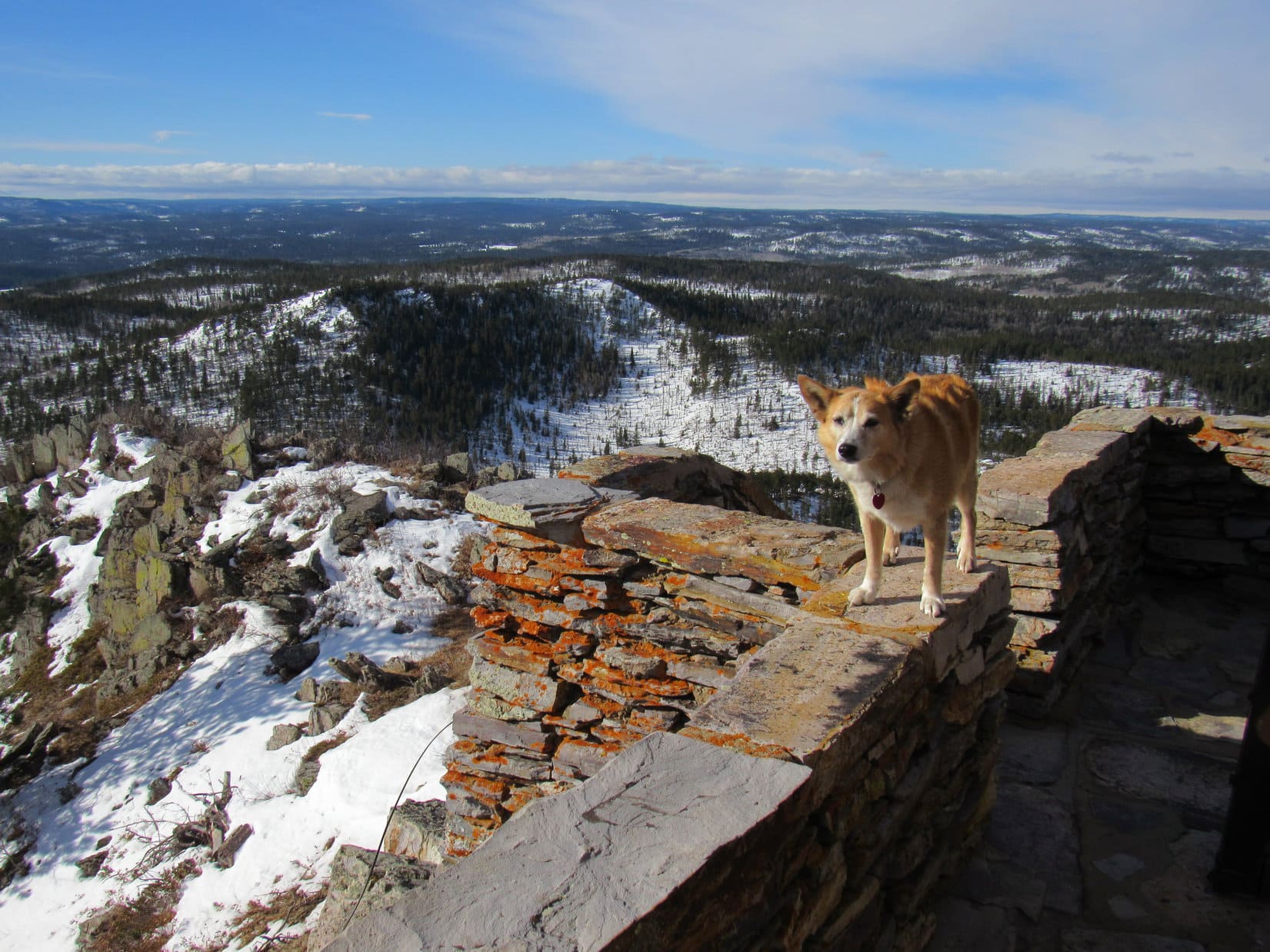
The wind wasn’t all that terrible, but SPHP had to agree that life was more pleasant on the sunny E side of the lookout tower. To Loopster’s joy, this time SPHP hadn’t forgotten to bring the chocolate coconut bars. She curled up on SPHP’s lap, inhaling her share, then munched some Taste of the Wild.
After a pleasant 10 or 15 minutes peacefully enjoying the views, it was time to brave the wind and take a few photos between major gusts.
The sunny E side of the lookout tower, where Loop and SPHP hung out for a bit. Photo looks W.Peak 6380 (L) in the foreground, and Bear Butte(4,422 ft.) (far L) in the distance. Photo looks ENE.
Terry Peak(7,064 ft.), framed between Deer Mountain(6,652 ft.) and Bald Mountain(6,617 ft.), was the big view, but Lupe could also see all the way S to Black Elk Peak(7,231 ft.), and W to the limestone plateau country.
Deer Mountain (L), Terry Peak (Center), and Bald Mountain (R). Photo looks NW.Peak 6600 (L of Center) in the foreground. Photo looks SW.
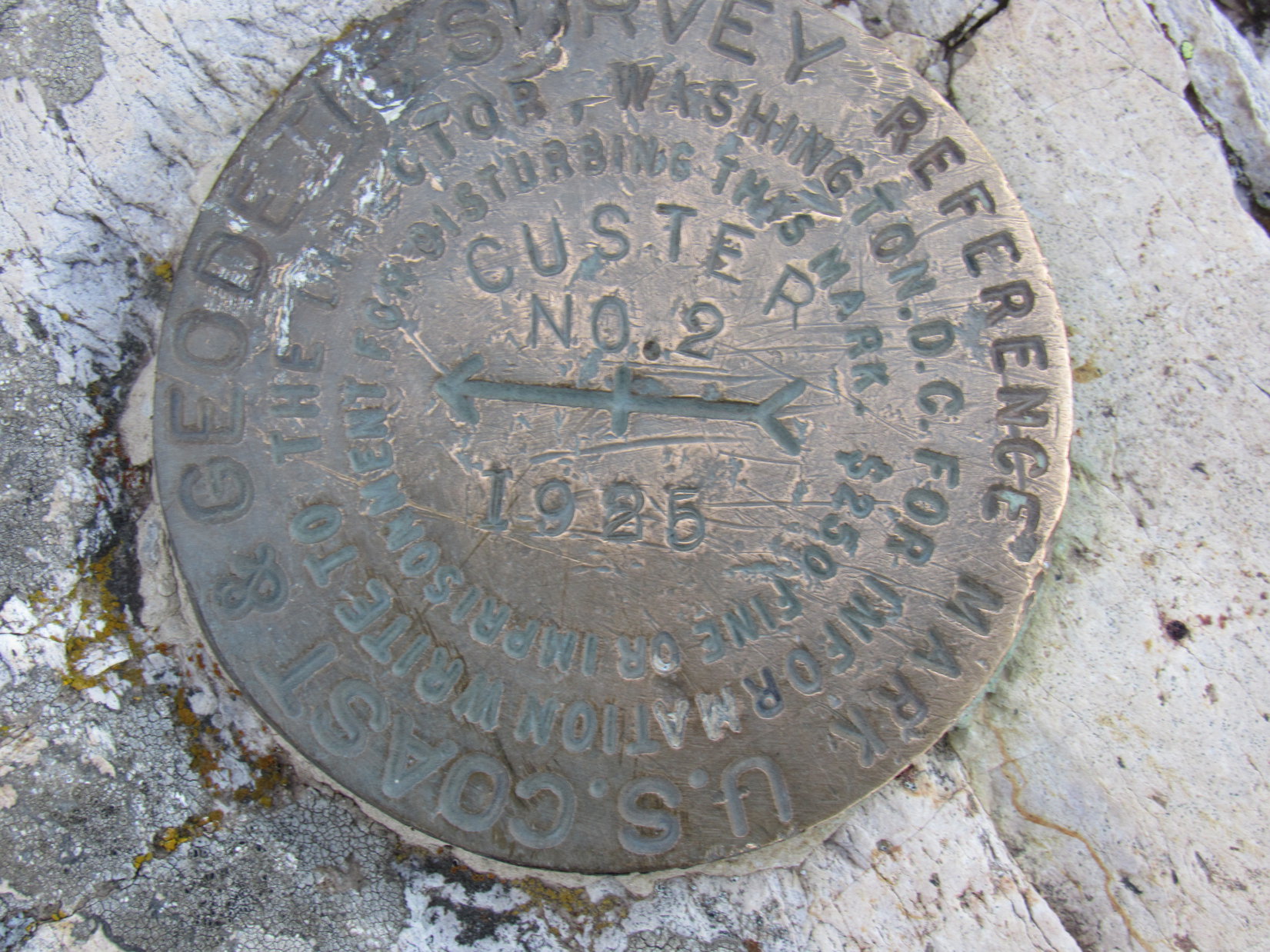
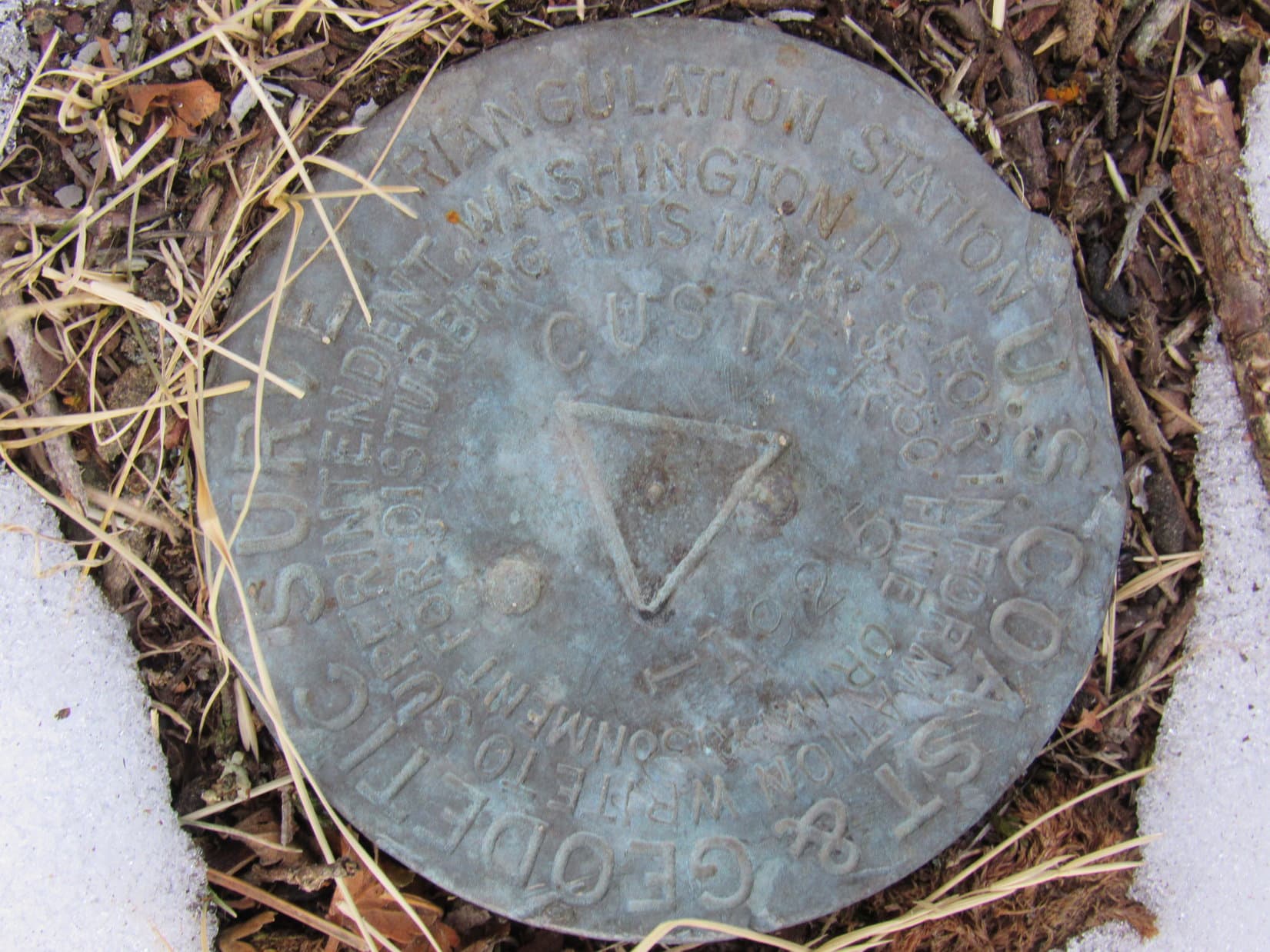
One or two laps around the lookout tower was about all the American Dingo was willing to put up with. She didn’t get any respite from the wind yet, though. After descending the tower steps, SPHP searched for the Custer survey benchmarks near the N side of the foundation.
Benchmark No. 2 near the NW corner of the lookout tower points E toward another marker 10 feet away.“Custer” survey benchmark dated 1925.
Lupe’s Custer Peak tour concluded with a look at the views from a short ridge SW of the tower.
Black Elk Peak (far L) on the horizon. Photo looks S.Looking SSW.Peak 6600 (Center) in the foreground. Photo looks SW.
40 minutes! After a 4.5+ year absence, hardly seemed enough to do justice to Custer Peak, but the wind wouldn’t let up, and the Carolina Dog was anxious to go. Plenty more to do today, anyway, down where the breeze wouldn’t be so stiff. Lupe started her descent leaving the summit as she’d found it, bathed in sunshine and battered by the wind.
About to head down. Photo looks NE.
Once back to the road, SPHP paused briefly for another look at Peak 6600, then it was on down around to the leeward side of the mountain.
Peak 6600 (Center) in the foreground. Photo looks SW.
You sure seem interested in Peak 6600 today, SPHP!
That’s because that’s where we’re going next!
We are? I thought we might be done with the wind and all.
The wind’s not that bad, Loop, especially down below. More adventures in store! We’re going to climb Peak 6600, since it’s got such a fabulous view of Custer Peak, then head NW a few miles to climb Peak 6480.
Peak 6480?
Yes, another 300+ foot prominence peak from Lists of John. Sort of been thinking maybe we ought to start working the 300+ foot prominence lists this year, since you’ve been to just about every named peak in the Black Hills that we can legally climb. Quite a few of them more than once. Gives us new places to explore!
I’m all for exploring, SPHP! Sounds good!
By the time Lupe got back around to the windy N side of Custer Peak, a line of gray clouds could be seen approaching from the NW.
Wonder if that’s the lead edge of the front coming in, Loop? Didn’t think it was supposed to get here until this evening. Hope the wind doesn’t get too much stronger.
Started out OK, but sure hasn’t warmed up any today, either, SPHP.
Reaching the saddle leading to Peak 6600, Lupe left the road, plunging right into the dense, snowy forest. A 260 foot climb almost due S would get her up to the 6600 foot contour at the NW end of the summit ridge.
In the snowy forest, beginning the trek up Peak 6600.
As expected, the route steadily steepened. Some rocks, some deadfall, but mostly just trees and snow. Lupe had done this once before, nearly 6 years ago, and been rewarded with a fantastic view of Custer Peak. Best one possible, in fact, since Peak 6600 was the easily the highest point anywhere close to Custer Peak, and the summit ridge had a nice rocky spot where an unobstructed view could be obtained.
Any idea how much deeper this snow is going to get, SPHP?
Lupe wasn’t far from the top when the forest darkened. Overhead, the sky was now a soft gray. What happened to all the sunshine? Loop was right! Felt colder out, too.
C’mon, Looper! The front must be here early! Let’s get up to where we can get a couple of nice shots of Custer Peak before the weather deteriorates any further.
Didn’t take long. A few more minutes, and Loopster was there, standing in the cold wind on the rocky viewpoint at the NW end of Peak6600.
An hour had gone by since Lupe had left Custer Peak. What a change! Not only had all hint of sunshine utterly vanished, but a massive soft gray cloud hung low over everything. Only on the far horizon did a brighter line indicate the already distant edge of the monstrous cloud.
The rocky viewpoint at the NW end of Peak 6600’s summit ridge. Photo looks S.
Custer Peak was still in view, except for the top 50 or 100 feet, where fog was now streaming by. All in shadow now, instead of lovely sunshine, but nothing to be done about that.
Be ready, Loopster! As soon as the fog clears from the summit, we’ll grab a quick photo of Custer Peak before things get any worse.
Bad decision! Should have snapped one right away. The Carolina Dog was ready, but the summit didn’t clear even for an instant. Instead, the cloud suddenly swallowed the entire mountain. Moments later, even Black Elk Peak(7,231 ft.), far to the S, was gone.
Black Elk Peak (Center) dimly on the horizon, moments before it vanished, too. Photo looks SSE.
Oh, come on! Really? It’ll clear, if we have a bit of patience, Loop. Got to be a little break before too long.
Lupe seemed unconvinced, but was willing to curl up on SPHP’s lap for the warmth, if nothing else. Another chocolate coconut bar didn’t hurt a thing, either.
No break in the cloud. Peak 6600 became an island in a gray oblivion, the only place left standing in the whole world. 15 minutes ticked away. Tiny snowflakes filled the air.
OooooK! Even I can take a hint, if ya knock me over the head with a 2 x 4! Custer Peak photo isn’t happening, Loop. Wha’dya say we go in search of the true summit of Peak 6600? After that we can see about Peak 6480.
Best idea you’ve had in the last hour, SPHP! Let’s do it!
Final moments at the NW high point of Peak 6600. Photo looks N.
The summit ridge dipped a bit as Lupe traveled SE along it. Pines and fog hid whatever was ahead until she was almost upon it. After going several hundred feet or more, a sizable rock formation appeared. Possibly the true summit, although no telling in this fog.
Circling around to the SE, Loop found a spot where she could scramble to the top, which proved to be kind of a weird jagged area.
At the jagged-topped true summit candidate. Photo looks N.
Nope! Not the true summit. Continuing SE only a little farther, Lupe went up a slope to definitely higher terrain. The American Dingo was almost at the SE end of the summit ridge. Congratulations were in order! SPHP was almost certain the elevated line of rock Lupe had reached was the true summit of Peak6600.
True summit of Peak 6600. Photo looks N.
There didn’t seem to be any reason to linger on Peak 6600, especially if Loop still hoped to get to Peak 6480 when the forecast was for steadily deteriorating conditions. A couple of minutes at the top, and Lupe was on her way down the S ridge.
Starting down Peak 6600’s S ridge. Photo looks S.
Not too far to USFS Road No. 216.1! The descent went well, and in less than 0.25 mile, Lupe picked the road up again a little SE of a high point. (Point 6427 on the topo map) Looper headed for it, reaching an open gate at the top in a thin fog and light snow.
At Point 6427 on USFS Road No. 216.1. Photo looks NW.
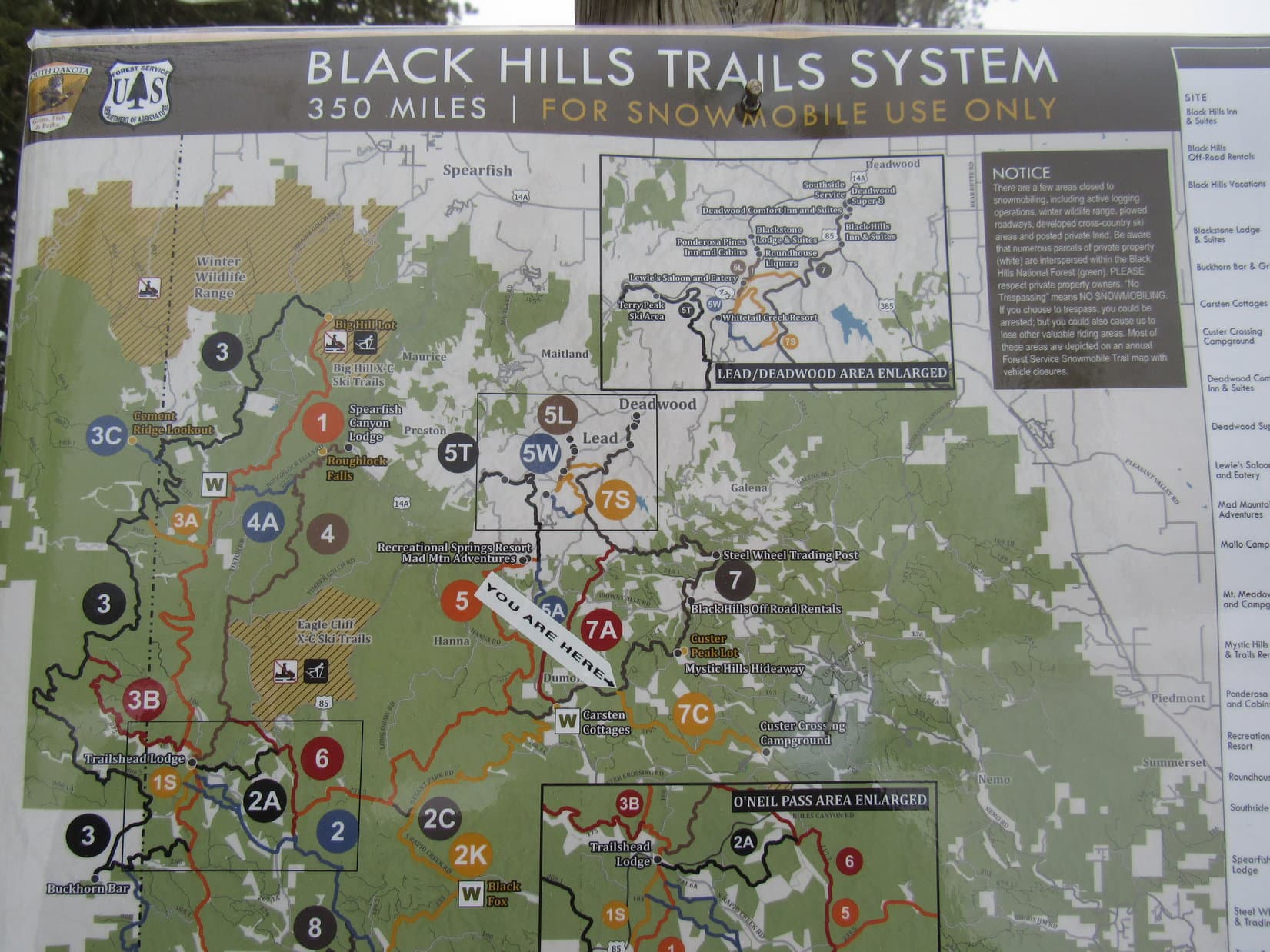
Continuing NW on the snowy road, Lupe soon came to an intersection at a low spot. A map was posted here. SPHP took a look.
Snowmobile trail map posted along USFS Road No. 216.1.
What’s it say, SPHP?
Nothing helpful to us, Looper. It’s a large scale snowmobile trail map.
The way things are going, we’ll be needing a snowmobile before this is over.
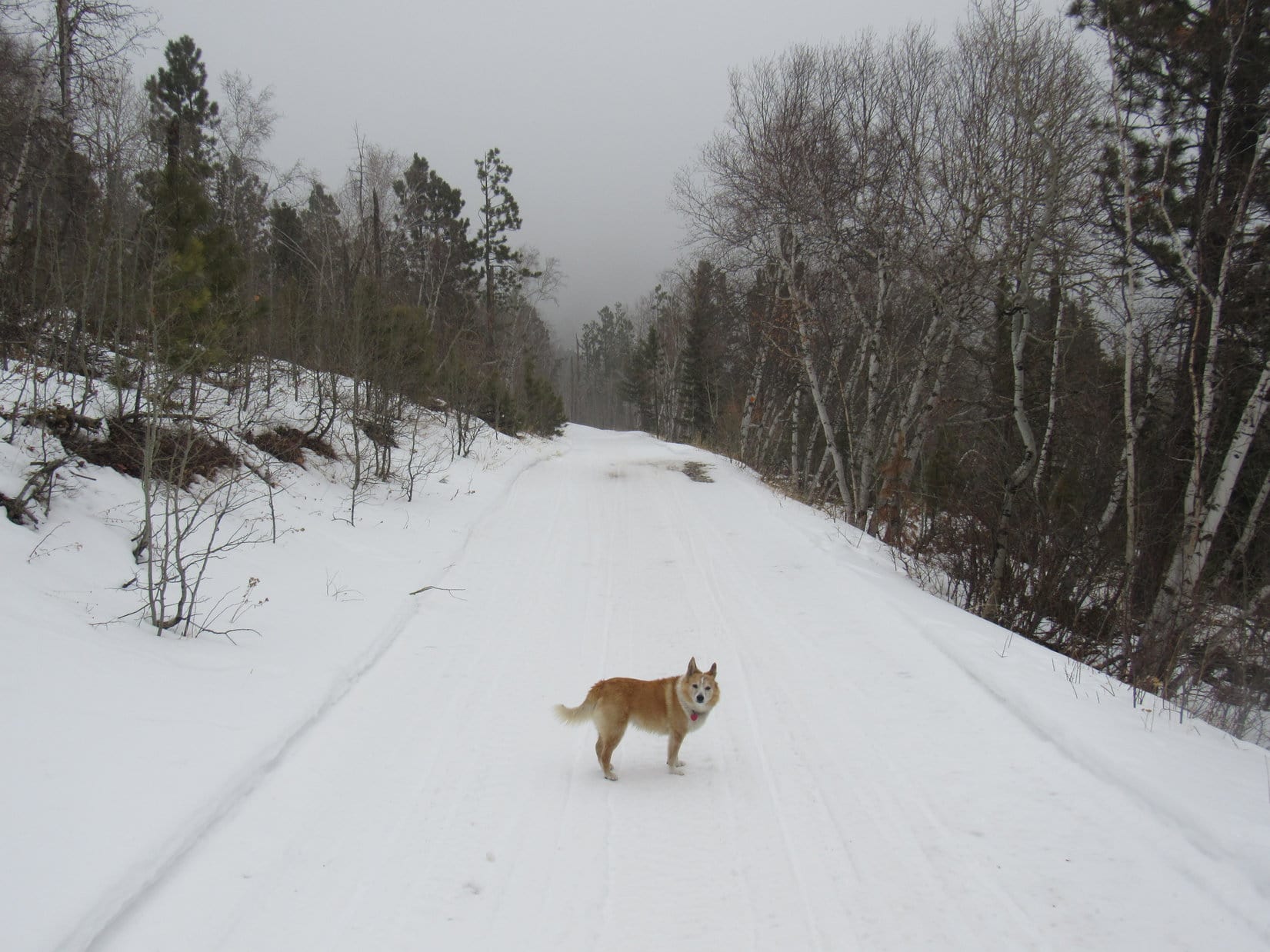
That had a ring of truth to it. SPHP looked down at the American Dingo standing patiently on the snowy road, earnestly returning SPHP’s gaze. All around, the forest was a mystery of fog and tiny swirling flakes. Treetops swayed in the wind, releasing occasional cascades of fresh accumulations. Snowing harder. Even Loop was starting to turn white.
Not really that bad out. Barely cold enough for snow, but the temp was supposed to drop, the winds increase. Would it even be possible to find Peak 6480 in the fog? Suppose Lupe did, what then? Not going to see a thing.
What do you think, Loop?
About?
Call it, or go on? We can come back, and do Peak 6480 another time.
Awesome out here in the snowy woods, isn’t it, SPHP?
Absolutely! But possibly pointless, too. Not sure it’s worth trying to go all the way to Peak 6480. Might not recognize it, even if we find it.
Whatever you want to do, SPHP! You know I’ll be there!
Truer words never spoken. Not spoken now either, only conveyed by those completely trusting eyes. No sense in letting a friend like that catch pneumonia!
So, Expedition No. 265 came to an early end. Part success, part failure. 1.5 miles back to the G6. A beautiful time in fog and snow, enjoying winter’s silence and solitude together. (End 1:07 PM, 31ºF)
USFS Road No. 216.1A near Peak 6600, Black Hills of South Dakota 2-3-21
Days 14-16 of Lupe’s 3rd Summer of 2020 Dingo Vacation to Wyoming & Montana!
8-18-20, 4:35 PM, 72ºF, Kings Hill Pass, Hwy 89 – As Lupe sniffed her way around the Kings Hill campground loop, sad thoughts. A few years ago, this had been a popular place. The campground was open again after being closed the last couple of times the Carolina Dog had visited, but hardly anyone around now. Most of the beautiful trees had been cut. A sign said water was no longer available due to the spring drying up.
Along the road to nearby Porphyry Peak(8,192 ft.), the situation wasn’t much better. Trees cut way back from the roadside were heaped in ugly brown piles. At least it only turned out to be this way near the start. After the first curve, the forest hadn’t been touched.
Looper trotted along keeping an eye out for squirrels. She’d spent much of the day relaxing by Jefferson Creek while SPHP caught up the trip journal. That had gotten mighty dull after a while, so she was happy just being on the move again.
Didn’t take long to reach Porphyry Peak’s summit. The sky was the clearest the American Dingo had seen it up here in years. Miles to the NE, Long Mountain(8,621 ft.), Big Baldy Mountain(9,177 ft.), and Yogo Peak (8,801 ft.), 3 of the highest peaks in the Little Belt Range, were all looking good!
Relaxing by Jefferson Creek.Near the fire lookout tower on Porphyry Peak. Photo looks E.Long Mountain (L), Old Baldy Mountain (Center) and Yogo Peak (R). Photo looks NE.
8-18-20, 7:32 PM, 71ºF, Kings Hill Pass – Porphyry Peak hadn’t taken all that long. Loop had been back for an hour already. She was surprised, but all for it when SPHP suggested heading up to Kings Hill(8,008 ft.), too. With the air so clear and a few clouds around, maybe there would be a fabulous sunset?
Lupe arrived at the summit just in time. Eh, not super spectacular, but not bad, either.
Porphyry Peak (L) from Kings Hill. Photo looks WNW.Sunset from Kings Hill.Little Belt Mountains.
8-19-20, morning, Hwy 89, S of White Sulphur Springs – Wet pavement was all the G6 encountered as an isolated storm drifted off to the E, but the sky still looked stormy ahead. After a brief stop in Livingston, SPHP drove S a couple of miles to a L turn (Hwy 89, MP 49.8) onto East River Road (Hwy 540). After crossing a bridge, East River Road curved SE.
Hey, SPHP! Wasn’t that the Carter bridge? We spent some time here down by the Yellowstone River not too long ago, didn’t we?
Yup! That’s right, Loop! We stopped at the river after checking out the Suce Creek trailhead, remember?
Isn’t that the trailhead for Livingston Peak(9,314 ft.)? Are we going to do that next?
Yes, and yes!
Having scouted it out before, SPHP drove right to the trailhead.
Livingston Peak (Center) from the NNW a week earlier.Suce Creek Road is a L (E) turn off East River Road 3 miles SE of Hwy 89 and the Carter Bridge over the Yellowstone River. Photo looks S.Suce Creek Road from East River Road. Photo looks ESE.Livingston Peak from about a mile in on Suce Creek Road. Photo looks NE.Sign at a R turn to the Suce Creek trailhead. Photo looks NE.At the Suce Creek trailhead a week earlier. Photo looks NE.
8-19-20, 11:10 AM, 64ºF, Suce Creek trailhead – A small thunderstorm passed through shortly after Lupe reached the trailhead, resulting in a 15 minute delay waiting in the G6 for the rain to stop. Quite a few clouds still around, but plenty of blue sky to the W, so maybe it was going to be OK? SPHP had a look at a posted map of area trails before Loop started up Suce Creek trail No. 44.
Suce Creek area trail map. Loop started out from the lower trailhead.At the start of Suce Creek trail No. 44.
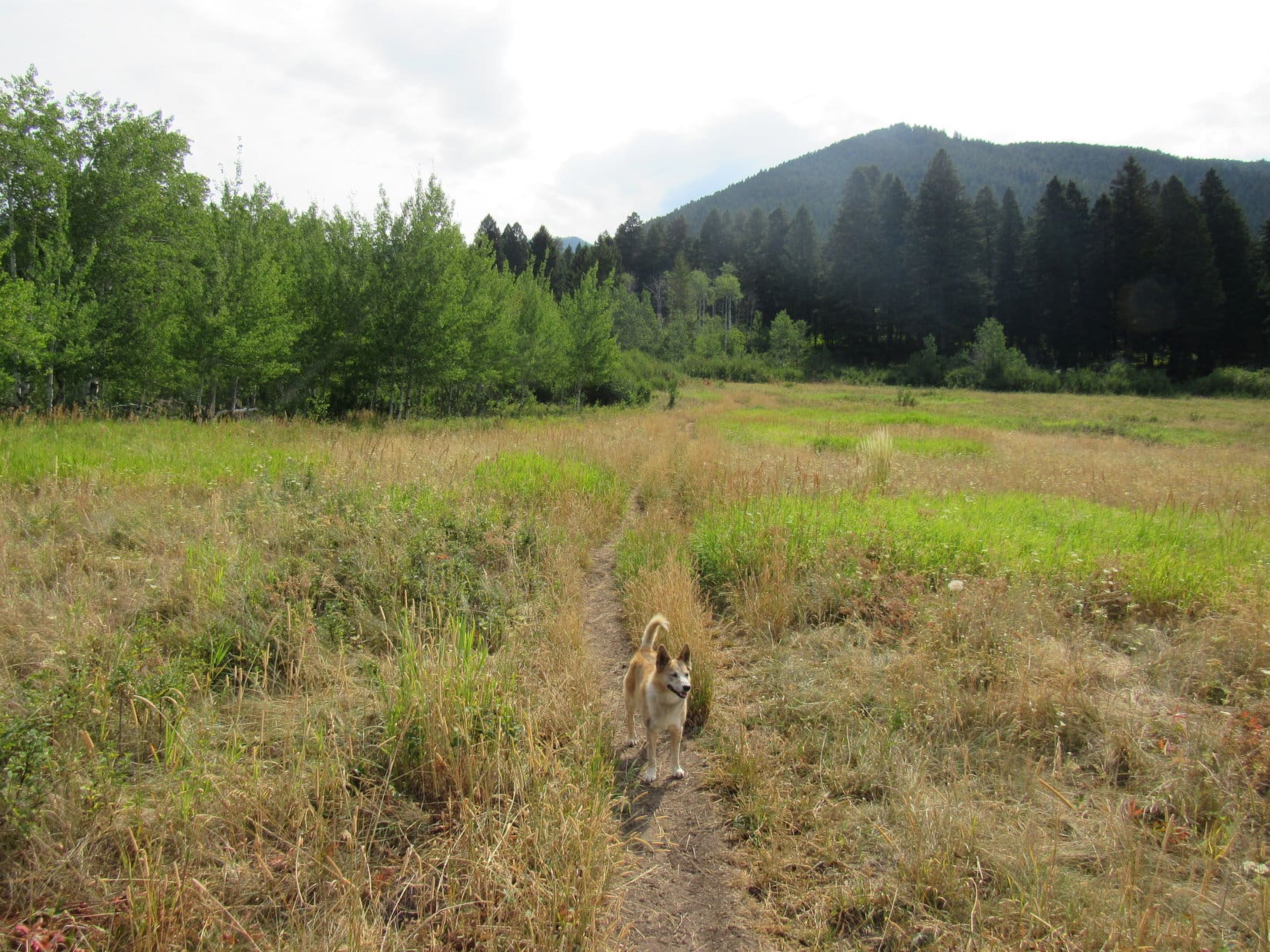
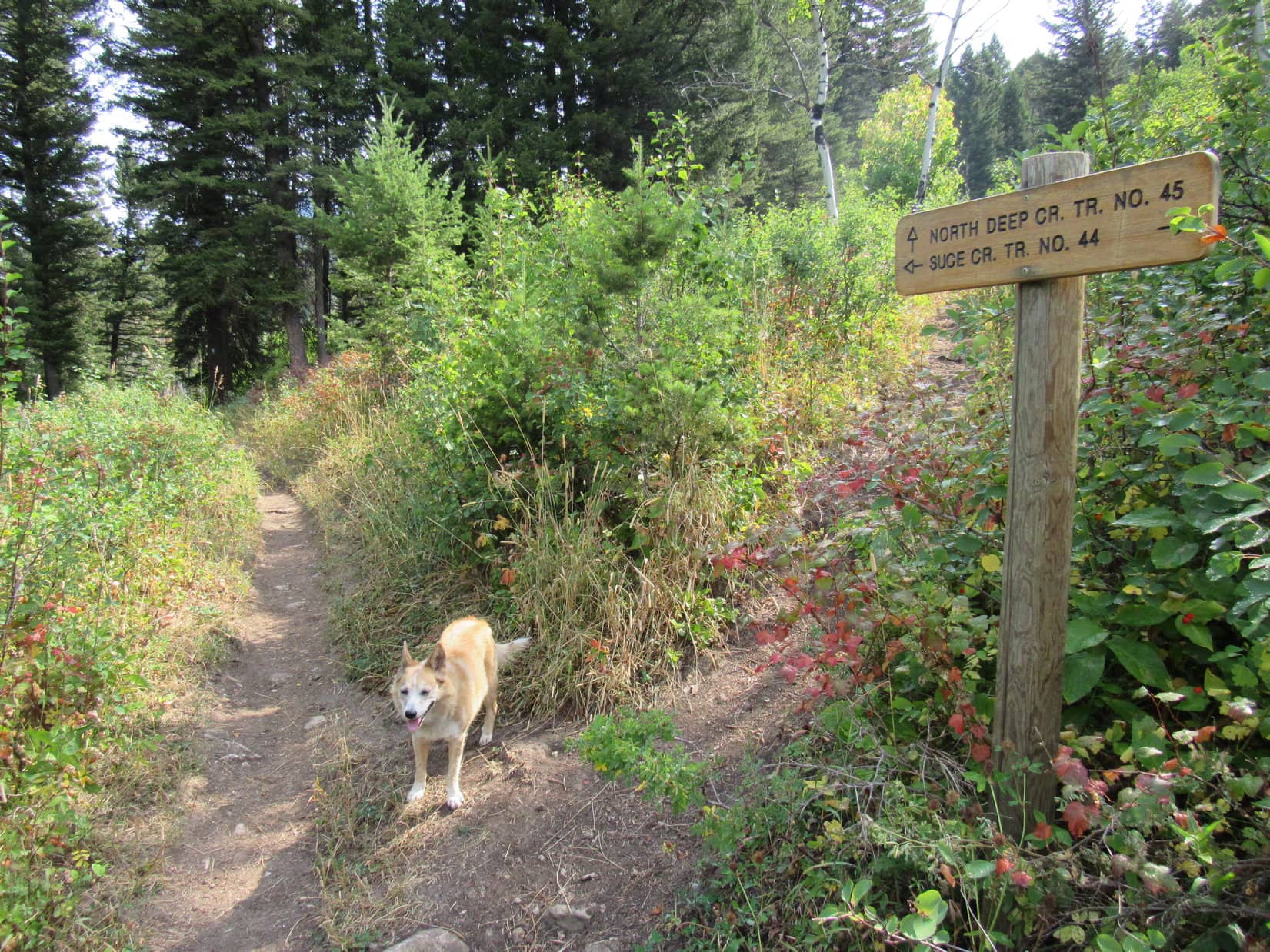
Heading SE, Lupe crossed a meadow. The trail then curved N, climbing into a region of tall bushes. Loop gained 100 feet of elevation before the trail leveled out. Here a junction appeared on the R with North Deep Creek trail No. 45, but the American Dingo ignored it and went on.
Crossing the first meadow. HP7290 (R). Photo looks SE.At the junction with N Deep Creek trail No. 45, which Lupe didn’t take. Photo looks NE.
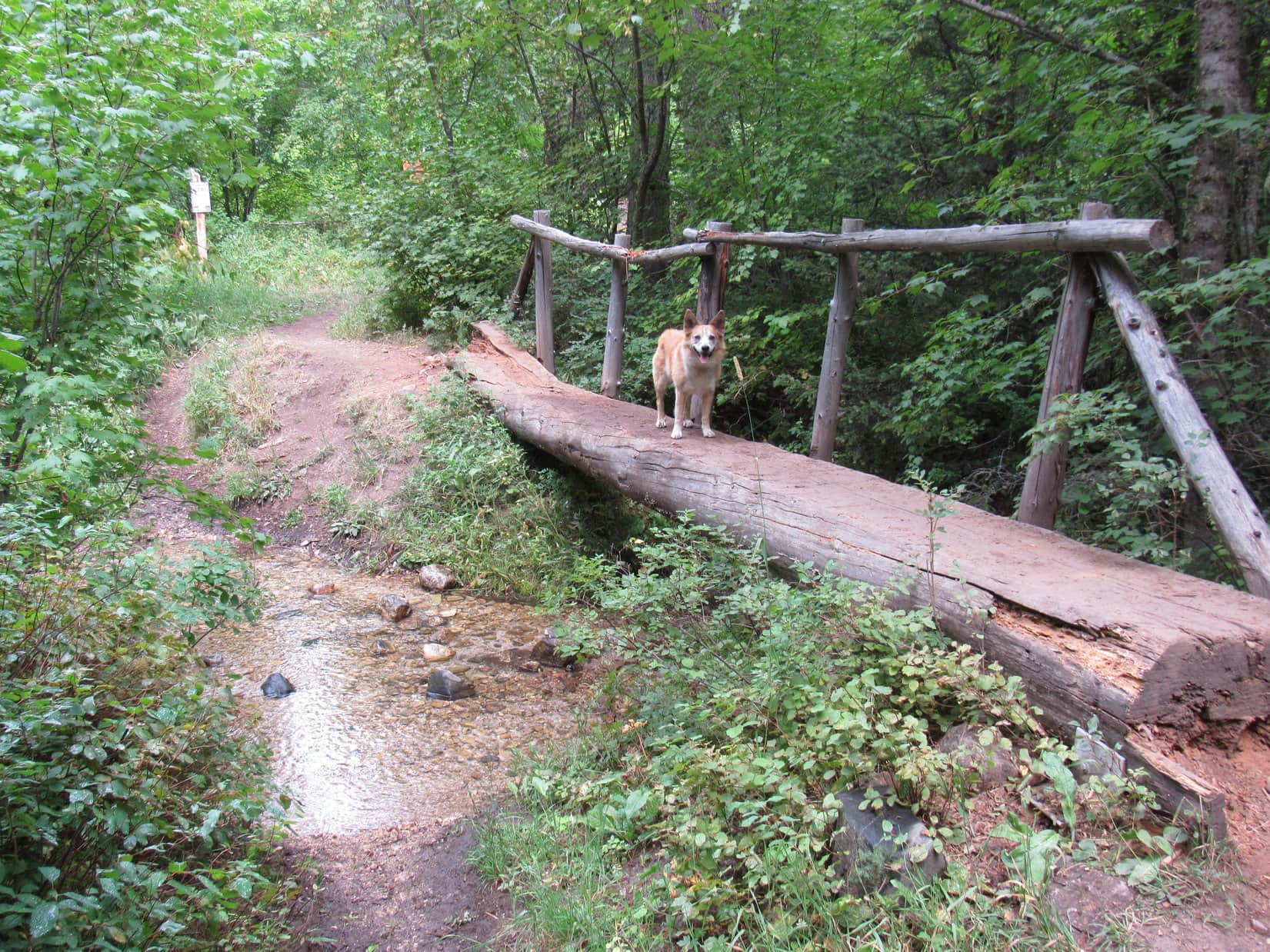
The Suce Creek trail soon curved back to the W and started downhill. After losing 280 feet of elevation, Lupe came to a large half-rotten log with a wooden handrail serving as a bridge over a small stream.
Crossing the log bridge.
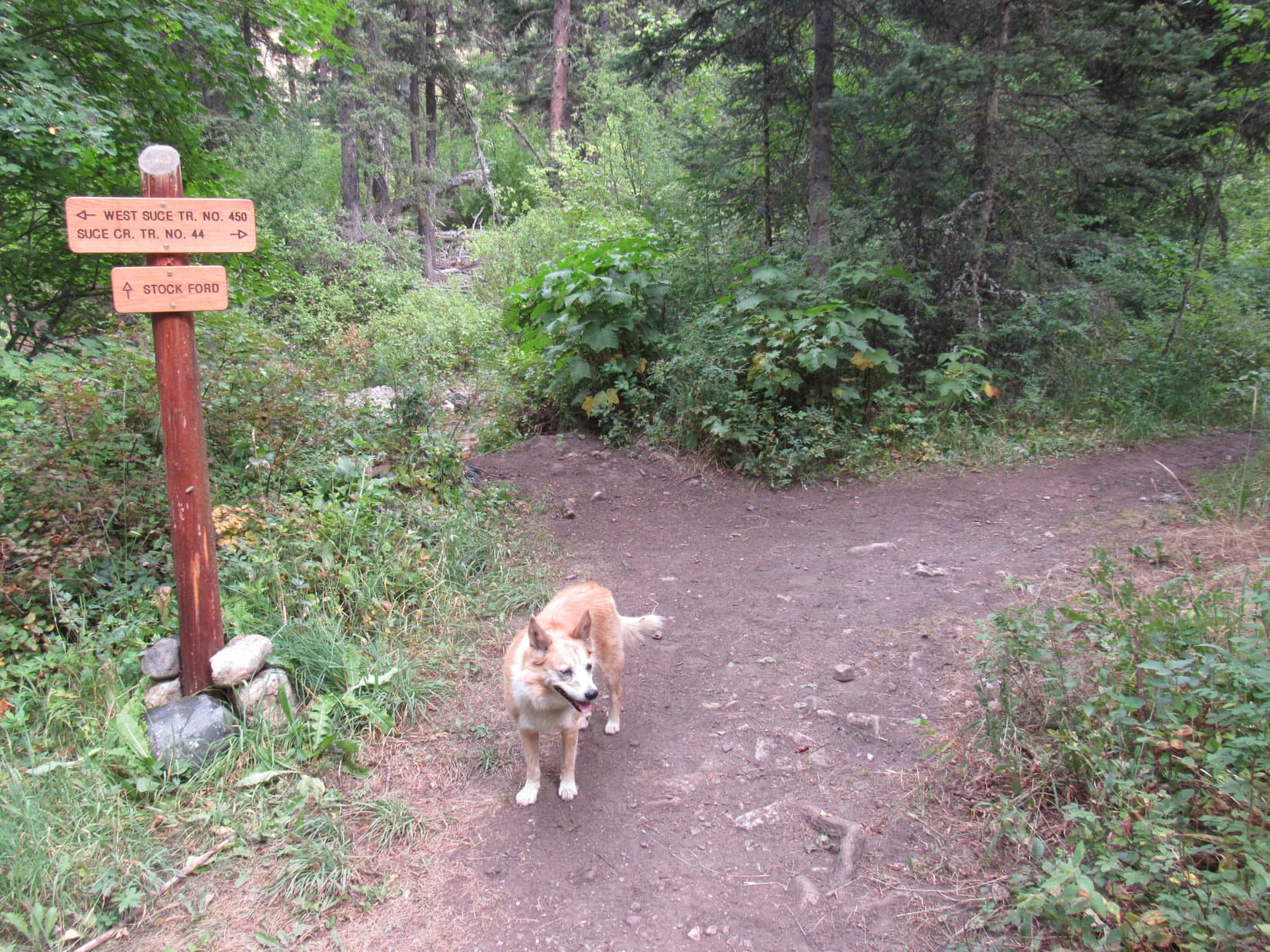
Just beyond the log bridge was another trail intersection, this time with West Suce Creek trail No. 450, which went off to the L. Directly ahead was Suce Creek itself. Lupe went R, sticking with Trail No. 44.
Intersection of Suce Creek trails No. 44 and No. 450.
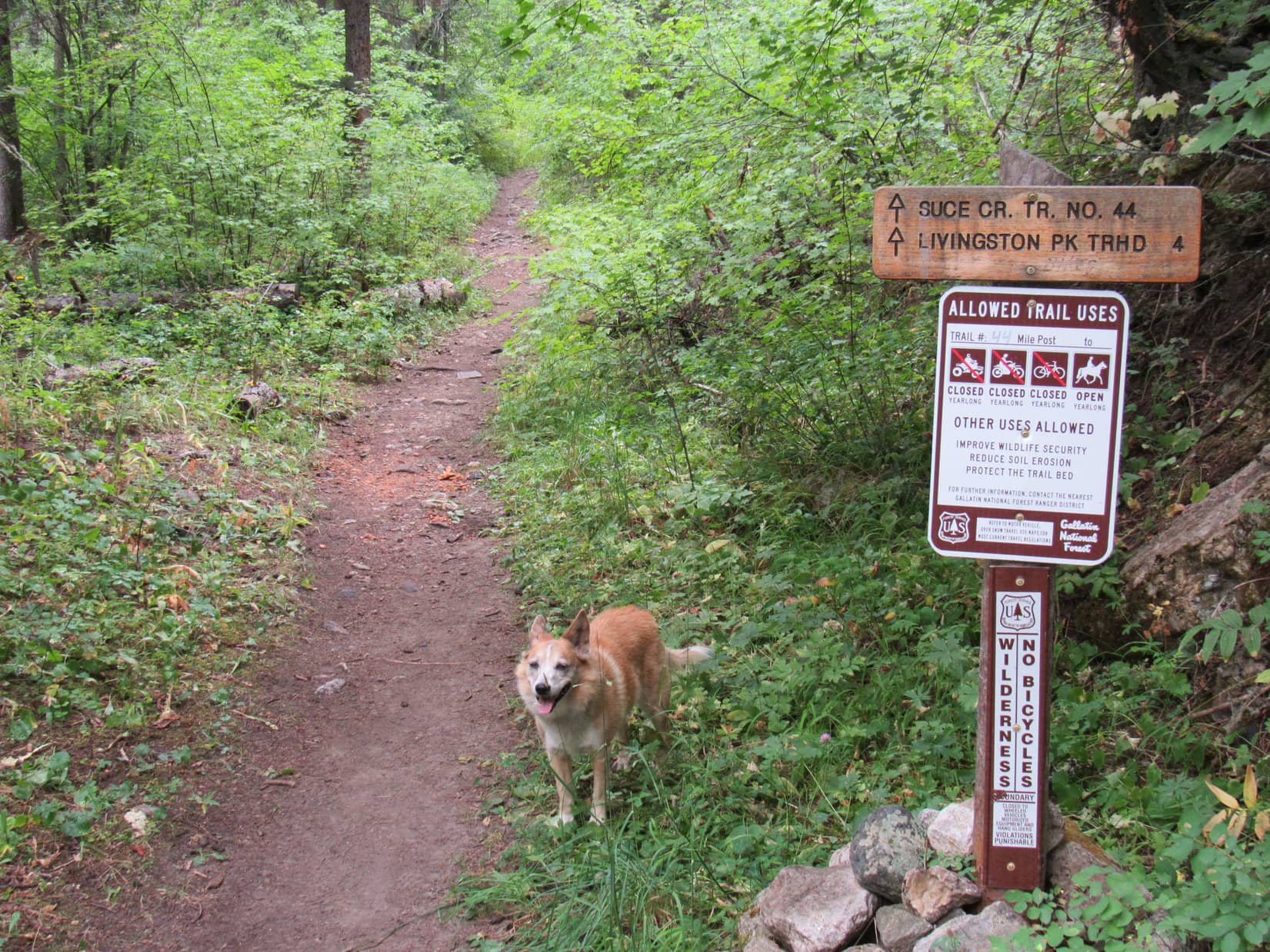
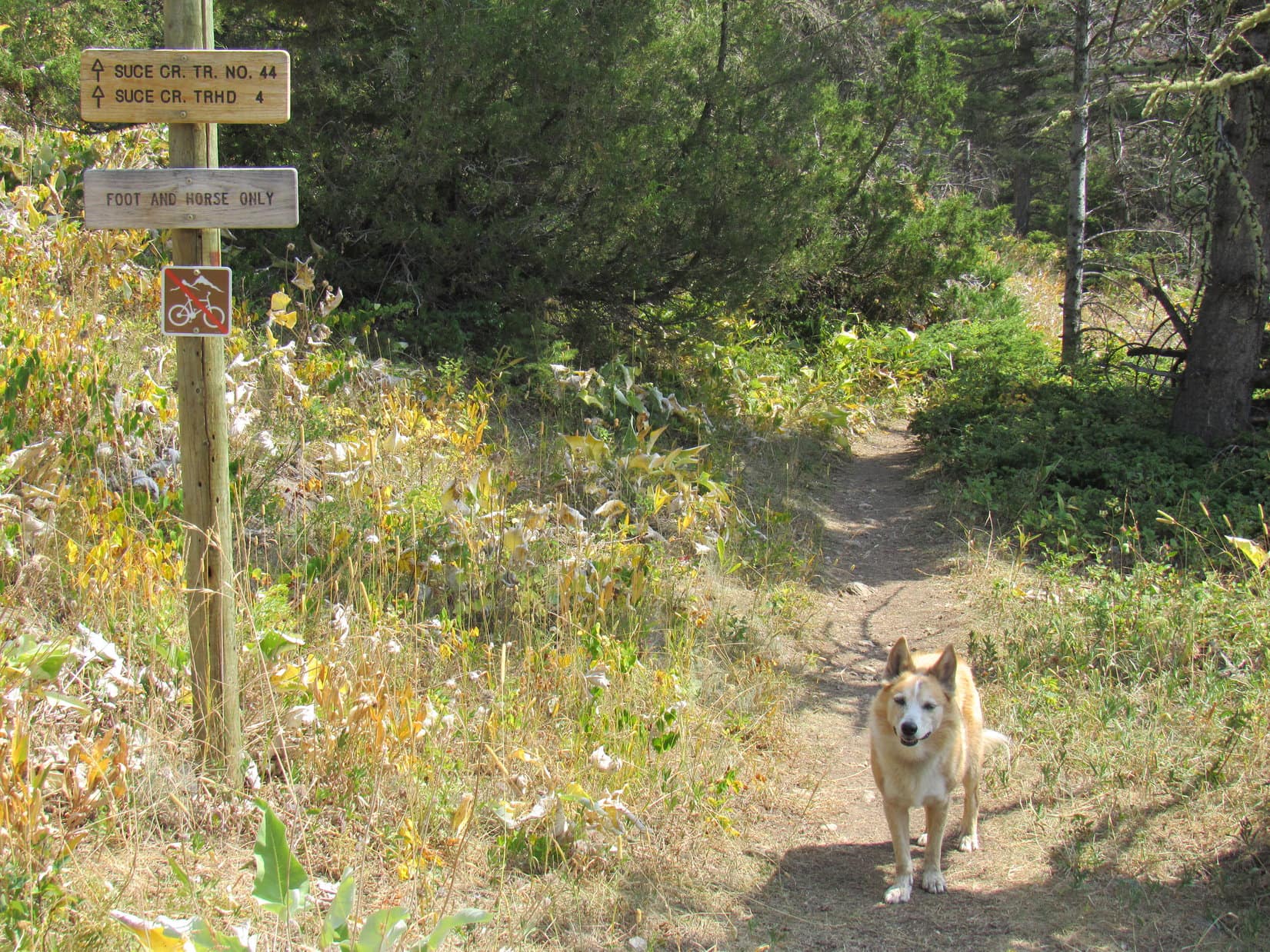
Staying SE of Suce Creek, the trail went NE up a long leafy valley. Due to the dense vegetation, Suce Creek was often heard, but seldom in sight. Before long, Lupe started coming to more signs. The first one mentioned an actual Livingston Peak trailhead 4 miles ahead. 9 or 10 minutes past this sign the trail forked.
The L branch quickly led to a bank overlooking Suce Creek where the trail simply ended, apparently eroded away. Returning to the R branch, there was a small “NF TRAIL” sign. Loop continued on this way.
On leafy Suce Creek trail No. 44. Photo looks NE.Maybe there’s a shorter way to Livingston Peak, SPHP? 4 miles to the official trailhead!The L branch of a fork disappears into Suce Creek.This way, SPHP! Taking the R branch.
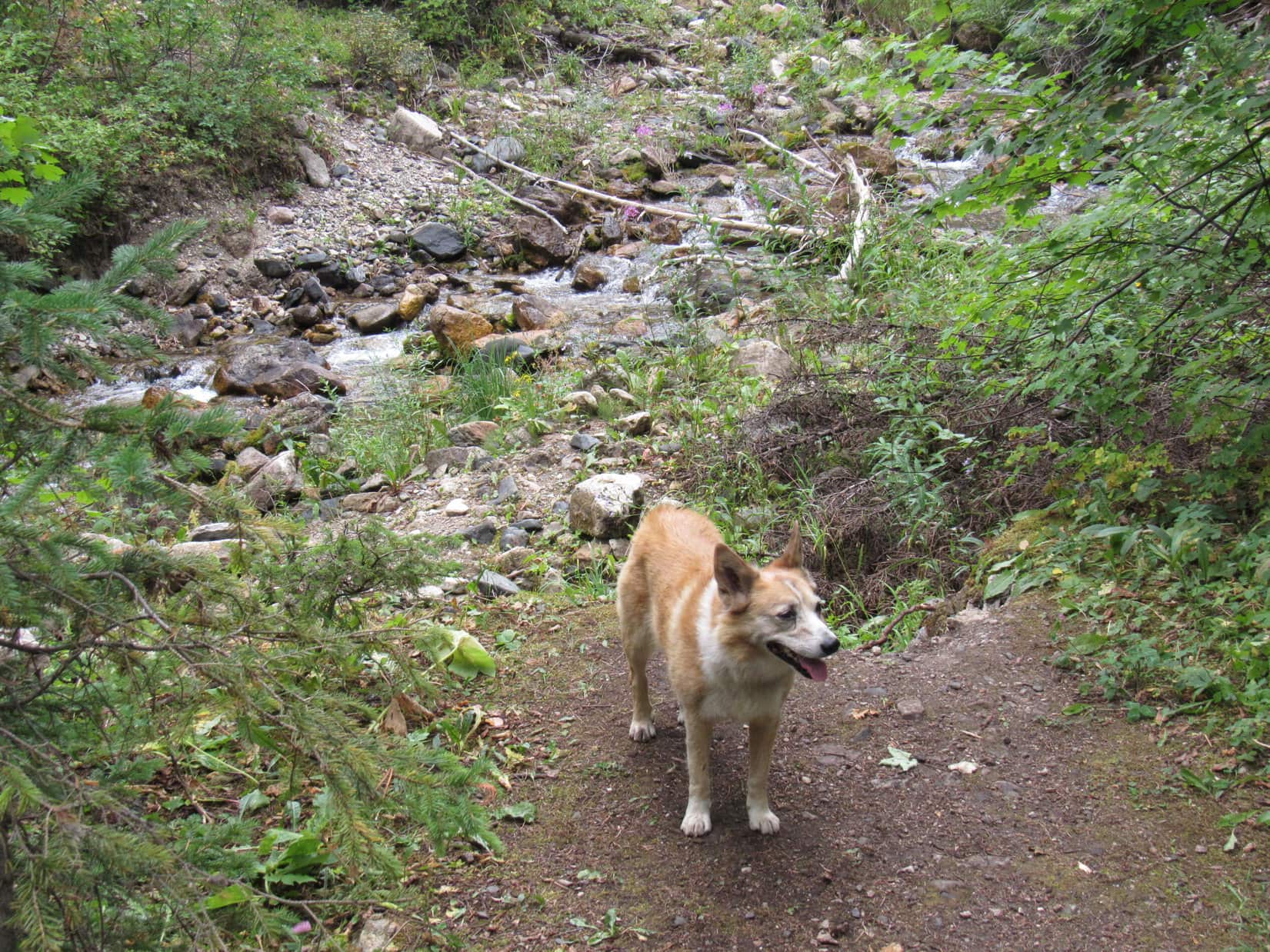
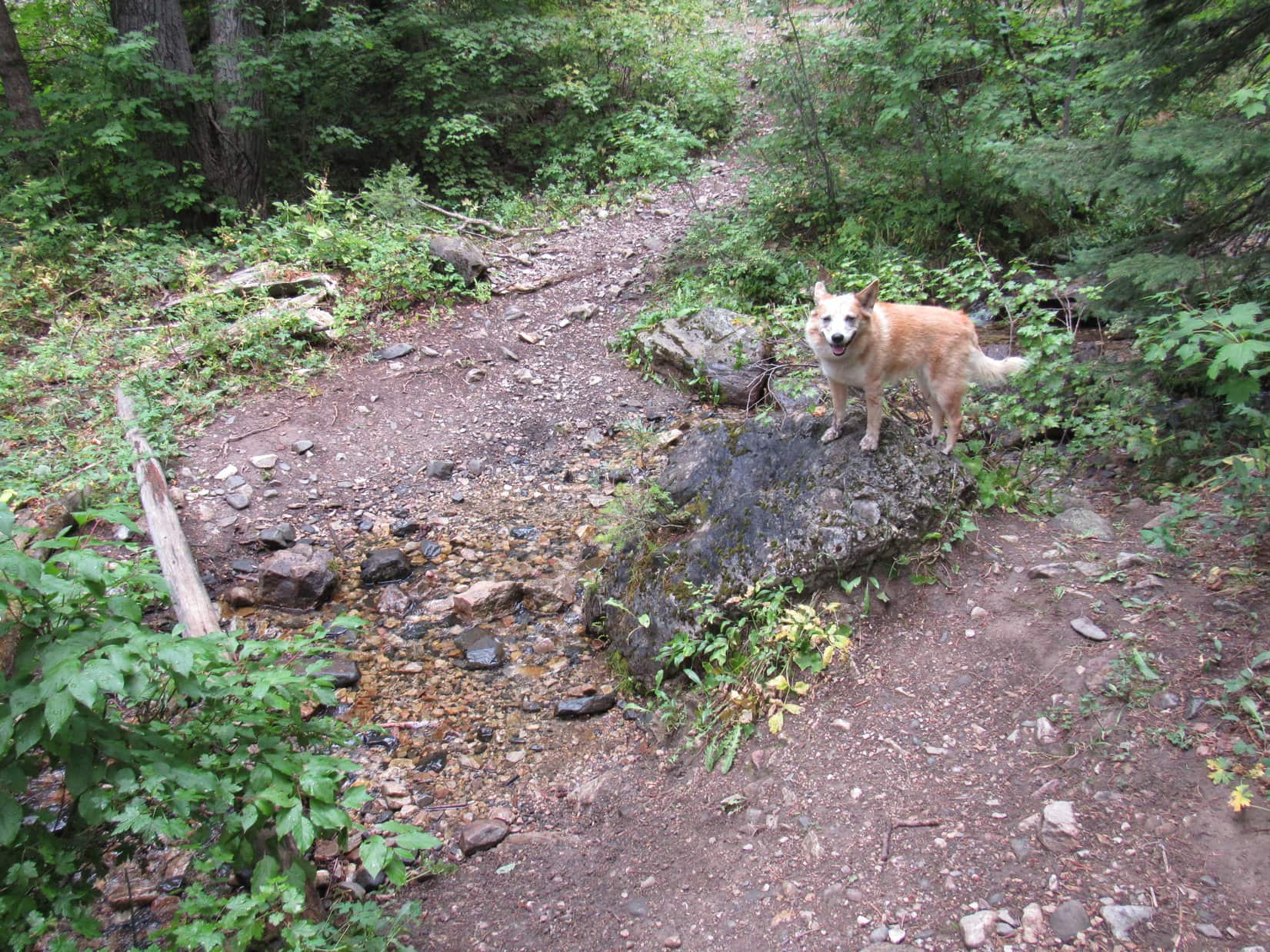
45 minutes from the trailhead, Suce Creek trail No. 44 finally crossed Suce Creek. No bridge here, but the stream was merely a rock hop. Up to this point, Lupe had been gaining elevation quite slowly. However, the incline now steepened somewhat as she started up into the Lost Creek valley.
Lost Creek was just a tiny thing. The trail crossed it several times, often as little more than dry washes, or a mud hole at one point. Farther up the valley, Lost Creek actually had better flow. 45 minutes after crossing Suce Creek, Lupe crossed Lost Creek at a point where the stream was deepest, which still wasn’t saying much.
Fording Suce Creek.Lost Creek is looking pretty good here! A mighty 2 inches deep!
Beyond this final Lost Creek crossing, Trail No. 44 left the valley floor. Lupe climbed a short, steep slope. Curving sharply back to the SW, the trail promptly leveled out. Soon occasional breaks in the forest were providing first glimpses of Livingston Peak(9,314 ft.) and Mount Delano(10,138 ft.).
At the start of a long switchback reached after crossing Lost Creek. Photo looks SW.A glimpse of Livingston Peak (L). Photo looks ESE.Mount Delano (L). Photo looks S.
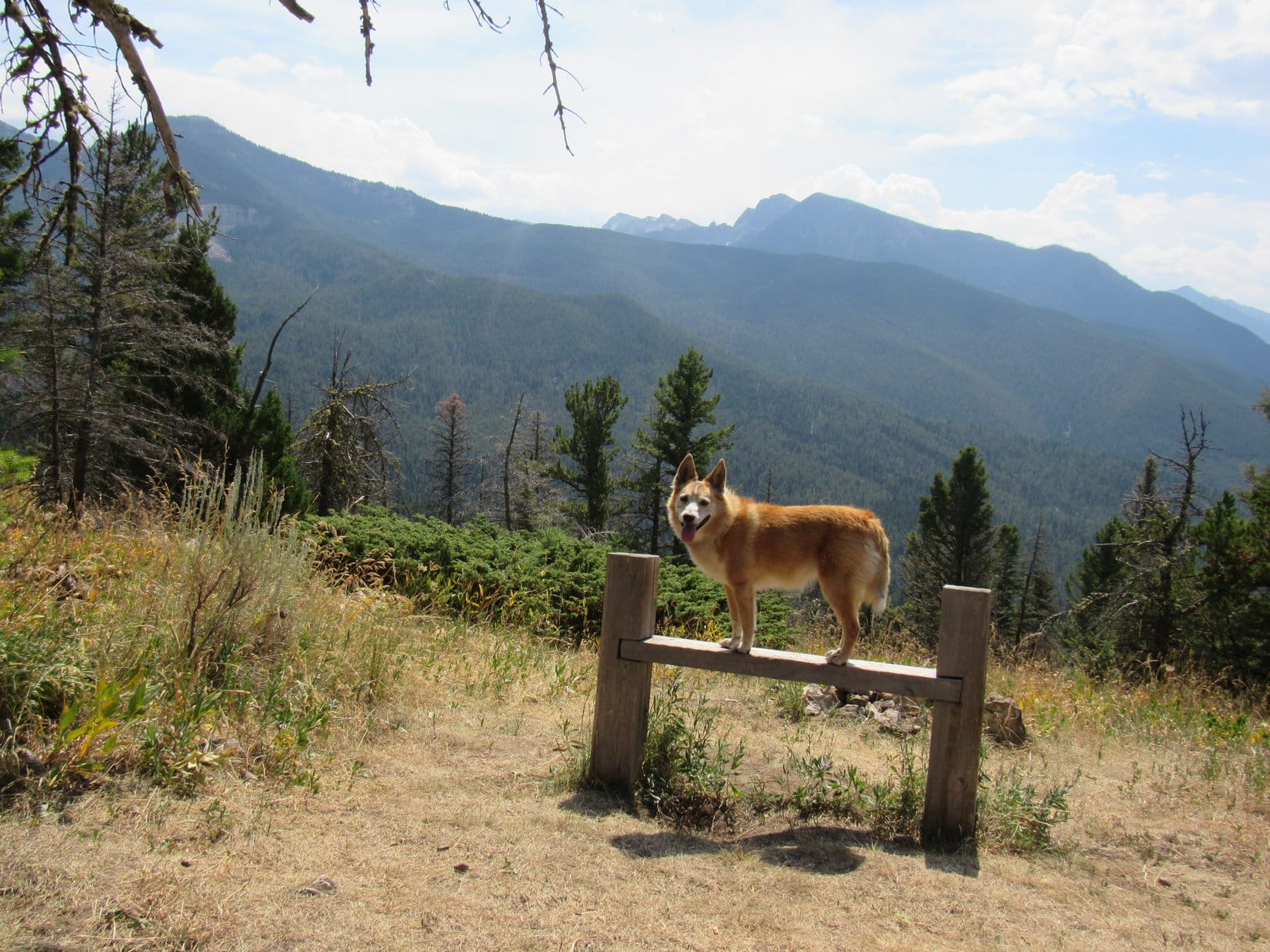
Loopster followed this nice, flat switchback for 0.5 mile before reaching a clearing at Pass 6420. A crude wooden bench offered a good view of Mount Delano. The top of what might have been Mount McKnight(10,310 ft.) was even in sight.
Arriving at a big clearing 4 miles from the Suce Creek trailhead. Photo looks E.Mount McKnight (?) (Center), Mount Delano (R). Photo looks SSE.
This clearing was a major intersection with a number of other trails. The upper end of West Suce Creek trail No. 450 went off to the SW from here. Just around a corner to the NE, was a spur going NW to the official Livingston Peak trailhead. Lupe had no reason to visit that destination, though. Instead she headed NE on Livingston Peak trail No. 449.
About to start up Livingston Peak trail No. 449. Photo looks NE.
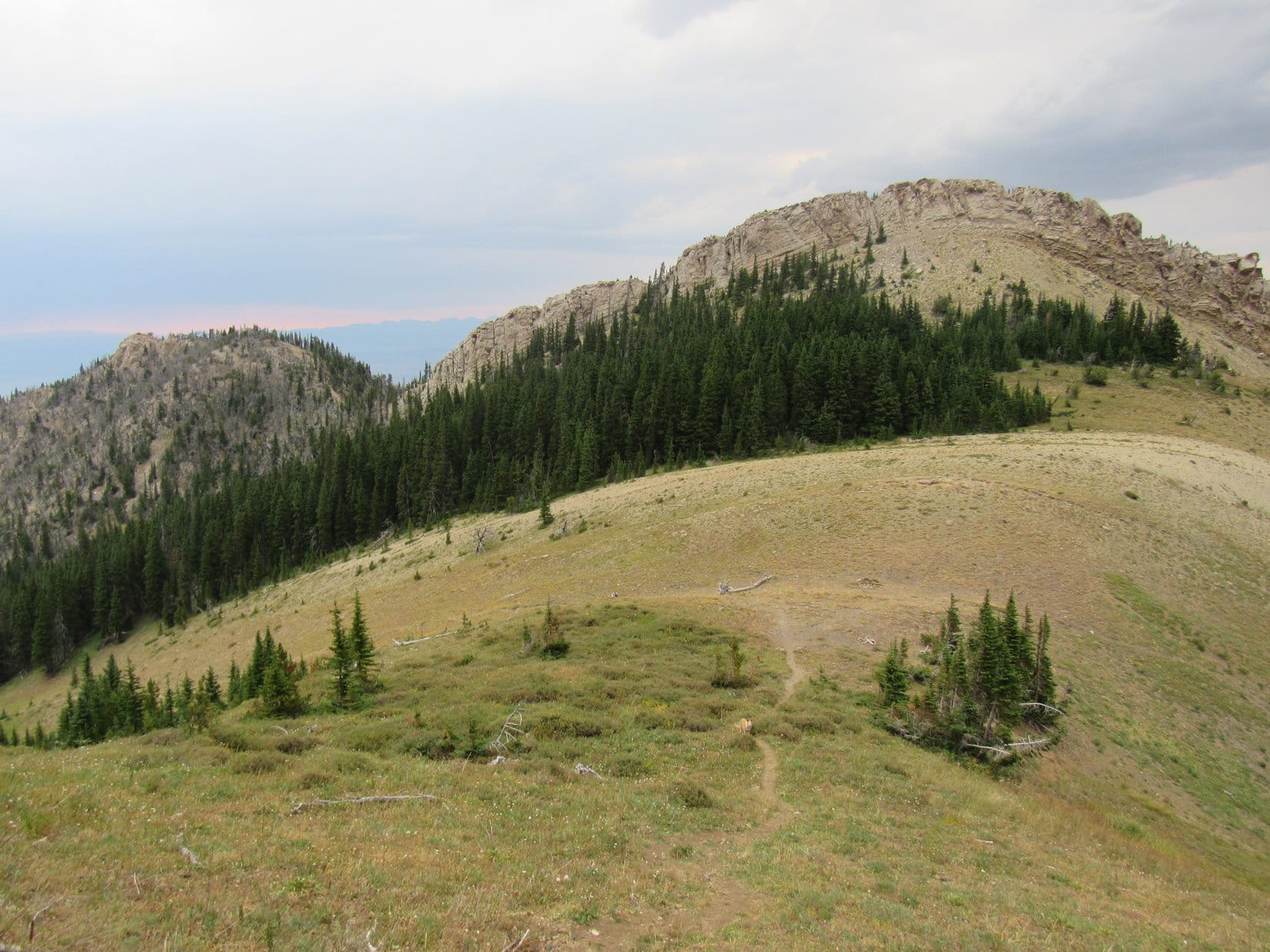
Lupe had traveled 4 miles in 2 hours to get to the clearing, but only had a net gain of 800 feet of elevation to show for it. Still 3,000 feet to go! Even so, the first part of the Livingston Peak trail still wasn’t steep. The trail wound NE on a broad, forested ridge gaining elevation at an easy to moderate pace.
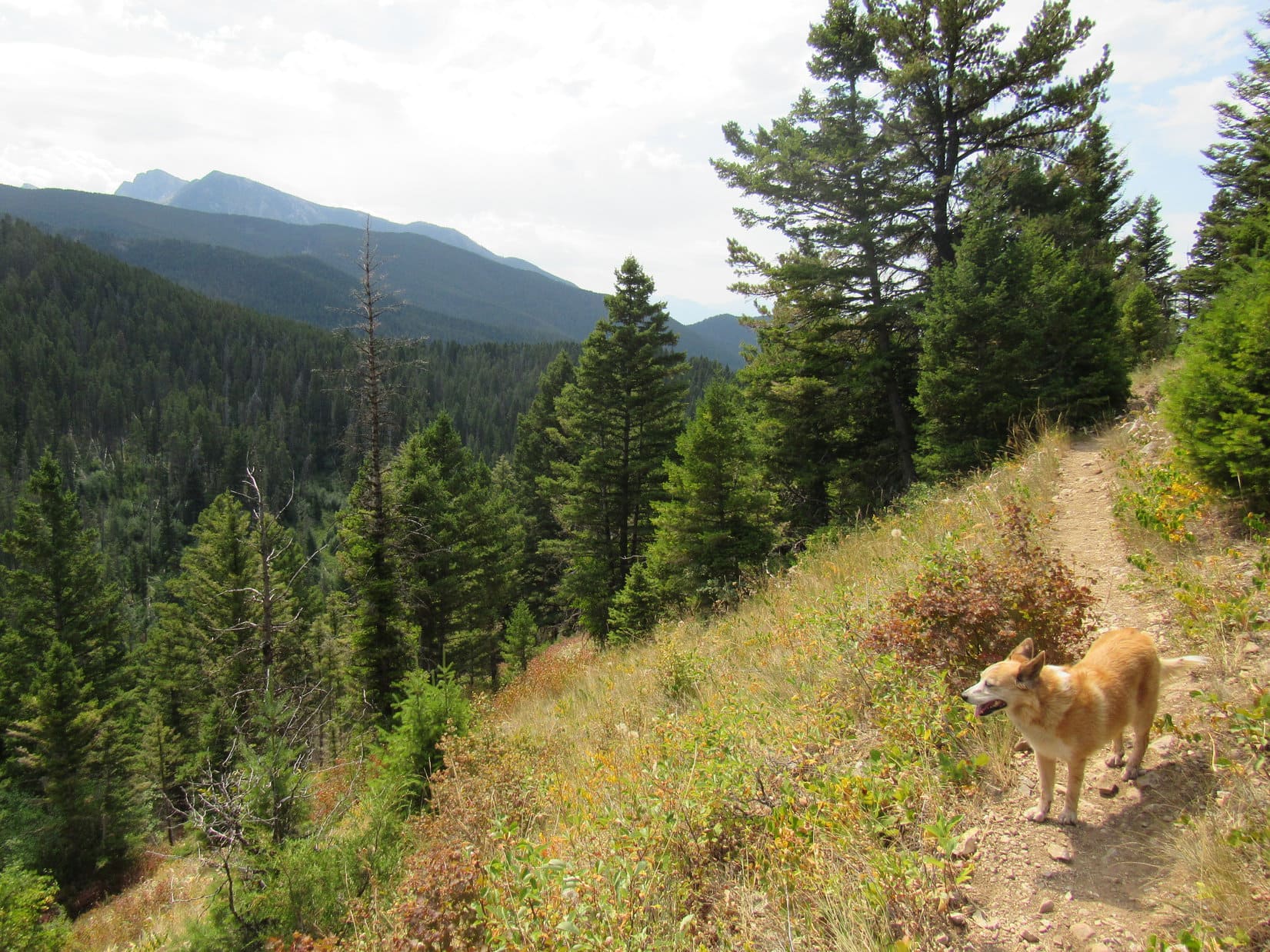
SPHP began hearing a sound like the faint jingling of bear bells, but Lupe seemed oblivious to it. Turned out that the sound was actually water trickling through a rusty 4″ diameter pipe half buried along the edge of the trail. This pipe followed the trail for quite a long way, even after the trail left the ridge to traverse the same steep slope Lupe had been on earlier, but now well above that first long switchback.
From up here, Lupe had a much better view of Livingston Peak.
Livingston Peak from the upper switchback. Photo looks E.
This upper switchback was also long and flat. Easy traveling! Loopster made rapid progress. Soon she could see a big rock formation 1.5 miles off to the ENE. Checking the topo map, SPHP suspected Pass 8300 was over in that vicinity.
On the also easy, upper switchback. Photo looks NE.Pass 8300 is up next to the big rock formation (Center). Photo looks E.
Continuing NE, the terrain was changing. Somewhere along the way, Lupe left the moss-covered water pipe and upper switchback behind, as the steepness of the slope the trail was on began to decrease. The trail eventually turned E, crossing a fairly large meadow before returning to the forest where the Carolina Dog went over minor Pass 7060.
On the E side of Pass 7060, Livingston Peak trail No. 449 curved N, but soon gradually swung around to the E, then SE. For a little way, Lupe was on the NE side of the upper Lost Creek drainage. As soon as the trail dipped to cross the dry stream bed, the situation changed.
Up to this point, both the Suce Creek and Livingston Peak trails had been easy to moderate (at worst) climbs virtually the entire way. The couple of long switchbacks had been been quite flat, and beyond Pass 7060 there had been a stretch where Lupe had even lost a little elevation. However, on the SW side of Lost Creek, Trail No. 449 started climbing much more aggressively, pinned tightly between a steep forested slope and the creek bed.
On the NE side of the valley, large rock formations formed the crest of a long ridge rising to the SE.
Rock formations seen shortly before crossing upper Lost Creek. Photo looks N.SW side of Lost Creek. The trail starts climbing much more aggressively here.
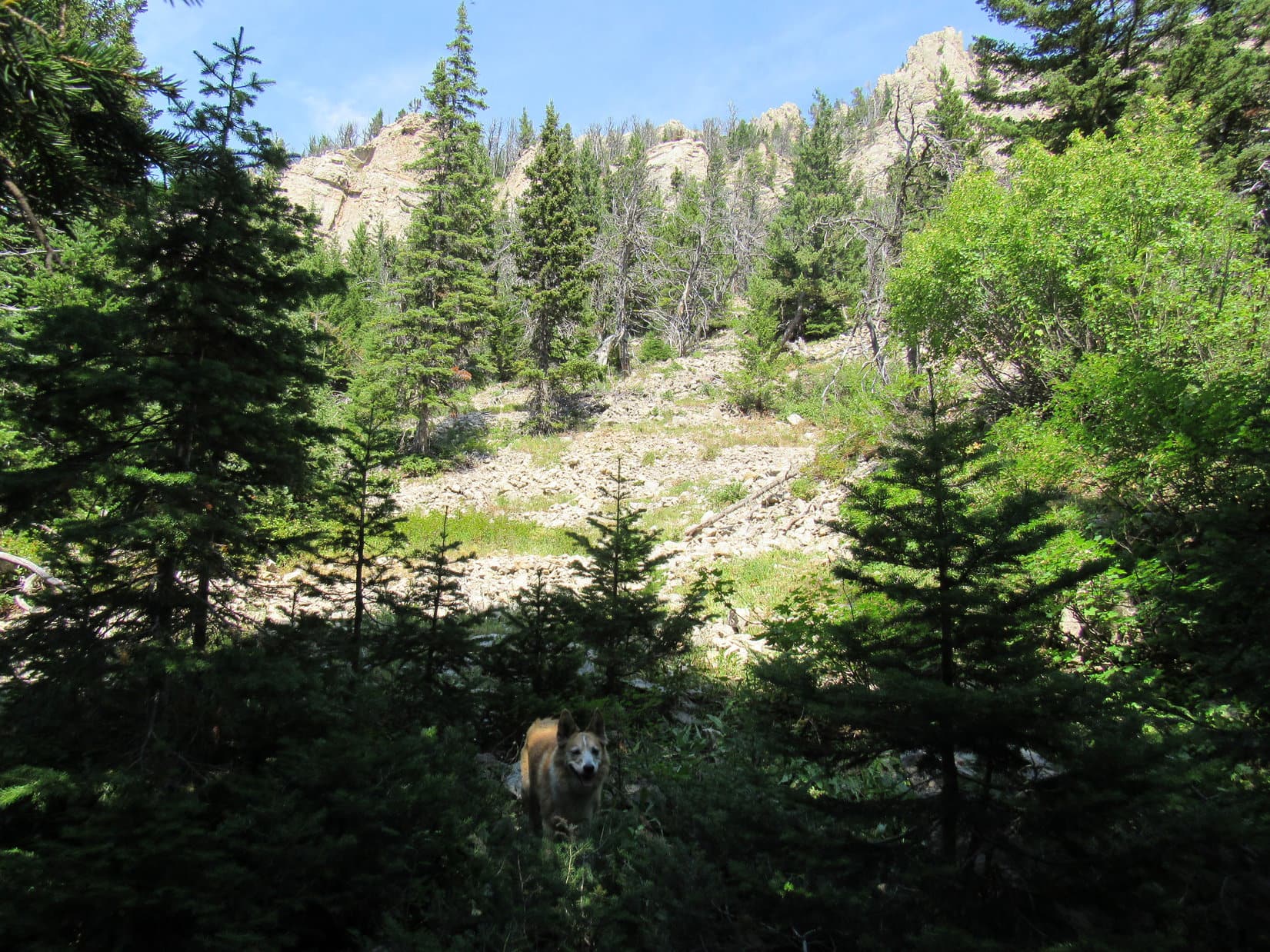
At first, Lost Creek seemed to be completely dry this high up, but that wasn’t entirely true. Now and then a trickle of water surfaced, enough for Lupe to get a drink, but little more than that. The trail soon crossed back over to the NE side of the valley, where it remained from then on continuing relentlessly higher. Meanwhile, views of the rocky ridge to the NE became more and more impressive.
HP7623 (L) and the ridge of rock NE of the trail (R). Photo looks NNW.Seems like we’re finally starting to get somewhere! Photo looks NNW.Can’t be too much farther to Pass 8300! Photo looks SE.
The last water in Lost Creek was seen right before the trees gave out. Ahead, a meadow stretched all the remaining distance up to Pass 8300. Another 200+ feet of elevation gain ought to about do it!
Pass 8300 (Center) appears ahead. Photo looks SE.
Pass 8300 was a broad grassy region. A large cairn sat out in the middle of it. Although the topo map showed a trail continuing over the SE side of the pass into East Baldy Basin, Lupe saw no sign of it. The view of the canyon on the other side was impressive, though, and so was the sight of a massive forested slab of rock on Livingston Peak’s N slope.
The N side of Pass 8300 was bordered by a grassy hill topped by a strip of forest above which a distinctive crest of solid rock curved like the brim of a giant old-fashioned bonnet. Back to the NW was a hazy view of Livingston, Montana, fully 3,800 feet lower way down in the Yellowstone River valley.
Looking over Pass 8300. Photo looks SE.N slope of Livingston Peak. How do trees even survive on that slab of rock with so little soil? Photo looks SSE.By the Pass 8300 cairn. Livingston, Montana is visible down in the Yellowstone River valley beyond Lupe and forested HP7623 (L of Center). Photo looks NW.Pass 8300. Photo looks NNE.
The S side of Pass 8300 was bordered by a steep forested slope. The N face of Livingston Peak(9,314 ft.) looked about 300 feet high, but only part of it could be seen from here. In reality, Loopster still had another 1,000 feet to go. After a short rest break, the American Dingo headed for the trees at the base of the slope.
N face of Livingston Peak from Pass 8300. Photo looks SW.Mission Creek valley (R) from just below the trees S of Pass 8300. HP8460 (Center). Photo looks ENE.Looking back at Pass 8300 before heading up. Peak 8631 (far R). Photo looks NNE.
Fortunately, a use trail went up Livingston Peak’s N face. The slope was so steep that SPHP kept grabbing branches and tree trunks for support, as Lupe charged practically straight up the mountain. Nearly the entire route was forested, but toward the top, the trees shrank in size and began to thin out.
Getting easier! Already a long way up the N slope where the trees start thinning out. Photo looks S.
Rock slides appeared, a few cairns showing the route higher. Above the rocks, Lupe found the trail again on a grassy slope dotted with young pines, but it soon played out, vanishing 50 feet below the top.
By the rock slides. Photo looks SE.Looking down on Pass 8300 (R of Center). Peak 8631 (R). Photo looks NNE.Almost there! Photo looks SE.
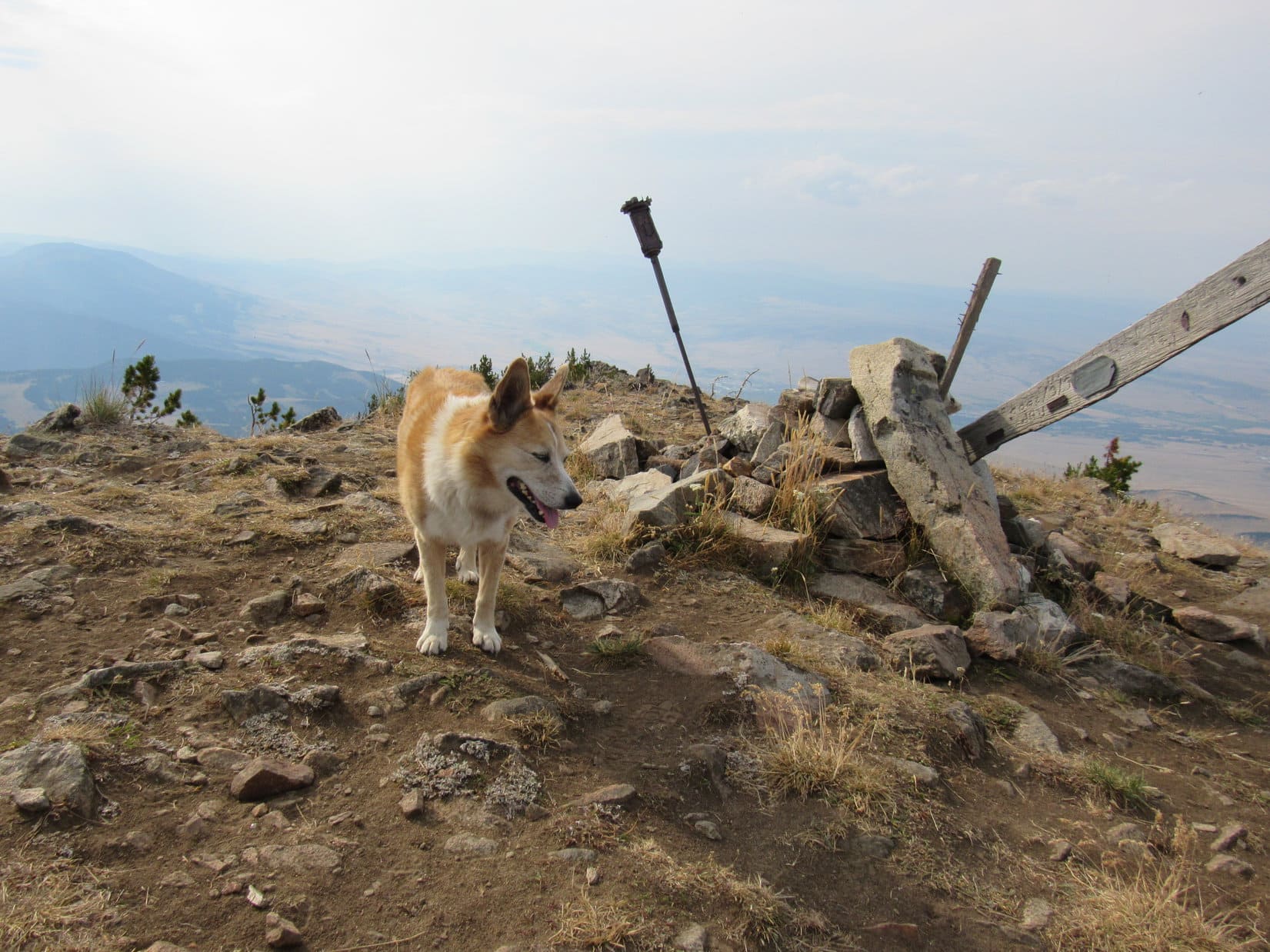
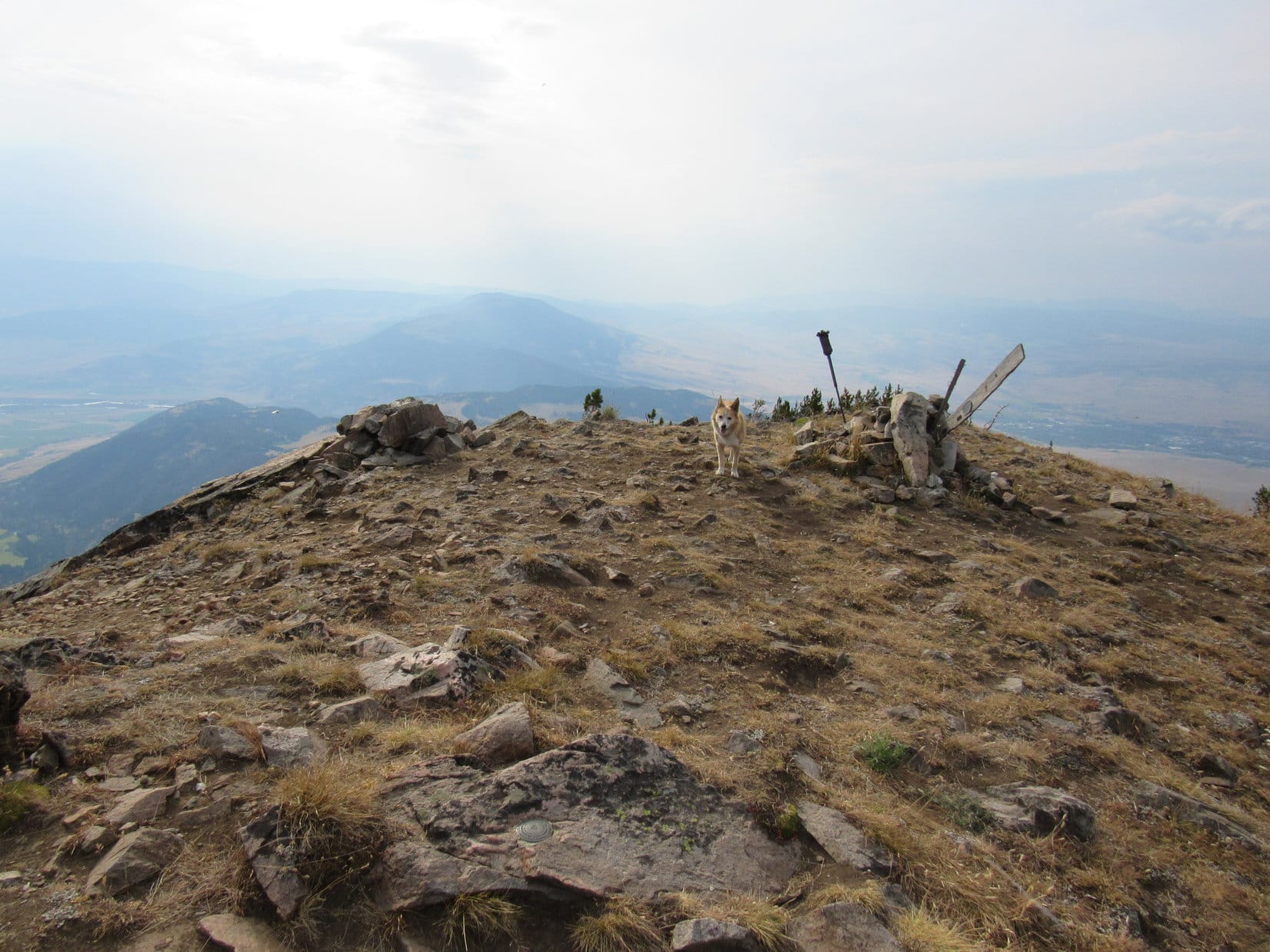
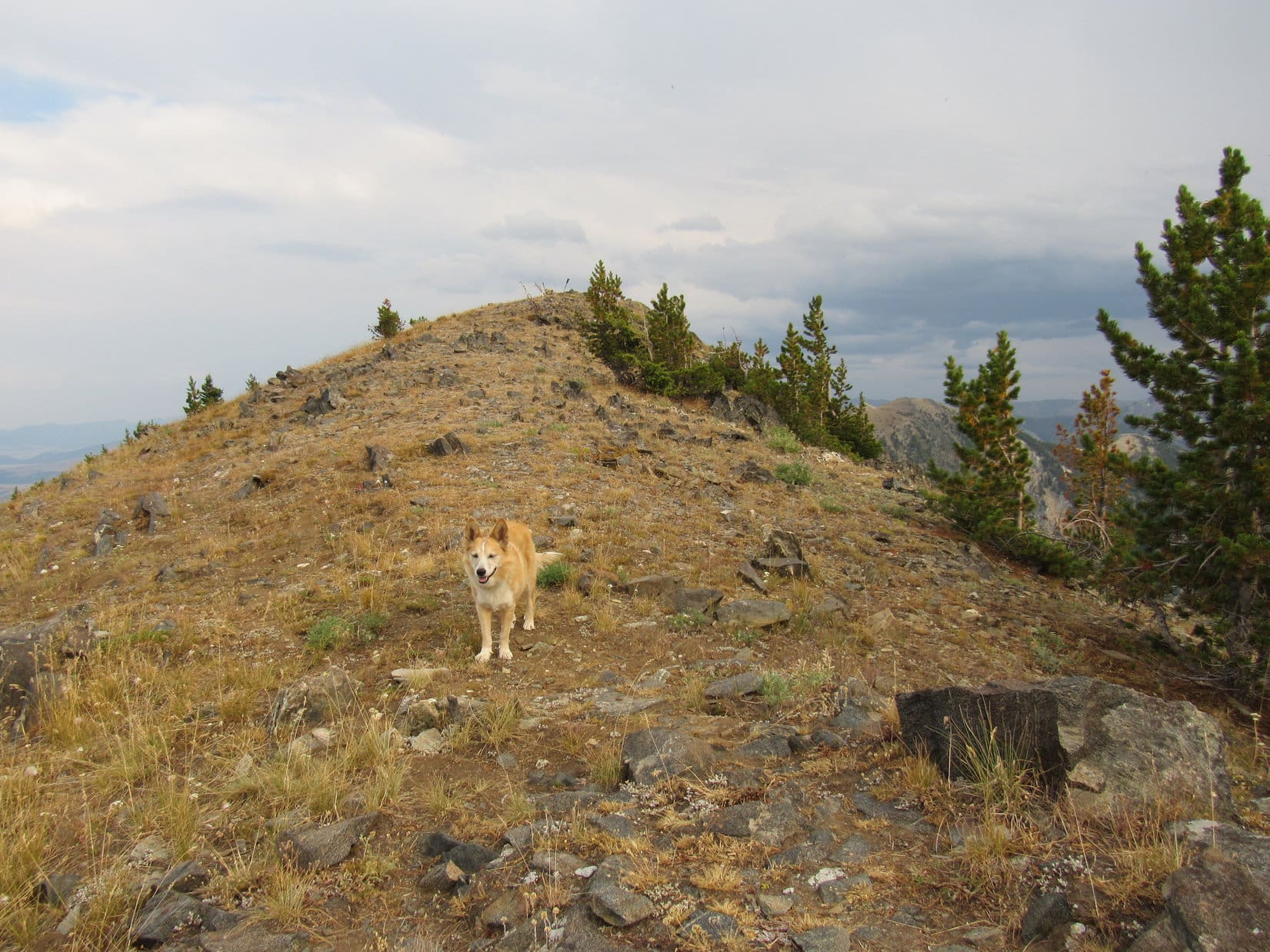
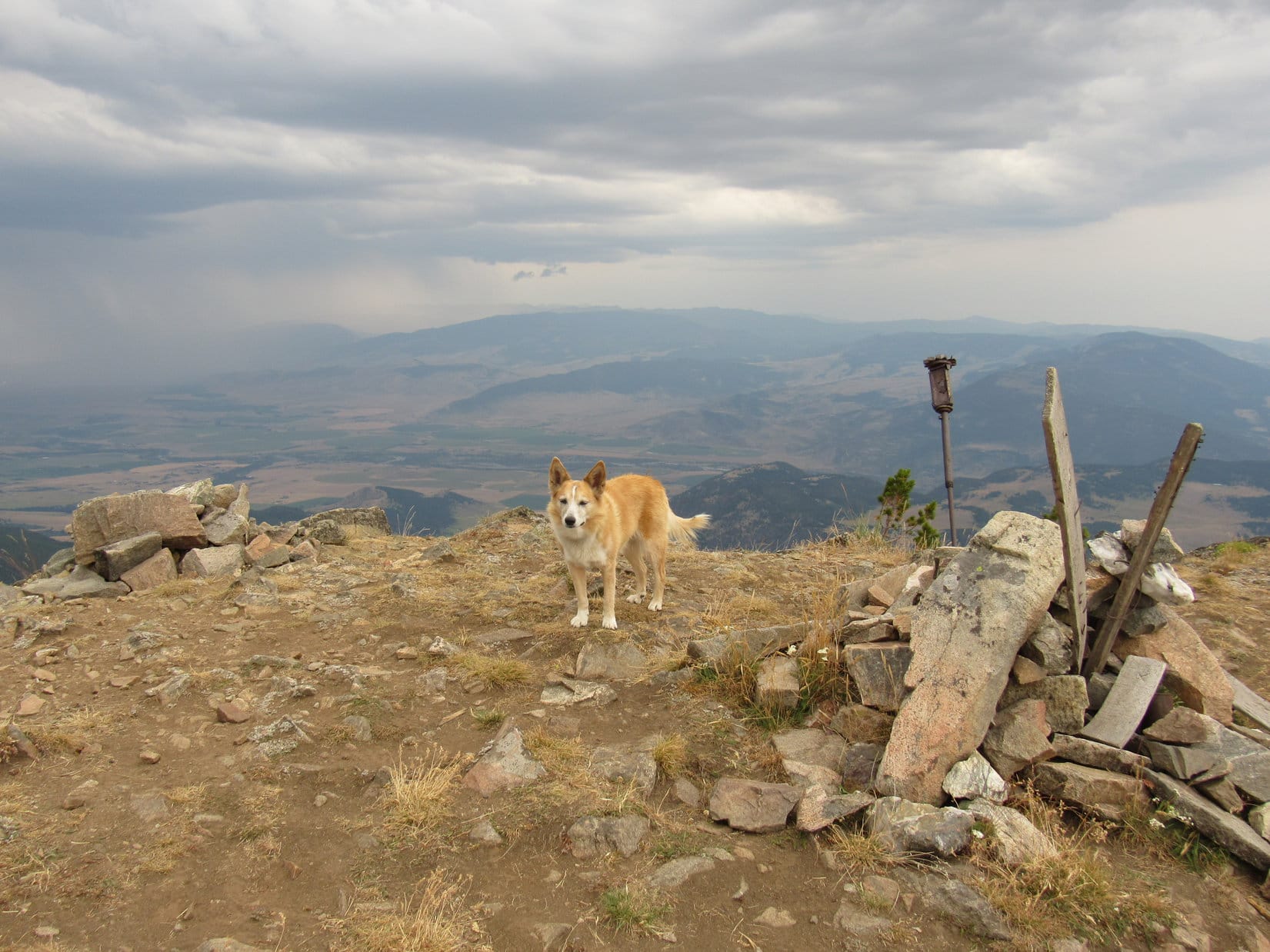
The rest was easy! Lupe reached a stony NW/SE oriented summit ridge. A cairn with boards and a metal pole sticking out of it at weird angles was visible a short distance to the SE. From the cairn, the true summit appeared to be over at a collection of rocks 25 or 30 feet farther SE, but they were only marginally higher.
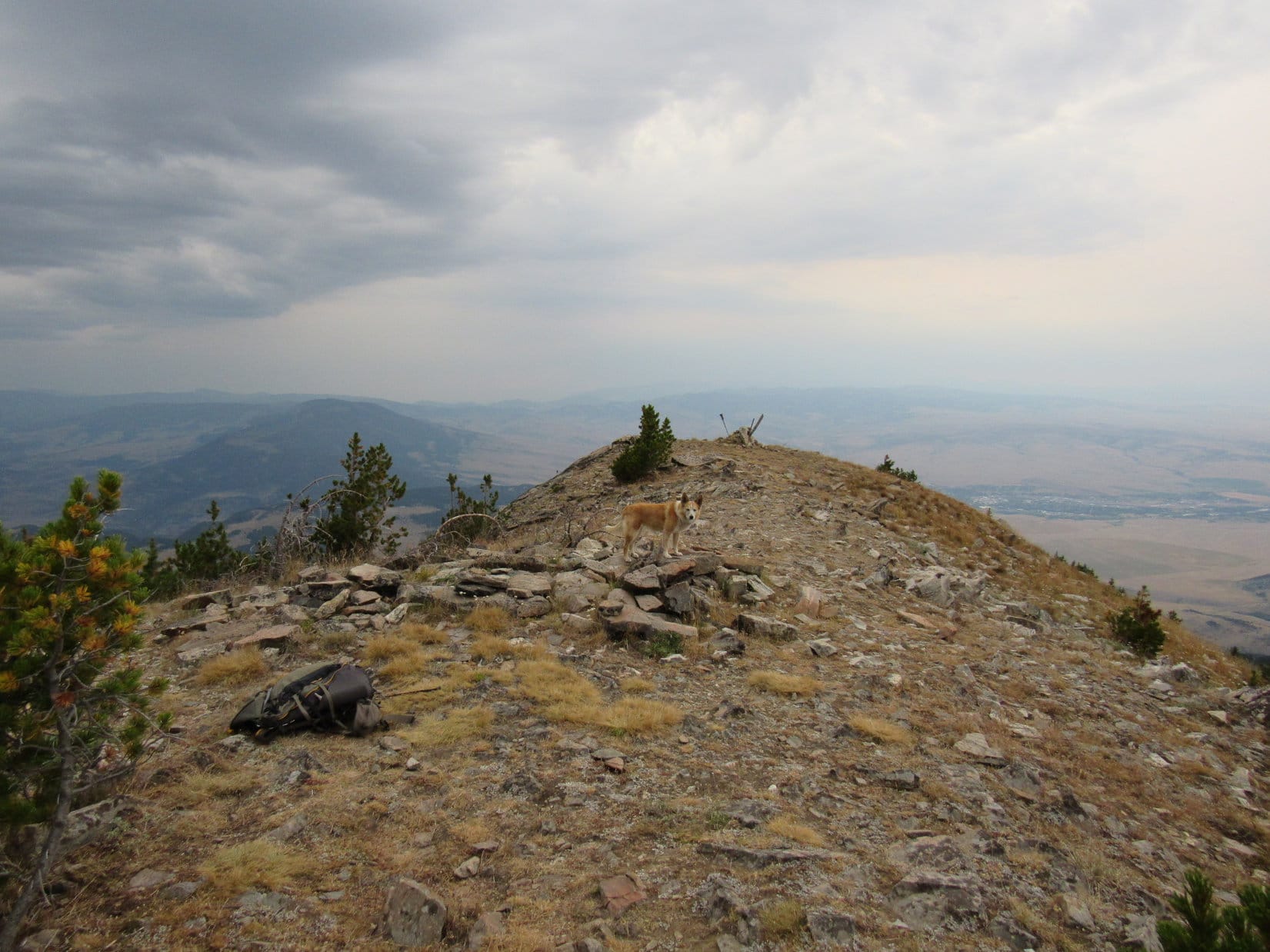
Made it! On the summit ridge. Photo looks SE.By the oddly decorated cairn. Photo looks NW.
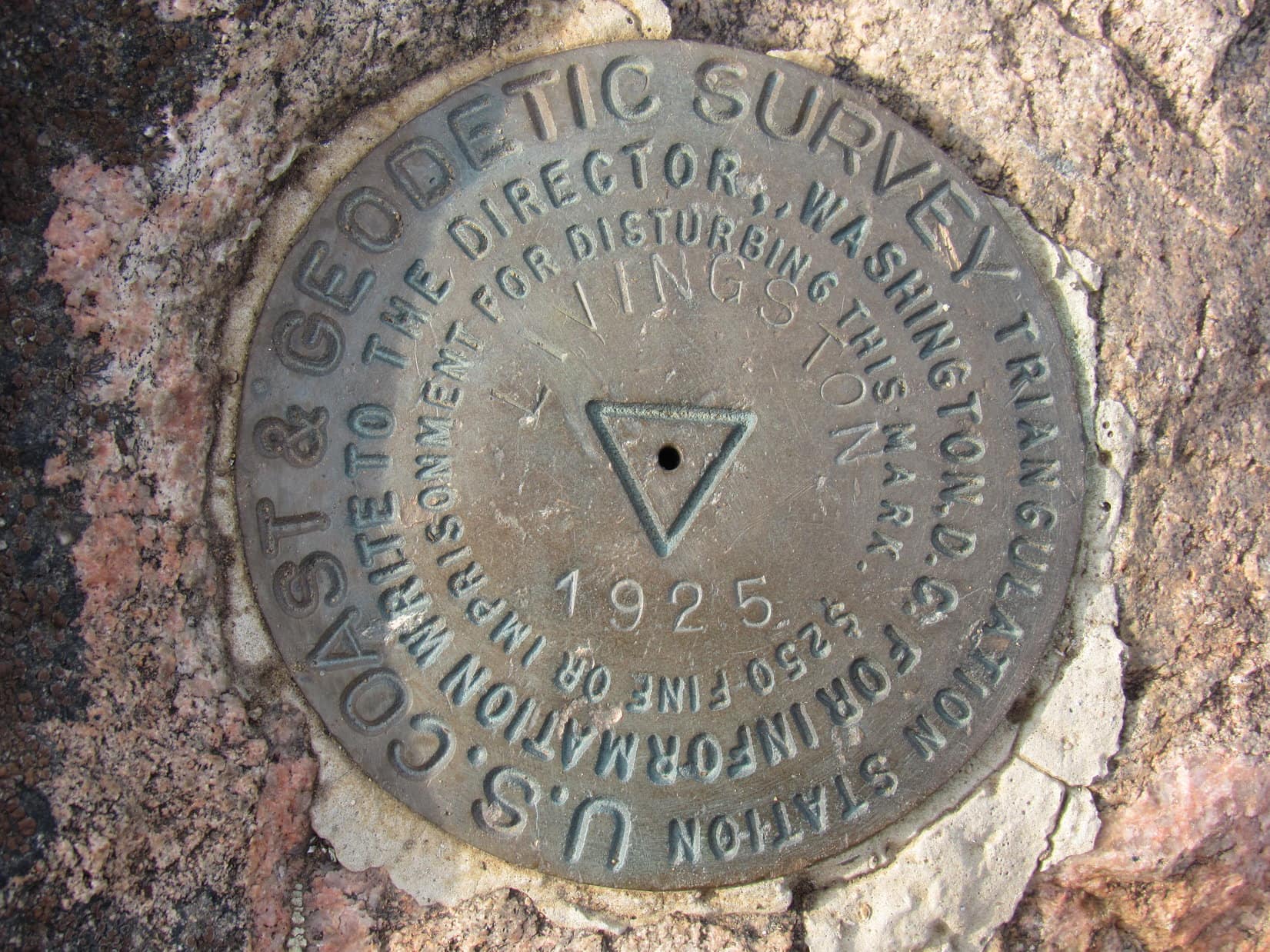
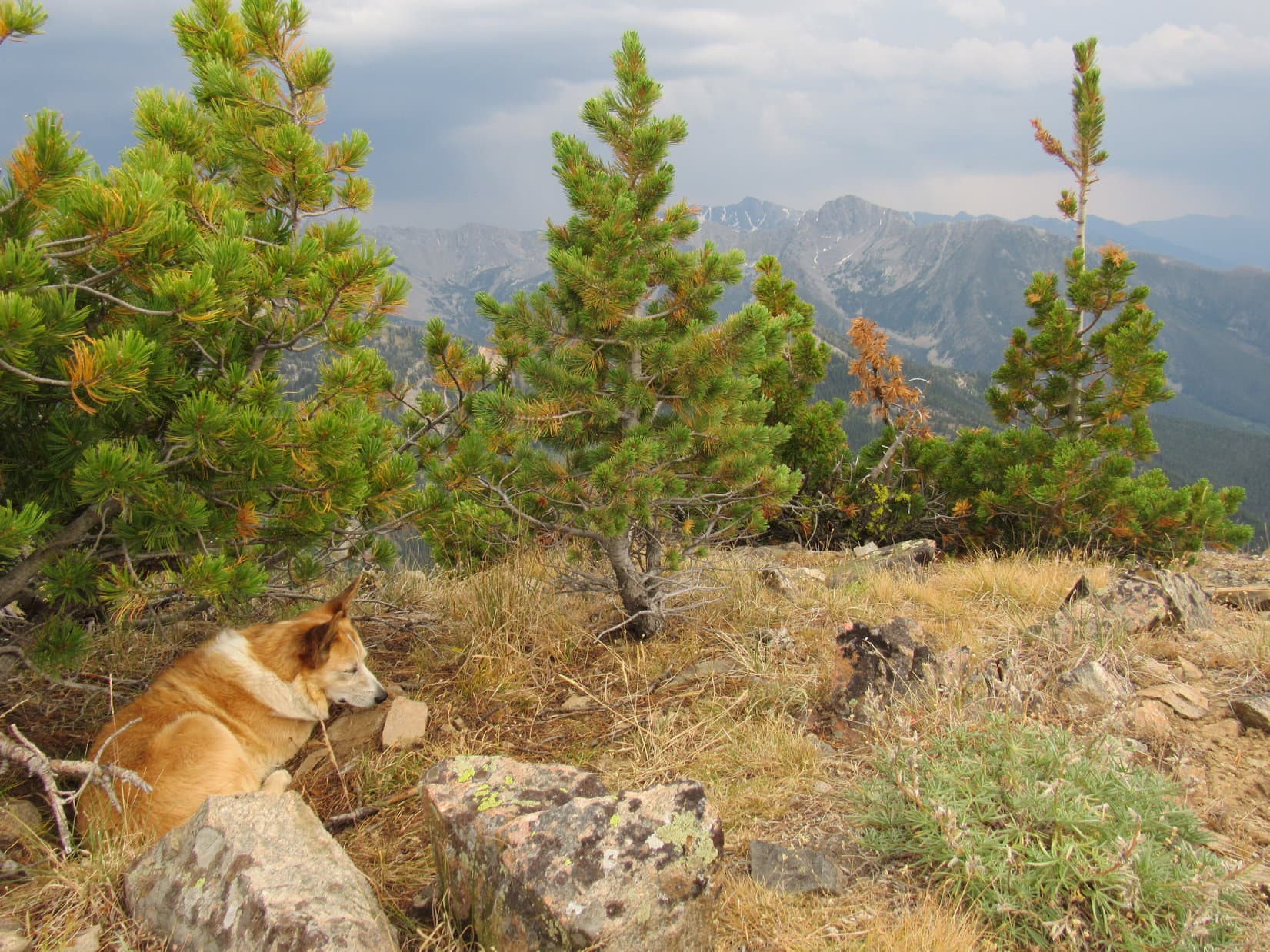
5:08 PM, Livingston Peak – Whew! From Suce Creek, Livingston Peak had been a long march followed by that 1,000 foot very steep climb at the end. SPHP dumped the backpack by some stunted pines near the true summit. A couple photos of a survey benchmark attached to one of the largest rocks, and it was time for a break.
The survey benchmark (Center) and cairn from the true summit. Canyon Mountain(8,038 ft.) (L of Center). Photo looks WNW.“Livingston” survey benchmark.
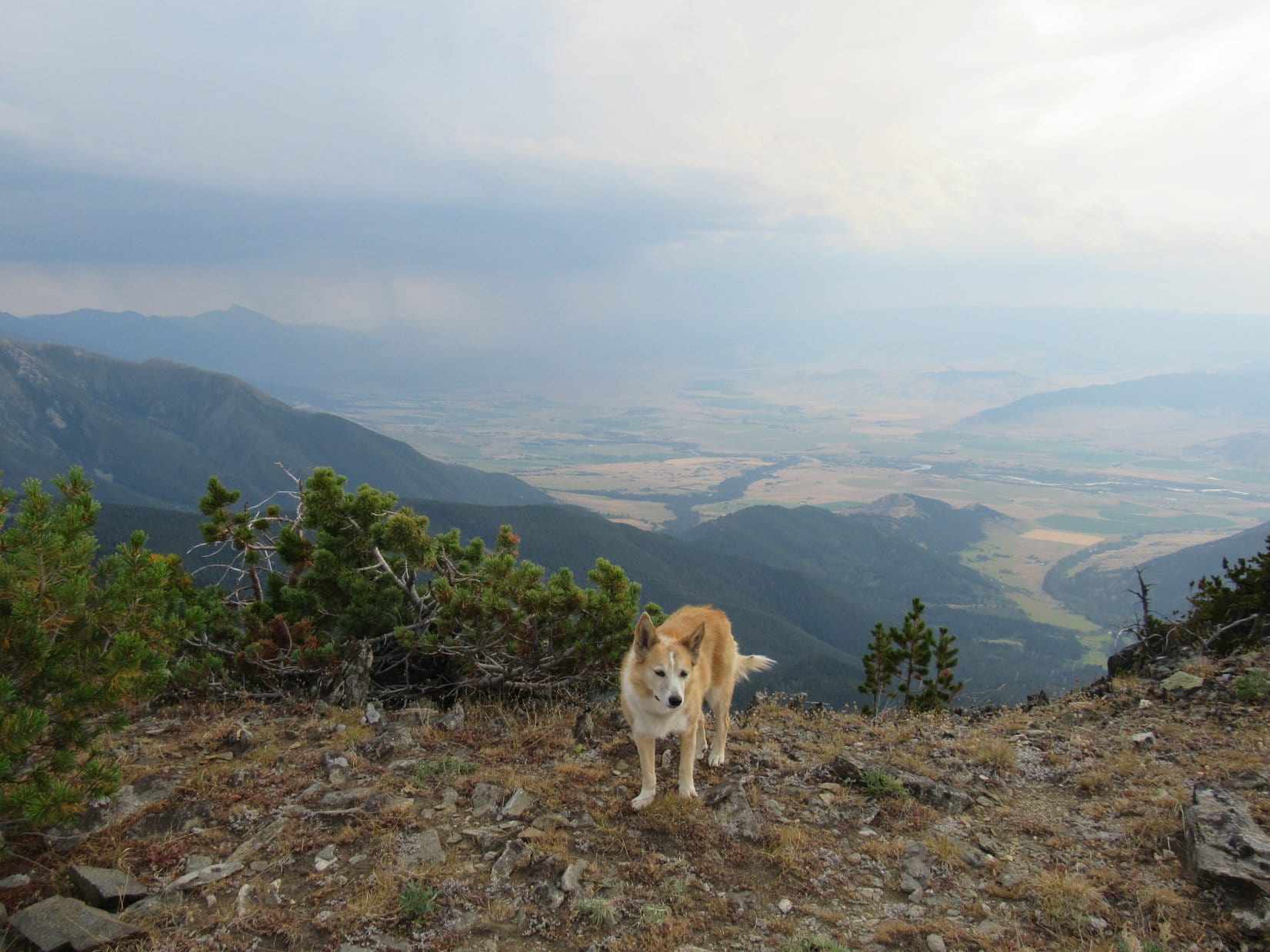
Too bad the sky wasn’t as clear as it had been earlier! Only weakly sunny now. Plenty of general murkiness, but still some blue sky to the N. A small thunderstorm rumbled 25 miles S, dropping heavy rain as it drifted NE. SPHP kept an eye on it as Looper relaxed. No worries. Gonna miss Livingston Peak by a wide margin.
Taking it easy for a bit.
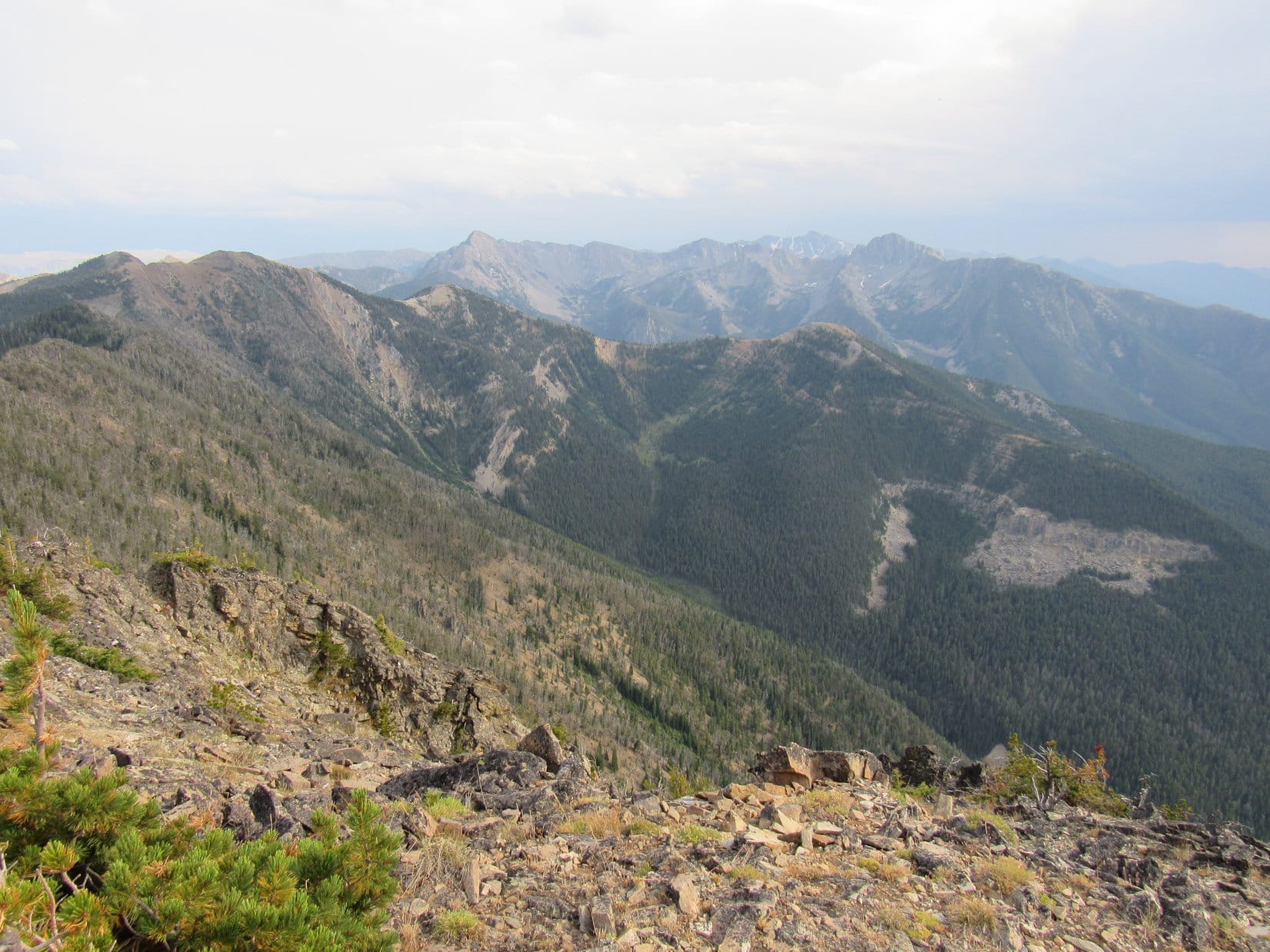
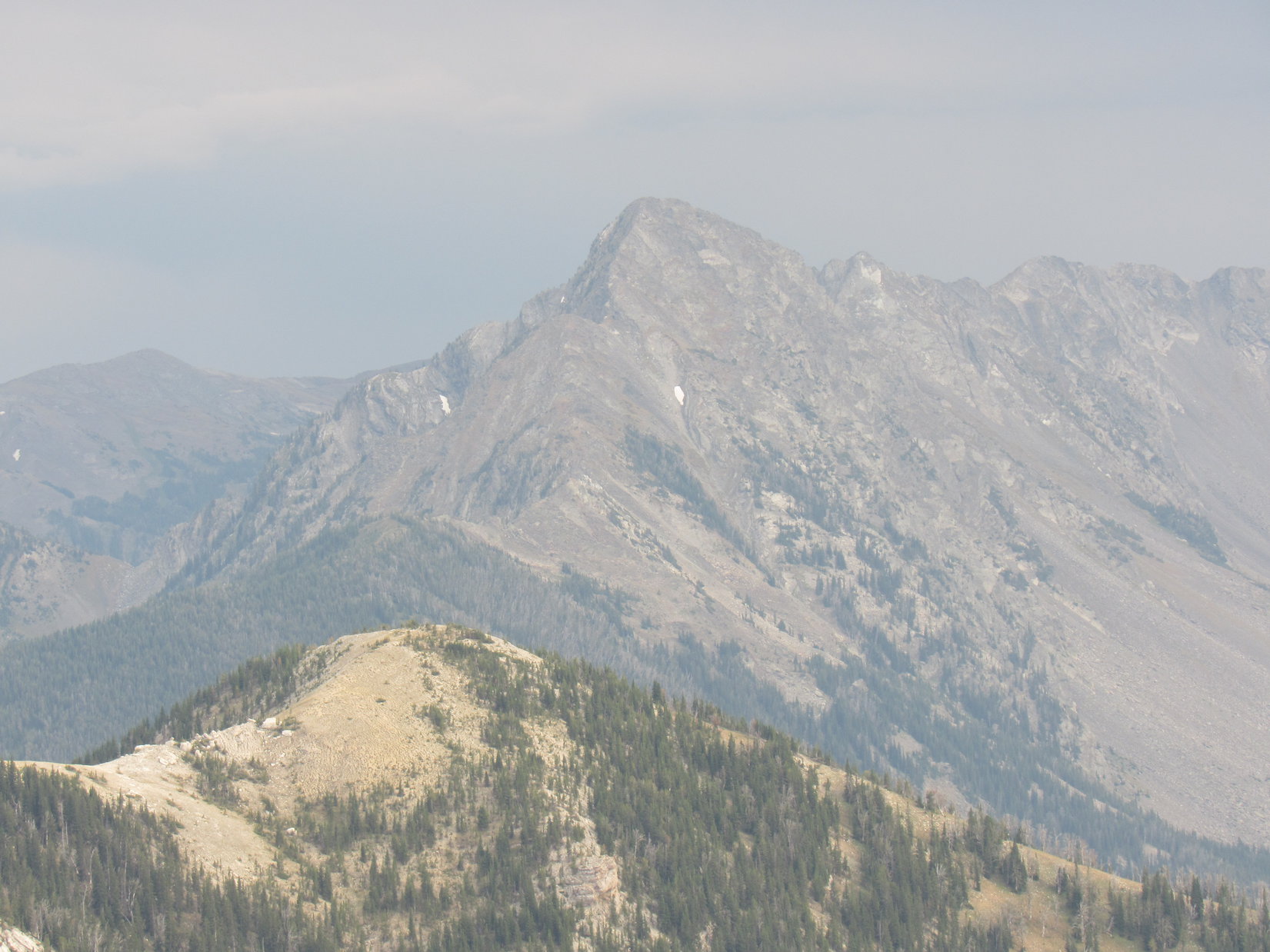
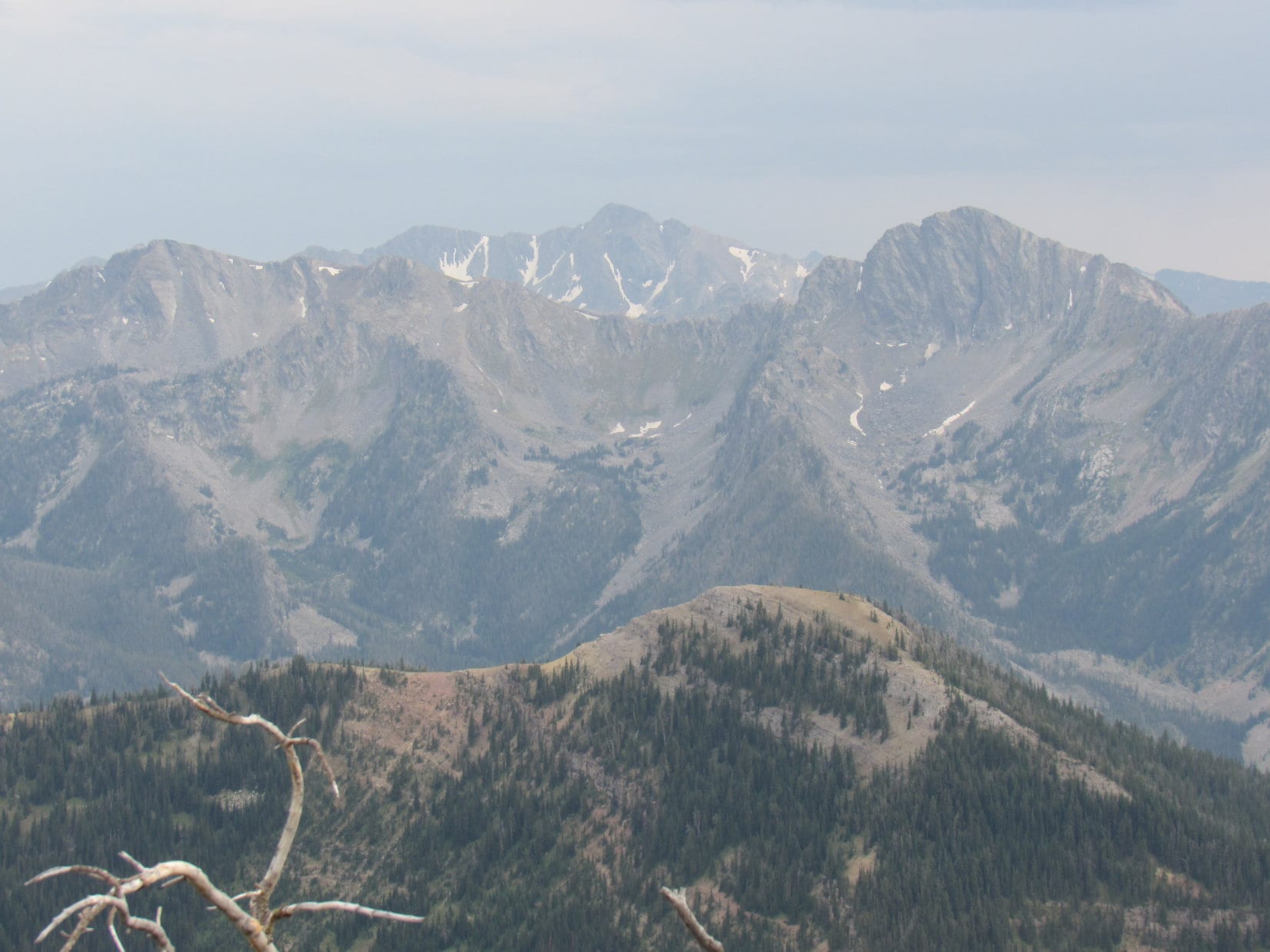
The best views were to the S where Black Mountain(10,941 ft.) soared well beyond Mount Delano(10,138 ft.), which was connected by a long ridge of lesser peaks to Peak 10228 farther E.
Peak 10228 (L). HP8806 in the foreground above Lupe’s rump with Black Mountain (Center) in the distance beyond it. Mount Delano a bit to the R. Photo looks S.
The highest part of Livingston Peak’s summit ridge was 600 or 700 feet long. The N slope Lupe had come up had been very steep, but the S side of the mountain was even steeper, nearly a precipice. The true summit was much closer to the NW end of the summit ridge than the SE end, and the cairn even more so.
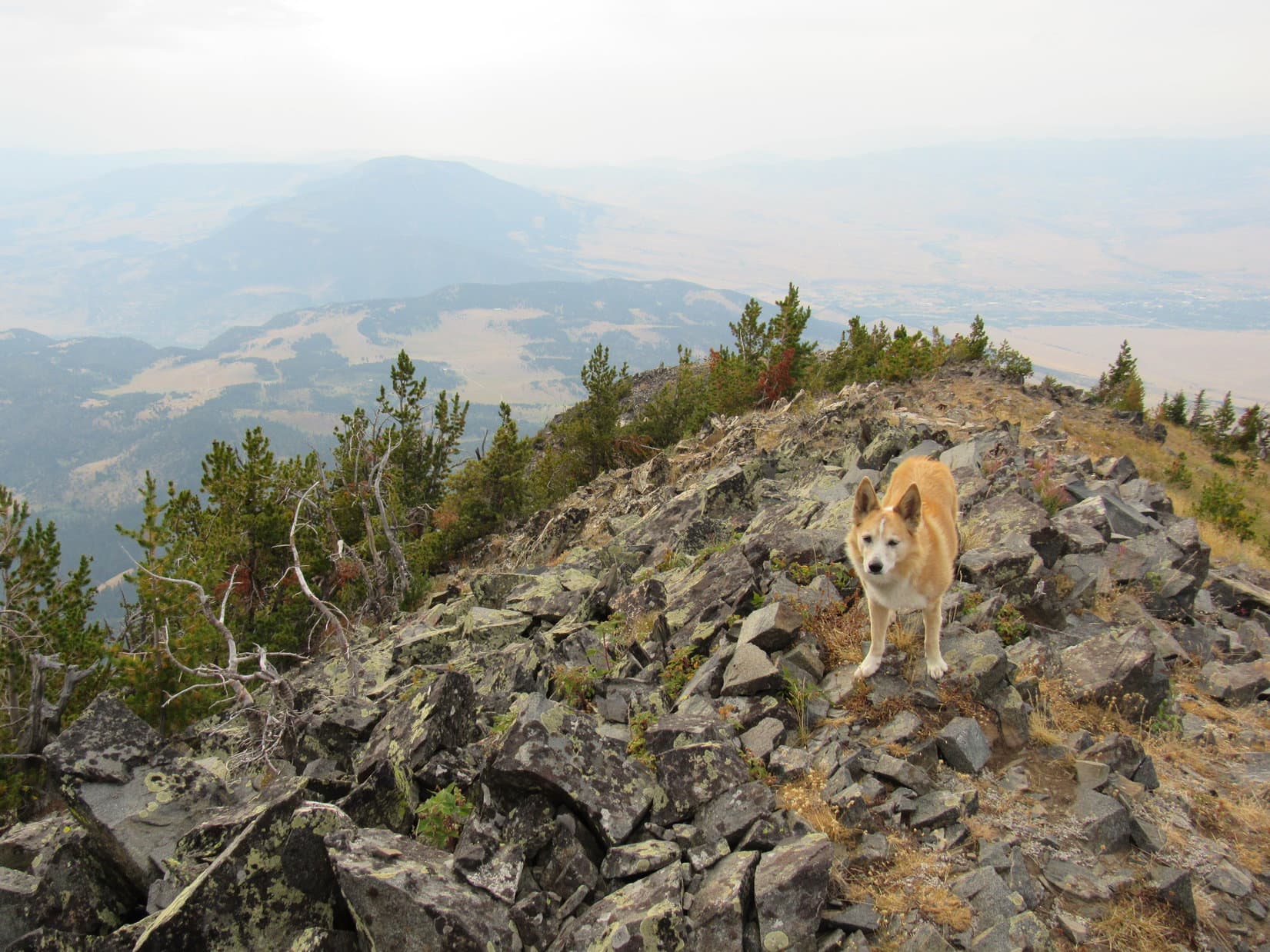
Another thunderstorm appeared W of the first one, but observation led merely to the conclusion that this storm was destined to miss Livingston Peak, as well. After enjoying a decent break, Loopster set off to explore the longer part of the summit ridge to the SE. Small pines concentrated along the S edge were easily bypassed by staying a bit to the N.
Exploring the summit ridge. Photo looks SE.
From the entire ridge, Lupe had a clear view of Peak 8631 and HP8460 to the NE. After traveling SE far enough to get past most of the trees, she also had a panoramic view of everything that way, too.
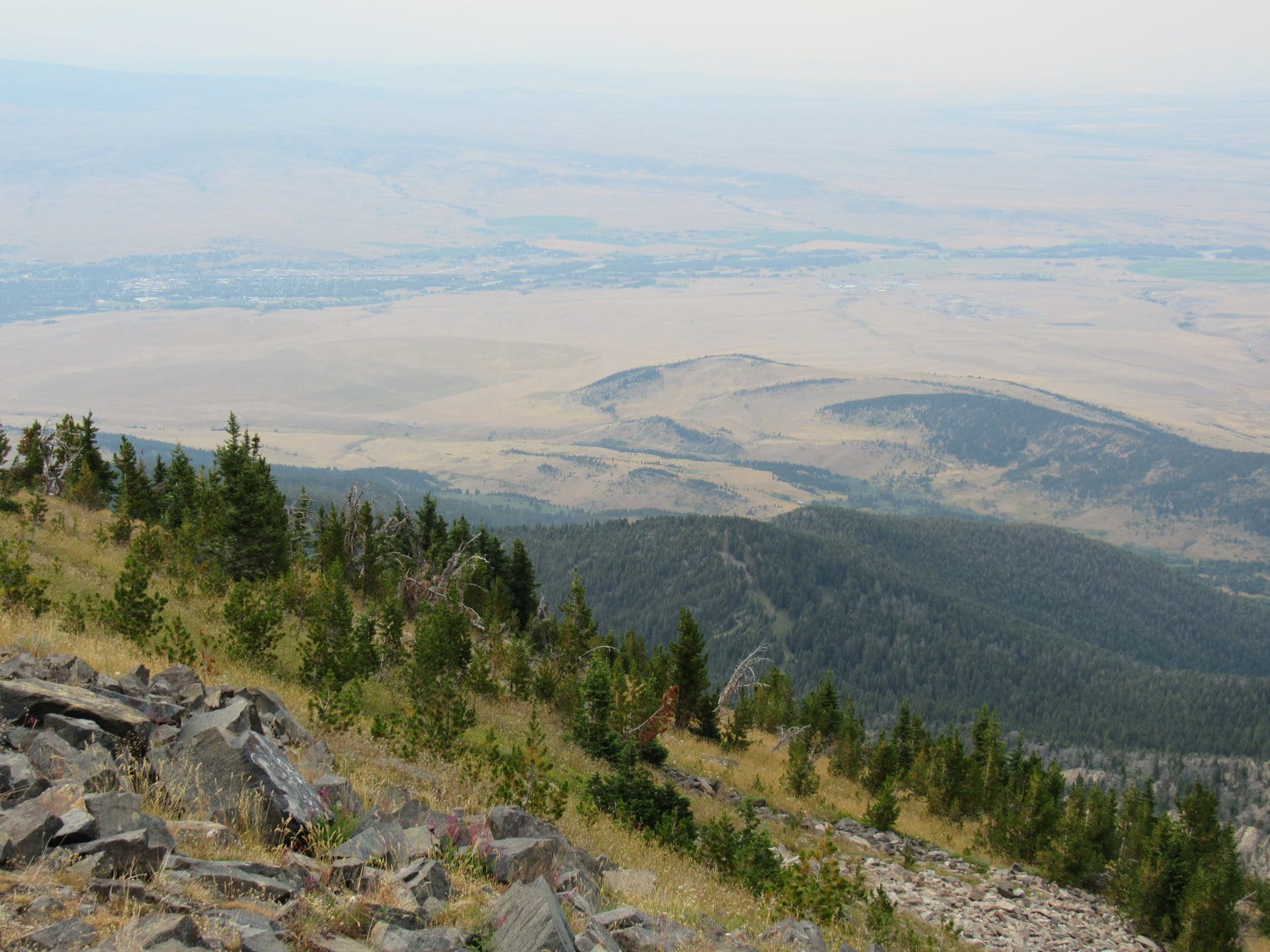
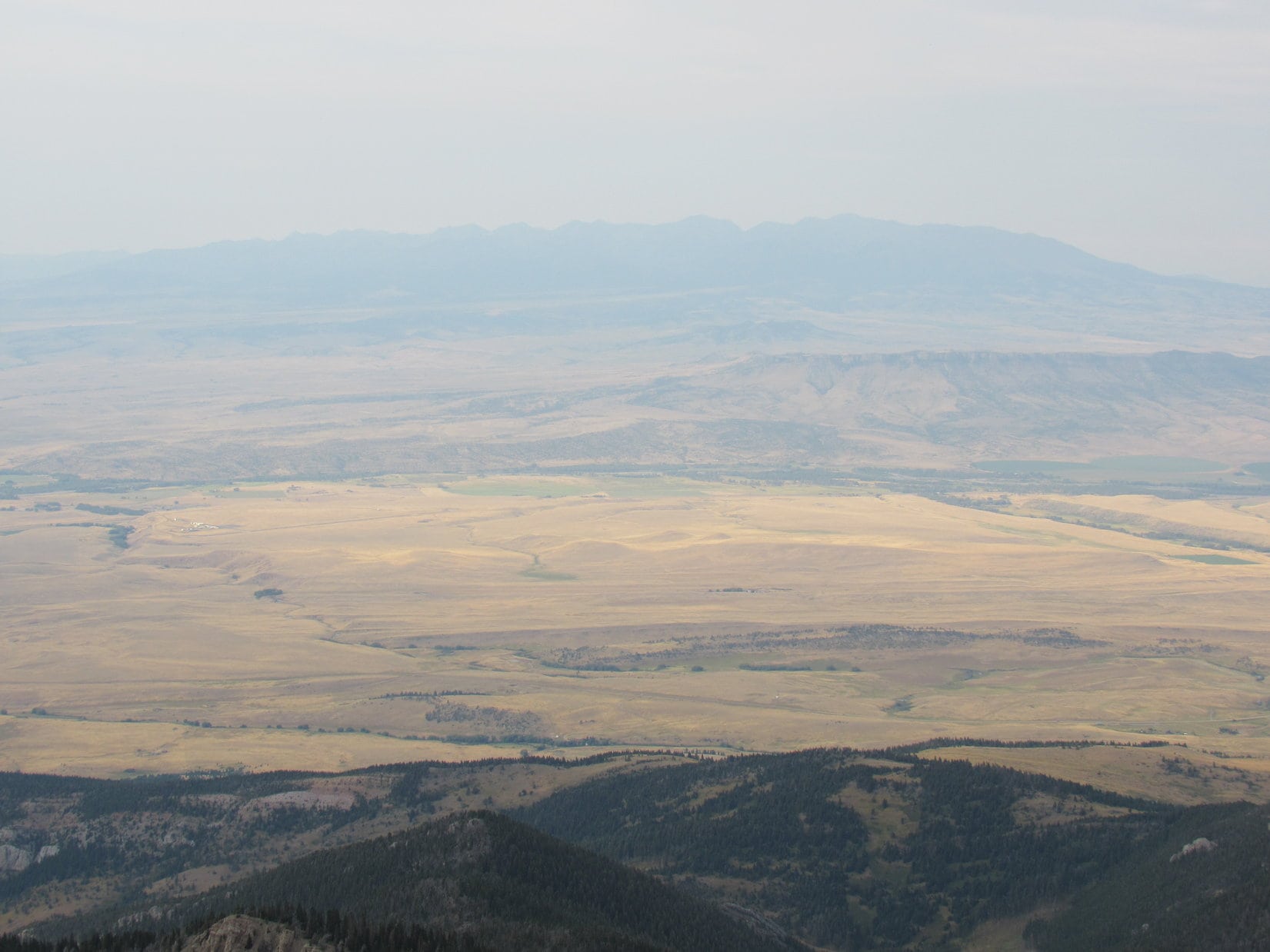
Peak 8631 (L) and HP8460 (Center). Photo looks NE.Peak 9472 (far R). Photo looks SE.Peak 9472 (far L) and Peak 9444 just to the R of it. Peak 10228 (L of Center), Black Mountain (R of Center), and Mount Delano (R). Photo looks S.Peak 10228 (Center). Photo looks SSE with lots of help from the telephoto lens.Peak 10088 (L), Black Mountain (Center), and Mount Delano (R). Photo looks S with help from the telephoto lens.
If Lupe had had the time, she could have explored Livingston Peak’s SE ridge for miles, but she went only 400 or 500 feet from the true summit to where the highest part of the ridge began to drop off appreciably. Doubling back to explore the much shorter section of the ridge NW of the true summit, SPHP kept a close eye on events to the SW where rain showers could still be seen beyond the lower Suce Creek valley and Yellowstone River.
Storms to the S and SW bore watching. Lower Suce Creek valley (R). Photo looks SW.Lower Suce Creek valley (Center). Yellowstone River beyond it. Photo looks SW with help from the telephoto lens.Venturing out along the NW ridge. Photo looks SE back toward the cairn.
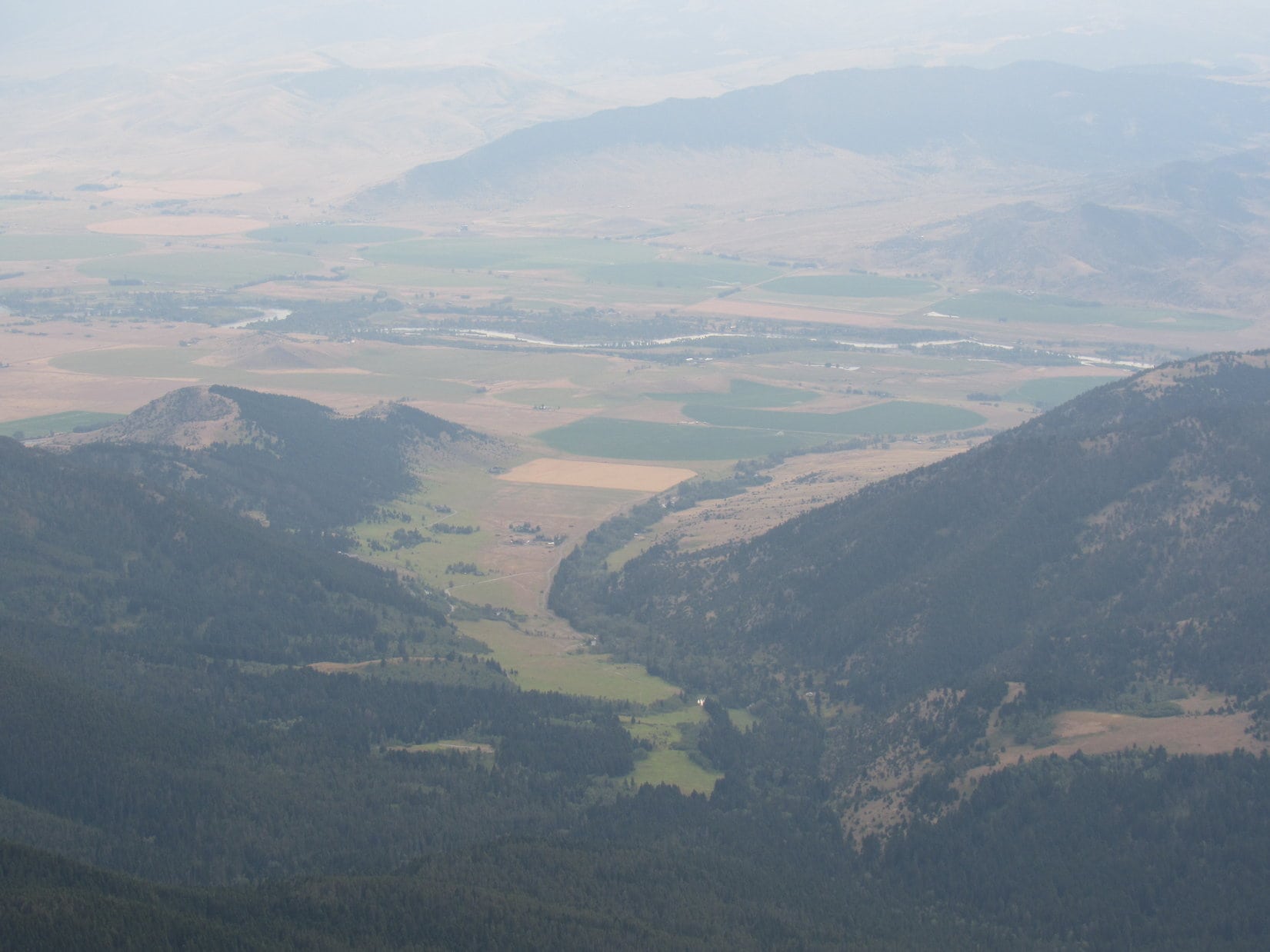
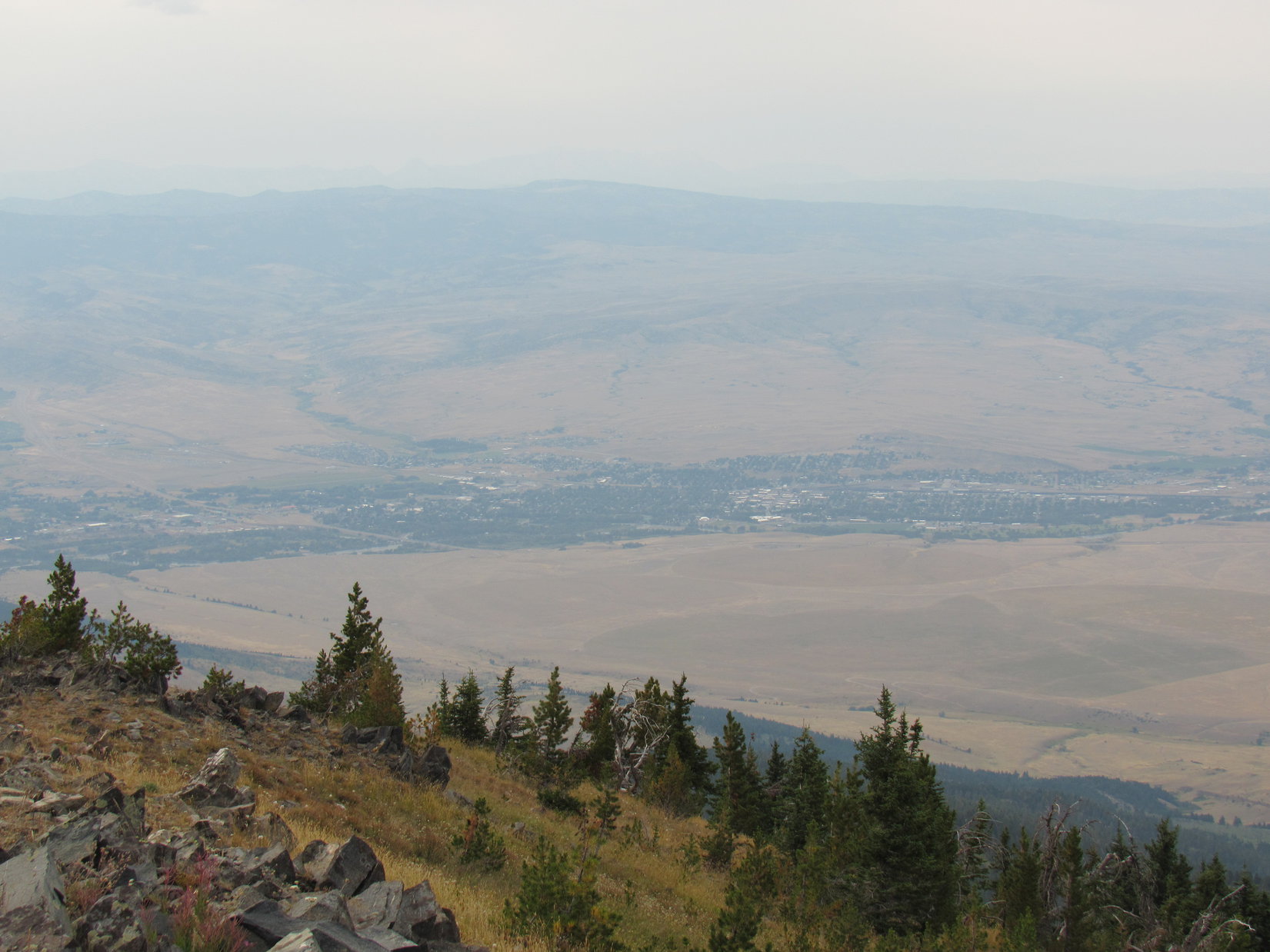
Lupe went only 200 or 300 feet beyond the cairn to where the NW ridge got kind of rocky. Beyond this point, the ridge started dropping off much more steeply. Unfortunately, conditions to the W were deteriorating. What should have been a great view of Livingston, Montana was very hazy. Prairies, hills and mountains beyond it were barely visible. Far to the N was a dim view of the Crazy Mountains.
As far NW as Lupe went. Canyon Mountain(8,308 ft.) (L). Livingston, MT (lower R). Photo looks NW.Livingston, MT. Photo looks NW with help from the telephoto lens.Looking down on HP7623 (Center). Yellowstone River beyond it. Photo looks NNW.Crazy Mountains in the distance. Photo looks N.
By the time Lupe had been up on Livingston Peak for 40 minutes, not a speck of blue sky remained. A third thunderstorm was now off to the SW. Not wanting to leave before her traditional hour at the top was over, Loop headed back to the stunted pines near the true summit to relax a while longer.
The entire S horizon darkened as the Carolina Dog watched a gray wall of heavy rain creep steadily closer, sweeping from vision everything in its path. Raining almost everywhere to the S now. Lupe and SPHP hung in there, enjoying a few last precious moments of rest, solitude, and quiet contemplation.
Enjoying another break as the rain spreads. Peak 9472 (L), Peak 9444 (Center), and Peak 10288 (R). Photo looks SE.
8-19-20, 6:12 PM, Livingston Peak – Alright! Hour’s up! Better get with it. A final stroll about the true summit area, and Lupe stood by the cairn on top of Livingston Peak(9,314 ft.) for the last time. The wall of rain to the S was only a few miles away now. Impact seemed certain.
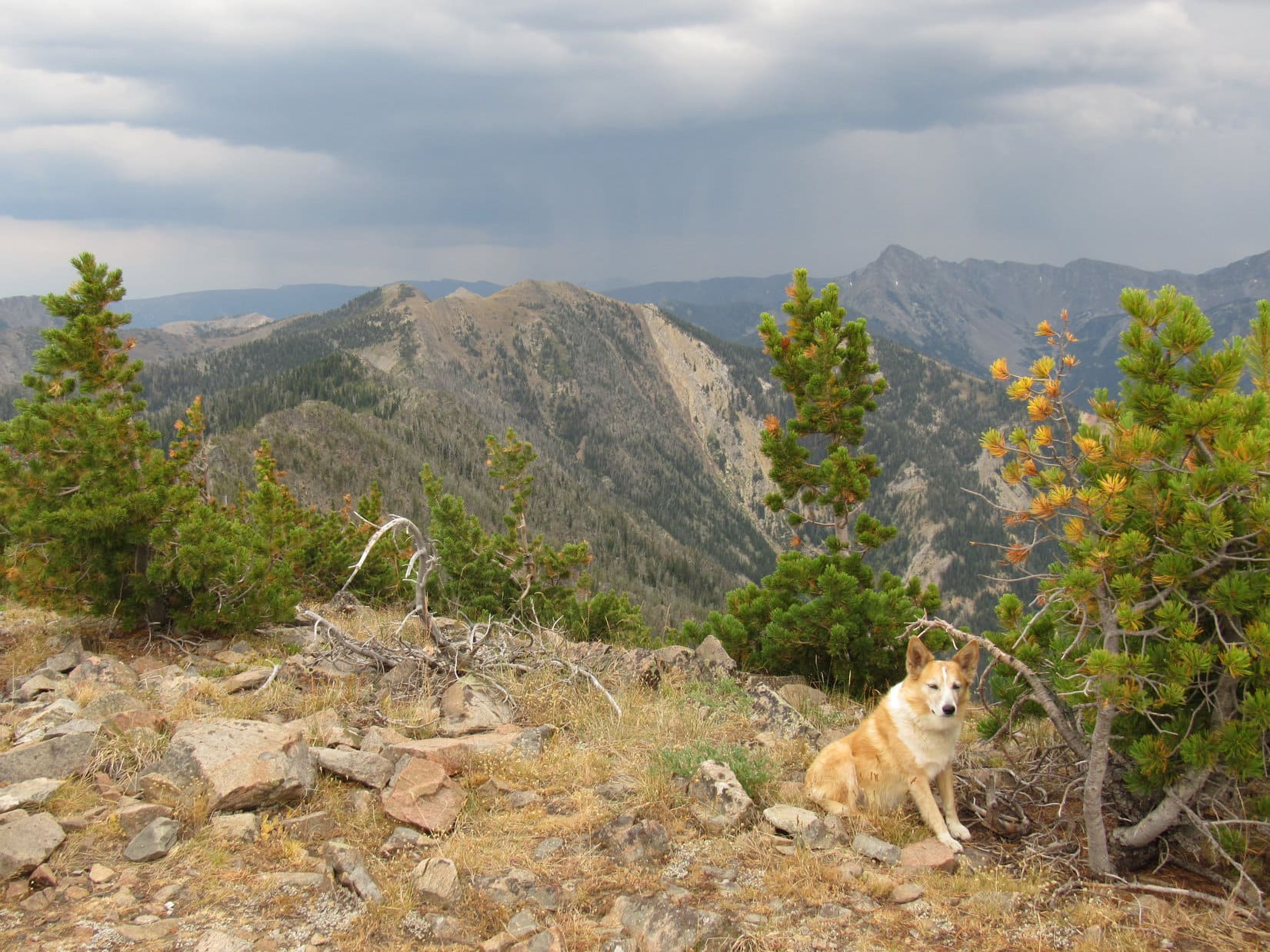
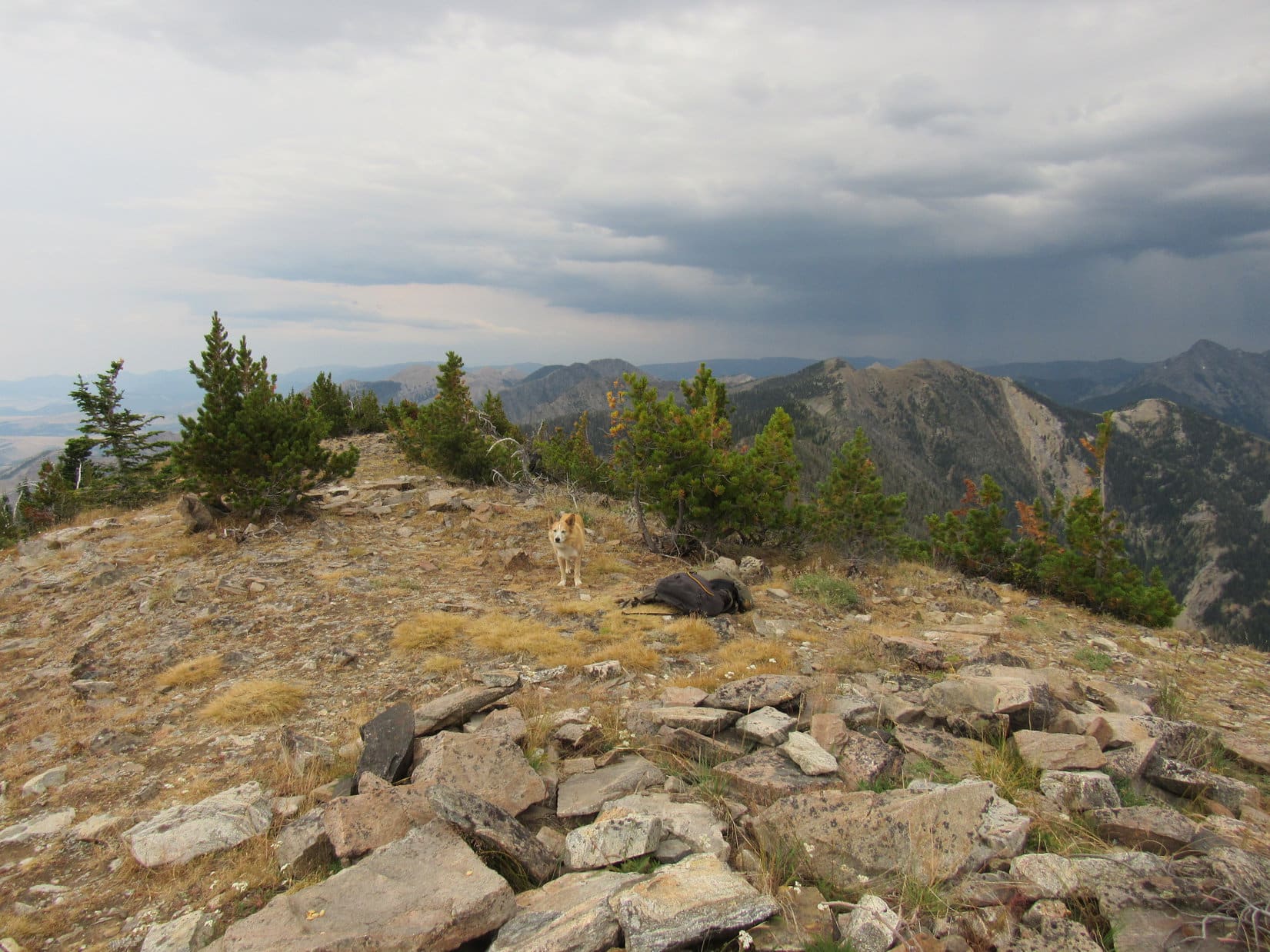
Near the end. Looking SE from the true summit.Loop’s last moments at the true summit with the cairn beyond her. Photo looks NW.By the cairn with rain on the way. Photo looks W.
Onward! Puppy, ho!
Might have waited too long! Hurry, hurry! Livingston Peak’s steep N slope would be extremely slick and super treacherous, if it got soaked. Bad enough when it was dry! In a rush, Lupe and SPHP left the summit heading NNW down the grassy slopes leading to the rock slides.
Uh, oh. Where’s the trail? SPHP couldn’t find it. Loop sniffed about, but didn’t seem to know where it was, either. A couple of minutes marching back and forth looking for some sign of it, and SPHP spotted a cairn down among the rocks. There we go!
Below the rocks, the trail was easily picked up again. The race was on, such as it was. SPHP had to proceed at least somewhat cautiously. Just too steep! Meanwhile, Lupe decided to play a game. The crazy Carolina Dog kept stopping and letting SPHP go on ahead. She just sat there until SPHP was completely out of sight before she’d even consider following. SPHP often had to call her again and again before she’d reappear.
Not a good time for these Dingo shenanigans!
Down, down, down! For some reason the rain was holding off. Ought to have been here by now. A few scattered big drops hit. Thunder rumbled closer and closer. Any moment now!
Yet it didn’t happen. Started sprinkling a few times, but kept quitting. Lucky! Would be great to get down to Pass 8300 before the rain really hit. Lupe finally got the idea that down was the place to be. The waiting and stalking game apparently over, she zipped on by SPHP.
Hah! Made it! There was Loopster waiting down at the pass.
Back at Pass 8300. Photo looks N.
Somehow the rain must have missed Livingston Peak? Even so, the race was still on. The way the sky looked, likely a temporary reprieve. Once SPHP joined Looper at Pass 8300, she led the way, turning NW down into the upper Lost Creek drainage on Livingston Peak trail No. 449.
The Luck of the Dingo held! The trail seemed longer than SPHP remembered, but Lupe got clear down past the steep part along Lost Creek, too. Still no rain, but storms were now squeezing in from both S and N. Making great progress here, though! The path was now level or a slight downhill slant most of the time.
The forest grew dim. Hard to tell what the storm situation was. Lupe made it over minor Pass 7060, and through the meadow! The American Dingo reached the long straightaway of the upper switchback, but trouble was inevitable. Trapped! Raining to the N! Raining to the S! Thunder and lightning to the W! Livingston Peak was the only place where it wasn’t raining. Not gonna last.
Toward the end of the upper switchback, it began. Light rain at first. Reaching the ridge leading down to the trail junction where the wooden bench was, SPHP stopped to put on the ancient tattered blue Cookie Monster look-alike rain poncho. Flashlight on! An already damp Dingo resumed the trek. Moments later, the deluge hit.
Not exactly a cloudburst, but it rained hard. Lightning flashed, thunder boomed. Totally drenched, Loopster was miserable and worried sick. Scary close! Again and again the impenetrable black forest suddenly lit up in a blinding blaze, momentarily illuminating dripping trees and pouring rain. An instant later black as death again, only the feeble beam of the flashlight revealing the muddy trail ahead.
30 minutes, and the rain abated. Thunder and deadly lightning drifted E. Occasional light showers, then nothing. No way to dry off, though. Sopping wet vegetation overhung the trail in too many places.
8-19-20, 10:08 PM, Suce Creek trailhead – The Livingston Peak adventure was finally over. SPHP opened the door of the G6, and a mighty weary American Dingo leapt inside. Atop a pile of gear and pillows, Lupe curled up on her pink blankie and started licking herself dry. Too tired to even eat much, she closed her eyes after only 0.5 can of Alpo. Lights out, totally zonked.
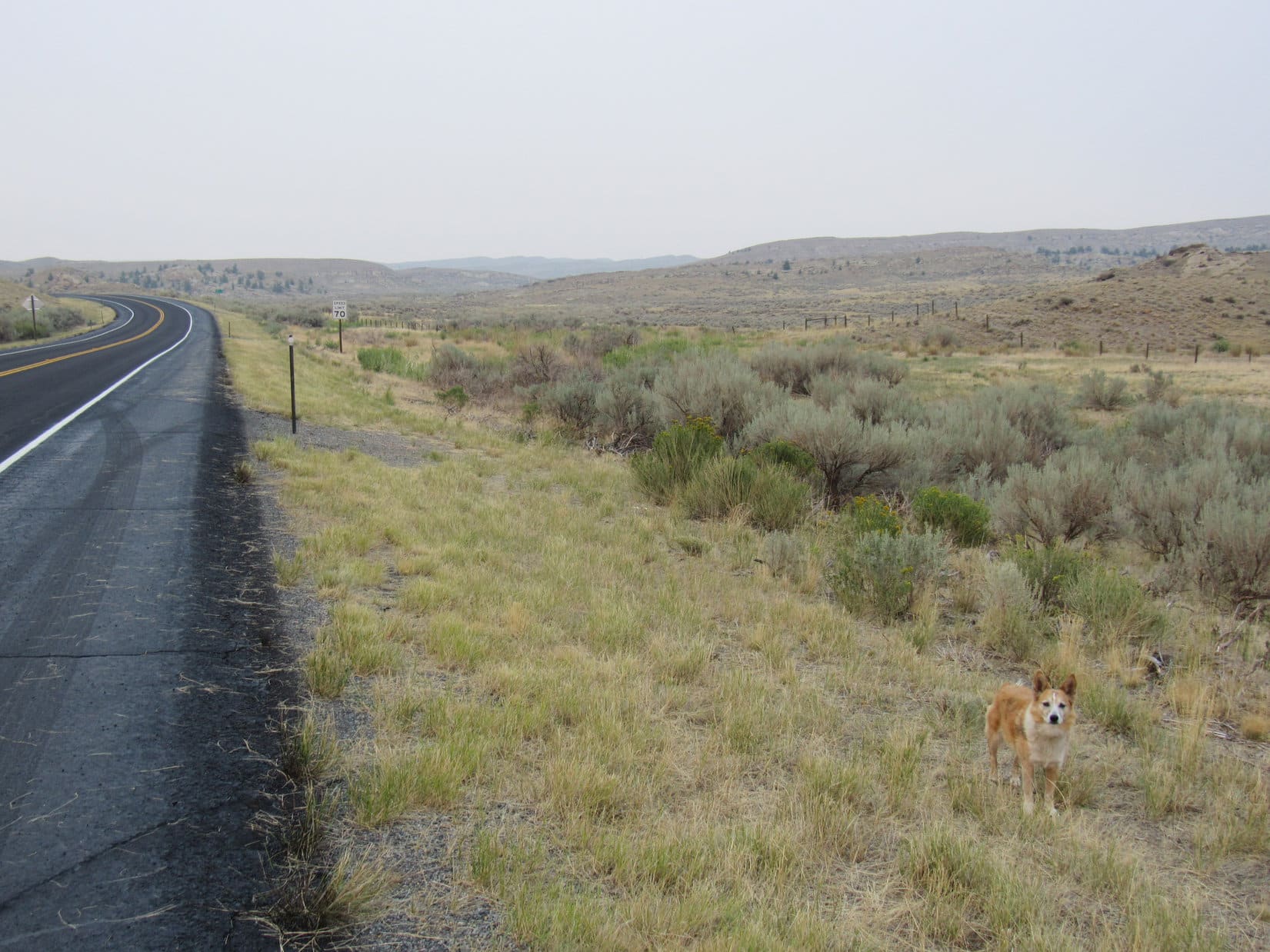
8-20-20, 7:22 PM, SW of Meeteetse, WY – Light already fading, Lupe stood alongside the W end of Hwy 431. Parched sagebrush and a white sky. Off to the W, a pink-orange sun had just sunk into the murk.
At the W end of Hwy 413 SW of Meeteetse, Wyoming. Photo looks NE.
The Carolina Dog’s 3rd Dingo Vacation of the Year of Perfect Vision was over. Livingston Peak had been the grand finale. Lupe was going home.
August 20th! Wasn’t supposed to be like this. So many mountains yet to climb this summer! But the sun had been pink-orange at the Suce Creek trailhead this morning, too. SPHP hadn’t thought much of it at the time. Rained again for an hour. About mid-morning when it started getting sunny and hot, Lupe and SPHP had driven down to the Yellowstone River access point, and hung out down there for a few hours.
However, yesterday’s rains were merely local. By mid-afternoon, the air was hazy again. The plan was to go climb mountains in the Beartooths next, but when Lupe got there, the air was thick with smoke. Only a dim outline of the mighty Beartooths could be seen.
No sense in going to all the trouble of climbing big mountains smothered in smoke! Eh, no worries. The Beartooths aren’t the only mountains in the American West. Time for Plan B! Lupe could just slip down into Wyoming and head for the grand and glorious Wind River range.
Wyoming was no better. In fact, it was worse. Not a cloud in the sky. Ought to have been a perfect day. Looking straight up Lupe could see a blue tinge. Everywhere else, a dirty white sky. A uniform dirty white for hundreds of miles.
Somewhere out W, countless wildfires were raging. The Livingston Peak rain had been a lucky, local fluke. Almost everywhere else, the W was in drought. Come to think of it, the sky had been hazy only a few days ago even at West Butte(6,983 ft.) way up in the Sweetgrass Hills by the Canadian border.
SW of Meeteetse, SPHP came to the realization that the Wind River range wasn’t going to be any different. Not much chance of finding clear skies anywhere else out W either. Prime time to be in the mountains, yet maybe the season was effectively over? Significant, widespread rains weren’t likely this time of year. Not out W!
That’s what it was going to take, too, wasn’t it?
The Year of Perfect Vision felt cursed. Was climbing season really, truly over already? Was Lupe done? Enormously disappointing, but sure felt like it. Maybe the Carolina Dog’s grand day at Livingston Peak really was the end. (Home, 8-21-20, 1:35 AM)
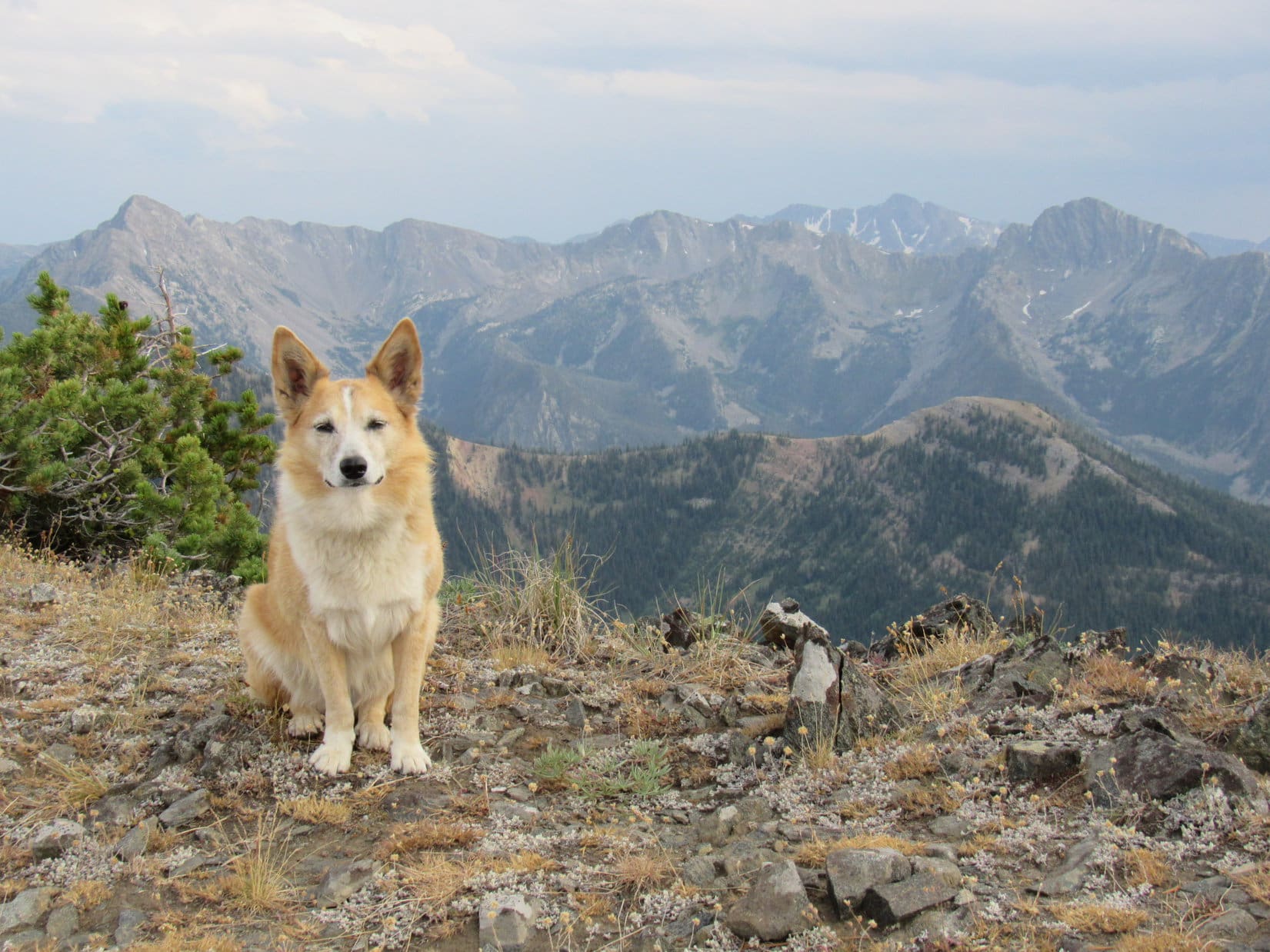
On Livingston Peak, Absaroka Range, Montana 8-19-20