Mount Saint George, Stone Mountain Provincial Park, British Columbia, Canada (8-5-17)

Day 6 of Lupe’s 2017 Dingo Vacation to the Yukon & Alaska!

(5:21 AM, Summit Lake at Summit Pass, Stone Mountain Provincial Park)  The second time SPHP woke up sunlight was just beginning to shine on Mount Saint George.  The light quickly grew in intensity.  In minutes, the mountain was aglow, radiantly beautiful all pink and yellow.  SPHP knew it wouldn’t last long, but couldn’t muster the energy to grab the camera until it was too late.  The moment had passed.

Yesterday, up on Mount Saint Paul, Lupe and SPHP had been all excited about her success there, and eagerly looking forward to climbing Mount Saint George today.  But by the time it was over, yesterday had been a nearly 13 hour expedition in rugged territory, and had taken a toll.  SPHP felt it.  Apparently Lupe did, too.  She was awake, but all bleary-eyed.  Clearly, “ambition” wasn’t her middle name this morning.

Huh? … Another mountain? … NOW!? You can’t be serious! For pity sake, just hit the snooze button, would ya, SPHP? I’ll think about it later.

For several minutes Lupe licked SPHP affectionately, as if to apologize for not wanting to dash off up the next mountain at the crack of dawn.  It turned out she was hungry.  She devoured a chicken treat, a milk bone, a generous bowl of Taste of the Wild, and lapped up a huge drink of water before rolling over to resume snoozing.

Clouds moved in.  Mount Saint George vanished.  It started to rain.  Shucks!  If it didn’t show signs of clearing up before SPHP’s breakfast was over, it would make more sense to drive on instead of sitting around here.  Lupe still had a long way to go to get to where she had more adventures planned in the Yukon and Alaska.  Still, it would be a pity not to even get an attempt on Mount Saint George in.  If only yesterday’s beautiful weather had held out one more day!

Nothing one can do about that.  It was what it was.  A wind came up.  It rained harder.  SPHP piddled around to see what would happen.  Breakfast, catch up the trip journal, get water at the campground, pitch out the trash, straighten out the G6, study a few maps.  At 8:00 AM, the moment of truth arrived.

The breeze had died down.  The rain had stopped.  The sky remained overcast, but not darkly.  Mount Saint George still couldn’t be seen.  Maybe it would clear up?  Prospects seemed 50/50.  Lupe had been awake for a while now, looking no worse for yesterday’s wear.  The Carolina Dog was ready for action again.  Was it worth it, or was it smarter to drive on?  Decisions, decisions.

Kind of now or never, Loopster.  What do you think?  Who knows if we will ever be back here again?  We’re a mighty long way from home already.

Oh, I’ll be fine either way, SPHP.  Yesterday was great fun, so I’m happy enough with an easy day watching scenery from the G6 if you want to drive on.  On the other paw, I’d be happy to climb Mount Saint George now, too, if you’d like.  Even if you don’t get your precious views, I always enjoy sniffing around and a good romp.

Hmm.  Not that helpful, Looper.  You’re as wishy-washy as I am.

Well, tell me what the weather is going to do, and I’ll tell you what to do.

I was hoping with your keen Dingo senses you knew.  I can’t tell what’s going to happen.  Maybe it’s best to delay making a final decision?  We could start for Mount Saint George, but if the weather doesn’t clear up by the time we reach where the Flower Springs Lake trail leaves the road to the microwave tower, we could try going to Flower Springs Lake instead.  If the weather gets all socked in and it starts to rain again, we can just beat a retreat and drive on.

Fine with me, SPHP!  So are we going then?

Thus went the discussion, with no real resolution until 8:15 AM when at the edge of vision far to the W, the deciding factor appeared.  A tiny speck of blue, blue sky.  Hope blossomed.  Maybe the weather really was going to clear?  Maybe an hour from now, Lupe would be in brilliant sunshine?  That blue speck was enough.  Mount Saint George (7,402 ft.) was a go!

Lupe and SPHP crossed a paw bridge at the Summit Lake stream outlet which was where a sign at the campground indicated the Flower Springs Lake trail began.  Immediately across the bridge, the trail divided three ways.  No sign here.  Left, right or straight?

Lupe tried going R along the shore of Summit Lake.  She quickly came to places where the trail had collapsed into the lake.  This couldn’t be right, could it?  Perhaps this wasn’t even a real trail?  (Note: Consulting maps later on, SPHP discovered this really was the Flower Springs Lake trail.)  Loop returned to the junction by the bridge.  This time she tried the middle trail which went up a hillside into the forest.

After Loop had gained some elevation, a small sign said she was on the Ridge trail.  Appropriately enough, it climbed to the top of a ridge where it leveled out.  The Ridge trail now passed through a forest dense with bushes.  Everything was wet from the earlier rain.  The bushes soon had Loopster sopping wet, too.  She was one soggy doggie, but her spirits weren’t dampened in the least.

The Ridge trail wasn’t terribly long.  After crossing the ridge, it led down a forested embankment to meet up with a road.  SPHP knew this road led to a microwave tower perched on a hill at the base of Mount Saint George.  Somewhere along the way the road ought to provide Lupe a convenient access point to the mountain.  The American Dingo followed the road SSW going uphill.

A bit of a trek brought Lupe to a sign identifying the Flower Springs Lake trail where it crossed the road.  This area was open terrain, the forest having recently been left behind.  The sky was still overcast, but the speck of blue sky to the W had grown considerably.  A W breeze held promise that the clouds might soon sail off to the E.  With this encouragement, all thought of settling for the Flower Springs Lake trail was banished.  On to Mount Saint George!

Shortly after passing the Flower Springs Lake trail, the road made a big switchback climbing W before leveling out.  Lupe was now headed straight W toward the microwave tower, which could be seen atop its hill, High Point 5469 (1,667 m), more than a mile away.  To the S, seemingly right at the base of Mount Saint George (7,402 ft.), a green 200 foot high ridge paralleled the road.

Lupe followed the road W halfway to the microwave tower before SPHP decided she might just as well begin her ascent of Mount Saint George.  Lupe left the road and climbed S up onto the big green ridge.

Looking W at the microwave tower on High Point 5469 (1,667 m). This tower sits close to the N base of Mount Saint George. Lupe left the road here, turning S (L) to climb a 200 foot high green ridge that parallels the road.

Up on the green ridge, Lupe and SPHP stopped briefly to rest.  Looking back, part of Summit Lake where Lupe had started from was in view.  The Carolina Dog had already gained many hundreds of feet of elevation.  Beyond the lake Looper could see Summit Peak (6,611 ft.).  Only yesterday, Lupe had stood on top of Summit Peak on her way to Mount Saint Paul (6,985 ft.).

Up on the big green ridge looking back at where Lupe had come from. She’d started out at the far end of Summit Lake (R) which appeared to be many hundreds of feet below where she was now. Summit Peak, which she had climbed yesterday, is the more distant mountain at Center. Photo looks NE.

Lupe continued SW across the green ridge, which was very wide, toward the base of Mount Saint George.  At first, heading right on up the wide NE arm of the mountain looked like it would be a snap.  As Lupe got closer, though, it became apparent this was an illusion.  A deep valley draining to the SE was between the American Dingo and the mountain.

Loop crossing the big green ridge toward the base of Mount Saint George. It initially looked like Lupe ought to be able to head straight for the NE arm of the mountain (Center), but she soon discovered a deep intervening valley draining to the SE (L). Photo looks SSW.

Dang it all, anyway!  SPHP didn’t feel like descending into that deep, steep-sided drainage.  A glance to the W revealed that the highest part of the drainage was way over near the microwave tower.  Climbing onto this big green ridge had been a waste of time.  Lupe should have just stuck with the road until she was at the base of the hill the tower sits on.  It would have been faster and easier to turn S there.

A glance to the W revealed that the high point of the drainage Lupe needed to get across was way over by the microwave tower. It would have been easier to simply stick with the road instead of climbing up onto this big green ridge. Photo looks W.

Live and learn.  Lupe and SPHP turned W traveling along the ridge toward the microwave tower.  This pleasant level stroll was made even easier by an old jeep trail Loop found on the way.  As Lupe started getting closer to the tower, she left the jeep trail angling SW to look for a good route down into the drainage.

As Lupe started getting close to the microwave tower, she angled toward the S side of the ridge she was on looking for a way across the drainage. The bottom of the drainage is in view now on the R. Mount Saint George has 3 N arms or ridges. The NE arm Lupe would ultimately go up is on the L. The middle N arm that ends closer to the microwave tower is seen on the R. Look at those beautiful blue skies now! Oh, yeah! Things were looking good. Photo looks SW.

Mount Saint George has three N arms or ridges.  A large valley comes down between the middle and NE ridges that joins the drainage Lupe needed to get across only a little E of that drainage’s high point.  As Lupe drew closer, she could see a sizable gash at the lower end of this valley.

That gash looked like a good spot to begin Lupe’s ascent of Mount Saint George.  Once opposite the gash, the bottom of the intervening drainage wasn’t all that far below the green ridge, and the slope leading down into it wasn’t so steep.  Lupe and SPHP descended into the drainage, and crossed over to the gash.

Looking across the drainage at the gash at the lower end of the valley between Mount Saint George’s middle N and NE ridges. The middle N ridge is on the R. Photo looks SW.
Lupe on her way down into the drainage. It wasn’t far or steep to the bottom from here. The microwave tower is in view at the far end of the green ridge. Photo looks W.

As expected, the terrain in the eroded gash was nearly all rock.  A stream so small it could be conveniently crossed almost anywhere tumbled down a series of small waterfalls into pretty pools below.  Lupe explored numerous nooks and crannies while SPHP trudged up the gash.

Lupe wades the small stream in the gash. Part of the big green ridge she had just come from can be seen on the L. Photo looks NE.
Looking up the gash. Although it was often fairly steep, traveling up the gash wasn’t bad at all. It certainly wasn’t as hard as it might have been. Most of the rocks were fairly small. Usually there were easy ways to avoid troublesome spots. Photo looks SSW.

After crossing the stream once, Lupe and SPHP stayed on the E (L) side of the gash the rest of the way up.  The water in the creek was cold and clear.  SPHP tried it.  Delicious!  The water SPHP had gotten from a pump back at the Summit Lake campground this morning tasted terrible.  SPHP dumped it all to fill 3 water bottles with fresh creek water.

At the upper end of the gash, Lupe discovered a lovely waterfall higher than any of the others.  It plunged noisily over a tilted layer of rock.

Lupe discovers the highest waterfall of all at the upper end of the gash. Photo looks S.
The terrain above this waterfall at the upper end of the gash was not so heavily eroded. The stream raced swiftly and smoothly over intact layers of exposed bedrock. Photo looks SW.

Above the final waterfall, Lupe followed the creek quite a distance.  Here it raced swiftly and smoothly over intact exposed layers of bedrock.  Nearby slopes were mostly green with low vegetation.  Gradually the creek bent around toward due S.

Lupe eventually left the creek to turn E toward Mount Saint George’s huge NE ridge.  Loop aimed for a large black rock prominent among whiter stones high up along the ridgeline.  A considerably lower black rock provided an intermediate goal.

Surprisingly, Looper found a narrow, but very definite trail that passed only a short distance below the lower black rock.  The trail continued climbing ENE from here slanting up along the side of the ridge.  Lupe reached the ridgeline somewhat below the upper black rock, which was now hidden from view.

Lupe was now on the lower slopes of Mount Saint George’s NE ridge.  Way down here, the ridge was rounded and extremely broad.  Small rocks interspersed with low vegetation dominated the terrain.  Up until a short time ago, a W breeze had prevailed, driving the cloud cover off to the E, and bringing blue sky and sunshine.

The wind was shifting, however.  A light E breeze was now forcing clouds back this way.  Summit Peak was almost completely hidden from view, and Summit Lake was disappearing fast.

By the time Lupe reached the lower slopes of Mount Saint George’s NE ridge, the breeze had shifted around to the E. Clouds that had earlier blown off to the E were on their way back. Only an outline of Summit Peak is now visible beyond Summit Lake, which is also rapidly disappearing from view. Photo looks NE.

Despite the approaching clouds, Lupe and SPHP turned S and began climbing the vast ridge.  The breeze might easily shift again, and Lupe had already come a long way.  The Carolina Dog wasn’t going to give up on Mount Saint George so easily!  Clouds enveloped the ridge.  Everything except the immediately surrounding terrain disappeared.

Although clouds moved in to envelop the NE ridge, Lupe continued up.

For a long way, Lupe and SPHP continued up the NE ridge in fog.  At least initially, the climb wasn’t as steep as Lupe’s ascents of Summit Peak and Mount Saint Paul yesterday.  Sometimes Looper even came to relatively level stretches.

Slowly, though, the situation changed.  The rocks increased in size.  Vegetation became scarce.  The terrain grew rougher and steeper.  Lupe was climbing sharp boulder fields.  In places, SPHP was scrambling instead of walking.  The ridge was clearly narrowing, though it was still broad.

Lupe takes a break at a rare patch of greenery.

Lupe climbed a series of 100+ foot high benches of jumbled, broken rock.  SPHP had to use hand holds.  At the top of each bench, the terrain ahead usually leveled out some and became easier to traverse, but another bench every bit as difficult as the last one always appeared ahead.

Up and up went the Carolina Dog, over one obstacle after another.  Time passed.  It seemed like Lupe had been at this a long time.  She must have gained a lot of elevation.  Hard to tell how much, though.  The fog might be distorting all sense of time and distance.

The fog was sometimes dark and thick.  If it had stayed that way long, it absolutely would have been time to give up on Mount Saint George and head down.  It didn’t though.  After a few minutes, it would lighten up again.  The fog swept in waves over the ridge.  And every now and then, if Lupe looked up, the gray was tinged with blue.  Maybe Lupe would climb above the clouds?

And then it happened.  A genuine patch of clear blue sky appeared directly overhead.  Lupe was in sunshine!  It didn’t last.  The fog reasserted itself.  The hole closed.  Lupe kept climbing.

More and more often, there were hints that Lupe was going to get above the clouds, or that they might simply blow away.  The fog grew lighter and darker with increasing frequency.  Blue tinged fog was seen more often overhead.  In the meantime, the terrain was getting easier.  The rocks were much smaller again.  Lupe seemed to be past the boulder fields and benches.  SPHP could walk instead of scramble.  Lung, heart and leg power were the limiting factors instead of broken boulder fields.

Finally, finally, a bigger hole in the fog.  Blue sky!  Lupe could see farther up the ridge.  The view was disheartening.  SPHP had thought she would be closer to the top.  The truth was, the American Dingo still had a long way to go.

Finally a genuine break in the clouds revealed much more of the ridge ahead. The sight was initially disheartening. Lupe still had a lot farther to go than SPHP had hoped. Photo looks S.

Puppy ho!  Onward!  Yes, it was still a long climb, but so what?  The terrain wasn’t bad, steep yes, but not terribly so.  This was cake!  Just a matter of one paw after another.  Lupe could get to the top of this NE ridge.  No obstacle was in sight that could stop her.

Clouds and fog continued to sweep by sporadically, but less and less often.  Lupe pushed on.  She was going to reach the top of Mount Saint George’s NE ridge in brilliant sunshine!

The persevering puppy approaches the top of Mount Saint George’s NE ridge in brilliant sunshine! Not far now! Photo looks WSW.

Suddenly Lupe was there!  She had reached the N end of Mount Saint George’s summit ridge where the middle N and NE ridges meet.  This was the high point of both of those ridges.  The views were incredible!

Looking NW, Loop could see the huge McDonald Creek valley.  To the W, beautiful silvery mountains stood in sunshine.  Off to the E and S was an amazing sight.  A soft ocean of purest white stretched beyond vision.  The ocean wasn’t much lower than where Lupe stood now.

From the N end of Mount Saint George’s summit ridge, Lupe could see all the way down to the bottom of the McDonald Creek valley (L). Photo looks NW.
Looking W. Silvery mountains stand in sunshine beyond the McDonald Creek valley.
To the E, an amazing sight greets Lupe. A soft, billowing ocean of white stretches beyond vision. The ocean isn’t much lower than where Lupe stands now on Mount Saint George. Photo looks NE.
Looking S at the sea of white being held back by the mountains.
What an amazing view! Dark blue mountaintops jut up like islands from the pure white ocean of cloud. It was like being in an airplane! Photo looks S.

One view was of greater importance than any other.  Lupe had made it to the N end of Mount Saint George’s summit ridge, but this was the lower end.  Not an awful lot lower, no more than 56 meters (184 ft.), relative peanuts compared to how far she’d come, but certainly enough to make a difference.  Lupe couldn’t claim a peakbagging success yet.  Unfortunately, the topo map showed the true summit was somewhere way over near the far SW end of the long ridge.  How hard would it be for Lupe to get there?

The whole summit ridge was in view now.  What Lupe saw was disconcerting.  It appeared she could travel safely a long way, but near the SW end of the ridge where the summit was, the rock turned dark and it looked dicey.  Really dicey.  It looked like Looper might encounter drop offs or walls of rock she couldn’t climb or go around due to virtual cliffs next to the ridgeline.

On a brighter note, Lupe could almost certainly reach a high point about halfway along the ridge that looked higher than anything else except the summit.  According to the topo map, High Point 7320 (2,231 m) was only 82 feet (25 m) lower than the true summit.  Not really close enough to claim a peakbagging success, but still a major accomplishment on a day like today.

Lupe at the lower N end of Mount Saint George’s summit ridge. The view toward the true summit at the far end was disconcerting. It wasn’t at all clear that Lupe would be able to get there. She could probably make it to High Point 7320 (2,231 m) (seen straight up from Lupe’s head), though. It was only 82 feet (25 m) lower than the true summit according to the topo map. Photo looks SW.
True summit of Mount Saint George (R). Photo looks SW with lots of help from the telephoto lens.

The true summit was too far away to tell for certain from here if Lupe would be able to climb it or not.  After a short rest dazzled by the views at the N end of the summit ridge, Lupe and SPHP headed for High Point 7320 (2,231 m).

At first, all was well.  The stroll along the ridgeline was easy.  Lupe made great progress.  She even found a delightful patch of snow.
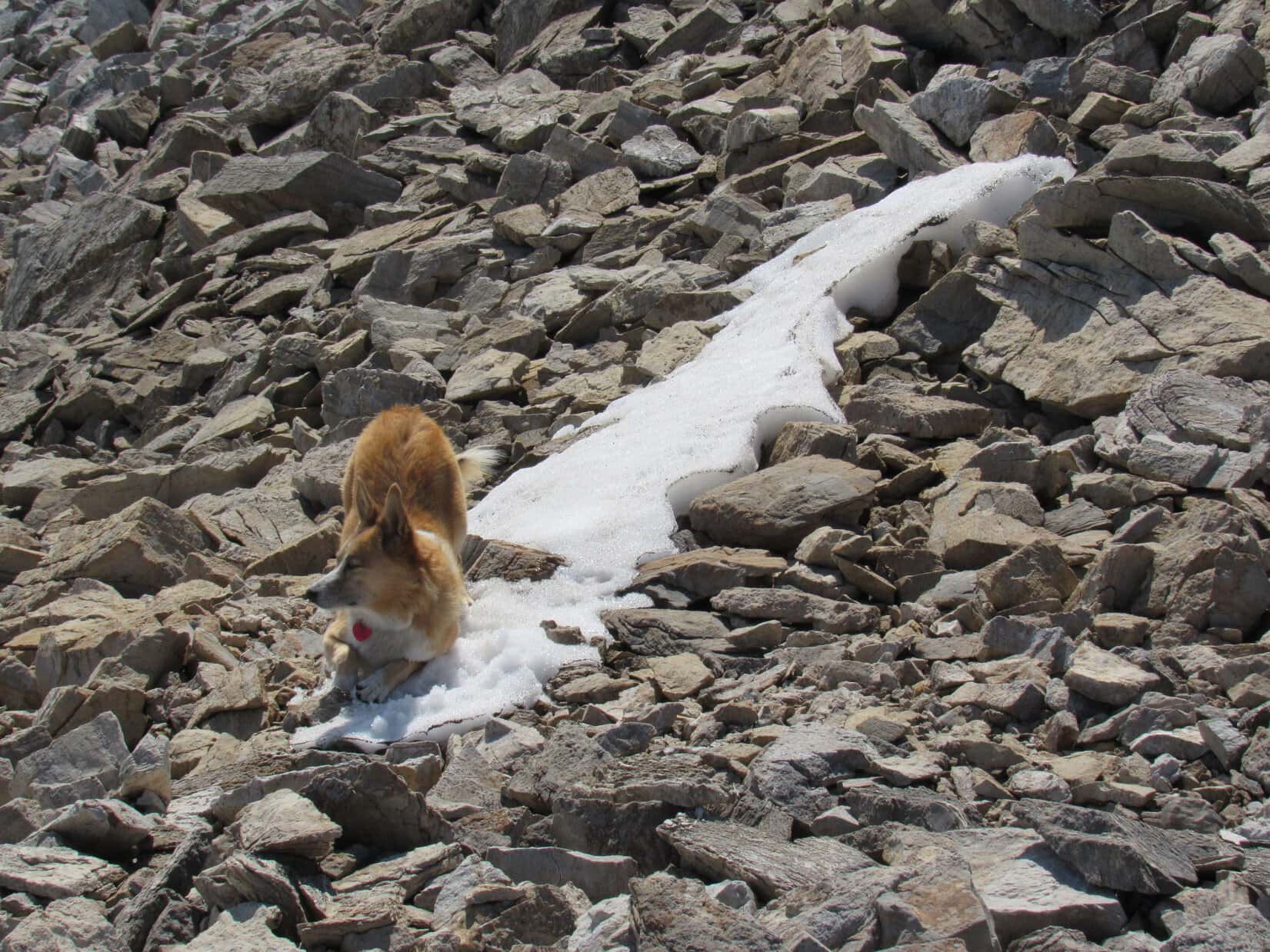
Loop enjoying a little patch of snow she found.

The easy trek was soon over.  Even at some of the lesser high points along the way, the terrain became too rough to stay right up on the ridge.  Lupe had to down climb a bit to get around them, negotiating a way through collections of large boulders.  Slow going, but at least possible.  Loop always stayed toward the less steep NW (R) side of the ridge.

The incredible scene to the S of dark mountaintops jutting up from an ocean of white reminded SPHP of photos in airline magazines.  Lupe has never been in an airplane.  She probably never will be.  This might be as close to having that airliner kind of view as Lupe would ever get.

Before Lupe even got to High Point 7320 (2,231 m) something happened that they never show in airline magazines.  All of a sudden, that bright white ocean of clouds flooded up in a swelling tide, completely swallowing Mount Saint George in a matter of seconds.  Lupe was engulfed in fog again.

Nope!  Loopster wasn’t turning back.  Foggy or not, the American Dingo had come too far, and the summit of Mount Saint George was too close.  One way or another, she was going to find out if she could get to the top or not.  Sadly, there wouldn’t be any views now, even if she made it.  No matter.  Reaching the summit in fog would still count as a legitimate peakbagging success.

Maybe it was smart to hurry things along, though.  SPHP didn’t like the notion of being way up here in fog for hours on end.  This time it didn’t seem likely the clouds would dissipate.  Onward!

Lupe reached High Point 7320 (2,231 m), but didn’t bother going all the way to the top.  She passed only 20 or 30 feet below it, again staying to the R.  Beyond High Point 7320 was a relatively flat area of small brown stones leading to the next somewhat lower high point nearby.  Beyond that next high point, Lupe was seldom right on the ridgeline.  She stayed NW (R), skirting past one high spot after another.

It was slow going, scrambling among large rocks and boulders on steep slopes the entire time.  Such limited visibility made things more difficult.  Lupe came to drop offs that couldn’t be seen soon enough to avoid having to retrace some hard won gains to down climb and go around them.  After each down climb, Lupe tried to regain her lost elevation.

Coming to drop offs in the fog usually meant retracing some progress and down climbing to get around them before returning to the ridge a bit farther on.
Lupe up on the ridgeline sometime after getting by High Point 7320 (2,231 m). Photo looks ENE.

The fog also made it impossible to see how much progress Lupe was making.  She had gone what seemed like a considerable distance beyond High Point 7320, when suddenly the fog thinned.  For a brief moment it was possible to see farther along the ridge.  Dark rocks.  Higher ground ahead!  Lupe was getting close to the summit!  It wasn’t that far away!  The fog closed in.  The view vanished.

There was a problem.  Lupe was on a platform of light gray rock.  15 feet ahead the platform ended abruptly at a drop of unseen proportions.  The platform narrowed toward the end.  It was like walking a plank.  SPHP peered over both sides of the plank.  To the L was a cliff.  To the R talus fields of darker rock could be seen well below where Lupe was.  They were steep, steeper than anything that had come before.

Lupe reaches the plank leading to a sudden drop off. Photo looks WSW.

This would be the biggest down climb yet.  Loopster would have to retrace more of her route to even start it.  She would then be on that very steep talus slope.  Yet if Lupe could get past this point, maybe she could quickly reach the summit?

The view ahead had only appeared momentarily.  Maybe what SPHP had seen wasn’t really the summit, just another of multiple high points on the way?  Maybe she couldn’t even get to the top of what had been so briefly glimpsed?

Standing there wondering in the enduring fog on the plank, the situation was starting to feel intimidating.  Unnerving.  Lupe seemed fine.  So close, yet …

A low rumble, muffled and distant.  Thunder?  Oh, brother.  Not up here!

It was the straw that broke the camel’s back.  If a storm was coming this was no place to be.  Close or not, whether Lupe could have made it or not, it was time to get out of here.  Enough playing with fire.  Time was up.  Lupe and SPHP turned back.  Within moments, thunder again, more distinctly twice in quick succession.  Closer, but still a way off.  It was coming from the W or SW.  Hurry, hurry!

On the retreat, Lupe passed so close to the top of High Point 7320 (2,231 m), that SPHP had her scramble briefly to its summit.  This was it!  As high as Lupe was ever going to get on Mount Saint George.  A couple of photos, then time to flee.  No views in the fog, anyway.

Near the top of High Point 7320 (2,231 m). Photo looks SE.
Lupe at the top of High Point 7320 (2,231 m). This is as high as Lupe ever made it on Mount Saint George. It was a valiant effort, but she’s still 82 feet below the elevation of the true summit. Photo looks S.

On the way back to the N end of the summit ridge, thunder was heard with increasing frequency.  Still distant, but louder and louder.  The storm was moving this way.

Lupe and SPHP had only barely started down the NE ridge when Lupe became frightened.  The thunder was getting unnervingly loud.  The Carolina Dog begged SPHP to stop and hide.  Not possible.  No place to hide existed.  Way too high and exposed on the mountain, down as fast as possible was the only answer.  SPHP urged Lupe onward.

No lightning was seen, but the thunder continued at regular intervals.  SPHP tried to reassure Loopster as she worried over each fresh rumble.  After a particularly loud roar, SPHP reached down to pet Lupe and got shocked twice.  The Carolina Dog’s fur crackled with static electricity.  Now Lupe wasn’t the only one truly alarmed.

A shock happened once more, but not as strongly the second time.  Down, down, down forever.  It started to rain.  Out came the rain poncho.  Poor Loop got soaked.  The thunder finally faded.  The storm had moved off in another direction.  Two thirds of the way down the endless NE ridge, the fog lifted.  For a while it continued raining, but only lightly now.

The waterfall down at the gash had tripled in flow!  For a few minutes the sun came out, shining briefly on the Carolina Dog now busy sniffing and exploring like on any other day, the fearsome thunder only a memory.  By the time Lupe was back on the microwave tower road, the fog had returned.

Safe and sound back on the microwave tower road. Photo looks E.
Remember! This was all your idea, SPHP! …. No worries Loop! I think you did fabulous, all things considered!
Miss Curly Tail happy to be checking the forest for squirrels again.

What a crazy day!  Memorable for sure.  So close, but denied!

Could Lupe have gotten to the summit of Mount Saint George (7,402 ft.) under more favorable conditions, or had she been destined to failure no matter what from the very start on a mountain that was simply an impossible challenge?

We’ll never know.  Puppy ho!  Onward!  (7:20 PM)

Looper on High Point 7320, as high as she ever made it on Mount Saint George, 8-5-17

Related Links:

Summit Peak & Mount Saint Paul, Stone Mountain Provincial Park, British Columbia, Canada 8-4-17

Stone Mountain Provincial Park, British Columbia, Canada

Want more Lupe adventures?  Choose from Lupe’s 2017 Dingo Vacation to the Yukon & Alaska Adventure IndexDingo Vacations Adventure Index or Master Adventure Index.  Or subscribe free to new Lupe adventures.

Black Hills, SD Expedition No. 86 – Crow’s Nest Peak (5-3-14)

Snow!  In May!  So much of it the G6 would never get through.  Carefully, SPHP backed the G6 up to a place where it could be turned around.  Half a mile SE of the junction of County Road No. 303 and USFS Roads No. 110 & 117 in Manganese Draw, SPHP parked the G6 at a wide spot along No. 303 near a cattle guard where private property began.  Lupe would have to start for Crow’s Nest Peak from here.  (10:52 AM, 52°F).

So much snow on the road this late in the spring was unexpected, but Lupe was already at 6,500 ft. elevation, which is pretty high territory for the Black Hills of South Dakota.  Her destination, Crow’s Nest Peak (7,048 ft.), is one of only a handful of mountains in the Black Hills topping out at over 7,000 ft.

Despite it’s lofty elevation, Crow’s Nest Peak doesn’t have the appearance of even a notable small hill, much less a peak.  All of the nearby ground is gently rolling territory that’s nearly as high.  Lupe and SPHP certainly weren’t expecting any dramatic views today.

In fact, the big question wasn’t whether Lupe could climb the mountain, but whether she would be able to find it?  Lupe’s 2 prior attempts to reach Crow’s Nest Peak from the S and SE on Black Hills, SD Expeditions No. 72 and No. 84 respectively had both ended in failure.  Snow on the ground had played a role both of those times, too.  Although Lupe must have gotten close on Expedition No. 72, Crow’s Nest Peak had been so difficult to recognize SPHP hadn’t been certain if she had even seen the mountain.

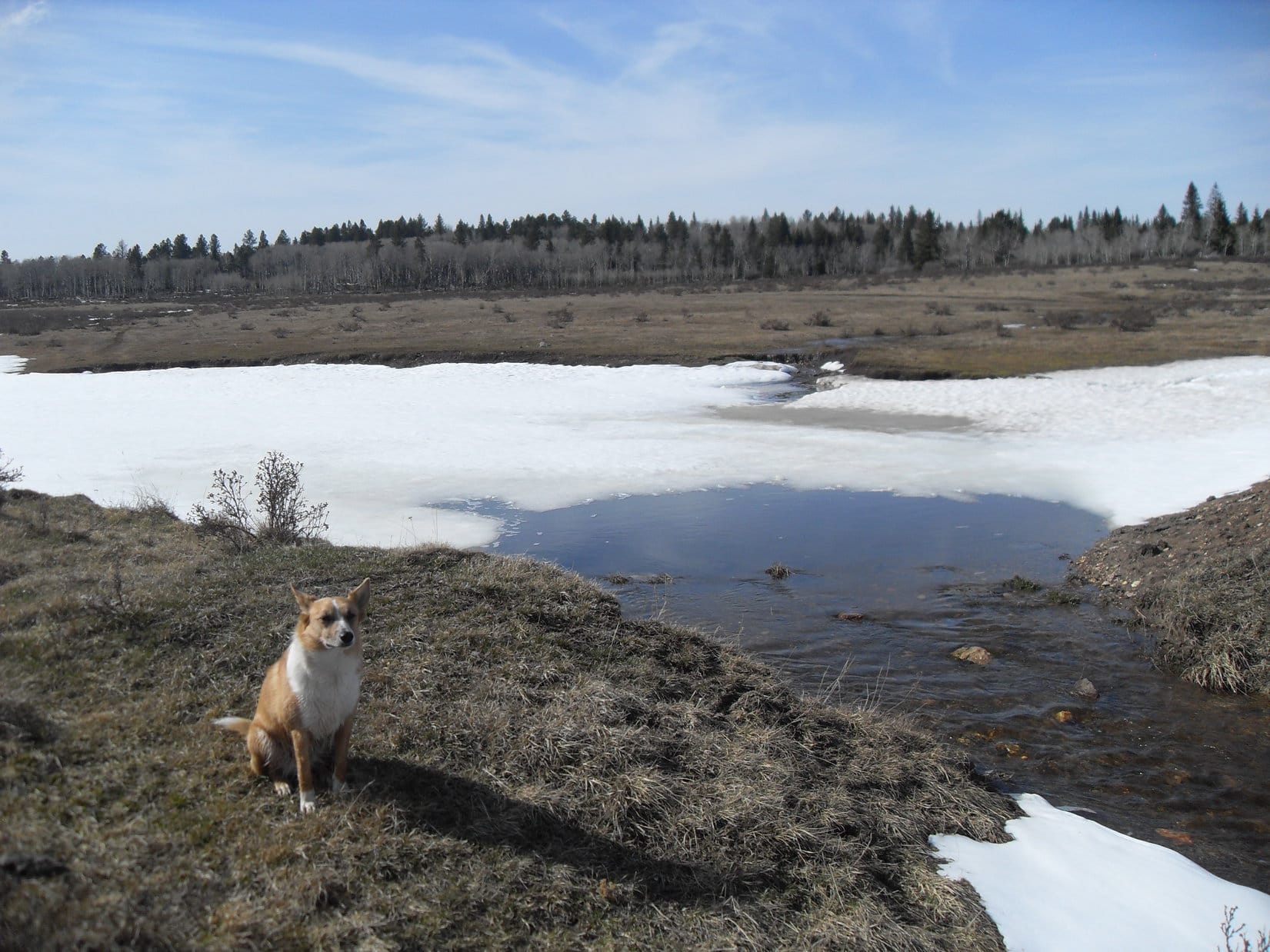
This was a new day, though.  This time, Lupe was starting for Crow’s Nest Peak from a closer point and a new direction.  As the crow flies to it’s nest, the summit was only 2.5 miles to the SSW.  Lupe began her latest attempt on Crow’s Nest Peak by finding a place to leap over to the S side of Castle Creek.  She then turned NW up Manganese Draw.

Blue skies, pleasant temperatures – it was going to be a glorious spring day for a romp in the hills!  Lupe had an easy time trotting along sniffing through the meadows near the clear running stream.

Looking WNW up Castle Creek in Manganese Draw.
Lupe in Manganese Draw as she starts out for Crow’s Nest Peak. Today’s adventure would be her 3rd attempt to reach the summit. The meadows along Castle Creek were easy territory to travel through, and an encouraging way to begin.

Lupe had to cross the creek several more times as it meandered through the valley, but there was always a way across.  Before long, Lupe was approaching the intersection of County Road No. 303 with USFS Roads No. 110 & No. 117.  Even if the G6 had been able to get this far, this would have been the end.  Lupe saw that No. 117 heading S from the intersection in the general direction of Crow’s Nest Peak was completely covered by a huge snowbank.

Lupe nears the intersection of County Road No. 303 and USFS Roads No. 110 & 117 in Manganese Draw. The big snow bank seen beyond her completely covered No. 117. Photo looks NW.

The plan was to follow No. 117 a couple miles S to get close to Crow’s Nest Peak.  From the intersection, Lupe avoided the big snow bank by returning to the meadow close to Castle Creek.  She crossed the creek one more time, and didn’t go back to the road until she was beyond the snow bank.  No. 117 climbed steadily as it wound around toward the SW.

Between the brilliant sunshine and fast warming temperatures, the steady upward trek along the road soon started feeling rather warm.  After going 0.5 mile SW on No. 117, an unmarked dirt side road headed SE up an even steeper slope toward the forest.  This was probably USFS Road No. 117.5D.  Getting out of the hot sun and up into the shady forest sounded good to both Lupe and SPHP.  Lupe would have a better time exploring the forest than following the main road anyway.

A short steep climb along No. 117.5D brought Lupe to the edge of the forest.  Much more snow was hidden here, still melting in the shade of the trees.  The snow wasn’t everywhere, but Lupe frequently encountered drifts 2 feet deep.  No. 117.5D continued climbing for a while, but eventually leveled out.  The road disappeared completely not long after reaching the high ground.

Crow’s Nest Peak was still 1.5 to 2.0 miles S.  According to SPHP’s old USFS map, Lupe should reach USFS Road No. 377 before she went half that far.  Dodging snow drifts as much as possible while staying on the highest ground, Lupe and SPHP wandered S through the forest.

Picking a way through the snowy forest was slow going.  Lupe went on and on, but came to no roads.  After what seemed like quite a while, Lupe came to a high spot in the forest.  SPHP wondered if this might even be Crow’s Nest Peak, but soon decided it couldn’t be.  (Note: Lupe was likely at the end of the ridge extending SE from High Point 7036 on the Peakbagger topo map.  Expedition No. 86 occurred shortly before Lupe discovered Peakbagger.com.  SPHP did not have a topo map along on this or any of Lupe’s earlier Black Hills expeditions.)

Little could be seen from the high spot.  The only distant view was toward the S or SE, but it wasn’t much of a view and there weren’t any apparent landmarks.  However, Lupe did have a glimpse between the tees of slightly higher ground off to the SW.

Lupe near the first high spot she came to in the forest.

The next small ridge to the SW wasn’t that far away, but progress toward it was slow due the snow drifts.  Lupe finally arrived up on this ridge, but it didn’t appear to be Crow’s Nest Peak, either.  Lupe could see even less from here (likely High Point 7034), but it looked like there might possibly be higher ground to the SE.

Lupe tried following the ridgeline SE, but didn’t seem to be losing or gaining any significant elevation.  However, she eventually came to a rocky ledge from which she had somewhat more of a view.  From here there appeared to be slightly higher ground off to the WSW.  Noticeably higher ground was off to the SSW, but farther away than SPHP thought Crow’s Nest Peak ought to be.  Still, nothing else around here could be any higher.

Lupe continued SE on the ridge, but soon had to give up on finding any better viewpoint.  She now left the ridge going toward the closer high ground to the WSW.  Another slow trek through the snow drifts brought Lupe to this new high ground.  She wasn’t really any higher than before back on the last ridge.  Not a thing could be seen except the forest.  The terrain in all directions was virtually flat.  Lupe turned S.

Only a few minutes after turning S, Lupe came to a road.  No. 377 at last!  Lupe followed the road WSW, and quickly arrived at a small clearing in the forest where she found a water trough surrounded by a pole fence.  Nearby was an unexpected intersection.  The new road was unmarked, but the road Lupe had been following was clearly marked as USFS Road No. 377.1C.

Lupe near the unexpected road junction. The marker for USFS Road No. 377.1C, which Lupe had already been following for a little way is seen on the right. The water trough surrounded by the pole fence is also in view. The intersecting road is out of sight behind the camera. Photo looks ENE.

Time to stop and check the USFS map again.  SPHP figured this new road must be USFS Road No. 377.  The map had surprising news.  The map confirmed the new road was No. 377, but Lupe was nearly 2 miles E of where she was supposed to be, a little N of Knutsen Spring!

It hardly seemed possible Lupe had gone this far E, but that was what the map showed.  How had SPHP gotten so badly turned around with the sun out in a cloudless sky?  Lupe was still far from Crow’s Nest Peak.  The map showed she had two options from here.  After a short jog S to Knutsen Spring on No. 377, the road would turn W, then NW for 2 miles.  At another junction, she would then have to turn SE following a different road for nearly another mile just to reach USFS Road No. 266.1A at a point 0.5 mile E of the mountain.

A shorter, more direct route was possible, too.  After reaching Knutsen Spring, if Lupe simply left No. 377 continuing S through the forest, she should find No. 266.1A less than 0.25 mile away.  No. 266.1A would then take Lupe 2 miles WSW straight to Crow’s Nest Peak.  That seemed like the thing to do.  Yet it was shocking to think that Lupe was still nearly as far away from Crow’s Nest Peak as when she’d left the G6.  Was Crow’s Nest Peak going to elude Lupe for a 3rd time?!

Lupe and SPHP left the junction with No. 377.1C heading W on No. 377.  This also seemed odd, since No. 377 was supposed to be going S to Knutsen Spring from here.  The only other choice, though, was to head E on what SPHP assumed was No. 377.1D, and for certain Lupe didn’t need to be going any farther E.  SPHP figured No. 377 would turn S soon, but it didn’t.  It kept going W.

With Lupe so far E of where she should have been, going W was probably OK, even though the road wasn’t going where it was supposed to according to the USFS map.  The next new development, however, was more disturbing.  Lupe started losing elevation, and losing it fast.  The road was going downhill!  Snow was plentiful, both on the road and in the surrounding forest.  Downhill or not, Lupe had best stick to the road and continue W.

Down, down, Lupe and SPHP went.  Before long, the forest ended.  The road entered a snowy meadow.  Another surprise!  A much better gravel road was in view ahead.  The gravel road was unmarked where Lupe reached it, but a marker confirmed Lupe had been traveling No. 377.  Nothing made any sense.  Why was this good gravel road even here?  It hadn’t been that long since Lupe had left No. 377.1C.  Lupe turned S on the gravel road, while SPHP pondered these mysteries.

Gradually, it began to dawn on SPHP that this good gravel road had to be No. 117 again.  Lupe was now somewhere farther S than where she’d originally left it.  Back at the marker for No. 377.1C, Lupe hadn’t actually been anywhere near Knutsen Spring, but much farther W, about where SPHP had originally thought she was before seeing the marker and consulting the map.  Within another 0.5 mile, Lupe should come to another road that would take her SE to Crow’s Nest Peak.

Before she’d gone another whole 0.5 mile, Lupe did come to another road.  This new road went ESE up a small draw, and was marked as No. 377.1A.  This seemed like it might be the right road.  At least it was going the right direction.  Lupe took it.

No. 377.1A steadily regained Lupe’s lost elevation, which was a good thing.  The road gradually turned SE, which seemed good, too.  The road was so soft and muddy from melting snow, Lupe and SPHP traveled much of the time off in snowy meadows nearby.

SPHP was watching for an expected junction with No. 377 again 0.5 mile from No. 117, but it never materialized.  Strange.  The map showed it, but no junction appeared.  Lupe continued on.  About 1.0 mile from No. 117, Lupe was approaching the top of a rise.  Off to the W in a meadow sat a large white plastic tank, presumably for water.  It was enclosed by another pole fence.  There wasn’t much snow up here.  Was Lupe coming to the top of Crow’s Nest Peak?

Coming up USFS Road No. 377.1A, Lupe saw a white plastic tank to the W of the road as she was approaching the top of a rise about 1 mile SE of USFS Road No. 117. Photo looks S.

A short distance beyond the white water tank at the top of the rise, Lupe found an unexpected road intersection.  If she stayed on No. 377.1A continuing SE, Lupe would start losing elevation at a good clip.  Turning SSW, she would lose less elevation following No. 377.1B.  Both roads were clearly marked.  Which way?  SPHP had no clue.

Lupe pricked up her ears listening to a wild turkey gobbling somewhere in the forest as SPHP sat on a log studying the USFS map.  It didn’t even show a road No. 377.1B.  Crow’s Nest Peak couldn’t be that far away, but where was it?  Lupe and SPHP went over to the white plastic water tank.  It bore no markings that shed any light on the situation.  Back to the log.  The question remained, which way to go?

SPHP remembered another map in the pack.  It was an old Black Hills National Forest “Travel Information Map”.  Maybe it would provide a clue?  SPHP took it out of the pack for a look.  The BHNF travel information map showed the USFS Roads in much greater detail than the old USFS map, although it contained absolutely no other details except section lines and numbers.

No wonder everything had been so confusing!  The BHNF travel information map was an enormous help!  It showed road patterns that matched up with what Lupe had been seeing on the ground.  The road numbers agreed with the markers Lupe had seen, too.  SPHP’s old USFS map, normally reasonably accurate, was riddled with inaccuracies.  It was a work of fiction in the area Lupe had been traveling through.

The BHNF travel information map showed the intersection of USFS Roads No. 377.1A and No. 377.1B where Lupe was right now.  She clearly needed to take No. 377.1B.  Although the BHNF travel information map didn’t show Crow’s Nest Peak, by comparing section lines on the two maps it was easy to see Lupe was only 0.5 mile NE of the summit.  Lupe and SPHP took off heading SSW on No. 337.1B.

As the roads went, Lupe would have more than 0.5 mile to go to reach Crows Nest Peak.  In fact, the BHNF travel information map led SPHP to believe she would have to go 0.5 mile just to reach the next intersection with USFS Road No. 266.  Well before Lupe had gone 0.5 mile, however, she came to a small clearing.  A road buried in snow disappeared going S into a dense forest.  There was no marker for it, but it was probably No. 266.

A less snowy road made a sharp turn to the W into another dense forest.  A marker showed this was still part of No. 377.1B.  Lupe did need to go W to get to Crow’s Nest Peak, so she left the small clearing staying on No. 377.1B.

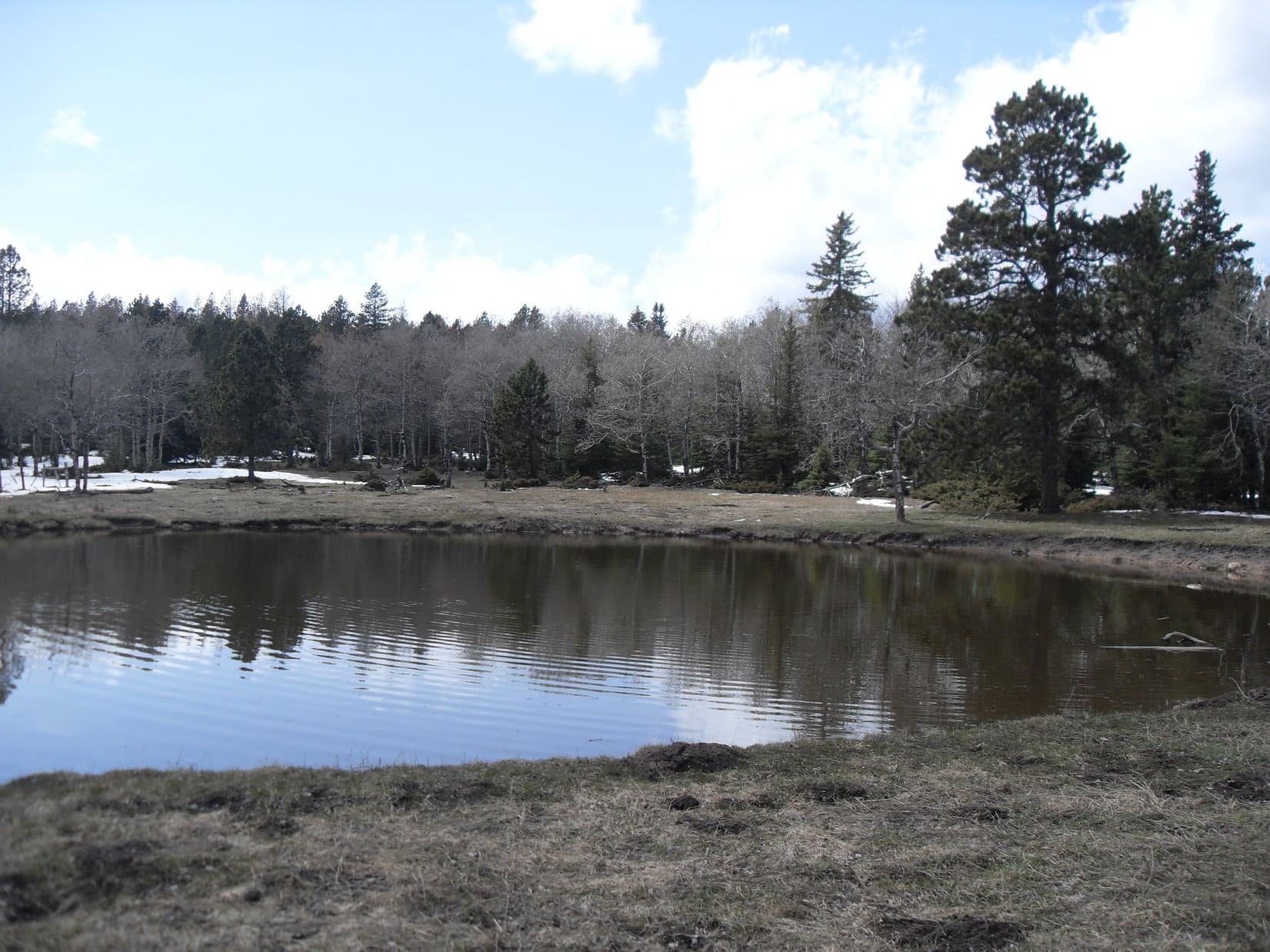
Lupe didn’t go much farther before she reached a larger clearing.  This clearing wasn’t completely treeless.  Spruce trees were scattered around.  On the N side of the road was a good-sized pond.  Three ducks were paddling around on this pond, but they flew off as Lupe approached.

Three ducks paddling around on this pond on the N side of USFS Road No. 377.1B flew away as Lupe approached. Photo looks NW.

Although the pond contained rather murky, brown water, it still seemed like a relatively nice place to take a short break.  Lupe had Taste of the Wild, while SPHP munched an apple.

After finishing her Taste of the Wild, Lupe went down to the edge of the pond.  She saw a salamander trying to avoid detection by burying itself in the mud at the bottom of the pond.  Salamanders are a fairly unusual sight in the Black Hills.  Lupe wondered what that strange thing was?  Fortunately, as far as SPHP was concerned, she didn’t want to find out badly enough to enter the cold, dirty-looking water.

Lupe near Salamander Pond. Photo looks ENE.

The time came to press on from Salamander Pond, but SPHP had a hard time discerning where No. 377.1B went from here.  A foray to the S revealed nothing.  As it turned out, No. 377.1B continued W hidden under snow.  It seemed like Lupe was gaining a little elevation as she followed the road W.  Soon she was definitely gaining elevation.  The faint road climbed a small hill from the SE.

Lupe arrived on top of the little hill to find a small, flat, opening in the forest.  Part of the opening was buried beneath a large snow bank.  A big pool of snow melt water covered a portion of the road ahead to the W.  The whole area was so level, most of the ground was soggy.  Water trickled NE into a marshy area among the trees.

Was this Crow’s Nest Peak?  Lupe seemed to be at the top of the small hill, but saw no signs or markers anywhere.  To the E, lots of snow could be seen between the trees.  A spur of the road headed in that direction.  However, before going E, Lupe went W to check out the big pool of water.  Beyond it, SPHP thought it looked like there might be a view.

Going over to the big pool, the ground was sopping wet.  Beyond the pool, however, the ground was drier and Lupe did have a bit of a view off to the W.  The forest had been thinned enough in this direction so that she could see a few high hills that had to be well into Wyoming.  Closer by were blue ridges nearly as high as where Lupe was now.  SPHP thought Lupe must be on Crow’s Nest Peak, but found no proof.

Looking E at the pool of snow melt water that partially covered the road on top of the little hill.

Lupe traipsed back E past the snow melt water pool, crossing the soggy ground again to reach the trees at the E side of the clearing.  She explored the spur of the road that went E into the forest.  Only a few trees into the forest, Lupe found herself at the edge of another even smaller clearing.  This tiny clearing was full of snow.  The snow made it hard to tell, but it looked like the spur road ended already at a small turnaround circle in the clearing.

Out in the middle of the tiny clearing, a red and yellow metal post stuck up out of the snow.  Lupe and SPHP ran over to the post.  It said “Survey Marker”!  This had to be it!

The post in the middle of the tiny snow-filled clearing said “Survey Marker”! This had to be it!

Excitedly, Lupe and SPHP started digging in the snow around the post.  At first Lupe didn’t find anything.  SPHP found a few rocks close to the W side of the post.  Almost immediately, Lupe uncovered something metal about half a foot N of the post.  The survey marker!  SPHP brushed the rest of the snow away.  The marker said “1912”.  At the center of a circle rimmed with the usual propaganda a single joyful word was stamped: “Crow”.

After failing on two prior expeditions, Lupe had arrived!   She was now undeniably on Crow’s Nest Peak (7,048 ft.).  She had found the survey marker someone had set here 102 years ago!  SPHP took a picture of it, not realizing until later on how blurry it had turned out.  Oh, well.

The survey marker on Crow’s Nest Peak. SPHP didn’t realize until later on how blurry this photo had turned out. “Crow” can sort of be made out above the triangle.

There were no views from the tiny snow-filled clearing.  The clearing bore no resemblance to what one thinks of as a mountain top.  Lupe hadn’t had much in the way of a distant view anywhere along the way here, either.  Yet finding the survey marker felt like finding a treasure.  Lupe was actually at one of the highest points in the Black Hills.  Looking for the marker in this remote part of the western Black Hills had been fun!

Lupe at the remote, undramatic, summit of Crow’s Nest Peak for the very first time.

Lupe and SPHP left the summit feeling inexplicably happy.  Nothing wrong with being happy is there?  The American Dingo seemed to take it for granted.  SPHP decided happiness needs no weighty justification.  Take it when you can get it, and be glad!  If being too happy is a problem, it’s among the best problems you can have.  Enduring it is easy.  Lupe and SPHP were willing to tough it out!

The Carolina Dog’s peakbagging goal for the day had been achieved.  SPHP knew there was beautiful open land flanked by forests not too far off to the W.  Lupe could wander over that way, find USFS Road No. 117 again, and have fun exploring on her way back to the G6.  Lupe passed by the pool of snow melt water on the W side of Crow’s Nest Peak one more time.

Lupe near the pool of snow melt water for the final time on her first successful trip to Crow’s Nest Peak. Photo looks WSW.

After enjoying the view W of the pool for a few minutes, Lupe followed the road down the SW slope of the little hill.  The road was in poor condition here.  It led to an intersection where Lupe turned WNW.  After passing through a level clearing, Lupe resumed losing elevation as the road went downhill through a forest.  Emerging at the far end, Lupe could see the good gravel road, USFS Road No. 117, again.

USFS Road No. 117 came into view again from the snowy road WSW of Crow’s Nest Peak as Lupe emerged from the forest. Photo looks NNW.

When Lupe reached No. 117 again, SPHP was surprised there was no sign at all for Crow’s Nest Peak at the turn onto the minor road she had been following.  A short distance off to the W was a junction with another good gravel road.  Lupe went over to check out that junction.  She found a sign saying this other good gravel road heading N was No. 117.5K.

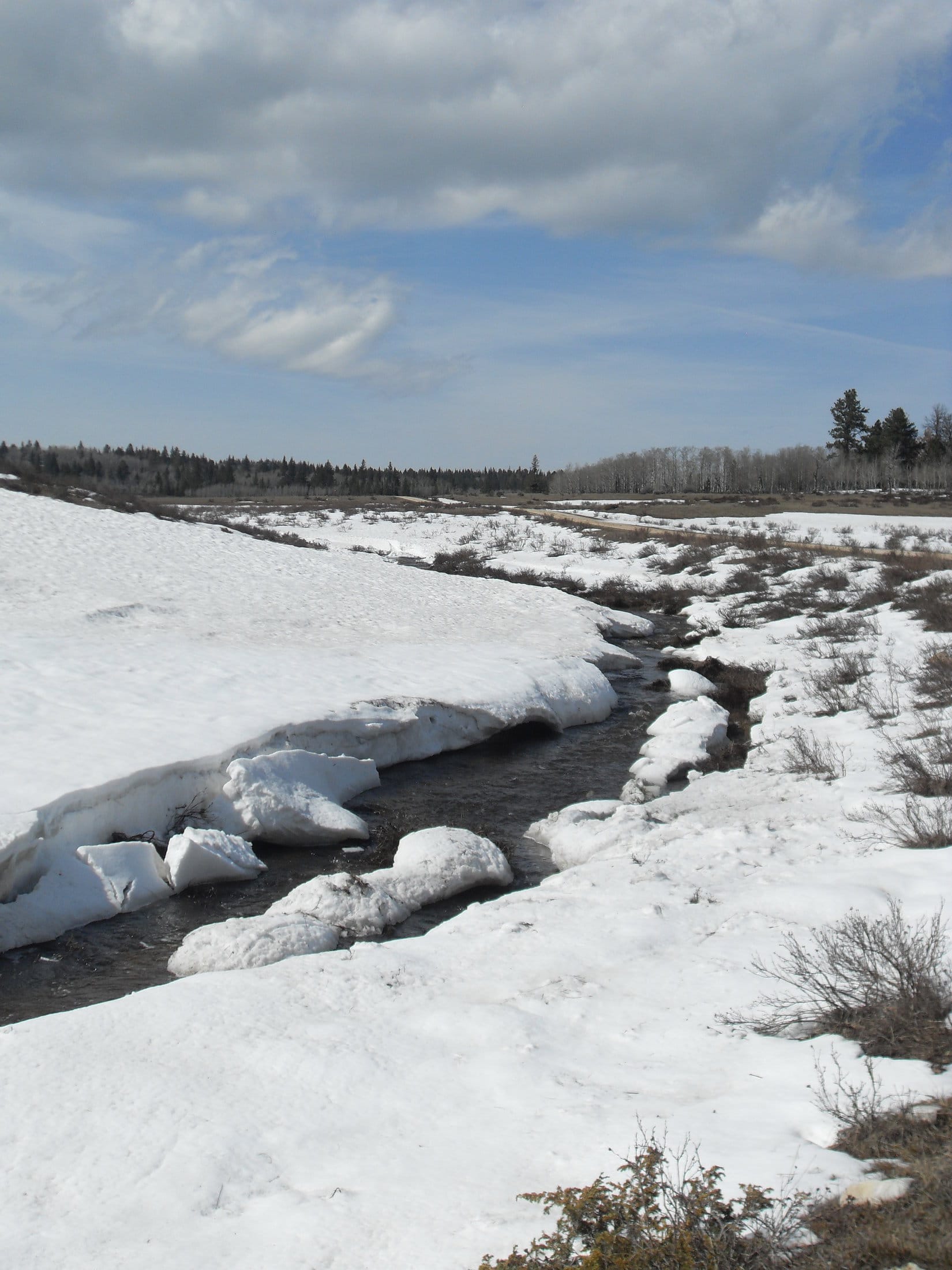
A stream with a strong current was flowing S on the W side of No. 117 from this junction.  Ordinarily, no stream exists here.  It was all snow melt.  Maybe Lupe could have some fun following the temporary stream S along the road?  SPHP kind of wanted to see if there were any more roads heading toward Crow’s Nest Peak from No. 117, and if any signs for Crow’s Nest Peak existed anywhere along the way.

The snow melt stream flowing S along the W side of USFS Road No. 117.5K. Ordinarily there is no stream at all here. It was all snow melt that would eventually flow into Beaver Creek a few miles SW of here. Photo looks NNE.

Lupe had a good romp exploring the meadows near the snow melt stream as she followed No. 117.  The road wound around to the SW.  Lupe paralleled it for at least 0.5 mile before coming to a bend where two big truck tires had been turned into water troughs.  One was full to the brim, while the other was nearly empty.

Lupe sits near the truck tire water trough. This one was almost overflowing. Photo looks NE in the direction Lupe had come from.
Lupe enjoyed the shade next to the almost empty truck tire water trough while SPHP checked the maps again. Photo looks SSW.

SPHP checked the maps again.  Lupe hadn’t come to any more roads.  It wasn’t likely any roads would leave No. 117 for Crow’s Nest Peak from any farther S than where Lupe was here.  SPHP’s curiosity was satisfied.  May as well head back N.

The two truck tire watering troughs were as far SW as Lupe went along USFS Road No. 117.  The snow melt creek was pretty impressive down here.  Lupe started following it back upstream.

Near the two truck tires, the snow melt stream was impressive for the Black Hills. This was as far SW as Lupe went along No. 117 before turning around to go back N. Photo looks NE.

Lupe went all the way back to the junction with No. 117.5K.  The meadows W of No. 117.5K looked so beautiful and inviting, Lupe and SPHP left No. 117 to continue N in those meadows.  Lupe came to a pond along the snow melt stream that was mostly full of snow.  A small waterfall tumbled into the little pond.

Lupe came to this cool little snow filled pond with a small waterfall tumbling into it in the meadows W of No. 117.5K. Photo looks NW.

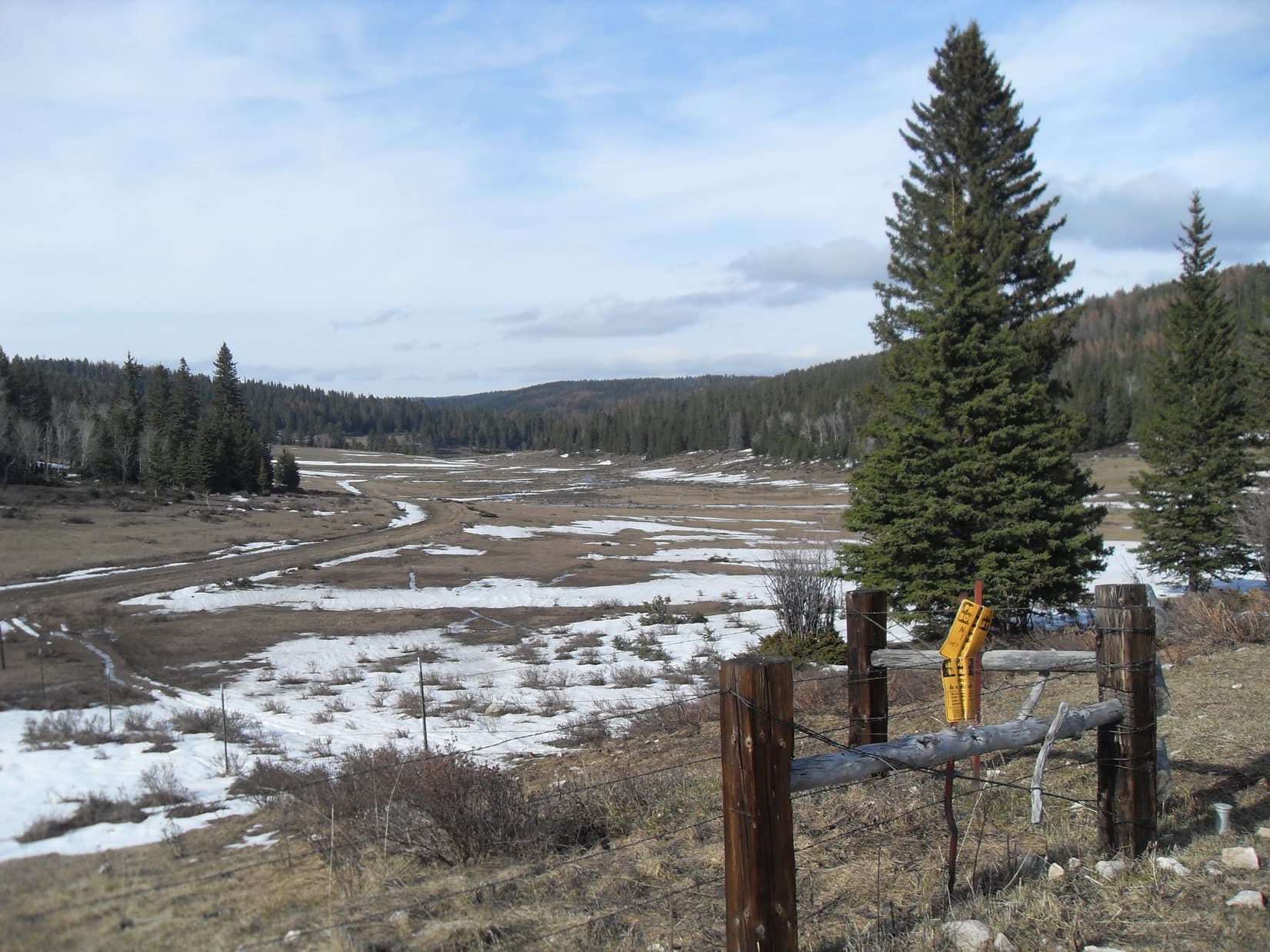
No. 117.5K went almost straight N gaining elevation gradually.  Eventually the road went over a little pass.  Beyond the pass was another long beautiful valley off to the NNE.  SPHP continued marching along soggy, wet side roads in the fields W of No. 117.5K, while Lupe roamed to her heart’s content.  SPHP stayed toward the W side of the valley near the forest, since Lupe enjoys having a mix of open ground and forest to run around on and explore.

As No. 117.5K went over this pass, the next long beautiful valley to the NNE came into view. Lupe and SPHP followed it staying toward the W (L) near the trees. Photo looks NNE.
Lupe enjoyed being able to make forays into the nearby aspen forest from the meadows along No. 117.5K. Photo looks NW.

No. 117.5K ended as a good gravel road a little N of the pass.  Near a barbed wire fence, it veered off to the NW as a muddy minor road.  Lupe was hungry again by the time she reached this point.  She took another Taste of the Wild break near the fence where the good part of No. 117.5K ended.

By the time she reached the N end of the good part of No. 117.5K near the barbed wire fence, Lupe was ready for more Taste of the Wild. A long day roaming the Black Hills gives a Carolina Dog a healthy appetite!
Ahh, better!
Looking back to the S from the N end of the good part of No. 117.5K toward the little pass Lupe went over. The mucky part of No. 117.5K continued off to the NW (R) into the forest, but Lupe didn’t follow it that way.

From the fence at the N end of the good part of No. 117.5K, Lupe left the road to continue NNE down the long gentle valley ahead.  She roamed the W side of the valley, crossing many little snow melt streams.  SPHP found another dirt road, and followed it where it wasn’t too muddy.  The easy, gradual, downhill trek was beautiful.  The air grew chilly as the sun began to sink.  It was still early spring up at this elevation.

The easy, gradual trek down the long valley beyond USFS Road No. 117.5K was a beautiful time. Lupe crossed many little snow melt streams and roamed happily as the sun began to sink and the air grew chilly. Photo looks NNE.

Eventually, SPHP saw No. 117 reappear on the E side of the valley.  Soon No. 117.5D came into view, too, on the far side of No. 117.  This was the road where Lupe had originally left No. 117 to escape the heat and explore the forest on her way to Crow’s Nest Peak.  Lupe could have gone over to No. 117 again, but instead she stayed on the W side of the long valley.

SPHP led her along the dirt road even after it re-entered the forest, turned NW, and started gaining elevation.  This proved to be a mistake.  Soon Lupe and SPHP had to leave the road to plunge down the N side of a densely forested steep slope.  The snow was feet deep here.  Suddenly, Lupe was leaping and bounding through snow up to her neck.

After what seemed like a long struggle, Lupe escaped the snow when she reached the floor of a valley.  She came to another road, No. 117.5I.  The intrepid Carolina Dog was now a little farther W in upper Manganese Draw than she had been early in the day.  Her adventure to Crow’s Nest Peak and back was almost over.  Before long she was E of No. 117 again, following Castle Creek downstream.  At 6:38 PM, (44°F) Lupe reached the G6.

Lupe had enjoyed sunshine all day near Crow’s Nest Peak.  Surprisingly, on the way home it turned out the rest of the Black Hills only a few miles to the E was under dense cloud cover.  Lupe was tired.  She curled up on the G6’s passenger side front seat.  SPHP thought she might go to sleep as the light faded.

The Carolina Dog couldn’t relax, though.  She was too worried she was missing out!  She wound up standing and watching for cows, horses and deer to bark at all along the long road home.  For Lupe, the adventure never ends!

On Crow’s Nest Peak, 5-3-14

Links:

Next Black Hills Expedition              Prior Black Hills Expedition

Want more Lupe adventures?  Choose from Lupe’s Black Hills Expeditions Adventure Index or Master Adventure Index.  Or subscribe free to new Lupe Adventures.