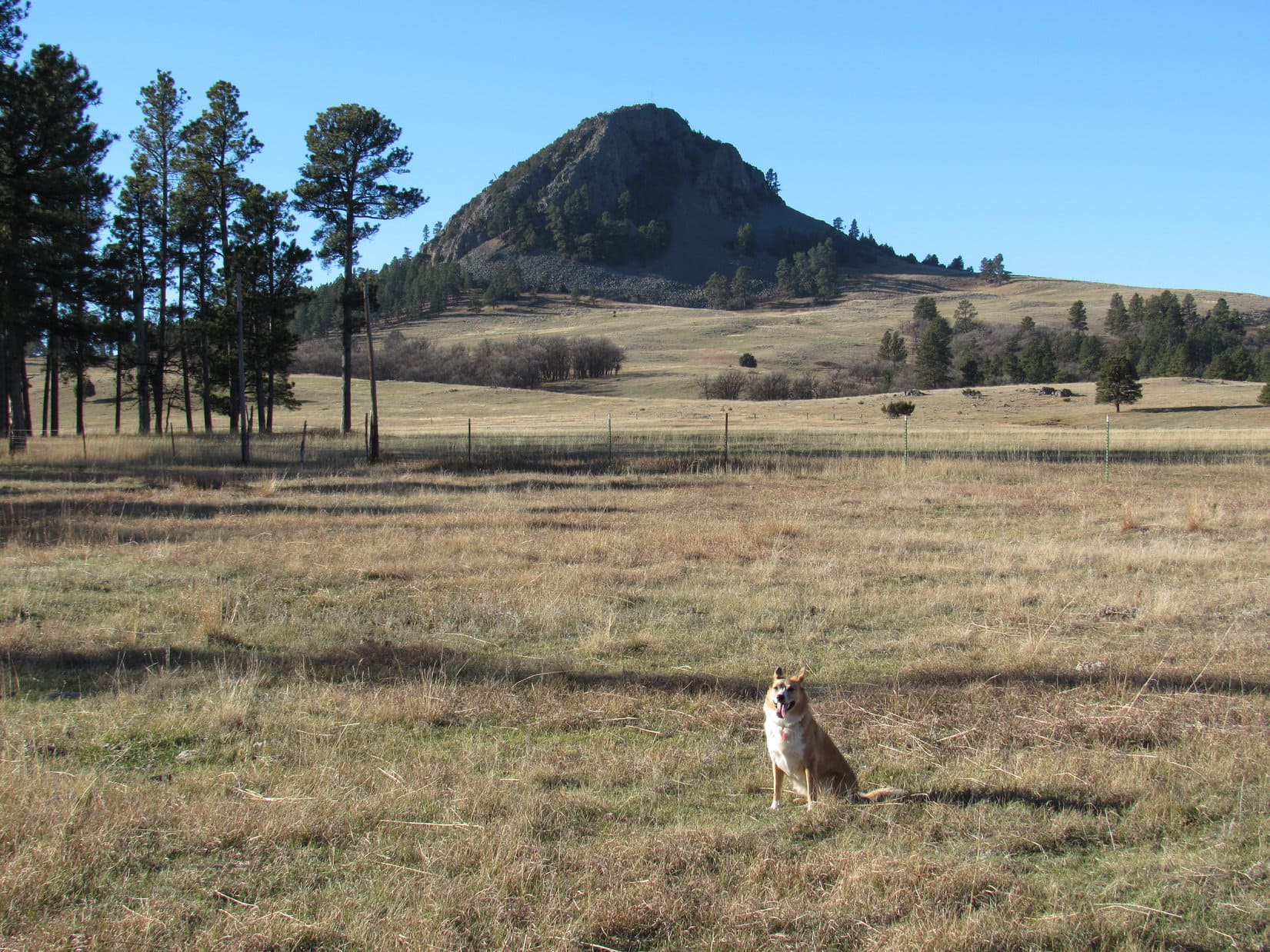
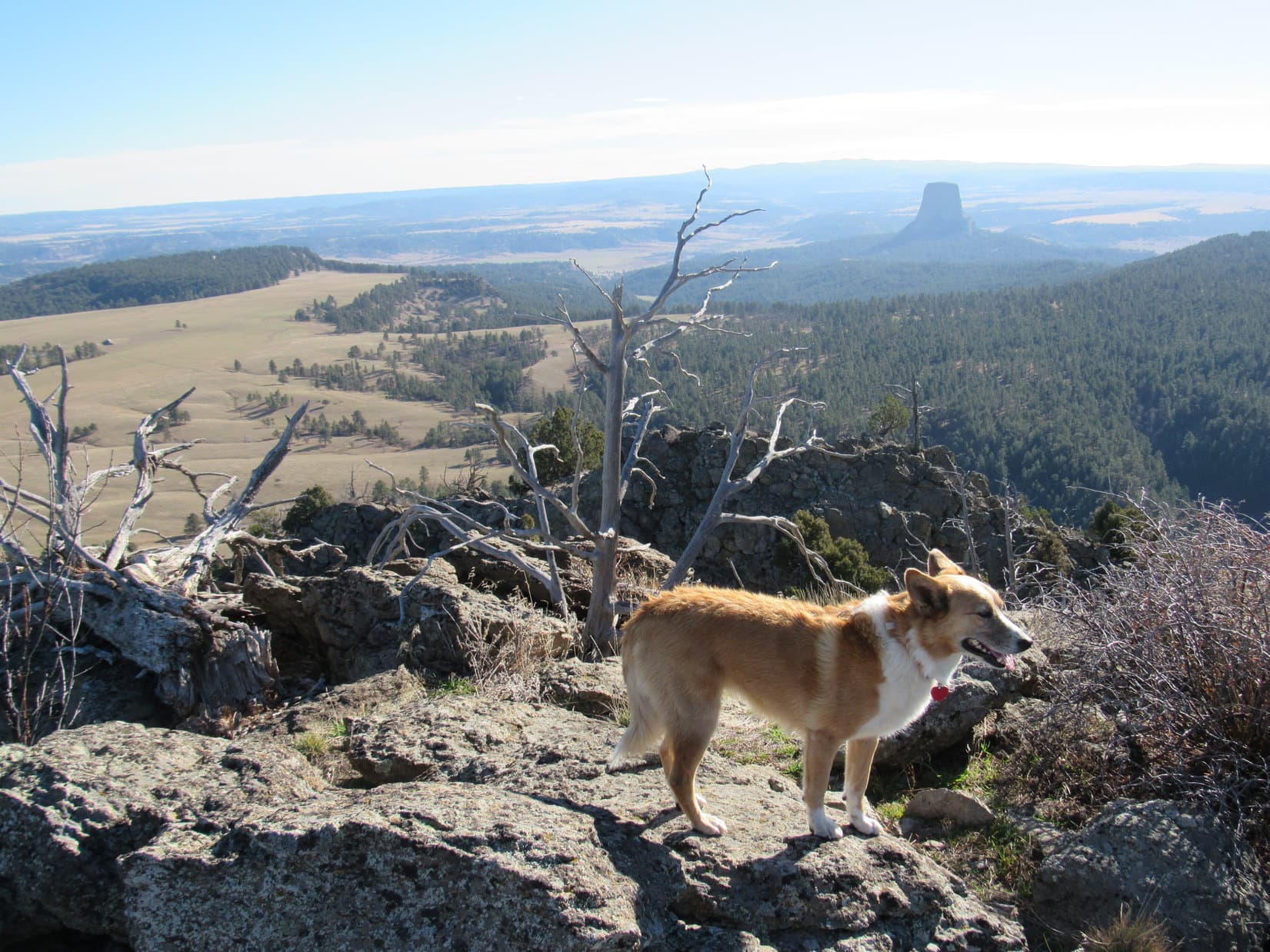
Black Hills Expedition No. 182 – Mount Pisgah (WY) & Laird Peak (SD) (11-13-16)

The sign said “Lunney”.  This was it!  Beyond a gravel parking area, SPHP opened a wire gate, then drove the G6 down a steep little slope, parking it next to an old building (8:49 AM, 48°F).  SPHP closed the gate again.  Lupe could come out now.  She bounded out of the G6 expecting great things!

Lupe arrives at the Lunney place, ready to start on her next Black Hills, WY adventure. Photo looks E.
The G6 parked on land owned by rancher Lauris Tysdal. The Lunney place just off US Hwy 85 is seen just beyond the fence. Photo looks W.

Lupe was in the Black Hills of Wyoming, about 5 miles S of the junction of Highways 85 & 585 at Four Corners.  She had just seen Red Butte on the E side of Hwy 85 less than a half mile to the N.  SPHP had been watching for the Lunney place, mentioned in a May, 2009 trip report by Edward Earl on Peakbagger.com.

The Lunney place was important as an access point to rancher Lauris Tysdal’s land and Mount Pisgah (6,380 ft.).  Mount Pisgah was one of two peakbagging goals Lupe had in this vicinity.  She already had Mr. Tysdal’s permission to cross his land to climb Mount Pisgah.  Later in the day, Lupe and SPHP would be looking for the owner of the ranch where Sweetwater Mountain (6,440 ft.) was, hoping to get permission to climb it, too.

First things first, though.  Before climbing Mount Pisgah, Lupe was going to go see Red Butte, a fin of red clay topped with a layer of limestone.  Lupe and SPHP went N through a field just E of US Hwy 85.  Red Butte was soon in view.

Lupe S of Red Butte. This fin of red clay capped by a layer of limestone is a somewhat unusual landmark in the Black Hills area. It is more typical of parts of Wyoming farther W. Photo looks N.
Red Butte, WY from the S. The butte is just E of US Hwy 85, about 5 miles S of Four Corners. It is seen to be much longer than it appears here when viewed from the E or W. Photo looks N.

After a good look at Red Butte, Lupe and SPHP returned to the G6 where a dirt road on the Tysdal Ranch headed SE.  This road would take Lupe all the way up to the top of Mount Pisgah.

Lupe about to start for Mount Pisgah. She would follow the dirt road seen here. It went SE beyond the building, then turned NE (L) before reaching the trees. Photo looks SE.

The road took Lupe SE past an old, low building, then turned NE before reaching the trees.  Lupe soon came to a fence across the road.  The fence wasn’t mentioned in Edward Earl’s report.  The Carolina Dog slipped under the fence.  She stayed on the road, as it entered the forest and wound its way up a small canyon.

Coming out into more open ground again, Lupe could see the same rock formations Red Butte was made of evident along the NW side of the canyon.

The same rock formations Red Butte was made of were also evident on the NW side of the canyon the road to Mount Pisgah passed through. Photo looks NW.

Now and then, side roads left the road Lupe was following.  She didn’t take any of the side roads, per Edward Earl’s advice.  The main dirt road slowly turned ENE as it went up the canyon.  For a while, the road looked like it was heading for a minor pass to the E.  Instead, it made a sweeping curve to the S before reaching the pass.

The road grew steeper, and wound around quite a bit, but was generally heading S.  Suddenly, Lupe dashed ahead.   She was looking up into the forest to the SE.  SPHP saw it, too.  Not too far away, a large coyote was watching Lupe!  As soon as it made eye contact with SPHP, it fled E into the forest.  Lupe was disappointed that the wild dog didn’t want to be friends, but it was probably for the best.

Lupe reached an orange well pump mentioned by Edward Earl.  By now, Lupe could see a tall tower up on the NW end of the huge Mount Pisgah summit plateau.  Edward Earl’s trip report had mentioned that a tower shown on the topo map at the N end of Mount Pisgah was not there, but Lupe most definitely saw one.  It was in plain sight.

Lupe at the orange hydrant, mentioned (as an orange well pump) by Edward Earl's trip report. Photo looks SE.
Lupe at the orange hydrant, mentioned (as an orange well pump) by Edward Earl’s trip report. Photo looks SE.

By now, Lupe was fairly high up on the NW slope of Mount Pisgah.  There were tree-broken views off to the N and W, but Lupe hadn’t come to any clear views.

From the orange hydrant, the road leveled out.  It turned sharply E, passing below the steep N face of the mountain.  Within a few minutes, Lupe came to a fetid brown pond in a depression S of the road.  The pond was shrunken by drought.  Hoof prints showed thirsty cattle had churned up the mud around the pond.  Apparently, cattle aren’t overly concerned about water quality.

Lupe at the fetid stock pond shrunken by drought. This pond is just S of the road, and N of the steep upper N face of Mount Pisgah. The brown water looked simply horrid. Photo looks ENE.

Beyond the nasty pond, the road swung toward the NNE before rounding the end of a narrow ridge extending in that direction from the summit plateau.  The road then turned S along the less steep E face of Mount Pisgah.  The forest was left behind.  Lupe was out in grasslands.  Here, she had a clear view to the E of the Black Hills in South Dakota across a valley several miles wide.

On the E slope of Mount Pisgah, Lupe had a sweeping view to the E of the Black Hills in South Dakota across a wide valley. Photo looks NE.
Lupe on the road up Mount Pisgah. Here she is on the upper E slope of the mountain. The road eventually entered the forest again, before making a couple of switchbacks to emerge up on the summit plateau. Photo looks S.

Another tower was visible ahead on top of the mountain, as Lupe followed the road S along the upper E slope.  The road re-entered the forest, made a couple of switchbacks, and emerged on open ground up on the E side of the huge summit plateau.

Most of the plateau was grassland, but the N end was pine forest.  Pines also ringed the edges of the plateau, cutting off the views, which was a little disappointing.  Not just one, but three large towers were visible to the S, a little W of a stand of pines where the true summit of Mount Pisgah was hidden from view.

Lupe reaches the open ground on the huge Mount Pisgah summit plateau. The road continued S toward 3 large towers. The towers were W of a stand of pines where the true summit of Mount Pisgah was still hidden from view. Photo looks S.

The road led toward the three large towers.  Lupe went that way, but her top priority was to find the true summit of Mount Pisgah.  Edward Earl had reported that the highest ground was somewhere under a cluster of young evergreens, along with no fewer than 8 concrete slabs with anchor bolts.  The concrete footings were likely part of a structure that was started, but never completed.

Two of the three large towers W of the true summit of Mount Pisgah. Photo looks SW.

W of the towers, Lupe slipped under a barbed wire fence running E/W that Edward Earl hadn’t mentioned.  Not too far S of the fence, she found the concrete slabs with anchor bolts.  The ground in this area was all quite level.  There was no clear, exact, high point, but Lupe had reached the true summit of Mount Pisgah.

Lupe stands on one of the concrete slabs Edward Earl mentioned in the area of the true summit of Mount Pisgah. Photo looks NE.

The cluster of young evergreens, wasn’t as young as it had been when Edward Earl was here nearly 7.5 years ago.
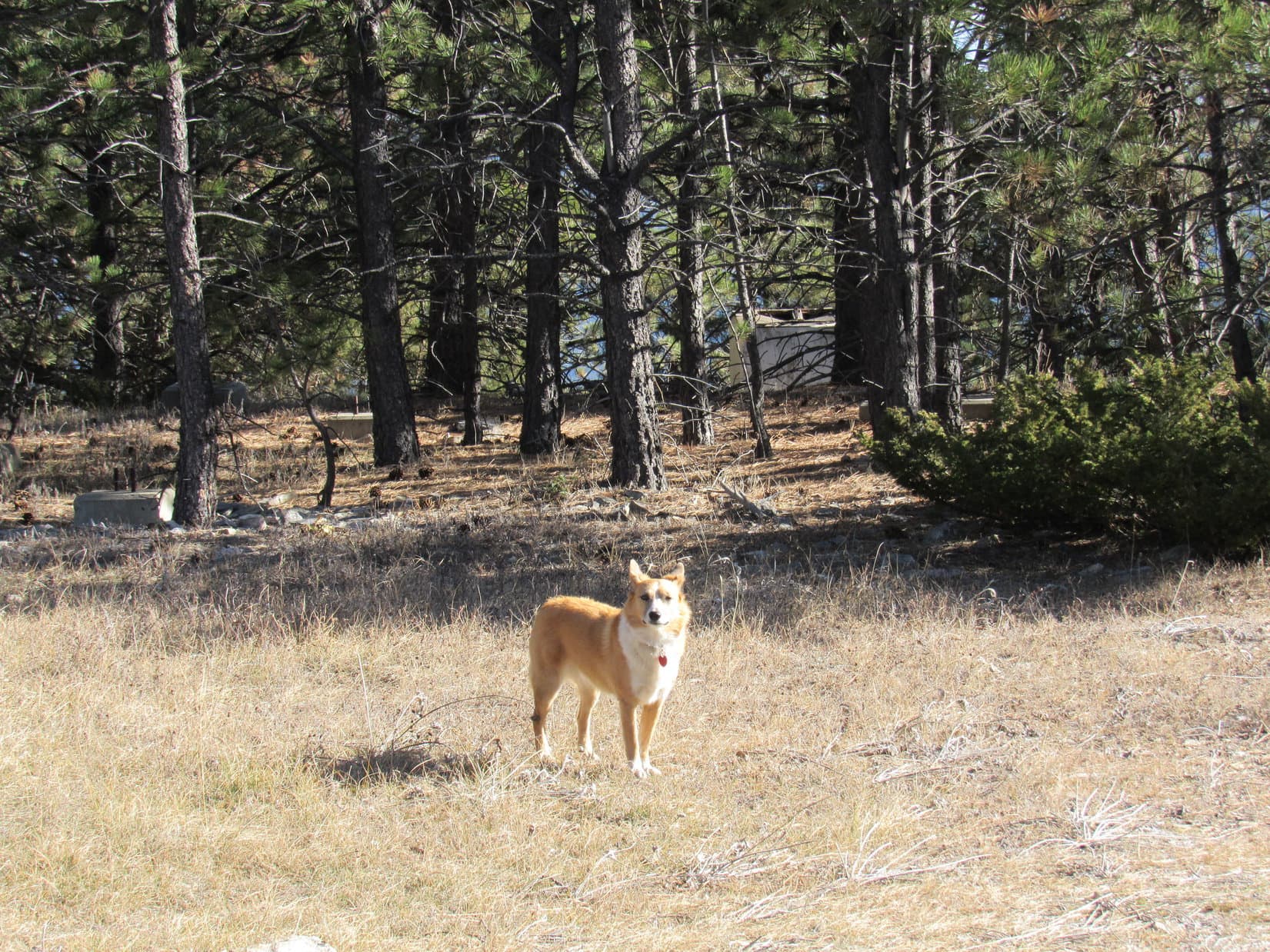
Lupe at the summit of Mount Pisgah. A couple of the concrete footings with anchor bolts are in view on the L. The young evergreens Edward Earl had seen nearly 7.5 years ago weren't so young anymore. Photo looks E.
Lupe at the summit of Mount Pisgah. A couple of the concrete footings with anchor bolts are in view on the L. The young evergreens Edward Earl had seen nearly 7.5 years ago weren’t so young anymore. Photo looks E.

The true summit of Mount Pisgah wasn’t too exciting, really.  Although the highest ground was quite close to the E edge of the summit plateau, there were too many trees around to see much of anything.  With Lupe’s peakbagging goal accomplished, she left the summit to take a closer look at the towers.

To the SSE of the three towers was a battered old blue and yellow school bus.  Due to broken glass on the ground, SPHP wouldn’t let Lupe get too close to it.  SPHP gathered up a number of Lupe treasures someone had carelessly discarded near the bus.

Lupe near the battered blue and yellow bus. Broken glass nearby meant Lupe couldn't get too close to it. Why on earth it was here was unfathomable. Photo looks NE.
Lupe near the battered blue and yellow bus. Broken glass nearby meant Lupe couldn’t get too close to it. Why on earth it was here was unfathomable. Photo looks NE.

Edward Earl had only mentioned one tower W of the summit, but now there were three.  The two farthest to the N had new-looking concrete slabs for support, and new outbuildings near them.  The N towers must have been installed after Mr. Earl had been to Mount Pisgah.

The three towers W of the summit. The towers on the L and R were new since Edward Earl was here in May, 2009. Photo looks N.

It doesn’t take a Carolina Dog long to look at a few towers!  Lupe was soon ready to move on.  Of course, she still had one tower left to check out, the one at the NW end of the summit plateau that she had seen from down by the orange hydrant.

Lupe and SPHP went N along the E edge of the summit plateau, hoping to catch an open view, but found none.  Lupe then went NW to the road again on her way to the NW tower.  A side road off the main dirt road went N into the forest.  Near the N edge of the plateau, it turned W and took Lupe to the lone tower Edward Earl had somehow missed. it turned W and took Lupe to the lone tower Edward Earl had somehow missed.

Part of the Mount Pisgah summit plateau. Photo looks NW.
Looking S back at the 3 towers W of the summit.
The 3 towers W of the summit from near the start of the side road to the 4th tower at the NW end of the mountain. The intersection with the main dirt road is at the L edge of this photo near the trees. Photo looks S.
Lupe nears the NW tower. It must have been here when Edward Earl was around; the outbuilding next to it looked quite old. How he missed it is unclear. Photo looks W.

The NW tower had broken wires hanging off of it.  Paint had peeled off much of the old shack next to it.  However, a heater or air-conditioner on the NE side of the shack was running.  How had Edward Earl missed this tower?  It must have been here, as old as it appeared to be.  Strange.

SPHP went over to the N edge of the summit plateau, hoping for a view.  Lupe didn’t come.  She was standing frozen near the shack.  She looked like she does whenever she steps on a cactus.  SPHP went back to her.  Lupe held up a little front paw, pleading to be carried.

SPHP carried Lupe over to the edge of the plateau.  Lupe rolled over on the ground, so SPHP could check her paws for cactus spines.  Nothing.  SPHP hadn’t seen any cactus anywhere on Mount Pisgah, either.  Maybe Lupe had stepped on something else sharp?  Ever since her bad experience with cactus in the Wildcat Hills of Nebraska, Lupe tends to assume cactus is everywhere any time her paws hurt.

Lupe at the NW end of the summit plateau before starting down the mountain. For a minute or two, she wanted to just sit here. Worried about cactus, she was hoping SPHP was going to carry her back to the G6. Photo looks SE.

Apparently, Lupe would have liked SPHP to carry her all the way back to the G6.  She stopped several times on the way down the mountain.  There really wasn’t anything wrong with her that SPHP could see.  She always came running when SPHP got too far ahead.

Instead of taking the road back, Lupe and SPHP went down Mount Pisgah’s NW slope.  A power line went down this way, too.  Most of the time Lupe stayed within sight of it.

Surprisingly, although Lupe hadn’t found any clear views from the edge of the summit plateau on top of the mountain, coming down the NW slope, she did!  Red Butte and Sweetwater Mountain (6,440 ft.), Lupe’s next peakbagging objective, were both in view from several spots on the way down.

Red Butte (L) and Sweetwater Mountain (the long forested ridge on the horizon) as seen from the NW slopes of Mount Pisgah. The canyon seen below Red Butte is the same one Lupe traveled through (from L to R) on the road leading to the top of Mount Pisgah. Photo looks NW.
Looking down on Red Butte with a little help from the telephoto lens. Photo looks NW.

The NW slope was steep until Lupe reached a road after losing 200 to 300 feet of elevation.  Lupe took the road SW a short distance to the edge of a small meadow where it looked like there might be a view.

The meadow turned out to be part of a much more extensive grassland.  Lupe did have a great view to the SW.

Lupe finds a much more extensive grassland than she'd been expecting. She had a great view from here. Photo looks SW.
Lupe finds a much more extensive grassland than she’d been expecting. She had a great view from here. Photo looks SW.

Lupe went through the grassland, and continued on down the NW slope of Mount Pisgah.  Down here, it wasn’t so steep.  Most of the time Lupe was in forest, but a forest full of small openings and glens.  Lupe’s route down was an easy one.

Crossing the big grassland, Lupe could see the entire length of the Sweetwater Mountain plateau off to the NW.
Lupe came to several dirt roads on the way down Mount Pisgah. She didn't follow any of them very far, but she did travel a short stretch of this road. Photo looks NNE.
Lupe came to several dirt roads on the way down Mount Pisgah. She didn’t follow any of them very far, but she did travel a short stretch of this road. Photo looks NNE.

The American Dingo eventually reached the road she had followed to the top of Mount Pisgah down in the canyon.  She followed it back to the Lunney place, which was only 10 or 15 minutes away (12:25 PM, 55°F).

The G6 was already up on the gravel parking area on the Lunney place with Lupe in it, and SPHP was just closing the gate to Lauris Tysdal’s land, when a jeep drove up.  Mr. Lunney was in it, somewhat surprised, no doubt, to find Lupe and SPHP on the property.

SPHP explained how Lupe had come to be here.  Mr. Lunney seemed satisfied with the explanation.  He began to tell SPHP a little bit about the history of the Lunney place.  His grandparents had bought the property, which includes over 8 acres of land with the house and outbuildings, back in the 1940’s.  In recent years, it had belonged to his mother, but she passed away earlier this year.

Mr. Lunney has another home, so this Lunney property is eventually going to be sold, although exactly when wasn’t clear.  There was no big rush to sell it.  Having been in the family so many decades, Mr. Lunney has a lot of fond memories of this place.

Lupe still had another peakbagging objective today.  After SPHP’s pleasant chat with Mr. Lunney, it was time to go look for the owner of the ranch that Sweetwater Mountain is on.  The ranch wasn’t far away, but the owner didn’t seem to be home.  Without permission from the owner, Lupe couldn’t climb Sweetwater Mountain.

SPHP was writing a note to leave on the door of the rancher’s home, when the owner drove up on an ATV.  SPHP had a conversation with him.  The upshot of it all was that Lupe was refused permission to climb Sweetwater Mountain.  However, when hunting season is over at the end of November, she is welcome to come back to climb it in December.

Well, that was that.  No Sweetwater Mountain today.  Lupe still had a few hours of daylight to do something with.  In the end, it was decided she might just as well climb Laird Peak (6,906 ft.) N of O’Neil Pass in South Dakota.  Laird Peak wasn’t a hard climb at all, and was on the way home.

Lupe and SPHP left the G6 parked S of a corral about 0.33 mile N of Hwy 85 along USFS Road No. 106 (2:35 PM, 48°F).  Lupe took a dirt road E up a shallow valley past Tom Spring.  The road reached an intersection at the upper end of the valley.  From there, Lupe bushwhacked E along the N side of a fence to a small forested rise.  She found the Laird Peak survey benchmark on top of the rise.

The Laird Peak survey benchmark was at the top of a small forested rise.
Lupe on Laird Peak. The survey benchmark is seen below her tummy. Photo looks N.
Sweet Lupe on Laird Peak.
Even though at 6,906 feet, Laird Peak is quite high for the Black Hills, it was another mountain with no views due to so many trees. The summit area is of modest size. A significant part of it is seen here. The post marking the survey benchmark location is seen on the R. Photo looks N.

Climbing Laird Peak had been quick and easy.  Lupe had no more peakbagging to do.  It was only around 3:00 PM, but the November sun was already quite low.  It would be dark in another 2 hours.

Since it would only take half an hour to get back to the G6, Lupe had some free time to roam and sniff.  She had no real purpose other than to enjoy life as a free-roaming Dingo in the woods.  Lupe and SPHP wandered through the forest.  The Carolina Dog made a big loop to the N, before returning to Laird Peak’s summit.  She then made a big loop to the S, getting fairly close to US Hwy 85.

Lupe nearly back to the Laird Peak summit at the end of her exploratory loop to the N. Photo looks S.

Sharply slanting pine-filtered rays of sunlight announced the imminent arrival of sunset.  Time to start back to the G6.  Lupe’s Black Hills Expedition No. 182 was drawing to a close.  Happily, she’d made it to Mount Pisgah in Wyoming, one of her two main peakbagging objectives, and Laird Peak in South Dakota, but Sweetwater Mountain had eluded her.

Hopefully, sweet Lupe will see the world from the top of Sweetwater Mountain sometime in December, but life’s uncertain, and that’s another adventure for another day.

Roaming free S of Laird Peak near day’s end. Photo looks NNE.

Links:

Next Black Hills Expedition                  Prior Black Hills Expedition

Want more Lupe adventures?  Choose from Lupe’s Black Hills Expeditions Adventure Index or Master Adventure Index.  Or subscribe free to new Lupe adventures.

Black Hills, WY Expedition No. 181 – Missouri Buttes (11-6-16)

Well, Loopster, it’s all been kind of leading up to this lately.  Don’t know if you are going to meet with any success today or not, but we’re at least going to try it.

Lupe wasn’t worried.  She wasn’t paying any attention to SPHP at all.  The eastern sky was just beginning to get light, but she could see cows, lots of big, beautiful, black cows, in the pastures along I90.  The cow-crazed American Dingo was busy barking for all she was worth.  A little later on, NW of Sundance along Hwys 14 & 24, there were herds of deer to entertain her, too.

Wyoming Hwy 24 goes right past America’s very first national monument.  Lupe’s first stop of the day was a quick one to see Devil’s Tower (5,112 ft.).  Not a soul was around early on a Sunday morning in November.  The sun’s first rays struck the tower while Lupe was there to see it.

Lupe arrives at Devil’s Tower, America’s first national monument, in time to see the first rays of the morning sun on it. Photo looks W.
Devils Tower plaque along Hwy 24.
Devil's Tower in the early morning light. Photo looks W.
Devil’s Tower in the early morning light. Photo looks W.

Lupe and SPHP didn’t go into the national monument.  Devil’s Tower is one peak Lupe is never going to bag unless she sprouts Dingo Wings.  However, with a little luck, she was going to get to see the top of it today!  After a good look at Devil’s Tower, Lupe and SPHP continued N on Hwy 24.

On 3 consecutive Black Hills Expeditions to the Bear Lodge Mountains, Lupe had seen distant views of both Devil’s Tower and the Missouri Buttes from a variety of vantage points.  They are the most famous and dramatic landmarks in the entire NE Wyoming region.  Although climbing Devil’s Tower was completely out of the question for the Carolina Dog, she was here now to try her luck climbing the Missouri Buttes (5,374 ft.).

SPHP had good reasons to believe Lupe might not make it.  There are actually 4 separate buttes in the Missouri Buttes cluster.  All are located within an area covering no more than 2 square miles about 4 miles NW of Devil’s Tower.  The problem was, all of the Missouri Buttes are on private land.  Lupe’s first hurdle was to find and secure permission from the landowner to enter the owner’s private property.

Even if permission could be secured to access the private property, there was another big problem.  The only information SPHP found online about climbing Missouri Buttes was a trip report by PanamaRed on SummitPost.org indicating there was Class 3 & 4 scrambling with some exposure near the top of the highest NW Missouri Butte.  Lupe and SPHP are up for some light Class 3, but anything approaching Class 4 just wasn’t going to happen.

Three miles N of Devil’s Tower junction, Lupe and SPHP left Highway 24 on Barlow Canyon Road.  The gravel road crossed the Belle Fourche River, went a mile N, and then turned W.

Looking S at Devil's Tower from Barlow Canyon Road. Lupe loved this view. Not for the big rock in the distance. All those beautiful black cows were what caught her fancy!
Looking S at Devil’s Tower from Barlow Canyon Road. Lupe loved this view. Not for the big rock in the distance. All those beautiful black cows were what caught her fancy!

SPHP wasn’t certain where to go, but wound up at the Lake Guest Ranch headquarters located near the NW end of Missouri Buttes Lake.  Even though it was early on a Sunday morning, SPHP received a friendly reception from a couple of ranch hands.  The ranch owner was available to talk to!

Lupe on her way to seek permission to climb the Missouri Buttes.
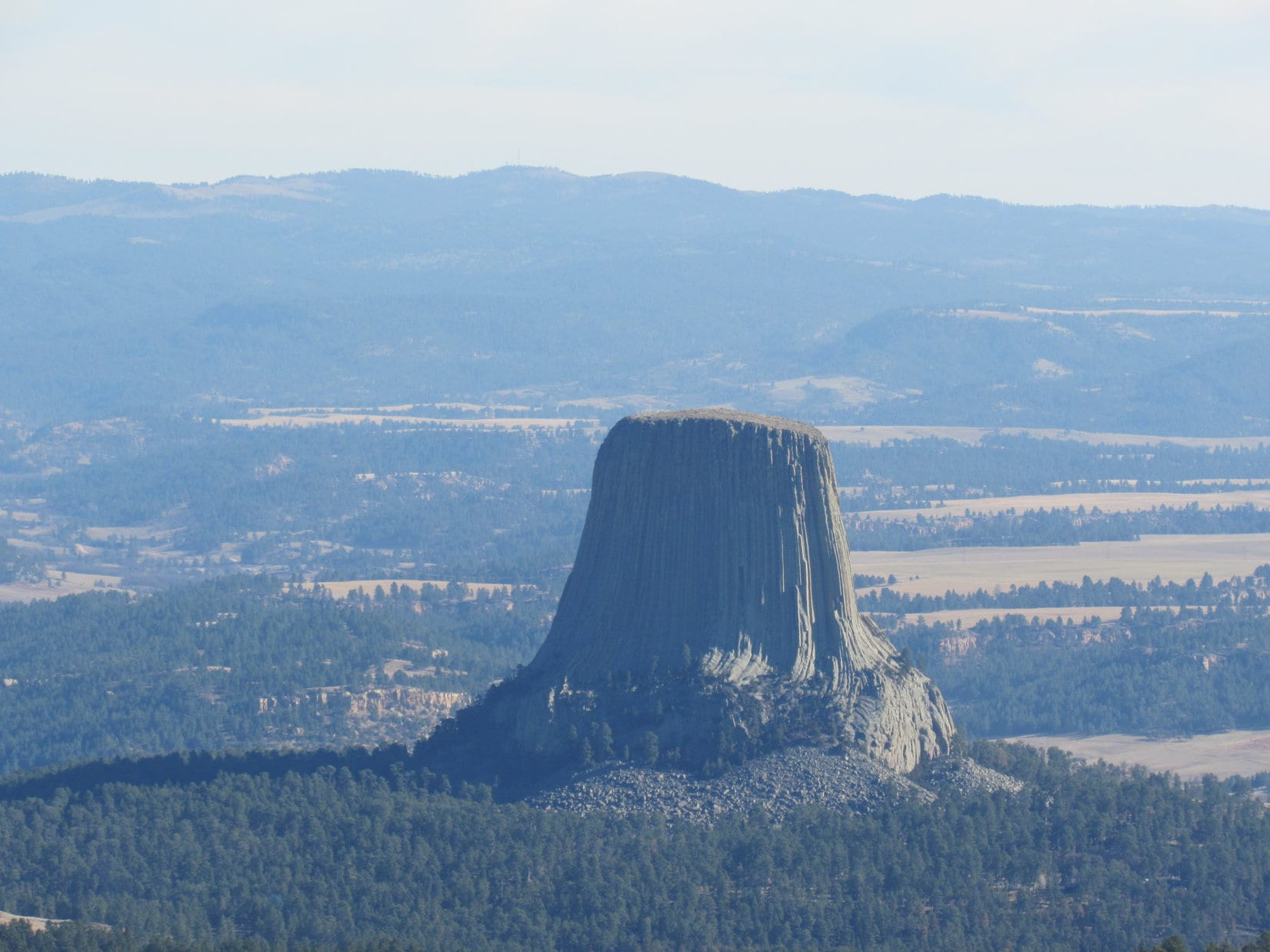

SPHP was invited in to talk to the owner.  The Lake Guest Ranch HQ was a pretty cool place inside.  SPHP was hopeful.  When SPHP explained to the owner why Lupe was here – to seek permission to climb the Missouri Buttes, the response was polite, but firm.  The answer was no.  The owner’s insurance wouldn’t allow it, it was hunting season and dangerous, etc.

The negative response was devastating!  Well, not devastating – there are plenty of mountains in the world Lupe can climb – but it was disappointing.  That was that, though, nothing could be done about it.  Lupe wasn’t going to get to climb the Missouri Buttes.  Until …

Until the Lake Guest Ranch owner said that he didn’t even own the land the 2 highest Missouri Buttes are on.  Didn’t own the land?!  Who did?  It was part of the Nuckoll ranch.  His neighbor J.W. Nuckoll owns the land came the response.  SPHP was given a phone number for the Nuckoll ranch.

Back in the G6, SPHP tried the phone number.  A recording, but no response.  Hmmm.  Didn’t we pass a sign or something for the Nuckoll ranch on the way here, Loop?  I think we did.

Not sure, SPHP.  Unless it was branded on the side of a cow, I wouldn’t have noticed!

Lupe and SPHP drove off from the Lake Guest Ranch looking for the Nuckoll ranch.  Along Barlow Canyon Road, there it was.  A mailbox said Nuckoll, and an old building nearby said something about Nuckoll sheep and wool.  This was it!  A driveway led more than a mile S into a side canyon before ending at two houses.  A sign on the first one said J.W. & Thea Nuckoll.

J.W. was an old-timer.  He was on oxygen, but was friendly when SPHP met him.  SPHP explained why Lupe was here.  J.W. said he had climbed the Missouri Buttes himself.  He had even climbed Devil’s Tower!  That was good, that was very good.  Surely he would understand?

He did!  Mr. Nuckoll agreed to let Lupe and SPHP climb the Missouri Buttes.  He had even more good news.  When SPHP asked how difficult a climb it was, Mr. Nuckoll told SPHP about a trail to the top of the highest NW Missouri Butte.  That sounded great!  SPHP then asked about the NE Missouri Butte, too.  Mr. Nuckoll said it was even possible to ride a horse to the top of the NE butte.  Lupe would have no problem!  SPHP thanked Mr. Nuckoll, and went off to tell Lupe the good news.

In just a few minutes, Lupe was on her way (8:51 AM, 53°F)!  The first part of the hike started farther along the driveway, beyond the two houses.  For a short distance, Lupe was on a road continuing up the little canyon.  There were lots of cows around.  Lupe and SPHP climbed a forested slope heading SSW to avoid them.  Up above, Lupe arrived at the edge of a huge gently sloping field.  The highest NW Missouri Butte (5,374 ft.) was already in view!

Lupe arrives up at the huge, gently sloping field. The highest NW Missouri Butte was already in view. Photo looks SW.

The somewhat lower NE Missouri Butte (5,212 ft.) is closer to Devil’s Tower, and wasn’t any farther away than the highest NW Butte.  Lupe and SPHP decided to go for the NE Missouri Butte first.  Even though the SE end of the butte looked the most rugged, Lupe went over to take a look at it, and see if Devil’s Tower was in view.

Lupe approaching the NE Missouri Butte. Photo looks S.
Devil’s Tower was already in view even before Lupe started her climb up the NE Missouri Butte. Photo looks SE.
Looking NE before climbing the NE Missouri Butte.
The SE end of the NE Missouri Butte as seen from the N. The highest part of the NE Missouri Butte is close to this end, but the butte is much more easily climbed from the NW.

The SE end of the NE Missouri Butte was quite steep and rocky, but it didn’t look impossible to climb up from here.  However, Lupe had already seen that the NW end of the butte was definitely easier.  Lupe and SPHP went back around to the NW end, where Lupe made her ascent.

Slippery pine needles on a moderately steep slope were about all Lupe had to contend with going up.  Before long, Lupe was at the true summit of the NE Missouri Butte, which proved to be near the SE end of the ridge.  An old wooden cross was sticking up from a summit cairn near some of the highest rocks.  The panoramic views toward the E were spectacular!

Of course, Devil’s Tower was the most striking landmark in view.  Much farther away, Warren Peaks (6,650 ft.) and Inyan Kara (6,360 ft.) could be seen, too, although they didn’t show up all that well in the morning haze.  Long pine-covered ridges with yellow cliffs, and the Belle Fourche River valley were off to the NE.  To the W, Lupe could see her next peakbagging goal, the NW butte, which is highest of all the Missouri Buttes.

Lupe at the summit of the NE Missouri Butte. Photo looks SE.
The highest NW Missouri Butte as seen from the 2nd highest NE Missouri Butte. Photo looks WNW.
Looking ESE from the summit.
The highest NW Missouri Butte again. A small part of Missouri Buttes Lake is in view along with the HQ of the Lake Guest Ranch. Photo looks W.
The Lake Guest Ranch HQ using the telephoto lens. Photo looks WSW.
Long pine-covered ridges with yellow cliffs dominated the views to the NE.

Lupe and SPHP took a break up on NE Missouri Butte.  The views were really awesome.  It was so wonderful that Mr. Nuckoll had granted Lupe permission to come and see this unique scene.  Lupe could see the top of Devil’s Tower from here!

What a sight! Lupe could see the top of Devil's Tower from NE Missouri Butte. She didn't even have to climb the tower or take a helicopter up to see it. Photo looks SE.
What a sight! Lupe could see the top of Devil’s Tower from NE Missouri Butte. She didn’t even have to climb the tower or take a helicopter up to see it. Photo looks SE.
Looking SSW at a couple of the lower Missouri Buttes.

After 45 minutes spent enjoying the summit of the NE Missouri Butte, it was time for Lupe to go see if she could find the trail Mr. Nuckoll spoke of leading to the top of the highest NW Missouri Butte.  Lupe went down the W slope of the NE Missouri Butte, and crossed the saddle over to the NW butte.

A big gash was visible on the NE side of the NW Missouri Butte, but it looked mighty steep and straight.  Mr. Nuckoll had spoken of the trail up the butte making a sharp turn.  SPHP didn’t think Lupe should try going up that NE gash.  It didn’t look like there was any way a trail could make a sharp turn from there.

The post by PanamaRed on SummitPost.org didn’t say what route he had taken to the top, but SPHP had the impression from photos PanamaRed posted that he had climbed up from the NW.  If that led to Class 3 & 4 scrambling, Lupe wouldn’t succeed in going up that way either.

Lupe started up the NW Missouri Butte from a boulder field at the base of the N face.

Lupe starts up the highest NW Missouri Butte. She went up the boulder field and then climbed through the trees to the base of the cliff. She then worked along the base of the cliff to the W (R). Photo looks SSW.

Lupe climbed up beyond the boulders into a zone of trees and bushes.  It was steep going, but still doable.  The worst part was the incredible number of low thorny bushes.  They didn’t seem to bother Lupe, but SPHP had to watch carefully before grabbing on to anything.

When Lupe reached the base of the cliff, she worked her way to the W, still climbing steeply all the way among trees and thorny bushes.  Her route led toward a couple of large rock protrusions sticking out to the N.  About the time she got close to the first big rock formation, Lupe reached some steep grassy ground above most of the trees and thorny bushes.

It looked like there was a route continuing W (R) up a channel between rock formations.  How high up this route went was difficult to see, although it looked like it might be possible to make a sharp turn to the E (L) near the top.  Maybe that was the way to go?  While pondering, SPHP suddenly realized Lupe was already on a very faint trail.  The barely discernable trail went steeply up a ramp toward the E (L) from here.

Maybe it was best to check out the ramp first?  The ramp went up to a high point where sunlight could be seen.  May as well see what was on the other side of that high point, before attempting to negotiate the rocky channel.

The ramp was a relatively easy climb.  In just a few minutes, Lupe and SPHP were at the top.

Lupe sits on a rock just above the top of the ramp. Photo looks W, back in the direction she came up the ramp. The ramp itself is not shown.
This view greeted Lupe at the top of the ramp on the N face of NW Missouri Butte. The NE Missouri Butte, where she had just been, is seen on the L. It turned out that the ramp did not end here. It made a sharp turn to the S (R) in front of the little tree that looks like it is growing out toward Devil's Tower. The ramp then leveled out, becoming an easy walk as it went S along the upper NE face of the butte. Photo looks SE.
This view greeted Lupe at the top of the ramp on the N face of NW Missouri Butte. The NE Missouri Butte, where she had just been, is seen on the L. It turned out that the ramp did not end here. It made a sharp turn to the S (R) in front of the little tree that looks like it is growing out toward Devil’s Tower. The ramp then leveled out, becoming an easy walk as it went S along the upper NE face of the butte. Photo looks SE.

Devil’s Tower and the NE Missouri Butte, where Lupe had just been, were both in view from the top of the ramp.  Peering S around the corner to the NE side of the butte, SPHP was surprised and pleased to see that the ramp continued.  It leveled out quite a bit as it traversed the NE face of the butte.

The ramp’s continuation was an easy walk, but didn’t go very far.  It soon ended at place where a few rocky steps up brought Lupe onto the moderately sloping NE part of the summit area.  The good news was that Lupe was almost to the top!  A short walk through a forest of junipers would take her to the summit of the highest NW Missouri Butte.  Her peakbagging success was assured!

The bad news was that Lupe’s nemesis was here, too, in great profusion!  The first thing SPHP saw upon gaining the summit area was cactus.  Lots of big cacti clusters were scattered around.  Lupe would have to be carried the rest of the way to the true summit.

Cacti like these grew in large patches scattered around the summit area. Lupe had to be carried the last 150 feet to the true summit of the NW Missouri Butte.

So, Lupe wound up being toted the last 150 feet to the true summit of the highest NW Missouri Butte.  She took her summit break there, under strict orders not to move around.  She wanted to be where SPHP was anyway, so it all worked out fine.

Lupe reaches the summit of the NW Missouri Butte, the highest of them all! Photo looks NNE.
There was an old radio tower on top of the NW Missouri Butte. The shack was unlocked and open. It was full of dirty, apparently unusable, old electronic equipment. Much of the summit area on NW Missouri Butte is covered with juniper trees like those seen here, although the area of the true summit where Lupe is, was largely free of them.

PanamaRed had posted a photo of the Missouri Buttes USGS survey benchmark, but at first SPHP didn’t see it.  A brief search revealed it partially hidden by a bush along the very NW edge of the summit, a little way W of the highest rocks.

This Missouri Buttes USGS survey benchmark was partially hidden by a bush along the very NW edge of the summit area. It was not right at the highest rocks.
The Missouri Buttes USGS survey benchmark is seen at (Center) near the bottom of this photo. Photo looks W.

The best views from the NW Missouri Butte in the vicinity of the true summit were the panoramic views to the W and N.  Junipers blocked the views in other directions.  Even though the air was rather hazy, it was still possible to see the outline of the Bighorn Mountains to the W.  Off to the NW and N, there was nothing higher than NW Missouri Butte anywhere in sight.

Lupe near the true summit. Photo looks W. The Bighorn Mountains could be seen on the horizon, but don't show up in the photo. Lupe assures you, they are out there!
Lupe near the true summit. Photo looks W. The Bighorn Mountains could be seen on the horizon, but don’t show up in the photo. Lupe assures you, they are out there!
Looking down at land immediately to the W of NW Missouri Butte. Missouri Butte Road leads right to the NW Missouri Butte, but may not be entirely on the Nuckoll ranch. Access to it was from the road leading to the Lake Guest Ranch. Lupe didn't start her trek from down there anyway, although it would have been a much closer starting point.
Looking down at land immediately to the W of NW Missouri Butte. Missouri Butte Road leads right to the NW Missouri Butte, but may not be entirely on the Nuckoll ranch. Access to it was from the road leading to the Lake Guest Ranch. Lupe didn’t start her trek from down there anyway, although it would have been a much closer starting point.
Thanks to Mr. Nuckolls kindly granting permission to be on his land, Lupe got to visit the top of this highest Missouri Butte. Photo looks NE.
Lupe at the true summit. There were cliffs just beyond the rocks. Photo looks N.
Cliffs along the N edge. Photo looks NE.

After 25 or 30 minutes relaxing near the true summit, it was time to explore the SW part of the summit area, which was hidden by juniper trees.  SPHP had to carry Lupe for fear of the cacti, but she didn’t mind getting a free ride.  From the SW end of the summit area, it was possible to see the Lake Guest Ranch HQ and Missouri Butte Lake.

Missouri Buttes Lake and the Lake Guest Ranch HQ (seen to the R of the lake). Photo looks SW.

Lupe also had a clear view of the 2 lower S Missouri Buttes.

The 2 lower S Missouri Buttes as seen from the SW end of the NW Missouri Butte summit. Photo looks S.

Lupe and SPHP returned to the summit for a final look around.  Lupe then got carried back down to the NE end of the summit area near the start of the ramp.  Before taking the ramp down, Lupe checked out the views from this end of NW Missouri Butte.

Lupe at the NE end of the NW Missouri Butte summit. She had a fabulous view of the NE Missouri Butte (L) and Devil's Tower (R) from here. Photo looks ESE.
Lupe at the NE end of the NW Missouri Butte summit. She had a fabulous view of the NE Missouri Butte (L) and Devil’s Tower (R) from here. Photo looks ESE.
Looking SE.
Devil's Tower from NW Missouri Butte. Photo looks SE.
Devil’s Tower from NW Missouri Butte. Photo looks SE.
Looking E at NE Missouri Butte.

Lupe took the ramp all the way back down to its beginning on the steep grassy slope near the large rock protrusions where SPHP first noticed the very faint trail.  Now that it was clear there actually was a trail, it was possible to see it continuing on down the mountain.

The trail went down to a much larger boulder field than the one Lupe had crossed coming up.  This area was well to the W of the area of trees and thorny bushes below the cliff Lupe had been in earlier.  Lupe went all the way down the boulder field, passed through a couple of stands of trees, and reached the pasture below the N face of NW Missouri Butte.

From near a stock pond, it was possible to get a good look at the best route up the mountain.

View along the cliffs near the top of the N face of NW Missouri Butte. Note the orange coloration on some of the rocks. (Probably orange lichens.) Photo looks W as Lupe was about to go down the steep part of the ramp (not pictured).
Lupe makes it down off the butte. NE Missouri Butte is in view beyond the stock pond. Photo looks E.
The easiest route up the NW Missouri Butte is visible in this photo taken from near the stock pond. Photo looks S at the N face of the butte. The easiest route up is through the trees on the W (R) to the loose rocks. Climb the loose rocks up to the trees below the orange spot near the center of the top of the butte. From there, the ramp leads to the E (L) up along the trees and bushes seen to the L of the orange spot. The ramp then curls around the E (L) side of the mountain (out of view) to gain the NE slope of the summit area. Easy, squeezy! Class 2 or Class 3 Lite all the way!
Lupe and SPHP originally came up through the trees and thorny bushes from the lower L. Not the best way to do it! Come up from the R, get through the trees to the steep grassy area below the orange spot, then go L up the ramp. The trail should become visible while still among the loose rocks before reaching the trees below the orange spot. Photo looks N.

Lupe had climbed both the highest Missouri Buttes.  Her Expedition No. 181 was an unqualified peakbagging success!  However, there was still a lot of daylight left.  Why not go take another look from the top of the NE Missouri Butte?  A few hours had gone by, and the sun would be shining from another angle.  There was only a little bit of cactus up there that SPHP had seen at the far SE end.  Lupe could avoid it easily.

Lupe was fine with going back up.  So once again, she climbed the W slope and then followed the summit ridge SE to the top of the NE Missouri Butte.  With the afternoon sun now lighting up the near side of Devil’s Tower, the view was even better than earlier in the day.

Devil's Tower in the afternoon sun from NE Missouri Butte. Photo looks SE using the telephoto lens.
Devil’s Tower in the afternoon sun from NE Missouri Butte. Photo looks SE using the telephoto lens.
Inyan Kara Mountain is seen faintly on the far R horizon.
Hmmm. That Carolina Dog looks a bit familiar! So does that odd tree stump-shaped rock in the distance.

Devil's Tower from NE Missouri Butte, WY 11-6-16Lupe on NE Missouri Butte, WY 11-6-16Lupe and SPHP spent another 30 beautiful minutes up on the NE Missouri Butte.  Then it was time to call it a day.  SPHP had told Mr. Nuckoll that it would be great to get a chance to talk to him some more when Lupe returned from Missouri Buttes.  It was probably best to get there well before the Nuckolls wanted to have their supper.

Lupe left NE Missouri Butte for the 2nd and final time.  She liked crossing the huge, wide open pasture, and going through the forest on the way back.  Before long, she was back at the Nuckoll’s house (3:26 PM, 55°F).

Looking S at one of the lower Missouri Buttes on the way down the NE Missouri Butte.
NW Missouri Butte on the way back. Photo looks W.

No one was around.  SPHP checked both homes, but there was no one to thank for the wonderful day Lupe had on the Missouri Buttes.  No telling where the Nuckolls had gone, or when they might return.  SPHP left a note in the door.

Then a very lucky American Dingo, one which had been to the top of the two highest Missouri Buttes, enjoyed a noisy evening drive past herds of cattle and deer on her way home.Lupe on NE Missouri Butte, WY 11-6-16Links:

Next Black Hills Expedition                Prior Black Hills Expedition

Want more Lupe adventures?  Choose from Lupe’s Black Hills Expeditions Adventure Index or Master Adventure Index.  Or subscribe free to new Lupe adventures.