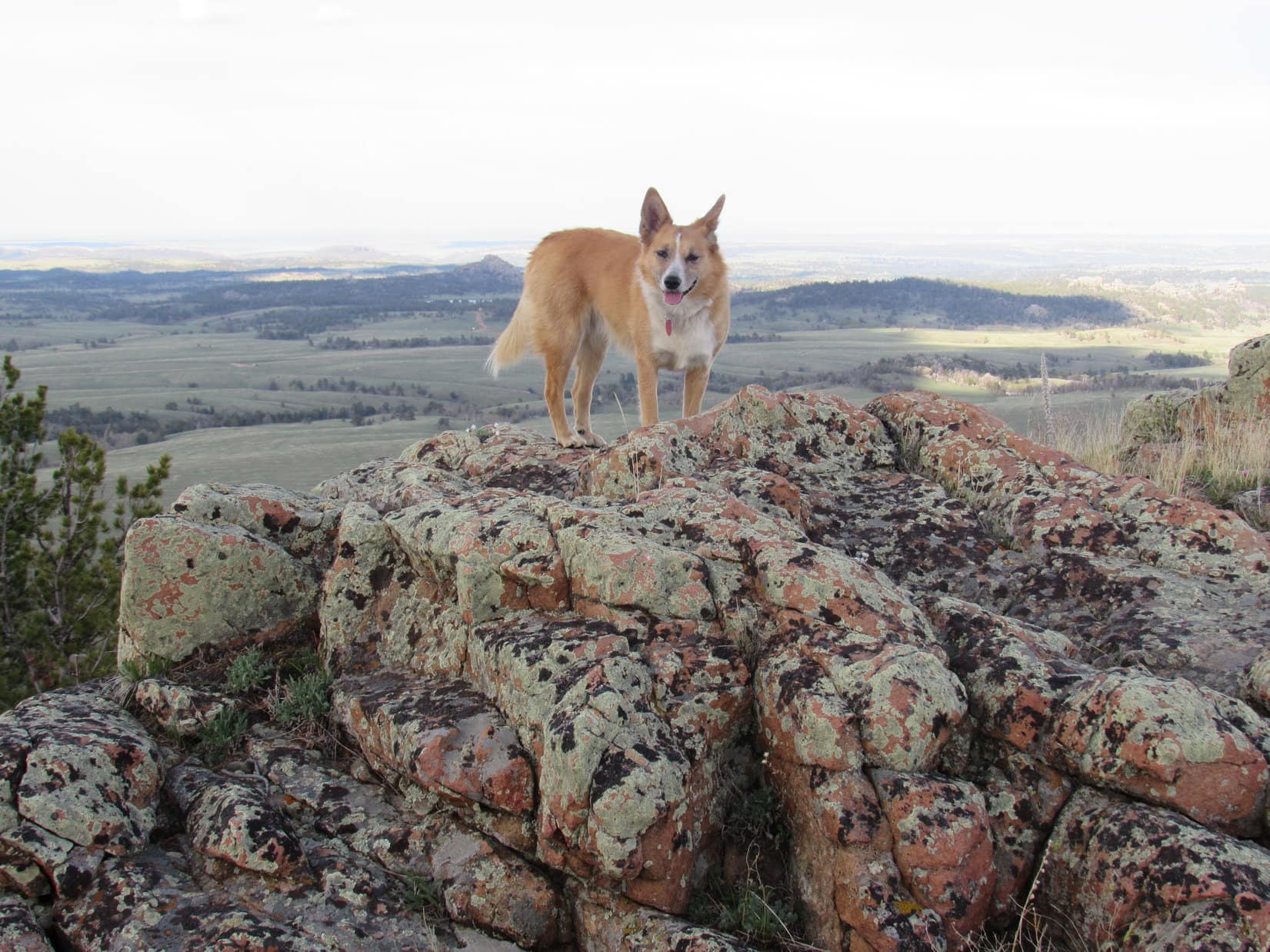
In the wee hours of the morning, Lupe wanted out. SPHP opened the door of the G6, and she bounded into the night. No stars. A light mist explained why. Hours later, dawn came. Low hanging clouds hid the mountains. There wasn’t a speck of blue sky anywhere. Maybe it was time to move on?
The plan had been for Lupe to explore nearby Twin Mountain (8,831 ft.) and the Sherman Benchmark area in the Laramie Mountains SE of Laramie, WY. Now there didn’t seem to be much point, unless the clouds were going to burn off soon.
Lupe had spent the last 2 days peakbagging in these mountains. Most of her goals had been achieved, or ruled out as too difficult. The more SPHP thought about it, the more it seemed like a good idea to move on, whether the sky cleared or not. Warbonnet Peak (9,414 ft.) was calling.
Warbonnet Peak was in the Laramie Mountains, too, but far away in the NW part of the range. It was a beautiful drive. The farther NW Lupe went, the more beautiful and remote the scenery became. N of the town of Medicine Bow, Lupe and SPHP left Hwy 487, taking Little Medicine Road for miles through high rolling plains where there were more pronghorn antelope than cows for Lupe to bark at.
The gravel road slowly deteriorated. There was almost no signage. At least not that meant anything unless you knew the names of the local ranchers. SPHP made a wrong turn onto Holaday Road. Almost 10 miles later, a red pickup truck appeared going the opposite direction. Turned out the lady driving it was lost, too. However, she had a great road atlas showing every little dirt road in Wyoming.
A couple minutes later, it was all figured out. The red pickup truck raced W out of sight. Lupe and SPHP turned around and followed it, but there was no way the poor G6 could keep up with a pickup on these roads. SPHP turned N onto Little Medicine Road again. Lupe enjoyed a spectacular ride up into the Laramie Mountains.
Little Medicine Road is shown on Wyoming state road maps. In combination with other roads, there was supposed to be a route through the Laramie Mountains here going all the way N to Douglas, WY. The creek crossings were mighty rough, though, for a road shown on the official state map. One might think an official state map would only show principal routes. In Wyoming, one would be wrong.
Lupe had already been going downhill again for miles when SPHP saw a couple of people. Did they know where the Campbell Creek campground was? They sure did. This was it! Heavy rains and flooding 3 weeks ago had washed out roads in the area. The county had just patched them enough to be passable. The two people were park service employees putting the campground sign back up. The campground was closed for a few days yet, but it was OK to stay here. No fees or services until the campground opened.
Perfect! That was a deal. Lupe and SPHP took the very last of the six campsites, No. 6 at the upstream end of the campground.

After a few minutes of preparation, Lupe and SPHP struck out for Warbonnet Peak (12:15 PM, 50°F). A wide trail led upstream on the W side of Campbell Creek. Lupe hadn’t gone very far when she reached a creek crossing. The creek was still swollen with melting snow. SPHP didn’t want freezing cold wet feet this early in the trip. There was a narrow spot just downstream. Maybe SPHP could jump across?
Lupe is a great jumper! SPHP, not so much. SPHP decided maybe it would be better to go upstream looking for a better spot. Lupe and SPHP explored the W bank a bit farther up. Nothing.

Turn back, jump across the narrow spot, or ford the icy cold creek? Those were the choices. SPHP threw the backpack across the creek. Then SPHP jumped. Made it! Good thing Campbell Creek wasn’t any wider, though.
Lupe and SPHP continued upstream along the trail. The ground was marshy. The trail itself was part trail, and part mucky little streams. Almost everywhere, the ground was sopping wet. Lupe and SPHP had to weave through the forest, on and off the trail, to avoid deadfall timber and particularly wet spots. Lupe hadn’t gone much farther, when she came to a stone fire ring. It was right on the trail at a rare dry spot.
Edward Earl had written about taking this trail up Campbell Creek on the way to Warbonnet Peak more than 7 years ago on May 24, 2009. SPHP had a copy of Mr. Earl’s trip report in the backpack. In it, Mr. Earl described a long slog with creek crossings, deadfall, brush, swamps and occasional deep snow. Conditions didn’t seem like they had changed for the better since then.
Even before Lupe had left home more than a week ago, Edward Earl’s trip report had SPHP thinking maybe there was another way to Warbonnet Peak from Campbell Creek? The topo map showed a long, broad ridge to the E of the creek that eventually wound its way past high points all the way to Warbonnet Peak. There wouldn’t be any roads or trails – just forests, fields, rocks and whatever else Lupe might encounter.
The first problem, of course, was how to climb 500 ft. up out of the Campbell Creek valley to get onto the ridge? Directly ahead, just past the fire ring, was a steep rocky spine coming all the way down to the trail from the NE. Climbing near the spine didn’t look that bad, though it was impossible to say how far up things would remain that way. Forests hid the slope.
Lupe wasn’t far from the campground yet at all. Nearly the entirety of Edward Earl’s miserable slog along Campbell Creek lay ahead. Whatcha, think Loop? Long, miserable slog along a questionable trail down by the creek, or try pioneering a new American Dingo route?
American Dingoes are high spirited and adventurous. Lupe was not only ready, but eager, to trail blaze an all new Lupe route to Warbonnet Peak. Lupe and SPHP left the trail, climbing NE along the rocky spine. Up and up. A forested hill came into view over on the W (opposite) side of the creek valley. Lupe and SPHP were gaining on it. Before long, Lupe was as high as it was.
The slope continued up. Lupe came to small rock outcroppings. The climb was steep, but steady. There were always manageable ways higher. Multiple ways, actually. SPHP had to stop for breathers, but leg and lung power were the only real limitations. When Lupe was clearly higher than the forested hill across the valley, things started leveling out. Lupe had made it up onto the ridge E of Campbell Creek!
Lupe found a snowbank to cool off on in the forest. While Lupe was chillin’, SPHP consulted the topo map. Time to change direction. From here the ridge sloped gently up toward the SE. When Lupe was sufficiently cooled down, Lupe and SPHP turned S or SE wandering through the forest. The going was much easier now.

Before too long, SPHP saw an opening in the forest. A small, partially sunlit hill was nearby off to the SW. It looked like the hill was on the edge of a drop off. Lupe and SPHP headed over to climb the little hill. A view would be great. SPHP could get oriented properly.
Lupe saw a high forested ridge to the SE. The ridge was situated beyond a big gap over much lower ground SPHP realized must drain W toward Campbell Creek. The SW end of the long ridge featured a towering cliff. Take a break, Lupe! Time to figure out where we are.
SPHP studied the topo map for several minutes, comparing it to the view from the little hill. It seemed pretty clear. OK, Loopster. This little hill is most likely High Point 8585. That high forested ridge to the SE has got to be High Point 9180. About 0.25 mile to the E should be High Point 8590. We will have to go over there to get around this big drainage before we can continue SSE to High Point 9180.


Lupe and SPHP left High Point 8585 going E near the edge of the drainage to the S. Lupe’s immediate objective was to get to High Point 8590. It didn’t take Lupe long to get there.


From High Point 8590, Lupe faced another big climb, 590 feet of elevation gain, up the forested NNW slope of High Point 9180. The topo map showed that Lupe might not have to climb all the way to the top. Maybe she could skirt around to the NE of the high point.

Soon after Lupe entered the forest to begin the climb up High Point 9180, it became apparent a tougher climb was in store than anticipated. As expected, the slope was moderately steep, and there was the usual deadfall timber. That wasn’t the problem. The problem was Lupe found snow. Lots of it. Almost everywhere.
The snow was soft and melting. Around the bases of most tree trunks, little or none remained. Between the trees, though, snow was stacked in drifts 2 to 4 feet high. Lupe was light enough to travel over the snowdrifts. SPHP was stuck post holing. The climb became a relentless endurance struggle.
Going around the NE side of High Point 9180 wasn’t going to be possible. Sheltered by the mountain’s shadow, the snow was deepest over there. Lupe and SPHP worked over more to the W, close to the edge of the drainage. Better exposure to the sun meant less snow. SPHP was able to climb faster.
It wasn’t until Lupe was on the upper portion of the slope that she started angling back farther E. Just below the ridgeline were the biggest snow drifts yet, 6 to 8 feet high. Lupe trotted up the snow to the top. A few minutes later, SPHP was able to join her. SPHP had to stop to breathe.
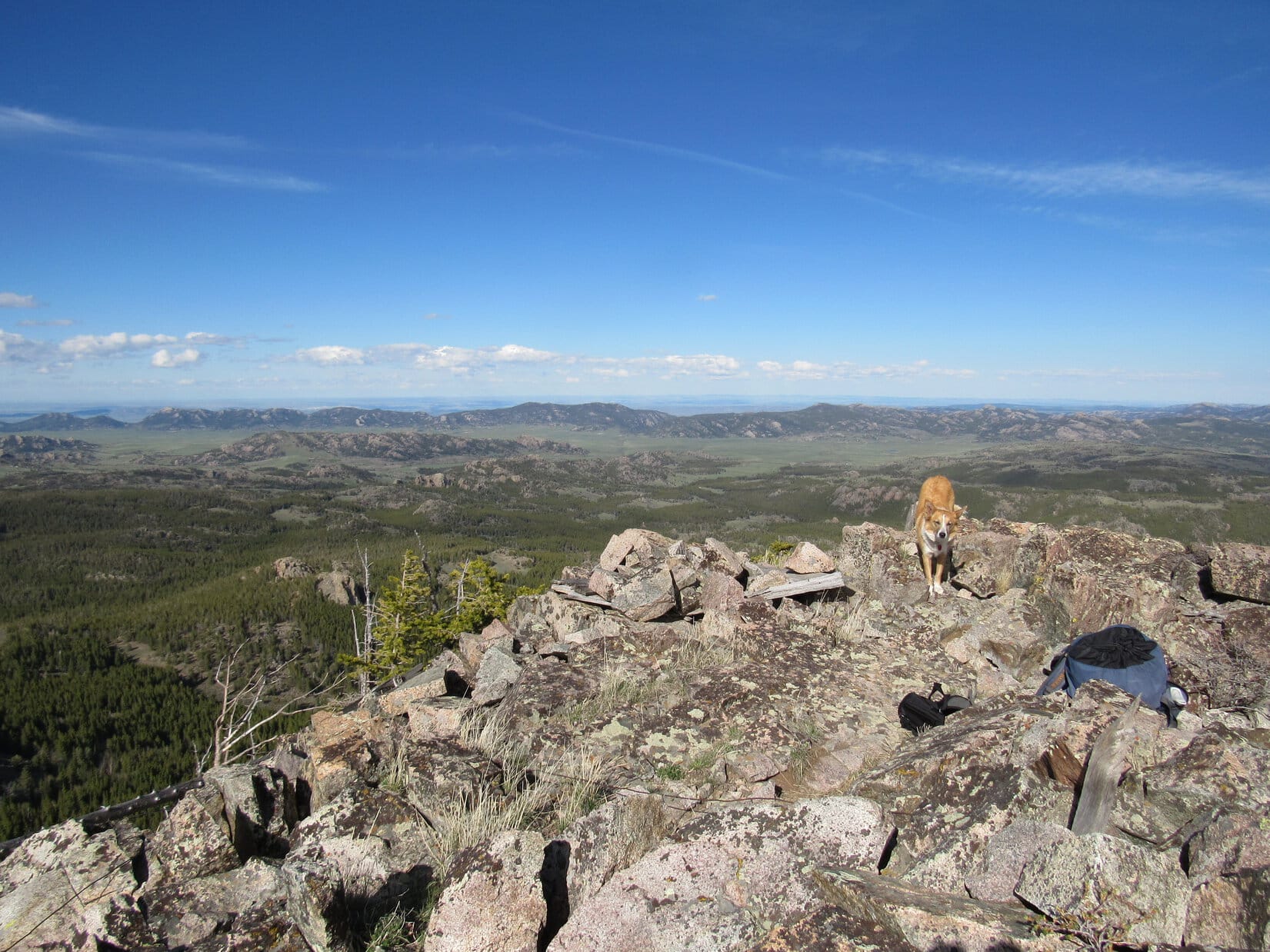
When SPHP could move again, Lupe and SPHP set out SW exploring along the ridgeline. Lupe had come up at the NE end of the highest part of the High Point 9180 ridge. Lupe appeared to be at the true summit. There wasn’t any snow on the exposed rocks near the edge. Lupe found a glorious view off to the NW, only 50 – 100 feet from where she had reached the ridgeline.


The fabulous view to the NW made High Point 9180 seem like a great objective in and of itself. Lupe and SPHP liked the rocky ridge with numerous viewpoints. Lupe had to press on, though. Warbonnet Peak was still a more than 1.5 miles to the SE as the crow flies. So far, Lupe and SPHP hadn’t even seen it yet.
Lupe and SPHP left the edge of the ridge behind and turned SE, immediately disappearing into the forest again. The ground was sloping gently downward now, but the way forward was still a struggle.
Despite a southern exposure, even this part of the forest was full of snowdrifts. To make things worse, the deadfall timber was thicker than before. If the rest of the way was going to be like this, Lupe wouldn’t make it to Warbonnet Peak – not through this kind of stuff. Maybe Lupe and SPHP should have stuck to Edward Earl’s route?
SPHP was thinking these gloomy thoughts, when suddenly the forest ended. Ahead was open ground! And off to the SE was a high peak, Warbonnet Peak!


Reaching the open ground and finally seeing Warbonnet Peak was most encouraging! Lupe still faced obstacles, however. The biggest obstacle was High Point 9310. It was directly ahead. SPHP could see quite a bit of snow up on it. Once again, SPHP consulted the topo map.
The topo map contours suggested the possible existence of cliffs on the far (SE) side of High Point 9310. Climbing to the top made no sense. Skirting High Point 9310 to the NE would definitely be shortest.
Lupe and SPHP made excellent time over the open ground heading down the slope toward High Point 9310. However, as Lupe approached the area NE of High Point 9310, the view was not encouraging. The area was heavily forested. Big snowbanks were near the trees.
Lupe and SPHP made only a short foray into the forest. The snow was deep. Like 5 or 6 feet deep, in many places. Staring further into the dark, dense forest, with snow piled so deep it looked like winter, prospects seemed simply ominous. Battling through for any significant distance looked impossibly slow and difficult. Lupe and SHP beat a hasty retreat.
From higher up, where Lupe had first broken out of the forest SE of High Point 9180, she had seen a huge knob of solid rock to the SW of High Point 9310. Open ground led almost all the way to it. Lupe would have to try going around High Point 9310 from somewhere over there. Lupe and SPHP turned S looking for the huge rock knob. Being a huge rock knob near open ground, it wasn’t hard to find.

Lupe and SPHP went over a small saddle to the NE of the huge rock knob. On the other side was a forested valley coming up from the SW. Lupe could see plenty of snow down below, but there wasn’t any up on the slope where Lupe and SPHP were. Lupe and SPHP tried to head NE on the slope between High Point 9310 and the valley to the SE. Lupe’s goal was to maintain elevation as much as possible while avoiding the snow.

For a while, Lupe and SPHP had no problem maintaining elevation, but as Lupe drew closer to the area right below the High Point 9310 summit, the terrain grew more rocky and steep. Progress slowed. Finally, it was time to give it up. Lupe would be better off going down to face the snow in the valley.


It wasn’t terribly far down to the valley floor. This valley had a SW exposure. Although there were snow drifts, they were only 2 to 3 feet high. SPHP had seen some open ground to the SE somewhere on the opposite side of the valley. Lupe and SPHP tried to find it.
Lupe and SPHP passed to the SW of some higher ground before beginning the climb out of the valley. On the way up, Lupe did find open ground, although she was already well up the slope by then. Soon Lupe was astride a boulder in a wide saddle on a ridgeline leading SE. The next obstacle, another forest with snow in it, was just ahead. A quick glance at the topo map, and SPHP decided the ridge ahead was High Point 9223, the last major obstacle on the way to Warbonnet Peak.

High Point 9223 didn’t look that high. It looked like Lupe could easily climb it. However, there didn’t seem to be any point in doing so. The topo map showed it should be possible to go around either end of the ridge. By now SPHP had figured out what that meant. The NE side would be dense forest with deep snow. The SW side was the way to go. Lupe and SPHP took the easy way, following open ground around to the SW.

As expected, the open ground ended. Lupe entered the forest again, as she neared the SW end of the High Point 9223 ridge. Lupe climbed a little and made it over the lower part of the ridge, but the ground ahead dropped off surprisingly steeply. The terrain was so steep, that SPHP decided Lupe had better climb higher up to find easier ground on which to get around High Point 9223.
Lupe made a short, but very steep climb to the E up a rocky ridge along the N side of a narrow ravine. She arrived up on a platform of rocks along the spine of the ridge. The rocks presented a good view back to the NW toward High Point 9310. Ahead to the E was more level ground as SPHP had expected. Beyond the level ground was a high spot that SPHP was still thinking must be the top of High Point 9223. Lupe wasn’t that far away from it. There were too many trees to see much to the SE, where SPHP was expecting Lupe would soon see Warbonnet Peak.


SPHP hadn’t consulted the topo map in a little while, but remembered it showed relatively flat ground on the SE side of High Point 9223. If Lupe could break out into the open beyond High Point 9223, Warbonnet Peak ought to be visible less than 0.5 mile away!
There was no reason to climb all the way to the top of High Point 9223. Lupe could now go around it on this relatively level terrain. Lupe and SPHP proceeded in the general direction of the top of High Point 9223, but angling 45° to the R (SE) to bypass it.
For a few minutes, Lupe and SPHP progressed quickly enough through a somewhat thinly forested area over and around big flat rocks. The slope began to steepen toward the S as the rocks gave way to more typical, denser forest. Everything seemed to be going fine. Any minute now, Lupe would see Warbonnet Peak up ahead!
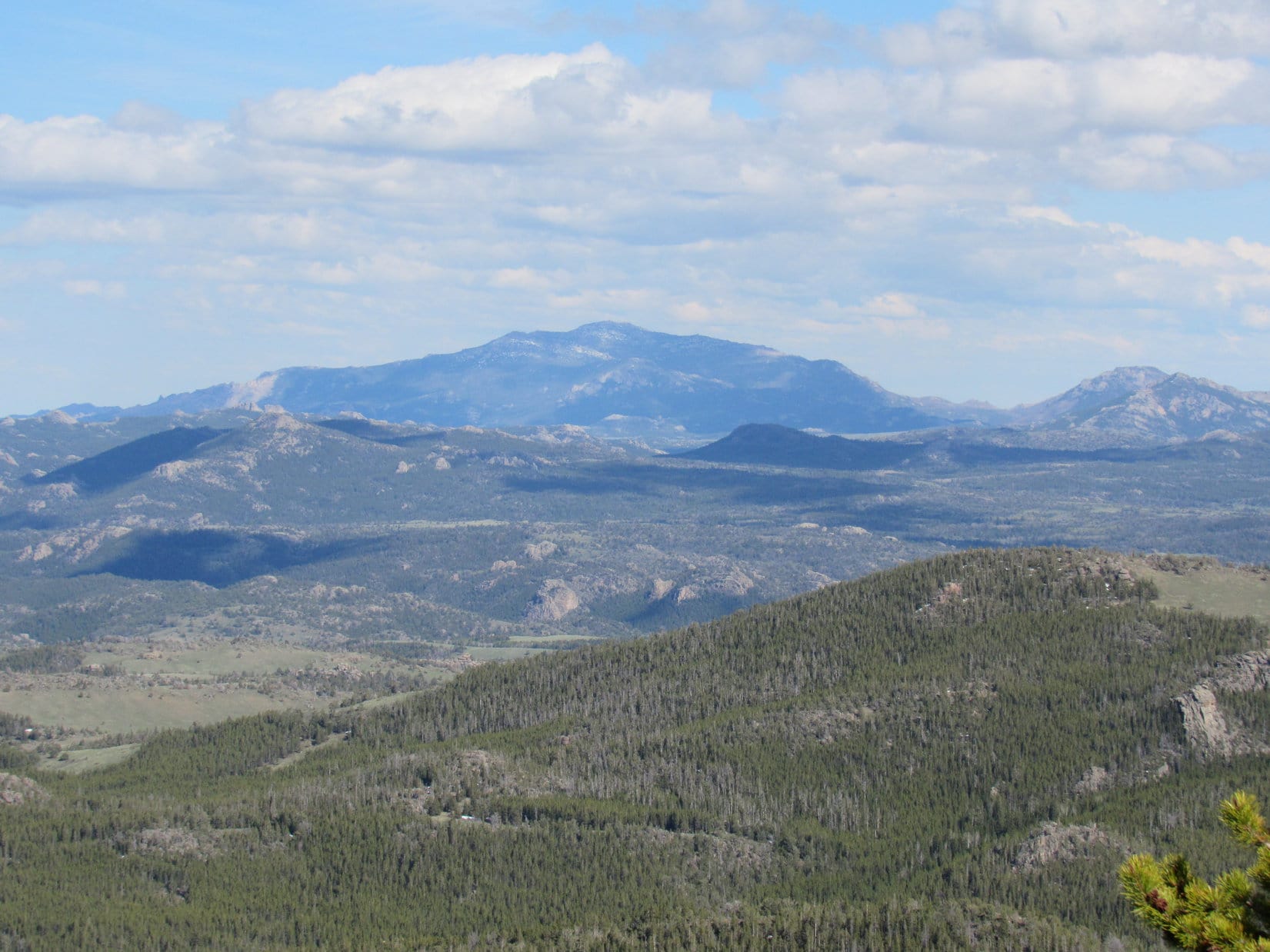
Suddenly, there was trouble. The ground started dropping off sharply. Between the trees, Lupe and SPHP did see the blue outline of a massive peak. It was very far away, however. It wasn’t Warbonnet Peak, but SPHP recognized it. Lupe had been there before, last summer. Miles and miles away was the unmistakable shape of the highest peak of the Laramie Range – Laramie Peak (10,272 ft.).
Well, that wasn’t so surprising. What was surprising was that the easy, relatively level terrain the topo map showed SE of High Point 9223 wasn’t there! And where on God’s green earth was Warbonnet Peak? It was nowhere in sight! Something was wrong.
Maybe SPHP was just turned around a bit? Whatever the case, the ground now dropped off very steeply this way. Lupe would have to try going around the NE side of High Point 9223. She would have to backtrack some to do so. Fortunately it wasn’t far. Lupe and SPHP turned around. Before long, Lupe was in position. SPHP wasn’t looking forward to a difficult trek through dense forests and deep snow, but expected that was what was in store.
Lupe had hardly gotten started trying to go around the NE side of High Point 9223 when she came to a stunning view, once again seen only partially between the trees. The terrain dropped steeply for hundreds of feet. Far lower mountains were seen just a few miles away. Lupe wasn’t going to be able to go around High Point 9223 this way either!
She wouldn’t have to. The truth hit SPHP like a bolt out of the blue. Lupe wasn’t on the slopes of High Point 9223. She must have circumvented it to the S while on the way through the snowy valley SE of High Point 9310. This was great news, actually! SPHP now knew where Lupe was. She was already high on the upper slopes of Warbonnet Peak (9,414 ft.). The summit was only a short climb away!

Within minutes, Lupe was attacking the last part of the steep, rocky W slope just shy of the summit. Suddenly she was there, standing atop Warbonnet Peak (9,414 ft.), the Converse County, WY High Point!


The summit of Warbonnet Peak was virtually all rock, with little vegetation. Consequently, Lupe had fabulous 360° views. There were still quite a few hours of daylight left – plenty of time for Lupe and SPHP to take a long break relaxing, sharing chocolate coconut granola bars, and enjoying the world from such a terrific vantage point.
The summit area wasn’t terribly big, maybe 10 to 20 feet wide and three times that much long, but there was room to walk around a bit on the jumbled rocks and decide on a favorite perch.


SPHP found a plastic jar with a green lid (about the size of a medium-sized peanut butter jar) tucked down among the rocks near the survey benchmark. Inside was a green plastic Indian Chief, and a red and white round plastic souvenir left by a winehead chick and an ex-drunk.

 There was also a single sheet of paper, on the back of which was a climber’s log with only 4 entries on it, the first one dating back to 9-23-2011. The other side of the log was a copy of the same trip report by Edward Earl that SPHP had a copy of in the backpack. Unfortunately, there was nothing to write with in the jar, and SPHP hadn’t brought a pen along. Lupe’s ascent did not get recorded on the log.

Lupe was a bit bored with the climber’s log and assorted associated paraphernalia. While SPHP fiddled around with it, she found a very small grassy spot on which to curl up for a snooze.

SPHP put the climber’s log and other items back in the plastic jar with the green top, returning the jar to its original resting place. While Lupe tried to snooze, SPHP took more photos of the views before discovering a larger Simply Orange plastic bottle a few feet away from the jar with the climber’s log.
Inside the Simply Orange bottle were a $1 bill, a penny, a folded newspaper article yellowed with age, and a photograph. SPHP had no way to get the photo or newspaper article out through the narrow neck of the bottle. SPHP left the cash inside, too.


Despite what had seemed like a long trek to reach Warbonnet Peak, Lupe had arrived at the summit with what SPHP estimated to be 4 to 5 hours of daylight remaining before sunset. Lupe and SPHP were in no rush to leave. After an hour or so, though, the sun had clearly made progress across the sky. Lupe was starting to revive from her nap, and showed signs of being ready for action again.

It was a long way back, and without any trails to follow, SPHP didn’t want to take a chance on not leaving enough time for Lupe to find her way back to Campbell Creek while it was still light out. A few more photos at the top, and it was time to bid a reluctant farewell to the fabulous views from Warbonnet Peak.


Lupe and SPHP took the same route Lupe had just pioneered on the way back to Campbell Creek. Now that the route was known, Lupe made faster progress than before. It helped that the return trip was mostly downhill, Lupe now knew a few shortcuts, and this time SPHP didn’t have to keep stopping to check the topo map. It was still a long trek. The sun made steady progress on its way to the horizon.


Once around High Point 9310 again, Lupe found a shortcut on her way back to the NW edge of the High Point 9180 ridge. She followed more open ground just a little farther to the W, instead of heading NW through the trees directly toward the actual summit.
This enabled Lupe to avoid the fairly short, but difficult trek through the snowy woods full of deadfall timber. When she reached the NW edge of the ridge, Lupe had a slightly longer trek back to the NE to the High Point 9180 summit. However, this was all much easier terrain. The view was terrific, too!
In fact, the highlight of the trip back was High Point 9180. If anything, the views were even prettier in the slanting light of early evening. Once again, Lupe and SPHP were impressed!

Although Lupe was fearless, and greatly enjoyed her second round of exploration along her newly blazed Warbonnet Peak route, there were two places that were a bit worrisome to SPHP.
The first one was the trek down from High Point 9180 to High Point 8590. Once Lupe was off the top of the High Point 9180 ridge, the entire route down was endless forest, with snowdrifts several feet deep between the trees almost the whole way. The forest was so dense, there were no viewpoints anywhere along the way. It was hard to tell whether Lupe was on course, or not.
SPHP started off just fine, following tracks left in the snow earlier in the day, but eventually lost them at one of the rare places with little snow. From then on, SPHP had to worry about staying on the ridgeline to High Point 8590. Uncertain of the correct direction, Lupe and SPHP wandered back and forth as Lupe continued down the slope, hoping to find either Lupe’s old tracks again or a glimpse of High Point 8590.
The concern was that SPHP might be unwittingly leading Lupe down into one of the big drainages to the E or W instead of to High Point 8590. The way down the mountain seemed longer than SPHP remembered, which added to the concerns. When the forest ended with the clear ground to High Point 8590 straight ahead, exactly as planned, it was a relief.

The second worrisome part of the return trip came almost at the end. SPHP couldn’t remember exactly where Lupe first reached the ridge above Campbell Creek before she had turned toward High Point 8585. SPHP’s recollection was that it hadn’t taken Lupe very long to reach High Point 8585 after gaining the ridgeline.
Upon reaching High Point 8585 again, Lupe and SPHP went NNW not too far from the W side of the ridge until Lupe reached some small clearings. These seemed vaguely familiar. SPHP had Lupe start down the steep W slope of the ridge right after passing by the last of these clearings.
SPHP was soon convinced that this was NOT the exact place Lupe had come up earlier in the day. It just wasn’t as rocky. Once again, the way down seemed farther than SPHP remembered. However, the steep forested slope didn’t come to any cliffs or get treacherously steep, so Lupe and SPHP just kept going down. Sooner or later Lupe would reach Campbell Creek!
Lupe did reach Campbell Creek. Conveniently, the trail was right there on the near side of the creek. SPHP still wasn’t certain if Lupe was upstream or downstream of where she had left both creek and trail many hours earlier.

One thing was for certain, Campbell Creek campground was downstream. Lupe and SPHP started following the trail downstream. Almost immediately, Lupe came to the stone fire ring where she had first left the trail. Lupe and SPHP had come down the ridge less than 100 feet from it.
The only remaining excitement on the way back was when SPHP had to leap across that first creek crossing one more time. Campbell Creek was visibly a little higher now due to all the snow that had melted in the afternoon. Once again, SPHP pitched the backpack across Campbell Creek. Once again, SPHP made the leap successfully.
At 8:16 PM (41°F), Lupe arrived back at the G6. Warbonnet Peak had been quite a day!
SPHP noted it had taken Lupe 8 hours to go from Campbell Creek campground to Warbonnet Peak and back. Edward Earl’s trip report indicated it had only taken him 6 hours. Of course, Lupe and SPHP had stayed up at the summit for at least an hour, probably somewhat longer than Mr. Earl had been there (he didn’t say exactly how long he stayed). Still, it had taken Lupe longer on her new route.
Lupe looked at SPHP. Hey, we had a fabulous day, and made it there and back in one piece. What more do you want? The Carolina Dog was too polite to mention that unlike Edward Earl, she was stuck with waiting for SPHP all the time.
Now how about some Alpo? I’m famished! Lupe’s route to Warbonnet Peak would, of course, be easier and faster when there is little or no snow. Save time going around the NE side of High Point 9310, instead of SW near the huge rock knob, to reach the high ground near High Point 9223. Take a more direct approach up Warbonnet Peak itself from the NW, instead of going so far around to the W or SW.
Lupe would still climb to the top of High Point 9180. The views are worth it!
Links:
Next Adventure Prior Adventure
Want more Lupe adventures? Choose from Lupe’s 2016 Laramie Mountains, WY Adventure Index, Dingo Vacations Adventure Index or Master Adventure Index. Or subscribe free to new Lupe adventures.