Striving for Squaretop Mountain, Wind River Range, WY – Part 1: Green River Lakes to Porcupine Pass (7-13-17 & 7-14-17)

Days 6 & 7 of Lupe’s 2017 Dingo Vacation to the Wind River Range, Wyoming & Select Peaks in Montana

The morning after Lupe’s return from her successful 4 day journey to Wind River Peak (13,192 ft.) was a lazy one.  The Carolina Dog had certainly earned a rest day!  SPHP picked up some fried chicken and a salad at Safeway in Lander.  Lupe took a couple of easy walks down by the Middle Popo Agie River across from Lander City Park.

By 11:00 AM, it was plenty hot out.  McDonald’s had ice cream cones on sale for 50 cents.  Even cheapskate SPHP was willing to spring for that!  Lupe got lessons in how to eat an ice cream cone.  By watching SPHP’s example, she became quite proficient at it.  It turns out Carolina Dogs are naturals at eating ice cream cones!

Enjoying a 50 cent McDonald’s ice cream cone in Lander, Wyoming. Lupe caught onto the whole ice cream cone concept in a flash!

Lupe’s next peakbagging objective, Squaretop Mountain (11,695 ft.), was clear over on the other side of the Wind River Range at the far NW entrance to Green River Lakes.  It would take all afternoon to drive over there, so right after the ice cream cones vanished, Lupe and SPHP left Lander and hit the road.

On her grand summer of 2015 Dingo Vacation, Lupe had spent a day reconnoitering Squaretop Mountain.  SPHP has an old book called Wind River Trails by Finis Mitchell, who spent most of his life running a fishing camp in the Wind River Range near the Big Sandy entrance.  In it, Mitchell describes a route up Squaretop Mountain from the E leaving the Highline Trail near Beaver Park.

Mitchell wrote that his route up Squaretop Mountain was “not difficult”.  He had taken scouting groups, and even a 4 year old child up this way once, yet Lupe had arrived at Beaver Park in late August 2015 only to see towering cliffs.  The topo map showed 3,500 feet of elevation gain in less than a mile.  No doubt Mitchell knew what he was talking about, but Lupe’s reconnaissance left SPHP desiring a more detailed route description than Finis had provided in Wind River Trails.

On the way back to Green River Lakes, Lupe had met Chad, a friendly forest ranger.  Did Chad know of a route up Squaretop?  Chad said he’d been to the top of Squaretop himself.  He said Mitchell’s route was hard to find since some of the landmarks in his route description (burnt areas) had changed.  SPHP asked if there wasn’t a feasible route from the W via Porcupine Pass?  Chad confirmed there was one, but it was longer, and he didn’t know the details.

Now, almost two years later, Lupe was on her way to Green River Lakes hoping to find that route from Porcupine Pass to Squaretop Mountain!  Hopes were high, bolstered by her success in reaching the summit of Wind River Peak.

The last part of the road to Green River Lakes, which used to be rough, was greatly improved.  It was still dusty and washboardy, but wasn’t nearly as stony as in 2015.  Gophers were abundant, and frequently dashed across the road as the G6 approached.  Lupe was enthusiastic about the gophers, and barked frantically at them as she sped by.

Lupe arrived at the trailhead near Lower Green River Lake at 5:00 PM.  Loop and SPHP were both anxious to go down to the lake to get a good look at gorgeous Squaretop Mountain again.

Lupe arrives at Lower Green River Lake for the first time in nearly 2 years. Her beautiful peakbagging objective, Squaretop Mountain (Center), is in sight beyond the lake. Photo looks SSE.

Lower Green River Lake and Squaretop Mountain were every bit as lovely as Lupe and SPHP remembered.  Of all the mountains in the Wind River Range, Finis Mitchell had chosen Squaretop for the cover of his book Wind River Trails.

Lupe wading in Lower Green River Lake. Photo looks SSE.

Lupe and SPHP both went wading in Lower Green River Lake.  The mosquitoes were bad, though, and eventually put an end to the fun.  Lupe then went down to the Highline Trail bridge where the Green River exits the lake.  A sign said that the bridge over Clear Creek (near the opposite end of Lower Green River Lake) was out due to flooding.

Lupe on the Highline Trail bridge over the Green River close to where it exits Lower Green River Lake. The Green River was running high, and a sign said the bridge over Clear Creek near the opposite end of the lake was out due to flooding. Photo looks NNW.

The Green River was running high, full of water from bank to bank.  Having just seen how full the creeks were, and how much snow still existed in the high country near Wind River Peak, Lupe wasn’t surprised.  With the bridge over Clear Creek out, Lupe wouldn’t be able to take the Highline Trail (No. 94) to Porcupine Pass tomorrow.  Fortunately, an alternate route exists.  Lupe could still take the Lakeside Trail (No. 144).

Even though Lower Green River Lake is at 7,961 feet elevation, the evening was hot.  The mosquitoes were bad.  Lupe and SPHP ended up staying in the G6, periodically running the AC to keep cool.  While SPHP caught up the journal, Lupe watched gophers.  Every now and then, she just had to be let out to bark at squirrels, or sniff at a gopher hole.

The next morning it was time for action!  Lupe and SPHP went down to Lower Green River Lake again to admire Squaretop Mountain (11,695 ft.) before setting out for Porcupine Pass.  (8:44 AM, 7-14-17, 66°F).

Lupe at Lower Green River Lake the morning of 7-14-17 ready to set out for Porcupine Pass, and eventually Squaretop Mountain (Center). Photo looks SSE.
Squaretop Mountain from Lower Green River Lake, Wind River Range, Wyoming. Photo looks SSE.

After a good look at her magnificent objective, Lupe followed the Lakeside Trail S along the W side of Lower Green River Lake.  Despite it’s name, the Lakeside Trail is seldom down by the shore.  Most of the time the trail stayed in the forest 50 to 150 feet above the lake.  Only once in a while did Lupe come to an opening with a good view of the lake and mountains beyond.

Heading S on the Lakeside Trail on the W side of Lower Green River Lake. Despite its name, most of the time the Lakeside Trail is 50 to 150 feet above the shoreline. Flat Top Mountain (11,823 ft.) is in the distance on the L. Photo looks ESE.

Lupe was less than halfway along Lower Green River Lake, when a backpacker approached from the opposite direction.  He turned out to be quite an interesting fellow.  Radek Hecsko was 48 years old, and from the Czech Republic.  He billed himself as “Czech Mix”.

Lupe meets “Czech Mix” on the Lakeside Trail. Czech Mix was hiking the Continental Divide Trail from Mexico to Canada.

Czech Mix was hiking the entire 3,100 mile Continental Divide Trail from Mexico to Canada!  He had started on May 2 in New Mexico, and hoped to reach the Canadian border by mid-September.  In 2015, he had previously hiked the entire 2,600 mile Pacific Crest Trail, which also goes all the way from Mexico to Canada.

Czech Mix jokingly called the Continental Divide Trail the “IPA Trail”.  He said he typically hikes 30 miles per day, though not in the most rugged territory, and does take occasional rest days.  Depending on the kindness of strangers, he hitchhikes to towns whenever possible to resupply.  On the trail he often goes hungry, but in towns he packs in the calories feasting on hamburgers, coffee and IPA’s.

Czech Mix said he might eventually take on the 2,190 mile Appalachian Trail to complete the “Triple Crown”, a feat very few people have ever accomplished.  He hadn’t really decided yet, though.  It was another massive undertaking.  For now he was staying concentrated on enjoying and completing the Continental Divide Trail.  Completing the CDT would be a rare accomplishment in itself, since it was the longest of the 3 trails and by far the least traveled.

After petting Lupe, and a nice chat with SPHP, Czech Mix pressed on.

Well, that Czech Mix was mighty impressive, Loopster!  Can you imagine tackling a 3,000+ mile long trail through high mountains like that?  It’s just plain heroic!

Oh, are we gonna do that?

I’ve no doubt you could, Loop, but I’m not up for it.  Completing any one of those trails is a gigantic endeavor!  I’ll be happy, if we can just make it to Squaretop Mountain.

Oh, I’m sticking with you, SPHP.  I’ll be happy if we can find some squirrels!

Flat Top Mountain (11,823 ft.) (L) and White Rock (11,284 ft.) (R) from the Lakeside Trail. Lower Green River Lake in the foreground. Photo looks SE.

Lupe continued meeting people along the Lakeside Trail.  They came strung out in small groups, but were all members of a youth group that had been camped at Twin Lakes.  The group leaders were all concerned about an 18 year old, who had wandered off on his own and never showed up at camp last night.  Their anxiety was only increased by the knowledge that his father was an attorney.

Two miles from where she’d started, Lupe reached the end of Lower Green River Lake.  Another 0.25 mile brought her to a trail junction.  Loop turned R on the Porcupine Trail (No. 137).  She would be gaining elevation nearly all the way to Porcupine Pass, a good 6 or 7 miles away as the trail goes.

Sign at the trail junction S of Lower Green River Lake. Lupe would take the trail to Porcupine Pass.
Lupe about to hit the Porcupine Trail seen beyond her. Photo looks S.

The Porcupine Trail didn’t begin climbing immediately, however.  For almost another 0.25 mile it remained level until Loop reached Porcupine Creek.  No bridge!  Another ford.  Lovely!  Lupe had forded a lot of big streams on her way to Wind River Peak, but SPHP had been hoping for a bridge here.  No such luck.

Less than 0.25 mile S of the trail junction, Lupe arrives at Porcupine Creek. SPHP had been hoping for a bridge. No such luck.

Actually, that wasn’t entirely true.  Upstream of the ford, a log extended over the creek.  A thin cable, which could be easily grabbed for support, was stretched high above it.  The log’s circumference wasn’t all that large, however, especially toward the far end.  Lupe couldn’t grab the cable, and might easily fall.  It was a drop of several feet into Porcupine Creek.  This makeshift bridge wasn’t going to do.

The near side of the ford was shallow, slow-moving water.  The far side was deeper, and a great volume of water seemed to be racing by.  What bothered SPHP far more than the ford itself, however, was what was right below it.  Only 20 feet below the ford, Porcupine Creek made a sharp bend.  This bend was clogged with sunken logs, branches and other debris.  The water was over Lupe’s head.  If she got swept downstream, she would be pinned with great force against the debris.

Czech Mix hadn’t come this way.  The entire youth group had, however.  No one had mentioned any problems crossing Porcupine Creek.  SPHP didn’t like the setup, but decided to carry Lupe across.

The bottom where the creek was deepest was stony.  Fortunately, perhaps due to traffic on the trail, the stones weren’t very slippery.  Porcupine Creek turned out to be only knee deep, but SPHP still had a hard time maintaining balance on the uneven bottom against the force of the swift current.  The Carolina Dog was glad to be let gently back down on solid ground again, when SPHP managed to struggle across safely.

The Porcupine Trail now began to climb aggressively, switchbacking SW up a steep forested slope.  Partway up, Lupe could hear Porcupine Falls somewhere off in the woods to the N, but she never saw it.  After gaining 800 feet of elevation, the trail gradually started leveling off.  Eventually Porcupine Creek came back into view.

After gaining more than 800 feet of elevation from the ford, Porcupine Creek came back into view again as the trail leveled out. Photo looks W.

Shortly after leveling out, the trail turned NW and forded Porcupine Creek again.  It could be seen continuing up a hillside beyond the far bank.  Thinking that was just the way to Twin Lakes, SPHP skipped the turn, and led Lupe SW beyond a trail junction staying on the SE side of Porcupine Creek.

The trail Lupe was on soon disappeared in a bog.  SPHP was puzzled when it couldn’t be found again on the other side.  Where had it gone?  No matter.  Lupe and SPHP continued onward, bushwhacking through the forest up hilly terrain.

After more than 0.25 mile, Lupe did find the Porcupine Trail again!  Belatedly, SPHP suddenly realized the trail to Twin Lakes hadn’t branched off until the Porcupine Trail had crossed over to the W side of the creek.  To stay on the trail, Lupe should have taken the ford that SPHP had her skip.

Oh, well.  No harm done.  Lupe had managed to bushwhack her way through, and it was actually better this way when the creek was so high.  The American Dingo’s bushwhacking had avoided 2 stream fords in the process.  Puppy, ho!  Onward!

Lupe finds the Porcupine Trail again. Although the day had started out mostly sunny, by now the sky was clouding up. Photo looks SW.

The trail was in great condition where Lupe found it.  It headed SW up a huge valley.  Porcupine Creek was often in view flowing through wide green meadows.  The trail almost always stayed out in the open, but gradually deteriorated, becoming muddy and passing through bogs in some places.   Lupe had wonderful views of rugged mountains towering over the far side of the valley.

Porcupine Creek flows down a wide valley of green meadows. Lofty peaks towered above both sides of the valley. Photo looks SW.

More than 0.5 mile from where Lupe had picked up the trail again, Porcupine Creek turned W to go around a small forested hill.  This was an especially nice spot, and seemed like a good place to take a break.  Lupe left the main trail to follow a short side spur down to the stream.  Wildflowers grew in abundance.  Lupe laid down for a rest.  Mosquitoes were a nuisance for the first time today, but they weren’t too bad.

Lupe pauses for a rest near Porcupine Creek. Photo looks W.
Wildflowers were abundant, although bright red ones like these were far less common.

After a pleasant break, Lupe and SPHP continued on.  The Porcupine Trail climbed the small forested hill, but soon exited the forest again.  For a while the trail was wet and boggy.  However, the valley eventually narrowed.  The trail became rockier, steeper, and re-entered the forest.  Up ahead were mountains with more snow on them than the scattered patches seen up to this point.

Beyond the small forested hill, the trail went back out into the open again. For a while it stayed wet and boggy. Meanwhile, the mountains up ahead were looking snowier. Photo looks S.
As the Porcupine Creek valley narrowed, the trail dried out and became rockier. Lupe started gaining elevation more rapidly. Photo looks S.
Lower down Porcupine Creek had been a gentle meandering stream, but now it was mostly whitewater as it tumbled over increasingly rocky terrain. Photo looks S.
Looking W across the Porcupine Creek valley.

After a long march, the Porcupine Trail finally emerged from the forest again.  It approached Porcupine Creek, closely following the E bank.  As Lupe continued S, the trail disappeared straight into a huge snowbank.  Efforts to pick up the trail on the far side of the snowbank failed.  Sigh.  What now?

Lupe had been making good progress toward the upper end of the long valley.  Ahead was another stretch of forest, but it couldn’t be too much farther to open ground again.  There seemed to be no choice, but to resume bushwhacking and see where it led.  The American Dingo climbed back into the forest.

The forest was denser here than where Lupe had bushwhacked before.  It wasn’t too hard to get around, though.  Loopster soon came to two substantial tributaries of Porcupine Creek in quick succession.  They were wild, whitewater streams that plunged W down from mountains on the E side of the valley.

Bushwhacking through the forest again, Lupe came to two substantial tributaries of Porcupine Creek in quick succession.

Fortunately neither tributary was so large that Lupe couldn’t find a safe place to ford them in short order.  Looper hadn’t gotten too far beyond the second stream when she reached the end of the forest.  She started crossing a meadow, and came across the Porcupine Trail yet again.

SPHP didn’t realize it at the time, but the trail had once again crossed over to the W side of Porcupine Creek for a short distance before returning to the E side.  So what?  Lupe’s bushwhacking had avoided another 2 fordings.  She was close to the end of the valley now.  Porcupine Pass was less than a mile away!  The trail went SE, heading straight for it.

Back on the Porcupine Trail again. Lupe is getting close to Porcupine Pass (Center), now less than a mile away. Photo looks SE.

The trail became progressively steeper and steeper.  Soon Lupe was on switchbacks.  The forest began to thin out.  The trees became stunted.  When Lupe reached treeline, Porcupine Pass was in view.  It was nothing like SPHP expected.

Porcupine Pass is at 10,700 feet elevation.  Yet due solely to its name, SPHP had always thought of it as being forested.  Thought of it as a place one might find porcupines – not that finding a porcupine was a good idea.  An encounter with one might end very badly for Lupe.

No worries, though, on that score!  Only scattered trees remained in view ahead.  None at all were up on the high saddle which appeared to be Porcupine Pass.  Lupe was still hundreds of feet below the pass.  A very long, steep snowbank led up to the top.  Egads!

Above tree line, Lupe’s first really good look at Porcupine Pass (L) was nothing like SPHP expected. Photo looks S.

Lupe continued up the trail, now hidden beneath snow, until she got close to the steep final slope leading up to Porcupine Pass.  Here she left the trail, and traveled E climbing a rocky hill.  She got up high enough for a good look around at the terrain in most directions.

Still hundreds of feet below Porcupine Pass, but not far from it, Lupe had this grand view of the Porcupine Creek valley she had just traveled up. Photo looks NNW.
Looking W. The Jim Creek Trail, which Lupe had bypassed while bushwhacking, is somewhere on the green slope on the opposite side of the valley.

The view to the E was the critical one.  It was decision time.  SPHP had originally planned for Lupe to go all the way on up to Porcupine Pass.  From there she would head E tomorrow for New Benchmark (11,850 ft.) and Peak 11,820 on her way to Squaretop Mountain (11,625 ft.).

However, an alternate route skipping New Benchmark entirely might be possible by continuing E from here without ever going all the way up to Porcupine Pass.  The topo map seemed to suggest this might be an easier route.

SPHP hesitated.  The view to the E was not all that reassuring.  Going E didn’t look clearly possible or impossible for Lupe.  There was a lot of rough, rocky ground.  Half a mile away or more was a wall of rock.  From here, SPHP couldn’t see enough detail to tell for certain if Loop might be able to skirt it to the S, or not.

Looking E from below Porcupine Pass. Lupe could skip Porcupine Pass and New Benchmark going this way, but it looked like a lot of rough terrain. Could she even get past the wall of rock seen on the N (L) bypassing it to the S (R)?
Another look E with more help from the telephoto lens.

A significantly longer, but perhaps less rugged option was also in sight to the NE.  That route all depended on whether Lupe could manage to get up on a big ridge at the end of a valley.  She probably could, but she’d have to travel quite a distance to find out for sure.

Another alternate route was in sight. Maybe Lupe could travel up the distant upper valley seen L of Center and climb up on the big ridge at the end? Once on the ridge, she could head SE bypassing both New Benchmark and Peak 11820. That might work, but certainly seemed to be the long way around. Photo looks NE.

Maybe all of the routes would work?  Maybe none of them would.  The decision on which way to go was an important one, perhaps critical if Lupe was going to have any success in reaching Squaretop Mountain.  Yet the right thing to do wasn’t at all clear.  Lupe could only try one approach.  SPHP wasn’t carrying enough supplies for any more than that.

Only short sections of the trail switchbacking 400 feet up the steep slope to Porcupine Pass were visible.  The vast majority of the trail was buried beneath a long steep snowfield.  However, a lane of snow-free ground existed E of the trail.  It was very steep, but Lupe could climb that slope easily enough.  SPHP could probably manage it, too.

In the end, SPHP decided to stick with the original plan.  Lupe began the climb up to Porcupine Pass.

Lupe on the final steep slope leading to Porcupine Pass. Photo looks S. And up!

It was a good thing the slope wasn’t any steeper, or SPHP wouldn’t have made it.  There were places where there was nothing firm to hang onto.  Traction wasn’t always good.  Yet it wasn’t long before Loop and SPHP were safely up at Porcupine Pass.  The views were impressive!

Loop arrives at Porcupine Pass! She had an impressive view of the long Porcupine Creek valley (R) she had traveled up to get here. Photo looks NNW.
The Dodge Creek valley from Porcupine Pass. Photo looks SSE.

Porcupine Pass was beautiful, but barren.  It felt cold, remote and forlorn.  Lupe hadn’t seen anyone since leaving the Lakeside Trail many miles ago.  It had been a long day.  For hours during the afternoon there had been dark clouds off to the NW, but now that it was evening, the sky had partially cleared.  There were still clouds around, but they didn’t look threatening.

Congratulations, Loopster!  This is it.  Porcupine Pass.  You made it!

We’re staying here?

Yeah, for tonight.  I’ll set up your tiny house in a minute.  Want to climb that hill to the W for a look around, once it’s up?  It’s Porcupine Pass Peak (10,890 ft.).  Won’t take long.

Can we do it in the morning, SPHP?  I’m hungry, and ready for a snooze.  Mosquitoes are bugging me even up here.  I’d sort of like to get in the tiny house, and call it a day.

Sure, we can do that.  I’d wish for a breeze to blow the bloodsuckers away, but its probably not a good idea.

Why not?

I have a feeling Porcupine Pass would be an absolute hurricane if the wind came up.  We’re lucky it’s a calm evening, even if we have to put up with some bad bugs.  Anyway, you’re right.  Tomorrow’s our big push for Squaretop Mountain.  We may as well eat and rest up for it as much as possible.  Just getting to New Benchmark (11,850 ft.) might be an ordeal, and Squaretop is miles beyond it.

Are we going to have problems?

Dunno.  Maybe.  New Benchmark looks far more challenging than I’d expected.   However, once we’re beyond it, you’ll have gained all the elevation you need to, and the terrain ought to be a lot easier.  It better be, if we’re ever going to make it to Squaretop.  We’ll see, though.  One thing is for certain, tomorrow will be another long day.

Whatever.  What’s for dinner?

For you, Alpo and Cliff bar.

Oh, that doesn’t sound bad at all!  Hurry up and get the tiny house assembled, would you?  I’m famished!

On it!

Lupe at Porcupine Pass, with her fully assembled tiny house in the background. Photo looks SSE.
View to the E toward New Benchmark (R) from Porcupine Pass. Tomorrow Lupe would have to go over New Benchmark and miles beyond it, if she hoped to get to Squaretop Mountain.

Related Links:

Striving for Squaretop Mountain,Wind River Range, WY – Part 2: New Benchmark – Victory & Defeat! (7-15-17)

Green River Lakes, Squaretop Mountain & the Highline Trail to Beaver Park, Wind River Range, WY (8-30-15)

Want more Lupe adventures?  Choose from Lupe’s 2017 Wind River Range in Wyoming & Select Peaks in Montana Adventure IndexDingo Vacations Adventure Index or Master Adventure Index.  Or subscribe free to new Lupe adventures.

Ferris Peak, Charlie Brown Range, Wyoming (6-17-17)

Day 10 of Lupe’s 2017 Dingo Vacation to the Laramie Range & Beyond!

As you drive along I-80 through Rawlins WY, you can see in the distance about 35 miles north a mountain range with a very striking feature: a zigzagging white cliff band running nearly the entire length of the range from left to right.  That band is the Madison formation, an upended layer of limestone which has subsequently been eroded into a series of V-notches by a succession of streams coming down from the crest above.  I first noticed this mountain range in the late 1980s, and that zigzagging line reminded me of the zigzagging line across the bottom of the shirt that Charlie Brown wears.  For this reason, I personally dubbed the range the “Charlie Brown Mountains”.  – excerpt from Edward Earl’s trip report on his 9-5-2014 ascent of Ferris Mountain on Peakbagger.com

Rain!  Not good.  If it rained too hard, the dirt road would turn to mud.  The G6 might get stuck way out here NW of Bairoil.  Better get back to pavement, now!

It was still dark out, but Lupe was already awake.  SPHP had just come to.  In pre-dawn rain and fog, SPHP drove back to Bairoil.  The rain had already let up to a light sprinkle, by the time Lupe reached the pavement on Hwy 73.  May as well keep going.

Eight miles E of Muddy Gap, SPHP turned S off Hwy 220 onto Carbon County Road No. 499.  The rain and fog were gone, but dark clouds still hid the Charlie Brown Range.  It was light out now, but still very early.  Lupe was ready for action!  SPHP wasn’t.

Gimme a few more hours snoozing time, Loop.  Need to wait a bit to see what the weather’s going to do anyway.  And with that, SPHP parked the G6 and went back to sleep.

A few hours later, SPHP was ready.  Time for Lupe to take on dreaded Ferris Mountain (10,037 ft.), high point of the entire Charlie Brown Range!  Of course, that was provided she could even get close enough to make an attempt feasible.

The first part of the way ought to be easy enough.  Lupe could follow directions in peakbagging hero Edward Earl’s trip report.  She was already at the first place Mr. Earl mentioned, the sign for Pete Creek Road & Cherry Creek Road at the turn off Hwy 220.

The BLM sign off Hwy 220 at the turn onto Carbon County Road No. 499. Whiskey Peak (9,225 ft.) (L), which Lupe had good time climbing yesterday, is in view. Photo looks SW.

Mr. Earl’s trip report contained detailed instructions on how to get to Ferris Mountain.  The next thing to look for was 0.9 mile from Hwy 220 along Carbon County Road No. 499, where a road branching off to the R was marked only by an unreadable sign.  This intersection quickly came into view.

The intersection 0.9 mile from Hwy 220 (L) where an unmarked road branches to the R off County Road No. 499 quickly came into view. Photo looks SE.

Mr. Earl’s instructions said to go straight at this first intersection, avoiding the R turn on the unmarked road.  2 miles from Hwy 220 was another R turn, this time onto Cherry Creek Road, which was also to be avoided.  Lupe and SPHP stayed on Carbon County Road No. 499 both times, and came to the Handcart Ranch sign 2.5 miles from Hwy 220.

Lupe by the unreadable sign at the first turn to the R, which is the wrong way to go. The G6 is parked along Carbon CR No. 499, which is the correct way.
Stay straight on Carbon County Road No. 499. Loop is on the correct route here.
At the 2nd turn to the R, which goes to Cherry Creek. Lupe did not take this side road either.
Lupe at the Handcart Ranch sign mentioned by Edward Earl as being 2.5 miles from Hwy 220. There was no turn off Carbon County Road No. 499 here.
These pronghorn antelope got Lupe excited!

Edward Earl mentioned a fork in the road 4.3 miles from Hwy 220.  The R branch goes to a ranch, while Carbon County Road No. 499 continues to the L.  Lupe arrived at this fork just as Mr. Earl said.

At the fork in the road 4.3 miles from Hwy 220. Carbon County Road No. 499 goes L here. The road to the R goes to a private ranch headquarters.

Edward Earl also said that the condition of Carbon County Road No. 499 worsened beyond this intersection.  He cited frequent mud holes which were dry when he was here, but correctly surmised they were mud puddles during wet weather.

SPHP had scarcely made the L turn at the fork, when there was trouble ahead.  A large mud puddle fed by a small stream completely blocked the road.  Lupe and SPHP got out for a look.

Lupe inspects the mud puddle and small stream blocking Carbon County Road No. 499.

Nope!  Not gonna try it!  This mud puddle was as far as the G6 was going.  Mr. Earl’s trip report indicated that it wouldn’t be much farther before high clearance would be needed anyway.  Even though the base of the Charlie Brown Range where Mr. Earl had parked his Nissan pickup truck was still 6.5 miles away, it was going to be paw and foot for Lupe and SPHP from here.  Loopster was in for a very long day!

SPHP parked the G6 in the field next to Carbon County Road No. 499, and proceeded to get ready for Lupe’s long march.  The ranch headquarters was in sight from this location, not too far away.  Soon a vehicle was seen leaving HQ.  A couple minutes later, Lupe and SPHP met Kyra Torgensen and her son.  The G6 was parked on the ranch Kyra and her husband own.  Naturally, she wanted to know what was going on.

The Torgensen’s ranch HQ was in view from where the G6 was parked. Kyra Torgensen and her son soon drove up wanting to know what was going on.

SPHP explained that Lupe was here to climb Ferris Mountain.  It was only another 0.2 mile to BLM land.  SPHP would have parked over there, but the G6 couldn’t get past the mud puddle.  Did she mind if the G6 was parked here for the day?

Mrs. Torgensen was a little reluctant at first.  However, Carbon County Road No. 499 had to be a public right-of-way, which she must have known.  SPHP didn’t mention this fact, though, hoping to avoid an argument.  In the end, while she may not have been thrilled with the idea, Kyra Torgensen was fine with the G6 where it was.  Before she drove away, she warned SPHP not to stay out too late, and to beware of wolves.

A few minutes later, Lupe and SPHP jumped the little stream, and began the long trek to Ferris Mountain (10:17 AM, 68°F).  Only 0.2 mile farther, the Carolina Dog went through a gate onto BLM land.  The road forked again.  Following Edward Earl’s instructions, Lupe took the road to Pete Creek.

After leaving the Torgensen’s ranch, Lupe took BLM Road No. 3148 to Pete Creek. The Charlie Brown Range was still more than 6 miles away.

Lupe and SPHP weren’t worried about wolves.  However, Ferris Mountain had long been the most dreaded peakbagging goal of this entire Dingo Vacation.  The mountain itself wasn’t the worry.  Distance wasn’t either.  Forewarned by Edward Earl’s trip report, SPHP had realized all along that Lupe would likely have a 6+ mile trek just to get to the Charlie Brown Range.

The problem was the sagebrush prairie Lupe would have to cross.  Two of Lupe’s nemeses might well be out there – cactus and rattlesnakes.  If Lupe became scared of cacti, she would refuse to move.  Rattlesnakes, of course, would be far worse.

For these reasons, SPHP encouraged Lupe to stay very close, preferably right on the road.  Most of the time she did.

A few cacti did grow out on the high prairie. Fortunately, they weren’t too abundant.
On the way to the Charlie Brown Range on Pete Creek Road.
Wildflowers blooming on the normally arid prairie.

Fortunately, Lupe saw only a few cactus and no rattlesnakes.  Meanwhile, the weather remained questionable.  Dark clouds hung around.  Sometimes they obscured virtually the entire Charlie Brown Range.  Other times, they lifted to reveal the mountains.  A significant storm was brewing off to the SE.  For a while it came closer, but eventually it sailed off to the NE.

Roughly 4 miles from the G6, Lupe came to a cairn on the L side of Pete Creek Road.  Edward Earl mentioned 3 cairns in this area, but the Loop only saw 1.

Lupe on the only cairn she saw on the L side of Pete Creek Road. Ferris Mountain, her ultimate goal, is straight up from Lupe’s head. Photo looks S.
Lupe at the wire gate described by Edward Earl 9.2 miles from Hwy 220. The view of the mountains ahead shrouded in clouds wasn’t too encouraging at this point.

6.5 miles from the G6, Lupe finally reached the base of the Charlie Brown Range on a grassy ridge E of the mouth of Pete Creek Canyon.  A white pickup truck was parked here near the edge of the forest, right about where Edward Earl must have parked his Nissan pickup.  Pete Creek Road, which had been going due S for miles, turned SE here.

Lupe at the base of the Charlie Brown Range close to where Edward Earl must have parked his Nissan pickup truck in 2014. Pete Creek Road (No. 3148) (R) heads SE from here. Photo looks SE.

Lupe still had another 0.5 mile to go on Pete Creek Road along the base of the mountains.  On the way, she lost 120 feet of elevation crossing the Rush Creek drainage, where she saw a salt lick noted by Edward Earl.  By the time she reached a green metal gate near the mouth of Pole Canyon, she had regained all of the lost elevation and a good deal more.

Beyond the green metal gate, Loop finally left Pete Creek Road.  She headed into Pole Canyon, and quickly came upon a different faint road heading up the valley.

A pronghorn antelope near Pole Creek, which is hidden in the trees. Photo looks E.
Lupe reaches the green metal gate after crossing the Rush Creek drainage on Pete Creek Road. The mouth of Pole Canyon is seen beyond her. Loop left Pete Creek Road near this point. Photo looks S.
Starting up Pole Canyon. Photo looks SW.

Edward Earl had followed this same road up Pole Canyon.  His trip report mentioned fallen trees and a few marshy spots, but Mr. Earl had been here in September when conditions are much drier.  Pole Creek was no occasional marshy spot in the middle of June, but a clear running stream.  It was easy enough to wade across, however, and Lupe enjoyed the cold water.

Lupe at the first crossing of Pole Creek.

The road crossed Pole Creek more than once.  Lupe also came to marshy glades, where the road hardly existed, but she could usually find it again a little higher up.  After a while the road completely disappeared, lost for good.

At another Pole Creek crossing.
Loop cools her paws in Pole Creek. By now, the road she had been following had faded away. So far, it was still pretty easy traveling up the R (NW) side of the canyon. The easiest routes usually weren’t right down by the creek.

At 8,450 feet, Loop arrived at the place where Pole Canyon splits.  When Edward Earl had been here, only the R (W) branch had flowing water.  Both branches had flowing water now.  Like Edward Earl, Lupe stayed L (E).  As she continued gaining elevation, the creek was increasingly hidden beneath snow.

Loop (behind the tree on the right) reaches the 8,450 foot level where Pole Canyon and the stream divide. She would follow the stream seen on the L here up the E branch of the canyon. Photo looks S.
As Lupe continued to gain elevation, the creek was increasingly hidden by snow. Photo looks S.

Lupe stayed to the W (R) of the creek, but it started getting harder to make progress.  The forest was dense, and the American Dingo came to more and more rocks and deadfall.  The canyon sides steepened, becoming more difficult to traverse.  SPHP decided Loop might have an easier time up on the ridge W of the creek.

For a while, leaving the canyon seemed like a good decision.  Lupe had no problem reaching the ridgeline.  It went straight S rising relentlessly at a pretty good clip, but there was less deadfall to deal with.  Sometimes there was even some open ground.  When she did come to rock formations, they usually weren’t much trouble to get around.  Lupe gained elevation rapidly.

After abandoning the canyon to get up on the ridge to the W, Lupe gained elevation rapidly. Here she is perched on the largest rock formation she had to maneuver around in the early going. Photo looks N.
Terrain like this open spot on the ridge was a lot easier to deal with than all the rocks and deadfall in the canyon Loop had left behind. Photo looks S.

It was a long way up.  Lupe gained lots of elevation, but the ridge started getting ever steeper and rockier.  Huge rock formations appeared above.  Looper ended up on steep slopes of broken rock interspersed with spruce trees.  This was challenging terrain.  SPHP began to fear there wouldn’t be a way to the top.

Lupe had gained a lot of elevation, but the ridge route became increasingly challenging. Lupe found herself on steep slopes of broken rock interspersed with spruce trees. This was slow going. Photo looks SSE.

The ridgeline had basically disappeared.  Lupe now seemed to be going straight up the N face of a mountain.  She needed to get to easier terrain.  SPHP led her up a very steep rocky chute toward a forested saddle between two massive rock formations.

Loop never made it to the saddle.  Everything got so steep, progress ground to a halt.  At the top of a long, narrow snow bank, SPHP realized that even if Loop could get up to the saddle, she probably didn’t stand much chance of getting over or around the giant rock formations towering above.  She would be trapped between them.

Lupe at the top of the snow bank where SPHP realized she needed to down climb and go around this part of the mountain. Photo looks N.

Lupe had to down climb.  She needed to get farther E.  She didn’t have to lose all that much elevation, but it took a lot of time.  Fortunately, it wasn’t terribly far around the huge rock formation above her.  Once she managed to get around it, things became easier.  The Carolina Dog was still on steep, rocky stuff, but the route up was more manageable.

Once Lupe worked her way around to the E of the massive rock formation that had towered over her, this route up was much more manageable. Photo looks SSE.

Loop climbed and climbed.  She was very high, and getting close to the top of something!  Her luck needed to hold only a little longer.  It did.  Suddenly she was there!  Lupe stood next to a wooden pole at the top of a big cairn.  The views were spectacular!

Lupe climbed and climbed. SPHP could see she was getting close to the top of something. Suddenly she was there, standing on top of a big cairn next to a wooden pole! Photo looks NE.

Had Lupe arrived at the top of Ferris Mountain (10,037 ft.)?  The grand views, and presence of the big cairn with the pole sticking out of it made SPHP think so.

A more careful look at the views and a glance at the topo map revealed this wasn’t the case.  Lupe was already nearly as high as the true summit, but she was actually on Ferris Mountain’s most westerly sub-peak over 10,000 feet.  The true summit was in view from here, still 0.5 mile away to the SE.

Although SPHP initially thought Lupe might have reached the top of Ferris Mountain here, the true summit (R), which wasn’t much higher, was actually still 0.5 mile away. Photo looks SE.

Clearly, the vast majority of the work of climbing Ferris Mountain (10,037 ft.) was done.  Getting over to the true summit didn’t look hard.  This appeared to be the 2nd highest point on the mountain, and an amazing place.  Lupe had time to take a rest break and enjoy the views.

Looking NW along the Charlie Brown Range from the westernmost 10,000+ ft. subpeak of Ferris Mountain.
The rocky crag seen below on the L is Ferris Mountain North (9,740 ft.). Far beyond it out on the prairie, part of Pathfinder Reservoir is in view. Photo looks NE.
Another look NW with help from the telephoto lens.
Looking down on Lupe’s route up. Pole Canyon divides near the center of the photo. Lupe had started up the R (E) branch, but soon got up on the forested ridge between the divided canyons. After that it was mostly straight on up, with a short down climb to get a bit farther E. Pole Canyon empties out onto the prairie on the R. Photo looks N.
Lupe takes a break on Ferris Mountain West. Photo looks NW.

After relaxing on fabulous Ferris Mountain West, it was time to move on.  The ridge Loop had to follow wasn’t difficult.  Her first objective along it was a slightly lower subpeak only 0.1 mile E.  She was soon there, looking down on the 9,900 foot saddle where Edward Earl had first reached the ridgeline.

The route along the ridge leading to the true summit of Ferris Mountain (R) didn’t look too difficult. Lupe’s first objective, a slightly lower subpeak 0.1 mile E of Ferris Mountain West is seen on the L. Photo looks ESE.
Heading toward the 9,900 foot saddle. Ferris Mountain’s true summit (Center) is seen straight up from Lupe. Ferris Mountain Middle (10,000 ft.) is across the saddle toward the R. Photo looks SE.

Loop went down to the 9,900 foot saddle and crossed it.  Edward Earl hadn’t gone all the way up to Ferris Mountain West, but the American Dingo was back on his trail again here.  She was now approaching Ferris Mountain Middle (10,000 ft.), the next high point along the ridge.

Looking down on Ferris Mountain North, the rocky crag on the R, from the 9,900 ft. saddle. Photo looks NNW.
Lupe approaches Ferris Mountain Middle, the next 10,000+ ft. high point along the ridge. Lupe went around the N (L) side of it before climbing up to the top from the E. Photo looks SE.

The Carolina Dog stayed high as she went around the N side of Ferris Mountain Middle looking for a way to the top.  She had to get E beyond the high point before she found a route.  Ferris Mountain Middle (10,000 ft.) was another rather dramatic place to be!

After circling around the N (R) side of Ferris Mountain Middle, Lupe found a route to the top from the E. This was a rather dramatic place to be! Photo looks NW.
At the top of Ferris Mountain Middle. Photo looks NW.
Ferris Mountain West, where Lupe had first come up, is seen in the distance slightly L of Center. Photo looks NW.

Ferris Mountain’s true summit was now no more than 0.25 mile away.  A lot of time had gone by.  Lupe and SPHP were anxious to get there.  The terrain wasn’t difficult, so Loop made great progress.

Approaching the true summit. Photo looks ESE.

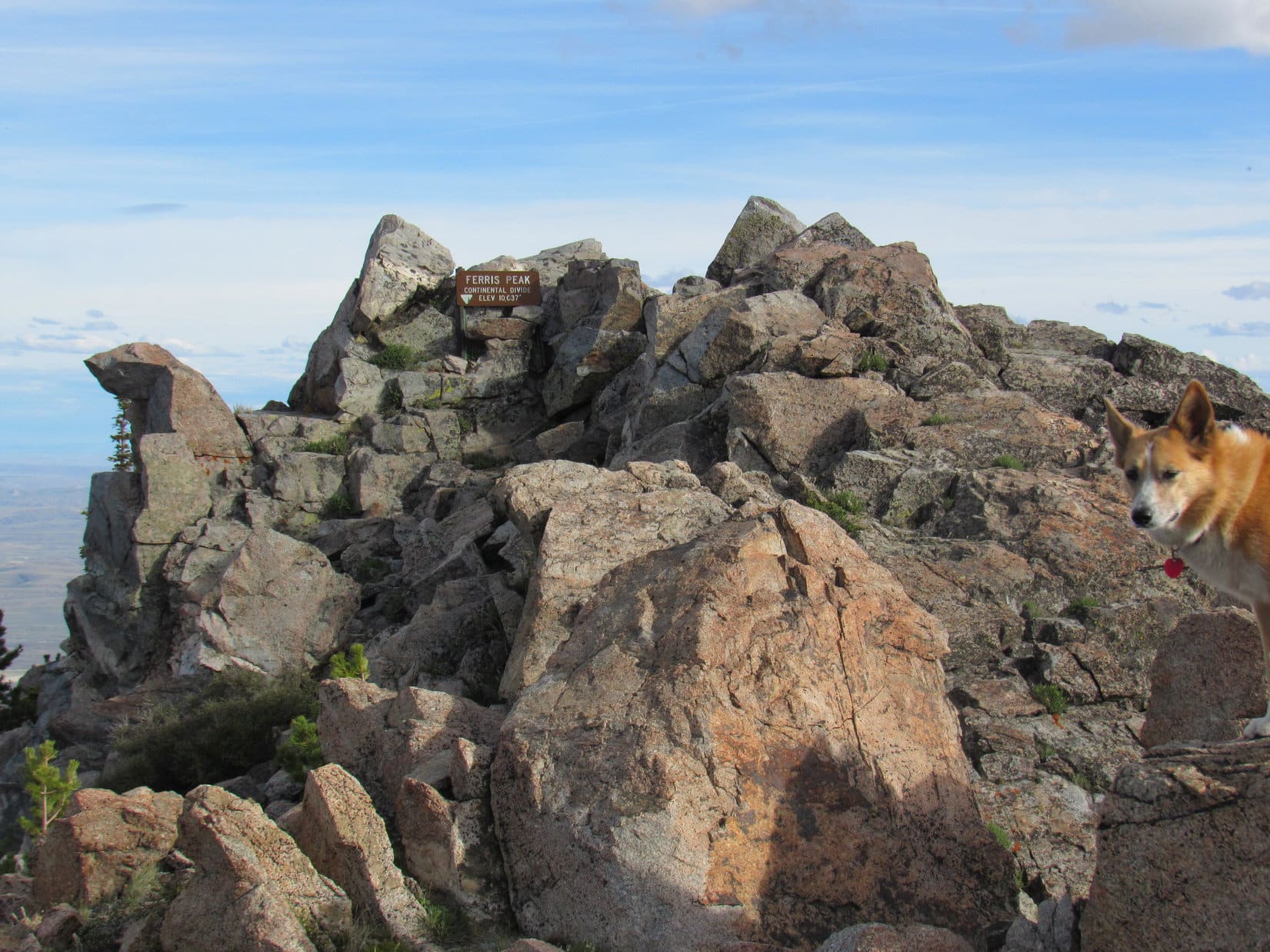
Near the very end, everything was rocky.  Fortunately, it still wasn’t too hard getting around.  Lupe seemed to be running out of mountain, when suddenly the summit appeared ahead.  Right below the highest rocks, a metal sign said “Ferris Peak, Continental Divide, 10,037 ft.”  Lupe had made it!

This what we’ve been looking for, SPHP? …. Yes, ma’am, that’s it, sweet Puppy!
On Ferris Mountain at the top of the Charlie Brown Range. Photo looks S.
Ferris Mountain summit. Photo looks S.

What a tremendous mountain!  The views were superb.  The weather was vastly improved from what it’d been this morning.  Beauty shone forth in every direction in the early evening light.  A glorious day!  SPHP congratulated Lupe on her grand success, shaking her freckled paw.

Scrambling the short remaining distance to the highest rocks, Lupe came across two survey markers.  At the very top, tucked among rocks near the metal sign, she found a plastic jar.  Inside was a registry.  SPHP was eager to have a look at.

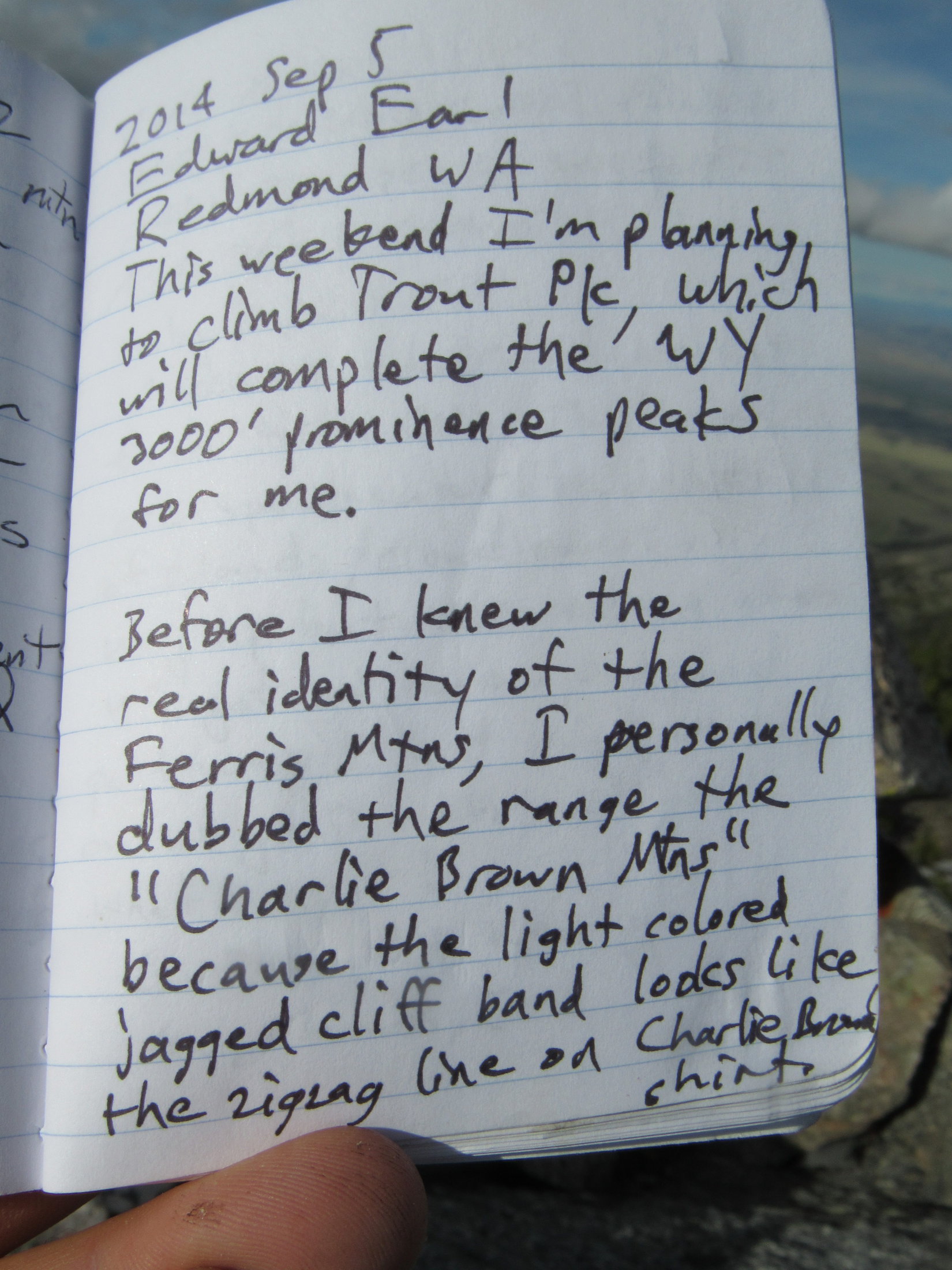
Was it there?  Yes, it was!  Happy day!  SPHP found the entry by Edward Earl.

One of two survey markers Lupe found on Ferris Mountain.
Survey marker No. 2.
The plastic jar containing the registry in its hiding place behind the metal sign.
Edward Earl’s 9-5-2014 entry in the Ferris Mountain registry.

Seeing that Edward Earl had written about the Charlie Brown Mountains made SPHP smile.  Lupe had been to quite a few mountains with assistance from Mr. Earl’s detailed trip reports.  Once again, she was at the top of a mountain Edward had been to before her.  Sadly, Lupe would never get to meet him.

Edward Earl had perished tragically nearly 2 years ago on 6-19-2015, drowned in the rushing Jago River in the Brooks Range in NE Alaska following two failed attempts to climb Mount Isto (8,976 ft.).

Others appreciate Edward Earl’s excellent route descriptions, too. John Stolk of Redmond, WA mentioned Edward in his registry entry dated 8-21-16.
Lupe’s entry in the Ferris Mountain registry.
Lupe taking it easy in the least uncomfortable spot she could find on Ferris Mountain while waiting for SPHP to finish with the registry. The registry showed that 4 other people had been here earlier today, but Loop never saw anyone.

Lupe rested among the rocks, while SPHP fiddled with the registry.  When SPHP was finally done, it was time to spend a while contemplating the tremendous views.

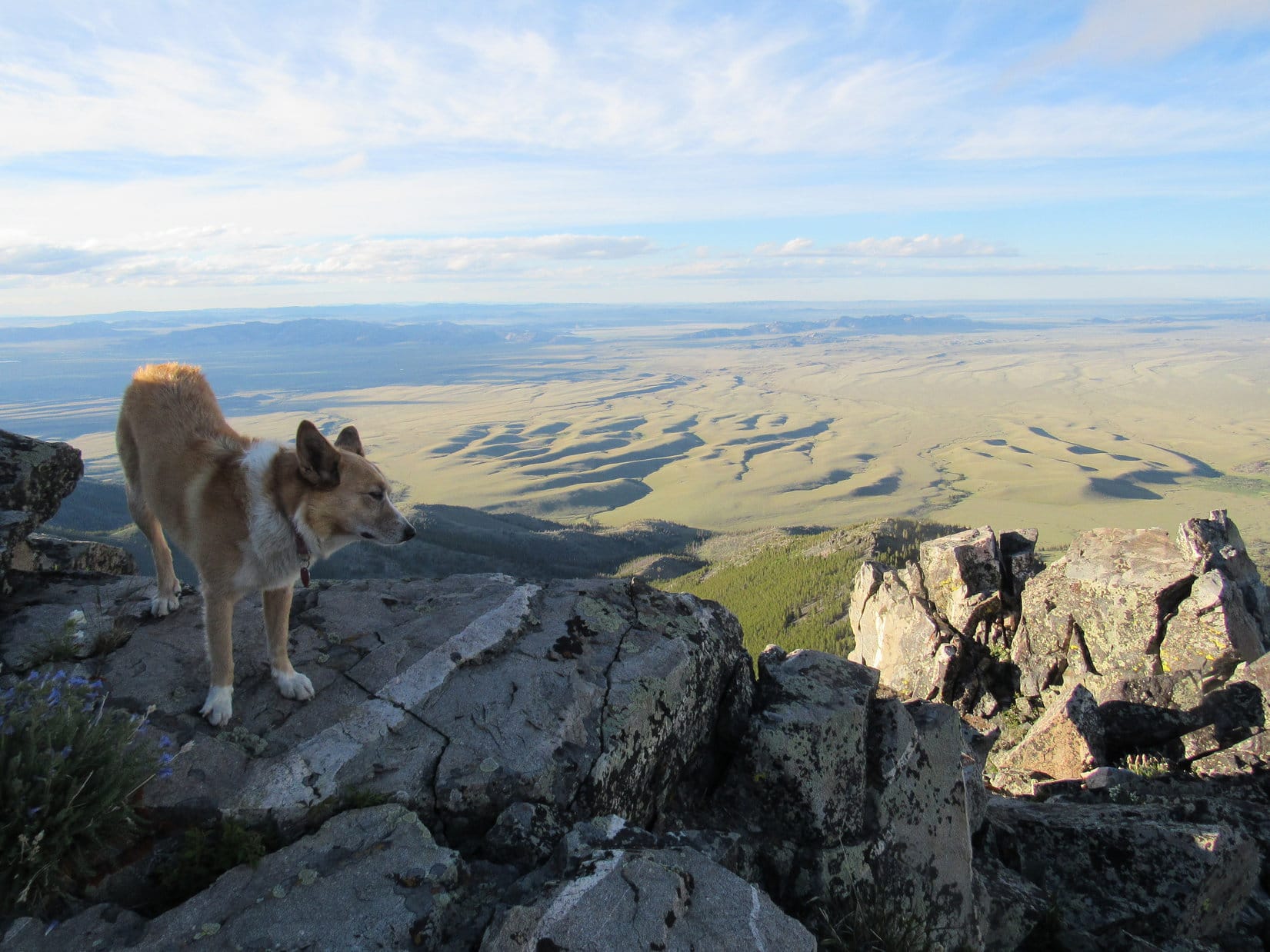
Lupe looking beautiful in the evening light up on Ferris Mountain. Photo looks N.
View to the SE.

Looking S. Edward Earl was once where Lupe was now.
Final moments at the top.
Looking NW from the summit. Ferris Mountain’s westernmost 10,000+ foot high point where Lupe came up is in the distance on the L.
Lupe had seen these same dome-like hills from Whiskey Peak (9,225 ft.) a day earlier. Photo looks NW with help from the telephoto lens.
Pathfinder Reservoir from Ferris Mountain. Photo looks NE with help from the telephoto lens.
The Pedro Mountains rise on the far side of the southern end of Pathfinder Reservoir. Photo looks E with help from the telephoto lens.

All too soon, the angle of the sun insisted it was time to move on.  Lupe left Ferris Mountain starting back the way she’d come up.  SPHP figured the American Dingo still had some time to spare.  She revisited the summit of Ferris Mountain Middle.

Lupe returns to the top of Ferris Mountain Middle. On the way back the plan was to visit Ferris Mountain North, the rocky knob on the R, too. Photo looks NW.
Ferris Mountain North (R) from Ferris Mountain Middle. Photo looks NW.
Ferris Mountain West (L) from Ferris Mountain Middle. Lupe wasn’t going all the way back over there on her way down.

From Ferris Mountain Middle, Lupe went down to the 9,900 foot saddle.  She was about to leave the mountain’s main ridgeline.  Before continuing down, she took a last look at the huge expanse of prairie S of the Charlie Brown Range.

Before leaving the 9,900 foot saddle, Lupe took a final look at the huge expanse of prairie S of the Charlie Brown Range. Photo looks SW.

She then turned her attention to her final peakbagging objective of the day, Ferris Mountain North (9,740 ft.).

Looking down on Ferris Mountain North from the 9,900 foot saddle. Photo looks N with help from the telephoto lens.

Looper headed down to the 9,700 foot saddle leading to Ferris Mountain North.  She went N toward the high point.  As she got close, she circled around to the E where it wasn’t as steep.  Lupe quickly found a rocky route to the top.

Approaching the top of Ferris Mountain North from the SE.

To the S, were the forested upper N slopes of Ferris Mountain leading to the ridge where the Carolina Dog had spent the last several hours atop the Charlie Brown Range.  To the N, thirsty sagebrush prairie stretched away to distant hills.  Shadows of ridges made the land look like ripples on a sea.

Lupe on Ferris Mountain North with a view of the NE side of the Charlie Brown Mountains. Photo looks NW.
Ferris Mountain (L), Ferris Mountain Middle (Center), and the 9,900 foot saddle (R) from Ferris Mountain North. Photo looks SE.
Looking down on the 9,700 foot saddle from Ferris Mountain North. The 9,900 foot saddle is seen up on the ridge on the L. Ferris Mountain Middle is the high point on the far L. Photo looks S.
A commanding view to the N.
Looking NNW.

Lupe couldn’t linger long on Ferris Mountain North.  She was 2 miles from the green metal gate near the mouth of Pole Canyon.  Another 7 miles to the G6.  After a good look around, and a little time spent in contemplation, Lupe headed back to the 9,700 foot saddle.

Downhill all the way now!  The Carolina Dog plunged N down into the E branch of Pole Canyon.  The forest was a maze of 3 to 5 foot high snow drifts and deadfall timber, but this route was easier than the way Lupe had gone up.  The terrain was only moderately steep, and not too rocky.

Loop soon discovered that the roughest ground was at the bottom of the canyon.  For a long way, she stayed E and higher up, sometimes more than 100 feet above the creekbed.  The snowbanks shrank and became less numerous, as she lost elevation.

By the time Lupe was low enough so most of the snow was gone, the deadfall wasn’t as bad either.  She now made fast progress, which was a good thing.  The sun, though still up, was hidden behind the mountains.  Sunset couldn’t be too far off.

As Lupe drew near the point where both branches of Pole Canyon converge, the terrain changed.  Lupe made her way to the bottom of the canyon, and leapt over to the W side of the creek.  She soon came to the stream confluence, and had to make one more crossing.  For a while she traveled down Pole Canyon staying W or NW of the stream.

To avoid the larger stream crossings and swampy ground closer to the mouth of Pole Canyon, Lupe eventually got up on the side of the ridge to the NW.  Nearing the base of the Charlie Brown Range, she reached the ridgeline.  The sun was down, the land dark.  Thin clouds glowed brilliantly orange in a pale sky.

The colorful display faded to gray.  Lupe managed to reach the green metal gate before it was too dark to see.  Still 7 miles to go, but Loop had made it to Pete Creek Road.  After crossing the Rush Creek drainage, the road turned N.  All gently downhill from here.

Lupe and SPHP marched away from the Charlie Brown Range, never looking back.  Only blackness was behind.  Ahead, distant headlights on Hwy 220.  The infinite universe glittered above.

Every now and then Lupe heard something, and went racing away into the night.  Antelope?  Rabbits?  No telling.  Fortunately, the luck of the Dingo held.  She always came streaking back, panting happily.  No cactus had stabbed her.  No rattler had bit her.  No wolves had devoured her.

Ferris Mountain had been a fabulous day!  Yet, things don’t always go one’s way.  Luck can run out.  Perhaps weariness, or the silent black night was to blame, but during the long trek back it was hard not to think about another adventurer who had come this way.  An adventurer who ultimately helped make this day a success for beloved Lupe, but whose luck had run out nearly 2 years ago.

It was hard not to ponder the life and times, and tragic fate of Edward Earl.  (12:05 AM)

Sunset in the Charlie Brown Range, 6-17-17.

Links:

Next Adventure                  Prior Adventure

Edward Earl on Peakbagger.com

Edward Earl’s trip report on his 9-5-2014 ascent of Ferris Mountain

Want more Lupe adventures?  Choose from Lupe’s 2017 Laramie Range, Wyoming & Beyond Adventure IndexDingo Vacations Adventure Index or Master Adventure Index.  Or subscribe free to new Lupe adventures.