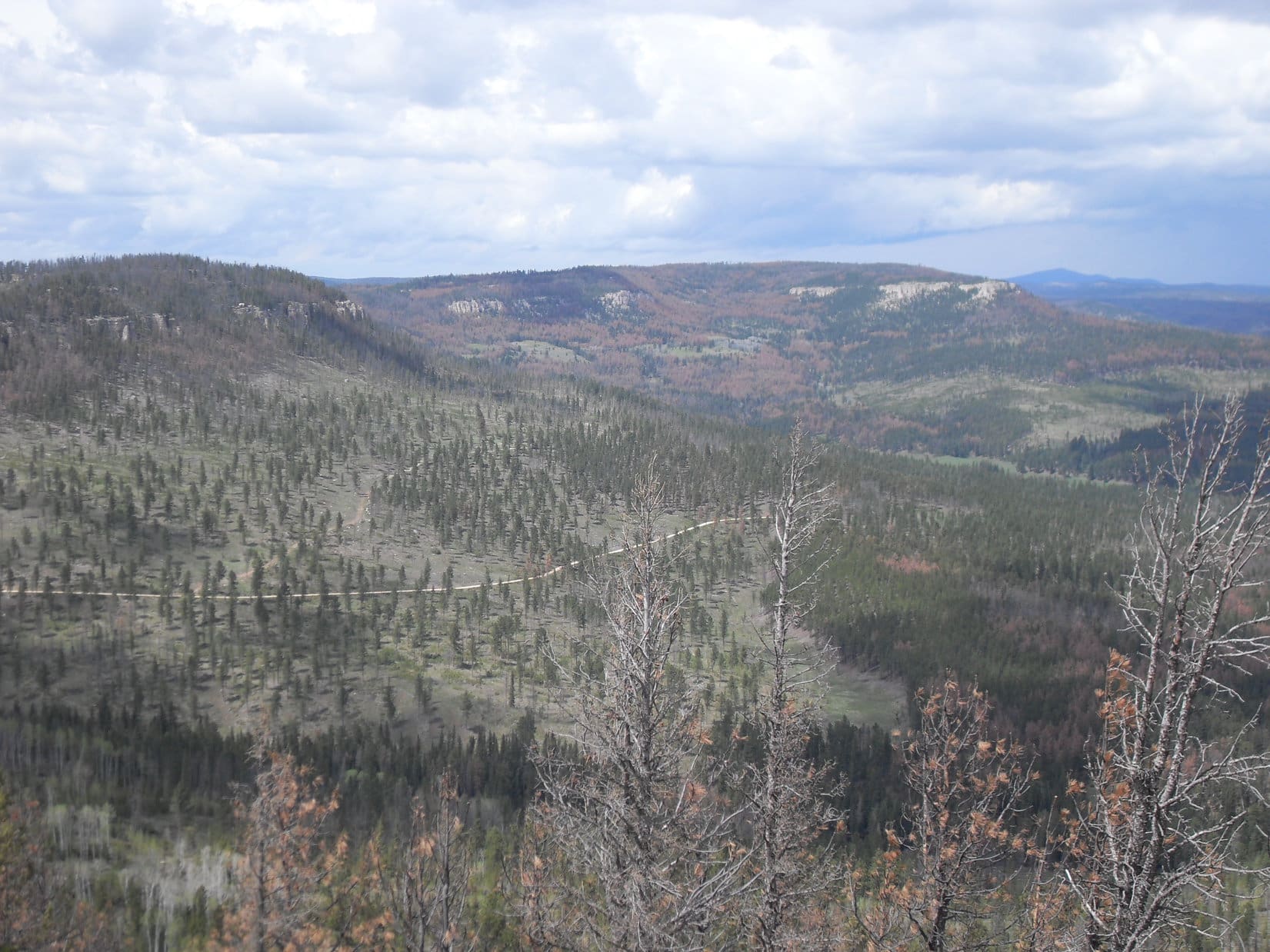
Black Hills, SD Expedition No. 90 – South Castle Rock, Castle Rock, Nipple Butte, Flag Mountain & Peak 6962 (5-24-14)

In early May of 2014, SPHP discovered Peakbagger.com, “an online resource for summit-focused hikers, climbers, and mountain lovers”.  User accounts are free, and it seemed like it might be fun to record a few statistics on Lupe’s expeditions and explorations there.  So, on 5-12-14, SPHP created an account for Lupe.

Using Peakbagger.com was fun!  Almost instantly, Lupe and SPHP were hooked!  Lupe started climbing as many mountains as possible on Peakbagger’s list of Black Hills 6500-foot Peaks.  Some of them Lupe had been to before, of course, but the list contained many peaks she had never climbed.

For Black Hills, SD Expedition No. 90, SPHP was excited to have 5 peaks along the E escarpment of the limestone plateau high country of the western Black Hills lined up for Lupe to climb.  All 5 peaks were on the Black Hills 6500-foot Peaks list.  They were strung out along a N/S line W of Reynolds Prairie.  Lupe would start from the S end climbing South Castle Rock (6,840 ft.) first.

Almost 2 miles NW of Deerfield Reservoir on W Deerfield Road, is a R turn on County Road No. 306 to Reynolds Prairie.  No. 306 winds NE up a hill for more than a mile before turning N and leveling out.  Right there, on the W side of No. 306, is a L turn on a side road going up a little hill.  The side road is USFS Road No. 189.1D.  SPHP parked the G6 at the top of the first short rise (9:57 AM, 67°F).

Lupe was starting out her ambitious day of peakbagging about 0.75 mile SSE of South Castle Rock.  She began following No. 189.1D N across a green field, but soon left the road as it angled NW.  Lupe continued N, gradually going uphill.  The sun felt hot out in the open field.  Lupe and SPHP were both glad to reach the shade of the forest, although the climb became increasingly steep.

Before long, Lupe reached the first significant limestone outcropping.  Lupe and SPHP went out to the SE end of it, where there were great open views from the NE around to the S.

Parts of Deerfield Lake are in view from the first big limestone outcropping going up South Castle Rock from the S. The S end of Reynolds Prairie is seen on the L. Photo looks SE.
The E end of Castle Rock (6,783 ft.) is the forested ridge with the many beetle-killed trees on the L. The N end of Reynolds Prairie is seen on the R. Photo looks N.
County Road No. 306 winds across Reynolds Prairie. Part of Deerfield Lake is seen on the R. Photo looks E.

From the SE viewpoint, Lupe continued climbing N up South Castle Rock.  She quickly reached a high point in the forest, but it was a false summit.  The topo map showed that the true summit was just a little bit higher and farther N.  There were many trees killed by pine bark beetles.  The deadfall timber made progress getting to the true summit rather slow.

The true summit proved to be located up on a limestone cap surrounded by small cliffs in every direction.  Lupe and SPHP scouted around looking for a way up.  The only easy way up was from the SW, where Lupe and SPHP were able to make it up to the top.  The summit area was flat and forested.  The highest point was located toward the N end.  Lupe posed for her South Castle Rock (6,840 ft.) summit photo next to SPHP’s backpack.

Lupe claims her first peakbagging success of the day at the summit of South Castle Rock! Photo looks WSW.

With the all views blocked by pines, Lupe didn’t linger very long on South Castle Rock.  Lupe and SPHP climbed back down using the same SW route.  Lupe then went around the W side of the summit escarpment heading N to her next peakbagging goal, Castle Rock (6,783 ft.).

Looking back at the N end of the low limestone cliffs below the summit of South Castle Rock. Photo looks S.

Castle Rock is slightly lower than South Castle Rock, and less than 0.25 mile farther N.  It didn’t take Lupe long to reach the W end of the main Castle Rock ridge, which extends out to the ESE.  Lupe and SPHP went all the way out to the E end looking for the highest point.  Somewhere along the way, Lupe must have gone over the true summit, but exactly where was never clear.  Near the E end, she posed for a couple of photos.

Happy Lupe on Castle Rock. Photo looks SW toward South Castle Rock.
Lupe looks a little less friendly here, but it was partly due to the sun making her squint. Lupe's next two peakbagging goals are in view behind her. Nipple Butte (6,800 ft.) is closest with Flag Mountain (6,937 ft.) beyond it. Photo looks N.
Lupe looks a little less friendly here, but it was partly due to the sun making her squint. Lupe’s next two peakbagging goals are in view behind her. Nipple Butte (6,800 ft.), capped with white limestone, is closest with Flag Mountain (6,937 ft.) beyond it. Photo looks N.

Lupe was off to a great start with 2 of her peakbagging goals already accomplished!  Lupe and SPHP returned to the W end of the main Castle Rock ridge.  Nipple Butte (6,800 ft.), over 0.5 mile N, was Lupe’s next stop.  Lupe and SPHP started going N following a somewhat lower and much skinnier ridge.

The N ridge wasn’t as heavily forested.  The views were actually better here than they were from up on the higher E ridge.  However, as Lupe proceeded N, it soon became apparent she wasn’t going to find any safe way down.  She reached a crevasse in the limestone that prevented her from going any farther N.

So Lupe and SPHP had to backtrack almost all the way to the S end of the N ridge again, before finding a steep route down off the E side.  Lupe lost 150 feet of elevation before turning N again.  While SPHP plodded along gradually regaining elevation, the American Dingo roamed the forest.  She eventually reached the saddle to Nipple Butte and started up the S slope.  The climb quickly became steep and very rocky.

Looking up the steep, rocky S slope of Nipple Butte. Photo looks N.

Lupe climbed up the broken limestone.  She got very high, but near the top it became clear that there were deep fissures in the limestone.  The fissures divided the summit area into several different rock islands in the sky.  The highest one was farther N.  There was no way for Lupe to get over to it from here.

Lupe and SPHP went back down.  Lupe circled around the W side of the mountain looking for another route up.  She found a steep approach from the WNW.  Lupe climbed until she reached a small grassy area between limestone outcroppings.  Once again, she was almost at the top of Nipple Butte.  The summit was now just to the S, above a 6 or 7 foot high wall of limestone.

SPHP had to lift Lupe to help her get up on the limestone platform.  She was nervous about it, but got up there OK.  SPHP climbed up next.  The limestone platform wasn’t very big.  There were sheer drops all around.  They weren’t tremendously high drops, but falling off wouldn’t have been healthy at all.  A 2 or 3 foot high chunk of limestone rested on the platform.  This was the true summit!

Lupe on Nipple Butte with the boulder that is the true summit seen right behind her. Photo looks SW.
Reynolds Prairie from Nipple Butte. Photo looks E.

Nipple Butte was a real island in the sky!  Being up there was a little like being on a cloud.  No trees blocked the views.  Lupe could see in every direction.  Lupe and SPHP relaxed for a while, just taking it all in.
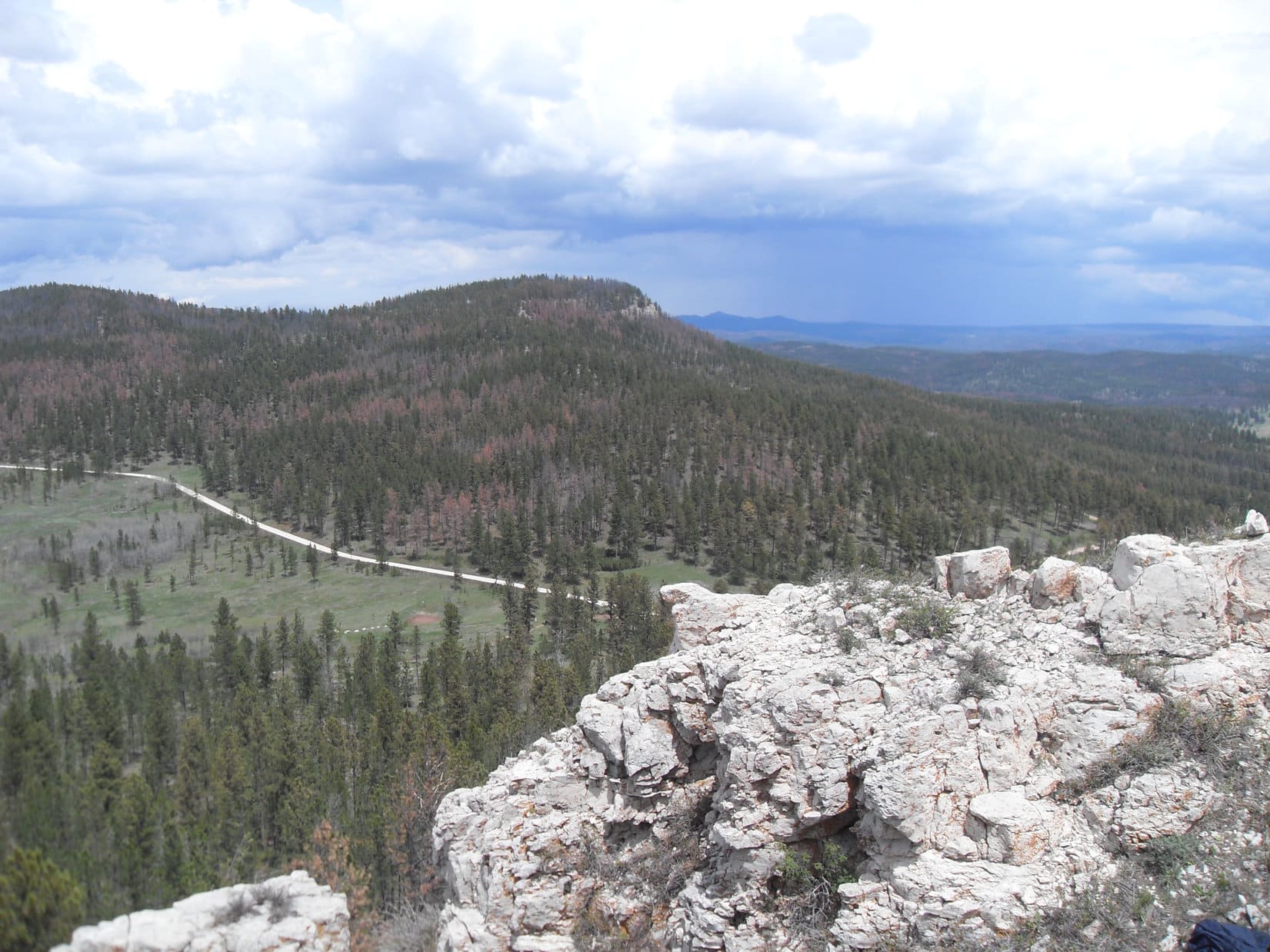
Flag Mountain (6,937 ft.) (Center), another mile N, was Lupe's next destination. USFS Road No. 189 is seen below. Photo looks N from Nipple Butte.
Flag Mountain (6,937 ft.) (Center), another mile N, was Lupe’s next destination. USFS Road No. 189 is seen below. Photo looks N from Nipple Butte.
Castle Rock. Photo looks S.
The S end of Reynolds Prairie (L) from Nipple Butte. Photo looks SSE.

When it was time to leave, SPHP carefully crawled off the N edge of the summit area first.  Lupe didn’t know how to get down!  It looked scary to the 2 year old Carolina Dog.  She didn’t really trust SPHP to help her either.  She stood up on top trying to figure out what to do.

Lupe looked happy enough, but she was more than a little worried about how she was going to get down off Nipple Butte.

SPHP finally managed to grab Lupe’s front legs and pull her near the edge.  Lupe was alarmed, but SPHP got a secure hold on her and helped her safely off Nipple Butte.  The Carolina Dog was greatly relieved!  Lupe and SPHP made the steep descent down the WNW slope.

Once completely down off Nipple Butte, Lupe headed N across USFS Road No. 189.  She began climbing the S ridge going up Flag Mountain (6,937 ft.).  By now it was afternoon.  Despite the shady protection of the forest, the heat forced frequent stops for water.  Lupe didn’t reach the rough road to the top of Flag Mountain until she was already quite close to the summit.  She followed the road the rest of the way to the rock stairs up to the remnants of the old lookout tower.

Lupe near the remnants of the old lookout tower on Flag Mountain. Photo looks E.

Remnants of the old lookout tower on Flag Mountain, 5-24-16Not much could be seen to the W, but in every other direction Flag Mountain featured impressive views.  Lupe felt more secure here than at Nipple Butte, too!
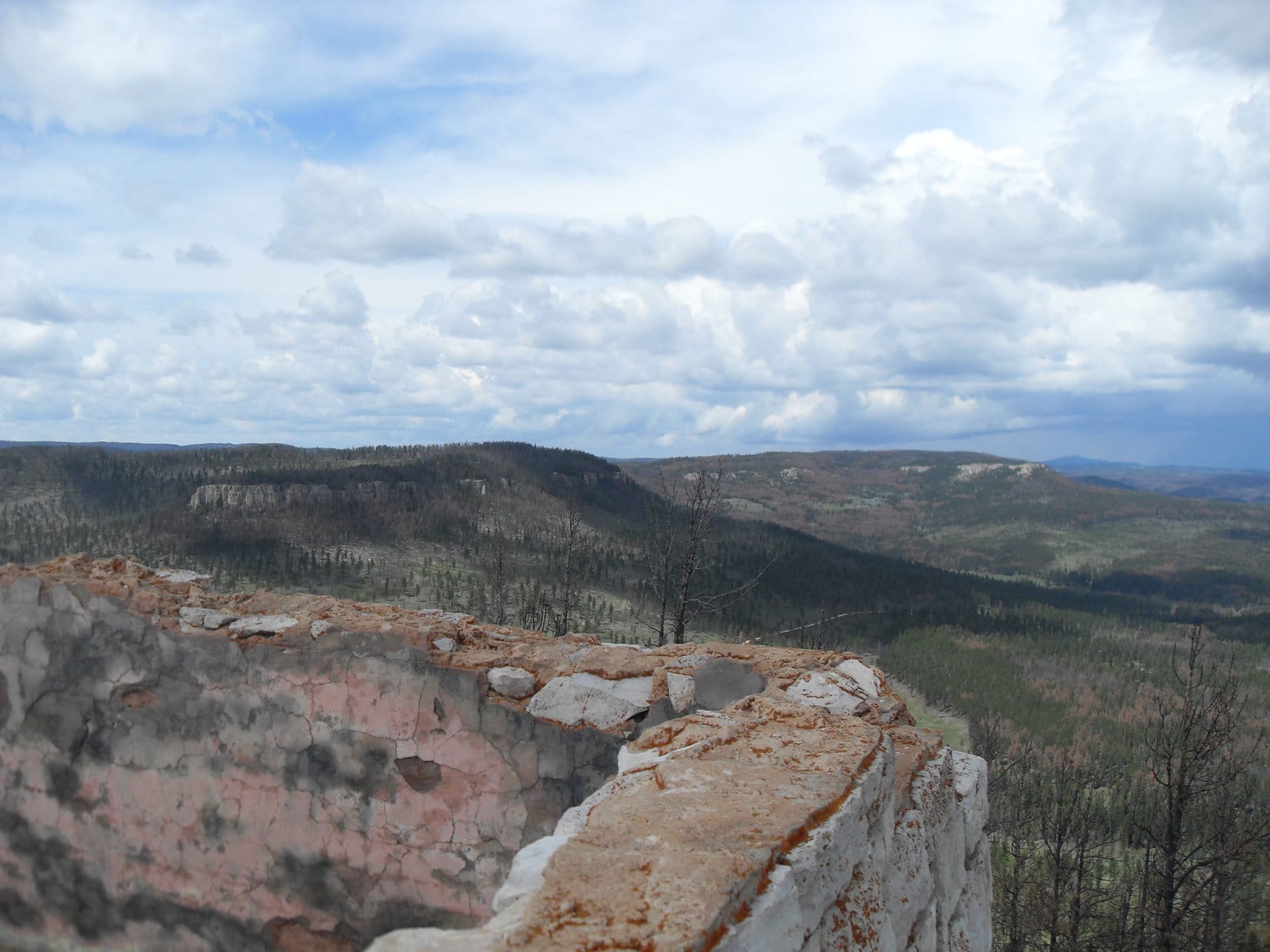
Lupe's final peakbagging goal of the day was Peak 6962, the ridge on the L. White Tail Peak (6,962 ft.) is the far ridge on the R. Photo looks N.
Lupe’s final peakbagging goal of the day was Peak 6962, the ridge on the L. White Tail Peak (6,962 ft.) is the far ridge on the R. Photo looks N.
Lupe feeling safe and secure in the remnant of the old lookout tower on Flag Mountain. Photo looks E.
Another look at Peak 6962 (L) and White Tail Peak (Center) from Flag Mountain. The gravel road is USFS Road No. 599. Photo looks N.

The afternoon was wearing on, but Lupe had only one more peakbagging goal left.  Peak 6962 was more than 1.5 miles to the NNW.  Staying on high ground, Lupe would have to go twice that far to get there.  Instead of taking the road, Lupe and SPHP left the remains of the Flag Mountain lookout tower going W along the ridge.

The ridge didn’t stay level for very far.  Lupe went down into the forest.  She briefly came to the road near the N end of a sharp bend.  Five ATV’s roared on by heading up.  Lupe continued W beyond the road and back into the forest.  Lupe and SPHP tried to stay on high ground as much as possible, as the terrain went up and down over a series of small rises and intervening saddles.  Nipple Butte, now to the SE, came into view at one point.
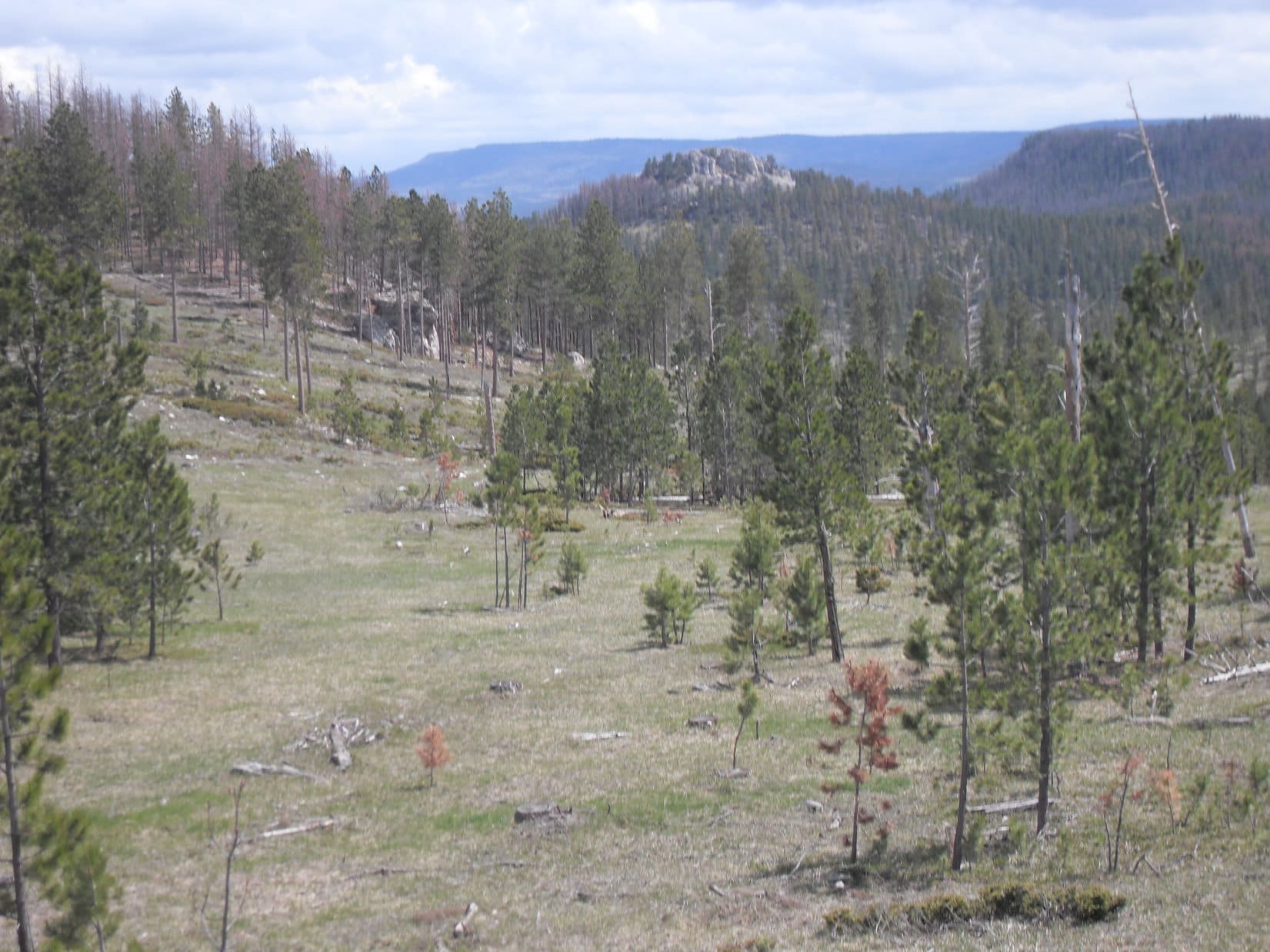
Nipple Butte (Center) viewed from the NW as Lupe was heading for Peak 6962.

Lupe had to go almost a mile W before the terrain allowed her to start turning N.  She eventually came quite close to USFS Road No. 189 again, but she stayed on a slightly higher ridge to the E of it.  When Lupe finally reached a point about a mile SW of Peak 6962, she was able to turn NE and follow another ridge toward the summit.

There had been quite a lot of deadfall timber to contend with on the way from Flag Mountain, but this last stretch going NE to Peak 6962 was simply terrible.  Dead trees had tumbled over everywhere, sometimes stacking several high.  To make matters worse, an old barbed wire fence followed the same ridgeline Lupe was trying to follow.  Along most of the route, the fence had collapsed under the weight of the many trees that had fallen across it.

SPHP was constantly worried that Lupe would get ripped up by the dangerous barbed wire.  The deadfall and terrain forced Lupe and SPHP back and forth across the fence line many times.  It was a struggle to make any progress through the seemingly endless obstacles.  Getting to Peak 6962 was taking a very long time.  The area felt very isolated and remote.  Protected by the shattered forest, Peak 6962 must not have many visitors these days!

Lupe gradually got closer to Peak 6962.  She started coming to a few places along the ridge where there were views of Flag Mountain off to the SE.  She also started seeing an abundance of beautifully blooming crocuses.  SPHP dubbed the area “Perfect Crocus Ridge”.

Finally, Lupe reached the area where the summit of Peak 6962 was supposed to be.  The topo map showed a couple of areas within 6960 foot contours.  Lupe arrived at the S one first.  The topo map was right.  The top of Peak 6962 was quite flat.  Both of the 6960 foot contours were contained within a 6940 foot contour covering a much larger area.  Lupe found no obvious summit.

There were no views either.  Forest was all around.  Even near the steep E edge of the mountain, the were enough trees still standing to quite effectively hide the view.  Lupe and SPHP trudged on to the N, to check out the terrain over there.  SPHP was hoping to find a view of White Tail Peak (6,962 ft.) to the N.  There really wasn’t one.  If anything, the forest was even thicker here.  The terrain here didn’t seem any higher than back to the S, either.

Lupe was tired from leaping over all the countless dead trees on the ground.  The Carolina Dog wanted to stop for a rest.  SPHP was tired, too.  SPHP sat on the ground.  Lupe had some water and curled up.  SPHP considered what to do next.  From Flag Mountain, SPHP had seen some big cliffs at the very end of a long ridge protruding S from the E edge of Peak 6962.  SPHP was certain those cliffs would provide some great views, but going there would add another 0.5 mile one way.

SPHP decided against it.  It was just too much work going through all the deadfall.  Maybe another time, if there ever was another time.

After 10 minutes, Lupe was ready to go again.  The highest spot on the mountain had seemed to be within the area contained within the S 6960 foot contour.  Lupe and SPHP went back there for Lupe’s Peak 6962 summit photos.  The forest badly damaged by pine bark beetles wasn’t very pretty, but there was a beautiful green carpet of kinnikinnick.

Lupe smiling on the lovely green carpet of kinnikinnick at the summit of Peak 6962. Note the semi-transparent white object to her R. Photo looks ENE.
This photo documents the existence of a genuine fire-breathing American Dingo on Peak 6962! Note the smoke coming out of her nose!

It was time to leave Peak 6962.  The shortest route back to a road was to head SW back along Perfect Crocus Ridge.  To avoid the worst of the deadfall timber, Lupe and SPHP tried staying below the ridgeline by going through a lower field to the SE.  For a little while, this worked well.  Lupe could run around without having to constantly be leaping over dead trees.  After a while, though, the terrain forced Lupe up and over to the NW side of the ridge.
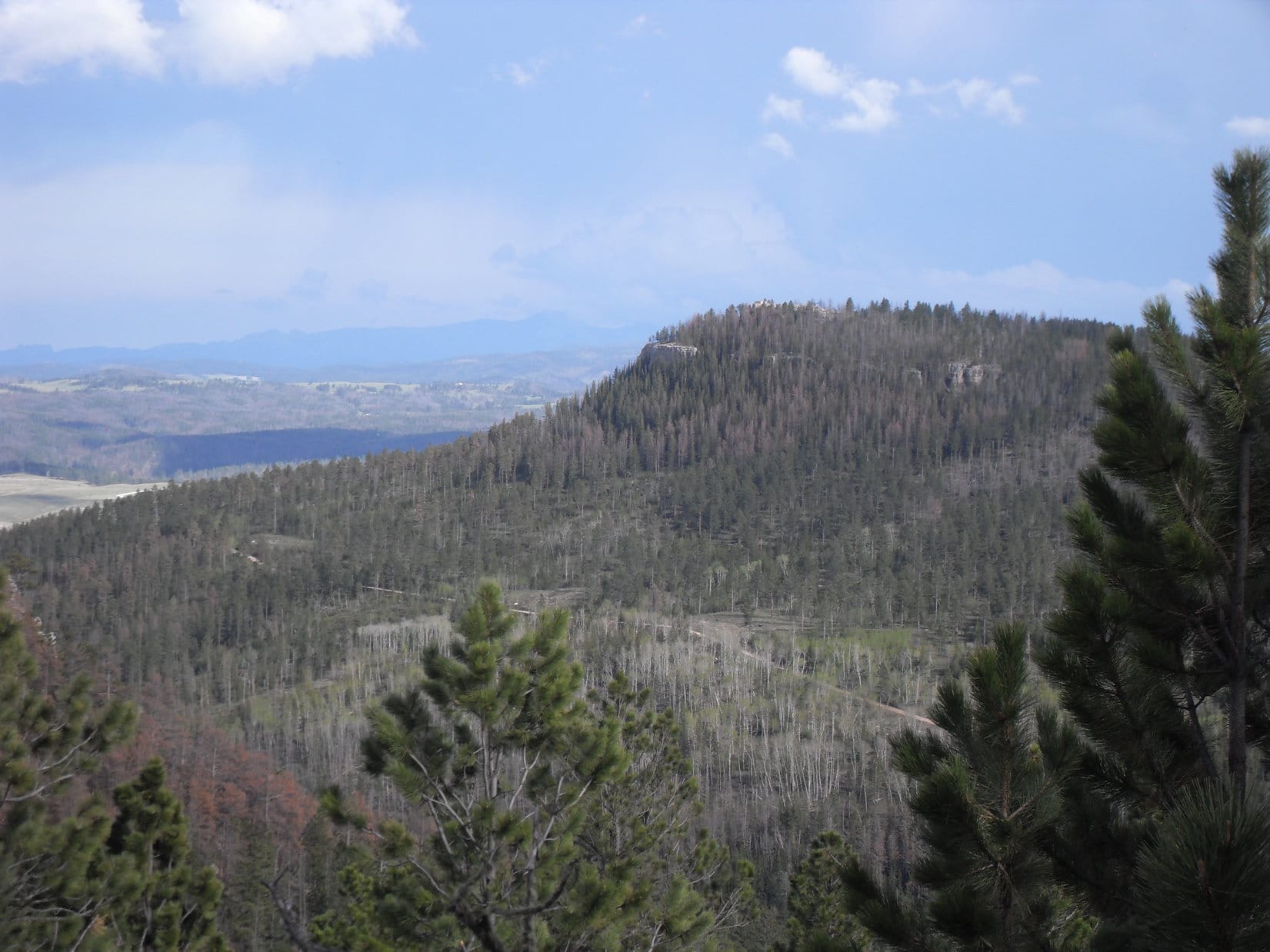
Flag Mountain from Perfect Crocus Ridge. Photo looks SE.

Staying off the top of the ridge helped more than SPHP initially realized.  Lupe came to a clearing in the forest.  Down a grassy slope to the SW was a good gravel road.  Lupe was already almost back to USFS Road No. 189!  SPHP stopped to look at the maps.  After marching along all day through the forest, SPHP was tired of dealing with all the deadfall.  Lupe was going to stick to the roads on the way back to the G6!

The quickest way back was to just follow No. 189 SE to Reynolds Prairie.  Too easy and dull!  A more interesting route was to take No. 189 only 0.5 mile S to USFS Road No. 239.  No. 239 went S through Horsethief Creek valley for 3 miles to W Deerfield Road down in the valley of the North Fork of Castle Creek.

Since it was already getting late in the day and SPHP was already fairly tired, naturally SPHP chose a third route, the longest possible one.  Lupe would go W on No. 189 for nearly 2 miles to USFS Road No. 129 before taking it S through Hughes Draw down to the North Fork of Castle Creek.  Lupe and SPHP headed on down to No. 189 and turned NW.

Gradually, it began to dawn on SPHP that going NW was a big mistake.  The sun was getting low, Lupe was heading away from the G6, and this route added at least another 5 miles to the trek back.  No matter how interesting this route might be, it was going to get dark.  It was really too late in the day for such silliness!  SPHP was regretting the decision to go NW when a road going S into a shallow valley appeared a short distance ahead.

A marker at the start of the road said this was No. 129.1B.  A quick check of the maps showed it was a shortcut down to No. 129 and No. 129.1A on the way to the North Fork of Castle Creek.  Good!  Lupe and SPHP immediately turned S on No. 129.1B.

The little valley No. 129.1B went down was very inviting.  Beyond a grove of aspen trees, Lupe and SPHP heard frogs croaking.  Lupe ran ahead to investigate.  She found a pond where she got a huge drink.  SPHP had completely run out of water more than a mile back.

The frog pond near USFS Road No. 129.1B where Lupe got a huge drink of water. The frogs did not resume croaking until Lupe left.

SPHP made good progress hiking down No. 129.1B.  There was open ground on both sides of the road.  Lupe had a blast racing back and forth across the valley.  She hadn’t had an opportunity to run like this all day.  She was having a great time.  Despite all the hours that had gone by, Lupe was still full of energy.

No. 129.1B reached an intersection with No. 129.  Two springs (Lyons Spring on the USFS map) combined to form a small creek, presumably Lyons Creek.  Instead of following No. 129 SE, Lupe went W a short distance to take No. 129.1A going S.

No. 129.1A was a decent road, but did not lose elevation as quickly as Lyons Creek did.  At first, Lupe was able to easily run down to the creek to get drinks of water.  Pretty soon, however, the road was well above creek level.  Lupe frequently saw deer down in the meadows by the creek below.
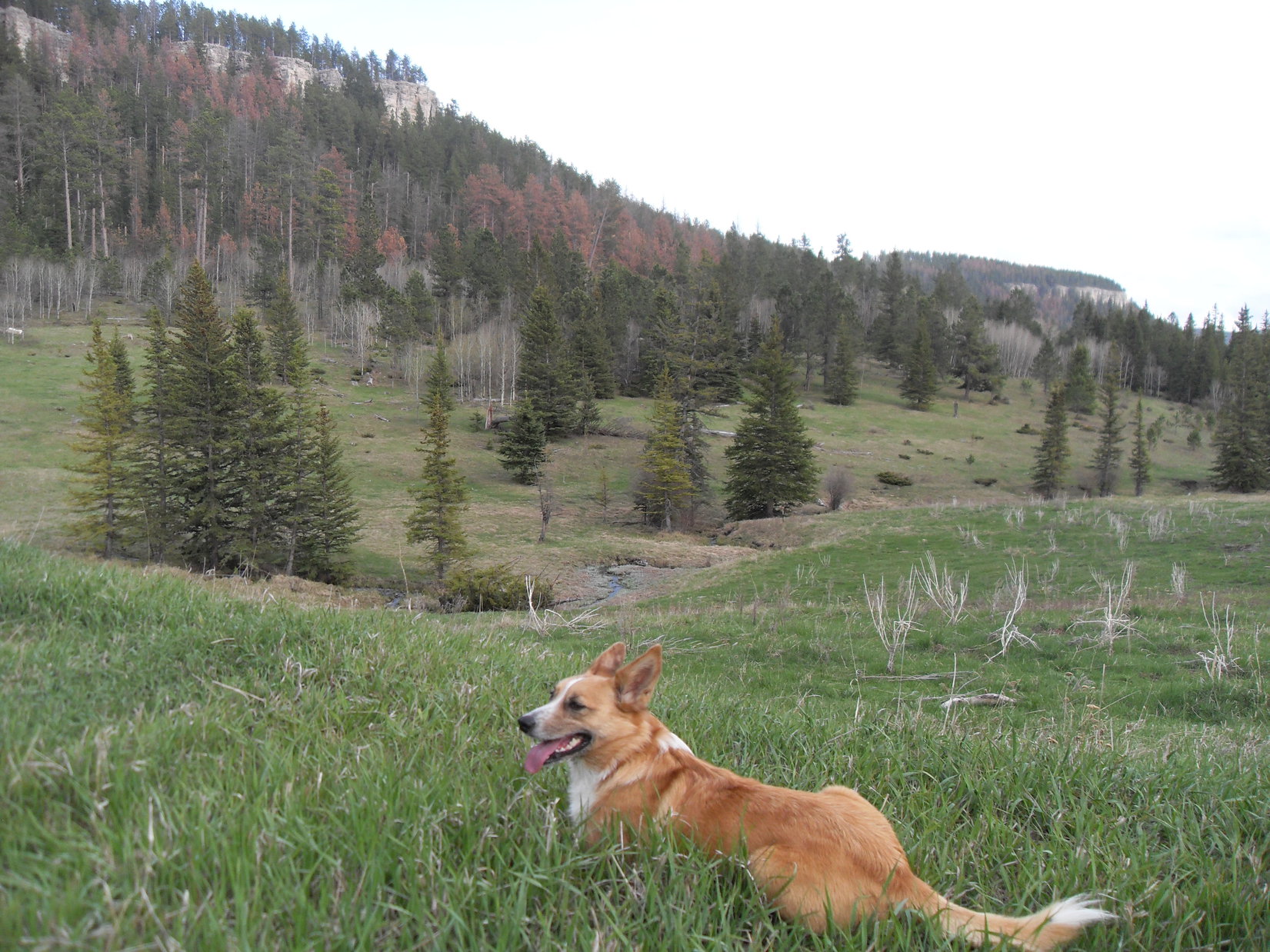
Lupe rests on the green grass above Lyons Creek. Photo looks SE.
USFS Road No. 129.1A. Photo looks S.

Lupe finally reached W Deerfield Road down by the North Fork of Castle Creek.  Lupe couldn’t resist getting in this much larger creek for another big drink.
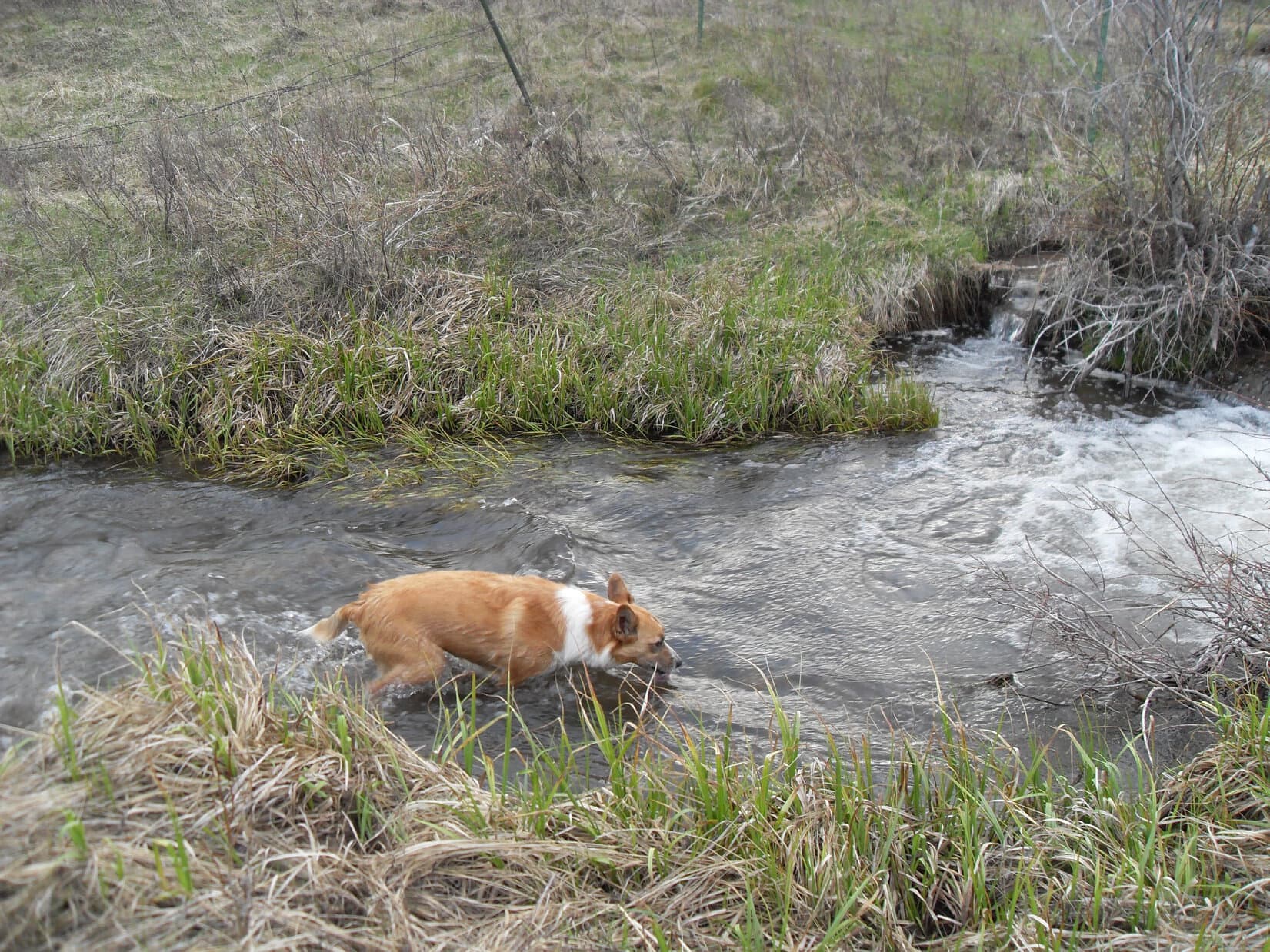
Getting a drink from the North Fork of Castle Creek.

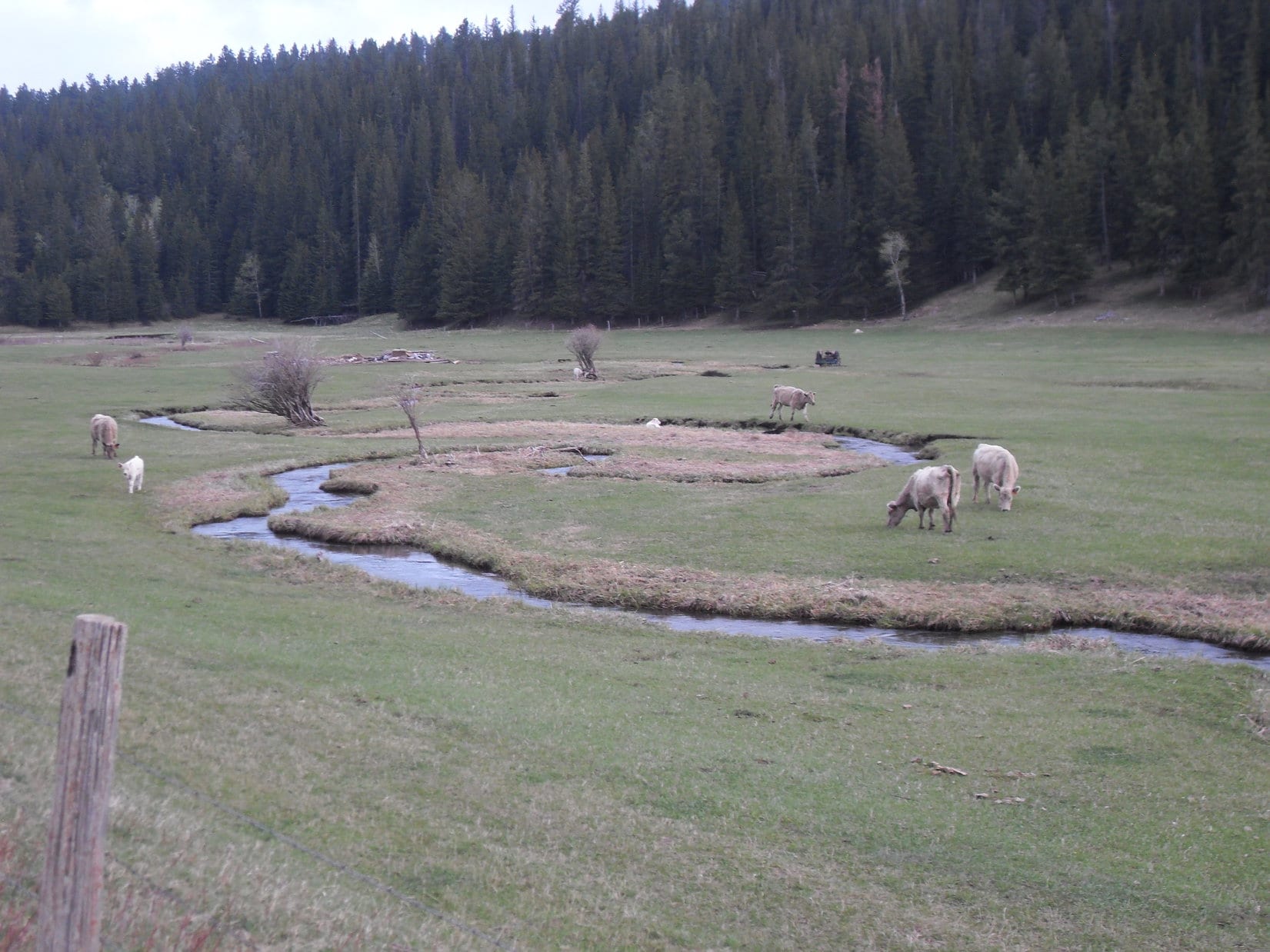
Lupe was still at least 3 miles NW of the junction with County Road No. 306 to Reynolds Prairie.  The G6 was another 1.25 miles beyond that.  Lupe and SPHP followed W Deerfield Road SE.  Cows were in the fields nearby.  Lupe was very interested.  Although the temptation was huge, she was a very good American Dingo and didn’t bark.

At 9:01 PM (55°F), Lupe finally reached the G6 again.  Light was still fading from the sky.  Lupe had been gone over 11 hours, but she did reach all 5 of her peakbagging goals!  Although she had just completed her 90th Black Hills, SD Expedition, Lupe’s peakbagging days were just beginning.
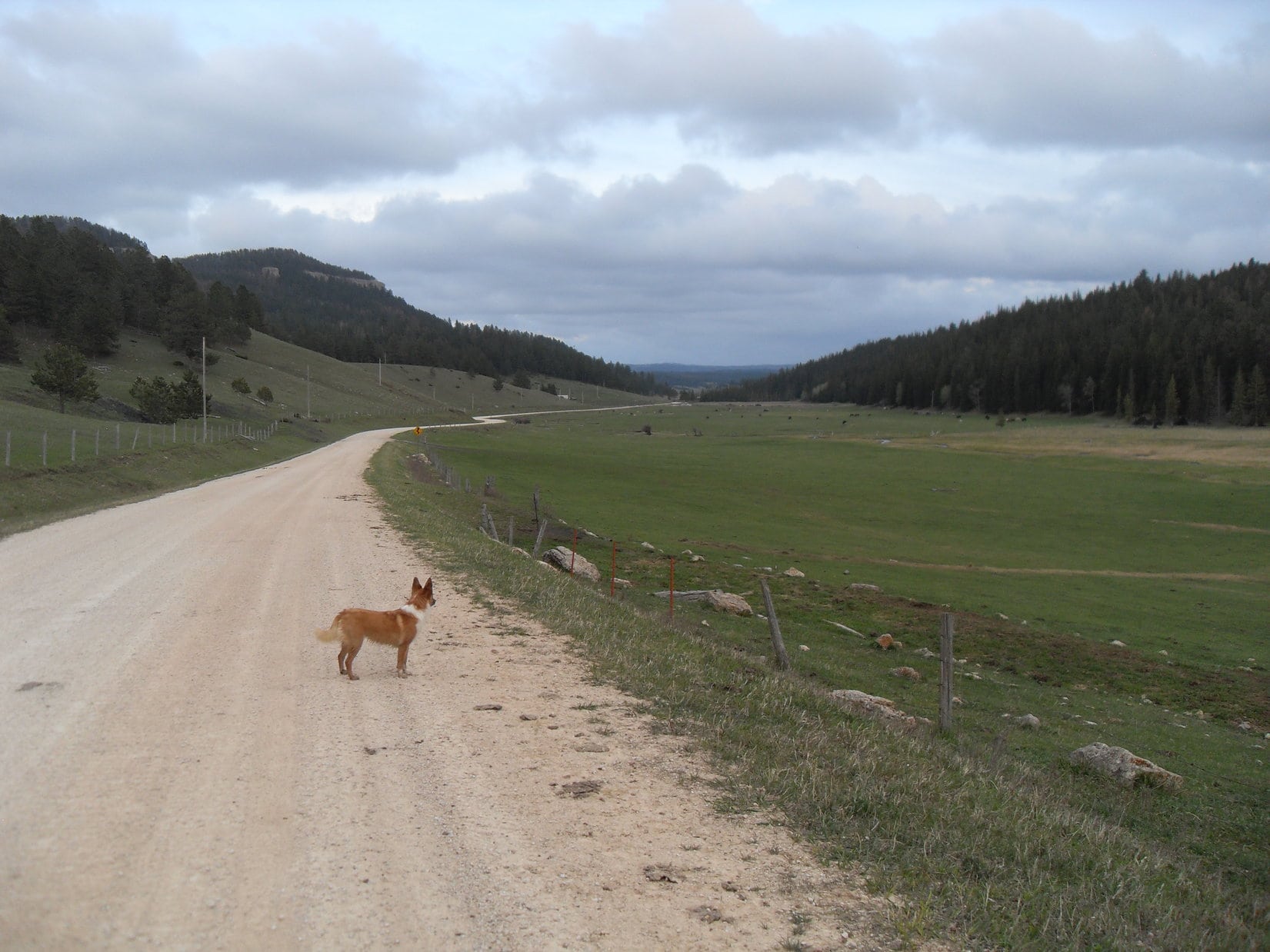
Lupe on W Deerfield Road in the valley of the North Fork of Castle Creek. Photo looks SE.
Some of the very tempting cows Lupe didn't bark at.
Some of the very tempting cows Lupe didn’t bark at.

Links:

Next Black Hills Expedition                       Prior Black Hills Expedition

Black Hills, SD Expedition No. 133 – South Castle Rock, Castle Rock, Nipple Butte, Flag Mountain & Peak 6962 (6-13-15)

Want more Lupe adventures?  Choose from Lupe’s Black Hills Expeditions Adventure Index or Master Adventure Index.  Or subscribe free to new Lupe adventures.

Mount Powell, Montana with Mountaineer Jobe Wymore (7-20-17)

Days 10 – 13 of Lupe’s 2017 Dingo Vacation to the Wind River Range, Wyoming & Select Peaks in Montana

Day 10, 7-17-17  For the first time on this Dingo Vacation, the night sky was clear.  Lupe wanted out.  She sniffed around invisibly in darkness.  Overhead, the Milky Way gleamed in the heavens amidst diamond bright constellations.  The Carolina Dog was still tired, though.  She quickly returned to resume her snooze.

Morning arrived.  Time to leave the magnificent Wind River range.  Lupe and SPHP went down to lower Green River Lake.  The American Dingo gazed once more upon Squaretop Mountain (11,695 ft.), the massive NW sentinel of the Winds, looming silently beyond the clear, still lake.

Squaretop Mountain (R of Center), massive sentinel of the NW Wind River Range, beckons beyond lower Green River Lake. Lupe’s 3 day journey to climb Squaretop had been a failure, though a terrific adventure. Photo looks SE.

Lupe’s attempt to climb Squaretop had ended in failure, though she did look down on its summit from New Benchmark (11,850 ft.), the high point of her 3 day journey.  Though ultimately unsuccessful, the effort to reach Squaretop from Porcupine Pass had been a beautiful and challenging adventure.

White Rock (11,284 ft.) (L) and Squaretop Mountain (R) beyond lower Green River Lake with help from the telephoto lens. Photo looks SE.

Today would be the first of several travel and rest days.  After stopping in Pinedale for supplies, Lupe and SPHP headed NW on Hwy 191 past Bondurant and Hoback Junction.  The S approach to Jackson was teeming with tourists and activity.  The mob scene at the heart of it all was avoided by turning W on Hwy 22, which took Lupe over Teton Pass (8,429 ft.).

Lupe crossed the border into Idaho for the first time in nearly 5 years.  W of the Teton Range, Lupe and SPHP were in unfamiliar territory.  Dark clouds hung over the Tetons.  N of Driggs, Lupe experienced 20 miles of cloudburst, as SPHP drove N on Hwy 33.  Beyond the thunderstorm, it was sunny again.

Lupe in Idaho for the first time in nearly 5 years taking a short break from the G6 W of the Tetons. This was unfamiliar territory. Photo looks SE.

SPHP drove all day.  Lupe saw beautiful scenery she’d never seen before.  She barked at cows and horses.  She lapped up chocolate milk.  After several hours in Idaho, she left it again crossing into Montana on Hwy 87.  By day’s end, Lupe was a mile S of Silver Star at a pullout along Hwy 41 overlooking the Jefferson River.

Looking NE from a high point along Hwy 287 W of Ennis, MT.
Looking S up the Jefferson River near day’s end.
The Jefferson River S of Silver Star, Montana. Photo looks NE.

Day 11, 7-18-17  The next morning, Lupe and SPHP headed N.  Approaching Deer Lodge on I-90, Mount Powell (10,168 ft.) came into view a dozen miles to the W.  SPHP left I-90 at Exit 195 and drove all the way to the trailhead to see if the G6 could get there.  The roads weren’t bad, although the final stretch on USFS Road No. 670 was so narrow it was a good thing no vehicles were coming the other way.  Lupe spent most of the afternoon at the trailhead, happily relaxing in the shade watching squirrels and chipmunks.

On the way to the Mount Powell (L) trailhead. Although the sky was clear, the air was a bit hazy with smoke from distant forest fires. Photo looks NW.
Mount Powell (L) seen through the smoke haze with help from the telephoto lens. Photo looks NW.

Mount Powell was Lupe’s next peakbagging objective, but no attempt on the mountain was going to be made today.  Late in the afternoon, Lupe and SPHP went down to Deer Lodge where Lupe enjoyed a McDonald’s ice cream cone.  Lupe’s evening was spent watching boats, sea gulls, geese, and little fish jumping at Georgetown Lake W of Anaconda.

Sunset at Georgetown Lake W of Anaconda.
Geese on Georgetown Lake.

Day 12, 7-19-17  Three miles E of Georgetown Lake, SPHP noticed a sign for Storm Lake on the S side of Hwy 1.  Lupe had time, why not check it out?  The G6 made it nearly 8 of the 9 miles to Storm Lake on USFS Road No. 675.  Lupe and SPHP continued on paw and foot.  Clearings in the forest near the road were full of colorful wildflowers.

Lupe among the wildflowers on the last mile to Storm Lake.

Several groups of people were fishing at Storm Lake when Lupe arrived.  Across the lake Looper could see Little Rainbow Mountain (9,989 ft.), which didn’t look like it would be too hard a climb.  A trail led across a dam at the N end of the lake.  At the W end of the dam, Storm Lake Creek exited the lake.  Lupe and SPHP crossed the creek, and followed the trail S along the W side of Storm Lake.

Loop along the NW shore of Storm Lake. Mount Howe (10,472 ft.) (L) and Little Rainbow Mountain (9,989 ft.) (R) are in view. Photo looks SE.

After a long week in the Wind River range, SPHP wasn’t too ambitious.  Instead of climbing Little Rainbow Mountain with the American Dingo, SPHP opted for a swim in the lake.  Lupe was content to go wading, too.

Lupe wading near the S end of Storm Lake. Photo looks E.

The trail continued SE beyond the S end of Storm Lake.  Several hikers came along about this time.  One of them showed SPHP a map indicating that the trail would wind its way S for a mile or so to Storm Lake Pass.  Mount Tiny (9,848 ft.) was supposed to be an easy climb from there.  Still feeling lazy, Lupe and SPHP skipped Mount Tiny.  Lupe left the trail to circumnavigate Storm Lake instead.

After returning to the G6, Lupe and SPHP spent part of the afternoon at a park along Warm Springs Creek in Anaconda.  By evening, Loop was back at the Mount Powell trailhead.

Day 13, 7-20-17  After a day of travel and two days spent lazing around, the Carolina Dog woke up at 5:20 AM.  SPHP joined her outside the G6.  Today was the big day!  Lupe was going to climb Mount Powell!  SPHP had everything ready in short order, but then did nothing.  Lupe was puzzled.  What was the holdup?  She was anxious to get going.

Suddenly, those big soft Dingo ears heard a noise.  Something was coming!  A yet unseen vehicle was approaching the trailhead.  A minute later, a silver Jeep Wrangler Rubicon appeared.  Lupe ran over barking to greet it.  Much to her surprise, out of the Rubicon stepped someone she knew – mountaineer Jobe Wymore!

Lupe hadn’t seen Jobe since she’d served as his advance scout at South Dakota’s second highest mountain, Odakota Mountain (7,200 ft.), back home in the Black Hills.  That had been more than 15 months ago.  On 4-2-16, Lupe had actually accompanied Jobe to Odakota, and then gone on to the Wildcat Hills of Nebraska with him that very same day.  In Nebraska, she’d climbed Wildcat Mountain (5,025 ft.) before succumbing to the prickly terrors of cacti.  Jobe had helped carry the tenderpaw Dingo out of danger back to the Bluffman’s house.

Now Jobe was coming with Lupe to Mount Powell!  She could hardly believe it!  She barked, leapt, and danced wildly around Jobe.  Of course, Jobe’s arrival was no mere coincidence – it had been prearranged.  And actually, Jobe wasn’t really coming along with Lupe and SPHP.  It was the other way around, Lupe and SPHP were tagging along on a mountain that Jobe needed to climb.

Mount Powell (10,168 ft.), the high point of Powell County in Montana, is on two massive peakbagging lists Jobe has been working on for years.  One list with 245 peaks (the short list!) contains all of the US county high points in all 48 contiguous states with at least 2,000 feet of prominence.  The other, longer list includes all 414 county high points of the western contiguous states (all the mountain states W of the prairie states).

After greetings were exchanged, Jobe, Lupe and SPHP set out on USFS Road No. 670, which was extremely rough W of the trailhead.  The road led steadily up the forested valley of the Dempsey Creek drainage.

SPHP’s prior research of possible routes up Mount Powell had shown that most climbers stay with the road at least as far as the mountain’s S ridge beyond Bohn Lake.  Some go all the way to a SW ridge in the vicinity of the Elliot Lakes.  These ridges were described in various reports as brushy, steep, cliffy, and containing boulder or scree fields.

However, climber Eric Higginbotham had explored a different route which sounded a lot easier.  The Higginbotham route left the road much sooner.  It passed through a huge alpine meadow (Marble Park on the map) early on, climbed in forest to High Point 8708, continued NW over a saddle, and eventually broke out of the forest on a broad ridge a mile SSE of the summit.

Higginbotham’s 7-19-15 Mount Powell trip report included a GPS track, an excellent description of how to find the trailhead, and a rather amusing account of his experience as well.  SPHP favored trying Higginbotham’s route.  Jobe must have, too.  Being technologically competent, he had already loaded Higginbotham’s GPS route into his smart phone.

The first thing to watch for was an open grassy slope on the NW side of the road about 0.67 mile from the trailhead.  The steep hillside soon came into view as Higginbotham had described it.  Jobe and Lupe led the way up.

Jobe & Lupe, reunited after more than 15 months, on the first open grassy hillside after leaving the road. This hillside was fairly steep. Photo looks E.

At the top of the steep hillside, Lupe re-entered the forest.  The ground leveled out to some degree as she continued up, heading W near the edge of the steep stuff.  Before too long, the terrain started pushing her N.  Loop quickly came upon the S end of Marble Park, the giant alpine meadow Higginbotham had mentioned.

Jobe & Lupe in Marble Park. Photo looks SSW.
The stroll up Marble Park was cake. The giant alpine meadow was just a nice long, steady, obstacle-free, moderate incline. Photo looks SSE.
The view ahead. Lupe & Jobe veered N (R) here gaining as much elevation as possible while still in Marble Park. Once back in the forest again, Loop & Jobe turned NW looking for High Point 8708, which isn’t in sight yet up on the forested ridge straight up from Lupe. Photo looks NW.

Marble Park was completely free of obstacles.  Jobe, Lupe and SPHP made rapid progress up the steady, moderately inclined slope.  Lupe stayed in the giant meadow as long as possible.  She didn’t re-enter the forest again until reaching Marble Park’s upper N end.  This allowed the American Dingo to completely avoid a shallow drainage to the W.

Once back in the forest, the next landmark along the way was High Point 8708, about 0.75 mile to the NW.  The forest was mostly open, the only real obstacle being scattered deadfall timber.  The climb initially steepened somewhat, but quickly became more gradual again.  Now and then, Jobe checked Lupe’s position versus Eric Higginbotham’s GPS track on his phone, but very little course correction was ever required.

When Lupe, Jobe and SPHP reached High Point 8708, the top of Mount Powell was in view 2 miles to the NW.

Jobe & Lupe reach High Point 8708. Mount Powell’s summit is now in view 2 miles to the NW.
A portion of Caruthers Lake is in view from High Point 8708. Photo looks W.

At High Point 8708, Lupe had already climbed 2,450 feet of the over 3,900 feet of elevation gain required to get to the summit of Mount Powell from the trailhead.  SPHP was amazed at how easy it had all been, and how quickly the time had gone by.  Credit for the easy route went to Eric.  Credit for making the time go by fast went to Jobe.

Lupe and SPHP really didn’t know Jobe well at all.  The only other time Lupe had been with Jobe was on that one day over 15 months ago.  Jobe had been friendly, considerate, and very kind.  He’d come to Lupe’s rescue carrying her over cactus infested badlands in Nebraska.  Jobe had also been a great conversationalist, expounding upon a variety of topics of interest to SPHP.

Shortly after leaving the trailhead this morning, Jobe had launched into a discussion of one of his favorite subjects – Jerry Garcia and the Grateful Dead.  Of course, SPHP was familiar with some of their top 40 hits, but that was about the extent of it.  Jobe, however, was an expert.  He didn’t consider the Dead’s top 40 hits even remotely among their best work.

Virtually the entire time it took to reach High Point 8708, Jobe had expounded upon the Grateful Dead.  A truly dedicated (fanatical?) fan, he listens to them almost exclusively.  Jobe knew not only all of the Dead’s songs, but how the songs had evolved and been perfected over time, at exactly which live concerts Jerry Garcia had performed the best renditions, all of the lyrics and their meanings, etc., etc.

SPHP couldn’t begin to absorb it all, but did gather that of the many Grateful Dead songs Jobe liked, he considered Morning Dew and Terrapin Station among their finest work.  Even though the subject matter was almost entirely unfamiliar to SPHP, Jobe’s enthusiastic and lively conversation had been so entertaining, it hardly seemed possible Lupe was already so close to Mount Powell.

Close she was, though.  Only a 0.75 mile long forested area, a significant portion of which was a relatively level saddle, now stood between Loop and the broad, bare S ridge leading to the final steep climb to the top of the mountain.  As Lupe left High Point 8708, and proceeded NW across the saddle, Jobe continued his time and distance warping commentary.  In no time at all, almost as if she had been teleported, the Carolina Dog broke out out of the forest and stood on the bare S ridge.

The lower part of the S ridge was a gentle incline, generously strewn with medium-sized flattish rocks, which were interspersed with small green plants and a few wildflowers.  Mount Powell was directly ahead.

In the lead, Jobe strikes out across Mount Powell’s nearly flat, barren S shoulder. The summit is straight ahead. Photo looks N.

The final ascent wasn’t any steeper than the grassy hillside Lupe had gone up right after leaving the road early on.  This slope was much rockier, but still just a walk up a hill.  Vegetation was present most of the way.  Lupe faced only a few short sections of nothing but scree.

Gettin’ there! Loopster & Jobe on the final ascent. Photo looks N.

Loopster arrived at the summit of Mount Powell (10,168 ft.) at 9:00 AM. Between Eric Higginbotham’s excellent route, and Jobe’s scintillating conversation (which by now had switched from the Grateful Dead to how life would be affected by coming technological changes), the whole trek up had taken only 3 hours.  To SPHP, it seemed like the easiest 3,900+ feet of off-trail elevation gain ever.

Success! Mountaineer Jobe Wymore and Lupe relax at the summit of Mount Powell. Photo looks S.

The summit area was roomy, flat and strewn with rocks.  Lots of rocks had been piled up to make a big circular Dingo fortress with a cairn in the middle of it.  A survey benchmark was easily found.  Not a tree or a bush grew anywhere, so the summit provided commanding 360° views.  Unfortunately, smoke from forest fires farther W made the air rather hazy.  Smoke could be seen rising from several points.

This exposed survey benchmark was easily found at the summit.
Dempsey Basin from Mount Powell shortly after reaching the summit. Unfortunately, the air was a little hazy due to smoke from forest fires farther W. More smoke is rising in the distance R of Center. Photo looks SW.
Jobe makes adjustments to a shoe while Lupe sits nearby just outside of the circular Dingo fort. Photo looks SW.

Lupe, Jobe & SPHP remained at the top of Mount Powell for a whole hour.  Jobe pointed out several peaks in the distance he had been to, or at least recognized.  As a treat, he shared chocolate brittle with Lupe and SPHP, who were both quite taken with it.  An hour was plenty of time to gaze at the grand views in all directions.  As a W breeze grew stronger, smoke began billowing up more noticeably from a fire to the SW.

Loop on the W wall of the Dingo Fort. The summit of lower Deer Lodge Mountain (9,765 ft.) is in view on the L. Photo looks ENE.
Looking down on Martin Lake. Peak 9779 is beyond the lake on the L. Photo looks W.
Looking down on Dempsey Basin. From closest to most distant, the 4 lakes on the L are Upper Elliot Lake, Lower Elliot Lake, Caruthers Lake & Goat Lake. Mountain Ben Lake is farther away on the R. The small lake nearby on the R is unnamed on the map. Smoke billows up (Center) on the far horizon. Photo looks SW.
The bald “hill” on the R is Peak 9467. The higher peaks straight beyond it in the distance are somewhere near Storm Lake, where Lupe had been yesterday. Photo looks SSW with help from the telephoto lens.
Looking SW with considerable help from the telephoto lens at some of the highest peaks visible from Mount Powell. Peak 9502 is in the foreground on the R. The high mountain in the distance beyond it is Warren Peak (10,463 ft.). The highest of all is West Goat Peak (10,793 ft.) on the L.

Other than the haze, conditions on Mount Powell were near perfect with a light W breeze and temperatures in the low 70’s °F.  Nevertheless, the time to depart drew near.  Lupe took a final look around, while Jobe used his phone to enter data on this successful ascent.

Lupe takes a final look around from Mount Powell. The highest mountain beyond her is Pikes Peak (9,359 ft.). Photo looks N.
Loop on the SW wall of the Dingo Fort. Jobe uses his smart phone to enter data on this ascent into Peakbagger.com. Photo looks NW.
Loop ready to head down. Mount Powell’s bare S slope is seen below on the R. High Point 8708 is on the forested ridge beyond Loop on the L. This had been her ascent route, and the American Dingo would be going back this way, too. Photo looks SSE.

Eric Higginbotham’s route up had worked great!  There was no reason to stray from it on the way back to the trailhead.  Jobe helped the time go by with stories of the exploits of other mountaineers he knew, and adventures he’d had with some of them.  He discussed some of the major peakbagging goals he has been working on for many years, how he was within a few years of completing them, and what he might want to do when they were finished.

Lupe back on the broad, barren S ridge, with Deer Lodge Peak visible beyond her. Jobe’s on the phone checking on a friend who was late to report in from another mountain. Photo looks NE.
Almost down! Lupe back at Marble Park. Photo looks NW.

By the time Lupe was back at the trailhead (12:40 PM), she knew about an odd medical condition affecting Jobe’s hair, and the sad passing away of his favorite cat, known simply as “H”, in January.  Only partly in jest, Jobe had pronounced himself a 3 dimensional person due to his 3 main interests in life – peakbagging, the Grateful Dead, and craft beers.

Climbing Mount Powell with Jobe had been super fun!  The best news of all was that Loop’s time with Jobe wasn’t over yet.  Tomorrow, Lupe would get to climb another peak with him!  The original plan had been to go to Old Baldy South Slope (8,640 ft.).  However, that plan had changed.  Sacagawea Peak (9,650 ft.), with nearly 4,000 feet of prominence was up next!

Once details for the next rendezvous had been settled upon, Jobe roared off in his Rubicon.  A short while later, Lupe and SPHP headed out, too.  When Lupe reached I-90, temperatures were in the 90’s °F.  So much smoke was in the air now that Mount Powell was barely visible.  SPHP stopped to buy a box of ice cream bars in Anaconda.  A certain eager Carolina Dog provided dedicated assistance in devouring all 6 on the spot.

An air-conditioned ride E to Bozeman ensued, where SPHP obtained a roasted chicken for dinner.  Taking Hwy 86 N out of Bozeman, SPHP eventually found the road to Fairy Lake.  The poor G6 took considerable abuse on USFS Road No. 74, making it 3/4 of the way to Fairy Lake before SPHP had mercy and parked at a big pullout.  By nightfall, an American Dingo stuffed full of roasted chicken was ready for Dingo dreamland.

Mountaineer and friend Jobe Wymore relaxes on Mount Powell, Montana 7-20-17

Related Links:

To the Wildcat Hills of Nebraska with Mountaineer Jobe Wymore (4-2-16)

Naya Nuki Peak & Sacagawea Peak, Montana with Mountaineer Jobe Wymore (7-21-17)

Crazy Peak, Montana – On the Verge of EPIC with Mountaineer Jobe Wymore (7-22-17)

Morning Dew, The Grateful Dead (7-19-89)

Eric Higginbotham’s trip report on Mount Powell (7-19-15)

48 States County High Points with 2,000+ feet of Prominence

Western Contiguous USA County High Points

Want more Lupe adventures?  Choose from Lupe’s 2017 Wind River Range in Wyoming & Select Peaks in Montana Adventure IndexDingo Vacations Adventure Index or Master Adventure Index.  Or subscribe free to new Lupe adventures.