Day 14 of Lupe’s 2017 Dingo Vacation to the Wind River Range, Wyoming & Select Peaks in Montana
Shortly before 6:00 AM, Lupe spotted Jobe’s silver Rubicon coming up Fairy Lake Road. Mr. Wymore was right on time, as usual. Loop and SPHP hitched a ride with Jobe the remaining two miles to the trailhead near the Fairy Lake campground.
It was the first time the Carolina Dog had ever been in Jobe’s Rubicon. As expected after yesterday’s adventure at Mount Powell(10,168 ft.), the Grateful Dead were playing on the stereo.
Loop next to Jobe’s silver Rubicon at the Fairy Lake campground trailhead.
Lupe caught only a glimpse of Fairy Lake before leaving the trailhead. The trail to Sacagawea Peak(9,650 ft.) started out winding up through forest in a generally SW direction. Loop gained elevation steadily, and was soon above most of the trees. A red sun had just cleared mountains on the E horizon.
A red sun had just cleared mountains to the E when Lupe got above treeline not far from the start of the trail up Mount Sacagawea.
The trail was good and well-traveled. It continued SW up into a large U-shaped valley where only scattered stands of trees grew. The rocky slopes surrounding the valley glowed in the early morning sunlight.
Rock formations of the lower N slopes of Sacagawea Peak glow beautifully in early morning sunlight. Photo looks S.Approaching the large U-shaped valley. Photo looks SW.Jobe & Lupe enter the U-shaped valley. The trail to Sacagawea Peak passes through the length of this valley, ultimately switchbacking up the slope at the far end to the saddle above. Photo looks SW.
Jobe was in fine form again today, regaling SPHP with tales of peakbagging adventures, and the incredible exploits and habits of some of the mountaineers he had become acquainted with over the years.
Time flew by. The saddle at the end of the U-shaped valley was only a mile from the trailhead as the crow flies, perhaps 1.5 miles as the trail went. The day seemed like it had hardly even begun, when Lupe started switchbacking her way up the slope below the saddle.
Jobe pauses partway up the steep slope below the saddle to scan the terrain above. Meanwhile, Lupe roams around blending in pretty well with the mountainside. She’s visible just above Jobe’s hiking poles. Photo looks WNW.
A cool W breeze was blowing up at the saddle when Lupe, Jobe & SPHP arrived. Trails went in several directions from here. Sacagawea Peak was in view less than 0.5 mile to the SE. A trail led up the mountain’s NW ridge.
From the saddle, Sacagawea Peak (L) is visible less than 0.5 mile away. Lupe poses by the trail up the NW ridge, while Jobe puts on a windbreaker. Photo looks SE.
The trail up Sacagawea Peak’s NW ridge was great. Lupe gained elevation rapidly. A couple hundred feet below Sacagawea’s summit she came to an unexpected intersection. A fainter, but still easily discernible trail continued SE across the rocky upper SW slopes of a long ridge, destined for a high point at the far end.
That high point, a little less than 0.5 mile away, was Naya Nuki Peak(9,581 ft.). Naya Nuki didn’t look hard to get to at all. The trail to it was fairly level, neither gaining nor losing significant elevation on the way. Jobe wondered if Lupe would like to go to Naya Nuki first before hitting Sacagawea?
Sure, why not? It looked easy.
Temporary change of plans. Instead of climbing Sacagawea Peak, Jobe & Lupe head for Naya Nuki Peak (Center). Photo looks SE.
Getting to Naya Nuki was easy, too! Twenty minutes later, Lupe, Jobe and SPHP were at the summit. Again today, the air was hazy with smoke from forest fires out W. Little could be seen toward far horizons, but views closer by of the Bridger Range were only partially impaired and still grand.
Success! Lupe reaches the summit of Naya Nuki Peak in the Bridger Range. Jobe is off by the summit cairn. Photo looks NNW.Sacagawea Peak (L) from Naya Nuki Peak. Photo looks NNW.Looking S along the spine of the Bridger Range. Ross Peak(9,004 ft.) is in sunshine on the R.Lupe astride Naya Nuki Peak’s summit cairn. Sacagawea Peak is on the L. Photo looks NNW.Yes, I made it. It was pretty easy, too!Jobe’s turn at the S end of Naya Nuki‘s summit ridge. Ross Peak (Center) in sunshine. Photo looks S.
After 15 minutes enjoying the views up on Naya Nuki Peak, it was time to head back to tag Sacagawea Peak, which after all was still the day’s primary objective.
Jobe starts back toward Sacagawea Peak (L), while Lupe returns to urge SPHP onward. Photo looks NNW.
Half an hour after leaving Naya Nuki, everyone was at the summit of Sacagawea Peak(9,650 ft.). Jobe and SPHP signed the summit registry. SPHP made sure Lupe’s name was on it, too.
Lupe and Jobe at the summit of Sacagawea Peak. Photo looks NNW.A closer look at Loop & Jobe on Sacagawea’s summit. Sacagawea Peak has 2 main peakbagging claims to fame. It has 3,930 ft. of prominence, and is the highest point in Montana’s Bridger Range. The mountain is named after Sacagawea, the Shoshone woman who served as an interpreter for the Lewis & Clark Expedition in the early 1800’s.
With 3,930 feet of prominence, the views from Sacagawea Peak were tremendous, despite being partially impaired by the hazy conditions.
Naya Nuki Peak, where Lupe, Jobe & SPHP had just come from is on the L. Ross Peak is farther away on the R. Photo looks SE.Ross Peak (9,004 ft.) (R) from Sacagawea Peak. Photo looks SSE.Looking S. Ross Peak on the L.Looking down Sacagawea Peak‘s rough NE ridge. Fairy Lake is hidden from view in the valley beyond this ridge. High Point 8650 is at far L on the more distant forested ridge. Photo looks NE.
Views of the mountains to the N, formed of layers of rock uplifted to very steeply inclined positions, were particularly impressive. Some of the exposed bands were quite colorful. Differences in color and how the rock had eroded away produced a near vertically striped effect.
View to the NW along the spine of the Bridger Range from Sacagawea Peak.The summit of Pomp Peak(9,562 ft.) is the rounded high point slightly L of Center just past the eroded rock bands. When Sacagawea gave birth to a son, members of the Lewis & Clark expedition gave him the nickname “Little Pomp” or “Pompy”. The peak beyond Pomp Peak with the large snowbank on it is Hardscrabble Peak(9,575 ft.). Photo looks NW.Pomp Peak (Center) with Hardscrabble Peak the next one beyond it slightly to the R. The saddle to Pomp Peak is seen below on the L. This is the same saddle Lupe had climbed up to on the way up from the trailhead near Fairy Lake. Photo looks NW.
Although Lupe, Jobe and SPHP remained only 15 minutes or so up on Sacagawea Peak, the Carolina Dog tried to sneak in a quick Dingo nap. Unfortunately, the summit offered little in the way of amenities.
Loop tries to sneak in a quick Dingo nap, but Sacagawea’s summit wasn’t particularly comfortable. Naya Nuki Peak(9,581 ft.) (Center) is in the background. Photo looks SE.
Less than 3 hours had gone by since Lupe had left the trailhead when she, Jobe and SPHP left Sacagawea Peak’s summit and started down.
Jobe & Lupe in the lead on the way down. Naya Nuki Peak is on the L. Photo looks SSE.Looking S down Dry Canyon. Ross Peak on the L.
Jobe had asked SPHP earlier if Lupe would like to climb Pomp Peak(9,562 ft.) and possibly Hardscrabble Peak(9,575 ft.)? Jobe didn’t intend to climb either of them, but was willing to wait for Lupe at the saddle, if she and SPHP wanted to do more. Naya Nuki and Sacagawea hadn’t taken all that long. Since Loop had gotten off to such an early start this morning, there was still plenty of time left in the day.
SPHP had seriously considered Jobe’s generous offer, but concluded Lupe really shouldn’t accept for several reasons. First of all, Loop and SPHP were now tagging along with Jobe on a trip he had planned. It really wasn’t right to make him wait. Secondly, a trail that could be seen going up Pomp Peak from the saddle appeared to vanish high up on a steep slope above cliffs. Maybe Pomp Peak was more dangerous terrain than Loop and SPHP were used to?
Both of those considerations were important, but the third and final reason was the real clincher. The original purpose in joining Jobe on this Dingo Vacation had been to climb as far up Crazy Peak(11,209 ft.) with him as possible. Crazy Peak was on a ton of peakbagging lists, and one of only two peaks remaining on the EPIC list which Jobe hadn’t climbed yet. Looper wanted to be there, at the summit if at all possible, to congratulate Jobe when he got it.
Crazy Peak was not a trivial climb, however. The completely off-trail route Jobe intended to take up the SE ridge would be 5 or 6 miles long, involve 4,300 feet of elevation gain, and might well border on the edge of what Lupe and SPHP were capable of doing. And the attempt on Crazy Peak was tomorrow!
So in the end, SPHP declined Jobe’s kind offer on Lupe’s behalf. It was simply more important to be as rested as possible for Crazy Peak than to tag Pomp or Hardscrabble. Once at the saddle, instead of continuing on to tackle Pomp Peak, the American Dingo took the trail down into the U-shaped valley leading back to the trailhead.
Jobe on the way back down to the saddle. Pomp Peak is in the background. SPHP turned down Jobe’s kind offer to wait for Lupe while she climbed Pomp Peak. It was more important to rest up for Crazy Peak tomorrow!The U-shaped valley N of Sacagawea Peak from the saddle. Photo looks NE.
Jobe gave Lupe and SPHP another ride in his Rubicon back to the G6. Much later in the day, he rendezvoused with the Carolina Dog again at the Big Timber picnic ground E of Crazy Peak. Lupe spent the evening relaxing and listening in, while Jobe and SPHP chatted until dusk. What she thought of the wide variety of fascinating tales Jobe related, she never really said.
On the way down the U-shaped valley on the way back to the trailhead, Lupe passed by a wedding party on its way up to Sacagawea Peak for the happy occasion. Not all events on the mountain have been so cheerful.
On 8-15-15, friends and family of prolific peakbagger Edward Earl climbed Sacagawea Peak to scatter some of his ashes. Edward had passed away on 6-19-15 trying to cross the Jago River following an unsuccessful attempt on Mount Isto(8,976 ft.) in the Brooks Range in remote NE Alaska. Only a little over 3 years before, Edward had climbed the mountain to scatter his mother’s ashes.
Lupe has succeeded in reaching the summits of a number of peaks aided by excellent detailed directions contained in trip reports written by Edward Earl, but sadly never got to meet him.
In early May of 2014, SPHP discovered Peakbagger.com, “an online resource for summit-focused hikers, climbers, and mountain lovers”. User accounts are free, and it seemed like it might be fun to record a few statistics on Lupe’s expeditions and explorations there. So, on 5-12-14, SPHP created an account for Lupe.
Using Peakbagger.com was fun! Almost instantly, Lupe and SPHP were hooked! Lupe started climbing as many mountains as possible on Peakbagger’s list of Black Hills 6500-foot Peaks. Some of them Lupe had been to before, of course, but the list contained many peaks she had never climbed.
For Black Hills, SD Expedition No. 90, SPHP was excited to have 5 peaks along the E escarpment of the limestone plateau high country of the western Black Hills lined up for Lupe to climb. All 5 peaks were on the Black Hills 6500-foot Peaks list. They were strung out along a N/S line W of Reynolds Prairie. Lupe would start from the S end climbing South Castle Rock(6,840 ft.) first.
Almost 2 miles NW of Deerfield Reservoir on W Deerfield Road, is a R turn on County Road No. 306 to Reynolds Prairie. No. 306 winds NE up a hill for more than a mile before turning N and leveling out. Right there, on the W side of No. 306, is a L turn on a side road going up a little hill. The side road is USFS Road No. 189.1D. SPHP parked the G6 at the top of the first short rise (9:57 AM, 67°F).
Lupe was starting out her ambitious day of peakbagging about 0.75 mile SSE of South Castle Rock. She began following No. 189.1D N across a green field, but soon left the road as it angled NW. Lupe continued N, gradually going uphill. The sun felt hot out in the open field. Lupe and SPHP were both glad to reach the shade of the forest, although the climb became increasingly steep.
Before long, Lupe reached the first significant limestone outcropping. Lupe and SPHP went out to the SE end of it, where there were great open views from the NE around to the S.
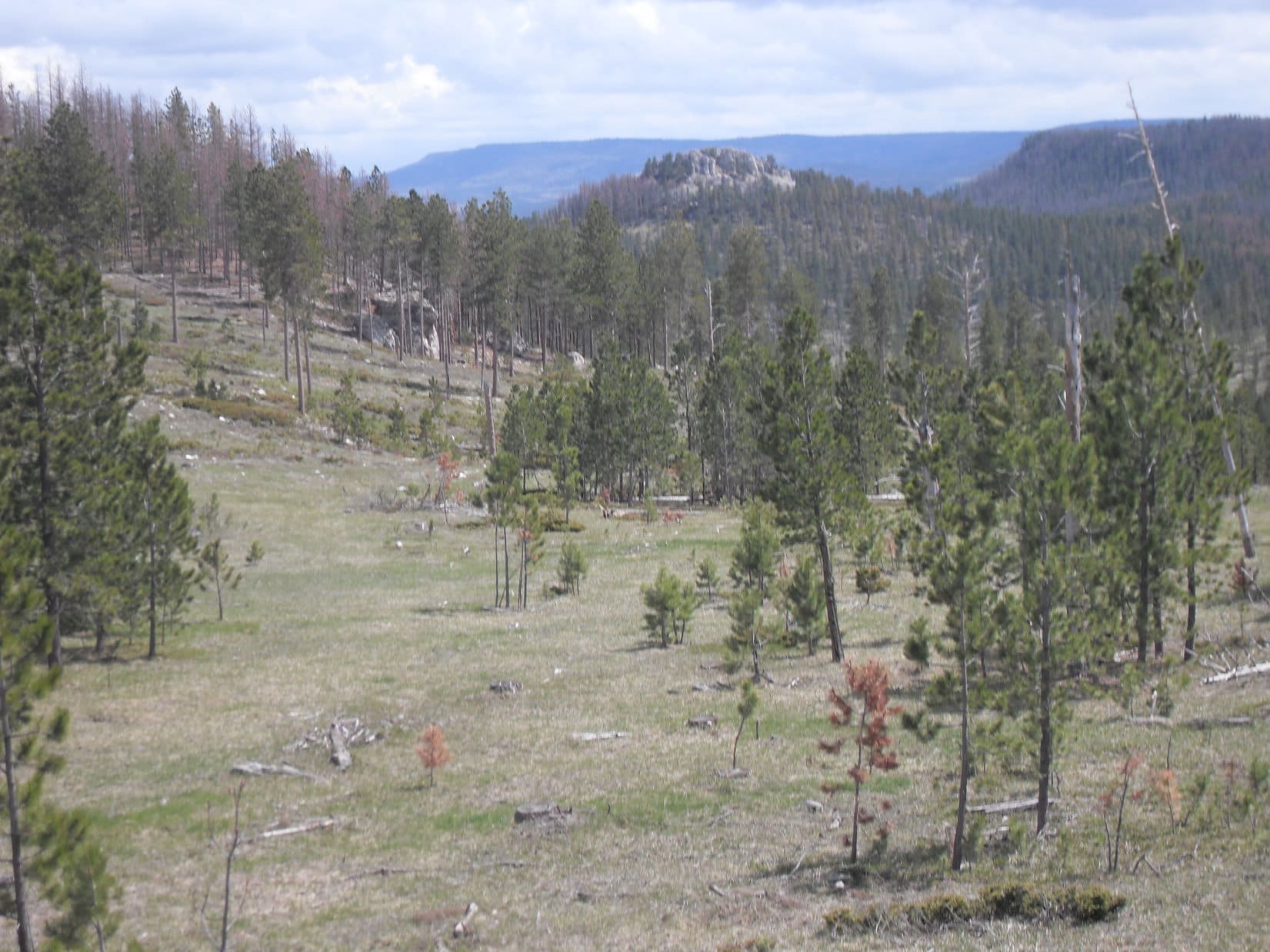
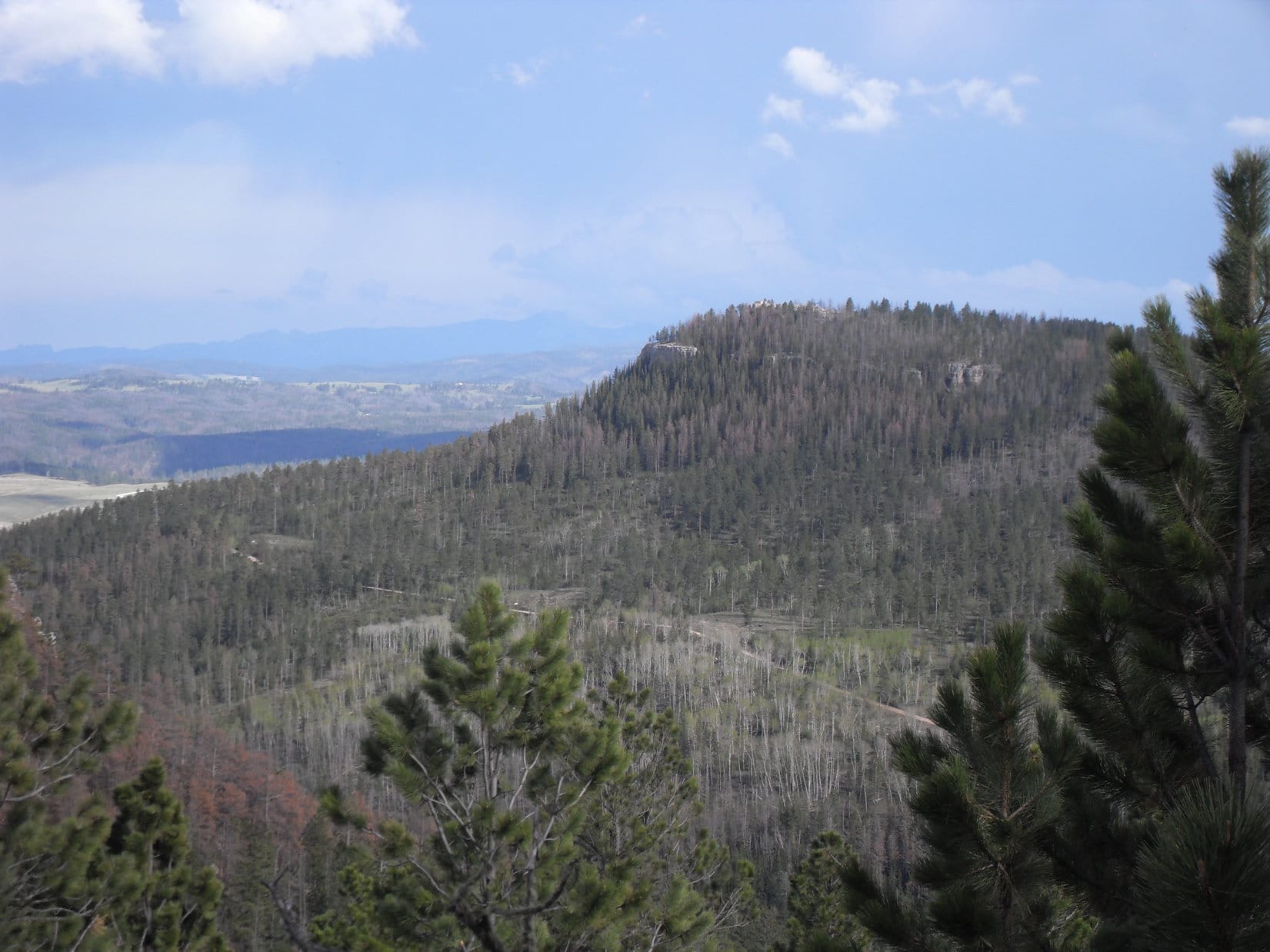
Parts of Deerfield Lake are in view from the first big limestone outcropping going up South Castle Rock from the S. The S end of Reynolds Prairie is seen on the L. Photo looks SE.The E end of Castle Rock(6,783 ft.) is the forested ridge with the many beetle-killed trees on the L. The N end of Reynolds Prairie is seen on the R. Photo looks N.County Road No. 306 winds across Reynolds Prairie. Part of Deerfield Lake is seen on the R. Photo looks E.
From the SE viewpoint, Lupe continued climbing N up South Castle Rock. She quickly reached a high point in the forest, but it was a false summit. The topo map showed that the true summit was just a little bit higher and farther N. There were many trees killed by pine bark beetles. The deadfall timber made progress getting to the true summit rather slow.
The true summit proved to be located up on a limestone cap surrounded by small cliffs in every direction. Lupe and SPHP scouted around looking for a way up. The only easy way up was from the SW, where Lupe and SPHP were able to make it up to the top. The summit area was flat and forested. The highest point was located toward the N end. Lupe posed for her South Castle Rock(6,840 ft.) summit photo next to SPHP’s backpack.
Lupe claims her first peakbagging success of the day at the summit of South Castle Rock! Photo looks WSW.
With the all views blocked by pines, Lupe didn’t linger very long on South Castle Rock. Lupe and SPHP climbed back down using the same SW route. Lupe then went around the W side of the summit escarpment heading N to her next peakbagging goal, Castle Rock(6,783 ft.).
Looking back at the N end of the low limestone cliffs below the summit of South Castle Rock. Photo looks S.
Castle Rock is slightly lower than South Castle Rock, and less than 0.25 mile farther N. It didn’t take Lupe long to reach the W end of the main Castle Rock ridge, which extends out to the ESE. Lupe and SPHP went all the way out to the E end looking for the highest point. Somewhere along the way, Lupe must have gone over the true summit, but exactly where was never clear. Near the E end, she posed for a couple of photos.
Happy Lupe on Castle Rock. Photo looks SW toward South Castle Rock.Lupe looks a little less friendly here, but it was partly due to the sun making her squint. Lupe’s next two peakbagging goals are in view behind her. Nipple Butte(6,800 ft.), capped with white limestone, is closest with Flag Mountain(6,937 ft.) beyond it. Photo looks N.
Lupe was off to a great start with 2 of her peakbagging goals already accomplished! Lupe and SPHP returned to the W end of the main Castle Rock ridge. Nipple Butte(6,800 ft.), over 0.5 mile N, was Lupe’s next stop. Lupe and SPHP started going N following a somewhat lower and much skinnier ridge.
The N ridge wasn’t as heavily forested. The views were actually better here than they were from up on the higher E ridge. However, as Lupe proceeded N, it soon became apparent she wasn’t going to find any safe way down. She reached a crevasse in the limestone that prevented her from going any farther N.
So Lupe and SPHP had to backtrack almost all the way to the S end of the N ridge again, before finding a steep route down off the E side. Lupe lost 150 feet of elevation before turning N again. While SPHP plodded along gradually regaining elevation, the American Dingo roamed the forest. She eventually reached the saddle to Nipple Butte and started up the S slope. The climb quickly became steep and very rocky.
Looking up the steep, rocky S slope of Nipple Butte. Photo looks N.
Lupe climbed up the broken limestone. She got very high, but near the top it became clear that there were deep fissures in the limestone. The fissures divided the summit area into several different rock islands in the sky. The highest one was farther N. There was no way for Lupe to get over to it from here.
Lupe and SPHP went back down. Lupe circled around the W side of the mountain looking for another route up. She found a steep approach from the WNW. Lupe climbed until she reached a small grassy area between limestone outcroppings. Once again, she was almost at the top of Nipple Butte. The summit was now just to the S, above a 6 or 7 foot high wall of limestone.
SPHP had to lift Lupe to help her get up on the limestone platform. She was nervous about it, but got up there OK. SPHP climbed up next. The limestone platform wasn’t very big. There were sheer drops all around. They weren’t tremendously high drops, but falling off wouldn’t have been healthy at all. A 2 or 3 foot high chunk of limestone rested on the platform. This was the true summit!
Lupe on Nipple Butte with the boulder that is the true summit seen right behind her. Photo looks SW.Reynolds Prairie from Nipple Butte. Photo looks E.
Nipple Butte was a real island in the sky! Being up there was a little like being on a cloud. No trees blocked the views. Lupe could see in every direction. Lupe and SPHP relaxed for a while, just taking it all in.
Flag Mountain(6,937 ft.) (Center), another mile N, was Lupe’s next destination. USFS Road No. 189 is seen below. Photo looks N from Nipple Butte.Castle Rock. Photo looks S.The S end of Reynolds Prairie (L) from Nipple Butte. Photo looks SSE.
When it was time to leave, SPHP carefully crawled off the N edge of the summit area first. Lupe didn’t know how to get down! It looked scary to the 2 year old Carolina Dog. She didn’t really trust SPHP to help her either. She stood up on top trying to figure out what to do.
Lupe looked happy enough, but she was more than a little worried about how she was going to get down off Nipple Butte.
SPHP finally managed to grab Lupe’s front legs and pull her near the edge. Lupe was alarmed, but SPHP got a secure hold on her and helped her safely off Nipple Butte. The Carolina Dog was greatly relieved! Lupe and SPHP made the steep descent down the WNW slope.
Once completely down off Nipple Butte, Lupe headed N across USFS Road No. 189. She began climbing the S ridge going up Flag Mountain(6,937 ft.). By now it was afternoon. Despite the shady protection of the forest, the heat forced frequent stops for water. Lupe didn’t reach the rough road to the top of Flag Mountain until she was already quite close to the summit. She followed the road the rest of the way to the rock stairs up to the remnants of the old lookout tower.
Lupe near the remnants of the old lookout tower on Flag Mountain. Photo looks E.
Not much could be seen to the W, but in every other direction Flag Mountain featured impressive views. Lupe felt more secure here than at Nipple Butte, too!
Lupe’s final peakbagging goal of the day was Peak 6962, the ridge on the L. White Tail Peak(6,962 ft.) is the far ridge on the R. Photo looks N.Lupe feeling safe and secure in the remnant of the old lookout tower on Flag Mountain. Photo looks E.Another look at Peak 6962 (L) and White Tail Peak (Center) from Flag Mountain. The gravel road is USFS Road No. 599. Photo looks N.
The afternoon was wearing on, but Lupe had only one more peakbagging goal left. Peak 6962 was more than 1.5 miles to the NNW. Staying on high ground, Lupe would have to go twice that far to get there. Instead of taking the road, Lupe and SPHP left the remains of the Flag Mountain lookout tower going W along the ridge.
The ridge didn’t stay level for very far. Lupe went down into the forest. She briefly came to the road near the N end of a sharp bend. Five ATV’s roared on by heading up. Lupe continued W beyond the road and back into the forest. Lupe and SPHP tried to stay on high ground as much as possible, as the terrain went up and down over a series of small rises and intervening saddles. Nipple Butte, now to the SE, came into view at one point.
Nipple Butte (Center) viewed from the NW as Lupe was heading for Peak 6962.
Lupe had to go almost a mile W before the terrain allowed her to start turning N. She eventually came quite close to USFS Road No. 189 again, but she stayed on a slightly higher ridge to the E of it. When Lupe finally reached a point about a mile SW of Peak 6962, she was able to turn NE and follow another ridge toward the summit.
There had been quite a lot of deadfall timber to contend with on the way from Flag Mountain, but this last stretch going NE to Peak 6962 was simply terrible. Dead trees had tumbled over everywhere, sometimes stacking several high. To make matters worse, an old barbed wire fence followed the same ridgeline Lupe was trying to follow. Along most of the route, the fence had collapsed under the weight of the many trees that had fallen across it.
SPHP was constantly worried that Lupe would get ripped up by the dangerous barbed wire. The deadfall and terrain forced Lupe and SPHP back and forth across the fence line many times. It was a struggle to make any progress through the seemingly endless obstacles. Getting to Peak 6962 was taking a very long time. The area felt very isolated and remote. Protected by the shattered forest, Peak 6962 must not have many visitors these days!
Lupe gradually got closer to Peak 6962. She started coming to a few places along the ridge where there were views of Flag Mountain off to the SE. She also started seeing an abundance of beautifully blooming crocuses. SPHP dubbed the area “Perfect Crocus Ridge”.
Finally, Lupe reached the area where the summit of Peak 6962 was supposed to be. The topo map showed a couple of areas within 6960 foot contours. Lupe arrived at the S one first. The topo map was right. The top of Peak 6962 was quite flat. Both of the 6960 foot contours were contained within a 6940 foot contour covering a much larger area. Lupe found no obvious summit.
There were no views either. Forest was all around. Even near the steep E edge of the mountain, the were enough trees still standing to quite effectively hide the view. Lupe and SPHP trudged on to the N, to check out the terrain over there. SPHP was hoping to find a view of White Tail Peak(6,962 ft.) to the N. There really wasn’t one. If anything, the forest was even thicker here. The terrain here didn’t seem any higher than back to the S, either.
Lupe was tired from leaping over all the countless dead trees on the ground. The Carolina Dog wanted to stop for a rest. SPHP was tired, too. SPHP sat on the ground. Lupe had some water and curled up. SPHP considered what to do next. From Flag Mountain, SPHP had seen some big cliffs at the very end of a long ridge protruding S from the E edge of Peak 6962. SPHP was certain those cliffs would provide some great views, but going there would add another 0.5 mile one way.
SPHP decided against it. It was just too much work going through all the deadfall. Maybe another time, if there ever was another time.
After 10 minutes, Lupe was ready to go again. The highest spot on the mountain had seemed to be within the area contained within the S 6960 foot contour. Lupe and SPHP went back there for Lupe’s Peak 6962 summit photos. The forest badly damaged by pine bark beetles wasn’t very pretty, but there was a beautiful green carpet of kinnikinnick.
Lupe smiling on the lovely green carpet of kinnikinnick at the summit of Peak 6962. Note the semi-transparent white object to her R. Photo looks ENE.This photo documents the existence of a genuine fire-breathing American Dingo on Peak 6962! Note the smoke coming out of her nose!
It was time to leave Peak 6962. The shortest route back to a road was to head SW back along Perfect Crocus Ridge. To avoid the worst of the deadfall timber, Lupe and SPHP tried staying below the ridgeline by going through a lower field to the SE. For a little while, this worked well. Lupe could run around without having to constantly be leaping over dead trees. After a while, though, the terrain forced Lupe up and over to the NW side of the ridge.
Flag Mountain from Perfect Crocus Ridge. Photo looks SE.
Staying off the top of the ridge helped more than SPHP initially realized. Lupe came to a clearing in the forest. Down a grassy slope to the SW was a good gravel road. Lupe was already almost back to USFS Road No. 189! SPHP stopped to look at the maps. After marching along all day through the forest, SPHP was tired of dealing with all the deadfall. Lupe was going to stick to the roads on the way back to the G6!
The quickest way back was to just follow No. 189 SE to Reynolds Prairie. Too easy and dull! A more interesting route was to take No. 189 only 0.5 mile S to USFS Road No. 239. No. 239 went S through Horsethief Creek valley for 3 miles to W Deerfield Road down in the valley of the North Fork of Castle Creek.
Since it was already getting late in the day and SPHP was already fairly tired, naturally SPHP chose a third route, the longest possible one. Lupe would go W on No. 189 for nearly 2 miles to USFS Road No. 129 before taking it S through Hughes Draw down to the North Fork of Castle Creek. Lupe and SPHP headed on down to No. 189 and turned NW.
Gradually, it began to dawn on SPHP that going NW was a big mistake. The sun was getting low, Lupe was heading away from the G6, and this route added at least another 5 miles to the trek back. No matter how interesting this route might be, it was going to get dark. It was really too late in the day for such silliness! SPHP was regretting the decision to go NW when a road going S into a shallow valley appeared a short distance ahead.
A marker at the start of the road said this was No. 129.1B. A quick check of the maps showed it was a shortcut down to No. 129 and No. 129.1A on the way to the North Fork of Castle Creek. Good! Lupe and SPHP immediately turned S on No. 129.1B.
The little valley No. 129.1B went down was very inviting. Beyond a grove of aspen trees, Lupe and SPHP heard frogs croaking. Lupe ran ahead to investigate. She found a pond where she got a huge drink. SPHP had completely run out of water more than a mile back.
The frog pond near USFS Road No. 129.1B where Lupe got a huge drink of water. The frogs did not resume croaking until Lupe left.
SPHP made good progress hiking down No. 129.1B. There was open ground on both sides of the road. Lupe had a blast racing back and forth across the valley. She hadn’t had an opportunity to run like this all day. She was having a great time. Despite all the hours that had gone by, Lupe was still full of energy.
No. 129.1B reached an intersection with No. 129. Two springs (Lyons Spring on the USFS map) combined to form a small creek, presumably Lyons Creek. Instead of following No. 129 SE, Lupe went W a short distance to take No. 129.1A going S.
No. 129.1A was a decent road, but did not lose elevation as quickly as Lyons Creek did. At first, Lupe was able to easily run down to the creek to get drinks of water. Pretty soon, however, the road was well above creek level. Lupe frequently saw deer down in the meadows by the creek below.
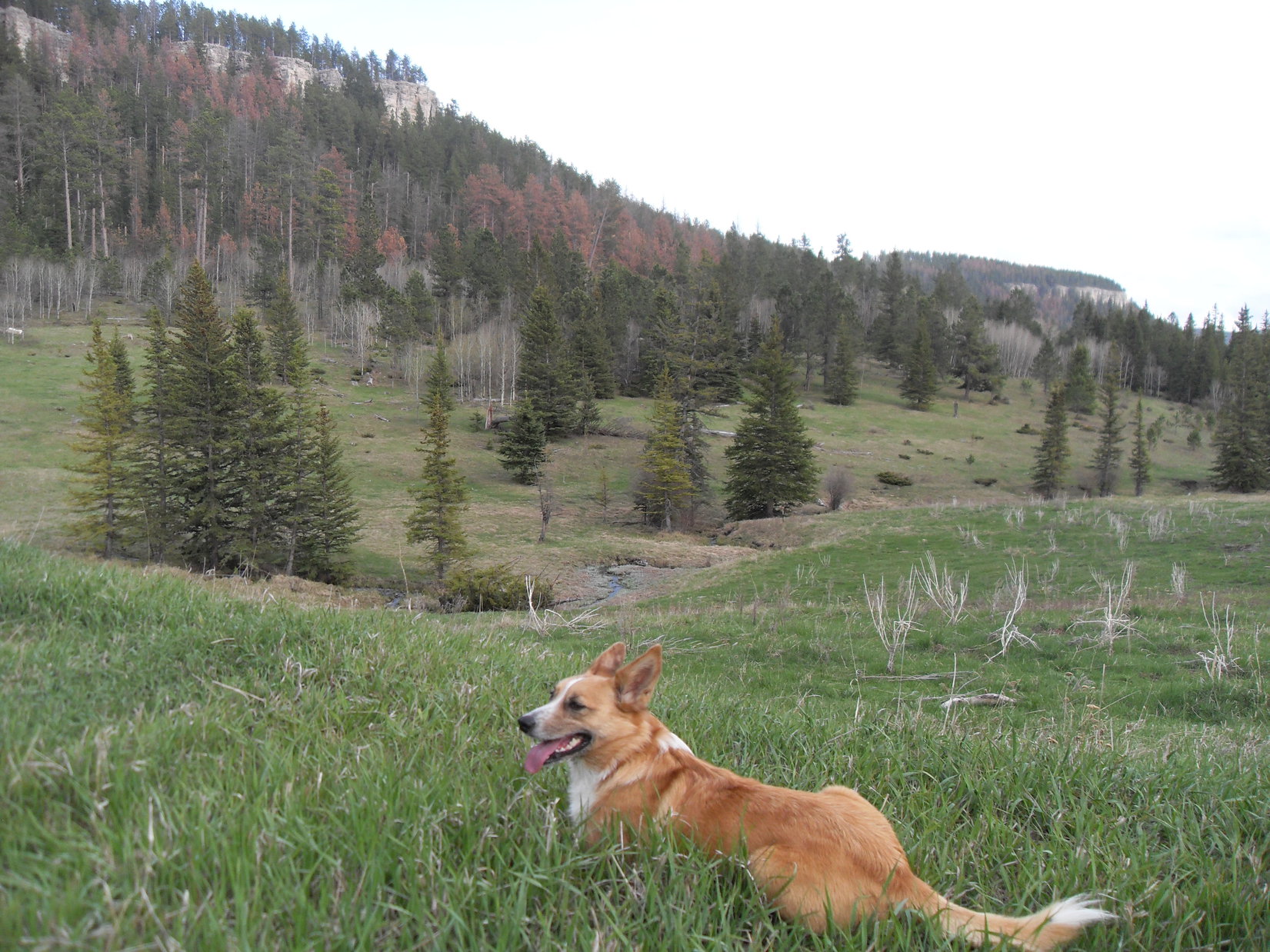
Lupe rests on the green grass above Lyons Creek. Photo looks SE.USFS Road No. 129.1A. Photo looks S.
Lupe finally reached W Deerfield Road down by the North Fork of Castle Creek. Lupe couldn’t resist getting in this much larger creek for another big drink.
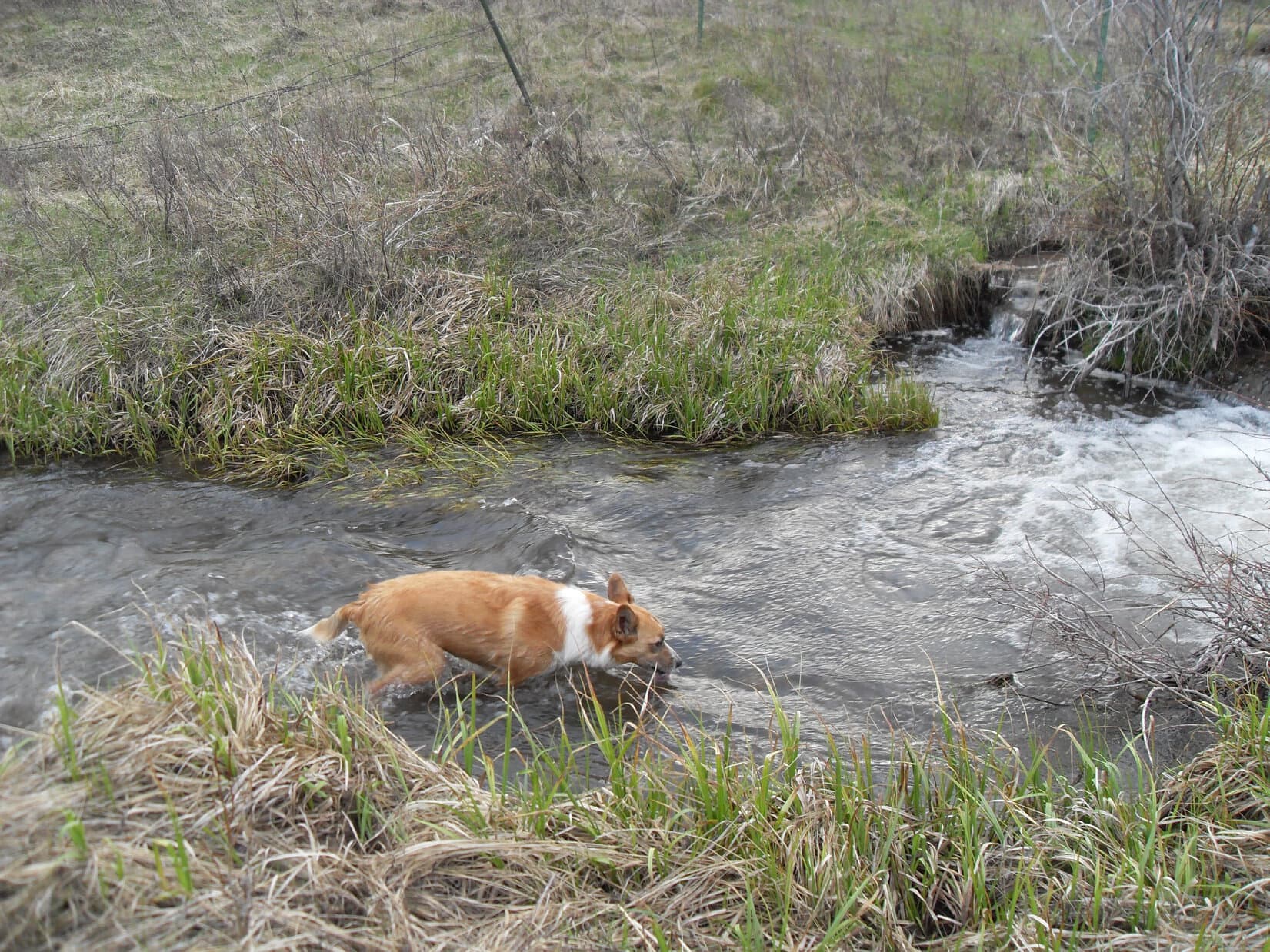
Getting a drink from the North Fork of Castle Creek.
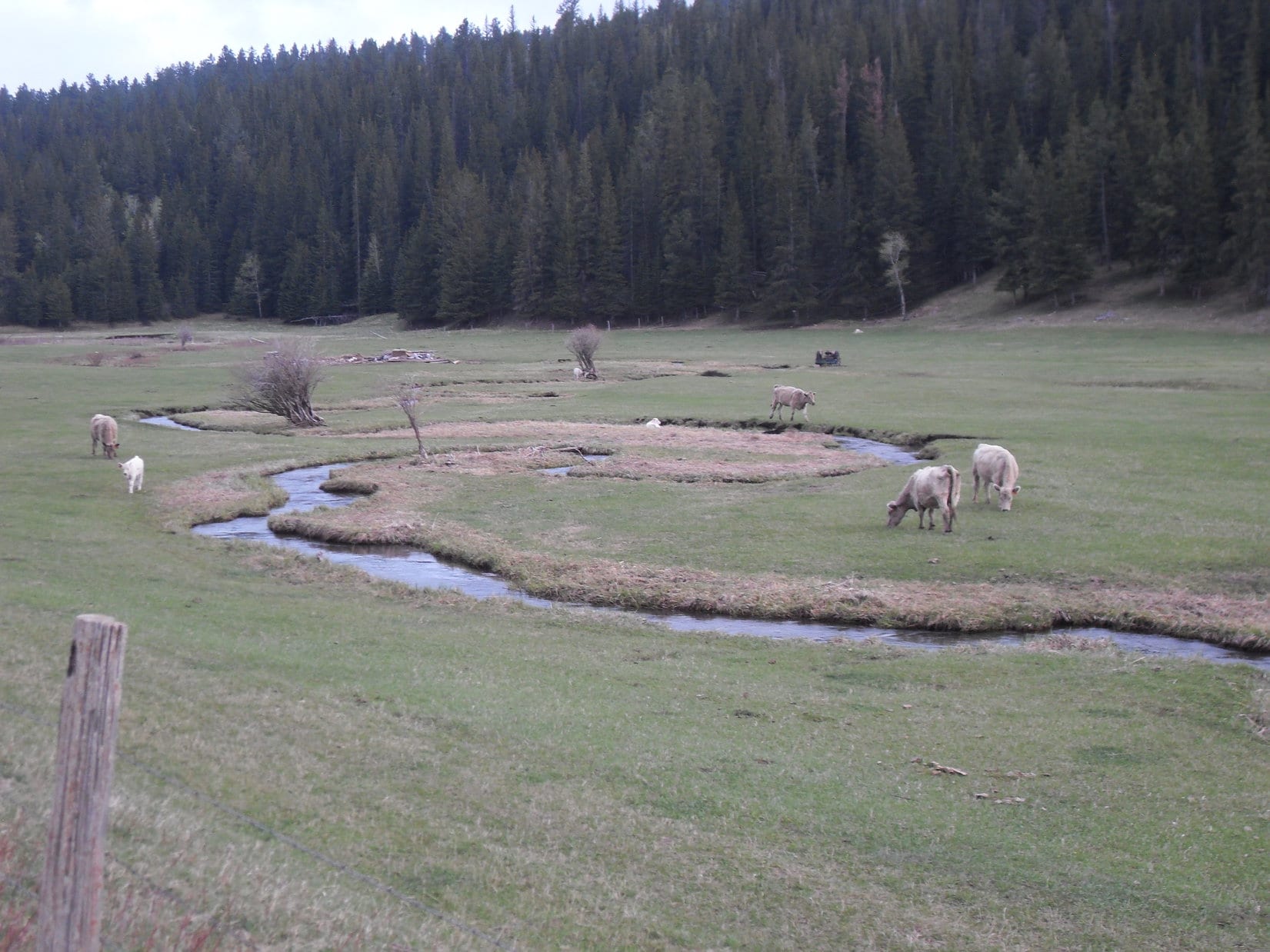
Lupe was still at least 3 miles NW of the junction with County Road No. 306 to Reynolds Prairie. The G6 was another 1.25 miles beyond that. Lupe and SPHP followed W Deerfield Road SE. Cows were in the fields nearby. Lupe was very interested. Although the temptation was huge, she was a very good American Dingo and didn’t bark.
At 9:01 PM (55°F), Lupe finally reached the G6 again. Light was still fading from the sky. Lupe had been gone over 11 hours, but she did reach all 5 of her peakbagging goals! Although she had just completed her 90th Black Hills, SD Expedition, Lupe’s peakbagging days were just beginning.
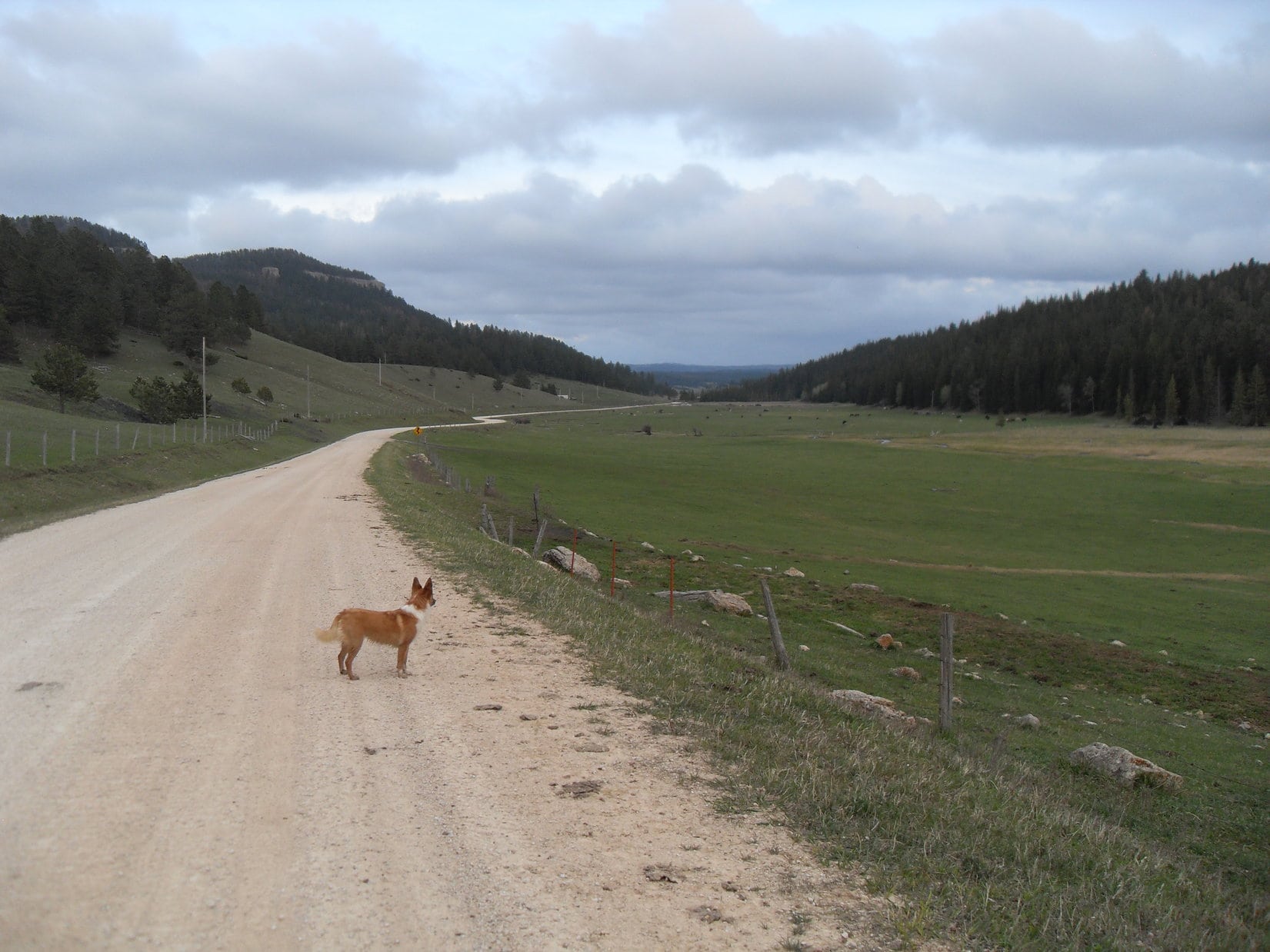
Lupe on W Deerfield Road in the valley of the North Fork of Castle Creek. Photo looks SE.Some of the very tempting cows Lupe didn’t bark at.