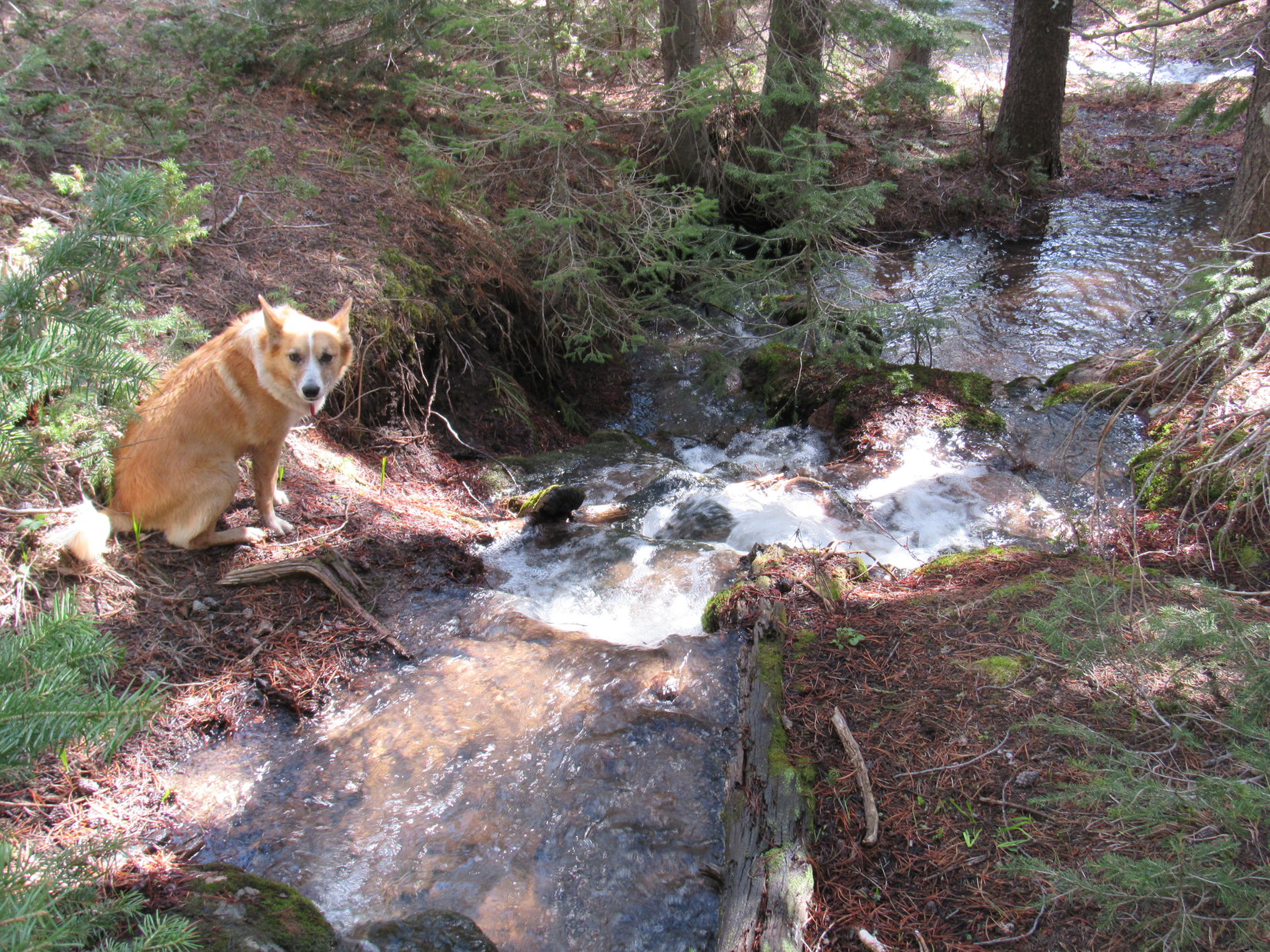
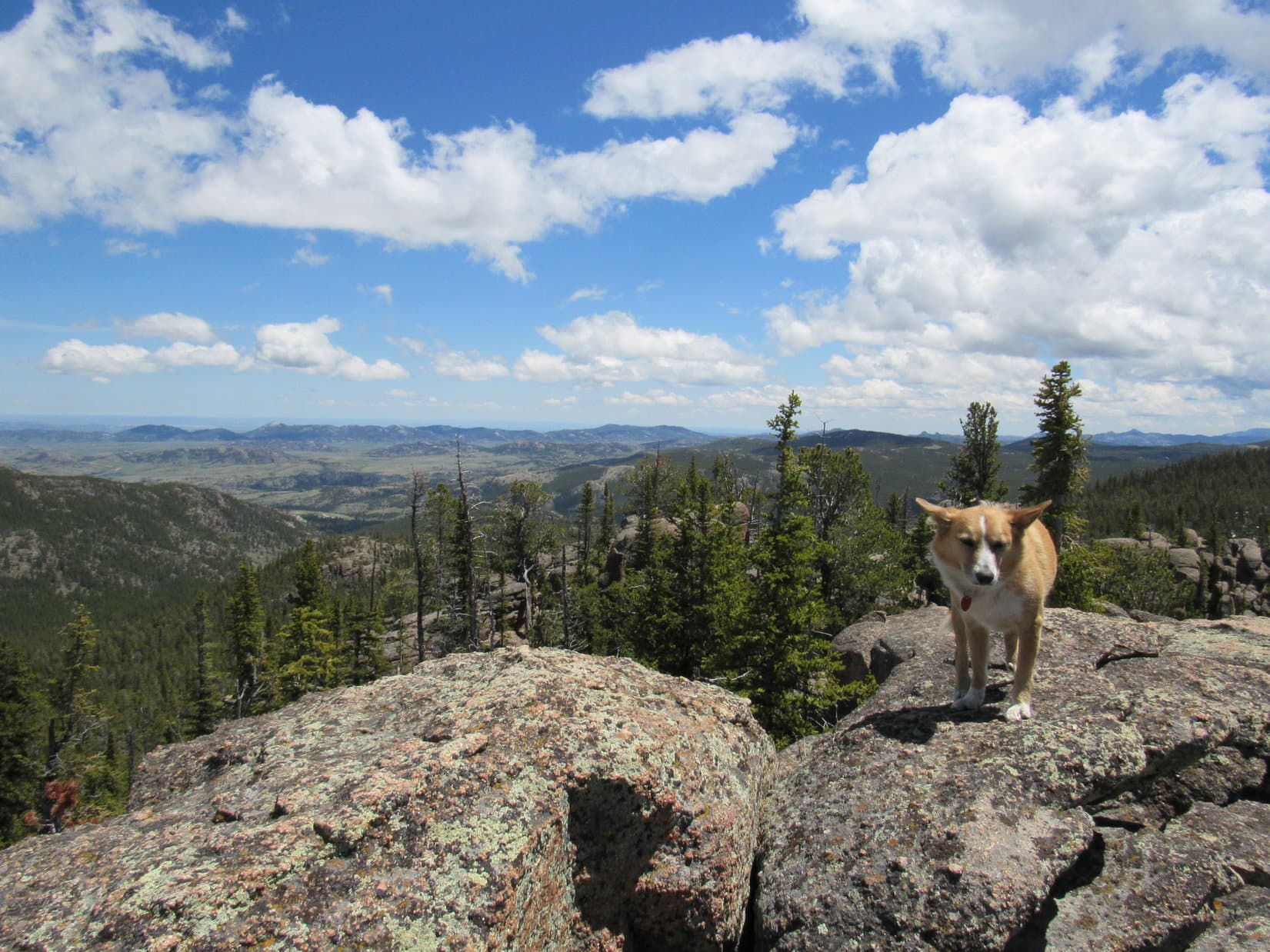
Day 3 of Lupe’s 2012 Dingo Vacation to the West Coast.
Lupe was somersaulting again against the door of her “tiny house”. She still hadn’t figured out that she couldn’t go through the tent door when it was zipped shut, but it had only been her second night ever in a tent. A squirrel was chattering away in a tree outside. Lupe wanted to go bark at it, but it was very early. Lanis was still asleep in the Honda Element, after his gear got soaked in a sudden downpour the previous evening.
Lanis isn’t much of a morning person. SPHP figured he would sleep for several more hours. This was an opportunity for Lupe to return to Bald Mountain(10,042 ft.). Lupe, Lanis and SPHP had climbed Bald Mountain the evening before, only to be almost immediately chased off of it by a brief intense rain shower. It wasn’t going to rain now, though. Lupe and SPHP left the squirrel and the campground in peace, and climbed Bald Mountain again.
After searching around on top of the mountain, SPHP had almost given up. Then, suddenly, there they were. Lupe had found the names that had been up there for a quarter century or more now. The names were just made out of loose rocks, but they were still easily recognizable. SPHP spent a little time repairing them.
SPHP wanted to add Lupe’s name to the mountain, but so much time had been lost looking around, it was probably best to get back down to the campground before Lanis awoke to find himself alone. It would take too much time to search around for some rocks to use. So Lupe and SPHP went down Bald Mountain enjoying the panoramic views, sunshine and fresh air.
(Just 11 months later, Lupe returned to spend a night on Bald Mountain and SPHP added her name then.)
SPHP needn’t have worried. Lanis was still sound asleep when Lupe returned. After having been responsible for getting Lanis’ gear wet the night before, SPHP wasn’t eager to further aggravate him by waking him up. Lupe and SPHP stayed busy in camp. Lanis eventually came to on his own. He was in a better mood than when he’d gone to sleep in the Element.
It was time for Lupe to leave the Bighorn Mountains of Wyoming and head farther W. The sun was much higher now. Lanis and SPHP dried things out while Lupe sniffed around. Pretty soon things were dry enough to pack them back in the Honda Element, and Lupe, Lanis and SPHP were underway.
Lanis drove W out of the Bighorns on steep, windy Hwy 14A. The route continued through Lovell, Powell and Cody, WY. From Cody, Lupe went N on Hwy 120 to Hwy 296, the Chief Joseph Scenic Byway. The Chief Joseph Scenic Byway lived up to its name. The road wound high up over a lofty pass. At a pullout on the W side of the pass, Lupe, Lanis and SPHP got out for a look.
View from the Chief Joseph Scenic Byway. Photo looks W from the pullout near the pass.
The view was most impressive, but there was a chilly wind. It looked rather stormy on the W side of the pass. Lupe hadn’t been at the pullout long when a cold rain began to fall. American Dingoes do have the good sense to come in out of the rain. Lanis and SPHP quickly joined Lupe in the Honda Element. Lupe’s journey continued down the winding highway on the W side of the pass.
The rain eventually stopped, but it was still pretty cloudy out. The St. Joseph Scenic Byway led to the Beartooth Hwy (No. 212). The Beartooth Highway goes NE over spectacular Beartooth Pass on its way to Red Lodge, MT, but Lupe wasn’t going that way yet. Instead Lupe, Lanis and SPHP headed W on the Beartooth Highway toward Cooke City, MT.
A side road off the St. Joseph Scenic Byway. The rain had stopped, but it was still pretty cloudy out.
Lanis and SPHP were looking for a campsite along the way. There were some campgrounds, but SPHP was picky and found nothing that looked quite right before reaching Cooke City, MT. Along the way, Montana became the 3rd U.S. Lupe state!
Cooke City, MT is basically a one street tourist town strategically situated 5 miles from the NE entrance to Yellowstone National Park. After looking around town just a little bit, it was time to get more serious about finding a campsite. Lupe, Lanis and SPHP headed back E on the Beartooth Hwy. This time Lanis was driving slower to allow for a more complete reconnaissance of the possibilities.
Not long after entering Wyoming again, Lanis and SPHP saw a turn to a little parking lot just N of the highway. A pickup truck with a camper was parked there close to a bend in a very beautiful river just 200 feet from the highway. It looked like a great dispersed camping site. Lanis pulled in off the highway. Everyone piled out of the Element to check things out.
This bend in the Clarks Fork of the Yellowstone River, became home base for Lupe, Lanis & SPHP during Lupe’s stay in the Beartooths on her 2012 Dingo Vacation. Photo looks NW toward Pilot Peak (L) and Index Peak (R).This small waterfall or rapid was just downstream of the bend in the river.Lanis is liking what he sees.
Unknown to Lupe, Lanis and SPHP at the time, the river was the Clarks Fork of the Yellowstone. This gorgeous site would become home base for the entire time Lupe spent in the Beartooths on her 2012 Dingo Vacation. The bend in the river offered a terrific view of the dramatic spire of Pilot Peak(11,699 ft.) and its neighbor Index Peak(11,240 ft.) to the NW. Just downstream of the bend, was a small waterfall or rapid with a nice pool of clear, cold water below it.
The reconnaissance downstream quickly met with the approval of Lupe, Lanis and SPHP. A walk upstream through a wooded area to a field next to the river followed. After being cooped up in the Honda Element a good part of the day, Lupe was so stirred up by the wild river and glorious surroundings, she got a crazed look in her eye. She pranced and growled and demonstrated just how ferociously prepared American Dingoes are for life in the wilderness.
Lanis has an eye for detail and took this shot of some mossy lichens growing on a rotting log near the river.Squirrels, schmirrels! Lupe feeling ready to take on elk, moose, grizzly bears and anything else the Beartooths can throw at her!And then I’ll crack their bones like this!
Returning to the bend in the river, SPHP had a chat with the other campers there, who already occupied the best site right next to the river. They told SPHP about a waterfall worth seeing just a mile or two to the E. The falls were up a short trail on the N side of the Beartooth Hwy. Why not check that out, too? Lupe, Lanis and SPHP hopped back in the Element to go find the waterfall.
As promised, a short, but steep hike up a trail led to a roaring torrent on Crazy Creek. The stream was strewn with logs. The falls were large, but this wasn’t really a classic straight down over an edge type of waterfall. It was too steep to be just rapids either. A better name is Crazy Creek Cascade. Lupe, Lanis and SPHP followed the trail all the way up to the top of the falls.
Crazy Creek Cascade. This waterfall was up a short, but steep climb N of the Beartooth Hwy.Lupe at Crazy Creek just above the big cascade.Lanis at Crazy Creek.
Lupe, Lanis and SPHP played around on the rocks next to Crazy Creek just above the cascade until it started getting dark. Time to head back to the Element, and the great campsite on the Clarks Fork of the Yellowstone.
When Lupe returned, the sky was still overcast. In fact, the clouds were darker and denser than before. It looked like it would almost certainly rain overnight. It didn’t seem to make any sense to set up the tent, which would surely leak if it rained hard enough. Lanis was going to have company in the Element tonight. Outside the rain began.
Morning! (5:57 AM, 30°F) SPHP opened the door of the G6 to let Lupe out, and grabbed the boots left outside on the ground the previous evening in the hopes that they would dry out a little. SPHP’s boots had been soaking wet after spending much of the previous day hiking through snow drifts with Lupe on her fabulous day trip to Warbonnet Peak(9,414 ft.) and back.
Well, that didn’t work. The boots weren’t dry. They weren’t soaking wet, either. Instead, they were frozen stiff. It was chilly out. Outside, there was frost on the picnic table. SPHP turned on the engine to warm things up, with the blower blasting the boots with hot air to thaw them out. Lupe hopped back into the G6 to bask in the warmth.
SPHP studied the maps. SPHP hoped Lupe would be able to climb two more mountains today. The original plan had been to go for Buffalo Peak(9,387 ft.) and then Squaw Mountain(9,313 ft.), which were 4 or 5 miles N of the Campbell Creek campground where Lupe and SPHP had spent the night. The Peakbagger.com topo map showed a 4WD USFS Road No. 664 leaving Cold Spring Road (County Road No. 24), and leading after a few miles to a trail going between the two mountains.
However, SPHP had acquired a new map yesterday. The forest service personnel who had been reinstalling the campground sign (washed away by floods a few weeks ago), gave SPHP a “Motor Vehicle Use Map” for the Medicine Bow National Forest. It didn’t show the road and trail leading between Buffalo Peak and Squaw Mountain at all. It did show something interesting, though. There was a trailhead along Cold Spring Road, and a Twin Peaks trail No. 618 leading right to Twin Peaks(9,280 ft.).
The Peakbagger.com topo map also showed Trail No. 618, but did not agree with the Motor Vehicle Use Map. The Peakbagger.com map showed Trail No. 618 passing 0.5 mile N of the Twin Peaks summit.
By the time SPHP’s boots had thawed out enough to become sopping wet again, and pliable enough to put on, Lupe had new plan for the day. She was going to find the Twin Peaks trailhead, and take Trail No. 618 to Twin Peaks. If there was enough time left in the day after that, she would try for Squaw Mountain.
After breakfast, Lupe and SPHP left Campbell Creek campground. SPHP drove N on Cold Spring Road. Three miles N of the campground, SPHP saw a big empty parking lot next to the forest a little uphill and W of the road. There was no sign along the road, but SPHP turned in and parked anyway (8:25 AM).
A small wooden sign, in deteriorating condition, still said clearly “Twin Peaks Trail No. 618”. The sign was next to an old jeep or ATV trail heading W from the parking lot. There was absolutely no other information around. This is it, Loop! Let’s get going!
The old jeep trail went gradually up and over a low part of a ridge coming down from the SW. On the other side, a little over 0.5 mile from the trailhead, Lupe reached Roaring Fork Creek. Snow was still melting up in the mountains, so Roaring Fork Creek was living up to its name. The creek wasn’t terribly large, but big enough so that SPHP started wondering how much of a problem creek crossings were going to be on Trail No. 618.
SPHP needn’t have worried. Trail No. 618 never did cross Roaring Fork Creek even once, although it did cross a few much smaller tributaries, most of which were clearly seasonal in nature. None of the tributaries presented any problem.
Lupe trotted along Trail No. 618, sniffing here and there, and making occasional short forays into the forest to investigate points of interest to American Dingoes. The trail went W following the S side of the creek upstream, most of the time well above it. About where the trail had reached Roaring Fork Creek, the valley had narrowed and the forest had become denser. Lupe and SPHP enjoyed a shady trek, with the pleasant sound of water tumbling over rocks below.
Gradually, the trail became steeper. About 0.75 mile after reaching Roaring Fork Creek, Lupe came to an intersection. It was unmarked, of course. Here, the old jeep trail veered to the SW (L) and started climbing steeply. To the R, a single track trail led down a hill toward the creek.
Decision time. Which way Lupe? The Carolina Dog made no response. Instead, she looked expectantly up at SPHP. We better check the maps. Hang on a few minutes. SPHP already knew what they would show. The old jeep trail to the L looked like it was heading in the direction shown on the Motor Vehicle Use Map directly to Twin Peaks. The single track trail continuing up Roaring Fork Creek was the route shown on the Peakbagger.com topo map. Depending on which map one looked at, both were supposedly Trail No. 618.
Yep, that was what the maps showed alright. The Motor Vehicle Use Map showed almost no details. It was impossible to know if the jeep trail actually went up to the top of Twin Peaks or not. SPHP suspected it wouldn’t, although it must end somewhere not too far from the summit.
The Peakbagger.com map showed the Roaring Fork Creek route would ultimately leave Lupe facing at least 0.5 mile of off-trail bushwhacking going up the N slope of Twin Peaks. On the other hand, if Twin Peaks proved impossible to climb, Lupe’s alternative peak, Squaw Mountain, would be much closer.
SPHP pondered for 10 minutes. Lupe took the single track trail near Roaring Fork Creek.
After going a little way on the single track trail, Lupe reached a barbed wire fence across it. A yellow sign said “Please Close The Gate”. The sign must not have been very effective. Sterner measures had been put in place. There was no gate. Only a fence. It ended at a rock formation a foot to the L of the trail. Lupe and SPHP climbed over the rocks to get by.
A little farther on, a more serious situation developed. The trail came to a marshy area with lots of little streams running through it. Crossing the area wasn’t a problem, but following the trail was. SPHP lost it completely.
Lupe near one of the tributaries of Roaring Fork Creek. SPHP lost Trail No. 618 in this area, but Lupe soon found it again a little farther upstream.
Lupe soon found the trail again a little farther upstream, but from here on, the trail seemed to be seldom used. Most of the time it wasn’t hard to follow, but every so often, it faded away. SPHP lost the trail completely several times, but Lupe always came across it again.
Trail No. 618 eventually began to climb well above the level of Roaring Fork Creek. The trail and creek started to diverge. The trail turned more to the WSW, while the creek angled NW.
For a long way up the creek valley, the only really view had been N toward Squaw Mountain on the opposite side of the valley. However, as Lupe continued gaining elevation, she now started seeing occasional glimpses of a high point to the S. A long, moderately steep, forested slope led up toward it. That high point had to be some part of Twin Peaks.
Lupe and SPHP took a break. SPHP needed to check the topo map to determine where Lupe should leave the trail. She would have to go S to start the climb up Twin Peaks. The topo map showed that Lupe was approaching a saddle in the trail. To the N of it were some contours indicating minor high points. The trail’s high point should be a good place to turn S.
The trail leveled out slowly as it approached the saddle. Some fairly impressive rock outcroppings began appearing on the N side of the trail. Lupe reached the saddle.
Lupe nears the saddle area where she would have to leave Trail No. 618 to climb S up Twin Peaks. These rock formations a short distance N of the trail helped confirm Lupe’s location. Photo looks NNW.
Lupe and SPHP went a little farther W on the trail. It started losing elevation at a pretty good clip. Yes, Lupe had made it to the saddle. No doubt about it. Lupe and SPHP went back to the trail’s high point. It was time for Lupe to leave Trail No. 618. SPHP took one more look at the topo map. Lupe would be climbing the N slopes of Twin Peaks. The map seemed to indicate the climb would be easiest going around toward the NE side of the mountain.
Lupe and SPHP left Trail No. 618 going S. The ground was almost level close to the trail, but Lupe soon reached the beginning of the long slope upward. Nothing but forest could be seen above. Just like yesterday, during Lupe’s trip to Warbonnet Peak, this forest with a N exposure was full of snow. The snow was stacked in drifts 2 to 4 feet high. The long struggle up the mountain began.
SPHP tried to angle toward the SE to get over to the NE slope of the mountain, as suggested by the topo map. The terrain didn’t want to cooperate. The easiest way up kept looking like it was farther to the W, where Lupe would be going up the NW side of the mountain. Lupe and SPHP made forays to the E where possible, but the terrain always soon started looking easier back toward the W.
Lupe was having a great time. The snow wasn’t a problem for her. SPHP made fewer attempts to go E, gradually giving in to the terrain. Lupe was destined to climb Twin Peaks from the NW.
Lupe climbed and climbed. Finally, she came to a more level area in the forest. A quick stroll led her to a rock formation. Now she could get a look at what was ahead.
Lupe reaches the first real viewpoint on her way up Twin Peaks from the NW. Photo looks SE toward the summit. Although hidden by trees in this photo, there was some very deep snow just to the L of the rocky ridge seen beyond Lupe on the R. Photo looks SE.
From the rocks, Lupe could see the summit of Twin Peaks ahead. The rest of the climb to the top didn’t look terribly long, but it was steeper than before. A rough, stony ridge rose from the NW almost to the top of the mountain, before turning E to the summit. Lupe could try to follow that ridge. Climbing directly up the steep, snowy, forested N slope was the other option.
After a short break, Lupe and SPHP left the rock formation. Lupe lost a little elevation crossing a shallow saddle. Lupe and SPHP stayed in the forest a little to the E of the rough, stony ridge. The slope kept getting steeper and steeper, the higher Lupe went.
SPHP decided Lupe should try to get up on the rough, stony ridge. Deep snowdrifts were in the shade of the NE side of the ridge. Lupe and SPHP had to climb up over them to reach the ridgeline. Lupe made it first. SPHP followed.
SPHP wondered if the ridge would be too rough to follow. If Lupe had gotten on it a little lower down, it looked like it would have been. From where Lupe reached it, however, the ridge wasn’t hard to follow. There was little or no snow on the ridgeline. Lupe began to make rapid progress.
Soon there were cliffs to the SW. Their height increased as Lupe climbed. A huge view opened up to the S. The ridge turned E. Lupe was nearing the summit. Instead of staying up on the highest rocks, Lupe and SPHP traversed ledges slightly below and to the S of them. The ledges were 5 or 6 feet wide, and seemed safer than the rocks above, despite the cliffs along the edge.
Lupe and SPHP proceeded carefully. Just short of the summit was a gap in the rocks. Beyond the gap was a wall of rock that looked like a potential problem. SPHP could get up it, but how was Lupe going to get up there?
SPHP told Lupe to wait, and went closer to get a better look. Suddenly, a Carolina Dog appeared above! Lupe had found a way up on her own. She knew what she was doing. Now it was SPHP turn. SPHP had to pass through a crack between two big rocks. The L boulder moved slightly as soon as SPHP touched it! It wasn’t completely stable. That was unnerving!
SPHP pushed gently on the boulder again. Yes, it did move, and quite easily. It rocked back and forth. More force didn’t make it move any farther, though. It wasn’t going to fall, its range of motion was quite limited. SPHP joined Lupe on top of Twin Peaks(9,280 ft.)!
Lupe reaches the top of Twin Peaks(9,280 ft.)! Squaw Mountain is on the L. Photo looks NE.
Right away, it was apparent that Lupe was at the true summit of Twin Peaks. The summit area was quite small, with cliffs to the N and S. The last part of Lupe’s climb had been from the W along the narrow rocky ridge and ledges. To the E, rocks went another 10 feet farther before reaching a drop off.
Lucky, Lupe! Purely by accident, Lupe and SPHP had come up the NW spine of the mountain. From the top, it looked like the only possible route Lupe and SPHP could have managed. Lupe had made it, though! Now she had fabulous 360° views, and a chance to rest while enjoying her peakbagging success.
Buffalo Peak (9,387 ft.) (L of Center) and Squaw Mountain (9,313 ft.) (forested ridge with a high point near Lupe’s head) were originally supposed to be Lupe’s peakbagging goals this day. Photo looks NNE from Twin Peaks.Looking SE from Twin Peaks toward territory familiar to Lupe! Laramie Peak(10,272 ft.) is seen on the far horizon on the R. Closer and farther to the R is Warbonnet Peak(9,414 ft.), where Lupe and SPHP had been the day before. High Point 9310 is on the far R.
Maybe Lupe didn’t like being up on the exposed rocks of the small summit area, or maybe she was simply ready for a break. After SPHP took a few photos of her on the summit, she went down to rest in a slot below the highest rocks.
The slot was a couple of feet wide and deep, 4 or 5 feet long, and protected by rock on three sides. The only opening was toward the W. There was a little grass for Lupe to lay down on, and a bit of shade. Lupe tried to close her eyes and rest, but a fly kept harassing her.
While Lupe snapped at the bothersome fly, SPHP tried to identify some of the surrounding mountains.
Buffalo Peak (9,387 ft.) looked like a forest fire had swept over it. Photo looks NNE using the telephoto lens.The high point on the R may be Buck Peak (9,061 ft.). Photo looks NNW.The conical mountain on the R may be Gunnysack (9,061 ft.). Photo looks NW using the telephoto lens.Lupe tries to rest in the safety of her slot in the rocks. Photo looks W at the rough, rocky ridge Lupe navigated on the way up. Sometimes she was up on top, but this high up she mostly followed rock ledges a bit lower down on the L (S).
One of the mysteries of Twin Peaks was why it was even called Twin Peaks. Lupe was clearly at the highest point on the mountain, with unobstructed views in every direction. Yet there didn’t seem to be any other similar peak nearby to be its “twin”. There were some lower ridges of rounded rocks a little way E of the summit, but they were close enough so it was hard to consider them a separate peak.
Looking at the E end of the summit area from the top. The lower ridges topped with rounded rocks seemed too close to be the “twin” of Twin Peaks.
SPHP decided High Point 9225 to the SE had to be the twin, but it didn’t look like one at all, at least not from here. High Point 9225 was a much longer, flatter, broader ridge. It didn’t resemble the true summit where Lupe was one bit.
High Point 9225, seen as the long flat ridge going all the way across this photo in the foreground, didn’t look like a twin of Twin Peaks at all. Maybe it does from a different angle. Photo looks SE.
Lupe and SPHP remained up on Twin Peaks for around 45 minutes. As lovely as the views were, the time came to think about moving on. Squaw Mountain(9,313 ft.) was next! Climbing Squaw Mountain didn’t look hard at all, but would take hours. Lupe and SPHP took a last look around from Twin Peaks, before starting a careful descent.
Looking WSW from Twin Peaks. Photo taken using the telephoto lens.Lupe stands at the summit of Twin Peaks, just above the slot in the rocks where she’d taken her rest break. Photo looks E.The American Dingo of Twin Peaks! Photo looks E.
At first, Lupe and SPHP retraced her route up on the way down. The narrow, rocky ridge presented no other obvious options. Eventually, though, Lupe got back down to more forgiving terrain.
SPHP had seen some open ground way down in the valley to the NW of Twin Peaks. It was W and NW of the saddle where Lupe had left Trail No. 618. SPHP suspected this open ground might lead far enough N to take Lupe around to the NW end of Squaw Mountain. After Lupe passed by the rock formation where she had gotten her first good look at the summit of Twin Peaks from the NW, Lupe and SPHP continued down trying to stay toward the NW.
Somehow, it didn’t work. Much to SPHP’s surprise, Lupe arrived at Trail No. 618 again right back at the top of the saddle. Lupe needed to go N from here to get to the W end of Squaw Mountain. However, the big rock formation N of the trail hadn’t gone anywhere. To get around it, Lupe could either go W or E.
SPHP decided Lupe should try going E. The plan was to turn N, and eventually NW going up the Roaring Fork Creek valley. Based on what had been seen from up on Twin Peaks, Lupe ought to find open ground somewhere W of Squaw Mountain.
Working her way around to the N side of the big rock formation, Lupe gained a little elevation, and ran into more snow. Not as much snow as on the N slope of Twin Peaks, but enough to slow SPHP down. Deadfall timber was abundant, too. Progress wasn’t as fast as SPHP had hoped.
The dense forest went on and on. Lupe did not come to open ground, even though she was getting closer and closer to the W end of Squaw Mountain. Now gradually losing elevation, the American Dingo came upon a series of small bright green openings in the forest. These bright green areas were swampy, full of shallow standing water and trickling little streams. The green openings were beautiful, but crossing them took time, as SPHP tried to avoid the wettest spots.
In the end, Lupe reached a final bright green marsh, somewhat bigger than the others. She had made it back to Roaring Fork Creek, but much farther upstream than before. The creek flowed E in the forest a little beyond the N edge of the marsh. Lupe went to the far NW end.
Lupe was now just S of the far W end of Squaw Mountain. It had taken longer to get here than SPHP had expected. Lupe hadn’t come to any easy open ground. Beyond the marsh, a damp, dank forest continued for who knew how much farther?
There were still hours of daylight left. SPHP had no doubt Lupe would be able to get to the summit of Squaw Mountain before dark. That wasn’t good enough, though. Lupe and SPHP weren’t at all equipped to spend a night on the mountain. Lupe would need enough daylight to find her way back to the trail through miles of trackless forest before dark. She wouldn’t have that much time.
Lupe stood on a rotting log at the edge of the forest. She was at her point of farthest advance. SPHP stared deeper into the forest, wistfully. Maybe Lupe would come back again some day to climb Squaw Mountain. Or maybe this was it, her only chance, a moment passing into history. Sorry, Lupe, we aren’t going to make it this time.
Lupe at her point of farthest advance on her way to Squaw Mountain. She is just S of the W end of it here. Photo looks NW into the damp, dank forest she would have had to travel through to continue. Photo looks NW.
When Lupe reached the G6 again, it was 5:27 PM (65°F). Soon Lupe and SPHP were heading N on Cold Spring Road. Lupe’s trip to the Laramie Mountains was ending, but Lupe and SPHP were still having fun. The drive to Douglas was absolutely gorgeous. Mile after mile of unspoiled classic western scenery.
Pronghorn antelope and cows caught Lupe’s attention. Barkfest was on! Lupe sped past them all having the time of her life. In the rear view mirror, Squaw Mountain and Buffalo Peak loomed impressively high and blue.