Castle Mountain, the Carbon County Montana High Point with Mountaineer Jobe Wymore – Part 1: Island Lake to Two Bits Lake (8-7-20)

Day 3 of Lupe’s 3rd Summer of 2020 Dingo Vacation to Wyoming & Montana!

8:05 AM, Island Lake campground off Beartooth Hwy No. 212 – Jobe Wymore was early, 55 minutes early.  Even so, despite waiting an hour for a pilot car to get her through road construction, Lupe had beaten him to Island Lake.  Only by 10 minutes, though.  It was super seeing Jobe again for the first time since November, 2018!  Great things were in the works!

Turned out Jobe had already been on an adventure.  Yesterday he’d climbed Mount Wood (12,660 ft.) with another friend, an opportunity that had sort of popped up out of the blue.  In a rush, Jobe had thrown everything into his Rubicon, driven straight out from Washington State, and trotted up Mount Wood.  Or maybe slogged up.  Mount Wood was not for the faint-hearted – more than 6,000 feet of relentless elevation gain in the rugged Beartooth Mountains.

Congratulations were in order, of course!  Jobe and his friend had made it to the top.  However, the upshot of it all was that Jobe had tried calling SPHP yesterday, and had left a message when he didn’t get an answer.  The message, eminently reasonable, had requested a one day delay to rest up before taking on Castle Mountain (12,612 ft.) with Lupe.  Early this morning, when he still hadn’t heard from SPHP, Jobe had driven all the way up from his motel in Red Lodge, keeping to the originally agreed upon schedule.

A guilt trip SPHP richly deserved!  Could have checked for messages on the way through Cody yesterday, but 110% confident Jobe would be here, SPHP hadn’t bothered.  Poor Jobe!  All worn out already, yet committed to setting out on a multi-day backpacking adventure with Loop.

SPHP felt terrible.  Well, not terrible, but guilty.  Actually, it was more or less a good thing.  Jobe was so much stronger and faster than SPHP that the exhausting day on Mount Wood only served to even things up a bit.  Come to think of it, this was great news!  Jobe wasn’t angry, actually rather cheerful and matter of fact about it, and now SPHP would stand some chance of not falling incredibly far behind.  Jobe’s sad tale was just a friendly reminder that maybe in the future, ya know it might not hurt to check that pesky old flip phone once in a while.

Over at the Island Lake trailhead, Jobe and SPHP chatted during last minute preparations while Lupe sniffed about.  Jobe always made SPHP laugh.  He had many mountain and other tales to tell, and was always handing out free samples of this or that new product he’d tried and liked.  SPHP never did anything different, so Jobe was usually able to conjure up some unimagined miracle.

8:51 AM, Beartooth Mountains, Wyoming – It was on!  Jobe Wymore and Lupe stood poised by the shore of Island Lake, ready to start for Castle Mountain.  A bluebird morning with a light breeze!  Optimism reigned as everyone set out on the Beartooth Highlakes Trail after rock hopping Island Lake’s outlet stream.  The trail led N, sticking close to the W shore.

Lupe and Jobe Wymore about to set out from Island Lake. Photo looks NW.
Off to a good start with Lonesome Mountain (L) in the distance.
Night Lake. Photo looks SE.

The trail was level or close to it.  Island Lake and Night Lake were soon left behind.  Jobe expounded upon interesting topics.  This was familiar much-loved territory, although Lupe hadn’t been here in years.  She was quite happy trotting along sniffing here and there, while listening in on the conversation.

State Line Peak (11,360 ft.), part of the enormous Beartooth Plateau ridge, was nearly always in sight.  Lonesome Mountain (11,399 ft.) could often be seen off by itself to the NNW, as well.  After Night Lake, the trail passed smaller lakes and crossed a little stream.

Almost before SPHP realized it, a new sign appeared pointing out the R turn to Becker Lake.  The sign made things easier than they used to be.  When Loop had been here years ago, this turn had been easy to miss.

Passing an unnamed lake N of Night Lake. Photo looks NNE.
Lonesome Mountain (L). State Line Peak (R). Photo looks NNW.
The new sign with directions to both Beauty and Becker lakes.

The Becker Lake trail passed part of Flake Lake on the R, and a couple of ponds on the L, before descending a small hill to a stream ford between Mutt & Jeff Lakes.  The water was a couple of feet deep, but stones and a tiny bushy island made it possible to rock hop the entire thing.

Next came a boulder field that had to be traversed along the NW shore of Jeff Lake, beyond which the trail crossed a soft, damp region before starting up the first significant slope of the day.  Gaining nearly 200 feet of elevation, Loop came to a half-dried up tarn in a narrow pass.

Near Flake Lake. Photo looks E.
Approaching Jeff Lake. The short boulder field that must be traversed along the NW shore and the slope leading up to the pass to the Becker Lake region are both visible beyond Loop. Mutt Lake is unseen off the L edge. Photo looks N.
Mutt Lake. Photo looks W.
Jeff Lake as seen on the way up to the pass. Photo looks SSE.
In the pass near the half dried up tarn. Photo looks NW.

From the pass, the trail headed N staying E of Becker Lake.  This region was forested, and at first, since the trail was well above and back from the lake, it wasn’t even in sight.  However, the forest soon began to give way to meadows with only scattered stands of conifers.  Before long, the American Dingo was getting glimpses of Becker Lake.

Becker Lake was nearly a mile long.  By the time Lupe was approaching the N end, the views were really opening up.

Jobe and Loop near Becker Lake. Photo looks SW.
Views opened up as the forest began giving way to meadows. Photo looks N.
Approaching the N end of Becker Lake. Photo looks NW.

Less than 0.5 mile N of Becker Lake, Lupe entered Montana.  Wyoming left behind, the trail went up a valley on the E side of a stream bound for Becker Lake from Albino Lake, which wasn’t in view yet.  Wildflowers flourished here, and Lonesome Mountain (11,399 ft.), which Loop had once climbed, was looming large.

Lonesome Mountain (Center). Albino Lake is hidden beyond the pass on the R. Photo looks NW.

The S end of Albino Lake was 0.6 mile N of the Montana border.  When Lupe, Jobe & SPHP got there, it was necessary to cross the outlet stream.  Although the stream was wide, this was no problem at all.  The entire stream was full of rocks sticking up above the water.  Rock hopping it was a cinch almost anywhere one chose.

Once across the stream, the trail wound over to the W side of Albino Lake, where it turned N again.  For more than 0.5 mile, Lupe was in the scenic region between Lonesome Mountain to the W and Albino Lake to the E.  Beyond the lake, it was only another 0.25 mile up to Pass 10340.  From here, Jasper Lake was now in view.

Albino Lake. Pass 10340 (L). Photo looks NNW.
Albino Lake from Pass 10340. Photo looks SE.
Jasper Lake from Pass 10340. The dark knob (Center) in the distance, is the end of Sky Pilot Mountain’s SE ridge. Photo looks N.

From Pass 10340, the trail headed NW down to a valley between Jasper Lake and Golden Lake.  SPHP warned Jobe about the sizable stream flowing down to Golden from Jasper.

Years ago, Lupe had gone beyond Jasper Lake twice.  The stream had been so high both times that it had been impossible to rock hop.  The first time, Loop and SPHP had wound up fording it near Golden Lake, both getting soaking wet paws in the process.  The second time, the whole issue had been avoided by circling around the E side of Jasper Lake where the flow was divided into a number of smaller inlet streams.  Worked, but this had been a somewhat tedious route.

Despite having climbed Mount Wood yesterday, Jobe sped on down the trail for a look at the Jasper Lake outlet stream situation himself.  Lupe and SPHP trudged after him.

Heh, no worries!  Upon reaching the stream, Jobe must have thought SPHP was nuts.  Either it was running considerably lower now than when Lupe and SPHP had been here before, or someone had rearranged a bunch of rocks.  A nice long string was now conveniently situated for relatively easy rock hopping all the way across.  Whatever!  Nothing wrong with good news, is there?

Here’s a glimpse of Golden Lake. Part of Lonesome Mountain (L). Photo looks SW.
Jasper Lake from partway across the outlet stream. Photo looks NE.
The downstream view. Lonesome Mountain (L). Photo looks SW.
Nothing to it now, SPHP! Come on!

Somewhere N of the outlet stream along the W side of Jasper Lake, the trail veered off to the W destined for Arrowhead Lake and myriad other lakes beyond.  Never saw exactly where that happened.  Didn’t matter.  Not the way Lupe and Jobe needed to go.

Castle Mountain (12,612 ft.) was still 5.5 miles NNW as the crow flies.  Today’s goal was to get at least as far N as Two Bits Lake, which was only another mile plus from Jasper Lake.  Jasper Lake had been a long, but relatively easy march with good trails the whole way and less than 1,000 feet of elevation gain.  However, from here on there would be no trails.  Ahead was a wilderness of rock.

For the time being, that was no big deal, since Lupe had already been to Two Bits Lake and even Donelson Lake before.  Slower going was in the cards, but success was assured at least that far.  Loop, Jobe and SPHP pressed on, heading NNW from Jasper Lake toward the last pass before Triskel Lake and Two Bits Lake.

Leaving Jasper Lake behind. Peak 11600 (R of Center). Photo looks SE.
Loop meditating among the Indian Paintbrush while Jobe waits for laggard SPHP. Photo looks NW.
Jasper Lake (L) and Lonesome Mountain (R). Pass 10340 (Center). Photo looks SSE.
Another look.

Progress was actually decent until the Pass 10380 region was reached.  Here, avoiding fields of talus as much as possible became the priority.  No way to avoid it all.  A lot of bouldering went on, with intermittent spurts on better ground keeping it all from getting too discouraging.  Staying to the W, several unnamed tarns were bypassed.

The largest and first tarn reached in the Pass 10380 region. Photo looks E.
Jobe isn’t a fan of talus. Had to pick his poison here at Pass 10380. Photo looks N.
Two smaller tarns just N of Pass 10380. Photo looks N.

Once over Pass 10380, the terrain eventually became easier to deal with.  Triskel Lake came into view, and everyone headed down that way first.  Not quite 4:00 PM yet, but maybe after lugging heavy packs for 7 straight hours this was good enough?  Jobe was ready to call it, and Lupe and SPHP sure had no objections.

Approaching Triskel Lake, the more distant one on the L. Photo looks WNW.
Triskel Lake (L). Photo looks W.

Where to camp became the question.  Wandering N toward higher ground while scouting out the area, the region somewhat closer to Two Bits Lake than Triskel Lake seemed to be the place to be.  Jobe assembled his tent before deciding on a precise location.  The breeze caught it, and Jobe was running around flying that tent almost like it was a kite, while still trying to find an acceptable spot.

So funny!  Jobe was hilarious!  So this is how guys with vast experience do it?  SPHP laughed, but Jobe did get it all under control.  He ultimately picked a little grassy ledge overlooking the stream running down from Two Bits Lake to Triskel Lake for his tent kite.  Barely enough room for it.  Jobe better not thrash around much in his sleep, or he’d be a goner.

Dinnertime!  Always on the cutting edge, Jobe had fancy freeze-dried stuff to prepare.  Thai something or other.  Sort of spicy.  While Jobe turned wilderness chef, Loop and SPHP wandered off looking for a place to pitch her tiny house, finally settling on a soft spot near a tarn over a little hill SE of Jobe’s abode.

Jobe scouting E of the stream between Two Bits Lake and Triskel Lake. Photo looks N.
Triskel Lake (L) and the stream running down to it (R). Photo looks SW.
Jobe’s comfy(?) perch (R of Lupe). Photo looks WSW.
Loopster’s tiny house. Home for the night. Photo looks NE.
The tarn near the tiny house, which is around the corner off the R edge. Photo looks SE.

After dinner, Jobe came looking for Loop and SPHP.  Finally spotting the tiny house, he then provided entertainment with his commentary for more than half an hour.  Good times!  Well before sunset, Jobe was ready to hit the hay.  SPHP knew Jobe was an early riser, and he’d had two long days in the mountains in a row, although today couldn’t have begun to compare with Mount Wood.

The sun was still well up when Jobe retired to his tent kite.  A gorgeous evening!  Even though Lupe and SPHP were both tired, too, there was something Loopster absolutely had to do.  7 years since the last time she’d seen Two Bits Lake, and it was only a short stroll away.  Better go take a look!

Two Bits Lake and its outlet stream. Photo looks N.
More of Two Bits Lake. Photo looks NNE.
Down by the shore.
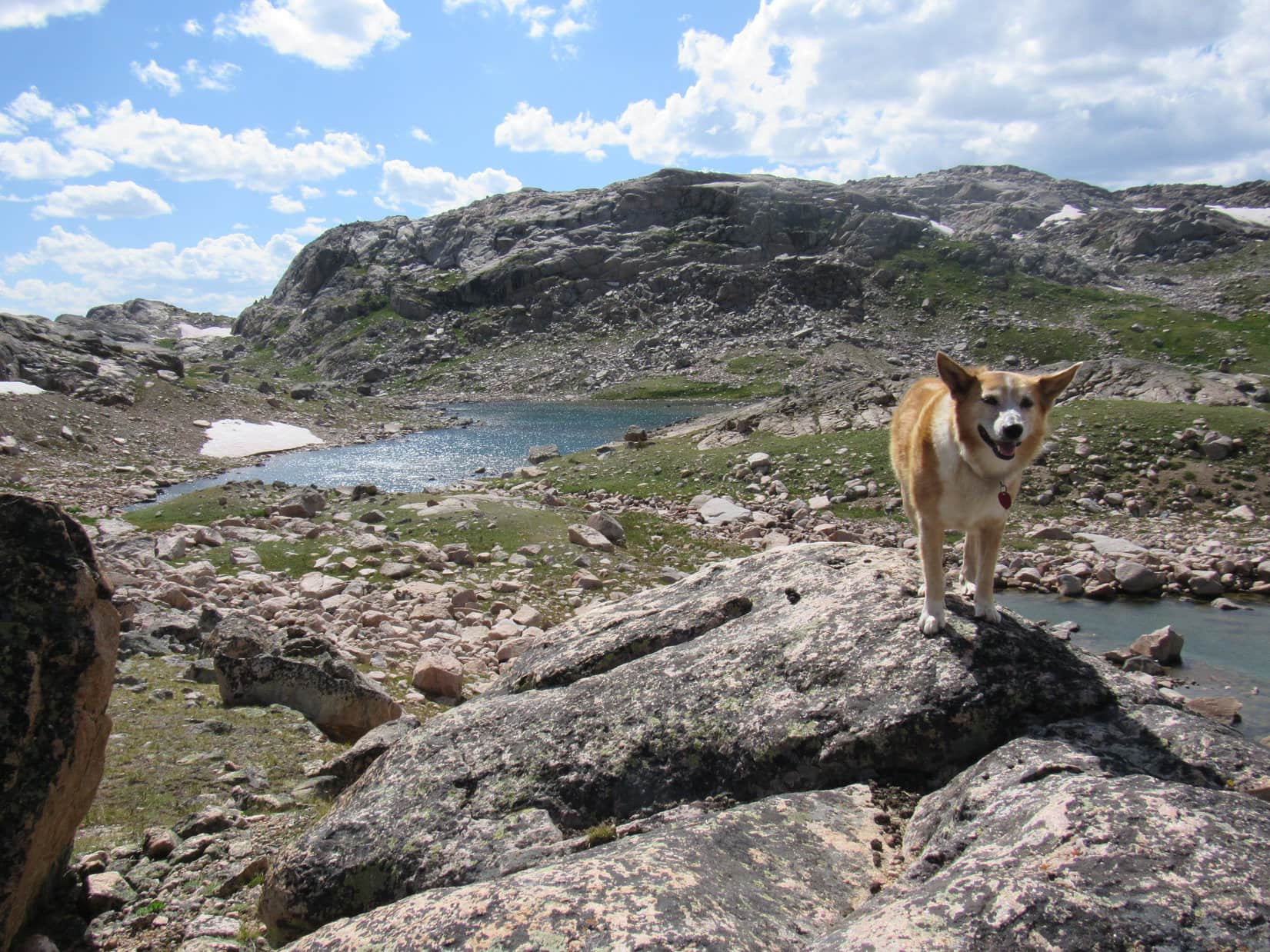
By the outlet stream that flows down to Triskel Lake. Photo looks SW.
A wider view.

This first day out had gone well, but then that was to be expected.  Been this far before.  The only thing that had worried SPHP at all to this point was what the outlet stream from Jasper Lake might be like, and it had turned out to be cake.

SPHP had convinced Jobe to take this Lupe route to Castle Mountain.  It wasn’t the usual one, and it was important that it worked.  Jobe had come a long way to get Castle Mountain done.  Among other incredibly challenging peak lists, Jobe had been working the Western Contiguous USA County Highpoints list for many years.  414 peaks, and he was only missing a few!  Mount Wood had been one of them.  Now Castle needed to fall!

Tomorrow was going to be different, a journey into the unknown.  Lupe had never been beyond Donelson Lake.  To even make an attempt on Castle Mountain, Jobe would have to be able to get to Flat Rock Lake.  From there, others had proven a route up Castle.

Only 2 mystery miles from Donelson Lake to Flat Rock Lake.  The topo map didn’t look too bad.  Would the Lupe route go?  No guarantees.  Anything could happen, but SPHP felt confident it would.

Two Bits Lake, Beartooth Mountains, Montana 8-7-20

Links:

Next Adventure                       Prior Adventure

Castle Mountain, the Carbon County Montana High Point with Mountaineer Jobe Wymore – Part 2: Two Bits Lake to Flat Rock Lake (8-8-20)

The Journey to Two Bits Lake, Beartooth Mountains (7-12-13)

Sky Pilot Lake, Beartooth Mountains of Montana (7-17-13)

Want more Lupe adventures?  Choose from Lupe’s Summer of 2020 Dingo Vacations to Wyoming, Utah & Montana Adventure IndexDingo Vacations Adventure Index or Master Adventure Index.  Or subscribe free to new Lupe adventures.

Black Hills, SD Expedition No. 260 – Moonshine Gulch, Peak 6205 & Minnesota Ridge (12-8-20)

8:49 AM, 38ºF, Rochford Road 1 mile E of Rochford – 0.25 mile W of Silver Creek Road, a wide valley appeared on the R.  Plenty of room!  SPHP pulled over and parked the G6.  Lupe hopped out and began sniffing around, while SPHP checked the topo map.  Yup, this had to be it – Moonshine Gulch!

At the mouth of Moonshine Gulch, about a mile E of Rochford. Photo looks WNW.

Loop’s mission today was to explore Moonshine Gulch far enough to reach Peak 6205, which shouldn’t be too hard, since Peak 6205 was only a mile away.  The American Dingo set off going WNW up the gulch on a wide dirt and dry grass road.  Pathetically easy at first, but that didn’t last.  Soon the road narrowed and headed into a thicket of deadfall.

Still near the start of Moonshine Gulch on the … uh … road. Photo looks W.

The deadfall was bad for a little way, but the Carolina Dog got beyond it.  The road was now all grassy and easy going again, lined on both sides by white-barked aspens.  Rather pretty, and already feeling quite secluded.  Clearly, no vehicle had been this way in a long time.  Moonshine Gulch promptly curved N, leading straight into another big tangle of deadfall.

On the grassy lane beyond the deadfall.
Among the aspens and pines. Photo looks WNW.
Back into the deadfall. Photo looks SSW.

After scrambling over, under, or around this next batch, Lupe continued N up the valley.  Moonshine Gulch narrowed, becoming more V-shaped.  A tiny frozen stream appeared.  Loop discovered free flowing water only a little farther upstream.

At the frozen trickle. Photo looks NE.
Running water! Photo looks SSE.

All signs of a road vanished as the region down by the stream became choked with vegetation.  Lupe traveled along a bench of somewhat higher ground up on the W slope.  The way things were going, Moonshine Gulch might soon become virtually impassable.

The bench eventually ended, but by then a narrow strip of thick grass had appeared E of the stream.  Lupe crossed over to it.  Continuing up Moonshine Gulch, what was left of the road reappeared, making the trek easier again.  The W side of the valley began to broaden out.  The road went over that way, then started fading in and out – at times helpful, at others, essentially non-existent.

A small frozen pond appeared.  Loopster went down to have a look.

On the exceedingly faint road as Moonshine Gulch widens out again.
At the tiny frozen pond.

Some barbed wire was near the frozen pond, but that wasn’t anything good for Dingoes.  The march N resumed.  The upper end of Moonshine Gulch was supposed to curve sharply W, and it began to look like that was going to happen.

Lupe didn’t really have to go that far N, though, to get to Peak 6205.  Since she was coming to more and more deadfall again, maybe it was about time to climb out of Moonshine Gulch?  Working NW up the deadfall-laden slope to the W, Lupe got high enough to see a somewhat flatter region where a thick forest of young pines grew beneath a canopy of much older trees.

Hmm.  Still some deadfall up here, too, but there didn’t seem to be any reason to go back down into Moonshine Gulch.  Climbing slowly, Loop continued NW through the young pines.  She soon found that the worst of the deadfall could be avoided without much trouble.

Before long, a small rock formation appeared ahead.

Not sure this is any better, SPHP? Want to try it? At the edge of the young pines after climbing out of Moonshine Gulch. Photo looks NW.
On the highest rock of the little rock formation. HP5880 (Center) in the background. Photo looks NW.

Upon reaching the rock outcropping, Lupe made a surprising discovery.  A road went right past it.  This was a decent road, too, not all faint and grassy like the one down in Moonshine Gulch.  Once again, SPHP checked the old topo map.

So what road is this, SPHP?  Looks like a lot easier way to get here than Moonshine Gulch was!

I’ll grant you that, Looper, but I have no idea what road this is.  The topo doesn’t show any roads at all in this region.  Some USFS Road, no doubt.  Tons of ’em in the Black Hills.  Might be shown on another map, but I think I know where we are.

OK, I’ll bite!  Where are we?

Hey!  No biting!  I think that hill beyond you is HP5880, and the hill right across the road is our destination, Peak 6205.  Doesn’t look high enough, though.  Must be more to it than we can see from here.

So, cross the road and head on up the slope?

Might as well, Loopster!  Go for it!

The mysterious USFS Road not shown on the topo map. Photo looks S.
E slope of Peak 6205. Photo looks WSW.

Lupe climbed and climbed.  Really was a lot more to this slope than had been visible down by the mysterious USFS road.  Good thing, because the top hadn’t looked any higher than HP5880 from below.  Wouldn’t have been any point in climbing the wrong mountain.

Plenty of deadfall to avoid, but nothing out of the ordinary these days.  The higher Lupe got, the more the glimpses of views between the trees confirmed that this really was Peak 6205.  She was clearly way above HP5880 by the time the slope began to level out.  Coming up from the NE, the Carolina Dog arrived near the S end of Peak 6205’s summit region.

An old board was nailed to a tree, and nearly a dozen rusty cans were strewn about.  Remnants of a blue stove with a metal grill sat next to an ancient stone fire ring covered with deadfall.  Several large tree trunks had collapsed next to this fire ring.  10 feet N of the ring was a little bench with stone supports and a log seat.  Didn’t look like anyone had been here in a long, long time.

Looking NE back the way Lupe came up.

Sort of a mess, isn’t it, SPHP?

Someone must have camped out up here once upon a time, Loop.

Nice spot with room enough for a tiny house, although not much in the way of views.  Too many trees!

Probably no views at all when all these dead ones were still standing.  Wonder who would have come to a lonely peak like this?

Adventurers of old, SPHP!  We’re not the only ones, you know!

Heh.  No, I guess not.  Well, what do you say we clean this place up a bit?  Get it a little more ready for adventurers of the future?

No big rush on that from the look of things, SPHP, but fine with me.

Really not that much to do.  SPHP dragged all the deadfall off the fire ring and away from the area around it, pitching it all onto the downed tree trunks nearby.  At least it was now out of the way.  Then all the rusty cans got gathered up and stuffed into a sack.  Once home, they could all go to recycling or the garbage.  SPHP took the metal grill for the blue stove, too, but didn’t have room for the stove itself.

Just going to leave this blue stove on the fire ring, Loopster, even though it’s no good anymore.  Kind of my exterior decorator touch.

Exterior decorator?  Don’t quit the day job, SPHP!

Oh, I won’t!  This is it!  Climbing no name mountains with a nutty Dingo.

Some humans have all the luck, SPHP!

Looper by the remodeled fire ring. Photo looks N.
Does look a little better, SPHP! Lupe on the little bench. Photo looks SSE.

Well, it was time for a break, and then a tour!  The usual Taste of the Wild, water, an apple, and a couple of small shared chocolate coconut bars.  Lupe then went to see the only clear view from the S end of Peak 6205.  From a patch of pine needles and grass, Lupe could look out over Moonshine Gulch toward the rumpled hills to the SE.

Looking SE from Peak 6205.

The true summit of Peak 6205 was NW of the fire ring.  Beyond another heaping helping of wretched deadfall was a 40 foot long narrow, stony ridge.  The highest rocks were at the NW end.

Peak 6205’s summit ridge. Photo looks NW.
True summit. Photo looks SE.

Not much in the way of views here, either.  The best were toward the W.  White Tail Peak (6,962 ft.) and Nipple Butte (6,800 ft.) were the most easily distinguished peaks on the horizon.

At the true summit of Peak 6205. Photo looks SSW.
White Tail Peak (Center) on the horizon. Photo looks W.
Nipple Butte (Center) is the sharpest little blip on the horizon. Photo looks SW.

And that was about it.  Nearly an hour after arriving, Lupe returned briefly to the fire ring toward the S end of the summit region before starting back down the mountain the same way she’d come up.

At the more hospitable S end again. Photo looks SSE.
Pretty snazzy, SPHP! At least compared to how we found it. Think how happy those future adventurers will be!
Starting down the E slope. Photo looks SW.

12:05 PM – Loopster had barely gotten started down the E slope, when SPHP had a change of heart.  The American Dingo had made it to Peak 6205 alright, but now what?  Just go back?  Seemed sort of early for that.

Hey, Loop!  Want to try for Minnesota Ridge (6,240 ft.)?

How far is it?

3+ miles as the crow flies.  Somewhat longer in practice.

It’ll be dark then before we get back won’t it, SPHP?

No doubt.  Don’t think we’ll have much of a problem, though.  Mighty nice out for December.  Supposed to be a record high for this date, in fact!

Lupe was fine with it.  Carolina Dogs love exploring, especially at dusk.  Instead of continuing down the E slope, SPHP went back to the NW end of Peak 6205’s summit ridge.  Following the ridgeline NW, Lupe began working her way down the mountain that way.  She soon saw White Tail Peak again, and even caught a glimpse of Custer Peak (6,804 ft.).

White Tail Peak (Center) on the horizon. Photo looks W.
A glimpse of Custer Peak from the NW ridge. Photo looks N.
Custer Peak (Center). Photo looks N with help from the telephoto lens.

A little farther down the ridge, Peak 6205’s N slope opened up a bit.  This whole region was full of deadfall.  A large grove of aspens was visible W of HP5880 at the bottom of the slope.  Leaving the ridgeline, Lupe picked her way down, eventually managing to reach the aspens.

Two grassy lanes through the aspens appeared to be remnants of old roads.  One went ESE, passing S of HP5880, apparently destined to link up with the mysterious USFS Road Lupe had run across E of Peak 6205.  However, Loop took the other lane, which went ENE.

Near the aspens W of HP5880 (R). From here, Lupe took the lane at far L. Photo looks E.

A short trek on the grassy lane led to a better road beyond the aspens.  Lupe followed this new mystery road as it curved N.  After 0.25 mile, she came to a “T” intersection.  A brown wand identified the road Loop had just taken as USFS Road No. 513.1B, no doubt a spur off No. 513.1, which she had apparently just reached.

On the better road beyond the aspens. HP5880 (L) up in the pines. Photo looks ESE.
Glancing back at Peak 6205. Photo looks S.
Wand near the junction of USFS Roads No. 513.1B & No. 513.1. Photo looks SSW.

No. 513.1 was a better road yet.  SPHP figured it was probably the same one Lupe had come to E of Peak 6205.  In that case, it ought to connect by swinging around the N and E sides of HP5880.  To test this theory, Lupe turned R at the junction, heading ENE.

Sure enough, No. 513.1 began to curve E, then SE.  Most of this territory was flat, but when No. 513.1 started losing elevation, Looper left the road to climb nearby HP5900, the next hill 0.5 mile NNE of HP5880HP5900 wasn’t much of a climb at all coming from the W, but the Carolina Dog did get a halfway decent look back at Peak 6205 from it.

Peak 6205 (L) from HP5900. Photo looks SSW.

On the way over here, Lupe had passed USFS Road No. 513.1C, another spur off No. 513.1 which went N, the general direction she needed to go.  Since No. 513.1C wasn’t too far back and would be a lot easier than a trek through the forest, Loop returned to it.

At the start of USFS Road No. 513.1C where it leaves No. 513.1. Photo looks N.

No. 513.1C was clearly marked as a dead end, but Lupe followed it for nearly 0.5 mile.  A long, gradual descent led to a slow rise.  Near the end, No. 513.1C split, with one branch curving off to the E.  Lupe left the road near this intersection, continuing to wander N through the forest.

Following No. 513.1C. Photo looks N.

Passing over a broad, gentle saddle, the American Dingo reached the start of a forested slope lower.  The terrain steepened and forced her to turn NE, staying SE of a deepening ravine.  After losing a fair amount of elevation in the trackless forest, Lupe came to a spot where she could easily cross over to the N side of the ravine.  Here she came to an animal trail going NE down the slope.

On the animal trail. Photo looks NE.

Near the bottom of the valley Lupe was entering, the animal trail crossed another mysterious old road.  The trail then turned NNE passing through a short section of forest.  Having lost a good 200 feet of elevation, Looper finally emerged on the W side of a broad, grassy valley.

Moonshine Gulch, Peak 6205, and all of today’s explorations since then had all been territory Lupe had never been to before, but she had been here years ago.  Loopster had made it to the Silver Creek valley.  Greens Gulch, the way to Minnesota Ridge (6,240 ft.), split off to the NE only 0.33 mile farther upstream.

We’ve been here before! This is the Silver Creek valley. Photo looks N.

Silver Creek was a small stream, small enough to leap over.  Lupe did so on her way to USFS Road No. 203.1F on the E side of the valley.  Upon reaching the road, Loop followed it N, then NE into Greens Gulch.  0.33 mile trek up Greens Gulch brought the Carolina Dog to an intersection she recognized from Black Hills expeditions long ago.

By Silver Creek after leaping over it. Photo looks NW.
In Greens Gulch, approaching a familiar intersection. Photo looks NE.

SPHP remembered at least one wand, maybe two, marking the roads at this junction, but none were to be seen now.  Checking the maps, it was clear Lupe needed to keep going E up Greens Gulch on USFS Road No. 203.1D, the only road she’d never taken before from this intersection.  No. 203.1D would get her up to a saddle SE of Minnesota Ridge.

Starting up No. 203.1D, Lupe came to a brilliantly lit field of dry grass.  At the far end, the road entered the forest and climbed more steeply.  After gaining more than 200 feet of elevation, Looper still hadn’t come to the saddle yet, but she’d reached another smaller field and the terrain was beginning to level out.  The road continued SE from here, but Lupe left No. 203.1D taking a shortcut straight E.

5 minutes led to a 15 foot high embankment.  Climbing it, Lupe reached the SW rim of Minnesota Ridge.  Turning NW, she quickly came upon a minor rock outcropping.

In the brilliantly lit field along USFS Road No. 203.1D. Photo looks ESE.
At the upper field, still on No. 203.1D. Photo looks NW.
First minor rock outcropping along the SW edge of Minnesota Ridge. Photo looks NE.

Minnesota Ridge encompasses a large, elevated region of pine forest.  Nearly all of it is gently sloping, except along the SW edge where the rim of a long escarpment features rock formations ranging from only a few feet to as much as 30 feet high.

Although Lupe had explored portions of Minnesota Ridge on a number of different occasions, the only other time she had come looking for the summit she had discovered a series of slightly higher rocks as she’d headed NW along the edge of the escarpment.  This time it wouldn’t be necessary to visit all those false “summits”, since the true summit was now known to be nearly 0.5 mile from here.

Gunfire!  Hunters to the NE!  Still unseen, they couldn’t be too far away.  Instantly transformed into a Chicken Dingo, Looper slunk quietly NW, sticking to SPHP like glue.  More shots were heard at intervals of several minutes before the incident ended.  By then, Lupe had come to a more open region along the escarpment.  Peak 6205 was visible 3 miles SSW.

Successfully eluded death and destruction! There’s Peak 6205 (Center). Photo looks SSW.

The last time Lupe had been here, the area close to the true summit had been a deadfall jungle.  The Carolina Dog reached a couple of rocks that looked familiar near the SE end of this region, getting up on both for a look around.  The deadfall was still here, and matters were now further complicated by dense young pines springing up amidst it all.

Pretty sure I’ve been on this rock before.
This one, too!

The true summit wasn’t much farther, only a few hundred feet of little pines and deadfall left to weave through.  When Lupe reached another line of rocks, she knew she was about there.

Farther NW, among the young pines.
Real close to the true summit now!

The true summit was off to the NE, 30 or 40 feet from the escarpment in a part of the forest that was still happily largely deadfall-free.  Loop and SPHP tromped about this slightly elevated flat region, but as before, nothing stood out as the clear high point.  Face it – the true summit of Minnesota Ridge was a roomy, but not terribly interesting place.

Weren’t there bigger rock formations where we saw huge birds flying around here last time, SPHP?

Yes!  There were, Loop.  Turkey vultures, if I remember right.  That’s a little lower ground, but not too far from here, just a bit farther NW.

Well, that was a lot more scenic, SPHP!  Why don’t we go over there?

Good idea!  We can hang out for a little while, and see if the big birds are still circling by.

NW of the true summit where the largest rock formations of the entire escarpment are. Photo looks NW.
This is more like it!

The big rock formations were easily found.  No turkey vultures this time, though.  The sun was already quite close to the horizon.  A short break was all Lupe had time for.  Taste of the Wild, the last apple and chocolate coconut bars all disappeared.

Trees had grown up enough to pretty much hide whatever limited views had been here years ago.  Looper did what she could, though.  Exploring the rim of the escarpment, she gazed out toward the setting sun, or peered into the forest below.

No more turkey vultures, SPHP!
Sort of makes you wonder what ever happened to them?
Exploring the escarpment.

The sun was down well before Lupe got back to USFS Road No. 203.1D near the SE end of Minnesota Ridge.  As dusk deepened, she followed the road W.  Stars twinkled above by the time she’d retraced her journey on No. 203.1F through Greens Gulch back down to the Silver Creek valley.

SPHP had a bright idea.  Instead of following No. 203.1F S down Silver Creek, why not go W?  The topo map showed a road going all the way to USFS Road No. 17, the highway N of Rochford.  No. 17 was only a little over a mile away.  Although a longer route back to the G6 overall, the rest of the march would be easy.

So from Greens Gulch, Lupe took a dirt road that went NW.  It curved W, as the map showed, crossed a muddy low spot containing the remnant of Silver Creek, then proceeded W on a long abandoned route.

It all went as planned until lights appeared ahead.  Avoiding private property, Lupe took a single track trail up a grassy draw that went S or SW.  After gaining a fair amount of elevation, she topped out.  In the weak beam of the little flashlight, no further route W could be seen.  However, the single lane track continued S, or maybe SE.  Hard to tell what to do in the dark, but sticking with the trail seemed the best option.

Exactly where Lupe went on this black December night is now a matter of conjecture.  Somehow she wound up following a road, probably USFS Road No. 217.1A, back down into the Silver Creek valley.  She eventually reached a private road leading to Silver Creek Road (No. 204), passing a number of homes decorated with cheery Christmas lights along the way.

A half moon was up by the time the American Dingo reached Rochford Road.  Not far now.  Only 0.25 mile W to the G6 still silently waiting at the start of Moonshine Gulch.  (7:14 PM, 51ºF)

Sunset from USFS Road No. 203.1D near Minnesota Ridge, Black Hills of South Dakota, 12-8-20

Links:

Next Black Hills Expedition                 Prior Black Hills Expedition

Black Hills, SD Expedition No. 203 – Gimlet Creek to Minnesota Ridge (5-6-17)

Black Hills, SD Expedition No. 78 – The Experimental Forest & Minnesota Ridge (3-9-14)

Want more Lupe adventures?  Check out Lupe’s Black Hills, SD & WY Expeditions Adventure Index, Master Adventure Index, or subscribe free to new Lupe adventures!