Start – 11:52 AM, 52°F, intersection of USFS Road No. 243 & Horse Creek Road
That last stretch of Horse Creek Road had been a muddy mess, but the G6 made it through. Lupe was at the start of USFS Road No. 243 again for the first time since … well, SPHP couldn’t remember since when. Whenever it was, it sure seemed like a long time ago now.
Lupe finally had a nice sunny, sort of warm day for late March. Right away, she was clearly happy with the situation. Due at least in part to more wintry weather than normal, the Carolina Dog hadn’t been on a proper Black Hills expedition in nearly 2 months. She was long overdue and looking forward to finally enjoying a romp in the hills.
Today’s peakbagging goal was Old Bald Peak(6,130 ft.) in the E central hills. Lupe had been there twice before, most recently well over 2 years ago on SPHP’s birthday. That wasn’t the most important thing about Old Bald Peak, however.
Old Bald Peak has the distinction of being Lupe’s very first peakbagging goal ever. Way back on 1-29-12 (Expedition No. 3!) when the Carolina Dog was only 13.5 months old, Lupe and SPHP had set out to find Old Bald Peak. Loop had started from Horse Creek Road that day, too, but from considerably farther away than where she was now. SPHP hadn’t been able to find the mountain, so her first peakbagging attempt had been officially unsuccessful, although she’d made it to the top of several other hills that day.
Finding the mountain wouldn’t be a problem today. Getting to Old Bald Peak from here would be cake. As a new twist on things, Lupe would also visit nearby Peak6167, a slightly higher hill S of Old Bald Peak on the way. Looper had never been to Peak 6167 before.
A cheerful American Dingo set out following USFS Road No. 243 going SSW up a long draw. The road was partially covered by melting snow and ice, and partly by muddy rivulets of snow melt making the road rather mucky.
A cheerful American Dingo sets off on USFS Road No. 243 on her way to Old Bald Peak. Photo looks SW.SPHP was surprised at how little snow was actually up in the hills. The road was snowier than anywhere else. Of course, Lupe loved the snow! Photo looks SW.
After more than 0.5 mile, the draw Lupe was going up split. So did the road. An unmarked side road continued SSW. Loop stuck with No. 243, which turned WSW here. Nothing else changed much. The road was still snowy, and Lupe continued gaining elevation steadily.
After another 0.5 mile, Loop reached a saddle at the end of the draw. A fence and a cattle guard were here. On the other side of the saddle, Lupe came to a junction with USFS Road No. 249. A second junction was only 100 feet away to the SW. Loop and SPHP went over there. No signage of any help, but SPHP was already certain where Lupe was. USFS Road No. 249 continued S from here down Marshall Gulch. USFS Road No. 530 headed W, and would soon turn NW on the way down Spruce Gulch.
Loopster didn’t need to take any road from here. She was excited and pleased when SPHP encouraged her to leave the roads heading N into open forest. Roaming the Black Hills National Forest off any road or trail is usually Lupe’s favorite thing to do.
After going N only a short way, Lupe turned WNW to climb a mostly forested hill. Deadfall timber was on the slope, and attempts to avoid the deadfall as much as possible greatly influenced the choice of routes. This hill was only a little over 200 feet higher than where Lupe had left USFS Road No. 249. Loop soon arrived at the summit.
The top of this first hill was rather rocky. Bushes and trees made moving around the summit more of a chore than it should have been. Lupe did get quite a nice clear view from a large rock outcropping toward the SW. The higher hills Loop could see off to the SW looked like they still had quite a bit of snow.
Lupe reaches the top of the first hill she climbed today. She is 0.25 mile WNW of the area where USFS Roads No. 243, 249 & 530 meet, and more than a mile SSE of Old Bald Peak. Photo looks SSW.Loopster stands on the best viewpoint from this first hill. She could see a lot of Black Hills territory off to the S and W from here. Photo looks SW.From another vantage point, it was possible to catch this glimpse of territory to the E. Peak5800 is in the distance on the L. Photo looks E.
After taking a short break on this first hill, Lupe and SPHP continued on. Peak 6167 was only 0.75 mile to the NNW from here. Right away, Lupe had to lose 150 feet of elevation. Losing the elevation was the hardest part of the whole journey to Peak 6167. The ridge Loop was following was rocky, full of trees and bushes, and even some snow on this N slope.
Once she had lost the elevation, Lupe had an easier time continuing N. She was starting to gain elevation again following a much broadened ridge compared to where she’d come down. It wasn’t long before Looper saw something that really excited her. A herd of 7 or 8 giant deers (elk) had heard Lupe and SPHP coming, and were running off through the forest.
Lupe dashed off to see where the giant deers were going, but they had a big head start. She couldn’t begin to catch up with them. Nevertheless, she came back to SPHP panting hard, but with a big smile.
With all the excitement over, Lupe and SPHP continued on and were soon in position to begin an ascent of Peak 6167’s SSE ridge. Parts of the ridge had so much deadfall timber, Loop sometimes had to down climb a bit to get around it. She always stayed E of the ridgeline then. This went on until the American Dingo was practically at the top of the mountain.
The summit of Peak 6167 was unusual. Pine trees ringed most of a 100 foot long summit ridge, which was oriented NNW/SSE. Two rows of slate stuck up on either side of this ridge separated by a grassy lane 10 to 20 feet wide. The row of slate to the E was nearly vertical, and featured the highest rock on the mountain, which stood 5 feet above the grass. Most of the W row of slate jutted out of the ground at only a 30° angle.
The first chunk of slate Lupe came to was also unusual. It was standing nearly vertical despite being part of the much more sharply angled W row. Lupe had no trouble hopping up on top of it. She would have been at the absolute true summit of the mountain, if not for smaller rocks 20 feet away that stuck up a foot higher along the E spine of slate.
Lupe reaches the summit of Peak6167 for the first time ever. Photo looks NNW.Loop balances on the highest rock big enough for her to stand on up on Peak6167. She’s only a foot lower than the true summit here. The true summit is the highest rock seen on the R.Well, I made it. Satisfied, SPHP? …. Yeah, Looper, that was great! You can hop on down again, if you like.Lupe stands near the E spine of slate sticking up out of the summit of Peak6167. The rock she had just been perched on is seen beyond her on the R. This is a good look at the grassy lane along the summit ridge. Photo looks SSE.Looper near the highest rock (L) on Peak6167. The top of this rock was way too small for her to stand on, but SPHP lifted the Carolina Dog up so she could put her paw on top to claim her latest peakbagging success. Photo looks SSE.
Not much could be seen from the summit. Trees blocked the views in nearly every direction. However, from some of the slanty pieces of slate along the W side of the grassy lane, Looper did have a fairly good view off toward the SW.
Looper stands on one of the slanty pieces of slate along the W spine of Peak 6167’s summit ridge. She has the best view from the summit area from here. Photo looks SW.Still looks pretty snowy in the high country, doesn’t it SPHP? Photo looks SW.
After photos from the summit area, Loop and SPHP headed a little back toward the S. Just before Lupe had reached the summit, she had come to a flat, grassy area with views in that direction. She had been able to see Black Elk Peak(7,231 ft.), the highest mountain in South Dakota. Black Elk Peak is always an attraction.
Lupe at the S end of Peak 6167’s summit ridge. The big rock she had first got up on here is seen on the R. Photo looks S.You coming to see Black Elk Peak, SPHP? ….. Be right there, Looper!There it is folks, the highest mountain in South Dakota! Black Elk Peak(7,231 ft.) is on the L. Sylvan Hill(7,000 ft.) is on the R. Photo looks S.
From this same flat, grassy area, the American Dingo could also see Boulder Hill(5,331 ft.) and a sliver of Sheridan Lake.
Boulder Hill (L) and part of Sheridan Lake (R). Photo looks SE.
Lupe had now seen about what there was to see from Peak 6167. It was time to press on to Old Bald Peak, which was now less than 0.4 mile to the N. An abandoned road curls up Peak 6167 from the W clear around to the E side of the mountain. Lupe hadn’t come up this road, but she started her journey N to Old Bald Mountain along it.
The abandoned road was full of snow. Lupe followed the snow all the way down to where the road curled W around the N side of Peak 6167.
Lupe hadn’t come up this abandoned road leading to the top of Peak 6167, but she started her journey to Old Bald Peak going down it. Photo looks NNW.
Old Bald Peak hadn’t been visible from the summit of Peak 6167 due to the forest, but Lupe got a fairly good look at it on her way down the abandoned road.
Lupe gets a good look at Old Bald Peak, her next peakbagging objective, from the snowy abandoned road. Photo looks N.
Old Bald Peak(6,130 ft.) is only 37 feet lower than Peak 6167, but Lupe would have to lose nearly 200 feet of elevation on her way over there. Naturally, the vast majority of this elevation had to be regained.
Once Lupe left the road at the N end of Peak 6167, her route down to the saddle leading to Old Bald Peak was fairly steep. Looper was soon down, however, and beginning her climb back to the summit of Old Bald Peak for the first time in exactly 2 years, 4 months.
Lupe makes it back to the summit of Old Bald Peak for the first time in 2 years and 4 months. This was the first time she had ever climbed the mountain from the S. Photo looks S.This was Lupe’s 3rd successful ascent of Old Bald Peak. She seemed pensive about it. Perhaps she was remembering that very first time way back on Expedition No. 3 when SPHP hadn’t been able to find the way here on a winter day?
The big views from the summits of the hills Lupe had climbed today all seemed to be off to the SW. Old Bald Peak was no exception. Once again forest blocked the views in virtually all other directions. The scene may have been a bit repetitious, but the snowy high country off to the SW was still beautiful!
Just think, SPHP! A few more weeks and all that snow will melt. We will be able to go exploring way up in the western Black Hills high country again! Photo looks SW.
Peak 6167 couldn’t be seen from the top of Old Bald Peak. Should have taken a photo of it on the way up. Lupe and SPHP went far enough back down Old Bald Peak’s S slope to find a spot with a halfway decent look at Peak6167.
Hey, SPHP, there’s Black Elk Peak (R of Center) off in the distance again! Photo looks S.Looking back at Peak 6167 from the S slopes of Old Bald Peak. The abandoned road Lupe had come down on the way over here is clearly visible. Photo looks S.
After getting the photo of Peak 6167, Loopster and SPHP returned to the summit of Old Bald Peak. Lupe’s peakbagging for the day was complete. 5 minutes were spent in contemplation before continuing on.
The peakbagging might be over, but for Lupe the best part of the day was still ahead. From Old Bald Peak, Loopster and SPHP wandered N through the quiet forest for a long way. It was a fun time in parts of the forest Lupe had been to before, but not for more than 2 years. Lupe saw many deer. She ran sniffing and exploring in places hardly anyone ever comes to.
Lupe starts down the easy N slope of Old Bald Peak. She was anticipating a good time re-exploring parts of the forest she hadn’t been to in years. Photo looks NNW.On the way down Old Bald Peak’s N ridge. Custer Peak(6,804 ft.) is the bump on the horizon on the R. Photo looks NNW.
The wandering was a good time. SPHP enjoyed it, too. Lupe eventually made it down to USFS Road No. 249 again, well N of Old Bald Peak. The rest of the way back to the G6 was a road trek, but a pleasant and still fondly remembered one. Lupe followed USFS Roads No. 249, No. 677, and No. 675 to No. 244, which became Horse Creek Road.
After a long absence, it had been great to get out in the hills again! Best of all, spring was finally here. Maybe it was still early yet, but Lupe’s 2018 adventures would soon be heating up right along with the weather. (4:47 PM, 46°F)
In an aspen forest N of Old Bald Peak at the onset of Spring.
Not much of an artist are you, SPHP? Can’t even draw a decent stick Dingo!
True, that! But it’s not a stick, Dingo. It’s a topographic map. With all of two contours on it. It’s going to have to do.
We’re going to rely on that?
Yeppers. Can’t waste any more time trying to print out a decent map. No telling where we might wind up with this wonderful homemade navigation tool, but we’ve got to get going.
Why can’t you print out a map? Is the printer broken?
No, I don’t think so. The computer and the printer are just having a spat. They’re refusing to talk to each other. Probably angry and upset by something one of these automatic Windows 10 updates said. I see that the printer got all huffy and “migrated” on 3-9-18. I never told it to do that, and it never asked for permission. It just took off on its own free artificial intelligence.
Migrated? Are you blind, SPHP? The printer is right there, still on your desk. It never goes anywhere.
Oh, you would be surprised, Looper. It migrates digitally. In this case, off to Noprintyland again, where it loves to wander off to every chance it gets.
So even though the printer is still right here, you’re saying it’s off having adventures of its own in Noprintyland?
Sounds strange, but yeah, that’s about the size of it.
Doesn’t make a lick of sense to me! Are you feeling, OK?
Yes, I’m fine. Anyway, come on! Time to hit the road!
Due to colder than normal wintry weather, Lupe hadn’t really been much of anywhere for a whole month. The snow had been melting the last couple of days, though, and today was supposed to be really nice. Loopster was ready for action – had been for weeks, but SPHP just kept driving. The American Dingo had a fun time barking at cows, but was still glad when SPHP finally parked the G6.
Lupe hopped out. She was at a familiar place, Cascade Falls along Hwy 71 at the S end of the Black Hills. Although Cascade Falls is a popular swimming and wading spot in the summer, no one was here now.
Let’s go take a look at the falls, Looper.
Lupe was happy to see Cascade Falls again. Photo looks WNW.Loop by Cascade Creek with Devil’s Slide Mountain(3,965 ft.) in the background. Photo looks NE.So are we gonna have a picnic, SPHP?
Lupe would have been perfectly happy staying at Cascade Falls, but that wasn’t her destination today. She was just here to stretch her legs for a few minutes, then it was back in the G. The drive S continued.
Nebraska! That sign said Nebraska! Are we going to cousin Dusty’s house in Colorado, SPHP? You sure packed light this time.
No, we aren’t going all the way to Colorado, Looper. We’re going back to Toadstool Geologic Park to explore part of the Hudson Meng Bison Trail. Remember when you took the Fossil Loop Trail a couple of years ago? That was in Toadstool Geologic Park.
Oh, yeah! That was awesome exploring the Nebraska badlands! Had to watch out for cactus, though. So we’re going back to take the Bison Trail now? Will we get to see the Hudson Meng Bison Kill? Oh, I hope so! Just think of it, SPHP, the bones of 600 bison, just laying there waiting to be gnawed on! Why, I will be the richest Dingo on earth with a treasure like that!
No, we’re not going all the way to Hudson Meng. Sorry. I don’t think it’s open this time of year. They wouldn’t let you chew on their bison bones, anyway. You wouldn’t like it if they did. Those bones are 10,000 year old fossils now. You’re a bit late getting to them.
Oh, too bad. So what are we gonna do then?
We’re going to take the Hudson Meng Bison Trail up the Big Cottonwood Creek drainage. When we’re out of the badlands, we’ll leave the trail and head S for Roundtop Peak. I’m hoping we’ll get to Pine Butte and Wright Peak, too. You will get to do a lot of exploring.
Oh, some peakbagging! Sounds like fun. Not as much fun as 600 bison bones, though.
Almost immediately after crossing the Nebraska state line, SPHP turned R on Toadstool Road. Toadstool Road was gravel. For a few miles there were spots where the road was mighty wet. The G6 went through huge mud puddles sending a slushy, muddy spray everywhere, but fortunately did not become stuck. The road then improved somewhat, up on higher, drier ground.
12 miles from the N end of Toadstool Road, Lupe saw another sign for Toadstool Geologic Park. SPHP turned R (SW) onto a side road that went up over railroad tracks. Toadstool Geologic Park was only 1.5 miles from here, but SPHP stopped a little before Lupe got there. Her peakbagging objectives for the day were in view.
Lupe arrives in NW Nebraska for some peakbagging fun. Roundtop Peak (far L), Pine Butte (L) and Wright Peak (far R) are all in view. Photo looks SW.Roundtop Peak(4,540 ft.) (L) and Pine Butte(4,500 ft.) (R) with a little help from the telephoto lens.Zoomed in on Roundtop Peak.
The road dead ended at a campground. Toadstool Geologic Park was totally deserted when Lupe arrived. SPHP took a quick look at some of the displays, while Lupe sniffed around the campground.
Lupe arrives at Toadstool Geologic Park in remote NW Nebraska.The Toadstool Geologic Park campground is on flat ground on the E edge of fossil bearing badlands. Photo looks SW.One of half a dozen informational displays. Fossils in the park are from the Eocene and Oligocene epochs during the “Golden Age of Mammals”.A display about the geological history of the area.This display is about exploring Toadstool Geologic Park. A 1 mile long Fossil Loop Trail goes through the badlands of Toadstool Geologic Park. Lupe had done the whole loop back in April, 2016. Easy and worthwhile!
After brief preparations, Lupe and SPHP left the campground heading W on the Fossil Loop Trail. (10:29 AM, 53°F) Lupe was soon among the toadstool rock formations Toadstool Geologic Park is named for.
Lupe among the toadstool formations along the Fossil Loop Trail. Photo looks NW.
The Fossil Loop Trail wound among fascinating badlands scenery. Lupe quickly reached a junction with the Hudson Meng Bison Trail.
After an interesting short trek along the Fossil Loop Trail, the junction with the Hudson Meng Bison Trail comes into view beyond Big Cottonwood Creek. Photo looks SW.The Fossil Loop Trail goes L, while the Hudson Meng Bison Trail goes R.Loopster ready to head out on the Hudson Meng Bison Trail. Photo looks W.
The Hudson Meng Bison Trail follows Big Cottonwood Creek S for more than a mile. Big Cottonwood Creek didn’t have any cottonwoods along it, so there wasn’t much shade. Most of the year, the creek would have been dry, but there was a shallow stream of snow melt today.
The trail crossed the creek many times. If conditions had been much wetter, this would have meant numerous slogs through deep mud. Clearly this was no place to be when it was wet. Fortunately, it was just dry enough today so SPHP could avoid getting too terribly muddy. Lupe simply forged ahead oblivious to the creek crossings.
Loop hadn’t gone far when she came to a sign saying she was about to leave Toadstool Geologic Park.
The Hudson Meng Bison Trail soon leaves Toadstool Geologic Park entering the Oglala National Grassland. Photo looks S.
The Hudson Meng Bison Trail promptly faded away. Apparently it sees little use. There was seldom any track to follow, but brown posts topped with beige marked the general route.
As Lupe followed Big Cottonwood Creek upstream, it became little more than a trickle. It wasn’t always possible to tell at a glance which way the Hudson Meng Bison Trail went. Other little creeks trickled out of large side canyons and ravines.
The marker posts weren’t numerous, but if Lupe went more than 5 or 10 minutes without seeing one, she had usually taken a wrong turn into a side canyon and had to backtrack. The correct route was almost always toward the W (R) in the canyon with the most vegetation.
Some of the side canyons proved to be interesting detours. Even if they were the wrong way, Lupe had fun on her brief excursions into them.
Loopster checks out the view from the top of a rock wall overlooking Big Cottonwood Creek. Photo looks WNW.Oh, SPHP, I just had a thought. Do you think we will come to any live bison along the Hudson Meng Bison Trail? Maybe I can get a fresh bison bone yet! Don’t see any bison from up here, but keep an eye out, would ya?Lupe in a scenic side canyon that proved to be the wrong way. Photo looks SE.Back on the trail. A brown marker post topped with beige is seen beyond Loop. Staying toward the W (R) in the canyon with the most grass was usually the correct way to go. Photo looks SSW.
Only a few days ago, it had still been cold out. With some snow still melting, SPHP wasn’t too worried Lupe would run into rattlesnakes.
However, there was a fair amount of her other prairie nemesis around. Cactus wasn’t super abundant, but it wasn’t uncommon either. SPHP had to watch out for it for Looper. In a few places, SPHP carried Lupe beyond larger cactus patches. Every now and then she stepped on a cactus, and didn’t care for that at all. SPHP then had to pull a few small, but painful spines out of her paws.
For the most part, though, the Carolina Dog was doing fine. She was having a good time sniffing and exploring. The badlands scenery following Big Cottonwood Creek was so beautiful and western looking! It was fun to think about all the strange ancient mammals that used to roam this area millions of years ago. Some of their bones are still hidden as fossils back in these wild looking ravines.
Another little stream trickles out of a wild badlands side canyon. Photo looks ESE.That’s kind of an interesting rock up ahead, don’t you think, SPHP? …. Oh, yeah! Pretty cool, Looper, looks like its the right direction, too! Not a bad landmark. Photo looks S.
After crossing muddy Big Cottonwood Creek a zillion times, and dodging cactus patches which were becoming more frequent and extensive, Lupe arrived at a fence. The fence had a big open gap in it where what little remained of Big Cottonwood Creek flowed through. Beyond this gap a trail marker could be seen. For the first time, the trail left the creek’s main channel here and entered a narrow side canyon.
At this fence line, Lupe reaches the end of her trek along Big Cottonwood Creek. A trail marker seen beyond the fence directed Loop into a narrow side canyon on the R.
The side canyon was V-shaped with steep, crumbly sides. The upper rim of this ravine wasn’t all that much higher than where Lupe was at the bottom. Clearly, the American Dingo would soon be reaching the end of the canyon.
Looper going up the narrow side canyon. The sides were steep and crumbly, but she would soon reach the end of this ravine. Photo looks S.
The end of the ravine was steep, but a short climb brought Lupe up onto a vast prairie. A faint, grassy road headed SSE. This was USFS Road No. 918, which would eventually go over a saddle between Roundtop Peak (4,540 ft.) and Pine Butte (4,500 ft.), both now back in view to the S.
Lupe emerged from the Big Cottonwood Creek drainage system up on a vast prairie. Roundtop Peak (L) and Pine Butte (R) were both back in view again. Photo looks S.
A line of Hudson Meng Bison Trail markers led across the prairie heading SW toward another big ravine. This ravine is part of the Whitehead Creek drainage. Following USFS Road No. 918 would have been a little shorter, but Lupe stuck with the Hudson Meng Bison Trail until she got close to the Whitehead Creek ravine instead.
Lupe nears the Whitehead Creek drainage. She left the Hudson Meng Bison Trail here. The trail continues down into the ravine and up the other side on its way to the Hudson Meng Bison Kill. Wright Peak(4,654 ft.) is in view at Center. Photo looks SW.
Instead of following the Bison Trail down into the Whitehead Creek drainage, Lupe left the trail heading SE. She stayed on the high ground overlooking the scenic ravine. The rim of the ravine had only a little grass and virtually no cactus. Lupe gained elevation steadily.
0.75 mile from where she’d left the trail, Lupe neared the top of a small hill. Here she had a good view off to the SW from a different angle than before. A higher ridge could now be seen beyond a sharp hill that SPHP had assumed was Wright Peak. Maybe that higher ridge was actually Wright Peak(4,654 ft.)? SPHP wasn’t certain. It seemed like that might make sense.
Consulting the hand-sketched topo map didn’t help. Knowing that Lupe would ultimately be approaching Wright Peak from the E, SPHP hadn’t extended the map any farther W than Wright Peak. Whether or not there was any higher ground beyond it wasn’t shown.
Nothing could be done to extend the map now. Lupe continued up to the top of the small hill. Roundtop Peak was less than 0.5 mile S.
Lupe on her way up the E edge of the Whitehead Creek drainage. This was a more scenic route than simply following USFS Road No. 918 would have been. Roundtop Peak is at Center. Photo looks SSE.Nearing the top of a grassy hill, Lupe has a good view to the WSW. Up until this point, SPHP had assumed that the sharp hill on the R was Wright Peak. However, Lupe could now see a higher ridge beyond it on the L.Looper reaches the top of the grassy hill. Her first peakbagging destination, Roundtop Peak is only 0.5 mile away. Photo looks S.
Lupe ended up following USFS Road No. 918 part of the way to the base of Roundtop Peak. She left the road to climb the hill’s surprisingly steep N slope.
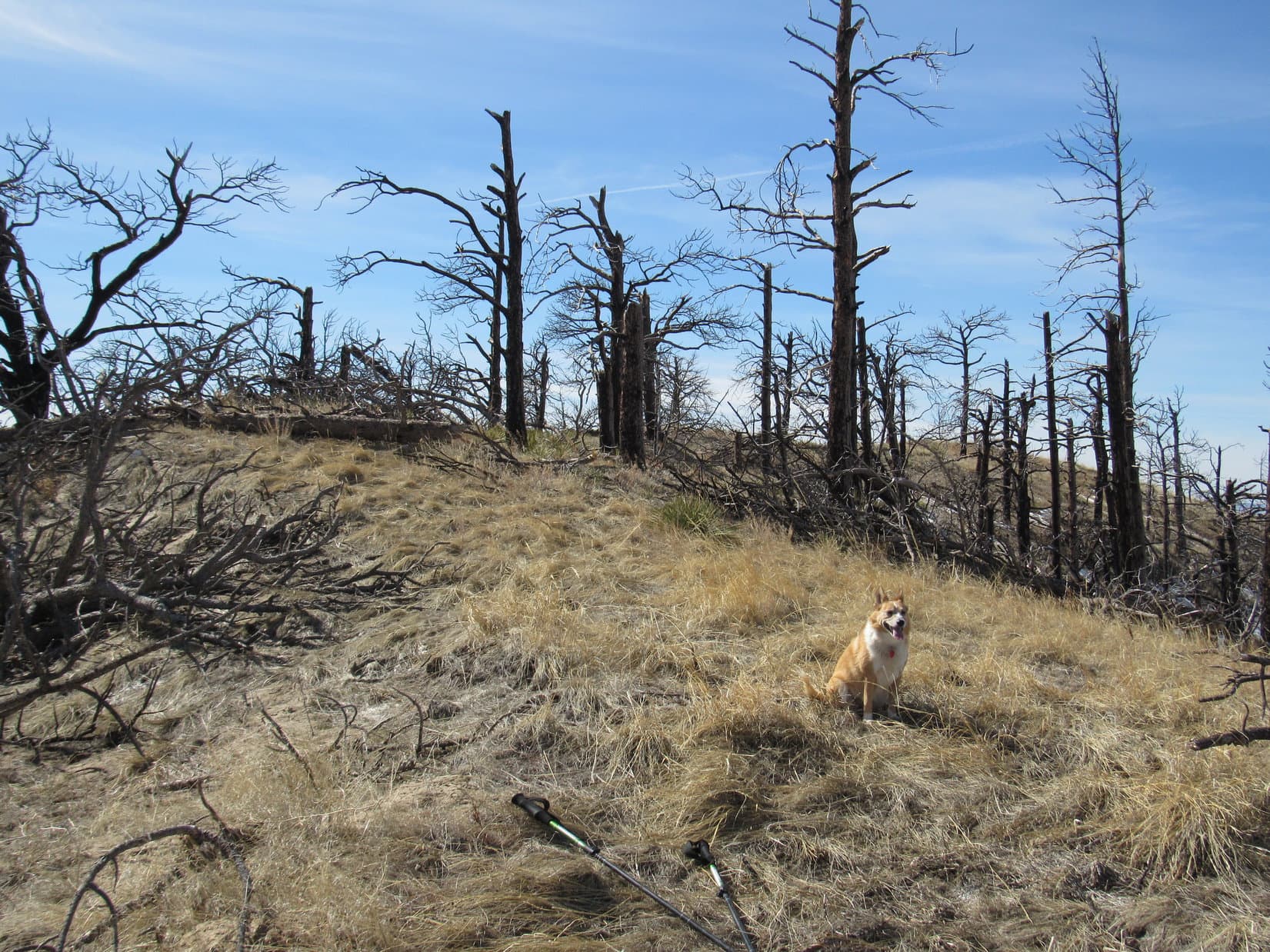
A forest fire had occurred in this region in 2012. Most of the pine trees on Roundtop were dead. Quite a few had fallen over. The deadfall made getting to the summit of Roundtop Peak harder than it should have been, but it still didn’t take Loop long to reach the top of the hill.
First things first! Lupe was ready for a break. Water and Taste of the Wild. SPHP ate an apple. For a little while, Loop and SPHP rested with a grand view of the western Nebraska prairie off to the SE. Then it was time to tour Roundtop’s summit.
Loopster takes a break up on Roundtop Peak. Photo looks WNW.Lupe enjoyed a grand view of western Nebraska prairies and ridges from Roundtop Peak. She could see Sand Creek Road, which is on the way to the Hudson Meng Buffalo Kill by vehicle. Photo looks SE.Loop at the true summit of Roundtop Peak, which was very close to the E edge of the hill. Photo looks E.A dead pine tree was at the true summit. A forest fire ravaged this region in 2012. Sadly, most of the trees on Roundtop were dead. Photo looks ENE.So which one is it, SPHP? Lupe along the S edge of Roundtop Peak’s summit. Wright Peak had to be one of the two high points seen in the distance. The ridge on the L was clearly higher than the sharper peak on the R. Photo looks WSW.The W half of Roundtop Peak’s summit area is in view here. The S side of the mountain hadn’t been hit as hard by the forest fire. Some of the pines at the W end were also still alive. Photo looks WNW.Sand Creek Road and a long piney ridge are in sight looking SW from Roundtop.
From the W end of Roundtop Peak’s summit, Lupe had an excellent view of her remaining peakbagging objectives.
The high ridge on the L is Peak4760. By now SPHP was mistakenly convinced it was Wright Peak, which is actually at Center. Pine Butte (R) was Lupe’s next stop. Photo looks W.Peak 4760 (L) and Wright Peak (R) with help from the telephoto lens. Photo looks WSW.
The summit of Pine Butte(4,500 ft.) is 0.75 mile WNW of Roundtop. It didn’t take Lupe long to get there. Pine Butte had really been hit hard by the 2012 forest fire. Deadfall littered the summit ridge. Not a single pine tree survived. Worse yet, no small trees had germinated since the fire. Pine Butte will not be worthy of its name again for a long, long time.
Looking back at Roundtop from Pine Butte. Photo looks ESE.Pine Butte’s summit ridge had been devastated by the 2012 forest fire. Lupe didn’t find a single living tree, even a small one. Photo looks W.Another look back at Roundtop Peak. Photo looks ESE.The true summit of Pine Butte is near the W end of the hill. Lupe has a grand view of the vast prairie to the NW from here.Peak 4760 (L) and Wright Peak (R) from Pine Butte. Photo looks WSW.
From Pine Butte, Lupe could see the Hudson Meng Bison Kill site buildings. The whole place looked deserted.
Lupe could see buildings of the Hudson Meng Bison Kill site from Pine Butte. Photo looks NW with help from the telephoto lens.
Wright Peak was Lupe’s next objective. The Carolina Dog left Pine Butte going partway down a S ridge before turning WSW. She crossed two gravel roads and a fairly high ridge between them before reaching hills which should lead her to Wright Peak. Once she was high up in these hills, she skirted along the S side of them continuing SW.
Looking back at hills Lupe passed on her way to Wright Peak. Photo looks ENE.
Lupe was now very close to Wright Peak, but SPHP mistakenly believed the American Dingo needed to get all the way to the higher ridge to the SW. This error would never have occurred if the printer had operated correctly this morning. With only SPHP’s crude hand sketched topo map to go on, Lupe and SPHP went right on by the true summit.
All Lupe needed to do to reach Wright Peak was climb the steep slope on the R. However, SPHP now mistakenly believed that the higher ridge on the L was Wright Peak. Photo looks SW.
It was an interesting trek nonetheless. Lupe arrived up on the higher ridge to find several high points along a series of small rock formations spread out over a relatively large area. All of these high points were nearly equal in elevation, but the one farthest S seemed perhaps a little higher than the others. Lupe and SPHP repeatedly searched around all these high points looking for the Wright survey benchmark, but found nothing. Lupe was actually on Peak 4760.
Lupe reaches the first high point that SPHP thought might be the summit of Wright Peak. However, Lupe was actually on Peak 4760 here. Photo looks SW.Lupe at the SSW end of Peak 4760. Photo looks SSW.Lupe helped SPHP search for the Wright survey benchmark, but found nothing. Photo looks S.Well, it’s quite a wonderful view whether this is Wright Peak or not, don’t you think, SPHP? The only bad thing is, I still don’t see any bison. Photo looks SW.
Looper and SPHP stayed up on Peak 4760 a little while. Not too long, though. The sun was getting low, and it was a long way back to the G6. There was a need for some speed on the return trip, so Lupe wouldn’t get lost down in the Big Cottonwood Creek canyon after dark on the way back to Toadstool Geologic Park.
Since she was in a hurry, Lupe didn’t go back through the hills the way she had come. Instead, she took a grassy road (USFS Road No. 944) that led down a draw. The draw ultimately fed into the larger Sand Creek drainage. This was a faster route, but didn’t bring Lupe close to the real Wright Peak again. So the Carolina Dog never got to climb it, even though SPHP now suspected the truth.
Lupe on her way down off Peak 4760. Photo looks W.Pine Butte (L) and Roundtop Peak (R) from the E slopes of Peak 4760. Photo looks ENE.The NE end of Peak 4760’s summit area. Photo looks NW.
When Lupe reached Sand Creek Road, she headed ESE. She soon saw an intersection with USFS Road No. 918 ahead. Loop cut over to No. 918 and followed it over the little pass between Pine Butte and Roundtop.
Lupe by a couple of rusty looking water tanks NW of Roundtop Peak. USFS Road No. 918 goes right by these tanks. Photo looks NE.
Once N of Roundtop Peak, the rest of the journey back simply retraced Lupe’s earlier route to Roundtop. It was a beautiful evening. Both Loop and SPHP had a wonderful time. Enough light remained to navigate the muddy Big Cottonwood Creek crossings and avoid the cacti when Lupe reached the badlands again.
The sun was down by the time Loop was back at Toadstool Geologic Park. As twilight faded, Lupe completed the rest of the Fossil Loop Trail, which brought her back to the campground. (7:23 PM, 47°F) It was a long drive home from here, but the fun wasn’t entirely over yet. Until she reached Hwy 71 again, Lupe stood on SPHP’s lap, her head out the window, barking happily at unseen black cows sniffed on the night air.
Lupe N of Roundtop Peak on the way back to Toadstool Geological Park, Nebraska 3-14-18