Black Hills, SD Expedition No. 209 – White Tail Peak (10-1-17)

Start – 10:57 AM, 52°F, intersection of South Rapid Creek Road (USFS Road No. 231) & USFS Road No. 191.

Lupe’s summer of 2017 adventures were over.  Her friend, Australian adventurer Luke Hall, who had recently paid her a visit here in the Black Hills, was gone.  Things were finally back to normal!  For the first time since early June, it was just Loopster and SPHP setting out on a Black Hills, SD expedition.

This expedition was looking promising, too!  Cows, so many beautiful cows, were right here near the start!  Lupe was thrilled.  The cows less so.  In fact, they looked on with deep concern.  Wasn’t that one of those ferocious American Dingoes?!

Expedition No. 209 was getting off to a promising start. Look at all those beautiful cows! Lupe was thrilled! Photo looks E.
Looking the opposite direction from the cows up the valley of the South Fork of Rapid Creek. USFS Road No. 231 is seen on the R. Photo looks W.

The cattle needn’t have worried.  They didn’t get chased, barked at, or devoured.  Instead, SPHP started SSW on USFS Road No. 191, leading Lupe up Long Draw.  When Lupe reached an intersection 0.5 mile later, she turned W on No. 191.1A.

At the start of USFS Road No. 191.1A in Long Draw. Photo looks W.

In the next 0.5 mile, No. 191.1A curved S, then W again.  Lupe reached another junction.  She had been this far once before over 2 years ago on Expedition No. 138.  That time she’d stayed in Long Draw, continuing W on No. 191.1A.  This time, just for something different, she turned SSW up Lessering Draw on No. 191.1C.

Near the start of Lessering Draw. Looper yawns waiting for SPHP to get on with it and snap the shot! Photo looks SSW.

Lupe had seen a small stream in Long Draw.  A tiny, trickling tributary of it was here in the lower end of Lessering Draw.  When the road entered a pine forest, Lupe spotted an abandoned cabin near the tiny stream.  The Carolina Dog went to investigate.

Checking out the old cabin in Lessering Draw. Photo looks SSW.

SPHP wouldn’t let Looper go inside the old cabin for fear of rusty nails or broken glass, but she did peer in to see what it was like.  “Dilapidated” pretty much sums it up.  Clearly, many years had passed since this cabin was inhabitable, even in the most rustic sense of the word.

Lupe returned to No. 191.1C continuing SSW.

Not far from the old cabin, Lupe re-emerged from the forest.  The road curved W passing through a lovely large meadow surrounded by low forested hills.  Aspen trees, greatly in the minority along the edge of the pines, were showing a bit of fall color.
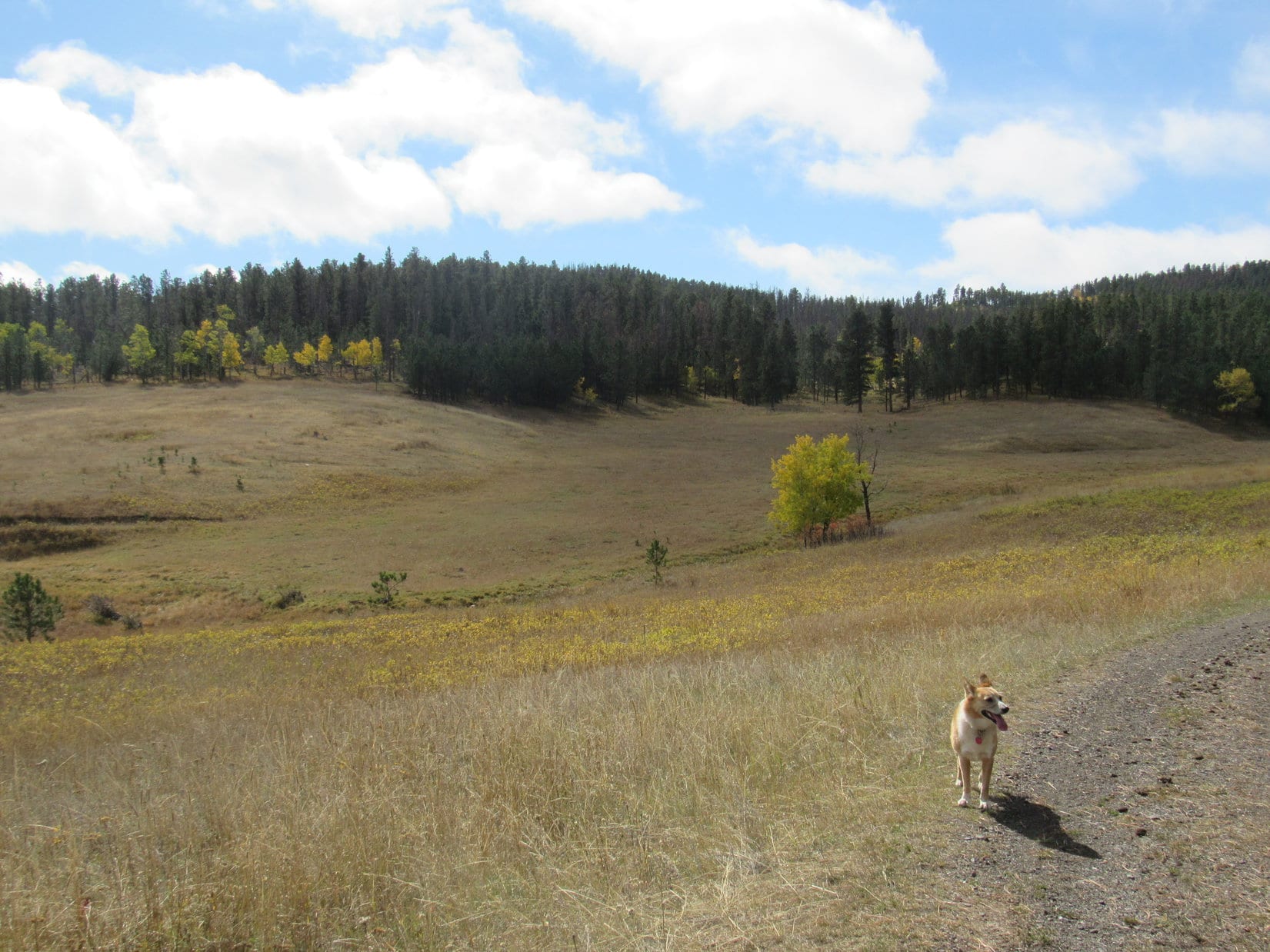
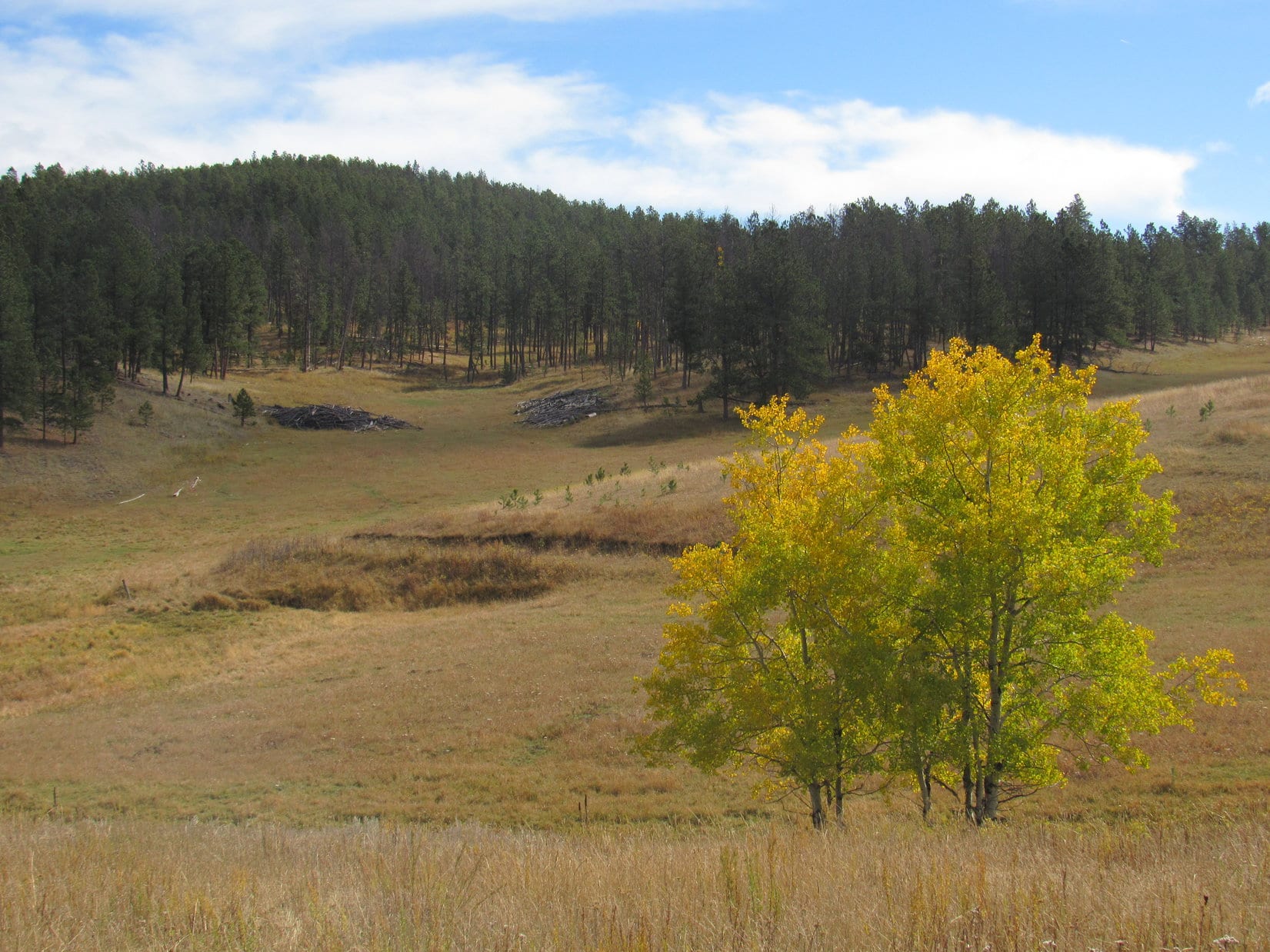
Beyond the old cabin, Lupe reaches a large meadow. Aspen trees were beginning to show a little fall color. Photo looks SW.
A bit farther on, another view of the same meadow. Photo looks ESE.

As Lupe proceeded through the meadow, No. 191.1C faded away to little more than a grassy track.  At the far end was a barbed wire fence.  An opening in the fence brought Lupe to USFS Road No. 125.

Lupe reaches USFS Road No. 125. The big meadow she had come through in Lessering Draw is still in view on the L. Photo looks ESE.

The Carolina Dog and SPHP continued W on No. 125.  The road passed through a narrow, forested part of upper Lessering Draw, which soon divided.  Lupe stuck with No. 125, as it curved N up one of the ravines to a minor pass.

Right at the pass was a barbed wire fence running roughly SW/NE.  Lupe went over a cattle guard to get past it.  (American Dingoes are highly skilled at crossing cattle guards!)  From here, No. 125 went N down the other side of the pass.  SPHP surmised it was heading for Maitland Draw.

Lupe needed to go more W than N.  White Tail Peak (6,962 ft.), her objective for the day, was 1.5 miles WNW of the pass.  Lupe left the road to follow the fence line WSW up a forested slope.  Upon reaching a ridge, she abandoned the fence to follow the ridge NW toward High Point 6346.  On the way, White Tail Peak came into view.

Nearing High Point 6346, Lupe gets her first view of White Tail Peak on Expedition No. 209. The summit is on the R. The mountain’s long SE ridge extends all the way to the L. Photo looks WNW.
Loopster astride High Point 6346. Peak 6962 is seen in the distance. Photo looks SW.

Loop easily leapt up onto the rock formation at the top of the ridge.  She stood astride High Point 6346.  That done, she pressed on to the NW toward White Tail Peak.  She was looking for the easiest way to get there with minimal elevation loss.  As it turned out, she could soon turn W toward the mountain without having to lose much at all.  She even came across a road leading W.  The road soon forked at Point 6424.

The road Lupe had been following was USFS Road No. 190, which angled NNW from here.  A side road going SW was marked No. 190.1A.  Lupe and SPHP had been on No. 190 before on prior expeditions to White Tail Peak.  Lupe could eventually work up and around to the summit that way.  A more direct route, though, would be to scale the mountain’s SE slope.  Today, Lupe had a special reason for doing so.

It looked feasible.  Lupe and SPHP left both roads behind, heading NW up a grassy slope of open forest.  Scattered deadfall provided the only obstacles.  The Carolina Dog purposely headed for the area between the mountain’s short and long SE ridges.  After traveling some distance, Lupe arrived at the edge of a golden forest.

Lupe arrives at the golden forest SE of White Tail Peak.
At the edge of the golden forest (R). The ridge beyond Lupe is part of White Tail Peak’s long SE ridge. Photo looks W.
Happy Lupe in the forest of gold.

Lupe happily sniffed her way through the magical forest of gold.  Above the golden forest, her climb steepened.  Would she would encounter a blocking line of limestone cliffs?  SPHP knew cliffs rimmed large portions of the upper E and S sides of White Tail Peak.

No cliffs appeared.  The American Dingo’s ascent didn’t even get all that steep before the terrain started leveling out again.  Lupe came to a faint road.  She followed it a little S, reaching a line of ragged limestone outcroppings.  This had to be it!  The spine of White Tail Peak’s long SE ridge.

Lupe reaches the limestone spine of White Tail Peak’s long SE ridge. Photo looks S.

This was Lupe’s 4th Black Hills, SD Expedition to White Tail Peak.  Yet to SPHP there had always been something lacking on her prior visits.  Long ago, so long ago it had been before there was a Carolina Dog, SPHP had been here alone.  Tattered, cobwebbed memories existed of a grand viewpoint at the end of a long march S.

To SPHP those memories were the essence of White Tail Peak.  SPHP had always wanted Lupe to see those sweeping views, but she had never run across them again.  Were the memories real, dreams, or confused with some other place?

On all of her prior expeditions here, Lupe had visited a limestone ledge SE of the summit where she’d enjoyed some very nice views.  However, they had never seemed as dramatic as SPHP’s old memories of White Tail Peak.  A sense of disappointment always lingered.

On one occasion, Lupe had specifically gone looking for the site of SPHP’s old memories.   Somewhere W of her usual limestone ledge, she’d found a much longer ridge going S.  Her exploration of it revealed some different vantage points.  However, none seemed familiar or measured up to SPHP’s expectations.  This wasn’t the place, either.

Today the plan was for Lupe to find out the truth.  SPHP had never allowed her to do a truly thorough search before.  And most helpfully, for the first time, SPHP had brought along a topo map.

The topo map revealed that White Tail Peak has 3 ridges protruding to the S – a short SE ridge, a long SE ridge, and a long SW ridge.  Studying it had convinced SPHP that Lupe had never been to White Tail Peak’s long SE ridge.  The long ridge she had visited must have been the long SW ridge.  The other times she had only been to the limestone platform near the end of the short SE ridge.

Her successful ascent from the SE up a visible gap between ridges made SPHP confident Lupe now stood on the long SE ridge’s limestone spine right at this very moment!  All that remained was to follow the ridge however far S or SE it went.

It was exciting to think Lupe was on the verge of discovery!  First, though, SPHP thought it best to go find White Tail Peak’s non-descript summit.  May as well make certain of locking in a successful full ascent before doing anything else.  Peakbaggers think like that.  Instead of going S, Lupe followed the faint road N.

Within minutes, the American Dingo reached a junction.  Ahh, so this was the turn SPHP had always missed or dismissed before!  Lupe was practically at the summit, it was only 100 feet to the NW.  She went up to claim her peakbagging success.

Lupe reaches the flat, non-descript true summit of White Tail Peak. It’s possible to drive right to it from the N on an ATV. Photo looks N.

Lupe had visited the short SE ridge every other time she’d come to White Tail Peak.  Though the views didn’t completely measure up to SPHP’s old memories, they were still impressive for the Black Hills.  It wasn’t far away.  Lupe might as well go take another look at them while she was here.  It was tradition now!

On the winding road leading from the summit to the viewpoint at the end of the short SE ridge.

Looper and SPHP followed a familiar winding road SE through an immature pine forest.  A few minutes brought Lupe to her usual White Tail Peak viewpoint.  Time for a break and a look around.  This was still a favorite place!

The view to the NE from the short SE ridge.

SPHP relaxed munching an apple.  Lupe devoured Taste of the Wild.  Water for all, though it wasn’t much needed.  The day had gone from mostly cloudy to overcast and noticeably cooler than before.  While Lupe and SPHP watched, even lower clouds streamed in from the NW.  A chill breeze blew way up here.  The incoming clouds were low enough so wisps of fog sailed by.

The low gray clouds were all part of one huge one.  The monstrous cloud fanned out rapidly, spreading gloom across the Black Hills.  Sunshine fled its influence, retreating far to the SE.  The apple gone and Lupe satisfied, it was time for a few photos.

Looking N from the short SE ridge.
Looking SW. Lupe had come up somewhere over on the now somewhat foggy ridge seen here, which had to be part of White Tail Peak’s long SE ridge.
Lupe stands on a narrow rock pathway leading to the last limestone platform at the end of White Tail Peak’s short SE ridge. Photo looks SE.
At the very end of the short SE ridge. Photo looks SE.
Same view with a little help from the telephoto lens.

The photo session over, Lupe and SPHP left the short SE ridge, retreating NW back to White Tail Peak’s summit.  Enveloped in a thickening fog, the mountain was growing colder and gloomier by the minute.

Good grief!  After coming all this way, suddenly there wasn’t any point in exploring the mountain’s long SE ridge.  Even if it led to the views SPHP remembered, Lupe wasn’t going to be able to see a thing.  Disappointment reigned.

Nothing could be done about it.  May as well forget about the whole thing.  Another time.  Would have had some nice fall colors, too.  Should have gone there first!  Sigh.

Reluctantly, SPHP led Lupe on the road N, away from the still unexplored long SE ridge.  May as well head for USFS Road No. 190.  It would take her E down off the mountain.  Maybe Lupe could explore some sort of an interesting loop on the way back to the G6?

Lupe went all the way N to No. 190, and began following it E.  She’d already lost some elevation, and was about to lose a bunch more, when suddenly the sky brightened.  Uncertain, Lupe and SPHP paused.  The trend continued.

Apparently conditions weren’t going to continue deteriorating after all.  It wasn’t going to be so bad.  The monstrous cloud wasn’t as dark or low as before.  The breeze was dying down and the air felt warmer.  Maybe Lupe could see something from the long SE ridge after all?

Worth a shot.  Back Lupe went.  To the summit again and beyond.  Lupe made the turn onto the faint road, which wasn’t so faint near the intersection.  She reached the limestone spine of the long SE ridge where she’d been before.

OK, this was it!  The moment of discovery was at hand.  Lupe explored S.  Up and down, onto and off of the discontinuous limestone spine.  Multiple times.  For a while, the forest hid everything.  Lupe went on, now heading SE.  She lost elevation, but not too fast.  Didn’t this have to be it?

Then there it was.  A first small limestone ledge with a view to the SW, a view worthy of what SPHP remembered.  Lupe was on the right track!  Naturally, she went over to see this glorious sight.

Lupe reaches the first small limestone ledge along the long SE ridge with a view like SPHP remembered from long ago.

To the SW, Lupe saw a broad canyon, created over eons by the North Fork of Castle Creek.  The creek wasn’t visible, but far below aspen trees glowed with the fleeting glory of early autumn.

Across the gaping canyon was Peak 6962, a remote mountain so alike to White Tail Peak (6,962 ft.), the summit was even the exact same elevation.  Just below its forested upper reaches, limestone cliffs extended around the N and E edges of the mountain.  Cliffs like those Lupe now perched above.

Peak 6962 (L) is the long, forested cliff-rimmed ridge on the far side of the gaping canyon of the North Fork of Castle Creek. Far below Lupe’s perch, millions of dying aspen leaves go out in a blaze of glory. Photo looks SW.

Looking SE along the edge of the long ridge Lupe was on revealed a series of similar viewpoints nearby.

Looking along the SW edge of White Tail Peak’s long SE ridge. Plenty more viewpoints were ahead for Lupe to check out before she would reach the end! Photo looks SE.

Traveling onward, Lupe checked out viewpoints along both sides of the long SE ridge.

At another viewpoint a little farther SE. Same basic view with Peak 6962 on the L. Photo looks SW.
Another look from farther back at Lupe’s vantage point. Photo looks SW.
Now out at the very end of the same vantage point. Photo looks WSW.
Still there with Peak 6962 on display across the entire background. Photo looks SW.
Now on the opposite (NE) side of the long SE ridge. White Tail Peak’s short SE ridge, which Lupe had always gone to before, is in view. Photo looks N.
Looking NE toward Custer Peak (6,804 ft.) (Center).
Custer Peak with help from the telephoto lens. Photo looks NE.

At the far SE end of the long ridge, Lupe finally found the big, nearly flat, open viewpoint SPHP remembered.  Even on an overcast day, the panoramic views were fabulous!

Out at the very end of the long SE ridge. Reynolds Prairie is the large grassland far beyond Lupe. Black Elk Peak (7,231 ft.) (L), Green Mountain (7,164 ft.) (R), and many other mountains Lupe has been to are seen on the horizon. Photo looks SSE.
Black Elk Peak (L) on the horizon. Photo looks SE.
Flag Mountain (6,937 ft.) (L) and Peak 6962 (R). Photo looks S.
Canyon of the North Fork of Castle Creek. Photo looks SW.
Looking NW along the ridge.

Perhaps on some bright sunny day, Lupe will return to White Tail Peak for a 5th time to see it all again beneath crystal blue skies.  For now, though, SPHP was content.  Lupe had rediscovered this glorious vantage point overlooking a vast portion of the central Black Hills.  White Tail Peak was everything dim memory had credited and cherished it as.

A cool breeze still blew.  Hours had flown by.  Time for the intrepid Carolina Dog to move on.  Puppy ho!  Lupe headed NW, back the way she had come.

On the way back, still on the long SE ridge. Green Mountain (L) is far on the horizon. Flag Mountain (Center) and Peak 6962 (R) in view closer by. Photo looks S.

As soon as practical, SPHP looked for a way for Lupe to get down off the long SE ridge.  She soon came to one.  Safely down, Lupe roamed the long slope to the SE, passing the same golden forest on her way back to the junction of USFS Roads No. 190 & 190.1A.

Heading down.
Passing the golden forest again.

Lupe had fun on the way back to the G6.  SPHP led her N on USFS Road No. 190 hoping to make a nice loop.  The American Dingo wound up going much farther N than anticipated.  A trail or road shown on the topo map failed to materialize.  An unmarked side road SPHP did try did not turn E as hoped.  Instead it began to fade away somewhere W of High Point 6217.

Enjoying the colorful woodlands.
Heading NNW on USFS Road No. 190. A road or trail shown on the topo map that SPHP was counting on to go E failed to materialize. Photo looks NNW.
A side road off No. 190 that SPHP did have Lupe try kept going N. Here it threatens to fade away completely. Photo looks N.

The failing road had to be abandoned.  Lupe bushwhacked E a long way.  Deadfall slowed progress considerably.  The sun must have set or was close to it.  Light was fading.  Hurry, hurry!

Yes!  A road!  Good deal, and none too soon.  SPHP quickly figured out that it was leading toward Long Draw.  Immediately overconfident again, SPHP had Lupe take a turn into Maitland Draw instead.

In the dim light, Lupe saw, sniffed, or otherwise sensed a presence before SPHP realized it was there.  Cows!  Way out here.  Enthusiastic Lupe streaked off barking.

The American Dingo returned before long, panting hard and apparently well satisfied with her romp.  Certainly more pleased than the annoyed cows had been.

No more of that, Loopster!  It’s getting dark anyway.  Better stay close.

Just grand.  The road didn’t go all the way through Maitland Draw like the map showed!  It turned S instead of staying E.  Maybe that wasn’t so bad?  SPHP suspected Lupe was on USFS Road No. 125.  Sure enough, she reached the cattle guard back up at the minor pass.  The rest of the way to the G6 was known.  Lupe had come this way earlier.  She would soon be back in Lessering Draw.

A curious, and perhaps very sad thing had happened shortly before Lupe reached the minor pass.  At first it seemed simply strange and unexpected.  Lupe had quit barking at the cows some time ago, when suddenly there was an answer!  A wild barking or howling, from off to the NW.

A coyote?  Maybe.  Lupe listened, but showed little interest and did not respond.  After a few minutes, it was not heard any more.  On the long dark trudge back to the G6, SPHP reflected, and eventually felt guilty and sad.  Glittering stars in an ink black sky shone down with a cold, cruel light.

Maybe an answer should have been made?

The more SPHP thought about it, the more that wild sound had seemed desperate.  Perhaps desperately searching.  What if it hadn’t been a coyote?  A poor lost or abandoned dog way out here?  Maybe it had heard Lupe and thinking salvation was at hand, had come running a great distance with soaring hopes looking for her?  If so, the disappointment at not hearing a response, and not knowing which way to turn, must have been crushing.

White Tail Peak had been a great and successful day for Lupe, but the accusatory thought persisted.  Perhaps the day had also needlessly ended as a bitterly cruel one for an innocent, lonely creature in need of help?  The uncertain truth remained somewhere out there, shivering alone in darkness, now miles away beneath eternally uncaring silvery stars.  (End – 7:40 PM, 35°F)

On White Tail Peak’s long SE ridge, 10-1-17

Links:

Next Black Hills Expedition                     Prior Black Hills Expedition

Black Hills, SD Expedition No. 283 – White Tail Peak (11-6-21)

Black Hills, SD Expedition No. 138 – White Tail Peak (9-19-15)

Want more Lupe adventures?  Check out her Black Hills, SD & WY Expeditions Adventure Index, Master Adventure Index, or subscribe free to new Lupe adventures!

Badlands National Park, South Dakota with Australian Adventurer Luke Hall (9-27-17)

Lucky Dingo!  Australian adventurer Luke Hall was staying with her.  For the second day in a row, Lupe was going to get to play host and tour guide.  That could only mean another brand new adventure!

Yesterday Lupe had taken Luke up to Little Devil’s Tower (6,960 ft.) and Black Elk Peak (7,231 ft.), the highest mountain in South Dakota.  Did Luke have any preference on what else he would like to see while still in the Black Hills region?  Yes, he did, actually!  Luke wanted to see Badlands National Park.

That was a great idea!  Although the W end of Badlands National Park is only a little over an hour’s drive E of the Black Hills, Lupe had never been there before, either.  Luke, Lupe and SPHP all piled into the G6.  The miles flew by.  It wasn’t long before SPHP turned onto Sage Creek Road a mile or two E of Scenic, SD.

The W end of the park’s N unit was still miles away, but Luke was ready to get out for a look around.

Australian adventurer Luke Hall on Sage Creek Road, a less frequented route into the W end of Badlands National Park’s most famous N unit. The park was still 10 miles away from here, but Luke wanted to take a look at the prairie lands typical of the surrounding area. Photo looks N.

Once Lupe reached Badlands National Park, a series of overlooks along Sage Creek Rim Road provided increasingly dramatic views.  The first views were of Sage Creek Basin.  The sharply eroded hills and bluffs typical of the Badlands were still a little way off in the distance.

Lupe at one of the first viewpoints inside the park along Sage Creek Rim Road. Photo looks SSE.
The badlands scenery grew more dramatic and impressive at each succeeding viewpoint heading E along Sage Creek Rim Road. Photo looks SE.
Lupe & Luke with another view of Sage Creek Basin. Photo looks SW.

Farmers, ranchers! Don’t let this happen to your property! Lupe stands next to a prime example of an erosion control program gone seriously awry. Photo looks S.

No one had to tell Lupe why this place was called the Badlands.  It was easy to see there wasn’t a snowball’s chance in you know where of finding a squirrel out here!  Most disappointing.  Why on earth had Luke wanted to come way out to this wretched, forsaken land?

The answer was soon apparent.  Hundreds, maybe thousands, of prairie dogs were living in large towns right along the road!  Hundreds, maybe thousands, of fat squirrels right on the ground that couldn’t climb a tree even if there was one?  It was an American Dingo’s dream come true!  Badlands?  Hardly, this place was a Dingo paradise!  Luke was a genius!

Hundreds of prairie dogs could be seen in towns right along the road.

Shockingly, SPHP was a total spoil sport.  This could have been the greatest day of Lupe’s life!  Instead, SPHP refused to let her go after those prairie dogs.  Not even one!  It was maddening.  Sure, those prairie dogs had burrows, but this ground was soft and Lupe is a great digger.  It would have been the most fun ever!

The Carolina Dog had to watch as a badger scurried across the road and disappeared down into a prairie dog burrow.  Luke saw a coyote nearby.  Poor Lupe could only stare out the window of the G6 and dream.  SPHP decided it was best to drive on.

Oh, what might have been, if SPHP hadn’t interfered!

At the Hay Butte overlook, a plaque told about how pioneers had gone to great efforts to hay the grass off of the top of a long, flat butte seen in the distance.  Why they felt compelled to do so was never fully explained.  The Badlands are completely surrounded by prairie.  What was so special about the grass growing on that butte?

It was a mystery of the universe.  Some things can’t be explained, like why SPHP sided with the prairie dogs against the loyal Carolina Dog, a lifelong friend?

A short distance E of the Hay Butte overlook, Sage Creek Rim Road ended at the paved Badlands Loop Road, which winds through the most frequently visited part of Badlands National Park.  Park headquarters and most trails, overlooks, and displays are located along the Badlands Loop Road.

Lupe’s first stop traveling E on Badlands Loop Road was at the Pinnacles overlook, where a couple of short trails led away from the road down to several viewpoints.  Luke went down to investigate.  American Dingoes couldn’t go on any of the trails, but the views were great right up by the road.

At the Pinnacles overlook. Hay Butte is the long, flat butte in the distance on the L with clearly badlandy sides. Luke is a mere speck checking out the views from the end of the trail on the R. Photo looks SW.
The view to the SE from the Pinnacles overlook revealed a sweet, happy Carolina Dog. Abundant weird landforms were seen in this same area, too. Photo looks SE.

Most of the dramatic eroded buttes and spires of the Badlands are horizontally striped with many relatively thin layers of gray, white, or pink soils.  At the Yellow Mounds overlook, however, a thick lower layer of yellow soil capped with red was exposed.  The grays, whites and pinks could still be seen higher up.  In some of the lowest parts of this region, the mounds were completely yellow, since the overlying layers had been eroded completely away.

While the soil colors can appear more dramatic near sunrise or sunset, or especially after a rain, even in sunshine at midday the Yellow Mounds were definitely worth a look.

Luke & Lupe at the Yellow Mounds. Here the yellow soil is seen as a lower layer at the bottom of a small valley. Photo looks NW.
Looking NNE directly across the same valley.
Looking ENE down the same valley. More of the yellow soil is exposed here. One of the smaller lower mounds in the valley is almost entirely yellow.
Yellow mounds were present on the S side of the road, too. Luke gives Lupe a lift to help get her more into the scene. Photo looks WSW.
Lupe enjoyed being toted around the Yellow Mounds area by Luke. Photo looks S.

10 or 12 miles E of the Yellow Mounds, Lupe arrived at a big parking lot next to the Fossil Exhibit Trail, a short loop trail where fossils are on display as originally found.  Luke went to check out the trail, while Lupe and SPHP visited with a park ranger who had just finished a talk on various fossils found within Badlands National Park.

The Badlands are full of fossil-bearing sedimentary rocks.  Fossils of many extinct animals from the Oligocene epoch 23 to 35 million years ago continue to be found here, including:

  • Leptomeryx – a small deerlike mammal
  • Oreodonts – common and sheeplike
  • Archaeotherium – a relative of pigs equipped with sharp canines
  • Mesohippus – an ancestor of modern horses
  • Hoplophoneus – an early saber-tooth cat
  • Metamynodon – a massive rhinoceros
Stark views of the Badlands like this one were common along the Badlands Loop Road.
People wander along the Fossil Exhibit Trail where fossils are on display as originally found. Luke took this trail while Lupe and SPHP stayed at the parking lot chatting with a ranger who had just finished a talk about fossils found in Badlands National Park.

After Luke got back from the Fossil Exhibit Trail, the next stop was at the Ben Reifel Visitor Center.  Lupe couldn’t go in, but Luke and SPHP did, returning with brochures containing maps of the park.  Several short trails were only a few miles away, so it was decided to go check them out.

Lupe had to wait in the G6, while Luke and SPHP went to explore the Window and Door trails.

The very short Window Trail ended at a metal railing at the edge of a deep gully. Across the gully was this view of steep, wild badlands. Photo looks E.
Luke on the Door Trail, which passed through a narrow gap to reach this large area of badlands. Photo looks E.
Luke farther along the Door Trail. A series of numbered posts showed the way. Photo looks SE.
Door Trail. Photo looks NW.
Luke stands near a twisting maze of steep, deep gullies typical of the badlands. Photo looks SE.
Badlands from the Door Trail. Photo looks SE.

The Window and Door Trails provided great views of some wild-looking badlands, but didn’t take long to explore.  After returning to the G6, Luke continued on to explore the Notch Trail. Meanwhile, SPHP stayed with Lupe near the start of the trail.

Lupe enjoyed being out relaxing in the dry grass, surrounded by the beauty of the Badlands.

Lupe relaxes in the dry grass near the start of the Notch Trail while waiting for Luke to return. Photo looks ESE.

Luke was gone quite a while.  People who had left after Luke did started returning.  When SPHP inquired, two groups they said they had been all the way to the Notch at the end of the trail.  Both groups had taken 40 to 45 minutes to make the round trip.

Lupe kept waiting.  Eventually Luke reappeared.

Luke returns from the Notch Trail. Photo looks SSE.

Of course, Luke had made it to the end of the Notch Trail, too.  He enjoyed the walk and the views, but especially the extra time he’d spent scrambling around on the Badlands formations.

The Badlands aren’t high at all by mountain climbing standards, but scrambling among them is tricky and potentially treacherous.  The very steep sides of the formations are often loose and crumbly.  Exercising considerable caution, Luke had successfully made it to the top of some of the highest formations near the Notch.

Near the start of the Notch Trail. Photo looks E.
View along the Notch Trail on the way to the Notch.
Luke up on top of Badlands formations near the end of the Notch Trail. Photo looks SE.
Looking SE. Most of the Badlands lie along a long, relatively narrow area. Views of the surrounding prairie are never far away.
Looking SW. The area near the Ben Reifel Visitor Center is on the far R.
Looking E.
Looking NW.

It was evening and time to start back when Luke returned.  SPHP drove W back along the Badlands Loop Road.  Lupe saw lots of animals to bark at from the G6.  Pronghorn antelope, a buffalo, and bighorn sheep all got the enthusiastic Dingo treatment as Lupe sailed on by.

Lupe got to make a few stops to enjoy the scenery along the way, too.

Scenery on the drive back W along the Badlands Loop Road.
Slanting evening light highlights the sharply eroded Badlands terrain.
Loopster enjoys a short outing along the Badlands Loop Road. Photo looks WNW.

The sun was sinking fast.  Lupe, Luke and SPHP stopped at Panorama Point for a final look at the Badlands before it set.  The evening was beautiful, and the sweeping views simply magnificent.

Approaching sunset from Panorama Point.
Australian adventurer Luke Hall at Panorama Point. Photo looks E.
Lupe, Luke & SPHP watched the sun set behind a distant jagged Badlands horizon.
Luke takes a photo from Panorama Point before the last rays of sunlight disappear.
Looking E from Panorama Point with help from the telephoto lens.
Lupe’s beautiful day in Badlands National Park draws to a close.

The sun disappeared from view.  Lupe’s beautiful day in Badlands National Park with her friend Australian adventurer Luke Hall was over.  It was her last big adventure with Luke before he would set out for Grand Teton and Yellowstone National Parks in Wyoming.

It was sad to think that Luke would be leaving soon, but Lupe and SPHP were both glad that he had taken the time to come and visit the Black Hills and Badlands of remote western South Dakota.

Lupe at Panorama Point, Badlands National Park, 9-27-17.

Links:

Black Hills, SD Expedition No. 208 – Little Devil’s Tower & Black Elk Peak with Australian Adventurer Luke Hall (9-26-17)

Luke Hall’s travel & adventure blog

Badlands National Park

Want more Lupe adventures?  Choose from Lupe’s Dingo Vacations Adventure Index or Master Adventure Index.  Or subscribe free to new Lupe adventures.