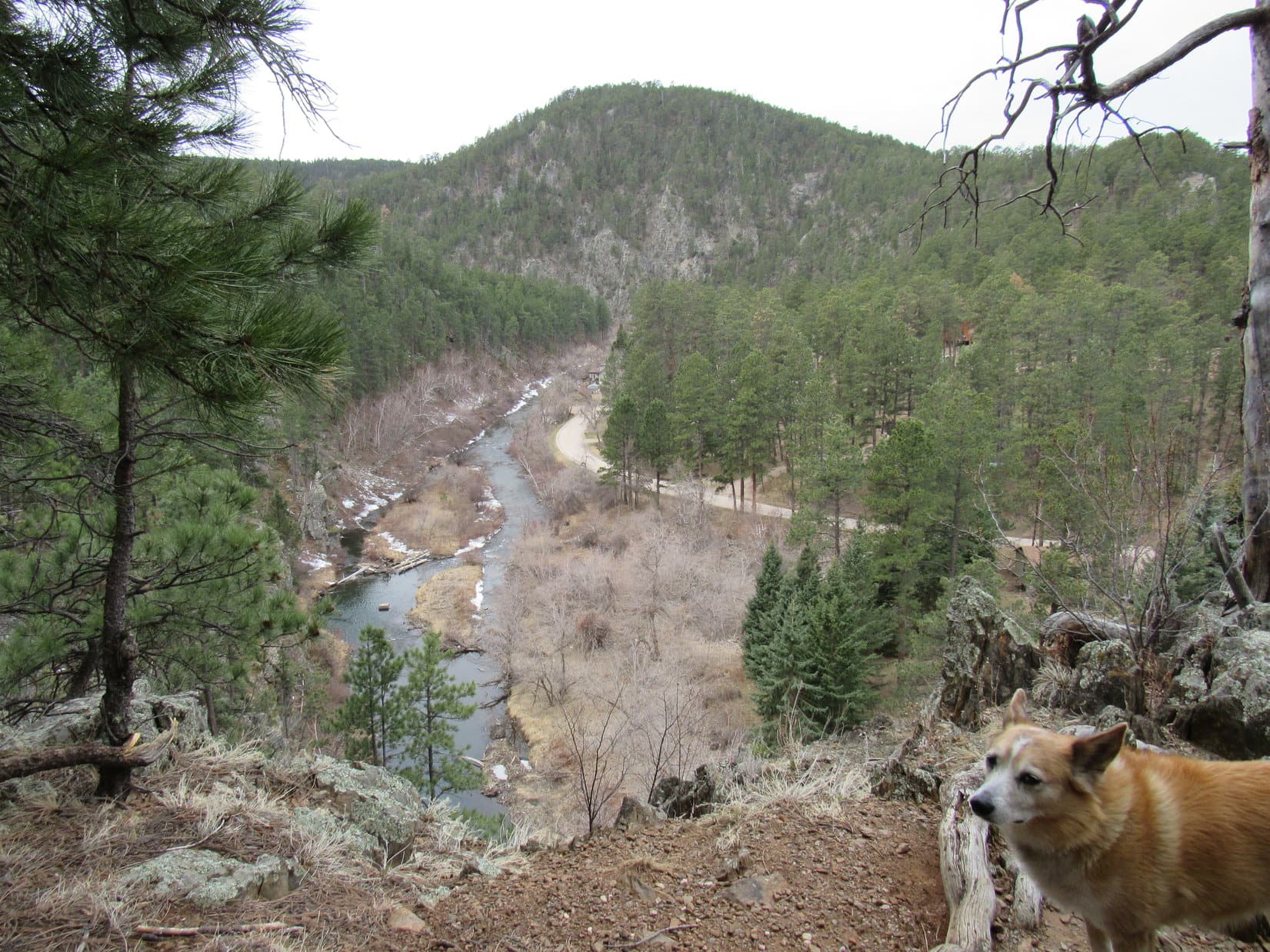
Black Hills, SD Expedition No. 276 – Making It or Faking It on Peak 6360? (4-18-21)

9:10 AM, 44ºF, Spring Creek Road W (USFS Road No. 305) –

This is really cool, SPHP!

You can say that again, Loopster!  Going to be downright frigid!

After parking the G6, Lupe and SPHP had taken a short walk up the road.  A wall of rock on the other side of Spring Creek had inspired Lupe’s reaction.  No bridge across the stream had inspired SPHP’s.

Parked just off USFS Road No. 305 near Spring Creek. Photo looks S.
A gorgeous spot from which to start Expedition No. 276! Photo looks S.

SPHP took another look at the topo map.  Yeah, this had to be the place, didn’t it?  Did appear to be some sort of faint road on the other side of Spring Creek.  Kicking boots off, SPHP waded across the stream.  Not hard, not deep, but numbingly cold.

C’mon over, Loop!

Lupe ran anxiously back and forth along the bank, but refused to brave little ole Spring Creek.  No amount of encouragement could persuade her to make the plunge.  SPHP sat down, and started putting boots back on.  Suddenly, Loop was right here!  A tree trunk formed a partial bridge a little upstream, maybe she had run across it?  Whatever she’d done, the Carolina Dog looked pretty pleased with herself.

Oh, aren’t you the foxy one, Miss Dry Paws?

Miss Dry Paws, safely across Spring Creek.

An adventure right off the bat!  Ready, Looper?  Let’s find out what else Peak 6360 has in store for us!

Loopster turned and trotted up what SPHP hoped was what remained of USFS Road No. 305.1H.

By Spring Creek, about to set off for Peak 6360! Photo looks S.

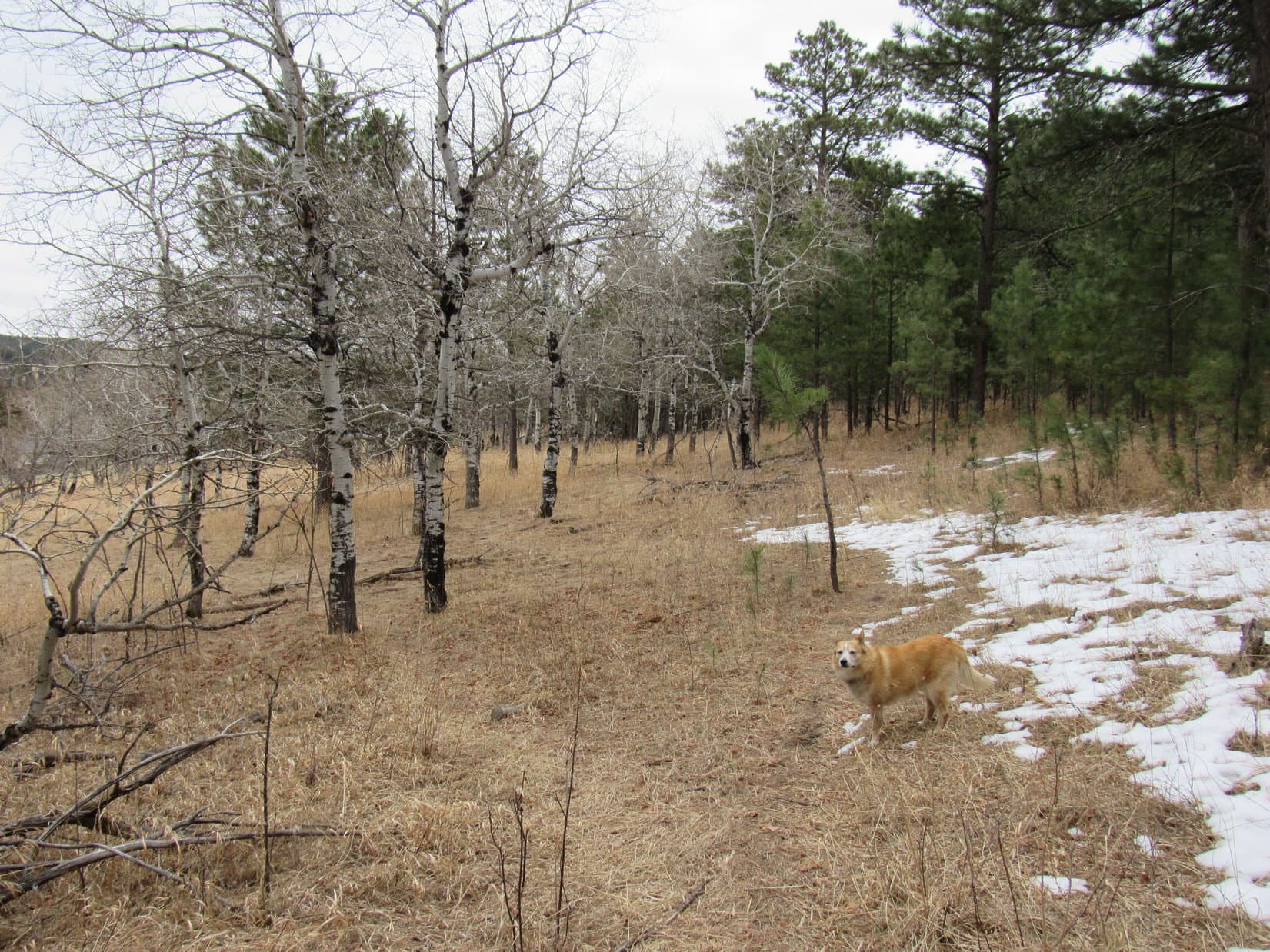
Up a little rise, and the road leveled out in a meadow.  For a moment it seemed the road had already vanished, but Lupe quickly found it again heading WNW up a little valley past a stand of naked aspens.  No. 305.1H must have been abandoned a long time ago.  Among the aspens stood the remains of an ancient cabin that had been, too.

In the meadow. Photo looks W.
Wow! This cabin has been here a while! Photo looks WNW.

Just past the cabin, the road made a big snowy curve S, starting to climb out of the valley along a forested hillside.  Matched up perfectly with the map.  This was USFS Road No. 305.1H, alright!

Leaving the valley. Photo looks SSE.

Passing tall pines and spruce, the air was comfortably warm, but a light breeze sometimes carried a fresh coolness aloft.  Still snow-covered, the road soon turned E.  Lupe trotted ahead without ever breaking through the crust, while SPHP plodded along behind.

Wonder how long it’s been since anyone’s been back here, SPHP?

No telling, Loop.  Seems super secluded, doesn’t it?

Rounding the E end of a ridge, USFS Road No. 305.1H curved WSW along the N edge of a hidden valley.  Scattered pines and a stand of tall aspens decorated a grassy lowland enclosed by forested ridges.  Snow clung to the N slopes.  Large rock formations could be seen at several high points way up on the ridgelines.  Peak 6360 was somewhere up there!

What an awesome place, SPHP!  This is amazing!

I’ll say!  No one ever sees this, Loop.  We are so lucky!

Entering the hidden valley. Photo looks SW.
Isn’t this magnificent? I’m loving it! Photo looks SSE.

No. 305.1H wound along the N, then W edge of the valley.  A junction where USFS Road No. 305.1K continued S, and No. 305.1H curved away to the W, was barely recognizable.  Lupe got on No. 305.1K, following the road until it faded away near the S end of the wonderful valley.

Skirting the valley on USFS Road No. 305.1H. Photo looks SW.
Rounding a snowy curve on USFS Road No. 305.1K. Photo looks SSE.
Heading for the S end of the valley. Photo looks SSE.

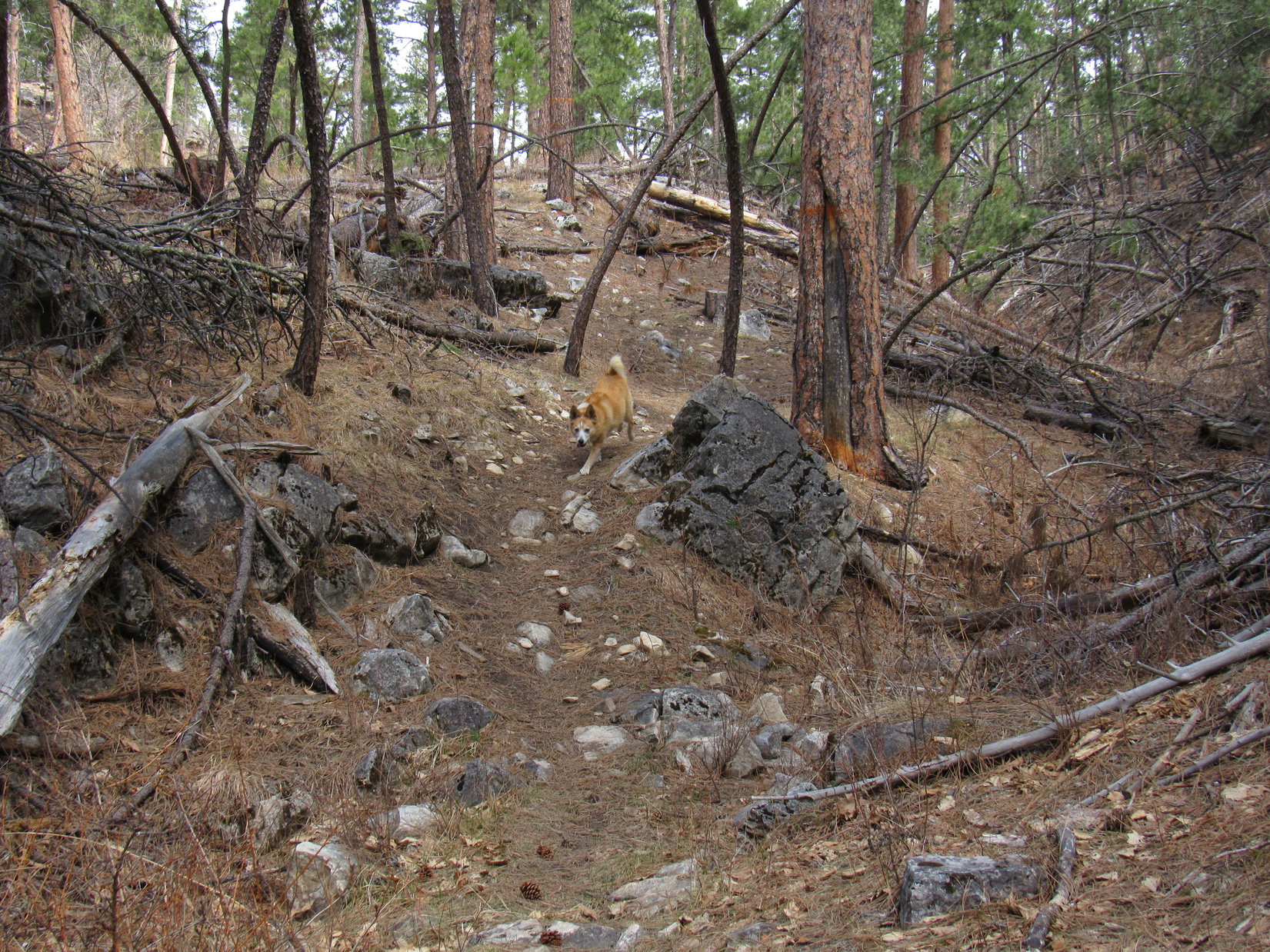
No. 305.1K was on the E side of the valley, just starting to climb, when it finally disappeared completely.  A huge rock formation way up on the ridge looked like it might be a problem to get around, so Lupe began her ascent of Peak 6360 aiming S of it.  A modest amount of deadfall during the initial part of the climb soon became a wretched relentless jumble.

Enthusiasm was not dimmed.  SPHP toiled after her, as Lupe leapt over one obstacle after another.  Views kept improving.  The sense that Peak 6360 might prove to be a spectacular summit by Black Hills standards kept growing.

Starting to climb as USFS Road No. 305.1K vanishes. Photo looks SSE.
Making progress! Photo looks SW.
The indomitable Dingo! Photo looks NE.

The climb took an inordinate amount of time for the amount of distance covered, but the steepness eventually began to diminish.  Lupe reached the ridgeline right where she’d been aiming, a little S of the big rock formation.

Crossing the narrow ridge, the American Dingo came to a gorgeous view of Saint Elmo Peak (6,458 ft.) and Black Elk Peak (7,231 ft.).

Saint Elmo Peak (L) and Black Elk Peak (R of Center). Photo looks ENE.

Wowee!  What a fabulous view, SPHP!

Yeah, it’s incredible, Loop!  This is a new perspective!  Seems different from what we’ve grown used to, doesn’t it?

It does!  Can’t wait till we get to the top!  Wonder what we’ll see then?

The top of Peak 6360.  A gnawing fear had existed ever since Lupe first saw this ridge from way down in the hidden valley.  All these big rock formations up along the ridgeline!  If the summit was like that, some huge vertical clump of stone, getting to the top might be an issue.  Peak 6360 might be beyond the Carolina Dog’s capabilities, and that would be really sad, especially when this whole experience had been so fabulous so far.

Lupe was high on Peak 6360’s N ridge, and probably not too far from the summit.  A glance to the S only reinforced the fear of possible failure.  3 rock formations dominated the view.  The 2 closest were spiky, but of no concern, since they clearly weren’t the top.  The most distant formation, which might well be the true summit, was different.  From here it looked exactly like “some huge vertical clump of stone”.  Not good!

Looking S along the ridgeline. Potential summit visible near Center beyond Lupe.

Loopster!  Scramble up on that closest spiky formation.  Let’s see how things look from there.

Hmm.  Not any better.  The view from the first spike only reinforced the notion that Peak 6360 might well be nigh impossible for a Dingo without genuine rock climbing skills.  Looking back N at the rock formation Lupe had avoided by coming up S of it wasn’t much of a confidence booster, either, if that was a sample of what lay ahead.

Looking pretty dicey, SPHP! Peak 6360 summit(?) (Center). Photo looks S.
The rock formation (Center) that Lupe skipped by reaching the ridge on this side of it. Photo looks N.

Hard to say.  Maybe it wasn’t as bad as it looked?  Closer inspection was in order.  Picking a way slowly through the interminable deadfall, Loop continued S, working up to and past the 2nd spike.

Be of good cheer! We’re gonna do this! Approaching the 2nd spike. Photo looks S.

Ugh!  More big rocks, more deadfall ahead.  The summit block looked more intimidating with each step toward it.

Past the 2nd spike, a somewhat disheartening view. Photo looks S.

Peak 6360 was still very cool, though!  Although problematic, the rock formations were beautiful and unique.  In addition to Saint Elmo Peak and Black Elk Peak, Lupe had a grand view of Elkhorn Mountain (6,381 ft.), Gap Lode Peak (6,560 ft.), Little Devils Tower (6,960 ft.) and Sylvan Hill (7,000 ft.), too.

Saint Elmo Peak (far L), Elkhorn Mountain (L), Black Elk Peak (Center), Little Devils Tower (R), and Sylvan Hill (far R). Photo looks ENE with help from the telephoto lens.

11:43 AM, 52ºF, Peak 6360 – The sky had been clear, a bright blue, when the Carolina Dog set out from Spring Creek, but was mostly cloudy now.  Sort of surprising, since the forecast yesterday had been for clear skies all day.  Every few minutes, the situation changed from sunlight to shadow or back again.

Lupe had made it to a patch of grass at the intersection of Peak 6360’s 3 main ridges.  A glorious spot, but the news could hardly be worse for a peakbagging Dingo.  The N ridge was of no concern.  That was the way Loop had come up.  The true summit clearly wasn’t anywhere along it.

The main problem was just to the SE, right at the start of Peak 6360’s long E ridge.  That “huge clump of stone” Loop had seen from the N ridge did appear to be the true summit.

Not happening, is it, SPHP?  Looks impossible!

Yeah, sorry Loopster!  Most disappointing, but not entirely unexpected as we have seen.  Doesn’t appear to be much hope that the other side is any better, either.  Probably worse.

500 or 600 feet out on the SW ridge was another, smaller high point.  Might have been a glimmer of hope for Loopster, since it looked to be possibly in contention for title of true summit, but to be honest, it didn’t really look like it from here.  Had to be close, though!

Cold comfort!  The SW high point appeared to be a tight collection of long rocks standing on end.  “Fail” written all over it, too.

Peak 6360’s SW high point (R of Center). Photo looks SW.

Well, might as well see what we can do here, Loop.  Looks like you can get pretty close to the top.  Maybe there actually is a way up?

The American Dingo headed for the E summit block and began to climb.

Loopster got pretty high, but not all the way to the top.  A snow-covered shelf on the N side of the formation was as far as she could go.

As high as Loop got on the E summit block. Photo looks WNW.

SPHP had tagged along, of course.  No way to boost Lupe any higher.  The rock walls were simply too tall.  No safe route back, even if she could get higher.  Yeah, this was it.

How much farther is it to the top, SPHP?  Can you tell?

Eh, I’d say at least 10 feet, Loop, no more than 20.

So, what now?

Guess we’re done.  No sense breaking our necks doing something stupid.  Stay here, I’ll go back down and take your picture.

As SPHP turned to head down, a sudden gust of wind ripped SPHP’s hat off.  It went tumbling down the S side of the rock formation.

My Alaska cap!

Can you still see it, SPHP?

Yeah, about 15 feet down.

15 feet!  Can you still get to it?

Not from here, Loop!  However, looks like I can climb up to it from down around the S side.  Anyway, stay where you are.  I’ll get that picture!

As high as Lupe got on the E summit block. Photo looks SE.

Alrighty!  Got it!

Lupe came bounding down, rejoining SPHP at the little grassy patch.

Shall we go get your cap, SPHP?

Naw, not yet.  It’s on the lee side now, so it isn’t going anywhere for the time being.  Let’s take a break.

A chocolate coconut bar.  A little Taste of the Wild.  That was about it for refreshments.  The sky darkened.  A few snowflakes sailed by.  Nothing serious.  Lupe and SPHP sat on the grass contemplating the unbeatable E summit block.  In addition to the magnificent views to the ENE, there were interesting sights in other directions, too.

A line of big ridges along the E edge of the limestone plateau country was visible off to the W.  Some of the highest ground in the Black Hills was over that way.  The fire lookout tower on Bear Mountain (7,166 ft.) was visible to the naked eye, but didn’t show up on a photo.  Zimmer Ridge (6,600 ft.) was 3 miles NNE.

The break area is the patch of grass seen on the L. Photo looks NW.
Bear Mountain (R). Photo looks W with help from the telephoto lens.
Zimmer Ridge (Center). Photo looks NNE.

Cap time, SPHP?

Yeah, let’s go get it.  Don’t want to lose my Alaska cap!

To get to the cap, Lupe first had to go down the S side of the ridge a little way.  The views in this direction were also quite impressive!  Wasn’t that Northeast Cicero Peak (6,240 ft.) on the far horizon?  SPHP was almost certain it was.  Lots of rugged terrain closer by, too.

Northeast Cicero Peak (Center) on the far horizon. Photo looks SSE.

While Lupe waited below, SPHP managed to climb 25 feet up a narrow chute, successfully retrieving the Alaska cap.  A little farther down to the SE was a fairly large rock formation that looked like it might be worth visiting just for fun.  However, the American Dingo had barely started toward it, when SPHP noticed another chute heading up the S side of the E summit block.

The chute was long, and very steep, but maybe doable!  And weren’t those little trees visible at the upper end the same ones that Lupe had seen from the other side that were right up on top?

Loopster!  Let’s check this out!  Maybe, maybe, baby!

Partway up the S side chute. Photo looks NE and up!

Getting a little scary, but not much farther to go.  15 feet?  Lifting Lupe, SPHP held her aloft.

Climb, Loop, climb!  You can do it!

A tiny little spot where she could sit was just ahead, but the American Dingo absolutely refused to try for it.

Your certifiable, SPHP!  Put me down!  NOW!

Lupe scampered lower as soon as SPHP complied.

Alright!  Stay there, Loop.  We’re a team!  I’ll go up and tag it for the both of us.

Fine!  Have at it!  Be my personal representative, SPHP.

A few feet higher, and hmm.  The Dingo was right.  Any halfway decent rock climber could do this, but SPHP didn’t have those credentials.  Not even a wannabe.  Too scary.  Not a high enough percentage play.  SPHP retreated.  So close, but defeated again!

Congratulations, SPHP!  You do have a few brain cells left!

Yeah, maybe one or two.  Let’s go take a look at that other formation now, just for kicks.

The lower formation was a very scenic spot.

Loop (Center) on the lower formation. Photo looks SE.
S side of Peak 6360’s E summit block from the lower formation. Photo looks N.

Peak 6360 has been quite the experience, SPHP, but are we about done?

Almost.  One more thing though, Looper!  We ought to at least go over to the SW high point and poke around a bit.

Point “Fail”, you mean?

Hah!  Yeah, that’s the one.  Shouldn’t take long.

Except for the deadfall.  Every movement up here on Peak 6360 took a month of Sundays, but Lupe was willing, so the slog began.

Heading for “Point Fail” (L), Peak 6360’s SW summit. Photo looks WSW.

Holy smokes, Loopster!  You can’t be far from the top!  Stay right there.  I’m coming up!

Lupe sat among bare-branched little bushes in a cleft way up on the NE side of the SW high point.  Much to SPHP’s surprise, it hadn’t been that hard to get this far.

In the cleft high on the SW summit. E summit block (R), and Saint Elmo Peak (far R). Photo looks NE.

SPHP scrambled up next to Looper.  Hardly any room, but what a view!  An exciting one to be sure.  Lupe appeared to be just as high, if not a bit higher than that dang E summit block!

Careful, Loop!  Don’t move!  You’ve got some big drops right next to you!

An airy spot on the SW summit block. E summit block (beyond Loop), Saint Elmo Peak (Center), Black Elk Peak (R) and Little Devils Tower (far R). Photo looks NE.

SPHP stood next to a couple of skinny rocks jutting higher.  Couldn’t reach the top of either of them with a hand, but tapped both tops easily enough with a broken hiking pole that was only 2.5 feet long.

Cheating!  And not good enough, at that.  Just a little farther SW were more rocks a few feet higher yet.  So close, but no way to get to them.  A crying shame!  Probably Peak 6360’s true summit.  SPHP would almost bet money on it.

Top of the SW high point, likely Peak 6360’s true summit. Photo looks SW.

Lupe was in a precarious spot.  Better get down!  SPHP retreated.

Starting down. Zimmer Ridge (L of Center), Peak 6360’s E summit block (R). Photo looks NE.

Lupe picked her way down to a viewpoint S of Point Fail.  Great stuff, but by now SPHP was more interested in the view of Point Fail itself from this direction.

A little farther down the SW ridge. Black Elk Peak (L), Little Devils Tower (Center) and Sylvan Hill (R). Photo looks E.
Peak 6360’s SW summit block. Photo looks NNW.

Another go at it, SPHP?

Yes!  Let’s try it from the SW!

Through the deadfall, then another scramble higher.  Nope.

First try from the SW. Photo looks NE.

Wrong route.  A better one existed closer to the highest rocks, but clearly Lupe’s last chance!  Before going over there, another rest break was in order.  This time the Carolina Dog put a serious dent in the Taste of the Wild supply.

Atlantic Hill (6,393 ft.) was in sight.  The original plan had been to climb it, too.

Atlantic Hill (far L). Photo looks SW.

Ready to do this, Loopster?

The American Dingo was, but she couldn’t.  Climbing right along the SW side of the SW summit block, Lupe got up to a decent-sized shelf that was probably just as high as the cleft she had reached on the other side of the formation, but could go no higher.  Within 10 or 15 feet of the top and right next to it, but that was it.

Lupe was done.

As high as Lupe got W of the SW high point. Not far from the tippy top! Photo looks N.

Her personal representative wasn’t.

The wall of rock next to the shelf had a few narrow little footholds.  The rock was super solid with decent handholds, too.

Stay here, Loop!  I’ll give it a go!

A little bit of rock climbing, and SPHP’s head was right next to and a foot higher than the highest rock on Peak 6360.

Woot!  Peak 6360!  We did it, Looper!  At least, we’re claiming it!

Are you at the top, SPHP?

I’m looking right at my R hand gripping the top of the highest rock.

Oh, that’s excellent!  Close enough for Dingo work!  Enjoy the view, then come on down!

No letting go!  One-handed, SPHP snapped a few pics.

Peak 6360 true summit!
Peak 6360’s E summit block (L), Saint Elmo Peak (Center), Black Elk Peak (R). Photo looks ENE.
The cleft Lupe had made it to during her attempt from the NE side is seen toward the R. Peak 6600 (far L), Zimmer Ridge (Center) and Peak 6360’s E summit (far R) in the background. Photo looks NE.
Loopster waiting below. Hidden valley (far R). Photo looks WNW.

2:39 PM, Peak 6360’s SW ridge – Well, it was over.  After going a little way down the S side of Peak 6360’s SW ridge, Lupe had found a pass through the rocks.  She now stood looking at the descent back down to the hidden valley.  It was an awesome view!

Medicine Mountain (6,878 ft.) and the lofty ridges of the E edge of the limestone plateau were to the NW.  Almost directly N, Peak 6720 and Peak 6600 were in sight, too.

Too late in the day to consider trying to go all the way to Atlantic Hill.  Sad, because it looked like a fun trek, but Peak 6360 had chewn up too much time.  Worth it, though!  What a memorable peak 6360 had been!

About to head down. Photo looks SW.

This was a different route down, a steep N slope with 2 feet of snow in addition to all the deadfall.  The descent took a long time, but there was no hurry, and Lupe got to enjoy the views until they sank out of sight.

Peak 6720 (L) and Peak 6600 (R). Photo looks NNW.
Limestone Plateau (L) and Medicine Mountain (R of Center). Photo looks NW.
Heading down. Photo looks S.
Looking back. Photo looks SSE.

Past the last of the deadfall, the trek back through the hidden valley was a joy.  Easy, beautiful, and Peak 6360 had ultimately been a success!  The only bad part was that the delightful return was over way too soon.

Re-entering the hidden valley on the way back from Peak 6360. Photo looks NNW.

4:01 PM, 54ºF, Spring Creek

Oh my gosh, Lupe!  Are you alright?  Is that how you did this before?

Right through Peru, baby!  Upon reaching Spring Creek again, SPHP had waded across without the slightest hesitation.  No bothering with taking boots off this time.  They weren’t waterproof, and with all the snow on Peak 6360’s N slope, SPHP’s feet were already soaking wet.

Immediately after getting across, though, SPHP had turned to see Lupe, anxious because left behind, take a running start and hurl herself in one mighty leap over the stream.  She barely made it, and landed with a hard thud against the bank.

Did you break a rib, Loop?

Nope!  The Carolina Dog looked a bit sheepish, but she was fine.  Peak 6360 adventure complete!  Onward, puppy ho!

Peak 6360, Black Hills of South Dakota 4-18-21

Links:

Next Black Hills Expedition                    Prior Black Hills Expedition

Want more Lupe adventures?  Check out Lupe’s Black Hills, SD & WY Expeditions Adventure Index, Master Adventure Index, or subscribe free to new Lupe adventures!

Black Hills, SD Expedition No. 275 – Mount Wheaton, Peak 4516, Peak 5171 & Peak 5741 (4-14-21)

Pleading eyes.

You promised, SPHP!

I know it, Loop, but it’s really not all that nice out for the middle of April.  Can’t you wait another day or two?

You P-R-O-M-I-S-E-D we would go today, SPHP!  Not even raining or snowy or windy!  Why can’t we go?

Tell ya what, Looper.  I’ll check the forecast, see what it says.

9:22 AM, 30ºF, Hisega Road – Past the last green house on the R, a little yellow and black National Forest boundary sign sat along a fence line.  SPHP pulled just off a side road beyond it, parking in the tall grass.  Not very warm out, below freezing, in fact, but even if the day was cold and blah beneath a gray sky, the luck of the Dingo was running hot!  Snow in the forecast the next 2 days had finally stirred SPHP to action, and as it now turned out, there actually was access to Mount Wheaton (4,600 ft.).

About to strike out for mighty Mount Wheaton! Photo looks W.

Mount Wheaton was going to be cake.  Over 300 feet of prominence, 340 feet to be precise, according to Lists of John, was the mountain’s claim to fame.  An easy trek, the summit wasn’t even a mile away.

In any case, Lupe was happy as she set out, following the road W.  Past a row of pines, the road curved S heading for a gate at the E end of a low ridge.  Simply bypassing the gate, since no fence was on either side, Loop soon reached a meadow on top of the rise beyond it.  The terrain rose to the W, but Mount Wheaton didn’t look like much from here.

Rounding the first curve. Photo looks SW.
At the gate. Photo looks S.
In the meadow. Photo looks WNW.

Abandoning the road, Loopster crossed the meadow.  Upon entering the forest she came across a path going W, and was excited to see several deer fleeing through the trees.

A hill soon appeared ahead.  An easy climb got Lupe to a rounded ridge running E/W.  An old log at the E end was oriented the same direction.  Only marginally higher, the highest ground proved to be between the log and a line of rocks 200 feet farther W.

Approaching the hill. Photo looks WSW.
On the old log at the E end of the ridgeline. Photo looks WNW.
At the line of rocks toward the W end. Photo looks WNW.

Looking ahead, the terrain sloped away.

Is this all there is to Mount Wheaton, SPHP?  I was hoping for more!

Seems rather skimpy to me, too, Loop, and I wasn’t expecting all that much to begin with.  Let me check the topo map.

The map insisted that there actually was more to Mount Wheaton.  Lupe had only reached the E high point.  The summit was a little farther and 100 feet higher at the W end of the next ridge.  SPHP encouraged the American Dingo to keep going.

A minor dip quickly led to the next rise.  Climbing from the E, Lupe saw red “W’s” on several trees.  “W” for Wheaton?  Seemed entirely possible.

100 feet isn’t much.  The terrain soon began to level out.  Beyond a few rocks, Loop made an interesting discovery.  Part of a deer leg was laying on a bed of pine needles.  No sign of the rest of the deer.

Stay alert, SPHP!  Maybe it’s “W” for were-wolves?

Climbing the W ridge. Photo looks SW.
Getting close to where the terrain levels out. Photo looks WNW.
The disembodied deer leg.

Mount Wheaton’s true summit wasn’t much farther, some high ground at the W end of the ridge.  A big cairn sat near the SW edge.

Mount Wheaton’s summit. Photo looks SW.
Nothing says success like standing on the summit cairn! Photo looks SW.

Mount Wheaton (4,600 ft.) wasn’t all that heavily forested, but enough trees were present to obscure the views in almost every direction.  By moving around a bit, it was possible to at least catch a few glimpses of what was out there.  Nearby Tomaha Point (4,700 ft.) and more distant Boulder Hill (5,331 ft.) and Silver Mountain (5,405 ft.) were visible to the S.  A better look at Commissary Point (4,598 ft.) was to the SE.

Disappointingly, there was no view of Thrall Mountain (5,091 ft.) at all.

Tomaha Point (L), Boulder Hill (Center) and Silver Mountain (R). Photo looks S with help from the telephoto lens.
Commissary Point (L). Photo looks SE with help from the telephoto lens.

And that seemed to be about it for Mount Wheaton.  Loopster left the summit retracing her route along the ridge.

Leaving Mount Wheaton. Photo looks E.

The American Dingo was already back down to the E high point when a man and a dog appeared, approaching from the E.  Lupe and SPHP met Duane and Rusty, a 6 year old Irish Setter who liked to carry big sticks and didn’t speak at all.  Duane did, though, and he had some interesting things to say.

Duane and Rusty live near Mount Wheaton, and enjoy a circular romp along some of the faint trails twice a day.  Rattlesnakes were in the area, and cougars, too!  That deer leg up on Mount Wheaton?  Yup, part of one of several recent cougar kills.  A year ago, Duane had seen a 4 foot rattler on this very same E high point.  Happily, too cold to have to worry about rattlers today.

The red “W’s on the trees did stand for Wheaton, and marked the course of the Mount Wheaton trail from the Wheaton College Summer Camp just N of the mountain.  If Lupe was interested in views, the best one was from the RazorBack Ridge trail, which led to a viewpoint overlooking Rapid Creek and ended at a sharp ridge SW of Mount Wheaton.

Well, why not?  Might as well take a look!  When Duane and Rusty went on their way, Lupe headed WNW down the Wheaton trail.

On the Wheaton trail.

Near a fence marking the Wheaton College Summer Camp’s S property line stood a tree with an “R” for RazorBack.  A sign with arrows pointed toward both Mount Wheaton and RazorBack Ridge.  The RazorBack Ridge trail followed a faint road SW.  “R’s” led over to cliffs overlooking Rapid Creek, just as Duane had said.  Thrall Mountain (5,091 ft.) was visible, too!

At the intersection where the Mount Wheaton and RazorBack Ridge trails part ways.
Rapid Creek (R) and Thrall Mountain (L of Center). Photo looks NW.
HP4815 (Center) beyond Rapid Creek. Photo looks SW.

Duane was right!  The view was worth the side trip.  However, what could be seen of RazorBack Ridge farther SW looked heavily forested.  Probably not much point in going all the way over there.

Lupe headed back up the RazorBack trail and part of the Wheaton trail.  Staying low, she explored another route Duane and Rusty had taken E.  It eventually led back to the meadow above the gate.  From there, it was a simple matter to follow the road back to the G6.  (11:10 AM, 32ºF)

On the Duane & Rusty route! Photo looks E.
Buzzards Roost (4,695 ft.) (Center) from the meadow. Photo looks SE.
Back at the gate. Photo looks N.

Mount Wheaton turned out to be fun, SPHP!  Except for one thing.

And what might that be Loop?

Not even 2 hours, and we’re back already!  Is that it?  Are we done?

Hah!  Not by a long shot!  Got 3 more Lists of John peaks for you today, but they are strung out so far from each other that we’ve got to drive to each one.  Almost like a mini Dingo Vacation!  A little early yet, but we’ve got to go through Rapid City on the way to the next one, so we’ll stop for lunch, then continue on to Peak 4516.

12:26 PM, 35ºF, Victoria Lake Road – A circular pullout on the R provided ample space to park the G6 shortly after leaving Sheridan Lake Road.  Still cloudy and cool, but a few little patches of blue sky were beginning to appear.  A trail the Carolina Dog had explored more than once what now seemed like ages ago, went NW up a short, gentle rise to a meadow.

Another super easy one, Looper!  Peak 4516 is only 0.5 mile away as the crow flies, a bit longer the way we’ll go.  Head for that slope!

The trailhead just off Victoria Lake Road. Photo looks N.
Top of the rise. Loop left the trail here to climb the slope beyond her. Photo looks NE.

Much to SPHP’s surprise, Lupe almost immediately discovered a trail that wound up the slope to the NE.  This trail took her around the W end of a little ridge, passing a limestone formation on the way, then headed NE up the ravine S of Peak 4516.  The bottom of the ravine was kind of a mess, but the trail was clear.  A squirrel provided a few shrill moments of entertainment.

On the newly discovered trail. Photo looks NW.
Up on the limestone. Photo looks NNE.
In the ravine. Photo looks NE.

After crossing the bottom of the ravine, the trail merged with another one.  Lupe continued NE only a little way before turning N up a shallow, forested drainage.  A steeper climb led to yet another trail on the S side of a rounded hill.

That must be Peak 4516, SPHP!  We’re almost there!

Sure enough!  Looper was soon posing on the small chunk of limestone constituting the true summit.

In the valley S of Peak 4516. Photo looks NNE.
Approaching the summit from the SE. Photo looks NW.
Peak 4516 true summit! Photo looks NW.
Another view. Photo looks SW.

On the way back, Lupe took an even shorter route, exploring Peak 4516’s SW ridge before heading S right on back down to the trail in the ravine.

Exploring Peak 4516’s SW ridge. Photo looks SW.

Fun, but not even an hour for that one.  You’re going soft on me, SPHP!

Not entirely, Looper.  The next peak is going to be tougher.

1:32 PM, 38ºF, Spring Creek Picnic Area along Sheridan Lake Road – Sunny skies now!  The morning’s dreariness had departed, but still cool for the middle of April.  Before setting off for Peak 5171, Lupe helped herself to a drink, then sniffed along the edge of Spring Creek.

The Spring Creek Picnic Area is 0.5 mile due S of Peak 5171.
By Spring Creek.

What’cha think, Loop?  Long, scenic way up, or the short route?

Can we take the short route up, and the long way back, SPHP?  That way we’ll get to see it all.

Sounds like a plan.  Onward!  Puppy, ho!

Lupe headed W on Sheridan Lake Road.  No traffic, since it was closed not far from here due to construction.  Upon reaching the mouth of the valley SW of Peak 5171, Loop left the pavement.  A brown wand for Trail No. 6710 stood next to a dirt road.

By the Trail No. 6710 wand. Photo looks NW.

A road!  Guess this is going to be easier than I thought, Looper!

Luck of the Dingo, SPHP!

The road soon vanished, but a single track trail did go up the valley.  Eh, just as good!  No. 6710 quickly became quite steep, but eventually got easier.  Not much to see except trees.  After a 0.67 mile climb NW, the trail entered a more open region and curved NE.  Having already gained 500 feet of elevation, Lupe reached a broad saddle on Peak 5171’s NW ridge.  SPHP paused, taking a breather near a rock formation.

By the single track wand, only a little beyond the Trail No. 6710 one. Photo looks NNW.
Waiting on SPHP at the saddle NW of Peak 5171. Photo looks S.

A little more to Peak 5171 than Mount Wheaton or Peak 4516, isn’t there, Looper?

Most definitely!  I like it!  How much farther, SPHP?

Oh, not that much, maybe 0.4 mile and another 270 feet higher?

As soon as SPHP was ready, the Carolina Dog kept going.  A gentle slope led up into a dense forest.  Fortunately, the trees didn’t have many low branches to interfere with SPHP’s progress.  As the slope steepened, Lupe passed several rock formations.  No difficulties with them, either.

Heading into the dense forest. Photo looks ESE.

2:31 PM, 40ºF, Peak 5171 – Peak 5171’s summit wasn’t as thickly forested as the NW ridge, but enough trees, including several gigantic Ponderosa pines, were up here to block the views in most directions.  High ground consisting of a rounded region covered with pine needles connected short S and E lobes.  The true summit proved to be a little rock next to a broken tree near the end of the S lobe.

Peak 5171’s summit region. Photo looks W from the E lobe.
By the broken tree at the true summit. Photo looks SE.
On the highest rock. Photo looks S.

Time for a break!  The best views were toward the E or S, so Lupe and SPHP hung out on the SE slope between the S and E lobes.  Would have had a panoramic view if not for a single monstrous Ponderosa pine that towered up right smack in the center of the field of vision.

Any good news in that pack, SPHP?

As a matter of fact, there is, Loopster!  Care for a chocolate coconut bar?  Think we’ve earned one this time.

Ask a silly question, and a chocolate coconut bar blinks out of existence.  A little warmer would have been even better, but it was pretty nice up on Peak 5171.  Lupe curled up on SPHP’s lap, and for a while nothing happened.  Some kind of a huge bird circled lazily on the breeze before gliding away.  A turkey vulture?  Hard to say, it never got that close.

Lupe ventured over to a rock formation just to the E that looked like a decent vantage point.

HP4972 (far R). Photo looks SE.

How’s the view from there, Loop?

Good, but that colossal tree still messes it up.

Peak 5171 is one of those summits where you have to move around some if you want to get a semi-clear look at the best the mountain has to offer.  Boulder Hill (5,331 ft.) and Silver Mountain (5,405 ft.) had both been visible from Mount Wheaton, but Peak 5171 was much closer to them.  The telephoto lens revealed more detail.

Silver Mountain (Center) beyond Baker Park. Photo looks SSE.
Another look with help from the telephoto lens.
Boulder Hill (L) and Silver Mountain (R). Photo looks SSE.

Part of the E end of Sheridan Lake was in sight.  The top of Peak 5200, which Lupe had visited not terribly long ago during her explorations of Flume Trail No. 50, could be seen as well.

Sheridan Lake (Center). Photo looks SW.
Sheridan Lake (L) and Peak 5200 (R, in the foreground). Photo looks SW with help from the telephoto lens.

Before her Peak 5171 tour was over, Lupe returned to the true summit and took in the views from a platform of rock nearby.

On the platform near the true summit. Photo looks SSW.

3:06 PM, 39ºF, Peak 5171 – 35 minutes gone!  Probably about as long as Lupe could stay up on Peak 5171, if she really intended to take the long way back and still hope to climb another mountain today.  SPHP grabbed the pack, and Loopster was on her way back down the NW ridge.

Loop abandoned her route up at the saddle where SPHP had taken the breather.  Here, she took a trail down the slope to the NE, but it soon shot off to the NW.  Lupe didn’t make the turn.  Instead she kept sniffing NE until she had wandered clear down to USFS Road No. 405.

N of Peak 5171 on USFS Road No. 405. Photo looks ENE.

No. 405 was scenic and gently downhill all the way, but also easily twice as long as the route Lupe had taken up Peak 5171.  The road wound clear around the E side of the mountain where the Carolina Dog went by the Balser Summer Home Group, a collection of nice older cabins.

Passing a Balser Summer Home Group cabin. Photo looks N.

Lupe was already close to Sheridan Lake Road by the time she reached USFS Road No. 405.1A, a more secluded route back to the Spring Creek Picnic Area.  No. 405.1A ended at a rocky slope, but by then the journey was nearly over.  (4:28 PM)

USFS Road No. 405.1A. Photo looks SW.

4:53 PM, 35ºF, Centennial Trail No. 89, Samelius Peak trailhead

Here?  We’ve been here lots of times, SPHP!

Yup!  But we’ve never climbed Peak 5741 before.  Today is the big day!

Fine with me!  Where is it?

Not too far, Looper.  It’s the peak NW of Samelius Peak (5,856 ft.)

Samelius Peak!  That’s where we had our interview with Michael Zimny of South Dakota Public Broadcasting last year!

Exactly!  So head N, if you’d like to do this.

This was a favorite area.  Didn’t have to tell the American Dingo twice.  Lupe went around the gate and headed up USFS Road No. 531.  Wasn’t long before the S end of Peak 5741 came into sight.

At the Samelius Peak trailhead of Centennial Trail No. 89.
About to set out on USFS Road No. 531. Photo looks NW.
Peak 5741 (L). Photo looks N.

Instead of heading straight for the mountain, Looper stuck with No. 531 until she got to the saddle NNW of Samelias Peak.  Here she left the road, gradually climbing NW through the forest along the S side of a ridge.  It wasn’t far at all to a bit of a view down Joe Dollar Gulch.

Looking NNW over Joe Dollar Gulch.

From this viewpoint, Lupe turned SW, crossing a minor saddle that led to a fairly steep climb among deadfall and patches of snow.  Every now and then there were glimpses of Samelius Peak (5,856 ft.) off to the SE.

After gaining close to 300 feet of elevation, the Carolina Dog reached the SE end of Peak 5741’s summit ridge.  A fair amount of deadfall up here, too, but it wasn’t too bad.  The true summit was somewhere over near the opposite NW end of the ridge.  Still climbing, but much more slowly now, Loop headed NW.

Samelias Peak summit. Photo looks SE with help from the telephoto lens.
At the SE end of Peak 5741’s summit ridge. Photo looks WNW.

Within minutes, the ridge began to narrow, the deadfall worsened, and an unsettling sight appeared.  Just ahead, a boulder jutted 8 or 10 feet skyward above a mess.

Criminitly, Loop!  Don’t tell me that we can’t even get to the top!  Thought this was going to be a slam dunk.

Is that the true summit, SPHP?

I don’t know, but sure looks like it!

The problematic boulder (R of Center). Photo looks NNW.

Scrambling among the deadfall and rocks, closer inspection revealed that getting Lupe to the top of the problematic boulder might be nearly impossible without taking undue risk.  Just to get a few feet higher?  Not worth it!  Fortunately, it turned out that this wasn’t the end of the ridge.  Maybe there was still higher terrain ahead?

Lupe kept going, and sure enough, there was!  However, the situation at the next high point was practically a duplicate of the first one.  Another skinny, vertical boulder with no reasonable way to the top.

The ridge continued.  SPHP soon became convinced that the second high point wasn’t the top, either.  Lupe kept coming to marginally higher spots.  Occasionally, openings permitted views, including a nice one of Black Elk Peak (7,231 ft.).  The terrain rose more and more slowly, and the rock formations diminished in height.  Even the deadfall began to fade away.

Confidence grew.  Maybe this was going to work after all?

Black Elk Peak (Center). Photo looks SW.
A minor high point with a bit of a view. Photo looks S.

A flat rock scarcely any higher than others nearby appeared ahead, close what appeared to be the NW end of the summit ridge.  Lupe got up on it, but it soon turned out that a collection of bigger rocks that might be a bit higher existed 40 feet farther NNW.  No problem!  The American Dingo easily leapt onto the highest rock there, too.

Congratulations, Loopster!  I think you’ve done it!

SPHP shook Lupe’s extended paw.

At the highest point, or close to it, at the NW end of Peak 5741’s summit ridge. Photo looks NW.
At the likely true summit. Photo looks N.
Summit region from the true summit. Photo looks SE.

6:29 PM, 30ºF, Peak 5741 – In the area between the flat rock and likely true summit, a glowing green carpet of kinnikinnick covered a NW slope illuminated by the evening sun.  Lupe sat looking at a tree-broken view of Five Points (6,221 ft.) while SPHP dug a celebratory chocolate coconut bar out of the pack.  Smoke, or maybe steam, drifted S from the sawmill near Three Forks.

Felt cold in a light breeze way up here on Peak 5741, but long after the chocolate coconut bar vanished, Lupe and SPHP sat contemplating the beautiful scene near the end of a 4 peak day.

On the kinnikinnick. Photo looks ESE.
Five Points (Center) in the distance. Photo looks NW.

Looper had a look at Mount Warner (5,889 ft.), but forest hid the views in other directions.

Mount Warner (Center). Photo looks ENE with help from the telephoto lens.

The kinnikinnick faded, then glowed again.  Evening magic!  But time grew short, sunlit cheer returning more feebly after each passing cloud.

On the way back, Loop varied her route.  Near the SE end of Peak 5741’s summit ridge, the American Dingo went down a S slope steeper than the one she’d come up.  Reaching USFS Road No. 531 near it’s junction with Centennial Trail No. 89, Lupe prolonged the day by taking the longer Centennial Trail route back to the Samelius Peak trailhead.

See!  I was right, wasn’t I, SPHP?  We had a good time!  Aren’t you glad we went on Expedition No. 275, instead of frittering the day away at home?

SPHP couldn’t help but agree.  (7:40 PM, 31ºF)

Peak 5741, Black Hills of South Dakota 4-14-21

Links:

Next Black Hills Expedition                    Prior Black Hills Expedition

Want more Lupe adventures?  Check out Lupe’s Black Hills, SD & WY Expeditions Adventure Index, Master Adventure Index, or subscribe free to new Lupe adventures!