
April in the Black Hills ended with 5 straight days when Lupe never saw the sun. Sometimes it rained, sometimes it snowed, sometimes it didn’t do anything except blow. The one thing that didn’t change was the unrelenting gloom. Lupe stared out the window for hours. She dozed when the boredom got to be too much to bear.
The clouds were breaking up and the sun was shining, though, on the first morning of May. Was Lupe ready for a Black Hills expedition? Was she ever! Impatiently she urged SPHP to action. Let’s go this very second! That didn’t happen, but as soon as the usual preparations were complete, the Carolina Dog got her wish.
Within moments of when SPHP parked the G6 near the intersection of USFS Roads No. 180 and No. 541.1, Lupe was even happier! After spending all of her April expeditions in cactus country in the southern or SW Black Hills, she was now much farther N. Lupe instantly seemed to realize there was no danger of encountering any of the hated cactus here. She ran with abandon through the fields and pine forests. This was more like it, as far as the American Dingo was concerned!

Lupe’s first peakbagging goal, Kirk Hill (5,345 ft.), was only a little more than a mile SSE of the G6. Lupe and SPHP started out following USFS Road No. 541.1, which gained elevation steadily as it headed SE up a small valley. A tiny stream soon appeared just W of the road, but Lupe was more interested in the delightful patches of cool, wet snow in the forest.

After following No. 541.1 uphill for a mile, Lupe arrived at a flat stretch of road at a pass just E of Kirk Hill. Lupe had already gained hundreds of feet of elevation. Here the forest had several inches of heavy wet snow, not just scattered patches. That didn’t bother Lupe in the slightest. She left the road heading W up the mountain.

Lupe didn’t have to go very far through the snowy forest before she found another road. That made things real easy. Lupe and SPHP followed this new road N. As SPHP hoped, it soon curved W and took Lupe all the way to the summit near the SW end of Kirk Hill.

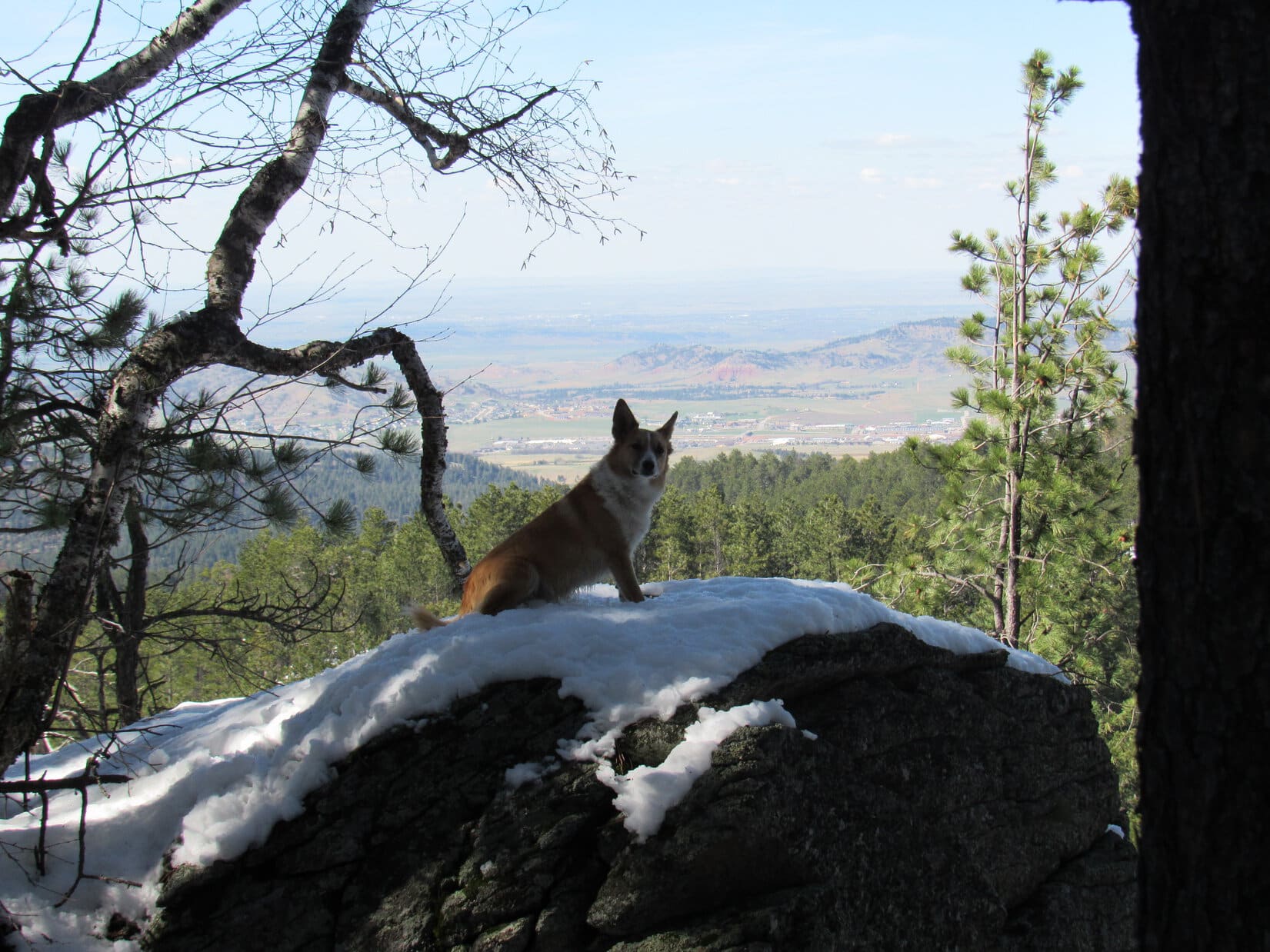
The very highest rocks were in a sunny little meadow, but the much larger summit area was broad, nearly flat and mostly forested. Some of the forest had been thinned, but although Lupe and SPHP wandered around the mountaintop quite a bit, it was hard to find any really good viewpoints. The very best view was of Custer Peak (6,804 ft.) to the SW, which looked quite snowy and rather dramatic.


After exploring much of the W end of Kirk Hill, Lupe returned briefly to the highest rocks at the summit one more time. Then she and SPHP started back E on the road.

Toward the middle of the mountain, Lupe and SPHP left the road to scout out the S rim. It was thinly forested, snowy, and sunny. The forest still interfered with the views to a significant degree, but it didn’t matter. The area to the S was pretty, but not dramatic. Lupe and SPHP returned to the road.
Just to find out if this road was marked in any way, Lupe and SPHP stayed on it all the way until it reached No. 541.1 again. There was a marker at the intersection. The road to the top of Kirk Hill was No. 541.1G. If Lupe and SPHP had stayed on No. 541.1 just a little longer on the way up, Lupe would have reached this junction within a few minutes.
Lupe and SPHP returned to the G6 on No. 541.1, this time following it downhill to the NW (12:04 PM, 50°F). Before leaving the area, Lupe went to get a drink out of the tiny stream nearby. The little stream has no name on the maps, but is a seasonal tributary of Park Creek.


Lupe’s journey to Kirk Hill had been a success, but her next peakbagging mission was quite some distance away. She was going to climb Tetro Rock (5,562 ft.) located 6 miles SSE of Spearfish, SD. Lupe took a rest break while SPHP drove.
Tetro Rock was only 1.5 miles SSE as the crow flies from where SPHP parked the G6 at the intersection of Maitland Road and USFS Road No. 195.2A (12:53 PM, 52°F). Before heading out to Tetro Rock, however, Lupe and SPHP went to take a quick look at False Bottom Creek.

With snow melting up in the nearby hills, False Bottom Creek was looking good. What wasn’t looking so good were some Lupe Treasures scattered around both banks. SPHP collected some of them before Lupe left for Tetro Rock following USFS Road No. 195.2A.
No. 195.2A started off heading NNE away from Tetro Rock. It gained a little elevation heading out of the Black Hills National Forest and then leveled out as it turned E, passing by a couple of large homes up in the forest S of the road. The road soon jogged to the S a bit, turned E again, and then went SE back into the National Forest.
The original plan had been to follow No. 195.2A as it wound around crazily for well over a mile. At a point about 2 miles NNE of Tetro Rock, the Peakbagger.com topo map showed some kind of faint road leaving No. 195.2A a little to the W of Tetro Creek. This road snaked S up a ridge about halfway to Tetro Rock. Lupe would then have to bushwhack the rest of the way trying to follow the high ground to the summit.
The original plan might have worked just fine, but shortly after No. 195.2A entered Section 6, an unmarked side road appeared on the SE side of 195.2A. It was just the sort of private, secluded little road that Lupe and SPHP love. A hump of dirt near its start looked likely to discourage any low-clearance vehicles. Lupe and SPHP went up onto the hump to get a better look at where this side road was going.

Past the hump of dirt, the little side road turned W gaining elevation gradually. The grassy road looked inviting. SPHP checked the topo map again. This road wasn’t shown, but if it were to turn S, it might actually be a shortcut to Tetro Rock. The terrain seemed to favor the notion that it would at least turn and head SW for a little while.
Well, so much for the original plan! Lupe and SPHP abandoned No. 195.2A to follow the side road. It went W for a little way, but as anticipated, gradually bent around to the S. SPHP became quite enthused with the way things were working out. The side road was staying on the E side of a drainage near the E side of Section 1. Although it wasn’t in view yet, Lupe and SPHP were heading almost directly toward Tetro Rock.
Lupe and SPHP made great progress for a little while on the grassy road. That is, until it ended. Suddenly, that was it. No more road. It really wasn’t surprising, but still a little disappointing that it hadn’t gone further. Lupe was still at least a mile N of Tetro Rock. The snow covered slopes of the mountain ahead looked fairly steep.
The choice was either to bushwhack on up the mountain and try to follow the high ground to Tetro Rock, or double back to No. 195.2A and go back to the original plan. SPHP checked the topo map again. It looked like Lupe ought to be able to continue following the high ground easily enough, if the way didn’t get too steep. Yeah, Lupe could do this!
The first part of the climb up the snowy slope was filled with a tangle of the branches of small trees and large, slender bushes. It didn’t take very long to get up above the worst of it. The rest of the climb was steep, but not steep enough to prevent Lupe from continuing onward. Lupe had fun exploring, while SPHP plodded slowly upward. Lupe reached a rock outcropping at the top of this first big climb.

SPHP paused for a breather and another map check. The worst was over. It looked like the way S from here had to be less steep. Lupe should be able to stay toward the W side of a ridgeline and just keep climbing. There would be a couple of minor high points along the way, but it ought to be possible to find and climb Tetro Rock.
So Lupe and SPHP continued on S through the trackless forest. As Lupe gained elevation, there was even more snow in the woods. Happily, as the topo map showed, the way forward wasn’t as steep as what Lupe had just come through. After climbing for a while longer, Lupe and SPHP took a break near another rock outcropping. SPHP ate an apple. Lupe had some Taste of the Wild.
Off to the WNW, the top of Spearfish Peak (5,800 ft.) could be seen between the trees. Across the valley to the W was a ridge at least as high as where Lupe was. SPHP checked the topo map again. Yes, it looked like Lupe was on the right track, but Tetro Rock was still 0.75 mile farther S.

Suddenly, Lupe growled. Her hackles raised up. She stood at attention looking W at the nearby rocks. Lupe growled several low threatening growls over the span of a few minutes. She detected something out there. SPHP stared W wondering what was approaching. SPHP detected nothing unusual.
Whatever it was never appeared. Lupe relaxed. So did SPHP. SPHP wondered what Lupe had sensed. Maybe it was better not knowing.

It was time to get going again. A little farther S, Lupe should come to the first, and highest, of a couple of minor high points near the SW corner of Section 6. Maybe Lupe would be able to see Tetro Rock from there?
Lupe and SPHP continued a gradual climb to the SE through the snowy woods. Sure enough, Lupe came to a high point. There were a number of nice rock formations here, but the biggest one with the best view was toward the SW end of the high ground.

Ahead to the S was a higher forested hill where Tetro Rock was supposed to be. SPHP shouldn’t have been disappointed, but this first view of Tetro Rock was a bit of a letdown. Of course, the topo map showed that Tetro Rock was not steep when viewed from the N. The SW slope is much steeper and probably far craggier and more impressive, but the SW slope wasn’t in view from this angle.
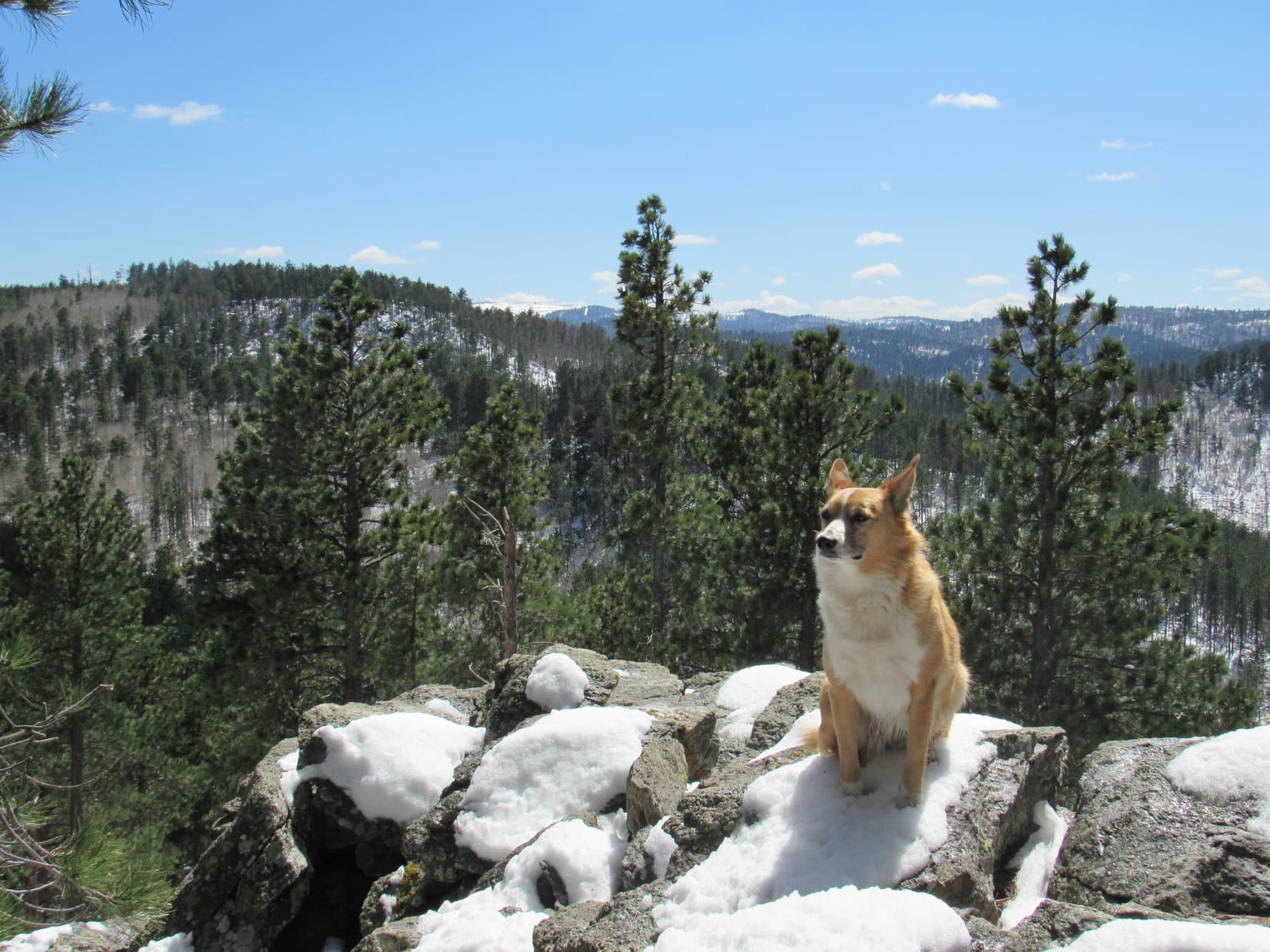

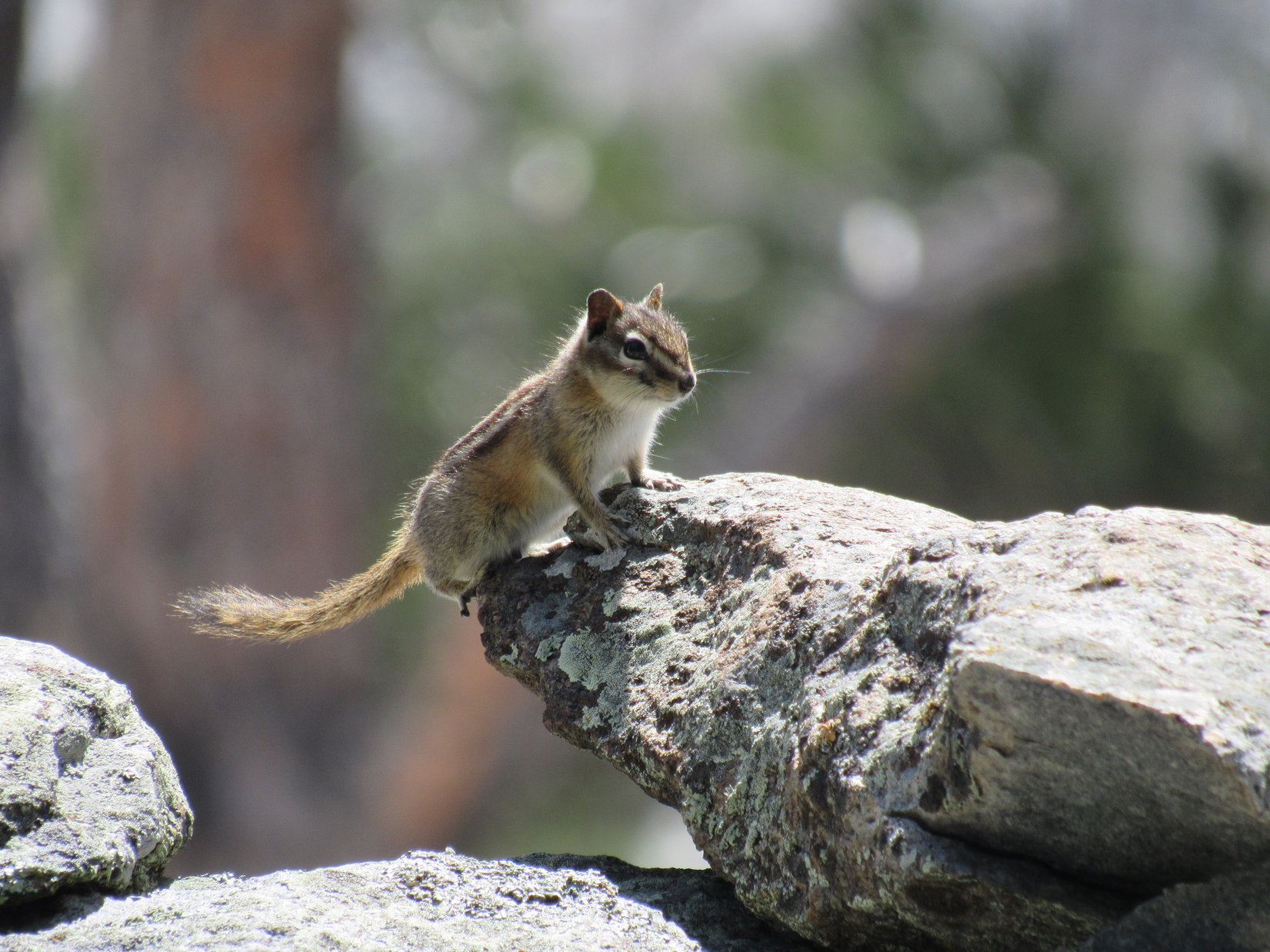
Tetro Rock was still 0.5 mile away. Lupe and SPHP left the minor highpoint continuing S. Now Lupe was losing elevation. She soon came to another lower high point. It featured less impressive rock formations and no views. The forest was too dense.
S of the second high point, Lupe entered a small meadow created by heavy logging. Slash was on the ground everywhere, along with numerous big long tree trunks that had been cut into 2.5 foot long pieces left to rot on the ground. Lupe and SPHP had come to lots of similar areas where loggers had been busy along the way, but none as big as this one. It was slow going picking a route through all the debris.
At the bottom of the saddle between the last minor high point and the start of the climb to Tetro Rock, Lupe found a logging road. It was pretty snowy, but it helped speed things up considerably. The road took Lupe S to a point 0.25 mile E of the summit of Tetro Rock. At the high ground there, another logging road branched off to the W. SPHP suspected it would take Lupe right to the top of Tetro Rock.
The logging road going W was blocked in quite a few places by dead trees, but it did go to the summit area on Tetro Rock. The road ended in a snowy clearing surrounded by forest. Gah! No views at all. With a name like Tetro Rock, SPHP had been expecting, or at least hoping for something more exotic. Well, viewed from the SW it probably was, as the topo map indicated. Coming from the N or E, it was just another high spot in the forest.
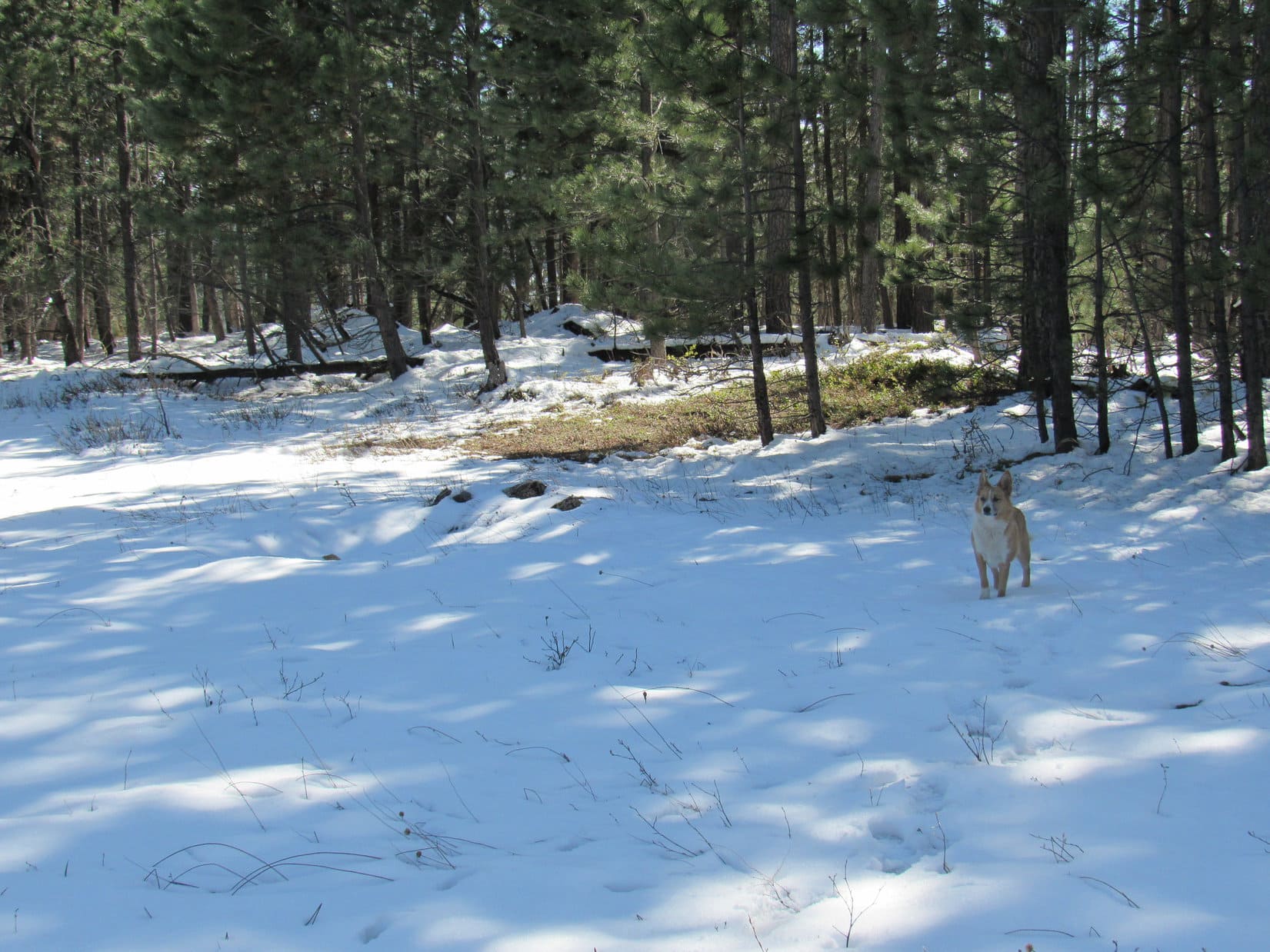
The snowy clearing was nearly level. There was no obvious high point or summit. It looked like there might be higher ground off to the N, and maybe some places scattered in the nearby forest that were a little higher than the snowy clearing. Nothing looked like it was more than a few feet higher, though. Lupe was basically at the top of the mountain.
Before going to check out the possible rise to the N, Lupe and SPHP headed SW to see what the steep SW face of Tetro Rock looked like from above. From the edge of the level ground, the mountain sloped off increasingly steeply. There were too many trees to see the views from the high ground, although it looked like it might be possible to see something from some of the rock formations below.
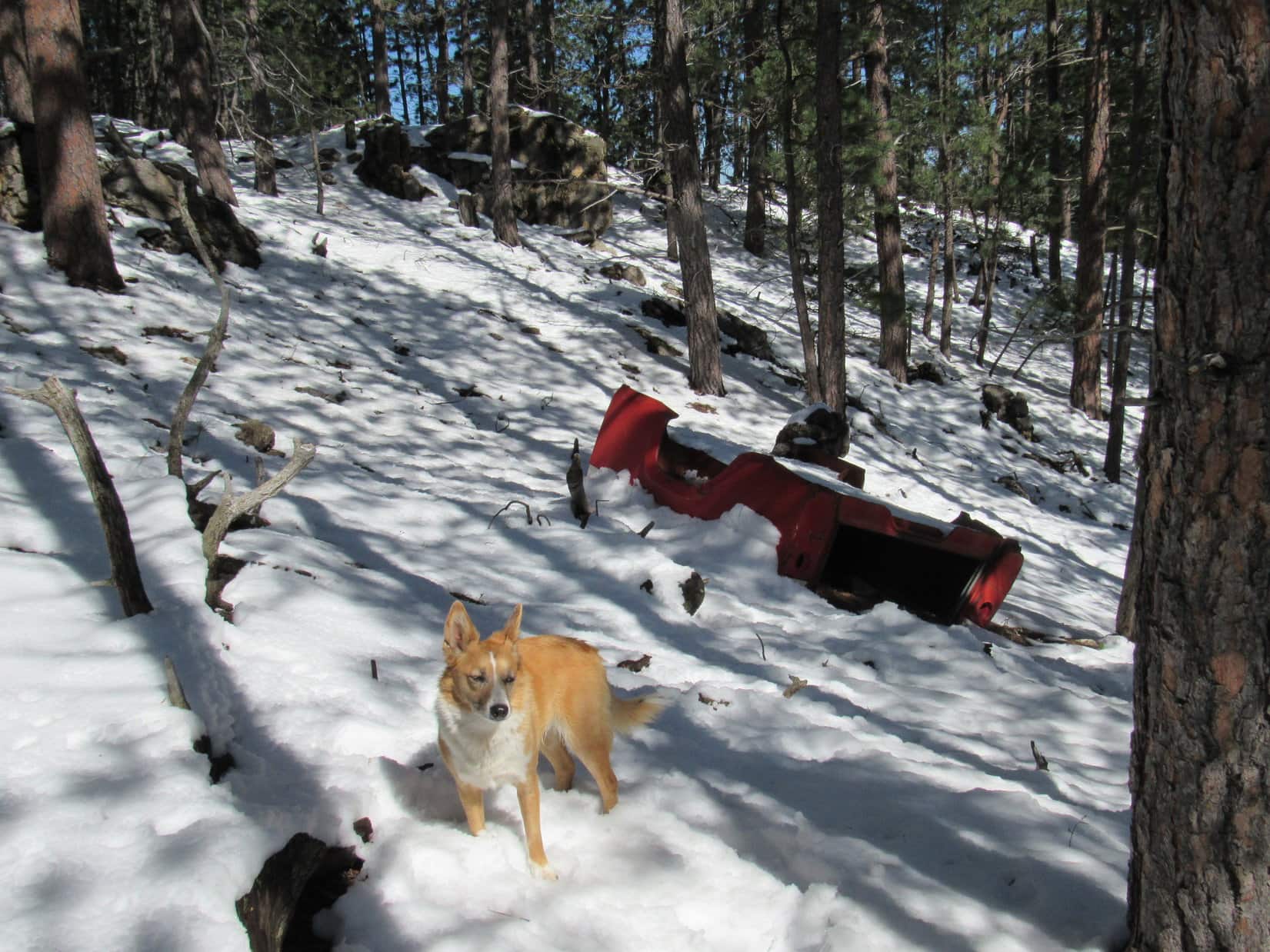
A little cautiously, Lupe and SPHP went over the SW edge of Tetro Rock. The slope wasn’t bad, but looked like it was going to get steeper. In fact, this looked like the kind of place that might easily end in some dramatic cliffs. Not too far below, there were rock formations that looked like the tops of cliffs.
Lupe and SPHP went down to check out the view from the most promising one nearby. Lupe was treated to a beautiful view of Terry Peak (7,064 ft.) to the SSW.


Lupe and SPHP were satisfied. At least Tetro Rock had yielded a lovely view of Terry Peak. Lupe and SPHP climbed back up to the rim of the flat ground. It was time to go check out the possible higher ground N of the snowy clearing. Lupe passed through the snowy clearing again on the way.
It wasn’t too far to the high ground to the N. It took longer than it should have to get there. The loggers had been busy here, too. There were lots of big tree trunks cut into sections on the ground. Slash was everywhere. As Lupe drew near the highest rocks, it was possible to see a long way off to the NE. Unfortunately, there were still enough standing trees to mar the view for the camera.
A collection of fairly big rocks among all the debris of the logged trees seemed to be the highest point on Tetro Rock. This was probably the true summit. It did seem a little higher than the snowy clearing had been, though SPHP wouldn’t swear to it. Several rocks looked about equally high. SPHP encouraged Lupe to get up on the most impressive looking of these rocks for her Tetro Rock summit photo.

It didn’t look like there was any higher ground farther N, but it did look like there were some bigger rock formations not too far away in that direction. Lupe and SPHP went over to check them out. The true summit definitely wasn’t over here, but the rock formations were certainly more impressive than those at the actual summit.

By now Lupe and SPHP were near the NW end of Tetro Rock. Lupe’s explorations of the summit area were complete. The sensible thing to have done would have been to just go back S to the snowy clearing and take the logging roads back to the saddle S of the minor high points N of Tetro Rock.
However, it seemed more enticing to explore a shortcut by simply heading NE down the mountain. This route might not be any faster than taking the logging roads, but it went through still unexplored territory. The topo map indicated it should work. So off Lupe and SPHP went, heading NE down off Tetro Rock. At first it was kind of steep, and Lupe passed by more big rocks.
The shortcut worked! It was slow going over the snowy rough ground, and Lupe eventually had to turn more to the E to maintain elevation, but Lupe found the same logging road again a little S of the two minor high points.
From here, the trek back was easy. Lupe and SPHP just followed their tracks in the snow. SPHP was happy that Lupe had made it to Tetro Rock. Lupe enjoyed exploring the woods. Once Lupe reached the dead-end of the grassy side road again, the rest of the way back to the G6 was just a pleasant late afternoon road hike. Lupe and SPHP spent a little time collecting more Lupe Treasures at False Bottom Creek before leaving the area (5:56 PM, 55°F).
What now? Lupe already had a successful peakbagging day behind her. She could have gone straight home. The American Dingo didn’t seem at all tired, though. SPHP still had some energy reserves left, too. There were still a couple of hours of daylight left.
Custer Peak (6,804 ft.) had looked snowy and impressive from Kirk Hill earlier in the day. Why not go there? It was an easy road hike. Lupe could reach the top before sunset. The dominant peak of the N central Black Hills would provide impressive views in every direction. Lupe had been there before, but it sounded like a good way to end the day.
About 0.5 mile SE of Custer Peak, SPHP parked the G6 at an intersection along USFS Road No. 216 (6:41 PM, 42°F). It was chillier up here. There was a N breeze blowing. Lupe and SPHP started the familiar road hike to the top.

A lot of snow must have melted during the day. There wasn’t nearly as much around as SPHP expected. It was an easy trek, but the N breeze felt quite cool as Lupe and SPHP neared the summit. The road up the mountain ends a little short of the summit. From there, a trail goes up to the lookout tower. Lupe was already beyond the end of the road and on the trail’s switchbacks, when SPHP was very surprised to see a vehicle driving up the road.


Lupe reached the lookout tower to complete her 5th ascent of Custer Peak. The sun wouldn’t set for another 15 minutes or so. SPHP expected people from the vehicle that had driven up the mountain would be coming up to see the sunset, but no one came. Lupe and SPHP wandered around the lookout tower and the surrounding area while waiting for sunset.


The sky was almost completely clear. There were no clouds in the W to make the sunset glorious. Lupe and SPHP watched a golden-orange fireball sink below the horizon. Except for the trek back to the G6, Lupe’s Black Hills, SD Expedition No. 170 was over.
On the way down the switchbacks, suddenly there were two dogs! Two people appeared right behind them. Lupe sniffed with Ansel and Fern. SPHP chatted briefly in the cool breeze with Aaron Ploog and his girlfriend, Kelsey. It was already near freezing out, but Aaron, Kelsey and 3 dogs (there was a husky still in the car) were going to car camp on Custer Peak! They were on their way up to the top, so Aaron could decide what to shoot.

Aaron said he was with Awake At Night and lived in Spearfish. Later on at home, SPHP looked up Awake At Night Photography on the internet. Aaron is a Noctographer, taking photos after dark and selling them. Pretty cool stuff!
Lupe seldom meets anyone on most of her adventures. Every now and then, though, Lupe meets some very interesting people (and dogs) out on adventures of their own! (8:54 PM, 33°F)

Lupe Treasures collected: 6 glass bottles, 3 plastic bottles, 8 aluminum cans.
Links:
Next Black Hills Expedition Prior Black Hills Expedition
Want more Lupe adventures? Choose from Lupe’s Black Hills Expeditions Adventure Index or Master Adventure Index. Or subscribe free to new Lupe adventures.


