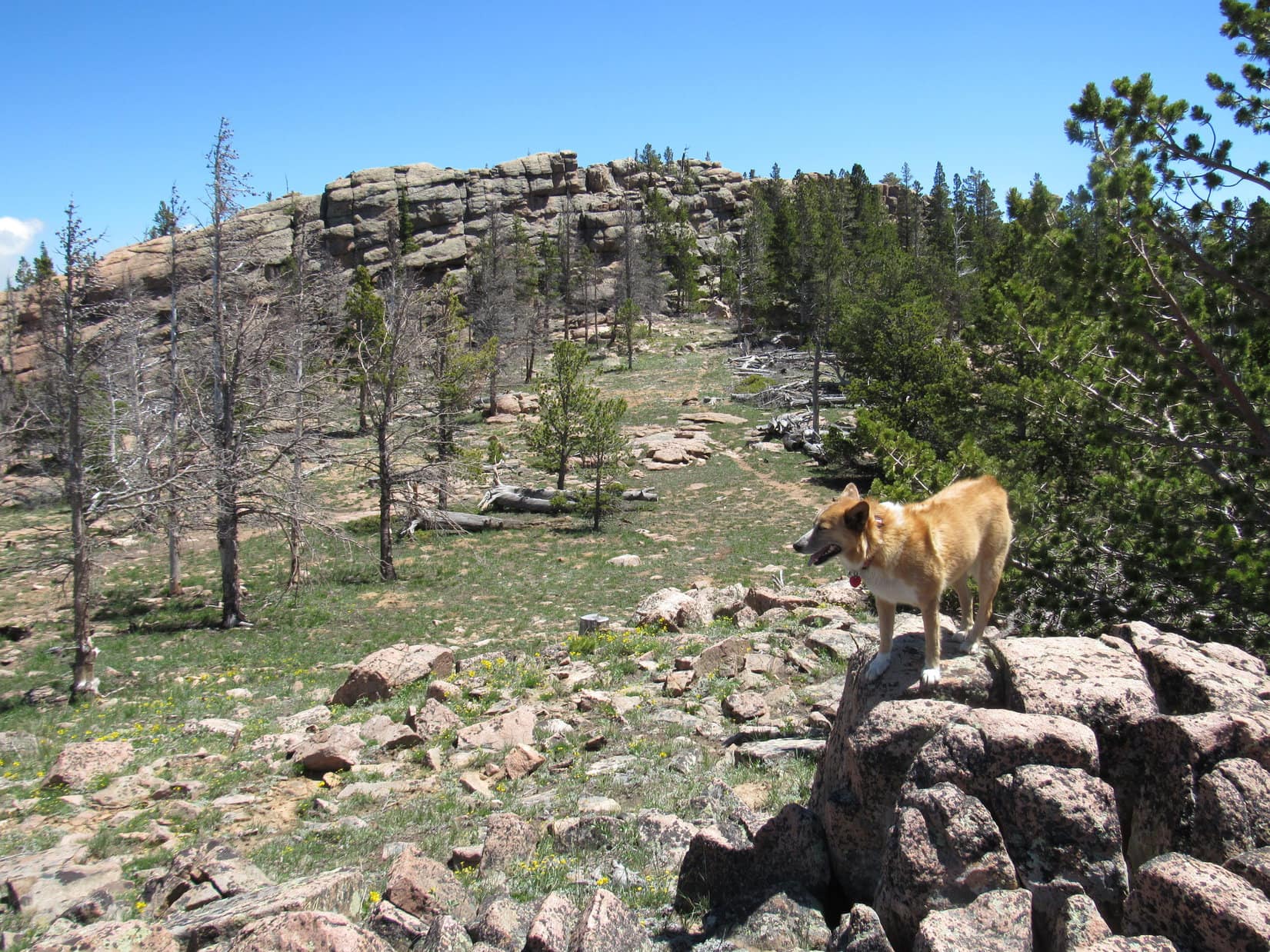
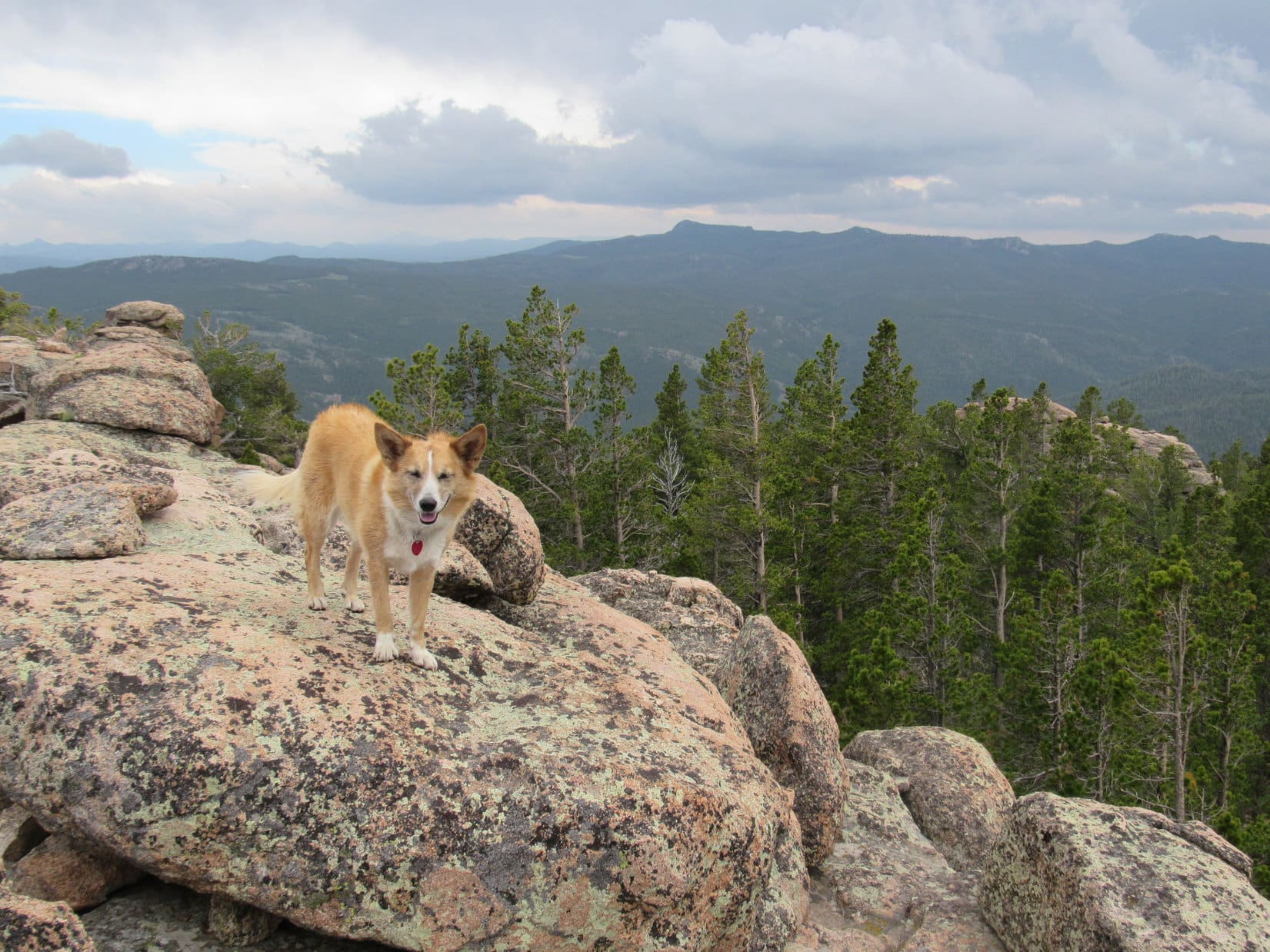
Wow, surprising! Snow on the road here. Only a dusting really, but it was the first snow Lupe had seen up in the Black Hills so far this fall. A harbinger of things to come, but probably not in quantity for another month yet. American Dingoes love snow, if there’s not too much of it. Lupe was in a cheerful mood as she began her trek up Bear Mountain along USFS Road No. 299.1C.
Bear Mountain(7,166 ft.) was only a couple miles SW, so it wouldn’t take her long to get there.
Lupe was excited to see snow on USFS Road No. 299.1C as she started up Bear Mountain. Photo looks W.
More than 0.5 mile from where she’d started, Lupe reached an intersection. USFS Road No. 299.1C turned N here. Loop took No. 299.1J heading W instead. Up until now, the road had been in the forest, but No. 299.1J soon curved SW entering more open territory.
USFS Road No. 299.1J curves SW as Lupe continues up Bear Mountain. Photo looks WSW.
Although Lupe came to no more intersections, by the time she reached a barbed wire fence practically at the top of the mountain, a marker said she was on No. 299.1K. Exactly where the transition occurred wasn’t clear. It hardly mattered. Lupe didn’t care. The important thing was she had made it to the top of Bear Mountain.
Lupe went over to the base of the fire lookout tower to claim her latest peakbagging success!
Lupe arrives at the base of the fire lookout tower on Bear Mountain. This was her 3rd ascent of the 3rd highest mountain in the Black Hills. Photo looks SW.
This was Lupe’s 3rd ascent of the 3rd highest mountain in the Black Hills. On one of her previous visits, Lupe had actually gone all the way to the top of the lookout tower. She and SPHP had paid a visit to the friendly forest ranger on active duty inside the ranger quarters.
No one was around today. With no opportunity for another social visit in the comfort of the ranger station, Lupe didn’t bother to climb the tower. A chilly 15 mph breeze blew out of the N. The cold wind would only be worse higher up.
Instead, Lupe went to a small limestone outcropping SE of the tower to check out the views.
Lupe up on the limestone SE of the ranger tower. Black Elk Peak(7,231 ft.) (Center) is the high point seen in the distance. Photo looks E.Looking back at the fire lookout tower. Photo looks NW.
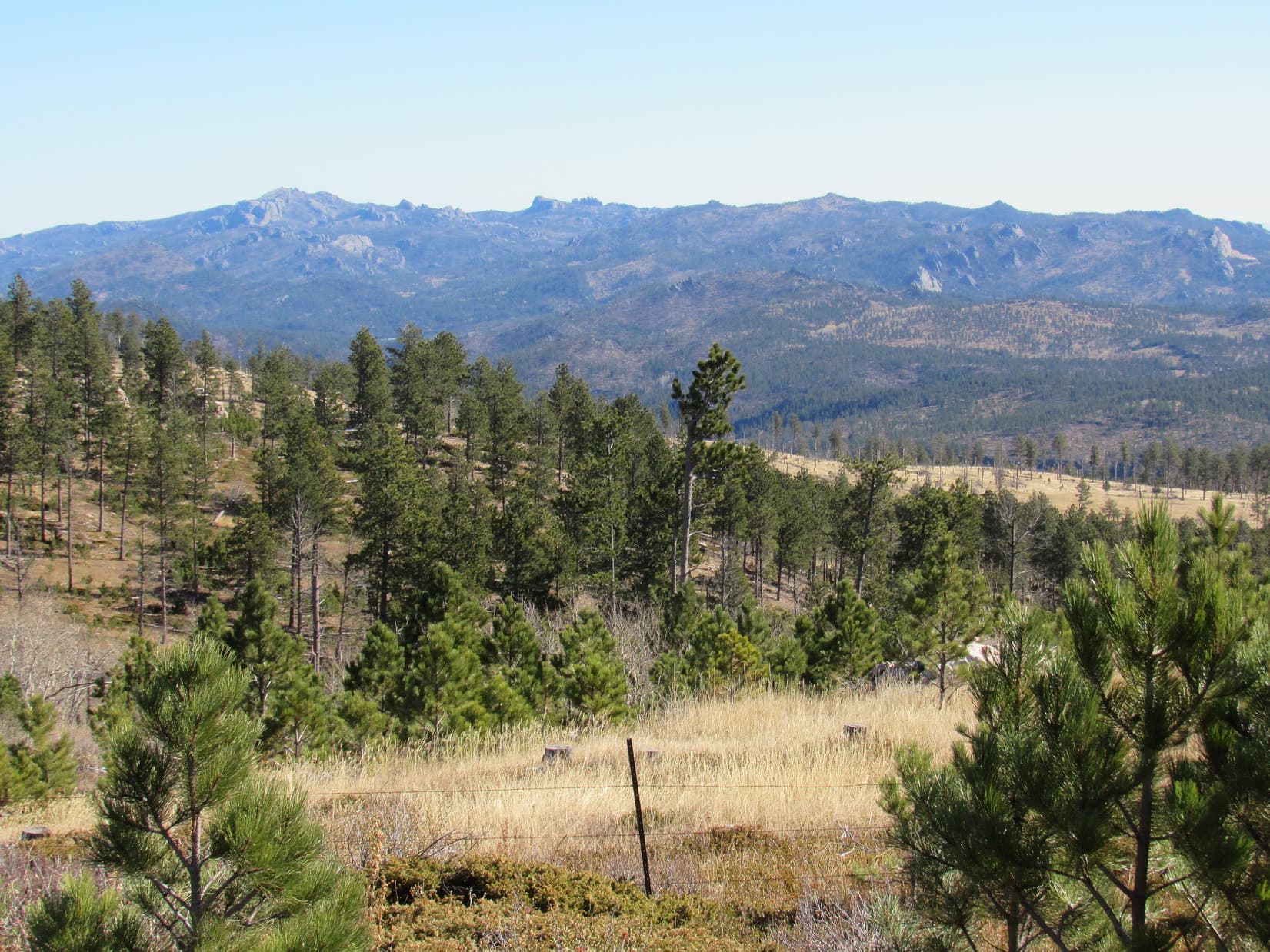
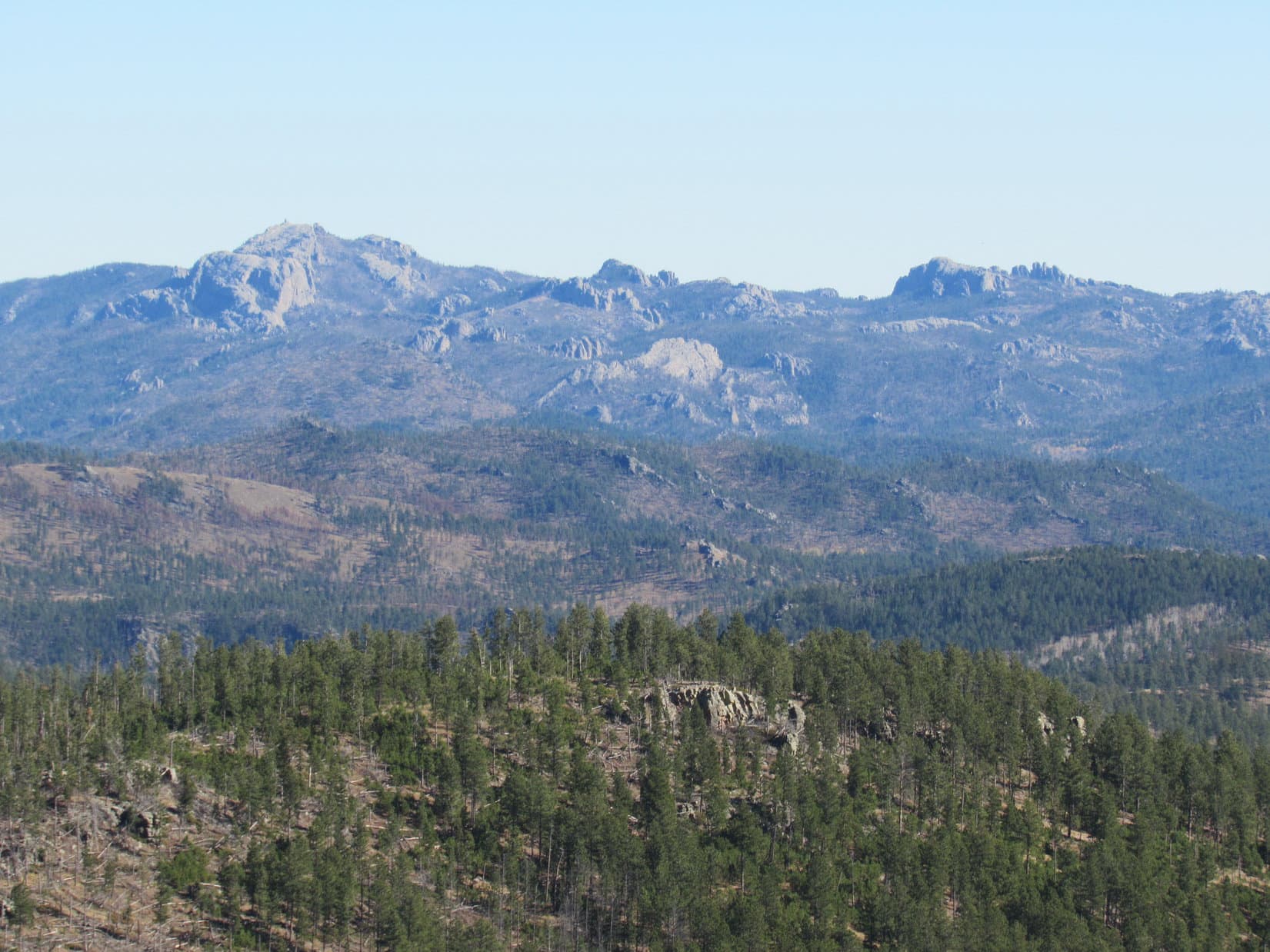
The best views were off to the E where Black Elk Peak(7,231 ft.), the highest mountain in South Dakota, dominated the scene. Lupe also enjoyed a panoramic view to the S. The American Dingo could see much of the southern Black Hills from here.
Black Elk Peak (Center) is 11 miles due E of Bear Mountain.Looking ESE with a bit of help from the telephoto lens. Black Elk Peak is now on the L.From Bear Mountain, Lupe also had a sweeping view of much of the southern Black Hills. The highest point in the distance on the L is Northeast Cicero Peak(6,240 ft.). Photo looks S.
Climbing Bear Mountain was only the beginning for Lupe. The plan was to visit Odakota Mountain(7,200 ft.) nearly 4 miles to the N, too. Since Lupe and SPHP had gotten off to a rather late start, it was already past noon. With days getting short in mid-October, Lupe couldn’t linger on Bear Mountain too long.
After checking out the views, Loopster briefly dropped by the Bear Mountain fire lookout tower again before continuing on her way.
Lupe at the fire lookout tower on Bear Mountain again before leaving for Odakota Mountain. Photo looks E.Loop ready to depart Bear Mountain. Photo looks N, the direction she would be heading to get to Odakota Mountain.
Both Bear Mountain and Odakota Mountain lie along the E edge of the high limestone plateau country of the western Black Hills. The first part of Lupe’s journey N to Odakota Mountain would be along the E rim of the high country.
From the Bear Mountain fire lookout tower, Lupe took the same road she had come in on NE a short distance. When she got close to the E rim, she followed another road that angled N. This road eventually turned NW. Lupe left the road to continue N along the rim. Odakota Mountain was already in sight!
Lupe near the E rim of the high country of the limestone plateau. Her next objective, Odakota Mountain is the high ridge seen beyond her. Photo looks N.
The terrain along the E rim was hilly. The area was forested, but generally not too densely. However, a fair amount of deadfall timber existed in spots. In a couple of places, the deadfall was dreadfully thick.
Back this summer, Lupe’s mountaineering friend Jobe Wymore had given SPHP a free pair of excellent Komperdell trekking poles. SPHP had never used trekking poles before, and until today had done nothing with Jobe’s gift. SPHP quickly discovered that the poles really did help going through the deadfall!
For 1.5 miles, Lupe traveled N near the E rim of the limestone plateau country. When the American Dingo finally reached a road, SPHP knew she had arrived at an intermediate objective, the Boy Scout overlook.
Coming from the W, USFS Road No. 291.3K leads almost to the edge of the E rim here. A short path goes from the highest ground down to a large, flat limestone platform perched at the top of sheer cliffs. A pond a mile to the NE near the Medicine Mountain Boy Scout camp can be seen far below. The platform also provides sweeping views of the Black Hills to the E.
Lupe reaches the limestone platform known as the Boy Scout overlook. Photo looks ENE.The short path leading to the Boy Scout overlook is seen on the L. Photo looks ENE.
The Boy Scout overlook is a favorite spot. Lupe had been here before on other Black Hills expeditions. Before taking a Taste of the Wild and water break, Lupe took a look at the glorious views.
Lupe on the Boy Scout overlook, a large platform of limestone perched at the E edge of the high country of the western Black Hills. Bear Mountain, where Lupe had just come from, is the high ridge seen beyond her in the distance. Photo looks S.Looking E from the Boy Scout overlook. Black Elk Peak is on the horizon beyond Lupe.Black Elk Peak (L), Peak6920 (Center) and Little Devil’s Tower(6,960 ft.) (R) plus some of the Cathedral Spires(6,840 ft.) (R). Photo looks E with help from the telephoto lens.Looking NE now. Peak6720 is the rounded semi-barren hill on the L. Medicine Mountain(6,878 ft.) is the double humped hill with the high point straight up from Lupe’s back. Farther away a bit more to the R is Five Points(6,221 ft.).
Although Odakota Mountain was now only 2.5 miles away to the N as the crow flies, Lupe’s break at the Boy Scout overlook had to be kept short. To actually get to Odakota Mountain, she had to swing more than 1.5 miles W going down Grand Vista Draw. She would then have to go another 1.5 miles back E again on her way up Long Draw. All that extra mileage, plus the distance N!
Loop curled up next to SPHP on the limestone platform for a few minutes, but soon it was back to business. Lupe left the Boy Scout overlook heading W on USFS Road No. 291.3K.
In the upper end of Grand Vista Draw, Lupe reached an intersection. The Carolina Dog left No. 291.3K to take No. 291.3A down the wide, shallow canyon. Beautiful light brown grass lined the road. Lupe passed through a stand of aspens where a few colorful leaves still held on.
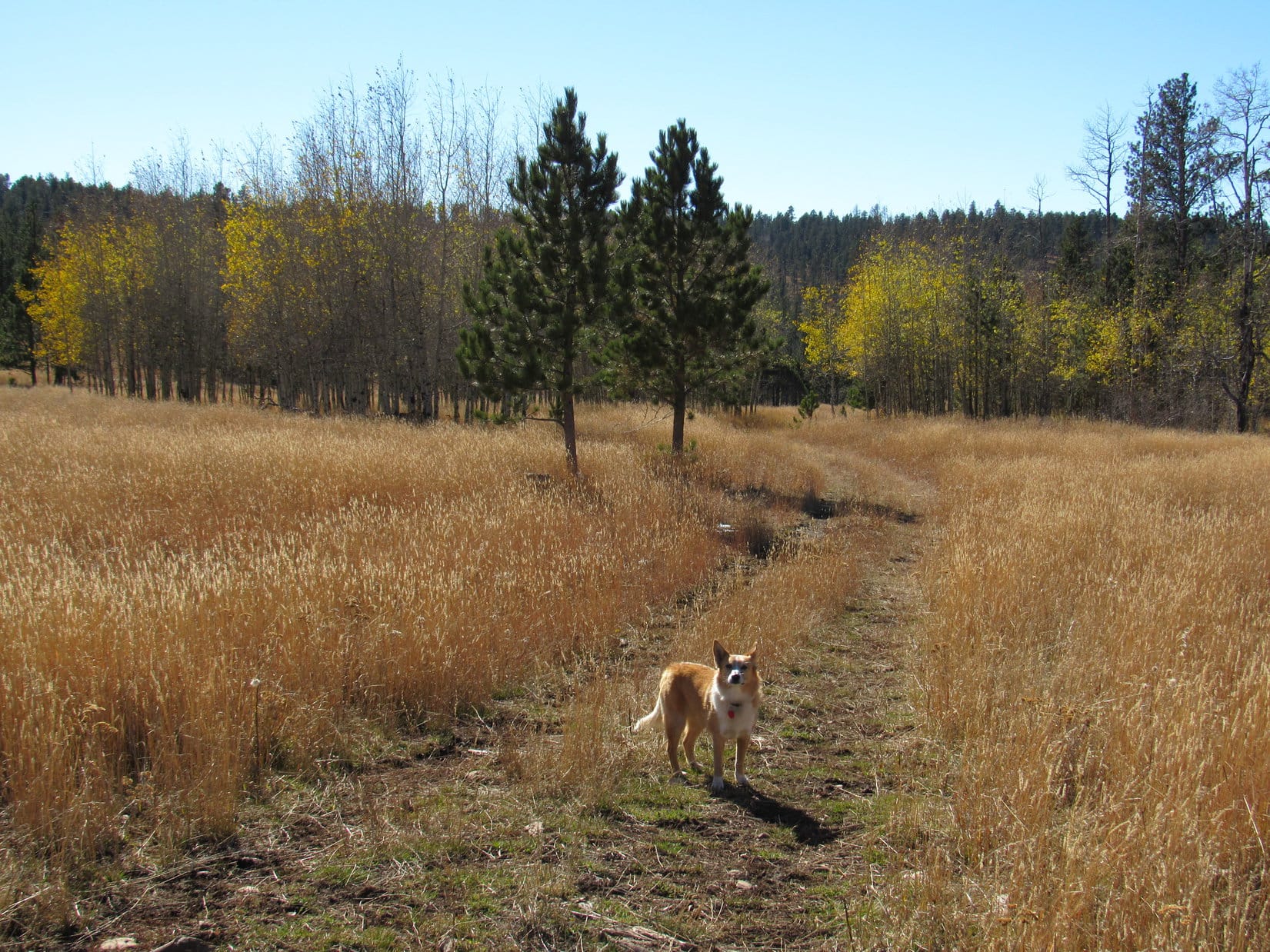
Beautiful light brown grass stood along USFS Road No. 291.3A on the way down into Grand Vista Draw. Photo looks WNW.Passing the aspens. A few colorful leaves still clung to the trees. Photo looks WNW.
The trek down Grand Vista Draw was easy. On the way, Lupe saw scattered limestone formations along the canyon sides, but they weren’t high or dramatic. Meadows dominating the upper end of the draw gave way to pine forests lower down. Finally, near the low point where Grand Vista Draw and Long Draw meet, Lupe reached a line of boulders placed across the road.
Lupe reaches a line of boulders across the road in the area where Grand Vista Draw and Long Draw meet. Photo looks N.
A few boulders couldn’t stop Lupe! She continued N on the road, but it ended abruptly in the forest. A short, shady trek brought Lupe to Spring Creek.
Lupe reaches Spring Creek at the start of Long Draw. Photo looks N.
Loop and SPHP crossed Spring Creek (those Komperdell trekking poles proving useful once again!), and climbed through a small meadow to reach a minor road. The minor road quickly brought Lupe to USFS Road No. 693, which she could follow all the way up Long Draw.
Long Draw did seem long. Along the way, Lupe saw deer. She found squirrels to bark at. She had a fun time, but at last the Carolina Dog reached the high point of No. 693 at the upper end of Long Draw where the road turned N.
Loopster in the upper end of Long Draw. Photo looks E.
At the high point, Lupe abandoned the road. The summit of Odakota Mountain was now only 0.25 mile ESE through the forest. SPHP was surprised when Lupe drew near the small, slightly higher ridge where the summit is located. A barbed wire fence crushed in many spots by collapsing trees killed by pine bark beetles had been repaired since Lupe was last here.
The repaired fence was good news! Lupe has been seriously injured by downed barbed wire several times in the past. This had been a dangerous place. It still was to some degree. Even though the fence was fixed, a tremendous amount of deadfall timber still infested the area. Lupe and SPHP cautiously picked a way through the mess.
Lupe found the small cairn near the E end of the relatively short summit ridge. She had made it to the top of Odakota Mountain(7,200 ft.), the 2nd highest mountain in South Dakota!
Lupe reaches the summit cairn on Odakota Mountain, the 2nd highest mountain in South Dakota. Photo looks WSW.The summit ridge on Odakota Mountain is a jungle of deadfall timber. Photo looks WSW.
Although Odakota Mountain is the 2nd highest in South Dakota, the summit doesn’t provide much in the way of views. Despite how many trees have died and fallen over, more still remain. A tree-broken view to the S was about all there was to see.
A tree-broken view to the S is all the summit of Odakota Mountain has to offer. Lupe could see Bear Mountain (the long high ridge in the distance) where she had come from, and the small pond near the Medicine Mountain Boy Scout camp (far L).
Cliffs at the far SE end of Odakota Mountain do offer unobstructed views. Lupe had seen them once, long ago. However, getting there from the summit requires a bushwhack through a significant stretch of bad deadfall timber. Lupe didn’t have time to go see those views today.
Lupe relaxed next to the summit cairn. Once again, a short break was all she could afford to take.
Lupe relaxes next to the summit cairn. Another short break was all she could take here. Photo looks NW.
Odakota Mountain is one of the mountains Lupe has visited most. This was her 8th time at the summit. The first time the Carolina Dog had come here nearly 3.5 years ago, there hadn’t even been a cairn. The last time she’d been here was over 1.5 years ago, when she had first met her friend Jobe Wymore and guided him to the mountain. Sadly, Jobe wasn’t here to share the mountain with her today.
Snap out of it, Loop! Enough reminiscing! We’ve got to get going. You still have to go all the way back to Bear Mountain and then back down to the G6!
The American Dingo sprang to her paws! Time for action? She was ready! Isn’t she always?
Leaving Odakota Mountain, Lupe got to do something she had never done before. For over 0.5 mile, she explored the high ground along the edge of the mountain’s SW ridge. SPHP wanted to see if she could find any unobstructed views from this area. She did, too!
Bear Mountain, the long high ridge on the R is where Lupe was heading back to from Odakota Mountain now. Part of the pond down at the Medicine Mountain Boy Scout camp is seen below on the L. Photo looks S.Lupe did find beautiful, unobstructed views from Odakota Mountain’s SW ridge. Black Elk Peak is on the horizon beyond Lupe’s face. Photo looks ESE.Exploring Odakota Mountain’s SW ridge. Photo looks WSW.
Lupe had a great time exploring Odakota Mountain’s SW ridge, but only got to go about halfway along it. Too much deadfall timber was slowing things down, and the American Dingo no longer had time to waste. She returned to Long Draw. Lupe traveled through the fields paralleling the road.
Day nears an end as Lupe travels back down Long Draw. Photo looks SW.
Hurry, hurry! Now it was a race against time. The sun sank ever lower, then disappeared. Lupe and SPHP made good time, but twilight was fading fast as Lupe came back up Grand Vista Draw.
Looper followed USFS Road No. 291.3A S beyond its junction with No. 291.3K. For a while she stuck with it, but when the road turned SW it was decision time. Staying on the road meant miles and miles of extra distance. The other option was to bushwhack SE to the E edge of the limestone plateau country on the most direct route to Bear Mountain.
SPHP led Lupe SE. Leaving the road was contrary to long-standing rules against trying to bushwhack after dark. On the other hand, Lupe had already traveled much of this same territory earlier in the day. SPHP felt confident that having the E rim to follow meant she wouldn’t get lost.
Faint twilight lingered only far to the W now. Stars shone above, but no moon. Black night took over. Somehow the Carolina Dog always seems able to navigate in the dark without any problem. Not SPHP, who was walking unseeing straight into waist-high pines.
SPHP ran into a barbed wire fence. No damage done. Lucky! SPHP was blind as a bat. Better bring out the flashlight. The fence was good news, actually, it meant Lupe was getting close to the E rim. Deadfall timber was bad here, though. The Komperdell trekking poles were enormously helpful! SPHP would have tripped and fallen a jillion times without them.
After getting past the worst of the deadfall, Lupe reached the E rim! She saw a great many lights glittering far to the NE. That was Rapid City! An amazing number of lights were also scattered toward the SE in the general direction of Custer, but the town was not in view. Guided by the lights of Rapid City, Lupe and SPHP worked S along the E rim. Sooner or later, Looper would come to Bear Mountain again.
Despite initial confusion over exactly where Lupe was upon reaching a road, she had made it! She was back at Bear Mountain. A cold N wind still blew up here. Despite the wind, Lupe returned to the fire lookout tower. So what if it was cold, windy and dark? She’s a peakbagging Dingo, and this was another successful ascent! (End – 9:10 PM, 30°F)
Day 5, Part 1, of Lupe’s 2017 Dingo Vacation to the Laramie Range in Wyoming & Beyond!
What a glorious day! Spirits were soaring as Lupe and SPHP left the Twin Peaks trailhead on Trail No. 618 (7:14 AM, 59°F). The lucky American Dingo was setting off on a 2-day trek to a couple of fabulous peaks she’d seen for the first time a year ago when she’d taken this same trail and climbed Twin Peaks(9,280 ft.).
A lucky American Dingo about to set off on Twin Peaks Trail No. 618 for a couple of beautiful peaks in the Laramie Range.
Trail No. 618 started off as an old jeep trail that headed W up a rise. The E end of Lupe’s first peakbagging goal, Squaw Mountain(9,313 ft.), was soon in sight ahead.
Squaw Mountain (Center) came into view shortly after Lupe left the trailhead. Photo looks NW.
Even though the summit of Squaw Mountain was less than 2 miles WNW of the trailhead, Lupe was going to have to travel a lot farther than that to get there. According to the topo map, the easiest way up was from the NW. The plan was to circle more than halfway around the mountain to approach it from those NW slopes.
Loop wasn’t the least bit worried about how far it was to Squaw Mountain. She was just looking forward to a fun time exploring. On this long day in early June, the Carolina Dog would have plenty of time to get to the top of the mountain.
The jeep trail passed over the small rise, then dipped down close to Roaring Fork Creek. Lupe couldn’t resist going in for a cool drink.
Looper cools her paws off in Roaring Fork Creek.
Although there were a few muddy areas along Trail No. 618, it never did cross Roaring Fork Creek. Instead, the trail went W up a deep, forested valley staying a little S of the creek. After a mile or so, the jeep trail turned SW heading up a steep slope. At the base of the slope, Trail No. 618 veered off to the R, becoming a single track going down a much smaller slope almost to the edge of Roaring Fork Creek again.
Lupe stayed on Trail No. 618, continuing W up the valley. Now that the wider jeep trail had been left behind, it really did seem like Lupe was in a wilderness.
On Trail No. 618 after it left the much wider jeep trail behind. Now it really did seem like Lupe was in the wilderness!
Lupe knew what to expect, though. She had been this far before. Lupe continued along No. 618, which stayed relatively close to Roaring Fork Creek.
Before long, Lupe arrived at a fence with a sign saying “Please! Close the Gate”. A year ago, SPHP hadn’t seen a gate to close, just the fence, which ended right over the trail next to some rocks. Puzzled, Lupe and SPHP had climbed up onto the rocks to get around the end of the fence.
Not a thing had changed, but this time SPHP had a hunch. Doh! Yes, the entire fence across the trail was a gate. It swung open without much effort.
How about that, Loop? Learn something new every day!
Having a year to think about it helped, aye? Glad you passed the intelligence test this time around, SPHP!
Just call me Einstein and keep going, smart-alecky Dingo.
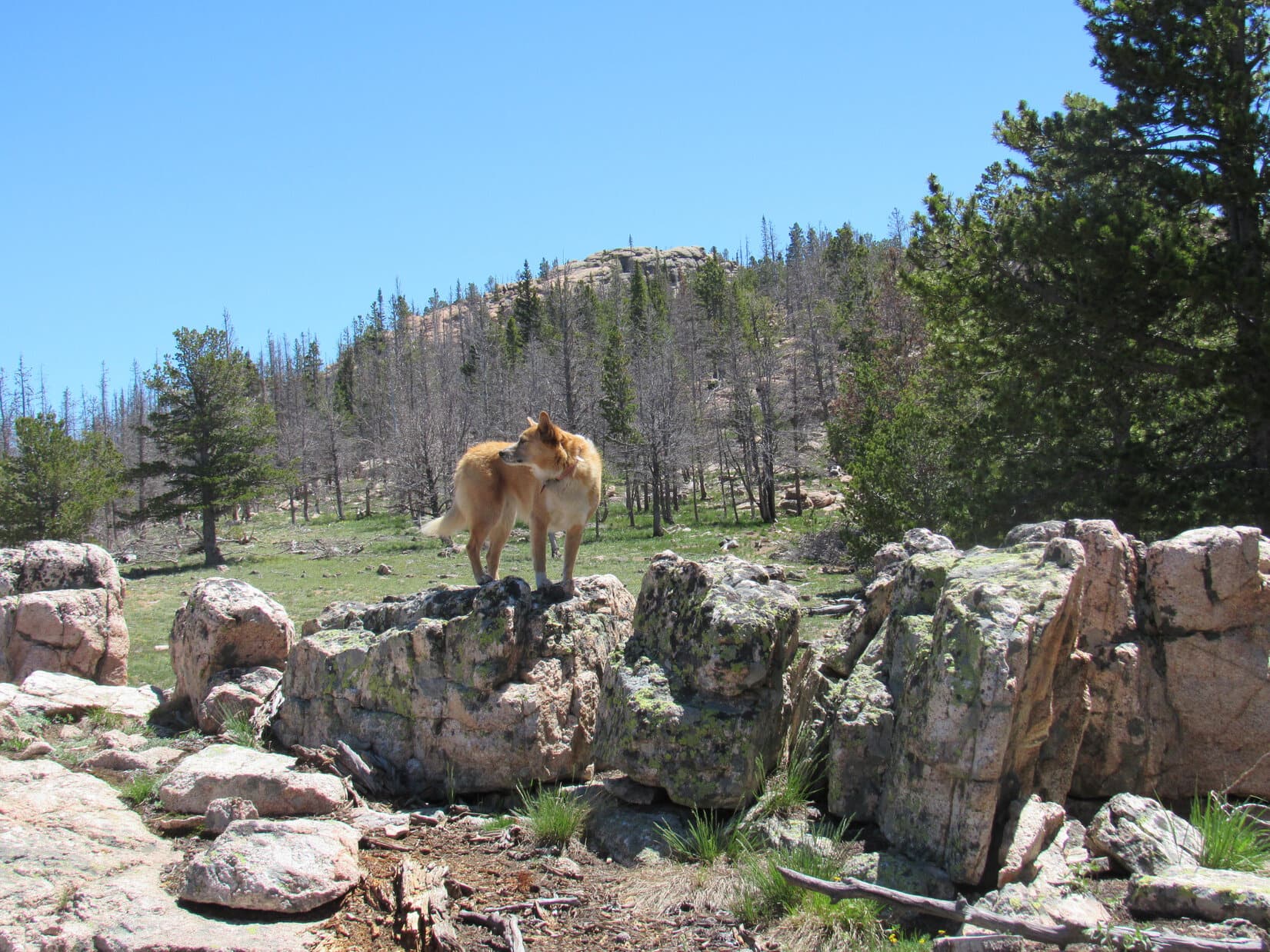
Lupe on the rocks at the site of SPHP’s intelligence test success.
Eventually, Trail No. 618 moved farther away from Roaring Fork Creek and began to fade. A few cairns helped show the way. Sometimes sticks had been placed across what otherwise might have looked like the route. The surest way of being certain Lupe was still on the trail was to watch for blazes on the trees. Generally there were two blazes, a small upper one with a larger blaze below.
Trail No. 618 eventually began to fade. A few cairns like this one helped show the way.Blazes on the trees, like the ones on the tree on the R, became the most reliable way of following seldom-used Trail No. 618.
About a mile after it became single track, Trail No. 618 angled SW leaving Roaring Fork Creek behind. SPHP expected it to continue SW to a minor pass about 0.6 mile farther on. A year ago, Lupe had followed this same trail to that pass.
However, after going SW for 0.25 mile, this time the trail turned SE and kept going that way. Something was wrong. SPHP kept expecting the trail to bend back around to the W, but it didn’t. Hmmm. SE was definitely the wrong way.
SPHP had been watching for, and caught a glimpse of, a tall rock formation that SPHP remembered was immediately N of the minor pass. May as well head straight for it. Lupe left whatever trail she was on, going W through the forest. She soon came across another trail, which must have been No. 618, because it went the right way.
Lupe made it to the minor pass.
Lupe arrives at the minor pass. The tall rock formation just N of Trail No. 618 is in view. A year ago, Lupe had gone 0.5 mile S from here to climb Twin Peaks(9,280 ft.). This time she needed to go N around the W end of Squaw Mountain. Photo looks N.
A year ago, Lupe had gone S from here to climb Twin Peaks, the summit of which was only 0.5 mile away. After a successful ascent, Lupe had come back down to this pass, crossed over No. 618, and proceeded N around the E side of the tall rock formation. She’d gone quite a distance bushwhacking through forests and bogs, but had never made it to the W end of Squaw Mountain before she ran out of time and had to turn back.
Last year’s march through the forests and bogs had been intriguing, but maybe there was an easier way? From up on Twin Peaks, Lupe and SPHP had seen large meadows in the valley W of this pass. SPHP didn’t remember how far N they went, but looking for the meadows seemed like a good idea.
Lupe followed No. 618 going W over the minor pass. The topo map showed the trail continuing W, but Lupe needed to start turning N. Once she’d lost a little elevation, the Carolina Dog left No. 618 heading NW through the forest. From here on, she wouldn’t have any roads or trails to follow the rest of the way up Squaw Mountain.
That suited Looper just fine. American Dingoes love exploring off trail! Lupe raced through the forest sniffing like a Dingo possessed. She soon sniffed her way far enough NW to arrive at one of the big meadows she had seen a year ago from the top of Twin Peaks.
Lupe arrives at one of the big meadows she had seen a year ago from the summit of Twin Peaks. Photo looks SW.
The big meadow meant easy traveling, much easier than going through the forest. SPHP had hoped the meadow would extend a long way N, but was disappointed to see it didn’t go much farther that way. A short stroll brought Loop to the NE corner of the meadow.
Squaw Mountain wasn’t even in sight, but there was no other choice. Without the slightest hesitation, Lupe plunged headlong back into the forest. She traveled N or NNE through rolling terrain slowly gaining elevation along the way.
For close to a mile, there was no sign of Squaw Mountain. Looper had never been here before, and it seemed like she had been wandering the forest for a long time. Presently, though, she saw a creek to the E at the base of an embankment. She scrambled down, leapt over the little creek, and found herself on the W side of another meadow of bright green grass.
To the ENE was another tall rock formation. That had to be the W end of Squaw Mountain! Lupe had just crossed Roaring Fork Creek, which was much smaller up here. Hah! Progress!
After a mile long trek through the forest, Lupe crossed Roaring Fork Creek and arrived at this meadow of bright green grass. The rock formation seen ahead is the W end of Squaw Mountain. Photo looks NE.
The meadow of bright green grass was only a few hundred feet wide, but extended NNE for a long way. Perfect! Just the direction Lupe needed to go from here.
Actually, it wasn’t so perfect. The bright green meadow quickly proved to be mostly bog. The ground was soft, wet and mucky. Standing water was here, there and everywhere. Not good!
SPHP led Lupe across the bog the shortest and driest way possible. Back into the forest! The forest on the E side of the bog was dense, but without much deadfall, so it wasn’t too bad to go through. Lupe had a blast! She thought this place was great. She explored this way and that. Whenever she felt like it, she wandered over into the bog for a drink.
Sniffing around in the dense forest somewhere between the W end of Squaw Mountain and the bog E of Roaring Fork Creek. Photo looks N, but the view was the essentially the same in all directions.A very busy Carolina Dog passes by again. Loopster loved this place!
The dense forest was nearly level near the bog, but Lupe eventually got far enough N to where she needed to start angling NE. Once she left the bog behind, the terrain started rising and became rougher. Lupe continued on until she was NW of Squaw Mountain.
This was supposed to be the easiest side of the mountain to go up. Lupe turned SE to begin her ascent, but soon faced a jumble of large boulders on a still densely forested and now much steeper slope. Deadfall timber was more abundant here, too, creating more obstacles. How tough was this going to get? For a while, progress was slow.
After gaining a couple hundred feet, Lupe found the terrain wasn’t as steep as before. Fewer large boulders were in the way. The forest wasn’t as dense, either. SPHP found it much easier to maneuver around.
The topo map showed there was no rush to reach Squaw Mountain’s main E/W ridgeline. Reaching the top of it too far W meant Lupe would have to go over a couple of potentially rough high points. The Carolina Dog would likely have an easier time angling gradually up the N side of the mountain traveling ESE. If she could reach the ridgeline about halfway to the E, that should be perfect. From there, it shouldn’t be too hard to get to the summit at the far E end.
Lupe went E for a little while climbing more slowly, and unexpectedly arrived at the edge of the living forest. Ahead the entire forest had burned. The vast majority of the dead trees were still standing. The burnt forest wasn’t pretty, but it was certainly easier to see the terrain. Loop didn’t care for the dead forest nearly as much as the living one, but it made the trek easier for SPHP.
Coming up from the NW, Lupe discovered that most of the forest on the N slopes of Squaw Mountain had burned. The American Dingo didn’t like the burnt forest as much as the living one, but it was easier for SPHP to traverse and see what was ahead. Photo looks ESE.
Lupe arrived at what seemed to be the ridgeline a little E of a tall rock formation. There were a few live trees here. The forest hadn’t burned at all on a nearby slope to the SE which rose steeply toward an unseen high point still far above where Lupe was.
Lupe near the base of the tall rock formation. This point seemed to be somewhere up on the main E/W ridge, but still too far W. A forested slope to the SE rose steeply to much higher terrain. Photo looks WNW.
A patch of ground E of the tall rock formation was level and not rocky. Lupe was going to have to camp somewhere tonight. Maybe this wasn’t such a bad place? After pondering for a couple minutes, SPHP decided against leaving the tent and sleeping bags here. It might be hard to find this place again, and it was still quite early in the day.
Lupe pushed on, continuing E or ESE through the burned forest. She did not climb through the living forest leading to the much higher point to the SE. Instead she stayed to the N until she was past it, trying to avoid gaining too much elevation too soon.
The American Dingo was still steadily gaining some elevation, though. After a while, Looper was clearly getting quite high on the mountain. Shortly before reaching the main summit ridge, Lupe found something that delighted her – snow!
Nearing Squaw Mountain’s summit ridge, Lupe was delighted to find these snow banks on the N side of more large rock formations.
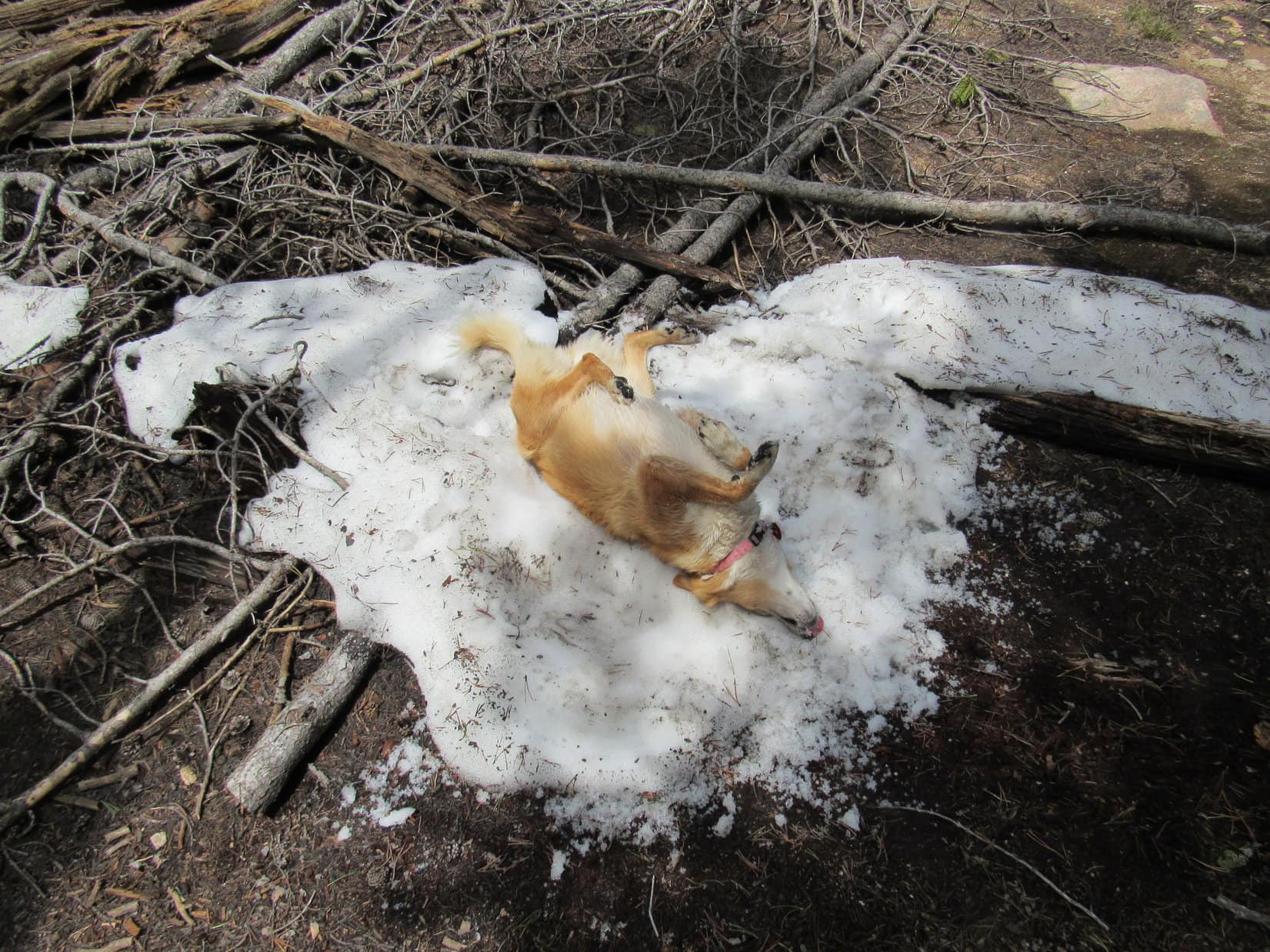
Lupe did a little slipping, sliding and sledding on the soft, deliciously cold snowbanks. No doubt it was refreshing. Loop was clearly pleased with the experience and somewhat re-energized.
Squaw Mountain’s main E/W ridge wasn’t far off now. Beyond the snowbanks, Lupe turned SE climbing more aggressively. Reaching the ridge was easy, and she was soon there.
Lupe had reached the main ridge at a great point. She was well past the high point she had skirted to the N. It’s rocky summit was now in view a little off to the W. Lupe had saved some unnecessary elevation gain by going around it. Squaw Mountain’s true summit was still unseen somewhere off to the E, but the path to it looked open and easy.
The main ridge was level and several hundred feet wide here. Toward the N, the trees had burned. However, the S half of the ridge was all living forest. This was a good place to take a break. Lupe found a spot in the shade to lay down. She had her usual fare of Taste of the Wild and water. SPHP dropped the tent and sleeping bags. This place would be easy enough to find again. Maybe Lupe should camp here?
Loop takes a break in the shade up on Squaw Mountain’s main E/W ridge. Photo looks E in the direction of the still unseen summit.
When her break was over, Lupe traveled E along the broad ridge staying near, but not in, the living forest. She soon came to a N/S running line of boulders. Up ahead a much larger rock formation was in sight. Was that the summit? Lupe pressed on toward it.
Heading E along the main ridge, Lupe reaches a line of boulders. Beyond it, a much larger rock formation was in sight. Was that the summit? Photo looks ENE.
The Carolina Dog climbed a broad, thinly forested slope between the big rock formation and a smaller one to the S. The high point she had seen from the line of boulders wasn’t the summit, but part of a ridge of solid rock that went even higher. Lupe got up on the smaller rock formation for a better look.
A path led toward a wall of rock roughly 40 feet high. The wall appeared to extend NW/SE across the entire main ridge. The high point on the wall might well be Squaw Mountain’s summit, but was there even a way up onto it? Who knew?
No one yet, but Lupe was about to find out! She took the path leading to the wall of rock.
After coming up the slope on the L, Lupe got on this smaller rock formation for a better look at the 40 foot high rock wall ahead. A path led toward it. Lupe took the path to go see if she could find a way up. Photo looks NE.
The path ended at the base of the rock wall. There was certainly no way up that Loop or SPHP could manage from here. Lupe headed SE along the wall, looking for some sort of a break providing a route to the top. She came to a place where a big knob of rock sat up on top of the wall. It looked like there was a place right next to it where Lupe could scramble up with a little help from SPHP.
After following the rock wall SE, Lupe arrived here. If SPHP would give her a boost, it looked like she could get up on top of the wall right next to the large knob of rock seen on the R. Photo looks ENE.
Lupe climbed as high as she possibly could. SPHP then gave her a boost up the last few feet. She’d made it! Lupe was up on the rock wall. SPHP scrambled up after her. A quick look around revealed a couple of surprises.
Lupe stands near the big knob on top of the rock wall. A couple of surprises were immediately evident up here. Photo looks SE.
First of all, SPHP had expected Lupe might be able to simply walk NW back along the top of the rock wall to the highest rocks to claim a peakbagging success. She could go that way, alright, but Squaw Mountain’s summit wasn’t over there. Lupe could now see the summit, but it was some distance away off to the ENE. She still had farther to go.
You mean we still have to go way over there? …. Afraid so, Looper, looks like that’s the true summit of Squaw Mountain. Come on, it’s not that far. You’ll be there in a jiffy! Photo looks ENE.
The second surprise was that if Loop had only gone a little farther SE along the base of this rock wall, there was an opening where she could have easily gotten past it without having to climb up on top. Oh, well! At least that was news she could use on the way back.
There didn’t seem to be any reason to dilly dally around on the rock wall. It was easy to get down off the NE side of it. Once down, Lupe trotted through the forest heading ENE toward the summit. She discovered a couple of fun things to do along the way.
Lupe dug furiously at the base of a tree for several minutes. She didn’t turn up anything, but the American Dingo left the freshly undermined tree looking quite cheerful. Apparently, digging like that had been a good time. Loop also found a few more small patches of snow. They were melting fast, even in the shade. Lupe availed herself of these opportunities to cool off again.
It really wasn’t that far from the rock wall to the true summit, only a few hundred yards. A short, easy scramble up white rocks brought Lupe to the summit of Squaw Mountain(9,313 ft.). At the very top, a white rock about 3 feet high leaned at a steep angle. Loop bounded up in a single leap. Sweet success!
Lupe on the highest rock on Squaw Mountain. Another peakbagging success! Photo looks NE.
The trek up Squaw Mountain had been really fun! The views at the top were rewarding, too. A few trees existed around the summit area, but not enough to block the views. By moving around a bit, it was possible to get a clear view in any desired direction.
Climbing Squaw Mountain had been fun! Lots of off-trail exploration and a few challenging spots, but nothing too difficult. Great views from the top, too! Photo looks NE.Looking back along Squaw Mountain’s main ridge. The rock wall Lupe had climbed over from the other side is in view above her head. The big knob she had gotten up next to is seen on the L. Other lower high points along the main ridge are seen farther off to the R. Photo looks WSW.Another look at Squaw Mountain’s main E/W ridge. Photo looks WSW with a bit of help from the telephoto lens.
A small wooden structure a couple feet NW of the summit rock had collapsed long ago by the looks of it. There was some smooth wire around, too. However, the one man-made thing SPHP hoped to find up here was nowhere to be seen. A search for the Squaw Mountain survey benchmark yielded nothing. Where was it? The entire summit area was only 15′ x 10′. It should have been easy to find.
Nope, nada. SPHP eventually gave up the search.
The small collapsed wooden structure a couple feet NW of the summit rock is seen on the R. Photo looks W.A short distance E of the true summit, Lupe stands on a rock shaped like an elongated chair. SPHP promptly dubbed it “the Dingo Throne“. The views from the Dingo Throne were fantastic! Photo looks ENE.Still on the Dingo Throne, this time looking NW at Buffalo Peak(9,387 ft.) (R).Buffalo Peak was Lupe’s next peakbagging goal after Squaw Mountain. Looks like fun, doesn’t it? Photo looks NW.Buffalo Peak (Center) is 1.5 miles NNW of Squaw Mountain.
After spending a little time gazing at the tremendous views, Lupe was ready for another break. Even up here, the day was getting kind of hot for wearing a fur coat. Loopster took shelter in the shade of a couple of small trees SE of the summit rock. SPHP gave her water and Taste of the Wild again. She would have preferred steak and ice cream, but at the top of a remote mountain in the Laramie Range, even an American Dingo has to take what she can get.
After dining, Lupe looked ready to doze off. However, some pesky flies arrived and wouldn’t leave her alone. She spent her time snapping instead of napping. Meanwhile, SPHP went back to looking around.
A large bird swooped by. No doubt some loyal reader of this blog will once again suggest the bird was both a vulture and an evil omen. Fortunately, with all the snapping at flies going on, and SPHP apparently still conscious, the evil omen did not yet feel confident enough about the situation to drop in for a meal.
Lupe takes it easy in her fly-snapping spot.A large bird swooped by. Fortunately for Lupe and SPHP, even if it was a vulture, it was premature in it’s thinking. Photo looks up.A year ago, Lupe had also climbed Warbonnet Peak(9,414 ft.), the highest point seen L of Center. That had been a great adventure, too! Photo looks SSE.Warbonnet Peak is the Converse County, Wyoming high point. Photo looks SSE with help from the telephoto lens.
A rare moment arrived. SPHP had an idea! Peering down among cracks between the rocks under the collapsed wooden structure, there it was! The Squaw Mountain survey benchmark. Hah! SPHP had to wait until the angle of the sun illuminated it better before taking a photo.
The Squaw Mountain survey benchmark is hidden down in cracks between rocks beneath the collapsed wooden structure next to the summit rock. Photo looks down.
Lupe had been up at the summit of Squaw Mountain for half an hour now. Unfortunately, the weather to the SW seemed to be deteriorating. It looked like rain showers might move in from that direction. Maybe it was time to think about moving on?
Loop was fine with that. Snapping at flies had grown old. Before leaving, though, she returned briefly to both her Dingo Throne and the true summit for a last look around.
Lupe back on her Dingo Throne for a final look around. Buffalo Peak is seen on the L. She would be headed there next! Photo looks NNW.Looking N from the Dingo Throne.Final moments on the summit rock. Photo looks ENE.
SPHP started down first. Lupe waited for the signal to follow.
Waiting for the signal to come down. Photo looks N.
Still waiting at the same spot. Photo looks WNW.
From the summit, the rock wall Lupe had climbed up earlier had looked equally high. A quick check of the topo map revealed that the highest part of the wall was also enclosed by the 9,280 foot contour. So the rock wall was conceivably just as high or higher. SPHP didn’t really believe the rock wall was higher, but she may as well tag this “W summit” on her way back, too.
Even including time spent frolicking in the snow again, it only took Looper 10 or 12 minutes to get back to the rock wall.
Ahh, so nice and cool!Dingo ecstasy!
Coming from the E, it wasn’t hard to get up on the highest rocks of the rock wall. In the short time it had taken to get here, though, clouds had spread across a large portion of the sky. A cool breeze blew out of the SW. Lupe better not stay up here long.
Lupe reaches the highest rocks of the rock wall. It had only taken 10 or 12 minutes to get here from the summit, but clouds had already spread over a large part of the sky. Warbonnet Peak is the high point at Center. Photo looks SSE.Looking NE from the rock wall back toward the true summit. The sky was still mostly blue in this direction.Looking W.Looking E.
After a good look around from the top of the rock wall, Lupe circled down around to the SE, passing through the break in the wall she had discovered earlier. With the weather clearly deteriorating, she made a beeline W back to the place where SPHP had left the tent and sleeping bags on Squaw Mountain’s main ridge.
Too bad the weather was threatening. It would have been fun for Lupe to spend the night up here and get some sunset photos. However, considering the situation, it seemed better to get down off the mountain. SPHP grabbed all the gear. Lupe left the main E/W ridge going NW down Squaw Mountain’s N slope.
Looper lost elevation faster than she’d gained it coming up. She was somewhere N of where she’d been before, but she was still angling W, too. It seemed to take a long time to get through the burned forest. The sky became so threatening, it became prudent to look for a place to take shelter. Widely scattered big raindrops started falling. Lupe finally found a place to hide under a small overhanging rock formation.
The rain shower didn’t amount to anything. It was over only a couple of minutes after Lupe took cover. Figures. When nothing further happened for another 10 minutes, the Carolina Dog went on. Down, down, down, trying to go WNW now. Lupe was aiming for relatively level ground SW of Buffalo Peak and the Meadow Creek valley.
Lupe finally reached the living, unburned forest. She liked this better, but now it wasn’t possible to see much at all. SPHP was surprised when Lupe came across a logging trail or some kind of road not long after reaching the living forest. First she followed it SW, the direction where she ought to run into the bright green bog and Roaring Fork Creek again. Before long, though, the road simply dead-ended.
Oh, well. Other than to get re-oriented, there wasn’t much reason to return to the bog anyway. May as well turn around and see where this road came from. At first, it took Lupe NE, but soon began curving N, then NW, and finally clear around to the W. N was fine. NW was fine. W into unexplored territory was not. Lupe didn’t need to go any farther that way.
On the logging road somewhere NW of Squaw Mountain. Photo looks W.
Even so, the road was a nice luxury. After all the bushwhacking, SPHP was reluctant to leave it. Maybe it would curve back N again? It did, but only for a short stretch, then it curved W again. Gah! Who knew where it went? SPHP was about to abandon the road to head N when it briefly curved SW. Ahead beyond a huge gnarled tree with 3 trunks was a sunlit meadow. A squirrel chattered. Lupe streaked over to bark at it.
An omen! A good one, too! To heck with buzzards and vultures! Lupe needed a place to camp tonight, and a beautiful green meadow next to a giant squirrel tree would be perfect!
Lupe arrives at the beautiful green meadow. She needed a place to camp tonight. This secluded meadow fully equipped with a giant squirrel tree nearby was perfect! Photo looks SW.
The rain shower had passed on by. Clouds remained in the sky, but the meadow was sunny and bright. The sun was still high, looking like it would be up for another 5 or 6 hours. Twilight would linger for another hour after that. Buffalo Peak(9,387 ft.) couldn’t be much more than a mile away to the NE.
Why wait until tomorrow? Lupe had time. The tent and sleeping bags could be left here. In case it rained again, SPHP hung them up in the ancient squirrel tree. Less surface area would be exposed to the sky that way.
Lupe wanted to linger at the old tree and watch squirrels. For a few minutes, SPHP indulged her. Then it was time for the next big thing. Lupe and SPHP left the grand old squirrel tree heading N for Buffalo Peak.