Atlantic Peak, Wind River Range, Wyoming – Part 1: The Christina Lake Trail & Beyond to Atlantic Lake (9-14-20)

Days 1 & 2 of Lupe’s 5th Summer of 2020 Dingo Vacation to Wyoming!

9-13-20, 3:20 PM, 85ºF, Lander city park – Only 6 days ago, Lupe had left Lander intent upon climbing Atlantic Peak (12,490 ft.).  Instead, she’d wound up fleeing S into Utah in a futile attempt to avoid a freak Labor Day blizzard.  Well, guess what?  85ºF!  Summer of 2020 was back, and the American Dingo was, too!

“Police Line Do Not Cross” said a plastic yellow streamer cordoning off most of the deep green lawn beneath the big old cottonwood trees.  Piles of broken branches, damage from the recent storm, were heaped up throughout the park awaiting removal.

Didn’t matter.  Loopster loves Lander City park!  Free camping and squirrels!  Going to be home for tonight.  Tomorrow morning she would head up into the SE end of Wyoming’s mighty Wind River Range.
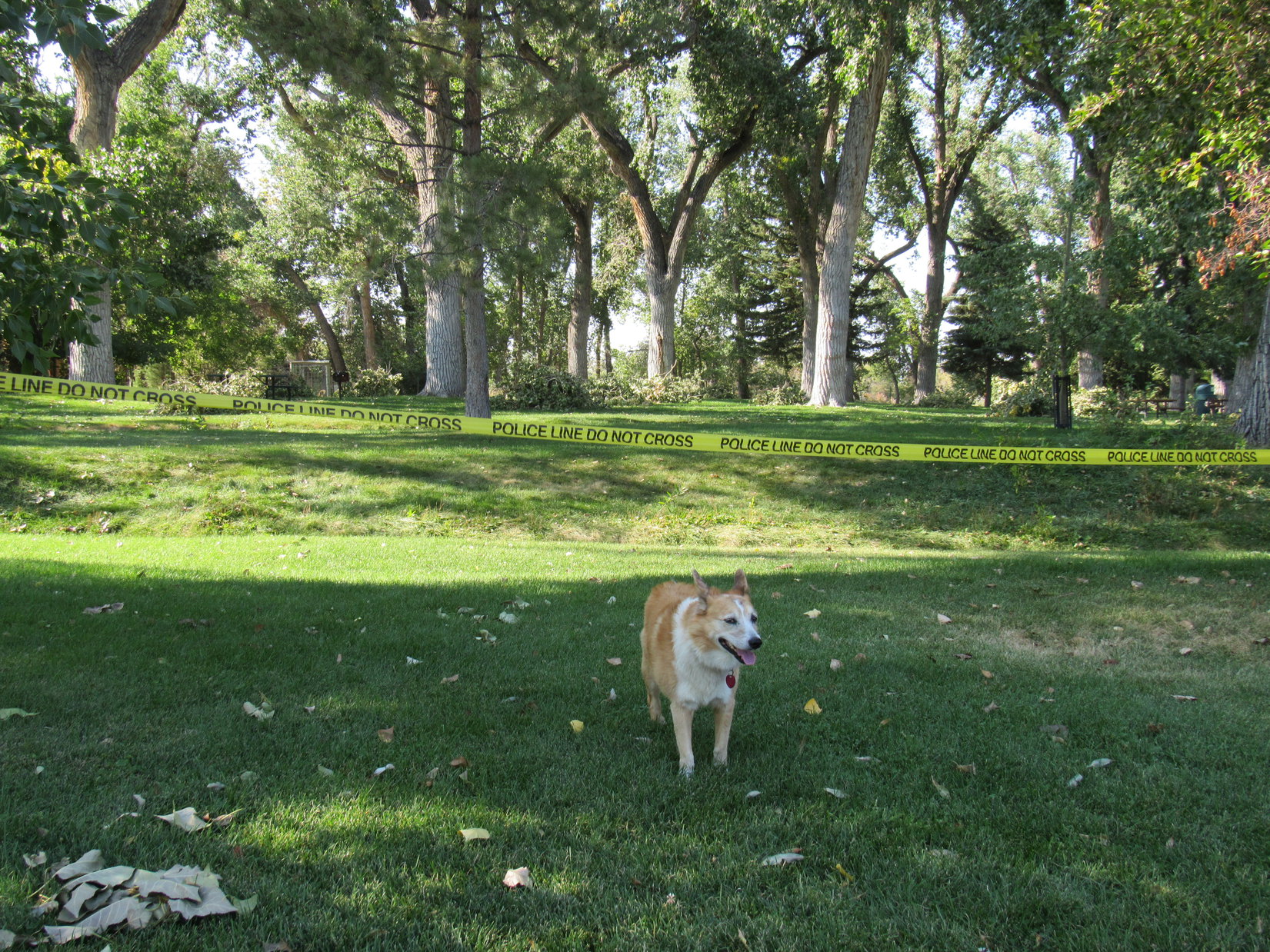
Return of the Dingo! Back at Lander city park.

9-14-20, 9:49 AM, Christina Lake trailhead just off County Road No. 300 – The W was still on fire.  The blizzard may have cleared the air for a while, but smoke was already drifting back into the Wind River Range.  Didn’t seem to be too bad.  Nothing to be done about it in any case.

Smoky or not, Looper was doing this!  Just getting to the trailhead this morning was as close to Atlantic Peak as she’d made it this summer.  Her first “attempt” had been back in July, when it turned out that the access road, County Road No. 300, had been closed for repairs.  Then, of course, there was the Labor Day blizzard, which had once again forced a retreat before the Carolina Dog ever even left the highway.

3rd time’s a charm, Loopster!  C’mon, let’s hit it!
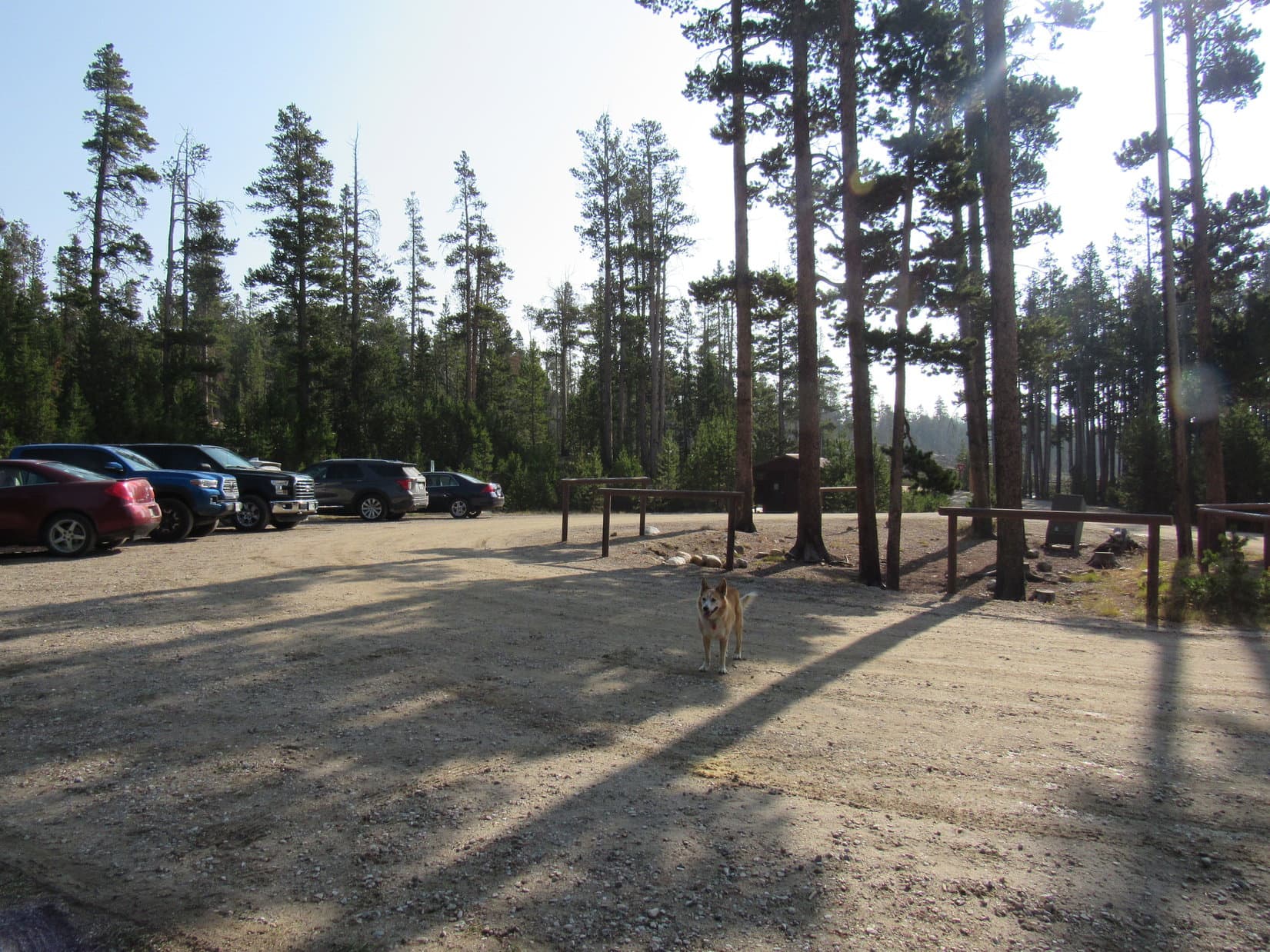
At the Christina Lake trailhead off County Road No. 300, just S of Fiddlers Lake.

Near a small corral, Christina Lake trail No. 721 left the trailhead as a stony path heading N up into the forest.  The trail turned W after a brief climb, leveling out before getting quite to the top of a minor ridge.  The topo map showed Fiddlers Lake nearby, likely just on the other side.

Here now!  Might as well take a look!  Lupe left the trail, angling NW up onto the ridge.  Sure enough!  There was Fiddlers Lake.  A rocky dam was visible not too far away along the SW shore, which ought to be a good viewpoint.  Loop sniffed her way over to it.

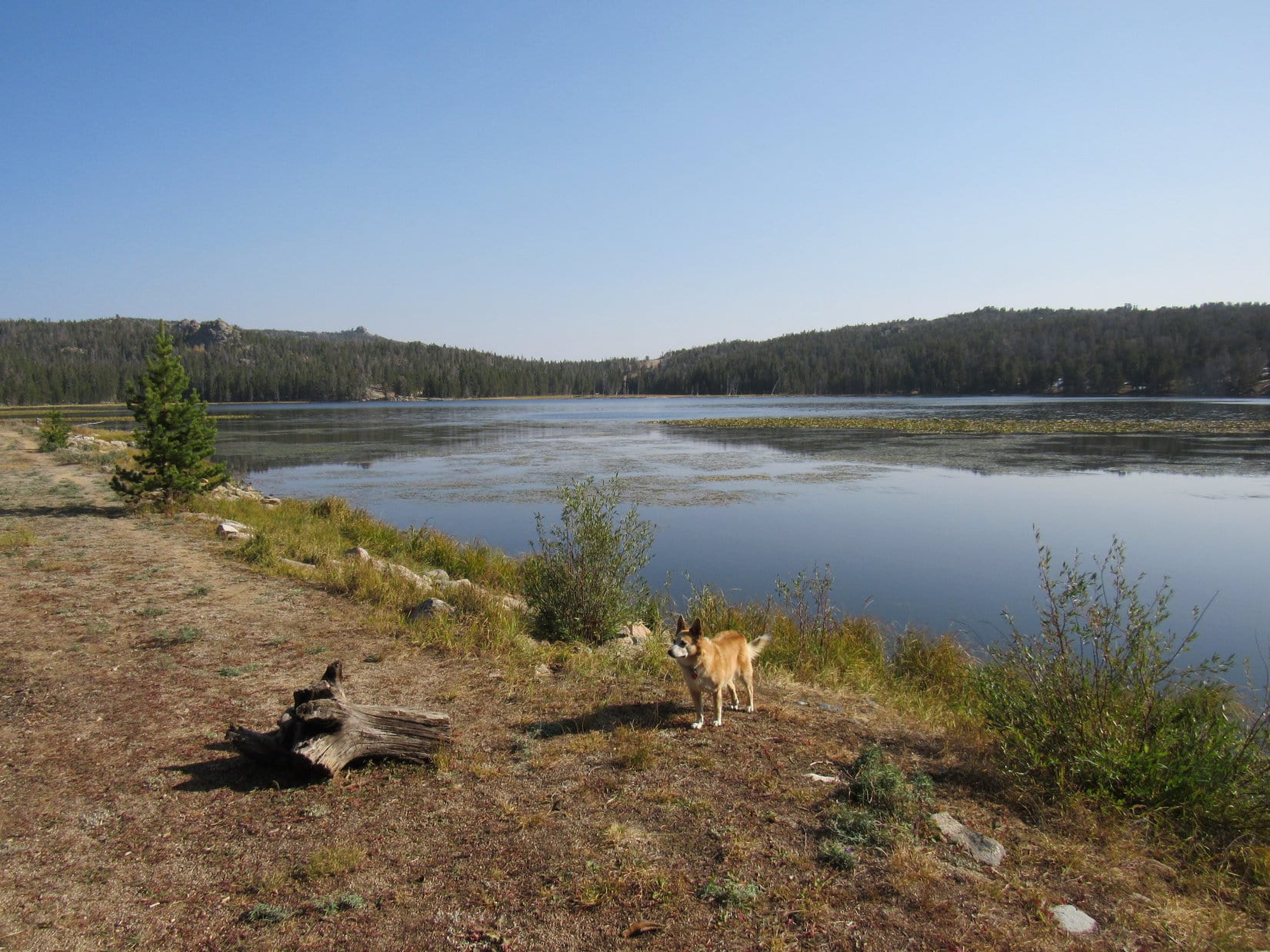
Near the dam, Fiddlers Lake was calm and weedy.  Looked like there were lots of lily pads farther out before reaching truly open water.  Nice, but not super impressive.  Fiddlers lake resembled an overgrown pond.  Most of it probably wasn’t very deep, but maybe the fishing was good?

Carolina Dogs don’t fish much.  Lupe returned to the Christina Lake trail.

Leaving the Christina Lake trailhead. Photo looks N.
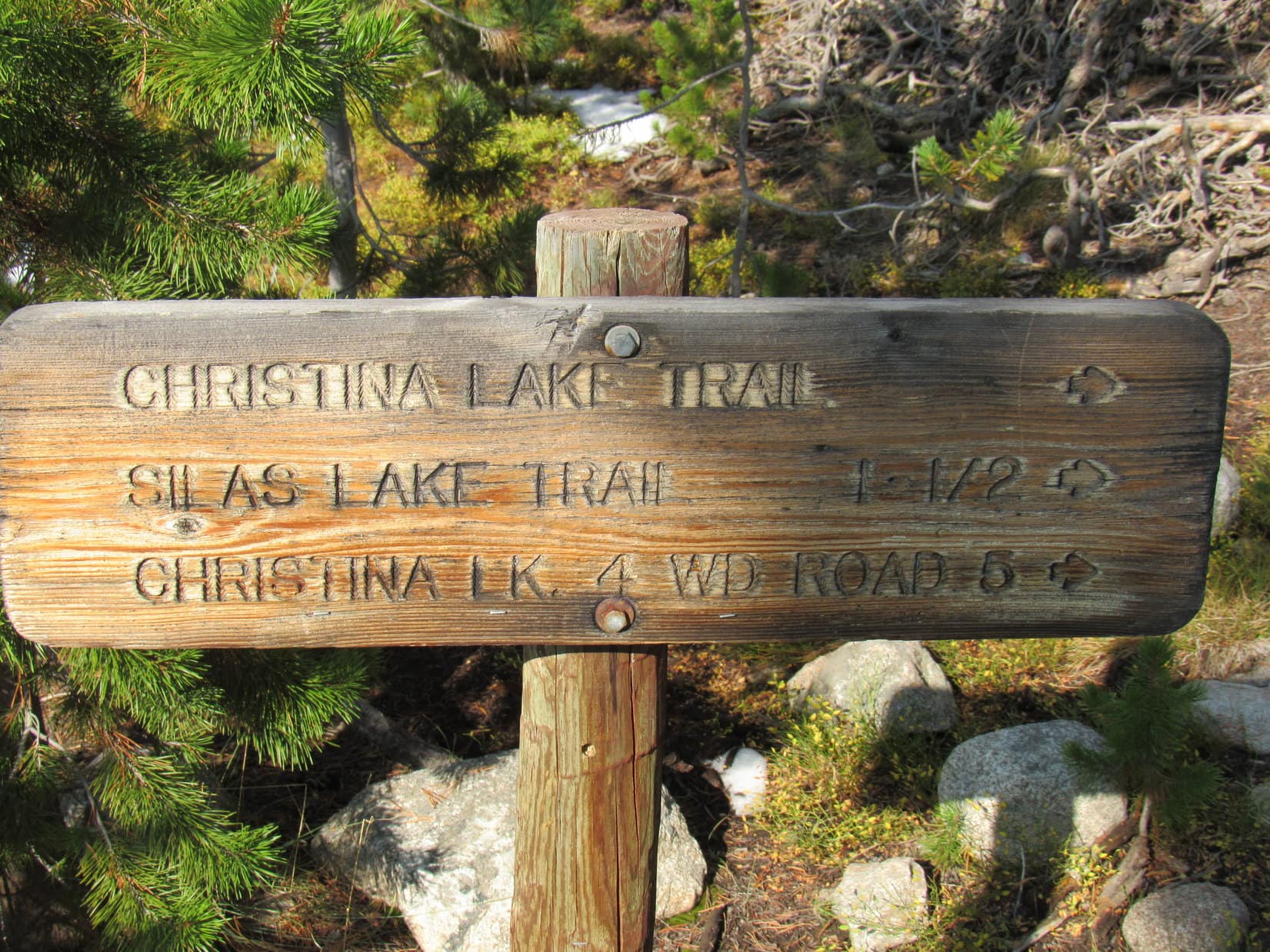
Sign at the start.
Fiddlers Lake. Photo looks NE.

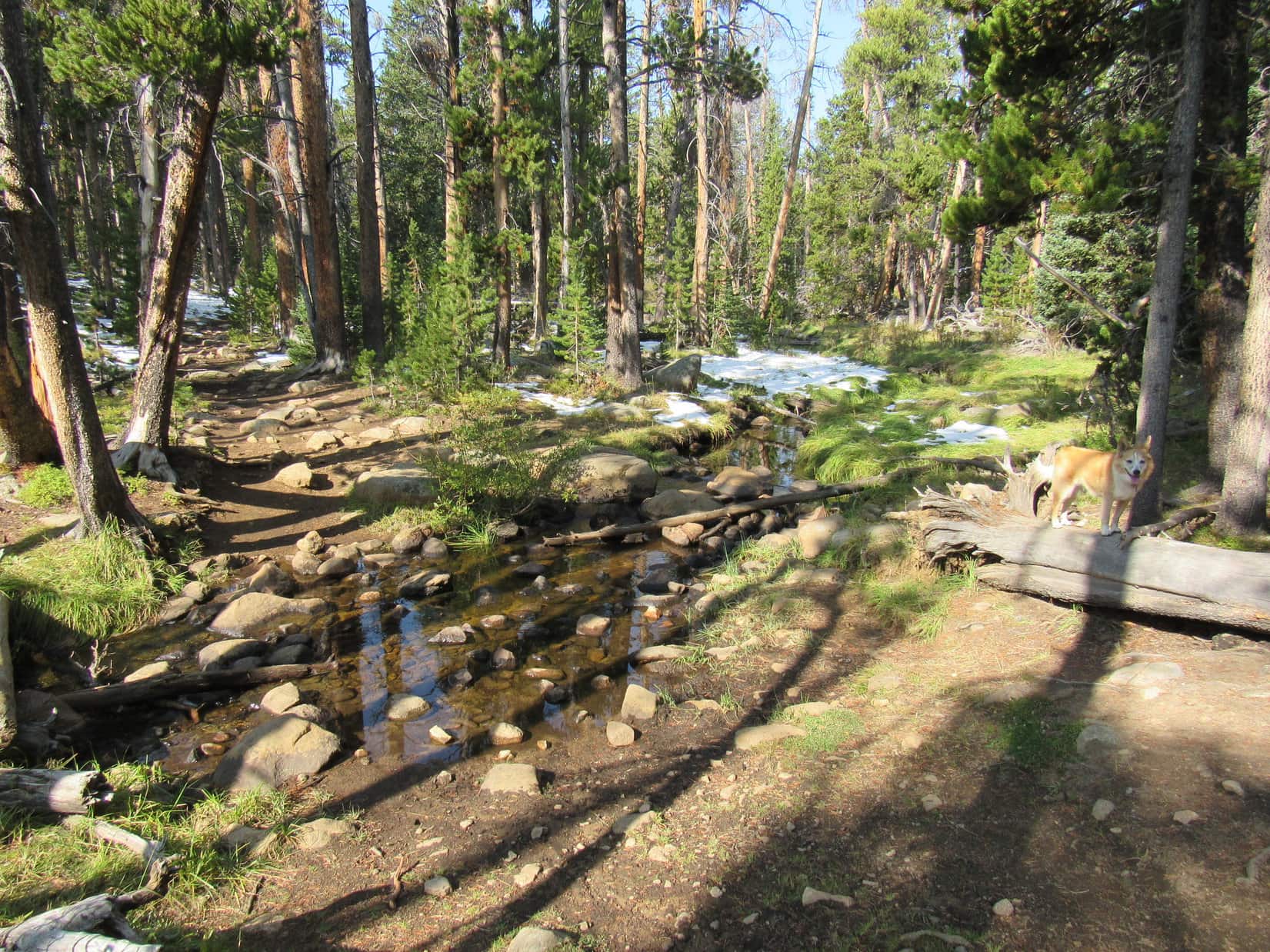
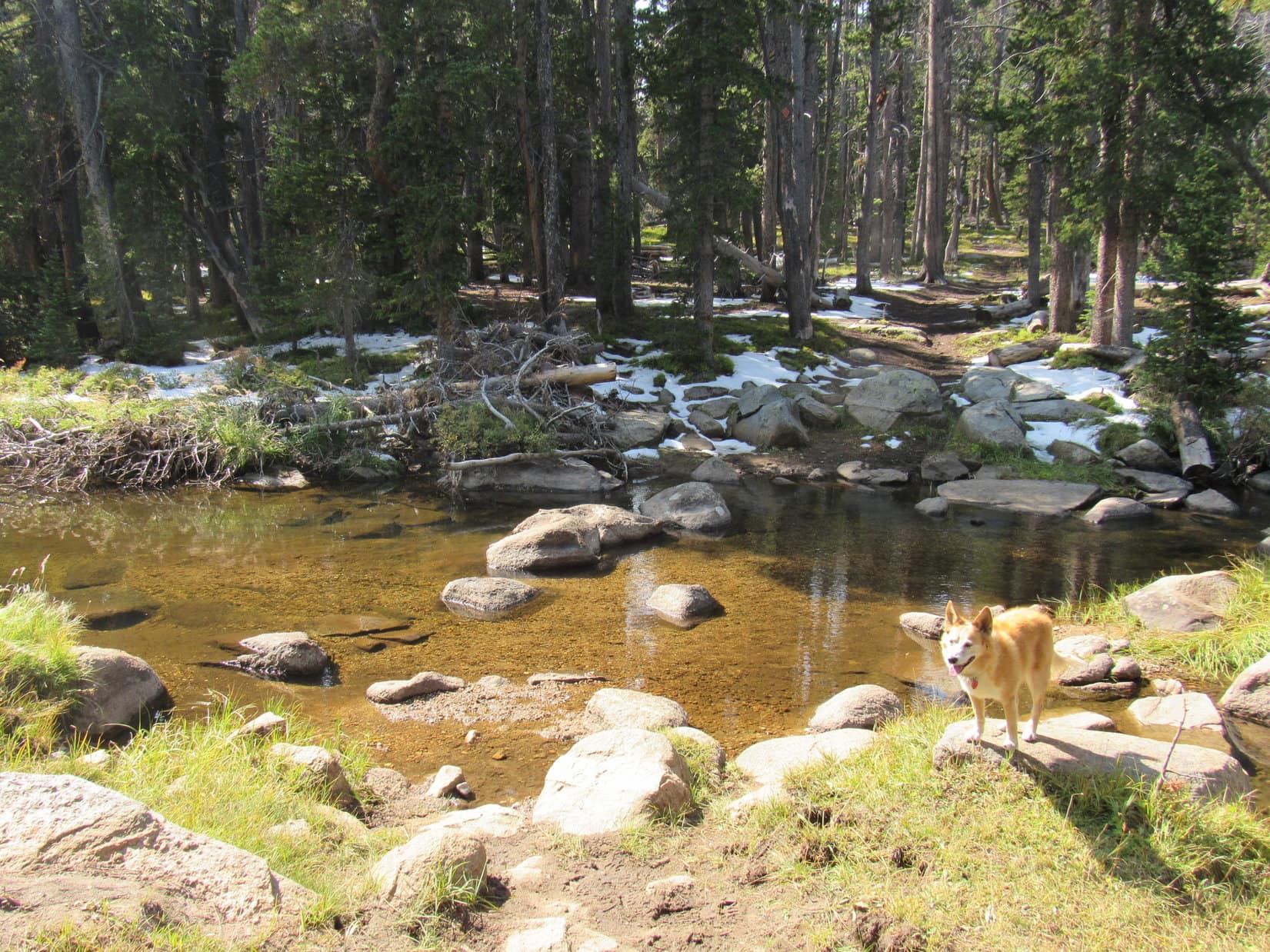
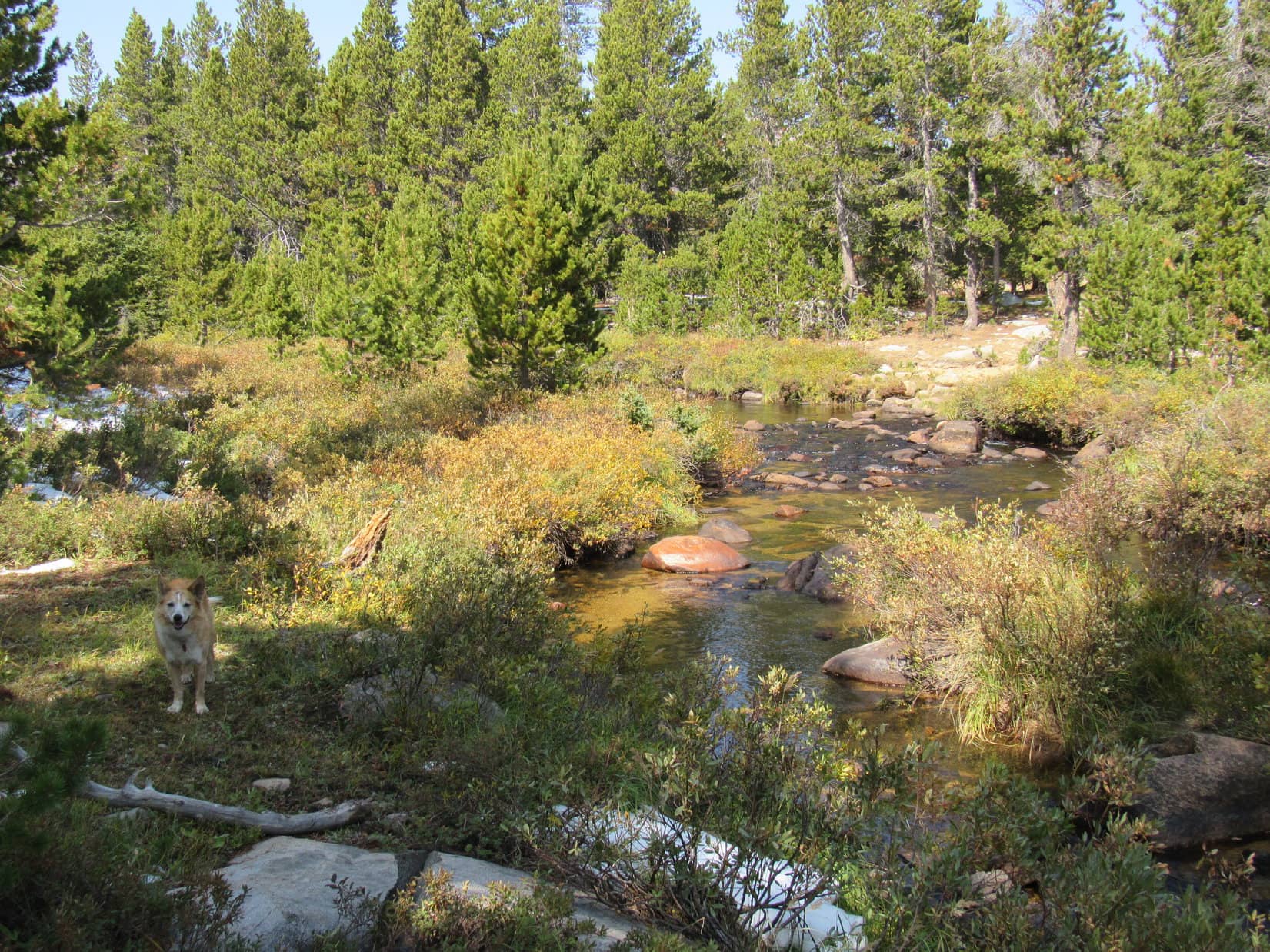
Morning sunlight streamed through the trees.  The air was humid and fresh.  Scattered patches of snow melting in the forest made it feel more like spring than mid-September.  Easy to follow, the Christina Lake trail bounced along neither gaining nor losing much elevation.  Less than 0.5 mile from the trailhead, Lupe reached Fiddlers Creek.  No bridge, but Fiddlers Creek was too small to present any difficulties.
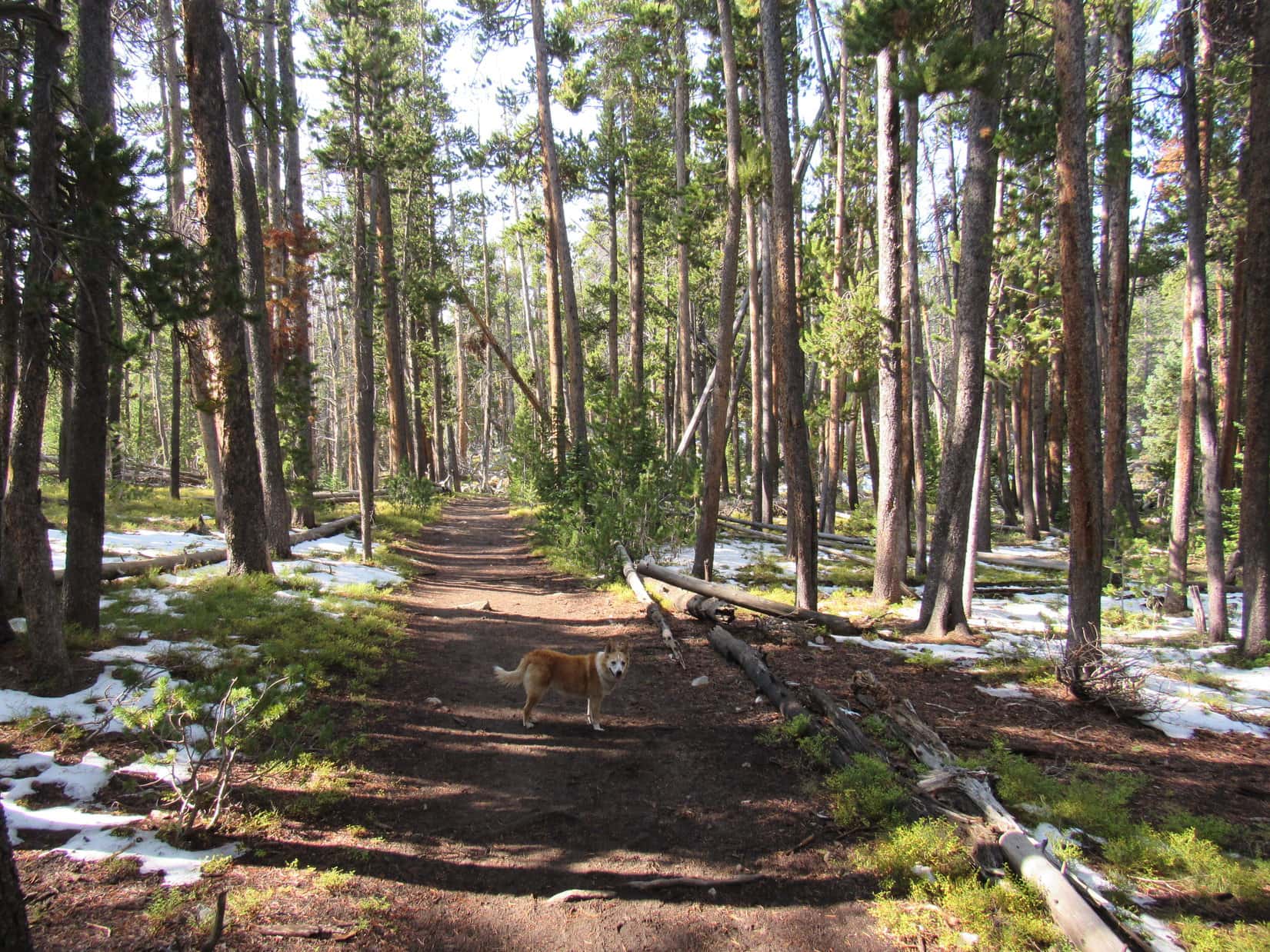
Feels like spring with all this melting snow! Christina Lake trail No. 721.
Fiddlers Creek.

After crossing Fiddlers Creek, Lupe gained 200 feet of elevation before the trail leveled out again.  Proceeding SW, a gradual downhill section led to several more streams, all mere trickles.  After another modest climb, the trail straightened and flattened well up on the side of a steep slope.  At the end of this straightaway came a curve to the R.  Beyond it, Loop arrived at a junction.

Silas Lake trail No. 722 headed off to the W (R) here on its way to Upper Silas Lake, a popular destination judging from the registry 1.5 miles back at the trailhead.  Lupe, however, didn’t need to go to Upper Silas Lake.  Sticking with the Christina Lake trail, she continued on.
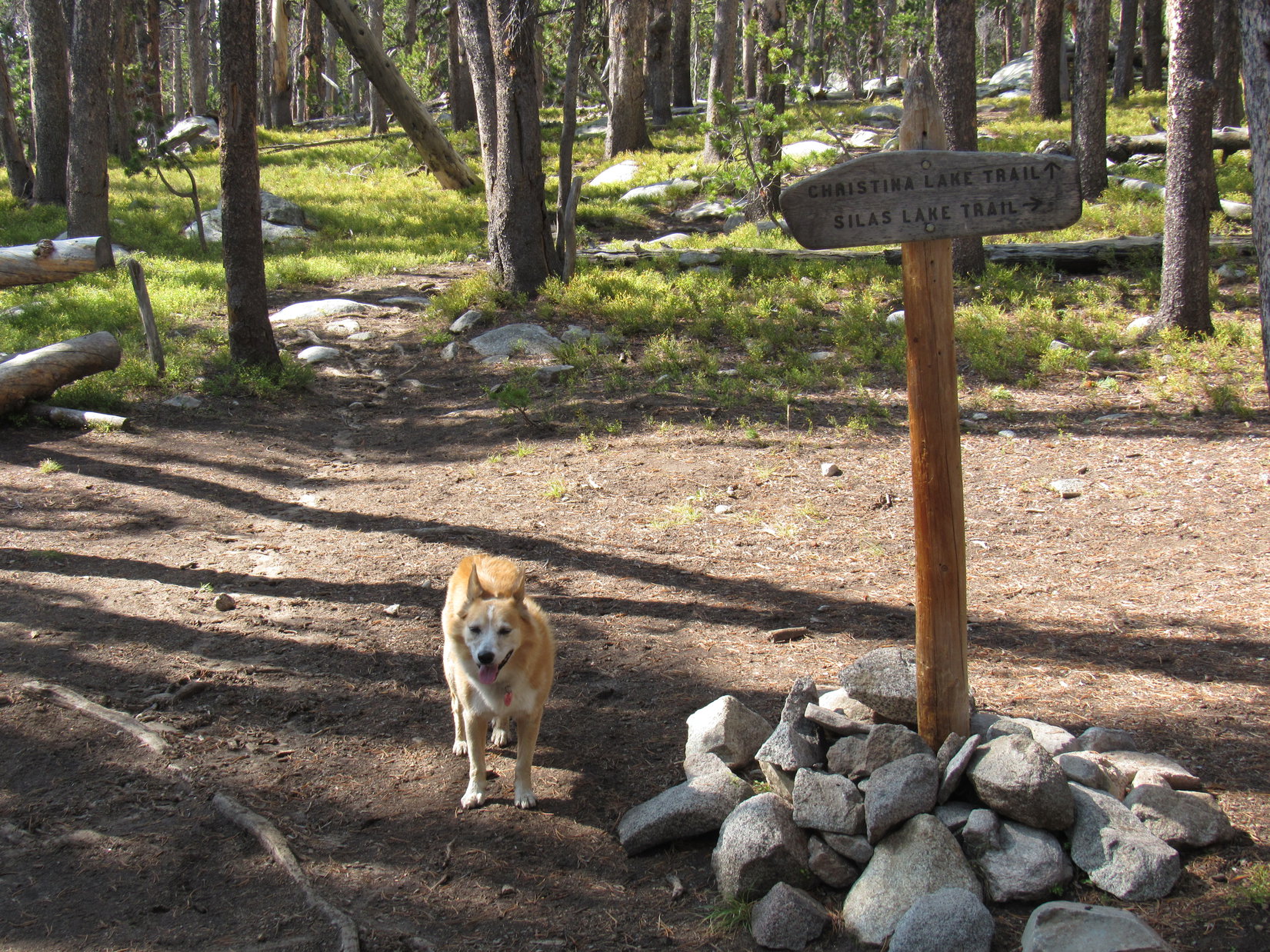
At the junction with the Silas Lake trail.

Occasionally, small clearings had been visible off to one side or another, most of which looked like boggy regions.  20 minutes past the Silas Creek trail junction, the largest clearing yet appeared on the L.  A little beyond it, Lupe reached Silas Creek, the biggest stream she had come to so far.
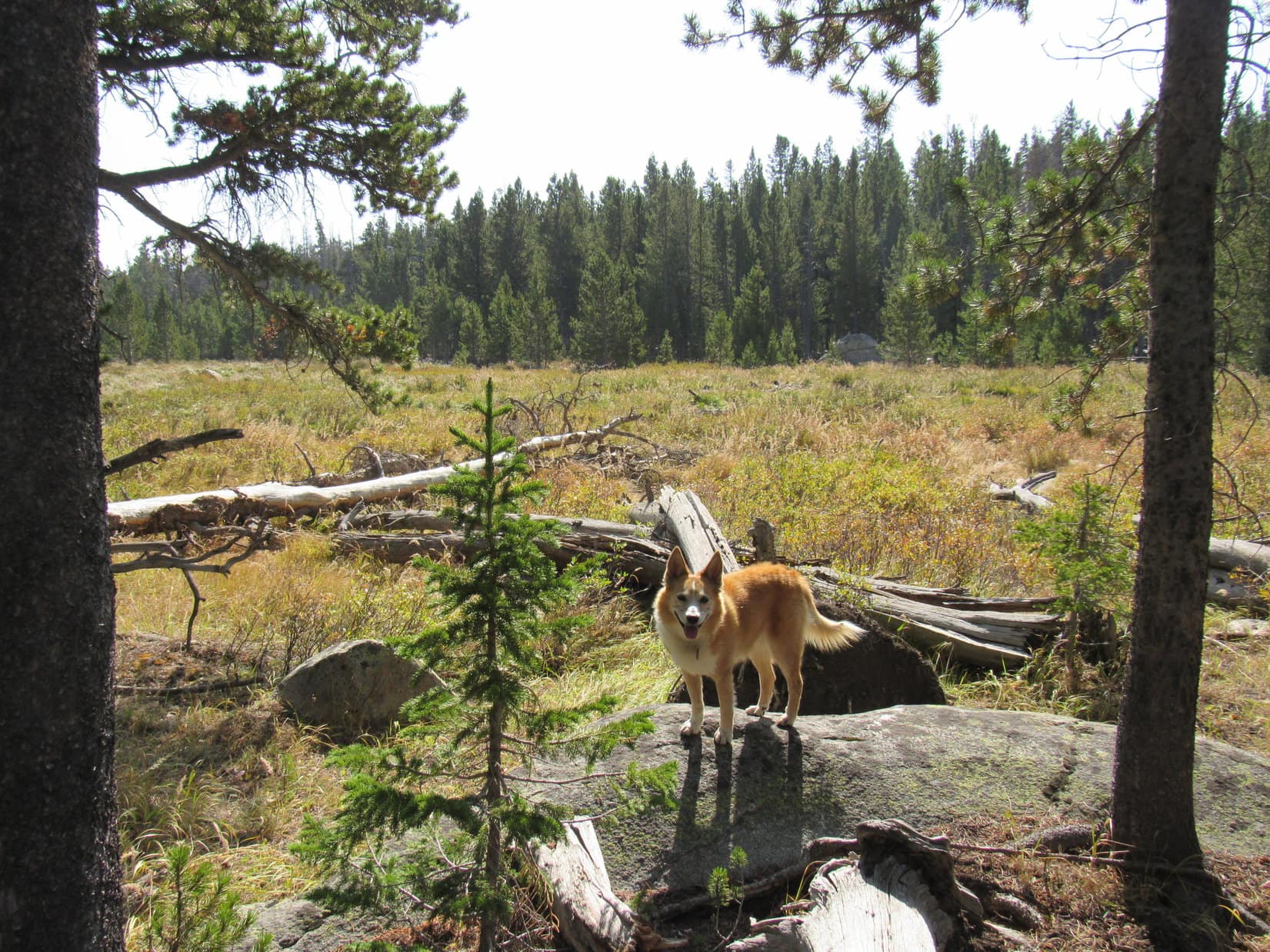
Glimpse of the big clearing on the L side of the trail. Photo looks S.
Silas Creek.

Silas Creek wasn’t all that big, either, but was fairly wide where the trail crossed it.  Many rocks were in the stream, both upstream and down, but a quick check didn’t reveal any spots where they were arranged quite fortuitously enough to permit a rock hop.  Oh, well!  Shedding boots and socks, SPHP waded across.  Lupe followed after.

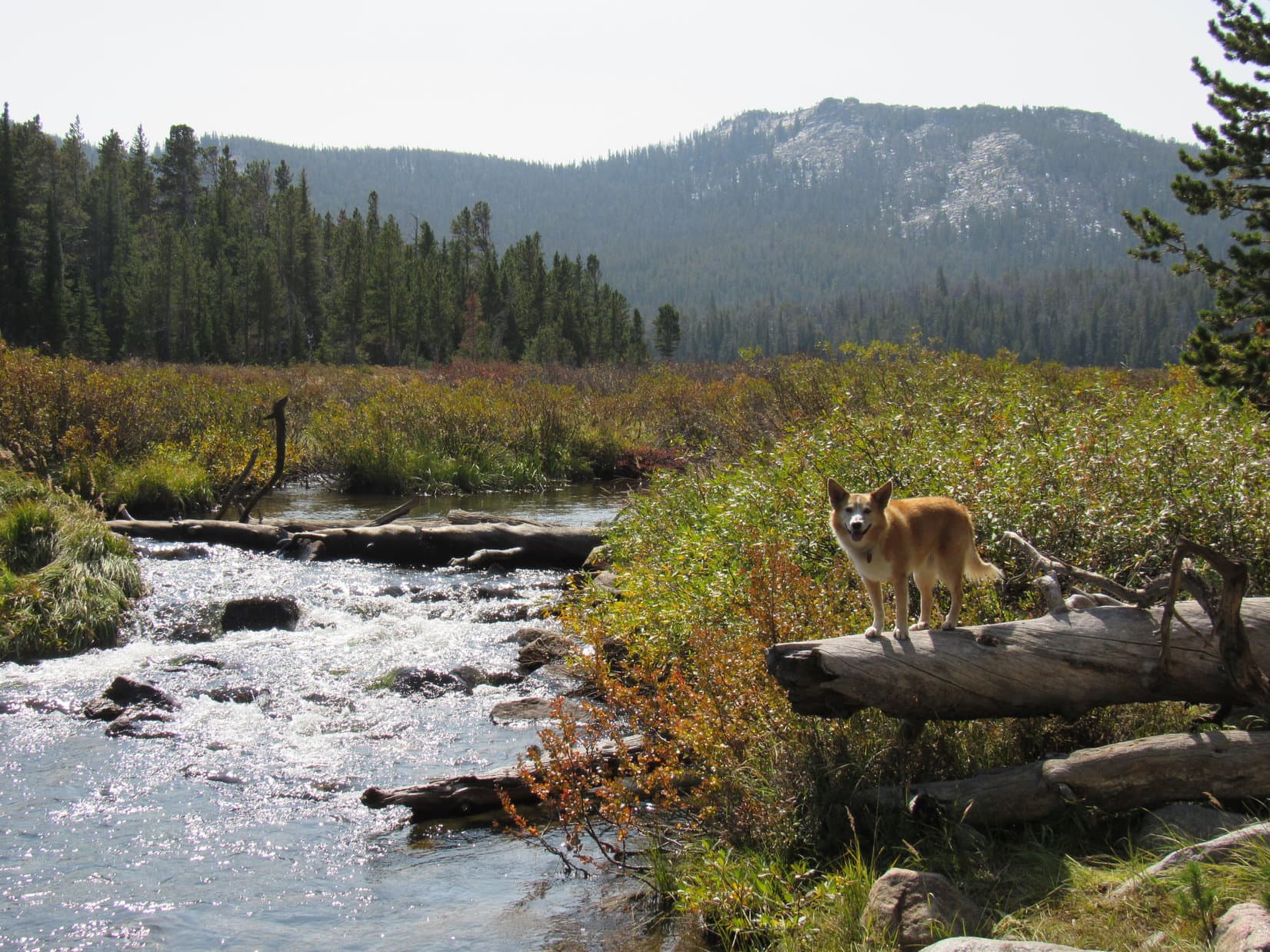
That was easy enough!  However, the American Dingo didn’t get much farther before coming to an even larger stream.  Atlantic Creek had twice, maybe triple, the flow that Silas Creek did.  The bottom of Silas Creek had been sand and gravel, but Atlantic Creek was rocky.  As much as 2 or 3 feet deep, the prospect of wading across Atlantic Creek’s stony bottom wasn’t too attractive.  Fortunately, the water was just low enough to permit a rock hop on stones barely protruding above the surface.
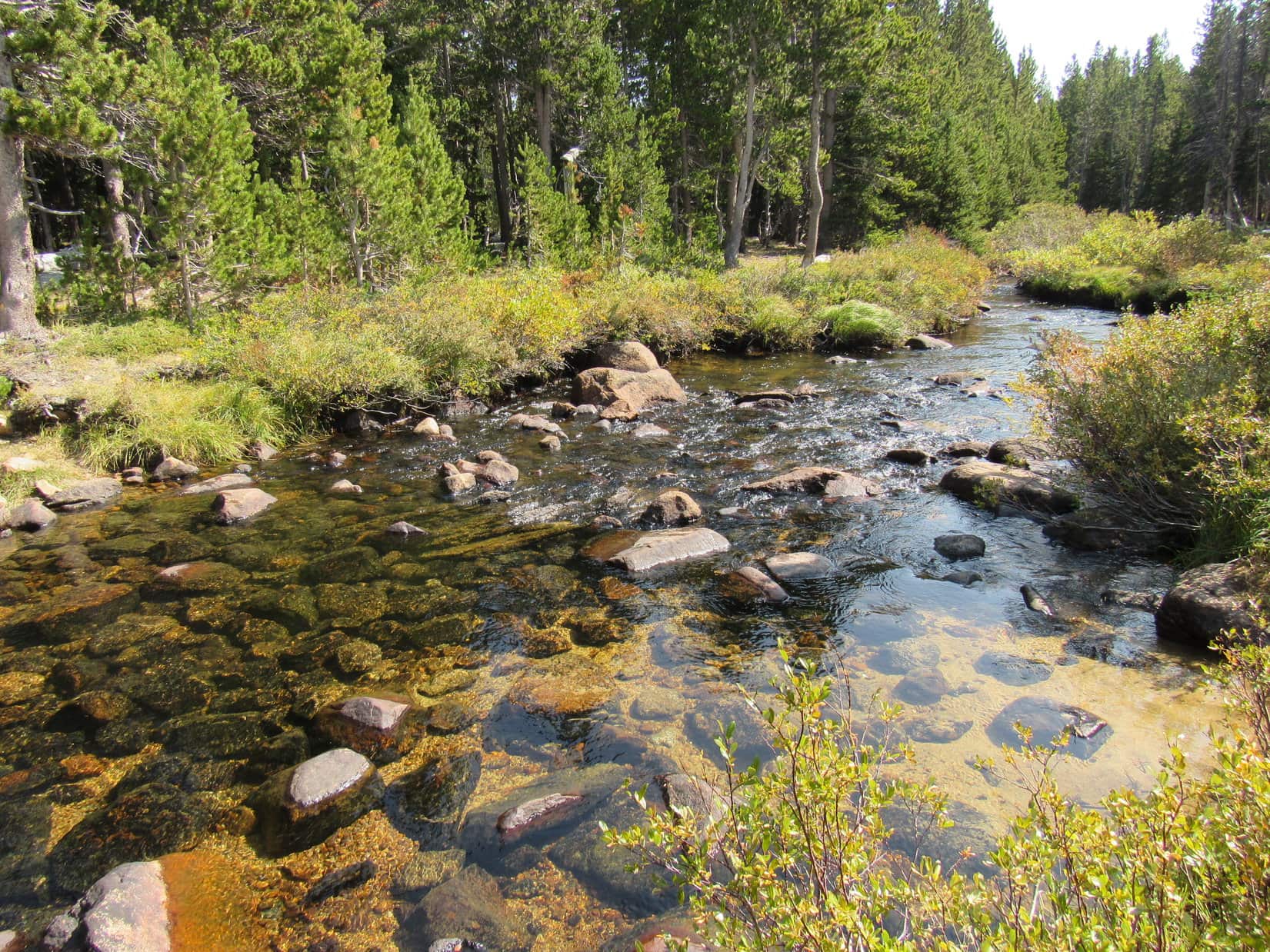
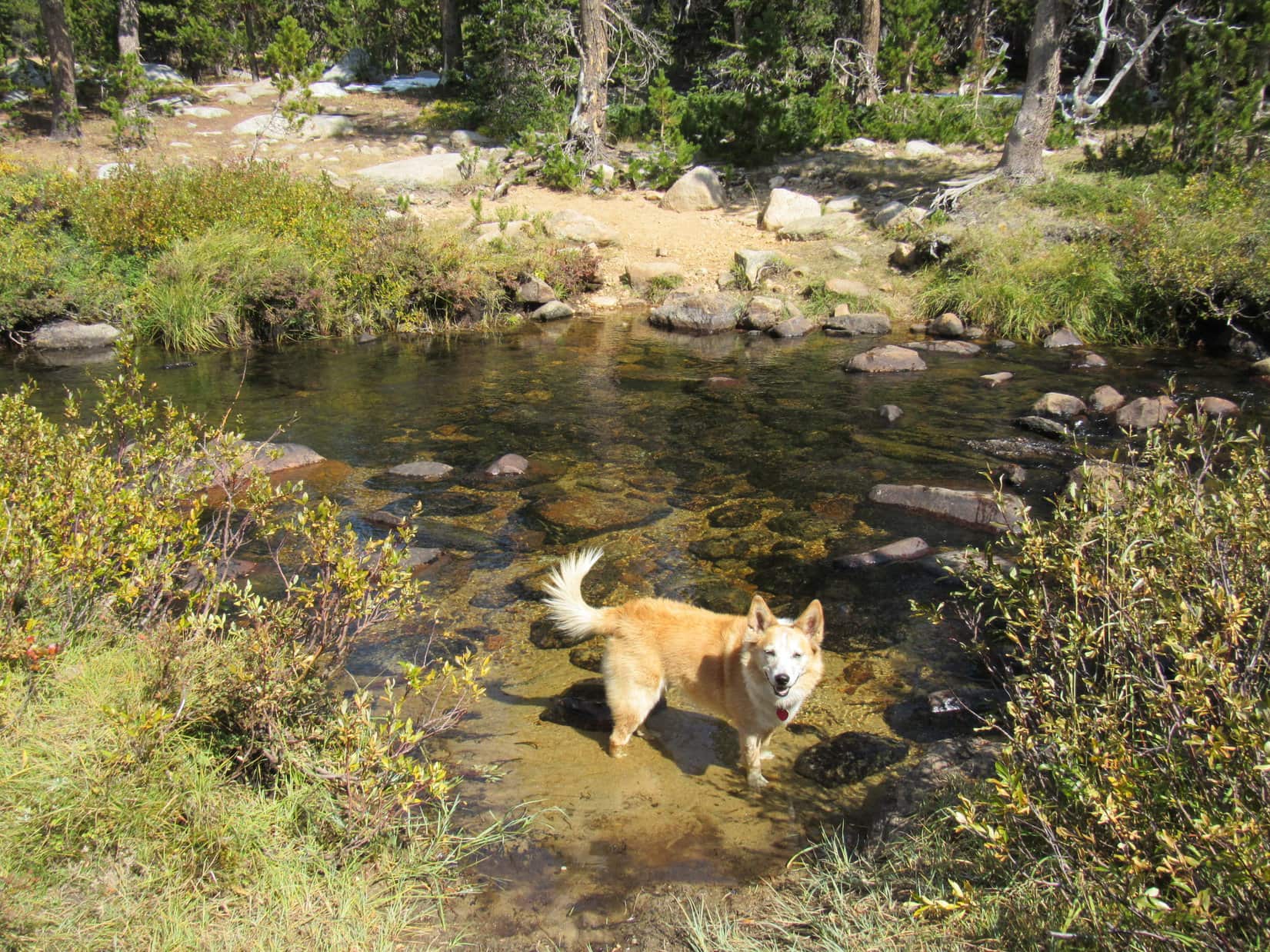
Atlantic Creek.
SPHP’s such a tenderpaw! Nothing to it!
Looking back after crossing Atlantic Creek. Photo looks NW.

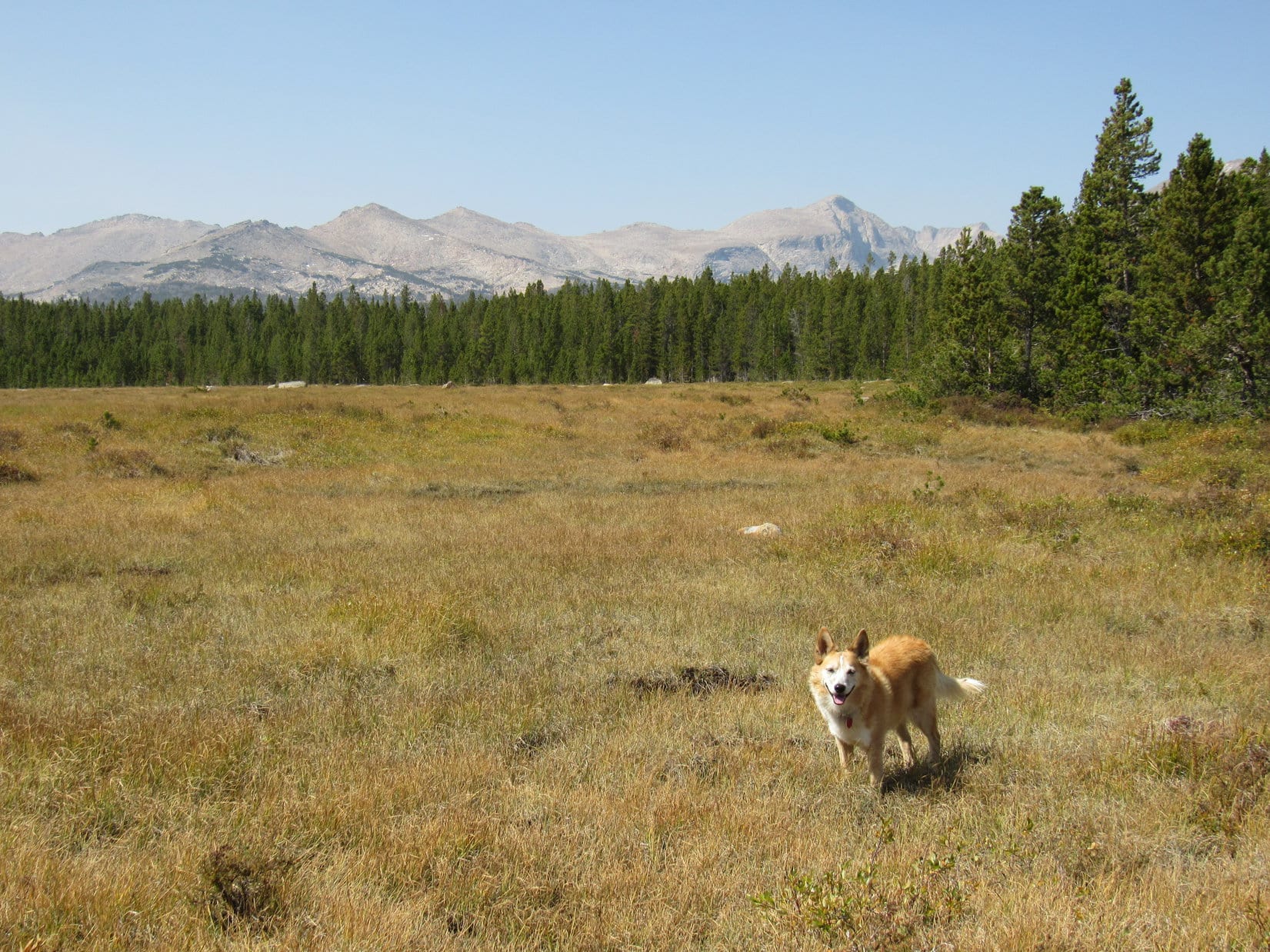
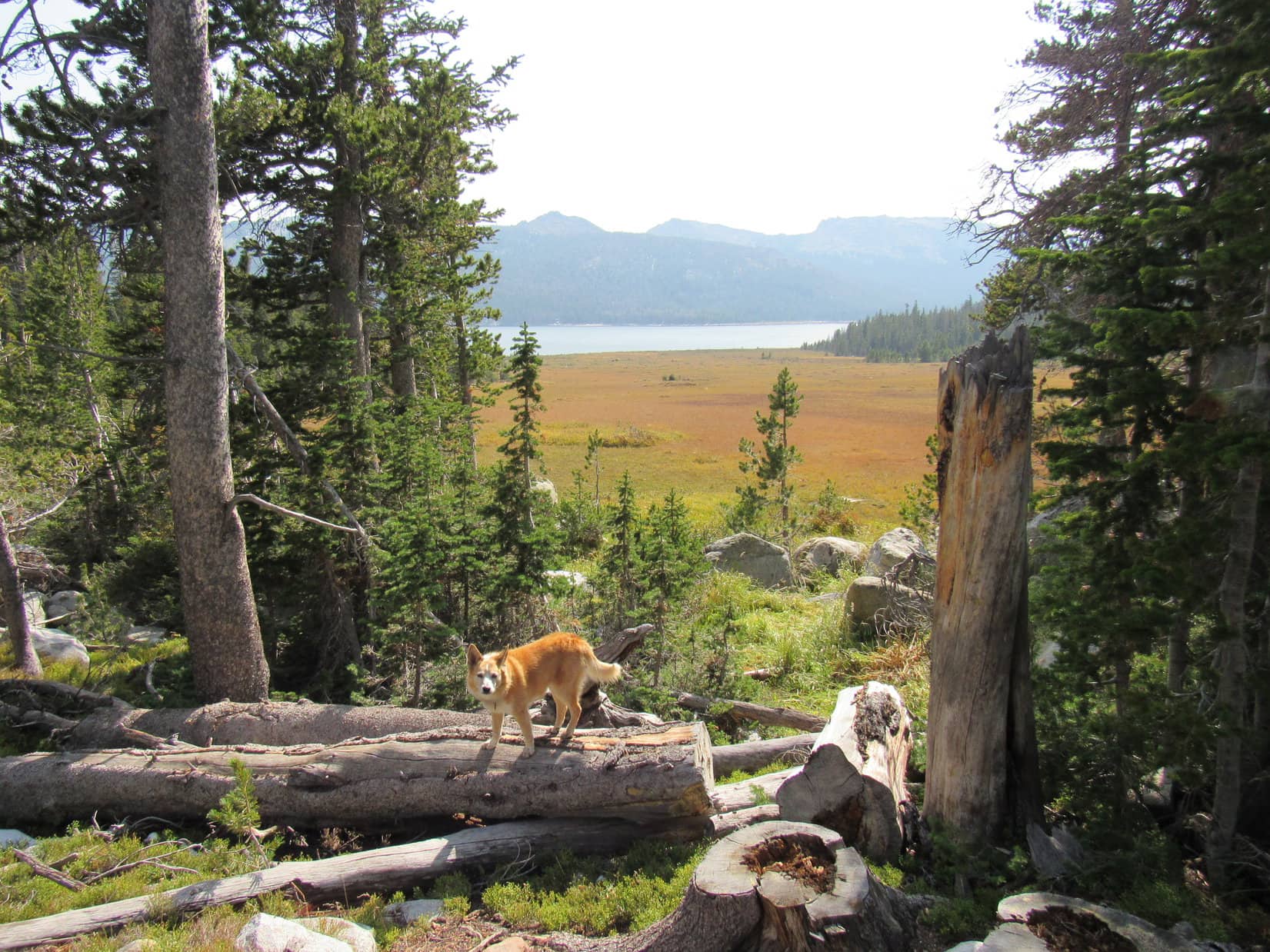
Shortly after leaving Atlantic Creek, the Christina Lake trail went over a minor rise, passing through a clearing strewn with rocks and several large boulders.  Beyond this clearing, the trail re-entered the forest going gradually downhill.  At a low spot, the Carolina Dog came to the edge of an enormous field.  This field looked grassy and dry, but was actually quite soggy.

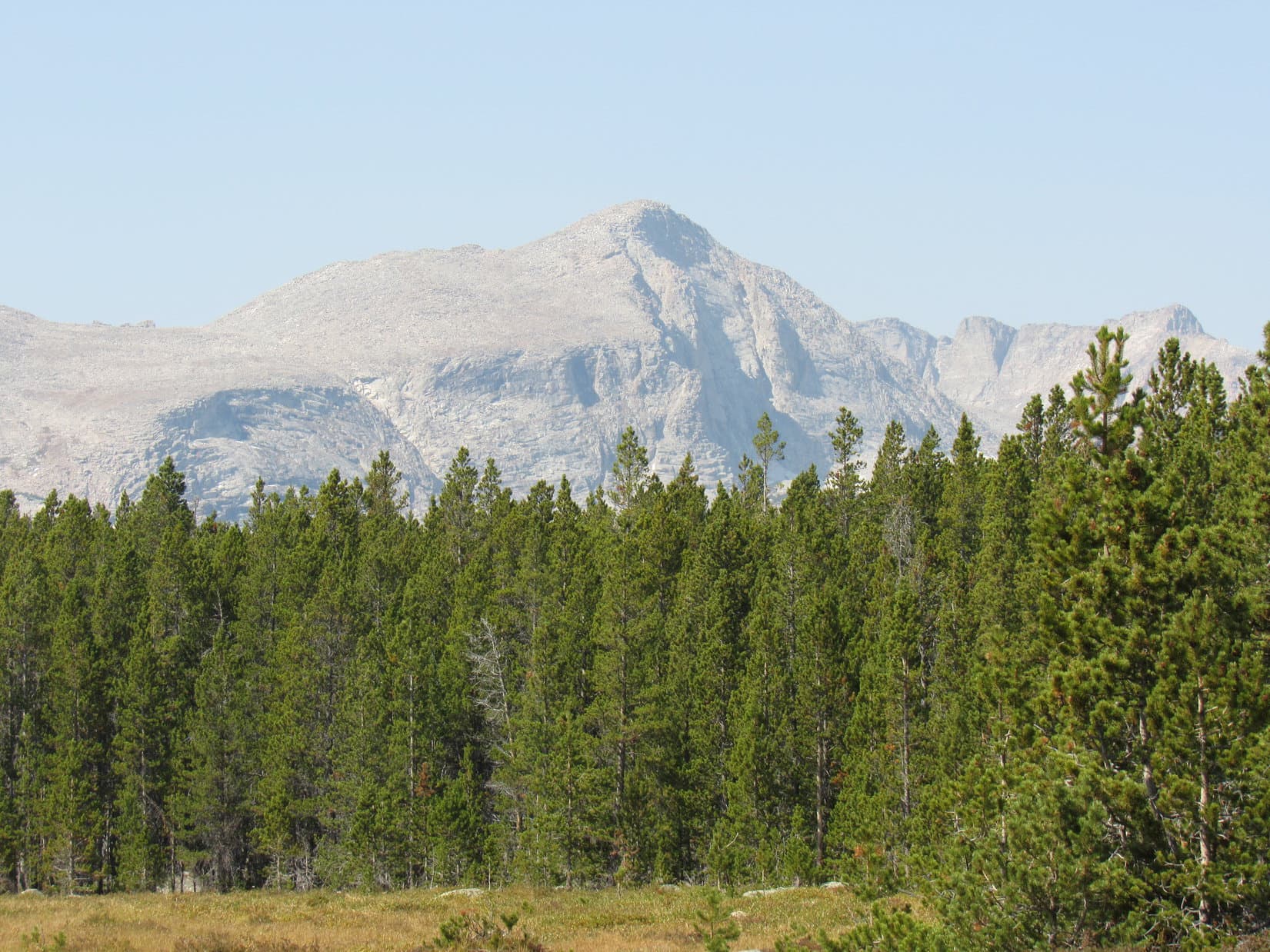
While looking upstream back at Atlantic Creek, Loopster had caught a glimpse of a high mountain.  SPHP had wondered at the time if it might have been Atlantic Peak?  A much better view of that same mountain, plus a number of peaks along a ridge S of it, was now available.  A quick check of the topo map convinced SPHP that the high mountain probably really was part of Atlantic Peak (12,490 ft.).
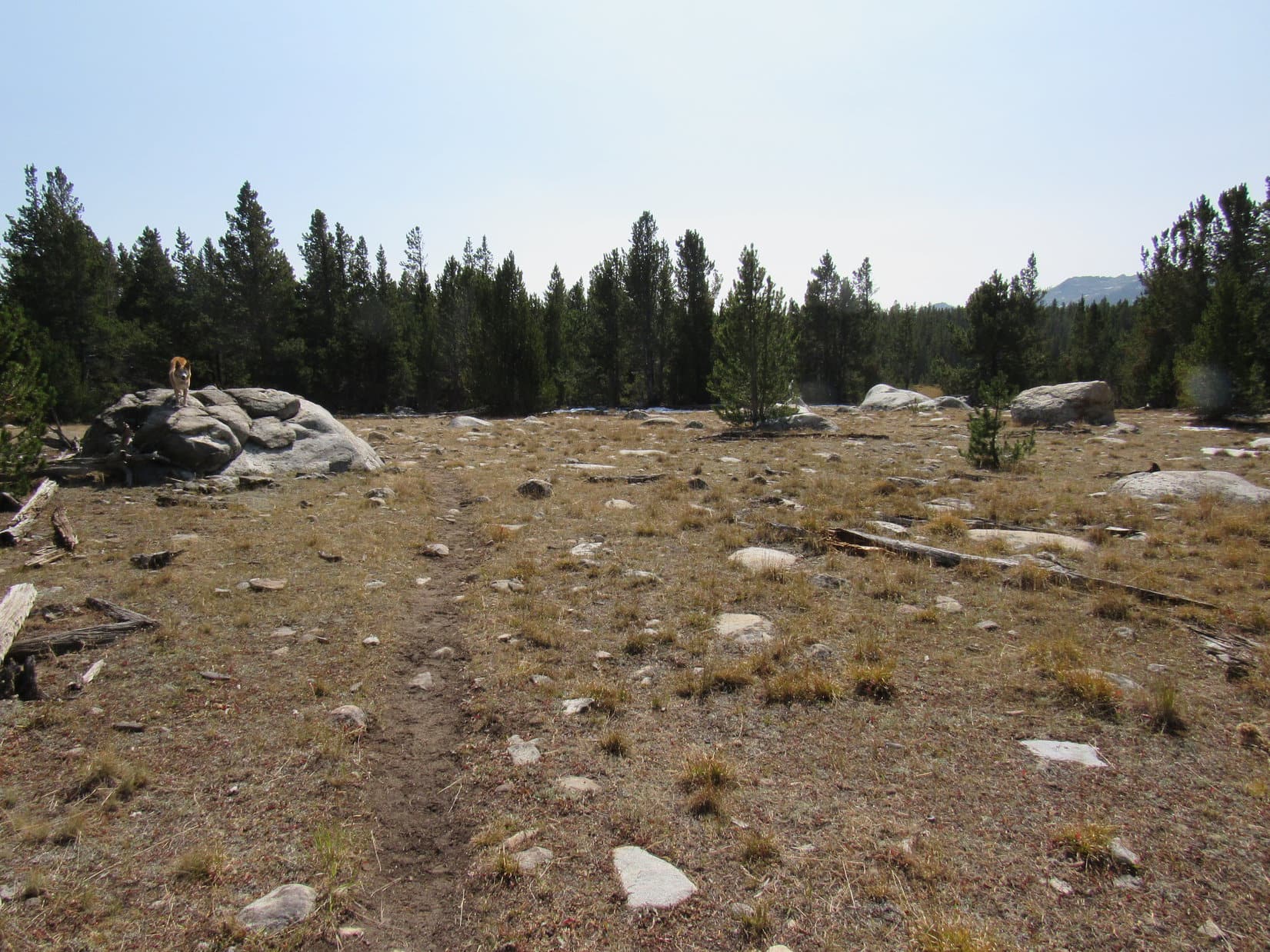
Crossing the rocky clearing.
That’s HP12261, the E end of Atlantic Peak behind me! Photo looks WNW.
HP12261 (Center). Photo looks WNW with help from the telephoto lens.

Staying near the edge of the damp field, the American Dingo followed the Christina Lake trail through a boggy depression before returning to drier ground in the forest.  For a little way, the trail paralleled the field closely enough to still see it between the trees.  After that, Lupe roamed SW at will for another mile.  Meanwhile SPHP had an easy time, making good progress on a gradual incline.
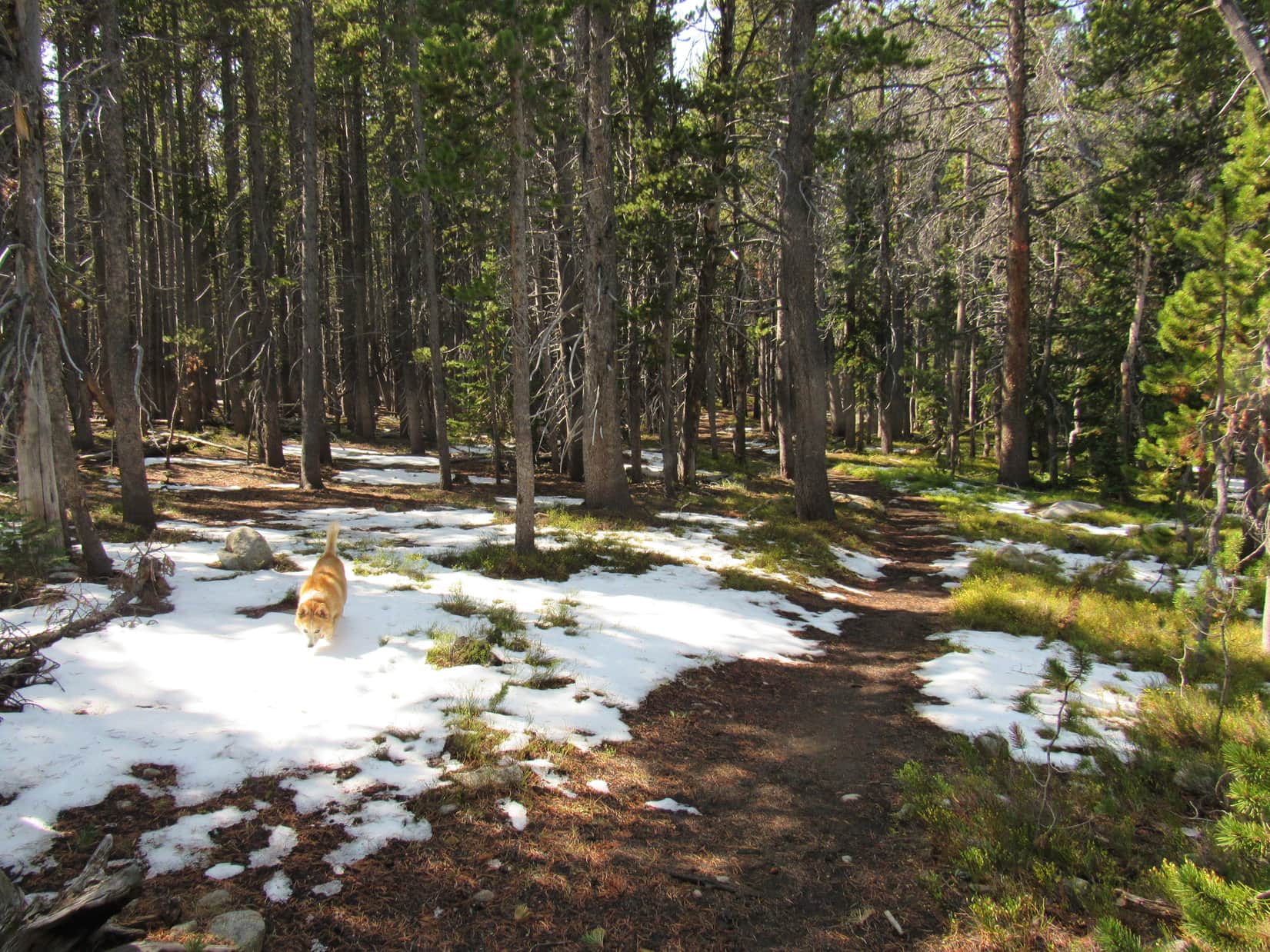
Enjoying an easy trek through the forest.

Christina Lake trail No. 721 ended as a single track at a “T” junction with the Christina Lake 4WD trail, a dirt road liberally endowed with plenty of protruding boulders and an ample assortment of mud puddles.
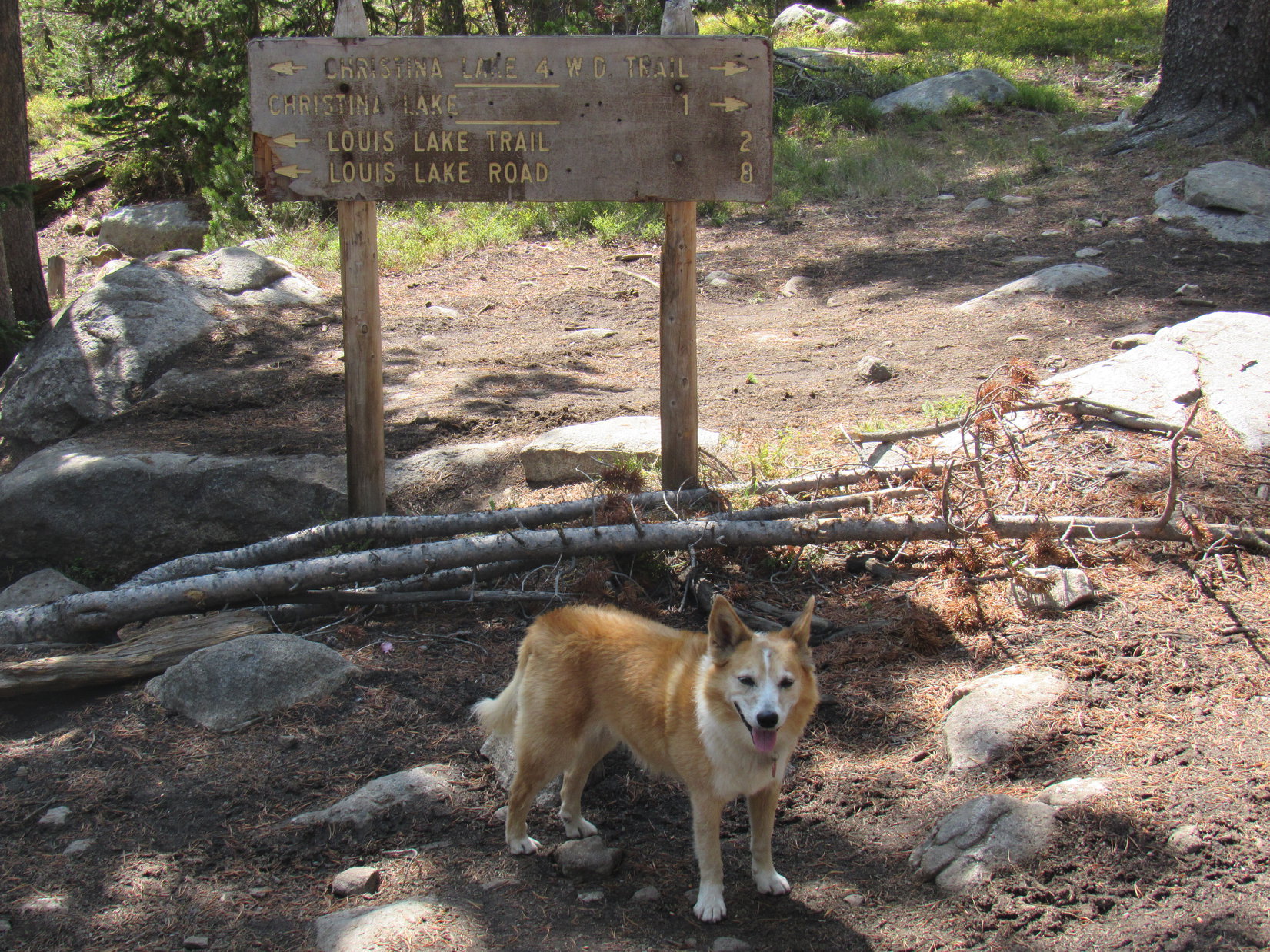
Signage at the junction with the Christina Lake 4WD trail.
Not exactly G6 territory! Christina Lake 4WD trail.

This junction was very close to where the 4WD trail crossed the Little Popo Agie River.  SPHP had originally intended for Lupe to get here by taking Louis Lake trail No. 724 to the Christina Lake 4WD trail, but had ultimately decided against it, leery of what Loop might have to face in order to get across the Little Popo Agie.  The Christina Lake trail avoided this necessity entirely, and also had the additional advantage of saving an extra 800 feet of elevation gain required coming from Louis Lake.

Ditching the backpack for the moment, SPHP led Loop down to the Little Popo Agie River, 150 feet away.  One look, and SPHP was thrilled!  The decision to come by way of Christina Lake trail No. 721 had been a great call.  No bridge, and the Little Popo Agie River was 5 to 10 times the size Atlantic Creek had been.

Hah!  Don’t get too used to it, Looper, but every now and then I do manage to do something right!

You know what they say, SPHP!  Even a broken clock is … well, never mind.  Good call, SPHP!
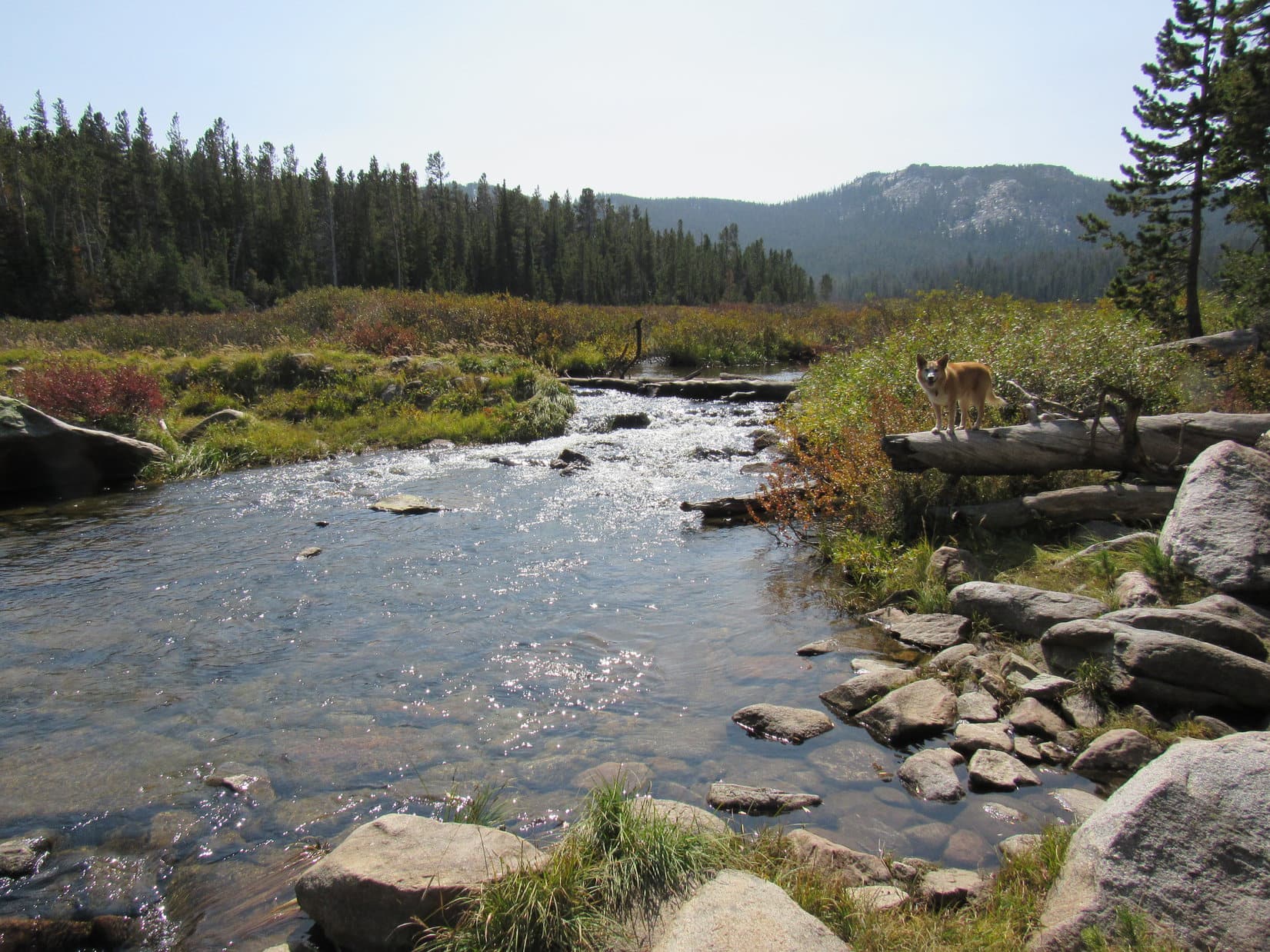
Never would have rock hopped this baby! Little Popo Agie River. Photo looks SSW.
Of course, maybe crossing that little log jam would have worked! I could have done it!

Since Gustav Lake was only a little farther upstream, Lupe might as well have a look at it, too.  However, Gustav Lake proved to be surrounded by bushes and marshy ground.  Getting all the way to the shoreline wasn’t going to be possible.
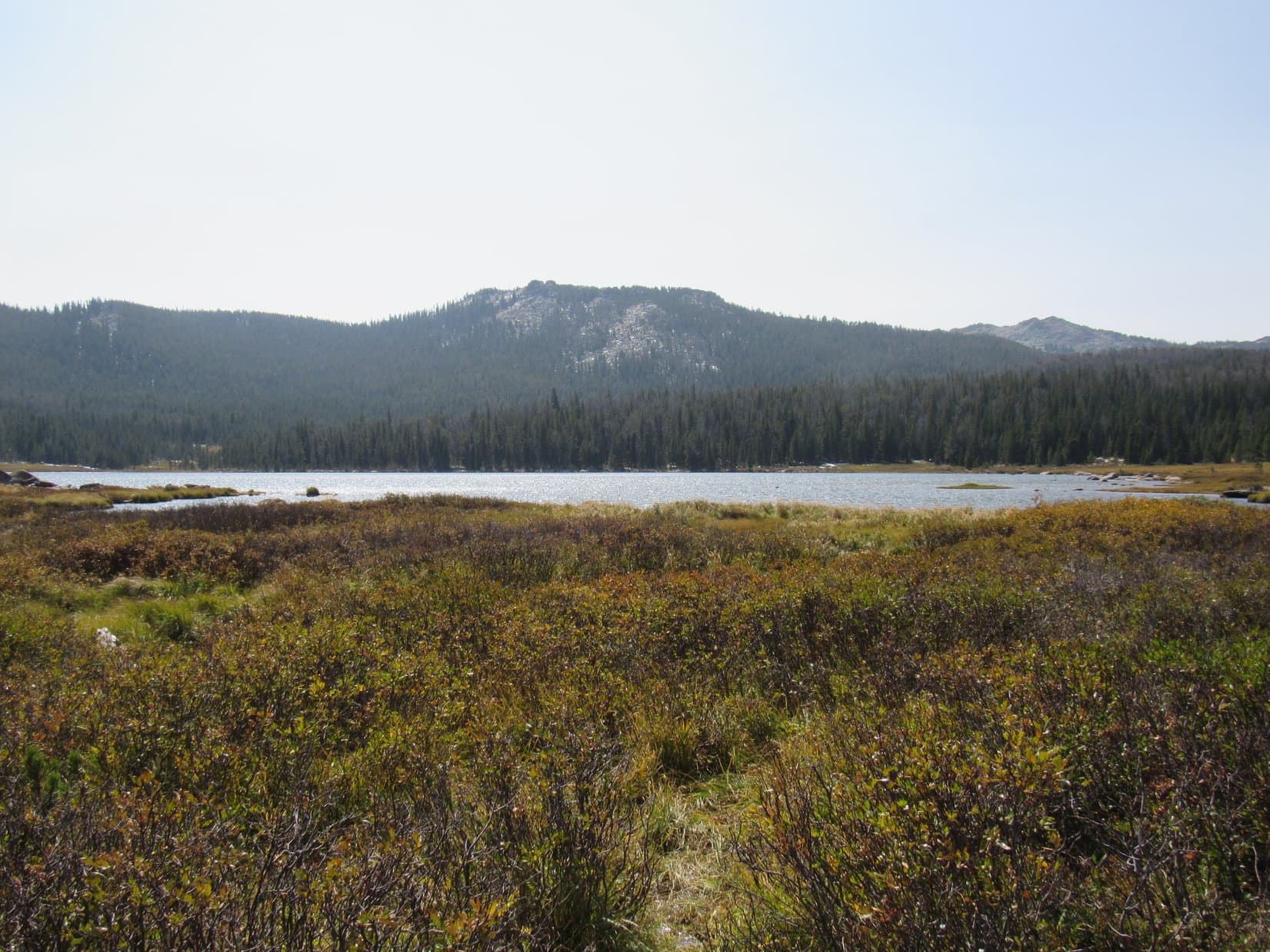
Gustav Lake. HP10669 (Center) beyond it. Photo looks SSW.

Returning to the junction, SPHP grabbed the pack.  Lupe now headed W on the Christina Lake 4WD Trail.  The road would have been a G6 killer, but was fine as a hiking trail.  Only 0.5 mile to Christina Lake!

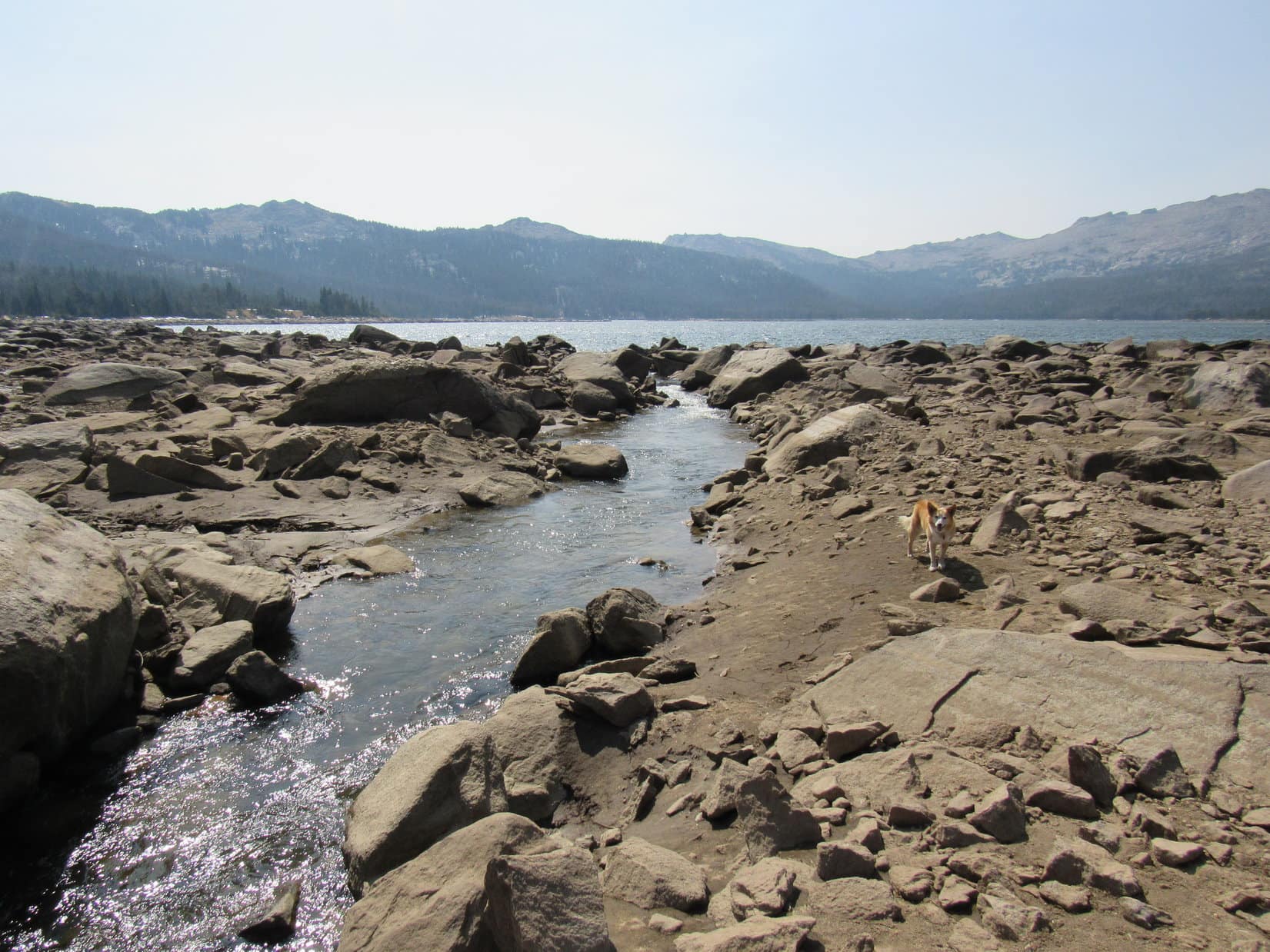
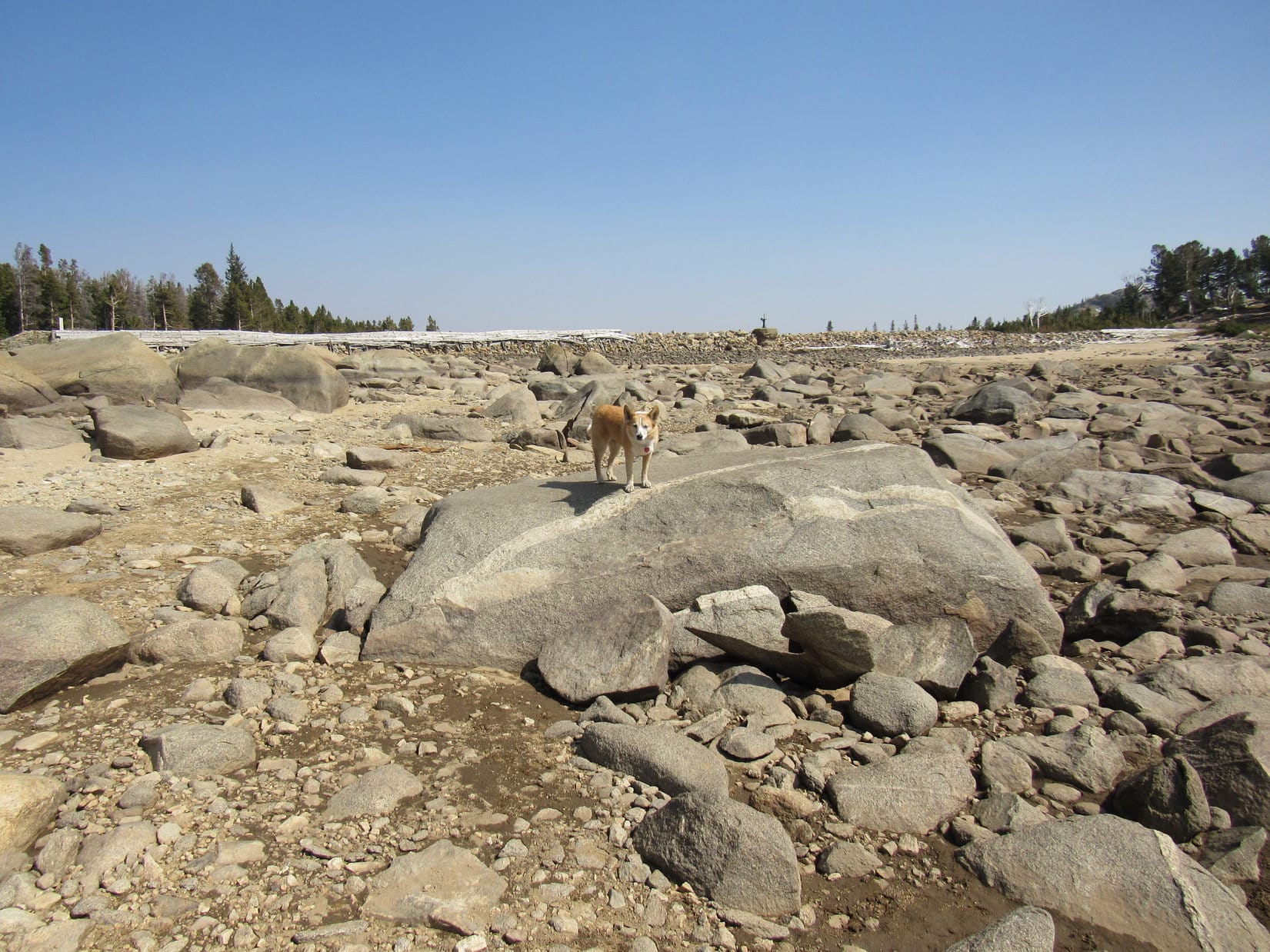
9-14-20, 1:31 PM, Christina Lake – A spur off the 4WD trail led to a long rock dam at the NE end of Christina Lake.  It was immediately apparent that the big lake was far below capacity.  The shoreline wasn’t even close to the dam.  Christina Lake was surrounded by a broad swath of sand and boulders exposed below the normal high water mark.
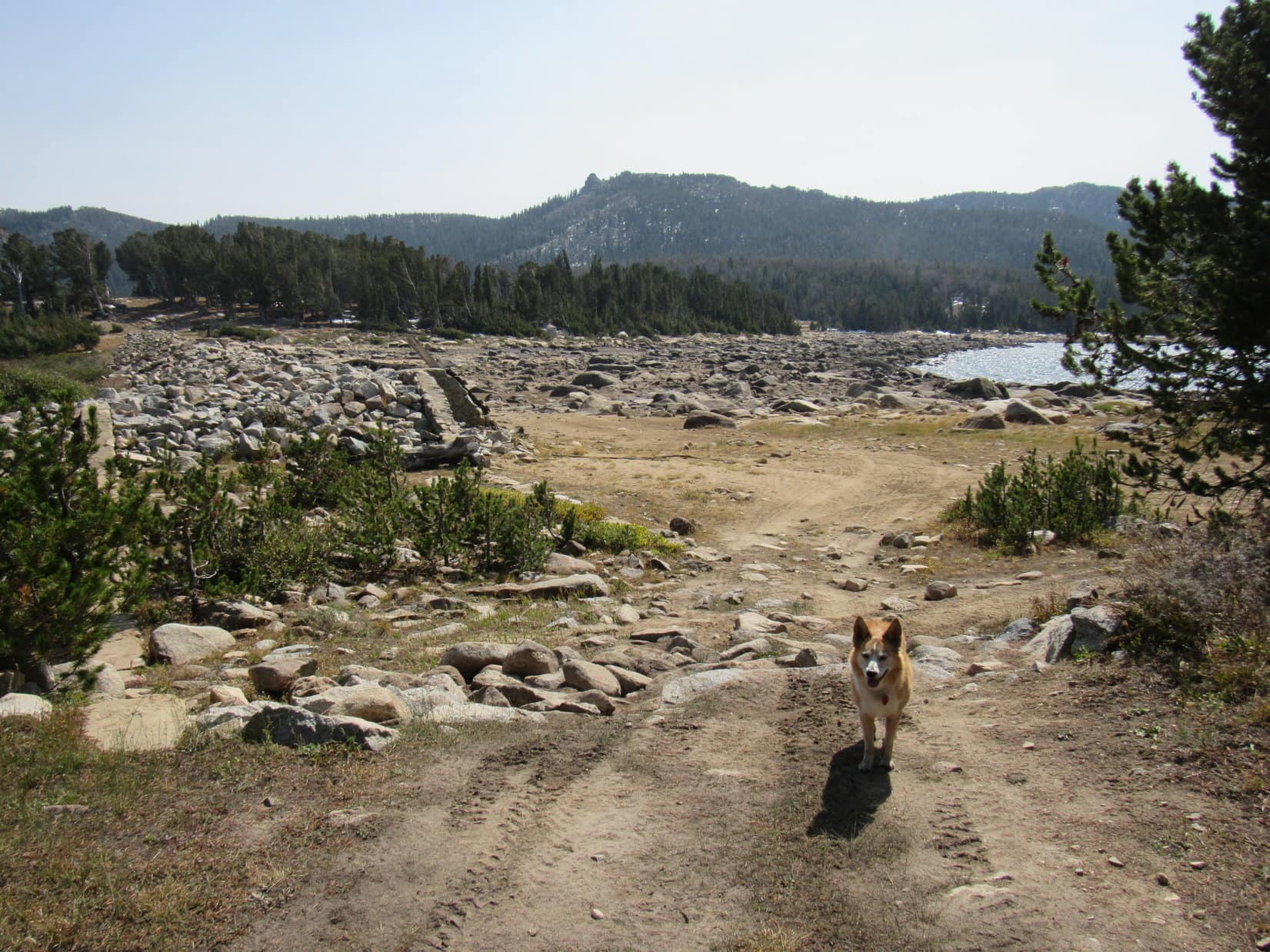
Arriving at Christina Lake. HP10669 (Center). Dam (L). Photo looks SSE.

A little off to the W along the N shore was an open flat region with a great view.  SPHP stashed the backpack against a sun-bleached log here.  About time for a rest break, but Lupe was going to do a little exploring first.  As soon as SPHP was ready, she wandered down to the beach.

At capacity, Christina Lake is more than a mile long, and still must have been close to that big even now.  Flanked by mountains to the S and W, Christina Lake was much larger and far more impressive than Fiddlers Lake had been.
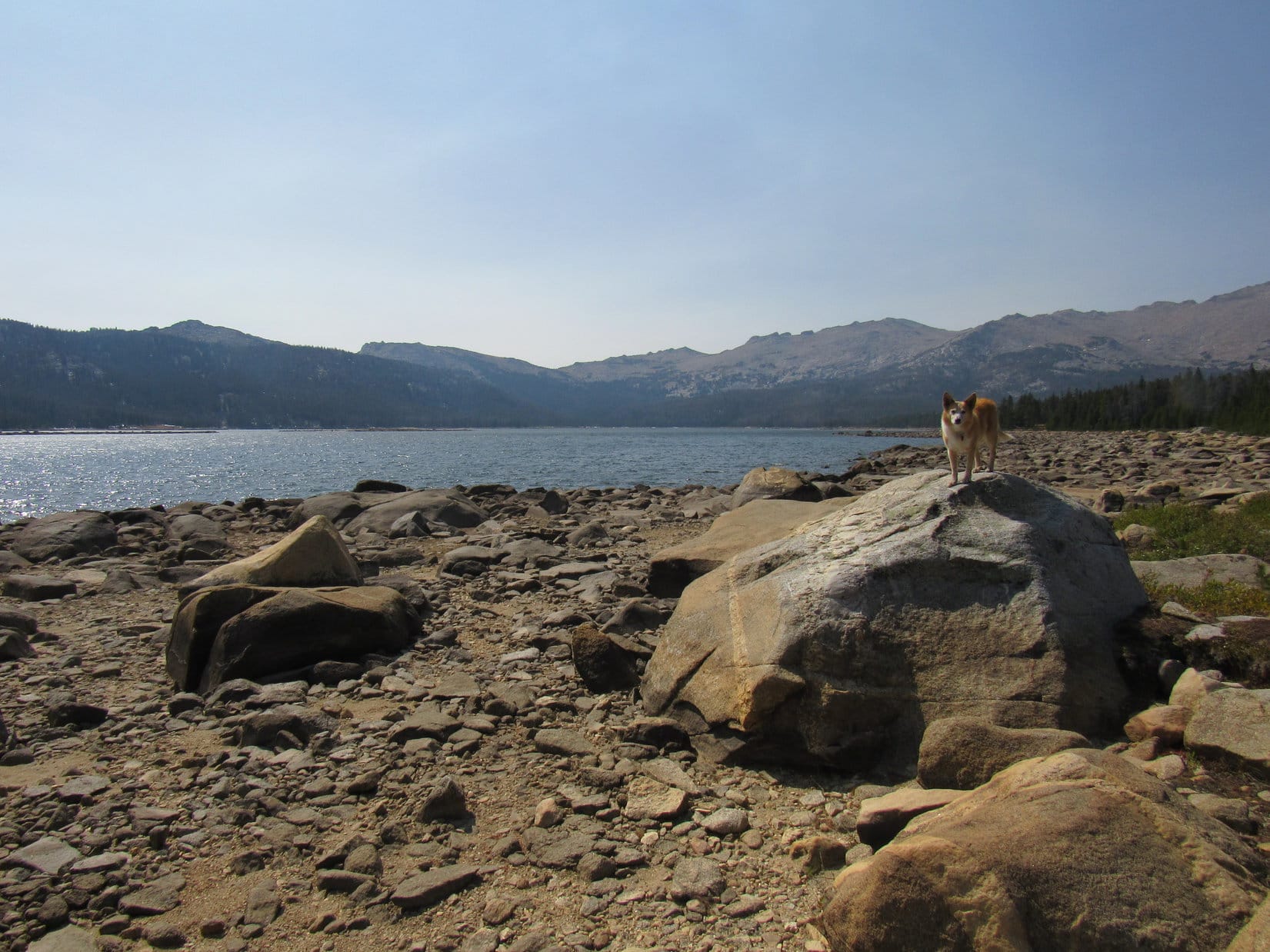
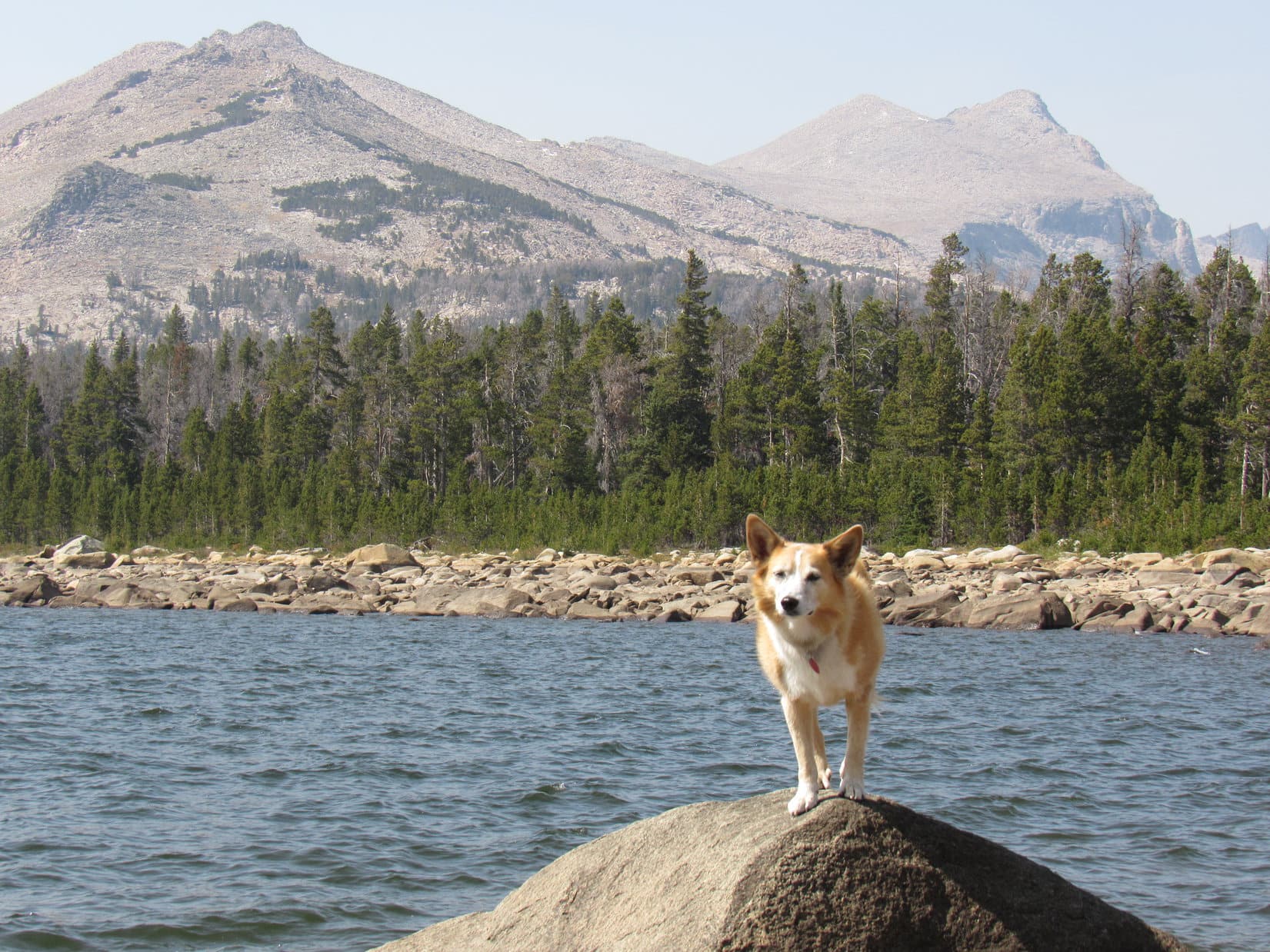
Christina Lake. Peak 11448 (R) beyond Lupe. Photo looks SW.

Atlantic Peak (12,490 ft.) was in sight.  However, it was clear that Loop would be able to get a better look at it if she went farther SE.  Continuing in that direction, she soon came to a narrow channel that the Middle Popo Agie River was surging through.  Following the channel E toward the dam, the whole river disappeared into a hole.

Christina Lake was being drained like a bathtub!  Up on top of the dam, a valve could be seen, no doubt used to control the flow.
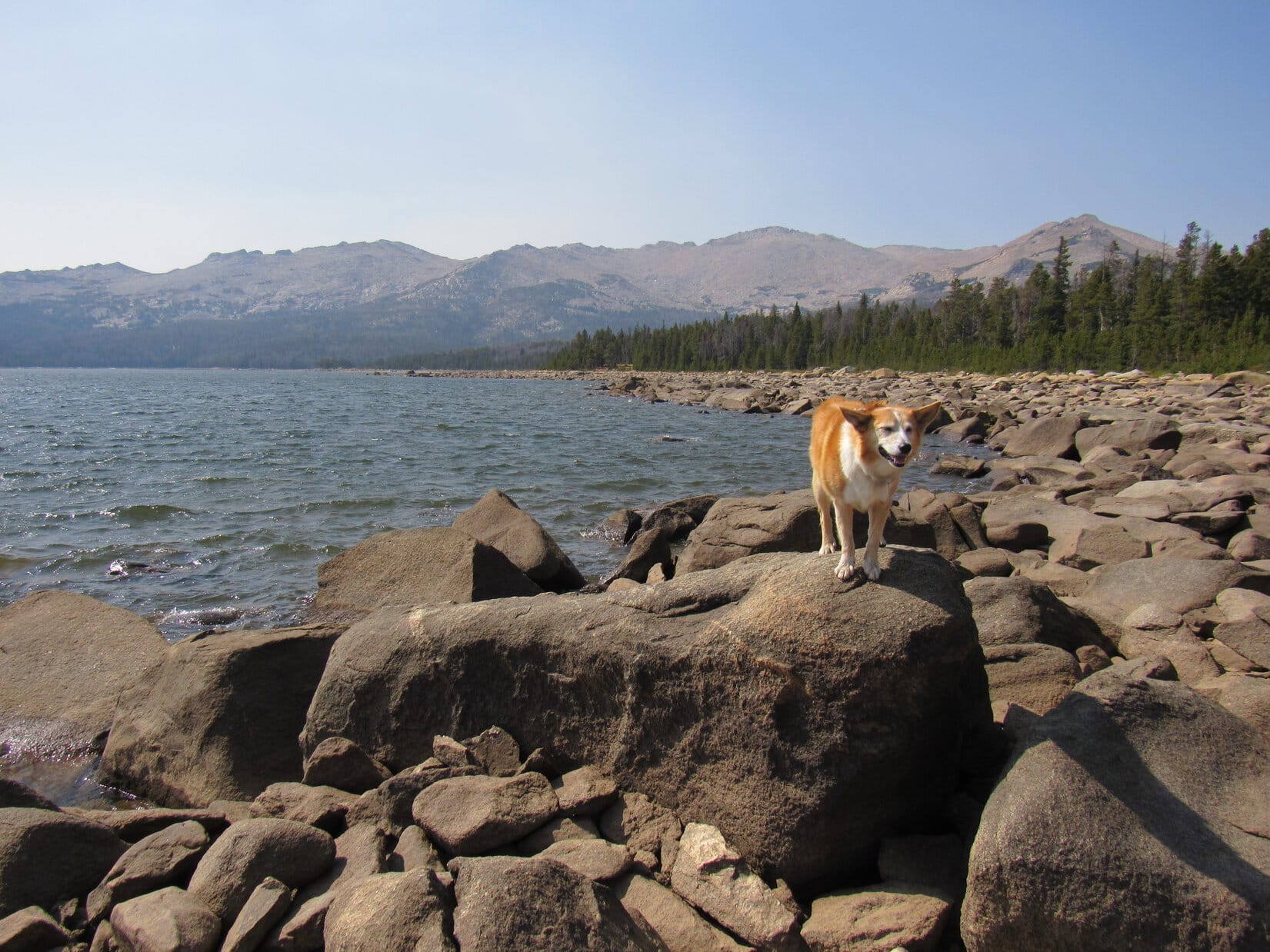
Atlantic Peak (R). Photo looks WNW.
By the Little Popo Agie River as it drains out of Christina Lake. Photo looks SW.
Approaching the dam. Flow control valve (R of Center) up on top. Photo looks E.

Once S of the Little Popo Agie River channel, Lupe ventured down to the lake again.  From here she could see the true summit of Atlantic Peak, still 4 miles away.
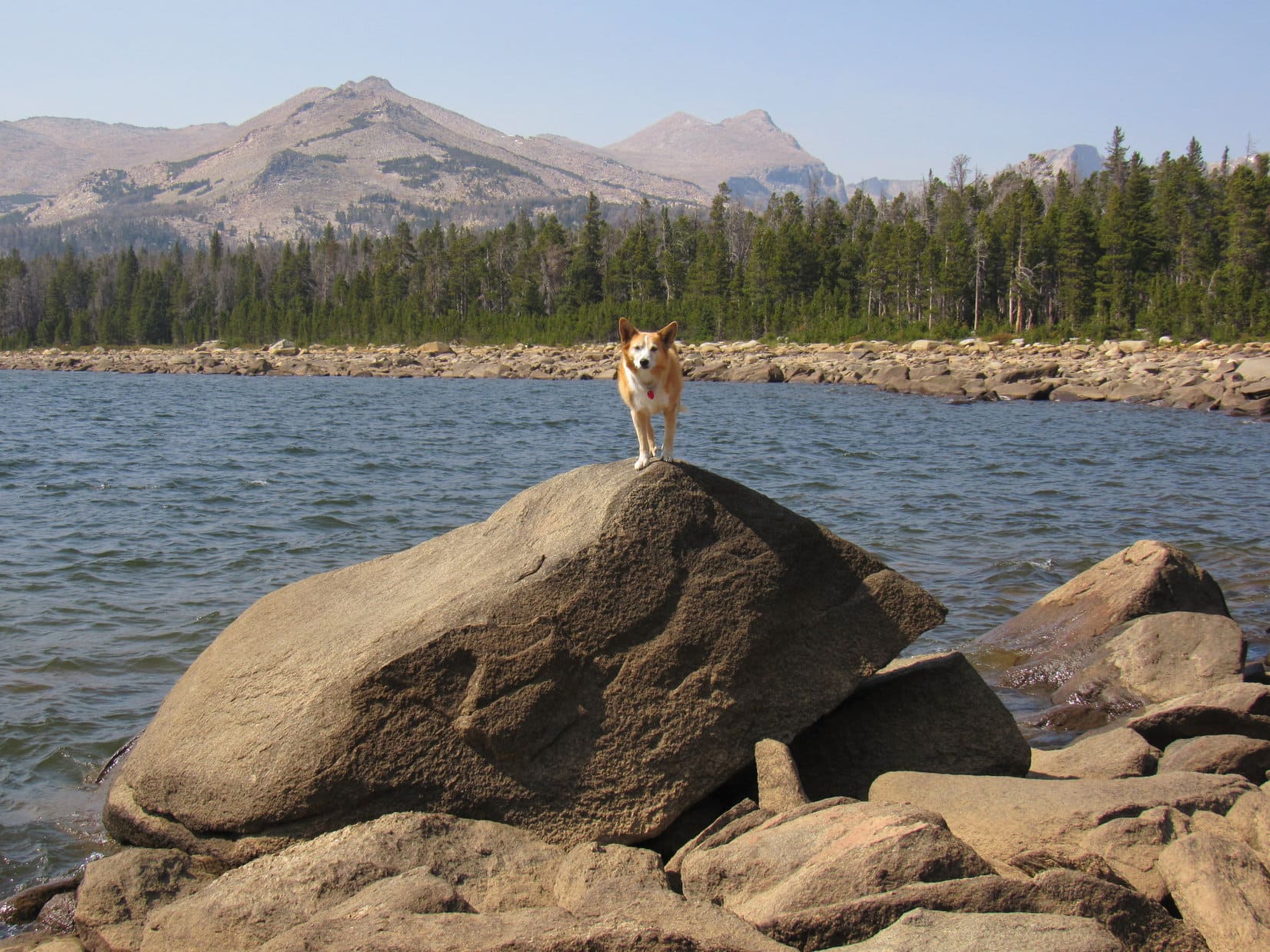
Atlantic Peak (Center) from Christina Lake. Photo looks NW.
Atlantic Peak (straight up from Lupe) with help from the telephoto lens.

Satisfied with having gotten about as good a look at Atlantic Peak from Christina Lake as possible, Lupe and SPHP returned to the backpack.  A pleasant half hour was spent having lunch and resting in the shade of a couple of large pines while enjoying the view.
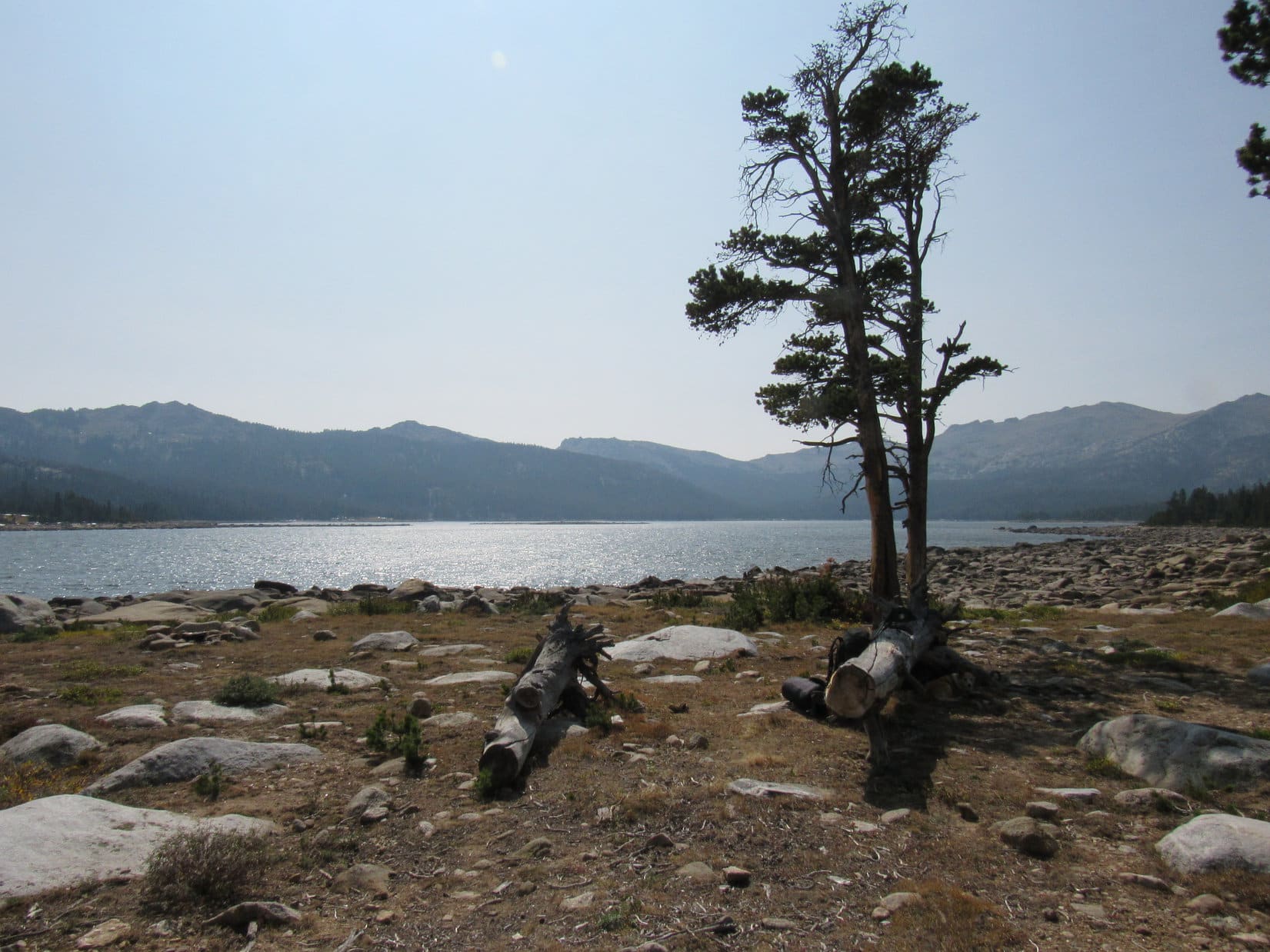
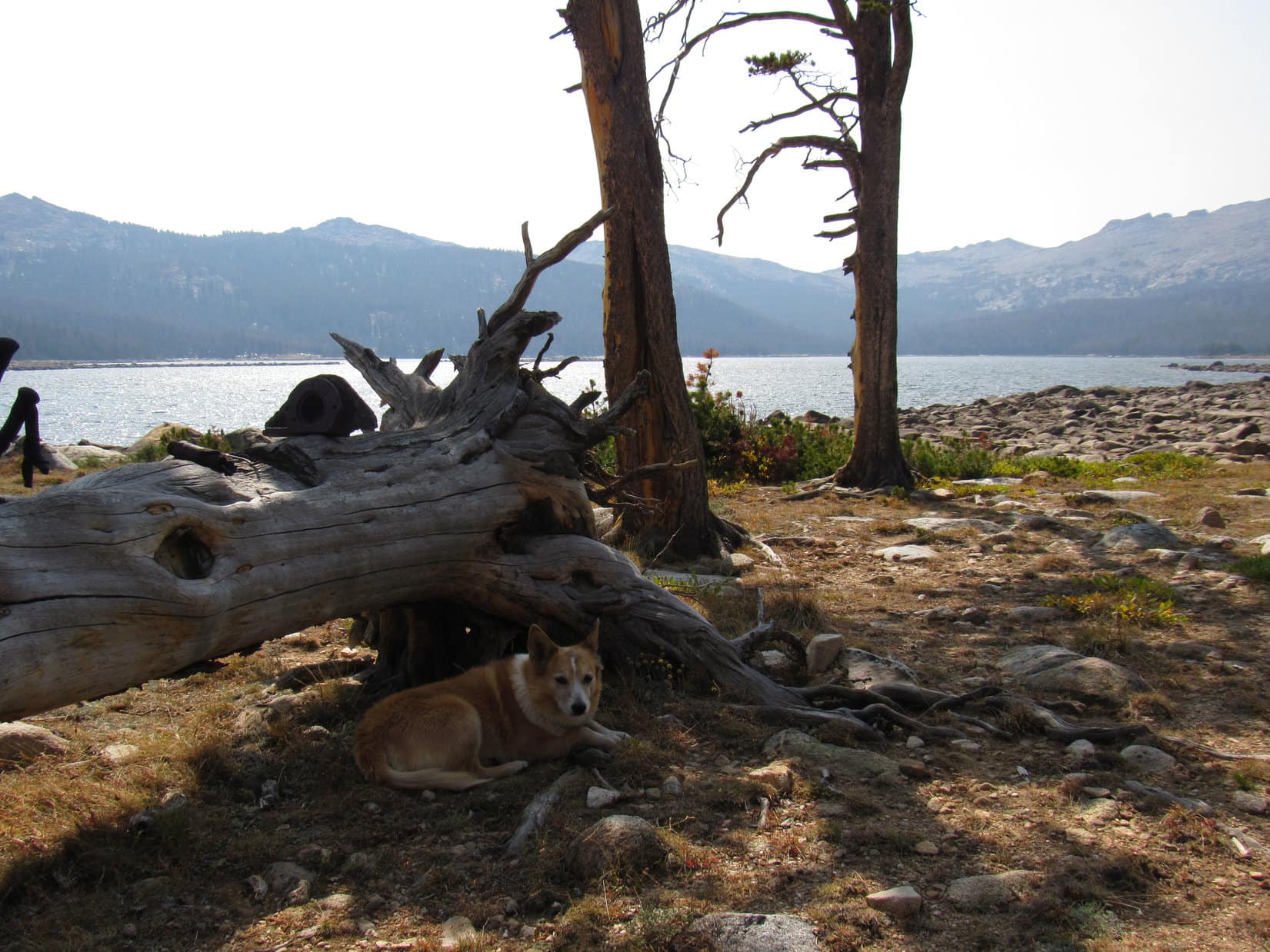
Christina Lake as seen during a break for lunch. Photo looks SW.
Relaxing in the shade.

Nearly an hour after arriving at Christina Lake, it was about time to press on.  Lupe hopped up on a boulder for a final look around before returning to the Christina Lake 4WD Trail.  Heading W, the road forked almost immediately.  Loop took the L branch paralleling Christina Lake’s N shore.  However, the lake was seldom seen, since the road stayed back in the forest as much as several hundred feet from the shoreline.

After nearly 0.5 mile, the road curved N away from Christina Lake shortly before ending at a sign for Atlantic Lakes trail No. 723.
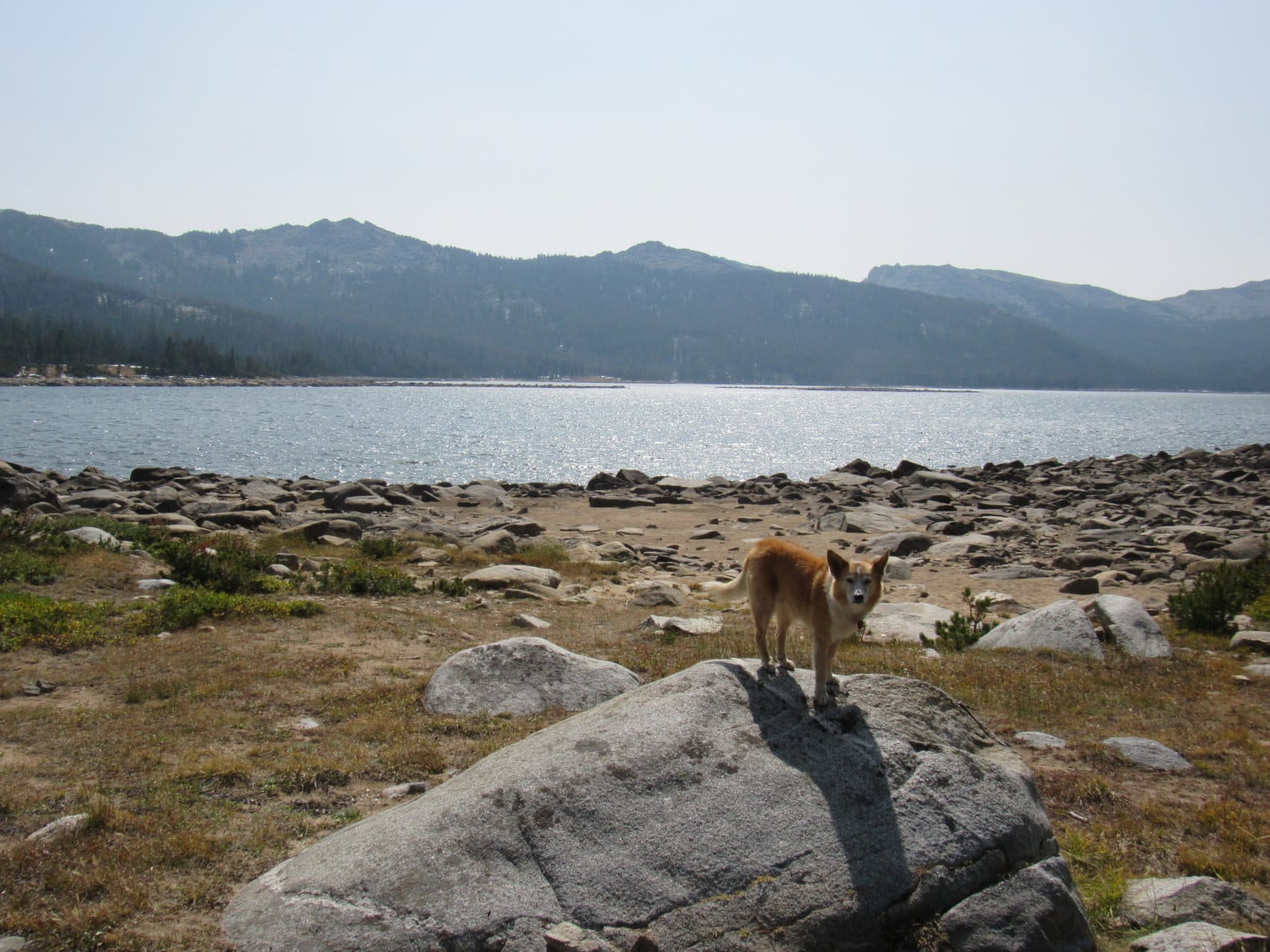
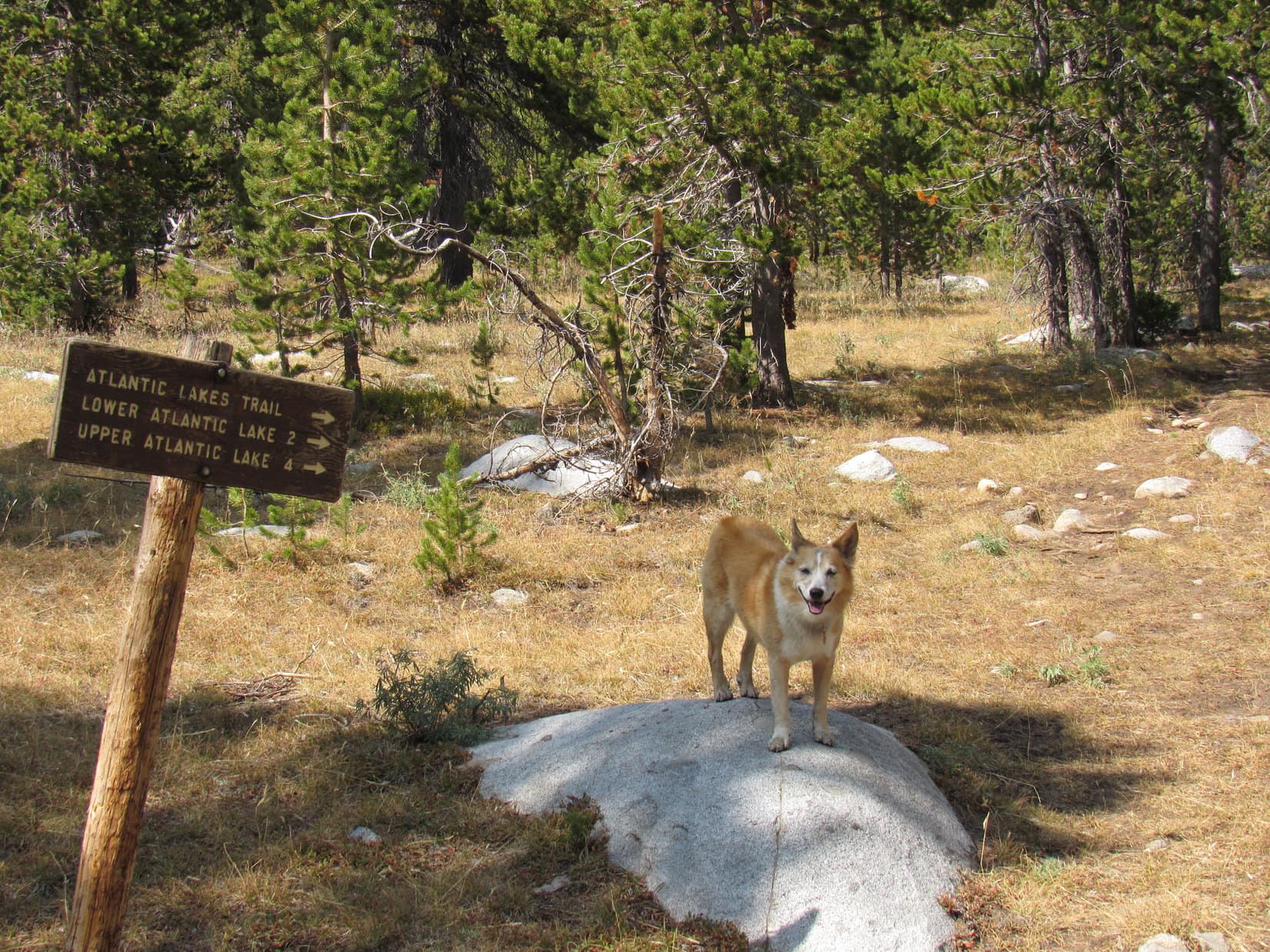
About to depart from Christina Lake.
Start of the Atlantic Lakes trail.

Somewhat unexpectedly, the sign said it was 2 miles to Lower Atlantic Lake, or 4 miles to Upper Atlantic Lake.  Hmm.  SPHP didn’t remember seeing more than one Atlantic Lake on the topo map.  A quick re-check confirmed the existence of only one lake named “Atlantic Lake” as far as the map was concerned, which had to be the lower one referred to by the sign, since it wasn’t any more than 2 miles away.

Heading N deeper into the forest as a faint single track, the Atlantic Lakes trail was a bit worrisome at first.  Before long, though, the route became clearer and stayed that way, the trail ultimately proving to be easy to follow.

Gradually gaining elevation, the trail soon curved NW.  Lupe came to a sign for the Popo Agie Wilderness.  She’d barely left the sign behind, when a last glimpse of Christina Lake appeared.
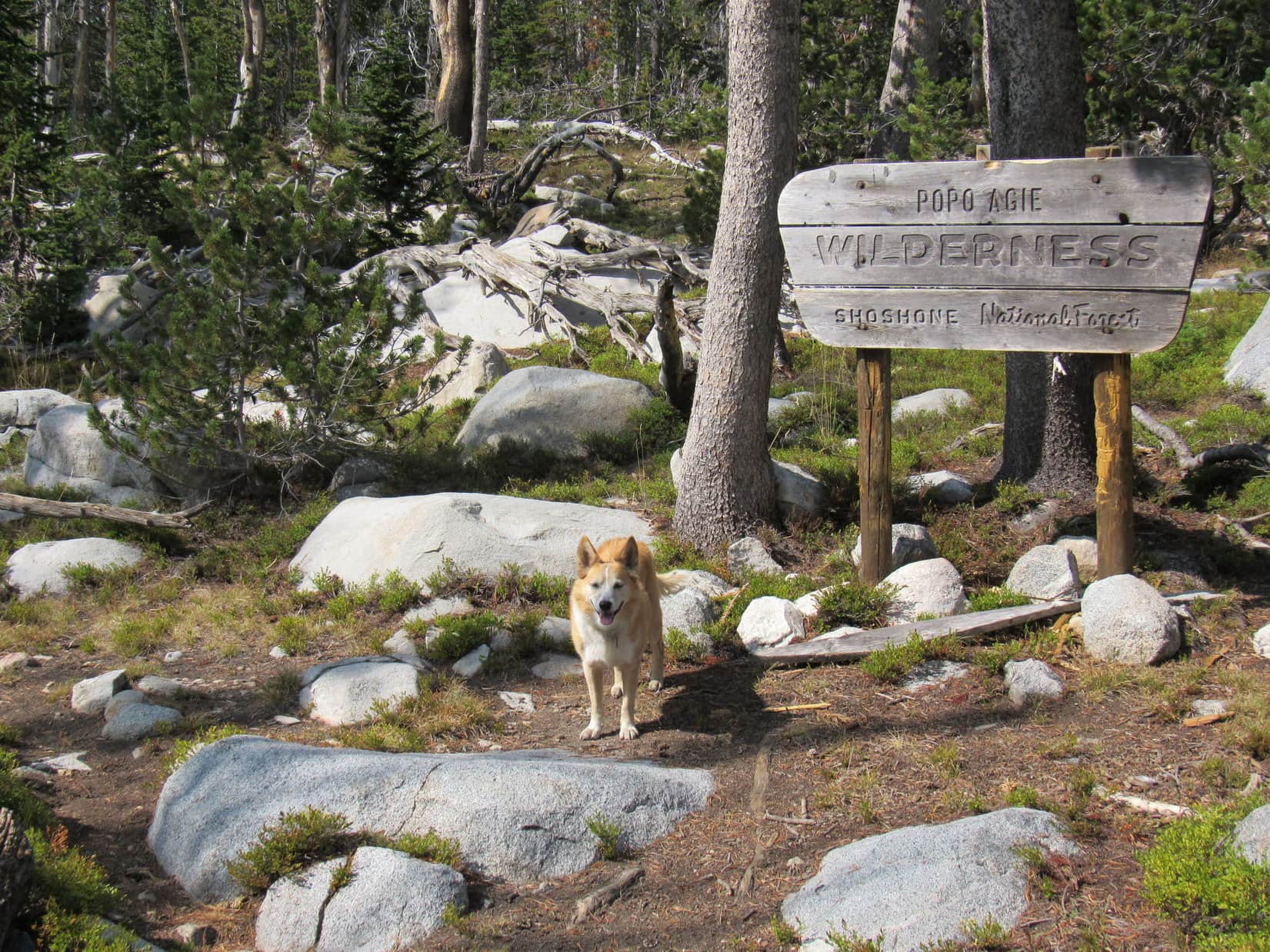
Entering the Popo Agie Wilderness.
The only glimpse of Christina Lake from Atlantic Lakes trail No. 723. Photo looks S.

The Atlantic Lakes trail continued NW through a featureless forest, still slowly gaining elevation most of the time.  The forest contained many dead trees.  Plenty of rounded light-gray boulders were scattered about.  Small plants provided a bright green ground cover.

After a while, the trail passed a rocky depression on the R, then leveled out.  A dip led to a tiny stream, the only water seen along the way.
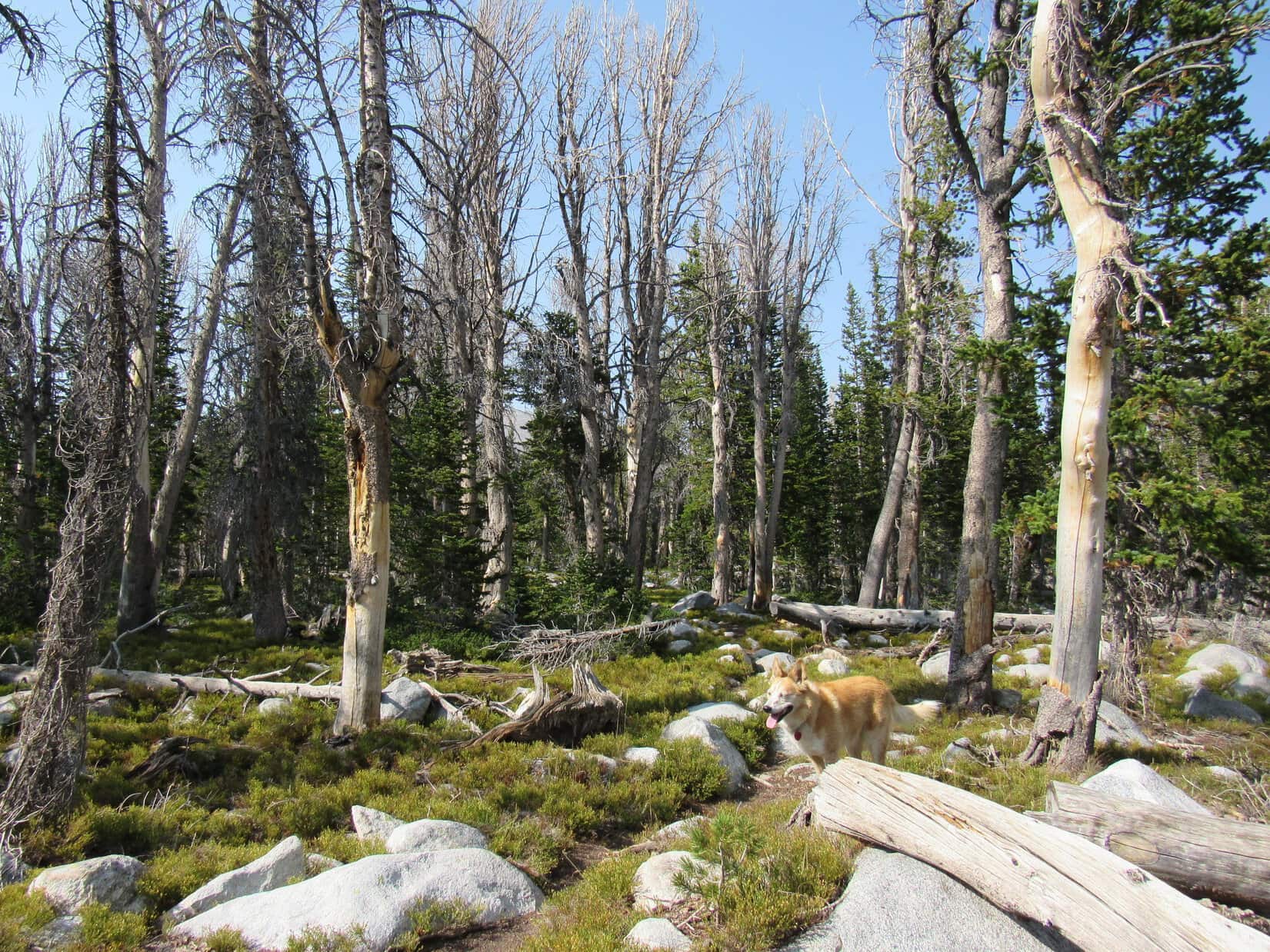
Dead trees and scattered boulders along the Atlantic Lakes trail.
Exploring the forest.

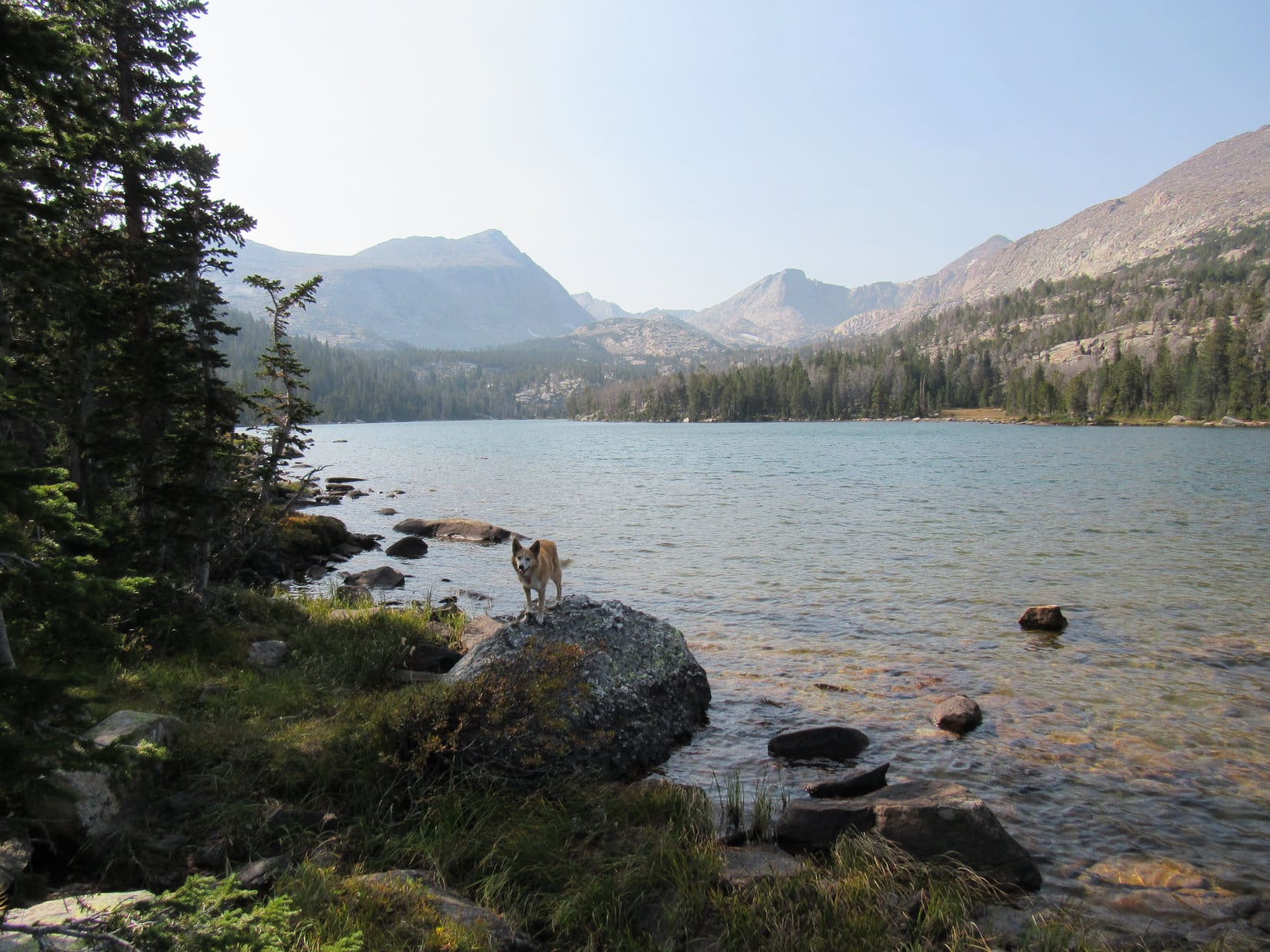
9-14-20, 3:54 PM, Atlantic Lake – Between the trees on the N (R) side of the trail Lupe could see a clearing, and beyond it, water.  This must be it!  Leaving the trail, Loop and SPHP went down for a look.  A little under 0.5 mile long, and not nearly as wide, Atlantic Lake wasn’t anywhere close to being as large as Christina Lake had been, but tucked in among big mountains at the SE end of Atlantic Canyon, it was even more scenic.

2 miles to the NW, the summit of Silas Peak (12,248 ft.) was sight.  From the shoreline, Atlantic Peak (12,490 ft.) was also visible to the WNW.
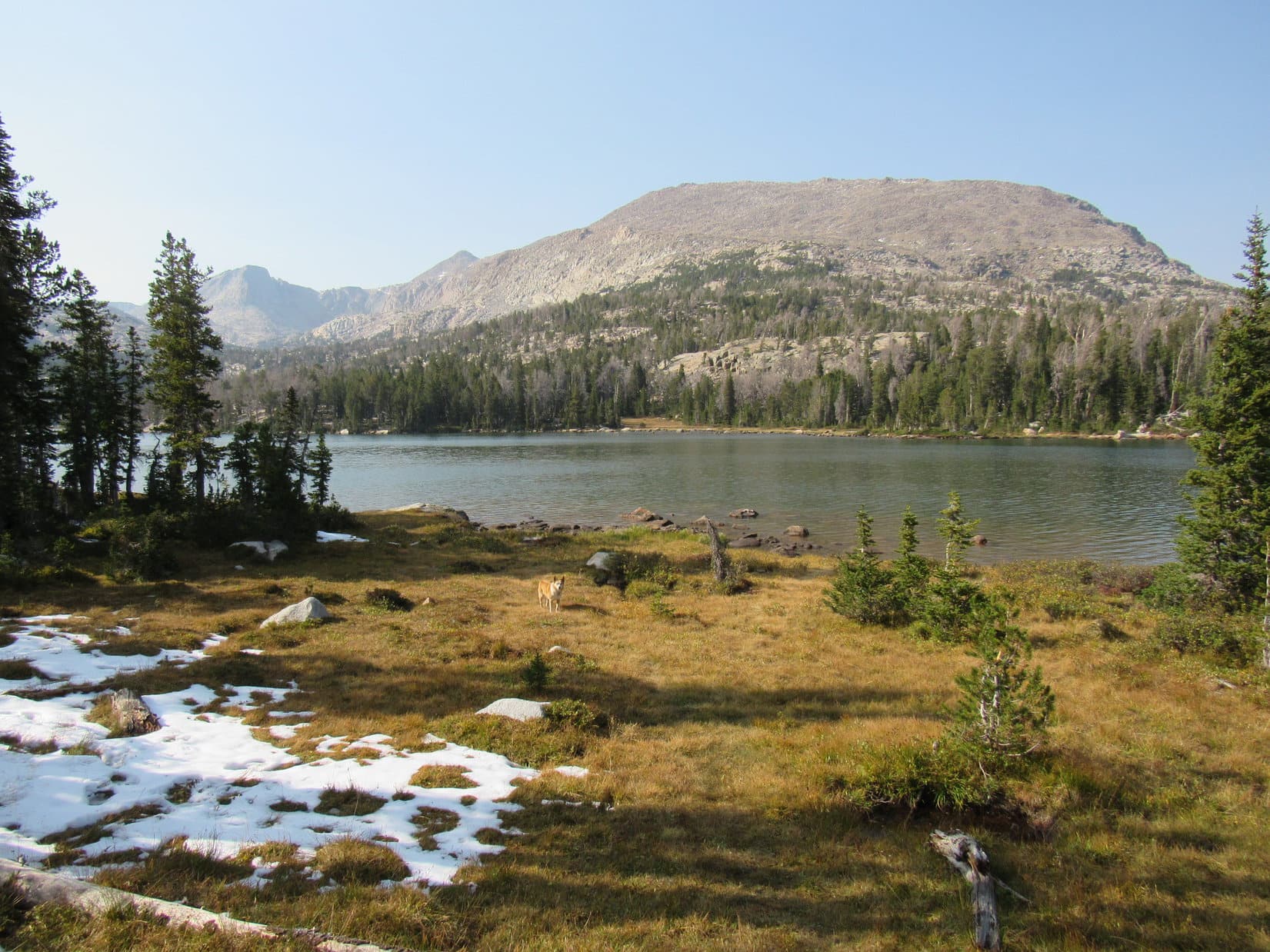
Atlantic Lake. Silas Peak poking up L of Center. Photo looks NW.
Atlantic Peak (L) and Silas Peak (R) from Atlantic Lake. Photo looks WNW.

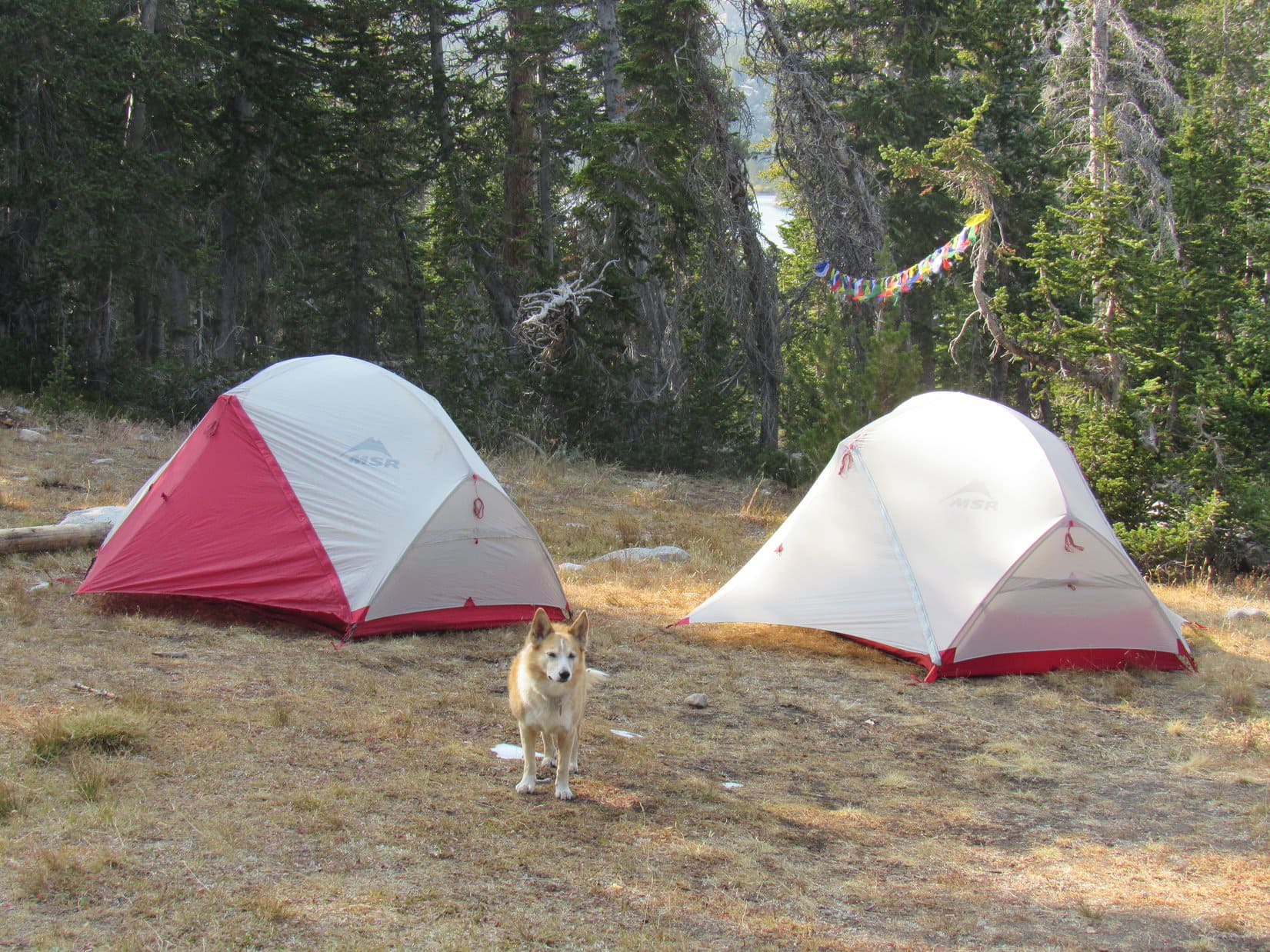
Returning to the trail, Lupe continued W.  A few hundred feet farther, the Atlantic Lakes trail appeared to end at a clearing.  Back from the lake a little way, this clearing would have been an ideal spot to pitch Looper’s tiny house, but SPHP was surprised to see that it was already taken.

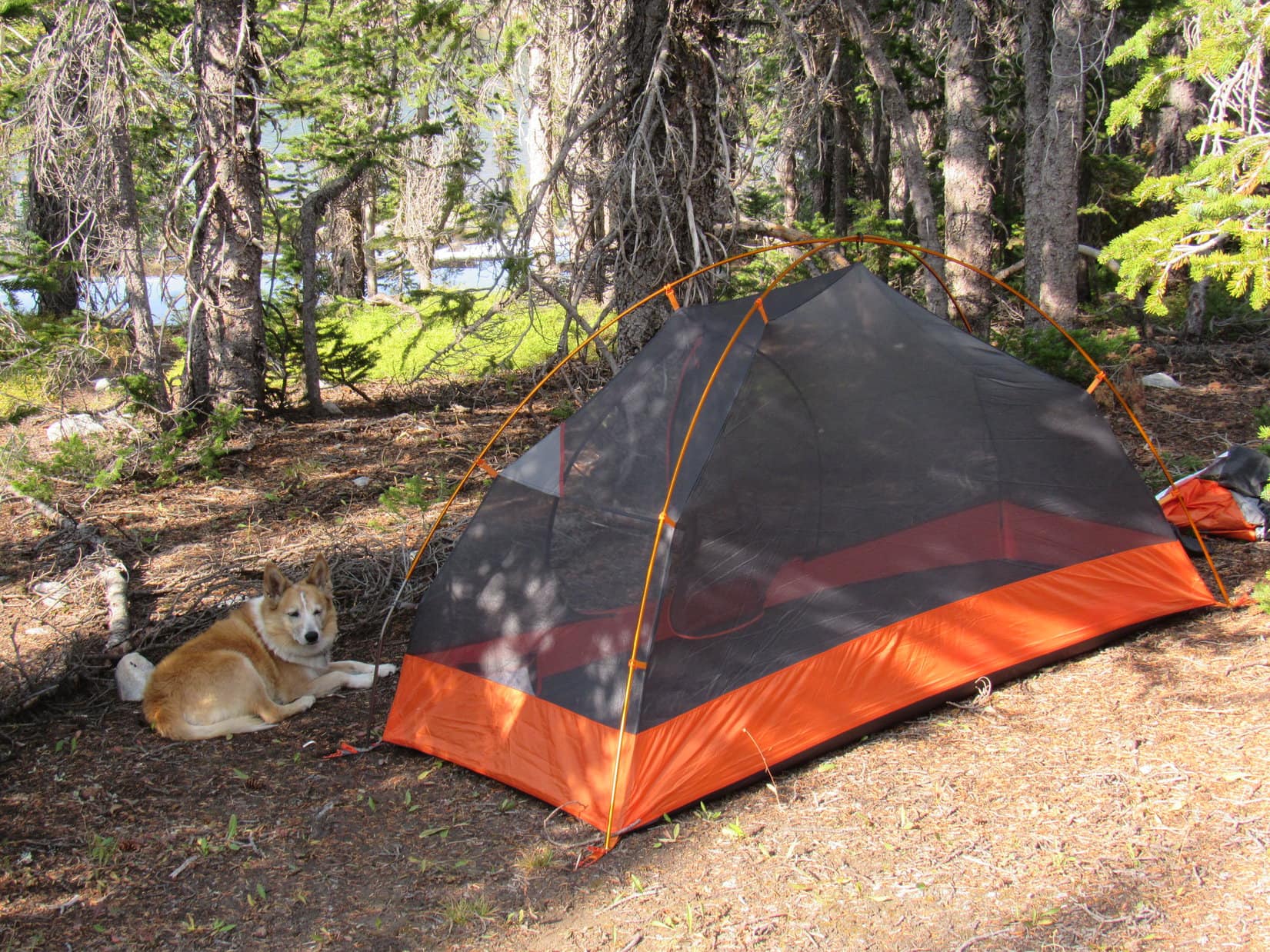
With the exception of a forest ranger riding an ATV, Loop hadn’t seen anyone at all since leaving the Christina Lake trailhead this morning.  No one was here at the moment, either.  After a brief search, SPHP settled on another spot to pitch the tiny house.
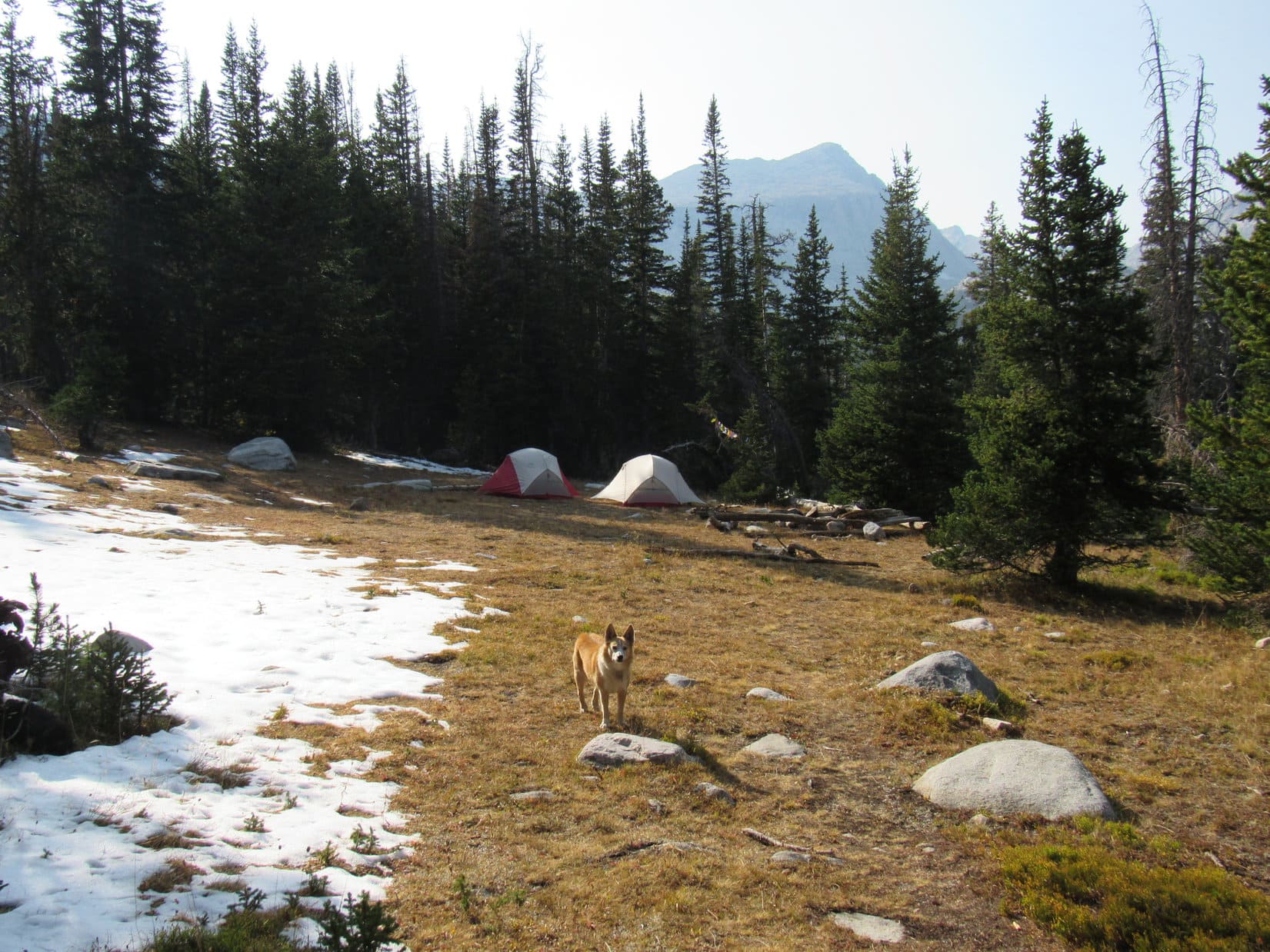
What a great spot! Atlantic Peak (R). Photo looks WNW.
No one around at the moment, but they’ll be back sooner or later!
Not as nifty as that clearing was, but this will work!

After dinner, Lupe was free to enjoy the rest of the evening.  She spent most of it exploring, or just relaxing along the S shore of Atlantic Lake.
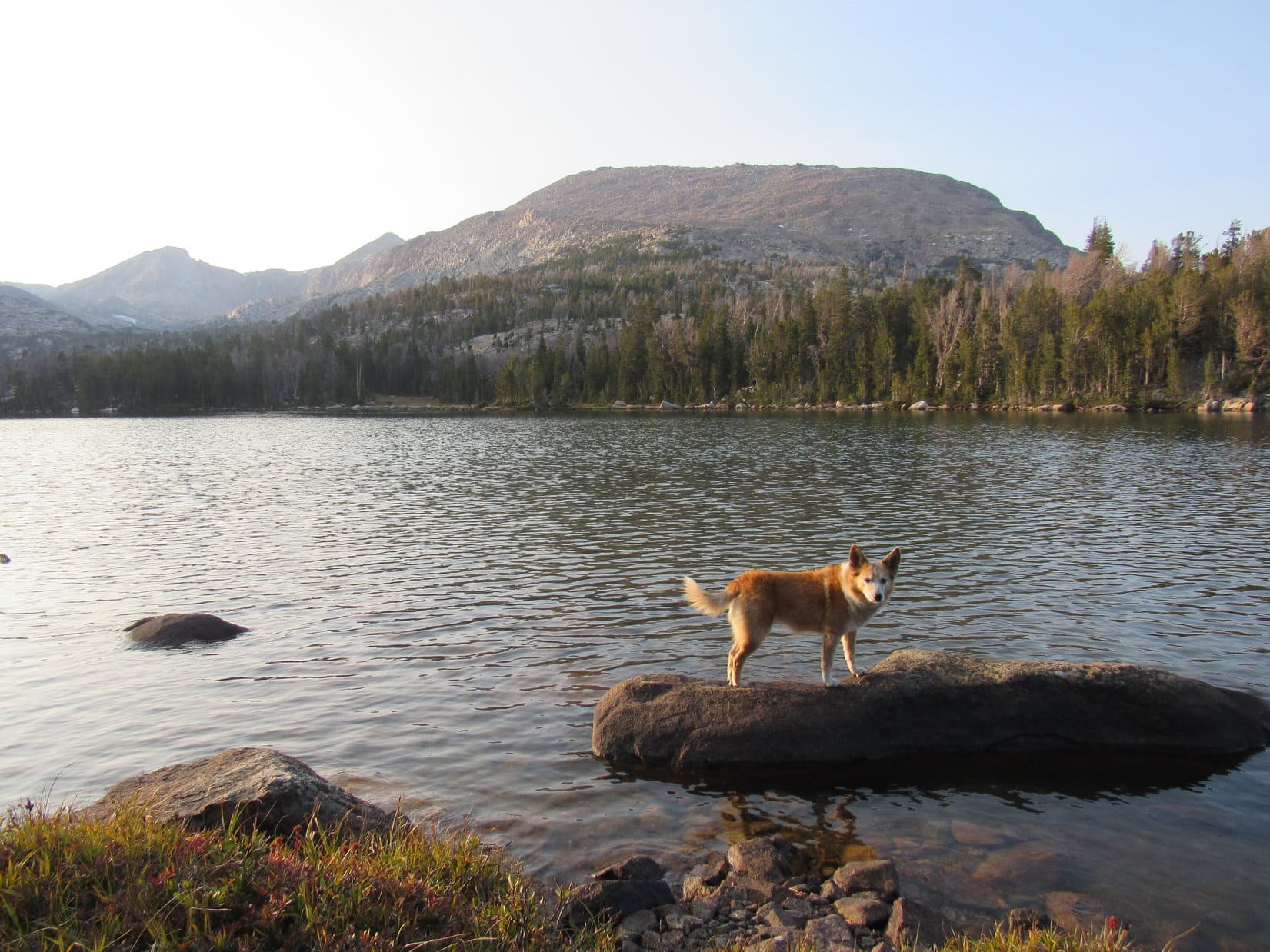
On Dingo Island! Photo looks NW.
E end of Atlantic Lake from the S shore. Photo looks NE.

What a fun day this had been!  Atlantic Lake was roughly 7 miles from the trailhead where Lupe had started out this morning – 5 miles to Christina Lake, and another 2 miles to get here, yet this had been about as easy a mountain trek as the American Dingo had ever been on.  Only 800 feet of net elevation gain, good trails the entire way, and no steep sections at all.

Tomorrow would be different.  More than 2,200 feet of elevation gain in a little over 2 miles to get to Atlantic Peak (12,490 ft.)!

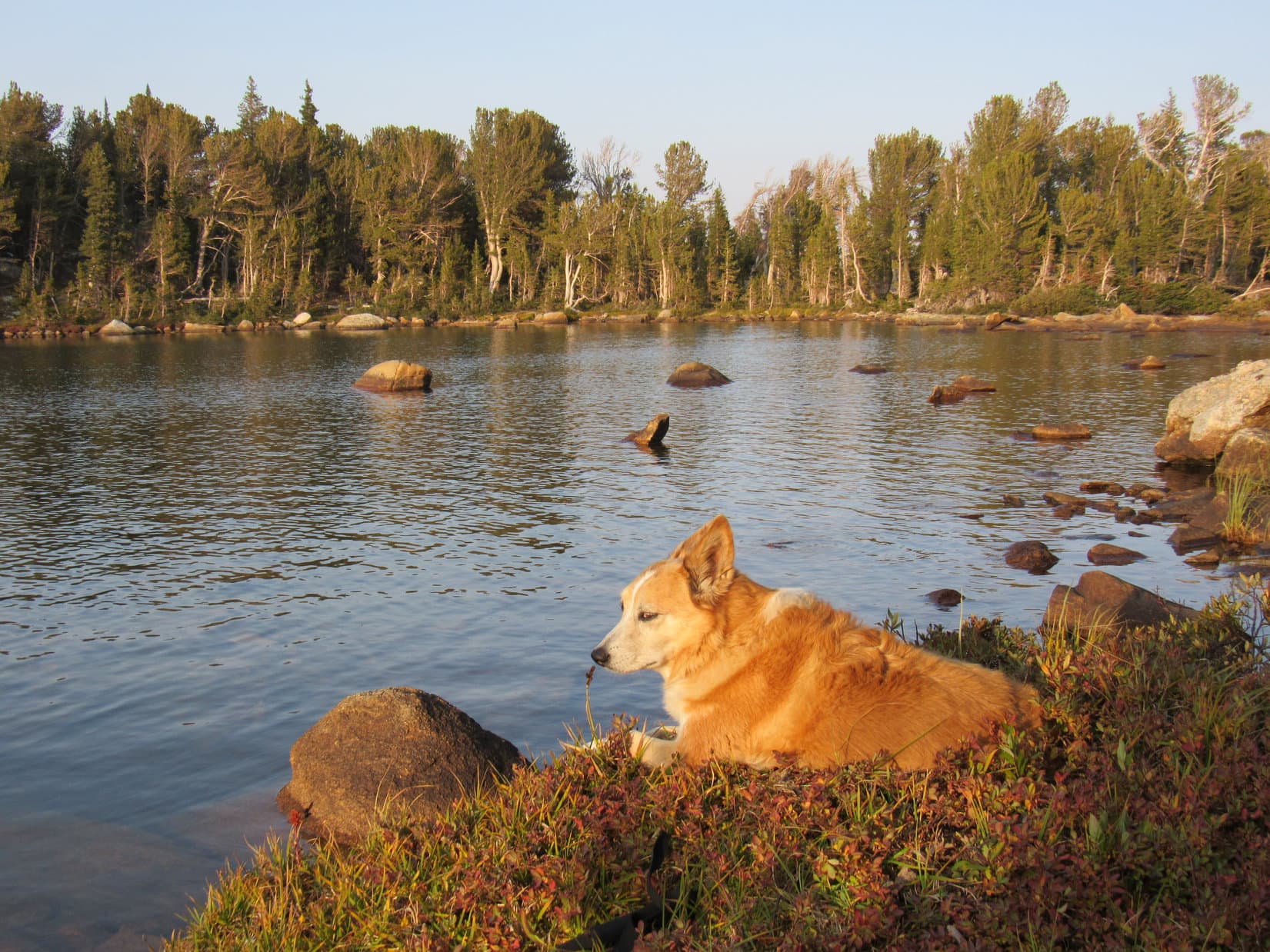
Watching the sun sink behind her ultimate destination as she rested by Atlantic Lake’s S shore, Lupe didn’t have to think about that yet.  Dusk was deepening when a man appeared a few hundred feet away.  The other campers must have returned!  Whether he saw Looper or not, wasn’t certain, but he gave no indication of it.
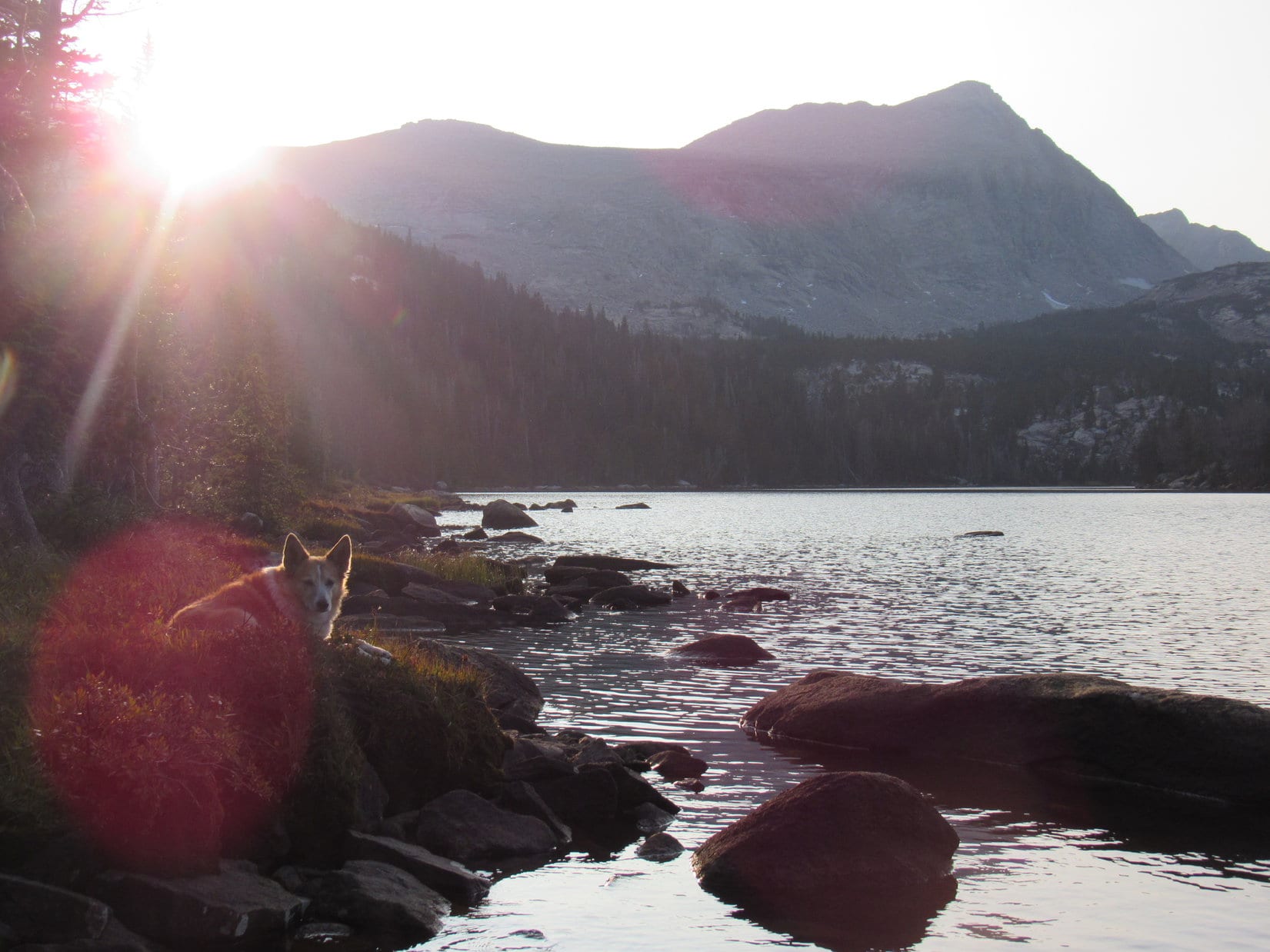
Evening repose at Atlantic Lake. Atlantic Peak (R). Photo looks W.

Shortly after the man disappeared again, Lupe retired to her tiny house, hoping for blue skies in the morning.  Not too likely with all the wildfires out W, but hope springs eternal.  With a little luck, sometime tomorrow an American Dingo would stand atop Atlantic Peak!
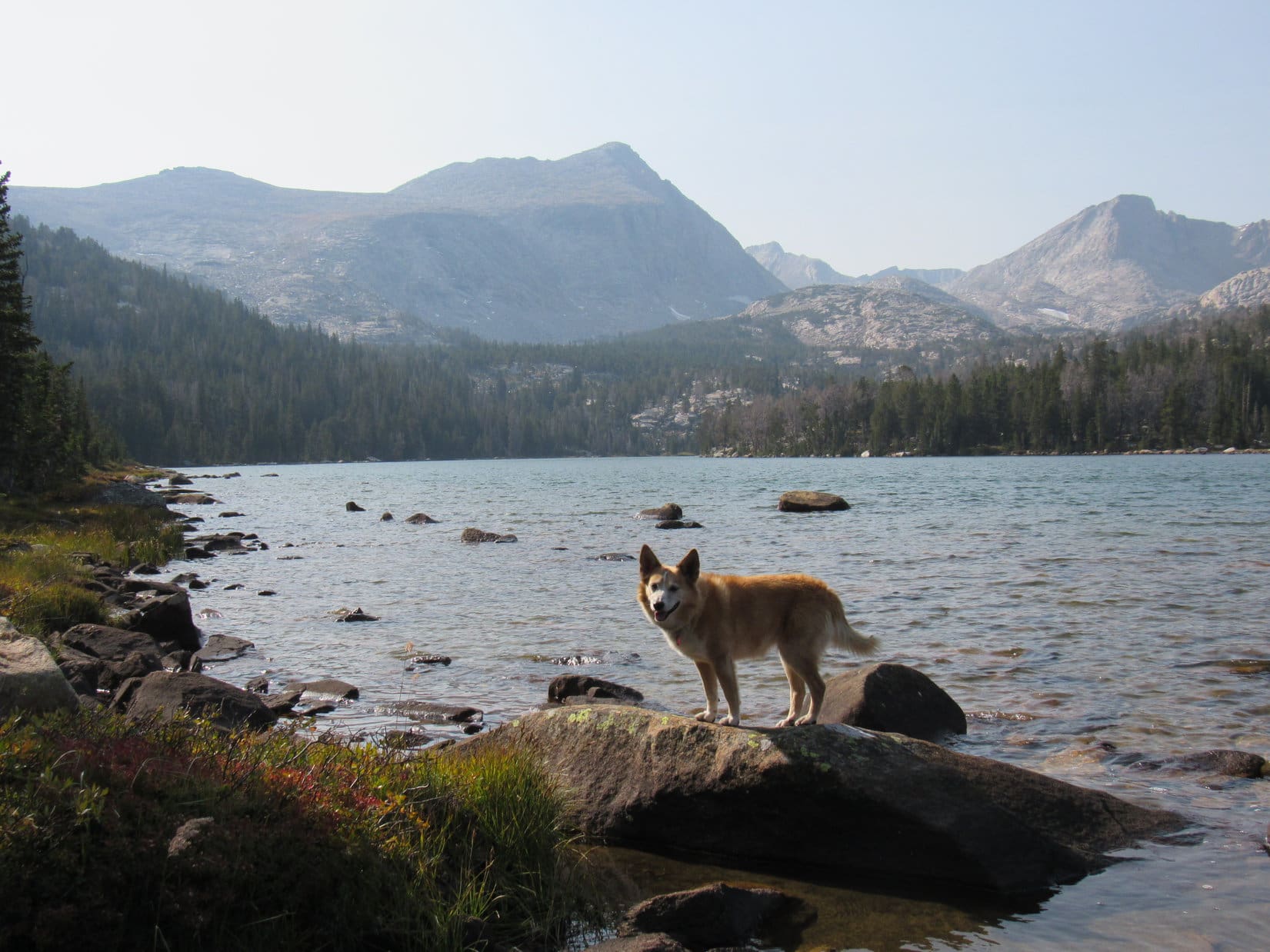
That’s where were going next! Hope you will return to join us for Atlantic Peak!

Links:

Next Adventure                          Prior Adventure

Want more Lupe adventures?  Choose from Lupe’s Summer of 2020 Dingo Vacations to Wyoming, Utah & Montana Adventure IndexDingo Vacations Adventure Index or Master Adventure Index.  Or subscribe free to new Lupe adventures.

Little Bald Mountain & Bear Rocks, Bighorn Mountains, Wyoming (8-6-20)

Days 1 & 2 of Lupe’s 3rd Summer of 2020 Dingo Vacation to Wyoming & Montana!

8-5-20, late afternoon, I-90 in eastern Wyoming –

So we’re not going to Canada or Alaska at all this year, SPHP?

Afraid not, Loop.  We would have if Covid-19 had petered out this summer, but it hasn’t.  Everything is in an uproar about it.  Technically, we could still go, but all the new rules and regulations make it not worth it.  Canada doesn’t want us to do any more than just drive through, which is pointless, and Alaska would force us to quarantine for 2 weeks upon arrival.  Maybe next year?  Let’s hope.

Well, that’s disappointing!  What’s the plan now then?

We’re off to Montana for a while, but the Bighorns are as far as we’ll get this evening.

Montana is beautiful, SPHP!  We used to spend time there before we started just driving through it on the way to Canada, remember?

Oh, yeah!  Montana is awesome!   Jobe’s even going to be there!  Guess we’ll save some money, too, ’cause it’s not that far.

Although Lupe kept a keen eye out, she didn’t see many cows to bark at along I-90.  However, the situation improved dramatically when SPHP abandoned it at Gillette to take the longer scenic route to the N Bighorns through Spotted Horse on Hwy 14/16.  Not only were there cows and horses, but deer, sheep and even wild turkeys, too.

Pandemonium reigned in the G6, a sure sign that this Dingo Vacation was off to a fabulous start!

Missouri Buttes (5,374 ft.) (L) and Devils Tower (5,112 ft.) (R) from I-90 E of Moorcroft. Photo looks N with help from the telephoto lens.
The traditional stop at Spotted Horse. Photo looks E.
Crossing the Powder River W of Spotted Horse. Photo looks N.
Downstream view. Photo looks SE.
Look at all those beautiful moo cows! This is gonna be a great Dingo Vacation!

8-5-20, 10:14 PM, 52ºF, 4 miles ENE of the Garden of the Gods, Bighorn Mountains –  The sun had already been on the horizon by the time the drive up into the Bighorns started, but at least Looper had made it up here.  In darkness, she enjoyed a short romp along USFS Road No. 165.  The were-puppy put in an appearance, attacking SPHP.  Perhaps that was due to the huge, orange moon glowing above the E horizon?

8-6-20, 2:07 AM – Excited to be in the Bighorns again, the Carolina Dog lay resting and watching on the ground outside the G6.  Much higher now, the moon had lost all it’s color and seemed to have shrunk.  Even so, it was still so bright that the stars weren’t.  A warm evening.  SPHP let Loop be for a while before calling her in, not wanting ruin the wee hour magic, but afraid of falling asleep while she was still alone out there.

8-6-20, 6:30 AM – The next thing SPHP knew, bright-eyed and alert, Lupe was in sunshine!  Sun up, but barely.  Underway almost immediately, SPHP drove W from Burgess Junction on Hwy 14A.  Even though Loop wasn’t seeing any cows, she was all excited, barking and singing the Dingo song, certain those cows were out there somewhere.

The cattle never did put in an appearance, but sheep did!  A shepherd on horseback was driving a huge flock across Hwy 14A onto the lower W slopes of Little Bald Mountain (9,907 ft.), assisted by 4 large pure white Great Pyrenees.  Sheep were every bit as good as cows!  As the last of the flock got across the highway and SPHP drove slowly past the stragglers, Loopster gave ’em what for, attracting the attention of 2 of the Pyrenees, who rushed over to defend their flock.

The woofing, pursuing Pyrenees were even more fun!  From the safety of the G6, the American Dingo responded to the white monsters with a savage, curly tail waving, leaping up and down, foaming-at-the-mouth barking barrage.  Utterly exhausting, but exhilarating!  SPHP didn’t dare stop until Lupe was at the huge pullout N of Bald Mountain (10,042 ft.).  By then, the Pyrenees had long since given up the pursuit.

That was a blast! Can we do it again, SPHP? Loop N of Bald Mountain, the big one, not the little one. Photo looks S.

Well, now what?  The plan had been to climb Little Bald Mountain, but obviously trying it while a huge flock of sheep guarded by a shepherd and 4 Great Pyrenees were on the premises might not work out for the best.  Pondering the point, SPHP decided Bear Rocks (9,403 ft.) was the answer, even though it meant driving past Little Bald Mountain again.

Heading back E, a surprise!  Sheep were once more streaming across Hwy 14A, now in the process of abandoning Little Bald Mountain for the exact same pastures they had just left W of the road.  Intensely excited, Lupe was all for driving right through the middle of the flock, but SPHP stopped and waited instead.  No sense in going all the way to Bear Rocks, if Little Bald Mountain was about to open up again.

Sheep stream across Hwy 14A W of Little Bald Mountain (L). Photo looks SE.

8-6-20, 7:41 AM, USFS Road No. 15 near the junction with Hwy 14A – The sheep had moved on, but at least Loopster could take consolation in the fact that she now had a clear shot at Little Bald Mountain (9,907 ft.).  Nothing to it, really.  Roughly 650 feet of elevation gain on a grassy slope less than a mile long.  Lupe was free to sniff and roam as she pleased while SPHP trudged along bringing up the rear.

About to head up Little Bald Mountain’s NW slope. Photo looks SE.
This really would have been a fun romp, if all those sheep were still here!

Halfway up was a minor rocky lip, just above the steepest part of the climb.  Didn’t amount to anything.  Once past it, the slope began leveling out.  At the top of Little Bald Mountain (9,907 ft.), Lupe discovered a wooden post.  The ground 20 or 30 feet SSW of this post seemed to be slightly higher, but a huge region didn’t differ much in elevation.

Little Bald Mountain was about as featureless as a mountain could get, except for the views.  Lupe could see quite a few other peaks she had been to at one time or another.  None appeared rugged, but all had that wide open spaces feel typical of much of the Bighorn Range.

Getting close to the top. Photo looks SE.
By the summit post. Peak 9953 (L) straight up from Loop. Photo looks E.
This seems to be about the true summit! Hunt Mountain (10,162 ft.) (L). Photo looks SE.

Strolling about the summit region, Lupe had a look at Peak 9953 to the E and Hunt Mountain (10,162 ft.) off to the SE.  The sagebrush plains W of the Bighorns could be seen to the SW, although the view was rather hazy.  Bald Mountain (10,042 ft.), which Loop had been to multiple times, was only a few miles NW.

Looking WSW.
Bald Mountain (Center) from Little Bald Mountain. Photo looks NW.

Most of the peaks Lupe had been to were off to the N or NNW.  Not too far away were Rooster Hill (9,400 ft.) and Burnt Mountain (9,492 ft.).  More distant were Duncum Mountain (9,831 ft.) and Sheep Mountain (9,813 ft.).  The Big Horn County High Point (9,257 ft.) in Montana was even visible on the far horizon.

Duncum Mountain (far L), Sheep Mountain (L), and the Big Horn County High Point (Center) all in the distance. Rooster Hill (L) and Burnt Mountain (R) in the foreground. Photo looks NNW.
Little Bighorn River drainage. Photo looks N.

SPHP congratulated Lupe on climbing Little Bighorn Mountain, shaking her paw.  The were-puppy decided to attack, since she’d seen and done about everything there was to see and do up here, and SPHP being the only target readily available.  Once she got that out of her system, Loop and SPHP sat together near the wooden post in a light breeze enjoying a peaceful Bighorn Mountains moment.

Relaxing near the post. Bald Mountain (L). Photo looks NW.

Half an hour after arriving, Lupe started back down the mountain.  By now SPHP had decided that she might as well visit Bear Rocks, too.

On the way back to the G6. Hwy 14A (L) and USFS Road No. 15 (R). Photo looks NW.

8-6-20, 9:47 AM, 68ºF, SW of Owen Creek campground –  SPHP parked the G6 in a big field just off USFS Road No. 236.01.  The topo map showed No. 236.01 turning to 4WD 0.33 mile back at the bridge over Owen Creek, but the road had actually been fine.  In fact, the G6 could easily have gone farther, but this was good enough.  Bear Rocks (9,403 ft.) was only 2 miles NW of here as the crow flies, although the route Lupe was going to take would probably add another mile or more to that.

Loop’s starting point for Bear Rocks. Photo looks S.

The sky was a bit iffy as Looper started SW along No. 236.01.  The road was flat all the way to the trees, both Lookout Mountain (10,147 ft.) and Dome Peak (10,828 ft.) in view off to the SE.  Upon reaching the forest, No. 236.01 gradually gained elevation all the way to a junction with USFS Road No. 220.

Heading for the trees on USFS Road No. 236.01. Photo looks SW.
In the forest. Photo looks SSW.
At the junction with No. 220 (R). Photo looks SW.

Taking No. 220, Lupe followed it NW up a much steeper slope.  The G6 would never have made it up this rocky, rutty affair.  Light rain showers drifted by, missing to the E.  A cool breeze felt good on the 0.5 mile trek up to HP9198, where the road finally flattened out.  After a short break to take in the views, Lupe continued W over the far side of the hill.

Heading up No. 220 to HP9198 (R). Photo looks NW.
No. 220 (L) from HP9198. Lookout Mountain (L) and Dome Peak (R) in the distance. Photo looks SE.
Heading down the W side of HP9198. HP9650 (Center). Photo looks WSW.

Lupe crossed the saddle W of HP9198 and kept going.  Leaving No. 220, which angled off to the L (SW), the Carolina Dog started up toward some dolomite formations SPHP assumed were on the way to Bear Rocks.

On the way up to dolomite formations W of HP9198. Photo looks WSW.

Something didn’t seem right, though.  The hill Lupe was now climbing had been visible from HP9198, and the top was all rounded and grassy.  Sort of strange for a place named Bear Rocks.  Off to the N was a lower hill with a line of dolomite cliffs near the top that looked a lot more like what SPHP expected to see.

The more promising line of cliffs off to the N.

A check of the map confirmed that Lupe needed to go N past those cliffs.  The slope she was currently climbing went to HP9650, not Bear Rocks.  Retreating most of the way back down to the saddle, Loopster picked up a primitive road heading NW.  Unmarked by anything other than a “No Motor Vehicles” wand, this was USFS Road No. 201216.

Near the start of abandoned USFS Road No. 201216. Photo looks NW.
HP9198 (L) from No. 201216. Photo looks SE.

0.25 mile on No. 201216 brought Lupe to a junction with No. 201311, yet another abandoned unmarked road that veered off to the NE (R).  Loop followed No. 201311 up sagebrush-covered slopes to the E end of the cliffs.  By the time she got that far, the road had become a braided series of single track trails heading N.

At the junction with No. 201311, which leads to the E (R) side of the cliffs ahead. Photo looks N.
Approaching the cliffs. Photo looks NW.

The most efficient course of action would have been to simply continue N past these cliffs, but Lupe and SPHP hung around for a closer look at some of the interesting formations.

Quickest way to the Bear Rocks summit is to proceed directly up the hill on the R, but let’s have a look around here first! Photo looks N.
Exploring the below the cliffs. Photo looks SW.
Dolomite formations like these are actually quite common in the Bighorns. Photo looks SW.
An American Dingo prepares to give a speech in a magnificent dolomite amphitheater. Four score and seven mountains ago

Seeing the spiffy dolomite cliffs from below inspired a desire to see the views from above.  SPHP also noticed that the topo map showed HP9399 somewhere up there not too far from the E edge.  That was only 4 feet lower than the true summit of Bear Rocks, still 0.67 mile to the NNW.  Maybe Loopster ought to visit this S summit, too?

Continuing N through an opening between gigantic fallen boulders, the Carolina Dog soon discovered a decent route up.  A quick climb, and Lupe was in the forest on top.  To get a look around from some of the clifftops she had just skirted, Loop explored SE until she came to a good viewpoint.

About to head N between the fallen boulders. Photo looks N.
Below an interesting formation. Photo looks SW.
Hey, here’s a way up, SPHP! Photo looks SW.
A little clearing Lupe arrived at on top. Photo looks NW.
At the viewpoint. HP9198 is the first hill beyond Lupe. Photo looks SE.

The views were impressive, and the deeply-fissured dolomite provided a variety of nice Dingo display platforms.  Nothing wrong with Little Bald Mountain, but the local terrain here was way more interesting!

Along the SE rim. HP9650 (R). Photo looks SSW.
Same spot, but with help from the telephoto lens. Photo looks SSW.
Black Mountain (9,489 ft.) (Center) in the distance. Photo looks NE.

Once satisfied with her explorations along the upper rim, Lupe turned to the task of trying to find HP9399.  Heading NNW, she scouted the region near the edge.  A little beyond where she first came up, a small ridge of dolomite seemed a likely candidate.

Lookout Mountain (10,147 ft.) (Center) from the HP9399 candidate. Photo looks SE.

This small rise with a view was not HP9399.  Going a few hundred feet farther, Lupe came to an 8 or 10 foot high ridge of crumbling rock.  50 feet long with minor high points at each end, as far as SPHP could tell, this ridge was almost certainly HP9399.  Buried in trees, no views were available here.

This seems to be it! HP9399! Photo looks NW.
The HP9399 ridge from the SE end. Photo looks NW.
Loop at the NW end. Photo looks WNW.

Having visited HP9399, it was time to seek out the true summit of Bear Rocks.  Still somewhat disoriented from paying insufficient attention to the topo map, SPHP wandered W.  Branches snapped as Lupe sniffed along nearby.  This old forest was a region of lumpy topography, but Loop was definitely losing elevation.

Mistakenly wandering the forest W of HP9399.

Checking the map again, SPHP finally realized W was the wrong way.  Lupe ought to be heading NE, staying up on the high ground as much as possible.  Course correction was made.  A longer march than expected brought Loop to the edge of the forest again.  Ahead was a gentle slope leading up to a flat hilltop that had been visible way back when she had still been below the E cliffs.

Upon reaching the top, Lupe found herself on a plain of disintegrating dolomite laced with shallow trench-like depressions.  Conifers dotted this region, interfering with views to the NW where the true summit of Bear Rocks ought to be, but from certain points a higher rock formation could be glimpsed a good 0.33 mile away.

Up on the dolomite plain. Photo looks NNW.
Looking back to the S.

The trenches were aligned NW/SE, parallel to the way Lupe needed to go.  Heading NW, she traveled a broad ridge strewn with small bits of dolomite that crunched underpaw like broken bones of the mountain.  Vertical cracks and fissures ran along the edges.

By one of the shallow trenches. Photo looks NW.
Following the flat, crunchy dolomite ridge. Photo looks WNW.

The ridge began to narrow, the trenches becoming deeper and harder to avoid.  Loop tried going down into one trench that quickly turned into a deep crack that led to a dead end.  Doubling back, she climbed out and resumed her trek NW, but soon came to drop-offs everywhere.  No choice, but to scramble 20 feet down into another trench and hope that it would take her somewhere.

At the bottom of this second trench, Lupe reached an opening where she could continue down to the W.  This brought her to a forested region SW of what remained of the failing upper ridge.  Turning NW again, the Carolina Dog climbed through forest before breaking out into a sunny meadow.  Atop the short slope ahead sat a 10 or 20 foot high wall of rock.

Reaching a dead end as the upper part of the dolomite ridge disintegrates. Loop had to scramble down into one of the cracks here to continue. Photo looks NW.
Approaching the Bear Rocks summit. Photo looks NW.

The true summit of Bear Rocks (9,403 ft.) was up on that wall of rock!  Debris along the center of the wall sloped clear up to the top providing access.  Once up there, Lupe found she had reached a roomy triangular region.  The two highest points were at opposite ends of the wall of rock she had just come up.  A superimposed raised platform of dolomite at the E end was clearly the true summit.

First things first!  Without hesitation, the American Dingo went over and scrambled up.

At the true summit of Bear Rocks. Photo looks ENE.
Not a bear in sight! This is Dingo Rocks today! Black Mountain (R). Photo looks ENE.
Another view of the true summit platform. Dome Peak (far R). Photo looks SE.
Bear Rocks is pretty cool, even without any bears!

8-6-20, 1:07 PM, Bear Rocks – After visiting the true summit, Lupe and SPHP moved over to the SW high point at the opposite end of the wall of rock.  Not quite as high here, but a comfier spot to take a short break, and the views were virtually the same.  Lookout Mountain (10,147 ft.), Dome Peak (10,828 ft.) and the Sheridan County HP (11,020 ft.) could all be made out to the SE.

We’re heading over to the SW high point (Center) now. Photo looks SW.
The true summit (R) from close to the SW high point. Photo looks NE.
At the SW high point looking SE the way Lupe came to get here. HP9399 is somewhere back buried in the trees on the R. Lookout Mountain (L) in the distance.
On the SW high point. Photo looks S.

The Bear Rocks summit region extended a good 250 feet NW from the two high points where Lupe had come up.  Naturally, the Carolina Dog took the time to sniff over that way for another perspective.

Checking out the NW part of the summit region. Photo looks NW.
Near the NW end. Dry Fork Ridge (8,480 ft.) (L) and Riley Point (8,536 ft.) (Center) on the horizon. Photo looks N.
At the NW end. The true summit is hidden behind the trees. SW high point (R). Photo looks SE.
Cliffs over along the edge of the Big Willow Creek canyon. Photo looks WNW with help from the telephoto lens.

25 minutes after arriving, Lupe was back at the true summit.  Although still early afternoon, it was already time to bid Bear Rocks (9,403 ft.) farewell.  Today was supposed to be part travel day, so getting back to the G6 was now a priority.  After a final look around from her “Dingo Rocks” platform, Loopster was on her way.

Back at the true summit. Photo looks ENE.
Final moments atop Bear Rocks.

On the way back, the American Dingo made great time.  Retracing the same basic route, she skipped HP9399 and SPHP’s earlier misguided wanderings.  Approaching the E end of the first cliffs she had come to, Loopster did take time to check out a weird wood-framed black plastic shelter hidden next to a big dolomite formation.

Nothing in it at the moment! Maybe a Dingo outlaw hideout? Photo looks SE.

Lupe went over HP9198 again, but didn’t take USFS Road No. 220 all the way back down to No. 236.01.  Instead, she left No. 220, cutting straight E through fields and forest, eventually emerging from the trees a mere 0.125 mile from the G6.

Nearly all the clouds had drifted off to the E.  Kind of hot out.  SPHP drove back down to Owen Creek, and let Loop out for a few minutes.  She waded in belly deep, lapping up the cold, clear water with gusto.  Then it was back in the G6 for a beautiful drive down Shell Canyon to the baking sagebrush plains W of the Bighorns.

By evening, Lupe was at Dead Indian Pass along spectacular Chief Joseph Scenic Hwy No. 296 in NW Wyoming.

At Dead Indian Pass. Photo looks SSW.
Windy Mountain (10,262 ft.) (L) from Dead Indian Pass. Photo looks NW.

8-6-02, 7:35 PM, Clarks Fork of the Yellowstone River – 2 miles NW of the Crazy Creek campground, SPHP pulled the G6 into a small parking area N of Hwy 212.  This was a favorite spot dating back to Lupe’s very first Dingo Vacation in 2012.  The joint was getting popular.  Four vehicles!

A trap had been set, but not sprung – not an FJ among them.  Oh, well.  It had been a long shot, anyway.  Tomorrow Lupe would be seeing her buddy Jobe again!  Something to look forward to for sure.  As the sun sank behind the towering spire of Pilot Peak (11,699 ft.) and knife-edge humpback of Index Peak (11,240 ft.), for the first time in years, the Carolina Dog paid a visit to the little waterfall around the next bend of the Clarks Fork of the Yellowstone River.

Once this was home away from home.  Lanis had been here.  Fun times!  Felt good to be back.

By the little waterfall around the bend.
Pilot (L) and Index (R) peaks from the Clarks Fork of the Yellowstone River, 8-6-20

Links:

Next Adventure                       Prior Adventure

Camped on the Clarks Fork of the Yellowstone River (7-11-13)

Want more Lupe adventures?  Choose from Lupe’s Summer of 2020 Dingo Vacations to Wyoming, Utah & Montana Adventure IndexDingo Vacations Adventure Index or Master Adventure Index.  Or subscribe free to new Lupe adventures.