Black Hills, SD Expedition No. 237 – Centennial Trail No. 89: Pilot Knob to South Boxelder Creek (10-18-18)

Start – 8:55 AM, 50 °F, Pilot Knob trailhead of Centennial Trail No. 89

The first half of October had been cold and wet, but that was history now.  This morning was clear and bright, and it was already 50 °F when Lupe and SPHP arrived at the Pilot Knob trailhead along USFS Road No. 208 (Merritt Road).  The air was calm down here at the trailhead, but Lupe could hear a breeze up in the pines.

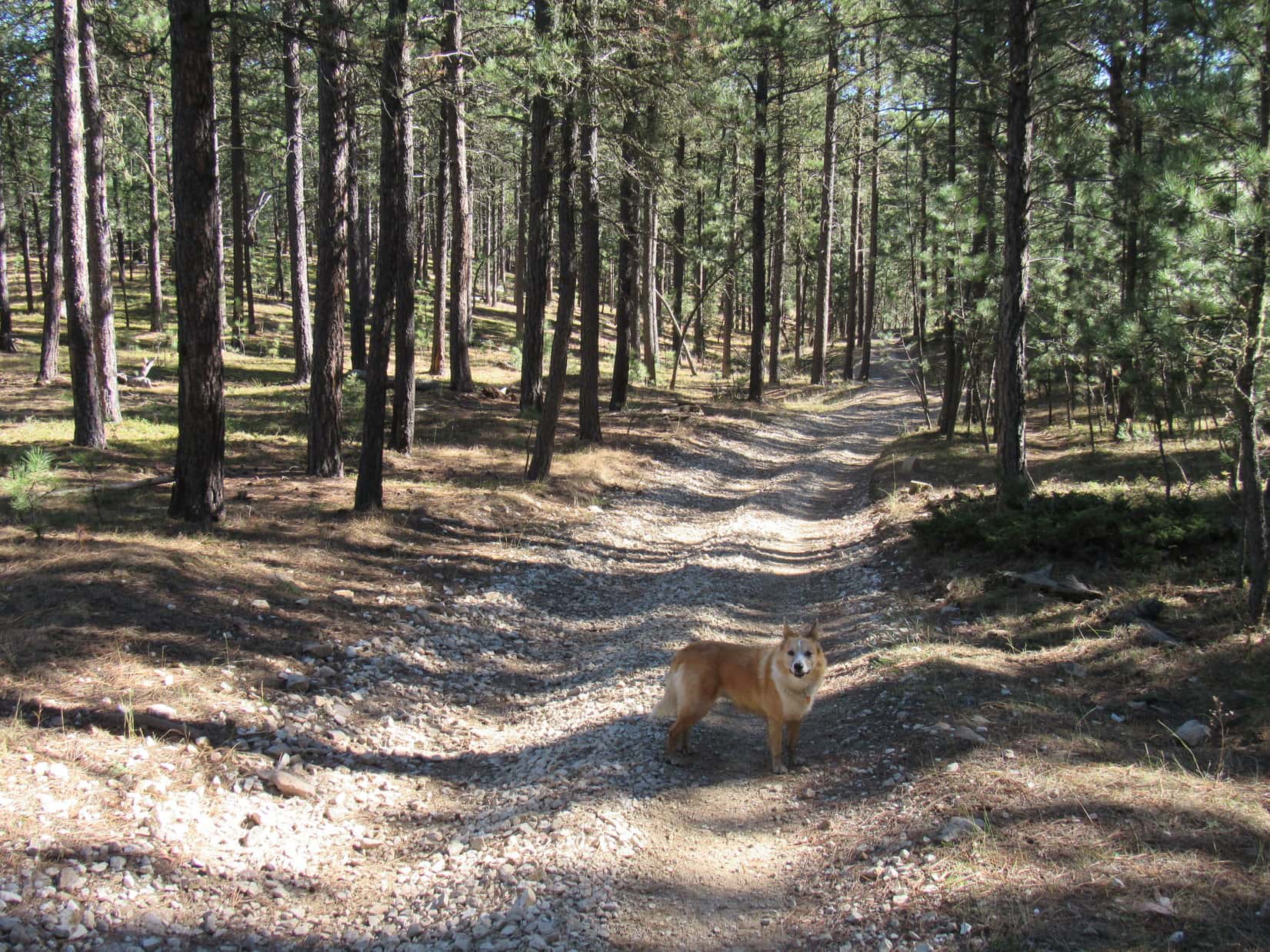
Lupe arrives at the Pilot Knob trailhead of Centennial Trail No. 89. It was going to be a great day with highs near 60°F expected. Photo looks NNE.

Lupe was eager to get started, which was a good thing.  Days are getting short by the second half of October, and she had a long way to go.  The South Boxelder Creek trailhead of Centennial Trail No. 89 near Nemo was 7.6 miles away, a 15.2 mile round trip.  And that was if Loop stayed on the trail, which she wouldn’t, because a little off-trail peakbagging was part of the plan for the day, too.

It’s 7.6 miles one way to the South Boxelder Creek trailhead from the Pilot Knob trailhead – 15.2 miles round trip. And that’s if you don’t climb any mountains on the side along the way!

Only a few minutes on the trail got Loopster up the first forested slope and around the bend to the N where she could see Pilot Knob (5,440 ft.) beyond a big field.  Pilot Knob didn’t look like much from here, but Loop had been there recently on Expedition No. 235.  Pilot Knob was actually a fun little climb and the views from the top had been surprisingly good.

Hey, SPHP! There’s Pilot Knob (L) again! We were just up there not too long ago, remember? Photo looks WNW.

Lupe followed Centennial Trail No. 89 NNW along the E side of the big field.  Near the end of the field, the trail curved NE and went past a sign for Boodleman Spring, which didn’t seem to have much in the way of water.  The trail got steeper after passing Boodleman Spring, and soon turned N again going up a forested valley.

After passing under a big power line, Centennial Trail No. 89 bent NW paralleling the power line.  When the power line reached a high point, the trail curved away to the E.  Lupe briefly left the trail to check out this high point, but there really wasn’t much to see.

Returning to the trail, Loop and SPHP followed it around the S end of a nearby hill to the E.

Going around the S end of the hill E of the power line’s high point. Photo looks E.

Lupe had been gaining elevation ever since leaving the Pilot Knob trailhead.  However, as Centennial Trail No. 89 curved back around to the N on the E side the hill, the trail reached a high point, too.

Ahead was a limited view of a high ridge beyond a deep valley.  Several high points could be seen along this ridge, which extended off toward the NNW.  The topo map revealed that the closest high point was Peak 5701, the highest spot along the entire ridge.

Peak 5701 (Center) is in view as Centennial Trail No. 89 descends into the valley of the West Fork of Estes Creek. Photo looks NNE.

Although Peak 5701 and the rest of the ridge it was on looked intriguing, Centennial Trail No. 89 wasn’t going up there.  The trail went toward Peak 5701, but upon reaching the floor of the deep valley it turned E at the base of the mountain.

The American Dingo had entered the valley of the West Fork of Estes Creek.  Looper soon came to a large puddle where Estes Creek crossed Centennial Trail No. 89.  The creek itself was a mere trickle only an inch or two deep.

Lupe reaches the puddle where the West Fork of Estes Creek crosses Centennial Trail No. 89. Photo looks ESE.

For 0.5 mile, Lupe continued E going down the valley on the N side of the West Fork of Estes Creek.  The creek gained some flow along the way, but remained quite a small stream.  NW of High Point 5452 the trail left the valley floor climbing up onto a small rise.  From here, the trail turned N gaining elevation gradually as it wound around the SE end of Peak 5701.

Lupe at a junction of Centennial Trail No. 89 and ATV trail No. 8251 shortly after leaving the West Fork of Estes Creek. Centennial Trail No. 89 is also an ATV trail all the way from Pilot Knob to South Boxelder Creek. In fact, it’s possible to go even farther on an ATV all the way to the Dalton Lake trailhead. Photo looks NNW.
Going around Peak 5701’s E ridge. Photo looks ENE.

Centennial Trail No. 89 eventually brought Lupe around E of Peak 5701.  For 0.75 mile, the trail now headed NNW roughly paralleling the long ridge between Peak 5701 and Peak 5628.

Now E of Peak 5701 heading NNW.

While the first part of this area was forested, farther on Lupe came to meadows, too.  The Carolina Dog reached a spot where she had a fairly clear view of Peak 5440 off to the NE.

Peak 5440 didn’t look too impressive.  It was just a flat-topped forested hill.  Yet with 360 feet of prominence, Peak 5440 was the most prominent mountain along the entire route Lupe would be traveling today.  So the plan was to take a little off-trail side trip to climb Peak 5440.  After seeing it, though, expectations were none too high.  Loop probably wouldn’t be able to see anything but trees from up there.

Despite technically being the most prominent peak along this section of Centennial Trail No. 89, Peak 5440 didn’t look too impressive. Lupe intended to climb it anyway. Photo looks NE.

Continuing on, Looper soon had views of Peak 5701 again and the long ridge going NNW from it to Peak 5628.  That big ridge looked a lot more intriguing than Peak 5440 did.  Despite not having as much prominence, it was higher and appeared to at least offer some views.  Peak 5701 even had a little snow.

Peak 5701 (L) looked more interesting than Peak 5440, and even had some snow. Photo looks SW.

The trail gradually curved toward the NE.  Stands of aspens sported a few yellow leaves, the last of 2018’s autumn colors.  Approaching Peak 5440, Lupe came to a couple of ponds surrounded by wooden fences.

A few colorful aspen leaves were about the last of this autumn’s display. Peak 5701 is on the R. Photo looks S.
Lupe comes to a fenced-in pond as Centennial Trail No. 89 approaches Peak 5440. Photo looks NE.

Beyond the ponds, Centennial Trail No. 89 curved N again.  This was as close as the trail was going to get to Peak 5440.  Looper left the trail and began to climb, heading first E, then SE as she got higher up.

Lupe soon reached a grassy area on the W face of Peak 5440 that she had seen earlier from a distance.  This was the only place she was likely to see much from Peak 5440.  She actually had a rather nice view of Peak 5701 and the long ridge to Peak 5628 from here.

Peak 5701 (L) and Peak 5628 (R) from the upper W slope of Peak 5440. Photo looks SW.
Peak 5701 from Peak 5440. SPHP sort of wished Lupe was climbing Peak 5701 instead. It looked far more interesting. Photo looks SW.

From the grassy area with a view, Lupe still faced the steepest part of the climb up Peak 5440, but even so, it wasn’t difficult and didn’t take her long.  The terrain soon began to level out.  The topo map showed two 5,440 foot contours on the mountain.  Lupe headed NE through dense forest looking for the first one, which contained by far the smallest area.  A single large boulder proved to be the clear high point of this contour.

Lupe on the big boulder which appeared to be the high point of the first and smallest 5,440 contour shown on the topo map. Photo looks NW.

The area contained by the larger 5,440 foot contour was only a couple hundred yards farther NE.  Loopster traveled through dense forest the entire way.  She seemed to gain at least some elevation.  This larger area was almost certainly higher than the big boulder, and had to be the location of the true summit.

No big boulder or other definite high point existed here, however.  The true summit might have been any of a number of smallish rocks located on nearly flat terrain that sloped only very gradually toward the SE.  The most interesting thing about this place was actually a 15 or 20 foot high escarpment along the NW edge of the area.  Forest blocked all views, but the escarpment featured some interesting rock formations.

The true summit of Peak 5440 is right around here somewhere! Photo looks N.
Hardly matters which of these rocks is the true summit of Peak 5540. Can’t see a thing except trees from any of them anyway! I’m calling this good enough for Dingo work!
This escarpment along the NW edge of the summit area is cool, though! Photo looks N.

Exploring is always fun, but Peak 5440 was the sort of place Lupe was only likely to get to once.  Might as well linger a while to enjoy whatever the experience had to offer.  It was time for a short break, anyway.  The usual fare was on offer.  Water and Taste of the Wild for Lupe.  An apple for SPHP.

When break time was over, it was back to Centennial Trail No. 89 by the same route Lupe had taken up.  Upon reaching the trail, Lupe continued N.  She soon came to a sign saying it was 4.5 miles to Nemo or 3.5 miles back to Pilot Knob.  Nemo was about a mile beyond the South Boxelder Creek trailhead, so this was about the halfway point.

Lupe reaches a sign near the halfway point between the Pilot Knob and South Boxelder Creek trailheads. Photo looks E.

It wasn’t much farther to another high point.  Centennial Trail No. 89 had been gaining elevation, albeit quite gradually, ever since leaving the West Fork of Estes Creek.  N of Peak 5440, however, the trail went over a broad, gentle pass.  On the other side Lupe was soon losing elevation faster than she had gained it.  She was entering the upper reaches of yet another valley.

Loop hadn’t gone far beyond the high point when she reached a sign for Caryl Spring.  Caryl Spring consisted of several inches of standing water full of fallen leaves.  Lupe cooled her paws off, and helped herself to a drink.

As Lupe headed toward the pass N of Peak 5440, she caught sight of this high ridge N of Peak 5628. Photo looks WSW.
Loopster at the high point of Centennial Trail No. 89 N of Peak 5440. There was a major road junction here, but not much in the way of signage. Photo looks E.
Starting down into the next valley. Caryl Spring is right around the bend.
Lupe standing paw deep in Caryl Spring, which did have a few inches of water.

From Caryl Spring the trail continued E farther down the valley, but not for long.  When the valley turned N, Centennial Trail No. 89 took off to the SE up a side draw.  Lupe gained close to 100 feet of elevation going over a minor ridge extending NNE from Peak 5440.  The Carolina Dog was soon over this ridge and starting a descent that would take her into Blue Draw.

Loop reached a sign indicating the South Boxelder Creek trailhead was only a mile ahead.

Gaining elevation again going over the minor ridge NNE of Peak 5440. Photo looks SE.
Beginning the descent into Blue Draw after crossing the ridge. Photo looks ESE.
Getting there! Only a mile to go to the South Boxelder Creek trailhead!

A junction existed where Centennial Trail No. 89 reached Blue Draw.  It wasn’t clear where the road heading SW was going other than farther up the draw.  Where it went didn’t really matter.  Loop just needed to head down the valley.  At the lower end of Blue Draw she would find the South Boxelder Creek trailhead.  The trail headed NE at first, then E the rest of the way.

Lupe in Blue Draw.
Approaching a seasonal stream in Blue Draw. It was just a puddle today.

The trek down Blue Draw was shady and pleasant, but it seemed like Lupe had gone more than a mile since seeing the sign about the trailhead.  Finally she saw a ramp for ATV’s and a gate ahead.  Just beyond the gate was the bridge over Boxelder Creek.  This was it!  Looper had reached the trailhead!

Oh, look! There’s the gate and ATV access ramp. We’re just about to the South Boxelder Creek trailhead!
Loop on the bridge over Boxelder Creek. Photo looks NE.
Boxelder Creek looking downstream (SE) from the bridge.
Looking upstream (NNW) from the bridge.
Lupe reaches her Centennial Trail No. 89 destination for the day, the South Boxelder Creek trailhead. Photo looks ESE in the direction of Nemo, which is out of sight about a mile away.

Despite Lupe’s side trip to Peak 5440, she had made fairly good time getting to the South Boxelder Creek trailhead.  Her Centennial Trail No. 89 explorations were complete for the day, although she still had to repeat the experience going all the way back to Pilot Knob again.

Not yet, though!  Time for another rest break.  Lupe and SPHP relaxed for a while on a grassy bank by the creek.

So we made it! That wasn’t so hard now, was it? And look at this beautiful stream and scenic bridge to adventure!
Guess that’s about it unless we come up with some other grand scheme on the way back to Pilot Knob!

Well, that would have been it, but on the way back to Pilot Knob the American Dingo made such excellent progress that when she reached the pass N of Peak 5440 again, SPHP realized that the sun wouldn’t set for at least another couple of hours.

So what do you say, SPHP? Still want to explore that big ridge going from Peak 5628 (R) to Peak 5701 (L)? Photo looks SW.

The big ridge with Peak 5701 at the S end and Peak 5628 at the N end was now in sight.  Seemed like Lupe had enough daylight left to explore it.  The American Dingo was willing, so why not?

Lupe and SPHP left Centennial Trail No. 89 heading SW for a saddle N of Peak 5628.

Lupe now off trail on her way to the saddle N of Peak 5628. Photo looks SW.

At first, the way was easy.  The terrain gained elevation slowly.  Lupe came to few obstacles.  For a while, SPHP even thought Loop might be on a long abandoned road, but it was hard to tell for certain.

As the Carolina Dog got closer to the saddle, though, the going got tougher.  No road here!  Lupe passed through a very dense pine forest.  Beyond that was an area of mixed pines and aspens thick with deadfall timber.  Loop didn’t have much farther to go to reach the saddle, but progress in the middle of this mess was slow, slow, slow.

The map showed a road going up to the saddle.  Lupe ought to come to it, but for a long way she didn’t.  SPHP had about decided the road didn’t exist any more, when suddenly there was Lupe, standing right on it.  Loop headed W on this road until it was clear she was due N of Peak 5628 and wasn’t going to gain any more elevation sticking with the road.

Time to start up Peak 5628!  Lupe and SPHP left the road heading S up a fairly steep slope.

Lupe reaches the road leading to the saddle N of Peak 5628. Photo looks SW.
Loop in the saddle N of Peak 5628. She left the road here. Photo looks SW.

The hardest part of the climb was the very beginning.  The slope was steepest here, and again full of deadfall timber.  Once Lupe was above the deadfall, the rest of the way was much easier.  The elevation gain from the saddle to the top of Peak 5628 was only about 300 feet, so it didn’t take long.

Close to the summit, Lupe discovered a platform of rock with a good view of Custer Peak (6,804 ft.).  A nearby rock formation proved to be the true summit of Peak 5628.  Looper had no problem getting up onto the highest rock.

This platform of rock near the true summit of Peak 5628 provided a distant view of Custer Peak (Center). Photo looks NW.
Lupe at the summit of Peak 5628. Photo looks N.
Oh, I’m glad we came here, SPHP! Quite a few trees around, but the views are most definitely better from here than they were at Peak 5440! Photo looks E.

Quite a few trees grew near the top of Peak 5628, so views were limited.  However, this was definitely better than Peak 5440 had been.  Not only could Lupe see Custer Peak, but a little way S of the summit was an open area where she had a good look at Peak 5701 at the opposite end of the ridge.

Looper could also see a broad expanse of territory to the S and W.  Even Black Elk Peak (7,231 ft.) was in view, although it was quite far away.

There’s our next peakbagging objective, Peak 5701 (Center)! Photo looks SE.
A broad expanse of Black Hills territory was visible to the S & W. Photo looks S.
Looking back toward the summit of Peak 5628 from the S.

SPHP had expected Lupe would have an easy time traveling along the ridgeline from Peak 5628 to Peak 5701.  However, the highest part of the ridge was capped by large rock formations.  Large quantities of deadfall timber existed in some places, too.

Traveling the highest part of the ridge would have taken too much time.  Lupe made far faster progress staying somewhat lower on the W side of the ridge.  She avoided the much steeper E side.

Loop heading S along the ridge from Peak 5628 to Peak 5701. The highest part of the ridgeline was too rocky for efficient travel. Photo looks SE.

The climb up Peak 5701 was short, but fairly steep and rocky.  The top of the mountain had quite a bit of rock, too.  The summit area was forested, but breaks in the trees provided some views.  The highest point was toward the SE at the edge of an uneven rocky platform.

The sun was getting low by the time Lupe reached Peak 5701. Photo looks SW.
Looking back over the ridgeline Lupe had just traversed toward Peak 5628 (Center). Photo looks NW.
Looper reaches the true summit of Peak 5701. Photo looks ESE.

Lupe and SPHP took the last rest break of the day up on Peak 5701.  The best views were toward the N and E from a rocks a little below and SE of the true summit.  Lupe could see both of the other mountains she had climbed today, and a big expanse of territory she had passed through on Centennial Trail No. 89.

Looking down on Peak 5440 (Center) from Peak 5701. Photo looks NE.
Peak 5628 (Center) from Peak 5701. Photo looks NW.

The sun was still up when Lupe headed N off Peak 5701 back down to the ridge leading to Peak 5628.  She went only far enough to reach a slope she could easily descend into the valley to the W.  This valley drained S into the valley of the West Fork of Estes Creek, but SPHP wasn’t certain which direction Lupe ought to go once she got there.

Which way to Centennial Trail No. 89?  The sun had set.  Light was now fading fast.  A decision needed to be made quickly.  When a brief foray to the E didn’t reveal anything that looked familiar, the Carolina Dog turned and went W.

W proved to be the wrong direction.  No matter.  Lupe continued up the valley of the West Fork of Estes Creek until she reached the power line she had been to much earlier in the day.  Following the power line SE got Loop back to Centennial Trail No. 89.

Since striking out for Peak 5628, Lupe’s return route had bypassed most of the trail.  Less than a mile remained to the Pilot Knob trailhead.  It had been a great day, and was now a beautiful evening.  Darkness reigned.  Stars twinkled.  A coyote howled.  Puppy, ho!  Onward!  Almost there.  (End 6:38 PM, 44°F)

Lupe on Peak 5701, Black Hills, South Dakota 10-18-18

Links:

Next Black Hills Expedition                  Prior Black Hills Expedition

Next Trail Section S

Black Hills, SD Expedition No. 235 – Centennial Trail No. 89: Deer Creek to Pilot Knob (9-29-18)

Next Trail Section N

Black Hills, SD Expedition No. 238 – Centennial Trail No. 89: South Boxelder Creek to Dalton Lake (10-28-18)

Want more Lupe adventures?  Check out Lupe’s Black Hills, SD & WY Expeditions Adventure Index, Master Adventure Index, or subscribe free to new Lupe adventures!

Black Hills, SD Expedition No. 236 – Deerfield Trail No. 40: Deer Creek to Silver City & Peak 5707 (10-6-18)

Start – 9:45 AM, 41 °F, at the Deer Creek trailhead 0.25 mile from Hwy 385 off Silver City Road

Oh, it was going to be a fabulous day!  Blue skies and high thin clouds greeted Lupe upon arrival at the Deer Creek trailhead.  The morning air was cool and fresh.  Autumn colors were near their height of glory.  The American Dingo was excited.  Loop was anxious to hit the trail!

Ready to hit the spur trail leaving the Deer Creek trailhead on a glorious fall morning.

This was Lupe’s third time here in as many weekends.  The first two times Lupe had been exploring segments of Centennial Trail No. 89.  Two weeks ago she had reached this point after starting from the Rapid Creek trailhead 5.0 miles to the S.  Last week she had started here and journeyed 3.8 miles N to the Pilot Knob trailhead.

The Carolina Dog certainly intended to continue her adventures along Centennial Trail No. 89, but not today.  The Deer Creek trailhead is also the E end of Deerfield Trail No. 40.  The far W end of this 23 mile long trail connects with the 11 mile long Lake Loop Trail that circles Deerfield Reservoir in the W central Black Hills.

The plan for the day was to head W on Deerfield Trail No. 40 only as far as the next trailhead at Silver City, a mere 3.7 miles away.  That ought to leave enough extra time for a couple of side adventures to Peak 5707 and Pactola Reservoir, as well.

As soon as SPHP was ready, Lupe set out from the Deer Creek trailhead on the now familiar spur trail leading W up a slope.  Five minutes on the spur got her to the main trail.  Here she turned L, proceeded 100 yards S to Silver City Road, then crossed it.  The trail continued S through pine forest to a minor pass about 0.5 mile from the Deer Creek trailhead.

This pass was where Centennial Trail No. 89 and Deerfield Trail No. 40 part ways.  A sign marked the R turn Looper needed to take to head W toward Silver City.

Lupe at the junction of Centennial Trail No. 89 and Deerfield Trail No. 40. This junction is 0.5 mile from the Deer Creek trailhead where she’d started. Loopster headed W toward Silver City from here. Photo looks W.

Deerfield Trail No. 40 initially gained elevation as it headed W from the junction, but soon leveled out.  Loop actually lost a bit of elevation as the trail subsequently dipped into a minor drainage.  Off to the NE, Lupe could see Silver City Road again not too far down a slope.  However, upon reaching the bottom of the drainage, the trail turned SW away from the road.  Starting up the drainage Lupe passed between several brightly colored aspens.

Upon reaching this drainage, Deerfield Trail No. 40 follows it uphill. The American Dingo passed between these bright aspens near the start of the climb. Photo looks SW.

A steady climb up the rocky bottom of the drainage ensued as the trail gradually curved W.  By the time Lupe was 0.5 mile from the junction with Centennial Trail No. 89, the drainage had faded away.  At this point Lupe wasn’t far below the top of a nearby hill to the SW.  Meanwhile, Deerfield Trail No. 40 was beginning to level out.  Apparently the trail was about to swing around the N side of the hill.

Deerfield Trail No. 40 levels out here not far below the top of a hill to the SW (L). Lupe had already gained 300 feet of elevation from the junction with Centennial Trail No. 89. Photo looks WNW.

Although Lupe was merely off to a good start as far as getting to Silver City was concerned, the topo map showed she was already fairly close to one of her side objectives.  Peak 5707 ought to be only 0.5 mile S of here.  A faded remnant of a road entered a small meadow S of the trail.  Maybe that was the way to go?

This small meadow next to Deerfield Trail No. 40 looked like a promising start toward Peak 5707. After crossing the meadow, Lupe climbed the forested slope seen on the R. Photo looks SSW.

Lupe abandoned Deerfield Trail No. 40 for the time being to begin her search for Peak 5707.  She went S through the small meadow, then turned SW climbing the nearby forested hill.  She quickly arrived up on a spacious, virtually flat summit, already at 5,520+ feet elevation.

Up on the flat 5,520+ foot elevation hilltop. Photo looks SW.

Loop headed SW on the broad hilltop until she caught sight of an even higher forested hill a little farther S.  That was High Point 5600.  Peak 5707 wasn’t in view yet, but ought to be beyond it.  Looper lost 80 feet of elevation going down to the saddle leading to High Point 5600.

On the saddle leading to High Point 5600. Photo looks SSW.

After crossing the saddle, the easiest route up High Point 5600 seemed to be to curl around to and up the E slope.  Before she even got to the top, Lupe could see Peak 5707 ahead.

From the upper E slope of High Point 5600, Lupe gets her first look at Peak 5707 (L). Photo looks SSW.

Lupe briefly visited the highest rocks on High Point 5600 before turning S toward Peak 5707.  This time she lost only 60 feet of elevation heading down to the saddle.  Along the way she came to a couple of spots from which she had quite nice distant views toward the E and SE.

Looper could see both Perrin Mountain (5,212 ft.), which she had been to only 2 weeks ago, and Thrall Mountain (5,091 ft.).  Loop had been to Thrall Mountain, too, but it was getting close to 4 years ago now.

Peak 5707 (Center) from the upper S slope of High Point 5600. Photo looks S.
The closest distant hill on the L is Perrin Mountain. Beyond it a little to the R is Thrall Mountain. Photo looks SE on the way to Peak 5707.
Similar view zoomed in. Lupe’s ears point up at Perrin Mountain. Thrall Mountain is at Center. Photo looks SE.

The N slope leading to the top of Peak 5707 really wasn’t much of a climb.  Lupe only needed to gain 150 feet of elevation, and the slope was only moderately steep.  Due to lots of deadfall timber, it was harder than it should have been, though.  Nevertheless, Lupe was soon perched at the true summit on the highest slanty rocks.

Due to the forest, the only really clear view was toward the NW.  Close by, Lupe could see Peak 5707’s NW ridge.  Custer Peak (6,804 ft.) was on the far horizon.

Success! Lupe at the summit of Peak 5707. Custer Peak is the distant high point at Center. Peak 5707’s NW ridge is in the foreground. Photo looks NW.

While Lupe had arrived at Peak 5707 from the N, the mountain’s main ridge runs NW/SE.  This ridge was quite narrow at the true summit.  Slanty rocks and scattered deadfall made the immediate area a bit of a hassle to maneuver on.  Once Lupe and SPHP were satisfied with having seen the limited available views, the Carolina Dog set off toward flatter terrain to the SE less encumbered with obstacles.

Lupe discovered a nice, wide flat area only a foot or two lower than the true summit.  It was a pleasant spot.

Only a little SE of Peak 5707’s true summit, Lupe found this nice flat area. It was only a foot or two lower than the actual high point, and much easier to move around on. Photo looks S.

The W end of Pactola Reservoir is only a mile S of Peak 5707.  SPHP had hoped Lupe would have a nice view of the lake from up here.  However, if there were any views, even this nice flat spot was too heavily forested to see them.  Lupe and SPHP continued a short distance SE along the ridge hoping to discover a decent viewpoint.

Sure enough, the American Dingo came to a point along the SW edge of the ridge from which it was possible to see Silver City, Rapid Creek, and the far W end of Pactola Lake.

Looking SW from Peak 5707’s SE ridge. Silver City is below on the R. The far W end of Pactola Reservoir is on the L.

The topo map showed Peak 5707’s SE ridge extending another whole 0.5 mile to come within 0.5 mile of Pactola Reservoir.  Maybe there were even better viewpoints somewhere along the way?  Eh.  Perhaps, but it seemed like a longer trek than SPHP really wanted to make away from Deerfield Trail No. 40 and Lupe’s other objectives.  It was decided to explore Peak 5707’s shorter NW ridge instead.

Done with a short, brief exploration of a small part of Peak 5707’s SE ridge, Lupe heads back toward the summit on her way to the NW ridge. Photo looks NW.

Exploring the NW ridge turned out not to be such a hot idea.  Most of the ridgeline proved to be a mess due to large amounts of deadfall.  Even so, lots of trees were still standing.  Lupe didn’t come to any grand views she hadn’t seen before.  Fortunately, there were some areas that weren’t too hard to traverse.  Lupe did make it out to the high point at the far NW end before turning around.

Looking back at Peak 5707’s summit from the NW ridge. Photo looks SE.
Not much deadfall here, SPHP! Kind of like a super highway for you! Photo looks NW.
Can’t see a darn thing from here, either! Loopster at the high point at the far NW end of the ridge. She turned around and went back from here. Photo looks NW.

Well, the views from Peak 5707 may have been a bit disappointing, but exploring is always fun.  At a minimum, Lupe had scored a peakbagging success.  The Carolina Dog headed SE back toward the summit along the NW ridge.  Before she got there, Lupe left the ridgeline heading E toward the saddle leading to High Point 5600.  Some of the aspen trees were loaded with golden leaves.

Even if there weren’t any dazzling distant views from Peak 5707, Lupe could still appreciate the golden leaves of the aspen trees.

Lupe could have taken a shortcut to Deerfield Trail No. 40 by going down a valley to the NNW before she even reached the saddle S of High Point 5600.  However, SPHP thought maybe she should return to the exact same point where she had left the trail.  That way Loop would get to see the entire trail, even if it got so late the return trip was in the dark.

So that’s what Looper did.  She went back over High Point 5600 and the 5520+ foot hill, and all the way back down to the small meadow where she reached Deerfield Trail No. 40 again.  As expected, a level stretch of trail took Lupe around the N side of the 5520+ foot hill, then turned SW.

Lupe back on Deerfield Trail No. 40 again as it rounds the N side of the 5520+ foot hill. Photo looks SW.

Once W of the 5520+ foot hill, Deerfield Trail No. 40 began to steadily lose elevation.  At first Lupe was traveling through pine forest, but she soon came to a long stretch with many aspens mingled in that was quite beautiful this time of year.

As the trail wound SW, Lupe came to a long beautiful stretch of forest with many aspens mingled in among the pines.
Sure is pretty along in here, SPHP. Hope it stays like this all the way to Silver City!
So, where is this place on the map, SPHP? …. Remember when you were up at the high spot at the far end of Peak 5707’s NW ridge, Loop? I think we are just N of there now, but several hundred feet lower.

Looking up, SPHP eventually saw that Lupe was rounding the far NW end of Peak 5707’s NW ridge.  Deerfield Trail No. 40 emerged from the aspens about this time and curved S.  The forest was all pines now, with virtually no other vegetation.  Pine needles covered the trail and littered the forest floor.

Lupe started having success finding squirrels to bark at.  Most of the time she stayed busy roaming off trail eagerly looking for the next one.

After leaving the aspens behind, Deerfield Trail No. 40 wound S in a solid Ponderosa pine forest. Photo looks SSW.
Well, those aspens were pretty, but when it comes to excitement, you just can’t beat squirrels! Lupe had considerable success finding squirrels in the pine forest.

The trail wound around a bunch, but overall kept working its way S.  Most of the time Lupe was still losing elevation, but after a while she came to level and even uphill sections, too.  The pine forest went on and on.  Lupe was somewhere on the lower W slopes of Peak 5707, but many hundreds of feet below the now unseen summit.

The pine forest finally began to open up.  Grass appeared.  Lupe had lost a lot of elevation.  She would soon reach a gravel road leading to the Jenny Gulch picnic ground near Pactola Reservoir.

Grass appeared when the pine forest finally opened up. Loop had lost many hundreds of feet of elevation by now. Photo looks S.

If there weren’t so many squirrels down here as before, it didn’t matter.  As Deerfield Trail No. 40 approached the gravel road to the Jenny Gulch picnic ground, Lupe spotted a new source of keen interest right across the road.  Cows!  Big, beautiful, black cows.  So tempting!

Approaching the gravel road to the Jenny Gulch picnic ground, Lupe spotted a new source of interest on the other side. Big, beautiful, black cows! Photo looks SSW.

Don’t even think about it, Loopster!  Be good!  Leave those cows alone.

SPHP settled for 2 out of 3.  Lupe was good.  She didn’t chase the cows.  Even after the trail crossed the road and she was mighty close to them.  However, Loop sure did think about it.  It was simply impossible not to.  Just the look in that Dingo’s eyes made the cows decide the grass was greener farther up the valley as Lupe approached.  A few decided there was some urgency in the matter, and set off at a lively trot.

Where the cows had just been, a rather rotten old tree trunk served as an official Deerfield Trail No. 40 bridge across a tiny creek.

The tempting cows departed of their own volition leaving Lupe in command of their field. She crossed the rotten tree trunk seen on the R, which still served as a bridge over a tiny creek. Photo looks SSW.

Beyond the creek, Deerfield Trail No. 40 headed SSW through the field to the base of a forested hillside.  It continued in this direction with the hill on the W and the field to the E until beyond the hillside.  The trail then turned W gaining elevation slowly as Lupe went through open forest and meadows.

After getting around the S end of a forested hill, Lupe follows the trail W through an area of meadows and open forest.

Lupe soon came to a short climb up and over a small ridge.  On the other side, water was in sight at the bottom of a steep slope.  Deerfield Trail No. 40 turned NNW heading down the slope.  After losing most or all of the elevation Lupe had gained going over the little ridge, the trail turned W again as the terrain began to level out.

After crossing the small ridge on the L, the terrain leveled out. Rapid Creek flows into the W end of Pactola Reservoir on the far side of the wetlands on the R. Photo looks S.

The American Dingo was only 0.5 mile from Silver City now.  Soon the red roof of the Silver City Community Hall was in sight beyond a field.  Lupe was thrilled to see a magnificent herd of black cows munching away at the tall grass.

Nearing Silver City, Lupe was thrilled to see an even bigger and more magnificent herd of black cows ahead. Silver Peak (5,810 ft.) is in the distance. Photo looks SW.

To avoid the cattle as much as possible, SPHP led Loop along the lower SE side of the field near the edge of wetlands.  Although the Carolina Dog didn’t bark and behaved quite nicely, the closest cows were unnerved by her predatory stares.  Most returned to the safety of the larger herd.

Lupe near the wetlands on her way past the cattle (off the R edge). Silver Peak is seen on the R. Photo looks SW.

The rest was easy.  Deerfield Trail No. 40 took Lupe across the last part of the field to Silver City Road.  Loopster briefly dropped by the Silver City Community Hall.  From a lawn liberally decorated with cow pies, she had a great view back toward Peak 5707 off to the NE.

Lupe reaches Silver City. Photo looks SW.
At the Silver City Community Hall. Note the snazzy red roof. Photo looks W.
Looking back at Peak 5707 (Center) from the Silver City Community Hall lawn. Photo looks NE with help from the telephoto lens.

On the other side of Silver City Road a scenic cliff was in view beyond Rapid Creek.  Lupe wandered over for a closer look.

Rapid Creek is somewhere near the base of this scenic cliff downstream of Silver City. Photo looks SE.

A 0.5 mile level stroll to the Silver City trailhead was all that remained for Lupe to complete her Deerfield Trail No. 40 objective for the day.

Lupe on Silver City Road. The main part of Silver City is off to the L (S) on the opposite side of Rapid Creek (hidden by bushes). Deerfield Trail No. 40’s Silver City trailhead is still 0.5 mile away down the road on the R. Photo looks W.
Loop by Rapid Creek near the bridge to the main part of Silver City. Lupe didn’t need to cross this bridge. The Silver City trailhead is on this same (N) side of the creek farther along the road on the R. Photo looks WNW.

Lupe made it to the Silver City trailhead, just a wide spot at the end of a gravel road.  Her mission accomplished, the Carolina Dog went a little farther exploring the near bank of Rapid Creek upstream to another bridge providing access farther up the canyon.

Lupe gets a drink from Rapid Creek near the Silver City trailhead. Photo looks ESE.
Exploring a little farther up Rapid Creek toward the next bridge. Photo looks WNW.
Up on the bridge. Photo looks W.

Lupe got up on the bridge over Rapid Creek.  Deerfield Trail No. 40 crosses this bridge on its way farther up the canyon.  This was it, though.  Lupe wasn’t going any farther today.

The Carolina Dog had been this way before.  In fact, long ago the Silver City trailhead and this same bridge had been the starting point for Lupe’s very first adventures in the Black Hills.  Both of her Black Hills, SD Expeditions No. 1 & No. 2 had begun right here in January, 2012.  Barely 2 years old then, Lupe had been so very excited by the mysterious Black Hills backcountry, and had such wonderful times!  That was way back in the days before SPHP even thought to bring a camera.

A short distance beyond the Silver Creek trailhead, once again on the bridge over Rapid Creek to a life of adventures! Both of Lupe’s first two Black Hills, SD Expeditions had started right here way back in January, 2012.

It was mid-afternoon.  This was a good place to take a break.  Lupe curled up with a view of Rapid Creek by the end of the bridge.  She had some Taste of the Wild, then spent a few minutes resting.  Perhaps, like SPHP, she was reflecting upon those first adventures so long ago.

Taking a break near Rapid Creek where it all began once upon a time. Photo looks ESE.

Ten minutes only, before the American Dingo was ready for action again!  Lupe and SPHP started back along the road.  Loop would return to the Deer Creek trailhead retracing the same route along Deerfield Trail No. 40.

Leaving Silver City heading toward Peak 5707 (Center) again. Photo looks NE.

On the way back, Lupe made two side trips off Deerfield Trail No. 40.  First, she left the trail to visit the Jenny Gulch picnic ground.  Here she had access to parts of the N shore of Pactola Reservoir.  Lupe and SPHP spent a little time exploring the area.

Lupe reaches Pactola Reservoir at the lower end of Jenny Gulch. Photo looks ESE.
Overlooking part of the W end of Pactola Reservoir near Jenny Gulch. A squirrel has Lupe’s attention. Photo looks WSW.
A wider view of the same area.
Pactola Reservoir is the largest lake in the Black Hills. Only a small portion is in view here. Photo looks W.

Later on, as evening approached, Lupe left Deerfield Trail No. 40 again to attempt a second ascent of Peak 5707.  Loopster used the exact same route she had taken this morning.  It was cloudier and cooler out now than it had been earlier.

S of High Point 5600 on the way back to Peak 5707 for a 2nd time. Photo looks ESE.

Lupe succeeded in reaching Peak 5707 a second time.  Sadly, a hoped for beautiful sunset wasn’t going to happen.  Lupe and SPHP hung around for 20 minutes anyway, enjoying the solitude and limited views.  Most of this time was spent relaxing on the flat area SE of the true summit.

Lupe makes an early evening return to the true summit of Peak 5707. Photo looks SSE.
Relaxing up on Peak 5707. Photo looks N.

Light was fading.  Lupe went back to the highest rocks a final time.  One more look around.  Then it was Puppy, Ho!  Onward!

One more mile of adventure!  Half a mile back to Deerfield Trail No. 40.  Another half mile to the Deer Creek trailhead.  It’s not over until it’s over!

Lupe made the most of every moment as darkness descended upon her Black Hills and Expedition No. 236 drew to a close.  (End – 7:07 PM, 42 °F)

Final moments at the top of Peak 5707, 10-6-18.

Lupe treasures gathered: 18 aluminum cans, 2 plastic bottles, 3 glass bottles.

Links:

Next Black Hills Expedition                       Prior Black Hills Expedition

Deerfield Trail No. 40 brochure & map

Next Trail Section W:

Black Hills, SD Expedition No. 163 – Deerfield Trail No. 40 – Silver City to Canyon City (3-23-16)

Centennial Trail No. 89 brochure & map

Next Trail Section S:

Black Hills, SD Expedition No. 234 – Centennial Trail No. 89 – Rapid Creek to Deer Creek (9-22-18)

Next Trail Section N:

Black Hills, SD Expedition No. 235 – Centennial Trail No. 89 – Deer Creek to Pilot Knob (9-29-18)

Want more Lupe adventures?  Check out Lupe’s Black Hills, SD & WY Expeditions Adventure Index, Master Adventure Index, or subscribe free to new Lupe adventures!