Black Hills, WY Expedition No. 257 – Inyan Kara (11-7-20)

8:57 AM, 61ºF, Hunter Ranch at the end of Crook County Road No. 198

Wish you hadn’t brought the dog!

Doug Hunter, owner of the ranch that Lupe needed permission to cross to get to Inyan Kara Mountain (6,360 ft.), was soft-spoken.  A tall, older man, he didn’t look entirely well.  His face had a reddish-purple cast to it.  SPHP felt a little bad about showing up unannounced to ask this favor of him.  The softly smiling reply was a bit sheepish.

Well, I did.

Doug sighed.

I’ll tie up my dog then.  If I don’t, he’ll follow you.

Thank you, so much!  By the way, we brought you a present.

You didn’t have to do that.

It is your land.  Realize that we’re asking you a favor, so thought we better come prepared to do a little something for you, too.  It’s nothing much.  Hang on a moment.

Opening the trunk of the G6, SPHP produced a 6 pack carton of Corona Extra.  Doug seemed surprised, maybe even faintly pleased, but said nothing.  He didn’t turn it down, though, when SPHP handed it to him.  A truck pulled up, as Doug accepted the gift.

They’re here for Inyan Kara, too.

Hunters?

No, hikers like you.

Doug went to tie up his black and white salt and pepper-coated dog, which was about the same size as Lupe and showing a lot of interest in her.  SPHP parked the G6 near the fence close to the house, let Lupe out, and grabbed the backpack.  As the Carolina Dog passed by, Mr. Hunter was chatting with the new arrivals.

We’ve established a no pet policy.  One dog got bit by a rattler, and another was attacked by a badger.  The owners wanted to blame us.

Yikes!  Awkward!  Maybe that young couple had a dog, too, had called ahead, and been told not to bring it?  Clearly, Doug had been expecting them.  Waving cheerily, but briefly, SPHP stepped up the pace.

Thanks again!  We’ll be out of your hair in just a few minutes.

Making it to the end of the fence around the ranch house yard, Lupe turned W following a dirt road down into a little dry creek bottom, then up the other side.  In bright sunshine, Inyan Kara loomed ahead.  Not all that far to the fence line marking the boundary of the Hunter ranch, and start of the isolated 2 square miles of Black Hills National Forest on which the mountain sat.

Even after ducking under the fence, Lupe and SPHP hurried on, angling NW now toward the trees.  Out of sight, out of mind!

Inyan Kara on the way to the Hunter ranch. Photo looks WNW.
Glancing back at the Hunter Ranch headquarters after ducking under the fence onto Black Hills National Forest land. Photo looks E.
On the lower E slope heading for the trees. Photo looks NW.
Edge of the forest. Photo looks S.

Reaching the forest, Lupe continued NW for a little way, still climbing gradually.  When SPHP figured she’d gone far enough, it was time to turn W straight up the steep slope leading to the top of the E ridge.  Loop was soon there, popping up onto the ridgeline near a minor rock formation.  Inyan Kara’s summit was already in sight only 0.5 mile away.

Getting close to the top of the E ridge. Photo looks WSW.
Inyan Kara summit (Center) from the E ridge. Photo looks WNW.

Looper was going to have to go a lot farther than 0.5 mile, though, to get to the top of Inyan Kara.  The igneous mountain, an ancient wanna-be volcano that never erupted, is shaped like an elongated horseshoe, or an enormous, partially coiled serpent.  A V-shaped valley hundreds of feet deep was between the American Dingo and the summit.

This E ridge was part of the serpent’s tail.  Loop would have to travel the length of the serpent’s coiled spine clear around to the S and SW before heading NE to the summit.  Before doing all that, Lupe wandered a little farther N to where the serpent’s tail began to drop more steeply.  Her clockwise journey around to the summit would start from here.

Lupe as far N along the E ridge as she went. Photo looks SSE.

As Lupe started the journey S, the forested ridge was narrow, but nicely rounded.  Minor rock outcroppings protruded at various points like petrified serpent vertebrae.  Slowly, but steadily, Loop gained elevation as she went, occasionally coming to minor dips and high points along the way.  An even higher spot was always reached a little farther on.

Tree effectively blocked the views, but every now and then, Loop came to small openings where she could see off into the distance.  At first, all of these openings looked E or SE out over the plains surrounding Inyan Kara.  From the first of these openings, the main body of the Black Hills looked like little more than a long blue ridge.  Farther on, the piney tablelands of the Sweetwater Mountains High Point (6,440 ft.) were discernable on the SE horizon.

Starting the clockwise journey around the long outer ridge. Photo looks S.
The Black Hills of South Dakota from Inyan Kara. Photo looks E.
Sweetwater Mountains High Point (Center – the most distant ridge). Photo looks SE.
Continuing higher. Photo looks SSW.
Another look at the Sweetwater Mountains High Point (Center – most distant ridge). Photo looks SE.

Lupe was SE of the summit by the time she got her next look at it.  From this angle she had the best view of the columnar jointing on the S face of the summit region she would have all day.  Although not as spectacular, Inyan Kara bore a certain resemblance to Devils Tower (5,112 ft.), NE Wyoming’s most famous and dramatic mountain.

S face of the summit region. Photo looks NW.
Columnar jointing is a relatively rare geologic feature. Photo looks NW with help from the telephoto lens.

Inyan Kara had not escaped a pine beetle infestation that hit the Black Hills region more than 10 years ago.  Considerable quantities of deadfall timber were strewn along the ridge.  As Lupe turned W along the S part of the ridgeline, she had to dodge more and more deadfall.  Many broken tree trunks amidst this shattered mess were laying perpendicular to her direction of travel, greatly slowing SPHP’s progress.

The weather was deteriorating, too.  What had started out as a sunny morning had clouded over to a considerable degree, especially toward the S.  An early gentle breeze was now a 15 to 20 mph wind sweeping in out of the SW.  SPHP kept an eye on some of the more threatening trees still standing in the swaying, creaking forest.

At the S end, Lupe came to broader grassy region.  For the first time, she could now see the plains SW of Inyan Kara.  Turning NW to explore the SW part of the ridge, the deadfall was really icky, and the Carolina Dog had to put up with the full force of the SW breeze roaring up the slope.

The wide grassy region at the S end of the ridgeline. Photo looks SW.
Traveling the SW ridge. What a mess! Photo looks WNW.
Summit (L) view from the SW part of the ridge. Photo looks NE.
View to the SSW with help from the telephoto lens.
A last look back to the SE.

Beyond the worst of the deadfall, Lupe came to a dip in the ridgeline and another, smaller grassy spot.  This led to a short climb, culminating at forested HP6262, the highest point along the Inyan Kara serpent’s body.

In the second grassy region, on the way to HP6262. Photo looks NW.
At HP6262. Summit (Center) in the background. Photo looks NE.

The serpent’s neck had been crushed.  To get to the head (summit!), which was now off to the NE, but not easily seen due to all the trees, Lupe had to descend 130 feet into a wide saddle leading to Inyan Kara’s N ridge.  She was happy to do so.  This descent immediately got her into the leeward protection of the ridge and out of the wind.

The downslope was full of deadfall, slowing progress again, but even so, Lupe was soon approaching the bottom.  The highest part of the saddle was also littered with deadfall.  However, by staying toward the SE, Loop was able to cross the saddle in nearly obstacle-free open forest.  A few minute’s tramp, and the American Dingo stood confronted by the first rock formations of the N ridge.

Near the highest part of the saddle leading to the N ridge. Photo looks N.
A bit farther SE in an almost deadfall-free zone. Photo looks E.
Approaching the SW end of the N ridge. Photo looks E.

Inyan Kara’s N ridge was much rockier than the long outer spine of the serpent Lupe had just come from.  Exactly where to start up wasn’t clear, and maybe didn’t make much difference, although it seemed to SPHP it might be best not to start too close to the S end.  Picking a spot just N of some thin-layered rock formations, Lupe began her ascent.

Open lanes strewn with pine needles existed among the rocks, making for a fairly easy, though somewhat steep, trek higher.  Upon regaining the elevation she’d lost on the way down to the saddle from HP6262, Looper reached an initial top at HP6285.  To the S, she already had a good view of the ridge she’d traveled to get here.  Off to the NNE, she could once again see Inyan Kara’s summit.

Among the first rock formations encountered along the N ridge. Photo looks NNE.
At HP6285. The long ridge Loop had traveled to get here (from L all the way to the R), is the closest one beyond her. Sweetwater Mountains High Point (R of Center) on the far horizon. Photo looks SE.
Summit (L) from HP6285. Photo looks NNE with help from the telephoto lens.

As Lupe and SPHP were taking a look around from HP6285, the young couple that had arrived shortly before Loop left the Hunter ranch caught up.  A quick exchange of greetings, and they pressed on ahead.

Lupe was soon hot on their trail.  The summit was only 0.25 mile away now, and not even 100 feet higher.  However, the route N following breaks among knobby rock formations was up and down with several steep or narrow spots along the way.  The top of the ridge was rough enough so it was often best to stay somewhat below it, usually toward the E overlooking the deep central valley.

Among the rock formations. Photo looks N.
Making progress. Up on top of the ridge at the moment. Photo looks NNE.
Getting there! Summit (Center). Photo looks NNE.

At one point, a large rock formation provided a break in the trees.  Both Devils Tower (5,112 ft.) and the Missouri Buttes (5,374 ft.) were faintly visible on the far NW horizon.

Missouri Buttes and Devils Tower (visible if expanded) both L of Center. Photo looks NW.

Just before the final rocky spurt to the summit, Lupe came to a big dip requiring a bit of a down climb.  The young couple were already beyond the dip, paused not far below the top, as Loopster approached.

Closing in on the summit. Photo looks NE.
In a rocky gully just shy of the top. Photo looks NNE.

The young man pushed on as Lupe passed the woman, who remained where she was.  Up a little rocky ramp, and the Carolina Dog was there!  On top of Inyan Kara (6,360 ft.), Lupe and SPHP met Marcus Neiman.  He’d already removed the rocks of a cairn located a little W of the true summit.

Roughly carved into the bedrock where the cairn had been was an item of historical significance.  “74 Custer”.  The inscription had been here for more than 146 years, since July 23, 1874, when an expedition led by Lt. Col. George Armstrong Custer had been in the Black Hills searching for gold.

Looper by the “74 Custer” inscription. Photo looks NW.
“74 Custer”. A closer look.

SPHP asked Marcus about the young woman with him.

She’s just nervous about this last part?  She’s practically here already!  A shame to come so far, get so close, and not make it to the summit.  Really nothing to it now.  Mind if Lupe and I talk to her?  We’d just like to give her a little encouragement.  No question she can do this!

Marcus had no objection.

What’s her name?

Martina.

Lupe and SPHP returned to where Martina sat in a partially sheltered spot below a juniper bush.  She couldn’t have been any more than 15 or 20 feet lower than the true summit, or 100 feet from it, but the top wasn’t visible from where she waited.

What could be seen of the rocky ramp higher might seem a bit exposed to someone not used to the mountains.  In fairness, Inyan Kara’s N ridge, which Martina had already come across, was more intimidating than the vast majority of mostly gentle peaks in the Black Hills region.  The gusty SW wind was blowing up here, too, which couldn’t have been helping matters.

Despite Lupe’s calming presence, and SPHP’s attempts to reassure her, Martina repeatedly said she was fine with staying right where she was.  Her choice, of course.  SPHP was about to give up when an idea struck.  The problem was that short, but psychologically intimidating, rocky ramp higher into the wind and the unknown.  Was there another route?

Climbing only a few steps N past the juniper bush, there was!  Piece of cake!  Martina could even see the critical part from right where she was.  Not expecting any miracles, SPHP pointed out that, if she could get to where SPHP stood only a dozen feet from her, Martina had Inyan Kara made.  The rest was even easier.

A moment’s hesitation, then without saying a word, Martina stood up.  Something inside had clicked!  Literally 2 minutes later, though perhaps still a bit nervous, Martina was standing, smiling and hugging with her husband, at the true summit of Inyan Kara.

Congratulations, were in order, of course!  Then a few photos.  SPHP had the temerity to ask Martina if she liked coconut?

Yes …

How about chocolate?

Martina shot SPHP an incredulous look.

Yeeessss …

3 small chocolate coconut bars were in the backpack.  SPHP offered one each to Martina and Marcus, then split the remaining one with an eager Dingo.

At the true summit with Martina and Marcus. Photo looks ESE.

A registry was in a round plastic bin tucked under a juniper bush along the N edge 10 feet from the true summit.  Somehow, the upper edge of the registry notebook had been gnawed away.  Marcus and SPHP both created new entries.

A couple of survey markers were up here, too.  One was 10 feet W of the true summit.  The other, stamped with an arrow, was 15 feet NE.

By the W survey benchmark.
W marker.
NE marker.

Half a dozen miles W of the main body of the Black Hills, Inyan Kara stood in grand isolation out in the high prairies of E Wyoming, part of a line of mostly smaller hills.  Sweeping views in all directions, although a bit murky on this unsettled day.

Marcus said he had climbed Missouri Buttes (5,374 ft.).  Surprising!  The buttes were on private property, so SPHP was under the impression that only a limited number of people had ever been there.

Zoomed in on Missouri Buttes (L) and Devils Tower (R). Photo looks NW.

Marcus and Martina were soon ready to go.  After Marcus rebuilt the cairn over “74 Custer”, they bid Lupe farewell and were on their way.

The rebuilt cairn hiding “74 Custer” is in front of Lupe. Photo looks NE.

Alone again.  Lupe had been here once before on a November day, nearly 6 years ago.  SPHP had seen her old entry in the registry, still there and legible on a page now smudged and dirty.  That had also been a gray, windy day, but colder, darker, and even windier than this one.  SPHP encouraged Looper to pose as she had stood back then, buffeted by the breeze with clouds approaching out of the SW.

In the November breeze again on Inyan Kara. Photo looks SW.
Looking SE.

6 years gone, a sobering thought.  Who knew if the Carolina Dog would ever return to Inyan Kara again?  What once was, is no more.

146 years ago when someone inscribed “74 Custer” up here, this had still been Sioux territory.  Lupe might have seen bison on the prairies below.  Despite the coming huge Native American victory at Little Bighorn in June, 1876, that had all been about to change forever.  By the end of 1877, with the surrender of Chief Joseph of the Nez Perce, no numerous native tribe still roamed freely in the United States.

As the afternoon wore on, the winds died down.  Clouds sailed away.  The day became sunnier and warmer.  On a remote sacred mountain, Lupe lingered.

At the true summit. Photo looks E.
Upper NE end of the summit region. Hooker Peak (5,862 ft.) (L). Photo looks NE.
View to the W.

On a clear day, it might be possible to see the Bighorn Mountains far to the W, but Loop saw no sign of them today.  A second somewhat lower region of the summit area was hidden in forest off to the E.  Together, Lupe and SPHP went over to explore it.  Cactus!  Had seen only a little of it back near the true summit, and none on the way up, but there was a fair amount of it way out at the E end.

Loopster got a couple of small, but painful cactus spines in one of her paws.  SPHP pulled them out, but she had had it!  The American Dingo demanded SCOP (Standard Cactus Operating Procedure) from then on as long as she was in this region.  She wouldn’t budge unless SPHP either carried her, or explored ahead before giving her the signal indicating that the route was cacti-free!

Lower E end of the Inyan Kara summit region. Hooker Peak (far L). Photo looks NE.
Let’s head back to the true summit. Less painful up there! Photo looks NW.

1.5 hours after arriving, and, well, you know the drill.  A final look around, and Lupe stood perched in a light breeze at the true summit of Inyan Kara (6,360 ft.) for the last time.  Solitude, beauty, isolation, joy!

Back near the true summit. Photo looks NE.
Last look NNW. Missouri Buttes (L) and Warren Peaks (6,650 ft.) (R) on the horizon.
Inyan Kara

Onward!  Puppy, ho!

Actually, SPHP led the way for the first little bit.  Lupe hung out up on Inyan Kara’s summit, waiting until SPHP had already gotten a good start.  She then came bounding along the rocks, catching up in a jiffy.

Go on ahead, SPHP! I’ll be with you shortly. HP6262 (R). Photo looks SW.
At the SW end of the summit region. Photo looks SSW.
About to begin the descent. Photo looks NE.

The first part of the return was a retracement of the same route Looper had taken up Inyan Kara’s N ridge.

On the way down. HP6262 (Center) on the far ridge. Photo looks SW.
Last look back. Photo looks NE.

Still time!  Looper’s explorations of Inyan Kara weren’t over.  Once the American Dingo made her way back to the saddle leading to HP6262, Lupe instead turned N, venturing into a valley she’d never seen before.

Usual sort of thing.  The remote valley steepened, becoming V-shaped with plenty of deadfall to contend with.  0.75 mile later and 850 feet lower, Loop emerged from the pines as the valley widened and flattened out.  She was way over on the NW side of the mountain now.

Traveling a grassy road that soon turned to dirt, the Carolina Dog circled the base of Inyan Kara clockwise, usually out on open prairie, but at times in darkening forest.  Not all that late, but evening comes stealing out of the E early while stalking the weary November sun.

Down off the mountain. Photo looks N.

To the N, Peak 5475 and O’Haver Peak (5,530 ft.) across the rumpled prairie, both looking much more significant now than they had from above.  To the NE, Hooker Peak (5,862 ft.), Iron Mountain (5,887 ft.) and Duling Hill (6,005 ft.), old friends Lupe had once visited before.

Peak 5475 (L) and O’Haver Peak (R). Photo looks NNW.
Hooker Peak (L), Iron Mountain (L of Center), and Duling Hill (R of Center). Photo looks NE.

Near the end, shortly before the dying day passed away, the sun cast a brief gleaming glance back as it fled into the W.  The American Dingo paused.  A moment of tranquil beauty.

Day’s end. Photo looks N.

Then it was gone.  Lupe was too, trotting S in the shadow of Inyan Kara.  (End, Hunter ranch HQ, 4:47 PM, 59ºF)

With Marcus and Martina, Inyan Kara, Wyoming 11-7-20

Links:

Next Black Hills Expedition                 Prior Black Hills Expedition

Black Hills, WY Expedition No. 104 – Inyan Kara Mountain (11-9-14)

The American Surveyor: Sacred Mountain – Climbing Inyan Kara

Many thanks to Douglas Hunter for granting Lupe permission to cross his ranch!

Want more Lupe adventures?  Check out Lupe’s Black Hills, SD & WY Expeditions Adventure Index, Master Adventure Index, or subscribe free to new Lupe adventures!

Black Hills, SD Expedition No. 256 – Deerfield Trail No. 40: Daugherty Trailhead to Signal Knob & Deerfield Lake (10-30-20)

8:36 AM, 26ºF, Mystic Road, Daugherty trailhead, Deerfield Trail No. 40

After that big storm last week, I never dreamed there would be so little snow up here, Loopster!  We could have gone up to the high country, if I’d realized it was going to be practically snow-free.

Still can if you want to, SPHP, but this is fine with me.

Eh, I didn’t plan anything out for up there thinking the G6 wouldn’t even be able to get close.  Maybe we should just go with the flow?  You can knock out a section of the Deerfield trail today.  We might even have time for a side excursion to Signal Knob (6,200 ft.) for some peakbagging fun!

You know I’m not picky, SPHP.  Happy just to be here!  If you are, too, let’s go!  Don’t want to keep the early squirrels waiting!

Somehow I doubt an American Dingo is what the squirrels are hoping for, but onward!  Puppy, ho!

Lupe was on it, anxious to make tracks and get in some long overdue sniffing action.  Sprinting ahead, she left the Daugherty trailhead of Deerfield Trail No. 40 following USFS Road No. 182 W up Whitetail Gulch.  Daugherty Gulch was 0.75 mile S of here, and why this wasn’t called the Whitetail trailhead instead of Daugherty had always been a mystery to SPHP.

However, it was more of a curiosity than a real mystery.  Whatever the answer was, it made no difference at all to Lupe.

Waiting impatiently at the Daugherty trailhead for the photo to get snapped so the day’s adventures can begin.
Starting up Whitetail Gulch.

Not a cloud in the sky!  Tiny sunlight diamonds sparkled on thin layers of frost and snow.  The air was crisp and clean, summer’s smoky skies at long last a thing of the past.  Deerfield Trail No. 40 wound gradually up Whitetail Gulch past ponderosa pine covered slopes and naked aspens.  A tiny creek trickled in the ditch next to the roadbed.  The road crossed it 10 minutes from the trailhead.

On USFS Road No. 182, which doubles as Deerfield Trail No. 40 in Whitetail Gulch.
Loop returning from one of her romps ahead.
At the tiny stream crossing 10 minutes from the trailhead.
A long straight stretch bordered by white-barked aspens.

All of the terrain Deerfield Trail No. 40 would take Lupe through today was pretty easy stuff.  Some variation, of course, but mostly a series of long gentle inclines and descents.  A good 0.5+ mile from the trailhead, Whitetail Gulch curved S.  The trail, however, continued W a little way before making a short steeper jog up to the N.  Turning W again, the road leveled out, reaching a high point shortly after passing No. 182.1D, a side road on the R (N).

Just beyond this high point, the Deerfield Trail curved SSW as it began a gradual descent.  Some open ground provided Lupe with her first views of nearby hills.  Nothing too spectacular, but pleasant enough.

At the curve beyond the junction with USFS Road No. 182.1D. Photo looks SW.

Lupe was soon past the open grassy region.  The trail now dipped more steeply down into a shady canyon, entering a different drainage.  At the bottom, the road crossed Crooked Creek, which was considerably larger than the tiny creek in Whitetail Gulch, but still a small stream.  Paving blocks in Crooked Creek made for a trivial stream crossing.

Immediately beyond Crooked Creek, the road forked.  A brown Deerfield Trail fiberglass wand was in sight ahead along the L branch.  Going that way, Loop quickly came to a second Crooked Creek crossing, also blessed with paving stones.

At the first Crooked Creek crossing. Stay L at the road fork ahead!
The second Crooked Creek crossing was only a few hundred feet farther.

Crooked Creek was a major low point.  From here, Deerfield Trail No. 40 climbed steadily following the creek valley higher.  Within 10 minutes, Lupe arrived at another place where the road forked.  She stayed to the R entering a shaded, narrower portion of the valley.  A snowy trek on a straight stretch led to a curve to the L where the road crossed Crooked Creek yet again, which this time flowed beneath it in a culvert.

Immediately beyond the culvert crossing, the road curved sharply R (NW), starting up a hill at a steeper pace.  However, Deerfield Trail No. 40 parted from the road at this curve.  SPHP nearly missed the trail as it headed off to the L.  The only sign was 25 feet from the road where a big ponderosa pine had a metal “40” diamond nailed to its trunk, and a pink ribbon could be seen behind it flapping in the breeze.

Heading W up the S side of the Crooked Creek valley after the 2nd stream crossing.
Looper at the fork 10 minutes W of the 2nd Crooked Creek crossing. Stay to the R here!
By the big ponderosa pine with the 40 diamond and pink ribbon. The trail has just left the road 25 feet back and is now a single track. Don’t miss this turn! Photo looks SW.

Deerfield Trail No. 40 now continued SW up Crooked Creek as a single track.  At first, the single track looked a little like an abandoned ATV trail, but soon lost that characteristic as it promptly entered a narrow, V-shaped valley.  The shady forest seemed dank and dark, but the trail was easy to follow.

Before long, Lupe came to another creek crossing.  This one was a bit of a mess.  A mostly frozen-over pool of water was surrounded by deadfall and tree trunks that had been cut to clear the trail, but which were still crowding the crossing.  The ice wasn’t thick enough to be trusted, and getting past this little spot was more trouble than it ought to have been.  On the far side, SPHP had to crawl under a downed spruce, but the Carolina Dog enjoyed plenty of clearance.

As it turned out, Loopster came to 3 of these stream crossings in quick succession.  None were significant obstacles, but they did slow SPHP down, which admittedly doesn’t take much.

First of the 3 Crooked Creek crossings that came in rapid succession.
Second crossing. The log next to Lupe would have made this one a cinch, if it hadn’t been icy.

Shortly after Lupe passed the third stream crossing, the valley turned S and began to open up.  The single track reached an old forest service road again, which continued up the valley at an easy pace, crossing Crooked Creek one last time at a point where the stream was a simple rock hop, almost a step-across.

The old road eventually began curving R (W), and soon arrived at a 3-way junction at a sunny clearing.  Another 3-way junction was just 150 feet away up a hill to the S.  A check of SPHP’s maps showed that all Lupe had to do was continue straight W on a road clearly marked as USFS Road No. 443.

The valley opens up after the 3 rapid succession stream crossings. Loop is approaching a final easy Crooked Creek ford just ahead. Photo looks SSW.
Still following Crooked Creek higher, but we won’t have to cross it again! Photo looks SW.
2 different 3-way junctions in this area. Stay straight W on No. 443! Photo looks WSW.

No. 443 headed W from the junction, then gradually curved NW.  What was left of Crooked Creek was still on the L (S) side of the road, but was now largely reduced to a strip of mucky terrain with only a little free flowing water among tufted grasses.  A little after No. 443 turned NW, Lupe reached an unmarked fork.

Directly ahead, a grassy slope lay between the two choices, either a road to the R (N) which went uphill into an area where several trees had pink plastic ribbons tied around them, or a road to the L (W).

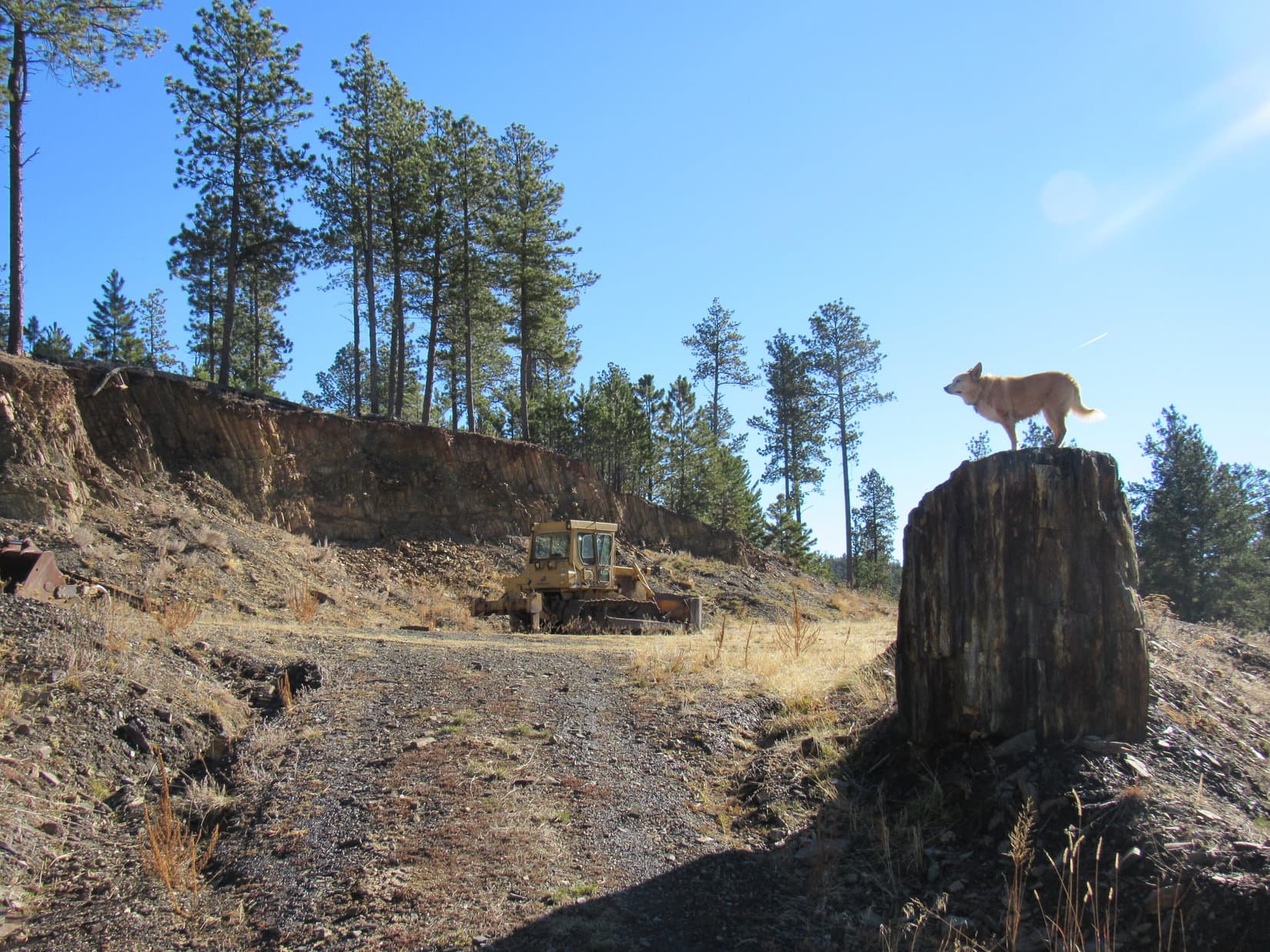
The road to the L looked more heavily trafficked, as though it might be a continuation of No. 443.  After some debate, Lupe went that way.  She soon came to a place where the hillside N of the road had been carved away by a bulldozer.  In fact, the guilty bulldozer was still rusting away up in the scar.  Orange signs in the trees nearby said this was an “active” mine site, but it sure didn’t look like it.

Part of the carved up hillside N of the trail. Photo looks E.
Looking ahead. No. 443, if that’s what it still was, continues W. Photo looks W.

Continuing W past the inactive active mine site, the road soon curved NW again, leaving the last remaining trickle of Crooked Creek behind for good.  Lupe came to a 3-way junction in a large clearing.  A tree on the E side of this junction had a 40 diamond nailed to it.  The positioning made it look like this meant the road heading NE up a little hill was actually the Deerfield Trail, not the way Loop had just come.

Wondering if the road from the NE was a continuation of the branch to the R that Loopster had not taken at the last fork before the mine, SPHP led her up to the top of the little hill.  Off to the L (N) was a somewhat higher ridge that looked like it might provide some distant views.  The road kept going NE, instead of bending around to the R (S) like it should have if it was going to head back to that last fork.

Inconclusive.  Didn’t really matter.  SPHP was certain Lupe needed to go back down and take the road going SW.  She sure didn’t need to be going NE.  Might as well forget this for now.  Maybe the Carolina Dog had taken a little shortcut by going past the mine, and maybe she hadn’t, but it was true that she hadn’t seen any 40’s along the road that went by the mine.

Lupe reached this junction from the R (SE). However, the 40 diamond on the pine at R seemed to indicate that this road to the NE (Center) had been the correct route. Photo looks NE.
On a brief foray to the NE to see if this was the route Lupe should have been on. Result: inconclusive. Photo looks NE.

Lupe turned around, went back down the little hill, and continued SW past the 3-way junction.  The road climbed gradually for a while, then leveled out.  Was this the place?  Nothing stood out, but then again, that was to be expected.  There wouldn’t be anything to make it stand out.  A brown fiberglass “40” wand confirmed Loopster was definitely on the Deerfield Trail again.

On the flat high ground. Photo looks SW.

A long time ago, the Carolina Dog had been this way.  In fact, back in the early days of her Black Hills expeditions she had traveled both the entire Deerfield and Centennial trails, among the longest in the Black Hills.  That was years before she had her very own adventure Dingo blog.  In the last few years, Loop had revisited some sections of both trails, which was more or less what this expedition was all about, too.

Today’s re-exploration had all seemed like a completely new voyage of discovery.  Nothing had triggered memories of having been here before until now.  Yet a growing eerie feeling of long lost familiarity still wasn’t conclusive.

Keep an eye out, Loop.  I think somewhere up here the trail veers off to the R, going downhill as a single track again.  If I remember right, the turn is marked, but still easy to miss.

I’ll try, SPHP, but I’m sort of busy watching for squirrels and deer, too.  Are we close to the turn you’re expecting, now?

Not sure.  Suddenly feel like I’m in an ancient dream walking in a real, but long forgotten land.  All I really remember is being up on a stretch of flat high country like this that didn’t offer any views, and subsequently missing the turn.  That scarred hill and rusting bulldozer we passed now seem vaguely familiar, too, but I could be confusing all this with some other completely different place.

Well, that’s really helpful, SPHP!  Let me know if your dream walk is due to turn into a nightmare somewhere up here.  Think I’ll stick to the squirrels and deer in the meantime.

The march SW went on and on, just like SPHP “remembered” it would, but Lupe still didn’t come to anything definitely recognizable, and no single track trail appeared veering off to the R.  Instead, Loop eventually came to a 3-way junction SPHP had no recollection of at all with USFS Road No. 429, which was marked with a brown wand and continued SW.

So here we are up in dreamland! Flat high ground, pine trees, no views, but an easy trek. Photo looks SW.
So far, so good, but still no single track off to the R (NW)! Photo looks SW.
Junction with USFS Road No. 429. (Near HP6006 on the topo map.) Photo looks SW.

No. 429 soon started dropping.  Slowly at first, but Looper hadn’t gone far before she was losing elevation at a good clip.  She came to a place where the road curved R (N) into a valley.  SPHP called a brief halt to check maps, and take a little break.  A building was off to the SW on a partially open hillside of mixed grasslands and pines.

Well, we’ve done it again, Looper.

Done what, SPHP?

Missed the turn onto the single track.  No harm done, though.  I suspect we’ll find it right around this bend.  That grassy hillside with the building makes me think we’re getting close to Slate Prairie.

Off the official Deerfield Trail a bit, but getting close to Slate Prairie. Photo looks SW.

Loop wasn’t hungry, but SPHP ate an apple.  Once it was gone, onward!

Apparently, the few brain cells that hadn’t suffered a memory dump were right.  Continuing around the curve down into the valley to the NNW, Deerfield Trail No. 40 crossed the road only a few minutes from the rest spot.

By the section of single track trail Lupe’d missed. It provides a little shortcut compared to following USFS Road No. 429 around a bend to the S. Photo looks E.
From USFS Road No. 429 (which Lupe is standing on), Deerfield Trail No. 40 continues as a single track up the ravine seen beyond her. Photo looks SW.

Leaving No. 429, Lupe turned WSW following a single track up a ravine.  This ravine was the upper end of the Bittersweet Creek drainage, a very small stream at this point.  The creek was a mucky mess where the trail first met it.  Loop avoided crossing it, staying along the S bank for a little way, waiting until SPHP found an easy spot to leap over.

A use path on the N bank led up to a boulder where it merged with the official Deerfield Trail.  The use path contained a hazard the official trail did not.  Several strands of rusty barbed wire from a downed fence were hidden in the grass just before the boulder.  Fortunately, Lupe did not get tangled in it.

An American Dingo forges ahead after successfully avoiding a barbed wire trap only a few feet from this rock. Photo looks SW.

Following the official trail up the ravine, Loop came to a flat region on the edge of Slate Prairie.  Signal Knob (6,200 ft.) could now be seen 0.6 mile to the SSE.

Heading up the ravine. Photo looks W.
Approaching Slate Prairie. Photo looks WSW.
Signal Knob from Deerfield Trail No. 40. Photo looks SSE.

Signal Knob wasn’t impressive, merely a small pine-forested hill isolated out in the Slate Prairie grasslands.  Lupe had been there before, more than 5.5 years ago.  SPHP remembered a deadfall timber laden summit due to a severe pine bark beetle infestation.

Noon already, but Looper had been making fairly decent time.  She was only a little over a mile from the Kinney Canyon trailhead, her minimum goal along the Deerfield Trail today.  No more significant peaks were close to this section of the trail, so SPHP figured the Carolina Dog might as well pay Signal Knob another visit.  The side trip would cost her an hour or so, but no more than that.

Leaving Deerfield Trail No. 40, Loopster struck out heading S across the rolling grasslands of Slate Prairie.  After crossing a ravine containing what remained of tiny Bittersweet Creek, she passed through a big field leading to County Road No. 307.  Ducking under a fence to cross the road, she was soon approaching Signal Knob from the NW.

Approaching Signal Knob. Photo looks SE.

The N end of Signal Knob was private property, but the S half was USFS land.  Lupe circled S partway along the W slope before turning toward the summit.  The entire W slope was a mess of deadfall and stickers, making what should have been a trivial romp higher a slow process.

Signal Knob is sort of a mess, but we knew that! Photo looks SE.

As expected, Signal Knob’s flat summit was still littered with deadfall, but patches of open ground existed, too.  Despite the pine bark beetles’ work, enough trees were still standing to interfere with the views.  The only really clear view was a nice one of Black Elk Peak (7,231 ft.) far to the SE.  The last time Lupe had been here, it had still been Harney Peak.

Black Elk Peak (L of Center) from Signal Knob. Photo looks SE.
Black Elk Peak with help from the telephoto lens.

12:29 PM, 55ºF, Signal Knob – A 10-15 mph breeze blew out of the W, but it was still nice up here for almost the end of October.  SPHP was glad Lupe had returned to Signal Knob.  However, if she was going to get as far along Deerfield Trail No. 40 as SPHP hoped, Loop couldn’t stay long.

Time enough for a relaxing light lunch, and that was about it.  Taste of the Wild for Lupe, who was somewhat hungry now.  Another apple for SPHP.  A small chocolate coconut bar served as desert.  Naturally, it got shared with the insistent sweet tooth Dingo.

Back on Signal Knob for the first time in more than 5.5 years. Photo looks NW.
Relaxing a bit before pressing on. Photo looks S.

A pleasant 20 minutes, and it was time to go.  At least the Carolina Dog had one minor peakbagging success to show for the day!  Bidding Signal Knob farewell, Lupe started down the W slope again.  The lower part wasn’t forested, and actually provided quite nice views of the E edge of the limestone plateau region off to the W.

A number of peaks Loopster had been to before were in sight, including South Castle Rock (6,840 ft.), Castle Rock (6,783 ft.) and Nipple Butte (6,800 ft.).

South Castle Rock (Center) and Castle Rock (R of Center), both part of the same ridge. Nipple Butte (far R). Photo looks NW over Slate Prairie and more distant Reynolds Prairie with help from the telephoto lens.
View to the SW from the lower W slope of Signal Knob.

Once down off Signal Knob, Lupe went NW intent upon getting back to Deerfield Trail No. 40 again.  She didn’t return to it at the exact same spot she’d left it, but picked the trail up somewhat farther W where it crossed USFS Road No. 187.

In Slate Prairie, almost back to Deerfield Trail No. 40. Flag Mountain (6,937 ft.) (far L), Peak 6962 (L), and White Tail Peak (6,962 ft.) (R) in the distance. Photo looks NW.
Back at the Deerfield Trail where it crosses USFS Road No. 187. South Castle Rock (straight up from wand). Photo looks WNW.

From USFS Road No. 187, the trail left Slate Prairie heading W into the trees.  Lupe soon came to a metal gate.  At roughly 6,220 feet elevation, this gate was the highest point along the entire Deerfield Trail.  From here the trail continued WNW on a long gradual descent.  At the bottom, Lupe popped out onto County Road No. 307 again, the same road she’d crossed near Signal Knob.

On the other side of No. 307 was a big grassy clearing, site of the Kinney Canyon trailhead.

At the metal gate W of USFS Road No. 187. This is the high point of the entire Deerfield Trail. Photo looks W.
Losing elevation after passing the gate. Photo looks WNW.
Looking back from County Road No. 307. Photo looks ESE.
At the Kinney Canyon trailhead. Photo looks W.

Not yet 2:00 PM, but close to it.  Looper had met her minimum goals for this Black Hills expedition.  Sure would be nice to continue far enough to link up with the Deerfield Lake Loop Trail No. 40L, though.  Another mile would almost do it.  SPHP actually hoped the American Dingo could get even farther than that.

Wha’dya think, Loop?  How are you feeling?

Great!  What’s up?

We can turn around here and call it a day, but want to keep going?  Be kind of fun to go all the way to the Deerfield Reservoir dam and see the lake.  On the other paw, the sun goes down mighty early these days.  We won’t get back to the G6 until well after dark, if we do all that.

I’m having a blast!  Let’s keep going!  You brought the flashlight?

Yup.  Extra batteries, too, if we need ’em.

So onward it was!  From Kinney Canyon, the Deerfield Trail continued SW up a little valley, now as a road again.  Shortly after the trailhead was out of sight, however, the trail veered off to the R as a single track.  A steady climb eventually leveled out in a young pine forest.

SW of the Kinney Canyon trailhead, the Deerfield Trail again becomes a single track as it splits off here from a short stretch of road it had been following. “40” trail wand beyond Lupe. Photo looks W.
In the young forest at the top of the next rise. Photo looks WNW.

A long descent was about to begin.  Beyond the young pines, Lupe went through a second metal gate.  Past the gate, she came to a big field.  On the far side was a road.  The last of the single track trail led over to it.

Last of the single track trail. The road leading to the junction with trail No. 40L is just ahead. Photo looks W.

Upon reaching the road, Lupe followed it R.  It immediately entered the shade of a forested valley.  The snowy road lost elevation more quickly than the single track had, but wasn’t steep.  Winding W down this valley, Loopster came to a sign for the Deerfield Recreation Area.  The junction with Lake Loop Trail No. 40L couldn’t be much farther.

A few more bends in the road, and there was the intersection at a small sunny clearing.

On the snowy road. Photo looks WNW.
Entering the Deerfield Recreation Area. Photo looks NW.
We’re getting close to the junction with Lake Loop Trail No. 40L now! Photo looks W.
This is it! W end of the official Deerfield Trail No. 40. Of course, it links up with No. 40L here, which goes clear around Deerfield Lake. Photo looks SW.

A couple of signs were at the junction of No. 40 & No. 40L.  One said Loop was now 7 miles from the Mystic Road trailhead, which is just another name for the Daugherty trailhead.  The other sign said the Custer Trails trailhead, accessible from No. 40L, was 2 miles away.

W end of Deerfield Trail No. 40. The E end links up with Centennial Trail No. 89.
Still at the junction, but on Deerfield Lake Loop Trail No. 40L now. Photo looks N.
The second sign.

Only one more objective left!  Lupe headed NW on Deerfield Lake Loop Trail No. 40L.  Castle Creek wasn’t as far as SPHP remembered, only 0.33 mile.  Another 0.33 mile past Castle Creek, and the Carolina Dog reached the top of the Deerfield Reservoir dam near its NW end.

Approaching Castle Creek below the Deerfield Reservoir dam. Photo looks NW.
Deerfield Reservoir from the NW end of the dam. Photo looks SSW.

A cool W breeze swept across the lake.  Trotting along the length of the dam, Lupe headed for a grassy region at its opposite SE end.  Leaving the dam, SPHP walked along a steep slope below a fence, stopping to rest where as much of the lake was in view as possible.  Loopster thought this slope was a little too steep, but SPHP helped her get comfortable.

Deerfield Lake from farther along the dam. Photo looks W.
Looking back along the dam. Photo looks NW.
The grassy slope. Photo looks W.

Tall strands of yellow grass danced in the wind.  Sunlight glittered on Deerfield Reservoir as an unceasing parade of shimmering blue waves rippled into the dam’s rocky shore.  Beyond the lake were ponderosa pine forested hills and ridges of the western Black Hills, dark green nearby, bluer in the distance.  Other than the wind sighing in the pines, silence.  Solitude.

Most of the rest of the Taste of the Wild disappeared.  The last chocolate coconut bar vanished.  Partially resting on SPHP’s lap, Lupe stayed a while, watching the waves.

3:11 PM, Deerfield Reservoir –  Two hours until sunset.  Nearly 8 miles to go.  Better get with it!  The American Dingo paused at the SE end of the dam for a final look, and was on her way.

Deerfield Lake.

The return was fun!  Such a beautiful evening!  Returning to Deerfield Trail No. 40, Lupe headed E.  Long uphill and downhill stretches, but never very steep, and more downhill going this way than uphill.  No rest breaks, no photo stops, no side trips, except a brief one that proved the road past the bulldozer and the inactive “active” mine site really was part of the official Deerfield trail.

Looper sniffed and explored to her heart’s content.  In Slate Prairie, she saw cattle grazing in the fields N of Signal Knob.  Later, she came upon several small groups of whitetail deer in the Crooked Creek valley.

Minus the stops, it all went by much faster than before, yet the last rays of sunlight vanished and dusk came on.  A bright star appeared, most likely a planet, and as the darkness grew, a circular glow highlighted the black outlines of pines in the E.

Tomorrow was Halloween, and October’s second full moon – a blue moon.  It was nearly full tonight.  As the moon rose above the treetops, Deerfield Trail No. 40 became a mix of shadows and moonlight, where a homeward bound Carolina Dog roamed at will.  (End 6:54 PM, 50ºF)

Signal Knob (R) from Deerfield Trail No. 40, Black Hills of South Dakota 10-30-20

Links:

Next Black Hills Expedition                   Prior Black Hills Expedition

Black Hills, SD Expedition No. 240 – Deerfield Lake Loop Trail No. 40L & Hat Mountain (11-14-18)

Deerfield Trail No. 40 – Map & Brochure

Want more Lupe adventures?  Check out Lupe’s Black Hills, SD & WY Expeditions Adventure Index, Master Adventure Index, or subscribe free to new Lupe adventures!