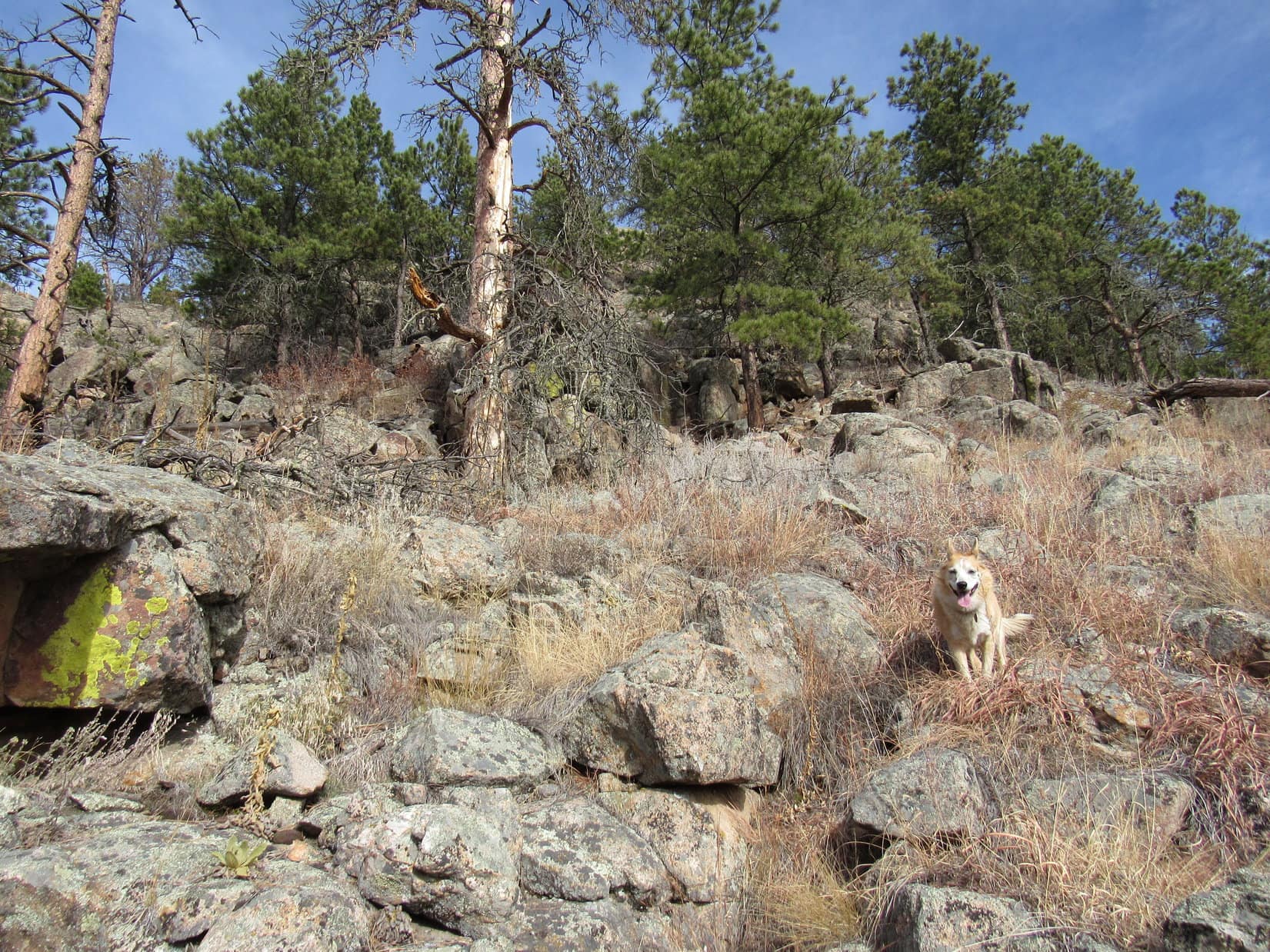
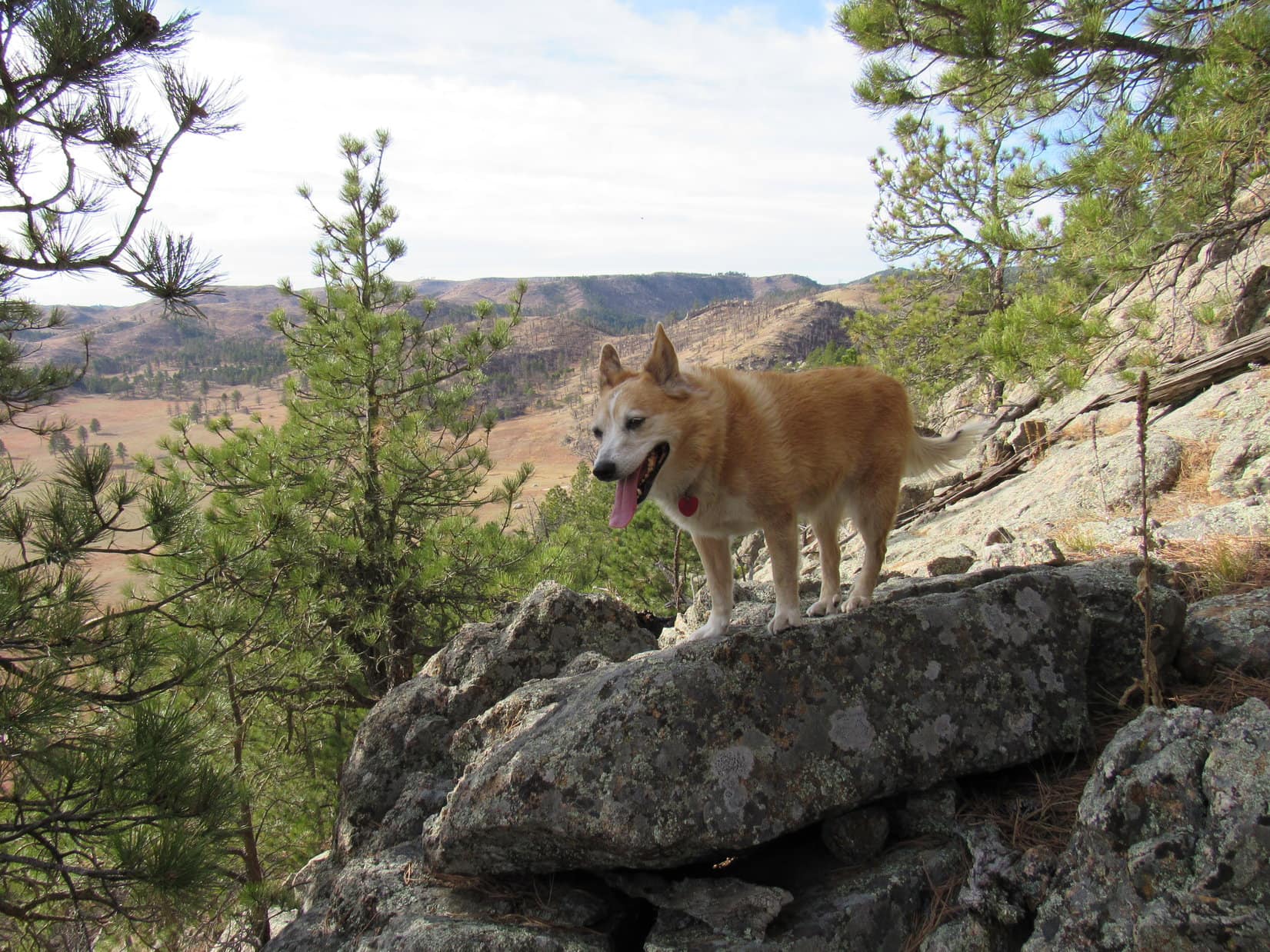
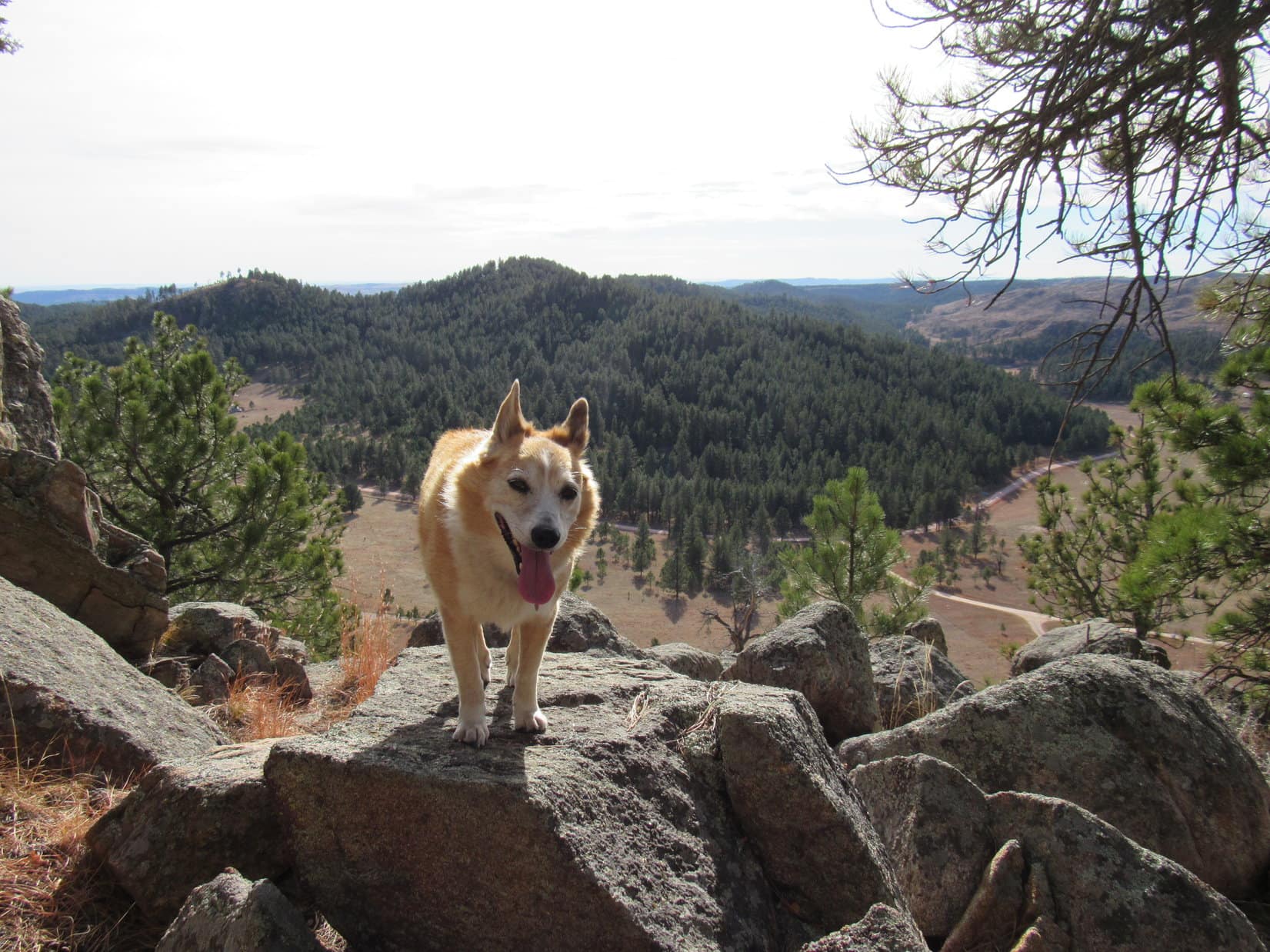
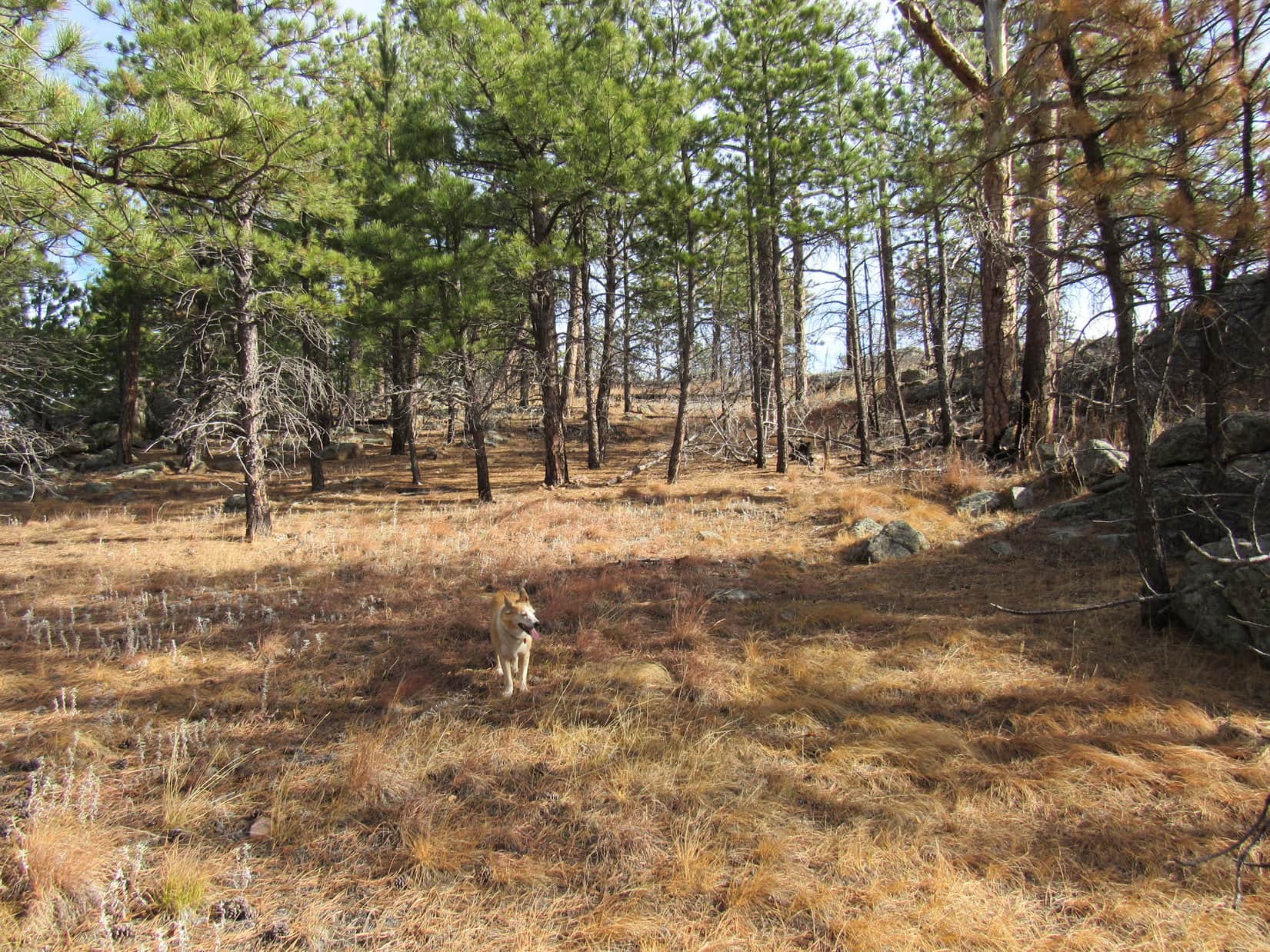
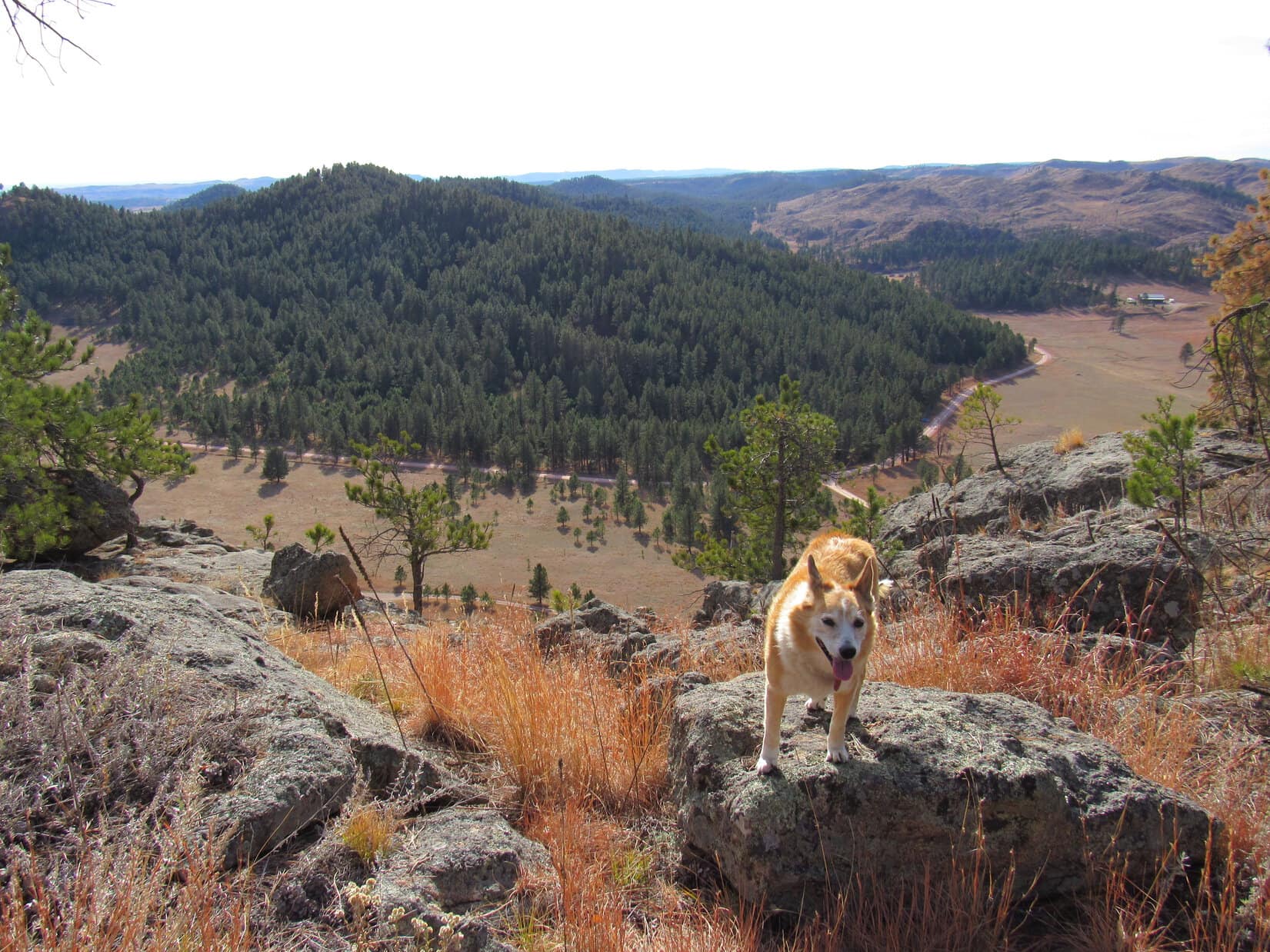
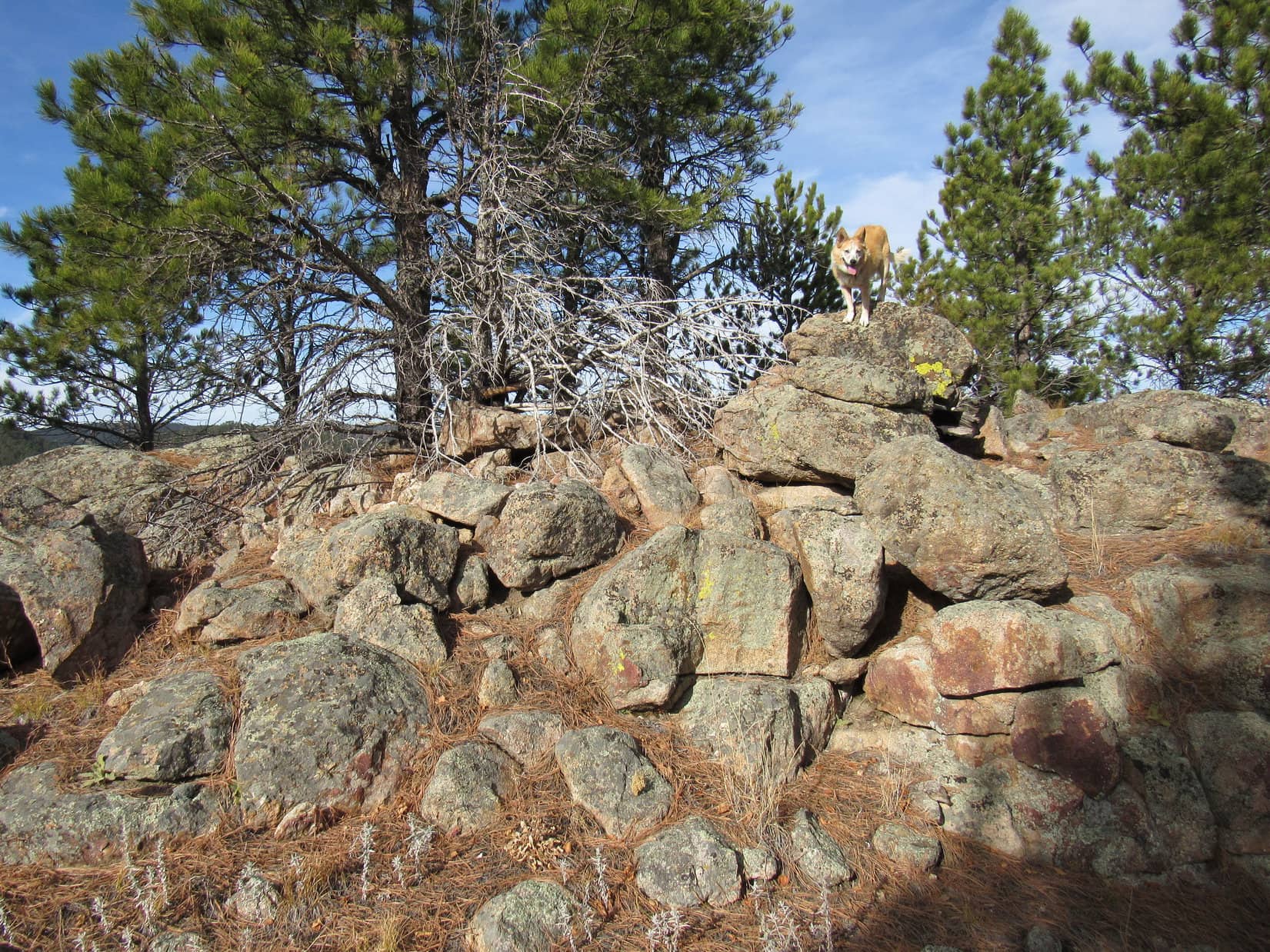
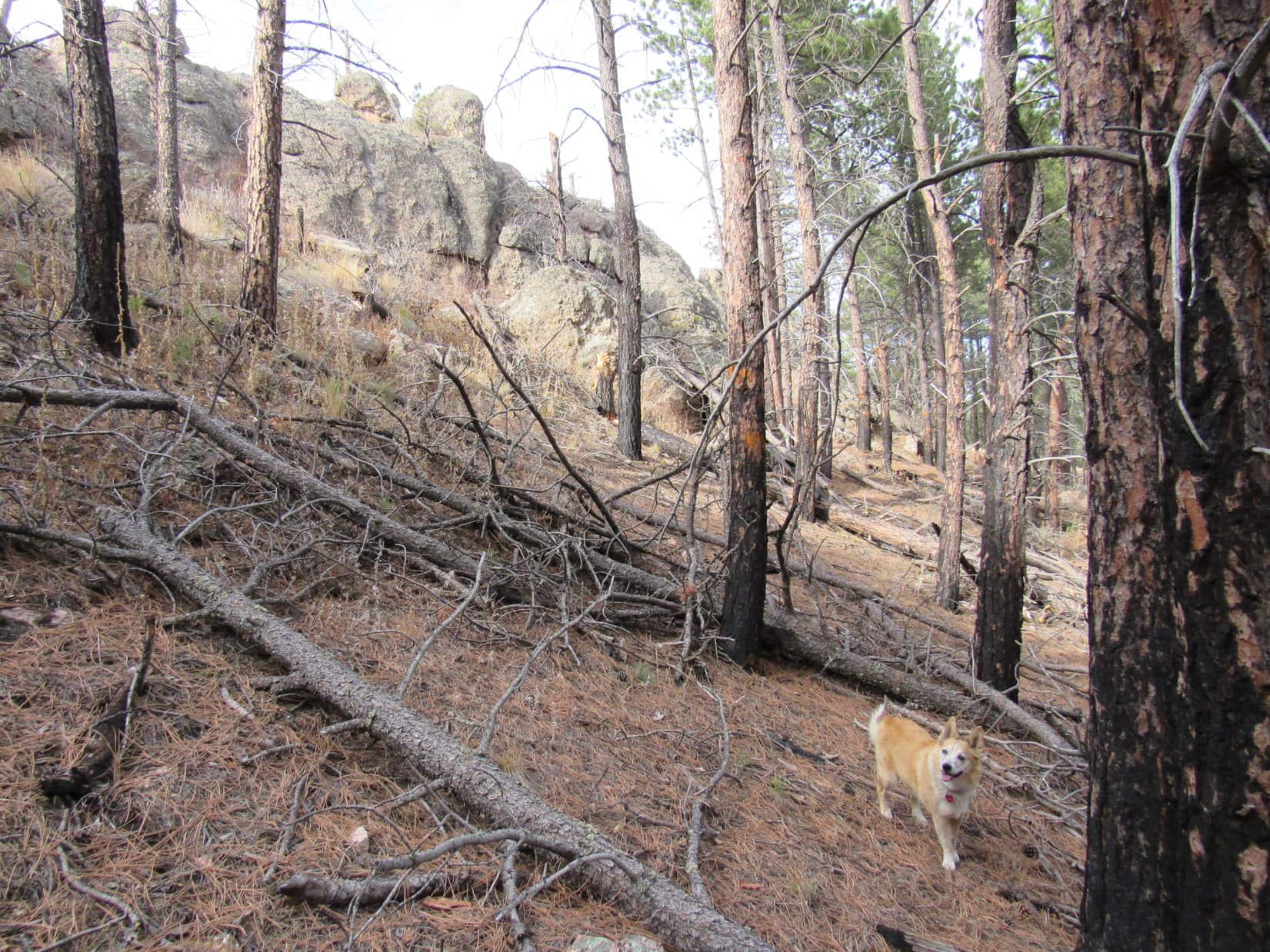
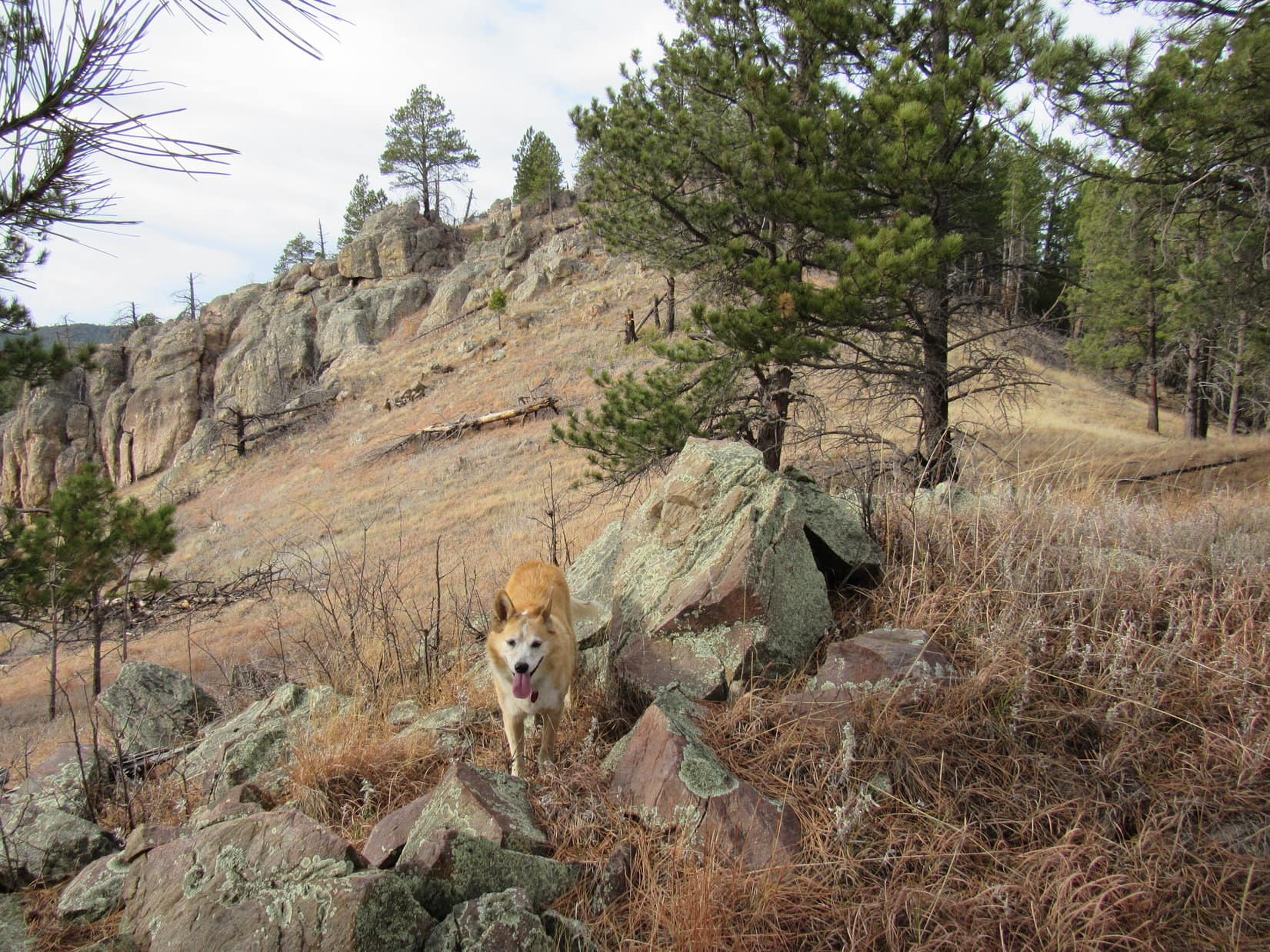
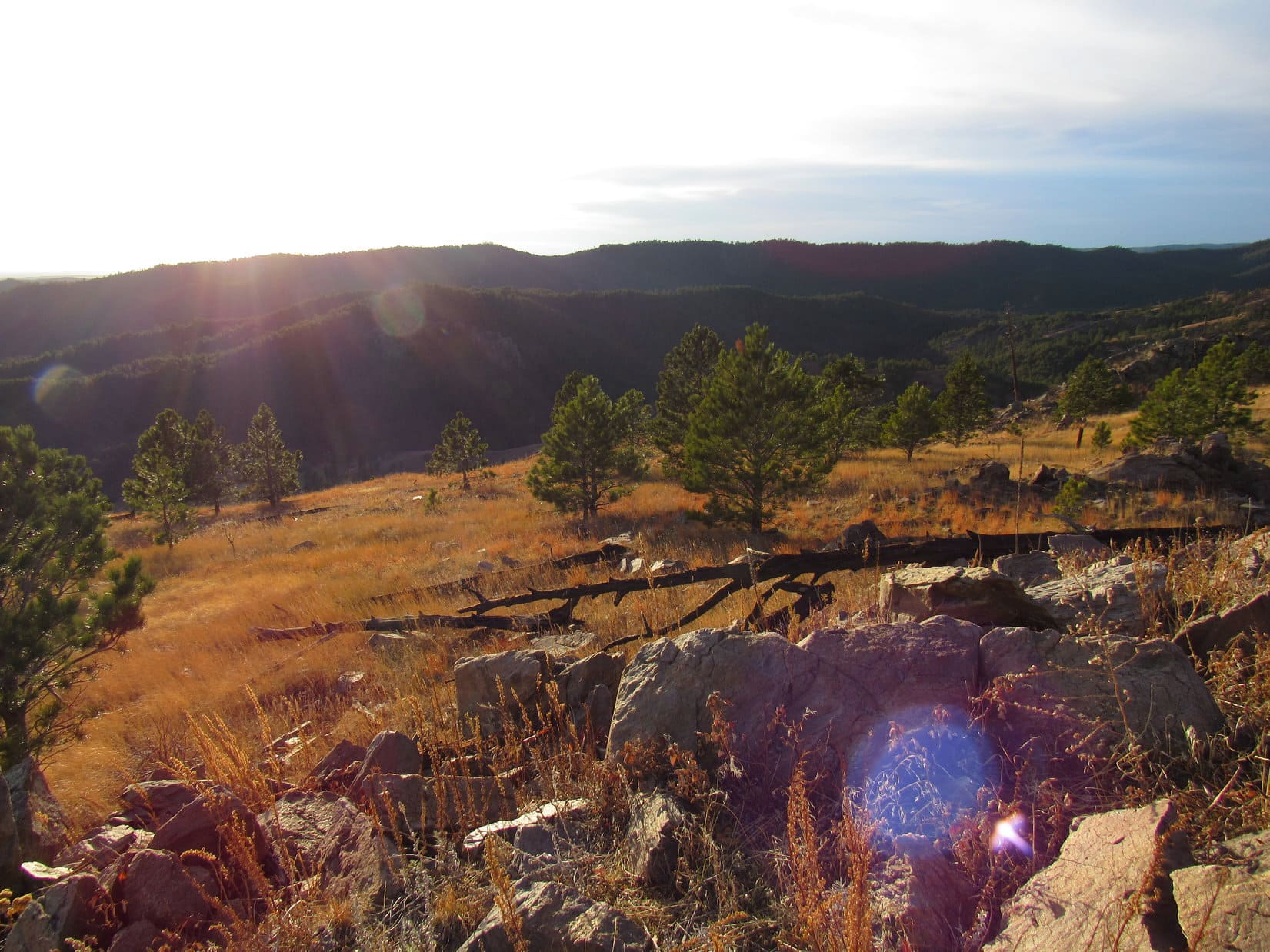
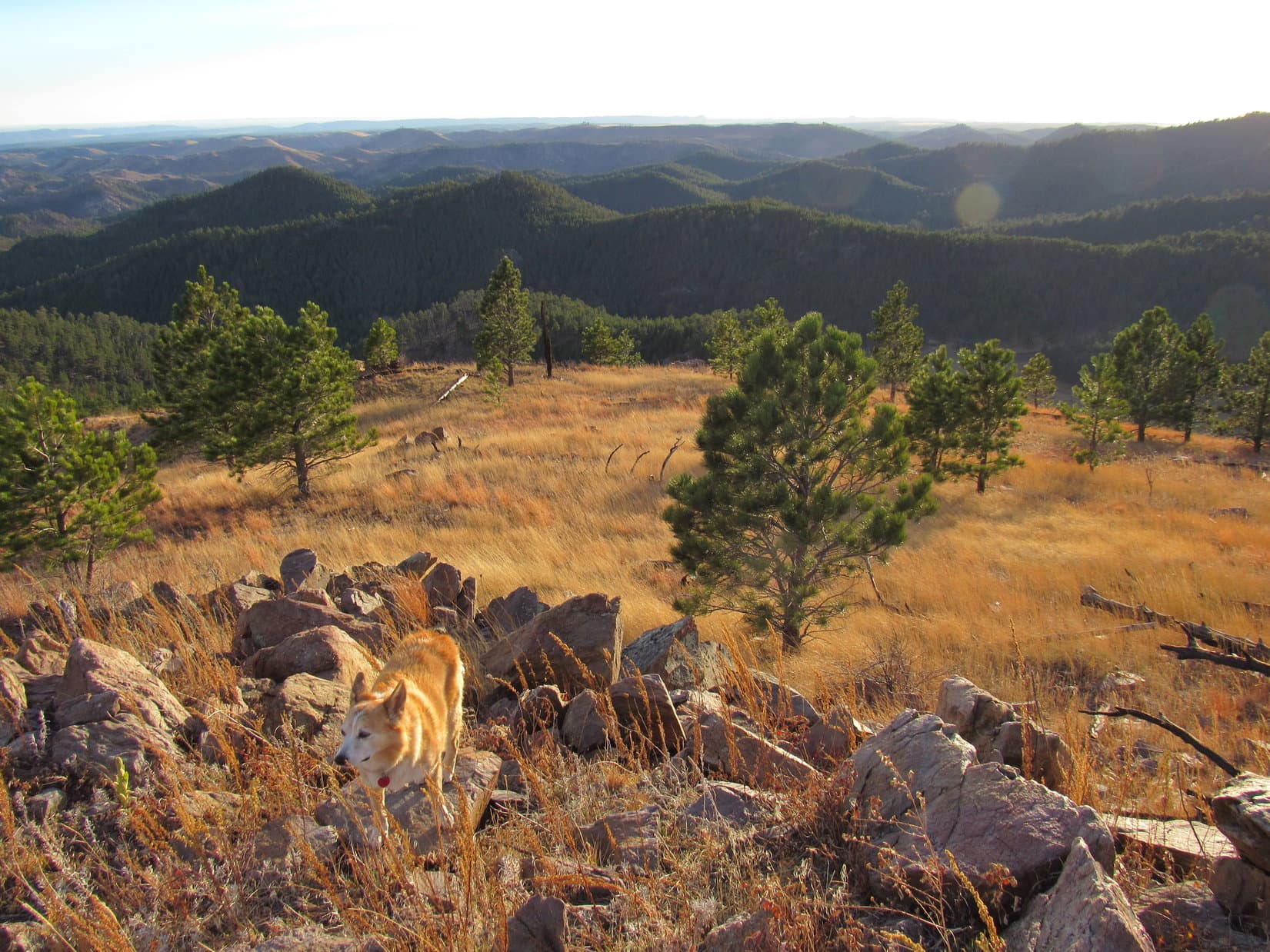
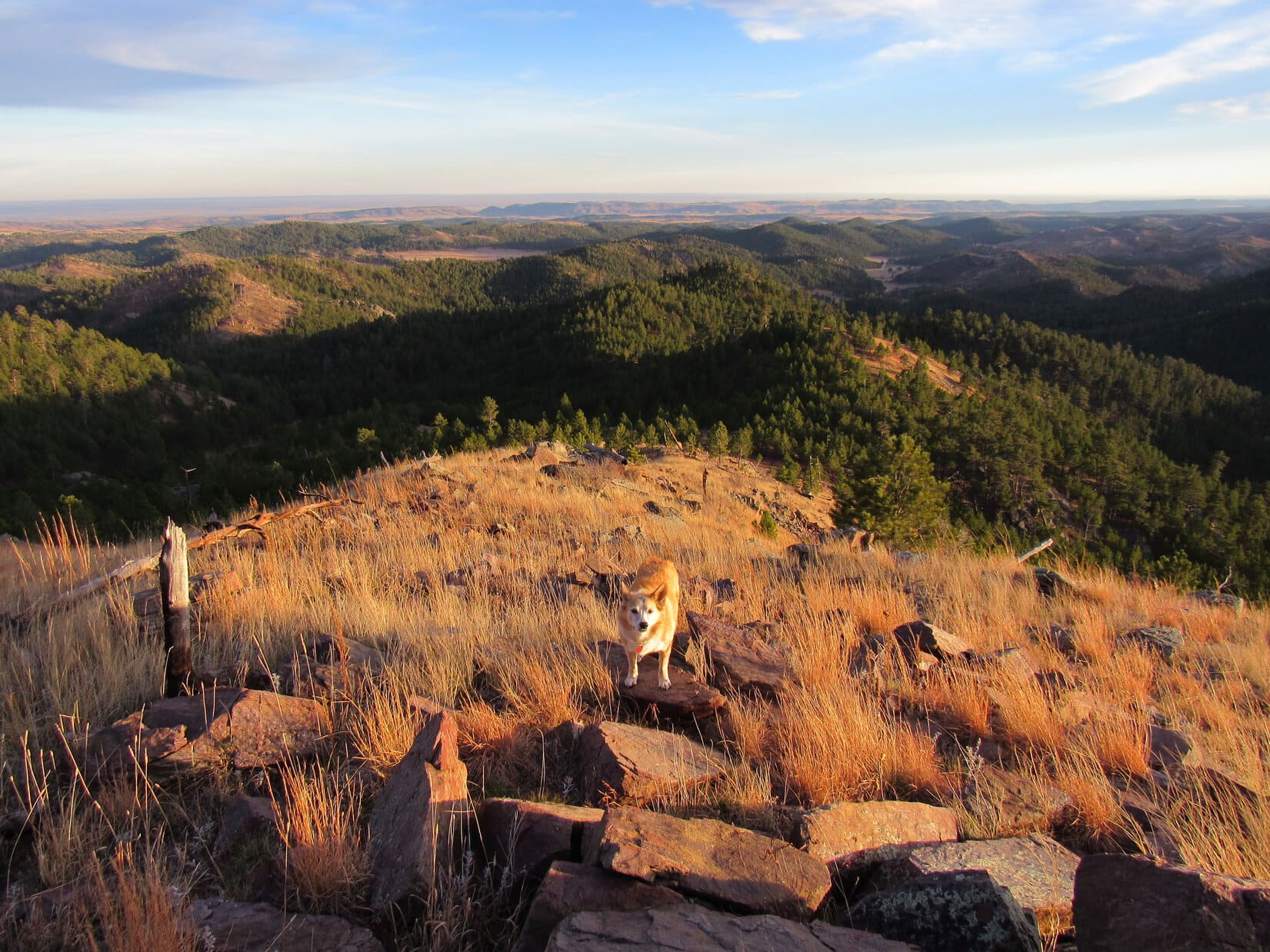
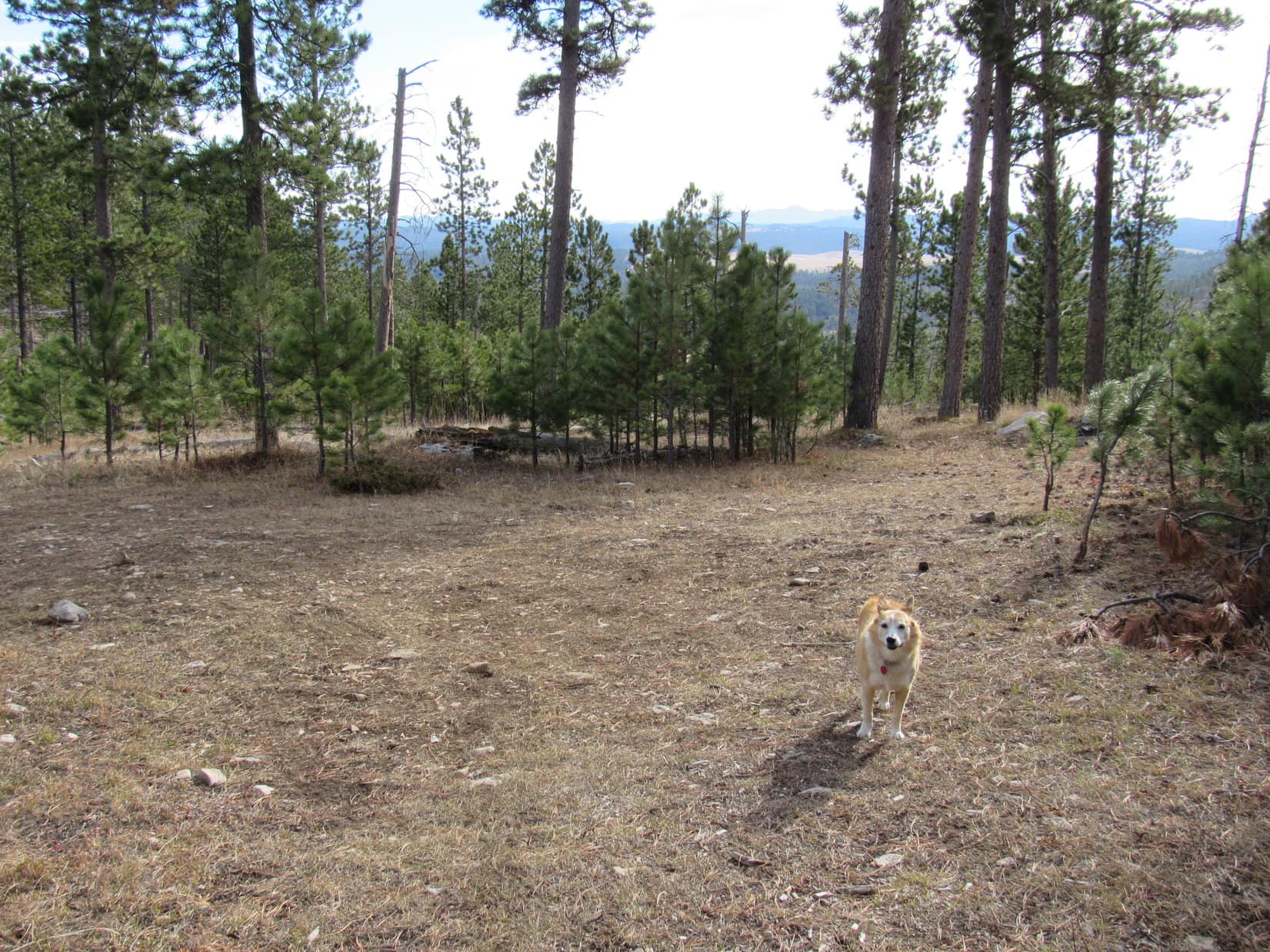
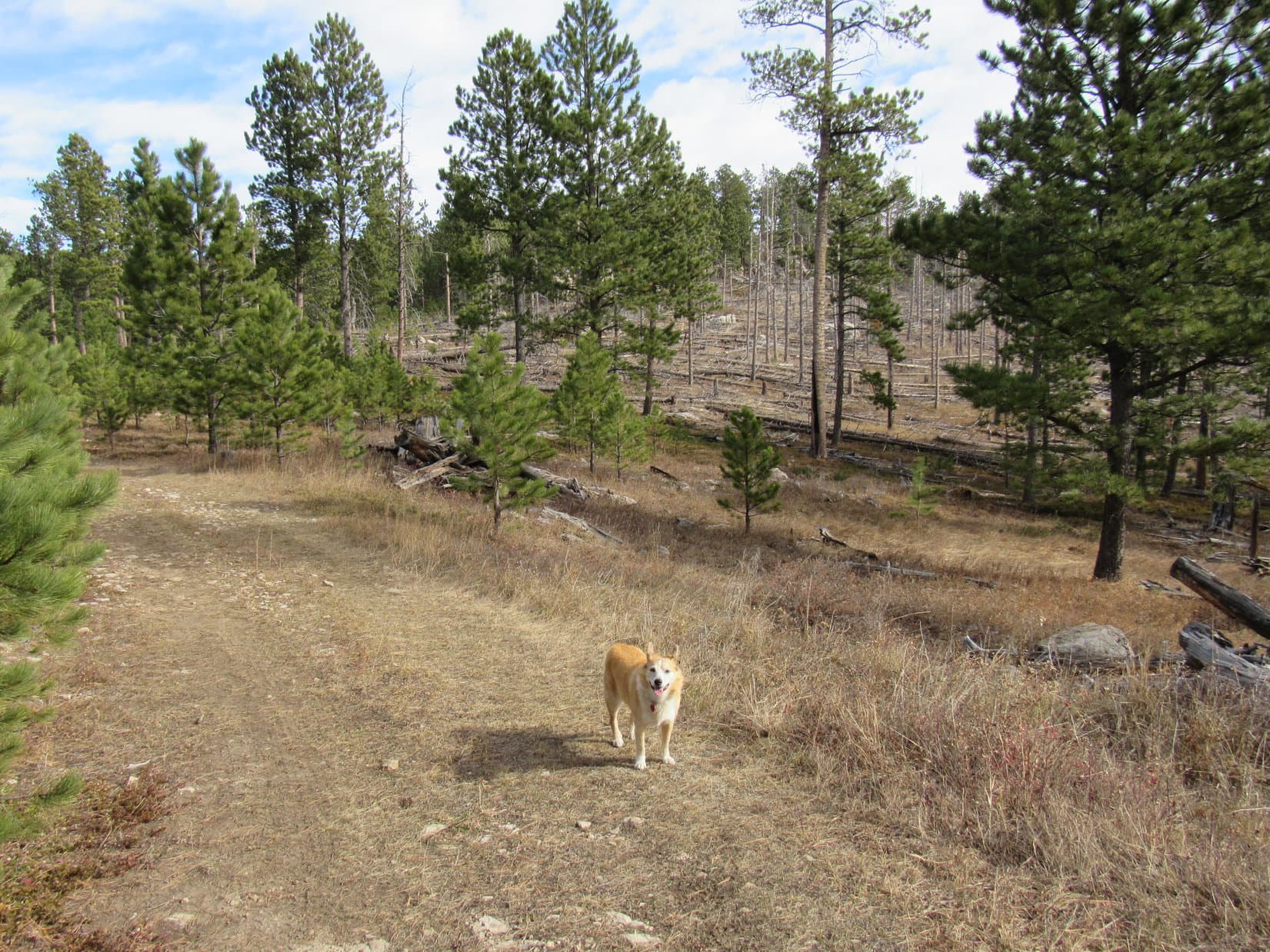
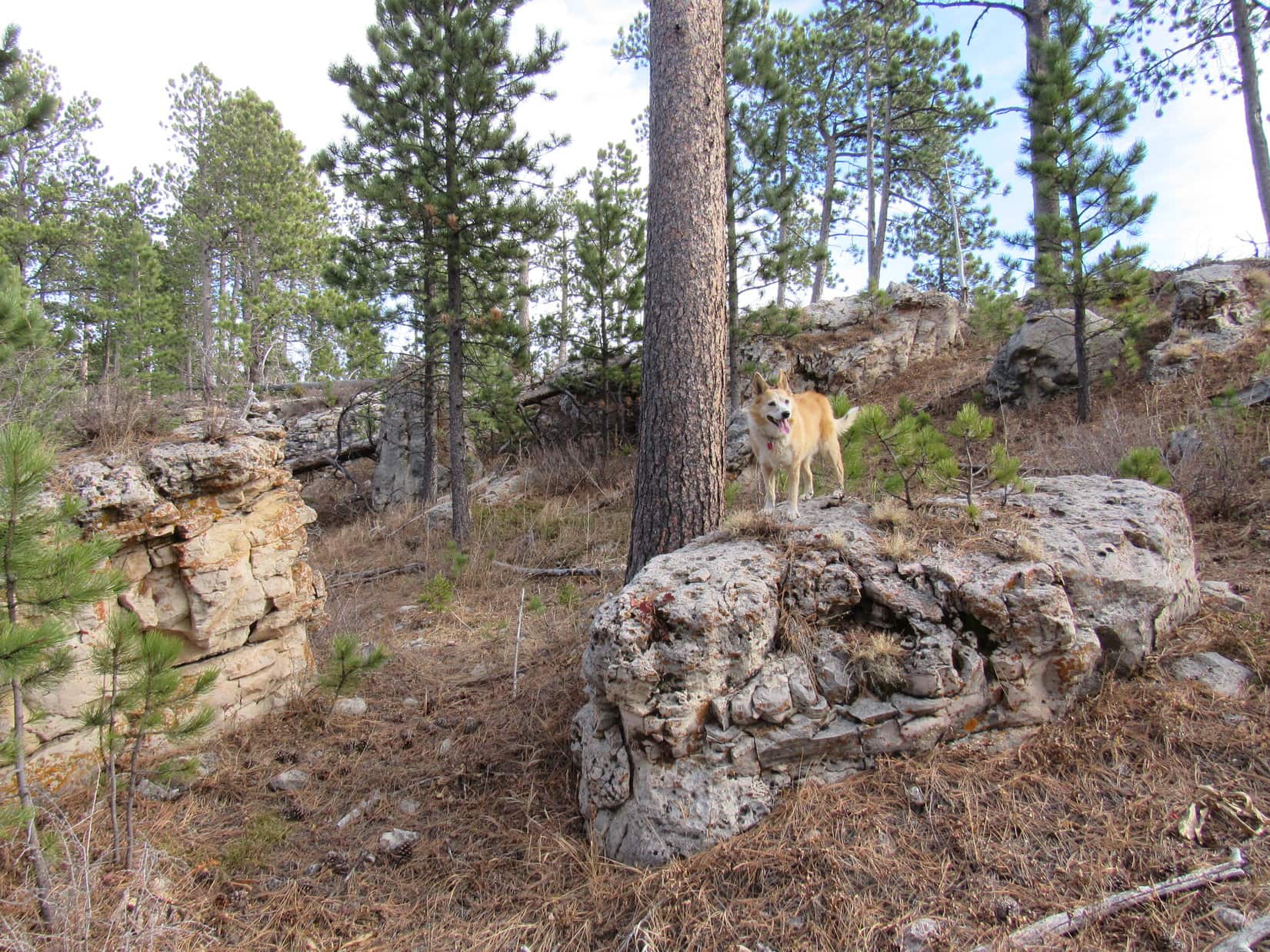
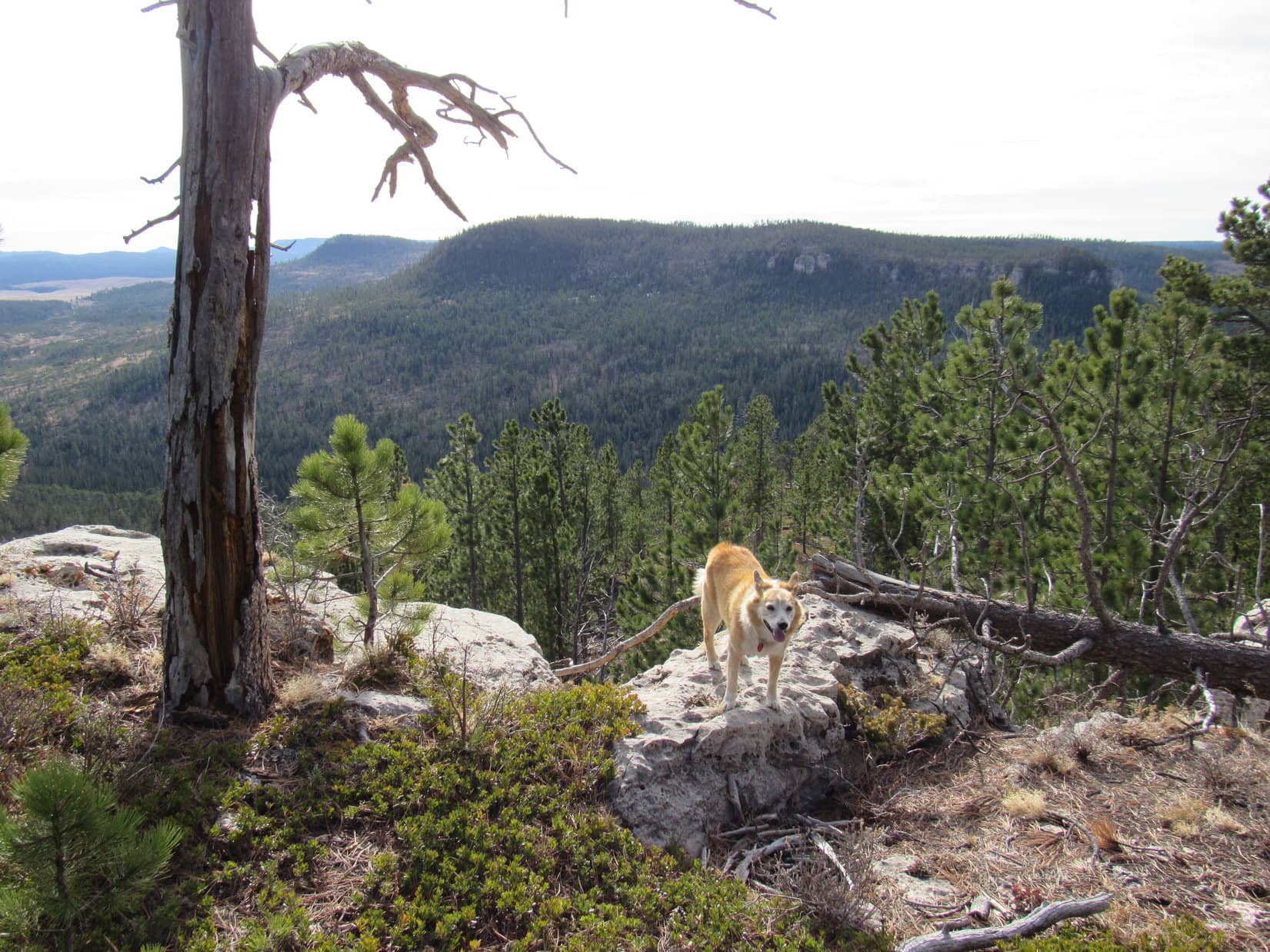
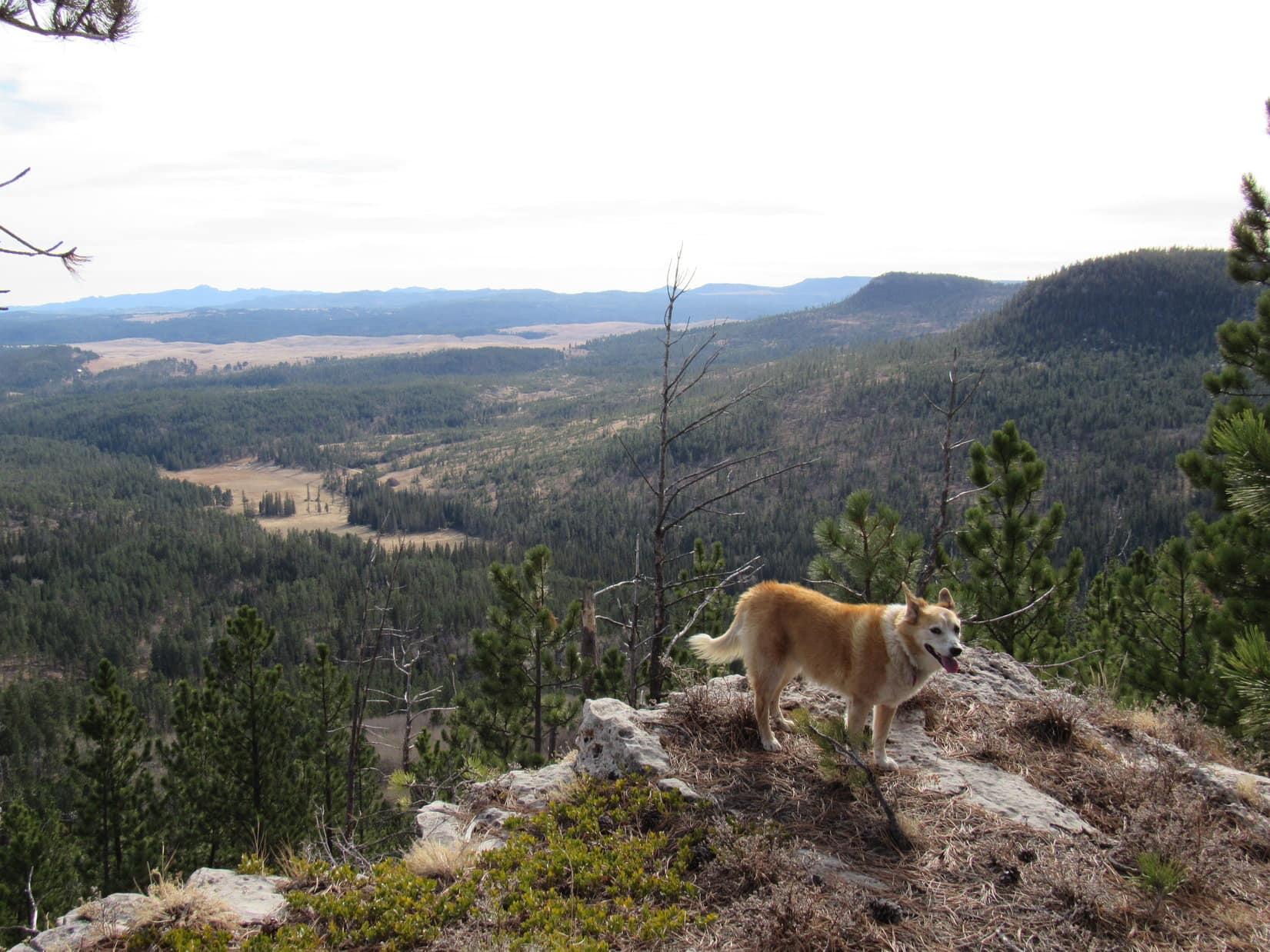
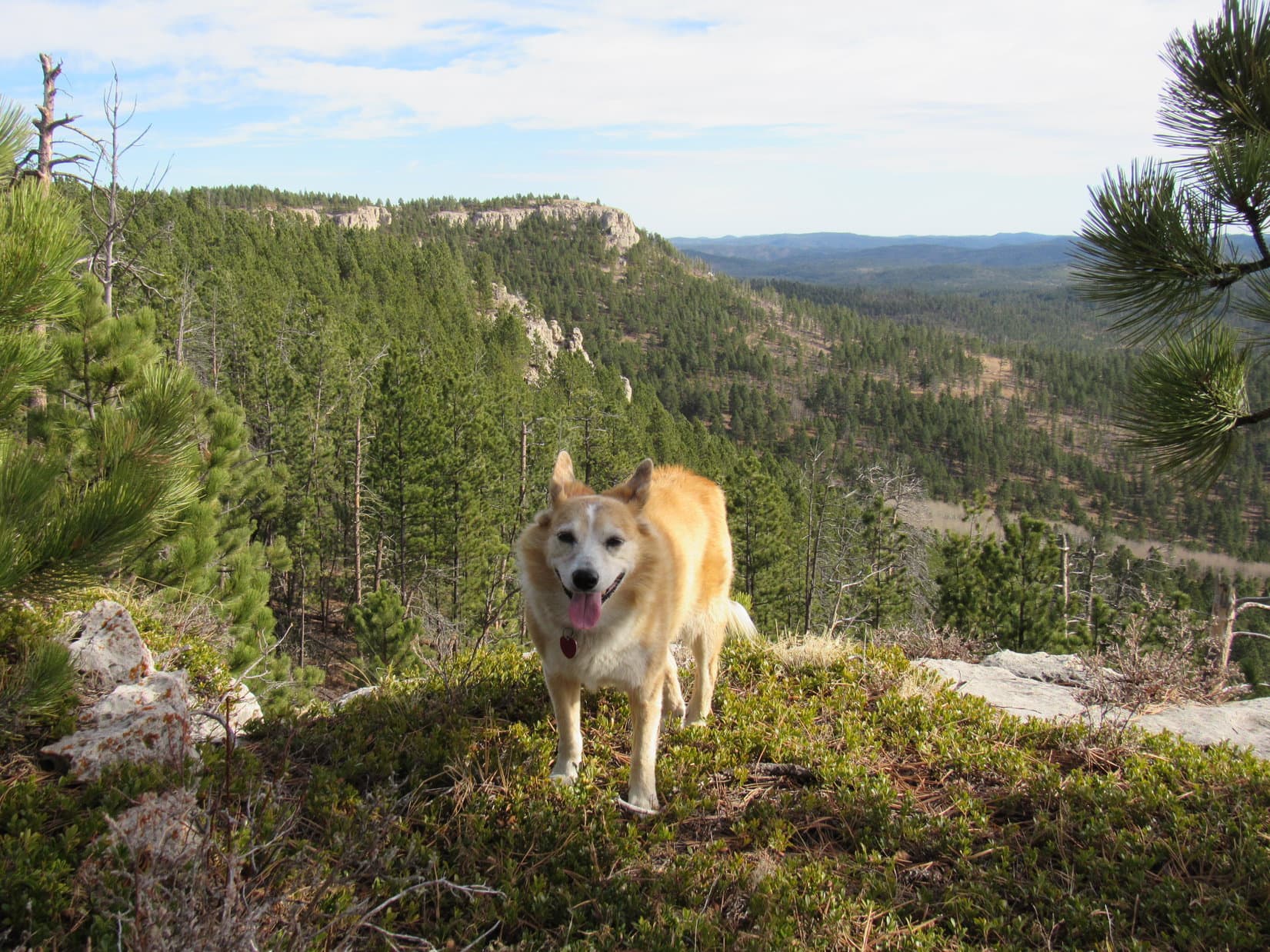
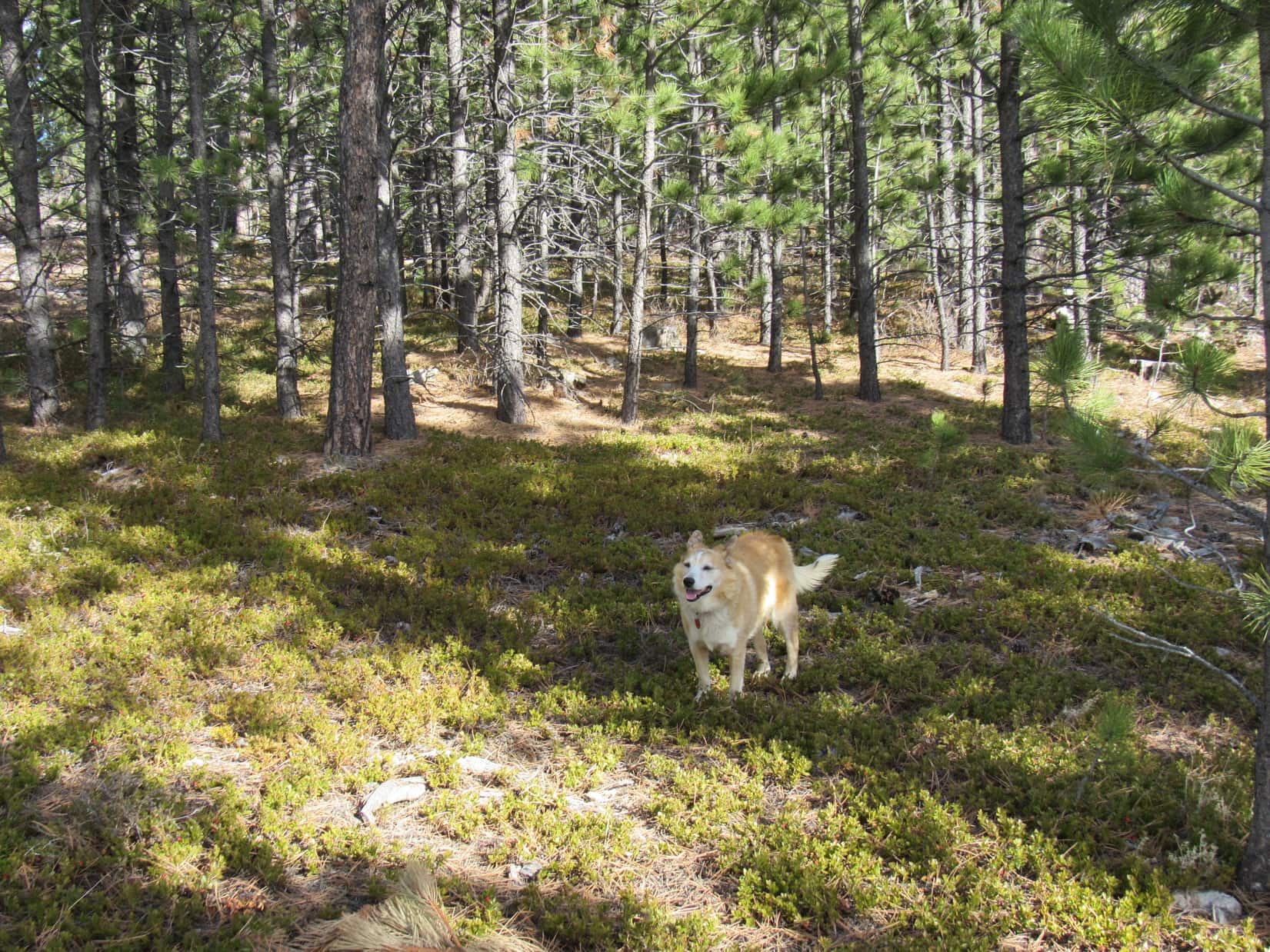
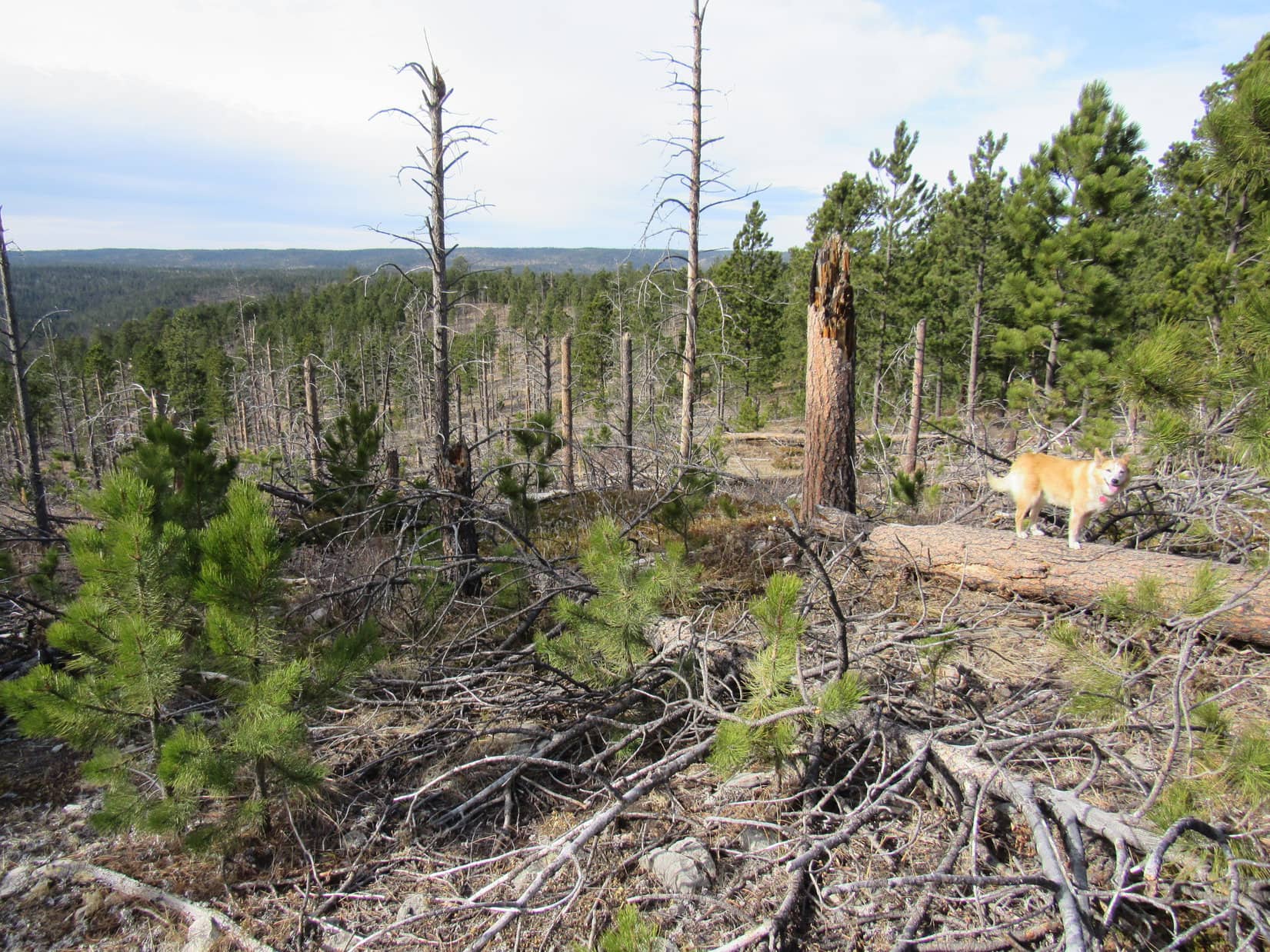
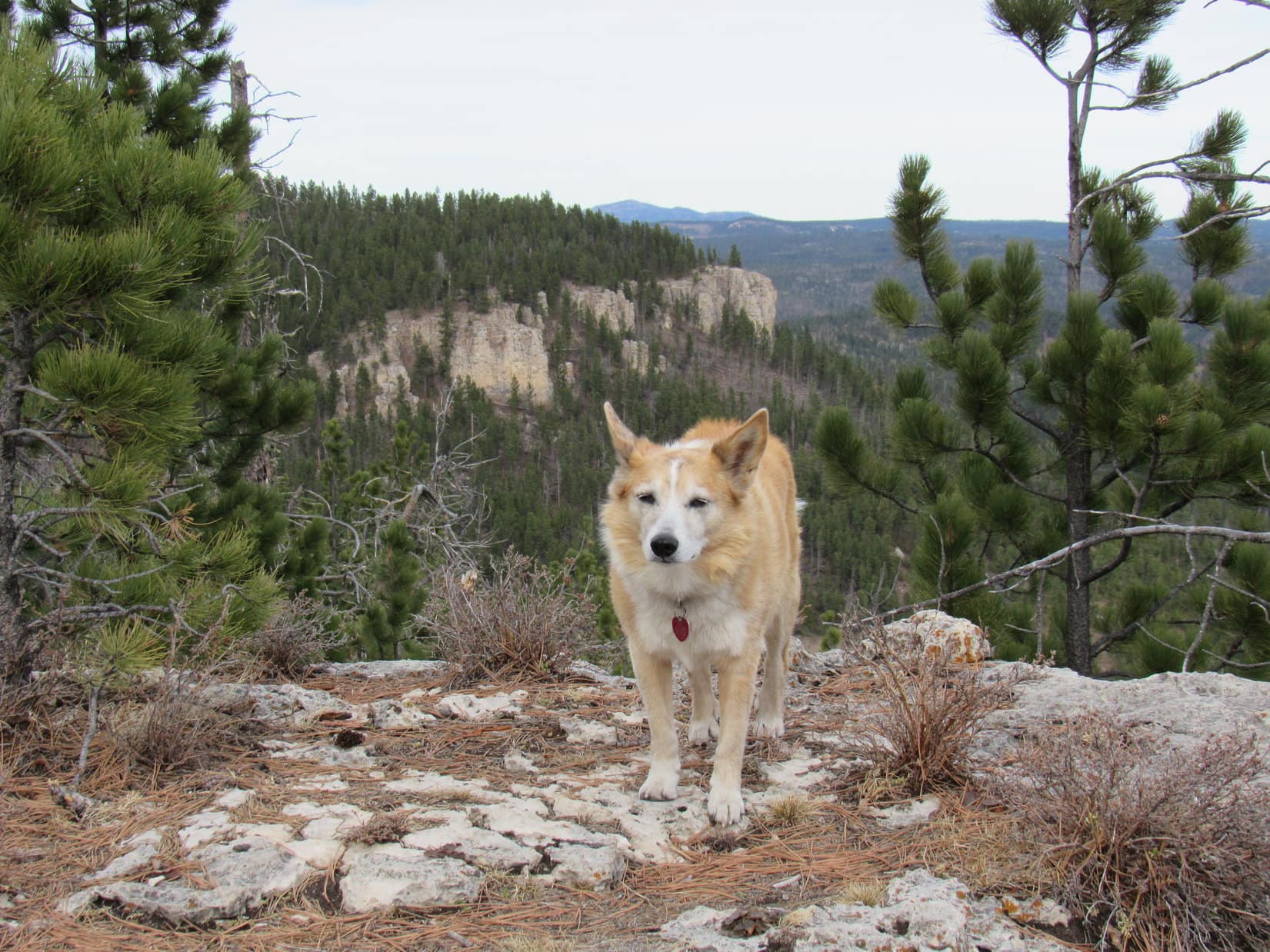
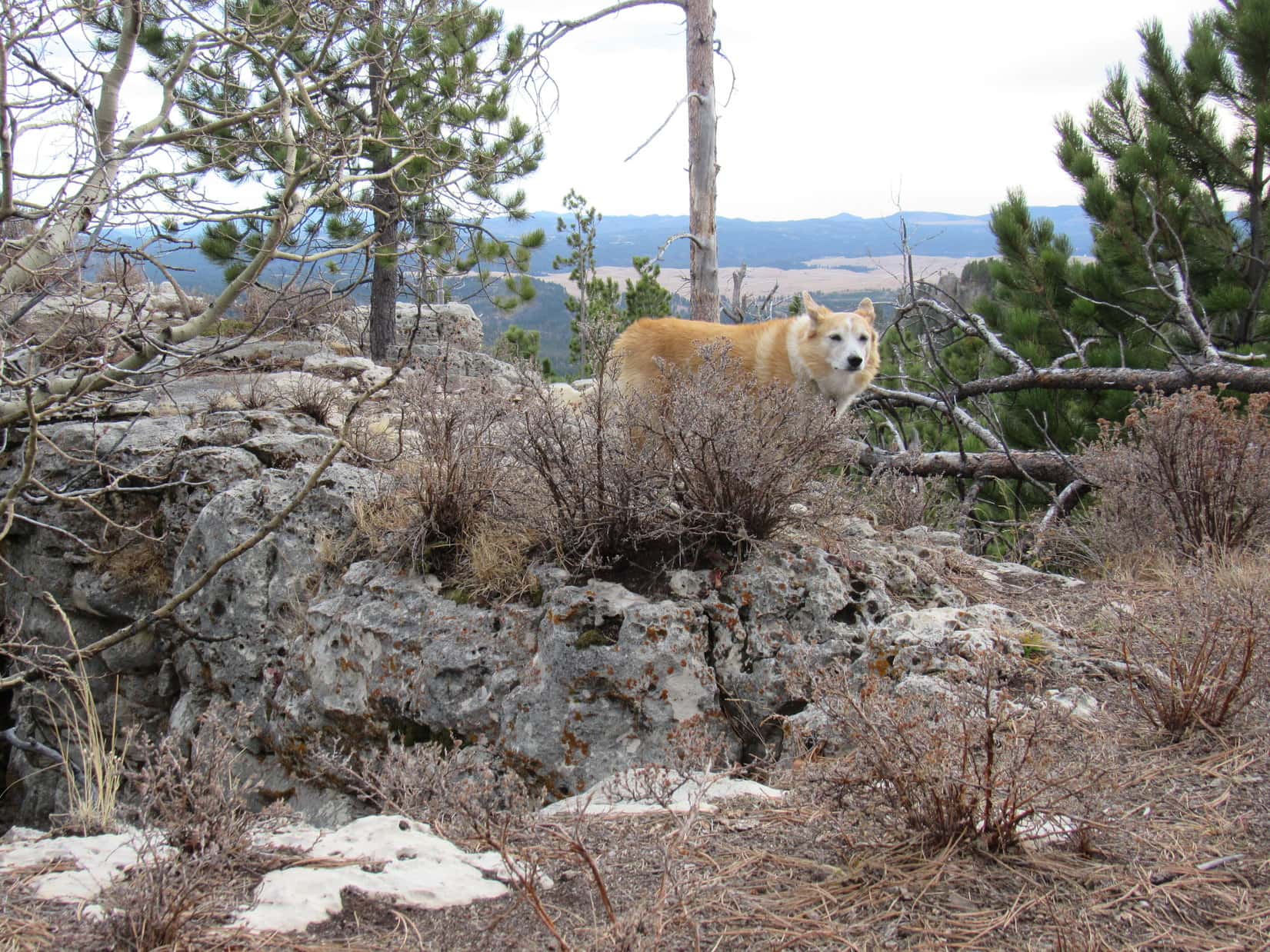
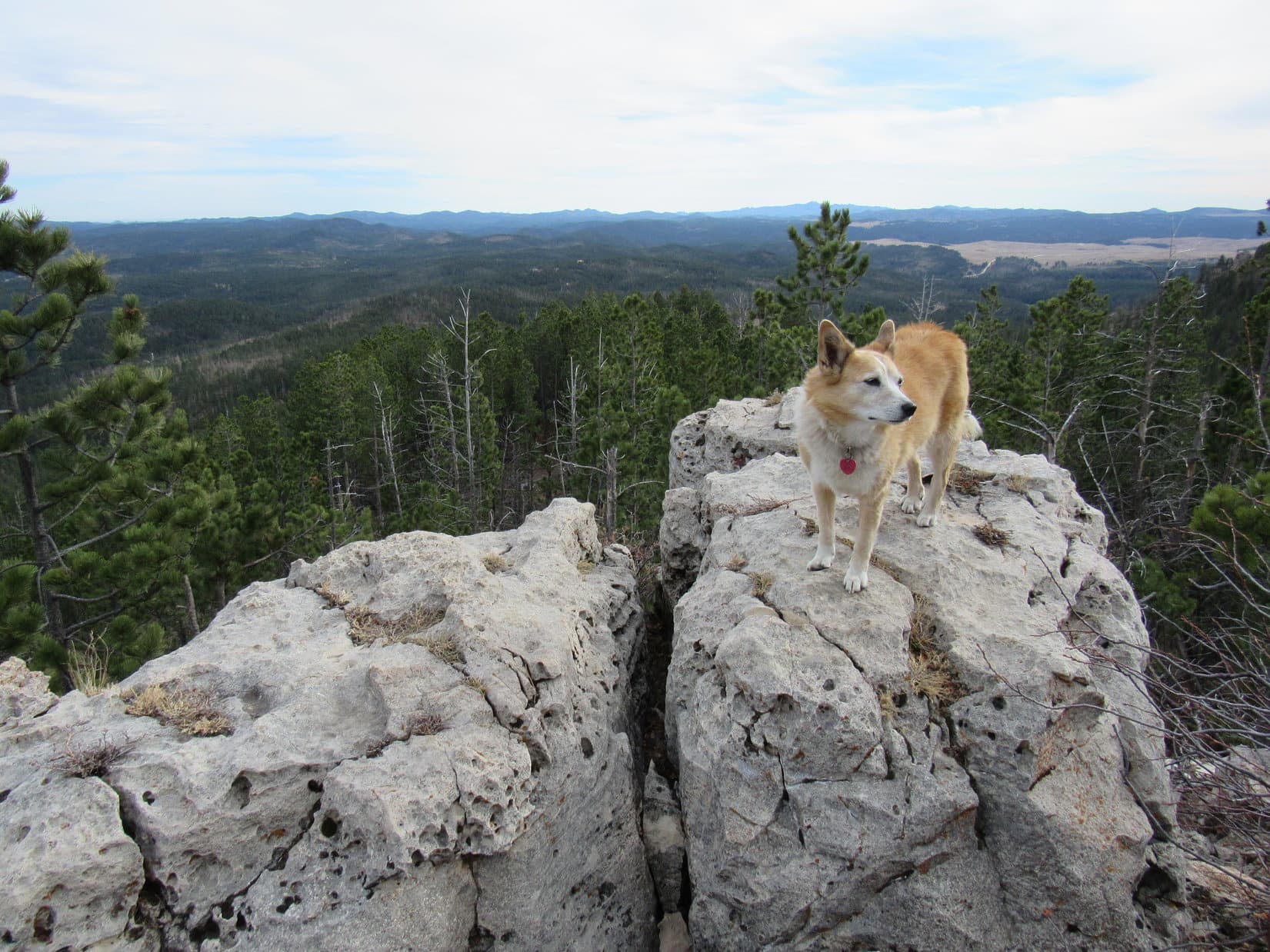
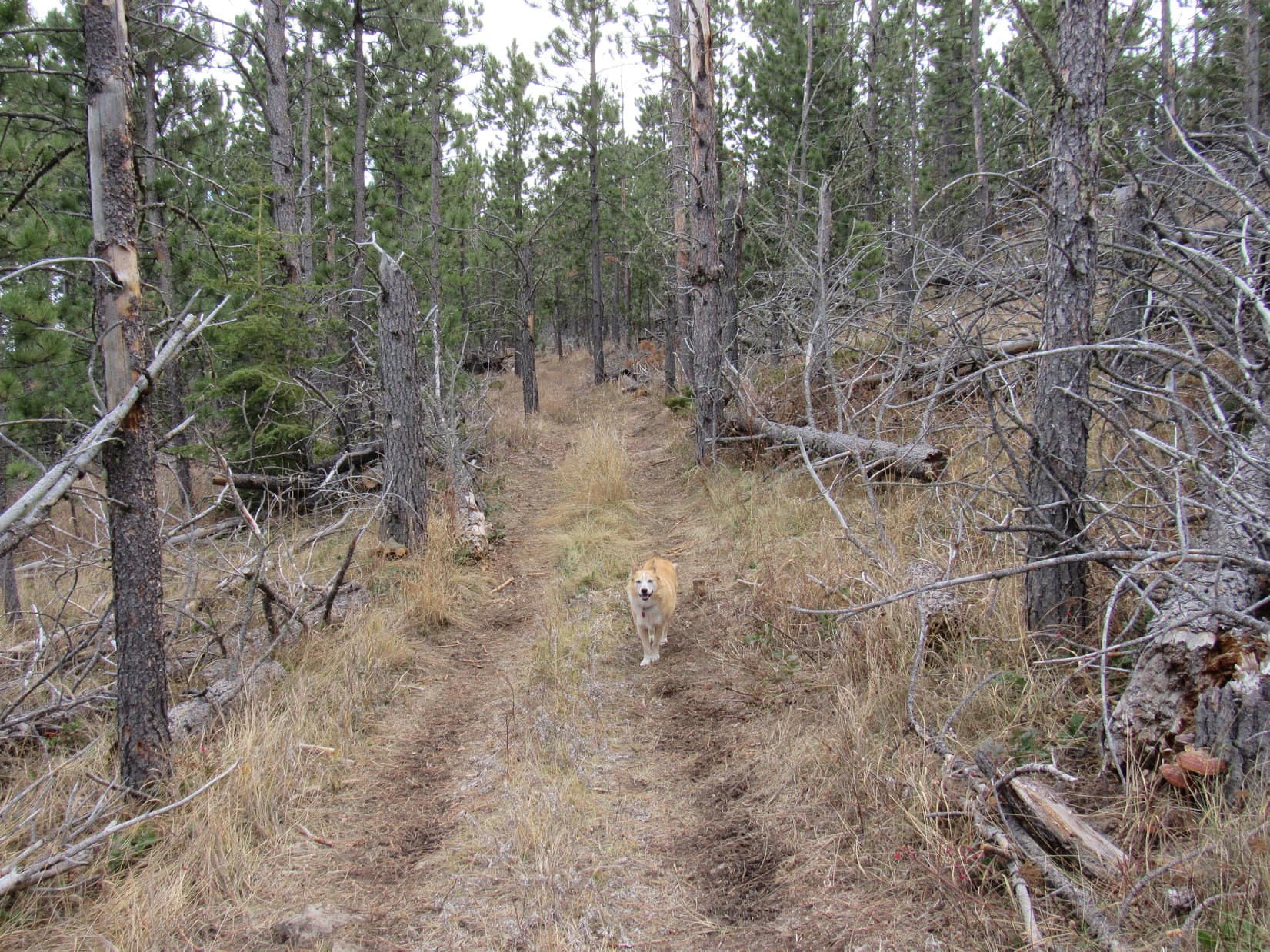
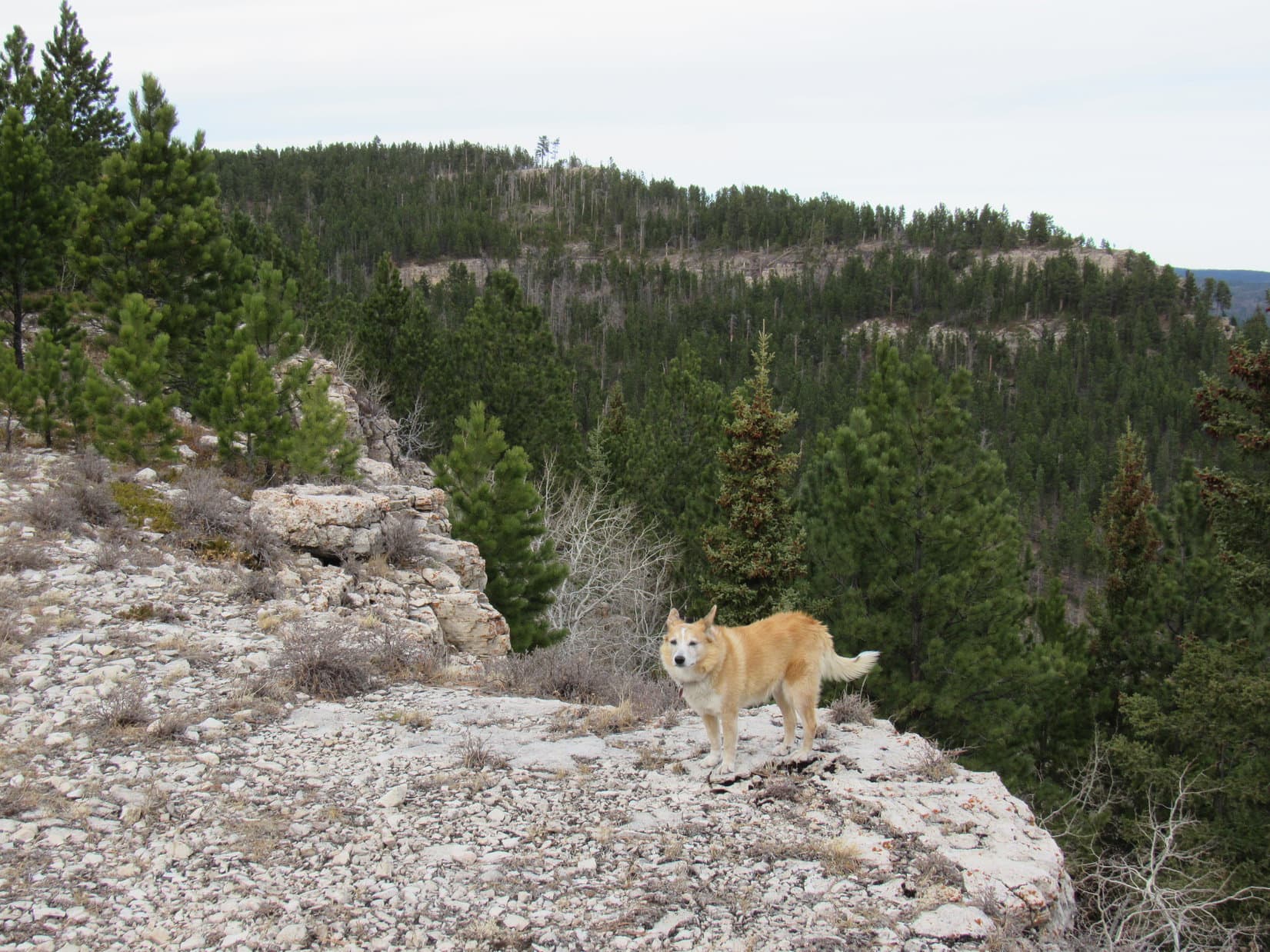
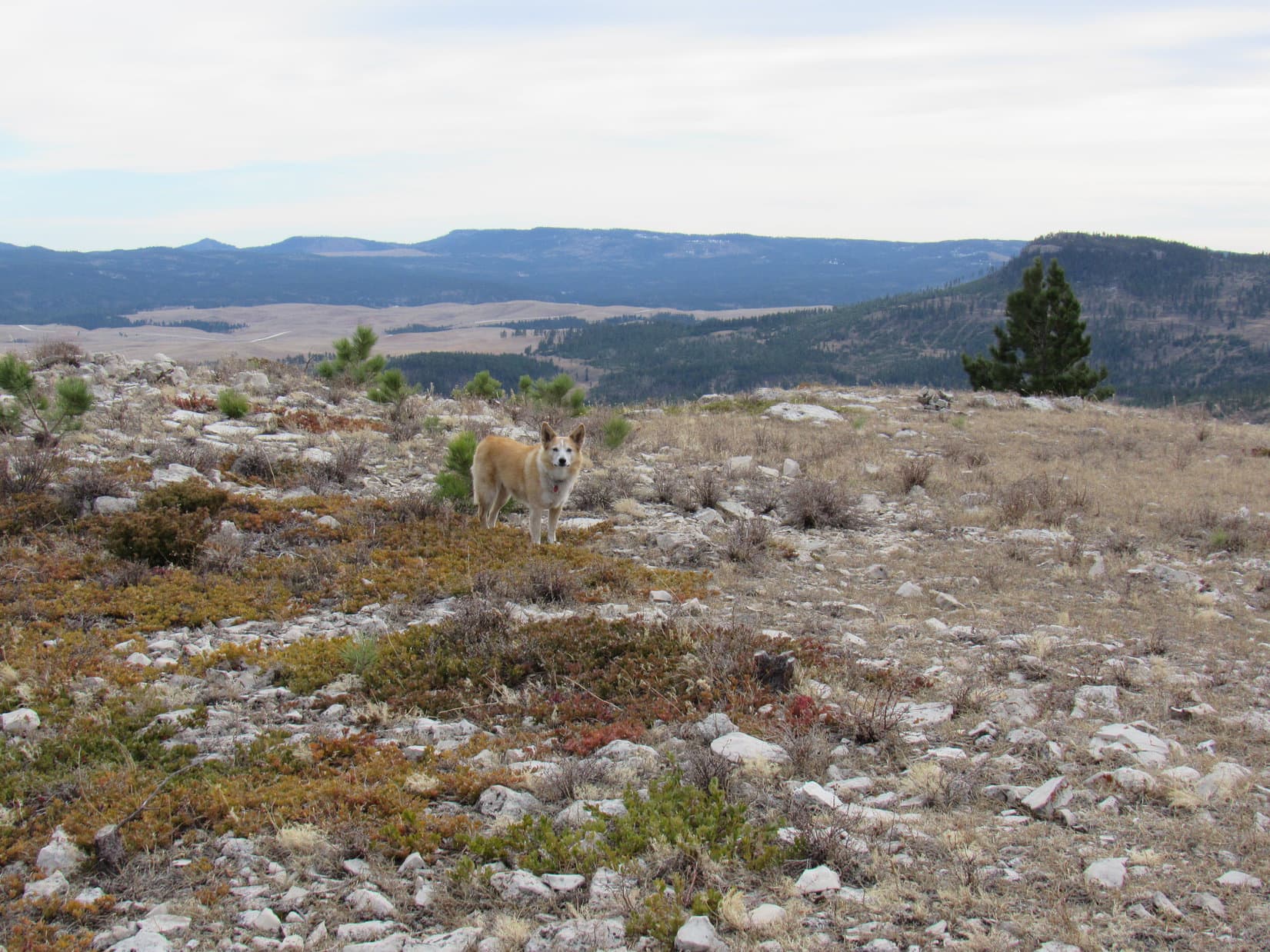
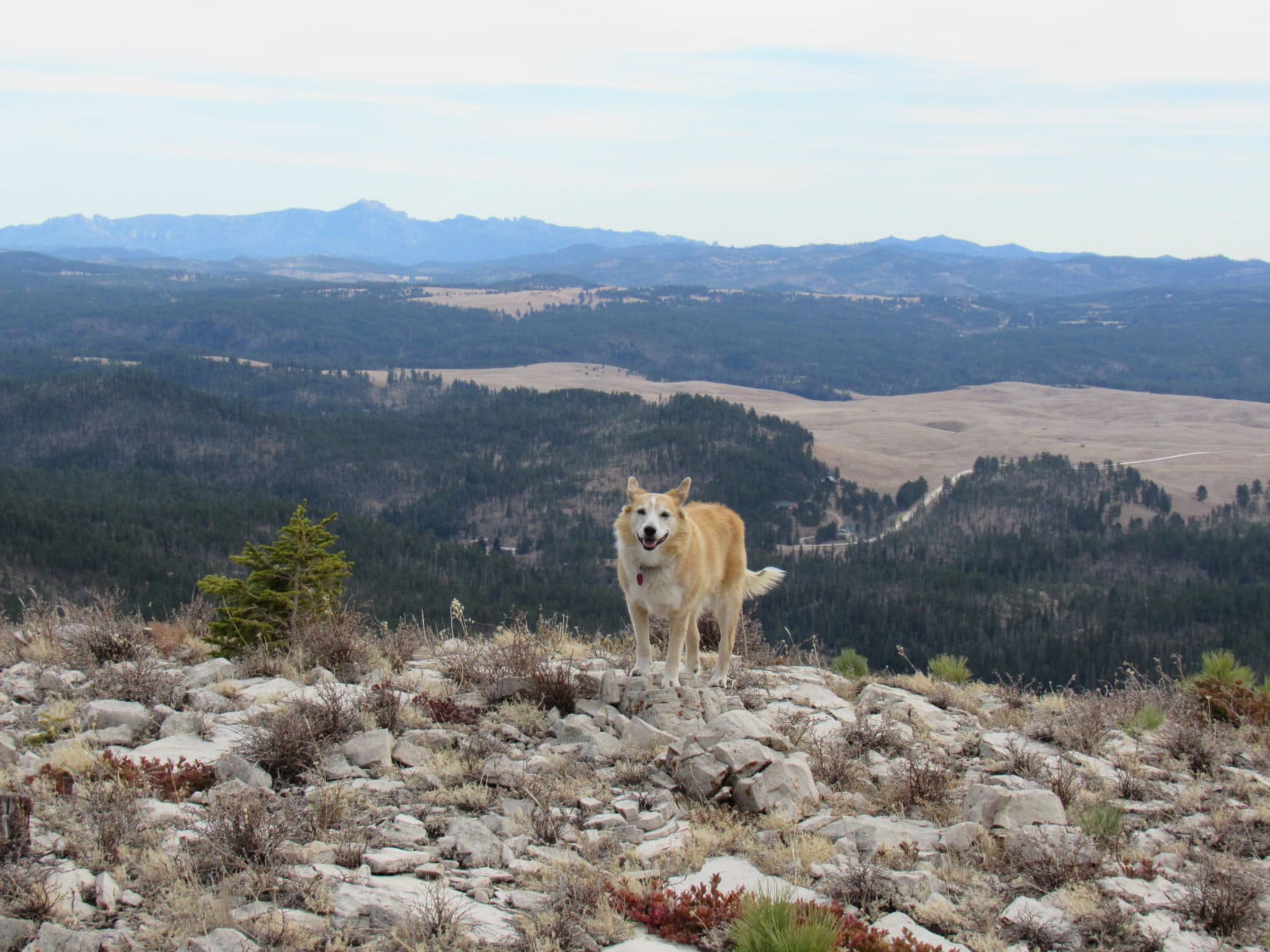
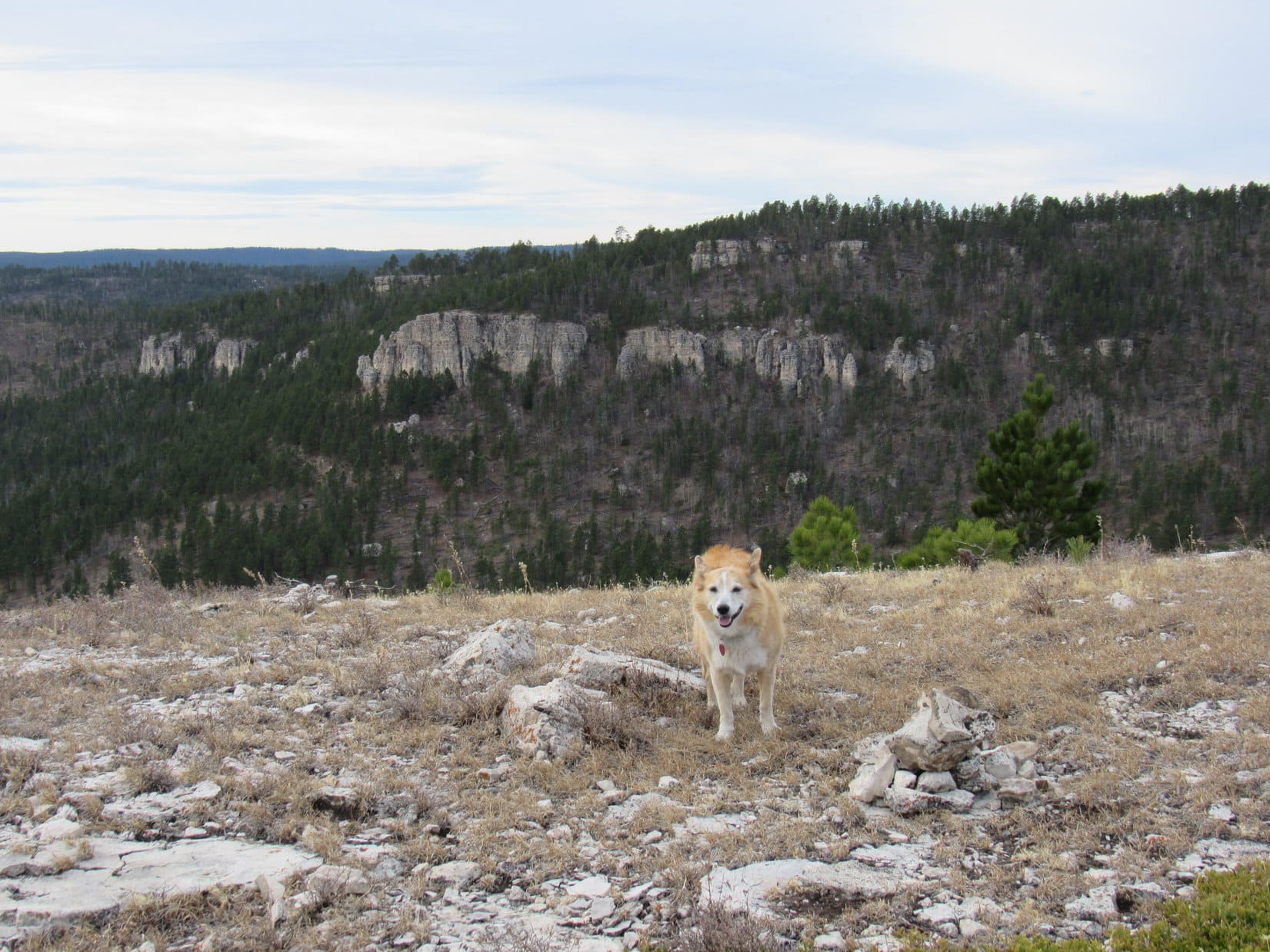
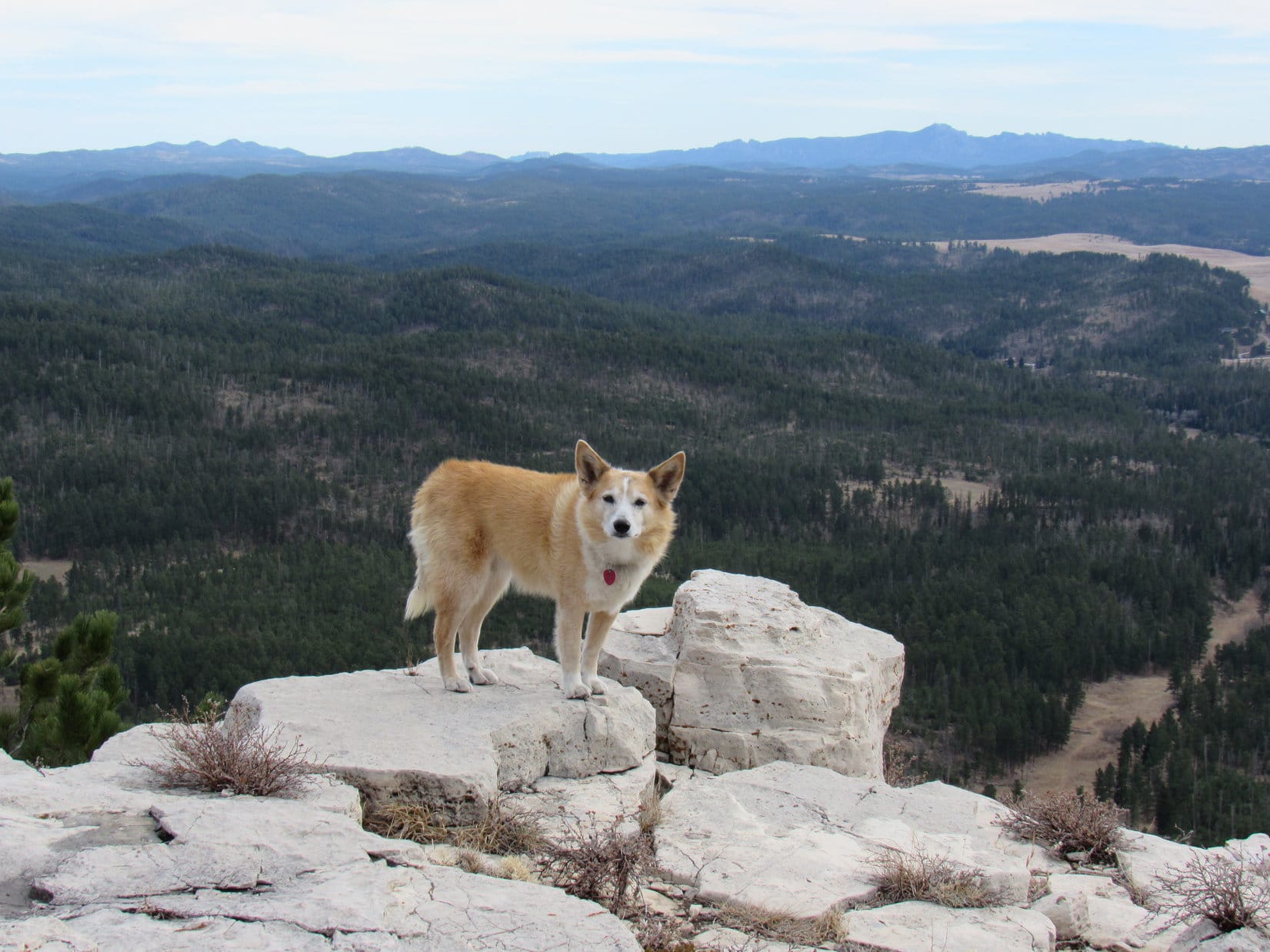
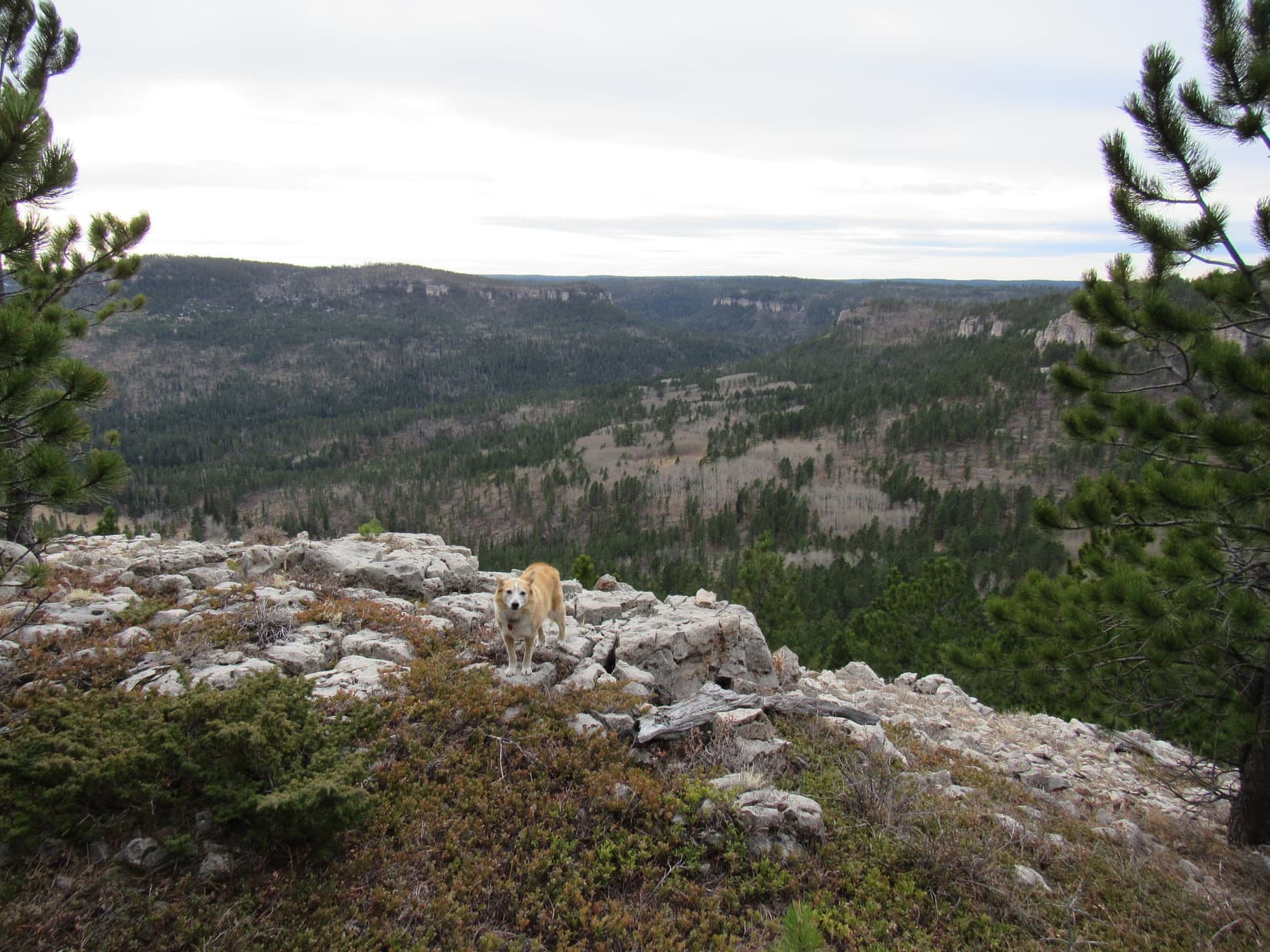
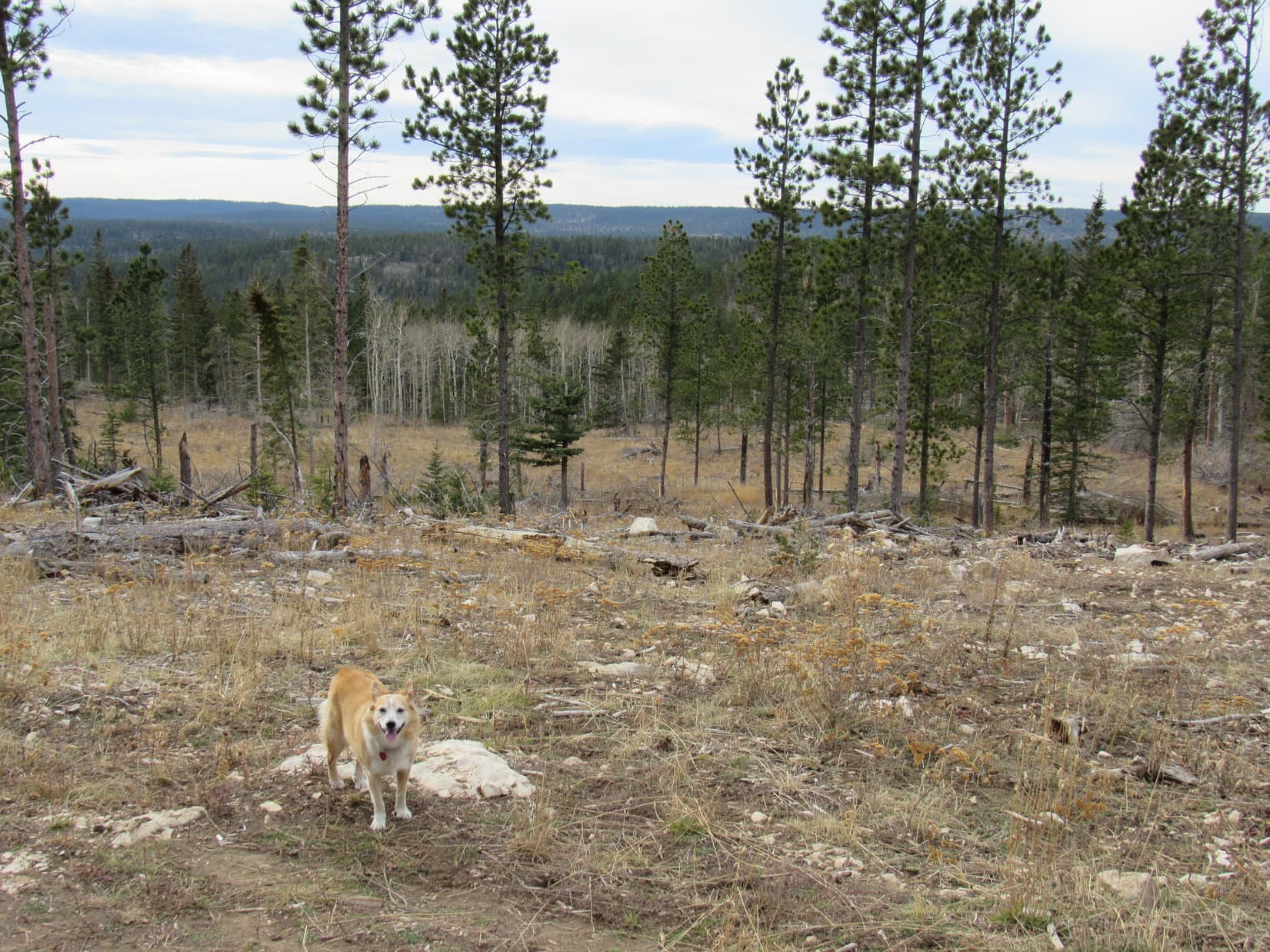
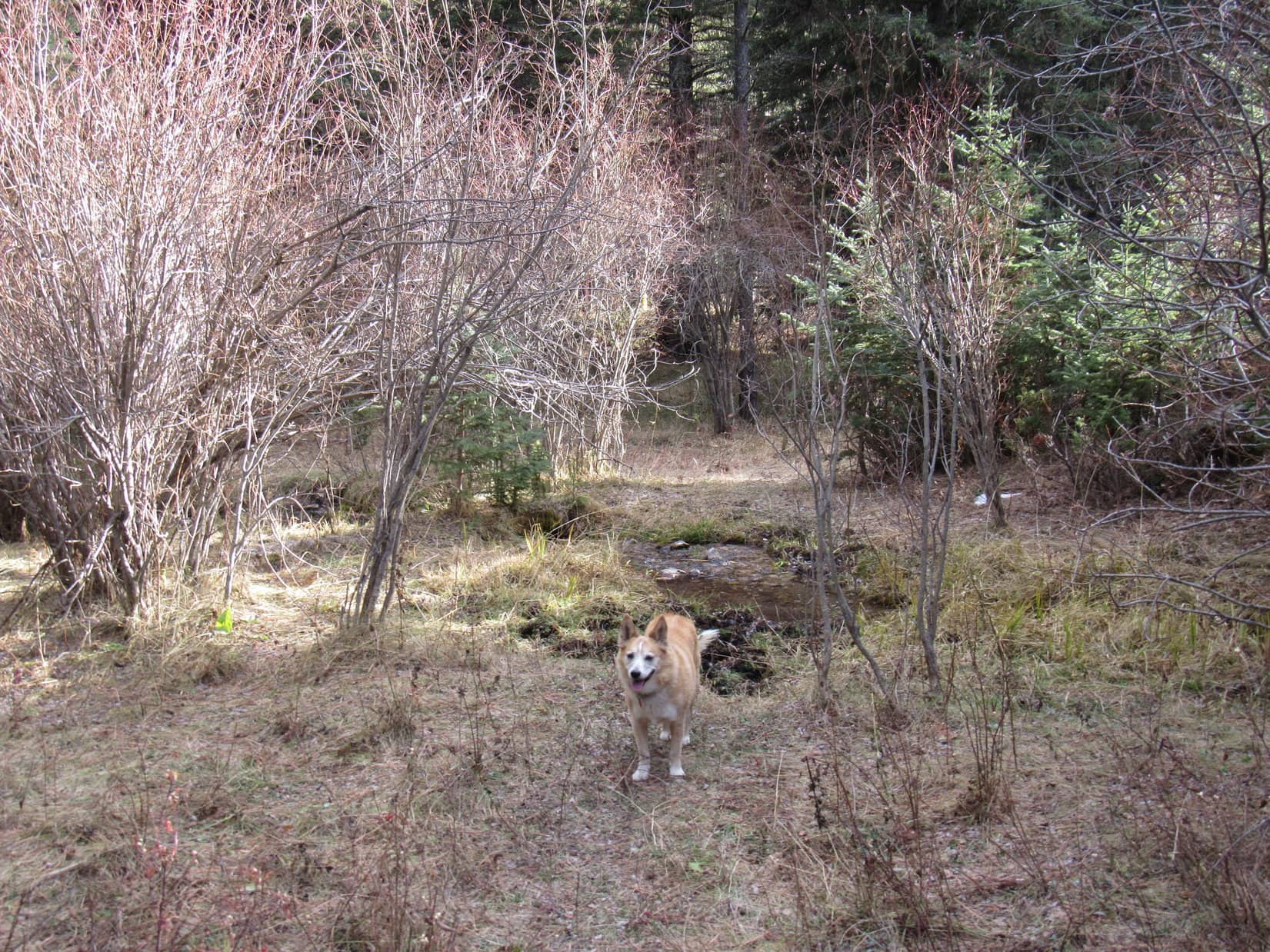
Black Hills, SD Expedition No. 284 – Peak 4980 & Peak 5604 (11-15-21)

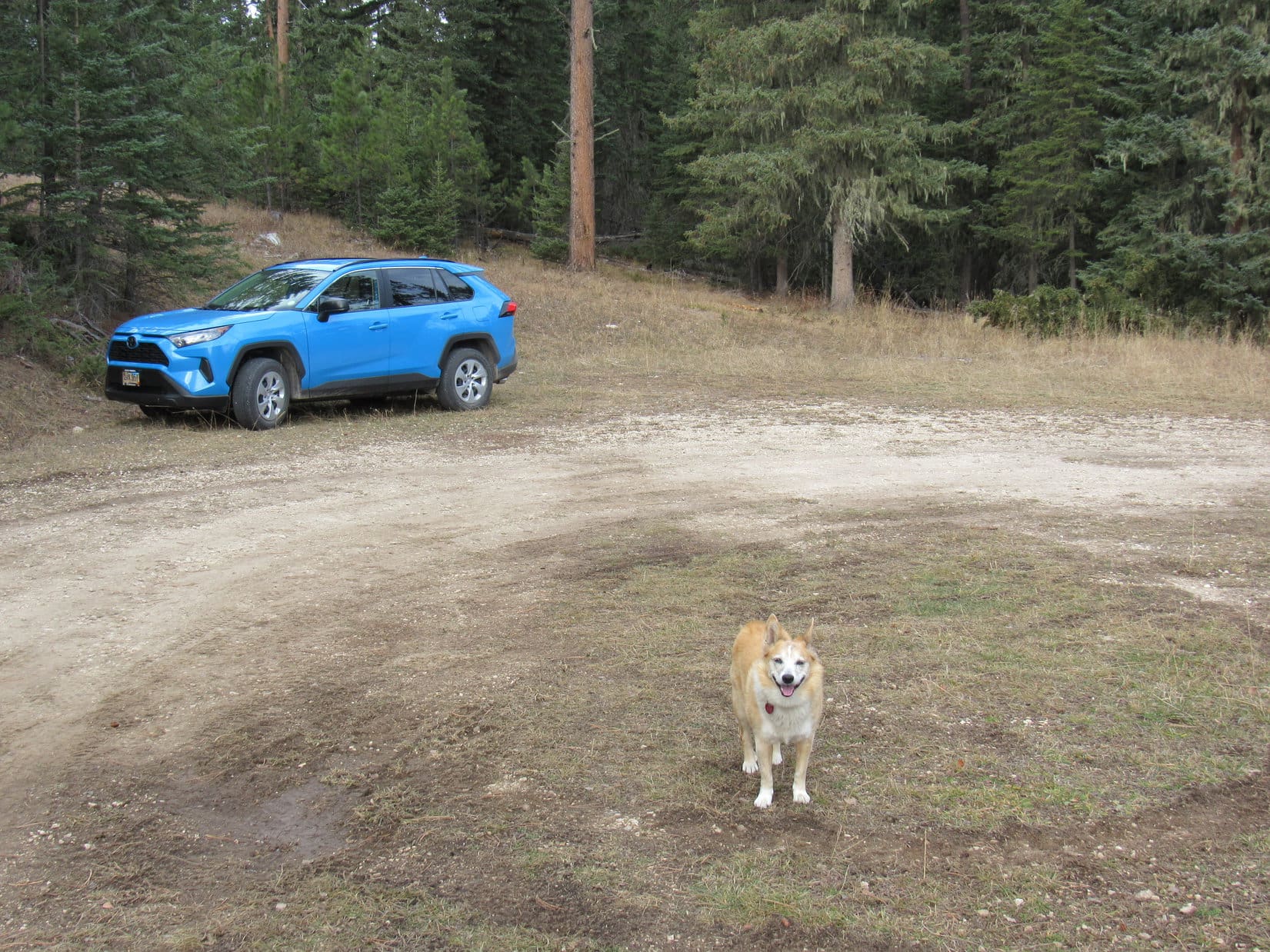
9:01 AM, 55ºF – Oh, that might be it!  On the second pass along Beaver Creek Road (Custer County No. 391) 0.1 mile SSW of the junction with Flynn Creek Road (Custer County No. 336), SPHP spotted a faint turn to the E.  Room enough to park the RAV4 in front of a barbed wire fence.  Beyond a gate, a dirt road went up into the forest.

Something else was beyond the gate, too – an old brown fiberglass wand marking USFS Road No. 391.1D.

Come on out, Loop!  Found it!

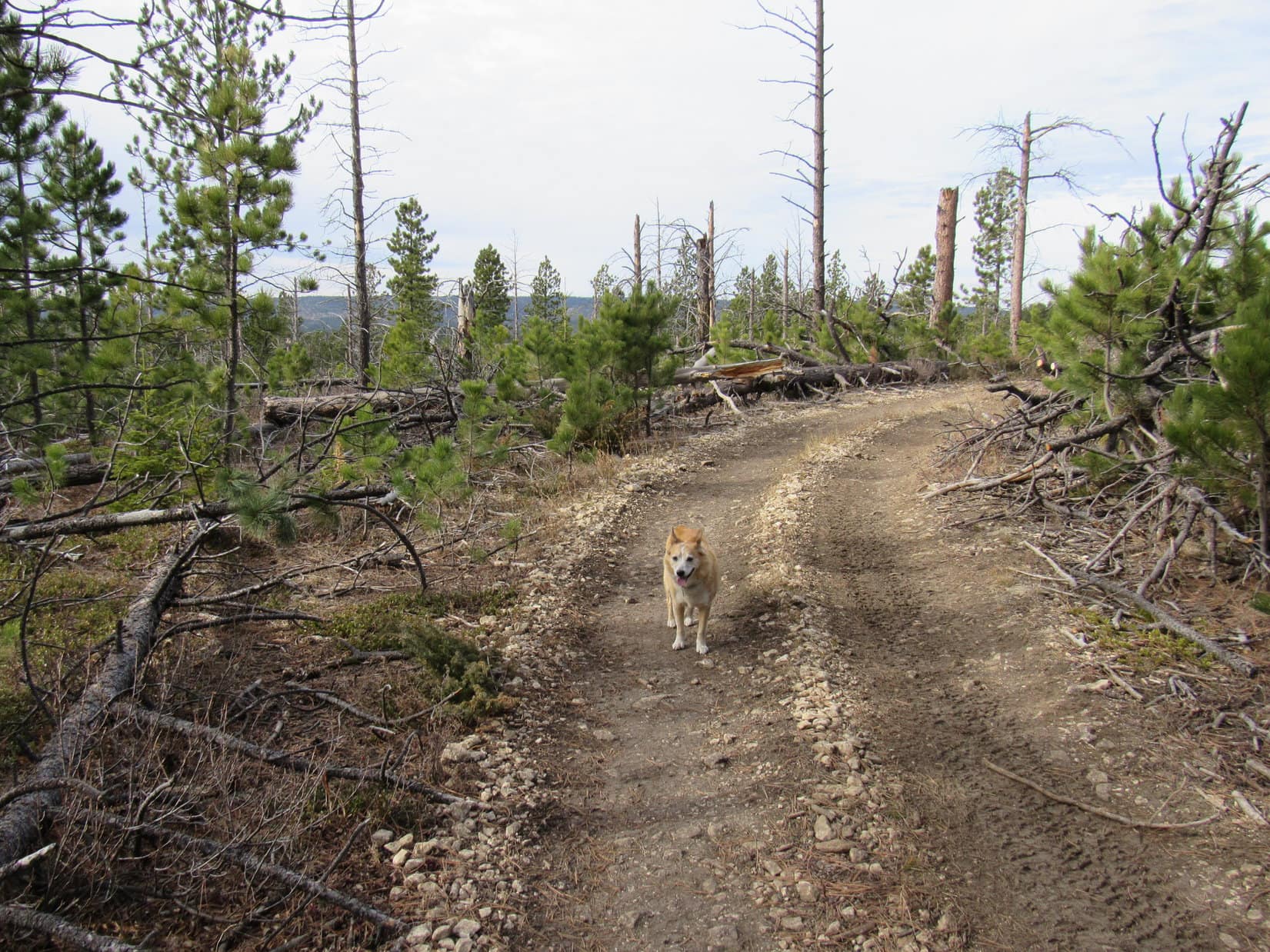
Minutes after bounding out of the RAV4, the Carolina Dog was following what remained of long abandoned No. 391.1D.
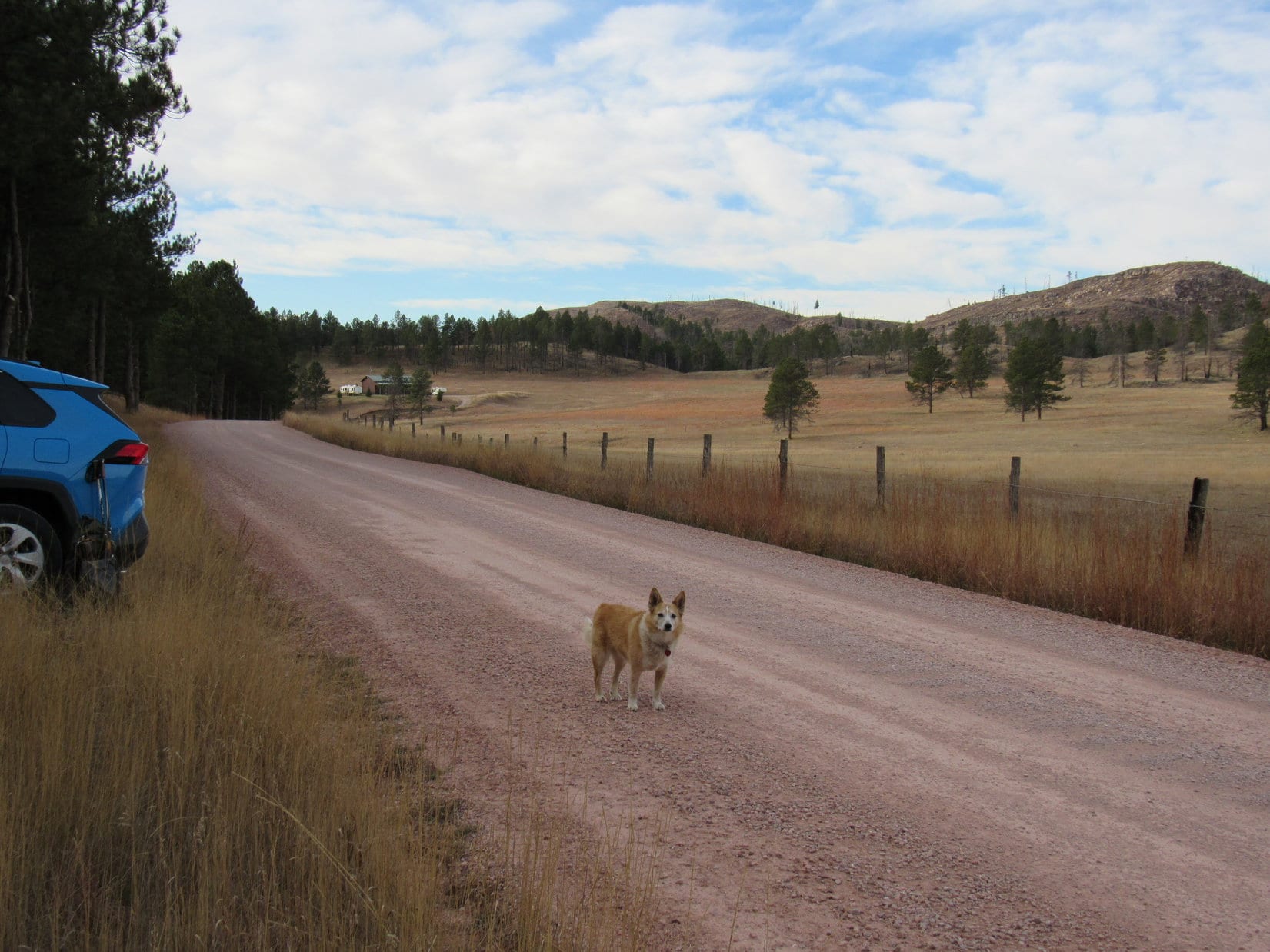
Beaver Creek Road where USFS Road No. 391.1D takes off. Photo looks SW.
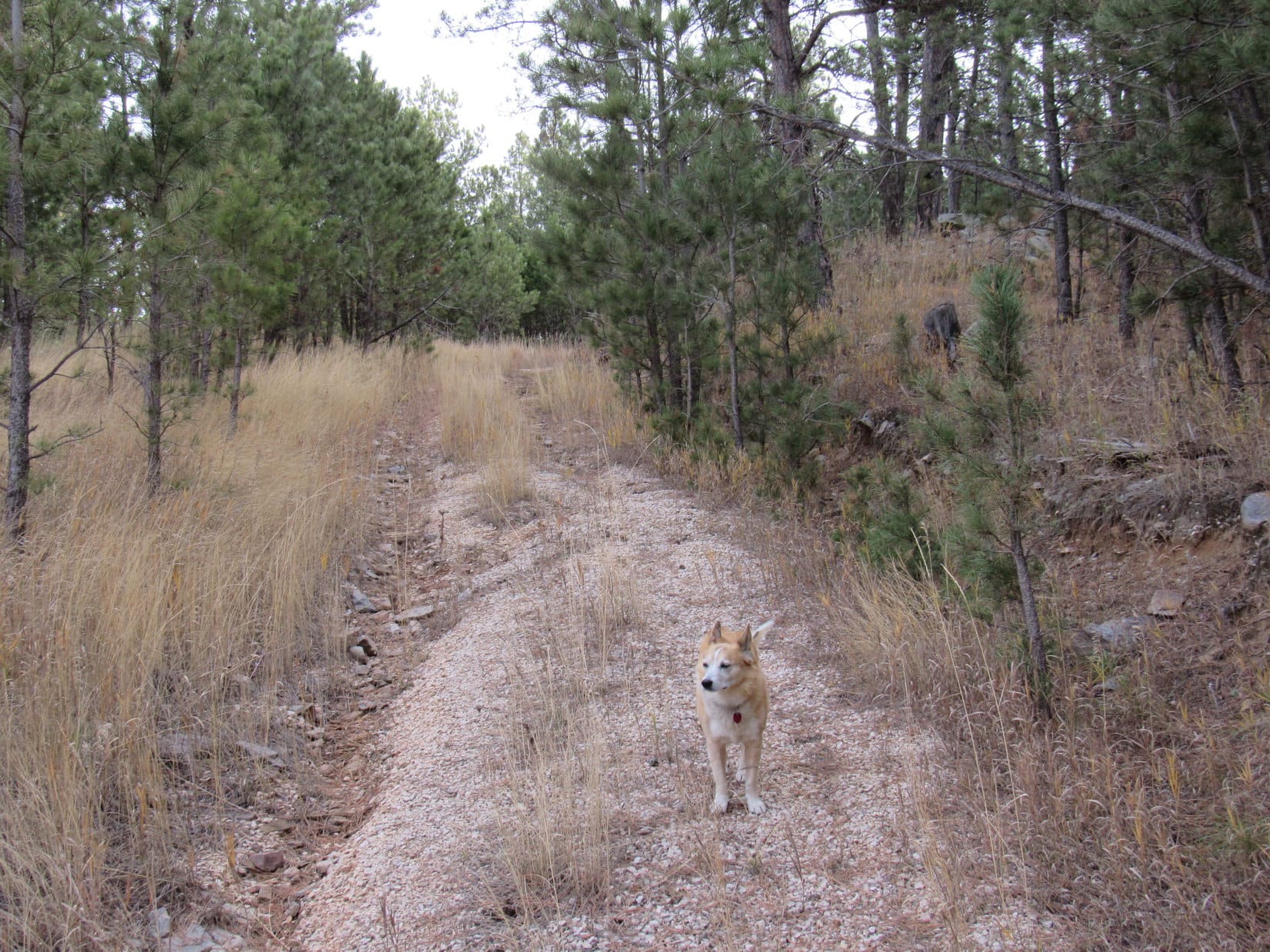
Setting out on USFS Road No. 391.1D Photo looks E.

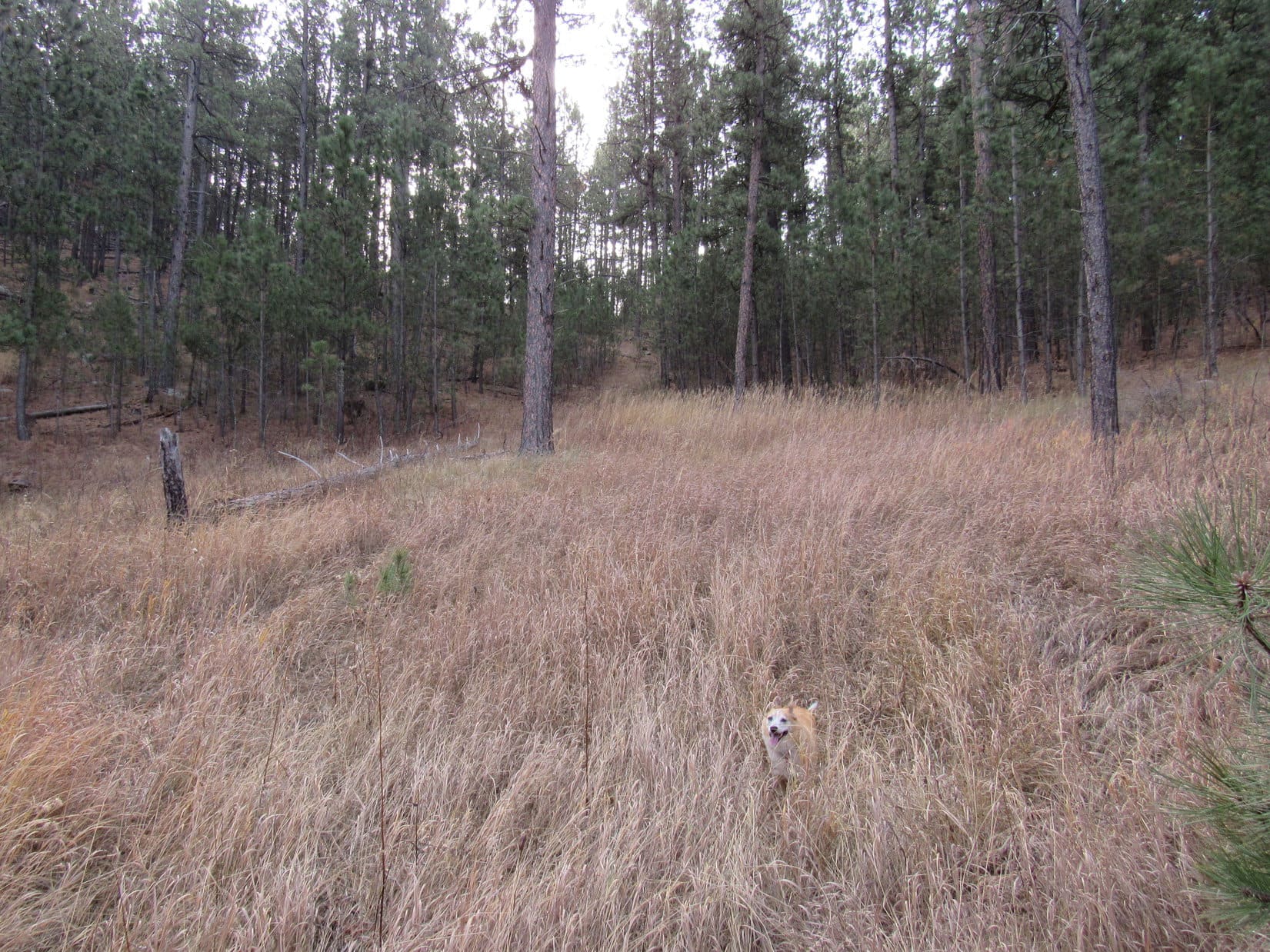
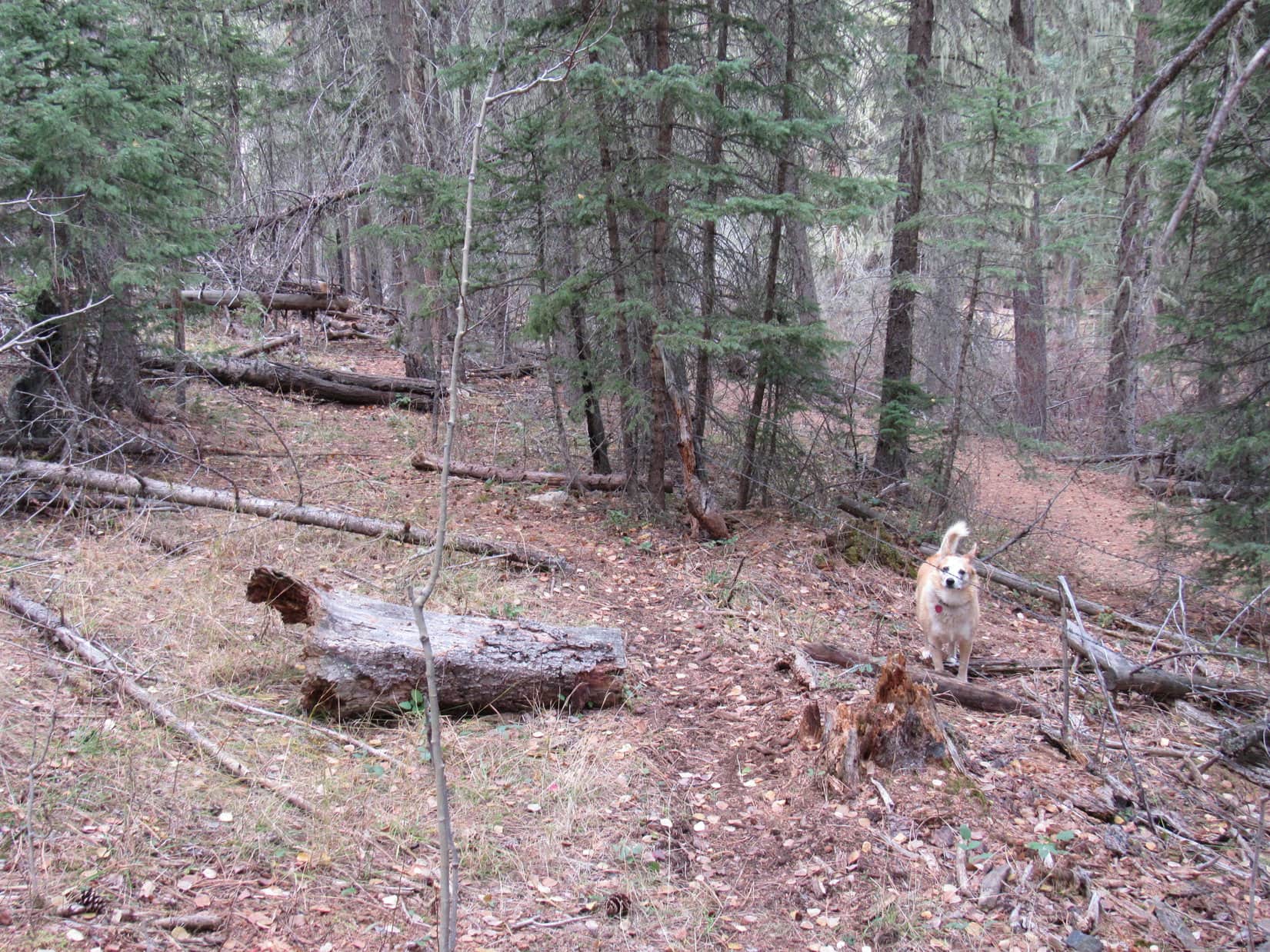
The road made a short climb to the E, then curved SE as it began to level out. Grass as tall as Lupe covered the flat lane ahead.

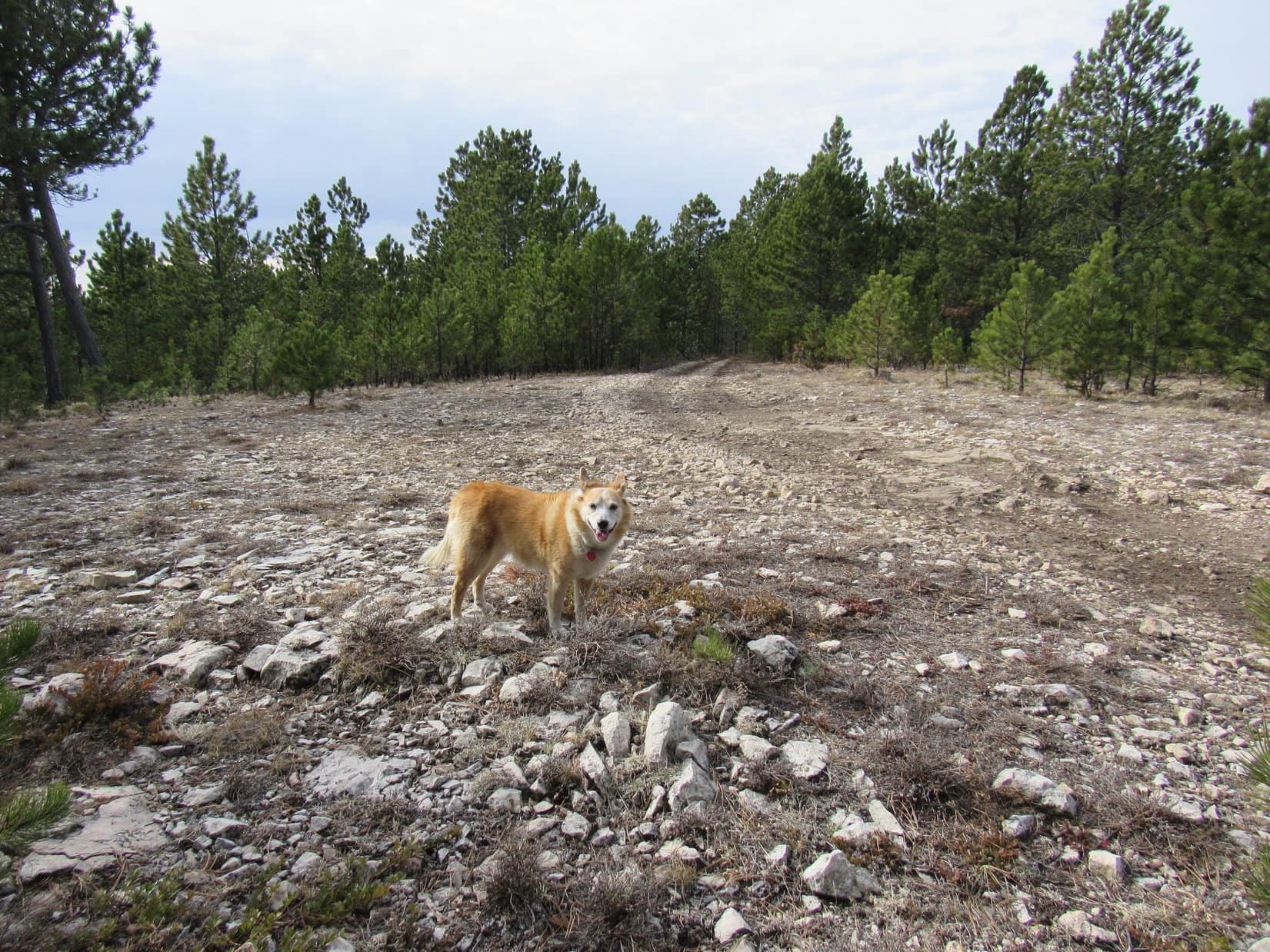
Most of No. 391.1D turned out to be a pleasant grassy lane. Photo looks SE.

Private property was just down the slope to the E as Lupe sniffed along.  Passing through a short stretch lined with little Ponderosa pines on each side, Loop reached a tall grass clearing where No. 391.1D faded away.  A minor pass was just ahead.
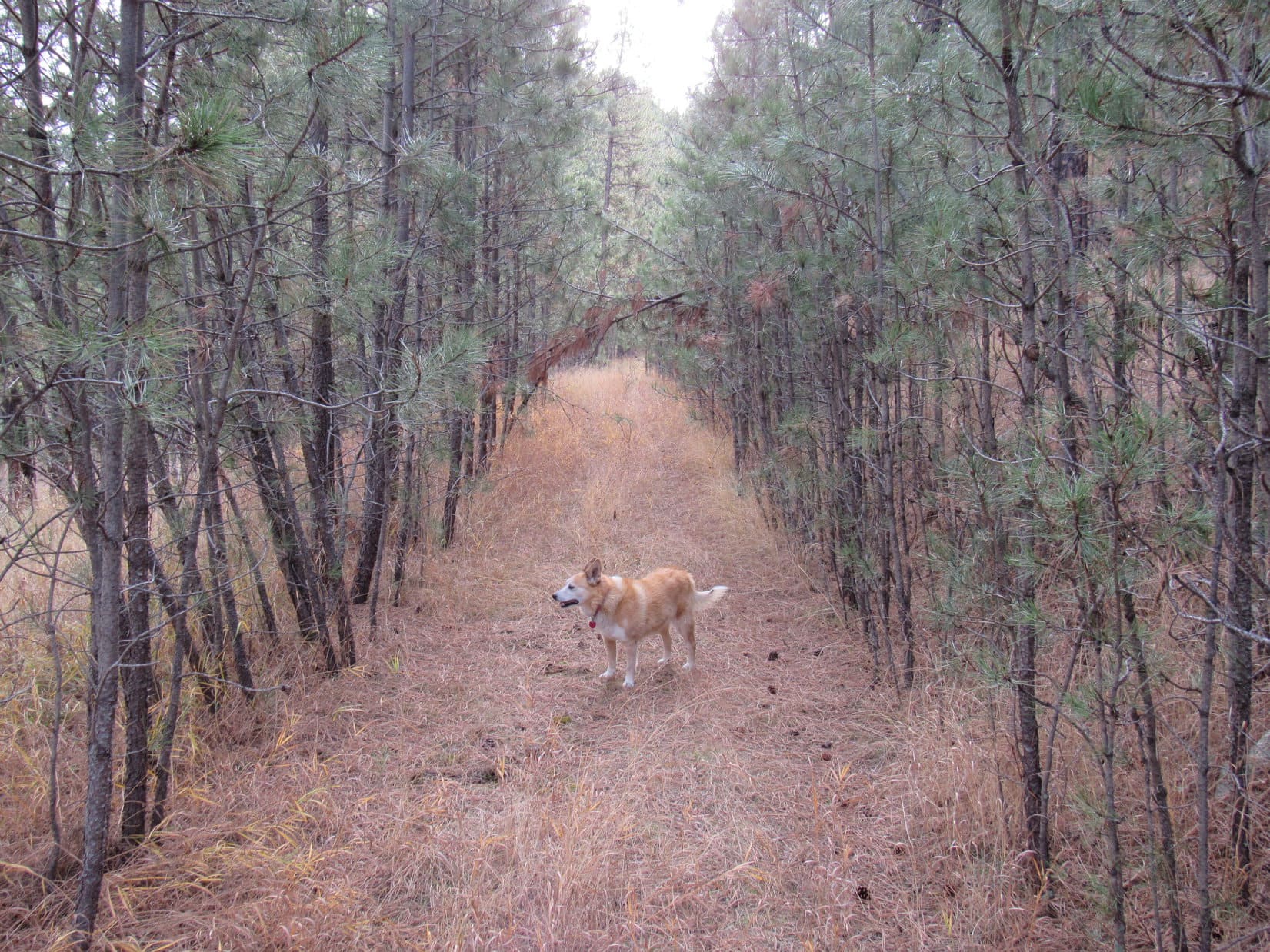
Between the little Ponderosas. Photo looks SE.
The tall grass clearing at the end of USFS Road No. 391.1D. Photo looks S at the pass.

Lupe made it up to the pass in a flash.  Grassy, but not as tall here.

Which way, SPHP?

Up that slope to the W, Looper!
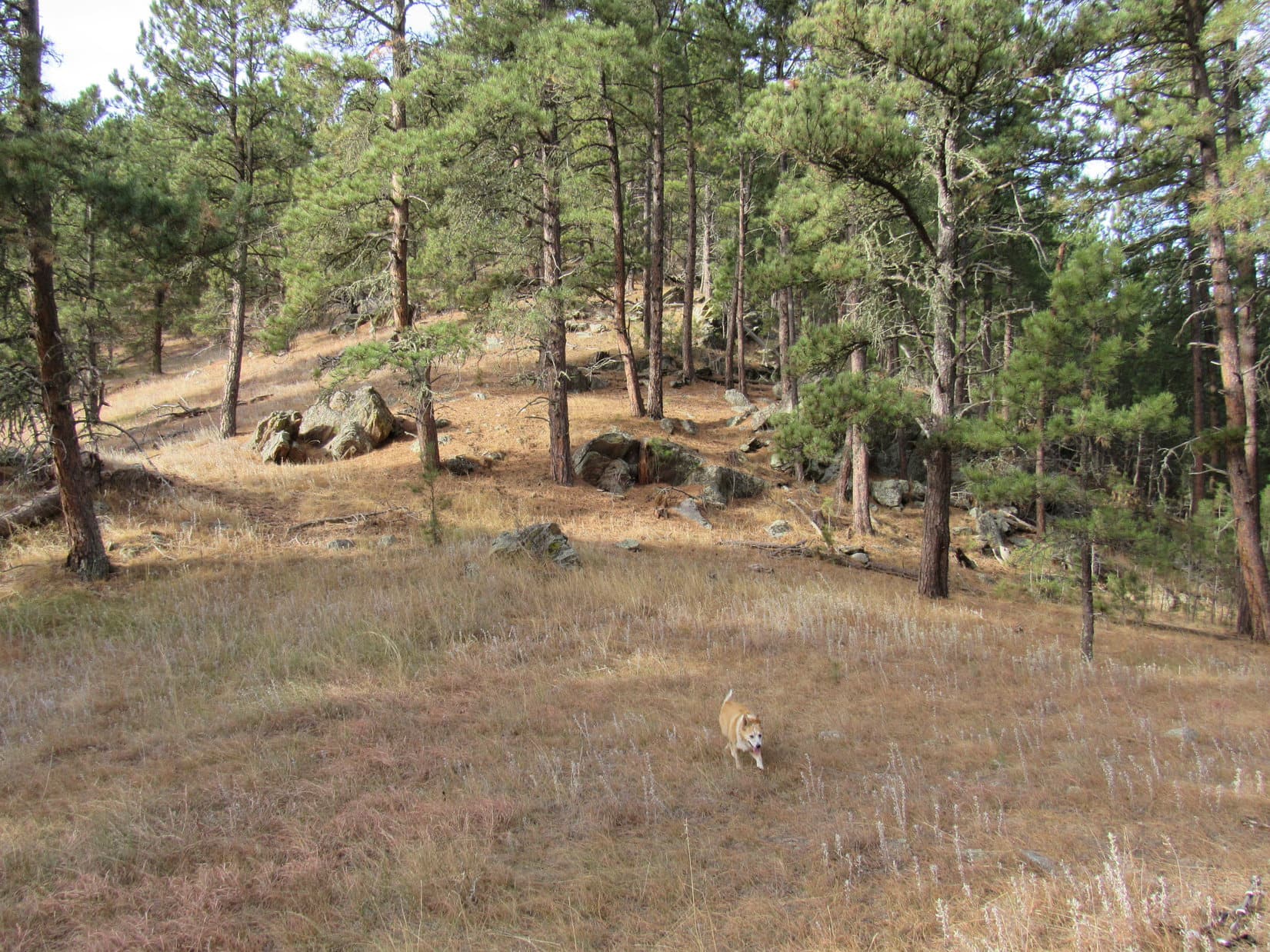
At the minor pass. Photo looks W.

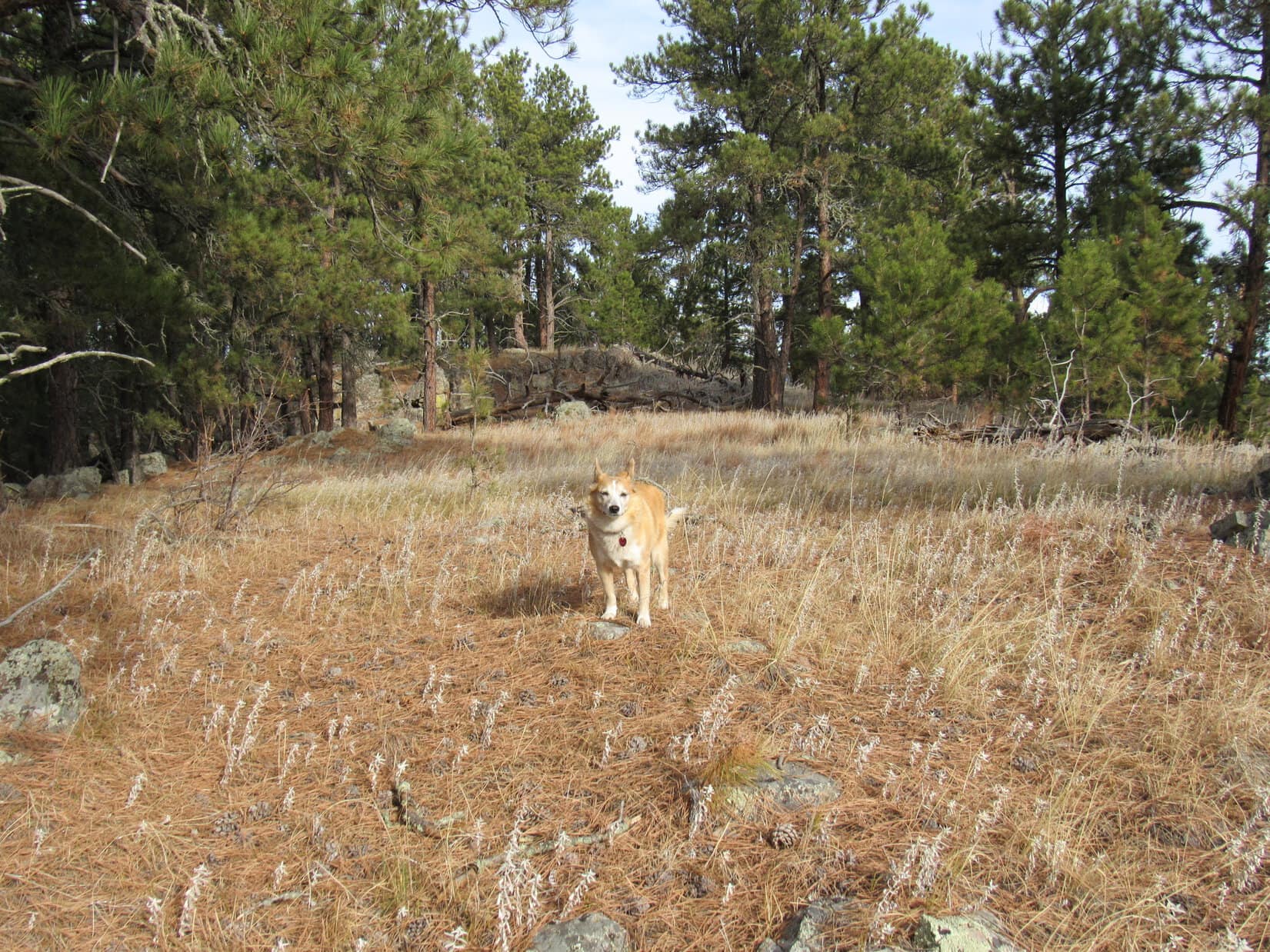
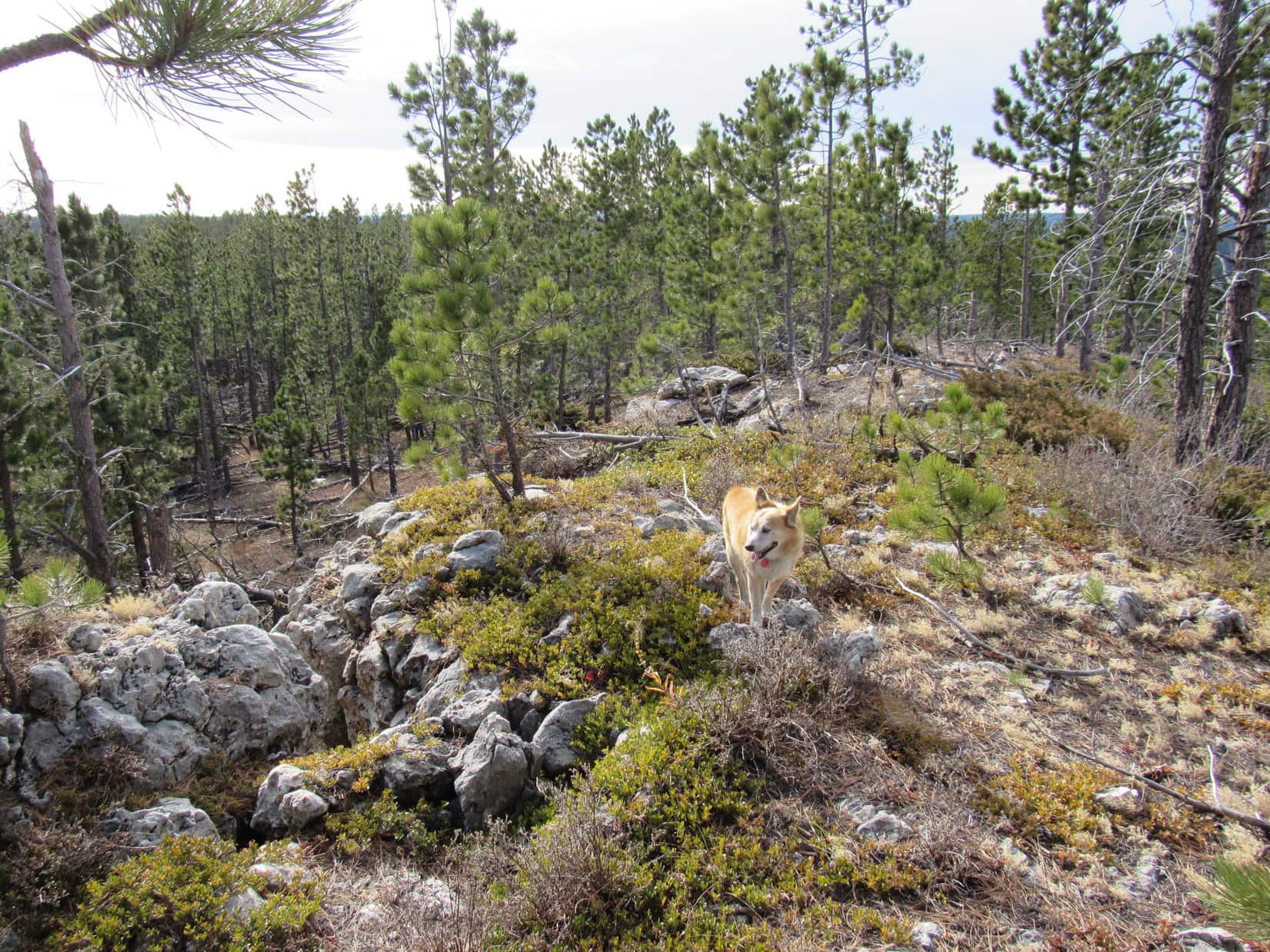
The slope to the W was a bit longer, but an easy climb, too.  Roaming an open forest featuring scattered rocks, the American Dingo soon reached an initial high point.
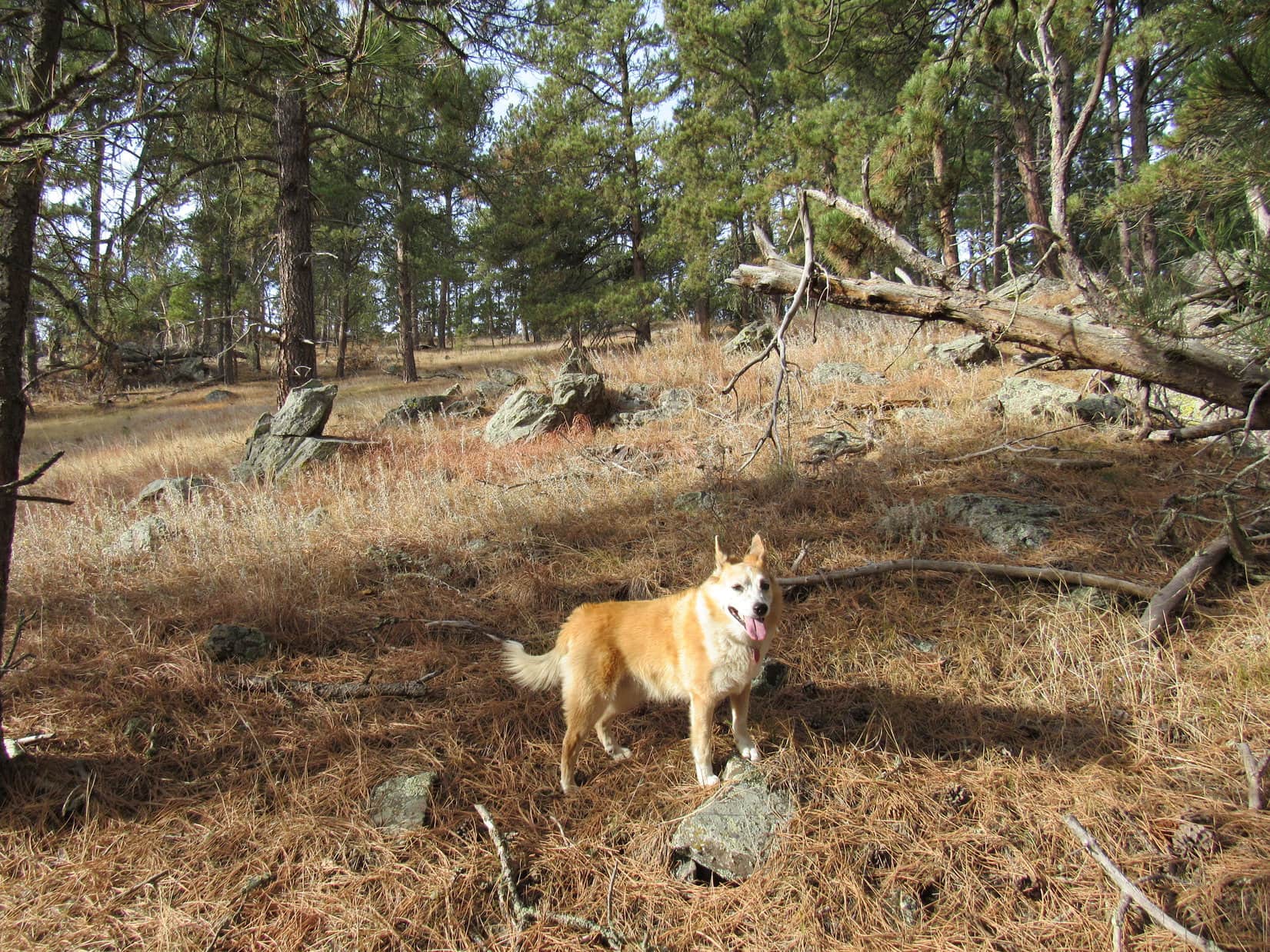
Heading up the slope W of the pass.

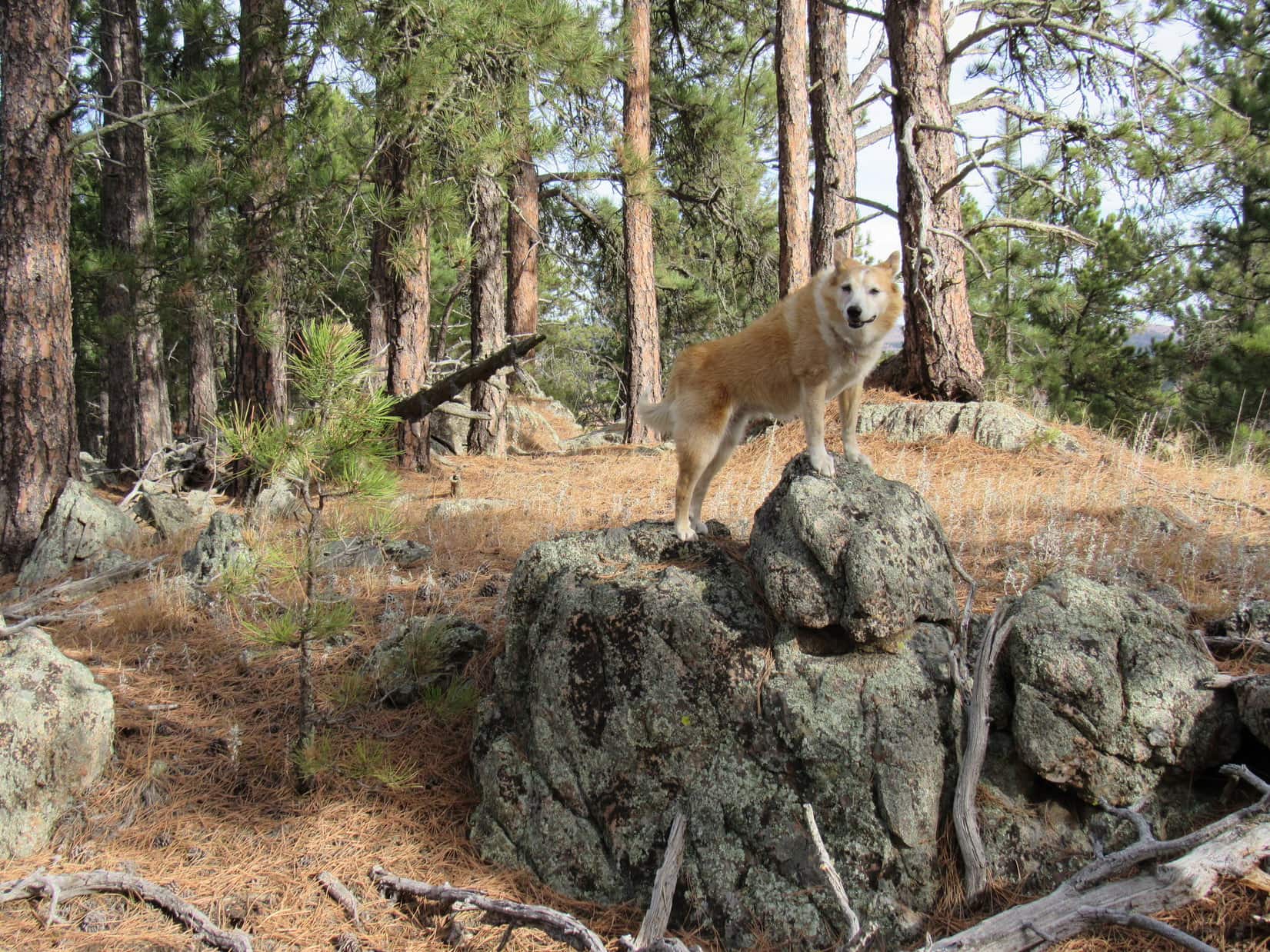
10:39 AM, 55ºF – Lupe got up on one of the highest rocks.

Where to now, SPHP?

Congratulations, Loopster!  You have just climbed Peak 4980!

What?  Already?  We’ve barely gotten started!
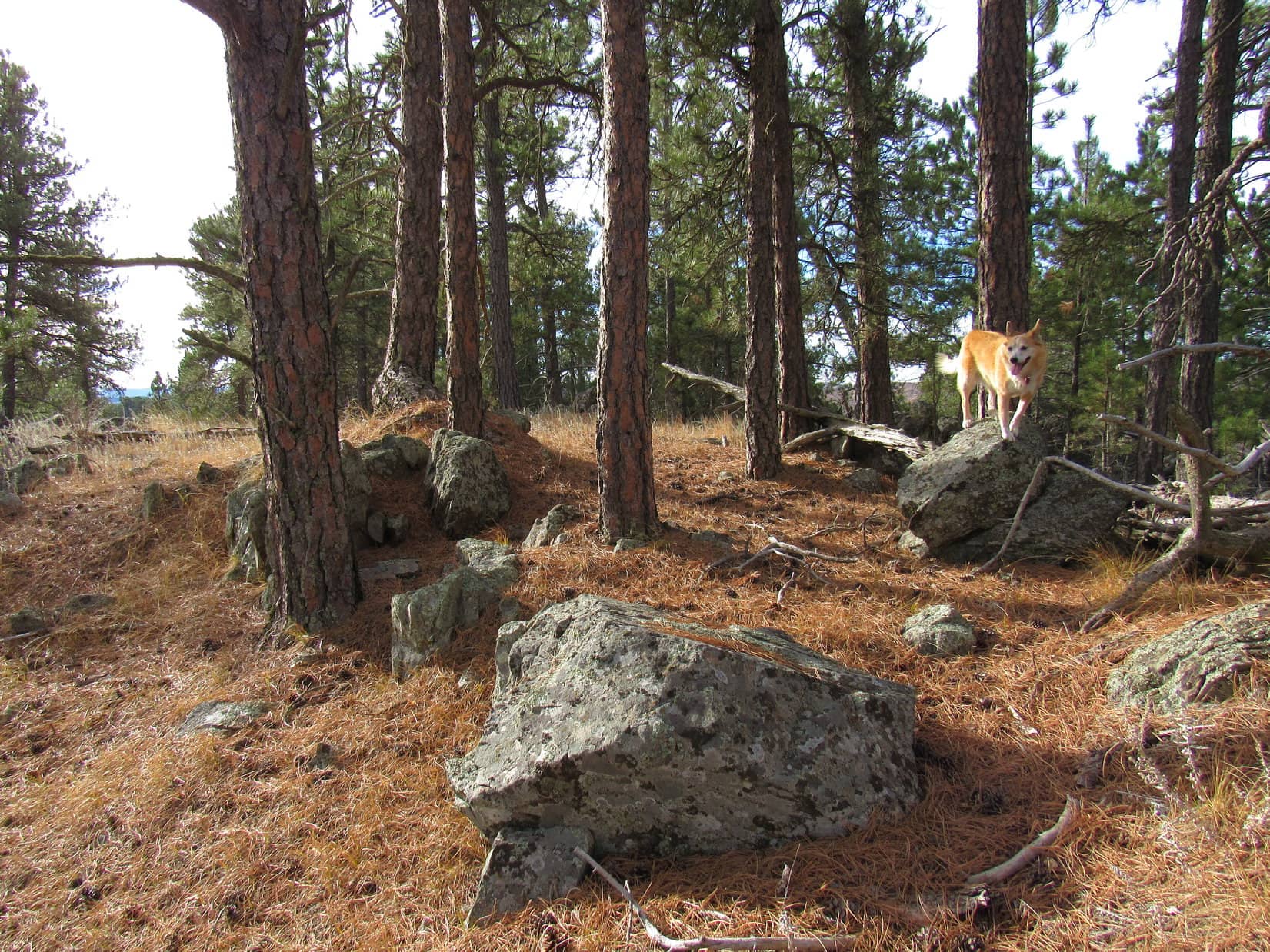
Peak 4980 summit. Photo looks SW.

Yeah, I know.  This peak is a super easy one, a cinch following the road.  Don’t worry, though, Loop.  More on the agenda!  The next peak will be tougher and a lot farther.

Sounds good, SPHP!  Is the next peak far enough away to require a fair amount of energy to get there?

Oh, yes!  I’d say so.

In that case, since we’ve already climbed a mountain, maybe we ought to have a chocolate coconut bar.  Just to keep our energy levels up, you know?

Conniving Dingo!  Kind of early in the day, but I suppose we can do that.

After water and a shared chocolate coconut bar, Lupe explored Peak 4980’s summit region.  The first rock she’d gotten up on wasn’t quite the true summit.  Several rocks were candidates for that title, but one a little farther SW seemed clearly a tad higher than the others.
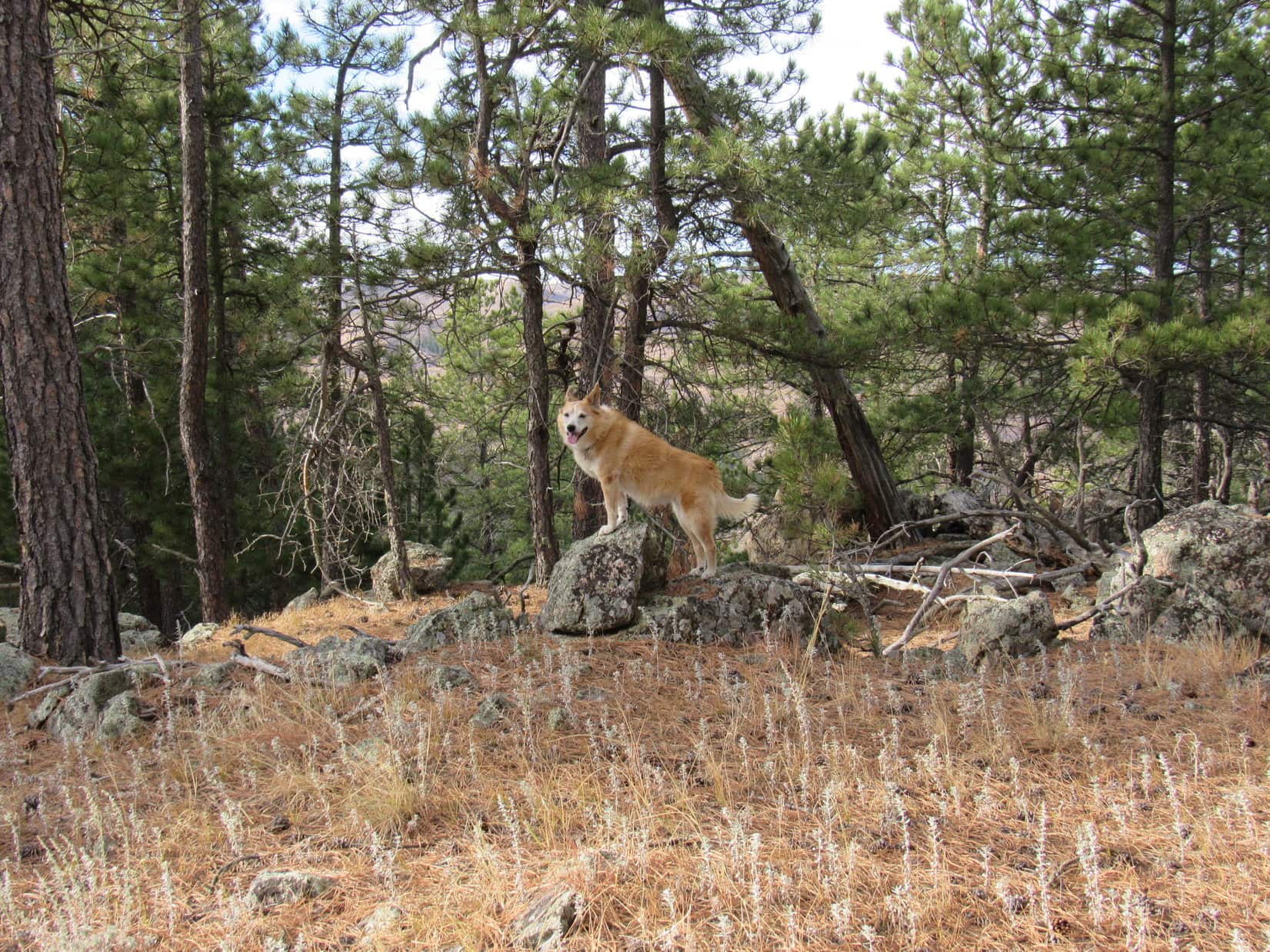
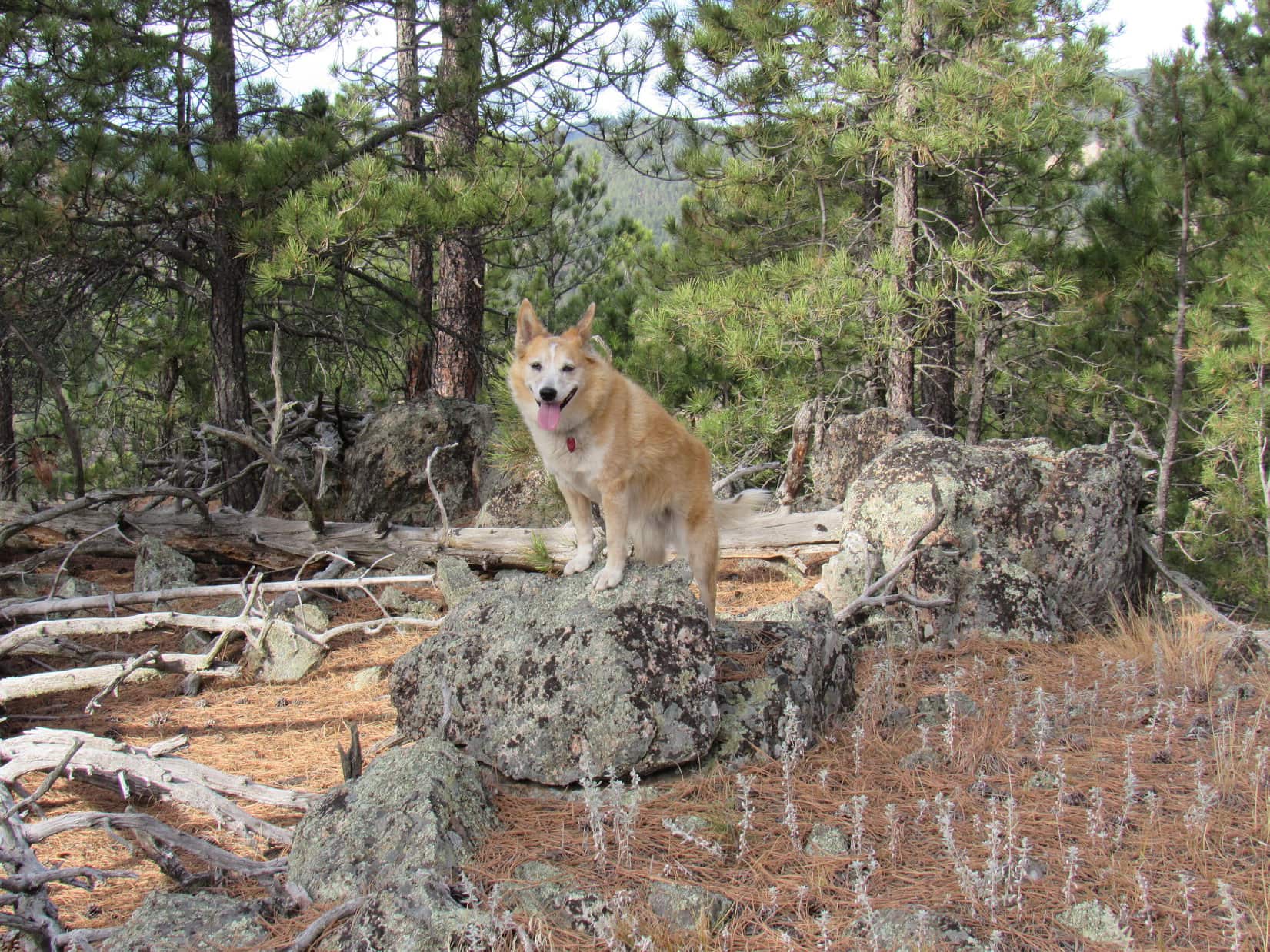
At the true summit of Peak 4980. Photo looks WSW.
Claiming an easy peakbagging success!

The highest part of Peak 4980’s summit region was 25 feet in diameter and toward the N end.  However, a minor dip led to a 200 foot long flat grassy area to the S.  Lupe sniffed along the length of it, while SPHP checked for views.
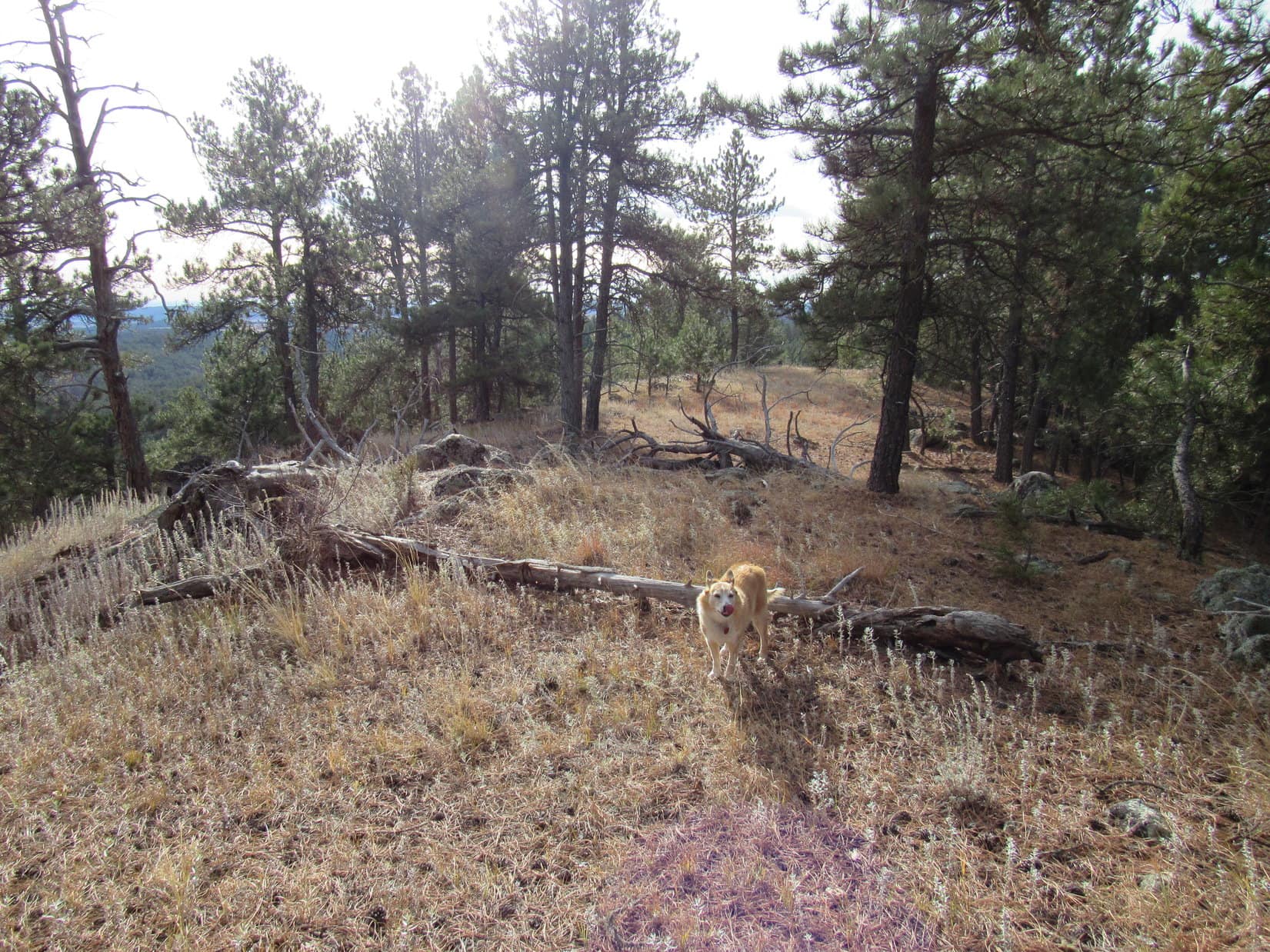
My that chocolate coconut bar was tasty! Lupe still licking her chops. Photo looks S toward the flat grassy end of the summit region.
In the grassy region. looking back toward the true summit. Photo looks N.

Eh!  Not much for views.  Glimpses to the SE that might have been nice minus a few trees, but that was about it.  Loop did a little scrambling on the rock formations separating the upper and lower summit areas, but that was about all there was to Peak 4980.  Half an hour after arriving, she revisited the true summit rock before departing.
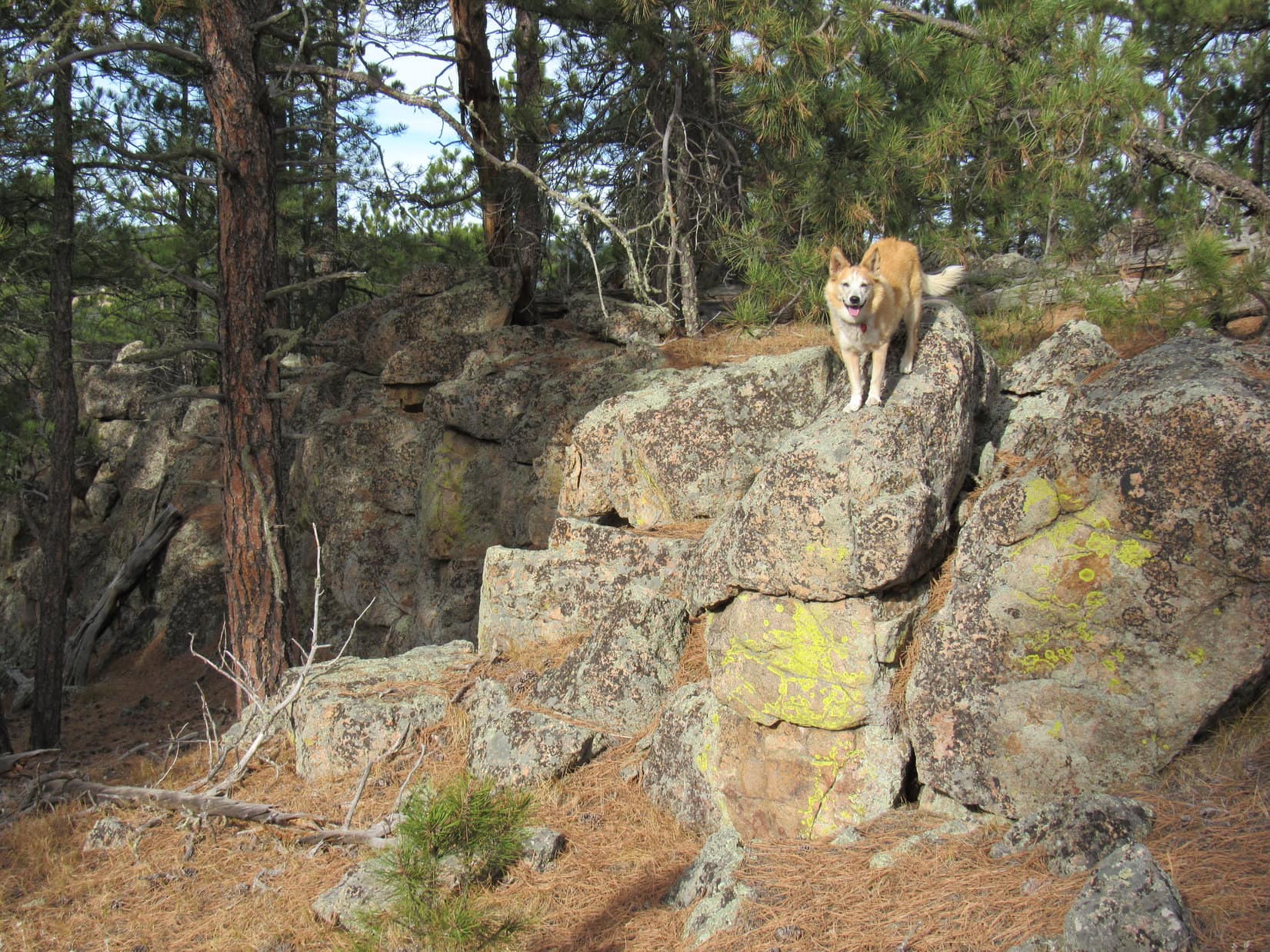
Along the edge of the dip. Photo looks NW.
Briefly back at Peak 4980’s true summit. Photo looks NE.

Instead of taking the same easy route along USFS Road No. 391.1D back to the RAV4, Lupe explored Peak 4980’s N ridge.  More challenging, but nothing major.  Heading down to the saddle leading to the first subpeak along the ridge, there actually was a spot with a view.  The subpeak had a better one.
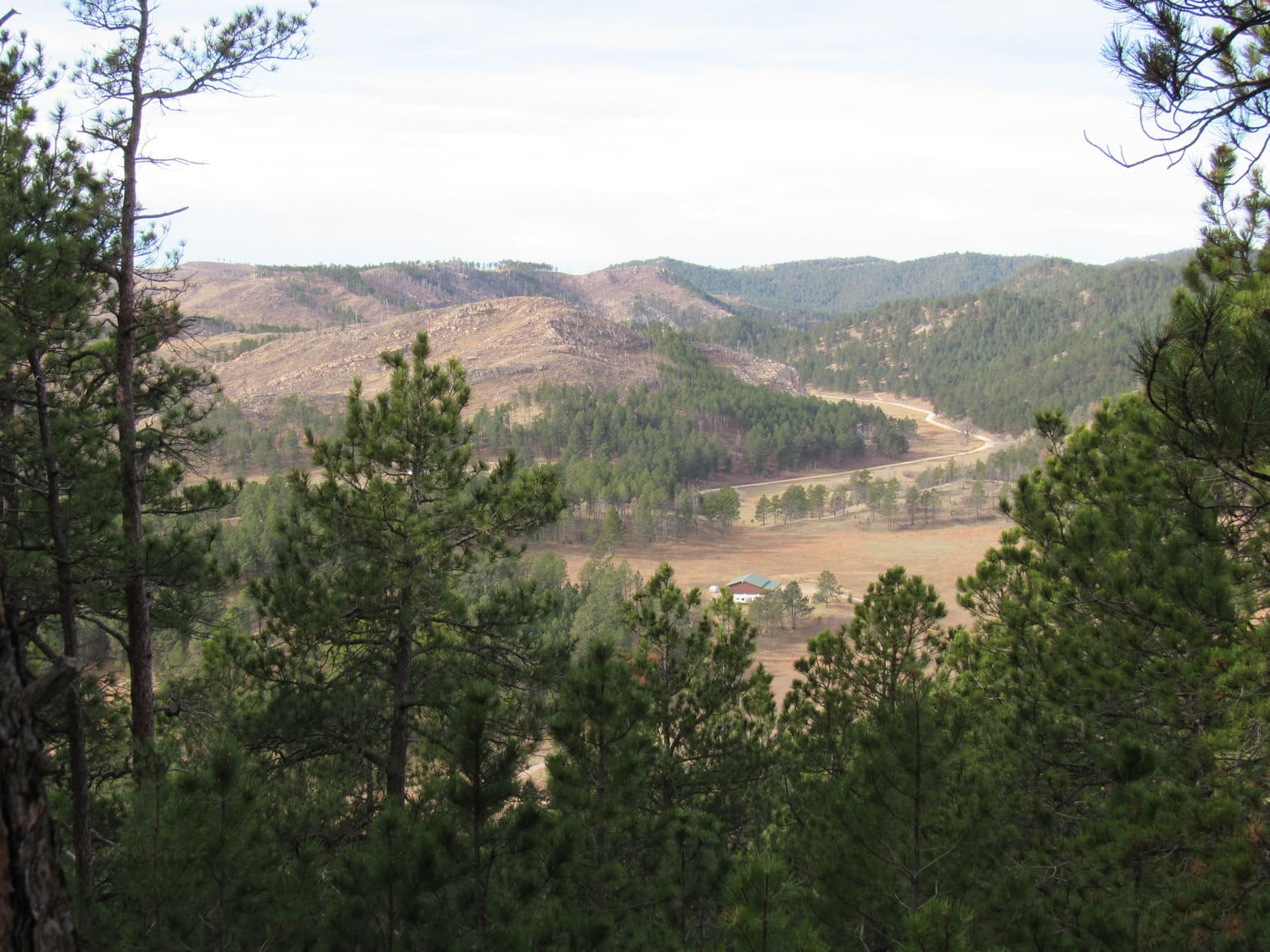
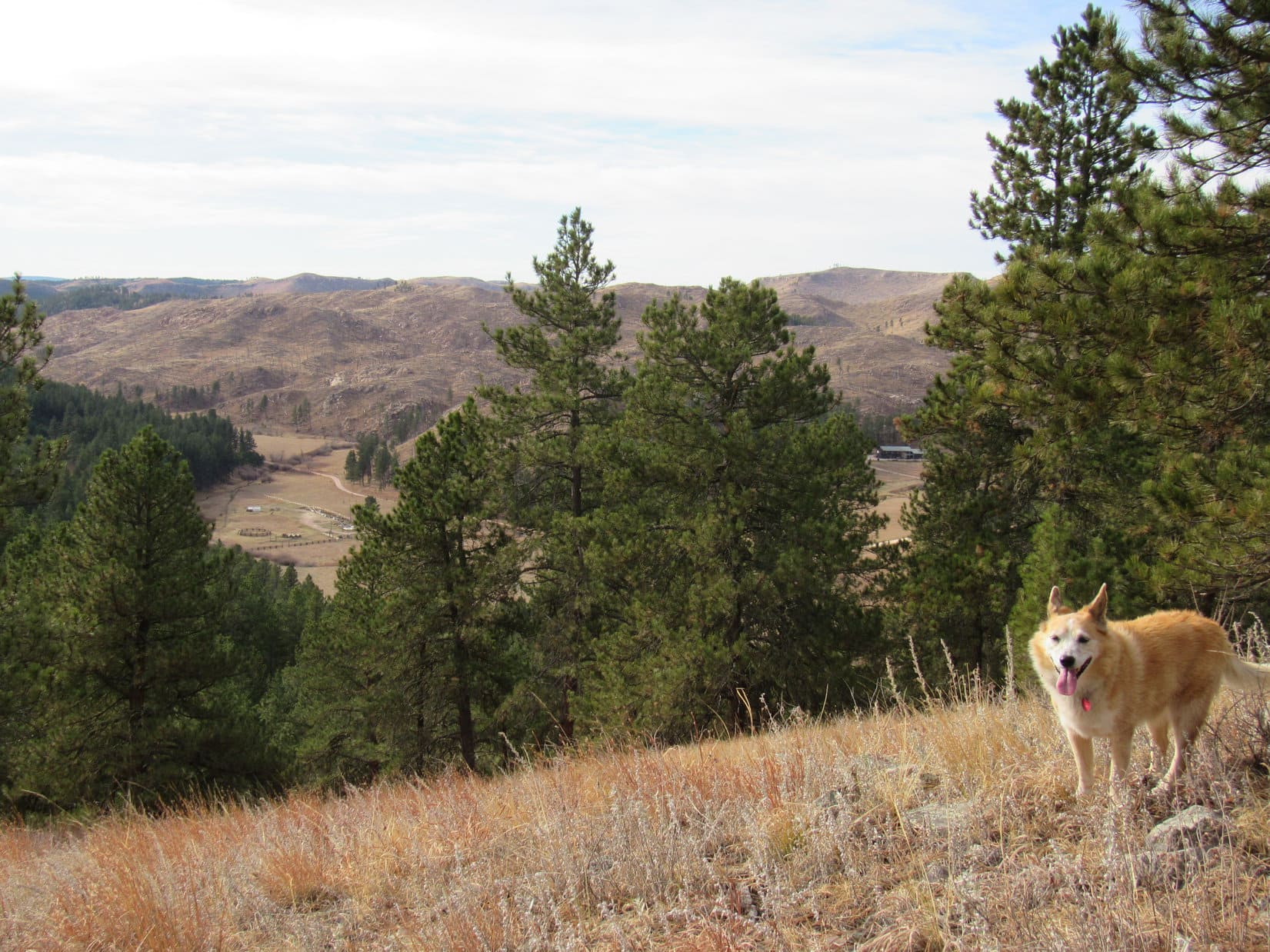
Glimpse of the Beaver Creek valley while heading down Peak 4980’s N slope. Photo looks W.
View from the first subpeak N of Peak 4980. Photo looks SW.

The final descent from the end of the N ridge got rocky and steep, but was soon all over and done with.  Lupe reached USFS Road No. 391.1D again.  Only a quick downhill march remained.
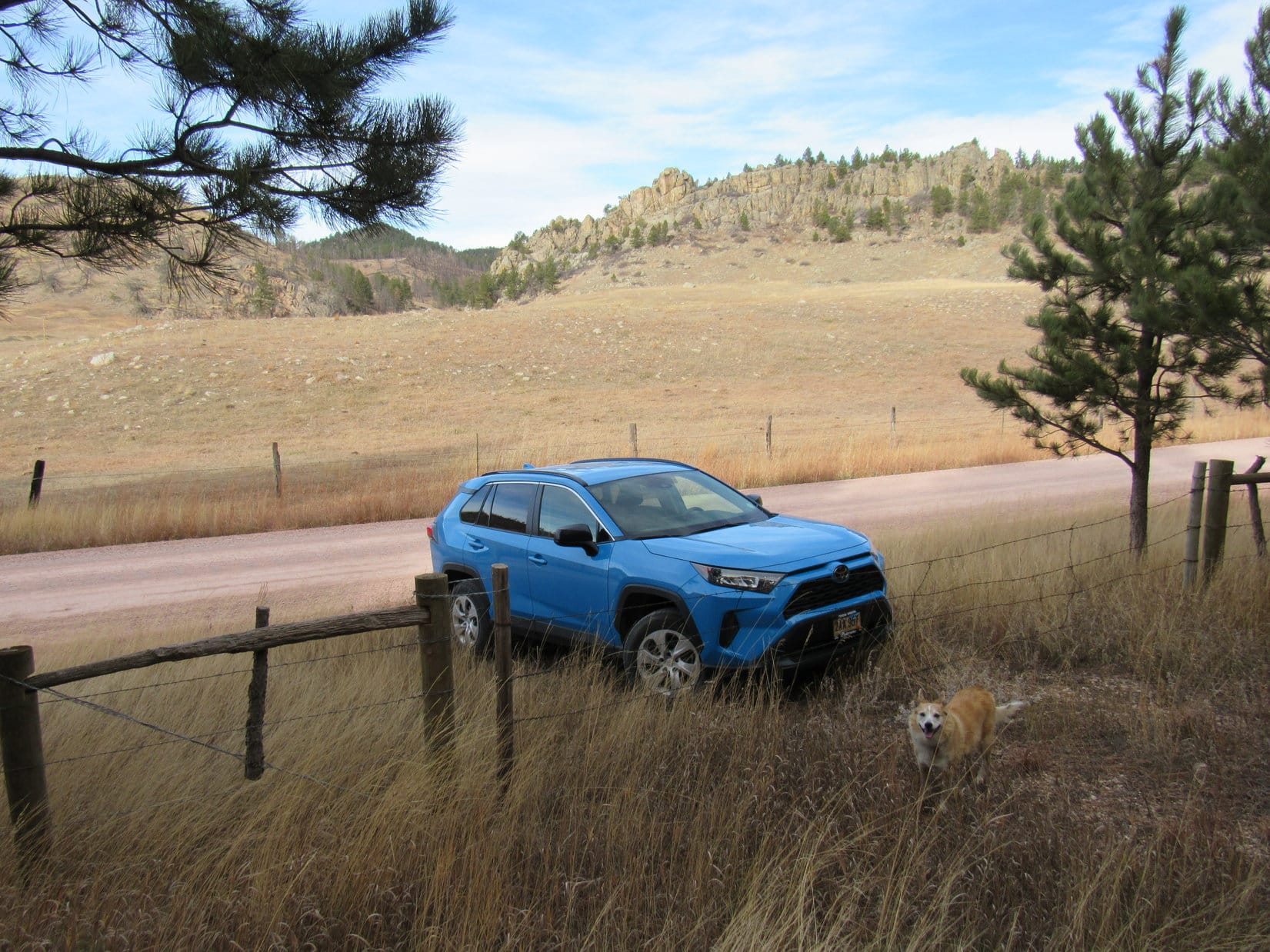
Back at the RAV4 along Beaver Creek Road. Photo looks NW.

Truth was that the RAV4 could get Lupe much closer to the next peak on the agenda, but where was the fun in that?  The American Dingo was surprised when SPHP walked right on by it.  At the junction 0.1 mile NNE, SPHP led Loop NW on Flynn Creek Road.  Another 0.1 mile got her to a R turn onto a side road going to the Cold Springs ranger station and a cemetery.

Directly ahead was a hillside that got quite steep and rocky near the top.  If Lupe could get up there, the intention was to follow a long ridge that went N, then NW, all the way to Peak 5604, her ultimate destination.
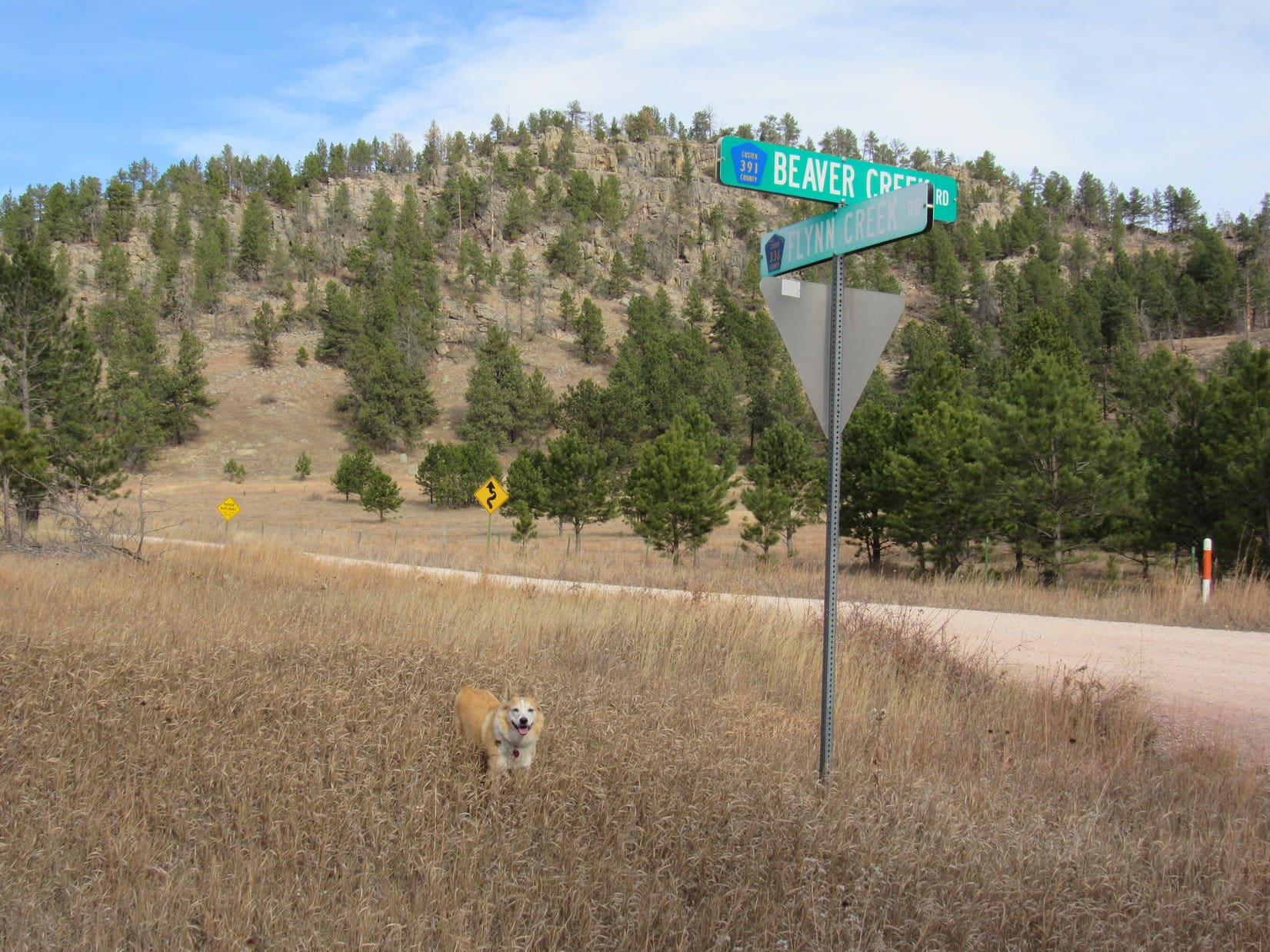
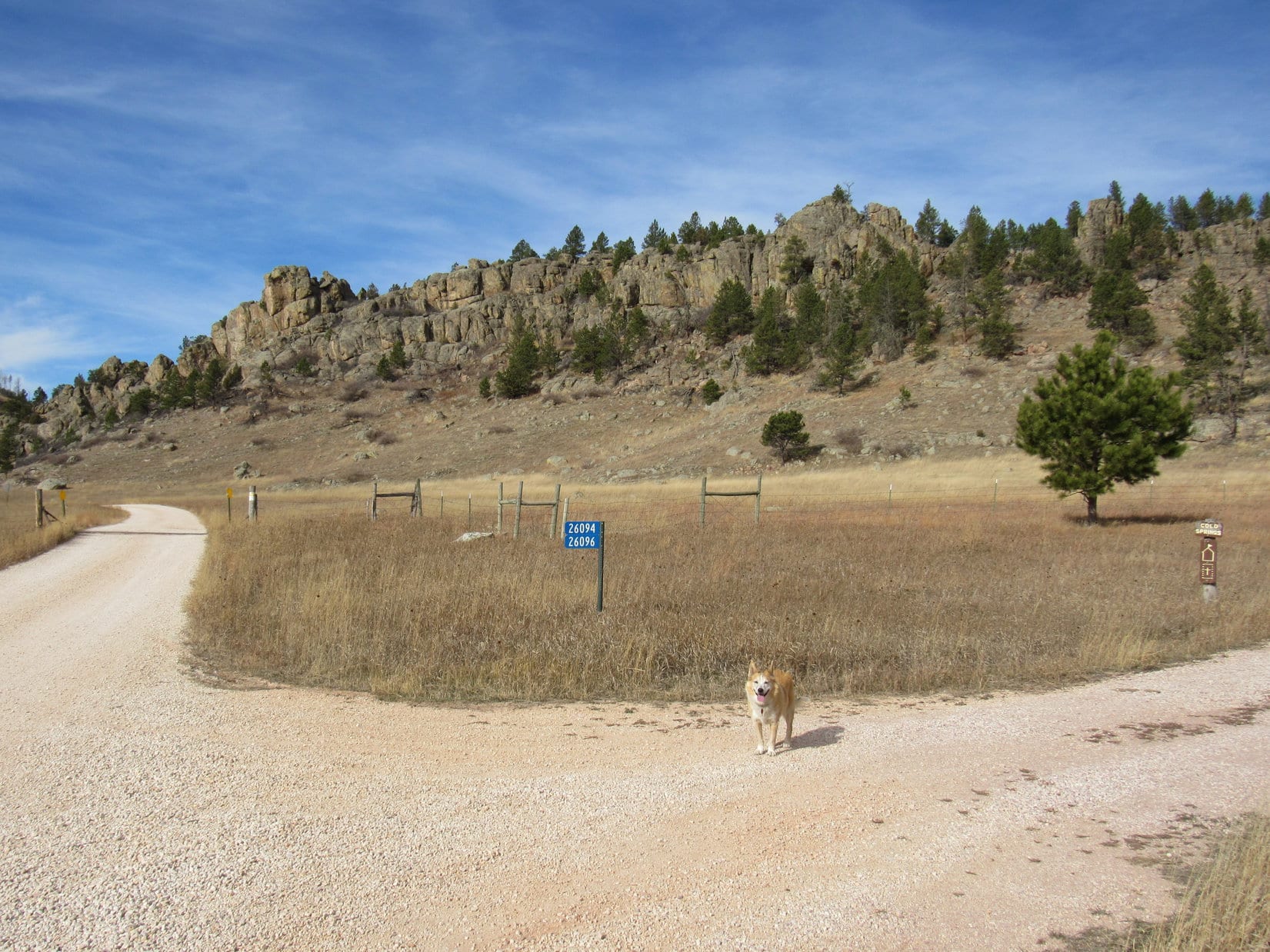
At the junction of Beaver Creek Road and Flynn Creek Road. Photo looks N.
At the turn to the Cold Spring ranger station and cemetery. Photo looks NW.
Heading for the hillside. Photo looks N.

The hillside really didn’t look all that bad, but once Loop left the road and started climbing, SPHP made the mistake of venturing too far E.  This ended up putting her on some of the steepest, rockiest terrain.

Starting to get rather rocky on the way up. Photo looks N.
Hmm. Not too far from the top, but mighty steep. Photo looks NE.
Getting some views! Photo looks SW.

In several spots, it looked like Lupe might get stuck.  Fortunately, there was always a way higher.  Loopster managed to reach the upper edge without needing any boosts from SPHP.  She was rewarded with a nifty view of Peak 4980 where she’d been only a little while ago.

Peak 4980 (L of Center) beyond Lupe. Photo looks S.

Beyond the edge, Lupe found a forested ramp that sloped gradually up toward the ENE between parallel lines of rock formations.  The absolute top of this hill couldn’t be much farther, so Lupe went to find it.

The highest rocks she came to along the S edge provided an even better view of Peak 4980.

On the easy, wide ramp. Photo looks ENE.
The grand view of Peak 4980 (L) from some of the highest rocks along the S edge. Photo looks S.

However, the top of the hill proved to be along the N edge, not the S edge.  Venturing across a flat region, Lupe came to a pile of boulders.  She promptly scrambled up, reaching the summit of HP5000.

At the summit of HP5000. Photo looks NNW.

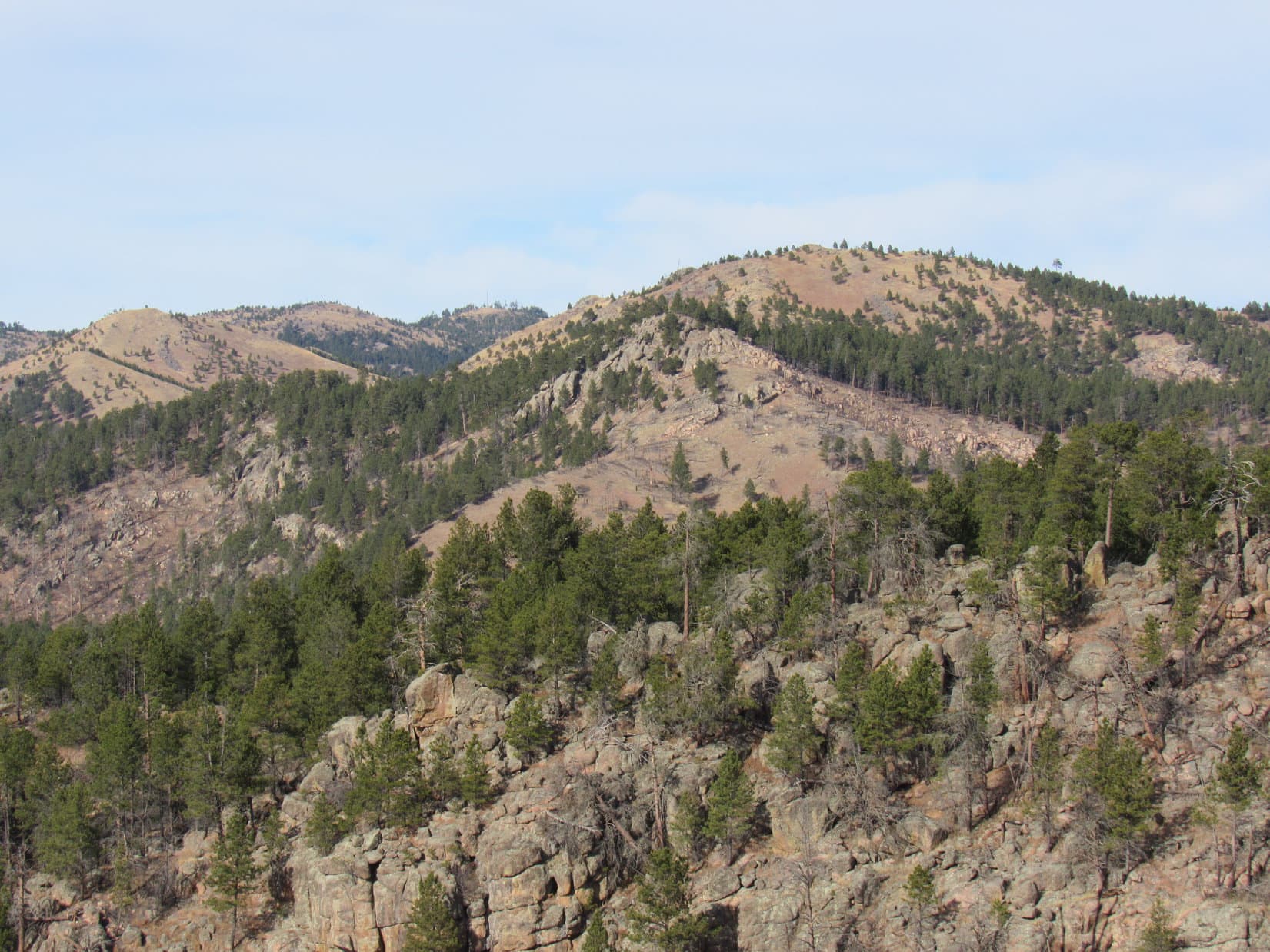
Too many trees to get a decent view to the N, but a lower spot a little to the W did have one.  2.5 miles NNW as the crow flies, Lupe could now see Peak 5604, her ultimate destination.  More than twice as far away, the top of Cicero Peak (6,166 ft.) was in sight, too.
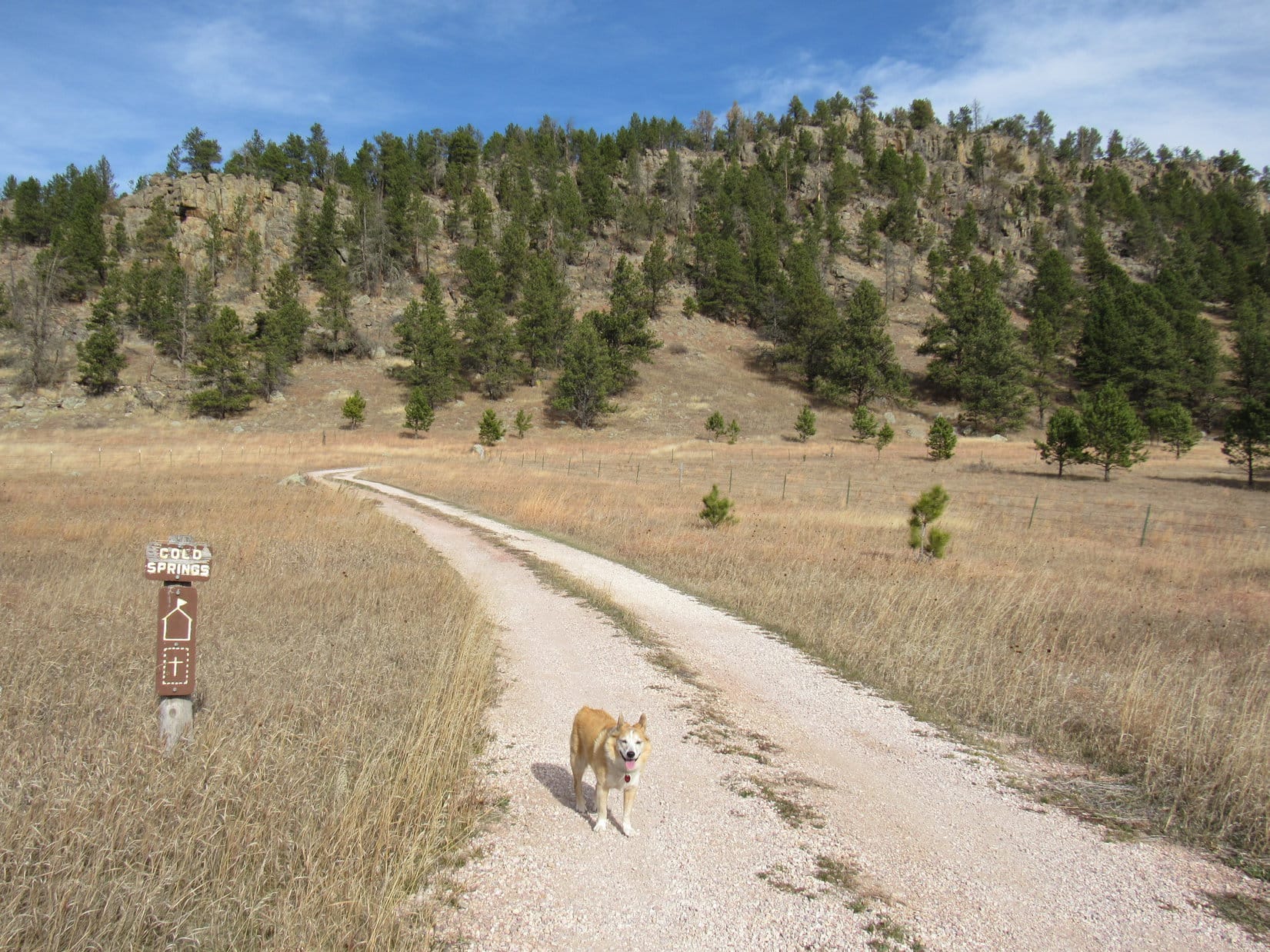
HP5072, the next hill along the proposed ridge route to Peak 5604, was of more immediate concern.  Beyond a saddle 160 feet below where Lupe was now, its S face looked a lot like the hillside she had just climbed.  Not all that big, but rocky and steep.

In fact, the territory ahead all looked rougher than SPHP expected.  Lupe was perched at the brink of a cliff, rather than a nice easy slope leading down to the saddle to HP5072.  Suddenly, it was clear that the American Dingo was in for a long day, not the stroll along a gentle ridge that SPHP had envisioned.
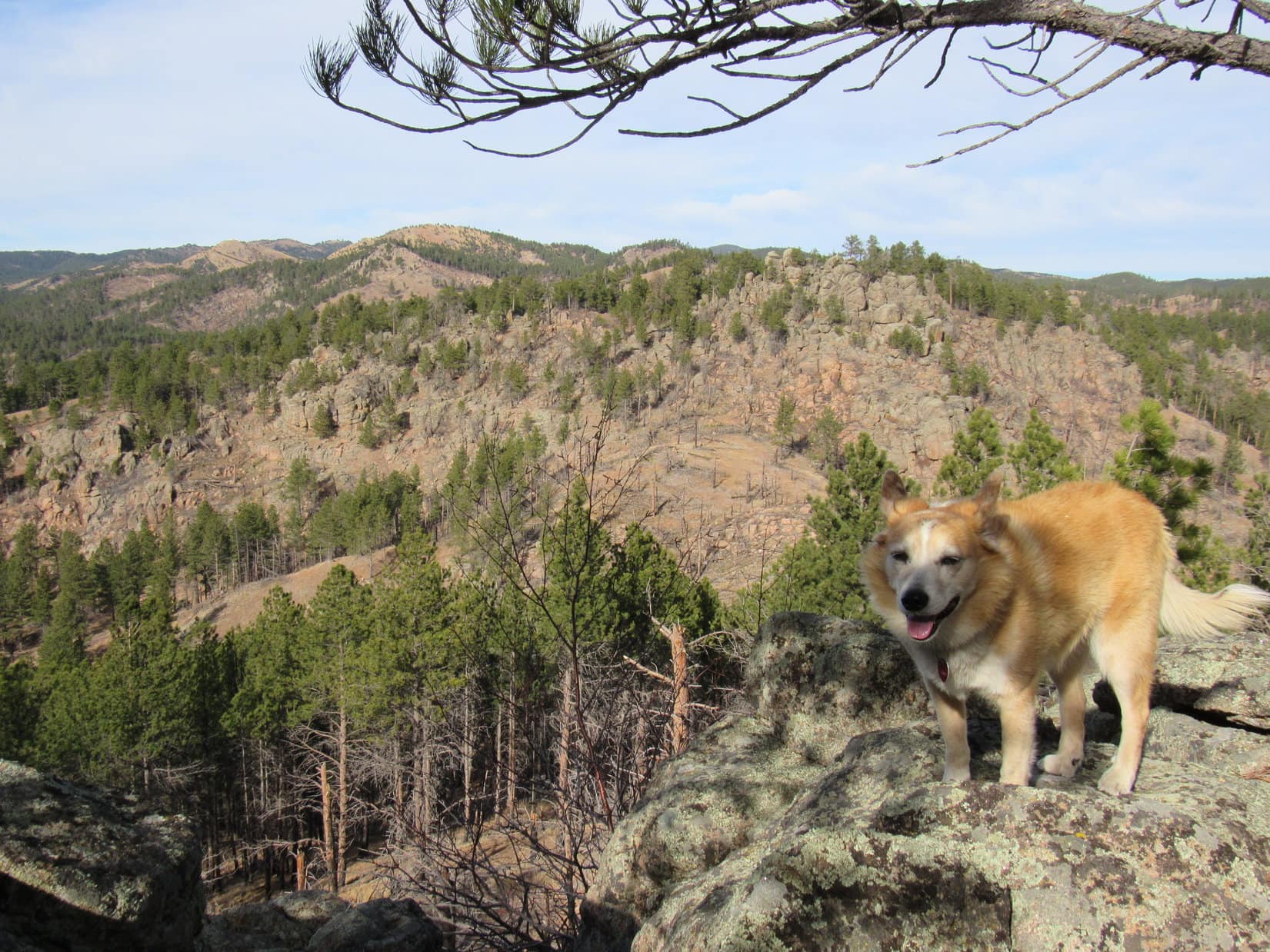
Peak 5604 (L of Center). HP5072 (R) in the foreground beyond Lupe. Photo looks NNW.
Cicero Peak (L of Center) in the distance. Peak 5604 (R). Photo looks NNW with help from the telephoto lens.

A short water and rest break was taken while contemplating this view, but the scene didn’t change.  The route N looked every bit as rugged as before.  Nothing to be done about it, though, except to start putting one paw in front of the other.  Lupe left HP5000 heading WSW back down the ramp while searching for a break in the cliffs.

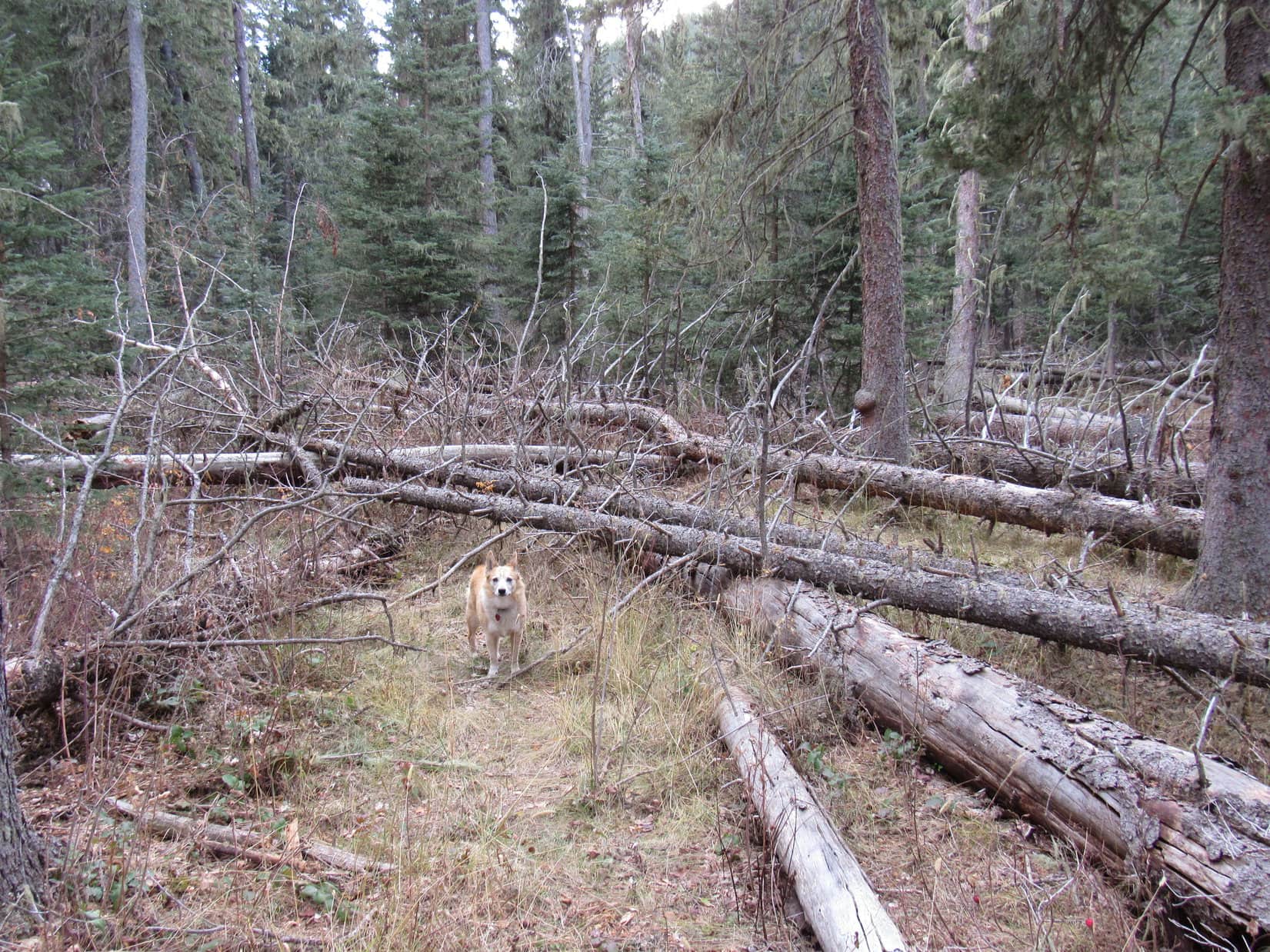
She had to go farther than expected to find one, and even then a bit of scrambling was involved, but Loop finally got below the drop-off.  The going was still a little slow, since the forest down here had a fair amount of deadfall to contend with, but the situation improved as Lupe headed N across the saddle leading to HP5072.  In fact, as she started up the N end of the saddle, she came to a nice view of Rankin Ridge (5,013 ft.), the high point of Wind Cave National Park.
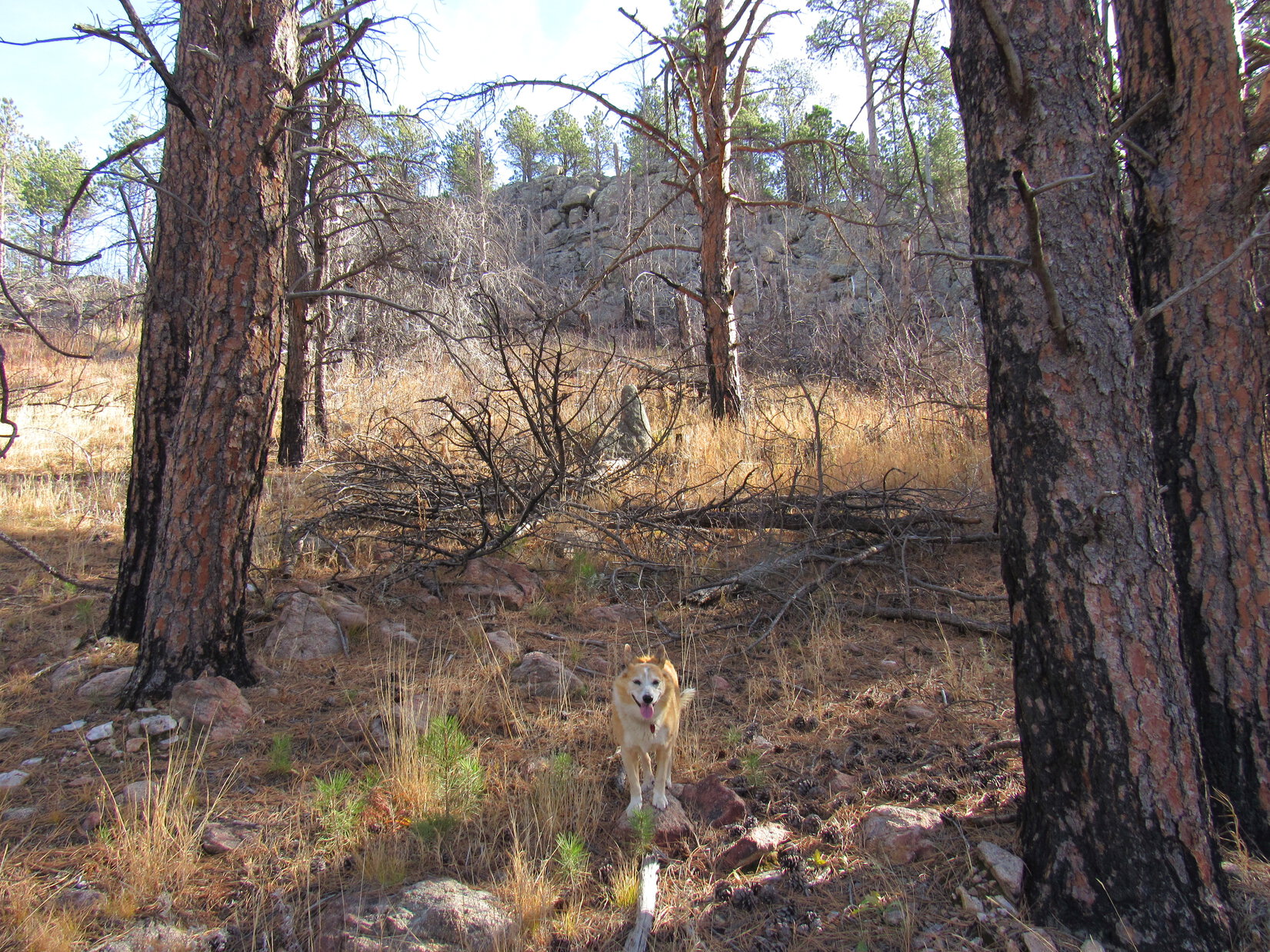
Looking back at HP5000 after finding a way down from the cliffs. Photo looks SE.
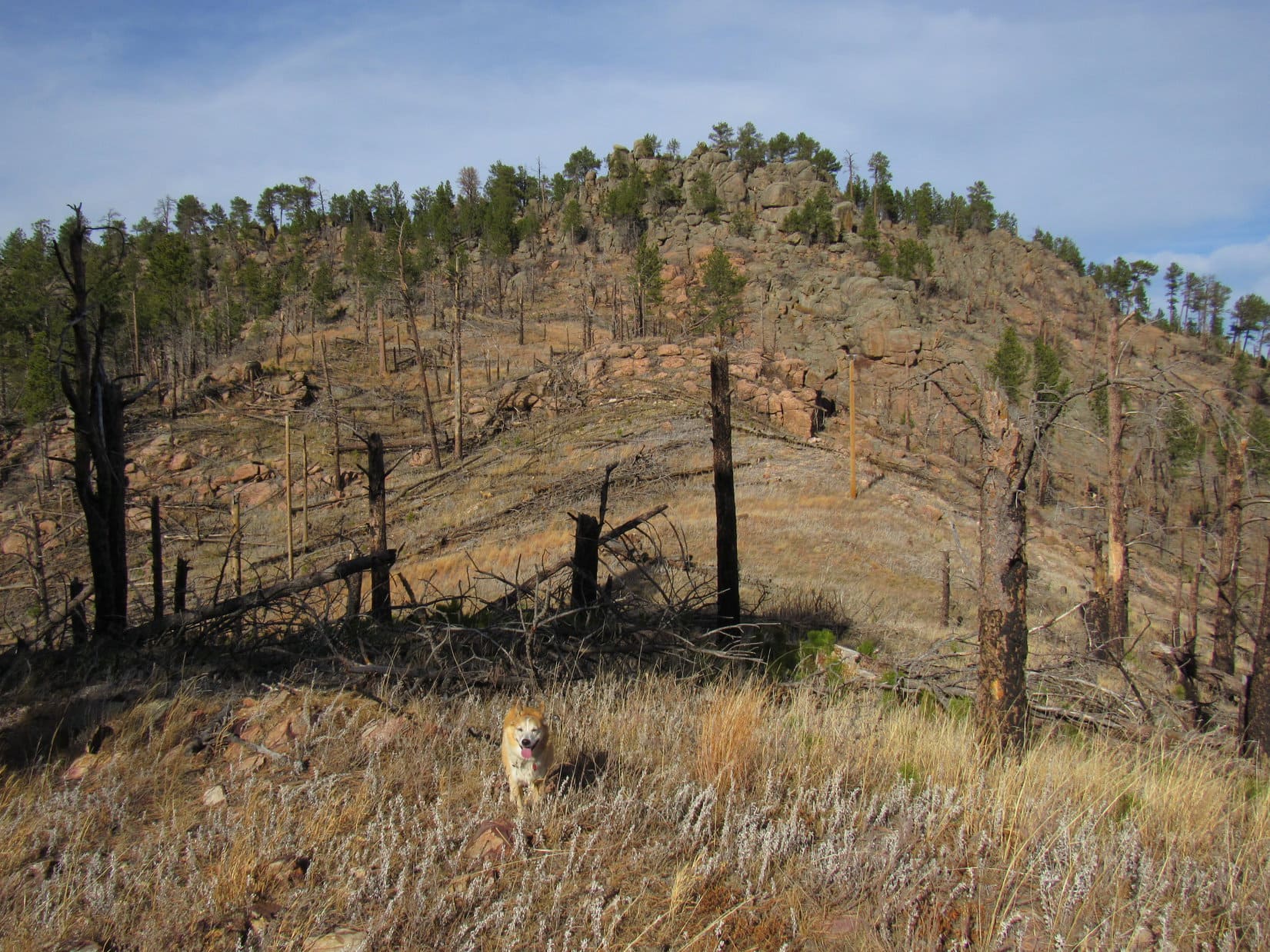
Crossing the saddle leading to HP5072 (Center). Photo looks N.
Rankin Ridge (Center), the high point of Wind Cave National Park. Photo looks E.
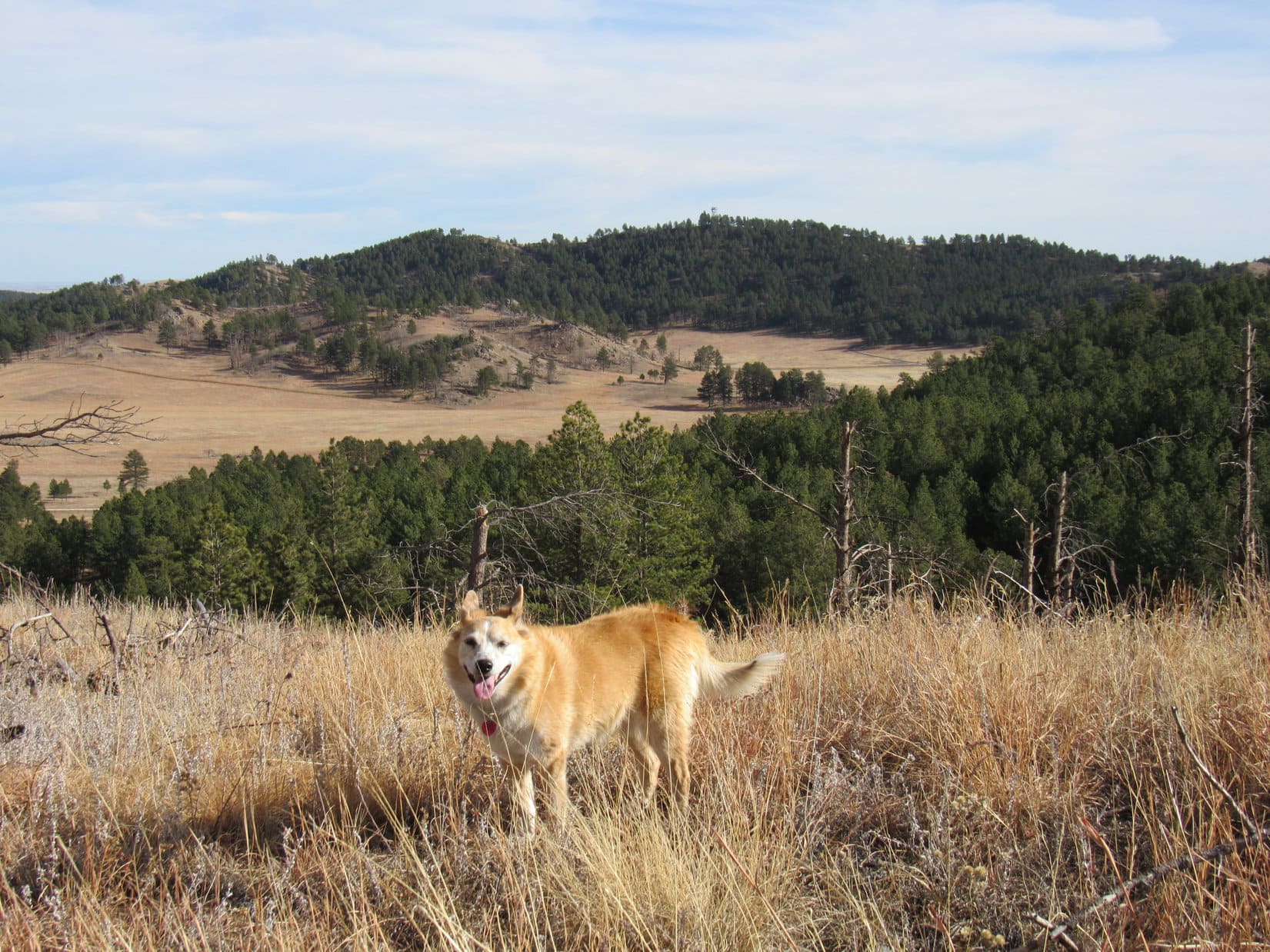
Staying toward the L (W), the climb up HP5072‘s S face wasn’t bad at all.  Lupe passed near some gigantic boulders at the top, but no attempt was made to see if it was feasible to get up on them.  The general impression was that any effort to do so would only be a waste of valuable time.

HP5072 was the S end of the longest, most consistent, part of the ridge Lupe was trying to follow.  Several minor high points were ahead.  The next objective was HP5227 near the N end, more than a mile away.

Thickly forested terrain N of HP5072 soon led to the first of the minor high points.  This was a rocky spot providing another view of Peak 5604, which was still a long way off.  Beyond this first high point, the ridge narrowed and remained quite rocky.  Loop was soon forced down off a spine of massive rock formations.

E of, and well below, these rock formations, the Carolina Dog traversed a steep slope until she could get past them.
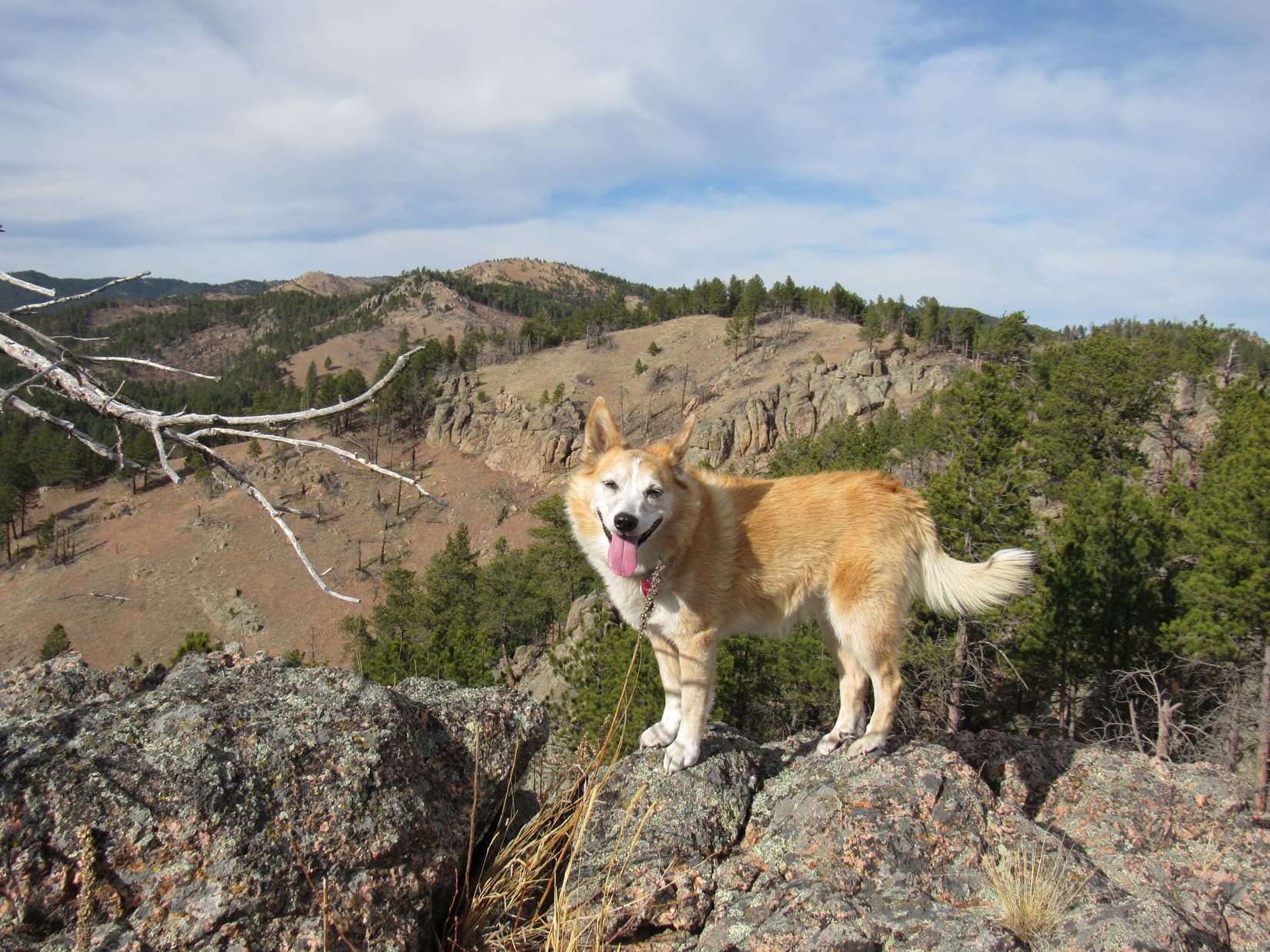
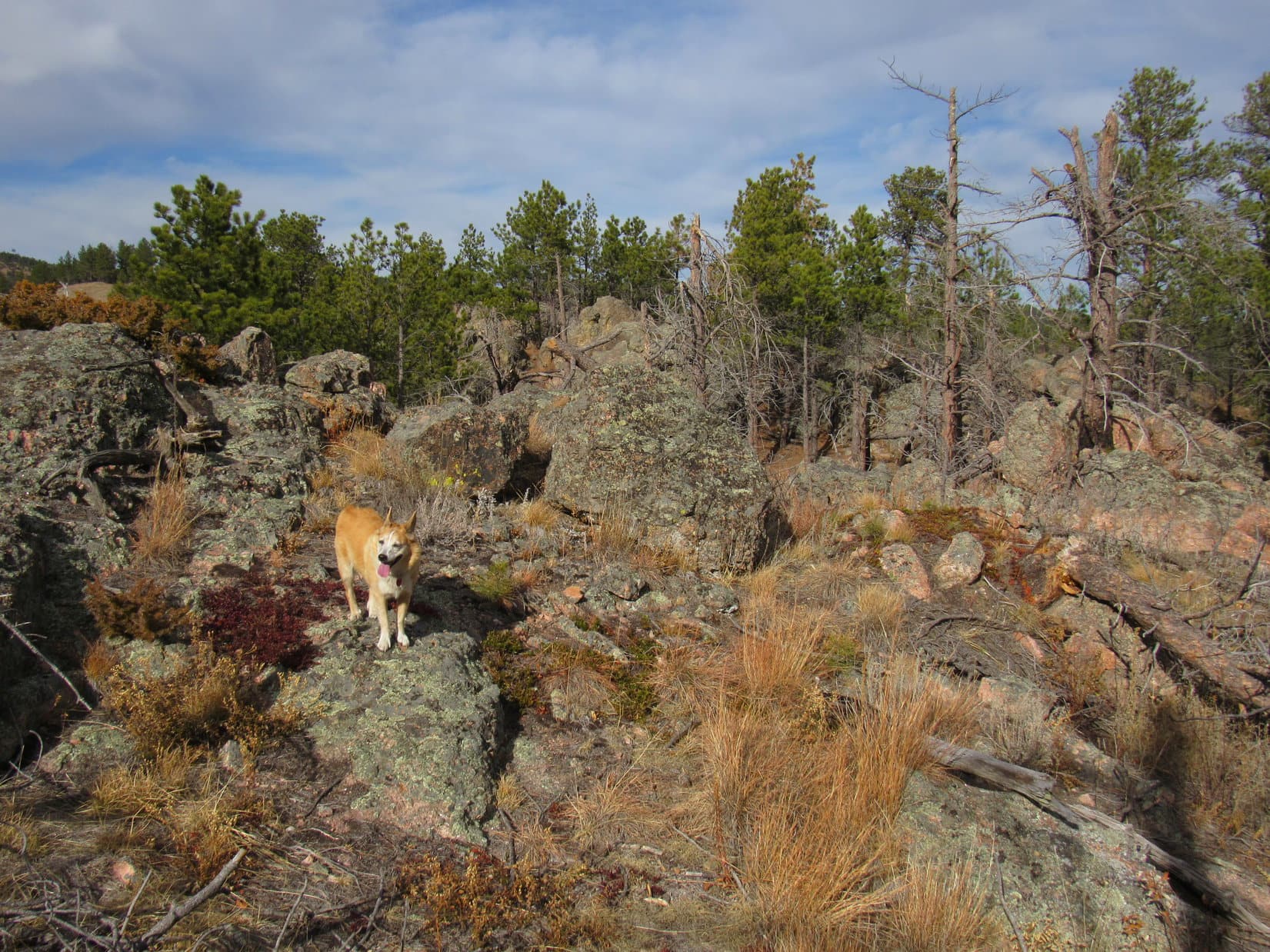
Peak 5604 (Center) from the first minor high point N of HP5072. Photo looks NNW.
N of the first minor high point, the ridge was rocky and narrowing. Photo looks NNE.
Traversing the forested slope E of the ridgeline. Photo looks N.
Back up on the ridge, approaching the next minor high point. Photo looks N.

The second minor high point along the way wasn’t as rocky.  More open toward the S, Lupe had a nice view of the route she had been traveling.
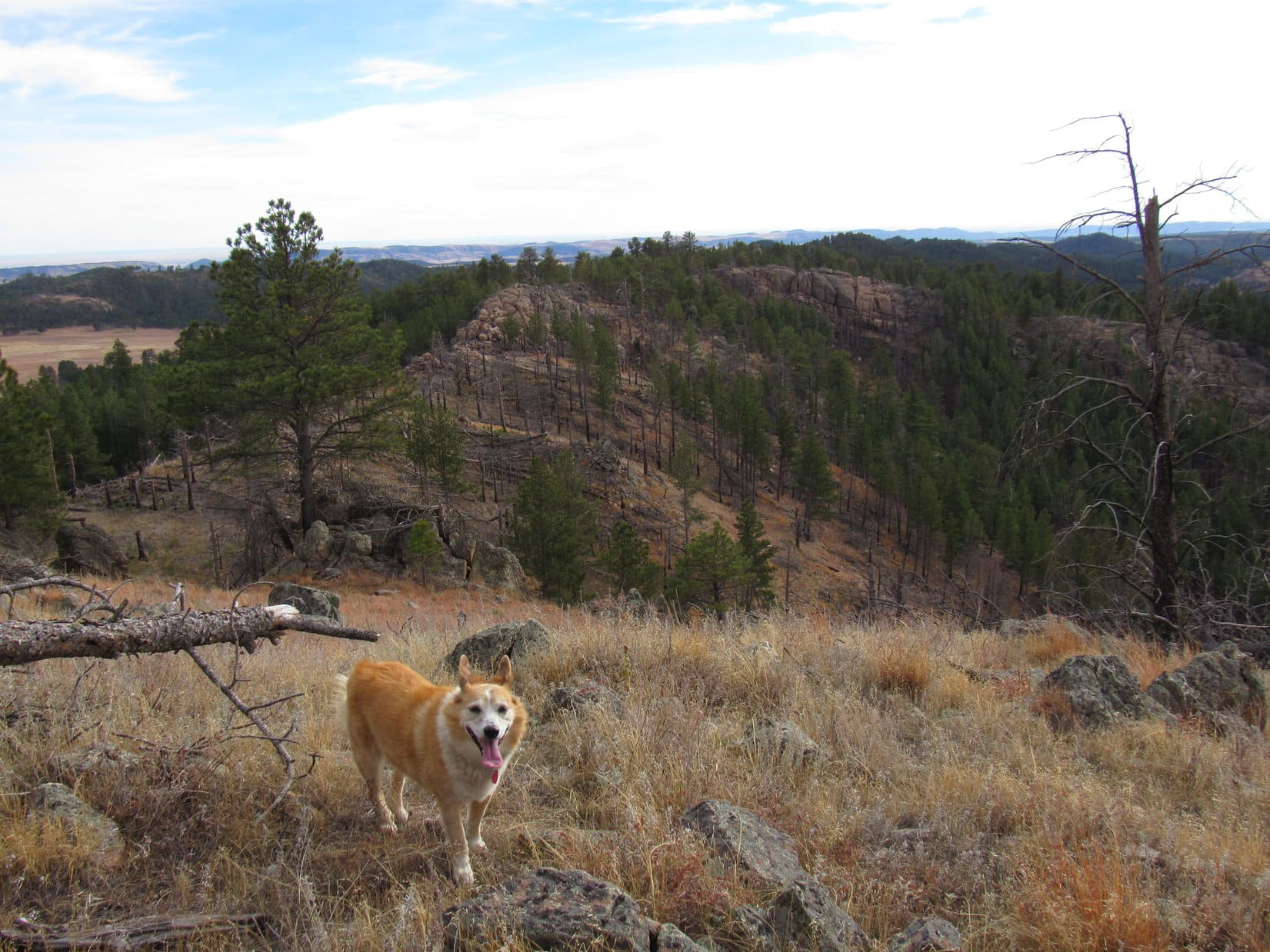
Looking back along the ridge. Photo looks SSE.

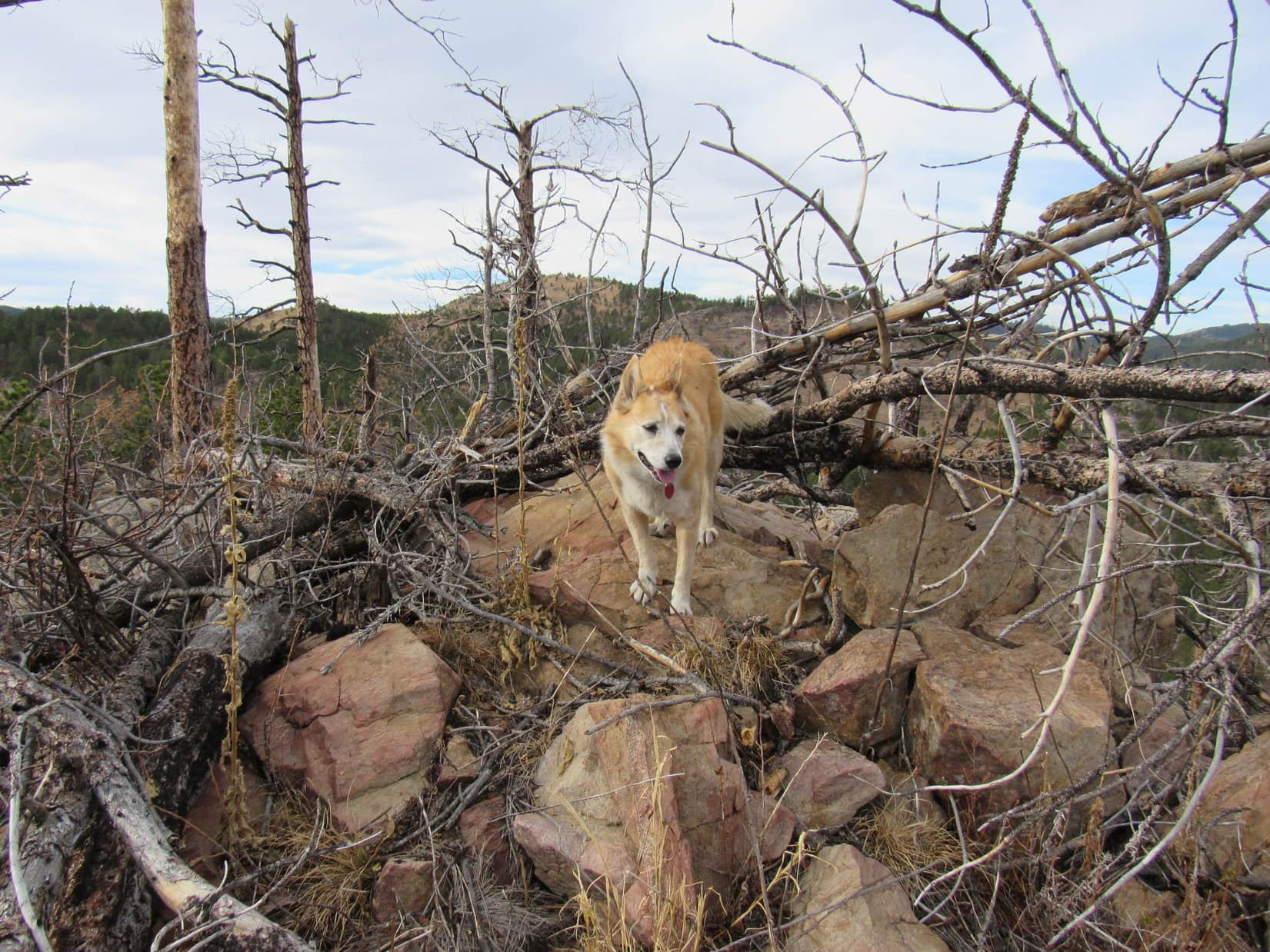
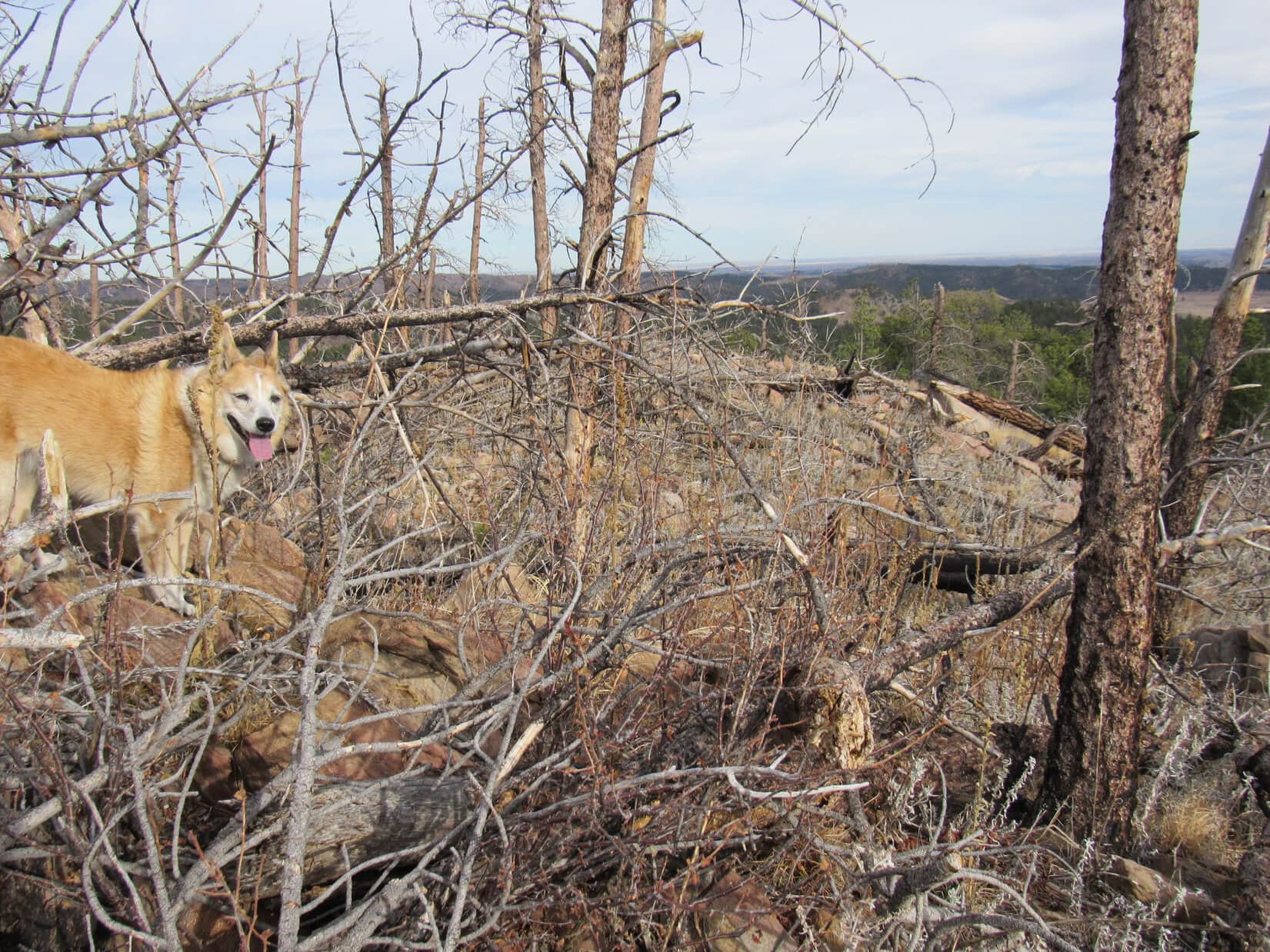
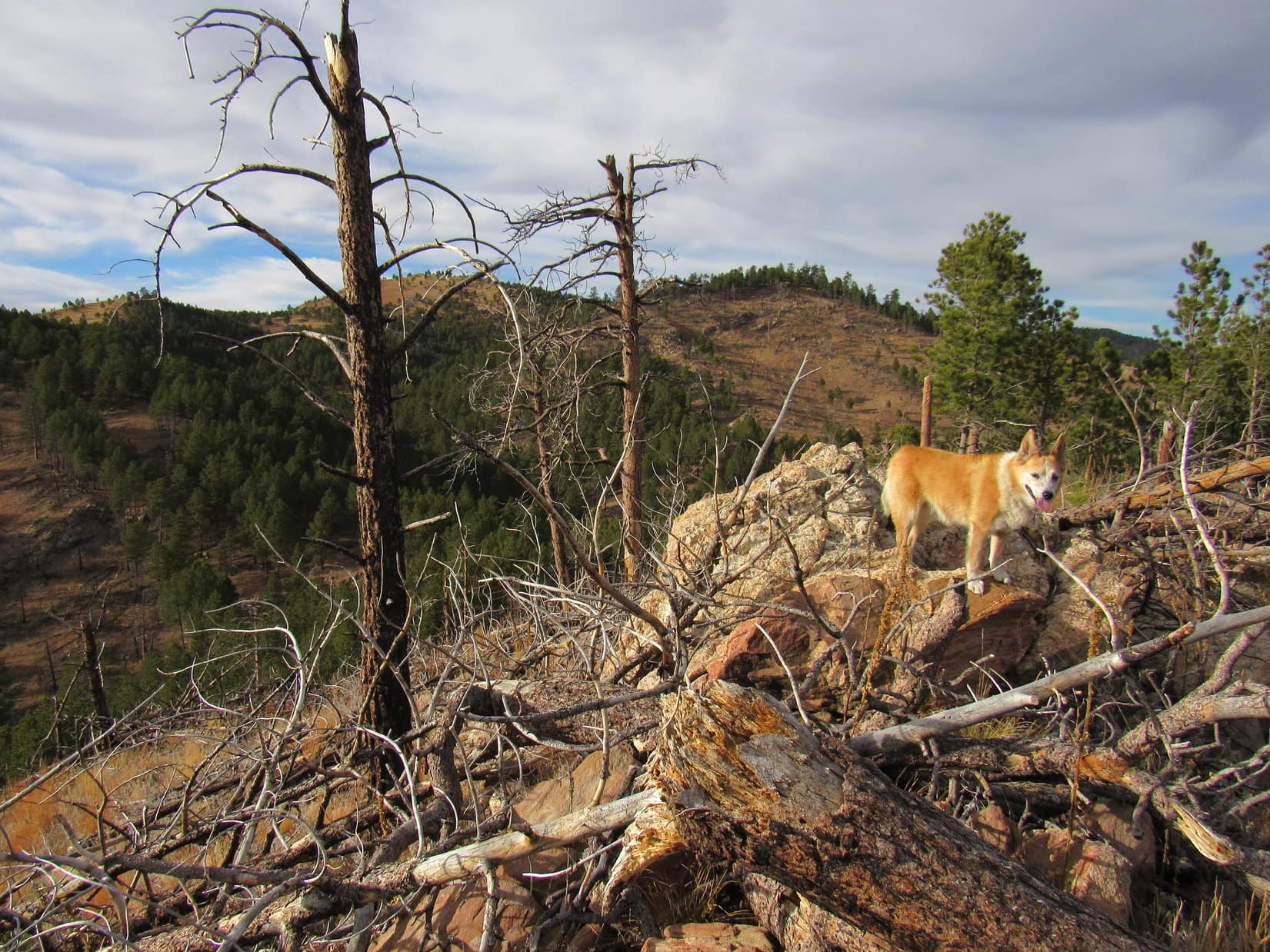
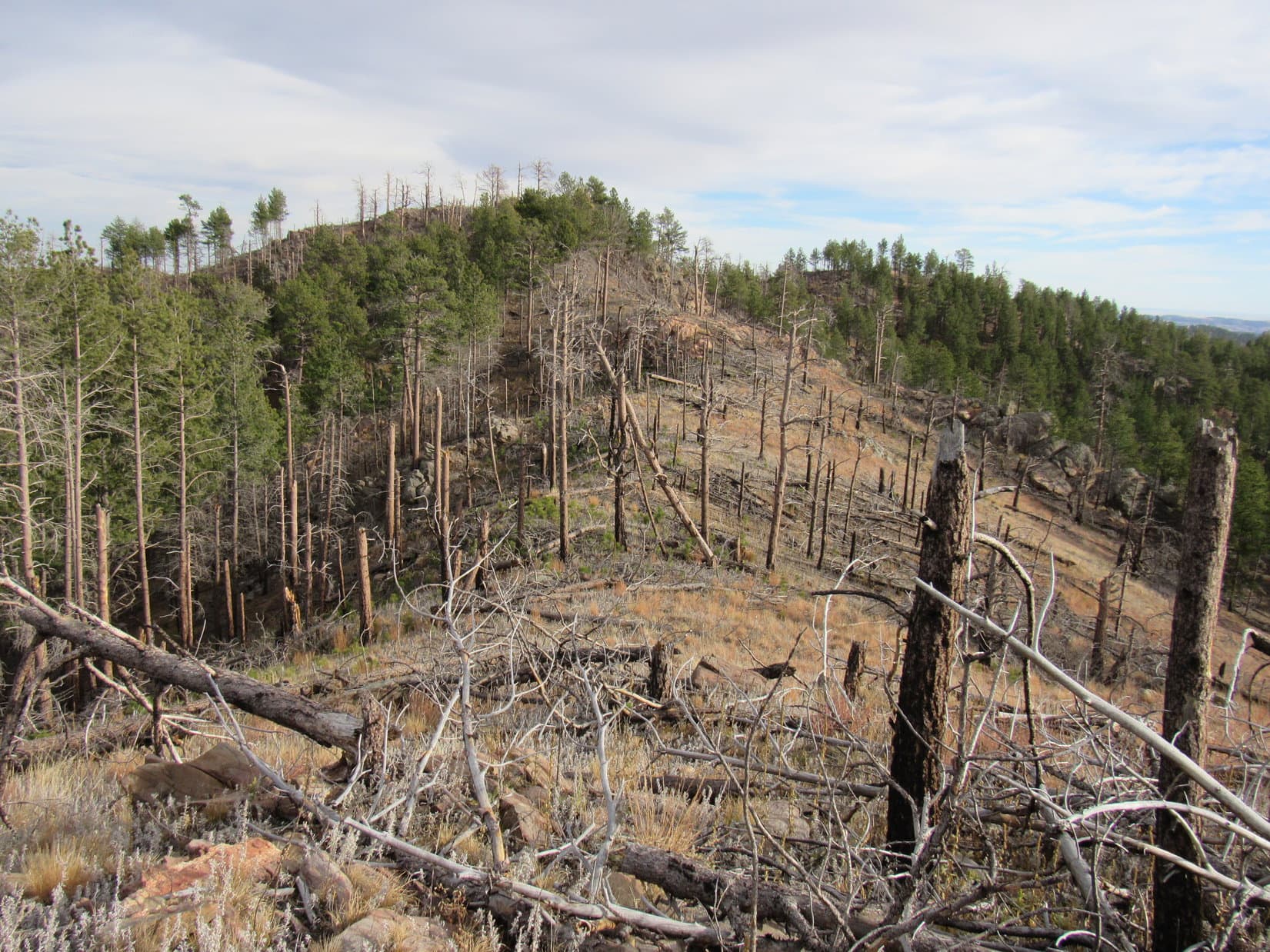
Still more up and down along the ridge to go!  HP5227 finally came into sight.  Getting there was a dismal undertaking.  Deadfall choked nearly the entire remaining distance, and HP5227 itself was no better.  Upon reaching the summit, SPHP had to snap a multitude of branches so Lupe could get to the highest rocks.  Minus the deadfall, the views would have been pretty decent from here, but it was practically impossible to move around.  HP5227 was just an ugly mess!
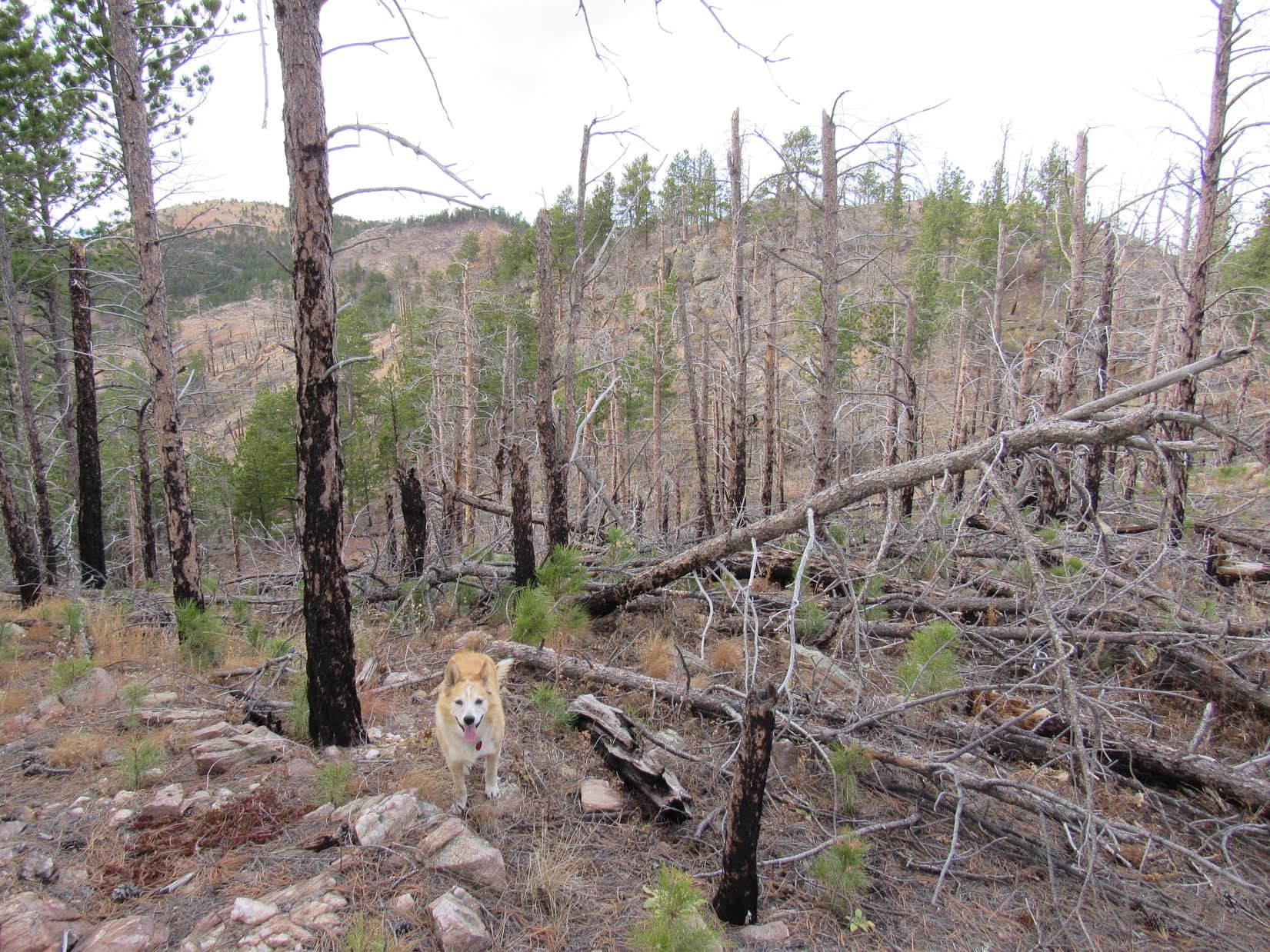
Approaching HP5227 (R). Peak 5604 (far L). Photo looks NNW.
HP5227 summit. Peak 5604 (Center) in the distance. Photo looks NW.
Like sticks? If so, HP5227 is amazing! Photo looks E.

Peak 5604 was still nearly a mile NW.  Almost 200 feet of elevation now had to be lost over 0.25 mile to get down to the last major saddle leading to it.  Lupe visited a couple of rock outcroppings during the descent.
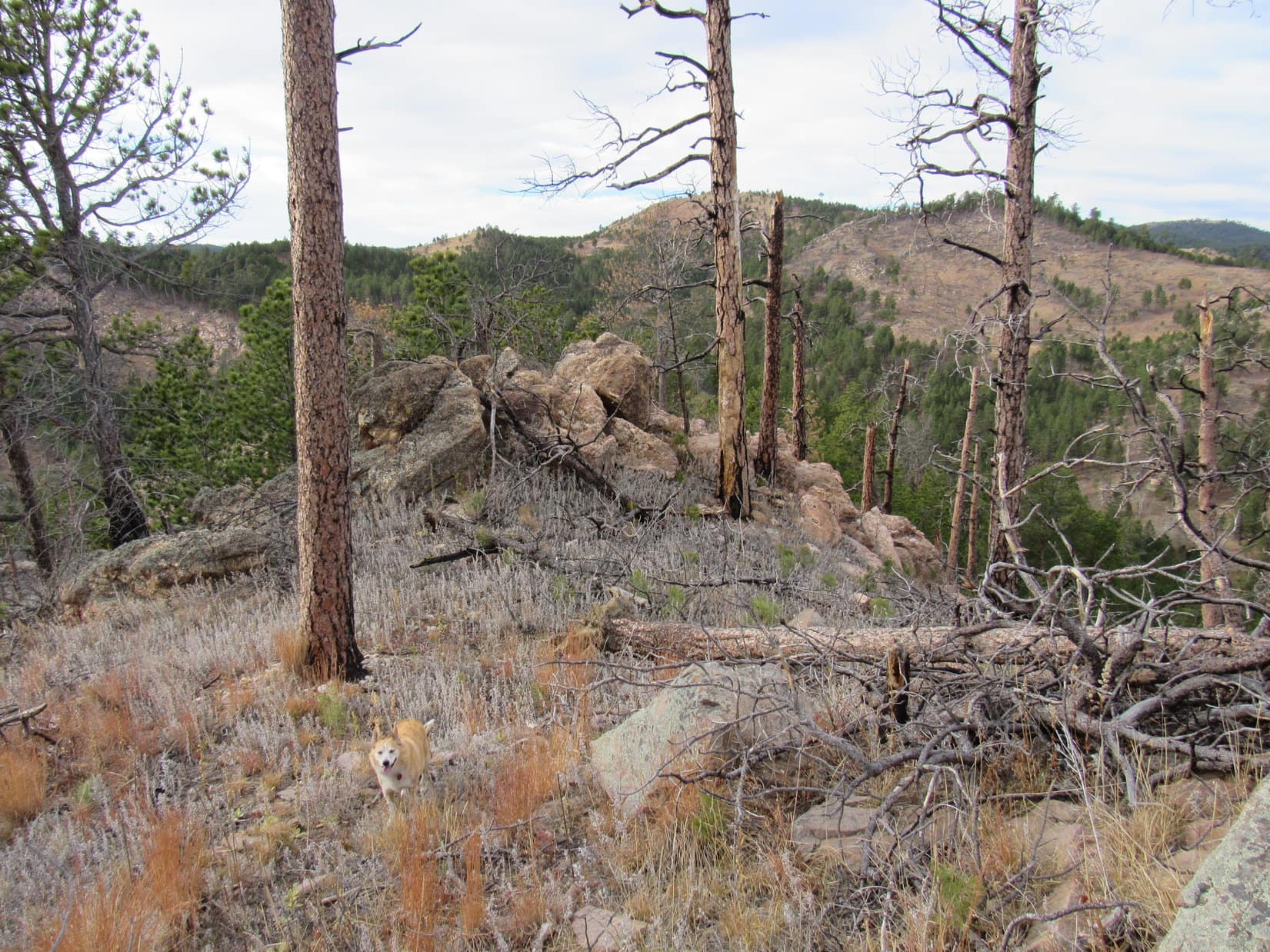
Approaching the first rock outcropping NW of HP5227. Peak 5604 (R of Center), HP5422 (R). Photo looks NW.
At the second rock outcropping NW of HP5227. Peak 5604 (L) and HP5422 (R). Photo looks NW.
Looking back at HP5227 (Center) from the second rock outcropping. Photo looks SE.

By the time Lupe got down to the saddle, she’d left the horrid deadfall behind.  Going W from the saddle, the Carolina Dog quickly discovered a game trail that climbed slowly through forest as it gradually turned NW.  The trail led to a tall grass meadow in the valley SE of Peak 5604.
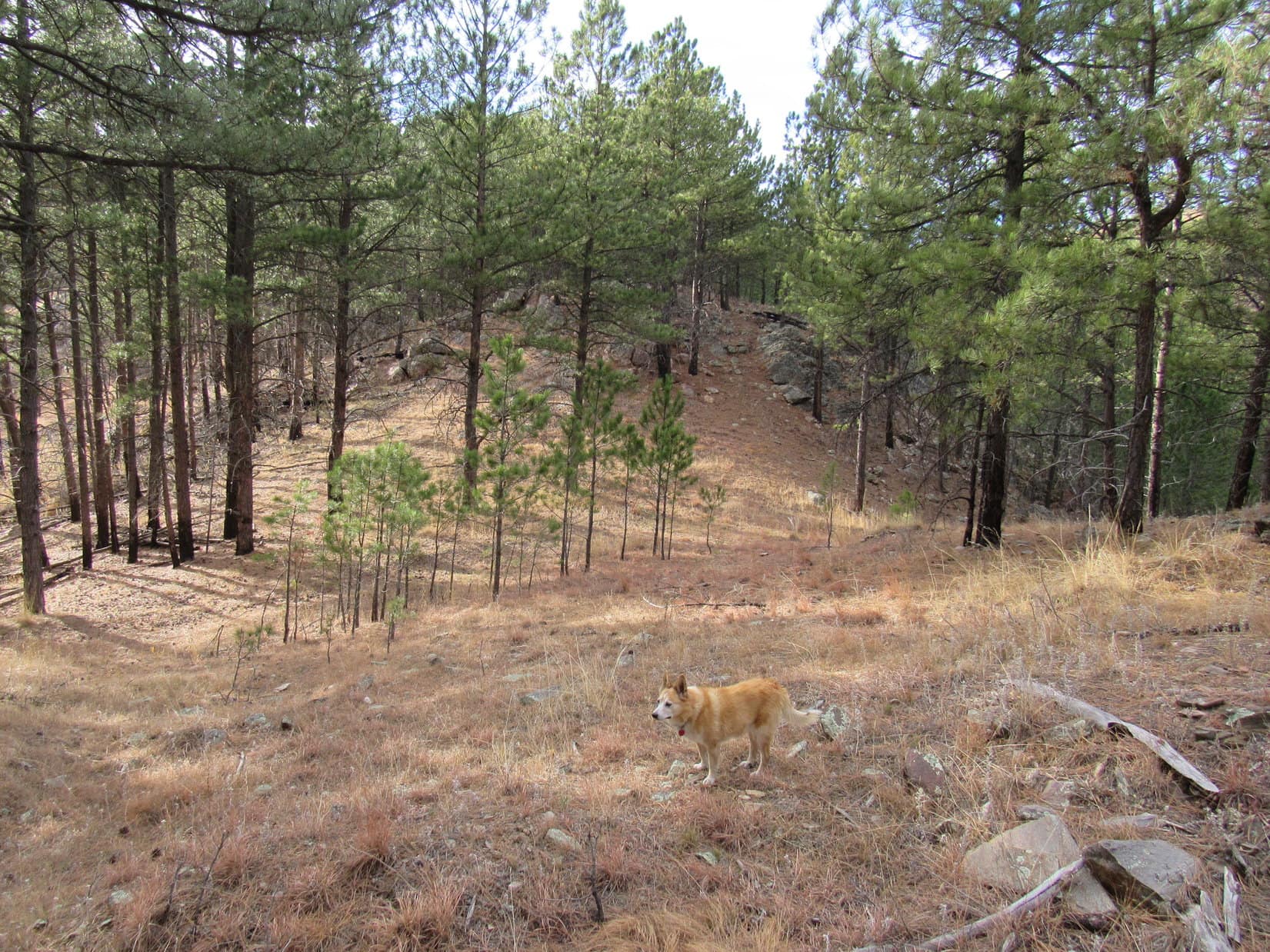
At the saddle between HP5227 and Peak 5604. Photo looks NW.
Following the game trail. Photo looks NW.
Entering the meadow. Photo looks NNW.

The trail vanished.  Lupe continued NW and the terrain soon steepened.  Turning WNW, the American Dingo reached Peak 5604’s S ridge, already quite high on the mountain.  All that remained was a steady trudge to the top, passing scattered pines, minor rock formations, and a bit of deadfall along the way.
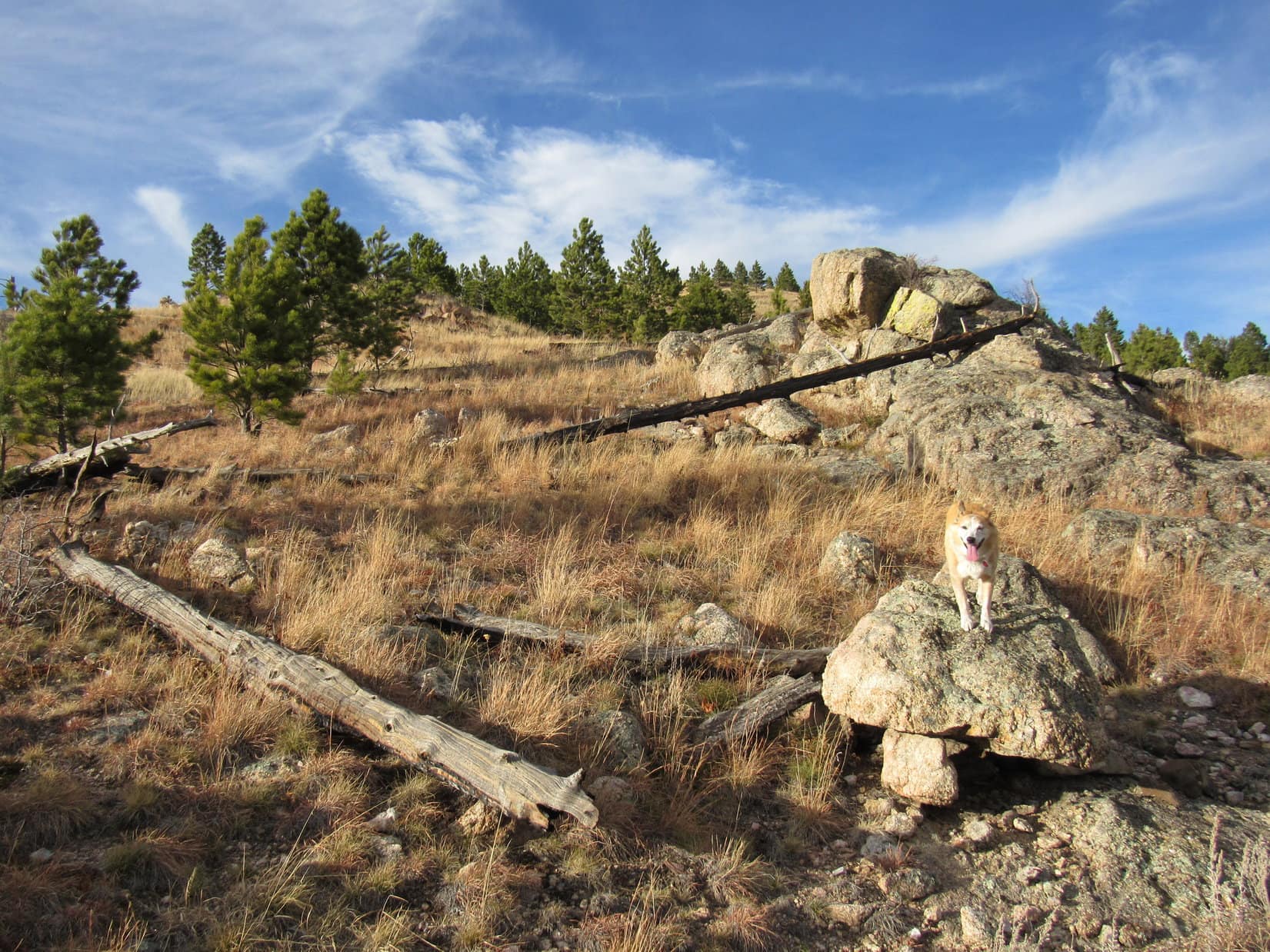
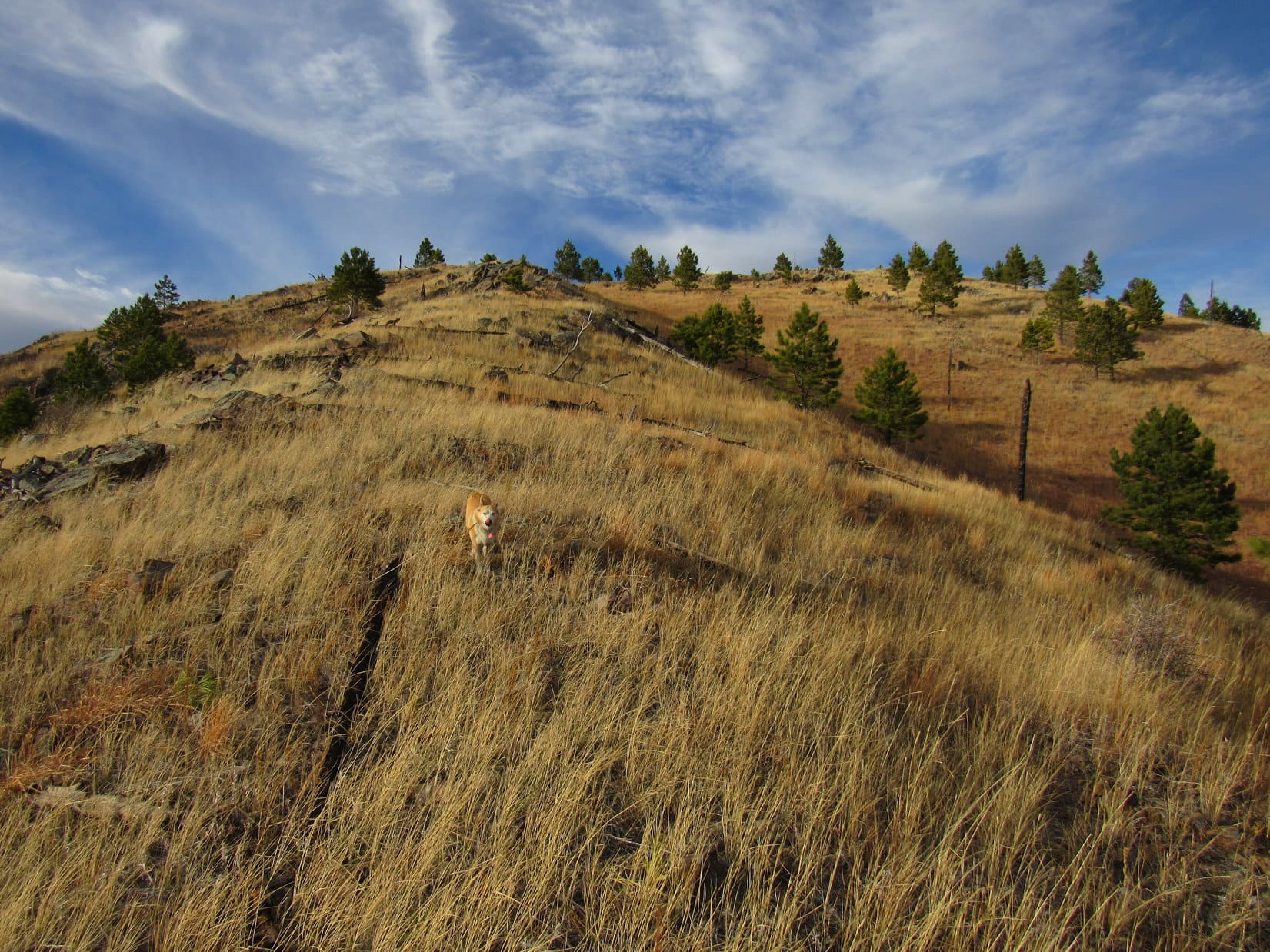
Climbing Peak 5604’s broad, poorly defined, S ridge. Photo looks NNW.
Getting close to the top! Photo looks NNW.

3:52 PM, 65ºF, Peak 5604 –  Nothing to it, but it had taken a long time to get here.  Lupe arrived at Peak 5604’s summit as the sun was getting low.  A light breeze stirred out of the W.  Incredibly warm out, maybe a record for this date in the middle of November?

After standing on the highest rock to claim her peakbagging success, Lupe looked for a place to relax.  Most of the top of the mountain was meadow, but the small elevated region near the true summit was rockier than decent consideration for comfort would have dictated.  For a while, the Carolina Dog wound up on SPHP’s lap.
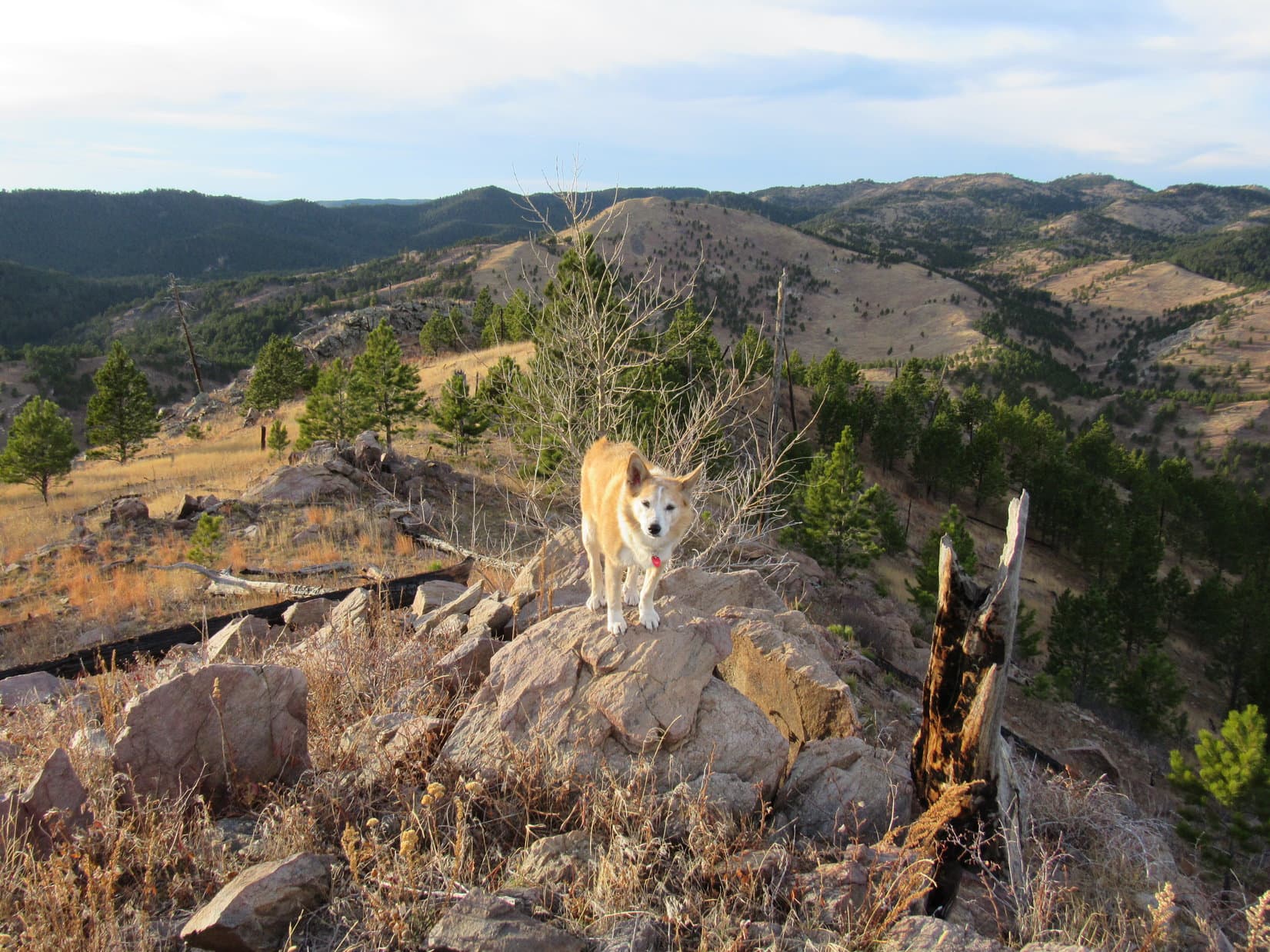
Success! At the true summit of Peak 5604. Photo looks NW.

Time for the traditional water, apple, chocolate coconut bar, and Taste of the Wild break!

Congratulations, Loopster!  Harder than I thought it would be, but we got here!

Peak 5604 was so worth it, though, SPHP!

Yes, the ridge route was fun, although, as usual, I could have done without all the deadfall.

Dream on, SPHP!  Par for the course in the Black Hills, and you know it!  Anyway, don’t forget!  It’s a good thing we came this way, because we now know the secret location of the precious Pink Dingo!

Precious Pink Dingo!  What on earth are you talking about?

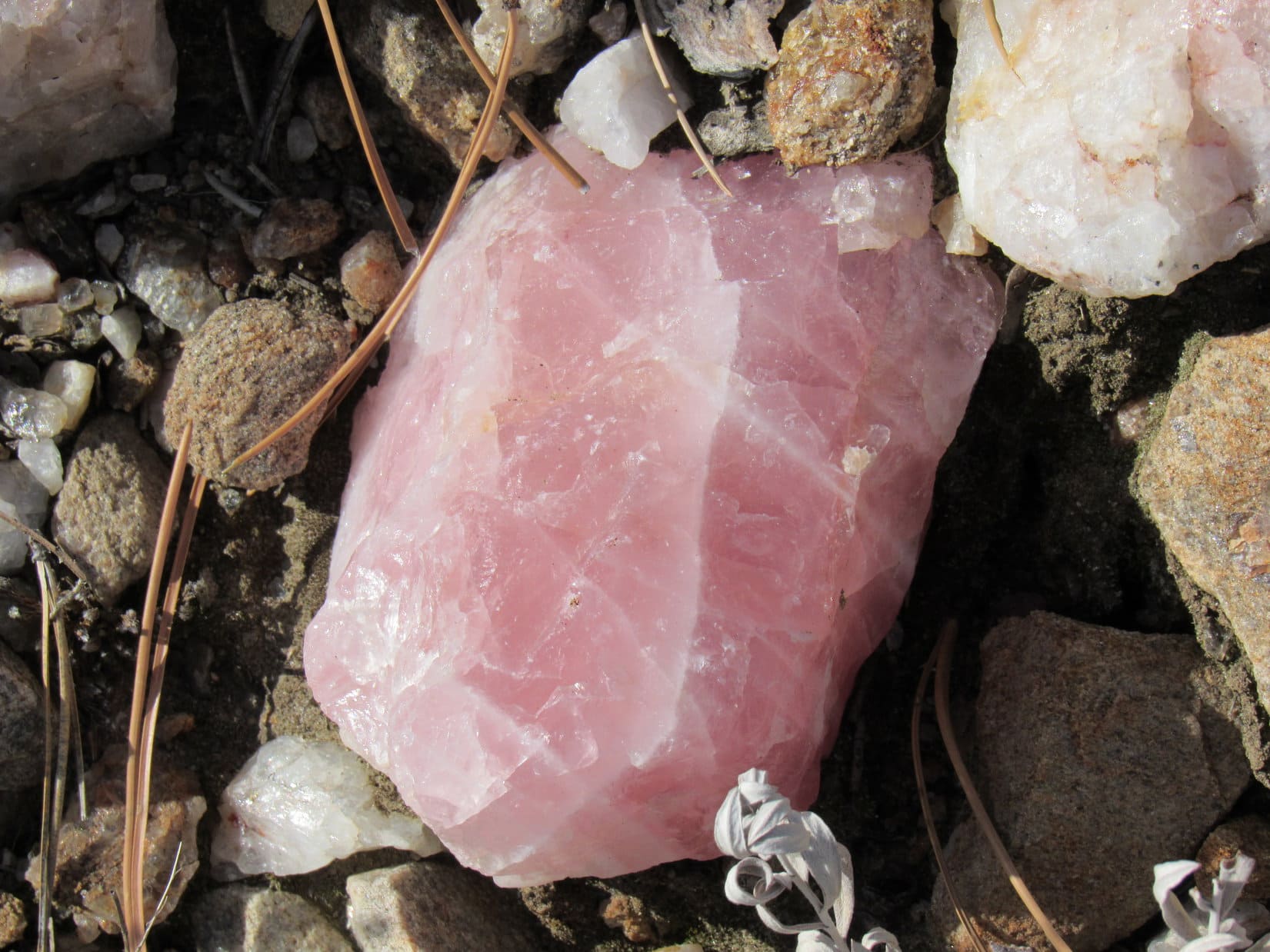
That huge gem we found, SPHP!  The enormous pink one!  It must be worth millions!  I still don’t know why you just left it there.

You mean that fist-sized piece of rose quartz?  Yes, a very nice specimen, but it isn’t worth millions.

Of course, it is, SPHP!  Admit it!  The Pink Dingo is the most magnificent geological discovery we’re ever made in all our wanderings!

Aren’t you forgetting the geodes we found once, Loop?

No, I’m not.  They were pretty, but small.  The Pink Dingo outshines them all!

Well, maybe so, Looper, but why are you calling a chunk of rose quartz “the Pink Dingo”?  It wasn’t shaped like a Dingo at all.

Don’t you know anything, SPHP?  Panthers are world famous for finding an incredibly valuable pink gem.  Mastermind thieves are always trying to steal it.  It’s called the Pink Panther!  Everyone else on the planet knows it isn’t shaped like a panther, but named in honor of the panther that found it!  You must be related to that inspector Clouseau in the documentary.

Ahh, I see.  So now there’s the Pink Dingo!

Undeniably discovered by an all-American Dingo, SPHP!  As you are my witness, the Pink Dingo is going to make us rich and famous!  You’ll see!

Rich and famous!  All due to the fabulous, newly discovered Pink Dingo!  Certainly a happy thought to mull over while gazing out at panoramic views enhanced by the slanting rays of the evening sun.

Higher country was off to the NW, where the old fire lookout tower was visible on Cicero Peak (6,166 ft.).  Not quite as high, and farther away, Mount Coolidge (6,023 ft.) was NNE.  None of the territory to the S or E was as high as Peak 5604.  Lupe could see all the way to Buffalo Gap.  To the W, miles long Bowman Ridge hid what lay beyond it.

Loopster had never been to Bowman Ridge.  Might be fun to explore it sometime.  Maybe another Pink Dingo, or even a Pink SPHP, was over there?
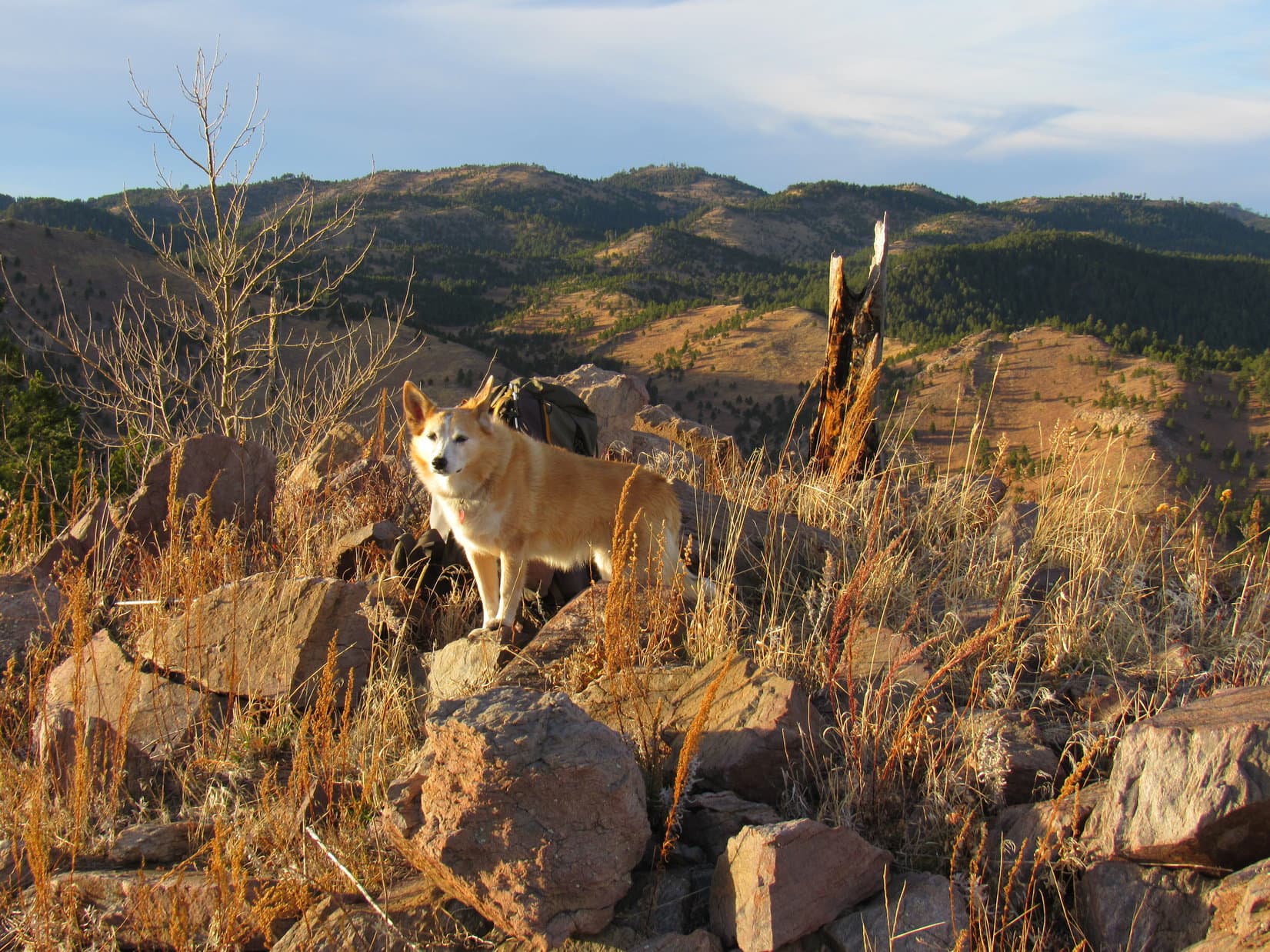
Cicero Peak (Center). Photo looks NW with help from the telephoto lens.
Mount Coolidge (far R) in the distance. Photo looks N.
Buffalo Gap (R) in the distance. Photo looks ESE.
Bowman Ridge along the horizon. Photo looks W.
The way Lupe had come up. Photo looks S.

Nearly an hour after arriving at Peak 5604, Lupe once again stood on the highest rock.  SPHP started down first, then called her when her summit hour was complete.
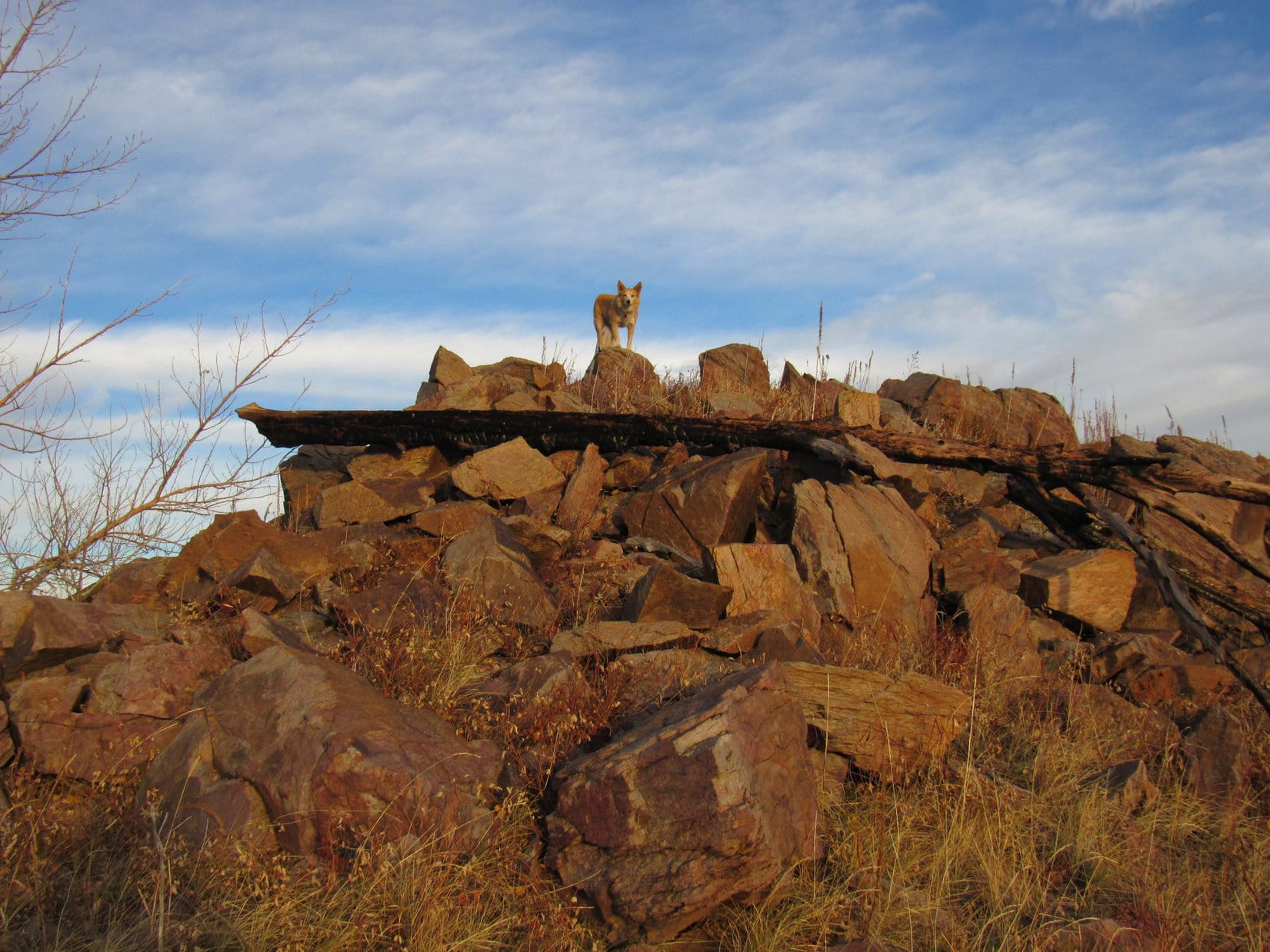
Final moments on Peak 5604. Photo looks, E.

Then it was down the mountain’s S ridge again in the beautiful evening sunlight.
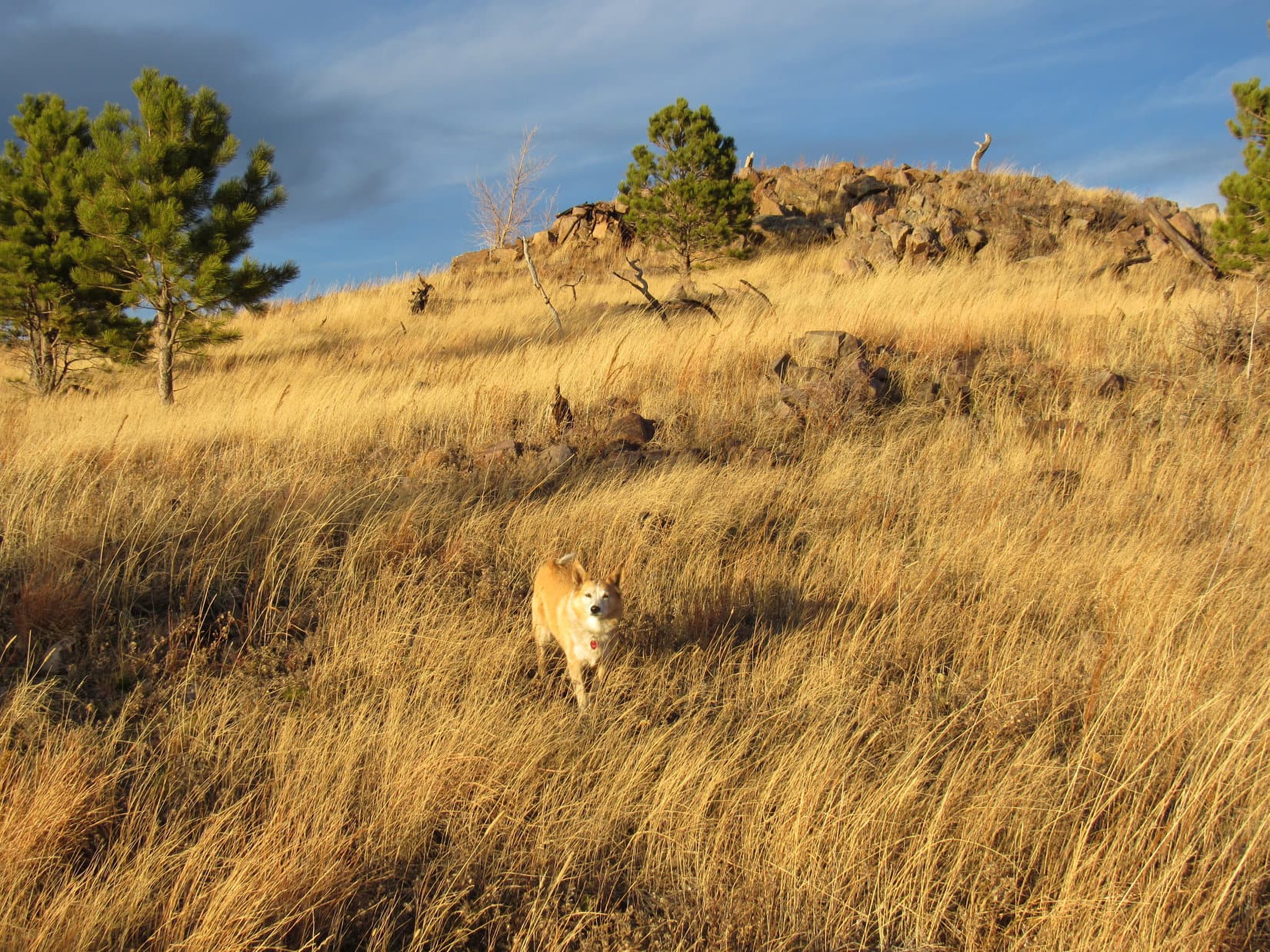
Leaving the summit region. Photo looks N.
Heading down the S ridge. Photo looks SSE.

Still some sniffing and exploring to do, but the sun was setting.  Instead of returning by the same route, which would have been horrendous in the dark, Lupe eventually turned SW off Peak 5604’s S ridge, descending into a valley.
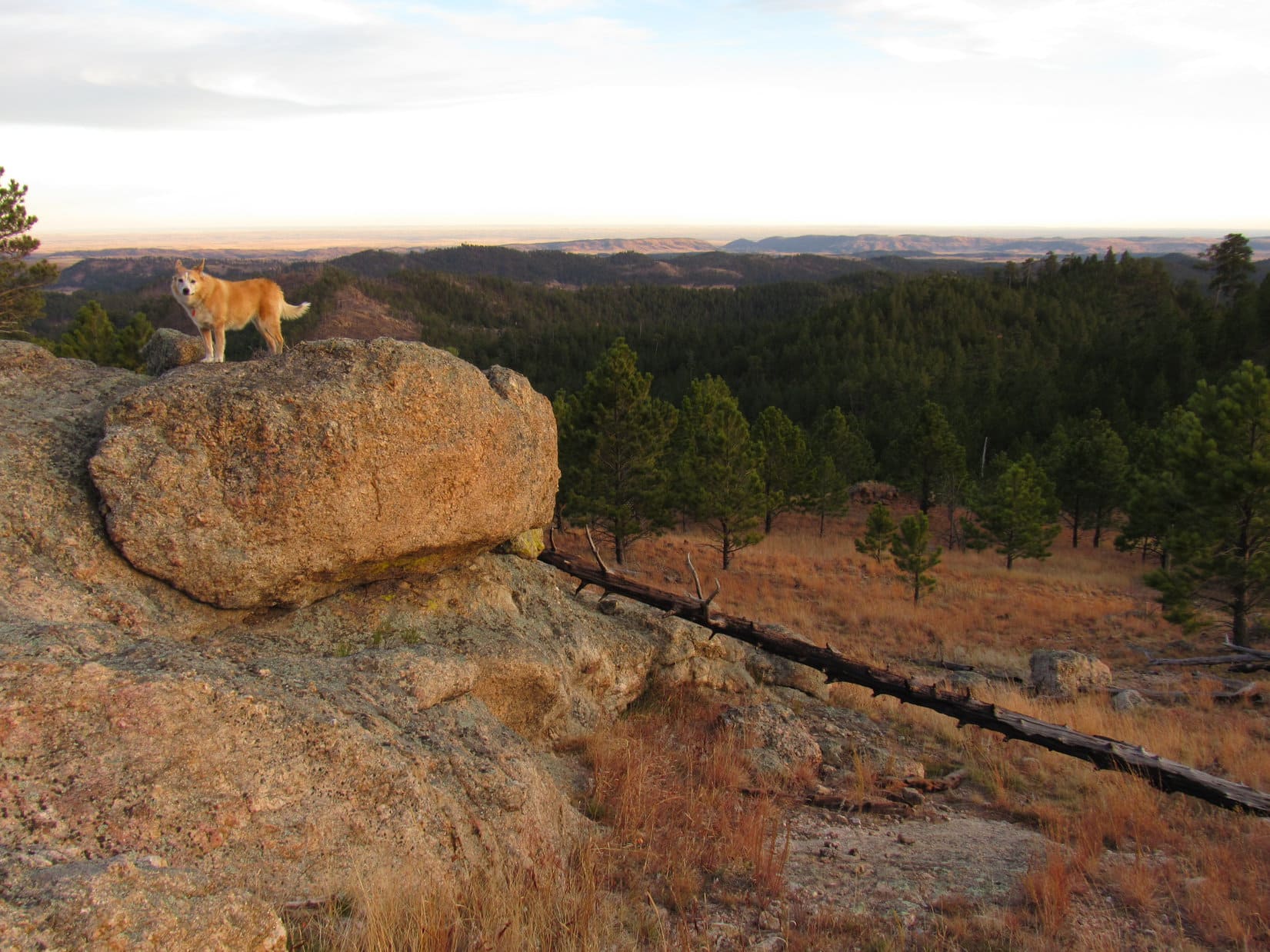
Still exploring! On the biggest rock of the S ridge. Photo looks SE.

The valley led down to Flynn Creek Road.  Road hike the rest of the way back now.  As dusk deepened and the silver stars appeared, the Carolina Dog was excited by the sight of deers grazing in the meadows.

Oh, and it was sort of fun to dream of becoming rich and famous, too!  (End 5:13 PM, 46ºF)
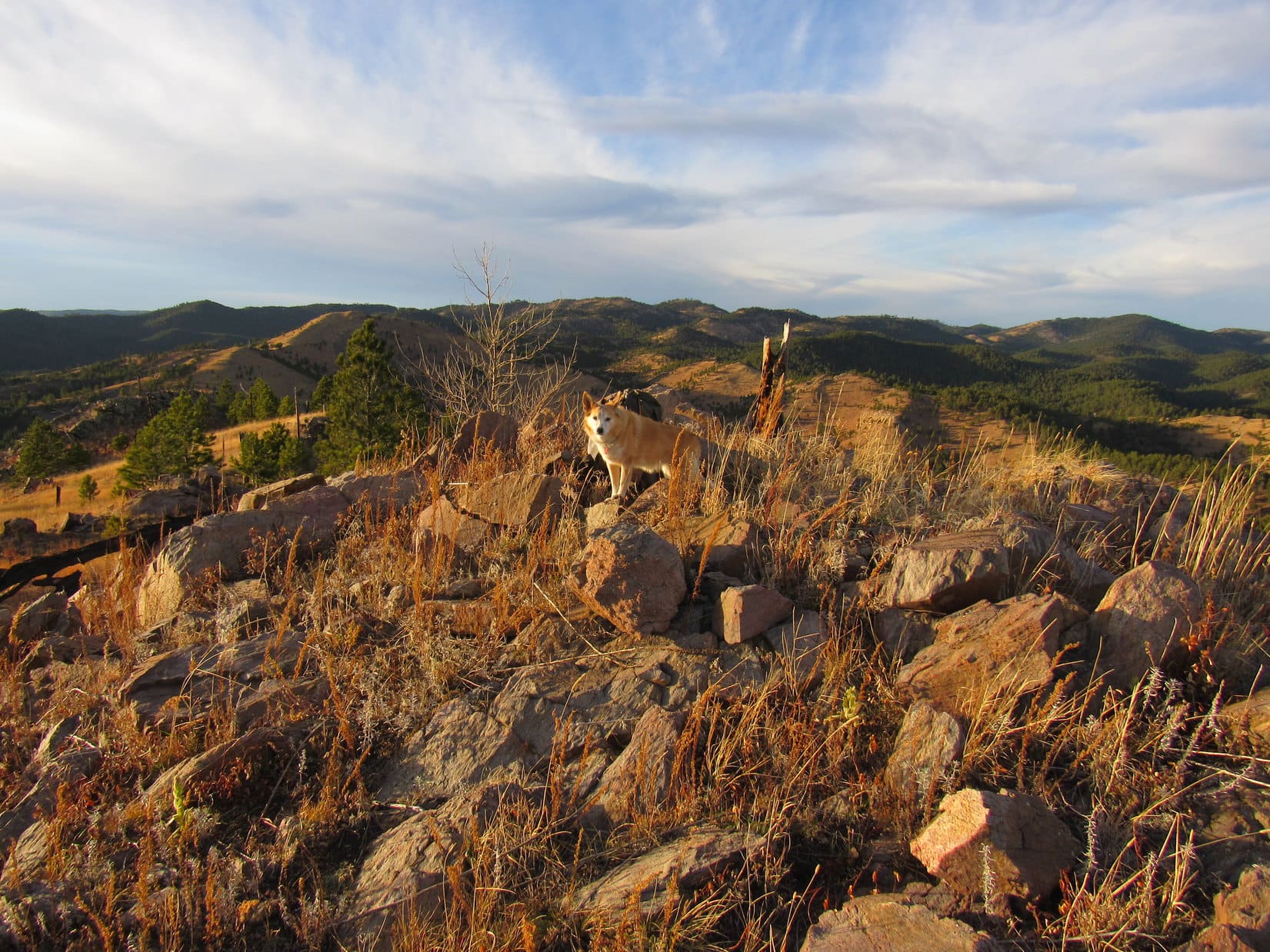
Peak 5604, Black Hills of South Dakota 11-15-21
The precious Pink Dingo!

Links:

Next Black Hills Expedition                     Prior Black Hills Expedition

Pink Panther theme song

Want more Lupe adventures?  Check out Lupe’s Black Hills, SD & WY Expeditions Adventure Index, Master Adventure Index, or subscribe free to new Lupe adventures!

Black Hills, SD Expedition No. 283 – White Tail Peak (11-6-21)

9:49 AM, 54ºF – At the end of USFS Road No. 599, SPHP parked the RAV4 at a big circular turnaround.  Lupe hopped out.  Nice and warm for early November, but she was here a little later than she ought to have been if she wanted to climb both White Tail Peak (6,962 ft.) and Peak 6962.

Parked at the end of USFS Road No. 599. Photo looks NW.

No need to decide which peak to shoot for yet, though.  The first mile would be the same for either one.  Eager to get going, Lupe headed NW into a dense forest, following an old barbed wire fence up the valley of the North Fork of Castle Creek.

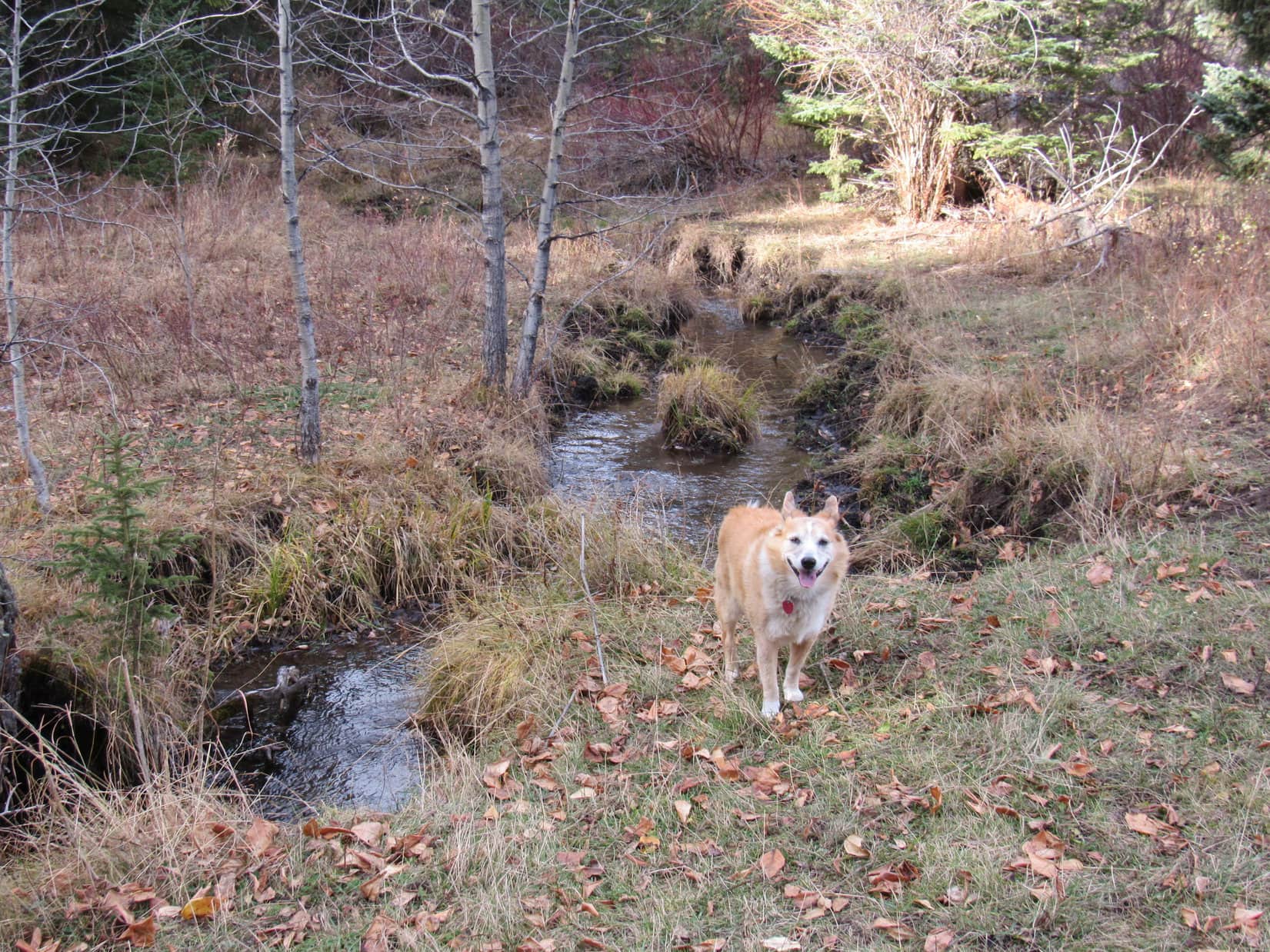
The forest was sort of a mess, full of deadfall.  SPHP’s progress was slow.  Fortunately, Lupe didn’t have far to go, before the forest opened up a bit.  Ducking through the barbed wire fence, she quickly came to the North Fork of Castle Creek.  Although small, the stream had decent flow.

Following the barbed wire fence.
At the first little clearing.
By the North Fork of Castle Creek.

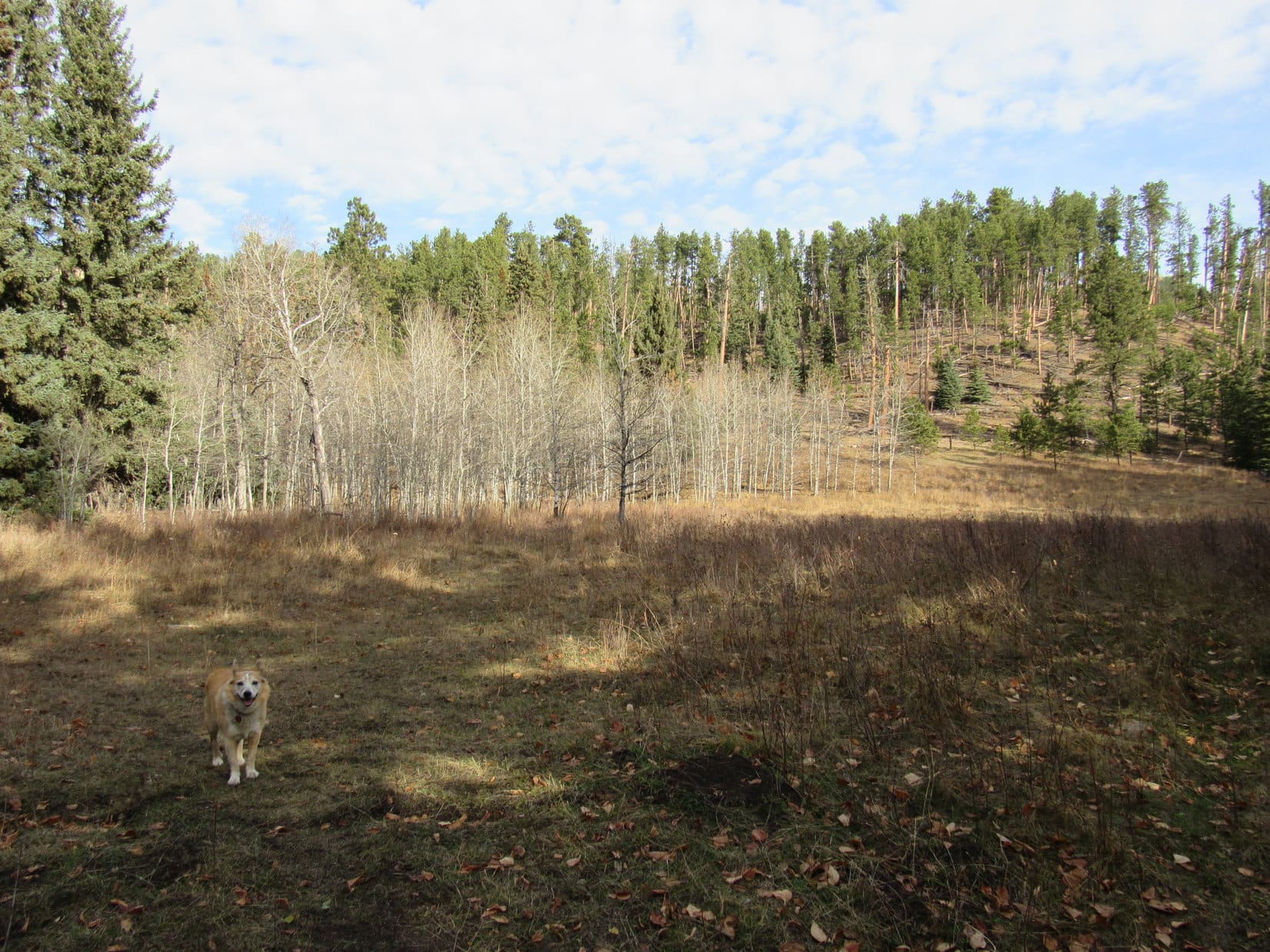
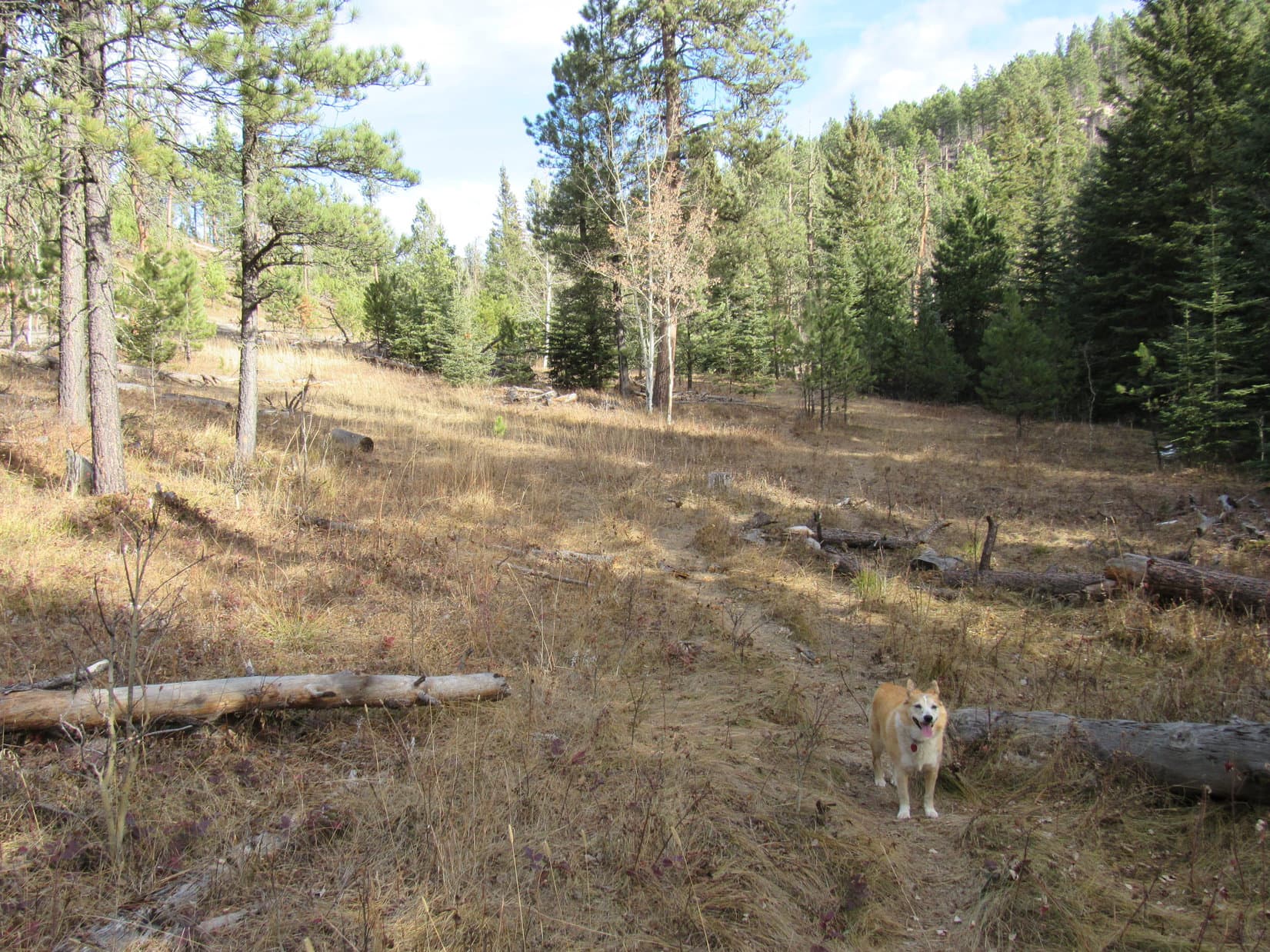
Beyond the creek was a larger clearing with a big stand of aspens at the far end.  Turned out there was an open lane through the aspens.  A faint trail ran through it.  Following the trail, Lupe came to another meadow.  To the N were some limestone cliffs, part of the S end of White Tail Peak.

The first big clearing after crossing the North Fork of Castle Creek. Photo looks NNW.
In the lane leading to the next meadow. Photo looks WNW.
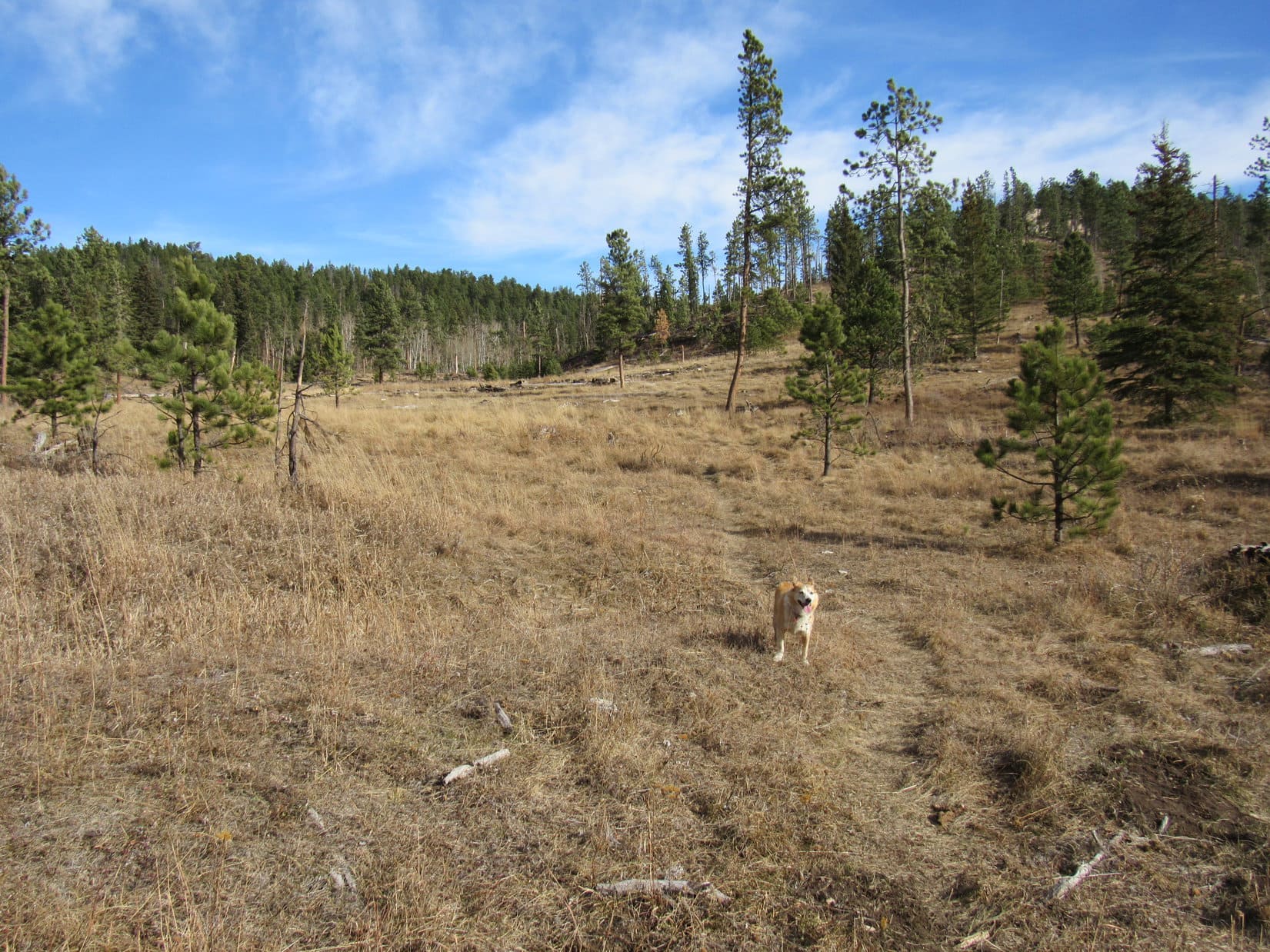
In the second big meadow. Photo looks NW.
Cliffs at the S end of White Tail Peak. Photo looks N.

SPHP was surprised when the trail persisted instead of fading away.  Certainly made life easy!  A mile from the start, Lupe came to a place where the valley divided.  The North Fork of Castle Creek forked here, too.  At a muddy spot, the trail crossed one of the tributaries.

Continuing up the valley. Photo looks W.
About to cross a tributary of the North Fork of Castle Creek. Photo looks W.

Decision time, Loopster!  White Tail Peak or Peak 6962?

Seems like an awfully long time since we’ve been to either one, SPHP.

Oh, it has been for sure!  4 years since we were last at White Tail Peak, and 6 since Peak 6962.

Either one is fine with me, SPHP.  Do you have a preference?  Maybe we can still get to both today?

We’ll give it a shot.  If I had to choose, I’d say White Tail Peak.  Best views, although we really ought to explore Peak 6962 more thoroughly.

Best views won out.  White Tail Peak it was!  The American Dingo left the divide bearing R as she continued up the branch of the valley to the NW.  This decision soon paid off with the discovery of the still considerable remnants of a melting snow bank to frolic on.
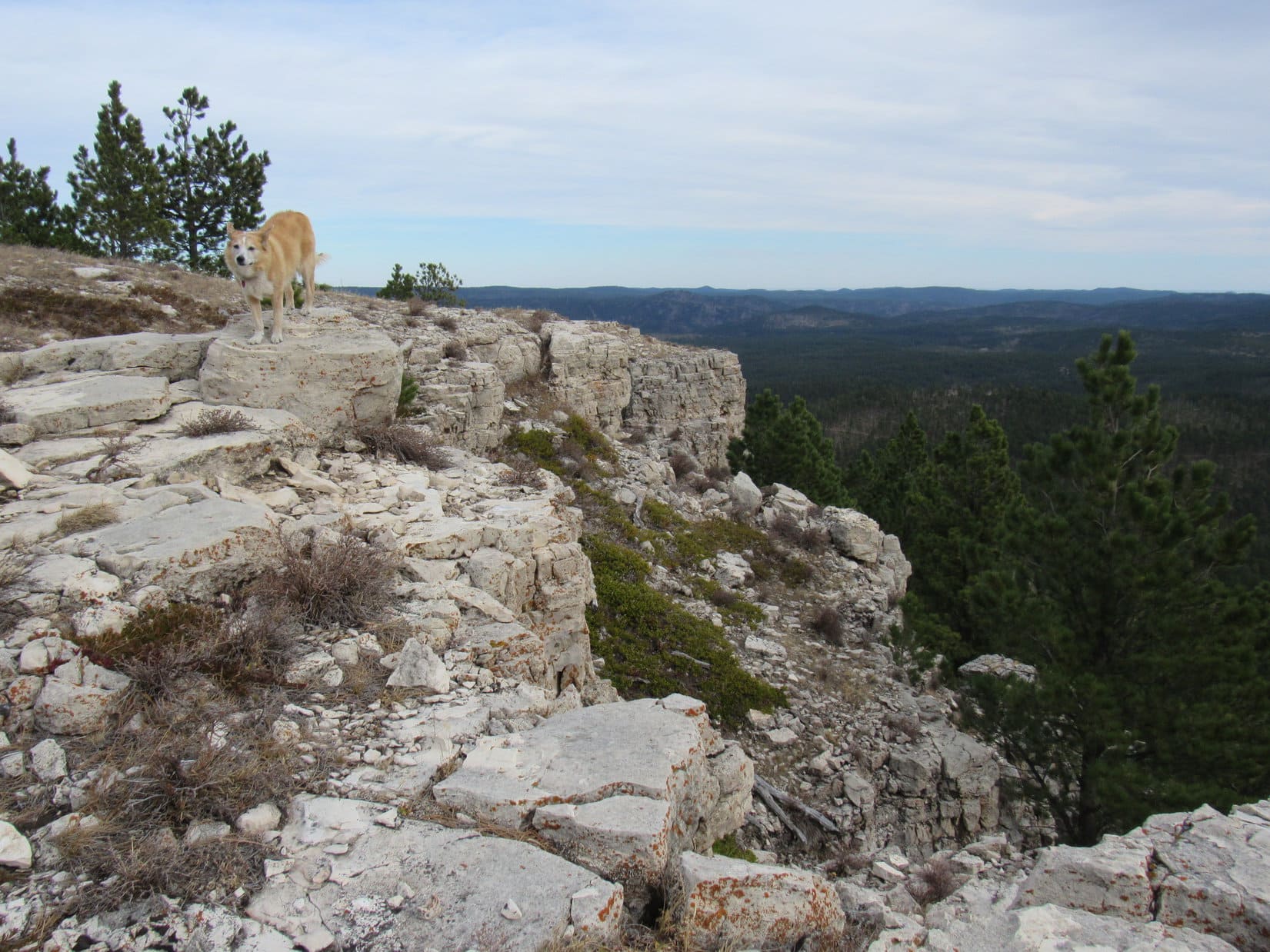
Oh, joy! Nothing like finding a snowbank on a warm day! Photo looks SSE.

0.25 mile from the first divide, the valley split again.  What was left of the North Fork of Castle Creek came from the L.  The valley to the R (NE) was completely dry.  Loop was now 1.5 miles SW of White Tail Peak as the crow flies, so that was the way to go.

Nearing the second major divide of the valley. Lupe again went R. Photo looks NNW.

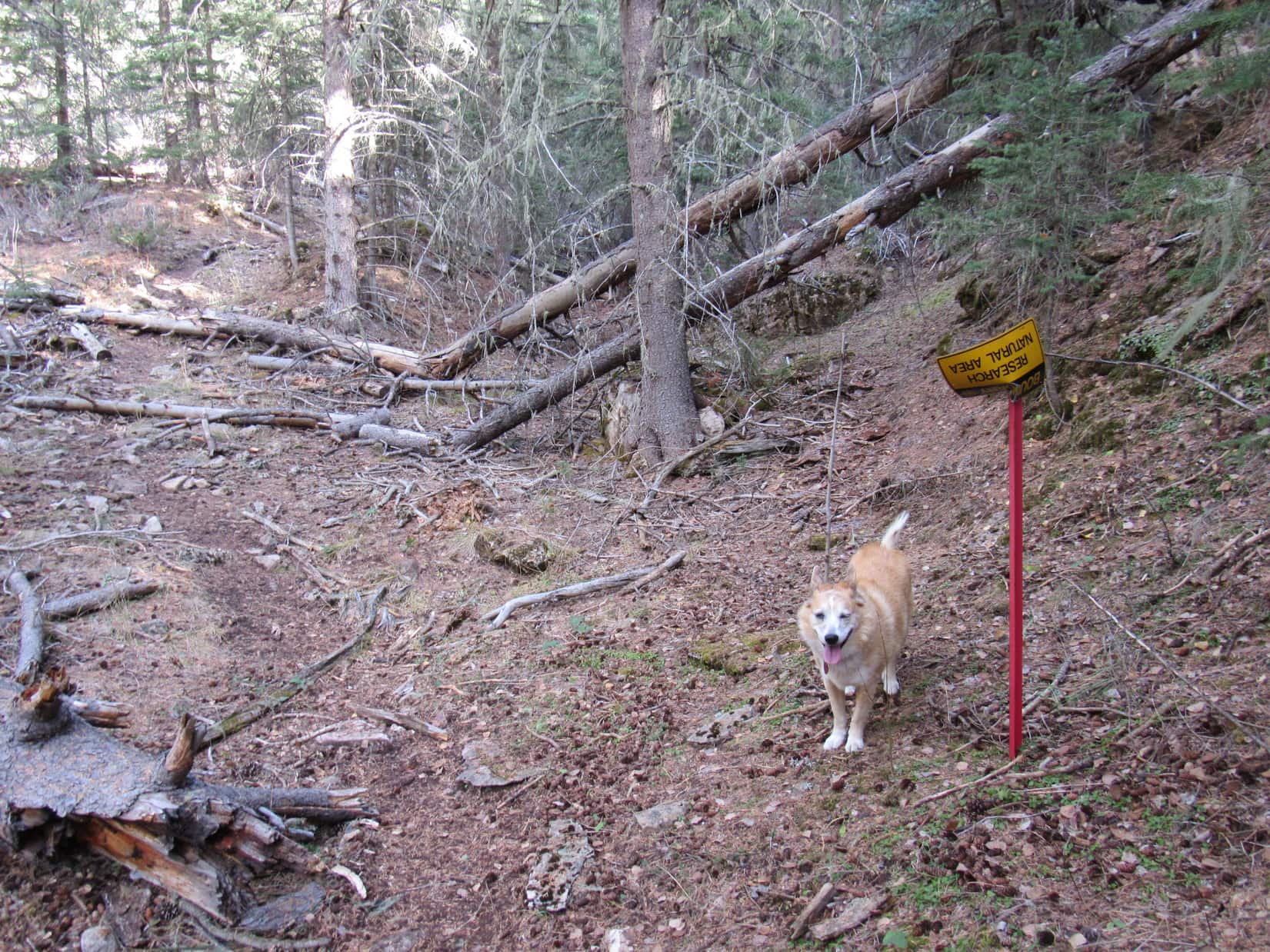
Soon after entering the NE branch, the valley deteriorated into more of a big, steep-sided ravine.  A dense forest grew here, partially choked with deadfall.  If it wasn’t for another unexpected path that wound through it all, passage would have been difficult.  Lupe came to a sign for a defunct research area.  A little farther on, she passed another.

By the first “research natural area” sign.

The path in the ravine was steeper than the nearly level trek back by the North Fork of Castle Creek.  Before long, the path climbed partway up the L side of the ravine, well above a V-shaped bottom.  As Looper kept going, she got past the densely forested section into more open territory.  Here the ravine curved N and broadened out.

The path ultimately led to the S end of an old abandoned road. This was USFS Road No. 190.1O.  Lupe followed the road N to a large clearing, part of which held the charred remnants of a giant burn pile left over from a logging operation.

By now the ravine had virtually melted away.  This was a more gently sloping region.  Heading NE past the charred area, Lupe came to another old road that went E.  No sign, but this had to be USFS Road No. 190.1P.

Beyond the densely forested part of the ravine where it started to broaden out. Photo looks NNE.
Approaching the burn pile area after leaving USFS Road No. 190.1O. Photo looks NNE.
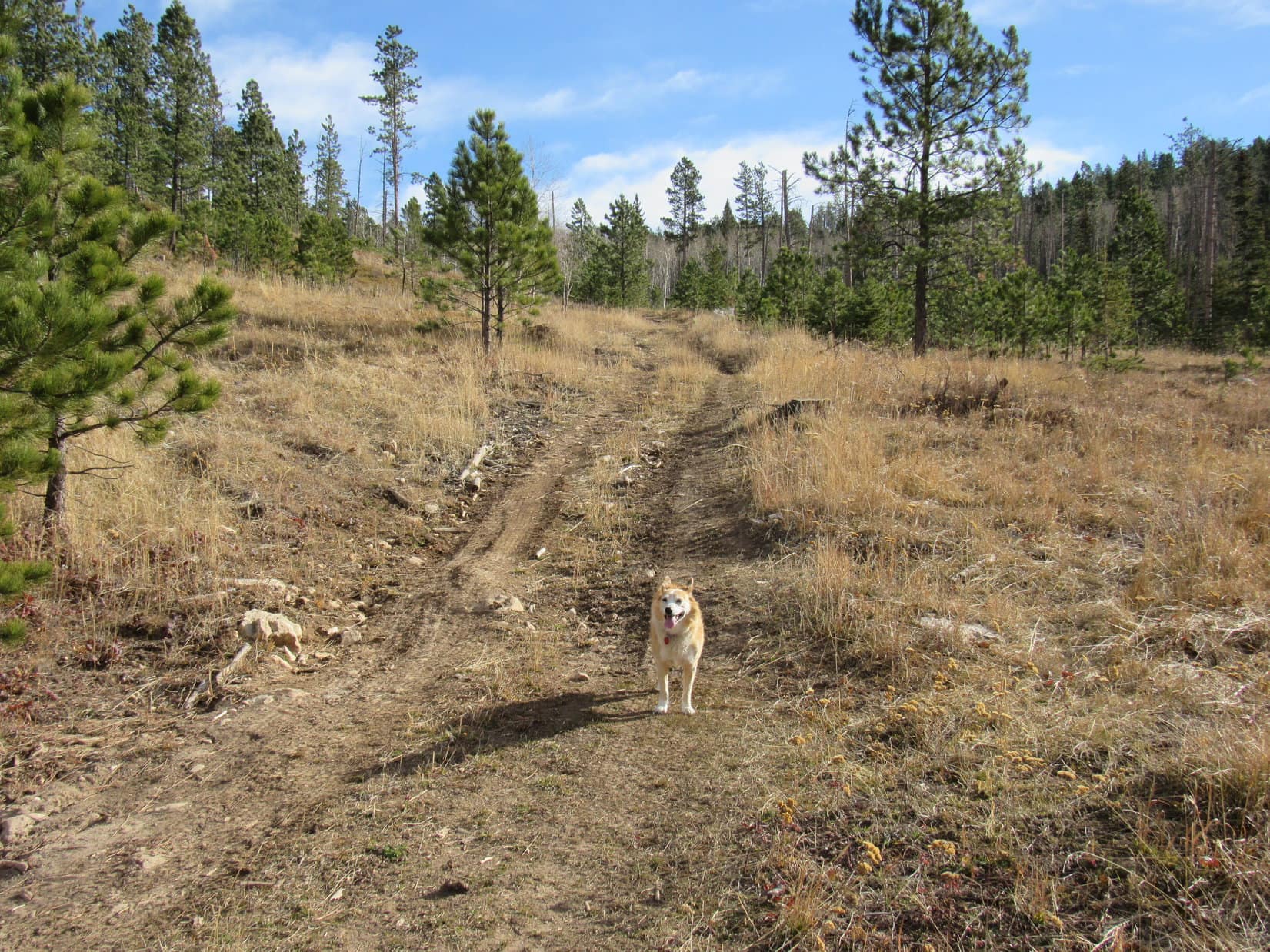
USFS Road No. 190.1P where Loop reached it. Photo looks E.

Taking No. 190.1P, the road climbed E for a little way, then flattened out as it turned S.  Half a mile on No. 190.1P brought Lupe to a small, flat clearing where the road ended.  This was high territory near the end of White Tail Peak’s long SW ridge overlooking the valley of the North Fork of Castle Creek, but other than a partial view to the SE, trees effectively hid the views.

At the S end of USFS Road No. 190.1P. Photo looks SE.

A higher part of White Tail Peak’s SW ridge was only a little farther NE.  Abandoning USFS Road No. 190.1P, Lupe crossed an open slope littered with deadfall.  This led to a somewhat steeper, but still easy climb in a live forest.  Near the top, Lupe began encountering small limestone outcroppings.

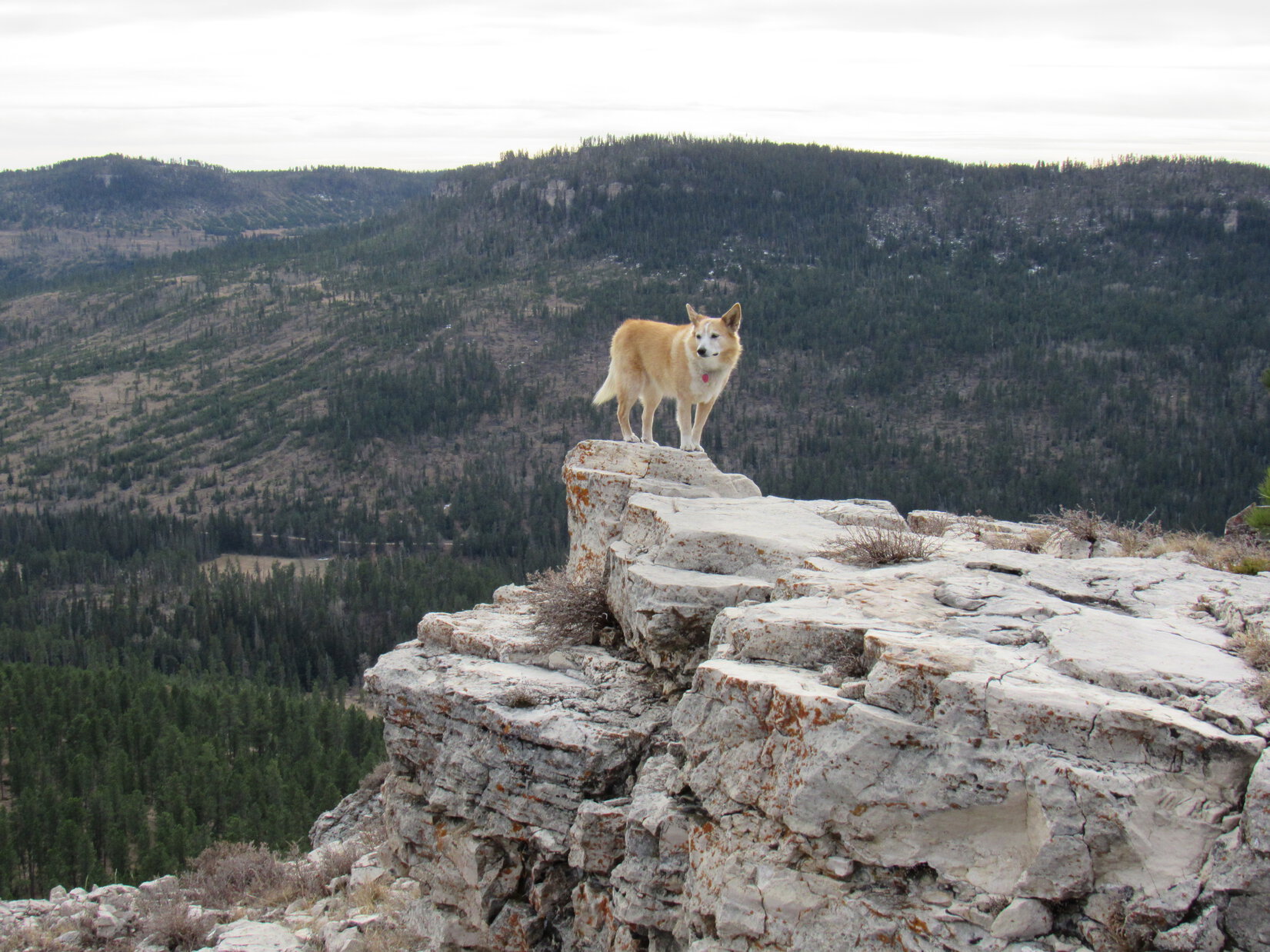
Lupe reached the S end of the upper portion of White Tail Peak’s long SW ridge.  Lots of trees up here, too, but also some nice views from rocks along the edge.

Beyond the valley of the North Fork of Castle Creek, peaks along the E edge of the limestone plateau were in sight.  Peak 6962 was closest.  Flag Mountain (6,937 ft.) was next, then Green Mountain (7,164 ft.) and Copper Mountain (6,920 ft.).  Even Medicine Mountain (6,878 ft.) could be made out.

Far to the SE, Black Elk Peak (7,231 feet) was visible way beyond Reynolds Prairie.

About to leave USFS Road No. 190.1P to cross the deadfall-laden slope behind Lupe. Photo looks NE.
Among the limestone outcroppings. Photo looks NE.
S end of White Tail Peak’s SW ridge looking over the valley of the North Fork of Castle Creek. Flag Mountain (R of the tree) and Peak 6962 (Center). Photo looks S.
Black Elk Peak (L) on the horizon beyond Reynolds Prairie. Medicine Mountain in the distance behind the tree at (Center), then proceeding R: Copper Mountain, Green Mountain, Flag Mountain & Peak 6962. Photo looks SSE.

White Tail Peak (6,962 ft.) is located along the E edge of the limestone plateau country, a large elevated region of the western Black Hills, much of which lies close to the Wyoming border.  It’s a complex peak involving multiple ridges extending out from an unremarkable summit.  Some of the best views are from two ridges, a long one and a short one, that both extend out to the SE.

The end of the long SE ridge was a favorite spot on White Tail Peak.  Lupe had a good view of it from here.

S end of White Tail Peak’s long SE ridge (Center) from the SW ridge. Photo looks ENE.

The plan was to visit both of the SE ridges.  On the way there, Lupe could tag White Tail Peak’s summit, which was still more than 0.67 mile away.  After lingering a few minutes at the S end of the SW ridge, the American Dingo headed  N.

For a little way, Lupe continued to gradually gain elevation.  Eventually the ridge leveled out.  Forest hid most of the views, although Loop did come to one spot with a view to the W.  Nothing too scintillating, just more forested ridges not quite as high as White Tail Peak.

Toward the N end, as the SW ridge merged into the rest of the mountain, the terrain began to rise again curving toward the NE.  Lupe came to a little high point, but this wasn’t the top yet.

Following the nice, wide SW ridge N. Photo looks NNE.
Looking W farther into the limestone plateau country.
At a little high point where the SW ridge joins the rest of the mountain. Photo looks SW.

Beyond this high point the terrain was fairly flat.  The territory to the N contained the shattered remnants of a forest killed by pine bark beetles.  Staying in a live forest, Lupe went ENE along the edge of the dead zone.  Even the live forest contained plenty of deadfall, but she didn’t have far to go before reaching a road.

This road was USFS Road No. 190.1Q.  Following it E, the Carolina Dog quickly arrived at the true summit of White Tail Peak (6,962 ft.), a small, flat clearing full of broken limestone slightly elevated above the level of the surrounding terrain.

USFS Road No. 190.1Q. Photo looks WNW.
True summit of White Tail Peak. Photo looks WNW.

No. 190.1Q went right through the clearing.  Not much to see here, so Lupe paused only long enough for a photo before continuing on.  The good stuff was a little farther.  Gradually losing elevation, the road wound SE through the forest, finally coming to the end of White Tail Peak’s short SE ridge.

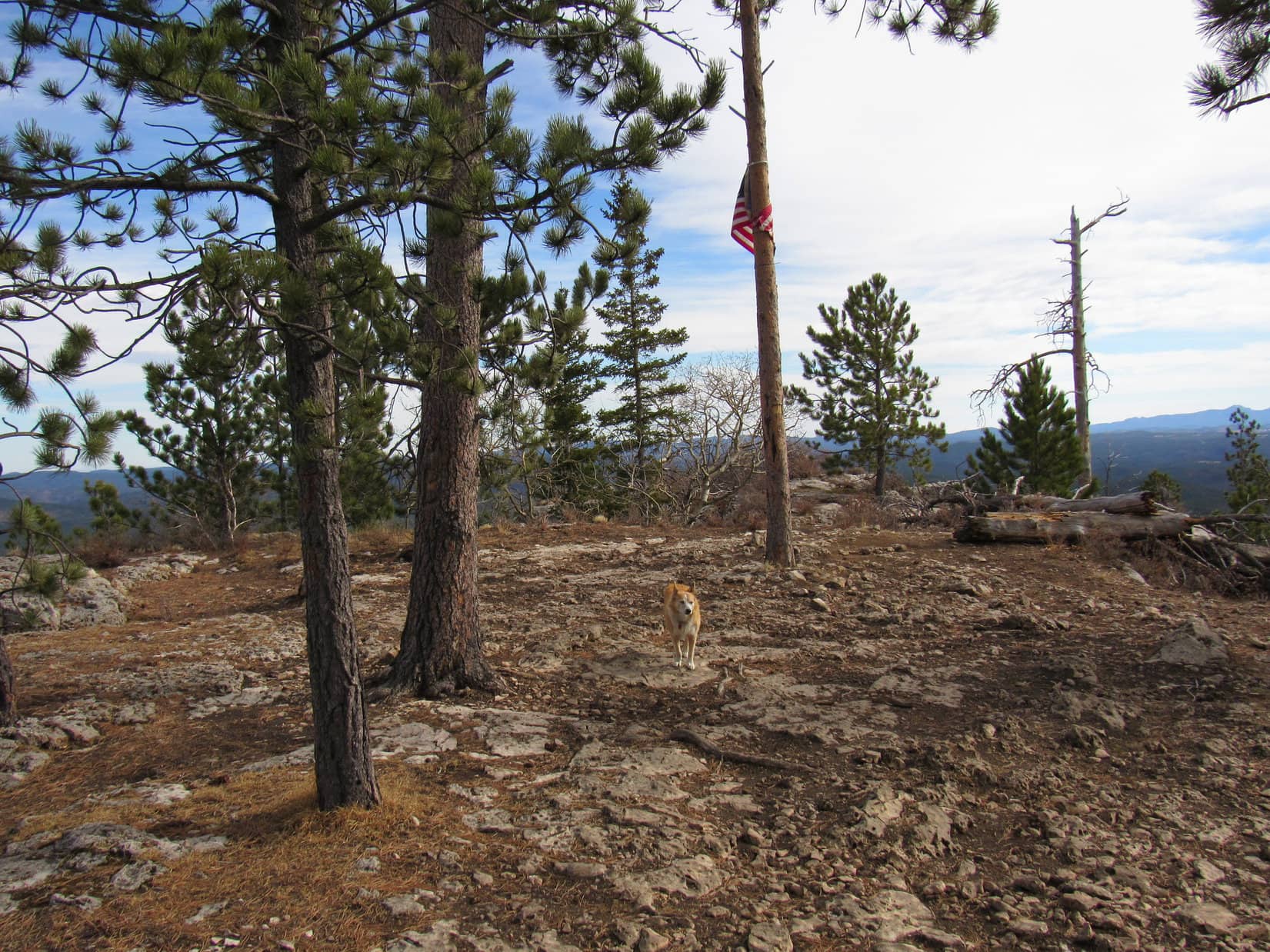
Lupe arrived to find an American flag wrapped around a tree.  Plenty of room to move around a level limestone platform here, and great views to the S and E.  In addition to all the major peaks Loop had seen from the SW ridge, both Custer Peak (6,804 ft.) and Terry Peak (7,064 ft.) were in sight, too.

Near the end of White Tail Peak’s short SE ridge. Photo looks SE.
Terry Peak (Center) in the distance. Photo looks N.
Reynolds Prairie beyond Lupe. Photo looks SSE.
Very end of the short SE ridge. Black Elk Peak (R) on the horizon. Photo looks SE.

A 30 minute break was taken for water, a shared chocolate coconut bar, Taste of the Wild, and an apple, all consumed while enjoying the views.  Pressed for time on a November day, Lupe then left the short SE ridge following No. 190.1Q almost all the way back to the summit.

100 feet before reaching the summit again, Lupe turned L (SW) onto a much fainter jeep trail leading down into the forest.  Heading S, the jeep trail soon leveled out just E of, and 40 feet below, a narrow limestone spine along the start of the long SE ridge.  The road continued another 0.25 mile, coming to an end at a viewpoint where Loop could see the short SE ridge which she had just been to.

On the jeep trail leading onto the long SE ridge. Photo looks S.
White Tail Peak’s short SE ridge as seen from the end of the jeep trail. Photo looks N.

This was not the end of the long SE ridge.  However, the jeep trail went no farther due to a minor, but sudden drop ahead.  Easily negotiating the drop on paw, Lupe continued on.  A short climb followed by a gradual descent and the forest gave way to a big clearing.  The end of the ridge was now just ahead.

Medicine Mountain (L), Copper Mountain (L of Center), Green Mountain (Center), and Flag Mountain (R) with Reynolds Prairie in the foreground. Photo looks S with help from the telephoto lens.

Unobstructed, the views to the S from the end of White Tail Peak’s long SE ridge were wonderful!  Stretching from E to W, they encompassed a vast expanse of the central Black Hills.  Lupe enjoyed the marvelous scene from lofty perches along the edge of limestone cliffs.

Black Elk Peak (L). Photo looks SSE with help from the telephoto lens.
White Tail Peak’s SW ridge from the long SE one. Photo looks WSW.
Along the edge. Photo looks ENE.
Green Mountain (far L), Flag Mountain (L) and Peak 6962 (R of Center). Photo looks S.
Five Points (6,221 ft.) (L) and Black Elk Peak (R). Photo looks SE.

1:03 PM, end of White Tail Peak’s long SE ridge – This was the premier viewpoint of the entire mountain, but whether Lupe could stay a while depended on what else was actually going to be on the agenda.

Gotta love White Tail Peak!  Magnificent view, isn’t it, Loop?  What do you want to do, though?  Still interested in Peak 6962?

Will we have enough time for it, SPHP?

Probably, but the sun will be down before 4:30 PM.  Sort of depends on how hard it is to get up there.  Coming from the W like we did the only other times we’ve been there, the deadfall was terrible.  If it’s like that coming from the N, we might not have enough daylight.  In any case, we’d have to get going right away, if we don’t want to be stumbling around in the dark on the way back.

Well, if we don’t try for Peak 6962, what are our other options?

Oh, we’ve never really fully explored White Tail Peak’s N ridge.  That might be pretty interesting.  Could hang out here for a while then head that way.  Plenty of time to do that.

Right or wrong, ambition won out.  Peak 6962 had been more or less part of the plan all along.  Lupe was soon heading back N again.  Along the way she stopped briefly to admire a great view of the valley of the North Fork of Castle Creek, the same valley she’d explored earlier in the day that would serve as her return route, too.

Peak 6962 (L), valley of the North Fork of Castle Creek (Center). Photo looks SW.

After going over White Tail Peak’s true summit again, Lupe followed USFS Road No. 190.1Q farther N than where she’d reached it on the way up.  She then abandoned the road to turn SW down a broad valley.  This was a shortcut back to the burn area close to No. 190.1O, allowing Loop to avoid having to retrace her earlier exploration of the SW ridge.

Taking a shortcut back to USFS Road No. 190.1O. Photo looks SW.

The shortcut worked great!  Loopster made it back to the North Fork of Castle Creek where the valley first divided NW of Peak 6962 with time enough for a quick ascent.  Crossing the creek, she took the branch of the divide she hadn’t explored this morning.  A mile S, then a mile E, and the American Dingo would be back at Peak 6962’s summit for the first time in over 6 years!

About to cross the North Fork of Castle Creek to set out for Peak 6962.

Didn’t happen.  Should have stayed up on White Tail Peak enjoying the views and exploring the N ridge!  Lupe didn’t get far heading S through the valley before coming to serious deadfall.  No fortuitous, unexpected paths through it all here!  When a slow, miserable trek demonstrated no sign that the deadfall was going to end anytime soon, that was it.

Eh, not happening! Photo looks S.

Sorry, Loop.  It’ll be dark by the time we can force our way through 2 miles of this nonsense.

Are we done then, SPHP?

Yes, afraid so.

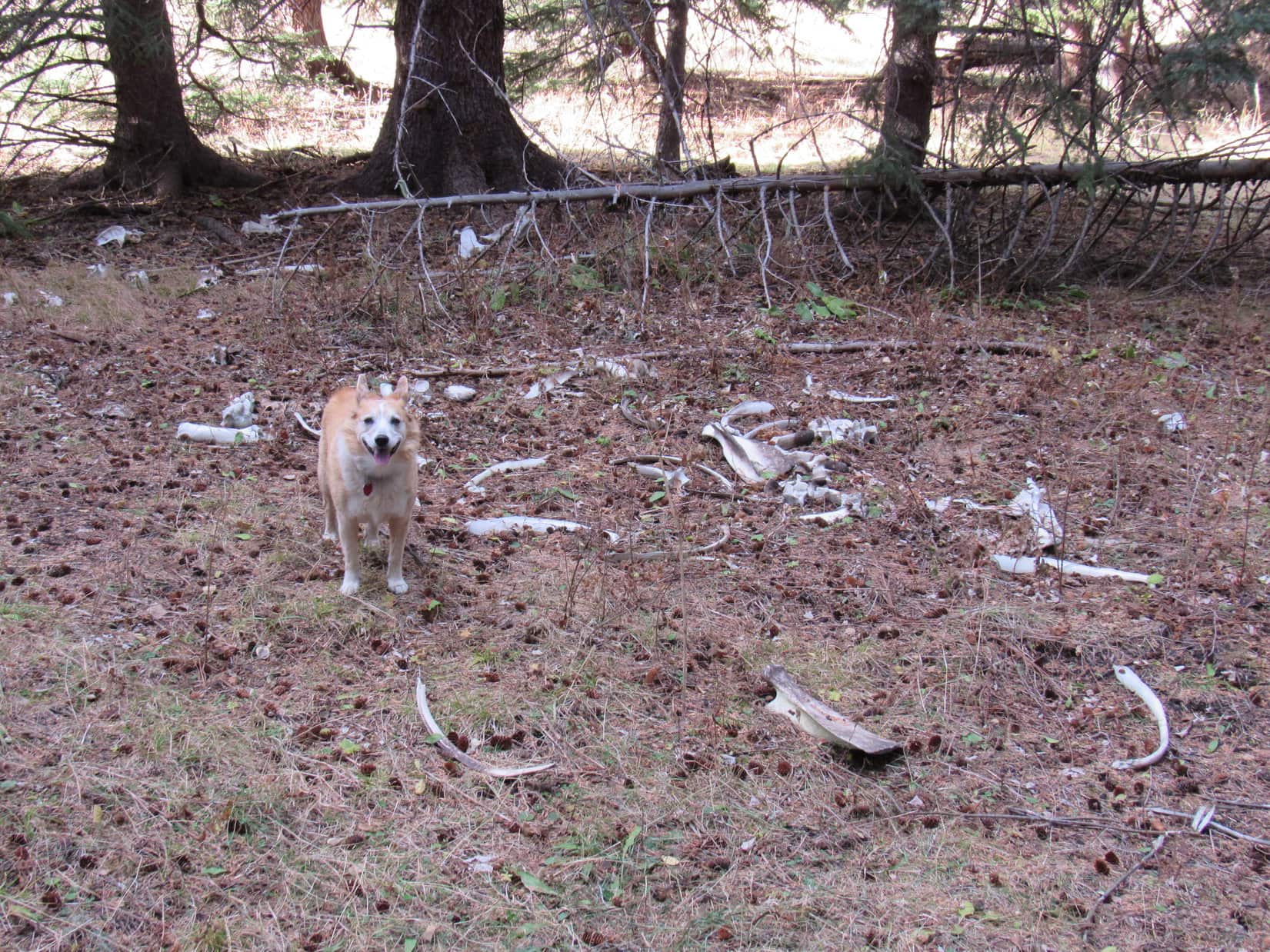
A pleasant mile back E through the valley of the North Fork of Castle Creek was all that remained of Black Hills, SD Expedition No. 283.  Along the way, Lupe discovered the scattered bones of some big animal, which made for some interesting sniffing.  She still made it back to the RAV4 before the sun was down.

At the interesting boneyard.

Guess, the good news is that we still have reasons to come back to visit both Peak 6962 and White Tail Peak another day, SPHP!

Come to think of it, that was good news!  (End 3:30 PM)

Peak 6962 from White Tail Peak, Black Hills of South Dakota 11-6-21

Links:

Next Black Hills Expedition                  Prior Black Hills Expedition

Black Hills, SD Expedition No. 209 – White Tail Peak (10-1-17)

Want more Lupe adventures?  Check out Lupe’s Black Hills, SD & WY Expeditions Adventure Index, Master Adventure Index, or subscribe free to new Lupe adventures!