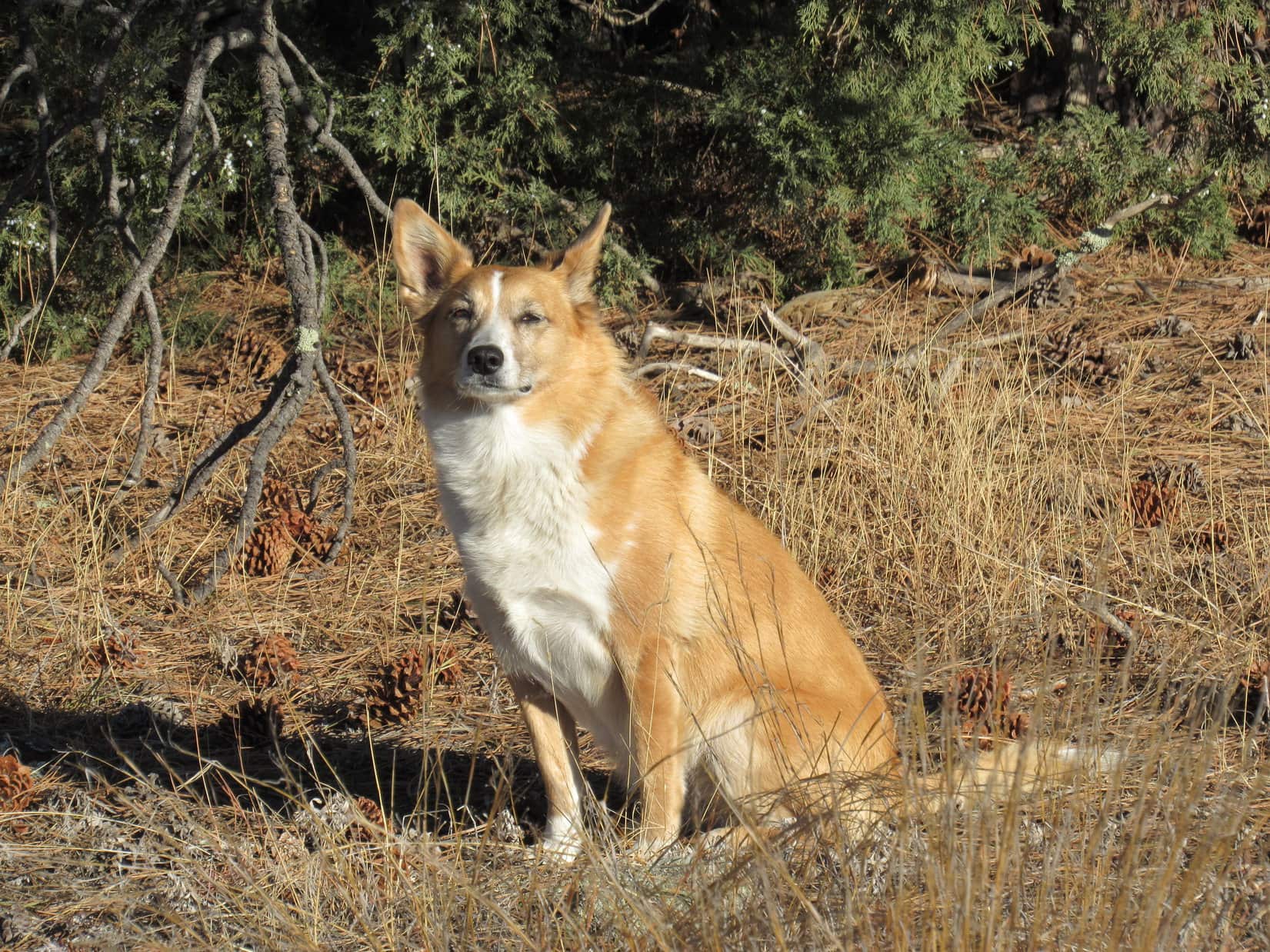
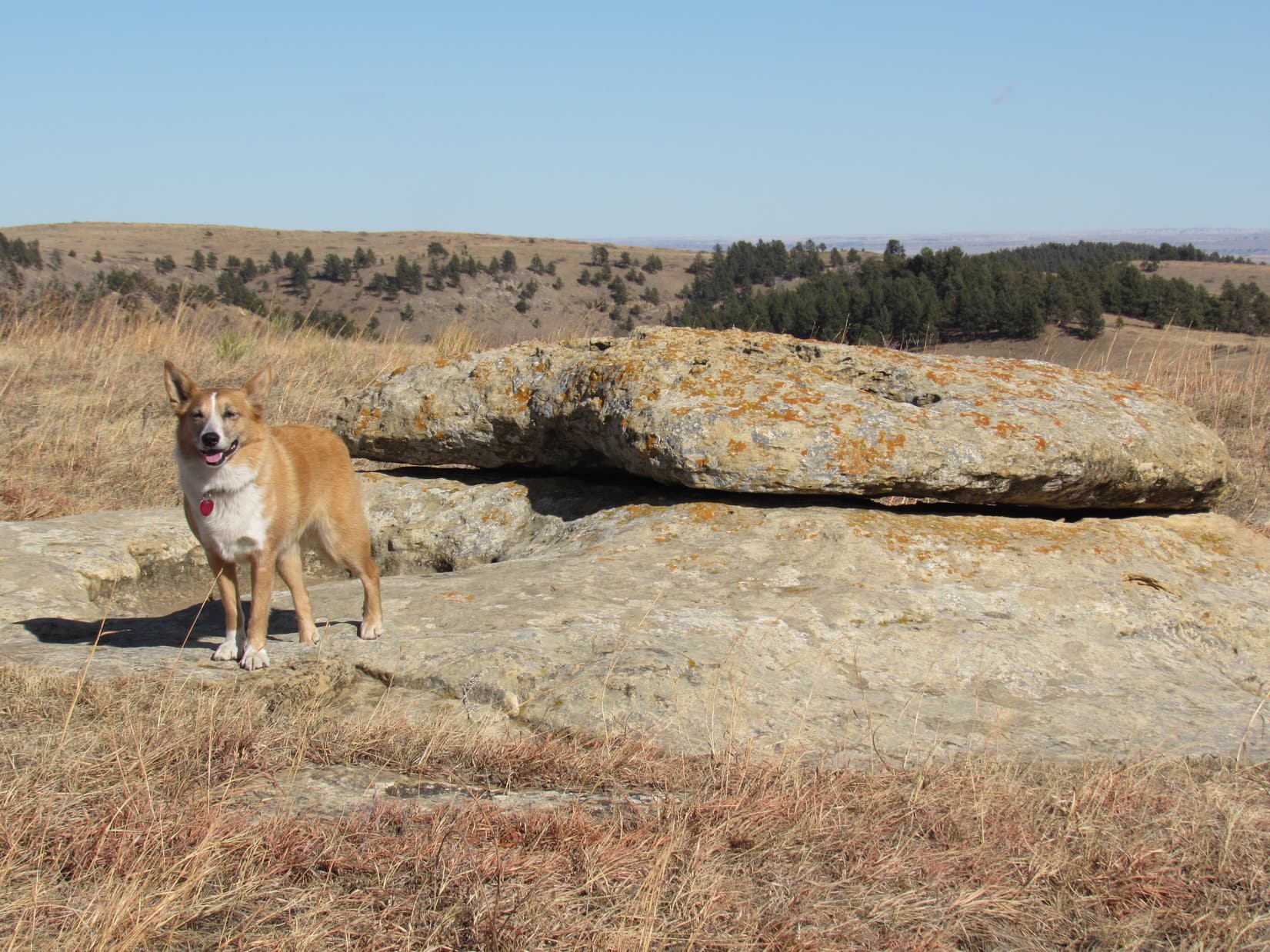
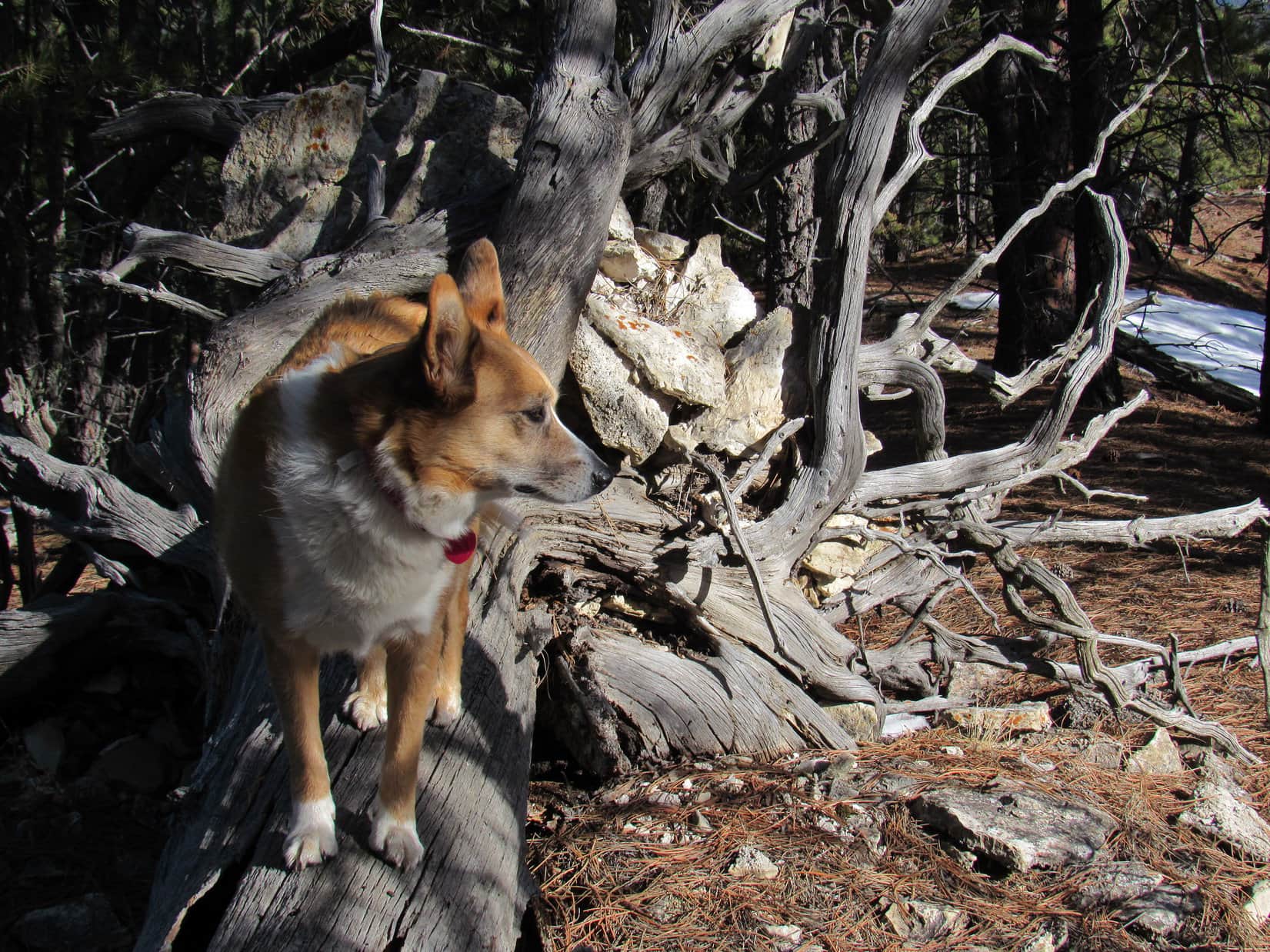
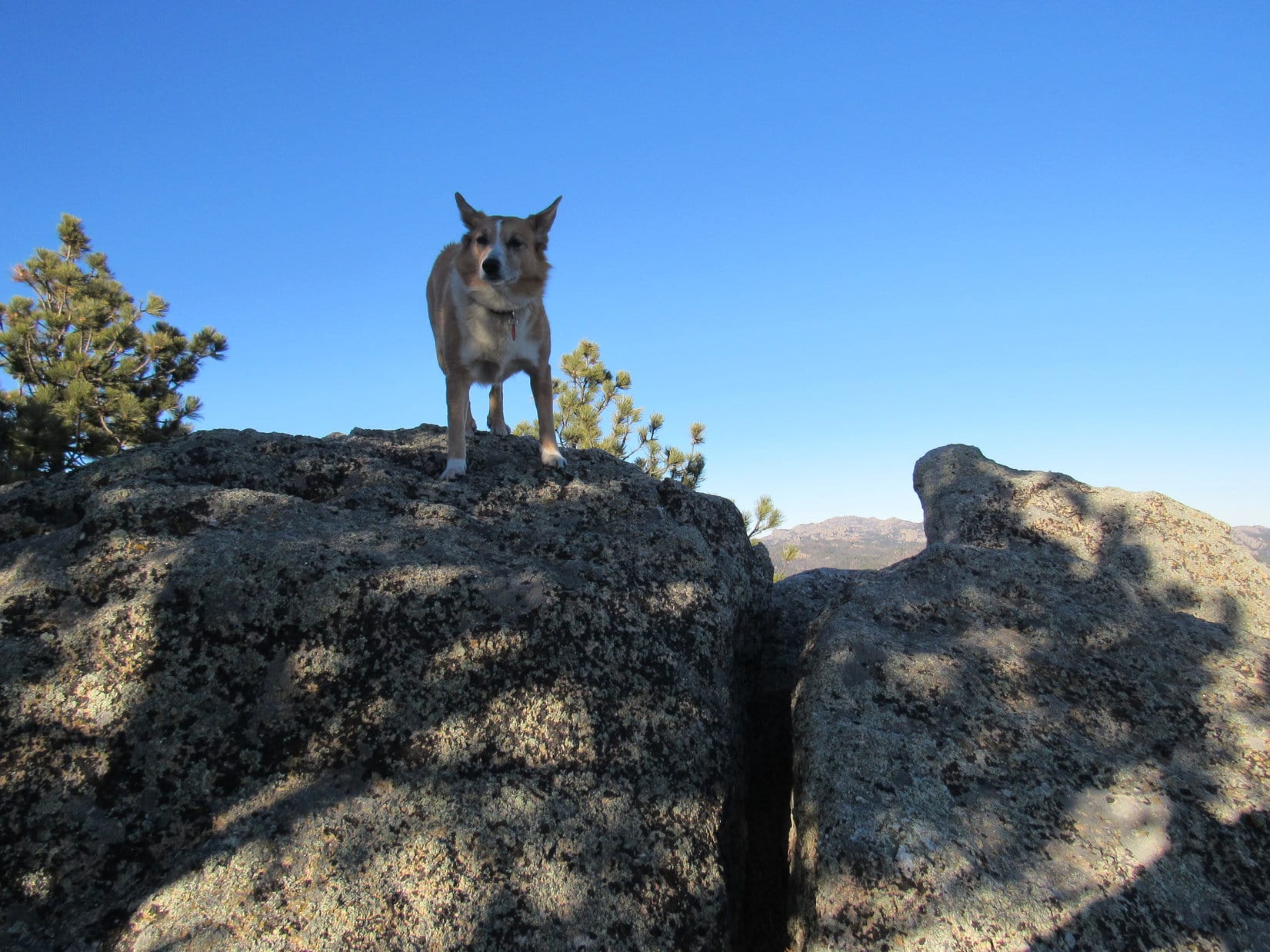
Black Hills, SD Expedition No. 192 – Maverick Mountain, Battle Mountain & Friendshuh Mountain (2-20-17)

Nope!  No way!  I’m not budging from this spot.  Take it off!  Take it off, now!

Tugging on the leash only made Lupe dig in and resist.  She wasn’t going anywhere.

OK, Loop, but you gotta stay close to me.  Let me lead the way.

The American Dingo had won.  SPHP couldn’t drag her all the way up the mountain by the neck.  The leash came off.  Would Lupe follow?  Reluctantly she did.  Her adventure had hardly begun, and she was already terrified.  SPHP had spoken the dreaded word: cactus.  Ever since her adventure in the Wildcat Hills of Nebraska with mountaineer, Jobe Wymore, cactus has been a greatly feared nemesis.

Lupe followed right at SPHP’s heels.  A very faint remnant of a road led W up the mountain.  Lupe wasn’t about to go running around off the road, or take the lead.  She did plod steadily along, however, which was all it would take to ultimately be successful.  Onward and upward!

SPHP had been afraid of this.  Lupe was on her way up Maverick Mountain (3,750 ft.) on the SE edge of the Black Hills.  The southern part of the Black Hills region is the driest and lowest.  Cactus line (sort of like tree line) tends to be in the 4,500 to 5,000 ft. range.  Maverick Mountain is well below that, so cactus wasn’t unexpected.

Lupe had arrived early at the Romney GPA (Game Production Area) parking lot (7:39 AM, 45°F), which serves as the Maverick Mountain trailhead.  On recent expeditions, she has been working on climbing peaks in the southern Black Hills that prolific climber Brian Kalet visited and added to the Peakbagger.com data base in May of 2016.  Maverick Mountain was yet another Brian Kalet peak.

Counterintuitively, being lower meant that climbing Maverick Mountain was a more daunting task for Lupe than the higher Brian Kalet peaks she had been to farther N – all because of the cactus.  If Lupe was going to climb Maverick Mountain at all, though, this was the time of year to do it.  Once the weather warmed up consistently, another even greater danger might be present.  SPHP wouldn’t even consider bringing her here then to risk a prairie rattlesnake bite.

Lupe’s Maverick Mountain adventure had begun only a few minutes ago, when she passed under a short wooden section in an otherwise barbed wire fence near the N end of the Romney GPA parking lot.  She’d paused by a fallen steel tower, and then headed straight past it to start up the base of a forested ridge.  She’d barely reached the trees when SPHP realized the situation, and spoken the dreaded word that brought Lupe to a screeching halt.

One of the signs posted along the barbed wire fence at the edge of the Romney GPA.
Plaque at the Romney GPA parking lot off Scenic Road. While hunting is the most common use of the Romney GPA, public access is allowed for other uses, too. The summit of Maverick Mountain is in the Romney GPA about a mile W of the parking lot. Photo looks NE.
Lupe at the start of her route up Maverick Mountain. She went under the section of wood fence seen here. (It’s near the N end of the parking area.) Beyond it, part of a fallen steel tower is laying on the ground. Lupe started up toward the bare spot on the ridge going to the R of the two big trees. She encountered both cactus, and the faint road leading to the top of Maverick Mountain before reaching the ridgeline. Photo looks WNW.
Lupe near the fallen steel tower. An old road leads up Maverick Mountain from the E. It was essentially non-existent at the start and end of Lupe’s route. However, at one time it apparently went to the L of the 2 big trees seen on the L. Lupe went to the R of the trees, but luckily still found a remnant of the road appearing as an almost indiscernible trail a little farther up the hillside. The old road got better as it went W (toward the L) up Maverick Mountain. Photo looks WNW.

Lupe resumed her trek with trepidation, as SPHP watched carefully for cacti on the way up the first hillside.  The Loopster wasn’t at all eager to move quickly, which was good, since there was plenty of cactus SPHP needed to guide her around.

Lupe had initially started up toward a bare spot on the ridgeline ahead.  Before she even got that far, she came across a trail angling to the W (L) that was so faint, at first, that SPHP wasn’t even certain it wasn’t imaginary.  However, it quickly improved and soon proved to be the old dirt road leading to the summit.

The road became easy to follow.  Fortunately, there wasn’t any cactus on it.  Lupe’s confidence began to return.  Although she now trotted ahead on the old road, she was careful not to leave it.  She understood perfectly well that the horrible cactus was waiting for her off the road.

Things were going well, again.  Lupe gained elevation steadily.  The road passed through a mixed forest of Ponderosa pines and junipers.  Spiny Yucca plants grew in sunny spots between the trees.  Occasional open views of the prairie to the E improved rapidly.  The highlight was the Cheyenne River sparkling in the morning sunlight.

Maverick Mountain is on the SE edge of the Black Hills. As Lupe climbed W, she had long distance views of the western SD prairies back to the E. The highlight of the view was the Cheyenne River sparkling in the morning sun. 4-lane Hwy 79 is seen down by the river, and crosses it on the R. Photo looks SE with help from the telephoto lens.
Getting higher. Photo looks SE.

Once Lupe found the old road going W up Maverick Mountain, it was typically easy to follow.  Where it wasn’t, straight ahead was always a good assumption.  The road kept progressing steadily W, with few twists or turns.

Fairly high up on the mountain, Angostura Reservoir came into view to the S.  Only on the edge of the Black Hills, and not actually in them, Angostura Reservoir is the largest lake in the entire Black Hills region.  Popular for fishing and boating, the lake was created by a dam on the Cheyenne River.

Fairly high up on Maverick Mountain, Lupe had this view of still frozen Angostura Reservoir. Located on the far SE edge of the Black Hills, it is the largest lake in the region. Photo looks S.

The old road faded away as it leveled out neared the top of Maverick Mountain.  Ahead of Lupe was an open field.  A dried up stock pond was in the middle of the field toward the S.  Trees rimmed the N and W edges of the field.  A small hill straight ahead was clearly the location of the true summit.

Almost there! The road faded out here with the summit of Maverick Mountain in view at the top of the small hill toward the R. Photo looks WSW.

Lupe was worried about cactus when the road disappeared.  She had good reason.  Even though the cactus had been worse lower down, there was still some scattered around.  Lupe followed SPHP closely across the field.  She made it to the summit of Maverick Mountain (3,750 ft.) without incident.

A cluster of several big Ponderosa pines grew right at the true summit of Maverick Mountain. Photo looks NNW.
Success! Despite it’s cacti defenses, Loopster arrives at the summit of Maverick Mountain! Photo looks NNW.
Comin’ for you Brian Kalet! Maverick Mountain was another southern Black Hills peak Brian Kalet had entered into the Peakbagger.com data base in the spring of 2016. Lupe has been climbing as many of them as she can lately.

Ordinarily, Lupe would have lingered on top of the mountain for a little while, exploring the summit area and seeing what there was to see.  With cactus on the mountain, though, she wasn’t about to get too rambunctious, or hang around for very long.  The views toward higher hills to the N and W were almost completely blocked by trees, anyway.

Lupe did roam around enough, though, to see the highlights of what views Maverick Mountain had to offer off to the S and E.

Looking E toward the prairies of western SD beyond the Black Hills. You’d be happy too, if you managed to get all the way to the top of Maverick Mountain without getting stabbed in the paw by a cactus spine!
The Cheyenne River from Maverick Mountain. An old windmill that had fallen over on the mountain S of the dried up stock pond is sort of in view beyond and to the L of Lupe. Photo looks SE.
The fallen over windmill is now on the R. The dried up stock pond is behind the closest pine tree L of Center. The way back down the mountain is off to the far L side of this photo. Photo looks ESE.

After a 15 or 20 minute stay up on the Maverick Mountain summit, Lupe headed E back across the N side of the field where the dried up stock pond was to start her trip back down the mountain.  The Carolina Dog was eager to get off this pin cushion!

Besides, Lupe had other higher peaks to climb not too far away near Hot Springs, SD.

On her way back down Maverick Mountain, Lupe was facing the great views of the Cheyenne River far below. Photo looks SE using the telephoto lens.
The old road is rather faint here, but Lupe is almost right on it. Maverick Junction where Hwys 79, 18 & 385 meet 5 miles E of Hot Springs, SD is seen far below on the L. Photo looks ENE.

When Lupe reached the last hillside at the bottom of the mountain, SPHP made her stop and stay put.  Due her fear of cactus, she didn’t dare disobey.

SPHP started searching around.  Earlier, SPHP had noticed Lupe wasn’t wearing her pink collar.  She’d had it on when she started out.  Where had it gone?  After some thought, SPHP had decided it must have come off in this area during all the commotion with the cactus and the leash right near the start of Lupe’s excursion.

The search was a failure.  Lupe’s pink collar was nowhere to be seen.  Lupe stood motionless wondering what was going on?  An idea!  SPHP took the leash out of a pocket.  Hah!  There it was!  Lupe’s pink collar had gotten tangled up with the leash, and been in SPHP’s pocket all along.  Doh!

Sorry, about the wait Looper.  Guess I’m losin’ it.  Come on, let’s go!  Lupe was more than ready.  She returned to the G6, leaving Pin Cushion Mountain behind forever!  Even Brian Kalet couldn’t get her to come back a second time.  (9:25 AM, 48°F)

Maverick Mountain had only been a warm-up.  Lupe had other higher peaks to climb not too far away near Hot Springs, SD.  Soon SPHP was parking the G6 on Sheridan Street in the N part of Hot Springs.  (9:40 AM, 50°F)  A stroll S to the end of the block brought Lupe to the start of Battle Mountain Road.

Lupe turned E on Battle Mountain Road.  The road climbed relentlessly all the way up to almost the top of, you guessed it, Battle Mountain (4,434 ft.)!  A short ascent up a jeep trail and rotting wood-framed steps brought Lupe to the rocks at the S end of the summit near the old fire lookout tower.  Looper got up on the rocks for a look around.

Lupe up on rocks near the very top of Battle Mountain. Photo looks NW.
Looper checks out the views from Battle Mountain. The high ridge on the L is part of the Seven Sisters Range. Photo looks SSW.

Lupe had been up on top of Battle Mountain once before, nearly two years ago on Black Hills, SD Expedition No. 126.  Back then a tribe of Neanderthals, still hanging around Hot Springs long after the woolly mammoths Hot Springs, SD is famous for (see Mammoth Site of Hot Springs) were gone, had left a lot of trash including broken glass strewn around the summit.  Due to all the sharp broken glass, SPHP had had to carry Lupe all around the summit area.

The summit of Battle Mountain was in considerably better condition today.  Almost no trash around.  Although there was still some broken glass, it looked weathered and old, lacking sharp, stabby points and edges.  SPHP was still cautious about letting Lupe get near the worst of it, but for the most part she could roam the top of Battle Mountain at will.

The big tower seen here was visible from down on Sheridan Street in Hot Springs where the G6 was parked. It isn’t quite at the top of the mountain, however. Photo looks WNW.
Loopster on the old Battle Mountain fire lookout tower. Photo looks SW.

Battle Mountain has a collection of towers on it. They partially obstruct the view of Angostura Reservoir from the summit. Photo looks S.

The reason for Lupe’s return to Battle Mountain didn’t seem to be in view from the summit.  Pine trees blocked the views to the NE.  Less than 2 miles that way was where Lupe’s next peakbagging goal was.  Friendshuh Mountain (4,450 ft.) was barely higher than Battle Mountain.  Lupe would have to go considerably farther than 2 miles to get there.  Dudley Canyon was in the way.

Friendshuh Mountain wasn’t actually another Brian Kalet peak.   Gustav Sexaur added it to the Peakbagger.com data base.  However, Gustav had never been there.  So far, Brian Kalet was the only Peakbagger.com account holder to have ever actually climbed Friendshuh Mountain.  Either way, it was another red circle on Lupe’s Black Hills map that needed to turn green!

Lupe left the Battle Mountain summit heading N into the forest.  She was barely below the summit’s limestone cap when a glimpse of Friendshuh Mountain appeared between the pines.

Friendshuh Mountain from just below the limestone cap at the N end of the Battle Mountain summit. Photo looks NE.

Friendshuh Mountain isn’t in the Black Hills National Forest.  Neither is Battle Mountain.  Both are in the Battle Mountain GPA (Game Production Area), however, so there is public access.

Coming down the N slope of Battle Mountain, SPHP was looking for the Battle Mountain GPA access road, which leads to the N end of Dudley Canyon close to Friendshuh Mountain.  Lupe found a way down off the limestone escarpments she ran into along the way, and very quickly came to a road.  Was this it?  The road headed E through a cut in the mountain.  SPHP was pretty certain this wasn’t the right road.

As Lupe had come up Battle Mountain Road, fairly close to the top of the mountain there had been 3 roads she could have taken.  None of them had any signs.  The first (lowest) turned N and went by a small building with a tower or big antenna next to it.  The second road also angled N, and came only 100 or 150 feet before Battle Mountain Road turned sharply S on its final short leg to the summit.

Where Battle Mountain Road had turned S, a third road had continued E uphill and then turned N.  Lupe was on this third, highest road.

Despite the lack of a sign, SPHP was pretty sure that the second road was actually the Battle Mountain GPA access road Lupe needed to be on.  Instead of going E through the cut, Lupe followed the high road S and then W back down to the intersection with Battle Mountain Road.  When she reached the second road, she turned and started following it N.

Lupe at the start of the 2nd road leading N from Battle Mountain Road near the top of Battle Mountain. This turned out to be the correct choice. This is the Battle Mountain GPA access road leading to the N end of Dudley Canyon.

For about 0.25 mile, the road was quite level.  It headed N on the W side of Battle Mountain.  When the road started curving NE making its way around the NW slope of Battle Mountain, Lupe was surprised and happy to find snow and ice.  From here on, she came to frequent stretches of snow, ice and mud wherever the road was shaded.

Lupe was surprised and happy to find snow and ice on the road where it curved NE around the NW slope of Battle Mountain. She came to many snowy, icy, muddy stretches from here on wherever the road was heavily shaded. Photo looks NE.

On the N side of Battle Mountain, the road began to lose elevation, going all the way down to about 4,080 ft.  There it crossed a saddle heading ENE toward Dudley Canyon.  This was the first drop.

By now SPHP was certain Lupe was on the correct road.  It began winding around to the N and sometimes NW, slowly regaining nearly all of the elevation Lupe had just lost.  The road stayed on the upper W slopes of Dudley Canyon.  Due to the forest, most of the time the canyon wasn’t even in view.  Lupe had fun.  She found a few squirrels to bark at.

The Battle Mountain GPA access road eventually turned E.  When it did, Lupe started losing elevation again.  She had barely started down when Friendshuh Mountain came into view to the SE.

Shortly after the road turned E, and before it had lost much elevation again, Friendshuh Mountain came into view to the SE.
Loop on the Battle Mountain GPA road as it starts its second significant elevation loss. From here, the road soon turned NE (L) and dropped down into the N end of Dudley Canyon. Friendshuh Mountain is in view ahead. Photo looks SE.

The road turned briefly toward Friendshuh Mountain before turning back to the NE and making its second and final significant drop down into the N end of Dudley Canyon.

At around 4,135 ft. elevation, Lupe reached the bottom of Dudley Canyon.  Next to the road, a map was posted of the Battle Mountain Game Production Area.  Apparently not enough game was being produced.  The map itself had been a frequent target.  It was riddled with bullet holes.

The N end of Dudley Canyon was mostly open ground with scattered stands of pines. Lupe reached the bottom of the canyon down by the pines on the R. She would eventually continue on up the other side of the canyon in the draw seen beyond them. Photo looks ENE.
This bullet hole riddled map of the Battle Mountain GPA is posted down at the bottom of the N end of Dudley Canyon. The Friendshuh Mountain GPA adjacent to the N is shown, too. A parking area was just S of this map. A dirt road nearby continued N through an open gate.

A parking area was S of the map, and a dirt road headed N through an open gate.  Lupe followed the road 100 yards to a double gate which was padlocked shut.  Another dirt road headed ESE up the draw behind it.

100 yards N of the map was this double gate, which was padlocked shut. A dirt road beyond it went up the draw seen on the right. Lupe went through the gate and up the draw. Photo looks ESE.

Lupe and SPHP went under and over the double gate respectively.  Lupe followed the dirt road up the draw.  Part of the road shaded by pines was snowy and muddy, but it wasn’t long before Lupe was up on a sunny hillside.  The road now went E along the N side of a barbed wire fence.

Lupe came to another set of double gates, both of which were standing wide open.  Friendshuh Mountain was in view beyond them directly to the S only 0.33 mile away.  Lupe was almost there!

The Carolina Dog didn’t head directly for Friendshuh Mountain, however.  The top of the barren ridge the road had been climbing was only a little farther uphill.  An interestingly shaped flat rock up there looked like it might offer a great unobstructed view of whatever was over on the E side of the ridge.  SPHP wanted to go see the views.

Lupe was a little reluctant to leave the road.  Her concern was justified.  On the way to the odd flat rock, SPHP saw her nemesis again.  Cacti were scattered on the dry, sunny ridge.  Not as many as at Maverick Mountain, but enough to be a concern.  Still, it was a good thing Lupe had come this way.  Upon reaching the odd flat rock, she made a discovery even more interesting than the sweeping views to the N and E.

Long, long ago, something else had come this way.  Something gigantic and dangerous!  Pressed deep into the rock next to the odd flat rock was a dinosaur track!  Other similar depressions were nearby, but none were so clear as this one.

Lupe on top of the odd flat rock on the ridge. She had come to see the big sweeping views to the N and E, but discovered something even more interesting – the huge dinosaur track pressed into the rock below. (The depression on the L.) Photo looks E.
Dingoes may rule the earth now, but that wasn’t always true! Another look at the dinosaur track. Photo looks SE.

The huge dinosaur track was pretty cool, and the wide open views on the barren ridge were great, too.  The summit of Friendshuh Mountain was covered with pines, so the views might be limited up there.  Why not take a break here?  Lupe was happy with that idea.  She curled up inside the dinosaur track while SPHP ate an apple.

Daring Dingo dallies in dino depression! Lupe actually curled up and rested for 10 minutes in the dinosaur track.
Loop back on top of the odd flat rock next to the dino track (out of sight just to the R). The open gates in the fence line Lupe would go through to finish her trek to Friendshuh Mountain are in view. Photo looks WSW.

After her brief rest stop in the dinosaur track next to the odd flat rock, Lupe returned to the road and went S through the open gates.  The dirt road went up a gradual slope heading almost straight for Friendshuh Mountain.

Lupe soon arrived at a large water tank, which had plenty of water in it.  Here the dirt road angled SE going over a gentle pass on its way around the E side of Friendshuh Mountain.  To the SW, a faint single track trail went up toward the trees N of the summit.  Information SPHP had previously found online indicated that the two routes made a loop around Friendshuh Mountain, but didn’t go to the summit.

Lupe arrives at the water tank. She’s very close to the summit of Friendshuh Mountain now! Photo looks SSW.
Lupe didn’t like the area near the water tank. Scattered cacti grew in the grassland around here. She didn’t get into the cactus, but she did get a few painful, sharp thorns from some other kind of plant stuck in her right front paw. SPHP had to pull the thorns out.

The area near the water tank was Lupe’s least favorite part of the journey to Friendshuh Mountain.  Cacti grew in scattered clumps in the grassland.  Some other plant with thorns was around, too.  Lupe had a couple of painful thorns in her right front paw by the time she reached the water tank.  SPHP pulled them out, but Lupe wasn’t happy.  She demanded to be carried from here.

Fortunately, the summit of Friendshuh Mountain was very close by now.  SPHP carried Lupe up the faint trail to the SW.  From the top of a little ridge N of the mountain, Lupe could see that the trail soon became a dirt road a little farther to the SSW.  The views to the W and SW were quite nice here.  SPHP put Lupe down for a couple photos.  She seemed a little more confident again.

Lupe just N of the top of Friendshuh Mountain. Battle Mountain and the towers on it (L) are in view. SPHP wonders if the small hill in the far distance on the R isn’t Matias Peak (4780 ft.)? Photo looks WSW.
Looking WNW. SPHP would have liked to explore the rocky ridge in the foreground, but with cactus around, it just wasn’t worth the worry and potential pain for Lupe. The ridge remains unexplored by American Dingoes.

Lupe made the final climb from the trail up to the summit of Friendshuh Mountain (4,450 ft.) on her own.  She felt safer and more confident among the trees than out on the open grasslands.  She came to no cactus up on the summit area, but she did find a limestone summit cairn next to a big melting snow bank.  The cold snow felt good on sore paws.

Success! Lupe reaches the summit cairn of Friendshuh Mountain. The cold snow felt good on sore paws. Photo looks S.
Friendshuh Mountain was defended not only by cacti, but dinosaurs, too! Even so, a wily Carolina Dog managed to reach this summit cairn.

Friendshuh Mountain had a roomy, flat summit area about 250 or 300 feet long N/S.  It sloped gradually down toward the E.  The top was open forest, but around the edges, the forest was thicker and effectively blocked the views in most directions.

After a short exploration, Lupe spent most of her time on Friendshuh Mountain at the S end of the summit area where there were fewer trees, and the best views were on display.  Lupe and SPHP rested here, enjoying the scene and simply being together in the warm sunshine.
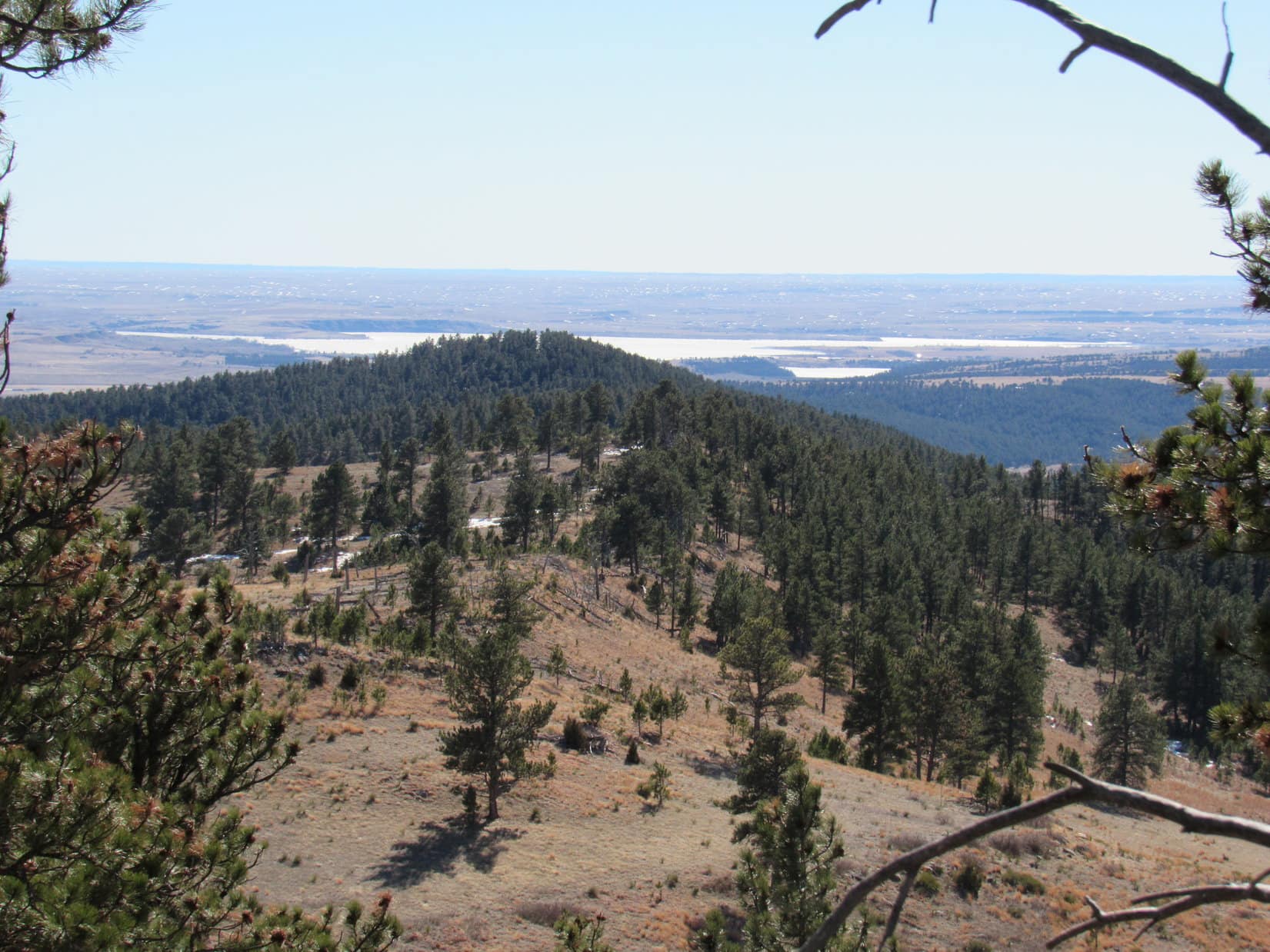
Frozen Angostura Reservoir was partially in view to the S.
The big ridge on the horizon is part of the Seven Sisters Range (Center). Photo looks SW.
A glimpse between the trees off toward the ESE.

After a pleasant half hour on Friendshuh Mountain, the time came to think about beginning the return trip to the G6.  Before leaving the mountain, Lupe returned briefly to the area near the summit cairn.

Before leaving Friendshuh Mountain, Lupe returned briefly to the area near the summit cairn. Here she is at the W edge of the summit. Photo looks NNE.
Loop enjoyed the feel of the cold snow on her paws near the summit cairn one more time. The cairn is in the shadows on the R. Photo looks SW.

Lupe was fine going down the forested N slope of Friendshuh Mountain on her own.  However, when SPHP wanted to cut directly across the open land back to the road leading to the gates near the dinosaur track, it was a different story.

Carolina Dogs have no fear of dinosaurs, but cacti are another matter.  SPHP had to carry Lupe all the way down to the road.  Even then, she wasn’t thrilled about being put down again.
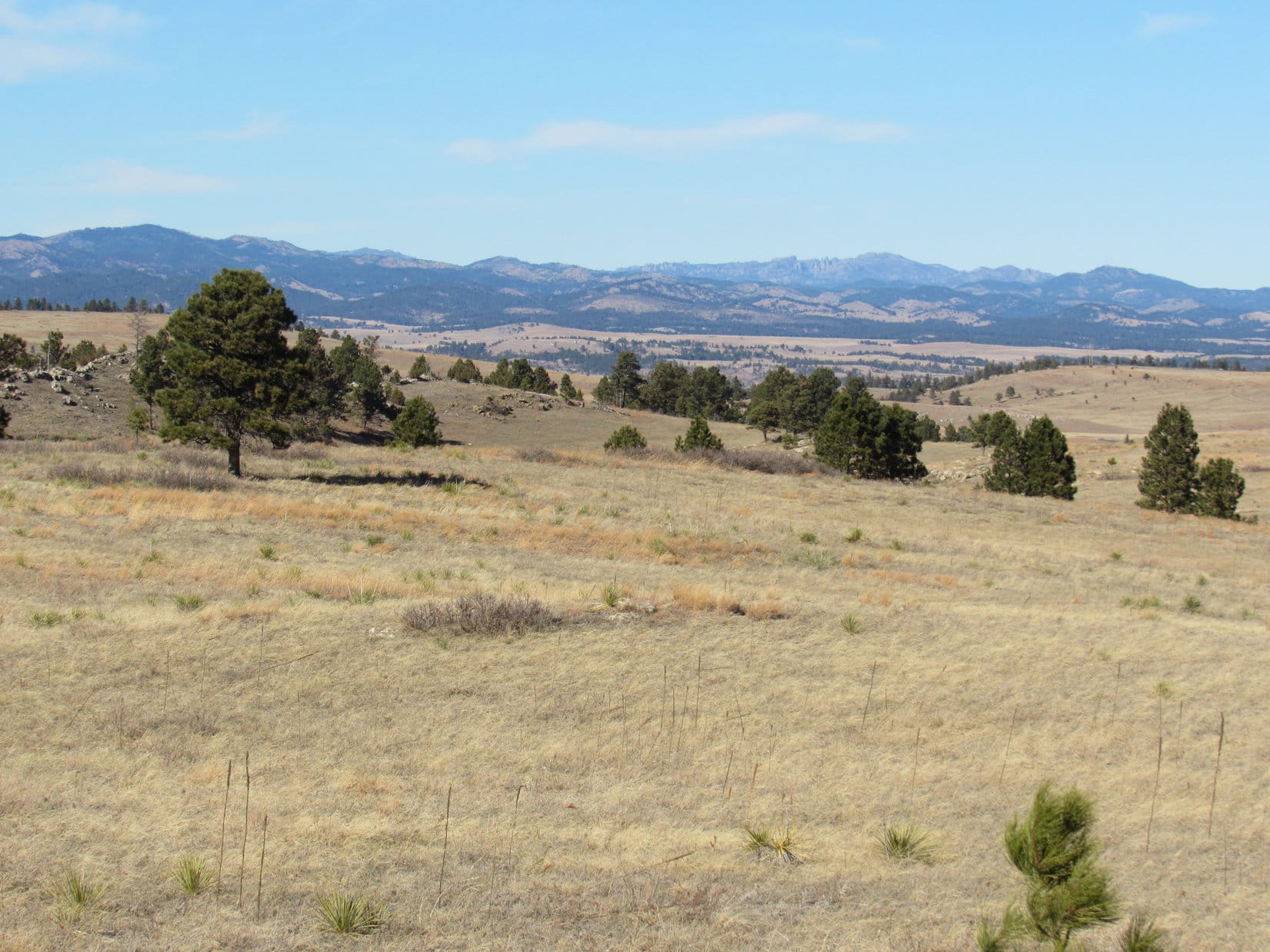
While Lupe was being carted across the open ground on the way down to the road, she had this sweeping view off to the NNW. Black Elk Peak (7,231 ft.) (R) is on the horizon. Photo looks NNW.
Couldn’t you at least carry me back to the forest? The open gates N of Friendshuh Mountain are seen ahead. After going through the gates, the odd flat rock and dinosaur track are off to the R (E). The way back to Dudley Canyon is to the L (W).

Since it was a little later in the day, SPHP wanted to return to the odd flat rock and the dinosaur track.  The sun would be lighting up more of the dino track now.  Loopster was dubious about wisdom of leaving the road, even for such a short distance.  When she managed to trot over to the dino track without incident, she cheered up.

Lupe cheered up when she reached the dinosaur track again without encountering any cactus. She wasn’t the least bit concerned about encountering the dinosaur. The track was obviously quite old. That dinosaur had to be many miles away by now. Photo looks SE.
Now that it was later in the day, the dinosaur track was better lit up by the sun. From the orientation of the claw marks, the dinosaur had been on its way from Wind Cave National Park to the Badlands National Park. Probably a tourist, or in search of one.
Looper seemed to enjoy being in the dinosaur track. She returned to her old resting place again, but this time she just sat there watching instead of curling up. Perhaps she was hoping to get a glimpse of the next dinosaur to come this way.
Come on, SPHP! Sing along with me! Oh, give me a home, where the dinosaurs roam, and the deer and the antelope play! Where never is seen, a cactus that’s green, and your paws won’t get stabbed all day!

From the odd flat rock and the dinosaur track, it was about 4.0 miles back to the G6 in Hot Springs.  Lupe got to follow the road back the entire way, retracing her earlier route to Friendshuh Mountain.

When Lupe got to the forest on the W side of Dudley Canyon again, she forgot all about cactus when she saw a squirrel.  She dashed off into the forest without a moment’s hesitation.  From then on, she left the road to roam through the forest whenever she felt like it.  Although there were still a few cacti scattered around, she didn’t step on any and had a great time.

Since the side trip up to the top of Battle Mountain (4,434 ft.) was so short, Lupe returned to the summit again when she got back to Battle Mountain Road.

On her way back to the G6, Lupe made the short side trip up to the top of Battle Mountain again. Photo looks SW.
I’ll have a Dingo on the rocks, please! A great way to end any long day. Photo looks NW.

Wow, it was 62°F out when Lupe reached the G6 (4:08 PM)!  What a fabulous, warm, bright day it had been for February!  Despite repeated cactus concerns, overall Expedition No. 192 had been a fun time with several more peakbagging successes for the Looper.

On the way home, Lupe got a ride in the G6 through beautiful Wind Cave National Park.  She did see a few buffalo roaming, but not a single dinosaur.  Dinosaurs just aren’t that common any more, even way out here in the remote Black Hills of western South Dakota.

Lupe on Battle Mountain near the end of Expedition No. 192. Photo looks SSW.

Trailhead Directions:

Maverick Mountain – The parking lot for the Romney GPA serves as the trailhead.  From Maverick Junction (intersection of Hwys 18, 79 & 385 about 5 miles E of Hot Springs, SD), go 0.7 mile W on Hwy 18/385.  Turn S (L) on Scenic Road immediately after crossing Fall River.  Follow Scenic Road 1 mile S to the Romney GPA parking lot on the R (W).

Battle & Friendshuh Mountains – A few blocks E of Evans Plunge in Hot Springs, SD, Hwy 385 turns N on its way to Wind Cave National Park.  Take Thompson Avenue E (R) just N of the turn.  A couple of blocks to the E, Thompson Avenue feeds straight into Battle Mountain Road (also known as Skyline Road), which goes 1.2 miles to the summit of Battle Mountain.  Another 2.5 miles on the unsigned Battle Mountain GPA access road leads to the parking area at the bullet hole riddled map about 0.5 mile NW (as the crow flies) of Friendshuh Mountain. 

Links:

Next Black Hills Expedition                    Prior Black Hills Expedition

Maverick Mountain on SummitPost.org

Friendshuh Mountain on SummitPost.org

Want more Lupe adventures?  Choose from Lupe’s Black Hills Expeditions Adventure Index, Dingo Vacations Adventure Index or Master Adventure Index.  Or subscribe free to new Lupe Adventures.

Black Hills, SD Expedition No. 191 – Peak 5360, Peak 5240 & Buckhorn Mountain (2-13-17)

Even standing right next to the marker, the numbers on it were so faded SPHP could barely make them out.  313.1G.  Excellent!  No doubt about it now, this icy dirt road leading into the trees was a USFS Road.  Come on out, Loop, this is it!  Lupe was out of the G6 in a flash (8:58 AM, 39°F).  She thrashed around rolling on the ice in her excitement and desire to cool off.

Most of the land right along Carroll Creek Road (County Road No. 313) was privately owned in this area, but SPHP’s old USFS map did show national forest land coming right down to Carroll Creek Road in a few places.  Finding USFS Road No. 313.1G meant Lupe had national forest access around the private property nearby.  She could get to Peak 5360.

Much of the snow that had been in this vicinity a week ago had melted.  What was left had turned to ice on No. 313.1G, making it quite slippery.  Off road, patches of crusty, crunchy snow lingered in shady spots.

The snow that had been in this vicinity a week ago had turned to ice now on USFS Road No. 313.1G. Photo looks N.

Peak 5360 was another of the series of peaks in the southern Black Hills that Brian Kalet had added to the Peakbagger.com data base last spring.  On recent expeditions, Lupe’s adventures had been focused on climbing these Brian Kalet peaks.  She now had a good start on visiting all of them.  A successful summit of Peak 5360 would “X” another one off the list.

Peak 5360 was only 0.67 miles N as the crow flies.  Lupe would have to go more like a mile to actually reach the summit.  No. 313.1G started out curving across the lower end of a draw to the NE.  It then went around the SW end of a forested ridge before turning NE.  Here, Lupe already had a view of Peak 5360 to the N beyond a field of private property.

After following No. 313.1G around the SW end of a forested ridge, Lupe could see Peak 5360 ahead beyond a privately-owned field. Photo looks N.
Peak 5360 from the S.

Displaying limestone cliffs at the SW end, Peak 5360 looked like it was probably easiest to climb from the NE.  Lupe followed No. 313.1G up the valley.  After the road got beyond the end of the private field, Lupe came to two intersections in rapid succession.  At the second one, she left No. 313.1G to continue NE on No. 313.1H.  She hadn’t gone far at all before reaching a fence with a “No Trespassing” sign.

SPHP checked the USFS map again.  Yes, a very narrow strip of private property within the national forest extended farther up the valley from here.  Lupe ought to be able to go around it easily enough.  SPHP led Lupe NW directly toward Peak 5360.  Sure enough, the fence ended shortly after reaching the trees.  Lupe turned NE again.

As she got closer to the NE end of the mountain, Lupe started climbing.  She had already gained a fair amount of elevation by the time she was able to turn SW to tackle the steepest part of the slope leading to the summit.  The remaining snow was getting soft and starting to melt, making things slick for SPHP.  The Carolina Dog had no problem, though.  She was rapidly approaching the small limestone outcroppings near the top of the mountain.

The snow was starting to melt and make things slippery as Lupe reached the steepest part of the climb up the NE slope. The snow was no problem for her. Soon she could see the limestone rock outcroppings just below the top of the mountain ahead.
Lupe at the base of the limestone cap of Peak 5360. Fortunately, the line of rock was discontinuous here at the NE end of the mountain. Lupe had no problem finding an easy route to the top. Photo looks SSW.

The exposed limestone cap at the NE end of Peak 5360 was not thick or continuous enough to create a solid line of cliffs.  Lupe had no problem reaching the top of the mountain.  The mountaintop was heavily forested, but she had good views from an opening looking NE.

Cicero Peak (6,166 ft.) (L) from the NE end of Peak 5360. Photo looks NE.
Black Elk Peak (7,231 ft.) (L). Photo looks NNE using the telephoto lens.

Now that she had made it up here, it was time for Lupe to explore the top of Peak 5360 to find the true summit.  The summit ridge extended another 0.125 mile to the SW, so the high point might be some distance away.

From here near the NE end of the mountaintop, Lupe set out to find the true summit of Peak 5360. Photo looks WSW.

As it turned out, Lupe didn’t have far to go.  The true summit was only 100 feet from where she’d reached the top of the mountain’s limestone cap.  Brian Kalet had marked the true summit on Peakbagger.com as being close to the NE end of the mountain.  Brian was absolutely correct.

A dead tree had fallen over right at the actual summit, and made a great prop from which Lupe could claim her 1st peakbagging success of the day.

Lupe stands on the fallen dead tree at the true summit of Peak 5360. Photo looks NE.
Amid a dense forest, the gnarly roots of the fallen dead tree were the most scenic thing in view from the true summit.

Simply because she had reached the true summit of Peak 5360 so quickly didn’t mean Lupe was done here.  Loop was ready to explore the entire summit area to see what else she might discover.  Two ridges converged at the true summit.  The shorter one went W, while the longer one went SW.  Lupe went SW first.

The SW ridge varied from 50 – 200 feet wide.  Although the ridge was fairly level, Lupe lost elevation steadily as she conducted her exploration.  From cliffs along the SE edge, Lupe often had nice views in that direction, but the forest hid everything to the NW.

Explorer Lupe midway along the SW ridge. Photo looks back to the NE in the direction she was coming from.
Exploring the SW ridge. Photo looks SW.

Lupe had lost significant elevation by the time she reached the cliffs at the end of the SW ridge.  Unsurprisingly, the best views were to the SSW.  Lupe could see both Parker Peak (4,848 ft.) and Matias Peak (4,780 ft.).  Both were far away on the horizon and looked like mere bumps from here.

The best view from the end of the SW ridge was to the SSW. Lupe could see both Parker Peak (on the horizon straight up from the end of her nose) and Matias Peak (also on the horizon, but a little to the R of her tail), but they were so far away they looked like mere bumps from here.
Looking down on the Carroll Creek valley. Despite the melting snow, the creek was bone dry when Lupe came by today. Photo looks WNW.

Since the views were better here at the end of the SW ridge than back at the true summit, SPHP suggested taking a short break.  Lupe was fine with that for 10 minutes.  Then she disappeared.  SPHP had to call her.  She came running back from the NE.  Apparently she had seen enough of this end of the mountain!

At the end of the SW ridge during break time. Photo looks S.

Lupe and SPHP started back up to the NE.  When the Carolina Dog was getting close to the true summit again, she turned W to explore the shorter W ridge.  This was the only part of the mountain with decent views toward the N or NW.  Lupe saw both Sylvan Hill (7,000 ft.) and Thunderhead Mountain (6,567 ft.), but they were quite a long way off.

Lupe’s explorations of Peak 5360 were now complete.  She returned briefly to the true summit before heading back down the NE slope.  She retraced her entire route back to the G6 (11:12 AM, 46°F).

On USFS Road No. 313.1G again on her way back to the G6. Photo looks SSW.

Lupe wasn’t done with Brian Kalet peaks yet today.  Another one, Peak 5240, was her next destination.  Peak 5240 is nearly 4 miles SE of Peak 5360 on the opposite side of the little town of Pringle.  Ordinarily that would have been close enough for Lupe to consider simply exploring a route to it through the hills, but the USFS map showed a lot of private property in the Pringle area.  Lucky Lupe was going to get a ride over to Peak 5240 in the G6.

That was fine with the American Dingo!  She kept a keen eye out for cows and horses to bark at along the way.  She saw several on the way to Pringle, and hit the jackpot when she got there.  A whole herd of black cattle was grazing SE of the intersection of Hwy 385 and Hwy 89.  Peak 5240 was close by, in full view beyond the herd.

Peak 5240 is only 0.67 miles SE of the small town of Pringle. It is clearly visible from the junction of Hwy 385 & Hwy 89. Photo looks ESE at the mountain from Hwy 89 less than 0.5 mile S of Pringle.

The old USFS map made it look like there was national forest access to Peak 5240 starting less than 1 mile E of Pringle on the S side of Hwy 385.  A possible USFS road shown on the Peakbagger.com topo map was nowhere in evidence, though, when SPHP drove by.  Quite a bit of private property was in the area.

In fact, an apparently long-established commercial business, the Pringle Bed & Breakfast resort, sat on fenced land S of Hwy 385 where SPHP had expected to find the national forest.  The Pringle Bed & Breakfast looked affordable to begin with, and they were advertising winter rates.  SPHP was in a generous mood.  Did Lupe want to go in for a luxurious, comfy snooze and hearty, nutritious breakfast?

Oh, you’re a riot, SPHP! No, I’m not this tired or hungry!
I’ll get you for this! Yeah, some day my fans will be reading “SPHP went missing mysteriously on Expedition No. Blah, Blah”.

SPHP still thought the land the Pringle Bed & Breakfast sat on was national forest ground, but the expected access road didn’t seem to exist and there was nowhere to park.  Maybe there was access from the W?  SPHP drove back W to Shirttail Canyon Road and turned S.  After passing by several private properties, a USFS marker appeared near the start of a dirt side road.  Lupe was in luck!  SPHP parked the G6, and Lupe was back in business (11:41 AM, 47°F).

The USFS road led up the W slope of Peak 5240 through an open forest of Ponderosa pines.  It soon ended at the old Townsite Mine, where a couple of signs indicated someone from Oklahoma had recently staked a new mining claim.  Lupe found nothing else here other than the big scar in the hillside left by the original mining operation.  She did have quite a good view back toward Pringle to the NW.

Lupe arrives at the historic Townsite Mine on the upper W slope of Peak 5240. It is historic simply because all defunct old mines are historic, in case you hadn’t ever noticed before.
From the Townsite Mine, Lupe had an unobstructed view of Pringle, SD. Photo looks NW.
Other than this big gash in the W side of Peak 5240, Lupe found nothing else at the old Townsite Mine. Photo looks N.

It doesn’t take a Carolina Dog long to look at a hole in the ground, even if it’s a fairly big one.  Lupe left the Townsite Mine going a little S before turning E.  She had to make her way up a short, fairly steep slope, but quickly reached the top of a limestone outcropping.  Lupe stopped briefly here for a look at the already great view to the SSW.

The view from here was similar to the one Lupe had from the SW ridge on Peak 5360, but was more open and panoramic.  Loopster could see Parker Peak (4,848 ft.) and Matias Peak (4,780 ft.) again.  They were still far away, but a little closer than before.

Coming up Peak 5240 from the SW, Lupe reached the top of this limestone outcropping where she had a great panoramic view to the S. Still appearing as little bumps on the horizon, Lupe saw Matias Peak (straight up from her tail end) and Parker Peak (L of Center). Photo looks SSW.
Another look SSW. Parker Peak is now near (Center) on the horizon.
Parker Peak (R) through the telephoto lens.

The rest of the climb up Peak 5240 was only moderately steep.  At the top of the mountain, one medium-sized rock stood out as being the true summit of Peak 5240.  Lupe stood on it to claim her 2nd peakbagging success of the day, striking a somewhat dramatic pose.  There was little doubt she was merely following a tradition already established by Brian Kalet.

Lupe poses dramatically at the true summit of Peak 5240! Hwy 385/89 N of Pringle can be seen in the distance. Bear Mountain (7,166 ft.) is on the far horizon. Photo looks NNW.
At the true summit. Photo looks WNW.

Near a cairn E of the true summit, Lupe found a survey marker, but it seemed to have more to do with a section line than anything having to do with Peak 5240.  The top of the mountain formed a ridge running E/W.  The ground was close to level for about 200 feet in this direction.  Lupe had surprisingly good views in most directions except to the W and NW, where pines blocked the view toward Pringle.

Looking down the S ridge from a point E of the true summit. Photo looks S.
View to the NE.
Looking SE. A lot of forest had burned in this direction.

After looking at the views from the E end of the summit, Lupe and SPHP took a break over toward the W end.  The trees here provided welcome shade.  Lupe wasn’t really hungry yet, but she stayed close by while SPHP munched an apple.

The view down the S slope was lovely.  On the horizon was a distant blue ridge that might be part of the Seven Sisters Range (4,420 ft.), where Lupe hopes to visit some more Brian Kalet peaks in the relatively near future.  SPHP must have been daydreaming and munching away for a while.  Suddenly an American Dingo was right there, demanding an explanation.

Just how long does it take you to eat one crummy apple, anyway? Can we go yet?

Lupe was ready for action!  OK, OK!  SPHP finished the apple.  Lupe cooperated with SPHP for one last photo looking down the S slope.  She returned briefly to stand atop the summit rock one more time.  Then she headed down the S slope to continue her exploration of Peak 5240.

Looking at the lovely view down the S slope from the break area a little W of the true summit. Photo looks SSE.
The high points along the distant blue ridge at Center and to the L may be part of the Seven Sisters Range S of Hot Springs, SD. Photo looks SSE using the telephoto lens.

Lupe went all the way down to the drop-off at the bottom of the S slope.  Although she had lost a fair amount of elevation, she still had a great panoramic view.

Lupe near the drop-off at the lower end of Peak 5240’s S slope. Shirttail Canyon Road is the dirt road below on the R. Beyond it, Hwy 89 curves away to the W. Matias Peak is the highest dark hill seen L of Center near the horizon. Photo looks SW.
Looking N back up the S slope.

Lupe’s investigations on Peak 5240 were now complete.  She left the mountain, stopping by the Townsite Mine one more time along the way.  Soon she was back at the G6 (1:04 PM, 47°F).

More than 4 hours remained before sunset.  Lupe had run out of Brian Kalet peaks to explore near Pringle.  However, while Loopster had been climbing all the Brian Kalet peaks farther N in recent weeks, SPHP had noticed a mountain not in the Peakbagger.com data base that Brian had somehow missed.  Buckhorn Mountain (6,330 ft.) was just N of Custer, SD.

Lupe had seen Buckhorn Mountain from Peak 6181 only a few weeks ago.  It looked like a fairly impressive peak which might have some pretty sweet views from the top.  The Custer area, especially to the N, is rugged territory for the Black Hills featuring lots of huge granite rock formations.  SPHP wasn’t even certain if Lupe could get to the top of Buckhorn Mountain, but she was about to find out!

After driving to Custer, SPHP parked the G6 again at the intersection of Hwy 89 and USFS Road No. 362, about a mile N of Hwy Alt 16 (1:33 PM, 45°F).  Buckhorn Mountain was only 1.5 miles to the NW.

On the first half of the trek to Buckhorn Mountain, Lupe followed USFS Road No. 362.  The road wound NW through a forest which had been thinned by loggers fairly recently.  Lupe liked the open forest, and trotted along on or near the road sniffing happily.  She gained elevation steadily, but only gradually, on the way.  She passed by a private drive on the N side of the road, but No. 362 continued on beyond it.

At the high point on No. 362, Lupe found an intersection.  From here, No. 362 went W starting downhill.  USFS Road No. 362.1C went N.  By now, Lupe was very close to the end of the part of the forest the loggers had thinned.  Buckhorn Mountain’s thickly forested SE ridge came right down to No. 362.1C nearby.  Lupe took No. 362.1C going N, but arrived almost immediately at a gate barring the road.  A sign said she had reached private property.

Lupe didn’t need to go any farther N anyway.  Time for the American Dingo to begin her ascent of Buckhorn Mountain!  Lupe and SPHP plunged into the forest, starting up the SE ridge.

The climb was really fun!  It was steep, but not too steep.  At first the forest was the only obstacle to navigate, but very quickly Lupe began coming to granite rock formations along the top of the ridge.  The higher up Lupe went, the more the rock outcroppings grew in size.  At any moment Lupe might come to a wall of solid rock preventing further advance along the ridge, but she didn’t.  Each time that kind of situation seemed to be developing, Lupe found an easy way over, around, or through.

Climbing Buckhorn Mountain’s SE ridge, Lupe came to many interesting rock formations along the way. This one has a hole in it near the top. Photo looks SSE.

SPHP knew that Lupe would eventually come to an intermediate high point, sort of an ESE shoulder of the mountain.  The shoulder area had some towering granite at the top.  It was the first area of real concern.  Would Lupe be able to get past this area without having to lose a bunch of elevation going around it?

A wall of rock 40 feet high appeared ahead.   Lupe’s prospects weren’t looking too good, but she kept climbing right up to it.  The luck of the Dingo held.  Looper found an easy route around the NE side of the rock formation.  She was past the ESE shoulder.  Nothing to it!

Lupe alongside the rock formations of the ESE shoulder of Buckhorn Mountain. She has already made her way around the NE (L) side of them. Photo looks SE.
Lupe below the rocks of the ESE shoulder. Photo looks SE.

Now that she was beyond the ESE shoulder, Lupe could see the top of Buckhorn Mountain ahead.  It was still a bit of a climb, but wasn’t that far away!

Now that she was past the ESE shoulder, Lupe could see the top of Buckhorn Mountain ahead. It wasn’t that far away!

Lupe lost only a little elevation traversing the saddle from the ESE shoulder to start the remaining climb up the E slope of the mountain.  The forest in the saddle had been thinned by loggers.  SPHP staggered through all the annoying slash the loggers had left behind.  Before reaching the end of the slash, Lupe was already climbing again.

It still wasn’t clear if Lupe would be able to reach the top of Buckhorn Mountain or not.  The final climb had stretches near the top which were even steeper than before.  SPHP had to grab onto rocks and trees in some places to get up.  None of this was difficult or scary – just a little light scrambling, but with snow and some deadfall timber around, it was slow going.

Near the top, suddenly the ridge was much flatter and easier than before.  Lupe and SPHP went W making rapid progress.  High rocks appeared ahead.  SPHP’s heart sank.  There was no way Lupe could reach the top, at least not from what SPHP was seeing from this direction.  The rocks were nearly vertical and way too high.

Nothing to do, but check it out.  Lupe worked her way around the N side of the rock formation, and found herself in a saddle between it and another rock formation to the N.  It still didn’t look like Lupe would be able to climb up the first rock formation.  So disappointing!  The rocks to the N looked easier, so Lupe went that way first.

The rocks extended farther N than SPHP had seen at first.  Lupe kept climbing along a surprisingly easy route.  As she reached the N end, SPHP looked back and saw that she appeared to be every bit as high as the highest rocks to the S!  In fact, the very highest rocks at the N end looked like they might even be slightly higher.  Lupe had reached the true summit of Buckhorn Mountain (6,330 ft.)!  Easy as pie in the end!

Lupe reaches the summit of Buckhorn Mountain. Easy as pie in the end! Photo looks E.
Lupe at the top of Buckhorn Mountain. These rocks at the N end are the true summit in SPHP’s opinion, although it is a very close contest with the first high point Lupe had seen roughly 200 – 300 feet farther S. Photo looks N.

The views were fabulous!  Poor Brian Kalet had really missed out by not getting to this peak.  Lupe had a sweeping 180°+ panoramic view everywhere to the N.  The Carolina Dog could see lots of the highest, most rugged territory and peaks of the Black Hills from here.

Thunderhead Mountain (6,567 ft.) is almost always referred to locally as Crazy Horse due to the memorial being carved into the mountain. Photo looks N using the telephoto lens.
Sylvan Hill (7,000 ft.)(L) and Black Elk Peak (7,231 ft.)(R). Photo looks NNE.
Bear Mountain (7,166 ft.) (L of Center) is the highest point along the far ridge. Photo looks NW.

Lupe decided to celebrate her successful ascent of Buckhorn Mountain by taking a break.  She feasted on Taste of the Wild, then curled up for a rest at a comfy spot in the warm sunlight.

Lupe decided it was time to put a little Taste of the Wild in her tank.
Relaxing in the sun. Photo looks NNE.

While Lupe relaxed, SPHP took a couple of close-ups using the telephoto lens.

Sylvan Hill with some help from the telephoto lens. Photo looks NNE.
A closer look at Bear Mountain. Photo looks NW.

After her short rest, Lupe got back up on the true summit at the N end of Buckhorn Mountain again.

Lupe returned to the N summit after her rest break. Black Elk Peak is seen on the R. Photo looks NNE.

The time had arrived to explore the rest of the summit area.  Maybe it was possible for Lupe to reach the top of the first rock formation she had come to farther S?  If she could, there wouldn’t be any question whether she had reached the true summit of Buckhorn Mountain.  The Carolina Dog headed S to check it out.

The top of the rock formation to the S is seen on the R. Photo looks S from a point not too far from the N summit.

It turned out that the S rock formation was really the middle high point on Buckhorn Mountain.  Between the trees, another high point could be seen even farther off to the SSW.  However, it was clear that the actual S high point wasn’t as high as either the central or N ones were.

From the NW, the middle rock formation didn’t look nearly as daunting as it had from the E.  Lupe could probably climb it from the SW!

Lupe near the middle high point. Seen from the NW, it wasn’t nearly as imposing as it had seemed when Lupe originally approached from the E. In fact, it looked like Lupe might be able to get to the top from the SW. Photo looks SE.

A couple of minutes later, Lupe and SPHP were at the top of the middle summit.  Getting there was an easy little scramble.  The area at the top was all lumpy granite, but Lupe had a little room to move around.  From here, she had terrific views to the E.  She could see part of the town of Custer to the SSE, and beyond all the way to Northeast Cicero Peak (6,240 ft.).

Loop reaches the top of the central high point on Buckhorn Mountain, the rock formation that had looked too imposing to climb as Lupe first approached it from the E. Photo looks NE.
Lupe on the Central high point. Looking back toward the N summit, which was almost in view from here, SPHP really wasn’t certain which was the true summit. Either way, Lupe had now been on top of both. SPHP’s final conclusion was that the N high point is the true summit, but it’s an extremely close contest. It’s entirely possible this is actually it. The difference might be only inches, a foot or two at most.

Having climbed both the N and Central high points now, no matter which one was actually the true summit of Buckhorn Mountain, Lupe had been there.  All that was left to do was check out the views from the lower S high point.  As Lupe approached it from the N, there seemed to be little prospect of reaching the top.  The rocks were vertical.

As Lupe approached from the N, there seemed to be little chance she could get to the top of the S high point. Photo looks S.

Sadly, SPHP didn’t think Lupe could even reach the S end of this rock formation, where there ought to be a sweeping panoramic view.  Wrong!  Lupe discovered an easy way around the W side that led directly up to a fantastic viewpoint.

From the far S end of the S high point, Lupe had this beautiful view to the WNW. Huge granite formations were close by. Farther off was Atlantic Hill (6,393 ft.) (R), and beyond it were the distant high ridges of the western Black Hills.
Lupe at the far S end of the S high point. The town of Custer is seen below. In the distance is Northeast Cicero Peak (6,240 ft.) (Center). Apparently deer (or mountain goats?) like this view. There were lots of what looked like deer droppings near the edge of the precipice. Photo looks SSE.
Part of the town of Custer, SD with Northeast Cicero Peak in the distance. Photo looks SSE using the telephoto lens.

Lupe couldn’t get to the top of the highest rocks at the S high point, but reached a point that wasn’t too much lower.  It didn’t matter anyway, since the S high point was definitely not the true summit.  After enjoying the grand view, Lupe returned to the N end of the mountain.  SPHP needed to retrieve the pack, which had been left there.

Thunderhead Mountain (Crazy Horse) (R of Center) again from the N summit. Photo looks N.
Black Elk Peak with a little help from the telephoto lens.

After SPHP retrieved the pack, Lupe left Buckhorn Mountain.  What a splendid fun climb and summit it had been!  Lupe went back to the G6 following the same scenic route she had taken up.  Near the wild-looking rock with a hole in it, SPHP found the topo maps on the ground.  SPHP had dropped them on the way up.

Fortunately, when the route is obvious, a map isn’t required.  Just keep following that curly Dingo tail onward and upward!  (5:27 PM, 36°F)

Links:

Next Black Hills Expedition                      Prior Black Hills Expedition

Want more Lupe adventures?  Choose from Lupe’s Black Hills Expeditions Adventure Index or Master Adventure Index.  Or subscribe free to new Lupe Adventures.