Black Hills, SD Expedition No. 99 – Peak 6820 & Crook’s Tower (10-8-14)

11:00 AM (60°F).  Rather a late start for Lupe’s expedition, but she would still have fun.  She was about to spend the rest of this glorious early fall day roaming the high country of the western Black Hills.  The sky was a clear blue with a few wispy clouds.  The air was calm, stirred only by an occasional light breeze.  The American Dingo was raring to go!

The G6 was parked just S of the W end of Besant Park at the junction of USFS Road No. 206 (Besant Park Road) and No. 206.2D.  As soon as SPHP let Lupe out of the G6, she streaked off across No.  206 racing N into a huge field that was part of Besant Park.  Oh, no!  She had T-bone steak on her mind!  Two black cows fled at the sudden noisy appearance of the bold Carolina Dog.  SPHP hadn’t noticed them, but Lupe sure had.

Lupe barked a couple of times just for good measure as she gave up the chase.  From far away, a brown and white streak came racing back across the field to SPHP.  The cows, also now very far away, mooed unhappily at having been disturbed.  A couple minutes later, Lupe arrived back at SPHP out of breath and panting hard.  She had a huge grin on her face.  Yes, this was already a glorious day!

It was time to move on before Lupe really got into trouble.  While she had been running around in Besant Park, SPHP saw something Lupe hadn’t noticed.  Quite close by, off in a much smaller unfenced field to the SW, a huge black bull was grazing.  SPHP hurried Lupe S on No. 206.2D.  Let’s go find Peak 6820 and leave the cows alone!

Peak 6820 was Lupe’s primary peakbagging goal for the day.  SPHP wasn’t entirely certain Lupe hadn’t been there once before.  Back on Black Hills, SD Expedition No. 58 on 5-11-13, Lupe had climbed a high ridge somewhere not too far to the E.  Maybe it was possible that ridge was part of Peak 6820?  It would be fun to find out.

Lupe didn’t stay on No. 206.2D very long.  After she had gone several hundred yards, SPHP noticed a trail heading E.  Peak 6820 was only about a mile to the E, so Lupe and SPHP followed the trail.  It climbed through the forest and arrived up on a high ridge.  SPHP recognized the ridge as the same one Lupe had been to on Expedition No. 58.  It wasn’t part of Peak 6820, though.  About 0.75 mile away, SPHP could see a modestly higher forested hill to the E.  That hill had to be Peak 6820!

Even though it wasn’t going to take Lupe any closer to Peak 6820, Lupe and SPHP explored the ridge Lupe was on around to the NNE.  At first the ridge was fairly broad, open and grassy.  The N end, though, was all in the forest.  SPHP had been hoping for a view of Besant Park to the N, but any view was hidden by the trees.  Lupe and SPHP returned S to where Lupe had come up.

Lupe could have gone down into the valley heading straight toward Peak 6820. However, it looked like she might not have to lose so much elevation, if she followed the ridge she was already on to the S.  It looked like this ridge would eventually swing around to the E toward Peak 6820.

Lupe and SPHP headed S following the ridgeline.  The ridge stayed about the same elevation, but gradually grew narrower.  Lupe came to several rock outcroppings, but the rock formations ended as Lupe approached a shallow saddle.  The saddle led over to the next ridge to the S.  Down in the saddle, Lupe found a dirt road, possibly another part of No. 206.2D.  She followed the road only a short distance before leaving it to angle SE up onto the next ridge.

The next ridge did go E.  As Lupe followed this second ridge, she could sometimes see White Tail Peak (6,962 ft.) to the S.  The second ridge started out as a broad, level mix of forest and meadows, but became narrower and rockier as Lupe went E.  The level part of the ridge ended at a small limestone cliff.  Lupe and SPHP had to double back to the W, and then turn SE to get past the cliff.

Lupe came to another saddle.  Everything to the NE was down in a thickly forested valley in the direction of Peak 6820.  To the SW, the land sloped down more gently into a sunnier, thinly forested area.  Ahead, another ridge rose to the SE.  Lupe and SPHP went up to the high point.  Lupe could see Peak 6820, but she wasn’t much closer to it.  Peak 6820 was still 0.5 mile away, but now to the NNE.

By now, it was clear that Lupe was going to have to lose some elevation to get to Peak 6820.  Lupe and SPHP went NW back down to the saddle, turned NE and plunged down into the forest.  There was quite a bit of deadfall timber, which slowed SPHP down considerably.  It wasn’t too far to the bottom of the valley, however, and once down there, Lupe came to a faint road.

Lupe followed the road NNW, slowly regaining elevation.  She soon arrived at an odd place.  Hidden down here in a small glade, was a huge metal water tank.  Nearby stood a an old tower with a rickety ladder leading up to a small warped platform at the top.

Lupe reaches the hidden water tank and tower down in the forest SW of Peak 6820. Photo looks N.

The water tank was nearly full to the top with a rusty brown water so murky SPHP could see only an inch or two into it.  Perhaps the tower had featured a windmill at some point in time?  A horizontal pipe stuck out over the water tank from near the base of the tower.

This photo shows the horizontal pipe hanging out over the water tank, and the sagging platform at the top of the tower. Photo looks NE.

Not too far to the NNE, Lupe came to another odd place.  A square area about 25 feet long on each side was fenced off by a barbed wire fence.  Inside the fence was a wooden framed structure only 6 inches high.  The wooden framework was completely covered with sheets of metal nailed to it.

Lupe sniffs around near the possible mine shaft cover SW of Peak 6820.

SPHP didn’t like the looks of it.  The only reason SPHP could think of for such an odd structure was that it served as a cover for a large, deep mine shaft.  If so, it was there to protect people or animals from a potentially fatal fall.  The cover looked like it had been here for years.  Who knew how structurally sound it still was, or how deep the hole hidden beneath it?

One thing about SPHP’s theory didn’t make sense.  There didn’t seem to be a tailings pile anywhere around.  There should have been a pretty big one nearby, if this was really the site of an old mine shaft.  Very strange!  Whatever the explanation, SPHP didn’t think anything good could come from lingering around here.  Lupe continued NNE toward Peak 6820.  She soon found another old road, or maybe it was the same one that had led to the water tank and tower.

The old road went NNE up the side of Peak 6820.  Parts of the road were clear, but much of it was choked with deadfall timber.  Lupe and SPHP spent more time off the road than on it trying to get past all the deadfall.  Shortly before reaching the top, the road veered E.  It emerged up from the forest at a fairly large clearing on Peak 6820.

The first thing Lupe noticed was a mud puddle large enough to bathe in.  She ran over to it, plunked herself down to cool off, and lapped up lots of very murky-looking water.  She emerged refreshed and well supplied with both essential and non-essential minerals, evidently quite satisfied with the experience.

The summit area on Peak 6820 is large and flat.  Much of it is open meadow, but the meadow is entirely fringed by forest.  There was hardly even a glimpse of a view in any direction.  Lupe and SPHP set off to explore the area.  The highest ground seemed to be a little way E of where Lupe had come up.

Lupe on Peak 6820. This point toward the S central part of the summit area seemed to be as much the true summit as anywhere else.

After exploring to the S and E, Lupe and SPHP returned to the mud puddle on the way to explore the N and W parts of the mountaintop.  Naturally, Lupe couldn’t resist taking another dip.

Double-dipper Lupe emerges from her Dingo-sized mud hole on Peak 6820 for a 2nd time.

Explorations to the N and W revealed only that the jeep trail Lupe had followed up the mountain continued over the top and on down the other side to the NNE.  There were some cliffs lower down toward the NW, but they weren’t terribly tall and were buried so deeply in the trees that even the cliffs didn’t provide any views.

With the summit area now fully explored, Lupe and SPHP left Peak 6820 heading WNW.  This time Lupe went down into the valley between Peak 6820 and the ridge to the W.  The terrain forced SPHP to the WSW for a little while, but eventually Lupe and SPHP were able to turn WNW again.  There was no trail and a considerable amount of deadfall timber to contend with, but this was a more direct route back to the G6.

The climb back up onto the ridge to the W was rather slow due to the deadfall, but once there, Lupe and SPHP made rapid progress again.  Lupe followed the ridge N to the trail she had been on early in the day.  She followed the trail W back to No. 206.2D, and then N to the G6 (2:46 PM, 66°F).

Approaching the G6, SPHP saw that there was now a big herd of black cows across USFS Road No. 206 in Besant Park.  This time, Lupe didn’t get to run after them.

Lupe would have loved to have more fun with these cows in Besant Park, but party pooper SPHP wouldn't permit it.
Lupe would have loved to have more fun with these cows in Besant Park, but party pooper SPHP wouldn’t permit it.

There was still plenty of time left in the day for Lupe to do some more exploring.  Crooks Tower (7,137 ft.) was only 3 miles away to the WSW as the crow flies.  Lupe had been there before, but it would still be fun to see it again.  It was still quite a long winding way to Crooks Tower from here, though.  To save some time, Lupe and SPHP hopped in the G6 and drove around to a closer point.

SPHP parked the G6 again at 3:09 PM (61°F).  Lupe was now only 0.33 mile W of Crooks Tower at the intersection of USFS Roads No. 189 and No. 189.4A.  Lupe and SPHP headed E on No. 189.4A.  Before long, Lupe had completed her 5th ascent of Crooks Tower!
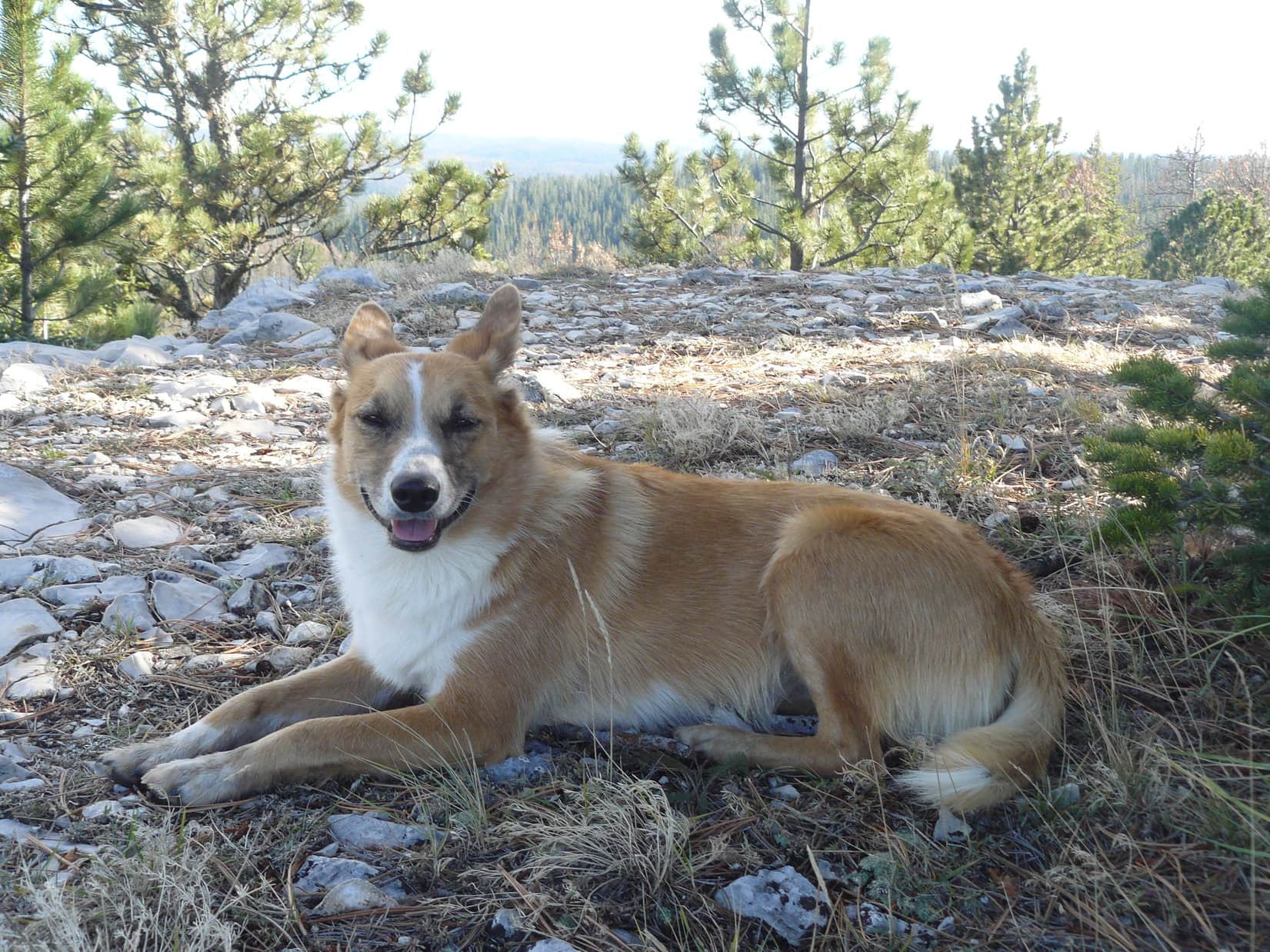
Lupe relaxes on Crooks Tower. This was her 5th ascent.

The summit of Crooks Tower is a relatively small (large room-sized), level limestone platform.  Although Crooks Tower is one of the very highest mountains in the Black Hills, there are plenty of ridges almost as high in the area.  The ridges and forest block the views in most directions, but Harney Peak (7,242 ft.) can be seen far to the SE.  There is a less dramatic distant view off to the N, too.

SPHP had never realized it before, but by standing at just the right spot and peering between tree branches, it was possible to get a look at Inyan Kara (6,360 ft.) off to the WNW in Wyoming.

Harney Peak (L) can be seen on the far horizon from Crooks Tower. Photo looks SE.
Looking N from Crooks Tower.

After enjoying the views from Crooks Tower, Lupe and SPHP returned to the G6.  There were still at least a couple of hours of daylight left.  SPHP pondered what Lupe should do next?  The top alternatives were a visit to Clayton Pond, or exploring USFS Road No. 189.4B.  Since Lupe was practically at No. 189.4B already, it won out.

Lupe and SPHP left the G6 where it was, and went right on by to USFS Road No. 189.4B.  The only marker at the start of the road wasn’t entirely legible, but seemed to indicate this was No. 189.4C or 189.6C, but that didn’t agree with SPHP’s USFS map.

No. 189.4B led Lupe WNW down a shallow valley.  The ridge to the N was sunny and thinly forested.  The S side of the valley was shady and densely forested.  Tall grass, taller than Lupe, lined both sides of the road.  Lupe virtually disappeared on her little side excursions.  She soon tired of having to leap up to see where she was, and stayed mostly on the road.  The road gradually and steadily lost elevation.

After more than a mile, there was a fence with a gate.  Ten minutes after going through the gate, Lupe reached an intersection.  USFS Road No. 189.4C went S.  No. 117.6B went N.  Off to the NNW, a curve in No. 117 could be seen up ahead across a big open field in a larger, wider valley.  Lupe and SPHP followed No. 117.6B all the way to No. 117.

USFS Road No. 117 as seen from No. 117.6B. This corner of No. 117 was as far as Lupe managed to get on her explorations WNW of Crooks Tower. Photo looks WNW.

By the time Lupe reached No. 117, she was 2 miles from the G6.  The sun was getting low.  It was time to turn back.  SPHP checked the maps for an alternate route, hoping Lupe could make a loop.  No, she really couldn’t.  Other roads in the area were too long, and it was too late in the day to cut directly through the forest.  Lupe and SPHP returned on No. 189.4B, this time going up the valley, instead of down.

On the way back, SPHP started thinking it might be fun to watch the sunset from Crooks Tower.  Even though forest hid the views to the W at the very summit, there was a ridge almost as high just S of USFS Road No. 189.4C a short distance SSW of the true summit.  Maybe Lupe could see the sunset from there?

Lupe arrived up on the ridge with a little time to spare.  The W end of the ridge ended at a small limestone cliff.  It wasn’t high enough to really get a good view to the W, but the view in that direction was better than it would have been at the true summit of Crooks Tower.  SPHP sat down next to a tree to wait.  A chipmunk darting around on the rocks nearby entertained Lupe.

Lupe watching the chipmunk (not pictured).

The chipmunk eventually ran off.  Lupe rested on the ground near SPHP.  The edges of her big, soft attentive ears glowed in the last rays of sunlight.Lupe near Crooks Tower, 10-8-14

Waiting for sunset.
Waiting for sunset.

Sunset from SSW high point on Crooks Tower, 10-8-14When the show was over, Lupe and SPHP continued on to the true summit of Crooks Tower.  Lupe made her 2nd ascent of the day, and 6th all time.  The full hunter’s moon was due to come up soon.  Darkness fell and stars began to appear.  Lupe and SPHP waited.  As the pale moon rose, a lone coyote began to howl.  Lupe was entranced.

For several minutes, the lone coyote howled, pausing now and then to listen.  At last, very faintly from far to the W came a few answering howls.  That was good.  The coyote had a friend.  So did SPHP.  It was time to take her home.  (7:06 PM, 41°F)Lupe at sunset SSW of Crooks Tower, 10-8-14

Links:

Next Black Hills Expedition                    Prior Black Hills Expedition

Want more Lupe adventures?  Choose from Lupe’s Black Hills Expeditions Adventure Index or Master Adventure Index.  Or subscribe free to new Lupe adventures.

Black Hills, SD Expedition No. 100 – Round Mountain, Peak 6740, Limestone Hill & Elliot Ridge (10-16-14)

Only yesterday it had been 80°F.  Now it was much cooler.  A cold front moved through overnight, and a fairly strong wind still blew out of the NW, but it wasn’t bad down here.  SPHP had just parked the G6 near the intersection of USFS Roads No. 422 and 284.1C (9:54 AM, 47°F).  Lupe was 0.33 mile N of Custer County Road No. 284, and 5 miles W of where “The Fort” used to be S of Crazy Horse on Hwy 385.  She was about to begin her 100th official Black Hills, SD Expedition!

Lupe and SPHP had an ambitious peakbagging day planned for Black Hills, SD Expedition No. 100.  Lupe was going to visit 4 mountains she had never been to before.  Her first goal was Round Mountain (6,600 ft.), the N end of which was only 0.5 mile to the W.  Lupe and SPHP headed W directly for the mountain.

Lupe started gaining elevation right away, slowly at first, but the mountain grew steadily steeper.  The area was all forested, but the forest had been thinned on the lower slopes.  Near the top, the forest was much thicker.  The climb was pretty easy, and soon Lupe arrived at a break in a line of small limestone cliffs near the N end of the mountain.  Lupe and SPHP quickly scrambled up on top.

Round Mountain’s summit ridge is about 0.20 mile long, and runs N/S.  The mountain is capped by a layer of limestone.  Small cliffs tend to form along the edges of the limestone cap.  The summit ridge is quite narrow at the N end, but wider toward the S.  Since Lupe and SPHP came up near the N end of the mountain, Lupe checked things out in that direction first.

At the N end of Round Mountain, the narrow limestone ridge ended in small cliffs on all three sides.  Pines hid most of the field of vision, but Lupe did get a partial look at Peak 6740 to the N.  It was windy and cold here.  Lupe didn’t stay long.  Lupe and SPHP went back to the little notch in the limestone cliffs to get out of the wind.  SPHP checked the topo map.  The true summit was supposed to be toward the S.

From the notch, it was easiest to just go S along the base of the W side of the cliffs until another break provided a way up on top again.  Lupe and SPHP continued S on the ridgeline.  For the most part, the forest blocked the views.  At least the forest was providing protection from the wind!  Occasionally Lupe could see distant peaks SPHP recognized to the E.  All that could be seen to the W was a high forested ridge less than a mile away.

The stroll along the top of the ridgeline was easy and almost level.  Lupe gained elevation slowly.  She passed over the true summit of Round Mountain, but continued on a little farther to the cliffs at the S end.  Lupe found the best views from Round Mountain here.  From on high, she could see a very long way S.

Lupe reaches the S end of Round Mountain. The big view here was easily the best from anywhere on the mountain. Photo looks S.

After checking out the view, Lupe and SPHP went N back to the true summit.  The summit area was very flat and hidden in the forest.  A small patch of exposed limestone seemed to be close to the highest point around.  Lupe posed for a photo.  Round Mountain was her first peakbagging success of Black Hills, SD Expedition No. 100!

Lupe at the summit of Round Mountain. Photo looks N.

Before leaving Round Mountain, Lupe and SPHP returned to the very N end of the summit ridge once again.  Lupe posed uncomfortably on the rocks in the cold wind.  As soon as her photo op was over, she was anxious to leave!  Lupe and SPHP went back to the notch, climbed down to the E, and turned N along the base of the limestone cliffs.  Soon Lupe was beyond them and on her way down the N slope of Round Mountain.

Lupe sits uncomfortably in the cold wind at the N end of Round Mountain. Her next peakbagging objective, Peak 6740, is the forested ridge seen to her L. Photo looks N.
Looking back at the small limestone cliffs at the N end of Round Mountain. Photo looks SSW.

Lupe’s next peakbagging objective was Peak 6740, which Lupe had seen part of from the N end of Round Mountain.  Peak 6740 was less than a mile away.  As the terrain started leveling out, Lupe and SPHP crossed USFS Road No. 241.1C.  Continuing N a couple hundred yards, Lupe found another grassy road which must have intersected with No. 241.1C back to the SW.

Like at Round Mountain and many other western Black Hills peaks, a layer of limestone forms the top of Peak 6740.  As a result, there are cliffs along most edges.  On Peak 6740, the limestone is thicker and the cliffs are higher than at Round Mountain.  SPHP scanned the SE facing cliffs, hoping to see a break where Lupe could climb up.  There appeared to be a couple of possibilities, but the mountain looked pretty steep.  It was hard to tell if there was actually a realistic route up from the SE.

The grassy road Lupe had just reached went N along the lower E slopes of Peak 6740.  SPHP decided it might be best for Lupe to stay on the road.  Maybe there would be an easier way up from the N?  The road was almost level and an easy trek.  Very conveniently for Lupe and SPHP, it went past the E side of Peak 6740 and curved around to the N side.  The grassy road then started looping down to the NE toward Custer County Road No. 292, which could be seen not too far below.

By the time the grassy road turned NE, Lupe and SPHP could see a broad, thinly forested valley ahead.  It rose at a moderate pace toward the SE up to the top of the ridgeline on Peak 6740.  Lupe and SPHP left the road and started climbing.  Lupe was exposed to the NW wind here, but it was a much easier way up than anything SPHP had seen from the SE.

Lupe climbed up to the highest point at the N end of the ridge.  There were great views from the edge of the cliffs here!  Time for a break.  Lupe had water and Taste of the Wild.  She then spent her time sniffing through low juniper bushes with a great deal of interest, although what was so fascinating about them was not apparent to SPHP.  While Lupe was thusly entertained, SPHP ate an apple and enjoyed the scenery.

St. Elmo Peak (6,458 ft.) (L), Harney Peak (7,242 ft.) (Center), Thunderhead Mountain (6,567 ft.) (R where the Crazy Horse carving is), and Sylvan Hill (7,000 ft.) (highest point on the ridge seen above and just L of Crazy Horse). Photo looks NE from the cliffs of the NE prong of the Peak 6740 anchor.
Lupe on the high cliffs at the end of the NE prong of the Peak 6740 anchor. She is distracted by something in the low juniper bushes off the L side of this photo. Photo looks N at Bear Mountain (7,166 ft.)
Lupe on the high cliffs at the end of the NE prong of the Peak 6740 anchor. She is distracted by something in the low juniper bushes off the L side of this photo. Photo looks N at Bear Mountain (7,166 ft.).

Peak 6740 has an unusual shape, rather like an anchor.  The bottom of the anchor is positioned to the SE.  The main shaft extends to the NW.  From the bottom of the anchor, prongs curve to the W and NE.  The topo map shows five particularly high spots on the mountain – two along the main shaft, one at the bottom of the anchor, and one near the end of each prong.  All of these high spots are connected by long broad ridges that are only marginally lower.

Lupe had reached the top of the ridge at the high spot near the end of Peak 6740’s NE prong.  However, it wasn’t clear if this was the true summit of Peak 6740, or not.  The high points are separated from each other by as much as 0.5 mile.  Due to the forest and the terrain, the high points aren’t all in view from one another.  The Peakbagger.com topo map shows the high points are very close to the same elevation.

To make certain Lupe reached the true summit, she was going to have to visit the other high spots on the mountain, too.  Lupe and SPHP left the NE prong heading for the SE high point near the bottom of the anchor.  Along the way, Lupe found there was a small break in the cliffs.  She really could have come up the mountain from the SE!  It would have been a much shorter and steeper route than the one she actually took by circling around to the N.

Round Mountain (Center) came back into view as Lupe headed toward the SE tip of the Peak 6740 anchor. Near this spot was a narrow break in the cliff wall which would have been a much shorter and steeper route up. Photo looks S.

The cliffs at the very SE tip of the Peak 6740 anchor provided a great look back to the S at Round Mountain.

Lupe at the SE tip of Peak 6740. Photo looks S at Round Mountain.

From the cliffs at the SE tip of Peak 6740, Lupe and SPHP went NW up a modest slope and found the closest high spot at the base of the anchor.  It seemed at least as high as the NE prong had been, and maybe a bit higher.  From here, SPHP could also see the high spot at the W prong.  It looked almost as high, but instead of going directly to the W prong, Lupe went NW to explore the main shaft of the Peak 6740 anchor.

Lupe found a small patch of exposed limestone here at the high spot near the SE bottom of the Peak 6740 anchor. Photo looks SE.

The main shaft of the anchor was more heavily forested than the rest of the mountain.  At first, the terrain didn’t look promising.  Lupe started out losing elevation.  After 5 or 10 minutes, though, she came to two high spots along the way.  The first high spot was a flat, elevated limestone outcropping.  The second high spot was close enough to be seen ahead a bit farther to the NW.  It looked like a 5 foot high limestone rock.

When Lupe and SPHP got close to the second high spot, Lupe discovered that the rock was actually three pillars of limestone very close together, all about 5 feet high.  Lupe and SPHP continued NW beyond the limestone pillars until it became clear there wasn’t any higher ground ahead.  The forest had been thinned in this area, and Lupe could see the high point at the NE prong of the anchor.  It looked every bit as high as where Lupe and SPHP were, and probably higher.

Lupe and SPHP returned to the limestone pillars high point.  Lupe got up on top of one of the pillars for a photo.

Lupe up on the 3 pillars high point on Peak 6470. This is the high point at the NW end of the main shaft of the anchor.

SPHP peered through the forest out over a small valley back toward the W prong.  Even though Peakbagger.com marks the true summit of Peak 6740 at the middle of the main shaft of the anchor, the W prong looked higher than the high points along the main shaft.  Lupe had better visit the W prong, too!  It didn’t take Lupe all that long to get there.

Lupe at the high spot on the W prong of Peak 6740.

By now, Lupe had been to all five of the high points on the Peak 6740 anchor.  Wherever the true summit was, she had been there.  If SPHP had to guess, the SE high spot at the bottom of the anchor was the true summit.  The W prong was a close second.  If Lupe thought differently, she didn’t say so.

It was time for Lupe to press on to her next peakbagging goal, Limestone Hill (6,620 ft.).  To get there, Lupe left the W prong of Peak 6740 taking a shortcut N down into a small valley.  She then climbed back up to the three pillars high point on Peak 6740.  She went a little farther NW, and then turned W following a lower ridge down through a dense forest of young trees.

Limestone Hill was only 0.33 mile away.  Lupe soon came to a shallow saddle where there was a jeep trail.  Lupe and SPHP followed the old jeep trail to a slight rise, which was the summit of Limestone Hill.  The summit area ended at a band of low limestone cliffs to the W.

Getting to Limestone Hill from Peak 6740 had been a snap!  SPHP took a break.  Lupe could have taken one, but she was too busy.  A chipmunk had taken refuge in a patch of low bushes at the edge of the cliff.  Lupe searched excitedly for it, but the chipmunk had all the advantages.  SPHP ate an apple and checked the maps.  Lupe’s final peakbagging objective for the day was Elliot Ridge (6,700 ft.), about 3 miles NW as the crow flies.

Lupe on Limestone Hill. The Bear Mountain quarry can be seen in the background. Photo looks NW.

Lupe couldn’t go to Elliot Ridge as the crow flies, though.  Down in the broad open valleys to the W and N of Limestone Hill, the fields were all private property.  Lupe would have to go S to get around it.  Lupe and SPHP returned to the jeep trail and started following it SE.

The jeep trail turned out to be USFS Road No. 284.1I.  It wound around quite a bit to the W of Peak 6740, but eventually turned S and arrived at Custer County Road No. 284.  Lupe and SPHP followed it 0.25 mile W to its junction with the S end of USFS Road No. 291 (Ditch Creek Road).  As soon as Lupe and SPHP reached the junction, gunfire erupted off to the N.

Someone had started target practice up at the Bear Mountain quarry.  The plan had been to go N on No. 291, but Lupe would have to pass by quite close to the quarry.  Since Lupe hates the sound of gunfire, SPHP stopped to consult the maps.  Was there another way around to Elliot Ridge?

Yes, there was, but it wasn’t as direct.  Unfortunately, it was too late in the day to consider the long route.  SPHP encouraged Lupe to head N on No. 291.  Lupe did her best to convince SPHP deadly danger awaited.

Limestone Hill is pretty enough, but doesn't look all that high or impressive from USFS Road No. 291. Photo looks E.
Limestone Hill is pretty enough, but doesn’t look all that high or impressive from USFS Road No. 291. Photo looks E.

With Lupe constantly insisting it was wise to turn back, progress going N on USFS Road No. 291 was slow until a couple of squirrels and some free range cattle diverted Lupe’s attention from the gunfire.  Fortunately, target practice ended before too long.  Lupe was then happy to trot right along.

Lupe and SPHP reached the intersection with USFS Road No. 293, which goes NNE to Bear Mountain.  On the other side of No. 291, a jeep trail led W into the forest.  SPHP was eager to leave No. 291, and hoped the jeep trail would turn NW toward Elliot Ridge.  It soon turned SW instead.  Lupe and SPHP left the jeep trail heading NW through the forest.

It wasn’t far to a small valley.  USFS Road No. 472 was down there, but Lupe just crossed it and continued NW up onto the next ridge.  From the top, Lupe and SPHP could see the larger Bear Spring Creek valley.  The other side of the valley was all barren.  This area had burned in the Jasper Fire back in August, 2000.

The story is that back on August 8, 2000, a woman stopped along the highway a couple miles W of Jewel Cave National Monument to pee.  For some reason, she thought it would be a good idea to light a match and drop it on the ground.  Before departing, she watched as pine needles caught fire and the fire started to spread.  The resulting Jasper Fire burned 83,000 acres of the Black Hills.  Elliot Ridge is in the burn area.

Lupe and SPHP headed down to Bear Spring Creek.  SPHP was surprised to see it was still flowing this time of year.  Lupe a long cool drink from the tiny creek.  It was the only stream she had come to all day.  From the creek, Lupe and SPHP continued NW up the other side of the valley.  Partway up, Lupe came to a dirt road, which may have been USFS Road No. 469.1A.  Lupe and SPHP followed the road SW a short distance, but left it at its high point to turn NW again and keep climbing.

As Lupe gained elevation, she started coming to rock outcroppings at high points along the way.  It was slow going.  There were many dead tree trunks and branches laying on the ground, bleached by years in the sun.  Even though the area is all in the Black Hills National Forest, Lupe kept coming upon barbed wire fences, too.  Lupe finally reached the top of the ridge.  Despite the unbroken views, SPHP was uncertain which way Lupe needed to go to reach Elliot Ridge.

It was still windy and getting progressively cooler out.  SPHP consulted the maps, but the wind was a real pest.  SPHP finally concluded that Lupe was far enough N.  Elliot Ridge was off to the SW from here.  Lupe and SPHP headed SW staying on the highest ground possible.  Out in the open, Lupe saw several herds of deer, both mule deer and whitetails.  Of course, they also always saw Lupe and SPHP and bounded away.

Lupe on her way to Elliot Ridge. The hill ahead proved to be a false summit. Photo looks SW.

The first big hill Lupe climbed heading SW proved to be a false summit, but the true summit of Elliot Ridge could be seen ahead from the top.  Lupe and SPHP continued on, and Lupe finally arrived at the summit of Elliot Ridge.

Lupe comes running back to SPHP from one of her explorations. The summit of Elliot Ridge is just ahead. Photo looks SSW.

Elliot Ridge itself was not very beautiful with all the dead trees laying around.  The fire had certainly opened up the views, though.  In the cool wind, everything looked and felt stark and desolate.  Lupe could see far to the SW into Wyoming.  SPHP could even make out Laramie Peak (10,272 ft.) very faintly on the farthest horizon.

Lupe seems quite pleased to have arrived at the summit of Elliot Ridge. Photo looks SE.

Lupe and SPHP continued S from the summit of Elliot Ridge.  Lupe came to a series of minor high points as she followed the ridgeline.  As the sun started sinking in the W, the wind finally began to die down.  It was really beautiful out.  The sense of isolation was inspiring.  On the E side of the ridge, there was a great view of the S end of the Bear Springs Creek valley N of Custer Country Road No. 284.

Lupe somewhere S of the summit of Elliot Ridge as the day nears its end.

SPHP hoped for a great sunset, but it didn’t develop.  Too many clouds moved in off to the W.  There was never more than just a little color that could be seen.  The world turned gray.Sunset from S end of Elliot Ridge, 10-16-14When the sun disappeared, Lupe and SPHP descended from the ridgeline heading SE down into the Bear Springs Creek valley.  Twilight was already well advanced by the time Lupe reached Custer Country Road No. 284 at the S end of the valley.  Lupe was still 5 or 6 miles from the G6.  Lupe and SPHP started trudging SE on No. 284.

It was dark out by the time Lupe had gone over a mile to the southernmost point on No. 284 where it turns NE.  A guy named Mitch came by in a pickup truck.  Mitch very kindly offered Lupe and SPHP a ride.  Lupe accepted immediately!  She thought a ride was a splendid idea!  She leaped way up into the big truck without the least bit of hesitation.

Mitch had a cabin somewhere farther W, but he was on his way E to his father’s ranch near Crazy Horse to get his hunting dog.  Mitch was a hunting guide, and had been out hunting coyotes.  The wind had ruined his calls, however, and the hunt had been unsuccessful.  Secretly, Lupe and SPHP were glad.  Lupe and SPHP are on the coyotes’ side.

SPHP asked to be dropped off at Round Mountain.  Mitch soon stopped the truck so Lupe and SPHP could get out.  As Mitch drove off, SPHP realized the drop off point didn’t look familiar.  The night was blacker than black.  SPHP couldn’t see anything – not the road, not a hand held in front of SPHP’s face, nothing except a few stars.  Good thing SPHP had brought the little flashlight!

Lupe was puzzled.  For 45 minutes, SPHP wandered repeatedly back and forth along the same stretch of No. 284 and a side road.  Which way was it to the G6?  Finally SPHP figured it out.  Lupe arrived back at the G6 at 8:26 PM (43°F).

It had been a long day.  Part of the night would have been long too, if Mitch hadn’t come along!  Expedition No. 100 had been a 4 mountain peakbagging success.  Time to head home for a big bowl of Alpo and a nice long snooze!Lupe S of Elliot Ridge, 10-16-14

Links:

Next Black Hills Expedition               Prior Black Hills Expedition

Want more Lupe adventures?  Choose from Lupe’s Black Hills Expeditions Adventure Index or Master Adventure Index.  Or subscribe free to new Lupe adventures.