Black Hills, SD Expedition No. 211 – Bear Mountain & Odakota Mountain (10-15-17)

Start: 10:54 AM, 44 °F, junction of USFS Roads No. 299 (Bobcat Road) & No. 299.1C.

Wow, surprising!  Snow on the road here.  Only a dusting really, but it was the first snow Lupe had seen up in the Black Hills so far this fall.  A harbinger of things to come, but probably not in quantity for another month yet.  American Dingoes love snow, if there’s not too much of it.  Lupe was in a cheerful mood as she began her trek up Bear Mountain along USFS Road No. 299.1C.

Bear Mountain (7,166 ft.) was only a couple miles SW, so it wouldn’t take her long to get there.

Lupe was excited to see snow on USFS Road No. 299.1C as she started up Bear Mountain. Photo looks W.

More than 0.5 mile from where she’d started, Lupe reached an intersection.  USFS Road No. 299.1C turned N here.  Loop took No. 299.1J heading W instead.  Up until now, the road had been in the forest, but No. 299.1J soon curved SW entering more open territory.

USFS Road No. 299.1J curves SW as Lupe continues up Bear Mountain. Photo looks WSW.

Although Lupe came to no more intersections, by the time she reached a barbed wire fence practically at the top of the mountain, a marker said she was on No. 299.1K.  Exactly where the transition occurred wasn’t clear.  It hardly mattered.  Lupe didn’t care.  The important thing was she had made it to the top of Bear Mountain.

Lupe went over to the base of the fire lookout tower to claim her latest peakbagging success!

Lupe arrives at the base of the fire lookout tower on Bear Mountain. This was her 3rd ascent of the 3rd highest mountain in the Black Hills. Photo looks SW.

This was Lupe’s 3rd ascent of the 3rd highest mountain in the Black Hills.  On one of her previous visits, Lupe had actually gone all the way to the top of the lookout tower.  She and SPHP had paid a visit to the friendly forest ranger on active duty inside the ranger quarters.

No one was around today.  With no opportunity for another social visit in the comfort of the ranger station, Lupe didn’t bother to climb the tower.  A chilly 15 mph breeze blew out of the N.  The cold wind would only be worse higher up.

Instead, Lupe went to a small limestone outcropping SE of the tower to check out the views.

Lupe up on the limestone SE of the ranger tower. Black Elk Peak (7,231 ft.) (Center) is the high point seen in the distance. Photo looks E.
Looking back at the fire lookout tower. Photo looks NW.

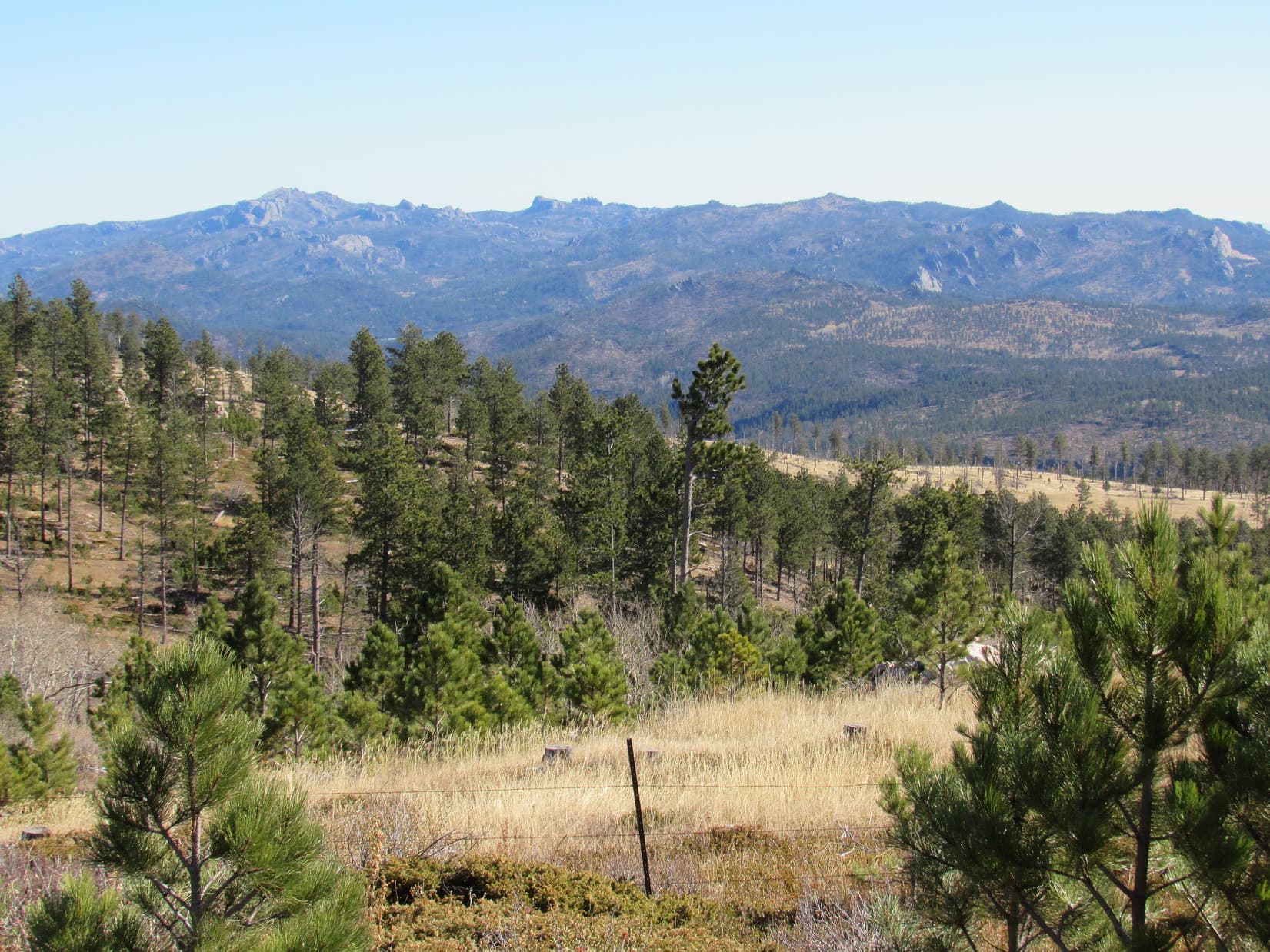
The best views were off to the E where Black Elk Peak (7,231 ft.), the highest mountain in South Dakota, dominated the scene.  Lupe also enjoyed a panoramic view to the S.  The American Dingo could see much of the southern Black Hills from here.

Black Elk Peak (Center) is 11 miles due E of Bear Mountain.
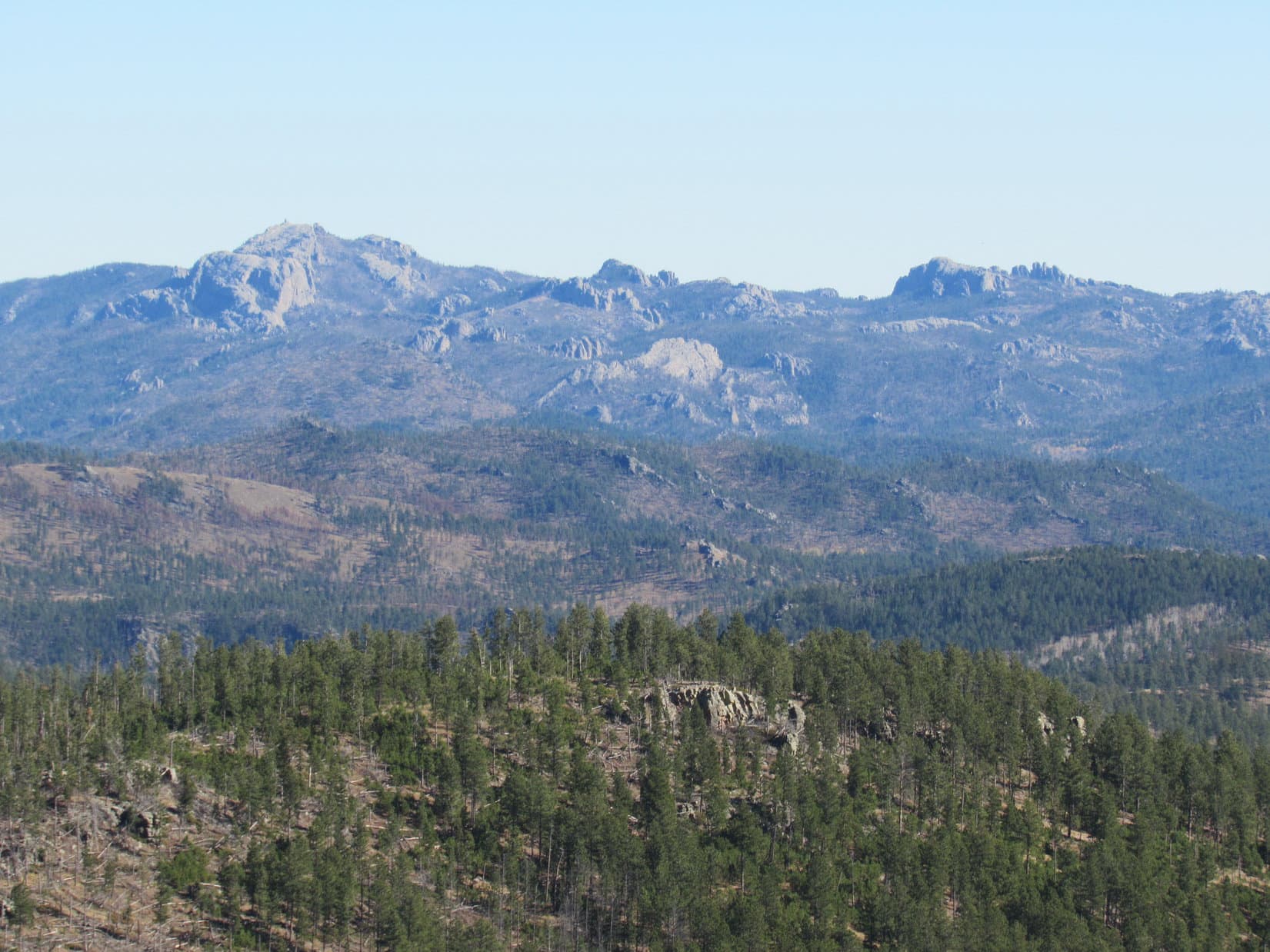
Looking ESE with a bit of help from the telephoto lens. Black Elk Peak is now on the L.
From Bear Mountain, Lupe also had a sweeping view of much of the southern Black Hills. The highest point in the distance on the L is Northeast Cicero Peak (6,240 ft.). Photo looks S.

Climbing Bear Mountain was only the beginning for Lupe.  The plan was to visit Odakota Mountain (7,200 ft.) nearly 4 miles to the N, too.  Since Lupe and SPHP had gotten off to a rather late start, it was already past noon.  With days getting short in mid-October, Lupe couldn’t linger on Bear Mountain too long.

After checking out the views, Loopster briefly dropped by the Bear Mountain fire lookout tower again before continuing on her way.

Lupe at the fire lookout tower on Bear Mountain again before leaving for Odakota Mountain. Photo looks E.
Loop ready to depart Bear Mountain. Photo looks N, the direction she would be heading to get to Odakota Mountain.

Both Bear Mountain and Odakota Mountain lie along the E edge of the high limestone plateau country of the western Black Hills.  The first part of Lupe’s journey N to Odakota Mountain would be along the E rim of the high country.

From the Bear Mountain fire lookout tower, Lupe took the same road she had come in on NE a short distance.  When she got close to the E rim, she followed another road that angled N.  This road eventually turned NW.  Lupe left the road to continue N along the rim.  Odakota Mountain was already in sight!

Lupe near the E rim of the high country of the limestone plateau. Her next objective, Odakota Mountain is the high ridge seen beyond her. Photo looks N.

The terrain along the E rim was hilly.  The area was forested, but generally not too densely.  However, a fair amount of deadfall timber existed in spots.  In a couple of places, the deadfall was dreadfully thick.

Back this summer, Lupe’s mountaineering friend Jobe Wymore had given SPHP a free pair of excellent Komperdell trekking poles.  SPHP had never used trekking poles before, and until today had done nothing with Jobe’s gift.  SPHP quickly discovered that the poles really did help going through the deadfall!

For 1.5 miles, Lupe traveled N near the E rim of the limestone plateau country.  When the American Dingo finally reached a road, SPHP knew she had arrived at an intermediate objective, the Boy Scout overlook.

Coming from the W, USFS Road No. 291.3K leads almost to the edge of the E rim here.  A short path goes from the highest ground down to a large, flat limestone platform perched at the top of sheer cliffs.  A pond a mile to the NE near the Medicine Mountain Boy Scout camp can be seen far below.  The platform also provides sweeping views of the Black Hills to the E.

Lupe reaches the limestone platform known as the Boy Scout overlook. Photo looks ENE.
The short path leading to the Boy Scout overlook is seen on the L. Photo looks ENE.

The Boy Scout overlook is a favorite spot.  Lupe had been here before on other Black Hills expeditions.  Before taking a Taste of the Wild and water break, Lupe took a look at the glorious views.

Lupe on the Boy Scout overlook, a large platform of limestone perched at the E edge of the high country of the western Black Hills. Bear Mountain, where Lupe had just come from, is the high ridge seen beyond her in the distance. Photo looks S.
Looking E from the Boy Scout overlook. Black Elk Peak is on the horizon beyond Lupe.
Black Elk Peak (L), Peak 6920 (Center) and Little Devil’s Tower (6,960 ft.) (R) plus some of the Cathedral Spires (6,840 ft.) (R). Photo looks E with help from the telephoto lens.
Looking NE now. Peak 6720 is the rounded semi-barren hill on the L. Medicine Mountain (6,878 ft.) is the double humped hill with the high point straight up from Lupe’s back. Farther away a bit more to the R is Five Points (6,221 ft.).

Although Odakota Mountain was now only 2.5 miles away to the N as the crow flies, Lupe’s break at the Boy Scout overlook had to be kept short.  To actually get to Odakota Mountain, she had to swing more than 1.5 miles W going down Grand Vista Draw.  She would then have to go another 1.5 miles back E again on her way up Long Draw.  All that extra mileage, plus the distance N!

Loop curled up next to SPHP on the limestone platform for a few minutes, but soon it was back to business.  Lupe left the Boy Scout overlook heading W on USFS Road No. 291.3K.

In the upper end of Grand Vista Draw, Lupe reached an intersection.  The Carolina Dog left No. 291.3K to take No. 291.3A down the wide, shallow canyon.  Beautiful light brown grass lined the road.  Lupe passed through a stand of aspens where a few colorful leaves still held on.
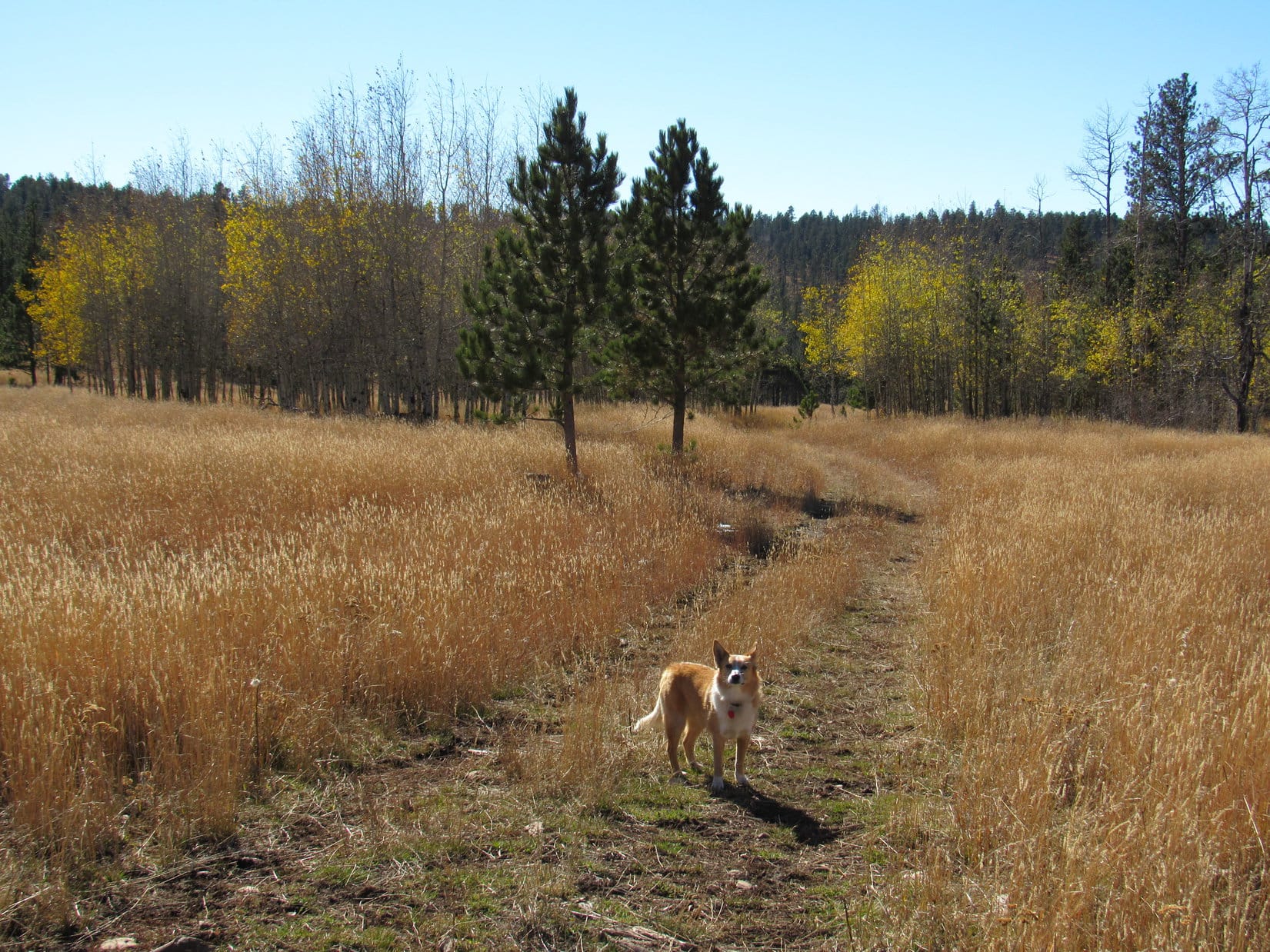
Beautiful light brown grass stood along USFS Road No. 291.3A on the way down into Grand Vista Draw. Photo looks WNW.
Passing the aspens. A few colorful leaves still clung to the trees. Photo looks WNW.

The trek down Grand Vista Draw was easy.  On the way, Lupe saw scattered limestone formations along the canyon sides, but they weren’t high or dramatic.  Meadows dominating the upper end of the draw gave way to pine forests lower down.  Finally, near the low point where Grand Vista Draw and Long Draw meet, Lupe reached a line of boulders placed across the road.

Lupe reaches a line of boulders across the road in the area where Grand Vista Draw and Long Draw meet. Photo looks N.

A few boulders couldn’t stop Lupe!  She continued N on the road, but it ended abruptly in the forest.  A short, shady trek brought Lupe to Spring Creek.

Lupe reaches Spring Creek at the start of Long Draw. Photo looks N.

Loop and SPHP crossed Spring Creek (those Komperdell trekking poles proving useful once again!), and climbed through a small meadow to reach a minor road.  The minor road quickly brought Lupe to USFS Road No. 693, which she could follow all the way up Long Draw.

Long Draw did seem long.  Along the way, Lupe saw deer.  She found squirrels to bark at.  She had a fun time, but at last the Carolina Dog reached the high point of No. 693 at the upper end of Long Draw where the road turned N.

Loopster in the upper end of Long Draw. Photo looks E.

At the high point, Lupe abandoned the road.  The summit of Odakota Mountain was now only 0.25 mile ESE through the forest.  SPHP was surprised when Lupe drew near the small, slightly higher ridge where the summit is located.  A barbed wire fence crushed in many spots by collapsing trees killed by pine bark beetles had been repaired since Lupe was last here.

The repaired fence was good news!  Lupe has been seriously injured by downed barbed wire several times in the past.  This had been a dangerous place.  It still was to some degree.  Even though the fence was fixed, a tremendous amount of deadfall timber still infested the area.  Lupe and SPHP cautiously picked a way through the mess.

Lupe found the small cairn near the E end of the relatively short summit ridge.  She had made it to the top of Odakota Mountain (7,200 ft.), the 2nd highest mountain in South Dakota!

Lupe reaches the summit cairn on Odakota Mountain, the 2nd highest mountain in South Dakota. Photo looks WSW.
The summit ridge on Odakota Mountain is a jungle of deadfall timber. Photo looks WSW.

Although Odakota Mountain is the 2nd highest in South Dakota, the summit doesn’t provide much in the way of views.  Despite how many trees have died and fallen over, more still remain.  A tree-broken view to the S was about all there was to see.

A tree-broken view to the S is all the summit of Odakota Mountain has to offer. Lupe could see Bear Mountain (the long high ridge in the distance) where she had come from, and the small pond near the Medicine Mountain Boy Scout camp (far L).

Cliffs at the far SE end of Odakota Mountain do offer unobstructed views.  Lupe had seen them once, long ago.  However, getting there from the summit requires a bushwhack through a significant stretch of bad deadfall timber.  Lupe didn’t have time to go see those views today.

Lupe relaxed next to the summit cairn.  Once again, a short break was all she could afford to take.

Lupe relaxes next to the summit cairn. Another short break was all she could take here. Photo looks NW.

Odakota Mountain is one of the mountains Lupe has visited most.  This was her 8th time at the summit.  The first time the Carolina Dog had come here nearly 3.5 years ago, there hadn’t even been a cairn.  The last time she’d been here was over 1.5 years ago, when she had first met her friend Jobe Wymore and guided him to the mountain.  Sadly, Jobe wasn’t here to share the mountain with her today.

Snap out of it, Loop!  Enough reminiscing!  We’ve got to get going.  You still have to go all the way back to Bear Mountain and then back down to the G6!

The American Dingo sprang to her paws!  Time for action?  She was ready!  Isn’t she always?

Leaving Odakota Mountain, Lupe got to do something she had never done before.  For over 0.5 mile, she explored the high ground along the edge of the mountain’s SW ridge.  SPHP wanted to see if she could find any unobstructed views from this area.  She did, too!

Bear Mountain, the long high ridge on the R is where Lupe was heading back to from Odakota Mountain now. Part of the pond down at the Medicine Mountain Boy Scout camp is seen below on the L. Photo looks S.
Lupe did find beautiful, unobstructed views from Odakota Mountain’s SW ridge. Black Elk Peak is on the horizon beyond Lupe’s face. Photo looks ESE.
Exploring Odakota Mountain’s SW ridge. Photo looks WSW.

Lupe had a great time exploring Odakota Mountain’s SW ridge, but only got to go about halfway along it.  Too much deadfall timber was slowing things down, and the American Dingo no longer had time to waste.  She returned to Long Draw.  Lupe traveled through the fields paralleling the road.

Day nears an end as Lupe travels back down Long Draw. Photo looks SW.

Hurry, hurry!  Now it was a race against time.  The sun sank ever lower, then disappeared.  Lupe and SPHP made good time, but twilight was fading fast as Lupe came back up Grand Vista Draw.

Looper followed USFS Road No. 291.3A S beyond its junction with No. 291.3K.  For a while she stuck with it, but when the road turned SW it was decision time.  Staying on the road meant miles and miles of extra distance.  The other option was to bushwhack SE to the E edge of the limestone plateau country on the most direct route to Bear Mountain.

SPHP led Lupe SE.  Leaving the road was contrary to long-standing rules against trying to bushwhack after dark.   On the other hand, Lupe had already traveled much of this same territory earlier in the day.  SPHP felt confident that having the E rim to follow meant she wouldn’t get lost.

Faint twilight lingered only far to the W now.  Stars shone above, but no moon.  Black night took over.  Somehow the Carolina Dog always seems able to navigate in the dark without any problem.  Not SPHP, who was walking unseeing straight into waist-high pines.

SPHP ran into a barbed wire fence.  No damage done.  Lucky!  SPHP was blind as a bat.  Better bring out the flashlight.  The fence was good news, actually, it meant Lupe was getting close to the E rim.  Deadfall timber was bad here, though.  The Komperdell trekking poles were enormously helpful!  SPHP would have tripped and fallen a jillion times without them.

After getting past the worst of the deadfall, Lupe reached the E rim!  She saw a great many lights glittering far to the NE.  That was Rapid City!  An amazing number of lights were also scattered toward the SE in the general direction of Custer, but the town was not in view.  Guided by the lights of Rapid City, Lupe and SPHP worked S along the E rim.  Sooner or later, Looper would come to Bear Mountain again.

Despite initial confusion over exactly where Lupe was upon reaching a road, she had made it!  She was back at Bear Mountain.  A cold N wind still blew up here.  Despite the wind, Lupe returned to the fire lookout tower.  So what if it was cold, windy and dark?  She’s a peakbagging Dingo, and this was another successful ascent!  (End – 9:10 PM, 30°F)

Back at Bear Mountain!

Links:

Next Black Hills Expedition                     Prior Black Hills Expedition

Want more Lupe adventures?  Check out her Black Hills, SD & WY Expeditions Adventure Index, Master Adventure Index, or subscribe free to new Lupe adventures!

Black Hills, SD Expedition No. 210 – Hat Mountain & Green Mountain (10-7-17)

Start – 10:44 AM, 57°F at the Gold Run trailhead near Deerfield Reservoir

Sunny skies, a light S breeze, and pleasant early October temperatures – a great day for a romp in the Black Hills!  Lupe would likely get to see some fall colors, too.  First things first, though.  Loop hadn’t been to Deerfield Reservoir in a while.  She may as well take a quick look at the lake before dashing off on her peakbagging adventures.

Only a small portion of the lake was visible from here, but the deep blue waters were a pretty sight surrounded by low pine-covered hills.

Lupe started the day with a look at Deerfield Reservoir. The blue lake was a pretty sight. Photo looks N.

After admiring the lake, Lupe set off for her first peakbagging destination of the day.  She left Deerfield Reservoir heading SW up a forested embankment.  It wasn’t far to Deerfield Road, which she followed W to USFS Road No. 691 (Williams Draw Road).  Traveling S along No. 691, Loop came to a small field where she could see Hat Mountain (6,779 ft.) up ahead.

From this small field near USFS Road No. 691, Lupe gets a fairly good view of Hat Mountain up ahead. Photo looks SSW.

Hat Mountain was only a mile away, so it wouldn’t take Lupe long to get there.  That is, if cows blocking the road could be convinced to get out of the way.  Not to worry!  The cattle were mightily and speedily impressed by the Carolina Dog’s enthusiastic persuasive abilities.  They complied immediately with her wishes.

These cattle on USFS Road No. 691 were quickly convinced to move and let Lupe and SPHP pass. Photo looks SW.

A little farther on, Lupe left the road herself.  She started her trek up the lower NE slope of Hat Mountain passing through a beautiful stand of yellow aspens.

Starting up among the yellow aspens. Photo looks SSW.

Above the aspens, Lupe climbed through a pine forest.  Above the pines, the upper N slope of Hat Mountain was grassy and treeless.

Looper on the upper N slope of Hat Mountain. Photo looks S.

When Lupe reached the summit, the first thing she did was to go over to the survey benchmark.  It was easy to find toward the E side of the flat, barren summit area.

Lupe stands next to the survey benchmark. Part of Deerfield Reservoir, where she had started from, is in view.  Custer Peak (6,804) (Center) can be seen on the horizon. The huge grassy area in between is Reynolds Prairie. Photo looks NNE.
The survey benchmark is so scratched up it’s getting a little hard to read “Hat”.

Next Lupe went to see the sights.  She had unobstructed views in every direction.  Simply fabulous!

Looking NNW. The grassy area seen straight up from Lupe is part of the Castle Creek valley. The most distant peak seen on the R is Terry Peak (7,064 ft.).
Black Elk Peak (7,231 ft.) is the distant high point on the L. Green Mountain (7,164 ft.) is the high ridge on the R. Photo looks SE.
Green Mountain, the long high ridge on the R, would be Lupe’s next peakbagging goal. The summit is near the edge seen almost straight up from Lupe. Photo looks SE.
Most of Hat Mountain’s flat, oval-shaped summit area is in view here. Photo looks S from near the N edge.
Near the S end of Hat Mountain’s otherwise flat summit is this small depression. Photo looks SW.
Loopster stands next to the small depression. The grassy ground seen in the distance straight up from her back is the upper S slope of South Castle Rock (6,840 ft.). Photo looks N.
Loop stands on a ledge at the S edge of the summit area. A little of the Heely Creek valley is seen below. Photo looks SW.
Kind of windy up here, SPHP! Think I’m going to go hide in the depression as soon as you’ve taken this shot. Photo looks NE.

Carolina Dogs aren’t fans of wind, and it was rather breezy up on Hat Mountain.  The steady 15 mph SW breeze was enough to make Lupe want to look for a sheltered spot.  She found that the small depression near the S end of the summit area worked fine.  She curled up there and took a little break.

Lupe retreats to the small depression to relax out of the wind. Photo looks SW.
Take as much time looking at the views as you like, SPHP. Think I’ll take a nap. Wake me when it’s time to go to the next mountain.

SPHP joined Lupe in the depression for a short break, then left to stroll around the summit again for another look at the views.  Meanwhile, Loop dozed off for a few minutes in her sunny, sheltered spot before SPHP announced it was time to move on.

Lupe left Hat Mountain heading S.  Green Mountain (7,164 ft.), her next peakbagging goal was still close to 4 miles away even as the crow flies.

Looper stands at the S end of Hat Mountain’s summit ready to head down to the grassy slope below. Photo looks S.
On the way down Hat Mountain. Photo looks SW.
Looking back at the Hat Mountain summit from the upper S slope. Photo looks N.
Lupe leaves Hat Mountain heading for Green Mountain, the high ridge on the L. On the way, she would cross the Heely Creek valley, seen below on the R. Photo looks SSE.

The first part of the way to Green Mountain was easy.  Lupe descended mostly open ground into the Heely Creek valley where fall colors were on display.

On the way down Hat Mountain to cross Heely Creek. Photo looks SW.
Fall colors on display in the Heely Creek valley. Photo looks SW.

Heely Creek was very small this time of year, only a foot wide and a few inches deep.  As soon as Lupe crossed it, her long gradual climb to the top of Green Mountain began.

Once she entered the forest S of Heely Creek, Lupe followed old logging trails and minor USFS roads.  Sometimes she was on faint roads abandoned so long ago that pine trees were growing on them.  Other times she simply went through the forest not on any road or trail at all.

On the way to Green Mountain, still W of USFS Road No. 691. Photo looks SSE.

About 2 miles from Hat Mountain, Lupe reached USFS Road No. 691 again.  She followed it S for a mile.  When it began angling SW, she left No. 691 going SE up a forested slope with enough deadfall on it to slow progress down for a while.  Eventually she came to a minor USFS road, which she was able to follow E the rest of the way to Green Mountain.

Green Mountain (7,164 ft.) is one of the highest points in the entire Black Hills.  However, the only distant views available are obtained along the E rim of the mountain.  The best views are toward the SE from limestone outcroppings right along the edge.

Lupe reaches the E edge of Green Mountain. On the horizon are Five Points (6,221 ft.) (L) and Black Elk Peak (7,231 ft.) (R). The large grassy area is the S end of Gillette Prairie.  Photo looks E.
Looking N along the E edge of Green Mountain.
A cairn can be seen on the limestone pillar beyond and behind Lupe. The pillar has a commanding view to the E, but is not the actual summit of Green Mountain. Photo looks NE.
Looking SW along the rim.
Black Elk Peak (Center) is in view on the horizon. Copper Mountain (6,290 ft.) is the much closer forested hill toward the R. Photo looks SE.

While Lupe was enjoying the big views, SPHP noticed a chipmunk.  Lupe hadn’t spotted it yet.  The chipmunk was scrambling around the limestone, appearing and disappearing right along the brink of the cliffs.

Lupe didn’t notice this chipmunk scrambling around the limestone right along the brink of the cliffs. Sometimes it disappeared over the edge before reappearing again a few feet away.

SPHP kept a watchful eye on the Carolina Dog.  These limestone cliffs were no place to go chasing around after chipmunks or anything else!  The chipmunk was sure-footed and could cling to the vertical face of the limestone.  Lupe could not.  Fortunately, she never saw the crafty, quiet “tiny squirrel”.

Lupe perches near the edge of the cliffs where the chipmunk had been scrambling around a few minutes earlier. She never did see it. The big ridge on the R is High Point 7159, an unnamed mountain only 5 feet lower than Green Mountain. Photo looks SE.

After taking in the views, and enjoying a Taste of the Wild and water break, Lupe agreed to let SPHP give her a boost up onto the limestone pillar where the cairn was.  The pillar was an excellent American Dingo display platform with a tremendous view.

On the limestone pillar. Five Points is in view on the horizon on the L. Part of Gillette Prairie is seen below. Photo looks E.
The cairn can be seen better here.
Peakbagging Carolina Dog (L) in the foreground, Black Elk Peak (R) in the distance, and Copper Mountain (R) between them. Photo looks ESE.

Ordinarily, Green Mountain offers complete solitude.  That wasn’t the case today, however.  Upon arrival at the E edge of the mountain, Lupe and SPHP had both seen a hunter perched on the limestone.  He had a tremendous view, and was using binoculars to scan a wide swath of territory below.  The hunter and SPHP had waved at one another, but did not speak.

Surprisingly, Lupe and SPHP weren’t alone on Green Mountain. From his limestone perch, this hunter quietly scanned a broad swath of territory below. Gillette Prairie is seen in the distance. Photo looks NE.

Lupe hates gunfire.  If that hunter took a shot at anything from so close by, poor Loopster would have been terrified.  Having seen the views and had a little break, it was probably best not to tarry here any longer.  It was a long way back to Deerfield Reservoir, anyway.

Of course, before leaving Green Mountain, Lupe still needed to visit the true summit to claim her peakbagging success.  Lupe and SPHP headed N from the limestone pillar.  The highest ground on Green Mountain was somewhere back in the forest only a little W of the E rim.

A fairly large area was nearly level.  It wasn’t really possible to identify an exact high point.  A variety of potential highest spots existed, none convincingly higher than the others.  Most of them featured small mounds of broken limestone.  After searching around for a few minutes, it was time to pick one.  Close enough for Dingo work!

At Green Mountain’s true summit, or as close to it as Lupe and SPHP could find. Photo looks N.
This was Lupe’s 4th visit to Green Mountain.

Although Lupe had been to Green Mountain 3 times before, it was a big place. She’d never explored some of the territory toward the N end.  Enough daylight remained today so she could go sniff about over there on her way back to Deerfield Reservoir.  Looper headed NW through the forest looking for a couple of sub-peaks shown on the topo map.  Both were still over 7,000 feet elevation.

The first hill she would come to was High Point 7062.  Plentiful deadfall timber slowed SPHP’s progress, but High Point 7062 eventually did come into view.

High Point 7062 (L), located 0.625 mile NW of Green Mountain’s summit, comes into view. Photo looks NNW.

As it turned out, High Point 7062 was worth visiting.  The small summit was capped with a limestone outcropping from which there were 180° views to the N.  Lupe climbed up for a look around.  She could see the top of Hat Mountain (6,779 ft.) from here.

Up on High Point 7062. Photo looks N.
High Point 7062 was worth visiting! Lupe could see a long way N from here. Photo looks N.
Hat Mountain, where Lupe had been earlier in the day, is the grassy, flat-topped hill on the L. Photo looks NW from High Point 7062 with help from the telephoto lens.

From High Point 7062, Loop could also see her next objective, High Point 7025, more than 0.5 mile to the W.  High Point 7025 had a much larger summit area in the form of a 400 to 500 foot long ridge.  The fairly narrow ridge was all about the same elevation, but heavily forested.  Lupe wouldn’t have much in the way of views over there.

High Point 7025, Lupe’s next objective, is the heavily forested ridge seen on the L. Photo looks W.

Even so, when Lupe left High Point 7062, she headed W for High Point 7025.  She enjoyed a beautiful early evening trek, while exploring new territory.

Lupe enjoys the evening on her way to High Point 7025. Photo looks WNW.

Lupe made it to High Point 7025.  She traversed the entire summit ridge from N to S, then back again.  As anticipated, there wasn’t much to be seen in the way of views due to the forest.

On the High Point 7025 ridge. Photo looks SE back toward Green Mountain.

The sun was getting low.  Deerfield Reservoir was still 4 miles N as the crow flies.  Better keep going!  Lupe left High Point 7025 heading N.  She explored more beautiful territory, saw lots of deer, and eventually found minor roads that led her back to USFS Road No. 691.

Darkness fell on the long road hike back to the G6.  Stars glittered above in a moonless sky.  The wind had died down hours ago.  SPHP tramped along, Lupe trotting nearby.  No lights, no traffic, no noise.  Everything as it should be when adventure’s done.  Quiet time together, then the long drive home.  (End – 8:09 PM, 44°F)

Heading down the N slope of High Point 7025 on the way back to Deerfield Reservoir. Hat Mountain on the L.

Links:

Next Black Hills Expedition                Prior Black Hills Expedition

Black Hills, SD Expedition No. 134 – Copper, Odakota, Green & Hat Mountains Plus the Dragon Caves (6-20-15)

Want more Lupe adventures?  Check out her Black Hills, SD & WY Expeditions Adventure Index, Master Adventure Index, or subscribe free to new Lupe adventures!