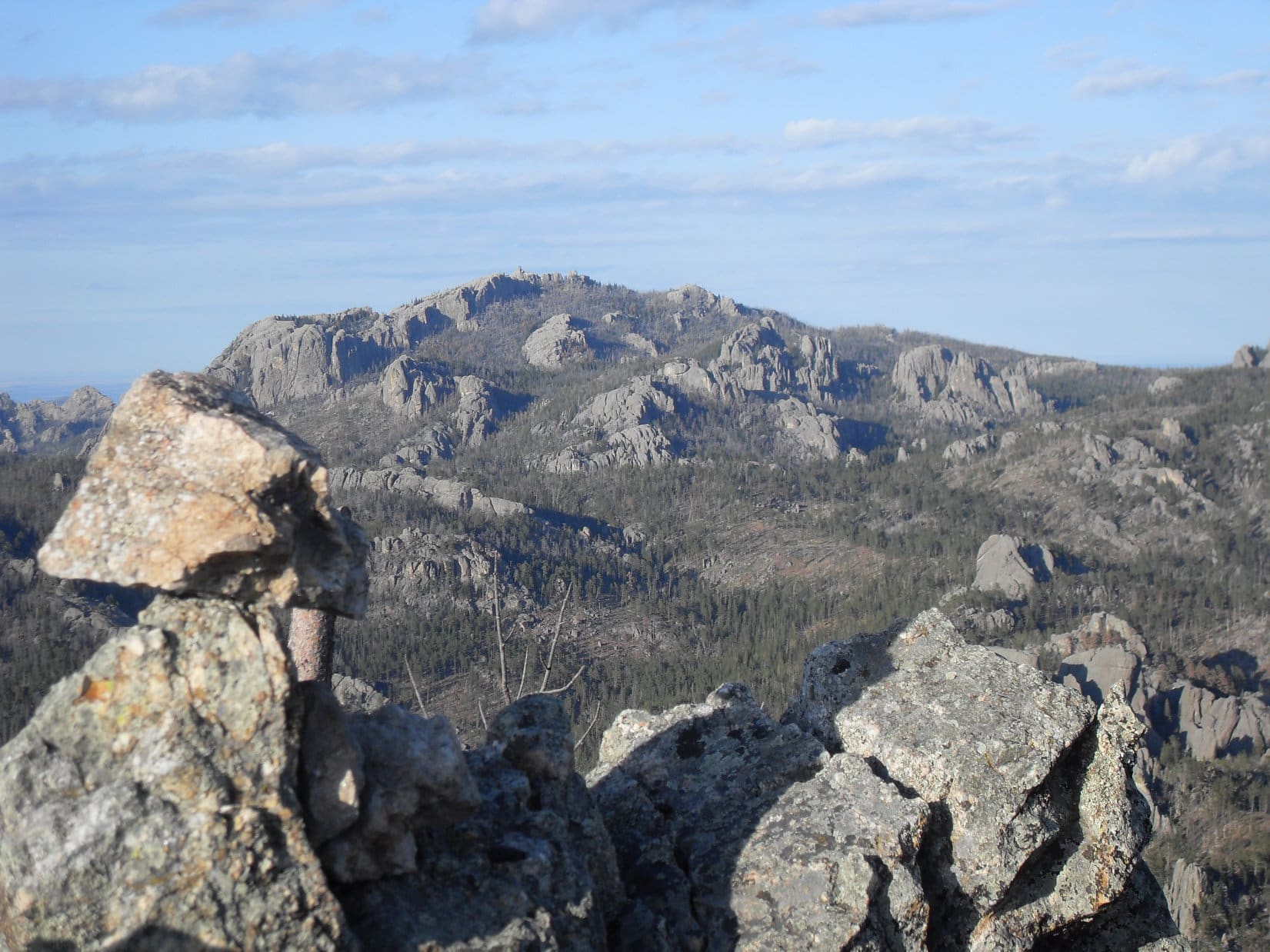
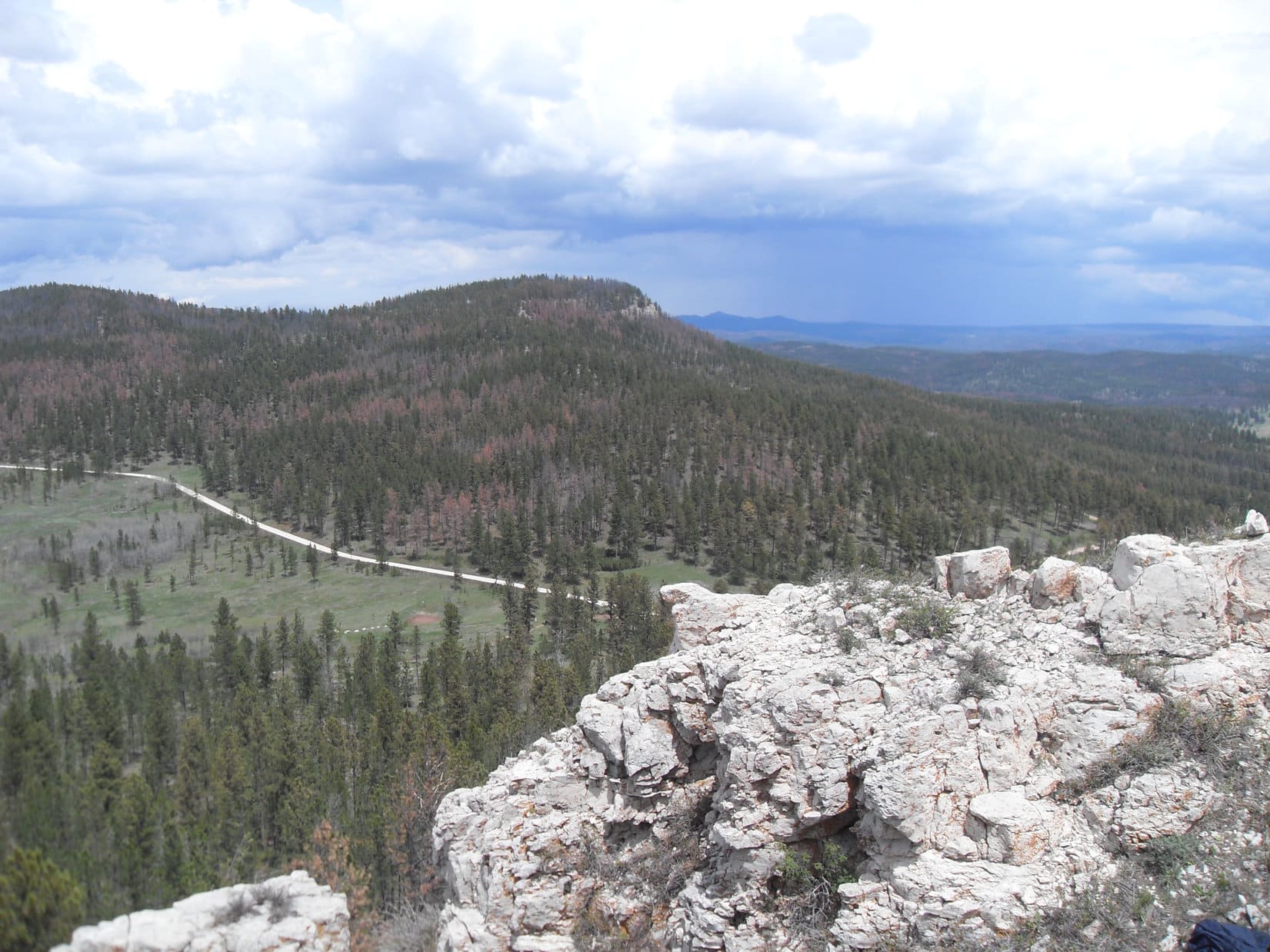
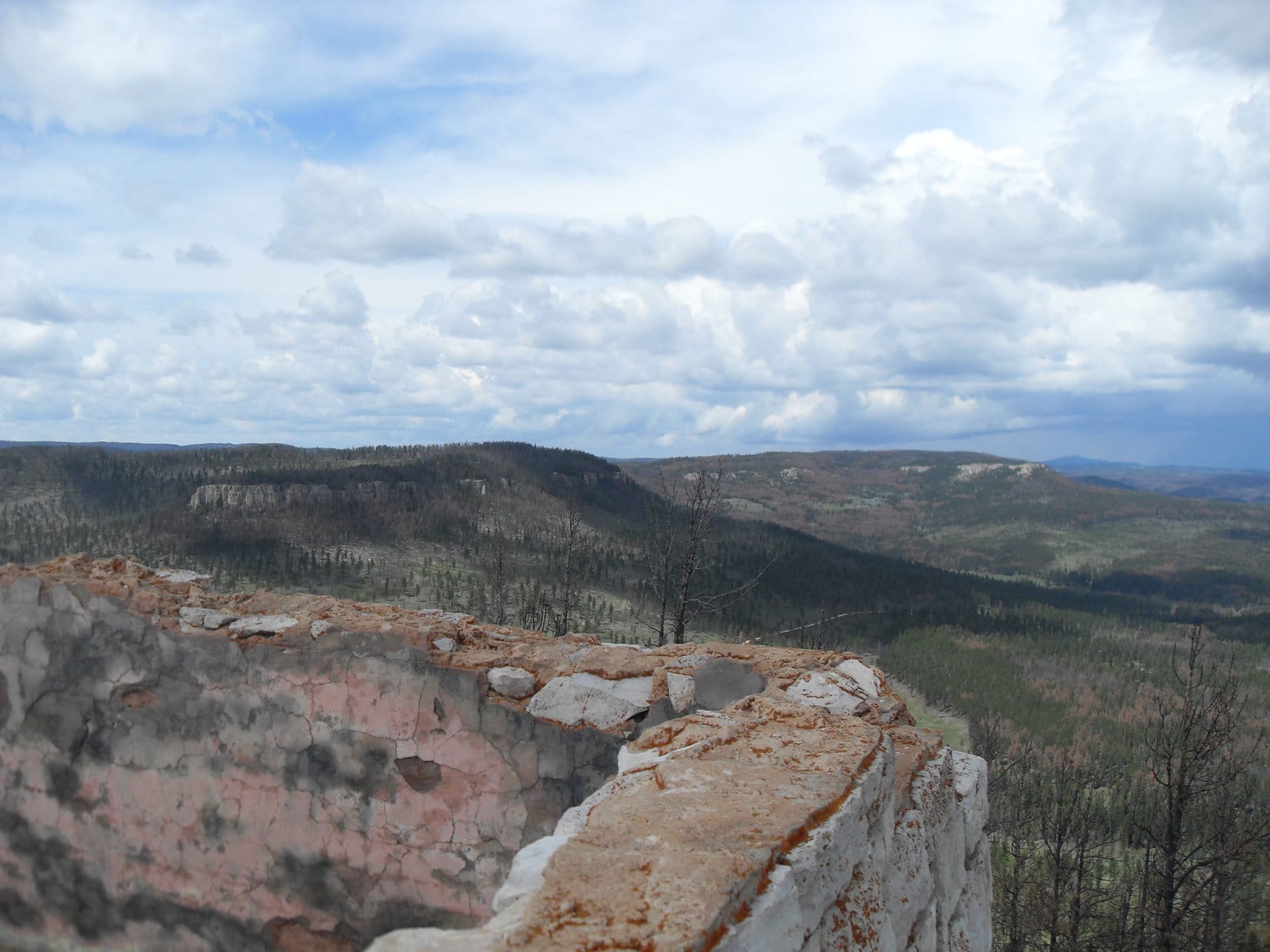
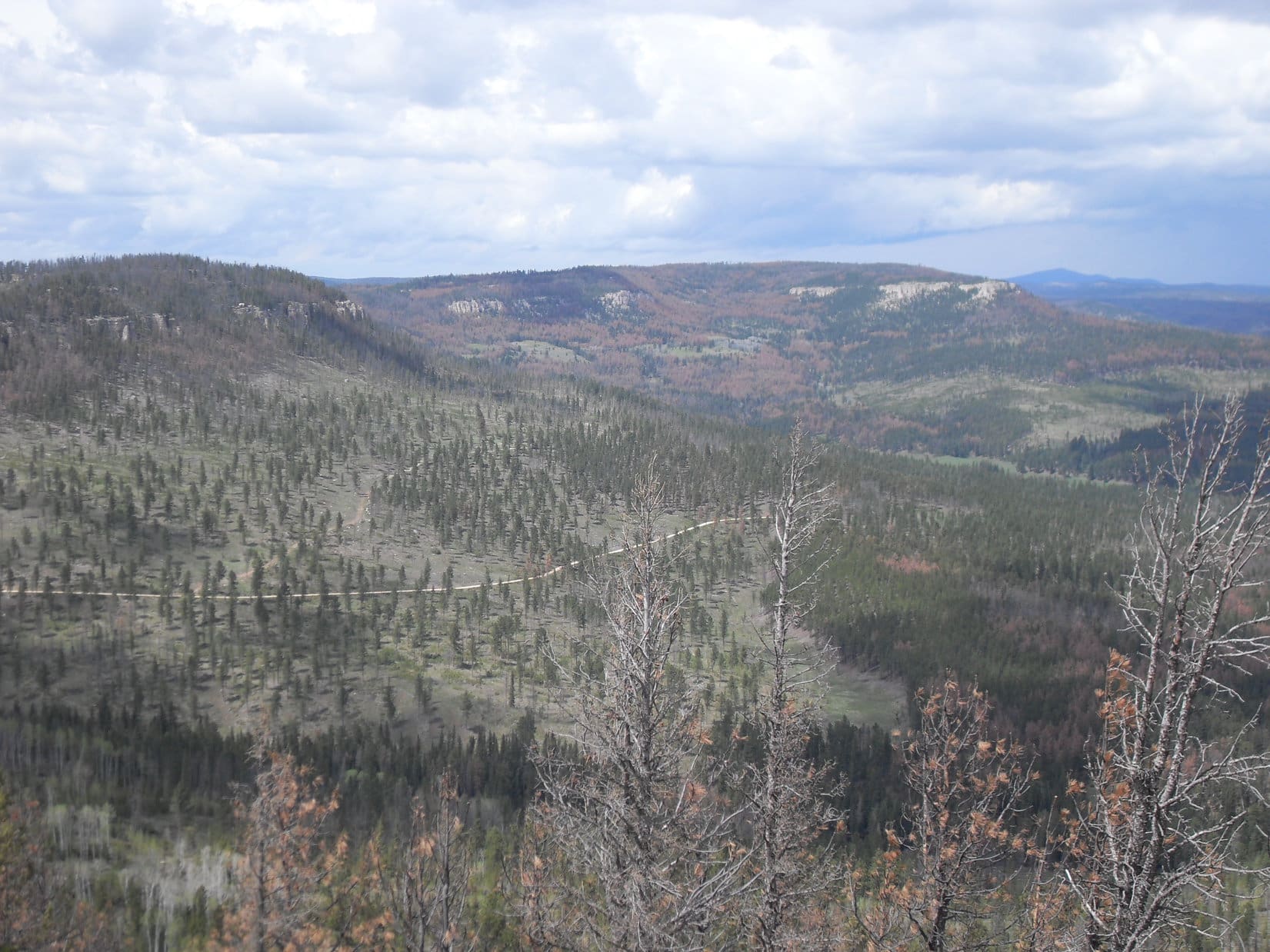
On the S side of Hwy 87/89 a little less than 0.5 mile from where the road reaches Sylvan Lake Lodge (if heading into Custer State Park toward Sylvan Lake), there is a little dirt parking area where a small power line crosses the road. SPHP parked the G6 here at 4:58 PM (51°F). It was already quite late in the day to start one of Lupe’s Black Hills, SD Expeditions, but her only peakbagging objective was just 0.5 mile to the W.
Lupe and SPHP took off heading W downhill through the forest, quickly arriving at a larger parking area only a few hundred feet away. Lupe’s ascent of Sylvan Hill(7,000 ft.) (shown as Sylvan Peak on SPHP’s old USFS map) would start from here. Very conveniently, a grassy road climbed off to the WNW from the lower parking area. Lupe and SPHP followed it, going around a locked gate near the bottom.
The grassy road switchbacked part way up the mountain to arrive at a low sod-covered structure mostly buried into the hillside. It would have been easy to simply step onto the sod roof from the uphill bank, but Lupe and SPHP did not get on it.
The grassy road had ultimately gone more S than W to get to this point, so although Lupe had gained some elevation, she really wasn’t much closer to Sylvan Hill, yet. However, there were already some pretty decent views off to the SE from the sod-covered structure. Lupe and SPHP took a few minutes to appreciate the scene. Then it was time for Lupe to begin the real work of finding and climbing Sylvan Hill.
Lupe and SPHP started climbing WNW up a steep forested slope. Lupe had no problems maneuvering, but as the terrain became progressively steeper, SPHP had to take some care (and a few breathers) along the way. A big rock formation came into view up above. Near its base, Lupe discovered a section of old roadbed laboriously made of rocks. From the roadbed, SPHP discovered there was no practical way over or around the rock formation.
Back down Lupe and SPHP went. Lupe really didn’t have to lose all that much elevation, but it took SPHP a while, simply because the terrain was so steep. As soon as it was possible to go SW around the rocks, Lupe and SPHP did so. Lupe resumed her climb heading WNW again. The climb became less steep, and Lupe arrived at a saddle W of the big rock formation.
SPHP had originally thought the first big rock formation might actually be the summit of Sylvan Peak, but by now it was very clear that it was not. Lupe and SPHP climbed W from the saddle toward another higher saddle. This wasn’t nearly as steep a climb as the first one was, but it did get steeper near the top. Lupe arrived up on the higher saddle between two smaller, but still substantial, rock formations. They were separated by only a few hundred feet.
At the second saddle, Lupe was already higher than any of the rocks of the first big rock formation, which could be seen below to the E. SPHP still wasn’t certain where the summit of Sylvan Hill was. Since the rock formation at the S end of the second saddle looked like it was probably highest, Lupe went there first.
Lupe and SPHP climbed up a cleft in the rocks, arriving up on a shelf of granite very near the top of the S rock formation. (This was likely high point 6849 on the Peakbagger.com topo map.) From the granite shelf, Lupe could see the summit of Sylvan Hill, still 0.25 mile off to the NW. Lupe could also see Harney Peak(7,242 ft.) to the NE.
From what may well have been High Point 6829, Lupe got her first look at the summit of Sylvan Hill(7,000 ft.) (Center), still 0.25 mile away to the NW.Lupe on a granite shelf on High Point 6829(?). Harney Peak(7,242 ft.) (L of Center) is in view on the horizon. The G6 was parked back down near the section of Hwy 87/89 seen just above Lupe’s ear. Photo looks ENE.
Lupe and SPHP scrambled back down off the granite shelf. Now that SPHP was certain of the direction to the summit of Sylvan Hill, there was no need for Lupe to climb the rock formation at the N end of the second saddle. Lupe and SPHP skirted it to the SW. From here on, the terrain was hilly, but not difficult. The main obstacle was the huge amount of deadfall timber. Pine bark beetles had killed much of the pine forest, which was in terrible condition.
Picking a way through the deadfall was very time consuming, but Lupe and SPHP made slow, steady progress toward Sylvan Hill. Lupe came to one more high point on the way, climbing most of the way up it before skirting around the SW side of the highest part. Lupe and SPHP tried to maintain elevation as much as possible, but Lupe had to lose a little before completing her ascent of Sylvan Hill(7,000 ft.).
Loop reaches the summit of Sylvan Hill. The views were fantastic, among the very best from any point in the Black Hills! Photo looks SE.
Fortunately, there was an easy way up the last little stretch to the top from the W. When Lupe arrived at the summit, SPHP was very impressed! Sylvan Hill offered 360° views, which had to be among the best anywhere in the Black Hills. A great deal of the central and southern Black Hills was on display, but the most spectacular view was undoubtedly the rugged terrain leading up to Harney Peak to the NE.
Lupe on Sylvan Hill. Photo is taken from the W, the direction Lupe came up the last short climb to the top.Harney Peak from Sylvan Hill. Little Devils Tower(6,960 ft.) is also seen just L of the top rock of the summit cairn. Photo looks NE.
The summit area on Sylvan Hill wasn’t very large, but there was room to sit down comfortably enough on small grassy areas. Since the evening was so gorgeous, and the scene so magnificent in every direction, Lupe and SPHP took a very long break. Lupe loved the views! She spent a lot of time surveying the Black Hills from her lofty vantage point.
Lupe squints in the slanting rays of the evening sun. Photo looks NNE.Harney Peak with a bit of help from the telephoto lens. The summit cairn of Sylvan Hill is seen on the L. Photo looks NE.
As it always does, the faintly sad moment when it is time to leave the mountain arrived. Although Lupe’s return trip to the G6 followed basically the same route she had taken getting to Sylvan Hill, it went faster. SPHP did a better job of avoiding some of the worst of the deadfall timber, and Lupe did not bother returning to the granite shelf at the S end of the second (higher) saddle.
SPHP did make one mistake that took a little extra time. SPHP failed to lead Lupe down close enough to the first big rock formation. Lupe and SPHP wound up going down a large drainage that headed S. SPHP soon realized Lupe was still too far W. The drainage was not going to take Lupe back to the sod-covered structure. Lupe had to climb back up to the NE, before she was able to go over a ridge and head more to the ESE.
The bushwhacking was done when Lupe reached the low sod-covered structure again. From there, it was an easy trek down the switchbacks of the grassy road. At 7:56 PM (46°F), Lupe was back at the G6. Despite all of SPHP’s navigation errors, the blasted deadfall timber, and the long, lingering stay on top of the mountain, the trek to Sylvan Hill had taken only 3 hours.
Lupe really wasn’t tired. For many miles on the way home, she stared eagerly out the windows of the G6, hoping to see deer to bark at. She wasn’t disappointed, either! Life in the Black Hills is just great, if you’re a Carolina Dog! SPHP thinks it’s pretty great, too.
In early May of 2014, SPHP discovered Peakbagger.com, “an online resource for summit-focused hikers, climbers, and mountain lovers”. User accounts are free, and it seemed like it might be fun to record a few statistics on Lupe’s expeditions and explorations there. So, on 5-12-14, SPHP created an account for Lupe.
Using Peakbagger.com was fun! Almost instantly, Lupe and SPHP were hooked! Lupe started climbing as many mountains as possible on Peakbagger’s list of Black Hills 6500-foot Peaks. Some of them Lupe had been to before, of course, but the list contained many peaks she had never climbed.
For Black Hills, SD Expedition No. 90, SPHP was excited to have 5 peaks along the E escarpment of the limestone plateau high country of the western Black Hills lined up for Lupe to climb. All 5 peaks were on the Black Hills 6500-foot Peaks list. They were strung out along a N/S line W of Reynolds Prairie. Lupe would start from the S end climbing South Castle Rock(6,840 ft.) first.
Almost 2 miles NW of Deerfield Reservoir on W Deerfield Road, is a R turn on County Road No. 306 to Reynolds Prairie. No. 306 winds NE up a hill for more than a mile before turning N and leveling out. Right there, on the W side of No. 306, is a L turn on a side road going up a little hill. The side road is USFS Road No. 189.1D. SPHP parked the G6 at the top of the first short rise (9:57 AM, 67°F).
Lupe was starting out her ambitious day of peakbagging about 0.75 mile SSE of South Castle Rock. She began following No. 189.1D N across a green field, but soon left the road as it angled NW. Lupe continued N, gradually going uphill. The sun felt hot out in the open field. Lupe and SPHP were both glad to reach the shade of the forest, although the climb became increasingly steep.
Before long, Lupe reached the first significant limestone outcropping. Lupe and SPHP went out to the SE end of it, where there were great open views from the NE around to the S.
Parts of Deerfield Lake are in view from the first big limestone outcropping going up South Castle Rock from the S. The S end of Reynolds Prairie is seen on the L. Photo looks SE.The E end of Castle Rock(6,783 ft.) is the forested ridge with the many beetle-killed trees on the L. The N end of Reynolds Prairie is seen on the R. Photo looks N.County Road No. 306 winds across Reynolds Prairie. Part of Deerfield Lake is seen on the R. Photo looks E.
From the SE viewpoint, Lupe continued climbing N up South Castle Rock. She quickly reached a high point in the forest, but it was a false summit. The topo map showed that the true summit was just a little bit higher and farther N. There were many trees killed by pine bark beetles. The deadfall timber made progress getting to the true summit rather slow.
The true summit proved to be located up on a limestone cap surrounded by small cliffs in every direction. Lupe and SPHP scouted around looking for a way up. The only easy way up was from the SW, where Lupe and SPHP were able to make it up to the top. The summit area was flat and forested. The highest point was located toward the N end. Lupe posed for her South Castle Rock(6,840 ft.) summit photo next to SPHP’s backpack.
Lupe claims her first peakbagging success of the day at the summit of South Castle Rock! Photo looks WSW.
With the all views blocked by pines, Lupe didn’t linger very long on South Castle Rock. Lupe and SPHP climbed back down using the same SW route. Lupe then went around the W side of the summit escarpment heading N to her next peakbagging goal, Castle Rock(6,783 ft.).
Looking back at the N end of the low limestone cliffs below the summit of South Castle Rock. Photo looks S.
Castle Rock is slightly lower than South Castle Rock, and less than 0.25 mile farther N. It didn’t take Lupe long to reach the W end of the main Castle Rock ridge, which extends out to the ESE. Lupe and SPHP went all the way out to the E end looking for the highest point. Somewhere along the way, Lupe must have gone over the true summit, but exactly where was never clear. Near the E end, she posed for a couple of photos.
Happy Lupe on Castle Rock. Photo looks SW toward South Castle Rock.Lupe looks a little less friendly here, but it was partly due to the sun making her squint. Lupe’s next two peakbagging goals are in view behind her. Nipple Butte(6,800 ft.), capped with white limestone, is closest with Flag Mountain(6,937 ft.) beyond it. Photo looks N.
Lupe was off to a great start with 2 of her peakbagging goals already accomplished! Lupe and SPHP returned to the W end of the main Castle Rock ridge. Nipple Butte(6,800 ft.), over 0.5 mile N, was Lupe’s next stop. Lupe and SPHP started going N following a somewhat lower and much skinnier ridge.
The N ridge wasn’t as heavily forested. The views were actually better here than they were from up on the higher E ridge. However, as Lupe proceeded N, it soon became apparent she wasn’t going to find any safe way down. She reached a crevasse in the limestone that prevented her from going any farther N.
So Lupe and SPHP had to backtrack almost all the way to the S end of the N ridge again, before finding a steep route down off the E side. Lupe lost 150 feet of elevation before turning N again. While SPHP plodded along gradually regaining elevation, the American Dingo roamed the forest. She eventually reached the saddle to Nipple Butte and started up the S slope. The climb quickly became steep and very rocky.
Looking up the steep, rocky S slope of Nipple Butte. Photo looks N.
Lupe climbed up the broken limestone. She got very high, but near the top it became clear that there were deep fissures in the limestone. The fissures divided the summit area into several different rock islands in the sky. The highest one was farther N. There was no way for Lupe to get over to it from here.
Lupe and SPHP went back down. Lupe circled around the W side of the mountain looking for another route up. She found a steep approach from the WNW. Lupe climbed until she reached a small grassy area between limestone outcroppings. Once again, she was almost at the top of Nipple Butte. The summit was now just to the S, above a 6 or 7 foot high wall of limestone.
SPHP had to lift Lupe to help her get up on the limestone platform. She was nervous about it, but got up there OK. SPHP climbed up next. The limestone platform wasn’t very big. There were sheer drops all around. They weren’t tremendously high drops, but falling off wouldn’t have been healthy at all. A 2 or 3 foot high chunk of limestone rested on the platform. This was the true summit!
Lupe on Nipple Butte with the boulder that is the true summit seen right behind her. Photo looks SW.Reynolds Prairie from Nipple Butte. Photo looks E.
Nipple Butte was a real island in the sky! Being up there was a little like being on a cloud. No trees blocked the views. Lupe could see in every direction. Lupe and SPHP relaxed for a while, just taking it all in.
Flag Mountain(6,937 ft.) (Center), another mile N, was Lupe’s next destination. USFS Road No. 189 is seen below. Photo looks N from Nipple Butte.Castle Rock. Photo looks S.The S end of Reynolds Prairie (L) from Nipple Butte. Photo looks SSE.
When it was time to leave, SPHP carefully crawled off the N edge of the summit area first. Lupe didn’t know how to get down! It looked scary to the 2 year old Carolina Dog. She didn’t really trust SPHP to help her either. She stood up on top trying to figure out what to do.
Lupe looked happy enough, but she was more than a little worried about how she was going to get down off Nipple Butte.
SPHP finally managed to grab Lupe’s front legs and pull her near the edge. Lupe was alarmed, but SPHP got a secure hold on her and helped her safely off Nipple Butte. The Carolina Dog was greatly relieved! Lupe and SPHP made the steep descent down the WNW slope.
Once completely down off Nipple Butte, Lupe headed N across USFS Road No. 189. She began climbing the S ridge going up Flag Mountain(6,937 ft.). By now it was afternoon. Despite the shady protection of the forest, the heat forced frequent stops for water. Lupe didn’t reach the rough road to the top of Flag Mountain until she was already quite close to the summit. She followed the road the rest of the way to the rock stairs up to the remnants of the old lookout tower.
Lupe near the remnants of the old lookout tower on Flag Mountain. Photo looks E.
Not much could be seen to the W, but in every other direction Flag Mountain featured impressive views. Lupe felt more secure here than at Nipple Butte, too!
Lupe’s final peakbagging goal of the day was Peak 6962, the ridge on the L. White Tail Peak(6,962 ft.) is the far ridge on the R. Photo looks N.Lupe feeling safe and secure in the remnant of the old lookout tower on Flag Mountain. Photo looks E.Another look at Peak 6962 (L) and White Tail Peak (Center) from Flag Mountain. The gravel road is USFS Road No. 599. Photo looks N.
The afternoon was wearing on, but Lupe had only one more peakbagging goal left. Peak 6962 was more than 1.5 miles to the NNW. Staying on high ground, Lupe would have to go twice that far to get there. Instead of taking the road, Lupe and SPHP left the remains of the Flag Mountain lookout tower going W along the ridge.
The ridge didn’t stay level for very far. Lupe went down into the forest. She briefly came to the road near the N end of a sharp bend. Five ATV’s roared on by heading up. Lupe continued W beyond the road and back into the forest. Lupe and SPHP tried to stay on high ground as much as possible, as the terrain went up and down over a series of small rises and intervening saddles. Nipple Butte, now to the SE, came into view at one point.
Nipple Butte (Center) viewed from the NW as Lupe was heading for Peak 6962.
Lupe had to go almost a mile W before the terrain allowed her to start turning N. She eventually came quite close to USFS Road No. 189 again, but she stayed on a slightly higher ridge to the E of it. When Lupe finally reached a point about a mile SW of Peak 6962, she was able to turn NE and follow another ridge toward the summit.
There had been quite a lot of deadfall timber to contend with on the way from Flag Mountain, but this last stretch going NE to Peak 6962 was simply terrible. Dead trees had tumbled over everywhere, sometimes stacking several high. To make matters worse, an old barbed wire fence followed the same ridgeline Lupe was trying to follow. Along most of the route, the fence had collapsed under the weight of the many trees that had fallen across it.
SPHP was constantly worried that Lupe would get ripped up by the dangerous barbed wire. The deadfall and terrain forced Lupe and SPHP back and forth across the fence line many times. It was a struggle to make any progress through the seemingly endless obstacles. Getting to Peak 6962 was taking a very long time. The area felt very isolated and remote. Protected by the shattered forest, Peak 6962 must not have many visitors these days!
Lupe gradually got closer to Peak 6962. She started coming to a few places along the ridge where there were views of Flag Mountain off to the SE. She also started seeing an abundance of beautifully blooming crocuses. SPHP dubbed the area “Perfect Crocus Ridge”.
Finally, Lupe reached the area where the summit of Peak 6962 was supposed to be. The topo map showed a couple of areas within 6960 foot contours. Lupe arrived at the S one first. The topo map was right. The top of Peak 6962 was quite flat. Both of the 6960 foot contours were contained within a 6940 foot contour covering a much larger area. Lupe found no obvious summit.
There were no views either. Forest was all around. Even near the steep E edge of the mountain, the were enough trees still standing to quite effectively hide the view. Lupe and SPHP trudged on to the N, to check out the terrain over there. SPHP was hoping to find a view of White Tail Peak(6,962 ft.) to the N. There really wasn’t one. If anything, the forest was even thicker here. The terrain here didn’t seem any higher than back to the S, either.
Lupe was tired from leaping over all the countless dead trees on the ground. The Carolina Dog wanted to stop for a rest. SPHP was tired, too. SPHP sat on the ground. Lupe had some water and curled up. SPHP considered what to do next. From Flag Mountain, SPHP had seen some big cliffs at the very end of a long ridge protruding S from the E edge of Peak 6962. SPHP was certain those cliffs would provide some great views, but going there would add another 0.5 mile one way.
SPHP decided against it. It was just too much work going through all the deadfall. Maybe another time, if there ever was another time.
After 10 minutes, Lupe was ready to go again. The highest spot on the mountain had seemed to be within the area contained within the S 6960 foot contour. Lupe and SPHP went back there for Lupe’s Peak 6962 summit photos. The forest badly damaged by pine bark beetles wasn’t very pretty, but there was a beautiful green carpet of kinnikinnick.
Lupe smiling on the lovely green carpet of kinnikinnick at the summit of Peak 6962. Note the semi-transparent white object to her R. Photo looks ENE.This photo documents the existence of a genuine fire-breathing American Dingo on Peak 6962! Note the smoke coming out of her nose!
It was time to leave Peak 6962. The shortest route back to a road was to head SW back along Perfect Crocus Ridge. To avoid the worst of the deadfall timber, Lupe and SPHP tried staying below the ridgeline by going through a lower field to the SE. For a little while, this worked well. Lupe could run around without having to constantly be leaping over dead trees. After a while, though, the terrain forced Lupe up and over to the NW side of the ridge.
Flag Mountain from Perfect Crocus Ridge. Photo looks SE.
Staying off the top of the ridge helped more than SPHP initially realized. Lupe came to a clearing in the forest. Down a grassy slope to the SW was a good gravel road. Lupe was already almost back to USFS Road No. 189! SPHP stopped to look at the maps. After marching along all day through the forest, SPHP was tired of dealing with all the deadfall. Lupe was going to stick to the roads on the way back to the G6!
The quickest way back was to just follow No. 189 SE to Reynolds Prairie. Too easy and dull! A more interesting route was to take No. 189 only 0.5 mile S to USFS Road No. 239. No. 239 went S through Horsethief Creek valley for 3 miles to W Deerfield Road down in the valley of the North Fork of Castle Creek.
Since it was already getting late in the day and SPHP was already fairly tired, naturally SPHP chose a third route, the longest possible one. Lupe would go W on No. 189 for nearly 2 miles to USFS Road No. 129 before taking it S through Hughes Draw down to the North Fork of Castle Creek. Lupe and SPHP headed on down to No. 189 and turned NW.
Gradually, it began to dawn on SPHP that going NW was a big mistake. The sun was getting low, Lupe was heading away from the G6, and this route added at least another 5 miles to the trek back. No matter how interesting this route might be, it was going to get dark. It was really too late in the day for such silliness! SPHP was regretting the decision to go NW when a road going S into a shallow valley appeared a short distance ahead.
A marker at the start of the road said this was No. 129.1B. A quick check of the maps showed it was a shortcut down to No. 129 and No. 129.1A on the way to the North Fork of Castle Creek. Good! Lupe and SPHP immediately turned S on No. 129.1B.
The little valley No. 129.1B went down was very inviting. Beyond a grove of aspen trees, Lupe and SPHP heard frogs croaking. Lupe ran ahead to investigate. She found a pond where she got a huge drink. SPHP had completely run out of water more than a mile back.
The frog pond near USFS Road No. 129.1B where Lupe got a huge drink of water. The frogs did not resume croaking until Lupe left.
SPHP made good progress hiking down No. 129.1B. There was open ground on both sides of the road. Lupe had a blast racing back and forth across the valley. She hadn’t had an opportunity to run like this all day. She was having a great time. Despite all the hours that had gone by, Lupe was still full of energy.
No. 129.1B reached an intersection with No. 129. Two springs (Lyons Spring on the USFS map) combined to form a small creek, presumably Lyons Creek. Instead of following No. 129 SE, Lupe went W a short distance to take No. 129.1A going S.
No. 129.1A was a decent road, but did not lose elevation as quickly as Lyons Creek did. At first, Lupe was able to easily run down to the creek to get drinks of water. Pretty soon, however, the road was well above creek level. Lupe frequently saw deer down in the meadows by the creek below.
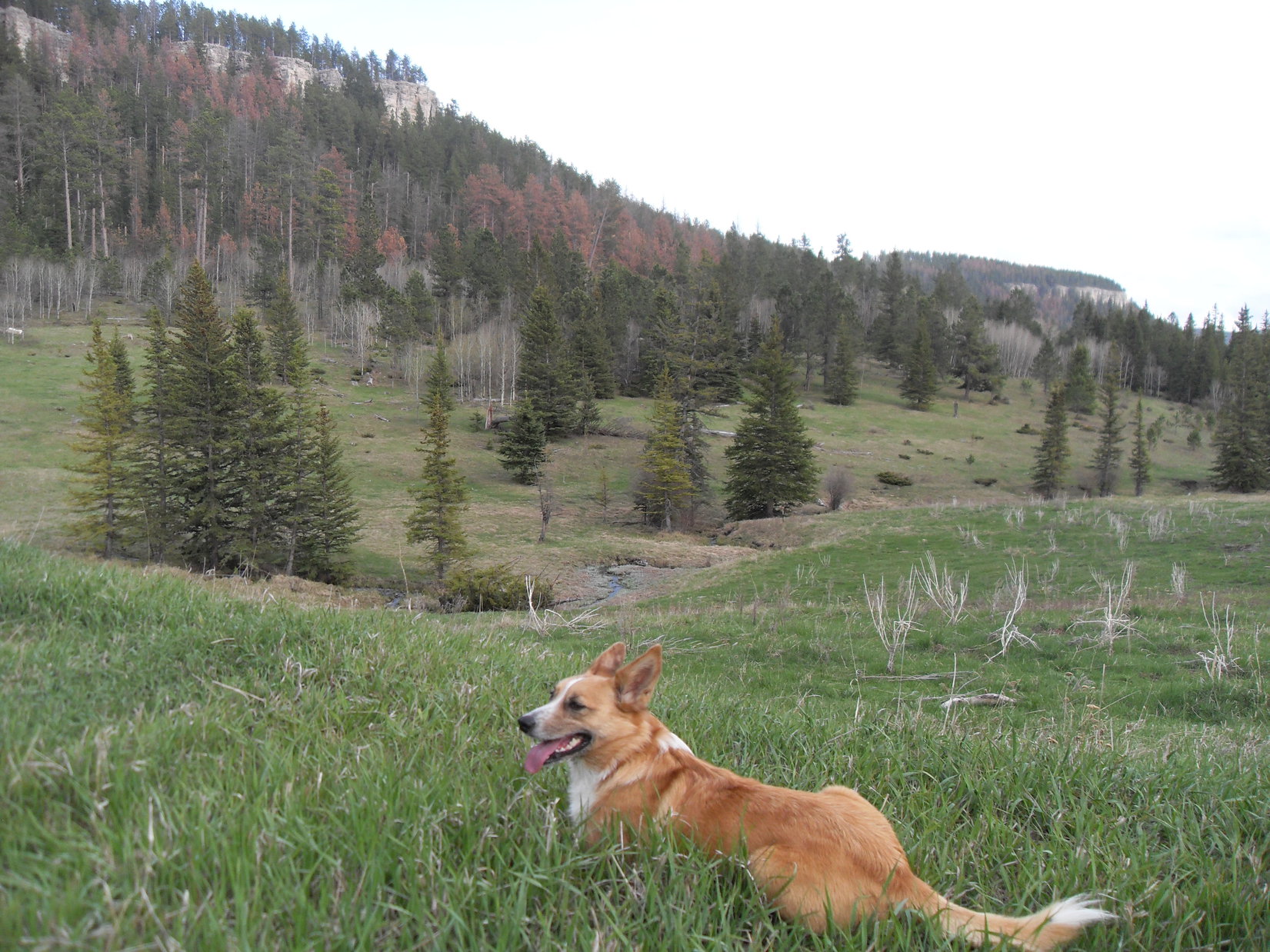
Lupe rests on the green grass above Lyons Creek. Photo looks SE.USFS Road No. 129.1A. Photo looks S.
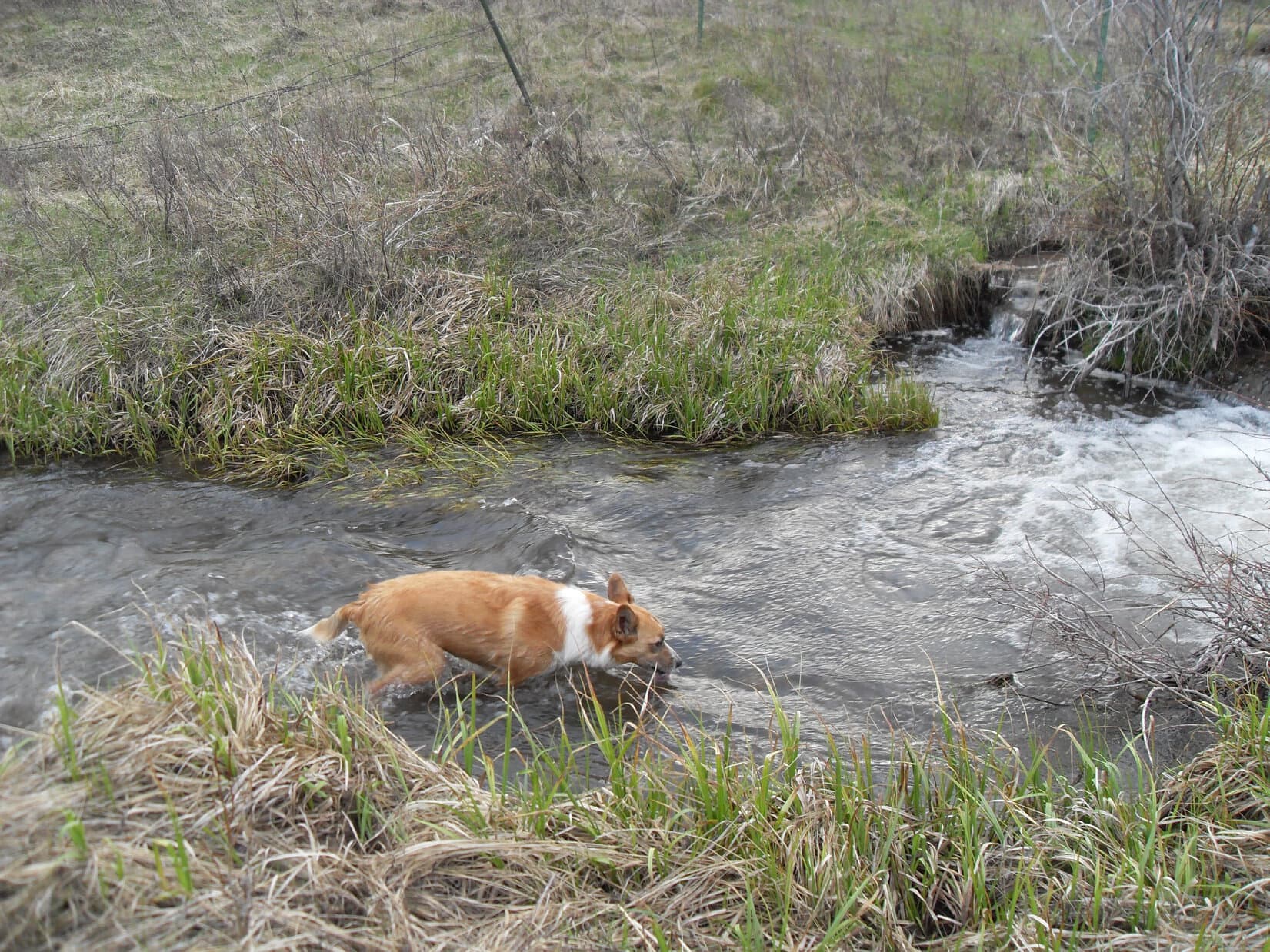
Lupe finally reached W Deerfield Road down by the North Fork of Castle Creek. Lupe couldn’t resist getting in this much larger creek for another big drink.
Getting a drink from the North Fork of Castle Creek.
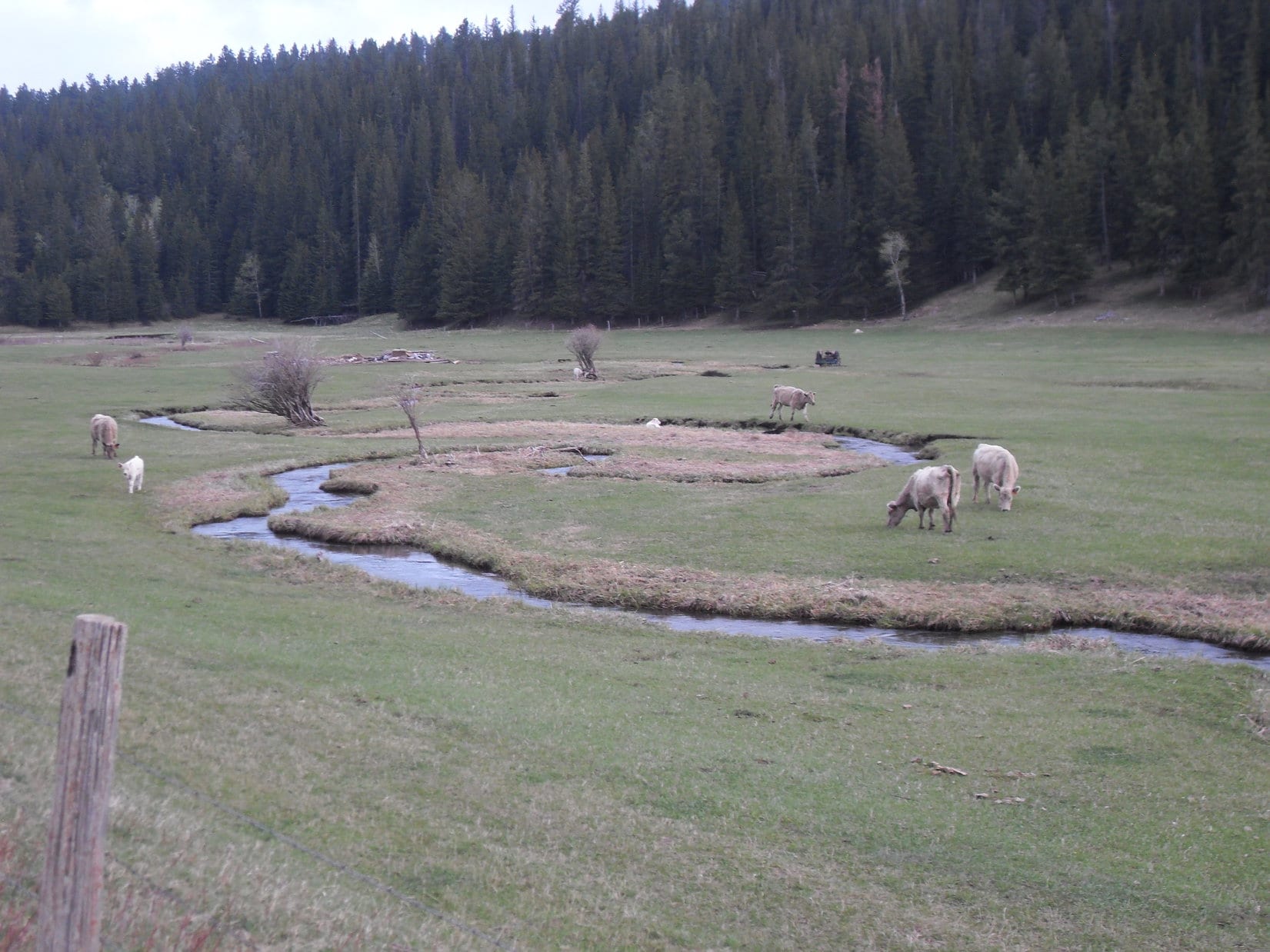
Lupe was still at least 3 miles NW of the junction with County Road No. 306 to Reynolds Prairie. The G6 was another 1.25 miles beyond that. Lupe and SPHP followed W Deerfield Road SE. Cows were in the fields nearby. Lupe was very interested. Although the temptation was huge, she was a very good American Dingo and didn’t bark.
At 9:01 PM (55°F), Lupe finally reached the G6 again. Light was still fading from the sky. Lupe had been gone over 11 hours, but she did reach all 5 of her peakbagging goals! Although she had just completed her 90th Black Hills, SD Expedition, Lupe’s peakbagging days were just beginning.
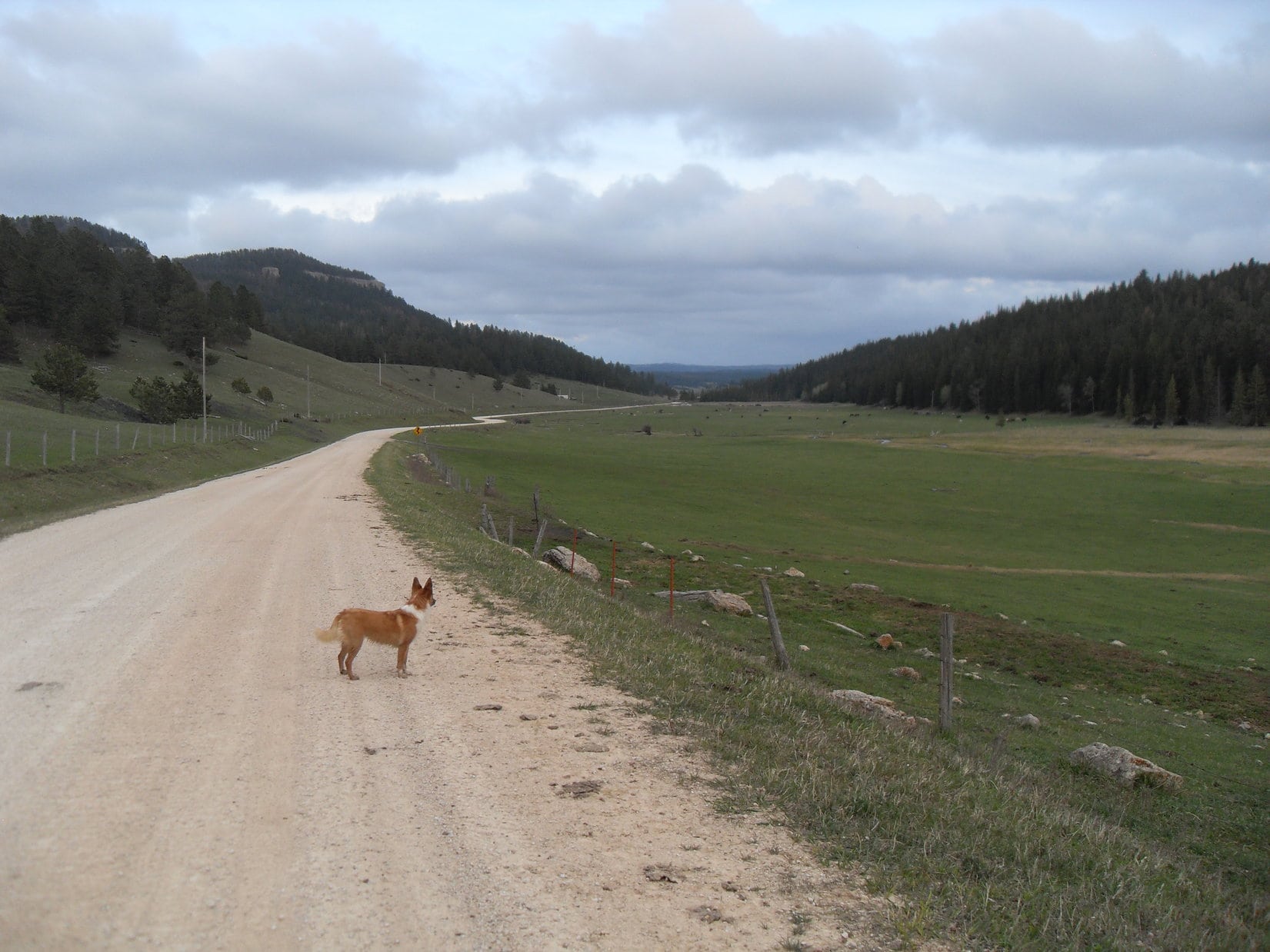
Lupe on W Deerfield Road in the valley of the North Fork of Castle Creek. Photo looks SE.Some of the very tempting cows Lupe didn’t bark at.