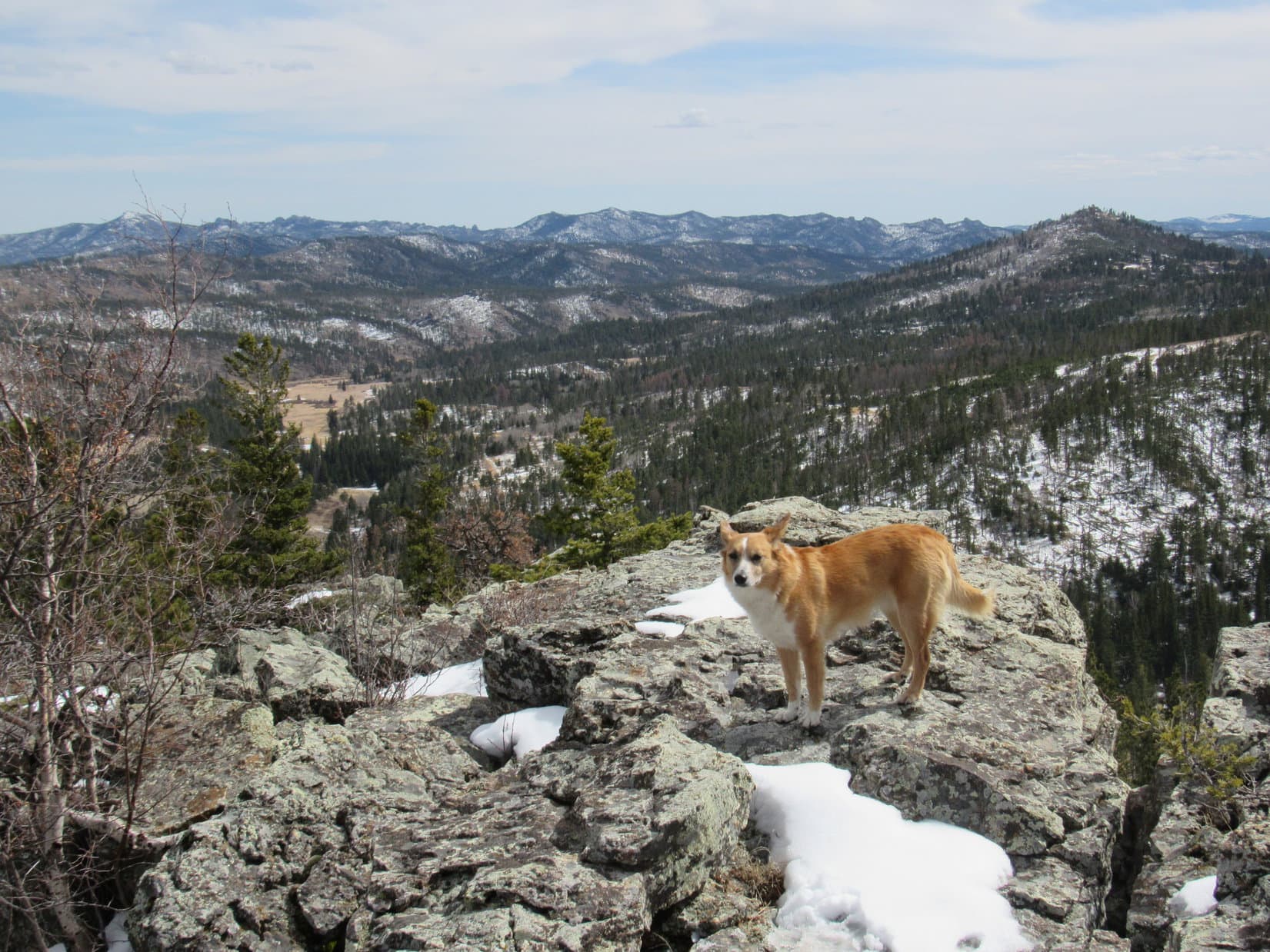
Black Hills, SD Expedition No. 165 – Matias Peak & Cicero Peak (4-4-16)

Lupe was on her way home from her adventures in western Nebraska.  It wasn’t the end of her adventures on this trip, though.  There was still time for one of Lupe’s Black Hills, SD Expeditions on the way!  As Hwy 18 climbed into the southern hills NE of Edgemont, SPHP was looking for USFS Road No. 379.  Lupe was going to climb Matias Peak (4,780 ft.).

Before reaching the top of the long hill, SPHP spotted a road heading into the trees on the N side of Hwy 18.  There was room to park the G6 there, too.  (11:52 AM, 59°F)  Good!  This was it, USFS Road No. 379!  A marker proved it.  Matias Peak was no more than 2 miles away as the crow flies.  SPHP’s old USFS map showed no road to it, but No. 379 was supposed to get within a mile SW of the summit.

Lupe and SPHP set out on No. 379.  Instead of heading NNE toward Matias Peak, the road wound its way downhill into a dry canyon to the WNW.  Once it reached the bottom of the canyon, No. 379 turned N and started back uphill.  Soon Lupe came to an unmarked intersection.  She took the right branch, which led NE.

Lupe hadn’t followed the right branch very far when Matias Peak came into view at a minor pass.

Matias Peak in the southern Black Hills as seen from a minor pass along USFS Road No. 379. Photo looks NE.

Lupe and SPHP stayed on No. 379, and went over the pass.  Lupe had already lost 100 feet of elevation when SPHP realized No. 379 was going turn NW away from the mountain and continue losing elevation.  A look around at the terrain showed it would have been better to leave the road back at the pass.  From there, Lupe could climb the ridge to the E.

Lupe and SPHP turned around and returned to the pass.  Lupe left No. 379 and started climbing.  Soon she was a very unhappy Carolina Dog.  There was cactus!  Lupe didn’t want to go this way.  She sat down and wouldn’t move.  She lifted a front paw pathetically begging SPHP for help and mercy.

SPHP checked her paws.  She didn’t seem to have cactus spines in any of them.  SPHP knew her paws weren’t really that sore.  Just a couple of hours ago, she had been racing around having a great time at Toadstool Geological Park in Nebraska.  Maybe she could smell the cactus?

In any event, whether Lupe had stepped on any or not, it was clear she knew cactus was around.  She wanted to go back to the road, or be carried.  The road wasn’t going to take Lupe to Matias Peak.  Going back meant giving up.  On the other hand, Matias Peak was still 1.5 miles away.  SPHP wouldn’t be able to carry her that far, and then all the way back again.

For a couple minutes, Lupe rested while SPHP pondered.  Well, let’s try it and see how it goes.  There’s quite a bit of forest, and there shouldn’t be much cactus in the forest.  SPHP picked Lupe up and started carrying her on up the ridge.  SPHP tried to stay in the forest as much as possible, but there were still sunny little openings harboring more cactus.

Where there were boulders, Lupe was willing to scramble up on her own power for short stretches.  Mostly SPHP had to carry her.  After a somewhat steep, rocky section, Lupe and SPHP reached the flat top of the ridge.  There was a nice view to the N.

Looking N.
Looking N.

Well, at least some progress had been made.  SPHP hoped that this ridge would just sweep around to the NE right on up to Matias Peak.  For a while it looked promising as SPHP carried Lupe E along the top of the ridge.  It all ended at a big steep drop.  SPHP put Lupe down and told her to stay, a completely unnecessary command.  She wasn’t about to budge.

SPHP scouted around looking for a view between the trees.  Low cliffs were just ahead.  Down below was a large field.  On the other side was another forested ridge.  That was probably the ridge that would lead N to Matias Peak.  SPHP returned to Lupe.  Time for a water and rest break!

SPHP studied the topo map printed out from Peakbagger.com.  It was a bit confusing at first, since the topo map was too old to show the correct location of Hwy 18, where Lupe and SPHP had started from.  In a few minutes, though, SPHP was pretty certain where Lupe was.  She was now at the E end of a small ridge marked toward the W end as 4,355 ft. elevation.  Lupe needed to cross the field down below, and head NE toward the next ridge.  That ridge would lead her N to Matias Peak.

It took a long time.  SPHP carried Lupe down off the ridge, finding a way down toward the S.  Then it was a long trek in the sun carrying Lupe across the field.  However, Lupe was willing to climb the far ridge on her own.  SPHP just kept an eagle eye out to help her avoid the occasional cactus.

Once up on the ridge, it was a steady climb, but a fairly gradual one most of the rest of the way up Matias Peak.  There were small cliffs on the W side of the ridge, which provided very nice viewpoints in that direction in many places.  Most of the time, Lupe and SPHP stayed near the cliffs to enjoy the views.

Looking WSW from the S ridge leading up to Matias Peak. USFS Road No. 379 can be seen coming down through the trees on the L. (That's the part of it Lupe and SPHP did not continue on beyond the pass. The pass is near the L edge of this photo.) Wyoming is on the horizon!
Looking WSW from the S ridge leading up to Matias Peak. USFS Road No. 379 can be seen coming down through the trees on the L. (That’s the part of it Lupe and SPHP did not continue on beyond the pass. The pass is near the L edge of this photo.) Wyoming is on the horizon!
Lupe relaxes on one of SPHP's many rest breaks going up Matias Peak.
Lupe relaxes on one of SPHP’s many rest breaks going up Matias Peak.

SPHP took many rest breaks on the way up Matias Peak.  Lupe would never have made it to the top, except for the gradual development of a technique Lupe seemed willing to go along with, despite her trepidation over the scattered cactus.

The technique went as follows: SPHP carried Lupe for a little way, and then put her down.  SPHP then left without her, continuing on up the mountain, scouting around to make sure there wasn’t any cactus along the way.  Lupe always watched with concern as SPHP marched off, but she wouldn’t move.

After going a suitable distance, SPHP would stop, turn around and shout back to Lupe that it was “time to check the maps”.  Lupe seemed to take this to mean that SPHP had somehow magically eliminated all the cactus in her way.  She immediately came running full tilt to catch up.

Of course, Lupe knows what checking the maps normally involves, so SPHP had to actually sit down, get out the maps and take a look at them for a few minutes each time.  Then it was time to carry Lupe for another stretch, before putting her down again.  Rinse and repeat.  Over and over.  It was slow, but not nearly as slow as trying to carry Lupe the entire distance.

Fortunately, Lupe never did run into any cactus.  She continued to believe in the power of checking the maps.  As Lupe and SPHP got nearer the summit, an unmarked dirt road appeared, temporarily curving closer to the W from somewhere off to the SE.  Lupe was perfectly willing to trot along without fear on this road.  Lupe and SPHP began to make rapid progress toward the summit.

Near the end of the climb, Lupe had to leave the road again, which now curved back around to the E of the summit.  The field to the NW had quite a bit of cactus in it, especially higher up.  SPHP went back to carrying Lupe all the time, but it wasn’t too far to the forest at the base of the final short steep climb to the summit.

There didn’t seem to be any cactus around on the final stretch up through the rocks and trees.  Lupe climbed up under her own power.  The top of Matias Peak is a flat forested ridge of moderate length running SW/NE.  Lupe found the very highest rocks to be somewhat closer to the NE end.

Lupe makes it to the top of Matias Peak! She is standing next to the very highest rock. There were a couple of other rocks around almost as high, one of which is the rock in the foreground. Photo looks NE.
Lupe on another rock contending for the highest point on Matias Peak. This one was a bit to the W of the other two, and had a view off to the WNW in the general direction of Pilger Mountain (4,788 ft.).

Lupe and SPHP were pleased to find that although the entire summit ridge was forested, there were several good viewpoints from Matias Peak.

Parker Peak (4,848 ft.) (Center) is the high point of Fall River County. Photo looks SE.
Looking SSE at a truck going over a bridge on Hwy 18. It turned out there was a much easier route up Matias Peak than the one Lupe and SPHP took starting out on USFS Road No. 379. The easier route begins on an unmarked dirt road that leaves Hwy 18 from the big flat grassy area seen to the R of the bridge. This is the same road that Lupe and SPHP encountered not far from the summit.
The best view from Matias Peak was toward Wildcat Peak (5,500 ft.) (L of Center) and Elk Benchmark (5,669 ft.) (R). Photo looks NNW using the telephoto lens.
The best view from Matias Peak was toward Wildcat Peak (5,500 ft.) (L of Center) and Elk Benchmark (5,669 ft.) (R of Center). Photo looks NNW using the telephoto lens.

Lupe and SPHP lingered up on Matias Peak for a while.  When it was time to go, Lupe’s confidence had returned to the point where she was running around like normal in the forest.  She came down off the short steep part at the SE end of the summit under her own power.  However, when she reached the grassy area where SPHP had seen quite a few cactus on the way up, SPHP insisted on carrying Lupe the rest of the way down to the dirt road.

Rather than retrace Lupe’s scenic, but slow approach route, SPHP decided Lupe should just stay on the dirt road to see where it went.  Lupe didn’t worry about cactus while on the road, but was still cautious enough not to make forays off to either side.  SPHP didn’t have to carry Lupe at all.

The dirt road wound around a little bit, but eventually straightened out and headed due S across open fields.  It reached Hwy 18 at the top of the long hill NE of Edgemont just W of a bridge over a deep ravine.  There was a big paved pullout on the N side of Hwy 18 where the dirt road reached it.  Even at the highway, the dirt road wasn’t marked with any sign or number.

If Lupe and SPHP would have started up Matias Peak from this point, instead of on USFS Road No. 379, Lupe would have had a much easier, though less scenic time reaching the summit.  The dirt road headed almost straight toward the summit gaining elevation at an easy pace.  Only the last little part of the climb would have been off the road.

At the pullout on the N side of Hwy 18 where the easiest and most direct route to Matias Peak (seen in the background) begins. Photo looks N.

The last part of the return trip from Matias Peak was a not-so-fun trek W along busy Hwy 18 for about 0.75 mile as the highway slowly curved SW.  It was all a gradual downhill slope, which was fortunate, since Lupe wanted to be carried part of the time.  SPHP had to oblige.

Lupe didn’t like the highway traffic, or the scattered cacti and broken glass waiting for her on the shoulder and in the ditch.  SPHP was in complete agreement.  Both Lupe and SPHP were quite happy when the G6 finally came back into view (4:17 PM, 70°F).

Before completing the drive home, Lupe had one final mission.  When Lupe’s trip to western Nebraska had started just 2 days ago, the last peak Lupe had climbed with new friend Jobe Wymore before leaving the Black Hills was Cicero Peak (6,166 ft.).  SPHP had been so interested in Jobe’s mountaineering stories, SPHP had forgotten the camera case up on top of the mountain.  Now Lupe was going to go back up Cicero Peak to see if it was still there.

SPHP parked the G6 at the start of USFS Road No. 338 (Cicero Peak Road) (4:55 PM, 60°F).  Somehow Lupe knew right away.  Maybe the air smelled different.  Maybe she remembered from being here before.  However she knew, Lupe was certain there wasn’t any cactus here!  Suddenly she was free to race happily through the forests again without a care in the world.

Lupe explored, while SPHP hiked the 1.5 mile road back up to the summit of Cicero Peak.  It was a gradual, easy climb.  Near the top, Lupe discovered what may be the last snow she will find in the Black Hills this spring.  There wasn’t much left, and the snow was melting fast, but it was clear Lupe loved it.  She ate big mouthfuls.  She rolled on it to cool off.  The snow tasted and felt great!

Ahh, snow! Feels and tastes so great!

As Lupe neared the summit, the question was, would the camera case still be there?  SPHP wasn’t even completely certain that was where it had been left behind.

Lupe reaches the tower on top of Cicero Peak. Photo looks SSW.

Lupe went around to the highest rocks just W of the summit tower.  Sure enough, Lupe found the camera case laying among the highest rocks!  The carrying strap looked like a squirrel had nibbled on one edge of it.  The squirrel hadn’t done it much harm, though.  Apparently camera case carrying straps lack that nutty taste squirrels crave.

Lupe finds the camera case resting among the summit rocks of Cicero Peak, right where SPHP had left it 2 days earlier. A squirrel had chewed the strap a little, but had done little damage.

Finding the camera case again made Lupe’s Cicero Peak mission a complete success!  All that was left was the descent back down the mountain.

On the way down, Lupe saw smoke from a forest fire to the SE.  She saw Matias Peak, where she had just been, looking small and insignificant far away on the S edge of the Black Hills.  She glimpsed the strange rock to the NW that Lupe and SPHP know as “Cracked Molar” (officially Beecher Rock?).  Sharp-eyed Jobe had noticed it two days ago.

Smoke from a forest fire (L) somewhere not too far SE of Cicero Peak.
Matias Peak (L) from Cicero Peak using the telephoto lens. Photo looks SSW.
The rock Lupe and SPHP know as "Cracked Molar" is probably officially Beecher Rock. Photo looks NW using the telephoto lens.
The rock Lupe and SPHP know as “Cracked Molar” is probably officially Beecher Rock. Photo looks NW using the telephoto lens.

The thing that made Lupe happiest, though, was seeing, tasting, and feeling the last of the cold melting snow one more time.Lupe coming down Cicero Peak, 4-4-16

Links:

Next Black Hills Expedition                Prior Black Hills Expedition

Want more Lupe adventures?  Choose from Lupe’s Black Hills Expeditions Adventure Index or Master Adventure Index.  Or subscribe free to new Lupe adventures.

Black Hills, SD Expedition No. 164 – Clark, Humbolt, Copper & Odakota Mountains (3-28-16)

Lupe was on a mission!  Another account holder at Peakbagger.com had contacted her on 3-20-16 asking for beta on road conditions in the western Black Hills.  How much snow was there?  Were the roads open?  Lupe and SPHP hadn’t been to the highest parts of the hills for several months, and didn’t know for certain – but Lupe was going to find out.

The other Peakbagger.com account holder wasn’t coming to the region until early April.  Since snow was in the forecast, it hadn’t made sense to run out to the western hills right away.  The last shot of new snow was over by the morning of 3-26-16.  Lupe and SPHP waited for 3-28-16, to give the snow a bit of time to melt.

It was supposed to get to 60°F by afternoon, but it was still quite cool in the morning.  That was alright.  Lupe and SPHP planned to visit a couple of lower peaks along the way.  The high country could wait until afternoon.  Let the snow keep melting until then!  Lupe’s first peakbagging goal was Clark Mountain (5,267 ft.), just W of Sheridan Lake.

Lupe and SPHP set off heading W up Clog Gulch on Be Still Road (USFS Road No. 738) from Hwy 385 (8:35 AM, 35°F).  Be Still Road took Lupe around the N end of Clark Mountain, gaining a bit of elevation while slowly turning SW.  After 0.5 mile, a house came into view up ahead.  Lupe was approaching private property.  To stay on USFS land, Lupe and SPHP turned SE leaving the road behind.  Lupe started climbing.

The first part of the climb was steep and rocky.  The rocks weren’t all that large, however, or difficult to navigate.  There was snow on the ground most places, but less than an inch on average.  After a pretty good climb, the ground became less steep as Lupe approached a broad swath of open ground where the pines had been cut down beneath a power line.

It wasn’t too much farther to the top of Clark Mountain.  Lupe passed under the power line, and turned S.  On the last part of the trek, Lupe was on a gently rising ridge about 100 feet wide.  A rock outcropping came into view ahead.  It was the summit of Clark Mountain!  Lupe climbed up on top of the highest rocks to claim her first peakbagging success of the day.

Lupe reaches the top of Clark Mountain! Photo looks SW.
Looking S at the summit.

There were a couple of other rock outcroppings that looked almost as high a bit farther to the S.  Lupe and SPHP went to check them out.  They proved to be a little lower.  Lupe had already been to the true summit.  Lupe hopped up on one of these also-ran rock outcroppings, anyway.

Lupe on the 2nd highest rock outcropping on Clark Mountain. Photo looks N.
Rin Tin Lupe!
Rin Tin Lupe!

To make absolutely certain Lupe hadn’t been to a false summit, Lupe and SPHP continued exploring to the S.  SPHP was also hoping to find a vantage point with a view to the E toward Sheridan Lake, less than a mile away.

The forest at the top of Clark Mountain consists mostly of large pines, without too many young ones in between.  By all appearances, the forest had been thinned quite a few years ago.  Even so, it was only possible to get glimpses of distant views in most directions.  Only an insignificant little piece of Sheridan Lake could be seen.

Lupe and SPHP didn’t have to go much farther S to be completely convinced Lupe had been to the top of the mountain.  Lupe returned to the true summit for a final look around before departing.

Although it was possible to get glimpses of distant views from Clark Mountain, that was about it. SPHP was disappointed that there weren't any clear views toward Sheridan Lake to the E. The top of the mountain was a very broad flat ridge.
Although it was possible to get glimpses of distant views from Clark Mountain, that was about it. SPHP was disappointed that there weren’t any clear views toward Sheridan Lake to the E. The top of the mountain was a broad flat ridge.
Lupe sits just below the summit rocks. Photo looks NE.

After bidding the Clark Mountain summit a final farewell, Lupe went N starting her descent.  She could have gone NW back down to Be Still Road, but instead Lupe explored the NE ridge.  This route wasn’t as steep and rocky.  Lupe passed through a stretch of very densely packed young pines.  Before long, she came to an open area which looked like it had been heavily logged recently.

Lupe went down into the open area following a logging trail E.  The logging trail entered a valley just S of the NE ridge, and followed the valley as it curved NE again.  After an easy downhill stroll, the logging trail ended right back at the G6, just S of Be Still Road (9:59 AM, 53°F).  Before heading on to Humbolt Mountain (5,722 ft.), SPHP gathered up a small collection of Lupe Treasures for recycling.

Humbolt Mountain is 3.5 miles SW of Clark Mountain near Hill City.  SPHP drove up Penalua Gulch Road looking for an access point.  The short road went through private property, and dead-ended at private driveways.  Lupe and SPHP had better luck on China Gulch Road (USFS Road No. 249), a bit farther W.  It provided an access point on USFS land less than a mile N of Hwy 16/385 (10:24 AM, 53°F).  Humbolt Mountain was just 0.25 mile to the SE.

Lupe and SPHP headed ENE up a faint road until Lupe wasn’t far from the N end of the mountain.  The intrepid Carolina Dog then turned SSE and began her climb in earnest.  The terrain got steeper and rockier as she went.  SPHP switchbacked a little bit looking for the easiest way up.  Lupe arrived up on the summit ridge somewhat S of its N end.  She then turned S to follow the ridge to the true summit near the S end of the mountain.

Humbolt Mountain’s summit ridge was much narrower and rockier than Clark Mountain’s had been.  Lupe went up and down, frequently having to skirt around the W side of a series of large rock outcroppings.  She had to lose a bit of elevation at a shallow saddle before the final climb up to the true summit.  Humbolt Mountain was forested, but Lupe and SPHP were pleased to find a few decent viewpoints.

Lupe was nearing the summit of Humbolt Mountain when this nice view of Harney Peak (7,242 ft.) (Center) appeared. Summit Peak (5,655 ft.) is the much lower forested ridge in front of Harney. Photo looks S.
Harney Peak from Humbolt Mountain using the telephoto lens. Summit Peak is in the foreground. Photo looks S.
Lupe reaches the summit of Humbolt Mountain. Photo looks S.
Looking SE at Storm Hill (5,656 ft.)

The rocky ridge was quite narrow, and there were several pine trees with annoyingly low branches up at the very summit.  After taking a look around, Lupe and SPHP continued S just a short distance where the ridge was a bit lower, but also wider and more open.  It was time for a little break.  Lupe had some Taste of the Wild.  SPHP consumed an orange.

Lupe on the ridge just S of the summit. Photo looks SSW.
The view of Harney Peak from the rest break spot. Beautiful! Photo looks S.

After a leisurely, but not overlong rest break, Lupe returned to the summit of Humbolt Mountain.  Although the view toward Harney Peak was the most impressive, Storm Hill could also be seen close by to the SE.  A little to the N of the summit was a look at Five Points (6,221 ft.) to the N.

Back at the summit. Photo looks NE.
Storm Hill. Photo looks SE.
One spot near the summit of Humbolt Mountain yielded this view of Five Points (6,221 ft.) (R). The mountain Lupe and SPHP call False North Point is on the L. Photo looks N.

Lupe returned to the G6 via the same route she had taken up the mountain (12:18 PM, 57°F).  The day had warmed up considerably.  Even out in the high country of the western Black Hills, whatever snow there was had to be melting fast.

Lupe on her way back to the G6. Here she is still up on the summit ridge well to the N of the summit. These slanting rock formations were typical toward the N end of Humbolt Mountain.

It was time for Lupe to go conduct her western hills reconnaissance!  Lupe and SPHP drove to Hill City, and turned NW on Deerfield Road.  At East Slate Road, SPHP turned S.  For the first few miles, there was hardly any snow at all.  Lupe enjoyed the drive.  There were lots of cows and a few horses to bark at along the way.

After a few miles, patches of snow appeared on the road.  The snow was only a few inches deep most places, and pretty slushy.  The G6 made it all the way to Six Mile Road (USFS Road No. 301) without any problem.  Six Mile Road was in good enough condition so SPHP could easily have driven further, but SPHP parked the G6 at the start of USFS Road No. 301.1A (1:09 PM, 54°F).  Lupe and SPHP would continue on paw and foot from here.

Dingo on a mission! Lupe reconnoitering road conditions on Six Mile Road E of Copper Mountain. Photo looks S.

Although there was some snow on Six Mile Road, it was melting fast.  Lupe and SPHP followed the road as it wound its way up closer to Copper Mountain.  The cliffs at the SE end of Copper Mountain (6,920 ft.) have some great views.  Before pressing on to her ultimate objective, Lupe was going to climb Copper Mountain first.

Lupe didn’t leave Six Mile Road until she was SW of Copper Mountain.  She then climbed N to the top of the W ridge before proceeding E.  There was some deadfall timber and thick stands of young pines along the way, but the climb wasn’t long or difficult.  Lupe reached the flat, rocky summit.  Most of the summit is forested, but there are cliffs very close by with magnificent views to the S and E.  Lupe and SPHP had a look around.

A pretty grand view from Copper Mountain! Harney Peak (L) is seen on the far horizon above Lupe. Much closer Medicine Mountain (6,878 ft.) is on the R. Photo looks SE.
Northeast Cicero Peak (6,240 ft.) was in view far to the SSE from Copper Mountain. It looked pretty snowy in this shot taken with the telephoto lens.
Looking N from the E edge of Copper Mountain. Gillette Prairie is the open grassland seen below.
Lupe at the SE end of Copper Mountain. Photo looks SE.

Lupe could see Odakota Mountain (7,200 ft.) about 1.5 miles away to the SW.  Odakota Mountain is the 2nd highest in the Black Hills and all of South Dakota.  It is not nearly as well known as Harney Peak.  However, Odakota Mountain was Lupe’s ultimate objective for Expedition No. 164.  It was the mountain that the other Peakbagger.com account holder had contacted Lupe about!

Odakota Mountain (7,200 ft.) (Center) as seen from Copper Mountain. Lupe was going to Odakota Mountain next. Six Mile Road is in view below. Photo looks SW.
Odakota Mountain (7,200 ft.) (Center) as seen from Copper Mountain. Lupe was going to Odakota Mountain next! Six Mile Road is in view below. Photo looks SW.

Lupe and SPHP went back to Six Mile Road, and resumed following it W.  There wasn’t any significant snow on the road until the final turn up to a saddle 0.5 mile NNW of Odakota Mountain.  This point was about 2 miles closer along the road to Odakota Mountain than where the G6 was parked.  The G6 could have made it this far, but no farther.

USFS Road No. 693 left Six Mile Road going S from the snowy saddle.  No. 693 is a minor gravel road that ultimately gets to within about 0.30 mile of Odakota’s summit.  It was snow-covered, narrow, and had some partially cleared deadfall timber.  A 4WD high-clearance vehicle might have been fine on No. 693, but not the G6.  Lupe and SPHP now knew the truth about the road conditions in the vicinity of Odakota Mountain.

Lupe at the start of USFS Road No. 693 near its junction with Six Mile Road. A car could get this far, but 4WD would be needed to go any farther. This was actually good news. The summit of Odakota Mountain was an easy 0.5 mile hike away.

Surprisingly, there was only 1-2″ of snow on the ground on average.  Lots of places had no snow, and some areas had 4-6 inches.  What snow there was, looked new.  Apparently there hadn’t been any snow pack at all until the last couple of small storms.  It was possible to drive as far as No. 693 or very close to it.  That left a hike of about 0.5 mile one way to the summit of Odakota Mountain.

Happily, if conditions didn’t change, the other Peakbagger.com account holder wouldn’t have any problem getting to the top of Odakota Mountain!

Of course, being this close to the top of the 2nd highest mountain in South Dakota meant Lupe and SPHP were going to go see it.  Lupe and SPHP went S on USFS Road No. 693.

Lupe on USFS Road No. 693. A narrow path existed between the mostly cleared away deadfall timber. Photo looks N.

The last 0.30 mile was just a bushwhack toward the summit of Odakota Mountain.  The smallish summit ridge is oriented E/W.  The top is level, but a complete tangle of deadfall timber.  SPHP wondered if the limestone cairn Lupe had seen on prior visits near the E end of the ridge would still be there?  It was!

Lupe at the Odakota Mountain summit cairn. Photo looks S.
Looking W along Odakota's summit ridge. What a mess of deadfall timber!
Looking W along Odakota’s summit ridge. What a mess of deadfall timber!

Even though a lot of dead trees have fallen over on Odakota Mountain, there are still enough trees standing to mar the views.  Currently, the only good viewpoint is at the far SE end of the mountain.  Lupe and SPHP had been there once before, but it was quite a trek through the dead forest.  Lupe wasn’t going back there today.  Her reconnaissance mission was already successfully accomplished!

SPHP had other things in mind for Lupe.  First among them was another rest break.  Lupe ate the rest of her Taste of the Wild.  SPHP finished the last orange.  There were still a few hours of daylight left.  Lupe could go exploring a couple of places she hadn’t been to before!

The first place Lupe went exploring after leaving Odakota Mountain was the gravel quarry N of Six Mile Road.  The gravel quarry wasn’t the real goal, though.  SPHP wanted to see what the views were like from the high cliffs a short distance NE of the quarry.

Lupe discovers a pristine white snow field at the gravel quarry N of Six Mile Road and Odakota Mountain. Photo looks N.
Gillette Prairie (R) from the high cliffs NE of the gravel quarry. Part of Reynolds Prairie is seen farther away on the L. Photo looks N.
The E end of Odakota Mountain from the cliffs NE of the gravel quarry. Photo looks S.

The second place Lupe went exploring was along a ridge going S from Six Mile Road and Copper Mountain toward Medicine Mountain.  Lupe went clear to the very S end of the high ground along the ridgeline, but the views never really opened up completely.

Bear Mountain (7,166 ft.) is the high ridge in the distance. Photo looks S from the ridge extending S from Six Mile Road and Copper Mountain.
Medicine Mountain. Photo looks SE using the telephoto lens.
Copper Mountain and Six Mile Road. Photo looks N.
Loopster here with your American Dingo eyewitness peakbagging report! Odakota Mountain, Copper Mountain and the surrounding area are a go!

Lupe and SPHP arrived back at the G6 at 6:12 PM (47°F).  Well, that was it.  Lupe’s peakbagging reconnaissance mission was over!  She gave SPHP orders to submit her report to the interested party when she got home, but not until she was first served a proper Alpo dinner.

Cows, horses and deer provided entertainment on the way home.  The fun never ends on the rambunctious Carolina Dog’s Black Hills Expeditions!

Copper Mountain from the NE on the way home.
Green Mountain (7164 ft.) from the E.
Part of the entertainment committee.

Links:

Next Black Hills Expedition               Prior Black Hills Expedition

Want more Lupe adventures?  Choose from Lupe’s Black Hills Expeditions Adventure Index or Master Adventure Index.  Or subscribe free to new Lupe adventures.