Black Hills, SD Expedition No. 167 – Surveyor’s Hill, Red Butte, Yellow Butte & the Elk Mountain Benchmark (4-20-16)

SPHP wasn’t very well organized.  It took longer than it should have to get going.  Finally, at noon, Lupe and SPHP were on their way in the G6.

Lupe was already expecting great things!  She was riding up high on a small mountain of gear, blankets and pillows, as if she was starting off on one of her Dingo Vacations.  That wasn’t what was happening, but this was going to be a special overnight outing.  Lupe was going to get to do two Black Hills, SD Expeditions in a row!

Lupe’s peakbagging goals were all clustered in the SW Black Hills, not too far from the Wyoming border.  First up was an easy one, Surveyor’s Hill (5,640 ft.).  SPHP parked the G6 at a curve in USFS Road No. 668 down in Hay Draw (1:48 PM, 58°F).  All Lupe had to do to get up to Surveyor’s Hill was follow a side valley NW for 0.375 mile.  Surveyor’s Hill was a minor hill sitting up on a larger ridge that lost elevation as it went SW.

Lupe started off doing just fine, following an animal trail at the bottom of the side valley.  However, when SPHP left the animal trail to start gaining elevation faster on the NE side of the valley, Lupe hesitated.  She remembered all the cactus around on her recent trip to the Wildcat Hills of Nebraska with mountaineer Jobe Wymore.  There had also been cactus around on her last couple of Black Hills, SD Expeditions, too.

Lupe didn’t want to leave the safety of the animal trail.  Even though SPHP didn’t see any cactus, it took some persuading to convince Lupe to keep going.  Lupe repeatedly sat down and lagged behind.  She only came when SPHP got too far away, or stopped to sit down and “check the maps”.  A few times, SPHP had to carry her.

Fortunately, it wasn’t far to Surveyor’s Hill, and there really didn’t seem to be any cactus around.  Lupe gradually regained her confidence.  Once she was up on the ridge at the base of Surveyor’s Hill, she started feeling secure enough to lead SPHP the rest of the way up.

Lupe nears Surveyor's Hill. Photo looks WNW.
Lupe nears Surveyor’s Hill. Photo looks WNW.

For such a small hill, the scenic rewards when Lupe reached the top were very nice.  The forest on Surveyor’s Hill completely burned away in the Jasper Fire in August, 2000.  As a result, Surveyor’s Hill has a commanding 360° view.  Some of the best views were off to the SW.

Lupe reaches the summit of Surveyor's Hill. Her next 2 peakbagging goals are in sight. Red Butte (5,500 ft.) is the partly forested hill L of Center. Yellow Butte (5,460 ft.) is the little knob seen straight above Lupe's tail. Wyoming is on the far horizon. Photo looks W.
Lupe reaches the summit of Surveyor’s Hill. Her next 2 peakbagging goals are in sight. Red Butte (5,500 ft.) is the partly forested hill L of Center. Yellow Butte (5,460 ft.) is the little knob seen straight above Lupe’s tail. Wyoming is on the far horizon. Photo looks W.
Two more of Lupe's peakbagging goals are seen here. Wildcat Peak (5,500 ft.) is on the L. Elk Benchmark (5,669 ft.) is the high point on the R closest to Lupe's ear. Photo looks SW.
Two more of Lupe’s peakbagging goals are seen here. Wildcat Peak (5,500 ft.) is on the L. Elk Benchmark (5,669 ft.) is the high point R of Center. Photo looks SW.
Red Butte from Surveyor's Hill using the telephoto lens. Photo looks W.
Red Butte from Surveyor’s Hill using the telephoto lens. Photo looks W.
Yellow Butte from Surveyor's Hill using the telephoto lens. Photo looks WNW.
Yellow Butte from Surveyor’s Hill using the telephoto lens. Photo looks WNW.

Lupe liked it up on Surveyor’s Hill.  She really didn’t want to follow SPHP down the S slope when it was time to go.  She still suspected she was being lured back down into dangerous cactus country.  SPHP went a long way down before Lupe finally decided she didn’t want to risk being left behind.

Lupe felt better remaining high up on her Surveyor's Hill vantage point. When SPHP got too far away, she reluctantly decided to come down. Photo taken looking NNW using the telephoto lens.
Lupe felt better remaining high up on her Surveyor’s Hill vantage point. When SPHP got too far away, she reluctantly decided to come down. Photo taken looking NNW using the telephoto lens.

On the short trek back to the G6, Lupe’s confidence continued to build.  Instead of encountering cactus, she saw a squirrel!  All the painful thoughts of cactus disappeared, wiped out in an instant by the exciting squirrel.  With the squirrel’s help, by 2:34 PM (58°F) Lupe was back at the G6, and on her way to Red Butte (5,500 ft.).

SPHP parked the G6 again down in Gillette Canyon, at the junction of USFS Roads No. 281 & No. 281.1V.  Red Butte was only a little over 0.5 mile WNW as the crow flies.  On the first part of the journey, Lupe and SPHP followed No. 281.1V.  Red Butte was soon in sight across a big field.

Red Butte from near USFS Road No. 281.1V. Photo looks WNW.

Lupe and SPHP stayed on No. 281.1V as it crossed a big field heading for Red Butte.  When the road reached the trees, it started gaining elevation.  Lupe and SPHP stayed on the road only until it started curving NE, then Lupe left it climbing NW directly up the forested ridge.

Once again, Lupe was reluctant to follow SPHP off the road.  Her fear of cactus returned.  Again and again, she stopped and watched while SPHP plodded away.  When SPHP got too far ahead, she waited for SPHP to stop and look back at her.  Then she ran to catch up.  In this manner, Lupe and SPHP progressed steadily, though more slowly than normal.

When Lupe reached the top of the ridgeline, she turned WSW following the ridge toward the summit of Red Butte.  SPHP still saw no cactus around.  Lupe’s confidence grew.

The steepest part of the climb came at the end.  The summit of Red Butte was up on top of a hill thickly covered with 3 foot high bushes.  Lupe liked the bushes, and the many pathways between them.  She forgot all about cactus, sniffing her way through the bush maze.  For SPHP, the bushes were more of a pain to navigate, but soon both Lupe and SPHP stood on the summit of Red Butte.

Lupe at the summit of Red Butte. Wildcat Peak (5,500 ft.) (L) and the Elk Benchmark (5,669 ft.) (seen above Lupe) are in view to the SW.
The highest parts of Red Butte were covered with a thick maze of bushes. Lupe liked them! Photo looks NE.
Lupe stands at the top of a small limestone outcropping on the E side of Red Butte. Photo looks N.

The true summit of Red Butte was near the ENE end of the short summit ridge close to where Lupe initially reached the top.  However, there was another high point off to the WSW.  After visiting the true summit, Lupe and SPHP headed over to this second high point to take a look at things from there.  On the way, SPHP suddenly spied a large patch of cactus ahead.

Right away, SPHP stopped Lupe and put her leash on.  Lupe had been so engrossed with exploring the maze of bushes, she didn’t yet realize there was any cactus around.  To make certain Lupe didn’t have a bad experience, SPHP carried her over the cactus patch to reach the second high point.

Lupe on the slightly lower WSW high point of Red Butte. Photo looks ENE back toward the true summit. The only cactus Lupe and SPHP came to all day was a big patch located between these two high points.

With cactus around, Lupe and SPHP didn’t stay long on the WSW high point.  It was quite close to the true summit, so the views weren’t much different anyway.  SPHP carried Lupe back over the cactus patch to the true summit again.  A break between the trees provided a look at nearby Yellow Butte (5,460 ft.), where Lupe would be headed next.

Yellow Butte from Red Butte using the telephoto lens. Photo looks N.

Lupe and SPHP left Red Butte heading back down the way Lupe had originally come up.  Lupe followed the ridgeline NE back to USFS Road No. 281.1V.  Lupe came to no more cactus, and although SPHP kept a careful lookout, SPHP saw no more cactus the rest of the day.

Crocuses were blooming on the ridge ENE of Red Butte.

When Lupe reached USFS Road No. 281.1V again, she followed it N for about 0.33 mile.  She then came to an intersection where she turned W.  She soon passed by No. 281.1A coming up Hop Draw.  From this point, No. 281.2Y led Lupe W the rest of the way to Yellow Butte.  In this manner, Lupe effectively went around the E end of Hop Draw coming from Red Butte.

Although Yellow Butte is a little lower than either Surveyor’s Hill or Red Butte, it is a much craggier, and therefore more interesting peak.  In fact, SPHP wasn’t at all certain that Lupe would find a way up to the summit.  As Lupe approached Yellow Butte, there appeared to be a reasonably safe way up near the S end of the E face, but SPHP didn’t really like the looks of it all that much.

Approaching the E face of Yellow Butte on USFS Road No. 281.2Y. It looked like it might be possible to climb up the big cracks on the L, but SPHP preferred to look around for an easier route up.

Instead of heading toward the big cracks in the rocks toward the S end of the E face, Lupe and SPHP went to check out the N end first.  The N end of the E face wasn’t encouraging at all.
The N end of the E face of Yellow Butte gave Lupe no encouragement at all. She could only get up this part of the mountain with Dingo Wings, which she didn't happen to have on her at the time. Photo looks WSW.
The N end of the E face of Yellow Butte gave Lupe no encouragement at all. She could only get up this part of the mountain with Dingo Wings, which she didn’t happen to have on her at the time. Photo looks WSW.

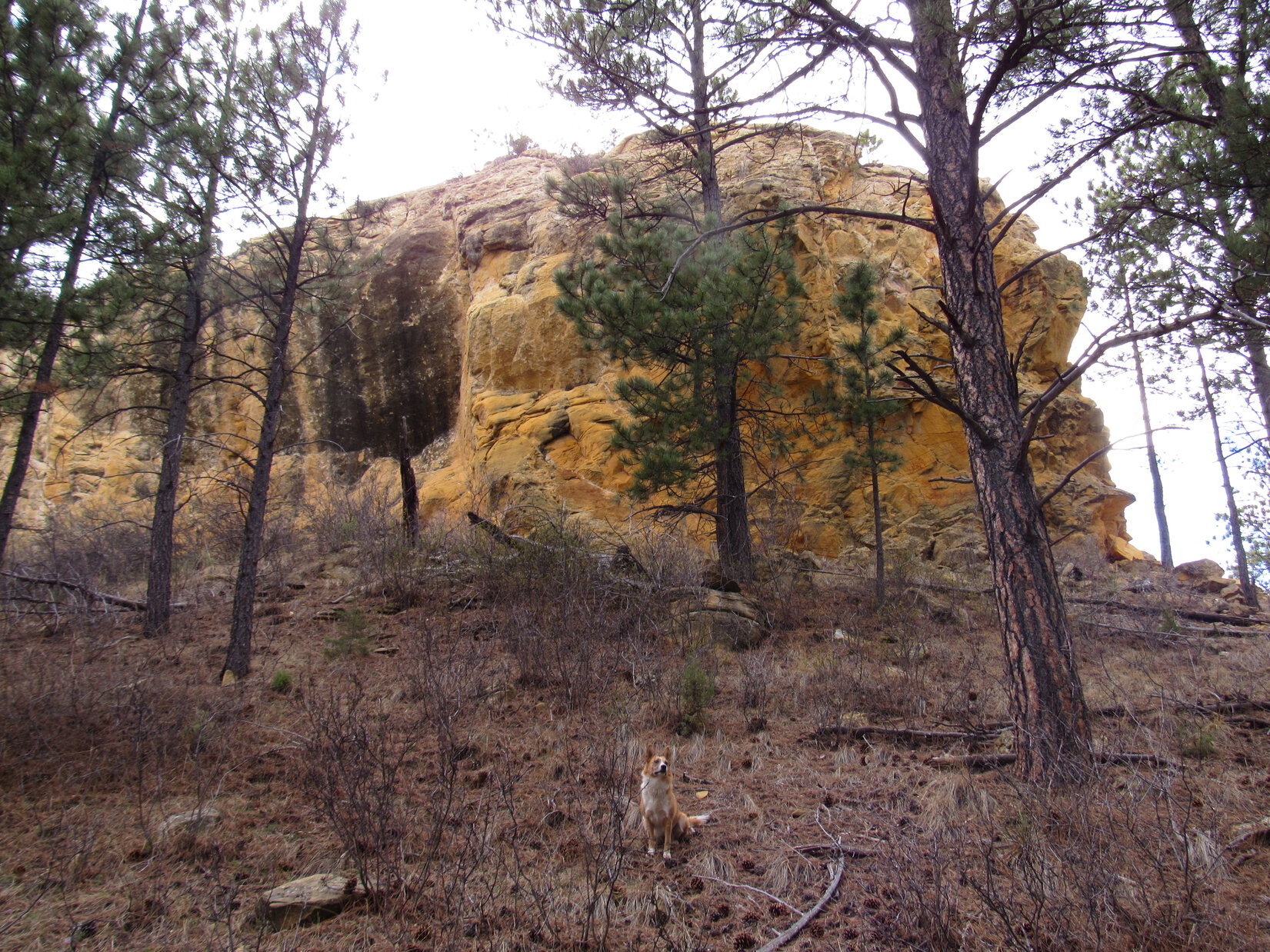
Yellow Butte was certainly well named!  The entire mountaintop appeared to consist of a massive very yellow rock outcropping with near vertical, and in some places overhanging, walls.  The narrow N end of the mountain featured beautiful yellow, overhanging cliffs.

Lupe perches on rocks beneath the yellow overhanging cliffs at the narrow N end of Yellow Butte. Photo looks S.

The northern portion of the W face of Yellow Butte was a towering, vertical yellow rock wall.

The northern part of the W face of Yellow Butte was a continuous yellow cliff. Photo looks N.

It was starting to look like Lupe and SPHP might have no choice.  The large steep cracks in the rocks on the E face might be the only possible way up.  However, as Lupe drew near the S end of the W face, suddenly there was a break in the sheer cliff wall.  A ramp of relatively easy terrain led all the way up to the top of the massive rock formation.

Surprisingly, the first rocks Lupe encountered on top were not yellow at all.  The true summit, which is closer to the S end of the mountain, consisted of a very different, but interesting gray-pink rock full of holes, lines and pockets.

Lupe on a dead tree very close to the summit of Yellow Butte. Red Butte (Center) is seen beyond Lupe. Photo looks SSE.
Lupe at the very top of Yellow Butte. Surprisingly, the rocks at the summit were not yellow at all. Instead, they were an interesting pink/gray stone full of holes, lines, and pockets. Photo looks NW.
Lupe at the very top of Yellow Butte. Surprisingly, the rocks at the summit were not yellow at all. Instead, they were an interesting pink-gray stone full of holes, lines, and pockets. Photo looks NW.
Lupe at the top of Yellow Butte. This photo clearly shows the unusual pink gray stone at the summit, and part of the broad flat top of the yellow rock toward the N end of the mountain. Photo looks N.

After visiting the summit, Lupe went to explore the flat top of the yellow rocks toward the N end of the mountain.  Exposed rock covered most of a fairly large area, but scattered trees and bushes grew here and there, too.  Cliffs were to the W, N and E.

Lupe out on the relatively flat top of the yellow rocks at the N end of Yellow Butte. Photo looks S toward the summit.

Yellow Butte was quite an interesting place.  SPHP was glad Lupe had found an easy way up.  Before departing, Lupe briefly returned to the summit one more time.  Then she headed back down the relatively easy ramp near the S end of the W face.

A closer look at the interesting pink-gray rocks forming the summit. Photo looks ESE.
A final look at the yellow cliffs on the W face of Yellow Butte on Lupe's way down. Photo looks N (and up!).
A final look at the yellow cliffs on the W face of Yellow Butte on Lupe’s way down. Photo looks N (and up!).

Lupe returned to USFS Road No. 281.2Y.  She followed it E to No. 281.1V again, which she stayed on all the rest of the way back to the G6 (5:49 PM, 55°F).

SPHP’s original plan had been for Lupe to head on over to Wildcat Peak (5,500 ft.) next, but the very late start earlier in the day meant it was already too late now for that adventure.  Lupe would get a chance to climb Wildcat Peak tomorrow.  In the meantime, Lupe had another fun alternative close to Wildcat Peak.  She could go to the Elk Benchmark (5,669 ft.).

Lupe had been to the Elk Benchmark once before, a little over a year ago on Black Hills SD Expedition No. 125.   Both Lupe and SPHP had a great time there then.  The Elk Benchmark is located at the NW corner of Elk Mountain, a high ridge on the border with Wyoming.   The ridge runs N/S for several miles.  The S end of the ridge is heavily forested, but years ago a forest fire burned virtually all the trees off the N end.

USFS Road No. 118 passes very close to the true summit at Elk Benchmark on its way to the Elk Mountain Lookout Tower (5,662 ft.), so it’s possible to drive almost right to it.  However, a year ago Lupe and SPHP had found it much more fun to travel the broad treeless portion of the ridge on paw and foot.  Lupe enjoyed chasing the numerous rabbits, and SPHP loved the big sweeping views.

Since USFS Road No. 118 traverses the entire length of Elk Mountain, Lupe and SPHP could stay out long after dark without worrying about getting lost.  Repeating Lupe’s prior journey to the Elk Benchmark would be a perfect way to end the day!  So when Lupe reached the G6 again after her visit to Red and Yellow Buttes, it was time to press on to Elk Mountain.

By 6:30 PM (54°F), SPHP was parking the G6 at the junction of USFS Roads No. 118 and No. 118.1C.  This junction was up on top of the Elk Mountain ridge at the S end of the burned area.  Elk Benchmark was still at least 2 miles N.  Before heading N, Lupe and SPHP made a short trek over to the E side of the ridge for a look at Wildcat Peak to the S.

Wildcat Peak is seen in the sunlight straight above Lupe. She would get a chance to climb it the next day. Photo looks S from Elk Mountain.

After a good look at Wildcat Peak, Lupe and SPHP went back to No. 118 to start following it N.  Lupe quickly rediscovered the existence of rabbits up on Elk Mountain.  The enthusiastic Carolina Dog bounded away.  She was off and running!  Fortunately, there didn’t seem to be any cactus to worry about.  Even though the rabbits had all the advantages on their home ground, Lupe had an exhilarating time sniffing excitedly for them and giving chase.

Meanwhile, SPHP was enjoying the tremendous views.  To the W, a broad swath of eastern Wyoming could be seen.  To the E, the southern Black Hills of South Dakota.  Far away, almost indiscernibly faintly on the SSW horizon, SPHP could even see Laramie Peak (10,272 ft.).

Lupe at the E edge of the Elk Mountain ridge. The Elk Mountain Lookout Tower is faintly visible in the distance just to the R of Lupe's head. The Lookout Tower is just 7 feet lower than the Elk Mountain's true summit at the Elk Benchmark (5,669 ft.). Photo looks N.
Lupe along the E edge of Elk Mountain. The Elk Mountain Lookout Tower is faintly visible in the distance just to the R of Lupe’s head. The Lookout Tower is just 7 feet lower than Elk Mountain’s true summit at the Elk Benchmark (5,669 ft.). Photo looks N.
Lupe now on the W side of Elk Mountain. Photo looks N toward the true summit at the Elk Benchmark (L of Center). USFS Road No. 118 is seen on the R.
Looking N at Elk Benchmark. There are two USGS markers on the rocks at the top. The one toward the S has an arrow pointing NNW toward the one with the elevation stamp, which is just a few steps away.

Lupe and SPHP barely made it to the Elk Benchmark summit before sunset.  The world was all aglow with a soft yellow-orange light.  Off to the SE, the Elk Mountain Lookout Tower stood on another high point almost as high as where Lupe was.

Lupe reaches the Elk Benchmark just before sunset. One of two USGS markers is right below her near her front paws. (This is the S one with the arrow on it.) Slightly lower Elk Mountain Lookout Tower is seen in the distance. Photo looks SE.
The S USGS marker with the arrow on it pointing toward the N marker a few paces away.
The N USGS benchmark with the 5,669 foot elevation stamp.
Lupe on Elk Benchmark at sunset. The N USGS benchmark with the elevation stamp is seen near her. A metal post sticks up out of the ground to its R. Photo looks S along the W side of the Elk Mountain ridge.

Lupe and SPHP took a break at the Elk Benchmark while the sun sank below the horizon.  On Lupe’s trip here more than a year earlier on 4-4-15, Lupe and SPHP had gone on to see the Elk Mountain Lookout Tower, and another nearby high point featuring the Most Colorful Rock.  This time, it would have gotten dark before Lupe could get over there, so there wasn’t any point in going.

Lupe and SPHP just relaxed enjoying the glorious view until the light started fading from the clouds.

Sunset from Elk Benchmark.

Lupe and SPHP didn’t start back toward the G6 until 10 or 15 minutes after the sun disappeared.  Then Lupe led the way, resuming her futile, but enormously entertaining rabbit hunts.  Darkness grew in the E.  The orange glow in the W faded.  Gradually it became harder and harder for SPHP to see the happily roaming Carolina Dog.  She became a phantom of the night, disappearing and reappearing at will.

A huge, white moon obliterated most stars and cast ghostly shadows.  Tomorrow the moon would be full.  The long trek back was marvelous.  At 9:08 PM, it was over.  Lupe and SPHP were back at the G6, but to Lupe’s delight, she wasn’t going home.  Together, Lupe and SPHP would spend this night on Elk Mountain!Lupe on Elk Benchmark at sunset, 4-20-16Links:

Next Black Hills Expedition                       Prior Black Hills Expedition

Want more Lupe adventures?  Choose from Lupe’s Black Hills Expeditions Adventure Index, Dingo Vacations Index, or Master Adventure Index.  Or subscribe free to new Lupe adventures.

Black Hills, SD Expedition No. 166 – Sullivan Peak, Red Point & Twin Buttes (4-10-16)

What looked like the shortest, easiest route to the Triangle Park area on SPHP’s old USFS map hadn’t panned out.  The map showed an improved gravel road going WSW from the long abandoned Lauzon School at a sharp turn along County Road No. 769 (Dewey Road).  Instead, Lupe had arrived to find nothing but a faint dirt road heading W across a pasture.  It didn’t look like anything that would prove hospitable to the G6.

No problem, right?  Farther S was another possible, if longer, access route.  USFS Road No. 120 headed N from County Road No. 769 about 1.5 miles E of Dewey.  Actually, it was kind of a problem.  Although Lupe and SPHP drove almost all the way to Dewey, USFS Road No. 120 seemed to be another of the map’s fictions.  SPHP saw no sign of it.

A couple miles back to the E, there had been a flat little field where there was an old water tank and an older windmill.  Overhead a large power line ran E/W next to County Road No. 769.  There had also been a place to turn off the road and park.  The map, if it could be believed, showed that this was USFS land.  It seemed like the only realistic option, if Lupe was going to make it to Triangle Park.

So, Lupe’s Expedition No. 166 began from near the old water tank and windmill (9:50 AM, 47°F).  As the crow flies, Lupe was starting 3.5 miles S of Sullivan Peak (4,967 ft.).  As the Carolina Dog sniffs, it was likely to be considerably farther.  Sullivan Peak was one of 3 peakbagging objectives Lupe had around Triangle Park.

The first thing to do was to get up on the long, high ridge that extends S from Sullivan Peak almost all the way down to where Lupe was beginning her trek.  SPHP started hiking NW toward a low forested ridge at the W side of the field.  Right away there was trouble.  Lupe wasn’t coming.  Her nemesis was here!  There was cactus in the field.

SPHP returned to examine Lupe’s paws.  She was OK.  Somehow Lupe, knew cactus was around, though.  SPHP tried to persuade Lupe to follow very closely, so SPHP could help her avoid the cactus.  No luck.  The American Dingo just didn’t want to go.

Not a very good start, so far.  SPHP looked around.  There was a fair amount of cactus in this field.  SPHP decided to just carry Lupe over to the forest, which wasn’t too far away.  Lupe’s spirits rose a little in the forest, but she still didn’t want to move.  SPHP put her leash on her.  It worked!  Somehow, Lupe found the leash a bit comforting.  She started following SPHP.  The leash enabled SPHP to guide her around the cactus without mishap.

Lupe and SPHP headed N through the forest, climbing steadily up the low ridge.  The climb became steeper, but before too long Lupe reached the S end of a higher ridge.  The higher ridge was broad, grassy, and sloped gently up to the N.  The big field was rimmed with trees.  To the E there was a thin line of trees near the edge of a cliff.

Lupe, wearing her leash, reaches the S end of the first of the high ridges on her way to Sullivan Peak. A long cliff was just beyond the trees on the E (R) side of this field.

SPHP hoped there wasn’t any cactus in the big field on the high ridge, but it was soon apparent there was.  Lupe had to stay on her leash, so she wouldn’t run into any of it.  Lupe and SPHP marched N near the E side of the field.  Sometimes there were places with big views to the E from the nearby cliffs.

Looking SE from the cliffs at the E side of the big field.

Near the N end of the field, Lupe found a road.  She was quite content to trot along the road, and not venture off it.  SPHP took her leash off.  The road went N beyond the field, passed by a small section of forest, and entered another big field that was more rolling and scenic.  Lupe and SPHP continued following the road N.  Maybe this was the fabled USFS Road No. 120 that would take Lupe close to Sullivan Peak?

After passing through the second big field, the road curved around to the E of a little hill before turning NW away from the cliffs.  From the little hill, another higher ridge could be seen to the N.  The higher ridge sloped gradually up to a much higher point than where Lupe was.  Maybe that was Sullivan Peak?

Looking N from the little hill beyond the N end of the second big field. Was that Sullivan Peak at the far end of the next higher ridge? Photo looks N.

Lupe and SPHP left the road to stay close to the E edge of the ridge near the cliffs.  Lupe and SPHP climbed steadily, but the going was slow.  Off the road there was cactus.  Even with her leash on, sometimes Lupe wanted to be carried.  In some places, there was quite a bit of deadfall timber.  Lupe found herself at some pretty dramatic viewpoints as she gained elevation.

Gaining elevation! This photo looks back to the S at the big fields Lupe had come through.

The high ridge Lupe had seen from the little hill was NOT Sullivan Peak.  The ridge went farther and farther N.  Lupe came to big areas that had completely burned in a forest fire years ago.  The deadfall timber and cactus made for an icky, slow trek, but the views from ever higher along the cliffs became steadily more impressive.

Yet another higher ridge appears, even farther N! Maybe that bump up barely seen beyond the trees on the R was Sullivan Peak?
Looking S back along the E cliffs at one of the areas Lupe passed through that had been devastated by a forest fire years ago. Even though the local area wasn't very pretty, the fire had really opened up the views!
Looking S back along the E cliffs at one of the areas Lupe passed through that had been devastated by a forest fire years ago. Even though the local area wasn’t very pretty, the fire had really opened up the views!

A big notch in the ridge forced the cliffs to bend around it to the W.  Going around the W edge of the notch, Lupe came to an area where the forest hadn’t burned.  Lupe was quite happy to find a road going through the living forest.  For a little while, she ran around without her leash again.

Happy Lupe on the road through the living forest. Photo looks NE.

Soon this road going through the living forest turned NW, too.  Once again, Lupe and SPHP left the road to stay not too far from the cliffs to the E.  Lupe had to climb up through a section of rocky, moderately steeper terrain.  A little past where the ground leveled out again, Lupe came to another big burned area.  Finally, she had a view of the real Sullivan Peak!

Sullivan Peak (L) is finally in view! The high point on the right is the "bump up beyond the trees" seen in a prior photo. Photo looks N.
Sullivan Peak (L) is finally in view! The high point on the right is the “bump up beyond the trees” seen in a prior photo. Photo looks N.
Getting closer! Lupe just S of Sullivan Peak (L). Photo looks N.

Lupe and SPHP continued N through the devastated forest, with Sullivan Peak now within reach.  There didn’t seem to be any cactus around up here, so Lupe got to explore a little without her leash on.  She didn’t seem to think there was any cactus, either.  She ran around, expending a lot of energy leaping over all the dead trees.

Finally, Lupe was there!  She reached the top of Sullivan Peak.  The dead forest was ugly, but the resulting 360° views were wonderful!

Lupe reaches Sullivan Peak! Photo looks NE along the short summit ridge.
Lupe on the highest rock on Sullivan Peak. Note the little round pin in the rock in front of her. Photo looks ESE.

There didn’t seem to be a survey benchmark, but a round metal pin somewhere between the size of a quarter and a half dollar had been cemented to the rock next to the highest rock on the mountain.

The metal pin is seen in front of Lupe’s right front paw. Photo looks E.
Lupe at the NE end of the summit ridge. Red Point, her next peakbagging goal, is the little forested hill seen directly above her in this photo. It looked so insignificant from Sullivan Peak, SPHP could hardly believe Red Point was a named peak. It didn't seem very red or pointy either! Photo looks NE.
Lupe at the NE end of the summit ridge. Red Point, her next peakbagging goal, is the little forested hill seen directly above her in this photo. It looked so insignificant from Sullivan Peak, SPHP could hardly believe Red Point was a named peak. It didn’t seem very red or pointy either! Photo looks NE.

When Lupe went over to see the view from the NE end of the summit ridge, it turned out there was a survey benchmark on Sullivan Peak after all!  It was located about 12-15 feet NE of the metal pin.

This survey benchmark was 12-15 feet NE of the previously seen round metal pin.
Lupe back on the very highest rock again. This photo looks S at the "bump up beyond the trees".
Lupe back on the very highest rock again. This photo looks S at the “bump up beyond the trees”.

Lupe and SPHP took quite a long break up on Sullivan Peak.  Lupe had water and Taste of the Wild.  SPHP enjoyed the views.  When SPHP got out a chocolate, coconut granola bar, Lupe was eager to help make it disappear!

There were lots of beautiful views from Sullivan Peak, but SPHP’s favorite was N toward Wildcat Peak (5,500 ft.), the Elk Benchmark (5,669 ft.), Twin Buttes (4,949 ft.) and Triangle Park.  Lupe seemed equally happy with all the views!

Lupe scrambled up on a high rock to add genuine American Dingo spirit to this look at Wildcat Peak (L of Center) and the Elk Benchmark (R of Center). Photo looks N from Sullivan Peak.
Twin Buttes (L of Center) and Wildcat Peak (R). Triangle Park is seen below on the L. Photo looks NW.

Lupe’s next peakbagging goal was Red Point (4,680 ft.) at the E end of Triangle Park.  She had seen it far below from the NE end of the summit ridge on Sullivan Peak.  Red Point looked so small and insignificant, SPHP was amazed it was even a named peak.  It was just a small hill compared to Sullivan Peak, and it wasn’t even red or pointy.  Nevertheless, Lupe and SPHP headed N down to Triangle Park to go visit Red Point.

An American Dingo high up in its rocky Sullivan Peak fortress, shortly before descending to go see Red Point, a small green forested hill on the E edge of Triangle Park. Lupe and SPHP both thought Sullivan Peak looked way more like a Red Point than the actual Red Point did! Photo looks E.

When Lupe made it down to Triangle Park, she had to cross part of the huge field to reach Red Point.  Once again, Lupe sensed cactus.  SPHP had to use the “checking the maps technique” developed on Expedition No. 165 to get Lupe to come.  It worked again!  Lupe came racing across the big field.

It only took 5 or 6 minutes to climb Red Point.  From a grassy open spot on the S side of Red Point, Sullivan Peak loomed high above.

Lupe appears every bit as pleased to reach the summit of Red Point, as any other mountain. Photo looks ENE.
Sullivan Peak (Center) from Red Point. Photo looks S.

Lupe’s 3rd and final peakbagging goal for the day was Twin Buttes (4,949 ft.), about a mile to the WNW on the other side of Triangle Park.  As Lupe left Red Point to head over there, she became very excited.  She saw a huge herd of “Giant Deers” (elk)!  The Giant Deers had already seen Lupe and SPHP, too.  They were beating a hasty retreat N into the trees and out of sight.

The last of the big elk herd disappears into the trees by an even smaller hill N of Red Point. Photo looks N.

The Giant Deers were gone in just a few seconds.  Lupe and SPHP continued WNW across Triangle Park aiming for a ridge to the right of a high point E of Twin Buttes.  There was a very faint road, which gave Lupe all the confidence she needed to cross most of the field on her own.  However, when it ended at an intersection with a better road entering Triangle Park from the NE, she wanted to be carried again.

On the way across the NE end of Triangle Park to Twin Buttes. The high point pictured is just E of Twin Buttes. Lupe and SPHP eventually climbed the ridge on the R side of this photo. Photo looks WNW.

Since it wasn’t much farther to the base of the ridge, SPHP carried Lupe over there.  She was happy again climbing the ridge under her own power.  Up on top of the ridge, there was a road that went SW between Twin Buttes and the high point to the E.  The summit wasn’t far away!  Lupe didn’t hesitate, even when it was time to leave the road.  Lupe climbed right to the top of Twin Buttes.

Climbing from the E, Lupe had reached the summit of the highest of the Twin Buttes right away.  The E butte gradually lost elevation along a long summit ridge as it went W.  It was clear the views would be best from there.  Lupe and SPHP trekked over to the W end of the summit ridge.  The view was really awesome!  Lupe could see far into Wyoming.  The border was less than 2 miles away.

Lupe at the W end of the highest (easternmost) of the Twin Buttes. The high point of the lower W Butte is visible on the R. The small lake on the L is M.W. Lake in Wyoming. Photo looks WNW.

Although the lower W butte was in view not too far away, there didn’t seem to be any reason to go over there.  The view was better from the higher W end of the E butte.  After peering far into Wyoming, Lupe and SPHP went back to the true summit at the E end of the easternmost of the Twin Buttes.  At the high point, Lupe and SPHP took another break.  Once again, Lupe was most helpful when another chocolate, coconut granola bar was foolish enough to make its appearance.

Looking W back along the summit ridge of the higher E butte of Twin Buttes.
Wildcat Peak (L of Center) and Elk Benchmark (R) from Twin Buttes. Photo looks N.
Sullivan Peak (Center) and Triangle Park from Twin Buttes. Photo looks SE.
Looking W along the summit ridge of Twin Buttes from the actual high point.
While Lupe and SPHP were still relaxing at the highpoint of Twin Buttes, the Bluebird of Happiness came to pay a visit. Photo taken with telephoto lens.

While Lupe and SPHP were still relaxing at the highpoint of Twin Buttes, the Bluebird of Happiness came to pay Lupe a visit.  Lupe and SPHP did feel happy, even after the Bluebird of Happiness flitted onward to parts unknown.  Lupe and SPHP left the summit to go take a look at the world from the high point just to the E of Twin Buttes.

Triangle Park and Sullivan Peak (R) from the high point E of Twin Buttes. Photo looks SE.
The summit of Twin Peaks as seen from the high point to the E. Photo looks W.
Red Hill (L) is buried in the green trees. Photo looks SE from the high point E of Twin Buttes.

It was a long way back to the G6, and the sun was saying it was time to start heading back.  Lupe and SPHP returned to the road between Twin Buttes and the highpoint to the E.  SPHP’s old USFS map said this must be USFS Road No. 118.  It would eventually tie in to No. 120 more than a mile SW of Sullivan Peak.

Lupe and SPHP followed No. 118 SW only partway down a ridge on the W side of Triangle Park.  Then Lupe and SPHP left the road, turning SE to get down there more quickly.  Once down in Triangle Park, Lupe continued SE straight for Sullivan Peak.  She passed by a little to the E of a pond at the W end of Triangle Park.

Lupe knew there was cactus around.  Even so, she was OK trotting along some faint animal trails.  SPHP only had to carry her for a final short stretch to the base of Sullivan Peak when the last animal trail faded away.  Lupe climbed all the way back up to Sullivan Peak under her own power, completing her 2nd ascent of the day!

Lupe back up on Sullivan Peak for a 2nd time. Photo looks N toward Wildcat Peak (L of Center) and Elk Benchmark (slightly R of Center).

Although it was getting sort of late, Lupe and SPHP lingered for a little while on Sullivan Peak again.  The splendid views were hard to leave behind.  It was time to go, though, and there was a need for some speed.

Lupe and SPHP left Sullivan Peak heading S, retracing the last part of the route Lupe had first taken there.  By now, SPHP was convinced that the first road Lupe had reached early in the day really was USFS Road No. 120.  As soon as she reached it again, Lupe and SPHP got on it and stayed on it almost all the way back.  Traveling the road was a lot faster than trying to dodge cactus and burned out forests.

Since No. 120 mostly stayed well to the W of the cliffs along the E edge of the high ridges Lupe was on, she didn’t get to see the same big views as earlier in the day.  However, it was still a beautiful evening trek beneath blue sky and white clouds sailing by overhead.  Lupe was happy being on the road.  She enjoyed trotting along sniffing the air.  Much of the time, it was possible to see far to the SW into Wyoming.

Back near the S end of the big field on the last high ridge, No. 120 turned SW into the forest, just as SPHP’s old USFS map indicated it would.  It would have been fun to see where it came out, but following No. 120 to the end would have added another 0.75 mile just to reach County Road No. 759 (Dewey Road) again, plus an extra 0.75 mile backtracking on No. 759.

Leaving the last high ridge, Lupe wanted to be carried to avoid the cactus.  SPHP carried her down, but didn’t stay far enough E to find the most direct route back to the G6.  As a result, the terrain ended up forcing Lupe almost straight S until she reached No. 759.  An easy, cactus free stroll to the E for 15 minutes on No. 759 brought Lupe back to the G6 (7:38 PM, 47°F).

Lupe’s Expedition No. 166 turned out to be a big success!  Red Point had been a bit disappointing, but both Sullivan Peak and Twin Buttes had been wonderful.  Even though they aren’t particularly high peaks for the Black Hills, their remote location near Triangle Park on the far SW edge of the Black Hills made them both dominating high points.  The forest fires, which made the peaks themselves rather ugly, had totally opened up the panoramic views.

Lupe didn’t think about any of that.  She was ready to go!  The sun was down, but the sky was still light.  Lupe rode joyously in the G6 standing with her head out the window, tongue hanging in the breeze.  She let every cow, horse, deer, and haystack she passed along the long, winding gravel road know that an American Dingo coming through!Lupe on Twin Buttes, 4-10-16Links:

Next Black Hills Expedition                     Prior Black Hills Expedition

Want more Lupe adventures?  Choose from Lupe’s Black Hills Expeditions Adventure Index or Master Adventure Index.  Or subscribe free to new Lupe adventures.