Black Hills, SD Expedition No. 114 – Thrall Mountain (1-10-15)

January 10, 2015, 10:32 AM, 32°F.  The first day since New Year’s Day 2015 that wasn’t too cold or windy.  SPHP parked the G6 at the Pactola Reservoir overlook next to Hwy 385 at the N end of the dam.  This time Lupe wasn’t fooling around.  She was going to climb Thrall Mountain (5,091 ft.)!

Back on New Year’s Day, SPHP had parked the G6 at the visitor center at the S end of the Pactola Reservoir dam.  From there, Lupe and SPHP had gone on a round about route on the way to Thrall Mountain.  Due to navigation errors made by SPHP, Lupe’s route had been so round about that she hadn’t even seen Thrall Mountain all day, much less climbed it, even though it was only a little over 2 miles away from Pactola Reservoir.

On the way back to the G6, though, Lupe and SPHP had scouted out a much more direct route to Thrall Mountain from Pactola.  Now Lupe was going to take that direct route back to a point only a mile or so from the mountain.  From there, Lupe would find and climb Thrall Mountain before doing anything else.  If there was additional time left for roaming around exploring, she could do it after claiming her peakbagging success.

Lupe returned to Pactola Reservoir on 1-10-15. This time she would start her trek toward Thrall Mountain from this viewpoint at the N end of the dam, instead of the visitor center at the S end.

Across Hwy 385 from the viewpoint at the N end of the dam, is a road that winds down below the dam to the Rapid Creek trailhead of Centennial Trail No. 89.  If it hadn’t been so icy and snow-packed, SPHP would have just driven down to the TH.  Instead, Lupe and SPHP went down the road on paw and foot.  Just before reaching the TH, the road crossed Rapid Creek.
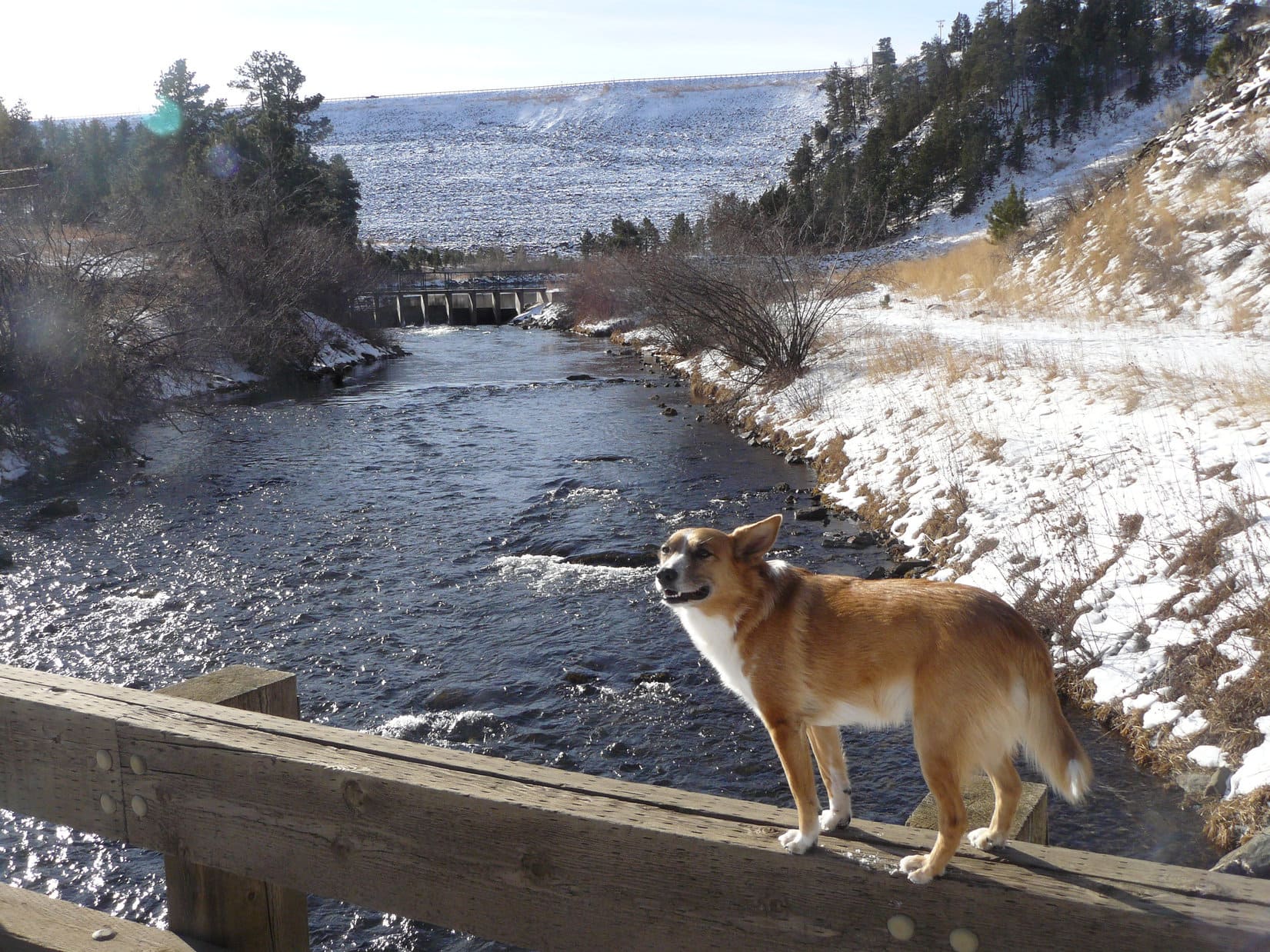
Lupe poses on the railing of the bridge over Rapid Creek below Pactola Reservoir dam.

From the Rapid Creek trailhead, Lupe and SPHP followed Centennial Trail No. 89 heading ESE through the big flat meadow below the dam.  Rapid Creek meanders through the meadow, and the trail had several nice footbridges crossing it.  Lupe and SPHP paused on each bridge to see if there were any trout down in the creek, but saw none.

It didn’t take long to reach the Tamarack Gulch trailhead at the SE end of the meadow.  Lupe and SPHP continued SE.  Centennial Trail No. 89 climbed a little hill, and reached USFS Road No. 772.1B, a road Lupe had been on back on New Year’s Day.  For a short distance, Centennial Trail No. 89 followed this road, but soon left it to continue S up a side road.  Lupe left Centennial Trail No. 89 staying on No. 772.1B, which turned E.

Lupe and SPHP were now retracing the route Lupe had scouted out before on New Year’s Day.  The snowy road made a long gradual climb up a valley.  When it reached a saddle, there was a junction with another road coming in from the N.  Lupe stayed on USFS Road No. 772.1B.  She followed it down into a snowy little valley where SPHP had taken her picture on Expedition No. 113, and on up to another higher saddle at the upper end of Powerhouse Gulch.

At the saddle was an intersection with another road.  SPHP hadn’t seen any marker the last time Lupe was here, but this time saw one identifying the side road as USFS Road No. 772.1C.  In a sunny spot where there was no snow, Lupe and SPHP took a brief break.  SPHP wanted to check the maps.

No. 772.1C was the right road to take.  It would lead Lupe out of the upper end of Powerhouse Gulch over a saddle, and down into a smaller valley SW of Thrall Mountain.  Lupe and SPHP set out on No. 772.1C.  It climbed NW, turned N and soon reached the saddle.  From the saddle, Lupe finally got to see Thrall Mountain, now less than a mile away to the NE.

No. 772.1C started down the N side of the saddle, passed under a power line, made a loop to the N, and then returned S to follow the power line E.  As the road drew near Thrall Mountain, it started gaining elevation again.  Lupe passed an unmarked minor road that headed off to the NW, but didn’t take it.  Near the road’s highest point along the power line, Lupe left No. 772.1C to start climbing toward Thrall Mountain from the SSW.

Lupe on USFS Road No. 772.1C SW of Thrall Mountain. The power line can be seen overhead. This snowy scene was pretty typical along the remote USFS roads Lupe traveled this day. Photo looks E.

The climb grew progressively steeper.  Snowy boulder fields forced Lupe around to the SSE side of the mountain.  Lupe and SPHP had to climb up through a short section of boulders, but made it without mishap.  Lupe was now almost at the top of Thrall Mountain.  Just short of the summit, Lupe reached the E viewpoint, one of three good viewpoints on or near the summit of Thrall Mountain.

From the E viewpoint, Lupe and SPHP could see Turkey Ridge and Prehistoric Ridge to the NE.  To the E, Rapid City could be seen on the edge of the Black Hills.  Beyond the town, the yellow plains of western South Dakota stretched to the far horizon.  Lupe and SPHP also saw human tracks in the snow!  By not reaching Thrall Mountain on New Year’s Day, someone else had beaten Lupe to becoming the first one to climb Thrall Mountain in 2015.

The summit was just 10’s of feet away.  Lupe and SPHP strolled over to the summit to claim her Thrall Mountain peakbagging success!  Whoever beat Lupe to the summit in 2015 was no longer around.  Years ago, there had only been a very small cairn on top of Thrall Mountain.  Now the cairn is easily 4 feet high.  It is comprised of many small rocks.  SPHP wanted Lupe to pose for a couple of photos at the cairn.

Normally Lupe is very cooperative, but coming up the mountain, Lupe had heard gunfire to the S.  Gunshots continued to be heard occasionally from that direction.  Lupe hates even the faint sound of gunfire.  She stuck to SPHP like glue.  Finally, the worried Carolina Dog relaxed enough for a couple of quick photos.
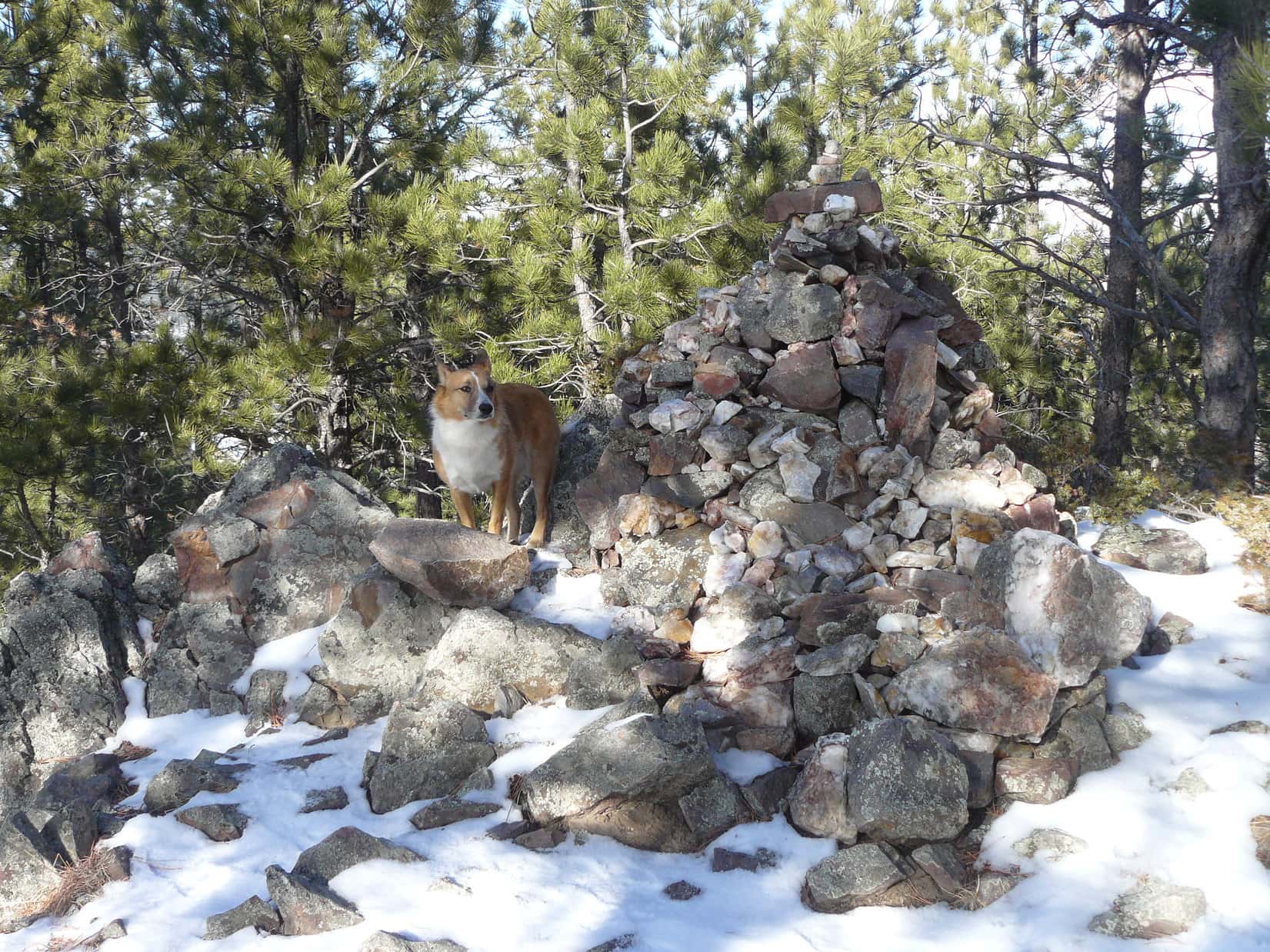
Lupe reaches the summit cairn on Thrall Mountain to claim her peakbagging success. Someone else had already beat her to the top of the mountain in 2015, as evidenced by human tracks Lupe and SPHP saw in the snow.
This was actually Lupe's 2nd successful summit of Thrall Mountain. The first time she was here was way back on Black Hills, SD Expedition No. 38 on 12-8-12, over two years earlier.
This was actually Lupe’s 2nd successful summit of Thrall Mountain. The first time she was here was way back on Black Hills, SD Expedition No. 38 on 12-8-12, over two years earlier.

Lupe and SPHP left the summit to return to the Prehistoric Ridge viewpoint.  There were still gunshots going on to the S.  Lupe put her paw down.  She refused to leave SPHP’s side for another photo.  It was simply too dangerous!

Prehistoric Ridge (the largest line of limestone bluffs farthest away) and Turkey Ridge (a much smaller ridge of reddish stone just in front of the right side of Prehistoric Ridge) from Thrall Mountain. The ridge names are private names assigned by SPHP. Photo looks NE.
Looking W at the Thrall Mountain summit from the Prehistoric Ridge (E) viewpoint.

Lupe and SPHP returned to the summit.  Lupe was very nervous due to the gunfire.  SPHP found a dry spot to sit down.  Lupe snuggled right up, looking for reassurance.  Together Lupe and SPHP stayed there for a while looking out at the view of Harney Peak (7,242 ft.) to the S.  SPHP chatted with Lupe and stroked her, while she gave SPHP a good licking.  SPHP ate an apple.

The best views to the S from Thrall Mountain are obtained just S of the summit.  SPHP took one photo looking SW at Peak 5800.  On a couple of prior occasions, (Expedition No. 77 on 2-16-13, and Expedition No. 80 on 3-23-14) Lupe and SPHP had gotten close enough to Peak 5800 to think about climbing it, but hadn’t actually done so.  Seeing Peak 5800 from Thrall Mountain, SPHP resolved that Lupe would climb it someday.  (Note:  Lupe did eventually climb Peak 5800 on Expedition No. 150 on New Year’s Day 2016!)
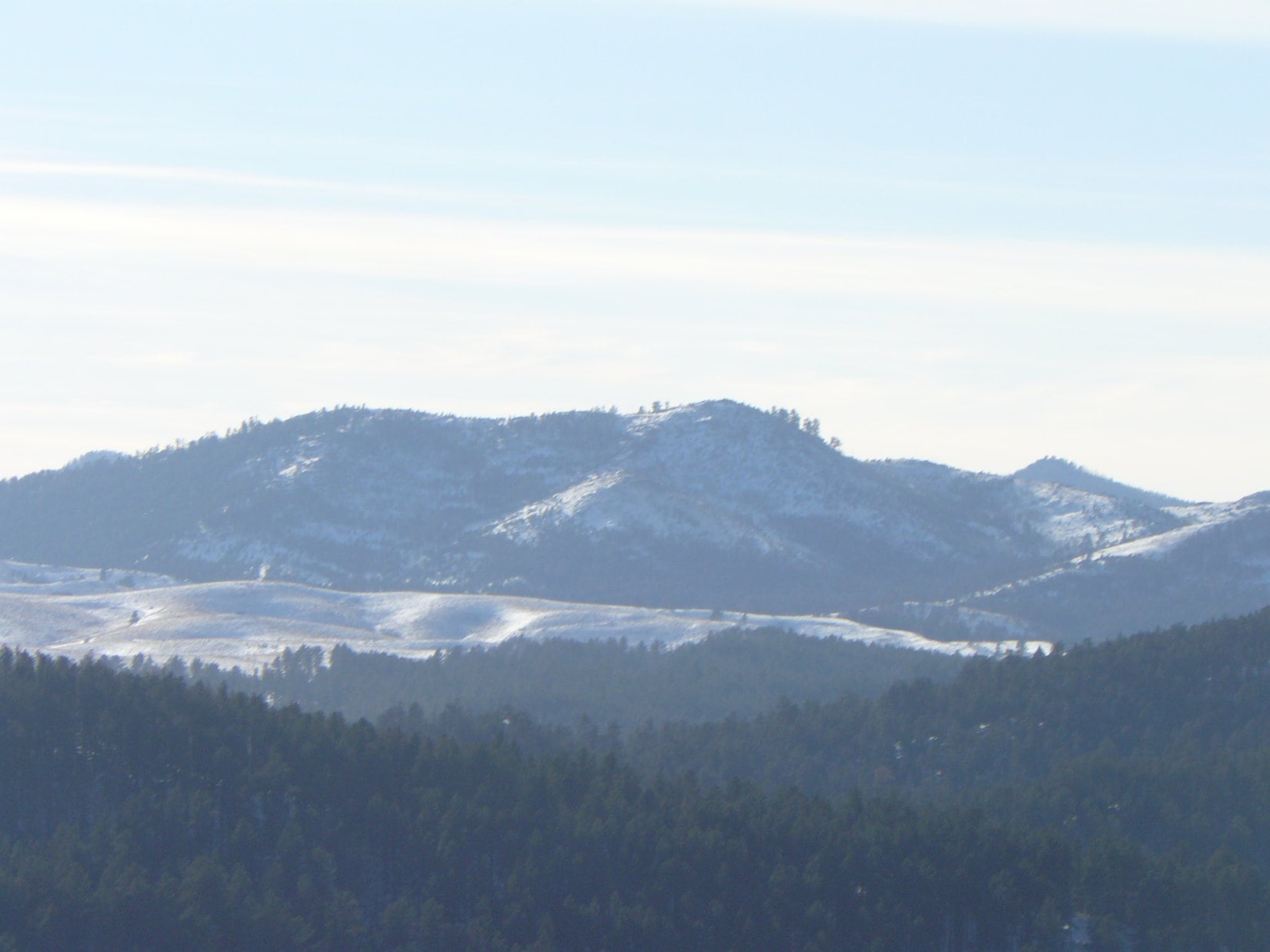
Peak 5800 from Thrall Mountain with a bit of telephoto lens assistance.

One of the best views from Thrall Mountain is from a rocky ledge located on a slightly lower ridge a short distance NW of the summit.  From the rocky ledge is a view to the NW toward nearby Johnson Siding, and the hills beyond all the way to Custer Peak (6,804 ft.).  Lupe was still a bit nervous, but she got up on the rocky ledge despite it all.

A still somewhat nervous American Dingo scans the NW horizon from the rocky ledge a short distance NW of the summit of Thrall Mountain.
Lupe on the rocky ledge. Photo looks WNW.

By now, Lupe and SPHP had visited all three of the best viewpoints on Thrall Mountain.  Lupe finally had her 2015 Thrall Mountain peakbagging success!  It was time to move on.

Lupe and SPHP went back down the mountain pretty much the same way they had come up.  While still near the top of the mountain, Lupe stepped on a cactus.  There was a brief intermission while SPHP pulled a few small cactus spines out of her paw.  Fortunately, she seemed none the worse for the wear.

Lupe returned to USFS Road No. 722.1B at the upper end of Powerhouse Gulch via No. 722.1C.  Lupe and SPHP could have just returned to the G6, but there were still at least a couple of extra hours of daylight left for exploring around, if Lupe wanted to.  She did!  Lupe and SPHP went SE a little way into Powerhouse Gulch to a side road that SPHP had by now figured out was USFS Road No. 722.1.  This was the road Lupe and SPHP should have taken on New Year’s Day to get from Gold Standard Gulch to Powerhouse Gulch.

Lupe and SPHP explored No. 722.1 heading SW.  Lupe passed by a junction with No. 722.1E, she reached a high ridge where she could look back at Thrall Mountain, she went on to Gold Standard Gulch and Centennial Trail No. 89 again.  Just roaming around exploring the back roads without any goal in mind was rather fun.  Of course, the sun eventually sank toward the SW horizon.  Time to start heading back to the G6.

The sun was down, but it was still somewhat light out when Lupe reached the G6 at 4:48 PM (27°F).  Black Hills, SD Expedition No. 114 to Thrall Mountain was over, but Lupe’s fun wasn’t!  Back at home, SPHP gave Lupe a big ham bone left over from a Christmas ham Guille had bought.  There was still plenty of good ham, fat and gristle attached to it.  Lupe’s eyes grew big as she gingerly accepted this treasure.

For several hours, Lupe gnawed energetically away on the precious ham bone.  She stripped it of every shred of ham, fat and gristle.  Her gnawing fangs reduced most of the ham bone itself to rubble.  She ate almost the entire bone.  During this time of Carolina Dog bliss, Lupe growled if SPHP got too close.  She still loved SPHP, but some things are just sacred, ya know!?

Links:

Next Black Hills Expedition              Prior Black Hills Expedition

Want more Lupe adventures?  Choose from Lupe’s Black Hills Expeditions Adventure Index or Master Adventure Index.  Or subscribe free to new Lupe adventures.

Black Hills, SD Expedition No. 174(b) – Summits on the Air! (Boulder Hill, 7-4-16)

By the time Lupe and SPHP arrived at grandma’s house, Joe and Dusty were ready and waiting.  Joe had already entered an alert on Summits on the Air!  Joe, Dusty, Lupe and SPHP lost no time leaving for Boulder Hill (5,331 ft.).

Boulder Hill from USFS Road No. 358 (Boulder Hill Road) where Flume Trail No. 50 crosses the road. Photo looks S.

At 8:19 AM (71°F), Joe parked the G6 at the high point of the saddle on USFS Road No. 358 near the Boulder Hill access road.  A cool N breeze could be heard in the pines.  Lupe and Dusty were soon racing through the shady forest.  Joe and SPHP took the access road.

Rain had finally arrived the day before – the real deal with thunder, lightning, small hail and at least an inch of moisture.  Lupe found big tan mud puddles on the access road.  She plunked herself down in several of them.  She emerged with cool, tan mineral water streaming from her fur.

The access road was only 0.375 mile long.  It ended at the base of the big rock outcropping at the top of Boulder Hill (5,331 ft.).  A spur of Flume Trail No. 50 wound up among the rocks to a small, shallow saddle between the N and S high points at the summit of Boulder Hill.  Good!  No one was around.  Joe would have his choice of sites to set up his ham radio equipment.

Two days earlier, Joe had had such a good time with his first Summits on the Air (SOTA) experience “activating” Custer Peak (6,804 ft.), that he wanted to try activating another peak in the Black Hills before he and Dusty had to head home to Arvada, Colorado.  SOTA is “an award scheme for radio amateurs that encourages portable operation in mountainous areas”.  Naturally, Lupe, Dusty, and SPHP had all wanted to come along again, too!

Joe decided to set up the radio equipment at the N end of the N high point.  He taped a 12 foot fishing pole supporting an antenna wire as high up in a pine tree as he could.  SPHP then helped Joe set up 4 lateral wires near the base of the antenna.  Lupe and Dusty supervised, while guarding against intruders.

Joe and Dusty during setup of the portable ham radio. The 12' fishing pole supporting the antenna can be see up in the tree toward the L. Several of the lateral wires can be seen, too.
Joe and Dusty during setup of the portable ham radio. The 12′ fishing pole supporting the antenna can be see up in the tree toward the L. Several of the lateral wires can be seen, too.
Lupe supervises while Joe finishes setting the radio up. Photo looks NW.

Pretty soon, the radio was ready.  This time, Joe had a much better idea of what to expect once the radio was on.  Before “activating” Boulder Hill, Joe gave SPHP the log book and a pen.  SPHP received a 5 minute crash course on how to log the contact call signs, and other data Joe would call out while operating the radio.

AA0Q (Joe's radio call sign) ready to get Boulder Hill on the air!
AA0Q (Joe’s radio call sign) ready to get Boulder Hill on the air!

Set up had gone smoothly.  AA0Q was ready to go on the air 5 minutes before the alert time Joe had posted on the SOTA website.  As soon as Joe started transmitting, the same thing happened as at Custer Peak two days earlier.  Within seconds of turning the radio on, a contact “spotted” AA0Q on Boulder Hill on the SOTA website.  Moments later, Joe told SPHP that it was another “pileup”.  Joe said it sounded like 30 hams were trying to contact him at once.

It was impossible to respond to them all, but Joe was better prepared than last time.  SPHP logged the contacts, while AA0Q “worked” them using Morse Code.  Joe recognized some of the contacts as repeats from his SOTA activation of Custer Peak.  Others were new.  The most distant contact was in Great Britain, which Joe said was very good for transmitting only 4 watts.

AA0Q on the air on Boulder Hill, with Dusty looking on. Photo looks NW.

Lupe and Dusty helped, too.  At one point, three hikers arrived up on Boulder Hill while AA0Q was still transmitting.  Both Lupe and Dusty barked a warning.  SPHP stopped logging long enough to point out the lateral antenna wires, so they wouldn’t trip on them.  SPHP also took a couple of group photos for the hikers using their camera.

Once again, Joe was rather amazed at the terrific response.  His Summits on the Air activation of Boulder Hill was a big success.  In roughly an hour, AA0Q worked 33 contacts by Morse Code, and one by voice.  By activating Boulder Hill, AA0Q had earned 6 more points toward the SOTA “Mountain Goat” award.  Including the 8 points earned on Custer Peak, he was now up to 14 points.  SOTA was fun and added a whole new dimension to AA0Q’s amateur radio hobby!

When Joe was done transmitting, it was time to take down the antenna and pack up all the radio gear.  When that was complete, Joe, Dusty, Lupe & SPHP went to explore a slightly lower high point a short distance to the N.

Joe and Dusty on the slightly lower high point to the N. Harney Peak (L of Center) is the highest point in the distance. Photo looks SW.
Silver Mountain's summit is in view just above Joe. Cliffs at the edge of the N summit area close to where AA0Q had been transmitting are seen on the L. Photo looks SSW.
Silver Mountain’s summit is in view just above Joe. Cliffs at the edge of the N summit area close to where AA0Q had been transmitting are seen on the L. Photo looks SSW.
Joe stands near the spot where he had been transmitting from on the N summit. Photo looks S.

Of course, the peakbagger in Lupe wasn’t about to leave Boulder Hill without a visit to the S summit area, too!

Lupe on the S summit. Silver Mountain (5,405 ft.) is the grassy peak on the L. Harney Peak (7,242 ft.) is on the horizon on the R.
AA0Q and Dusty at the S summit. Photo looks SW.
Harney Peak using the telephoto lens. Photo looks SW.
Part of Storm Hill (5,192 ft.) is seen on the L. Hwy 16 is visible on the R. Photo looks E.
Joe and Dusty on the trail on the way down. Photo looks S.

By noon, Joe, Dusty, Lupe and SPHP were back at grandma’s house.  Joe logged in all the QSO’s (contacts) he had made on the Summits on the Air website.  All the contacts earned points toward the SOTA “Shack Sloth” award.

After lunch, Joe & SPHP went with other family members off into the hills again.  SPHP wound up at Rushmore Cave, and Joe wound up at an antique shop in Keystone.

Lupe, Dusty and Maya (another dog in the family) were left behind with grandma.  SPHP had given all three dogs water and a Beggin’ Strip before leaving.  Grandma later reported that all the dogs spent the entire afternoon snoozing on the soft carpet in front of the fan.  Being a “Radio-Active” Carolina Dog can be a tough life, but someone’s got to do it!

Summits on the Air map showing AA0Q's activation of Boulder Hill.
Summits on the Air map showing AA0Q’s activation of Boulder Hill.

Links:

Next Black Hills Expedition               Prior Black Hills Expedition

Want more Lupe adventures?  Choose from Lupe’s Black Hills Expeditions Adventure Index or Master Adventure Index.  Or subscribe free to new Lupe adventures.