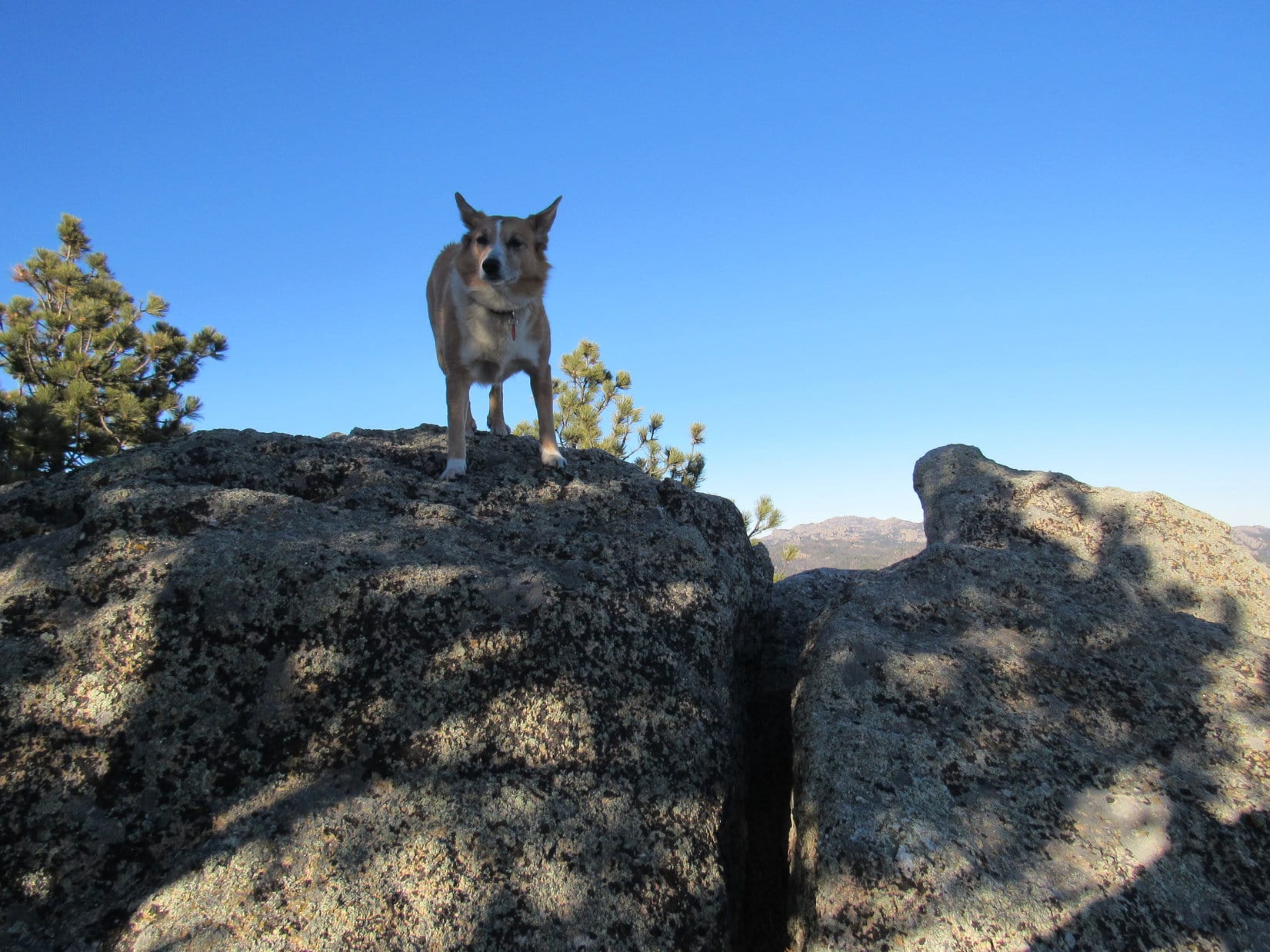
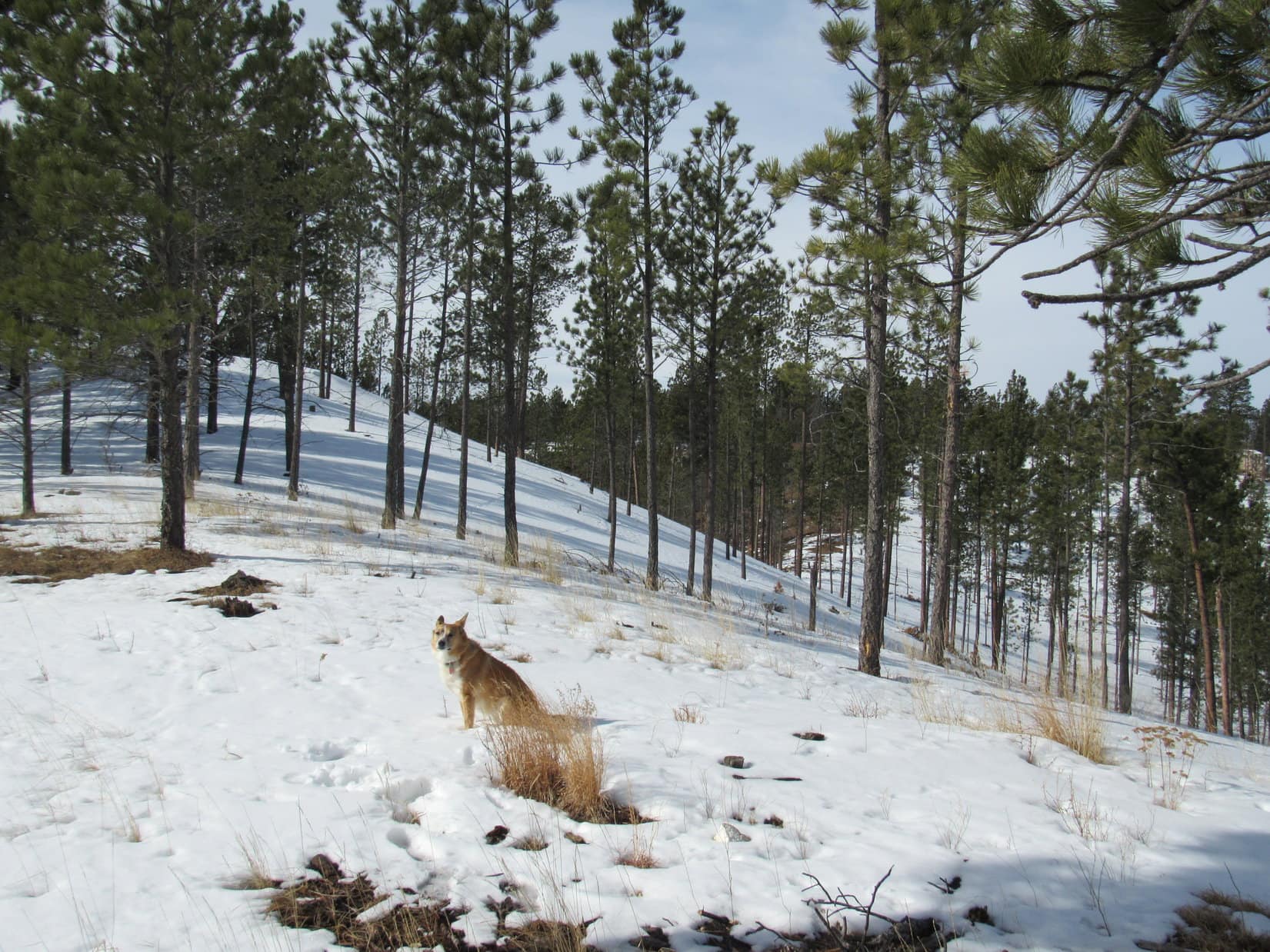
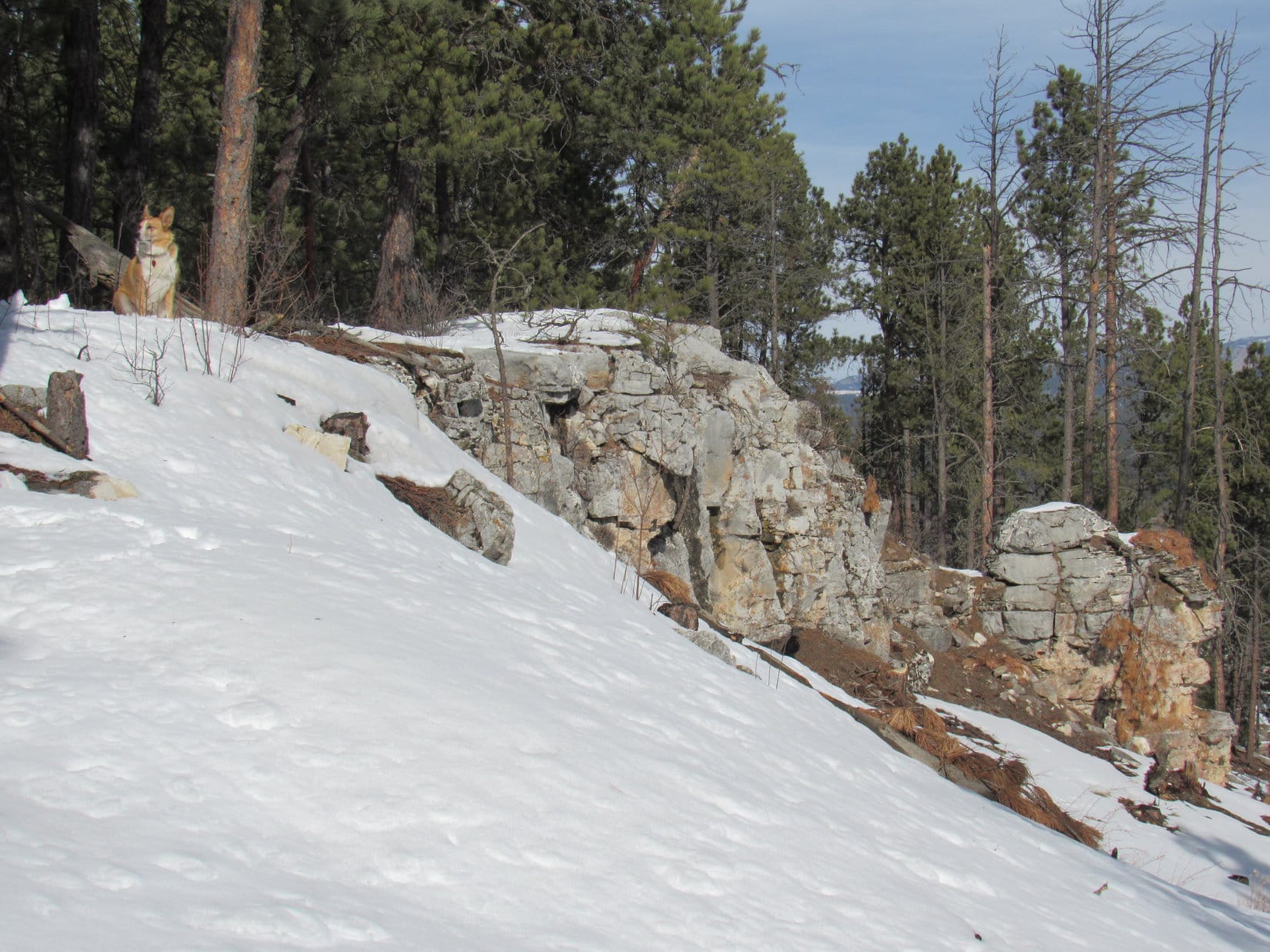
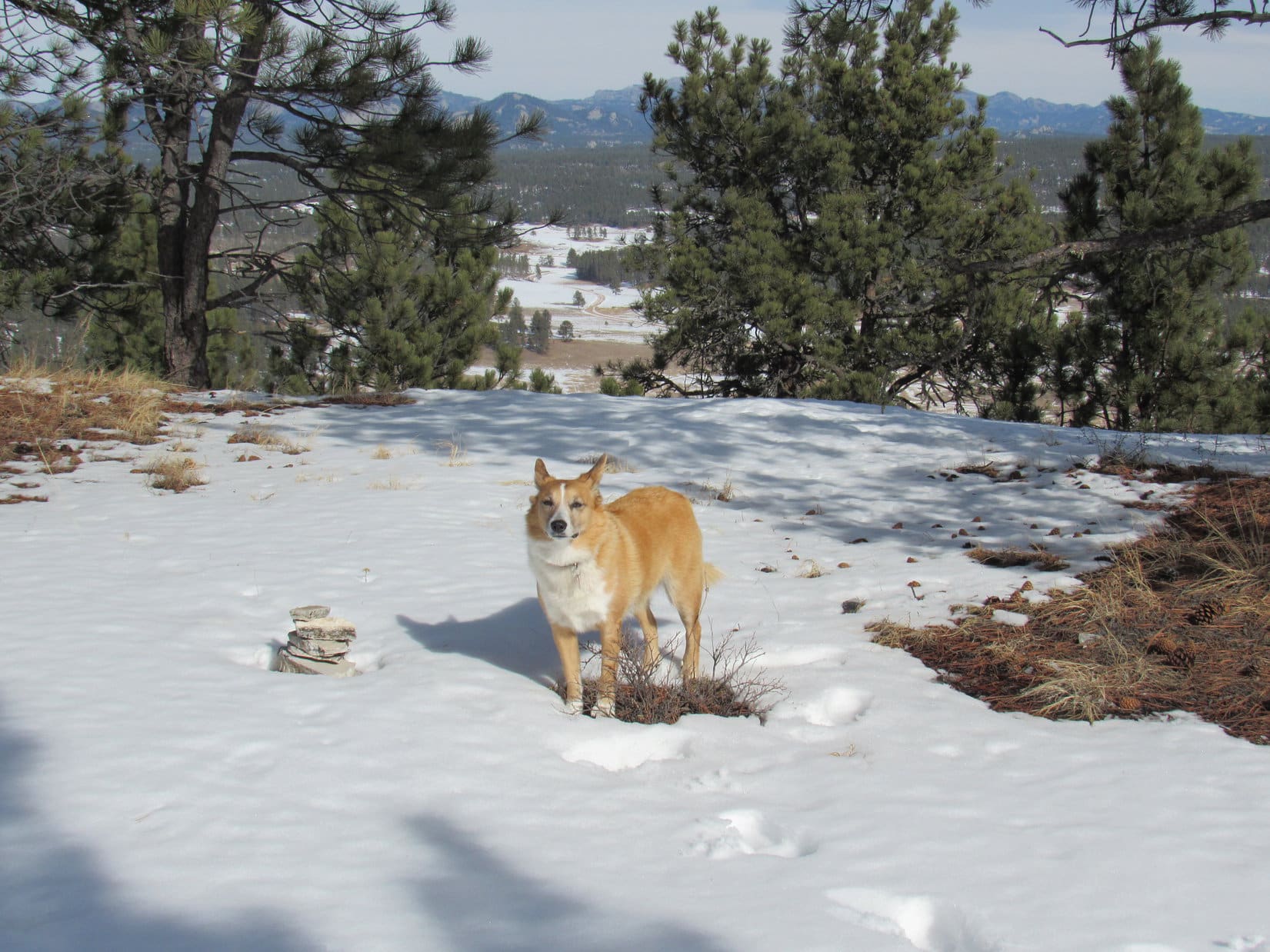
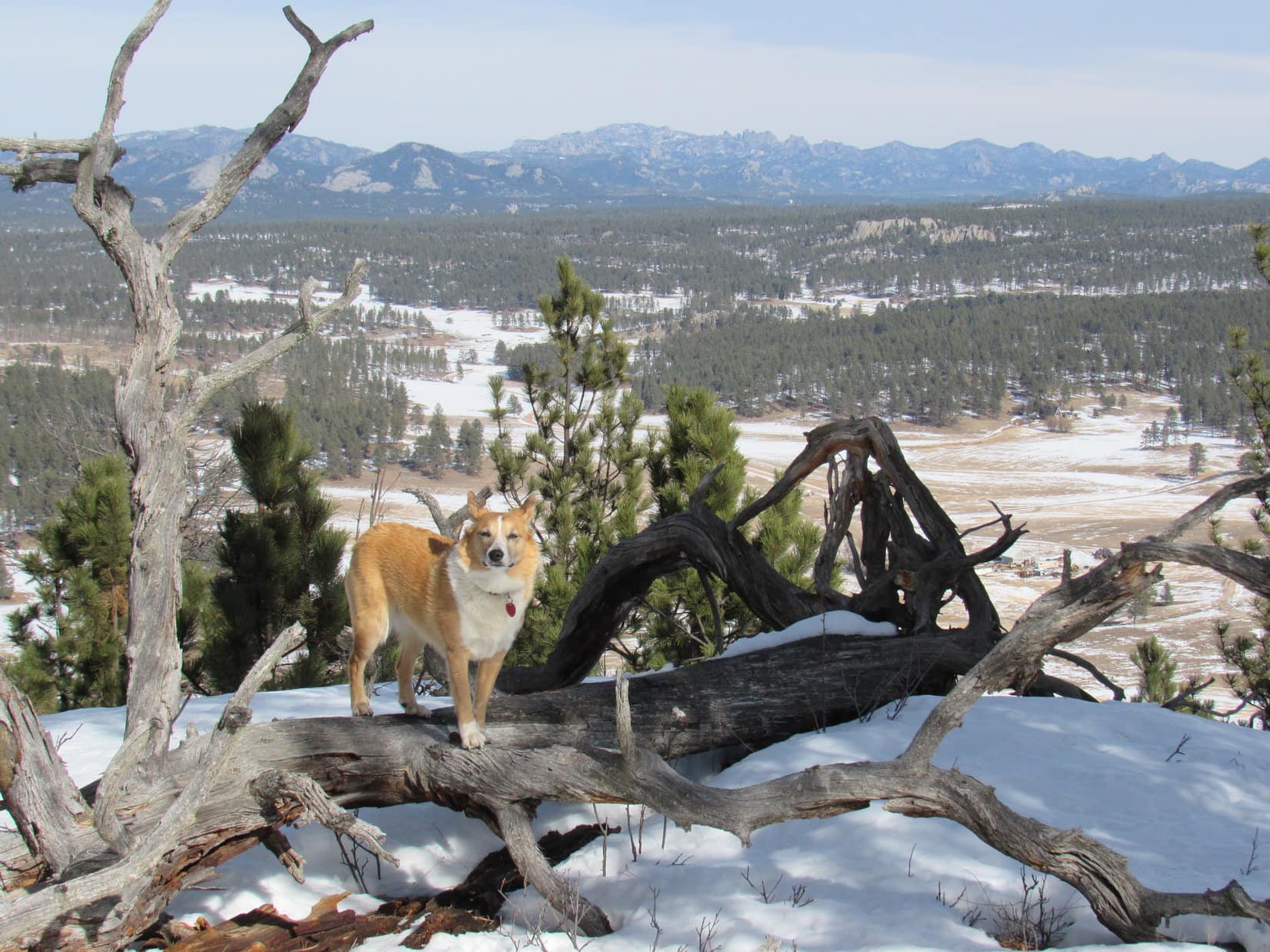
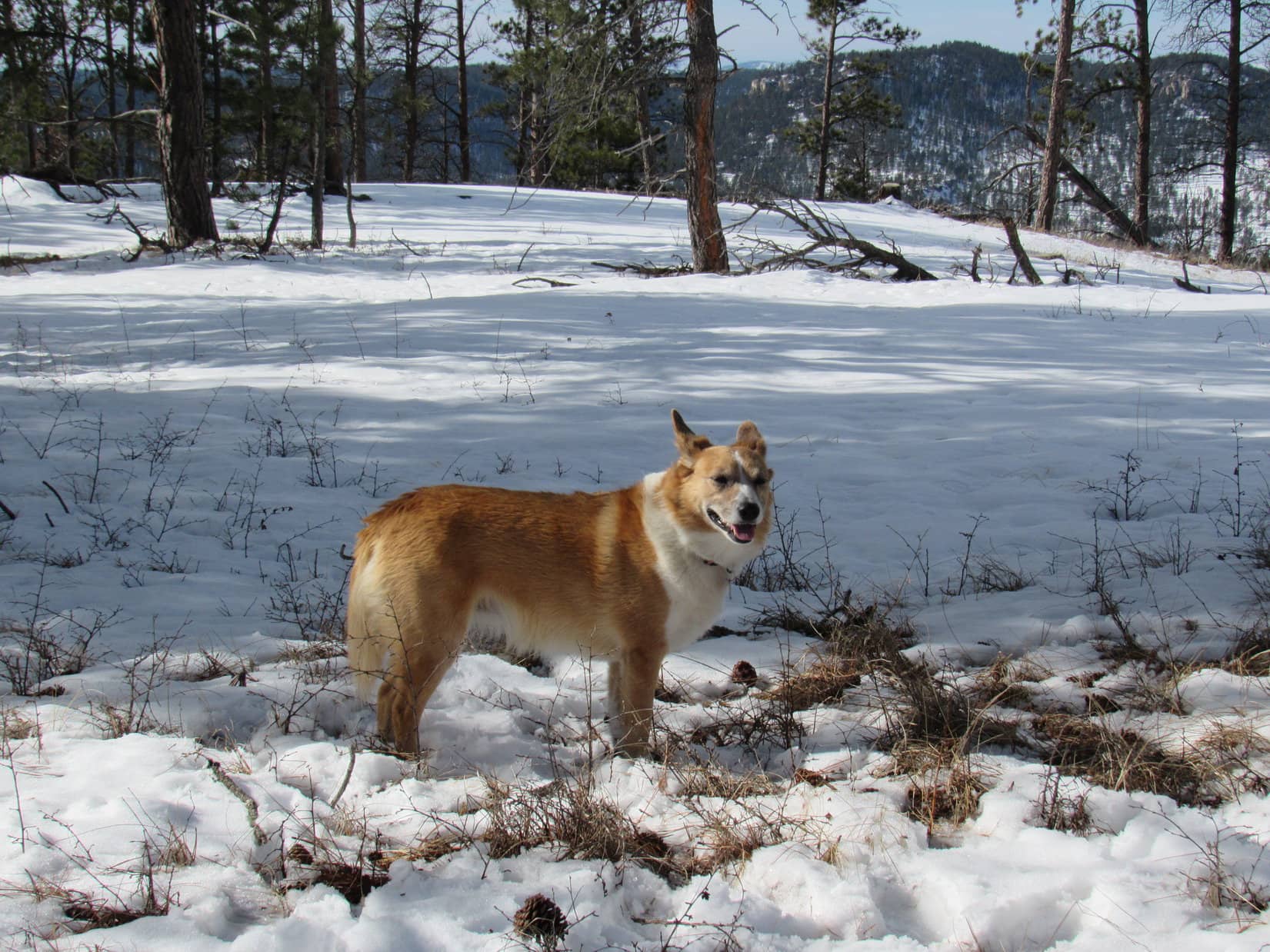
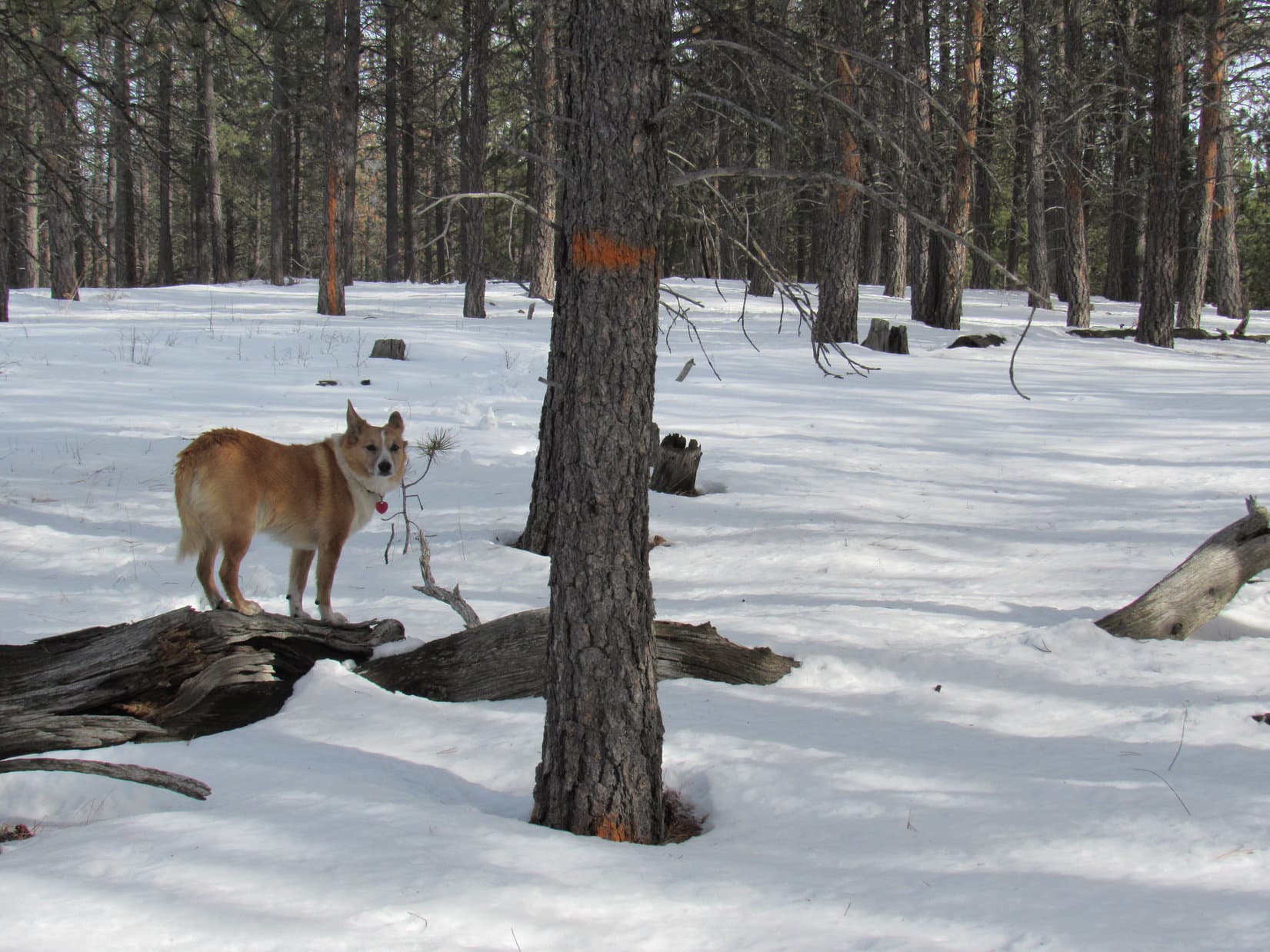
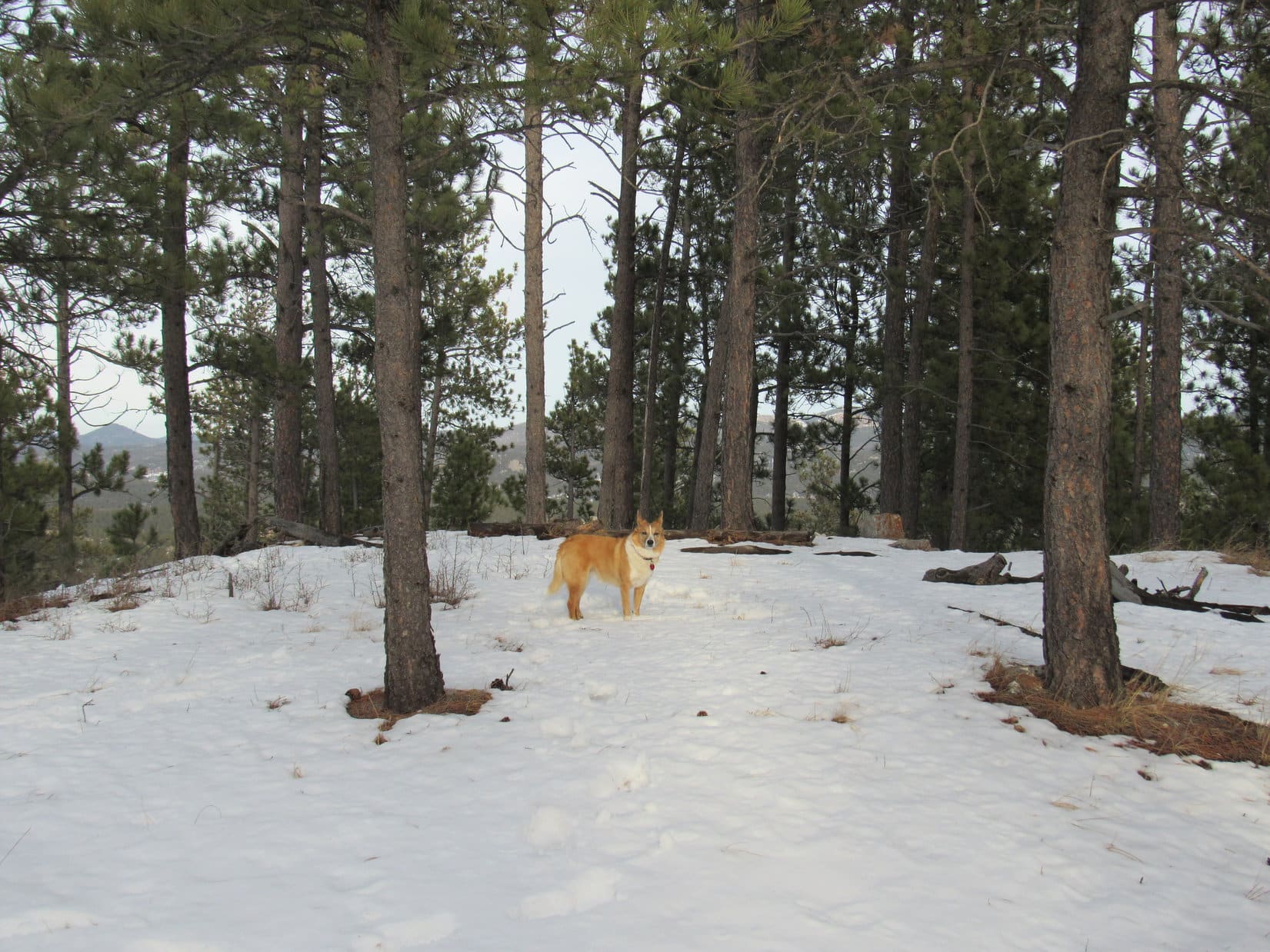
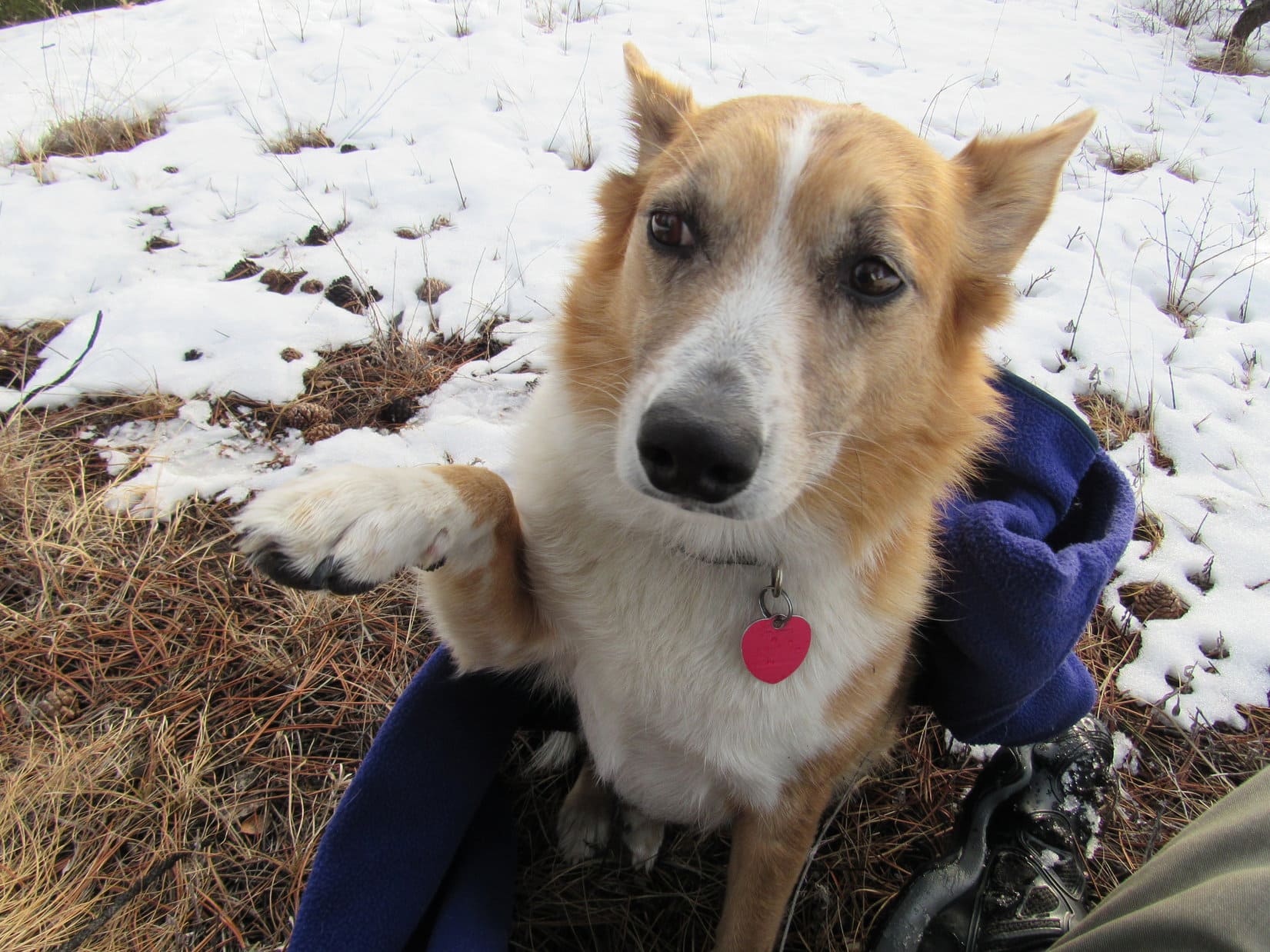
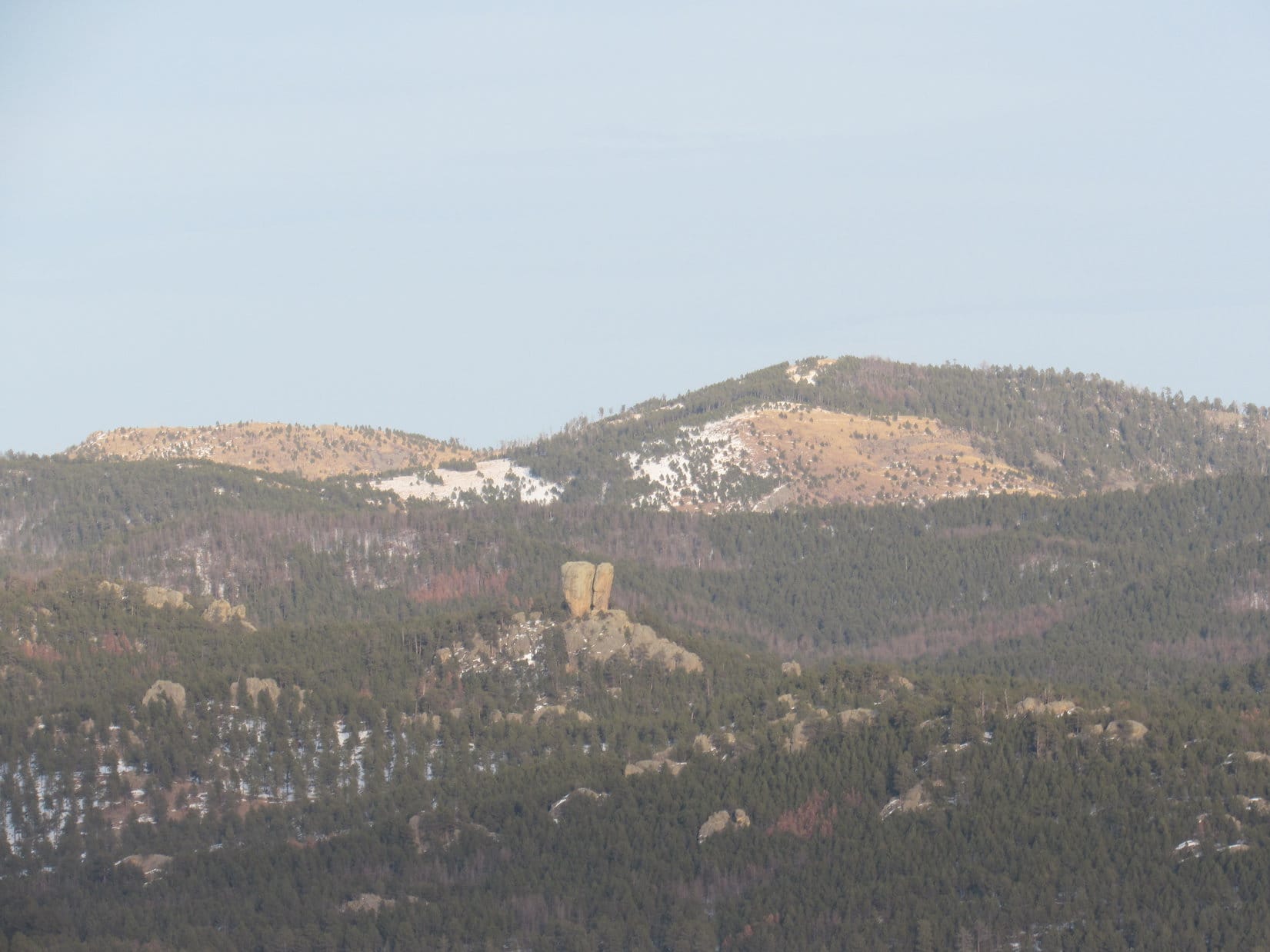
Black Hills, SD Expedition No. 191 – Peak 5360, Peak 5240 & Buckhorn Mountain (2-13-17)

Even standing right next to the marker, the numbers on it were so faded SPHP could barely make them out.  313.1G.  Excellent!  No doubt about it now, this icy dirt road leading into the trees was a USFS Road.  Come on out, Loop, this is it!  Lupe was out of the G6 in a flash (8:58 AM, 39°F).  She thrashed around rolling on the ice in her excitement and desire to cool off.

Most of the land right along Carroll Creek Road (County Road No. 313) was privately owned in this area, but SPHP’s old USFS map did show national forest land coming right down to Carroll Creek Road in a few places.  Finding USFS Road No. 313.1G meant Lupe had national forest access around the private property nearby.  She could get to Peak 5360.

Much of the snow that had been in this vicinity a week ago had melted.  What was left had turned to ice on No. 313.1G, making it quite slippery.  Off road, patches of crusty, crunchy snow lingered in shady spots.

The snow that had been in this vicinity a week ago had turned to ice now on USFS Road No. 313.1G. Photo looks N.

Peak 5360 was another of the series of peaks in the southern Black Hills that Brian Kalet had added to the Peakbagger.com data base last spring.  On recent expeditions, Lupe’s adventures had been focused on climbing these Brian Kalet peaks.  She now had a good start on visiting all of them.  A successful summit of Peak 5360 would “X” another one off the list.

Peak 5360 was only 0.67 miles N as the crow flies.  Lupe would have to go more like a mile to actually reach the summit.  No. 313.1G started out curving across the lower end of a draw to the NE.  It then went around the SW end of a forested ridge before turning NE.  Here, Lupe already had a view of Peak 5360 to the N beyond a field of private property.

After following No. 313.1G around the SW end of a forested ridge, Lupe could see Peak 5360 ahead beyond a privately-owned field. Photo looks N.
Peak 5360 from the S.

Displaying limestone cliffs at the SW end, Peak 5360 looked like it was probably easiest to climb from the NE.  Lupe followed No. 313.1G up the valley.  After the road got beyond the end of the private field, Lupe came to two intersections in rapid succession.  At the second one, she left No. 313.1G to continue NE on No. 313.1H.  She hadn’t gone far at all before reaching a fence with a “No Trespassing” sign.

SPHP checked the USFS map again.  Yes, a very narrow strip of private property within the national forest extended farther up the valley from here.  Lupe ought to be able to go around it easily enough.  SPHP led Lupe NW directly toward Peak 5360.  Sure enough, the fence ended shortly after reaching the trees.  Lupe turned NE again.

As she got closer to the NE end of the mountain, Lupe started climbing.  She had already gained a fair amount of elevation by the time she was able to turn SW to tackle the steepest part of the slope leading to the summit.  The remaining snow was getting soft and starting to melt, making things slick for SPHP.  The Carolina Dog had no problem, though.  She was rapidly approaching the small limestone outcroppings near the top of the mountain.

The snow was starting to melt and make things slippery as Lupe reached the steepest part of the climb up the NE slope. The snow was no problem for her. Soon she could see the limestone rock outcroppings just below the top of the mountain ahead.
Lupe at the base of the limestone cap of Peak 5360. Fortunately, the line of rock was discontinuous here at the NE end of the mountain. Lupe had no problem finding an easy route to the top. Photo looks SSW.

The exposed limestone cap at the NE end of Peak 5360 was not thick or continuous enough to create a solid line of cliffs.  Lupe had no problem reaching the top of the mountain.  The mountaintop was heavily forested, but she had good views from an opening looking NE.

Cicero Peak (6,166 ft.) (L) from the NE end of Peak 5360. Photo looks NE.
Black Elk Peak (7,231 ft.) (L). Photo looks NNE using the telephoto lens.

Now that she had made it up here, it was time for Lupe to explore the top of Peak 5360 to find the true summit.  The summit ridge extended another 0.125 mile to the SW, so the high point might be some distance away.

From here near the NE end of the mountaintop, Lupe set out to find the true summit of Peak 5360. Photo looks WSW.

As it turned out, Lupe didn’t have far to go.  The true summit was only 100 feet from where she’d reached the top of the mountain’s limestone cap.  Brian Kalet had marked the true summit on Peakbagger.com as being close to the NE end of the mountain.  Brian was absolutely correct.

A dead tree had fallen over right at the actual summit, and made a great prop from which Lupe could claim her 1st peakbagging success of the day.

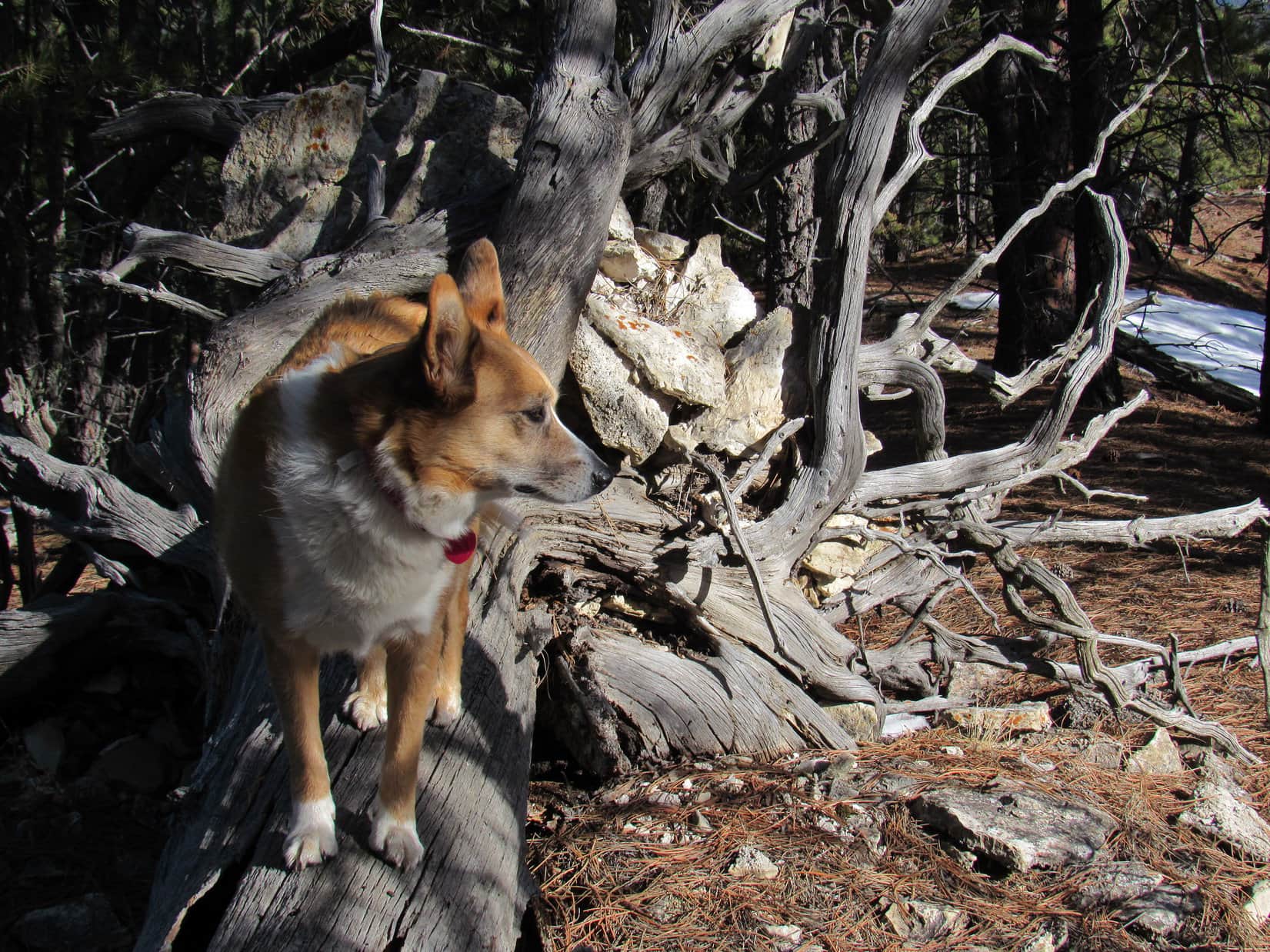
Lupe stands on the fallen dead tree at the true summit of Peak 5360. Photo looks NE.
Amid a dense forest, the gnarly roots of the fallen dead tree were the most scenic thing in view from the true summit.

Simply because she had reached the true summit of Peak 5360 so quickly didn’t mean Lupe was done here.  Loop was ready to explore the entire summit area to see what else she might discover.  Two ridges converged at the true summit.  The shorter one went W, while the longer one went SW.  Lupe went SW first.

The SW ridge varied from 50 – 200 feet wide.  Although the ridge was fairly level, Lupe lost elevation steadily as she conducted her exploration.  From cliffs along the SE edge, Lupe often had nice views in that direction, but the forest hid everything to the NW.

Explorer Lupe midway along the SW ridge. Photo looks back to the NE in the direction she was coming from.
Exploring the SW ridge. Photo looks SW.

Lupe had lost significant elevation by the time she reached the cliffs at the end of the SW ridge.  Unsurprisingly, the best views were to the SSW.  Lupe could see both Parker Peak (4,848 ft.) and Matias Peak (4,780 ft.).  Both were far away on the horizon and looked like mere bumps from here.

The best view from the end of the SW ridge was to the SSW. Lupe could see both Parker Peak (on the horizon straight up from the end of her nose) and Matias Peak (also on the horizon, but a little to the R of her tail), but they were so far away they looked like mere bumps from here.
Looking down on the Carroll Creek valley. Despite the melting snow, the creek was bone dry when Lupe came by today. Photo looks WNW.

Since the views were better here at the end of the SW ridge than back at the true summit, SPHP suggested taking a short break.  Lupe was fine with that for 10 minutes.  Then she disappeared.  SPHP had to call her.  She came running back from the NE.  Apparently she had seen enough of this end of the mountain!

At the end of the SW ridge during break time. Photo looks S.

Lupe and SPHP started back up to the NE.  When the Carolina Dog was getting close to the true summit again, she turned W to explore the shorter W ridge.  This was the only part of the mountain with decent views toward the N or NW.  Lupe saw both Sylvan Hill (7,000 ft.) and Thunderhead Mountain (6,567 ft.), but they were quite a long way off.

Lupe’s explorations of Peak 5360 were now complete.  She returned briefly to the true summit before heading back down the NE slope.  She retraced her entire route back to the G6 (11:12 AM, 46°F).

On USFS Road No. 313.1G again on her way back to the G6. Photo looks SSW.

Lupe wasn’t done with Brian Kalet peaks yet today.  Another one, Peak 5240, was her next destination.  Peak 5240 is nearly 4 miles SE of Peak 5360 on the opposite side of the little town of Pringle.  Ordinarily that would have been close enough for Lupe to consider simply exploring a route to it through the hills, but the USFS map showed a lot of private property in the Pringle area.  Lucky Lupe was going to get a ride over to Peak 5240 in the G6.

That was fine with the American Dingo!  She kept a keen eye out for cows and horses to bark at along the way.  She saw several on the way to Pringle, and hit the jackpot when she got there.  A whole herd of black cattle was grazing SE of the intersection of Hwy 385 and Hwy 89.  Peak 5240 was close by, in full view beyond the herd.

Peak 5240 is only 0.67 miles SE of the small town of Pringle. It is clearly visible from the junction of Hwy 385 & Hwy 89. Photo looks ESE at the mountain from Hwy 89 less than 0.5 mile S of Pringle.

The old USFS map made it look like there was national forest access to Peak 5240 starting less than 1 mile E of Pringle on the S side of Hwy 385.  A possible USFS road shown on the Peakbagger.com topo map was nowhere in evidence, though, when SPHP drove by.  Quite a bit of private property was in the area.

In fact, an apparently long-established commercial business, the Pringle Bed & Breakfast resort, sat on fenced land S of Hwy 385 where SPHP had expected to find the national forest.  The Pringle Bed & Breakfast looked affordable to begin with, and they were advertising winter rates.  SPHP was in a generous mood.  Did Lupe want to go in for a luxurious, comfy snooze and hearty, nutritious breakfast?

Oh, you’re a riot, SPHP! No, I’m not this tired or hungry!
I’ll get you for this! Yeah, some day my fans will be reading “SPHP went missing mysteriously on Expedition No. Blah, Blah”.

SPHP still thought the land the Pringle Bed & Breakfast sat on was national forest ground, but the expected access road didn’t seem to exist and there was nowhere to park.  Maybe there was access from the W?  SPHP drove back W to Shirttail Canyon Road and turned S.  After passing by several private properties, a USFS marker appeared near the start of a dirt side road.  Lupe was in luck!  SPHP parked the G6, and Lupe was back in business (11:41 AM, 47°F).

The USFS road led up the W slope of Peak 5240 through an open forest of Ponderosa pines.  It soon ended at the old Townsite Mine, where a couple of signs indicated someone from Oklahoma had recently staked a new mining claim.  Lupe found nothing else here other than the big scar in the hillside left by the original mining operation.  She did have quite a good view back toward Pringle to the NW.

Lupe arrives at the historic Townsite Mine on the upper W slope of Peak 5240. It is historic simply because all defunct old mines are historic, in case you hadn’t ever noticed before.
From the Townsite Mine, Lupe had an unobstructed view of Pringle, SD. Photo looks NW.
Other than this big gash in the W side of Peak 5240, Lupe found nothing else at the old Townsite Mine. Photo looks N.

It doesn’t take a Carolina Dog long to look at a hole in the ground, even if it’s a fairly big one.  Lupe left the Townsite Mine going a little S before turning E.  She had to make her way up a short, fairly steep slope, but quickly reached the top of a limestone outcropping.  Lupe stopped briefly here for a look at the already great view to the SSW.

The view from here was similar to the one Lupe had from the SW ridge on Peak 5360, but was more open and panoramic.  Loopster could see Parker Peak (4,848 ft.) and Matias Peak (4,780 ft.) again.  They were still far away, but a little closer than before.

Coming up Peak 5240 from the SW, Lupe reached the top of this limestone outcropping where she had a great panoramic view to the S. Still appearing as little bumps on the horizon, Lupe saw Matias Peak (straight up from her tail end) and Parker Peak (L of Center). Photo looks SSW.
Another look SSW. Parker Peak is now near (Center) on the horizon.
Parker Peak (R) through the telephoto lens.

The rest of the climb up Peak 5240 was only moderately steep.  At the top of the mountain, one medium-sized rock stood out as being the true summit of Peak 5240.  Lupe stood on it to claim her 2nd peakbagging success of the day, striking a somewhat dramatic pose.  There was little doubt she was merely following a tradition already established by Brian Kalet.

Lupe poses dramatically at the true summit of Peak 5240! Hwy 385/89 N of Pringle can be seen in the distance. Bear Mountain (7,166 ft.) is on the far horizon. Photo looks NNW.
At the true summit. Photo looks WNW.

Near a cairn E of the true summit, Lupe found a survey marker, but it seemed to have more to do with a section line than anything having to do with Peak 5240.  The top of the mountain formed a ridge running E/W.  The ground was close to level for about 200 feet in this direction.  Lupe had surprisingly good views in most directions except to the W and NW, where pines blocked the view toward Pringle.

Looking down the S ridge from a point E of the true summit. Photo looks S.
View to the NE.
Looking SE. A lot of forest had burned in this direction.

After looking at the views from the E end of the summit, Lupe and SPHP took a break over toward the W end.  The trees here provided welcome shade.  Lupe wasn’t really hungry yet, but she stayed close by while SPHP munched an apple.

The view down the S slope was lovely.  On the horizon was a distant blue ridge that might be part of the Seven Sisters Range (4,420 ft.), where Lupe hopes to visit some more Brian Kalet peaks in the relatively near future.  SPHP must have been daydreaming and munching away for a while.  Suddenly an American Dingo was right there, demanding an explanation.

Just how long does it take you to eat one crummy apple, anyway? Can we go yet?

Lupe was ready for action!  OK, OK!  SPHP finished the apple.  Lupe cooperated with SPHP for one last photo looking down the S slope.  She returned briefly to stand atop the summit rock one more time.  Then she headed down the S slope to continue her exploration of Peak 5240.

Looking at the lovely view down the S slope from the break area a little W of the true summit. Photo looks SSE.
The high points along the distant blue ridge at Center and to the L may be part of the Seven Sisters Range S of Hot Springs, SD. Photo looks SSE using the telephoto lens.

Lupe went all the way down to the drop-off at the bottom of the S slope.  Although she had lost a fair amount of elevation, she still had a great panoramic view.

Lupe near the drop-off at the lower end of Peak 5240’s S slope. Shirttail Canyon Road is the dirt road below on the R. Beyond it, Hwy 89 curves away to the W. Matias Peak is the highest dark hill seen L of Center near the horizon. Photo looks SW.
Looking N back up the S slope.

Lupe’s investigations on Peak 5240 were now complete.  She left the mountain, stopping by the Townsite Mine one more time along the way.  Soon she was back at the G6 (1:04 PM, 47°F).

More than 4 hours remained before sunset.  Lupe had run out of Brian Kalet peaks to explore near Pringle.  However, while Loopster had been climbing all the Brian Kalet peaks farther N in recent weeks, SPHP had noticed a mountain not in the Peakbagger.com data base that Brian had somehow missed.  Buckhorn Mountain (6,330 ft.) was just N of Custer, SD.

Lupe had seen Buckhorn Mountain from Peak 6181 only a few weeks ago.  It looked like a fairly impressive peak which might have some pretty sweet views from the top.  The Custer area, especially to the N, is rugged territory for the Black Hills featuring lots of huge granite rock formations.  SPHP wasn’t even certain if Lupe could get to the top of Buckhorn Mountain, but she was about to find out!

After driving to Custer, SPHP parked the G6 again at the intersection of Hwy 89 and USFS Road No. 362, about a mile N of Hwy Alt 16 (1:33 PM, 45°F).  Buckhorn Mountain was only 1.5 miles to the NW.

On the first half of the trek to Buckhorn Mountain, Lupe followed USFS Road No. 362.  The road wound NW through a forest which had been thinned by loggers fairly recently.  Lupe liked the open forest, and trotted along on or near the road sniffing happily.  She gained elevation steadily, but only gradually, on the way.  She passed by a private drive on the N side of the road, but No. 362 continued on beyond it.

At the high point on No. 362, Lupe found an intersection.  From here, No. 362 went W starting downhill.  USFS Road No. 362.1C went N.  By now, Lupe was very close to the end of the part of the forest the loggers had thinned.  Buckhorn Mountain’s thickly forested SE ridge came right down to No. 362.1C nearby.  Lupe took No. 362.1C going N, but arrived almost immediately at a gate barring the road.  A sign said she had reached private property.

Lupe didn’t need to go any farther N anyway.  Time for the American Dingo to begin her ascent of Buckhorn Mountain!  Lupe and SPHP plunged into the forest, starting up the SE ridge.

The climb was really fun!  It was steep, but not too steep.  At first the forest was the only obstacle to navigate, but very quickly Lupe began coming to granite rock formations along the top of the ridge.  The higher up Lupe went, the more the rock outcroppings grew in size.  At any moment Lupe might come to a wall of solid rock preventing further advance along the ridge, but she didn’t.  Each time that kind of situation seemed to be developing, Lupe found an easy way over, around, or through.

Climbing Buckhorn Mountain’s SE ridge, Lupe came to many interesting rock formations along the way. This one has a hole in it near the top. Photo looks SSE.

SPHP knew that Lupe would eventually come to an intermediate high point, sort of an ESE shoulder of the mountain.  The shoulder area had some towering granite at the top.  It was the first area of real concern.  Would Lupe be able to get past this area without having to lose a bunch of elevation going around it?

A wall of rock 40 feet high appeared ahead.   Lupe’s prospects weren’t looking too good, but she kept climbing right up to it.  The luck of the Dingo held.  Looper found an easy route around the NE side of the rock formation.  She was past the ESE shoulder.  Nothing to it!

Lupe alongside the rock formations of the ESE shoulder of Buckhorn Mountain. She has already made her way around the NE (L) side of them. Photo looks SE.
Lupe below the rocks of the ESE shoulder. Photo looks SE.

Now that she was beyond the ESE shoulder, Lupe could see the top of Buckhorn Mountain ahead.  It was still a bit of a climb, but wasn’t that far away!

Now that she was past the ESE shoulder, Lupe could see the top of Buckhorn Mountain ahead. It wasn’t that far away!

Lupe lost only a little elevation traversing the saddle from the ESE shoulder to start the remaining climb up the E slope of the mountain.  The forest in the saddle had been thinned by loggers.  SPHP staggered through all the annoying slash the loggers had left behind.  Before reaching the end of the slash, Lupe was already climbing again.

It still wasn’t clear if Lupe would be able to reach the top of Buckhorn Mountain or not.  The final climb had stretches near the top which were even steeper than before.  SPHP had to grab onto rocks and trees in some places to get up.  None of this was difficult or scary – just a little light scrambling, but with snow and some deadfall timber around, it was slow going.

Near the top, suddenly the ridge was much flatter and easier than before.  Lupe and SPHP went W making rapid progress.  High rocks appeared ahead.  SPHP’s heart sank.  There was no way Lupe could reach the top, at least not from what SPHP was seeing from this direction.  The rocks were nearly vertical and way too high.

Nothing to do, but check it out.  Lupe worked her way around the N side of the rock formation, and found herself in a saddle between it and another rock formation to the N.  It still didn’t look like Lupe would be able to climb up the first rock formation.  So disappointing!  The rocks to the N looked easier, so Lupe went that way first.

The rocks extended farther N than SPHP had seen at first.  Lupe kept climbing along a surprisingly easy route.  As she reached the N end, SPHP looked back and saw that she appeared to be every bit as high as the highest rocks to the S!  In fact, the very highest rocks at the N end looked like they might even be slightly higher.  Lupe had reached the true summit of Buckhorn Mountain (6,330 ft.)!  Easy as pie in the end!

Lupe reaches the summit of Buckhorn Mountain. Easy as pie in the end! Photo looks E.
Lupe at the top of Buckhorn Mountain. These rocks at the N end are the true summit in SPHP’s opinion, although it is a very close contest with the first high point Lupe had seen roughly 200 – 300 feet farther S. Photo looks N.

The views were fabulous!  Poor Brian Kalet had really missed out by not getting to this peak.  Lupe had a sweeping 180°+ panoramic view everywhere to the N.  The Carolina Dog could see lots of the highest, most rugged territory and peaks of the Black Hills from here.

Thunderhead Mountain (6,567 ft.) is almost always referred to locally as Crazy Horse due to the memorial being carved into the mountain. Photo looks N using the telephoto lens.
Sylvan Hill (7,000 ft.)(L) and Black Elk Peak (7,231 ft.)(R). Photo looks NNE.
Bear Mountain (7,166 ft.) (L of Center) is the highest point along the far ridge. Photo looks NW.

Lupe decided to celebrate her successful ascent of Buckhorn Mountain by taking a break.  She feasted on Taste of the Wild, then curled up for a rest at a comfy spot in the warm sunlight.

Lupe decided it was time to put a little Taste of the Wild in her tank.
Relaxing in the sun. Photo looks NNE.

While Lupe relaxed, SPHP took a couple of close-ups using the telephoto lens.

Sylvan Hill with some help from the telephoto lens. Photo looks NNE.
A closer look at Bear Mountain. Photo looks NW.

After her short rest, Lupe got back up on the true summit at the N end of Buckhorn Mountain again.

Lupe returned to the N summit after her rest break. Black Elk Peak is seen on the R. Photo looks NNE.

The time had arrived to explore the rest of the summit area.  Maybe it was possible for Lupe to reach the top of the first rock formation she had come to farther S?  If she could, there wouldn’t be any question whether she had reached the true summit of Buckhorn Mountain.  The Carolina Dog headed S to check it out.

The top of the rock formation to the S is seen on the R. Photo looks S from a point not too far from the N summit.

It turned out that the S rock formation was really the middle high point on Buckhorn Mountain.  Between the trees, another high point could be seen even farther off to the SSW.  However, it was clear that the actual S high point wasn’t as high as either the central or N ones were.

From the NW, the middle rock formation didn’t look nearly as daunting as it had from the E.  Lupe could probably climb it from the SW!

Lupe near the middle high point. Seen from the NW, it wasn’t nearly as imposing as it had seemed when Lupe originally approached from the E. In fact, it looked like Lupe might be able to get to the top from the SW. Photo looks SE.

A couple of minutes later, Lupe and SPHP were at the top of the middle summit.  Getting there was an easy little scramble.  The area at the top was all lumpy granite, but Lupe had a little room to move around.  From here, she had terrific views to the E.  She could see part of the town of Custer to the SSE, and beyond all the way to Northeast Cicero Peak (6,240 ft.).

Loop reaches the top of the central high point on Buckhorn Mountain, the rock formation that had looked too imposing to climb as Lupe first approached it from the E. Photo looks NE.
Lupe on the Central high point. Looking back toward the N summit, which was almost in view from here, SPHP really wasn’t certain which was the true summit. Either way, Lupe had now been on top of both. SPHP’s final conclusion was that the N high point is the true summit, but it’s an extremely close contest. It’s entirely possible this is actually it. The difference might be only inches, a foot or two at most.

Having climbed both the N and Central high points now, no matter which one was actually the true summit of Buckhorn Mountain, Lupe had been there.  All that was left to do was check out the views from the lower S high point.  As Lupe approached it from the N, there seemed to be little prospect of reaching the top.  The rocks were vertical.

As Lupe approached from the N, there seemed to be little chance she could get to the top of the S high point. Photo looks S.

Sadly, SPHP didn’t think Lupe could even reach the S end of this rock formation, where there ought to be a sweeping panoramic view.  Wrong!  Lupe discovered an easy way around the W side that led directly up to a fantastic viewpoint.

From the far S end of the S high point, Lupe had this beautiful view to the WNW. Huge granite formations were close by. Farther off was Atlantic Hill (6,393 ft.) (R), and beyond it were the distant high ridges of the western Black Hills.
Lupe at the far S end of the S high point. The town of Custer is seen below. In the distance is Northeast Cicero Peak (6,240 ft.) (Center). Apparently deer (or mountain goats?) like this view. There were lots of what looked like deer droppings near the edge of the precipice. Photo looks SSE.
Part of the town of Custer, SD with Northeast Cicero Peak in the distance. Photo looks SSE using the telephoto lens.

Lupe couldn’t get to the top of the highest rocks at the S high point, but reached a point that wasn’t too much lower.  It didn’t matter anyway, since the S high point was definitely not the true summit.  After enjoying the grand view, Lupe returned to the N end of the mountain.  SPHP needed to retrieve the pack, which had been left there.

Thunderhead Mountain (Crazy Horse) (R of Center) again from the N summit. Photo looks N.
Black Elk Peak with a little help from the telephoto lens.

After SPHP retrieved the pack, Lupe left Buckhorn Mountain.  What a splendid fun climb and summit it had been!  Lupe went back to the G6 following the same scenic route she had taken up.  Near the wild-looking rock with a hole in it, SPHP found the topo maps on the ground.  SPHP had dropped them on the way up.

Fortunately, when the route is obvious, a map isn’t required.  Just keep following that curly Dingo tail onward and upward!  (5:27 PM, 36°F)

Links:

Next Black Hills Expedition                      Prior Black Hills Expedition

Want more Lupe adventures?  Choose from Lupe’s Black Hills Expeditions Adventure Index or Master Adventure Index.  Or subscribe free to new Lupe Adventures.

Black Hills, SD Expedition No. 190 – Peak 5846, Peak 5880 & Peak 5840 (2-6-17)

Busy Carroll Creek Road (County Road No. 313) wasn’t a very good place to park, but would have to do.  SPHP pulled as far over on the W shoulder of the wide county road as possible.  With so much snow around, this was as good as it was going to get for the G6.  Lupe bounded out, eager to begin her day of fun in the Black Hills (9:59 AM, 49°F).

Only 100 feet back to the N, Lupe reached the intersection with Fox Ridge Road.  A short trek on Fox Ridge brought Lupe to her originally intended starting point at USFS Road No. 685.  The road was unmarked and snowy.  Fortunately, some vehicle with knobby tires had packed the snow down in a couple of tracks, making the hike along the road a lot easier than it otherwise would have been.

Lupe starts out on snowy USFS Road No. 685. Photo looks NW.

Lupe was about 5 miles SSW of Custer, SD.  Her mission on Expedition No. 190 was to climb 3 more Brian Kalet peaks.  Peaks 5846, 5880 & 5840 were all strung out along a line running roughly NW/SE.  None of them were in view yet.  Lupe would have to follow USFS Road No. 685 more than 2 miles, just to reach the pass between Peaks 5846 & 5880.

With so much snow around, Lupe couldn’t easily go running off exploring the forest like she usually does.  She tried a few times, but bounding through snow almost up to her neck was hard work.  Like SPHP, Lupe soon resigned herself to trudging along in the tire tracks on the road.  She alternated between leading and following, often pausing right in front of SPHP to sniff the air, thereby forcing a temporary halt.

SPHP tried switching tire tracks frequently to avoid trampling the Carolina Dog, but each time SPHP switched, Lupe switched, too.  She wanted to be in the exact same tire track as SPHP.  Sigh.  Good thing there wasn’t any big rush.  Between the snow and Dingo delays, Expedition No. 190 was off to a leisurely start.

After the first big bend in the road, Lupe was out of sight of any sign of civilization other than the snowy road going forward.  A S breeze was blowing.  The sky was blue with a few thin clouds.  Despite the snow, at close to 50°F, this was a warm day for early February.  The road hike was a nice one, winding mostly SW through the forest.

No. 685 gained elevation gradually for a while before leveling out.  Eventually it started a long, slow decline into a valley.  By now, Lupe could see part of the middle mountain, Peak 5880, ahead through the trees.

Peak 5880 was the first of Lupe’s objectives to come into view between the trees as she followed USFS Road No. 685. Photo looks WSW.

A little farther on, Lupe left the road briefly to climb up on a rock formation to the N.  SPHP thought she might have a good view of Peak 5846 from here.  She could see it, but the vantage point wasn’t as good as SPHP had hoped.

Lupe on the rock formation N of the road. She could see Peak 5846 ahead, but the view from this vantage point wasn’t as good as SPHP had hoped. Photo looks W.

As the road descended, Lupe lost all of the elevation she had gained, and then some.  At the lowest part of the valley, the road skirted the S side of a big field of private property.  When the road curved S away from the field, Lupe started seeing deer in the forest.  Deer aren’t quite as much fun as squirrels, but they do hold Lupe’s interest.

After leaving the big field behind, No. 685 gained elevation again.  Lupe eventually reached the pass between Peaks 5846 & 5880.  The pass wasn’t as snowy as the road had been.  Perhaps that was why a large herd of deer was hanging out here.  The deer promptly fled into the forest as Lupe approached.

Lupe reaches the pass between Peaks 5880 & 5846. Ahead USFS Road No. 685 descends into Ninemile Draw. Photo looks SW.

Only Peak 5846 was NW of the pass.  SPHP decided Lupe should climb it first.  Peak 5846 has two high areas.  Lupe climbed the closest S one first, coming up near the NE end of this area from the SSE.  The climb was steep, but only required Lupe to gain a few hundred feet of elevation.  When Lupe got up to where the terrain started leveling out again, she had a halfway decent view of Peak 5880 back to the SE.

Lupe reaches the NE end of the S high area of Peak 5846. She had a halfway decent view of Peak 5880 from here. The pass between the two peaks, which she had just climbed up from, is seen below. Photo looks SSE.

The highest part of the S high area is at the far S end of Peak 5846.  Lupe wasn’t anywhere near the S high point where she came up.  However, the true summit of the mountain was in the opposite direction at the N end of the N high area, anyway.

Lupe’s first task was to reach the true summit.  Off to the W, Lupe saw a thinly forested snowy hillside.  To the R of the hillside appeared to be a saddle leading over to the N high area.

To her W, Lupe saw this thinly forested snowy hillside(L). A saddle to the NW(R) appeared to lead over to the N high area where the true summit of Peak 5846 is located. Photo looks WNW.

Lupe went to the top of the snowy hillside, before crossing the saddle to the NW.  The NE side of the saddle was full of snow, but the ground to the SW was largely snow-free.  Unfortunately, a hazardous downed barbed wire fence was in the saddle.  SPHP lifted Lupe over it, but kept finding more barbed wire on the ground ahead.  The barbed wire made this a dangerous place for Lupe!  SPHP made her stay close.

The N high area of Peak 5846 is irregularly shaped.  The highest ground is near the NE edge of the mountain along a ridge leading NW.  Right away, Lupe came to a line of small cliffs along a narrow, rocky part of this ridge.

As soon as she had crossed the saddle, Lupe reached these small cliffs along a narrow part of the rocky ridgeline ahead. Photo looks N.

Although the ridgeline was quite narrow immediately N of the saddle, Lupe and SPHP had no problem following it NNW.  Lupe still had to be careful, though.  SPHP found one more section of downed barbed wire partially hidden in the snow.

After going a few hundred feet, the ridge broadened out greatly.  Lupe was now gaining very little additional elevation as she continued NW.  Right out in the open, she soon discovered a small cairn in the snow.

Lupe found this small cairn in the snow in an open area. At first, SPHP thought Lupe might have reached the true summit of Peak 5846 right here. Photo looks NE.

Was Lupe at the true summit of Peak 5846 already?  SPHP wasn’t sure.  The map showed the true summit at the far N end of the peak.  It looked like Lupe might still have farther to go.  Continuing onward, only 50 feet N of the little cairn, she came to a great open view to the NE.

50 feet N of the little cairn was this great open view to the NE toward Black Elk Peak (7,231 ft.) (Center).
Black Elk Peak(Center) and Cathedral Spires (6,840 ft.)(R). Photo looks NE using the telephoto lens.

Lupe entered the forest again, still going N.  Yes, there was higher ground ahead!  Lupe didn’t have much farther to go, though.  Soon she was up on a big snowy level area at the highest point on the mountain.  She had reached the true summit at the N end of Peak 5846!

Lupe reaches the true summit of Peak 5846! The summit area was very roomy. Here, Lupe is on the very highest ground was near the NE end. Photo looks W.
A broader view of Peak 5846’s summit. Photo looks W.
Lupe slightly NW of the highest point on Peak 5846. Photo shows the W end of the summit area. Lupe and SPHP took a break beyond the most distant snowy spot on the far right. Photo looks W.

The most dramatic view from Peak 5846 is toward Black Elk Peak off to the NE, but Lupe had already seen the best view of it from the viewpoint near the little cairn before she even reached the true summit.  Lupe and SPHP wandered over to the W end of the summit area, to see what Lupe could see over that way.

She had quite a nice view of Twin Sisters 2 miles to the NW.  Beyond Twin Sisters, Lupe could see higher hills in the distance.

From the W end of the summit area, Lupe had a good view of Twin Sisters (Center & R) about 2 miles to the NW.
Twin Sisters seen through the telephoto lens. Photo looks NW.

A little down the NW slope was a patch of snow-free ground.  Even though the wind had shifted to the W now, Lupe and SPHP took a break here.  SPHP ate an apple while enjoying the view.  Lupe wasn’t too hungry yet, but she had a little Taste of the Wild.

The W breeze wasn’t terribly strong, but still felt chilly.  The day wasn’t getting any warmer, that was for sure.  Lupe was happy when SPHP wrapped a spare purple Columbia pullover around her.

Lupe was happy to wear SPHP’s purple Columbia pullover in the cold W breeze during break time. Photo looks SE.
View to the W from Lupe’s break point at the NW end of Peak 5846’s summit.

Lupe still had two more mountains to climb.  Break time was limited to 15 minutes.  When it was over, the American Dingo returned briefly to the true summit of Peak 5846.  She then started S, retracing her route past the great NE viewpoint, the little cairn, along the narrow rocky ridge, and across the saddle leading back to the S high area.

However, Lupe did not turn E here to go back down the SE face of the mountain.  Instead, she continued S all the way to the S high point of Peak 5846, which she found at the top of a small forested knoll.  Lupe paused only briefly here before beginning her descent.  The S face of the mountain was steeper than where she’d come up, but had very little snow.

Peak 5880 from the S end of Peak 5846. Photo looks SE.
Lupe starts down the steep S face of Peak 5846. Photo looks E.

Lupe went all the way down to the pass where she’d left USFS Road No. 685 earlier.  She crossed the road a little SW of the high point of the pass, and began climbing from the NW up to the N ridge of Peak 5880.  The N face of the mountain was all forested, snowy, and fairly steep.  As Lupe reached the N ridgeline, the terrain started leveling out, although Lupe continued to gain some elevation.

Shortly after the slope of the terrain decreased, Lupe made a most interesting discovery.  Proceeding S along the ridgeline, the American Dingo found tracks – really big tracks – in the snow.  These weren’t the normal deer, wild turkey or rabbit tracks that Lupe usually comes across.  Not at all!  Lupe sniffed very carefully – mountain lion!

No doubt about it.  A very big kitty was around here somewhere!  The lion tracks looked fairly fresh, perhaps only 2 or 3 hours old.  The lion had been heading S along this same N ridge.  Lupe started following the mountain lion’s trail.

Fortunately, the N ridge was short.  To continue on to the summit of Peak 5880, Lupe soon needed to make a loop toward the E in order to stay on the high ground.  The lion hadn’t gone this way.  Lupe was disappointed when she had to quit following the lion, but SPHP thought perhaps it was best not to make a mountain lion’s acquaintance anyway.

Lupe was still gaining elevation as she followed the ridge ESE.  On her way, she came to a snowy clearing where she had a good view off to the N.  To the NW, she could see Twin Sisters again, poking up behind Peak 5846, where she had just been.

Mountain lion tracker Lupe on her way up Peak 5880. Off to the NW, she could see Twin Sisters(L)again poking up above Peak 5846 where she’d just come from. Photo looks NNW.
Bear Mountain (7,166 ft.) is the high distant ridge on the L. The smaller distant hill straight up from Lupe may be Medicine Mountain (6,878 ft.). The darker, closer hill on the R may be Atlantic Hill (6,393 ft.). Photo looks N.

The Peakbagger.com topo map showed 3 small areas on Peak 5880 enclosed by the 5,880 ft. contour.  Lupe was now approaching 2 of them midway along the ESE trending portion of the ridgeline.  Theoretically, any of these 3 areas might be the true summit of Peak 5880, although Brian Kalet had marked the 3rd, slightly larger area as the true summit.

Lupe came to only one high spot in the region where the topo map showed 2.  It was clearly the highest point around this part of the mountain.  This NE high point was located very close to a junction of ridges where Lupe needed to turn SW to reach Brian Kalet’s chosen summit.

This short, narrow stretch of the ridge was clearly the highest point Lupe came to NW of the contour Brian Kalet marked on Peakbagger.com as the true summit of Peak 5880. Photo looks S.

From the NE high point, Lupe followed a broad ridge going SW intending to find Brian Kalet’s true summit.  She lost a little elevation at first, but the terrain soon leveled out and began a gradual rise again.  Lupe came across another set of mountain lion tracks, but they were older than the tracks she had been following earlier.

After a 5 minute trek to the SW, a snowy hill became visible to the W through the forest ahead.  Climbing it from the E, SPHP was quickly convinced that Lupe was indeed about to reach the true summit of Peak 5880.  This hill was easily higher than where Lupe had been before.  Brian Kalet was right!

Lupe found the true summit of Peak 5880 in a large, flat, thickly forested area at the top of the hill.

Lupe reaches the true summit of Peak 5880! Photo looks WSW.
Lupe still at the true summit. There were no views here other than of the forest. Photo looks SE.

The snow was nearly a foot deep on the densely forested hill.  Lupe had no views of anything except more forest from the true summit.  She sniffed around the area for only 5 or 10 minutes.  The day was wearing on.  If Lupe was still going to try to climb Peak 5440, as well, she needed to get going.

Lupe retraced her route back to the NE high point, then turned ESE staying near the NE edge of the mountain.  An annoying barbed wire fence went this direction, too.  SPHP had to help Lupe across it several times.

Lupe was now gradually losing elevation.  She came to small cliffs at the ESE end of the ridge.  However, the way was open to turn S.  Lupe lost more elevation crossing a wide expanse of forest.  A fair amount of deadfall timber in this area forced lots of little detours.

By the time Lupe reached the last high point toward the S end of Peak 5880, she had seen 4 sets of mountain lion tracks, although only the first set had looked really fresh.  At the S high point, Lupe was ready for another break.  SPHP found a small snow-free spot among a stand of little pines.  Lupe had more Taste of the Wild.  SPHP wrapped her in the purple Columbia pullover again.  After 10 or 15 minutes, she was ready to continue onward.

Following a ridge that curved around to the SW, Lupe lost elevation steadily.  The topo map showed a minor road ahead, and Lupe reached it at a saddle.  This whole area was full of snow.  Lupe crossed the road going S.  The road was heading ESE and about to lose elevation.  Lupe plunged onward through the snowy forest, trying to maintain elevation up on the hillside.  The terrain forced her SE.

The topo map showed another lower pass a short distance ahead.  Lupe successfully maintained elevation until she reached the slope leading down to this second pass.  She found another road down here, and an intersection just to the E.  Lupe left the roads, and began her climb up the N ridge of Peak 5840.

At first, Lupe was climbing from the NW along a fairly steep snow-covered slope.  She gained a couple hundred feet of elevation before the slope became more gradual and the ridgeline turned S.  Higher up, Lupe came to a couple of halfway decent viewpoints along the way, but she didn’t linger long this late in the day.

Lupe reached the true summit of Peak 5840 at a junction of three ridges.  The summit area was much smaller than on Peaks 5846 & 5880, but had plenty of room to move around.  Once again, forest prevented Lupe from getting more than a glimpse of any distant views from the top of the mountain.

Lupe stands at the true summit of Peak 5840, completing her 3rd successful Brian Kalet peak ascent of the day! Photo looks E.
Lupe on Peak 5840.
Another view of the summit area. The W ridge of Peak 5840 can be seen heading off into the trees beyond Lupe. Photo looks W.
Lupe didn’t find any mountain lion tracks on Peak 5840, but she was still following in Brian Kalet’s footsteps.

Upon reaching the summit of Peak 5840, Lupe had successfully concluded her mission to climb 3 more Brian Kalet peaks today.  Even though the sun was getting quite low by now, she still had a little time to relax up on top of the mountain.  SPHP put the purple Columbia pullover back around her to keep her warm while she rested.

Lupe had a couple of requests.

Can I have some love, please?

First, she wanted love.  SPHP gave her a generous dose, and praised her for her 3 latest peakbagging successes earned despite having to spend so many hours in the cold, deep snow.

All the tender love made Lupe happy.  Next, she thought more Taste of the Wild would hit the spot.

Full of love, Lupe thought she’d tank up on Taste of the Wild, too.
That Taste of the Wild was good! How about a love chaser?

The Taste of the Wild disappeared.  Lupe begged for a little more loving, because, well, Carolina Dogs give away tons of love and enjoy receiving lots, too.  SPHP was most happy to comply with Lupe’s request.  Soon Lupe was feeling pretty good about the situation.

Soon Lupe was feeling good about the situation. She was toasty warm, full of nutritious Taste of the Wild, and dearly loved.

After a relaxing break on Peak 5840, it was time to get going again.  The sun would still be up for a little while, but the G6 was miles away.  Lupe posed for her final summit photo before heading down the mountain.

Lupe poses for a final photo at the top of Peak 5840. Photo looks S.

On the way down, Lupe and SPHP paused briefly at one of the viewpoints.

Medicine Mountain (6,878 ft.) is the distant peak at the far L. Atlantic Hill (6,393 ft.) is the closer, darker hill L of Center. Photo looks N from the N ridge of Peak 5840.
Northeast Cicero Peak (6,240 ft.) (R) and the rock Lupe knows as “Cracked Molar” (Center). Cracked Molar’s real name is Beecher Rock. Photo looks NE using the telephoto lens.

There wasn’t time enough left in the day for Lupe to retrace her original route to Peak 5840 back over Peak 5880, and then back along USFS Road No. 685.  When Lupe reached the pass N of Peak 5840, she turned NE following USFS Road No. 308.1F (Reservoir Road).

SPHP was surprised when No. 308.1F quickly led Lupe into a residential area.  The road eventually took Lupe N of these homes before winding NE through the forest again.

The light of day was fading, and so was No. 308.1F, by the time Lupe reached Carroll Creek Road.  SPHP was glad No. 308.1F hadn’t disappeared entirely in the dark forest.  The short cut back to Carroll Creek Road had worked!  Lupe had saved a lot of time and distance.

Lupe’s adventures on Black Hills, SD Expedition No. 190 were almost over.  Together, Lupe and SPHP started the 1.5 mile trek N along Carroll Creek Road back to the G6.  As stars began to appear overhead, Lupe and SPHP wondered if somewhere up on Peak 5880, a giant cat was beginning its nightly prowl?  (5:41 PM, 41°F)

On Carroll Creek Road.

Links:

Next Black Hills Expedition                 Prior Black Hills Expedition

Want more Lupe adventures?  Choose from Lupe’s Black Hills Expeditions Adventure Index or Master Adventure Index.  Or subscribe free to new Lupe Adventures.