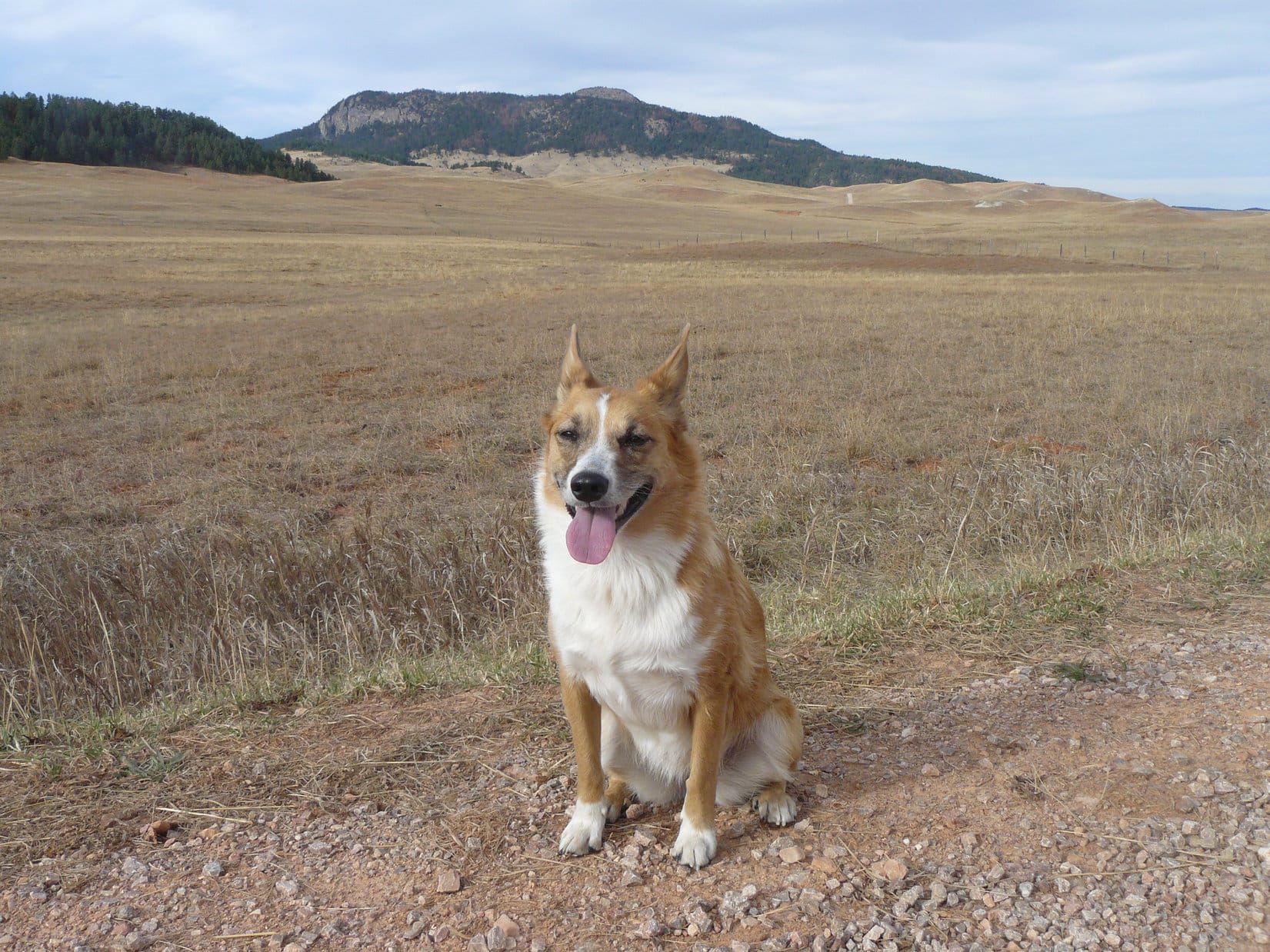
Black Hills, SD Expedition No. 103 – Peak 6733 (11-6-14)

Back on Black Hills, SD Expedition No. 102 on 10-29-14, Lupe had approached from the N to successfully climb St. Elmo Peak (6,458 ft.), but despite a valiant effort, she failed to reach Peak 6733.  Huge amounts of deadfall timber had choked the way.  It slowed SPHP down so much that Lupe ran out of daylight before reaching Peak 6733, although she did make it as far as Peak 6634 just 0.5 mile to the NNW.

On this beautiful warm morning in early November, SPHP had a new plan of attack for Lupe.  She would climb Sylvan Hill (7,000 ft.) and then follow the ridge around the S end of the valley to the W until she got to Peak 6733.  Trekking along this high ridge might be quite an adventure.  SPHP wasn’t certain how rugged it would be, but there could be some scenic and difficult to navigate large granite formations along the way.

Lupe didn’t get to find out.  At least 2 miles from where SPHP had intended to park the G6, Hwy 87/89 was barricaded.  The road was closed!  SPHP had never seen this part of Hwy 87/89 closed before, but it was now.  Well, what’s new?  Adventures often require flexible planning.  USFS Road No. 352 left Hwy 87/89 heading W right in front of the barricade.  Time to see where it would lead.

SPHP expected No. 352 would head SW toward Peak 6733, and it did, but not until after it went NW first.  About 0.75 mile from Hwy 87/89, No. 352 entered the NE end of the long valley between Sylvan Hill and Peak 6733, where the road divided.  USFS Road No. 352.1B went W.  A sign said “Private Drive”.

Lupe needed to go S, anyway, and No. 352 continued in that direction.  Just a little past the fork in the road, SPHP parked the G6 along No. 352 (9:14 AM, 47°F).  The immediately surrounding terrain was nice and level.  The forest had been thinned and cleaned up.  It looked almost like a park.  Lupe was less than 0.5 mile S of St. Elmo Peak.  She would start her trek to Peak 6733 from here.

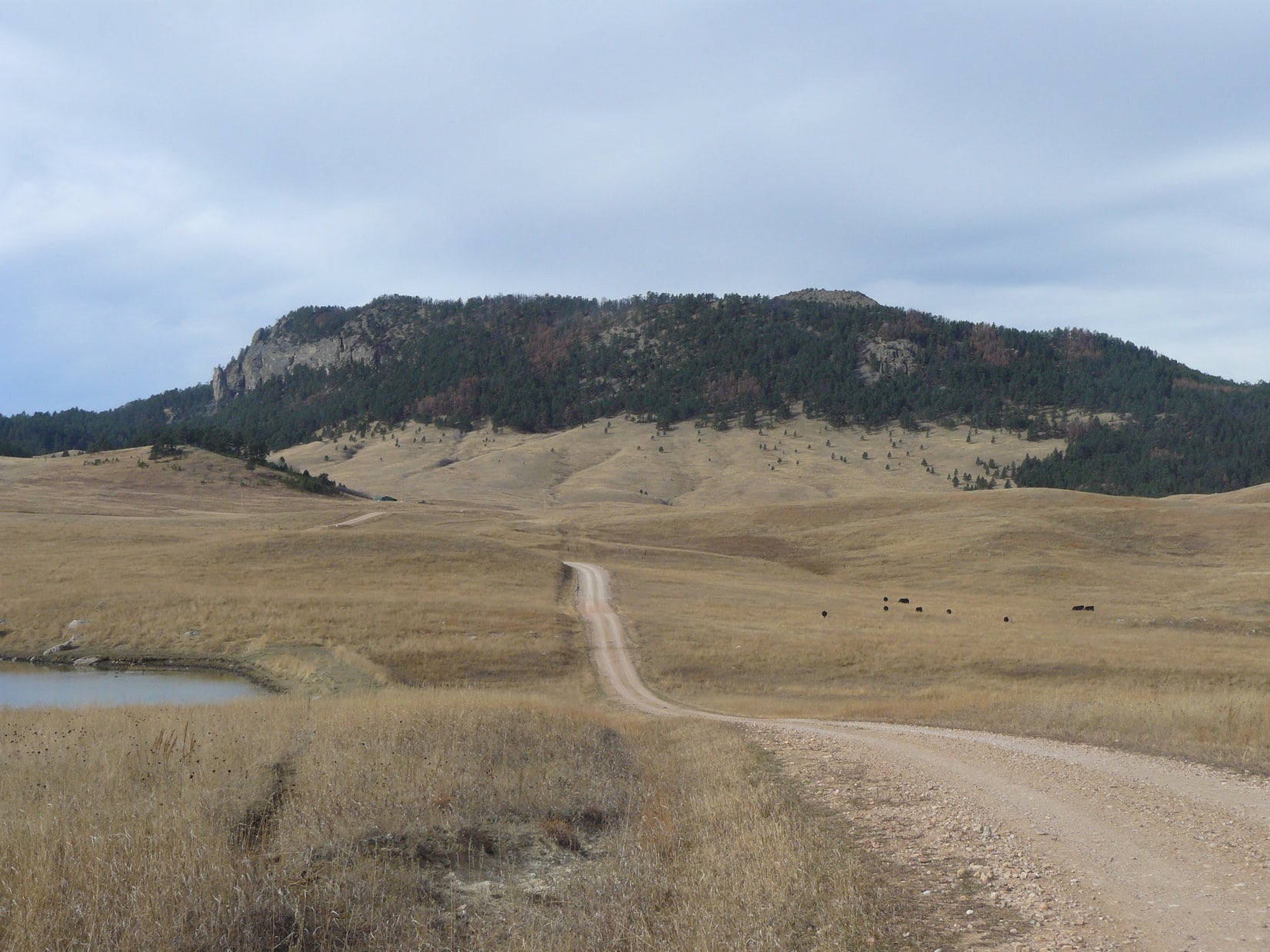
St. Elmo Peak from USFS Road No. 352. Photo looks N.

Lupe and SPHP headed S along No. 352.  With the change in starting points, SPHP had abandoned all thoughts of having Lupe climb Sylvan Hill, at least not before she climbed Peak 6733.  Instead, she was going to follow the road to the S end of the valley, get up on the ridge, and go directly for Peak 6733.

No. 352 gained elevation at a steady, moderate pace.  Within about 10 minutes, Lupe came to a green metal gate.  No vehicles could get past this point, so it was just as well that the G6 was parked back where it was.  Lupe and SPHP went around the gate and continued S, climbing steadily all the time.

The S end of the valley was less than 3 miles away.  SPHP expected the road would gain elevation nearly all the way, but when Lupe was a little over halfway there, suddenly No. 352 turned SW and started losing elevation rapidly.  The road went clear down to the bottom of the valley, where there was a junction with USFS Road No. 352.2A.  No. 352.2A headed back to the NW following a little stream down Bear Gulch.

The route No. 352.2A took looked grassy and inviting, but was headed the wrong way.  Lupe did go check out the stream for a big, cold drink before she was ready to leave this nice, secluded spot.

Happy Lupe cools down in the merry little stream flowing down Bear Gulch.

Lupe and SPHP got back on No. 352.  The valley narrowed a great deal just to the S, with towering rock formations on both sides.  The road led between them, following the creek upstream.

Once beyond the rock formations, Lupe was in the upper end of Bear Gulch.  Here the valley widened out considerably.  Much of the floor of the valley was a big grassy meadow.  This hidden area, protected on all sides by high forested ridges, seemed like it would be a popular place for deer to graze, but Lupe saw none.

No. 352 continued S along the E side of the big meadow.  Looking over at the big ridge to the W, SPHP saw a high point that was probably Peak 6634, the farthest point S Lupe had reached up on that ridge on Expedition No. 102.  It was hard to be certain, though.

Part of the big meadow in upper Bear Gulch. Peak 6634, the high point farthest S that Lupe reached along the ridge on Expedition No. 102, may be the one on the L.

Lupe came to a junction with USFS Road No. 352.2B.  It headed W across the meadow and disappeared into the forest.  Lupe and SPHP stayed on No. 352.  Soon another road, which was likely USFS Road No. 352.2D, branched off heading E.  Lupe was getting close to the S end of the valley.  She came to more little roads branching off in various directions.

SPHP was hoping to find USFS Road No. 352.2C, which should go SW before turning sharply to climb NNW up to a saddle on the ridge between Peak 6733 and Peak 6634.  When Lupe reached a road going SW, SPHP took it.  Soon unmarked roads were branching off of it in all directions.  Clearly, this wasn’t No. 352.2C.  The road continued SW deteriorating rapidly.  Before long, it disappeared entirely.  Lupe and SPHP were left climbing steeply straight up the ridge at the far SSW end of the valley.

Lupe reached the top of the ridge.  There would have been some great views to the N and S, but the forest was too thick to see much.  It looked like there might be a considerably higher point off to the SE hidden by the trees.  Another less prominent high point was close by to the WNW.  Peak 6733 had to be somewhere NW of there.

Down in the valley, No. 352 had been almost entirely free of any deadfall timber.  Up here on the high ridge, there was plenty of it.  Lupe explored while SPHP worked slowly along the ridgeline, picking a way through the deadfall.  There were frequent granite outcroppings along the way, and occasionally some pretty good views toward St. Elmo Peak or Sylvan Hill.

Lupe and SPHP went up and down following the ridgeline from one granite outcropping to the next.  Some of them were large enough to force SPHP around them.  Others were easily traversed.  Gradually the ridgeline curved to the NNW.  Peak 6733 came into view.  There was a considerable drop from the last high point Lupe went over down into the saddle leading to Peak 6733.  On the way down, Lupe found the only really clear look at Peak 6733 ahead.

Peak 6733 lies ahead! Photo looks NNW.
Lupe and SPHP climbed directly up this SSE spine of Peak 6733.

There was a lot of deadfall timber and several big granite outcroppings on the way up the SSE spine of Peak 6733, but Lupe and SPHP made it up the mountain.  At the very top was a large steep granite formation.  SPHP had to climb slowly and carefully up the last dozen feet, lift Lupe up on top, and then crawl up there, too.

The summit was surprising.  A narrow band of granite a few feet wide, and all about the same elevation, snaked around for 20 or 30 feet.  There were sheer, but not particularly high drop offs on both sides.  Still, they were plenty high enough so one really should take care not to fall off.  Lupe was fine up there, but SPHP crawled along the granite path looking for a more secure place.

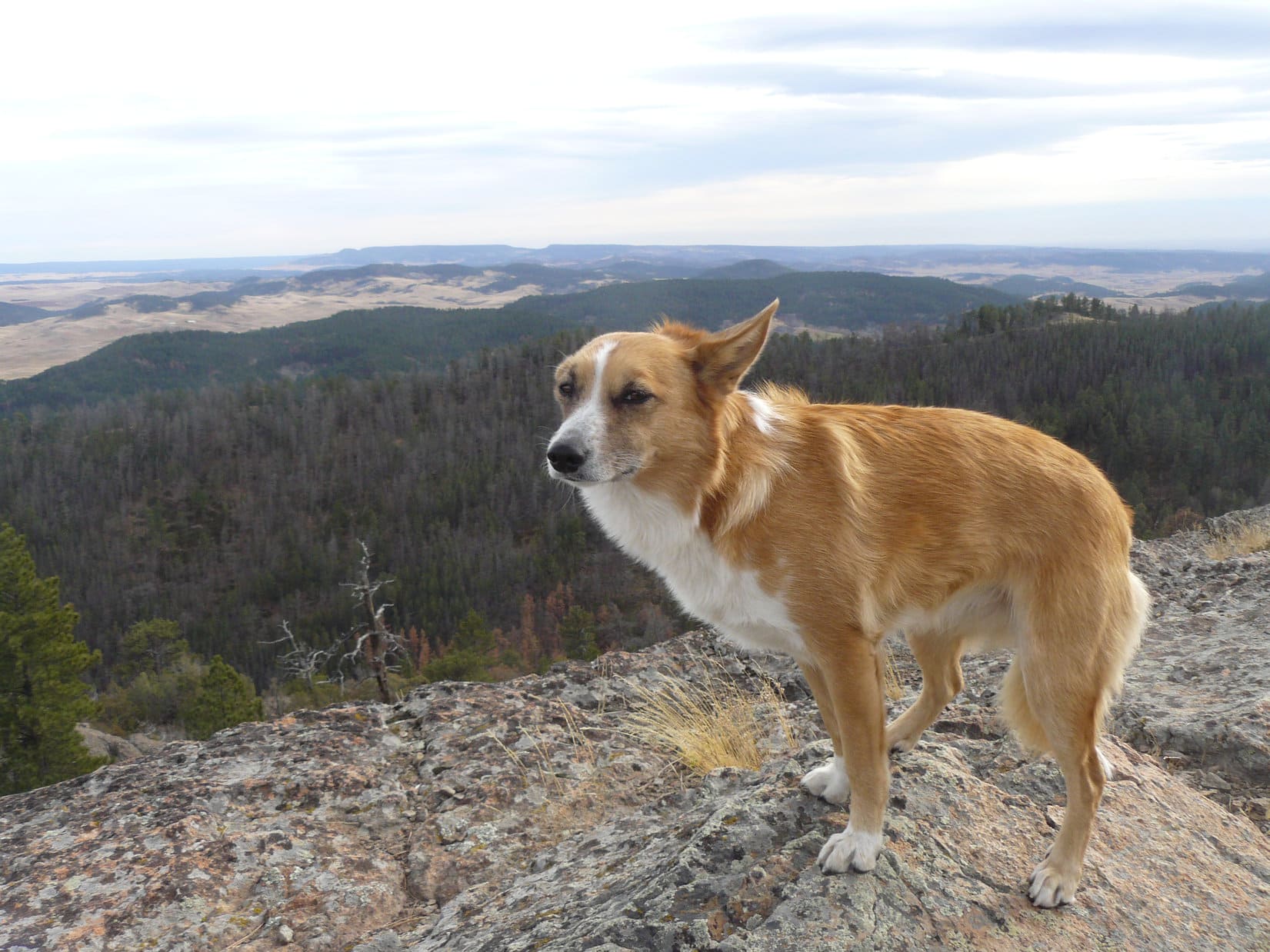
Lupe up on the narrow ridge of granite on top of Peak 6733. Photo looks WNW.
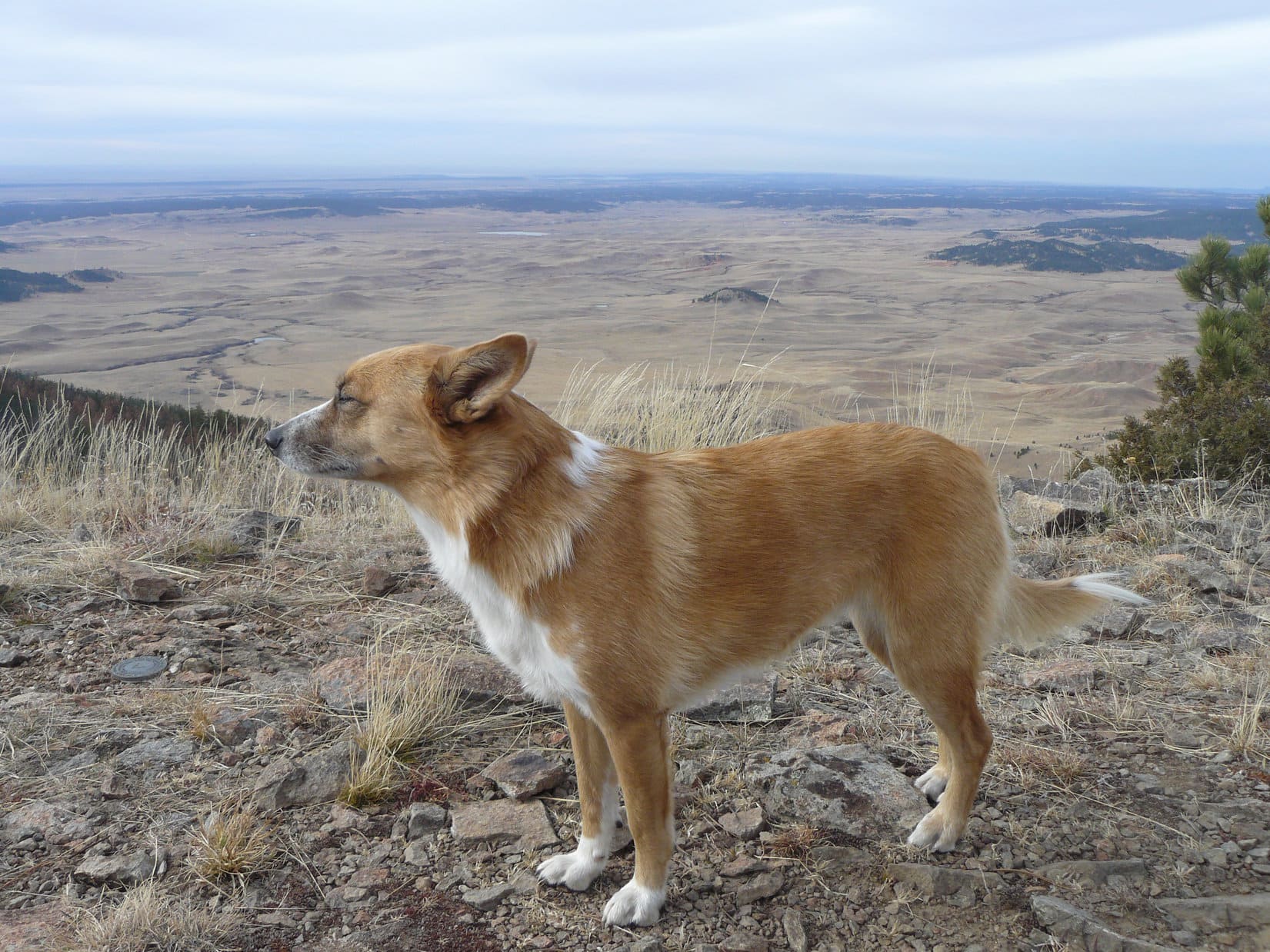
Lupe relaxes enjoying her Peak 6733 peakbagging success! Photo looks SW.

Somewhat surprisingly, SPHP only had to crawl along the granite for ten feet or so before it became evident that there was a small patch of level ground nearby to the NW.  It was almost as high as the summit.  SPHP scrambled over there, and got off the granite.

Now both Lupe and SPHP could relax and enjoy the views.  SPHP sat on the ground petting Lupe and taking a break.  Water and Taste of the Wild for Lupe.  Water and a golden apple for SPHP.  After eating, it was time for a few photos from seldom visited Peak 6733.

St. Elmo Peak (L) looks a lot smaller from Peak 6733! Photo looks N.
Sylvan Hill (Center) from Peak 6733. Photo looks NE.

Thunderhead Mountain (6,567 ft.), only 0.75 mile to the W, presented the most interesting view from Peak 6733.  Lupe had a great view of the rarely seen E side of the Crazy Horse memorial carving on Thunderhead Mountain.  The Crazy Horse carving has been in progress for decades, and is still far from being finished, but remains a popular tourist attraction in the Black Hills.

From Peak 6733, Lupe had this great view of the Crazy Horse carving on Thunderhead Mountain. The Crazy Horse memorial is a popular Black Hills tourist attraction, but most tourists normally see it from the other side. Photo looks W.

When it was time to leave Peak 6733, Lupe took a different route back than the way she had come up.  Lupe and SPHP worked around the SW and then W sides of the large granite outcropping at the top of the mountain.  The route was a real tangle of deadfall timber and thistles, but eventually Lupe regained the ridgeline N of Peak 6733.  She fought through more deadfall going N along the ridge all the way to USFS Road No. 352.2C at the saddle just S of Peak 6634.

Getting to No. 352.2C brought relief from all the deadfall timber.  Lupe and SPHP followed the road as it wound down into the upper end of Bear Gulch to the E.  It eventually led to USFS Road No. 352.2B, which brought Lupe to No. 352.

There were still a couple of hours left before sundown.  If Lupe was going to climb Sylvan Hill, now was the time to do so.  SPHP dithered.  Lupe had been on Sylvan Hill once before almost 6 months ago.  She climbed it from a different direction on Black Hills, SD Expedition No. 89 on 5-17-14.  The views were fantastic, but there had been a lot of deadfall timber to contend with along the summit ridge.

From upper Bear Gulch where Lupe was, it was over an 800 foot climb with no roads or trails.  Deadfall timber appeared to be strewn all over the steep ridge.  No doubt it would take a long time to reach the top, and another long time to get back down.  SPHP wanted to go, and Lupe was willing, but maybe it really wasn’t all that feasible even with several hours of daylight.  No sense getting stuck in the dark in a horrible tangled dead forest.

So instead of climbing Sylvan Hill, Lupe turned N on No. 352.  The road led her back between the big rock formations at the narrow part of the valley.  Lupe reached the merry creek bubbling along near USFS Road No. 352.2A.  It still looked inviting to explore the grassy valley along No. 352.2A.  So, Lupe did.  She eventually left No. 352.2A, and climbed up on some interesting granite formations where there was a nice view of St. Elmo Peak.

St. Elmo Peak from some granite formations down in Bear Gulch. Photo looks N.

Lupe’s explorations of Bear Gulch led her to USFS Road No. 352.1D, which in turn took her back to No. 352.  At 3:58 PM (55°F), Lupe was back at the G6.  Despite having taken a relatively easy return route, it was only 30 minutes until sundown.  Maybe that decision not to climb Sylvan Hill had been the right one!

It seemed a bit strange to be leaving for home before the sun was even down.  Lupe was happy enough, though.  She stood gazing intently out the windows of the G6 looking for deer, cows, horses or anything else it might be fun to bark at.  She had a great day climbing Peak 6733, and wasn’t disappointed on the way home either!

Note: Starting on USFS Road No. 352, the easiest and most direct up Peak 6733 would have been to take No. 352.2B heading W in upper Bear Gulch.  No. 352.2B leads to No. 352.2C.  Don’t follow No. 352.2C all the way NNW up onto the ridge.  Instead, at the very S end of No. 352.2C, leave the road and climb SW up to the saddle on the ridgeline.  From the saddle turn NNW, and finish the climb up Peak 6733.

Links:

Next Black Hills Expedition                       Prior Black Hills Expedition

Want more Lupe adventures?  Choose from Lupe’s Black Hills Expeditions Adventure Index or Master Adventure Index.  Or subscribe free to new Lupe adventures.

Black Hills, WY Expedition No. 104 – Inyan Kara Mountain (11-9-14)

Snow was in the forecast.  An approaching winter storm was supposed to hit tomorrow and dump half a foot of snow on the Black Hills.  The next 10 days weren’t expected to get above freezing.  Today was supposed to be nice, though, with highs in the 50’s.  Last chance, for a while at least, for Lupe to go on a Black Hills Expedition!

Lupe’s peakbagging goal for Expedition No. 104 was a rather unusual Black Hills mountain – Inyan Kara (6,360 ft.).  Inyan Kara is part of a line of forested ridges and hills in eastern Wyoming separated from the main body of the Black Hills in South Dakota by 5-10 miles of grasslands used mostly for ranching.  Like Devil’s Tower (5,112 ft.) in NE Wyoming and Bear Butte (4,433 ft.) near Sturgis, South Dakota, Inyan Kara was considered sacred by the Lakota Sioux.  General George Armstrong Custer is purported to have visited Inyan Kara on July 23, 1874.

Inyan Kara sits on roughly 2 square miles of the Black Hills National Forest completely surrounded by privately held ranch lands.  To even reach the national forest land, Lupe would need permission from the ranchers.  Lupe and SPHP had tried once before to get permission, way back on Black Hills Expedition No. 91 on 6-1-14, but had arrived at the ranch headquarters to find no one at home except the dog.

Lupe SE of Inyan Kara Mountain. Would she get permission from the local ranchers to cross their property to reach it?
Inyan Kara from the SE. Although Inyan Kara is on roughly 2 square miles of Black Hills National Forest, the mountain is surrounded by privately held ranchlands.
The road to the headquarters of Douglas and Sheila Hunter's ranch E of the mountain.
The road to the headquarters of Douglas and Sheila Hunter’s ranch E of the mountain.

This time Lupe and SPHP were in luck!  Lupe arrived at the headquarters of Douglas and Sheila Hunter’s ranch just E of Inyan Kara to find Mr. Hunter and a couple of helpers in his front yard busy loading a vehicle on a trailer.  Mr. Hunter’s dog, Bear, was very interested in meeting Lupe, but Lupe just growled.

Despite Lupe’s less than cordial reaction to Bear, Mr. Hunter kindly and readily granted Lupe and SPHP permission to cross his ranch to access Inyan Kara.  Mr. Hunter directed SPHP where to park the G6.  By 10:15 AM (50°F), Lupe and SPHP were on their way.

Lupe started out going W on a continuation of the dirt road that led to, and also went on by, the Hunter Ranch headquarters.  She passed some old outbuildings near a tiny, mucky creek, and soon afterward came to a junction with another road.  Lupe and SPHP turned N on this other road, but left it before long to start climbing through the fields directly toward SE-facing cliffs on Inyan Kara.  On the way up, Lupe and SPHP ducked under a fence, thereby leaving the Hunter ranch and entering the Black Hills National Forest.

Lupe and SPHP turned N to avoid the cliffs.  Lupe still angled slightly up the slope to gain elevation slowly, but steadily.  She was approaching the forest on the E side of Inyan Kara.  Once in the forest, Lupe and SPHP continued N working gradually up the ridge to the W.  When the top of the ridge became visible between the pines, Lupe and SPHP turned W and climbed directly up the steep slope to the crest of the ridge.  Lupe could now see the igneous summit of Inyan Kara to the WNW.

Lupe reaches the crest of the ridge. The summit of Inyan Kara is seen beyond her to the WNW.
The summit of Inyan Kara is basalt, an igneous rock. The basalt was forced up into overlaying sedimentary rocks as magma, which cooled and solidified. The sedimentary rocks at the top have since eroded away. Vertical columns can be seen in the basalt. A more famous and clearer example of similar geology can be found at Devil's Tower about 27 miles NW of Sundance, WY.
The summit of Inyan Kara is comprised of igneous rock.  Magma was forced up into overlaying sedimentary rock layers, but never erupted.  Instead, it cooled and solidified. The sedimentary rocks at the top have since eroded away. Vertical columns can be seen on the mountainside. A more famous and clearer example of similar geology can be found at Devil’s Tower, about 27 miles NW of Sundance, WY.

Lupe on the ESE ridge of Inyan Kara, 11-9-14Inyan Kara is an interesting mountain.  It is shaped rather like a distorted horseshoe, with the opening of the horseshoe NE of the summit and facing N.  A long ridge starts rising from the NE end of the horseshoe, and makes a big sweeping curve clear around to the E and then S of the summit, ultimately going clear over to the SW.  This long ridge gains elevation rapidly at first, but much more slowly as it progresses SW.

The S and SW portions of the sweeping ridge are quite high.  Close to the SW end, there is a significant saddle where some elevation must be lost going NE to approach a shorter, but higher ridge leading to the actual summit.  This N ridge is characterized by large igneous rock formations, but is easily climbed.  Several smaller saddles must be navigated while heading N along the summit ridge.

The N ridge angles NE shortly before reaching the top of Inyan Kara.  The summit and nearby areas form the NW end of the horseshoe.  Between the N and S ridges, a deep forested valley comprises the center of the horseshoe.

Lupe had reached the top of the lower sweeping ridge ESE of the summit.  The easiest way to reach the top of the mountain was to just follow the ridge as it swept around to the S and then SW.  From there, Lupe could traverse the saddle over to the higher N ridge and continue on to Inyan Kara’s summit.

The ridge was all forested and fairly narrow most of the way to the saddle, but it was never narrow enough to be a problem.  Deadfall timber sometimes partially blocked the way for SPHP.  It was only bad in one small area toward the SSW.  As Lupe progressed around the ridge, there were a few places with great views to the SE, S or SW.

Lupe on the S ridge of Inyan Kara. Photo looks SSE. The high ridge on the horizon seen above her head in this photo is the Sweetwater Mountain (6,440 ft.) high point.
Looking NNE at the Inyan Kara summit ridge from the lower S ridge.
Looking SSW from the S ridge.

Lupe and SPHP followed the S ridge around to the SW.  Lupe continued W far enough to make certain she had reached the highest part of the S ridge.  She then headed NE down into the saddle on her way to the N ridge leading up to the summit.  Lupe could have started NE down into the saddle a bit sooner, and she wouldn’t have lost quite as much elevation.  It still didn’t take her long to cross the broad forested saddle to reach the N ridge.

The most interesting part of Lupe’s climb up Inyan Kara started upon reaching the N ridge.  There were big rock formations.  The rocks were tan or pinkish orange, and had little steps or contours in them.  Lupe quickly climbed up to a high point at least as high as any spot along the S ridge.  From here, she could see the Inyan Kara summit off to the NNE.

The rest of the way to the summit was a bit tricky.  It involved some exploration and occasional back-tracking to find the easiest route.  In general, it proved best to stay to the NW side of the N ridge until getting quite close to the summit, since there were places that ended in cliffs to the SE.

The top of Inyan Kara is an open rocky ridge from which there are grand views in most directions.  Although it hadn’t been windy on the way up, there was a steady, cold wind out of the SW when Lupe reached the summit.  With the darkly overcast sky and stiff breeze, it was beginning to look like the forecast snow storm might well be on its way.  Lupe wasn’t going to get to enjoy the views for very long.

Lupe reaches the top of Inyan Kara! She didn't like the strong, cold breeze coming from behind her. The dark sky did look like the expected snow storm might be on its way. Photo looks SW.
Lupe reaches the top of Inyan Kara! She didn’t like the strong, cold breeze coming from behind her. The dark sky did look like the expected snow storm might be on its way. Photo looks SW.
Looking SSE from the Inyan Kara summit toward Sweetwater Mountain, the high ridge on the far horizon.
Looking NW from Inyan Kara. The circular USGS benchmark is on the ground in front of Lupe.

Right away, SPHP noticed a USGS benchmark out in the open just 10 or 12 feet E of the summit. SPHP was disappointed that it didn’t even say Inyan Kara on it.  While SPHP was looking at the USGS benchmark, Lupe was sniffing curiously around a big juniper bush just 8 feet N of the summit. Upon investigation, stuffed inside the bush SPHP found a broken Tupperware container inside a couple of Ziploc bags.  It was all held in place inside the bush by several rocks placed on top.

USGS benchmark on Inyan Kara.
Lupe not enjoying the wind by the juniper bush. The registry log was hidden inside this bush 8 feet N of the summit.

Inside the broken Tupperware container was a pen and notebook that serves as a registry log.  There were also other papers relating to a wedding, a funeral service and other events that had been held on top of Inyan Kara.  The registry went back to 2008 and contained quite a few names.  Some of the individuals had climbed Inyan Kara multiple times, with one claiming to have made 6 ascents.

SPHP would have liked to spend more time reading the registry, but the wind made reading for very long unpleasant.  It was difficult to hold the pages open and still without tearing them.  SPHP entered Lupe’s name in the registry log, before putting it all back together and stuffing everything securely in the bush.

Despite the wind, Lupe and SPHP lingered up on Inyan Kara for a while to enjoy the views.  Lupe had water and Taste of the Wild, and then huddled inside SPHP’s jacket to stay warm.  SPHP ate an apple and a big carrot.  For the Black Hills, the views were tremendous.  Far below and all around Inyan Kara was open ranch land, dotted here and there with forested hills and ridges.

On the N horizon, Lupe could see Missouri Buttes (5,374 ft.), Devil’s Tower, and Warren Peaks (6,650 ft.)Cement Ridge (6,674 ft.) was off to the NE.  Terry Peak (7,064 ft.) and the main body of the Black Hills were in view to the E.  Sweetwater Mountain was SSE.  Very far to the W are the Bighorn Mountains, which are easily seen from Inyan Kara on a clear day when the light is right.  However, SPHP could only barely make out one small portion of the southern Bighorns on this overcast day.

When it was time to go, Lupe and SPHP took the same route back along the N ridge going SSW and then down into the saddle area between the N and S ridges.  Instead of going on to retrace Lupe’s route along the S ridge, Lupe and SPHP ventured E down into the steep, deep forested valley between the ridges – the middle of the Inyan Kara horseshoe.

Lupe on her way down Inyan Kara. Photo looks N.

Lupe followed the valley all the way down to its exit onto the prairie NE of the Inyan Kara summit (the open end of the horseshoe).  There was no trail at all in the upper portion of the valley, and only a faint one in the lower part, until Lupe reached a jeep trail near a couple of old rusting water tanks near the valley’s N end.

The trek down through the central valley proved to take much more time than the S ridge route.  Except at the upper and lower ends, the valley is V-shaped nearly all the way.  Even the very bottom was steep, rough ground.  In places it was choked with deadfall timber killed by pine bark beetles, making the going very slow.

The valley did provide Lupe complete protection from the cold wind.  About the only other advantage was a tiny intermittent trickle of a stream where Lupe could get a drink.  Not much of an advantage when SPHP was porting water anyway.  While the valley was fun to explore once, Lupe and SPHP definitely recommend the S ridge route instead for the splendid views, shorter hike, and easier terrain!

Once Lupe emerged from Inyan Kara’s horseshoe, she followed the jeep trail around the E side of the mountain.  There were forests near the E ridge, but most of the time Lupe was out on the open range.  The jeep trail led right back to the Hunter ranch headquarters.

Lupe arrived at the G6 at 4:24 PM (51°F).  No one was around except Bear, who was standing on the front porch.  Bear whined when he saw Lupe.  Bear still wanted to play, but the tired Carolina Dog showed no interest, dashing the lonely ranch dog’s hopes.

Sunset leaving the Hunter ranch.

Inyan Kara Mountain is about 4 miles W of Hwy 585 in NE Wyoming between Sundance and Four Corners.  Turn W on County Road No. 198 about 15 miles S of Sundance.  Follow it about 1.5 miles W.  A sharp turn N on a dirt road eventually leads 2.5 miles NW to a fork in the road.  The Douglas and Sheila Hunter ranch headquarters is a short distance down the right fork.  Courtesy and respect for the landowner’s rights will go a long way toward securing permission to access Inyan Kara.

For more information on the interesting history of Inyan Kara, click here.

Links:

Next Black Hills Expedition                    Prior Black Hills Expedition

Black Hills, WY Expedition No. 257 – Inyan Kara (11-7-20)

Want more Lupe adventures?  Choose from Lupe’s Black Hills Expeditions Adventure Index or Master Adventure Index.  Or subscribe free to new Lupe adventures.