Black Hills, SD Expedition No. 71 – Coulsen Hughes Draw (11-30-13)

Start (9:30 AM, 29°F), 5 miles WSW of Deerfield Reservoir at the junction of USFS Roads No. 294 & 591 at the S end of Coulsen Hughes Draw.

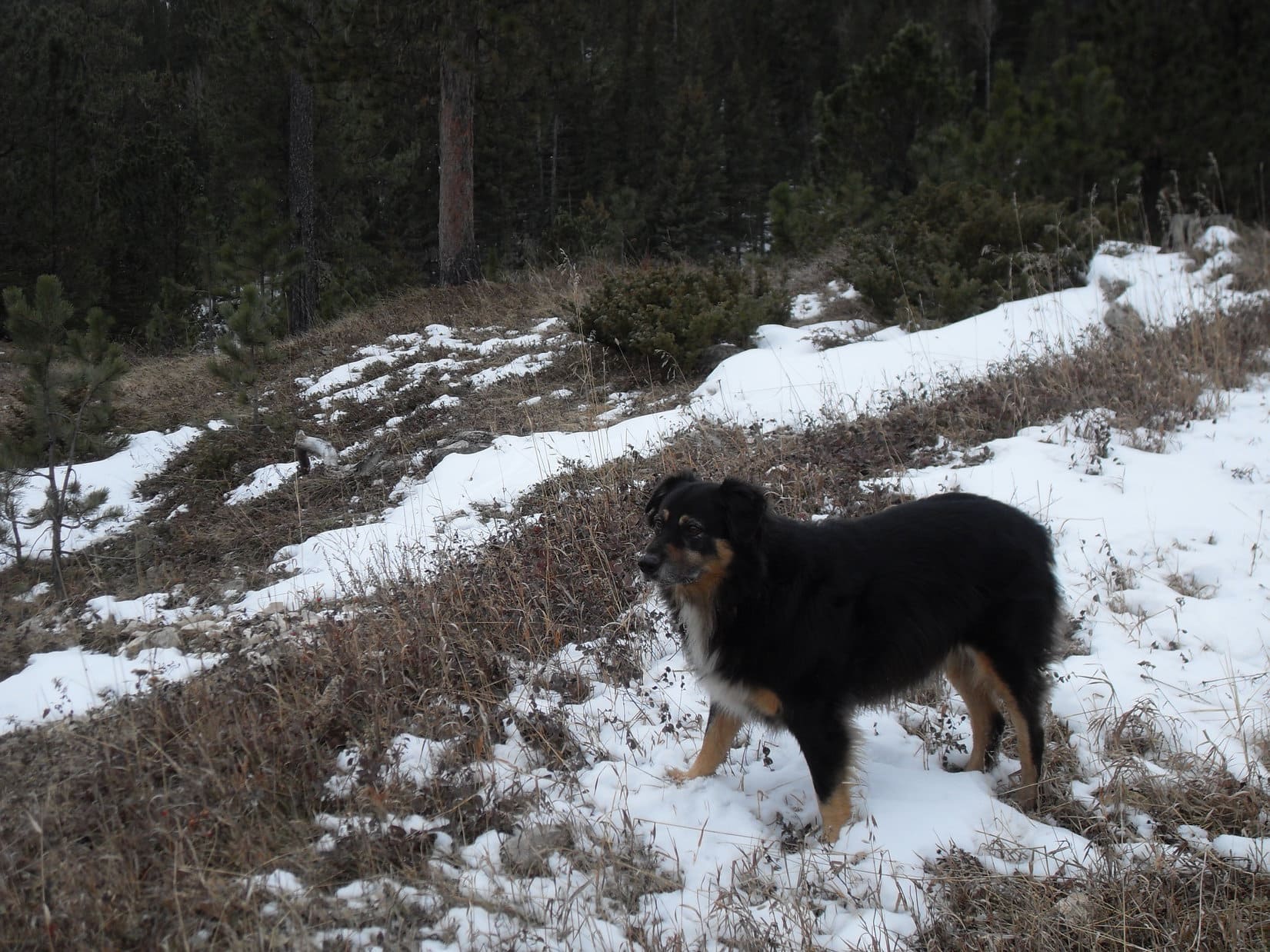
Gray skies and a sub-freezing temperature.  Patches of snow covered the dry, dead grass making the dark green of the forest appear even darker.  A quiet scene, forlorn and remote.  At the S end of Coulsen Hughes Draw, it felt like the start of winter.

Lupe wasn’t concerned.  She was ready to go exploring!  For her, it was the start of good times on Expedition No. 71.  Her friend, Sidney, was along, too.  This would be his 5th expedition with Lupe.  Big Sid was also enthusiastic about the prospect of a day spent roaming the hills, now that he understood he wasn’t being dog-napped.

Lupe along USFS Road No. 294 at the start of Expedition No. 71. Despite the chill air and gloomy gray sky, Lupe was looking forward to a romp up Coulsen Hughes Draw with her friend Sidney. Photo looks W.

Abandoning the G6, Lupe, Big Sid, and SPHP started N up Coulsen Hughes Draw on USFS Road No. 591.  Coulsen Hughes Draw is a moderately wide, shallow, grassy valley between two pine forested ridges.  Snow covered much of the ground near the trees on the W side of the valley, but the road was close to the E side and largely snow-free.

On Expedition No. 68, Lupe and Sidney had reached the N end of Coulsen Hughes Draw from a different direction.  It was about as far as they had gotten that time.  SPHP’s old Black Hills USFS map showed that Crows Nest Peak (7,048 ft.) was only 2 or 3 miles farther NW from there.  Lupe had never been to Crow’s Nest Peak.  Maybe Lupe and Big Sid could find and climb it today, after exploring the length of Coulsen Hughes Draw?

Loop and Big Sid had only been running around sniffing for 15 or 20 minutes, when suddenly a vehicle could be heard coming down the draw.  A pickup truck appeared with 3 guys in it dressed in camouflage and bright orange (the one defeating the other).  SPHP chatted with them for a few minutes.  They were elk hunters, but had seen nothing.  Had SPHP?  Nope.

Truth was, even if SPHP had, the hunters wouldn’t have gotten much help.  Lupe and SPHP are more on the side of the elk.

The trek up Coulsen Hughes Draw was an easy, scenic, gentle climb.  Lupe and Big Sid had a great time roaming at will.

Looking SSE back down Coulsen Hughes Draw.
Lupe on USFS Road No. 591 as it rounds a small hillside. Photo looks W.
Sidney near the forest at the edge of the valley. Looks like he’s spotted something!
A typical scene looking NW up Coulsen Hughes Draw. It was a pretty place for the dogs to run around. After the hunters went by early on, Lupe and Big Sid saw no one other than SPHP the rest of the day.
Lupe comes running back after an exploratory foray up into the forest.

As Lupe and Sidney traveled up the draw, they passed by several stock ponds.  The valley was gradually becoming snowier.  The ponds were all frozen.  By the time they’d gone 2.5 miles, Loop and Big Sid were getting close to the N end of Coulsen Hughes Draw.  One more stock pond was up ahead.  Beyond it, Coulsen Hughes Draw split in two.

The valley was wider and snowier by the time Lupe and Sidney reached the upper end of Coulsen Hughes Draw. The last stock pond is up ahead hidden behind the earthen dam seen a little R of Center. Here the draw split in two. Beyond the stock pond, Lupe and Sidney took the branch seen on the L. Photo looks NW.

Even before Lupe and Sidney reached this final stock pond, SPHP recognized the larger branch of the draw going N (R) as being the place Lupe and Big Sid had made it to on Expedition No. 68 before starting back for the G6.  The smaller branch of the draw going NNW (L) looked more intriguing.  This branch was totally new to Lupe, and led more directly toward Crows Nest Peak.

USFS Road No. 591 went up the larger N branch.  Lupe and company left the road to explore the smaller NNW branch of the draw.  An easy 0.5 mile trek brought Lupe to another dirt road.  This had to be USFS Road No. 157, although the only sign present was an old wooden one that didn’t mention No. 157.  It said only “Coulsen Hughes Draw” and pointed back the way Lupe had just come.

At this point, Lupe and Sidney were at least halfway to Crows Nest Peak, which was still another 2.5 or 3 miles to the NNW.  However, SPHP’s USFS map showed no roads at all leading any farther in that direction.  Going NE on No. 157 would only take Lupe away from Crows Nest Peak.  Going W, the road disappeared into a dense forest.  It would eventually lead to Miller and Procunier Springs, which were at least a little closer to Crows Nest Peak.

The last day of November is short.  Time would be an issue.  SPHP decided on a more direct route.  Lupe and Big Sid crossed No. 157, covered the last of the open ground at the end of Coulsen Hughes Draw, and plunged into the forest traveling NNW straight for still unseen Crows Nest Peak.

There was considerably more snow in the forest than on the open ground in Coulsen Hughes Draw, but it wasn’t too bad.  Before long, the terrain leveled off and looked like it was about to start descending.  SPHP thought it best for Lupe to stay high.  Off to the W was a higher ridge, so Lupe, Big Sid, and SPHP turned that way to gain as much elevation as possible.

The top of the ridge was all forested with no views in any direction.  Lupe and Sidney turned N again and continued onward, picking a way forward through the snow, low juniper bushes, and scattered deadfall timber.  Although the terrain went up and down a little, SPHP thought Lupe was still gaining net elevation, and hoped to get a glimpse of even higher ground toward Crows Nest Peak at some point.

Lupe started coming to little-used logging roads.  Since travel was easier on the roads, Loop and Big Sid followed them for short stretches when they seemed to be going the right direction.  Along one of these roads, suddenly Sidney was staring straight ahead.  Movement in the trees!  Sidney had spotted 3 of Lupe’s “giant deers”!  Lupe hadn’t seen them yet, but the elk had seen Sidney.  They were already disappearing into the forest.

The giant deers made another appearance 10 or 15 minutes later.  This time both Sidney and Lupe saw them and took off after them.  The elk had a huge lead, however.  Within a couple minutes, both Loop and Sid gave up and returned, the elk long gone.

The logging road Lupe was on ended in the forest.  Although it seemed like Lupe was quite high, no views existed in any direction.  SPHP led on through the forest trying to head NNW while staying on the highest ground possible.  Presently, open ground could be see ahead between the trees.  Before reaching it, Lupe came to another logging road.  The logging road took her to the edge of a long, wide field.

After leaving Coulsen Hughes Draw and USFS Road No. 157 behind, SPHP tried to lead Lupe and Sidney through the forest NNW toward Crow’s Nest Peak. Lupe ultimately arrived at this long, wide field. Photo looks S(?)
Intrepid American Dingo explorer Lupe on her Expedition No. 71 search for Crow’s Nest Peak.
Exploring is fun!

The new road divided almost immediately upon entering the field.  Lupe had her choice of going S while gradually losing elevation, or going NW gradually gaining elevation.

Lupe and Sidney followed the road going NW up a hill.  Soon the land leveled out on top.  A few inches of snow were on the ground.  Another group of 4 or 5 giant deers disappeared NE into the forest, but this time only SPHP saw them.

Near a stand of aspens, the road divided again.  Lupe had her choice of going W or N.  A marker was at the intersection.  SPHP eagerly anticipated this possible clue to how close Lupe was now to Crows Nest Peak.

At the top of the hill, the road leveled out and passed by this stand of aspens. Beyond the aspens, the road divided again. Approaching the intersection SPHP could see a marker ahead, and looked forward to this possible clue as to how close Lupe and Big Sid were to Crows Nest Peak. Photo looks NW.

What the marker said came as a complete shock.  No. 157!  The same road Lupe and Sidney had left at the N end of Coulsen Hughes Draw!  How was that possible?  Lupe and Sidney scarfed up Taste of the Wild, taking a lunch break while SPHP sat on a log staring dumbfounded at the USFS map while pondering the implication of this news.

The map didn’t show No. 157 coming anywhere near Crow’s Nest Peak.  Of course, the USFS map wasn’t very detailed.  It was possible unshown minor side roads branching off No. 157 did.  However, side roads would normally have an additional designation after the “157”, and this marker didn’t.  Hmmm.  SPHP shared a cheese stick with Looper and Sidney.  The cheese was much appreciated.

The most likely conclusion SPHP could come up with was that Lupe and company had not been going N, but W.  SPHP must have become disoriented somewhere along the way.  With no landmarks or views, and the sun hidden all day by clouds, it could have easily happened.  Oh, well.  Now what?  SPHP was no longer certain where Lupe was, or which direction was which.

Snack time was over!  Lupe was still going to find Crow’s Nest Peak!  SPHP led Loop and Big Sid along the road that supposedly went W.  That lasted only a couple of minutes.  Peering through the forest N of the road, it looked like the terrain was about to start losing elevation in that direction.  Maybe there would be a view from the hillside?  Lupe, Sidney and SPHP abandoned the road.  Back into the forest!  Onward!

Soon a view did appear.  A noticeably higher ridge could be seen farther N.  Crow’s Nest Peak?  It looked like it was still 2 miles away, about right if Lupe had been going W earlier instead of N.  Even though it meant losing elevation, SPHP decided to head straight for that ridge.

Lupe and Sidney were still having a great time!  They enjoyed the march down the forested hillside.  Lupe came to two large water tanks.  Water was pouring into one of them from a pipe.  A small overflow stream trickled down the hillside below the water tanks forming an ice flow.

Lupe followed the ice flow as far as it went, proceeding down into a valley.  As soon as she got to the bottom, she regained lost elevation climbing up the other side.  At the top she made a turn to the W, and once again emerged from the forest at the edge of another long, wide field.

About this time, the cloud cover started breaking up.  It became possible to discern the position of the sun.  SPHP thought Lupe had been going NW.  The sun said she had been going SW, or maybe even straight S.  Crazy!  Simply crazy!  One thing was certain, though.  There’s no arguing with the sun.

A period of wandering through big fields and pastures began.  Lupe started off heading first NW then N according to the sun, though it all felt wrong to SPHP.  As near as SPHP could figure out, Loop was somewhere N of Miller and Procunier Springs.  If true, Crow’s Nest Peak (7,048 ft.) was still as much as 2 miles N.  However, from none of this territory could Lupe see the high ridge she had seen earlier.

The Carolina Dog came to a number of roads (all unmarked) and fences.  After traveling N and circumnavigating a wooded area in the middle of an enormous field, Lupe made a foray into a forest even farther N.  Traveling E near the forest’s edge, she came to another long stretch of open land extending NE from the enormous field.  This area looked promising, but the sun was now clearly past its zenith.  Lupe retreated S across the enormous field again.

Near the S edge of the field, Lupe and Big Sid found another road.  This road was marked No. 157.2C.  A short journey E on it led to a fallen log, suitable as a rest area.  Lupe and Sidney finished off the Taste of the Wild.  SPHP shared another cheese stick with them, while consulting the map.

Looking N back across the enormous field. SPHP remains convinced that Lupe and Sidney had come within almost a mile of Crow’s Nest Peak while on the far side.
Sidney on USFS Road No. 157.2C. Photo looks ESE.
Lupe relaxes in the sun on dry ground next to the rest spot log.
Big Sid relaxes, too, wondering what’s next?
Say, SPHP, I realize this is just crazy talk, but have you ever considered investing in a GPS device, or even just a decent compass? Maybe then we could actually get to where we’re going!
I second that motion! Also, how about putting some more supplies in that pack? A bite of cheese stick every 3 hours just ain’t cutting it for me!

The map still didn’t show USFS Road No. 157.2C.  It wasn’t any more enlightening than it had been earlier.  Sigh.

Turning S and crossing the enormous field again had been an admission of defeat as far as reaching Crow’s Nest Peak was concerned.  It wasn’t going to happen.  Not today, anyway.  Way out in the western high country of the Black Hills on the last day of November with the sun starting to slide toward the horizon, the only thing that made sense was to figure out where Lupe was, and begin the journey back to the G6.

SPHP decided Lupe should head W on No. 157.2C staying near the big fields.  Sooner or later, the road would lead back to No. 157, probably right to that intersection near the grove of aspens where Loop and Sidney had taken their first rest break.

Even if one measly bite of cheese stick was inadequate, the second rest break was over.  Onward!  Big Sid seemed a little tired, but Lupe was still full of energy as they headed W on No. 157.2C.

A last look NNW across the enormous field. Somewhere out there, not too far away, was Crow’s Nest Peak. Lupe and Sidney weren’t going to reach it today.
Time to start for home! Big Sid heads W on USFS Road No. 157.2C, seemingly a bit tired. Lupe still had energy to bound around. Here she’s standing at the edge of the forest. Photo looks WSW.
Lupe races back to SPHP while Big Sid pauses to wait patiently for the signal to continue.

No. 157.2C went W only far enough to sweep around the W end of the forested hill to the S.  Upon reaching the other side, it wound E and SE all the way back to the intersection with No. 157 near the grove of aspens.  At least that had worked!

It would have been easy to simply follow No. 157 all the way back to Coulsen Hughes Draw, but now that SPHP was certain where Lupe was again, there wasn’t as much urgency as before.  Lupe and company took a snowy road heading S from the aspen grove.  Lupe could explore a different valley W of Coulsen Hughes Draw this way.

This route was beautiful and a pleasant trek.  Lupe found a squirrel to bark at.  Her excitement revived Sidney’s spirits as he got into the act, too.  Another adventure was ahead.  Lupe and Sidney saw 6 or 7 giant deers, the biggest herd yet!  Oddly, they had been congregated near a large skeleton.  As the live elk ran off, Lupe and Big Sid carefully investigated this most interesting find.

Lupe and Big Sid cautiously sniff an old skeleton. For some odd reason, 6 or 7 live elk had been congregated near it.

Lupe reached USFS Road No. 294 again a couple miles WNW of where the G6 was parked.  SPHP was pretty certain she had come down the Dowell Spring drainage after passing E of Dowell Spring itself.

Instead of staying on No. 294 the rest of the way, Lupe and Sidney traveled through the grassy valley just to the S of it.  More to sniff!  More to explore!  Although the sun was still shining on the ridges, all was in shadow down here.

After going a mile E, another road left No. 294 going first SW, but curving SE as it went up a side valley.  SPHP was seized with a desire to see the sunset.  Lupe and Sidney started up this side valley, eventually climbing the W side of it.  Everyone reached the top of the ridge to the W, but there was no view due to the thick forest.  All that could be seen was a final, filtered, glimmering between the trees.

With the last of the sunlight gone, a feeling of solitude descended.  The sky was clear.  No colorful sunset could develop.  Still, quiet, remote.  That was this place, this moment.

Still, quiet, remote, cold and dark was coming.  Better get going!

Sidney was done.  Filled with joy when he finally saw the G6, he trotted ahead of Lupe and SPHP as fast as tired paws would take him.  He stood waiting for SPHP to arrive to open the door.  Big Sid jumped in without the slightest hesitation the instant the door opened.  Home, James!

It was nearly dark, but Lupe wasn’t in such a hurry.  She was used to long days exploring.  The Carolina Dog paused for several minutes, still sniffing the light breeze.  Maybe she knew winter really was coming, and she wouldn’t be back in the high western hills again for a long time.

Lupe hadn’t made it to Crow’s Nest Peak, but Coulsen Hughes Draw had still been an adventure.  Together with Big Sid, the Carolina Dog had out-hunted the hunters, and seen the giant deers.  No one was shot dead or wounded as a result.  Everyone, including the giant deers, would live to see more adventures in the days to come.  End (4:44 PM, 27°F)

Links:

Next Black Hills Expedition          Prior Black Hills Expedition

Want more Lupe adventures?  Check out her Black Hills, SD & WY Expeditions Adventure Index, Master Adventure Index, or subscribe free to new Lupe adventures!

Black Hills, SD Expedition No. 226 – Gap Lode Peak & Black Elk Peak (4-22-18)

Start – Palmer Creek trailhead W of Mount Rushmore, 7:38 AM, 41°F

Spring had sprung yet again!  Maybe this time it would stick?  A certain Carolina Dog, sick and tired of winter’s repeated attempts to reassert control, was more than ready.  She arrived bright and early at the Palmer Creek trailhead with an ambitious day of peakbagging planned in the Black Elk Wilderness.

Black Elk Peak (7,131 ft.) from the Palmer Creek trailhead. Photo looks SE.

The first mountain Lupe was going for was Gap Lode Peak (6,560 ft.).  As soon as SPHP was ready, the eager American Dingo was underway.  Following the spur trail from the trailhead, she crossed the Palmer Creek valley.  A bridge got her across tiny Palmer Creek.  0.25 mile later, Lupe arrived at the junction with Lost Cabin Trail No. 2.

In the Palmer Creek valley setting out on the spur trail. Photo looks SW.
Loop reaches the junction with Lost Cabin Trail No. 2. Photo looks S.

At the trail junction Lupe went R.  She soon passed a registration station for entry into the Black Elk Wilderness.  SPHP registered, and Loopster went on.

Lost Cabin Trail No. 2 wound SW up a forested slope.  After Lupe had gone a mile or so, she reached a level area.  A massive granite formation extended a few hundred feet N from the trail.  The exposed granite would provide views in several directions.  Ready for a break, Lupe and SPHP went out onto the granite to look around.

Quite a number of peaks Lupe had been to before were in sight.

Loop out on the granite with a view of St. Elmo Peak (6,458 ft.) (L). Photo looks WSW.
The double peaked ridge in the background is Zimmer Ridge (6,600 ft.). The high point at Center is the true summit. Photo looks WNW.
Many smaller peaks Lupe has been to are seen here. The highest, on the horizon a little to the L of Loop, is Five Points (6,221 ft.). Photo looks N.

Looking SW, a big knob of rock capped the upper end of a sloping ridge.  That knob of rock was the E high point of Gap Lode Peak.  Loop still had a long way to go to get up there.

The knob of rock (L of Center) at the upper end of the ridge beyond Lupe is the E high point of Gap Lode Peak. Photo looks SW.

Lupe returned to Lost Cabin Trail No. 2.  She hadn’t encountered much snow lower down, but as the Carolina Dog continued gaining elevation, more and more snow appeared.  Soon the trail had a couple of feet of snow on it, slowing SPHP down considerably.

Lupe liked the snow.

The snowy trail switchbacked up a long slope.  Pine bark beetles killed a great many trees in this region years ago.  Enough dead trees have fallen over to open up the views to some extent.  Lupe had tree broken views to the N most of the way.

After a tedious climb, Lupe and SPHP reached a sunny, snow-free pass W of High Point 6482.  This pass was the start of the Black Elk Wilderness.

After a long climb, Lupe reaches a snow-free pass W of High Point 6482 on the topo map. This was the start of the Black Elk Wilderness. Photo looks S.

The pass was as close to Gap Lode Peak as Lost Cabin Trail No. 2 was going to get.  Lupe had been to the mountain once before.  Even though Gap Lode Peak is only a little over 0.25 mile WSW of the pass, she knew that getting there wasn’t going to be easy.

The terrain between Gap Lode Peak and Lost Cabin Trail No. 2 is rough, but that wasn’t the big problem.  Large amounts of deadfall timber were the real issue.  The deadfall had been a significant problem the last time Lupe had been here.  The situation hadn’t improved at all over the last few years.  If anything, the deadfall was even worse than before.

As soon as Lupe left the trail, she faced large quantities of deadfall timber. She could travel fairly quickly through it, but the deadfall slowed SPHP down tremendously. Photo looks W.

Several large granite formations were W of the trail.  Lupe went to them, climbing partway up to get a view.  The E high point of Gap Lode Peak (6,560 ft.) was much closer now.

From rocks W of Lost Cabin Trail No. 2, Lupe gets her first close up view of Gap Lode Peak. Photo looks SW.
Gap Lode Peak may not be very far away, but getting there is a pain. All the deadfall makes it an ordeal. It’s an impressive peak, though, for the Black Hills. Photo looks SW.
On her way to Gap Lode Peak, Lupe would travel down past Skinny Rock seen at lower R. She then continued to the far ridge coming up near the R edge. This was a mistake. It would have been better to go L up the snowy slope to reach the ridgeline higher up like Lupe did the first time she came here. Photo looks SW.

To get any closer, Lupe had to descend into a valley chock full of deadfall timber.  This valley had a N exposure, so 2 or 3 feet of snow was present as well.  Progress became dreadfully slow.

Deadfall drove all route decisions.  Lupe was constantly faced with choices.  She had lots of options – bad routes, worse routes, terrible routes, and ghastly routes.  SPHP tried to encourage her toward a nice selection of bad routes.  The goal was to reach the lower end of a wall of rock ahead.

Crossing the obstacle laden valley involved no great distance, but chewed up plenty of time.  Lupe did work her way through, though, and arrived at a tall, thin rock.  She had passed by this same rock the first time she’d gone to Gap Lode Peak, too.  It stood at the far N end of the wall of rock, and marked the point where Lupe could get past it.  SPHP decided this landmark deserved a special name.

Being an endlessly creative and imaginative person, SPHP easily came up with the splendid name “Skinny Rock”.

“Skinny Rock”, SPHP? Oh, yeah, that’s sheer genius. Hope you didn’t strain your brain.

In the immediate vicinity of Skinny Rock, the deadfall wasn’t bad at all.  As, Lupe continued on, however, she was soon back in the thick of it.  Ahead to the W was Gap Lode Peak’s NE ridge.  She pushed on toward it.

The first time Lupe had come to Gap Lode Peak, she had climbed this NE ridge reaching the ridgeline high on the mountain.  This had worked well.  SPHP wondered, though, if the ascent might not be even easier if Lupe could get up on the ridgeline at a lower point?  The American Dingo set out to find out.

Struggling through deadfall and snow, Lupe managed to get close to the ridgeline.  A continuous vertical wall of rock 15 to 30 feet high offered no obvious way to the top.  A search along the base of the wall, revealed a place where it might be possible to scramble up.

Lupe had no problem doing just that without the slightest assistance from SPHP.  From the ridgeline, she had a great view of the territory she’d just come through.  She could also see that this wasn’t going to work.  She was on a narrow, uneven wall of granite with drop offs on both sides.

Loopster reaches the top of a narrow spine of granite along Gap Lode Peak’s NE ridge. Unfortunately, this was a bad place to come up. Photo looks SSW.
Lupe did have a good view of the territory she had just come through. High Point 6482 is on the L. The closer, lower rock formation on the L is where Lupe had the good view of Gap Lode Peak. Skinny Rock is visible lower down L of Center. Black Elk Peak is in the distance at Center. Photo looks E.

After a brief, failed attempt to make progress along this granite spine, SPHP gave up.  Loopster retreated off the wall, and began heading SSW near its base.  After going only a few hundred feet the wall ended.  Loop returned to the ridgeline.

The deadfall on the other side of the ridge was bad, but the slope wasn’t quite as steep.  This area had a N exposure, so there was plenty of snow.  Lupe stayed on the W side of the ridge, leaping over or going under the deadfall as appropriate.  SPHP struggled onward as well.  Both headed SSW steadily climbing higher.

The terrain began to level out.  Gap Lode Peak has two main high points, an E one and a W one, at nearly the same elevation.  Lupe had made it to the deadfall strewn saddle between them.  The topo map shows a tiny area within a 6,560 ft. contour at the W high point, which according to the map makes the W high point the true summit, since the E high point doesn’t have a 6,560 ft. contour at all.

SPHP had a different opinion.  During Loop’s first ascent of Gap Lode Peak she had visited both high points.   SPHP came away believing that the E high point was actually the true summit, though it was admittedly hard to tell for sure.  Nevertheless, the Carolina Dog once again headed toward the W high point first.  When she got close, it was time to take a break.  Loop had an excellent view of Sylvan Peak (7,000 ft.) from a rock near her resting place.

Lupe near the W high point. Sylvan Peak is the high ridge at Center. Closer by on the L is a SW granite arm of Gap Lode Peak that Lupe would visit after the W high point. Photo looks SW.

Lupe curled up in the shade.  She had water and Taste of the Wild.  SPHP munched an apple.  All the snow, deadfall, and rugged terrain on the way here took a few minutes to recover from.

When the American Dingo was ready, she went with SPHP to Gap Lode Peak’s W summit.  She got up on one of the highest rocks.  According to the map, she had reached the true summit of Gap Lode Peak (6,560 ft.).

At the W high point of Gap Lode Peak. This is the true summit according to the topo map. The E high point is seen nearby on the L. Black Elk Peak is beyond Loop on the R. Photo looks E.

The best views were toward the E and SE into the heart of the Black Elk Wilderness.  This region contains some of the most rugged territory in the Black Hills.  Huge granite formations of Black Elk Peak (7,131 ft.), Peak 6920 and Little Devil’s Tower (6,960 ft.) dominated the landscape.

Black Elk Peak, the highest mountain in South Dakota is beyond Lupe. Large granite formations on the R are part of Peak 6920. Photo looks E.
Peak 6920. SPHP isn’t certain if the summit is in view here or not. Photo looks SE with help from the telephoto lens.
Lupe would soon be going to the E summit of Gap Lode Peak (Center). The route up is from the L. Photo looks E with help from the telephoto lens.

After visiting the W summit, Lupe did not go directly to the E high point.  Instead she went SW out onto a massive granite arm of the mountain.  Deadfall made even this short jaunt time consuming.  Once Loop made it to the exposed granite, though, it was easy to move around and enjoy some pretty spectacular Black Hills views.

At the end of the massive SW arm of Gap Lode Peak. The E high point is in view on the L. Elkhorn Mountain is the nearest of the two distant peaks on the R. Photo looks NE.
Black Elk Peak is beyond Lupe. Peak 6920 is on the R. Photo looks E.
Black Elk Peak from the SW arm of Gap Lode Peak. Photo looks E with help from the telephoto lens.
Bear Mountain (7,166 ft.) is part of the high ridge in the distance L of Center. Saint Elmo Peak is much closer on the R. Photo looks W.

Lupe finished her tour of Gap Lode Peak with a visit to the E high point.  Deadfall once again made the trek difficult despite the relatively short distance.

Lupe nearing the E high point. Photo looks ESE.

Actually getting up on top of the E high point involved a short scramble.  Lupe climbed up unassisted, although the scramble was right on the edge of what she could manage on her own.  Looper did make it to the top, though.  She could now claim her second successful Gap Lode Peak ascent, having once again visited both the E and W summits.

The views from here, of course, were for the most part quite similar to what Looper had already seen from the W high point.

Lupe up on one of the highest rocks at Gap Lode Peak’s E summit. Sylvan Peak is in the distance on the R. Photo looks SSW.
Black Elk Peak (L), Peak 6920 (Center) and Little Devil’s Tower (Lupe’s ear on the R points to it) are all in view. Photo looks ESE.
Looper atop the E high point of Gap Lode Peak. SPHP believes this is the true summit despite what the topo map shows. Photo looks SE.
So I’ve done it, right, SPHP? Made it to both the E & W high points, so now I can claim another successful Gap Lode Peak ascent. …. That’s right, Looper! Great work, puppy! Photo looks SE.

Neither the E nor W summits of Gap Lode Peak are roomy, but there was a small level area up here where Loop could hide in the shade next to the highest rocks.  The Carolina Dog decided she wanted to do that while SPHP admired the views.

Although the topo map shows that the W high point is the true summit, SPHP once again came to the conclusion that the E high point is actually higher.  Admittedly, it’s a close call, but that’s how it appeared.

Sylvan Peak (Center) and the W summit of Gap Lode Peak (R). Photo looks SW.
Bear Mountain (distant ridge at Center) and Saint Elmo Peak (R). The saddle between Gap Lode Peak’s E & W high points is in the foreground. Photo looks W.
Black Elk Peak. Photo looks E with help from the telephoto lens.

After being an eager participant earlier on, Lupe was reluctant to hop up onto any more rocks.  After all, her peakbagging goal was accomplished.  She now preferred relaxing in the shade.  Not until it was getting close to time to leave could she be persuaded to resume her usual cooperation.

I’ve already done this mountain, SPHP. You admitted so yourself only a little while ago. What more do you want? Sheesh! Photo looks N.
OK, OK, how does this look? …. Beautiful, Loop! Always better with a Carolina Dog, you know. Sylvan Peak (L) and the W Summit of Gap Lode Peak (R). Photo looks WSW.

After a leisurely time spent touring the highlights of Gap Lode Peak, Lupe was ready to move on.  She now needed to get back to Lost Cabin Trail No. 2.  SPHP had seen from the E summit that she might be able to take a shortcut, and avoid losing so much elevation.

So after Loop made it back down to the saddle, she gave the potential shortcut a whirl.  Lupe and SPHP plunged down a steep NNE slope in search of a better route E.

Looper still lost a bunch of elevation.  This maneuver looked like it was going to prove to be a complete waste of time.  However, as she neared a wall of rock, a possible saddle could be seen where Lupe might be able to get through.  The saddle was a little higher than where she was at the moment.  The effort of going back up to it was rewarded.  Surprisingly, a narrow passage actually did exist.

Rock formations seen from the saddle between the E and W summits of Gap Lode Peak. These formations are closer to the E summit. Photo looks SE.
Lupe finds a narrow passage to the E. Photo looks WNW.
Hey, what do you know, SPHP? Looks like this is going to work after all. Kind of a cool secret passage! Photo looks NW.

Whether Lupe’s newly discovered secret passage E from Gap Lode Peak really saved any time is debatable.  She certainly avoided losing as much elevation as she would have going all the way back down to Skinny Rock, but she wound up facing a longer than expected trek back to the trail.  The deadfall wasn’t any better on the this route than on the Skinny Rock route, either.  At least there was less snow this way.

At any rate, Loopster eventually did get back to Lost Cabin Trail No. 2.  Although she hadn’t traveled any great distance getting to Gap Lode Peak, hours and hours had gone by.  SPHP had originally foreseen Lupe also visiting Peak 6920 and Black Elk Peak on Expedition No. 226.  The sun would still be up for hours, but Peak 6920 would be another super time-consuming off trail march through deadfall and snow.  Trails go all the way up Black Elk Peak, but the summit was still miles away.

Calling it a day would have been the smart thing to do.  SPHP realized that Peak 6920 had to be dropped from consideration, but maybe Black Elk Peak wasn’t a lost cause yet?  The Carolina Dog seemed energetic and perfectly happy.  Lupe and SPHP continued on Lost Cabin Trail No. 2 intent upon Black Elk Peak.

Pushing on to Black Elk Peak. Photo looks WSW.

On and on along the snowy trail.  A short break was taken in a sunny glade.  Lupe enjoyed a shared chocolate granola bar.  Hitting the trail once again, she came to the Lost Cabin No. 2 spur trail, a shortcut to Trail No. 9 leading to Black Elk Peak.  The spur trail gained elevation slowly following a creek.  There was a lot of minor up and down along the way.

Lupe was nearing Little Devil’s Tower, but she was still far below it.

At the start of the Log Cabin Trail No. 2 spur trail. This was a short cut to Trail No. 9 on the way to Black Elk Peak, so Lupe took it.
Little Devil’s Tower from the Lost Cabin No. 2 spur trail. Photo looks SSE.

When Lupe finally reached Trail No. 9, she started meeting groups of people on their way down to Sylvan Lake from Black Elk Peak.  These were first people she had encountered all day.  It was getting toward evening, so no one else was on the way up.

Before long, Trail No. 9 was practically deserted, too.  Loop stayed busily engaged watching chipmunks.  SPHP kept trudging higher.  At last, the American Dingo was above Little Devil’s Tower (6,960 ft.) and the Cathedral Spires (6,840 ft.).  Black Elk Peak wasn’t much farther now.

After enjoying chipmunk watching along Trail No. 9, Loopster reaches a view of the Cathedral Spires (R). Photo looks SSW.

Two people were still out on the observation deck of the old Harney Peak lookout tower when Lupe arrived at the summit of recently (2016) renamed Black Elk Peak (7,231 ft.).  Brandon and Nate were rock climbers from Sioux Falls.  The only reason they hadn’t started down yet was that they intended to camp somewhere not too far away.  After a pleasant chat with SPHP, they departed as well.

Lupe left the observation tower, taking a trail from the basement out onto the granite W of the tower.  A cool E breeze was blowing.  SPHP shared the last chocolate granola bar with her.

Out on the granite W of the old Harney Peak lookout tower on Black Elk Peak. Photo looks SE.
Cathedral Spires (R) from Black Elk Peak. Photo looks S.
This was Loop’s 8th ascent of the highest mountain in South Dakota. Photo looks NE.

Lupe had made it all the way to Black Elk Peak, but shadows were lengthening.  She couldn’t stay.  In fact, it would be dark long before she could get back to the Palmer Creek trailhead.  Better get a move on.

On the way back, the American Dingo made a loop, taking Trail No. 9 down to Willow Creek Trail No. 8.  SPHP was thinking this might be a shorter route, but it had been a long time since Lupe had last been this way.  Trail No. 9 stayed high much farther than SPHP remembered.

The scenery was beautiful, but Loop didn’t have time to dilly dally.  It was a race against time and fading light.

On snowy Trail No. 9 on the way down to the Willow Creek trailhead.
Looking back at the lookout tower on Black Elk Peak. Photo looks SW.
Nearing Elkhorn Mountain prior to sunset. Photo looks NE.

Night won.  Two miles before Lupe reached the Willow Creek trailhead, SPHP had to bring out the flashlight.  After a short rest, Lupe trotted on, alert and uncomplaining, beneath silvery stars and a bright half moon.  (End – 10:25 PM, 38°F)

On Gap Lode Peak, 4-22-18

Links:

Next Black Hills Expedition                   Prior Black Hills Expedition

Want more Lupe adventures?  Check out her Black Hills, SD & WY Expeditions Adventure Index, Master Adventure Index, or subscribe free to new Lupe adventures!