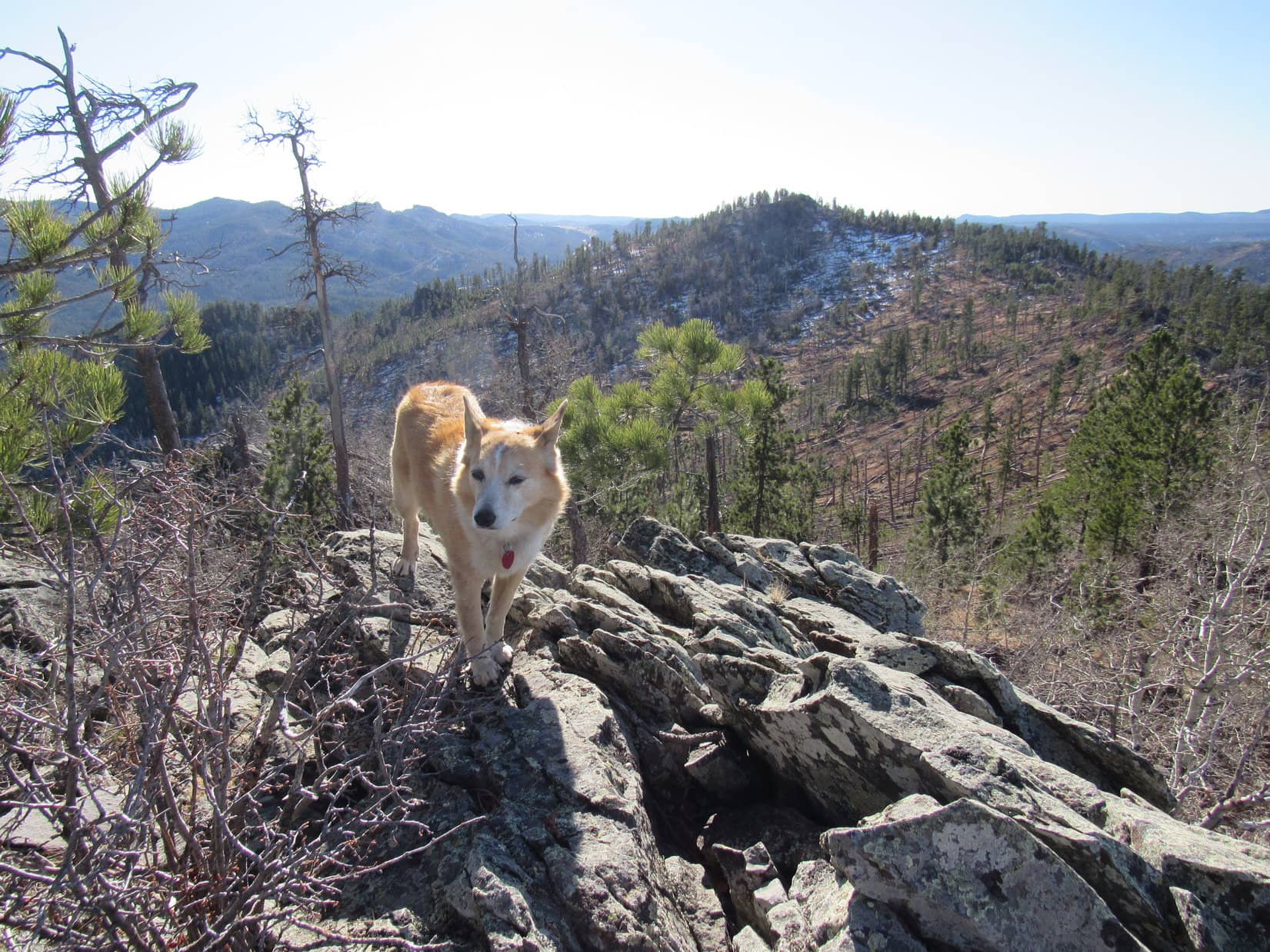
Black Hills, SD Expedition No. 259 – Zimmer Ridge & Peak 6600 (11-28-20)

7:59 AM, 18ºF, Whitehorse Road 0.2 mile from Hwy 16/385 – Dang chilly out!  Supposed to warm up a bunch, though.  Lupe was in high spirits as she set off up shady Whitehorse Gulch.  Apparently, the Carolina Dog wasn’t cold, but SPHP’s frigid fingers were glad when the gulch widened out enough to become sunny.

Whitehorse Road wound NW for a little over a mile before Lupe left it.  Crossing a small field of dry grass on the R, she entered the forest.  The terrain immediately began to slope higher, and soon became rocky.  Not bad at all, though.  Getting up Zimmer Ridge (6,600 ft.) was going to be a snap, if it stayed like this.

Near the forest after leaving Whitehorse Road. Photo looks NE.
Starting up Zimmer Ridge’s SW ridge. Photo looks NE.

Heh!  Not to be.  The rock formations along Zimmer Ridge’s SW ridge grew in size, and the slope steepened as the American Dingo climbed.  Looper eventually found herself high up on a bunch of boulders with no safe way forward, forcing a 50 foot retreat.

Determined Dingo, still on Zimmer Ridge’s lower slopes. Photo looks SSE.
On a short, easy, protected ramp higher. Photo looks ENE.
By a cool boulder along the SW ridge. Photo looks S.
A glimpse of Peak 6600 (R) beyond Whitehorse Gulch. Photo looks NW.

A minor setback.  Swinging around the W side of the big boulders, Lupe came to a steepish region of moderate-sized rock.  Scrambling up that, she reached a longer stretch of doghair pine right back on the ridgeline.  Loopster searched for squirrels, but she wasn’t going to be sneaking up on anything with SPHP snap, crackle, and popping twigs and branches every step of the way.

More big rock formations were ahead, but they weren’t gnarly enough to put an end to progress this time.  The forest began to open up along the ridgeline.  Unfortunately, that was due to all the deadfall.  Extremely common these days in the Black Hills, but never a welcome sight.

Scrambling the rocks. Photo looks NNE.
Among the doghair pines.
Another rock formation along the ridgeline. Photo looks SSE.
Oh, boy! Deadfall! Our favorite. Not! Photo looks NNE.

Zimmer Ridge’s SW and S ridges merged together somewhere along in here.  Lupe was getting quite high.  The summit couldn’t be an awful lot farther N, could it?

Maybe yes.  Loop had climbed Zimmer Ridge once before a little over 6 years ago.  Back then she had come up the W slope instead of the SW ridge, but had reached the main ridgeline well S of the summit.  Both routes ought to link up, but nothing looked familiar yet.

The Carolina Dog came to several larger rock formations along the top of the ridgeline separated by stretches of often deadfall-laden forest.  Reaching the N side of one of these outcroppings, aha!

Loopster!  Remember this?  You were here before!

I was?

Yes, yes!  Remember this log sticking out toward Sylvan Hill (7,000 ft.)?  Looks like it has weathered some more, but this has got to be the same one you visited before!

Lovely, I’m sure, but it seems to have made more of an impression on you, SPHP, than it did on me.  I’ll take your word for it.  Is this particular dead log some sort of big event?

Apparently, not!  I just thought it was sort of cool to see a reminder of our first visit to Zimmer Ridge.  I’m certain you were here before.  Took a photo of you by or on this log, which may be why I remember it.  Let’s get another!

Whatever!  Fine and dandy, SPHP!  Perfectly glorious!  But let me know when you’re certain you see a squirrel!

Traveling the ridgeline from one big rock formation to the next. Photo looks N.
Black Elk Peak (7,231 ft.) (R) in the distance. Photo looks ESE.
Once again on the oh, so incredibly memorable log pointing toward Sylvan Hill (L). Photo looks SE.

Having seen this fabulous reminder of the good old days, SPHP now felt that maybe it really wasn’t too much farther N to Zimmer Ridge’s true summit, although after thinking about it, it had seemed like a bit of a trek 6 years ago.

Another clearly higher point was off in that direction.  Looked more like a pine-forested hill than a rock formation, though.  SPHP recalled the true summit as being quite rocky, and surrounded by young aspens.

Whether that hill was or wasn’t the true summit, Lupe still had to go that way, though.  She headed N across a semi-open region harboring more deadfall.  Off to the SE were nice views of Black Elk Peak (7,231 ft.), Little Devils Tower (6,960 ft.), Saint Elmo Peak (6,458 ft.) and others.

On to the next higher point along the ridge. Photo looks NNE.
Black Elk Peak (Center), Little Devils Tower (R), and Saint Elmo Peak (R foreground). Photo looks ESE.

The next high point didn’t turn out to be the true summit, but it could be seen from here.  SPHP was sure that next more heavily forested hill had to be it.  A few rocks and aspens were visible at the top.  Lupe had to lose a bit of elevation to continue over there, but it wasn’t long before she was scrambling on rocks just SE of the top.

True summit of Zimmer Ridge ahead! Photo looks N.
Just below the S (true) summit. Photo looks NW.

Circling around to the N, Lupe climbed up to a gap between several large rocks at the very top of Zimmer Ridge (6,600 ft.).  Three stones were in contention for title of true summit.  Two were side by side just E of this gap, and one was immediately W of it.  SPHP helped Lupe up onto the closest E rock first.

On the E rock. Photo looks ENE.

The W rock was clearly a few inches higher than the two E ones were.  The crafty American Dingo managed to scramble around to the top of it all by herself.

At the true summit of Zimmer Ridge. Photo looks W.

Trees hid the views to the E, but Lupe could see a huge swath of the Black Hills in other directions.  Peak 6600, her next objective, was in sight to the WNW along the ridge on the far side of Whitehorse Gulch.  Big ridges of the limestone plateau country were visible miles farther W.

Peak 6600 (immediately R of Lupe) with ridges of the limestone plateau beyond. Photo looks WNW.

Perhaps the most interesting sight of all was HP6583, the N high point of Zimmer Ridge off to the NNE.  Connected by a 0.5 mile section of the huge ridge, HP6583 wasn’t much lower.  Having been there before, Lupe knew it was a much better place to take a break.  The true summit of Zimmer Ridge was a cool airy spot, but with little room to maneuver and nowhere to relax except well below the highest rocks.

HP6583 (R), the slightly lower N summit of Zimmer Ridge from the true summit. Photo looks N.

Took nearly 50 minutes to get over there.  Not really much of a surprise.  SPHP remembered this trek as having been a terrible deadfall mess.  Now it didn’t seem much worse than a lot of other places in the Black Hills, but Looper was still getting a workout leaping over one dead tree after another along whatever snaky route looked like the path of least resistance at the moment.

Most of the time the going was easiest E of the ridgeline.  The deadfall didn’t get bad until Looper was halfway to HP6583.  With so many trees down, Loop enjoyed a sweeping view of Elkhorn Mountain (6,381 ft.), Black Elk Peak (7,231 ft.), Peak 6920 and others off to the E and SE.

Leaving the true summit region. Photo looks SE.
Elkhorn Mountain (L), Black Elk Peak (Center), Peak 6920 (next knob to the R). Photo looks SE.
A glance back at the true summit (L). Photo looks S.

Shortly before reaching HP6583, most of the deadfall ended.  Lupe passed through a short section of young pine forest which led to a small boulder field next to a big rock formation at the top.  Circling around the NW side, the Carolina Dog scrambled up from the NE.  A lone pine tree’s inopportunely situated branches made following Loop a little tricky, but SPHP soon joined her on top.

Not much room up here, either, but definitely more comfortable than Zimmer Ridge’s true summit had been.  A U-shaped rock formation open to the SE surrounded a small area where Lupe could relax on a bed of pine needles, if she wanted to.  SPHP tossed some prickly pine cones out of it for her.

Loop on the rock formation at the top of HP6583. Photo looks SW.

The views from HP6583 were quite similar to what they’d been over at the true summit.  Loopster and SPHP hung around for half an hour.  A couple of little chocolate coconut bars were shared.  Lupe also partook of some Taste of the Wild while SPHP munched the usual apple.
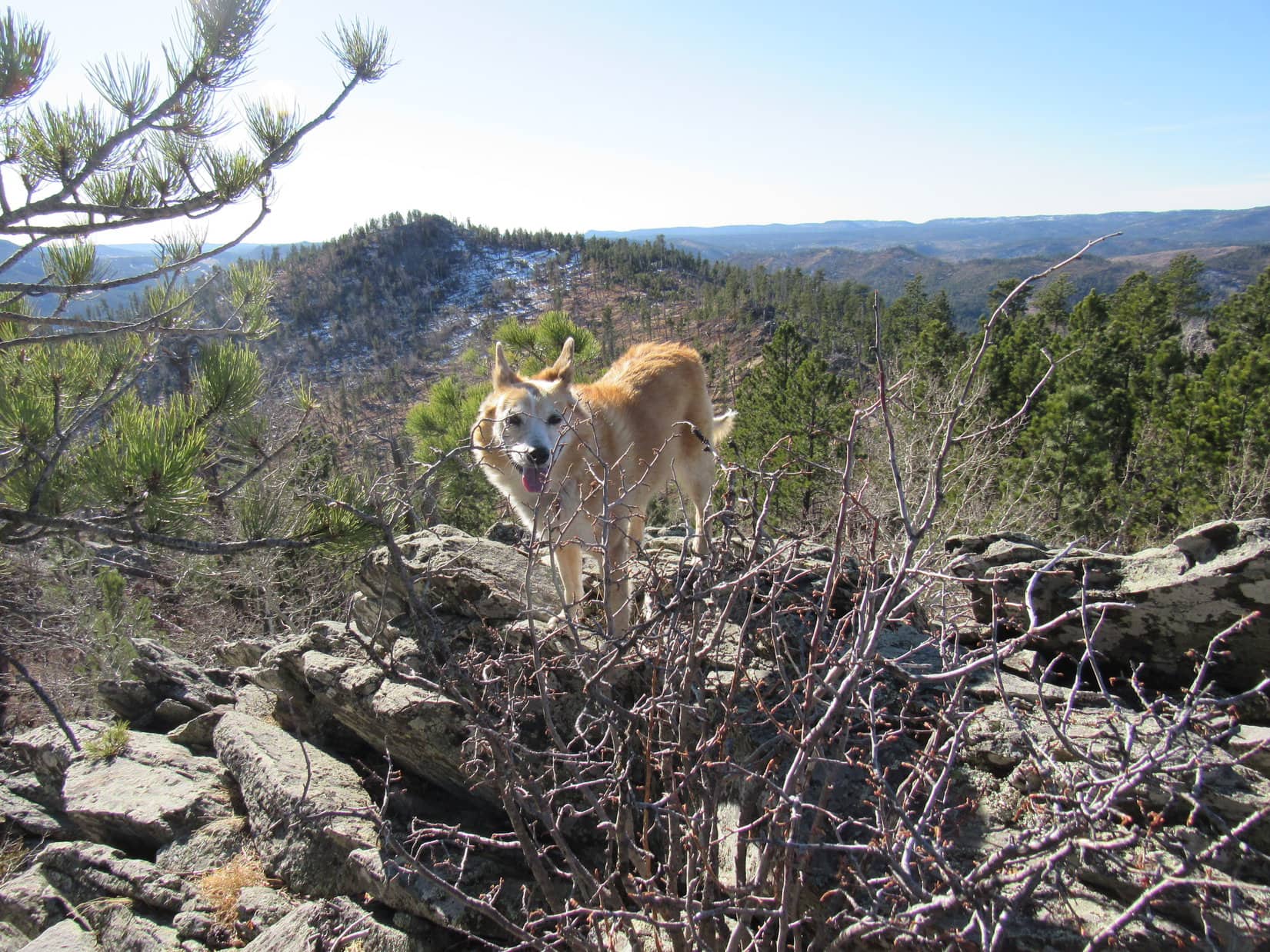
True summit of Zimmer Ridge (L) from HP6583. Photo looks SW.
Another angle. Photo looks SSW.
Peak 6600 is the high point on the next ridge past Loop’s head. Photo looks W.

Mighty nice day for late November!  Time passed quickly.  Before all was over and done with, Lupe had also visited a lower rock formation off to the NE which had a view of Five Points (6,221 ft.).

Five Points (L of Center) from the lower NE rock formation. Photo looks NE.

Peak 6600 on the W side of Whitehorse Gulch was the American Dingo’s final peakbagging objective for the day.  Abandoning Zimmer Ridge, Lupe started down HP6583‘s NW slope.  This was all densely forested, fairly steep territory.  For a while boulder fields were off to the L (S) as Loop worked her way W.  Some deadfall, but not bad.  No views except trees, a mix of aspens and pines.

Descending Zimmer Ridge. Photo looks WSW.

Looking for a minor hill on the way to Pass 5935, Lupe finally saw it a little off to the NW.  She headed over toward it, but turned W along the S slope instead of going all the way to the top.  Upon reaching the Pass 5935 region, Loop came to a clearing.  Nearby was a dirt road which she followed NW up to a junction with USFS Road No. 387.1B.

Looper reaches USFS Road No. 387.1B near Pass 5935. Photo looks WSW.

Taking No. 387.1B, Lupe followed it up a short rise.  Once it topped out, the road then headed SW down a ravine leading into Whitehorse Gulch.  At the bottom, No. 387.1B turned NW.  Before making the turn, Loop left the road at the bend, heading down to a little pond only 200 feet away.

This pond had been a pretty spot the last time the Carolina Dog had been here more than 6 years ago.  Today it was frozen over, and seemed sad.  Everything looked motionless and dead.  A moment of silent reflection, and Lupe returned to the road, now going NW farther up Whitehorse Gulch.

Nearing the bend in Whitehorse Gulch. Photo looks WSW.
By the frozen pond. Photo looks SW.

For about a mile, No. 387.1B wound its way steadily higher.  Lupe came to a new, unmarked dirt road that angled off to the L, but didn’t take it.  After a while, the air became more strongly pine-scented than usual.  The reason was soon clear.  Logging!  The forest that had been here ever since Lupe had last been this way was now mostly gone.

The loggers had been here just recently.  Lupe passed numerous stacks of fresh cut logs, and huge piles of branches still loaded with green pine needles.  The change opened up the valley view, but the freshly churned up ground wasn’t pretty, the damage too new.

Lupe was undeterred, still happily exploring ahead, but SPHP trudged after her in an increasingly melancholy mood.

Exploring upper Whitehorse Gulch. USFS Road No. 387.1B (R). Where the new dirt road on the L goes remains a mystery. Photo looks NNW.
Whitehorse Gulch. Photo looks NW.
Near the start of the recently logged region. Photo looks NNW.

At the extreme N end of Whitehorse Gulch, No. 387.1B came to an end at a circular turnaround loop.  A more primitive road went W from here, and soon climbed a short steep slope.  Up on top, now 0.75 mile due N of Peak 6600, Lupe found she had reached a minor pass.  A fence crossed the road, but the gate was open.  Beyond the fence was a meadow and views of nearby hills to the NW.

Leaving the road, the Carolina Dog headed S along a broad ridge leading to Peak 6600.  Loggers had been up here, too.  All large trees were gone, although small ones remained, the ground churned up with caterpillar tracks and littered with little broken branches still sporting bright green pine needles.  Zimmer Ridge (6,600 ft.) could be seen off to the ESE, the top of Black Elk Peak poking up behind it.

Zimmer Ridge (Center). Photo looks ESE.

The loggers hadn’t made it all the way to Peak 6600 along this ridge, but they’d gotten fairly close.  Lupe had to duck under the annoying ancient barbed-wire fence that also went this way a couple of times, but finally got past it, too.

Closing in on Peak 6600 (R). Sylvan Hill (L) in the distance. Photo looks S.

Little patches of snow were still slowly melting on the N slopes, as Lupe made the final 200 foot ascent to the top of Peak 6600.  Not particularly steep, just a forested, and in a few spots, snowy trek higher.

Peak 6600 has two summits, E and W, separated by 300 feet.  Coming up the NNE slope of the mountain, Looper reached the E summit first.  She scrambled up onto a narrow, vertical band of rock running N/S at the high point.  This was the same spot she had reached 6 years ago, where SPHP had taken a photo of her silhouetted as the sun sank in the W.

Not that late in the day yet this time around.  SPHP took a couple of new photos of Loop on the E summit, but from different angles than before.

Peak 6600, at the E summit. Photo looks S.
E summit from another angle. Photo looks NW.

Trees interfered with the views.  The W summit was a bit higher in SPHP’s opinion, although it couldn’t be seen clearly from here for the same reason.  Lots of deadfall between the two summits.  Lupe stayed near the N edge, trying to avoid the mess as much as possible, as she headed over to the true summit.

3:17 PM – Lupe stood poised at the true summit of Peak 6600 enjoying a sunlit reception.  45 minutes before sunset.  She would spend 25 of them right here.  This was a beautiful spot, with some room to move around.  The best and only open views were off to the N and W where a series of forested hills led to the high ridges of the limestone plateau country.

In brilliant sunshine at the true (W) summit of Peak 6600. Photo looks N.
Limestone plateau ridges on the horizon (L). Photo looks WNW.
Bear Mountain (7,166 ft.) beyond Lupe. Photo looks WSW.
At the S end of Peak 6600’s W summit region. Photo looks S.

The last apple vanished.  Lupe had more Taste of the Wild.  Water for all.  Conditions were awesome for late November, and the slanting rays of early evening sunlight made everything so beautiful!  Wouldn’t last.  Looper cooperated fully in getting a few more dazzling Dingo shots.

Green Mountain (7,164) (L) in the distance. Photo looks NW.
Evening on Peak 6600. Photo looks W.
Back on the highest rocks of the true summit. Photo looks N.

Would have been fun to stay and watch the sunset, but it was a long way back.  The most direct route would be steep and full of deadfall.  Better to leave early enough to not get stuck out among the worst of it in the dark.

Prudence was going to win out.  The sun wasn’t quite low enough yet to get a true silhouette shot this time, but SPHP tried anyway, hoping to get a couple that might be close before Lupe left Peak 6600 again.  This time she stood proudly atop the true (W) summit, instead of the E one.

Peak 6600, true summit. Photo looks W.
Final moments atop Peak 6600.

And the race was on!  The American Dingo started down Peak 6600’s steep SE slope, dodging all the deadfall as best she could.  She’d barely gotten going, when the views of Zimmer Ridge and the rugged territory surrounding Black Elk Peak were worth a pause.

Zimmer Ridge (Center). Photo looks E.
Black Elk Peak (L), Peak 6920 (Center), and Little Devils Tower (R). The SW ridge of Zimmer Ridge, which Lupe had climbed this morning, is the foreground. Photo looks ESE with help from the telephoto lens.

Dusk in Whitehorse Gulch.  The night sky never did get all that dark.  The white ghost of a nearly full moon rose over the shoulder of Zimmer Ridge.  Skirting fences along the edge of private property, an American Dingo slunk undetected through shadowy forest.

Chilly out again, but homeward bound.  (5:50 PM, 24ºF)

Peak 6600, Black Hills of South Dakota, 11-28-20

Links:

Next Black Hills Expedition                 Prior Black Hills Expedition

Black Hills, SD Expedition No. 101 – Zimmer Ridge & Peak 6600 (10-23-14)

Want more Lupe adventures?  Check out Lupe’s Black Hills, SD & WY Expeditions Adventure Index, Master Adventure Index, or subscribe free to new Lupe adventures!

Black Hills, SD Expedition No. 258 – Spearfish Peak & Little Crow Peak (11-19-20)

8:52 AM, 43ºF, Devil’s Bathtub (Cleopatra) trailhead in Spearfish Canyon – Sort of a late start, especially for this time of year when the days are so short, but Lupe ought to have plenty of time to get to the Devil’s Bathtub, a popular Black Hills destination accessible from Spearfish Canyon.  Last year she had been here and made it up Squaw Creek far enough to get to some beautiful pools past scenic cliffs, but it hadn’t seemed quite right.  Sure enough, a little research later on had proven that the American Dingo hadn’t gone far enough to actually reach the Devil’s Bathtub.  Now Loop was back to correct that mistake.

A 0.25 mile downstream jaunt along Spearfish Creek got Loopster to Cleopatra Place, a short road with a bridge over to some private homes and cabins on the E side of the river.  Just past the bridge, the start of the Devil’s Bathtub trail was on the R.  Certain of success this time around, Loop and SPHP started up Squaw Creek.

At the start of the Devil’s Bathtub trail.

In the narrow side canyon that Squaw Creek flows through on its way to join up with Spearfish Creek, the trail was soon criss-crossing Squaw Creek multiple times.  Expected, but what SPHP hadn’t anticipated was that there was still some snow and ice way down here along the shaded creek.  The frozen stuff had melted days ago almost everywhere else.

One of the early Squaw Creek crossings.

The first couple of crossings weren’t bad, but as Lupe continued up the valley, she kept coming to more snow and ice.  Not enough to support her weight, but enough to make everything slippery.  Even where it had all melted, the rocks were damp and slick.  Rock hopping was risky, and SPHP really didn’t want to wade through it all getting freezing wet paws.

A spur trail NE of the stream led steeply up to higher ground.  Hoping the spur might make it possible to skip some of the stream crossings, SPHP encouraged Loop to try it.  Worked, but not a great solution.  The short climb was tricky due to half-frozen mud.  Once the trail leveled out, Lupe then had to cross a skinny, damp section on a treacherously steep slope, only to promptly get forced all the way back down to creek level again.

On the level part of the spur trail.

The next stream ford was easier, but the one after it was much worse.  After successfully negotiating it only to immediately discover another one lying in wait that wasn’t any better, SPHP had had it.

Keep coming, SPHP! This one isn’t bad at all.

Hang on, Looper!

What’cha thinking, SPHP?

I’m thinking this isn’t going to work.  We already know from your trek up here last year that we still have a bunch of stream crossings to go.  Sooner or later, I’m going to wind up falling in the creek, or at least getting my paws soaking wet.  Not a thrilling prospect in November, even though you might be fine with it.

So what are you saying?  We’re done already?  We’ve hardly started!

How about a change of plans?  I say let’s skip the Devil’s Bathtub, and come back sometime when either the creek is solidly frozen over, or its just plain hot out.  That’s when everyone else comes up here, so they can use the Devil’s Bathtub as a swimming hole.

Fine with me, SPHP, but what do you want to do instead?

Little Crow Peak (5,885 ft.) isn’t far away.  Spearfish Peak (5,800 ft.) might even be within range.  We haven’t been to either one in more than 4.5 years.  Want to do that?

Sure!  Which way from here, then?

We’ll have to go back to the start if we can’t climb our way out of here.  Let’s give that a shot first.  Right on up that slope!  Onward!  Puppy, ho!

Climbing out of the Squaw Creek valley.

Loopster powered up, while SPHP thrashed around on the steep slope.  Managed to get up it, though.  Maybe 100 feet above Squaw Creek, Lupe came to an old road covered with pine needles.

We’re in luck, SPHP!  This ought to make things easier.  Which way now?

Not entirely certain, Loop.  Probably L.  The topo map doesn’t even show this road.  Say, maybe we can get to the Devil’s Bathtub after all, if we just follow it up Squaw Creek valley?  Wanna try that?

You’re a truly flexible planner, SPHP.  Devil’s Bathtub it is, again!  Head R then?

Yup.  Do it, Dingo!

Back on track for the Devil’s Bathtub! We’re going this way!

Well, shucks.  It didn’t work.  After going around a corner, chunks of the road were missing, haven fallen into the valley at one time or another.  The road became a mostly one track trail traversing some perilously steep slopes.  SPHP called another halt.

What now, SPHP?

Beginning to think this route is going to totally play out somewhere up ahead, Loop.  Probably just a big waste of time.

So, you want to go back the way we came?

Yes, but stick with this road.  Good chance it will tie in with USFS Road No. 186 before too long.  No. 186 will get us up to the Little Crow Peak region.  Same route that got us up there years ago.

Went fine for a little way, but we’re turning back again here.

Going NW back past where Lupe had originally reached this old pine needle covered road, it eventually did tie into another more substantial road.  SPHP didn’t recognize it as USFS Road No. 186, but maybe it was?  Almost had to be according to the map, although nothing looked familiar as the Carolina Dog took it higher.

At the junction with a more substantial rocky road that Loop followed higher.

Before long, Loop came to a single short switchback after which the road headed E up a narrow side canyon, climbing steadily at a pretty good clip.  This went on for perhaps 0.75 mile or more.  The terrain looked like it was about to level out a bit when Lupe reached a broken down gate in a fence line where the valley broadened out somewhat.

This gate seemed faintly familiar.  Immediately beyond it, the road branched.  Looper stayed to the L (NE), continuing up the valley.  She’d already gained a lot of elevation.  For the first time, a distant view was beginning to open up behind her.

On the way up the long non-descript valley.
At the broken gate, which seemed vaguely familiar. Photo looks E.
Starting to get a bit of a view. Photo looks WSW.

The road finally did level off.  The Carolina Dog had climbed completely out of Spearfish Canyon and its off-shoots.  This area also seemed vaguely familiar.  SPHP was fairly certain Loop had been here before.  If so, Little Crow Peak was only 0.5 mile off to the WNW.  Instead of going back to climb it, though, Lupe continued NE.

Late morning.  Sunny and crisp.  A thin layer of snow brightened the road ahead.  Felt good to be out and on the move, listening to the pines sighing in a light breeze.  Looper didn’t get much farther before coming to a landmark that SPHP recognized for sure.  At a spot where the road divided, remnants of an ancient battered bus sat quietly rusting away, just as it had been the last time Lupe had been here.

The road finally flattened out, providing a beautiful, easy trek ahead. Photo looks ENE.
By the battered bus.

The road continuing NE looked destined to go downhill.  Instead of going that way, Lupe turned due E on a rockier road that went uphill.  It wasn’t a big climb.  The road soon leveled out.  A little downhill stretch, and at the top of the next hill the American Dingo reached Carbonate Camp.

On the way to Carbonate Camp at the top of the next rise. Photo looks E.

Next to nothing left of the old ghost town.  A wooden sign nailed to a big Ponderosa pine tree said “Carbonate Camp Cemetery”.  Wooden boards marked 5 gravesites.  Although leaning, the decaying boards were still standing, but that was all that was still here.  2 of the graves were N of the road, the other 3 were S.

Noon hour.  Lupe and SPHP paused to relax for a few minutes by the 3 graves S of the road, and share a chocolate coconut bar.  With an eager Dingo in on the deal, the little bar vanished in seconds.  Loop followed that up with a Taste of the Wild chaser while SPHP munched an apple.

The new Carbonate Camp Cemetery sign. The old one that had been here 4.5 years ago had been misspelled.
1 of 5 wooden grave markers is visible just to the R of the sign. Not really much left here to desecrate. Photo looks E.
3 grave markers S of the road. About all remains of Carbonate Camp! Photo looks W.

E of Carbonate Camp, the road forked again, both branches heading downhill.  Lupe took the main road as it curled L around to the N, then NW.  Hmm.  Maybe this route actually went back to the ancient bus?  In any case, it wasn’t the right way.

Marching back up to the fork, Loop took a very rocky road NE down a steep hill.  Before she reached the bottom of a deep ravine, she came to such a badly eroded section that this road would have been impassable to virtually any vehicle, although it wasn’t a bad hiking trail.

From this first ravine, the road headed due E again, going up and down over several smaller hills.  0.5 mile E of Carbonate Camp, Lupe arrived at a frozen pond tucked away in the shadows of upper Rubicon Gulch.

Starting down into the first ravine E of Carbonate Camp. Photo looks E.
By the frozen pond in upper Rubicon Gulch. Photo looks WSW.

A number of roads intersected down here in Rubicon Gulch.  One going S led over to a gated-off area owned by a mining operation.  One went NW down Rubicon Gulch, and another continued straight E up a steep slope.

Without hesitation, the Carolina Dog took yet another road that climbed NE, then N up to the top of the next ridge.  The terrain leveled out as Lupe reached a big overhead power line.  After going under the power line, she passed a cute little cabin on the R (E).

The little cabin N of Rubicon Gulch.

Spearfish Peak (5,800 ft.) was still 2 miles N of here.  A little more than that the way the road went.  After 1:30 PM.  SPHP was now regretting the ridiculous decision not to climb Little Crow Peak first.  With sunset only a bit after 4:00 PM, if Loopster went on to Spearfish Peak it was probably going to be dark by the time she could get back to Little Crow.

Should have been evident all along!  Nothing to do about it now, though, except pick up the pace.  Might still work out.  Lupe continued N past some more private property.  Soon she was passing under the power line again, with a glimpse of Spearfish Peak in the distance.

Spearfish Peak (R) from the power line. Lupe did not go down the road seen on the R. Photo looks NNW.

From the power line, the road swung W a little way going up over a small hill in the process, then down again before turning N once more to climb a larger hill.  Meanwhile, the sky had clouded up, turning a sad gray.  The air felt colder.  Except for the dark green of the pines, and the snow white bark of leafless, shivering aspens, everything along the road was brown, tan, or beige, the somber colors of death.

Approaching Spearfish Peak (Center) on USFS Road No. 220. Photo looks N.

One of those afternoons with a late fall feel, as if the icy hand of winter was near, plotting to steal in without warning and seize the entire world in its eternal frozen grip.  An afternoon for brooding and dark thoughts.

Yet Lupe was doing fine, trotting happily along, sometimes venturing into the brush for a quick sniff before returning to the road.  She was making good progress.  Crow Peak (5,787 ft.), the big one, not the little one, came into sight off to the NW.  As Loop drew near Spearfish Peak, Bear Butte (4,422 ft.) could be seen looking small and insignificant out on the plains beyond the rest of the Black Hills.  It was still bathed in sunlight.  Clearly, winter was in no position to back up its idle threats.  At least, not yet.

Crow Peak (L of Center). Photo looks NW with help from the telephoto lens.
Getting close to Spearfish Peak. Photo looks NNW.
Bear Butte (Center). Photo looks ENE with help from the telephoto lens.

The road returned to the power line before getting to Spearfish Peak.  USFS Road No. 220 soon veered off to the R (NE) heading downhill.  Lupe stuck with the power line, and quickly came to another fork.  This time she took the L (NW) branch, a short road that ended near the trees.  An ATV trail continued up Spearfish Peak’s SE ridge, but soon gave out as well, reduced to a single track trail that wound the rest of the way up to the summit.

Lupe took the road to the L here, which leads to a trail to the summit. Photo looks NW.
On the single track trail, getting close to the top. Photo looks N.

Aspens, pines and deadfall!  The top of Spearfish Peak was sort of a mess, and didn’t provide much in the way of views.  The true summit was a big gray rock with a brass survey benchmark fastened to it a foot or two below the high point.  Just W of this rock sat a large gray box sporting a solar panel and a small, thin antenna.

True summit of Spearfish Peak. Survey benchmark visible lower R. Photo looks NW.
The “Spear” survey benchmark.
True summit and survey benchmark (R). Photo looks N.
Kind of a mess due to the deadfall, but not too bad. Lupe still on the true summit. Photo looks ENE.

Despite the fairly dense forest, a few narrowly restricted distant views existed.  Terry Peak (7,064 ft.) and Custer Peak (6,804 ft.) could both be seen off to the S, but not from any point where Lupe could get into the picture.  A glimpse of Little Crow Peak (5,885 ft.) and part of Spearfish Canyon was available from a spot a little W of the true summit.

Terry Peak (Center). Photo looks S with help from the telephoto lens.
Little Crow Peak (Center). Photo looks SW.

There was a need for speed, if Lupe still hoped to climb Little Crow Peak today.  Even so, SPHP allowed her to linger up on Spearfish Peak for nearly half an hour.  No sense in coming all this way, and not getting to savor the moment, at least to some degree.  The last chocolate coconut bar vanished along with the last apple.  The Taste of the Wild supply took a major hit, too.

Minutes came and went at breakneck speed.  Suddenly Lupe was poised again atop the true summit of Spearfish Peak (5,800 ft.).  A last photo, and Onward!  Puppy, ho!

Final moments atop Spearfish Peak. Photo looks NE.

On the way back by the same route, Bear Butte was still in sunshine as Lupe started the trek S from Spearfish Peak.  That didn’t stop winter from taking a shot.  Overhead, the sky darkened.  Several times snow granules massed for the attack, but they were tiny and didn’t have the numbers to accomplish anything.  Plunging to earth like minuscule white meteors, they melted and were gone.

Bear Butte again. Photo looks ENE with lots of help from the telephoto lens.
Little Crow Peak (R of Center) from 1.25 miles S of Spearfish Peak. Photo looks SW.

3:57 PM, 0.6 mile ESE of Little Crow Peak –  Still light out, but the sun was close to the horizon when Lupe reached a grassy road that veered off to the R (NW) 250 yards after passing the ancient bus.  This long forgotten road, which left USFS Road No. 186 before it started back down into Spearfish Canyon, wound its way WNW toward Little Crow Peak.

Without it, Loopster would never have gotten to the SE slope in time to race up as fast as SPHP could struggle through the thick underbrush of a mixed pine and aspen forest.

On the grassy road leading to Little Crow Peak (Center). Photo looks W.
Among the aspens.

The climb wasn’t a big one, maybe 200 feet of elevation gain, but when Lupe reached the first rocks at what had appeared to be the top, the view was confusing.  300 feet off to the N or NE was a clearly higher rock formation.  It seemed like Lupe had come up the S or even the SW slope, when SPHP had been pretty sure she’d been climbing from the SE.

At the first rock formation reached near the apparent summit (Center) of Little Crow Peak. Photo looks NNE?

No time to worry about an explanation for that now.  Light was fading, and the view was distressing for another reason.  SPHP remembered that Little Crow Peak had been somewhat of a mess due to deadfall when Loop had been here before, but it was really bad now.  As fast as possible, which wasn’t fast at all, Lupe and SPHP struggled through the maze toward the apparent summit.

The sun had just vanished when the Carolina Dog got there, the horizon still lit up with a lingering orange glow.

The sun is gone as Lupe reaches the second high point. Photo looks WSW.
Afterglow.

Egads!  This wasn’t the true summit either.  Another rock formation a good 10 feet higher could now be seen 300 feet farther N.  Worse yet, the deadfall between here and there was absolutely horrendous.  The light was going fast as Loop and SPHP clambered carefully over or under the obstacle course.  No going around anything, that just wasn’t possible.

This had better be the summit!  The light was fading so fast that Lupe was going to have to retreat soon.  Too many steep slopes that dropped hundreds of feet into oblivion in too many directions to risk not being able to find the way back to the grassy road.

4:36 PM, summit of Little Crow Peak –  Yup!  This was it!  Still light enough to tell that the intrepid American Dingo actually had reached the true summit of Little Crow Peak (5,885 ft.).  Lupe was now poised atop the highest rock.  The camera was very light sensitive, but it was getting so dark that photos now looked fuzzy.

Made it! At the true summit of Little Crow Peak. Photo looks W.

The true summit of Little Crow Peak, perhaps due to being reached in a frantic rush in the nick of time, seemed like a cool place.  Destroyed by pine bark beetles, the forest was completely shattered to the S and W, opening up the views.  Elsewhere, the surviving forest was still thick enough, and now dark enough, to hide whatever was out there.

Really was a shame that Lupe hadn’t climbed Little Crow Peak earlier.  5 minutes to enjoy her success, and that was it.  Gotta get out of here!

Cement Ridge (6,674 ft.) on the horizon beyond Lupe’s head. Photo looks SW with help from the telephoto lens.
Final moments atop Little Crow Peak. Photo looks SW.

Leaving the summit, Lupe found a short ramp to the S that enabled her to skip a lot of the worst of the deadfall.  However, she needed to go E to get back down to the grassy road.  Stars were appearing, the last of the light almost gone.  The sky was still somewhat light, but the forest and ground were virtually invisible.

The descent became one of confusion and constant second-guessing.  The flashlight had to come out.  Everywhere the mountain dropped away.  SPHP decided Loop was too far S, then too far N.  Nerve-wracking for a while, but at last the slope wasn’t so steep.  Must be on track.  Sure enough, the grassy road appeared ahead.

Still a couple of miles to go, but the rest would be easy.  Loopster could follow old USFS Road No. 186 all the way back down to Cleopatra Place at the start of the Devil’s Bathtub trail without having to return to Squaw Creek.  Cross the bridge over Spearfish Creek, and she’d be 0.25 mile from the trailhead and the G6.

Success assured, stars glittering in the now clearing night sky, Looper sniffed ahead, sometimes revealed by the weak beam of the flashlight, sometimes cloaked in the black void.  (End 7:00 PM, 31ºF)

Little Crow Peak, Black Hills of South Dakota 11-19-20

Links:

Next Black Hills Expedition                    Prior Black Hills Expedition

Black Hills, SD Expedition No. 171 – Little Crow Peak & Spearfish Peak (5-7-16)

Want more Lupe adventures?  Check out Lupe’s Black Hills, SD & WY Expeditions Adventure Index, Master Adventure Index, or subscribe free to new Lupe adventures!