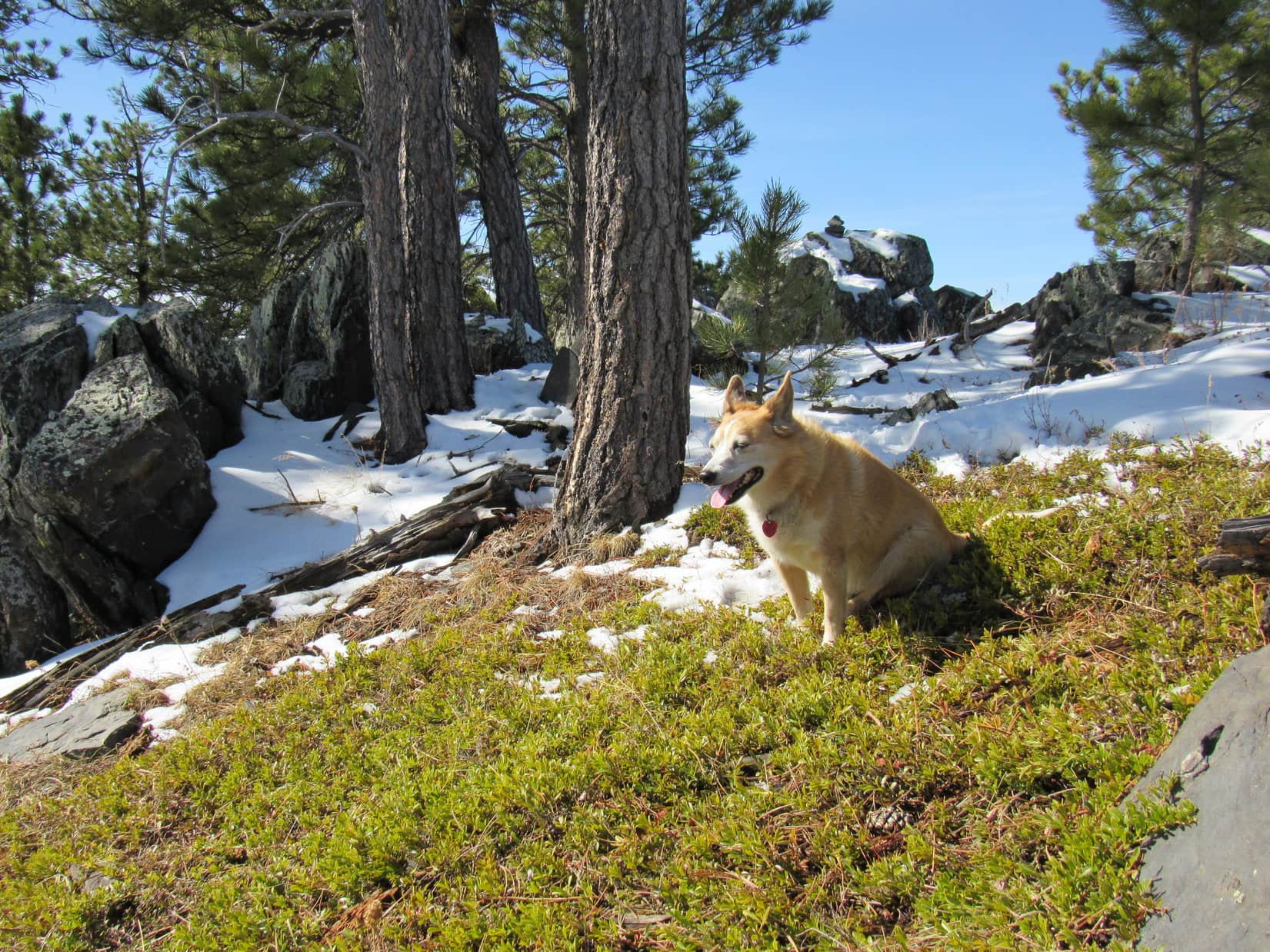
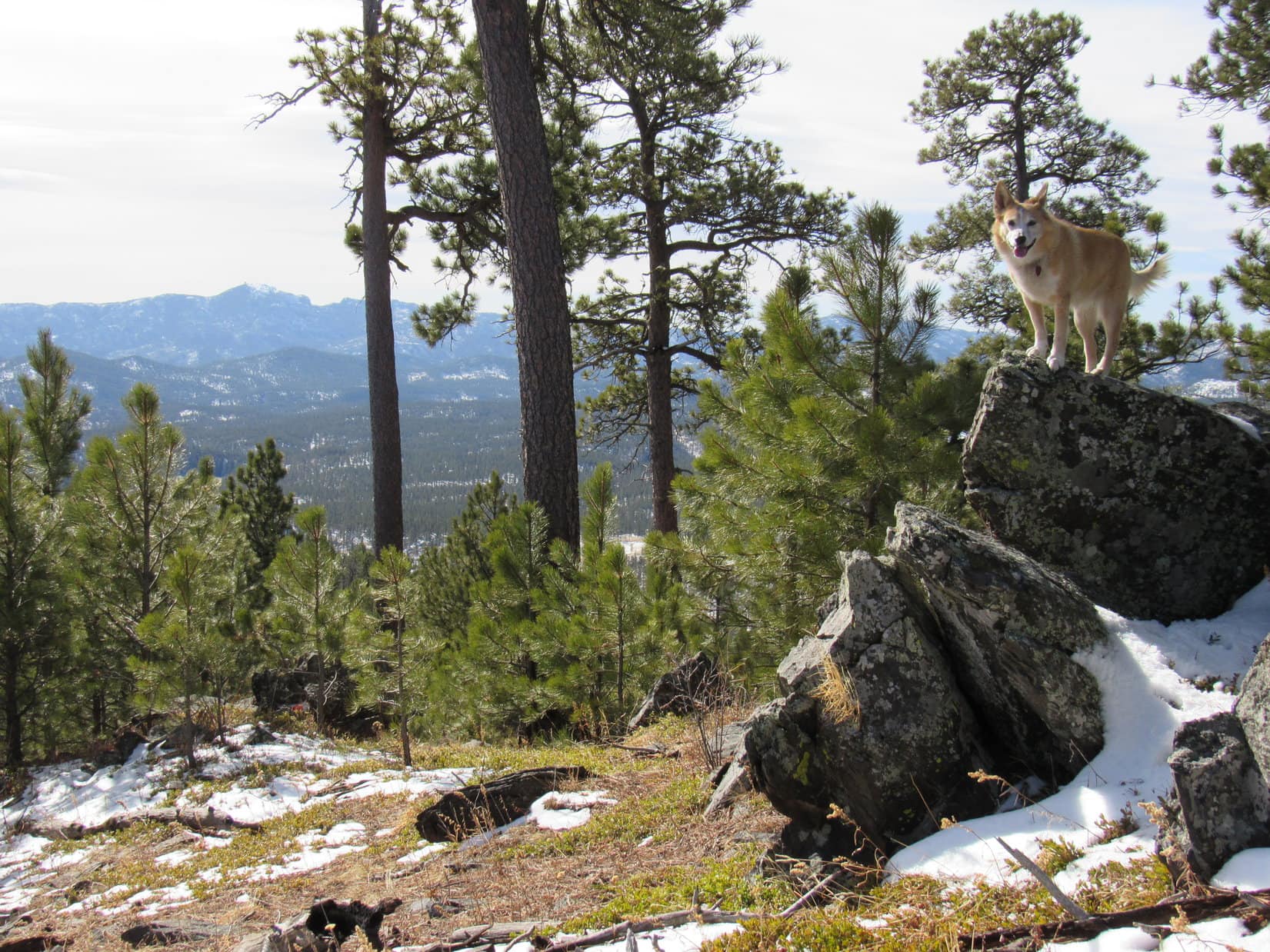
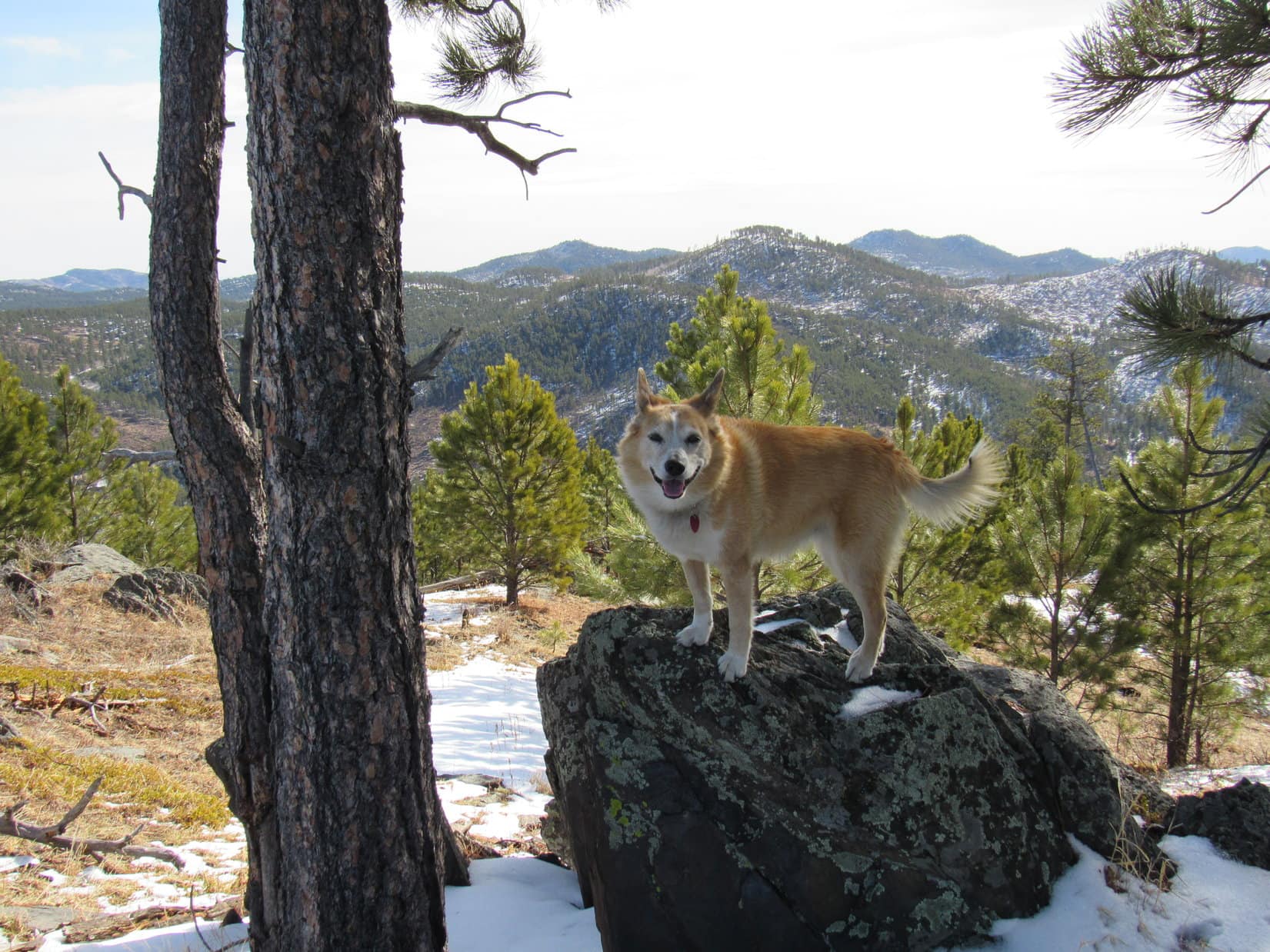
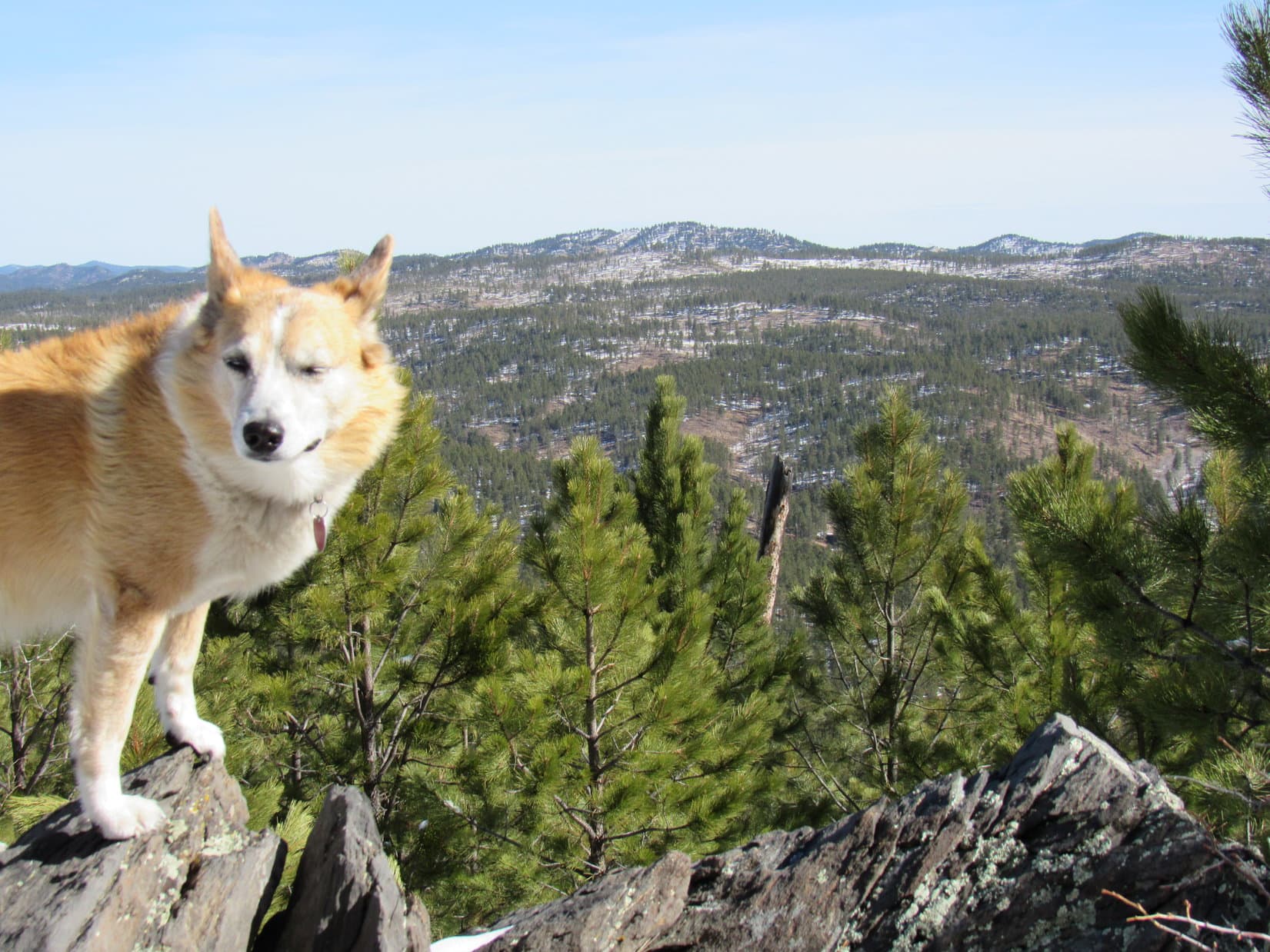
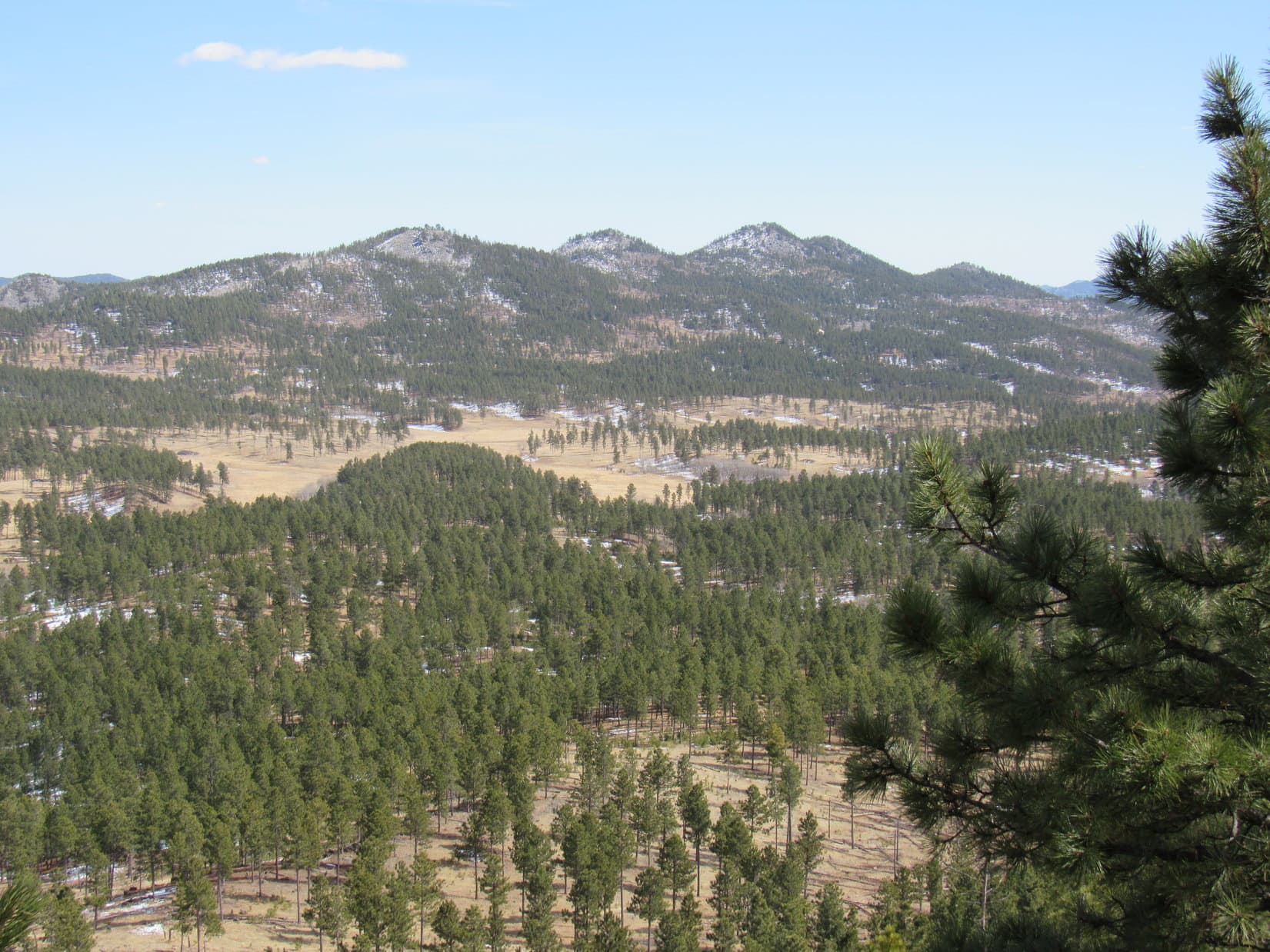
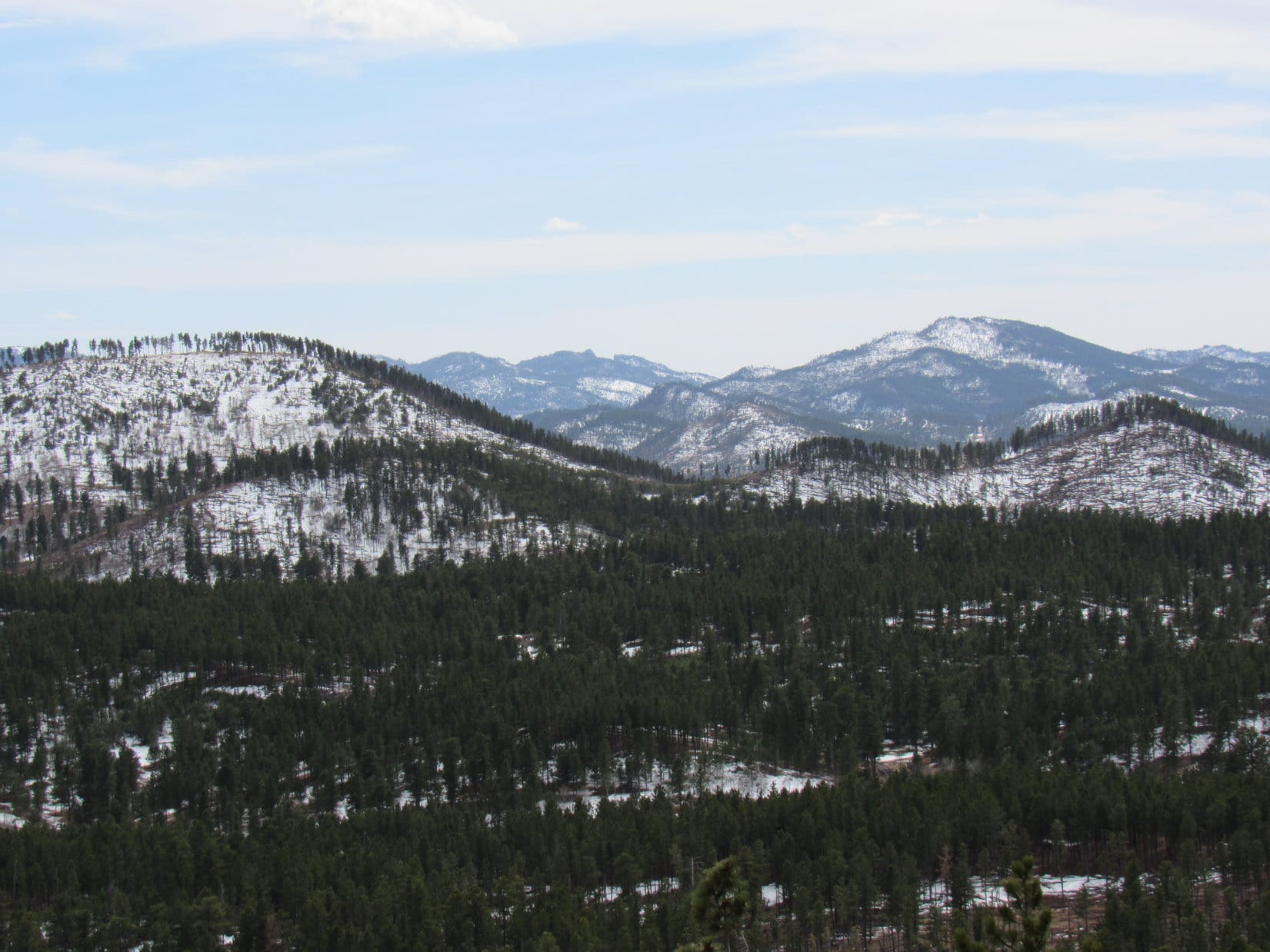
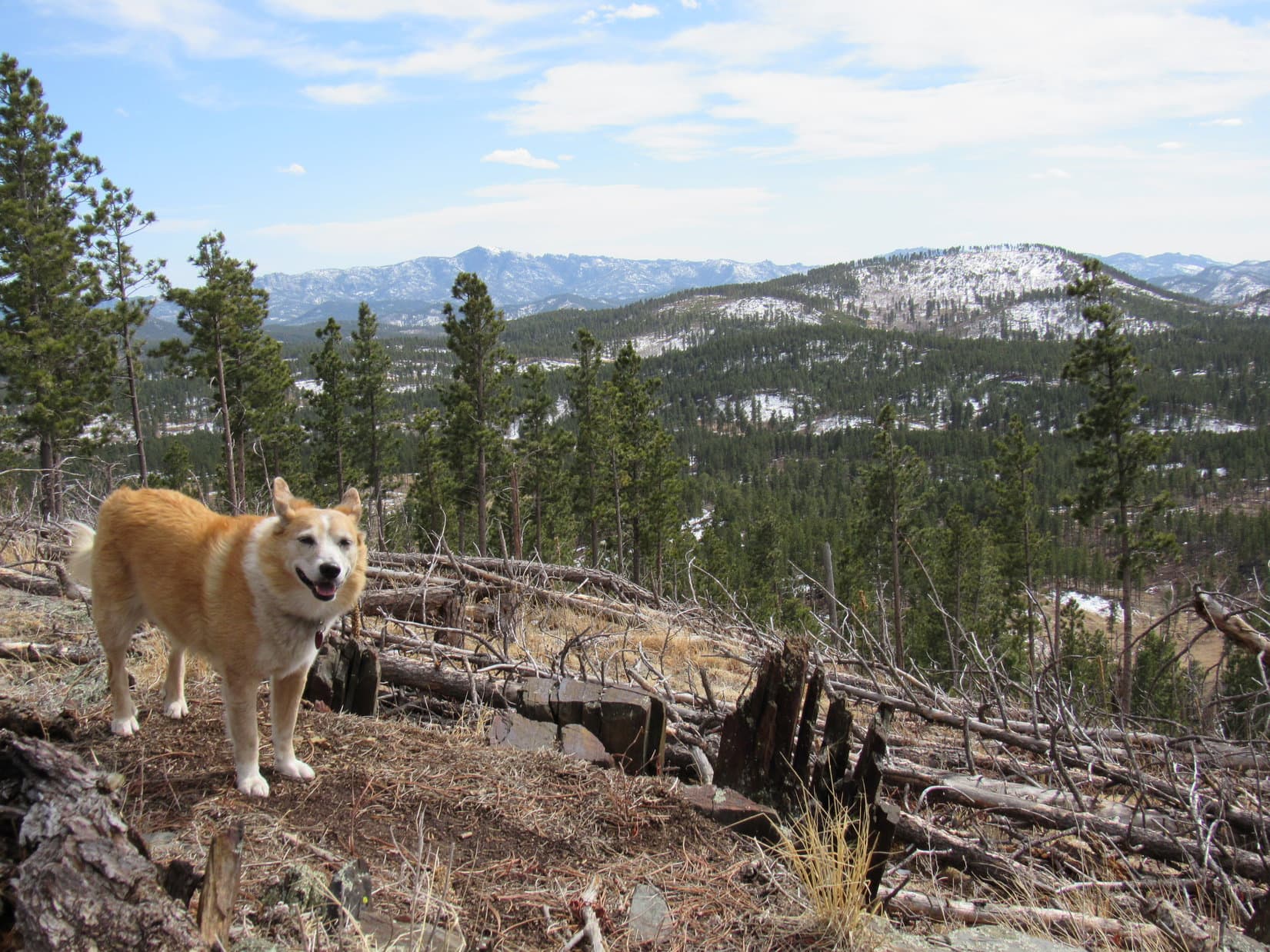
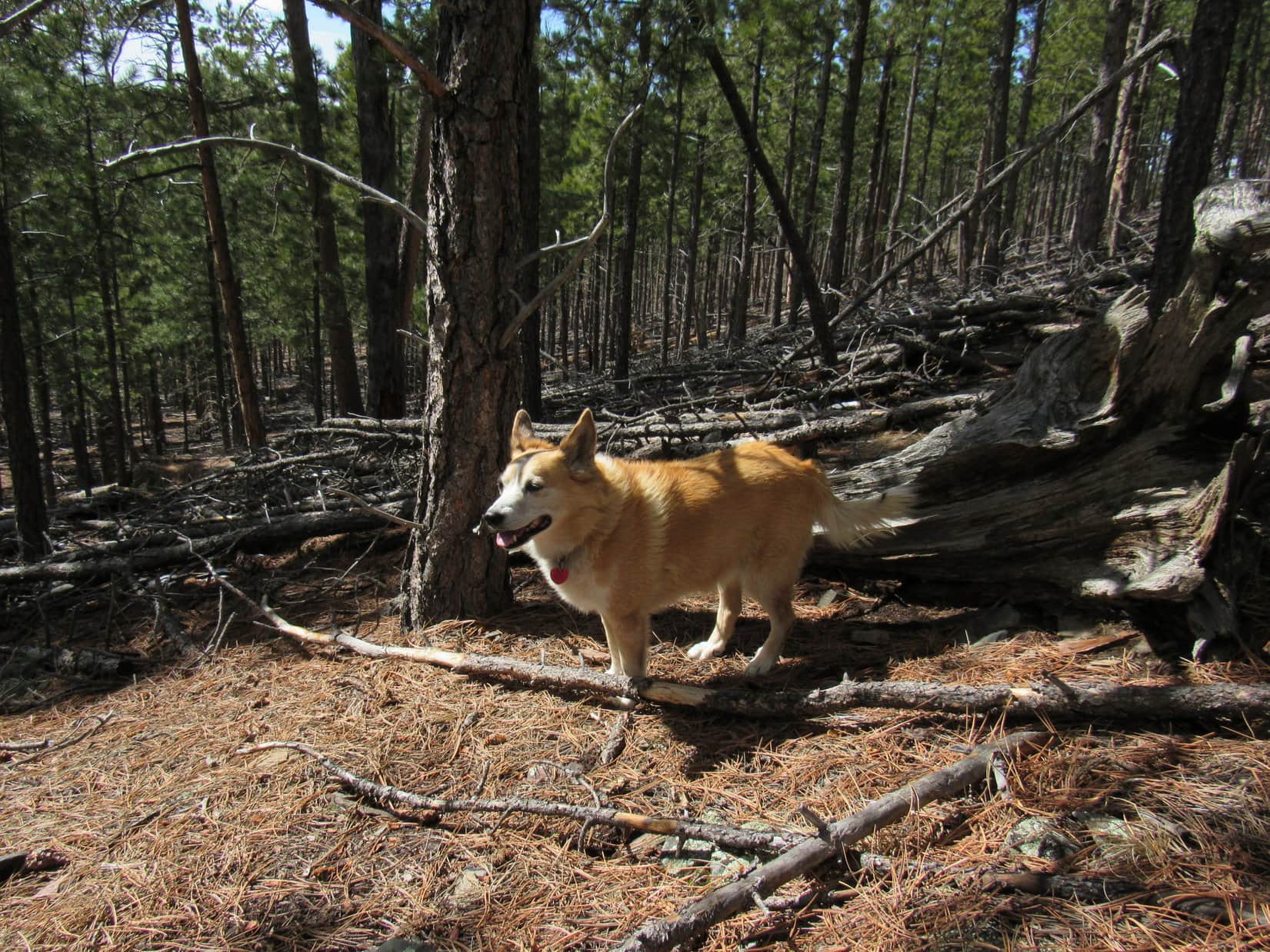
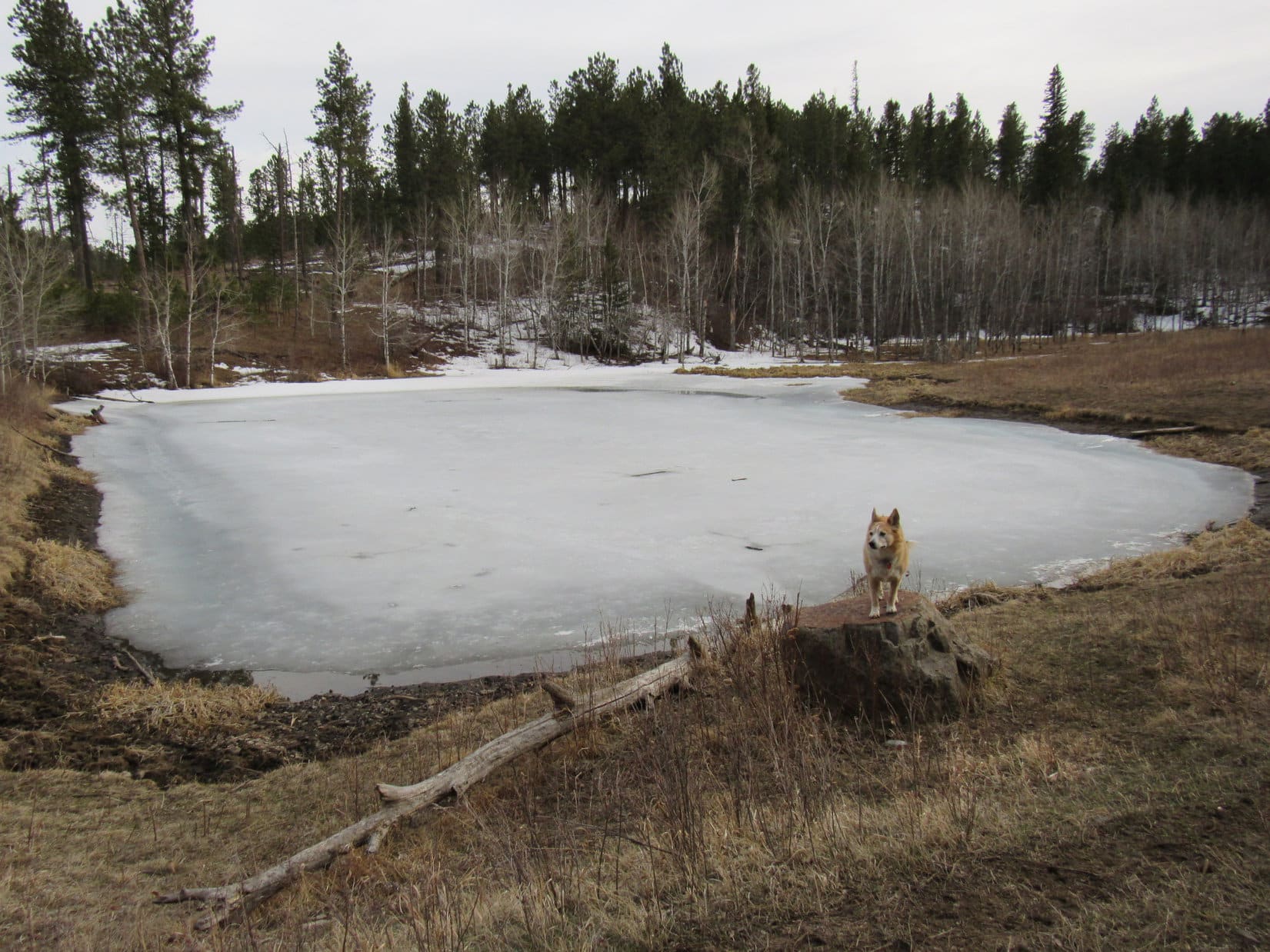
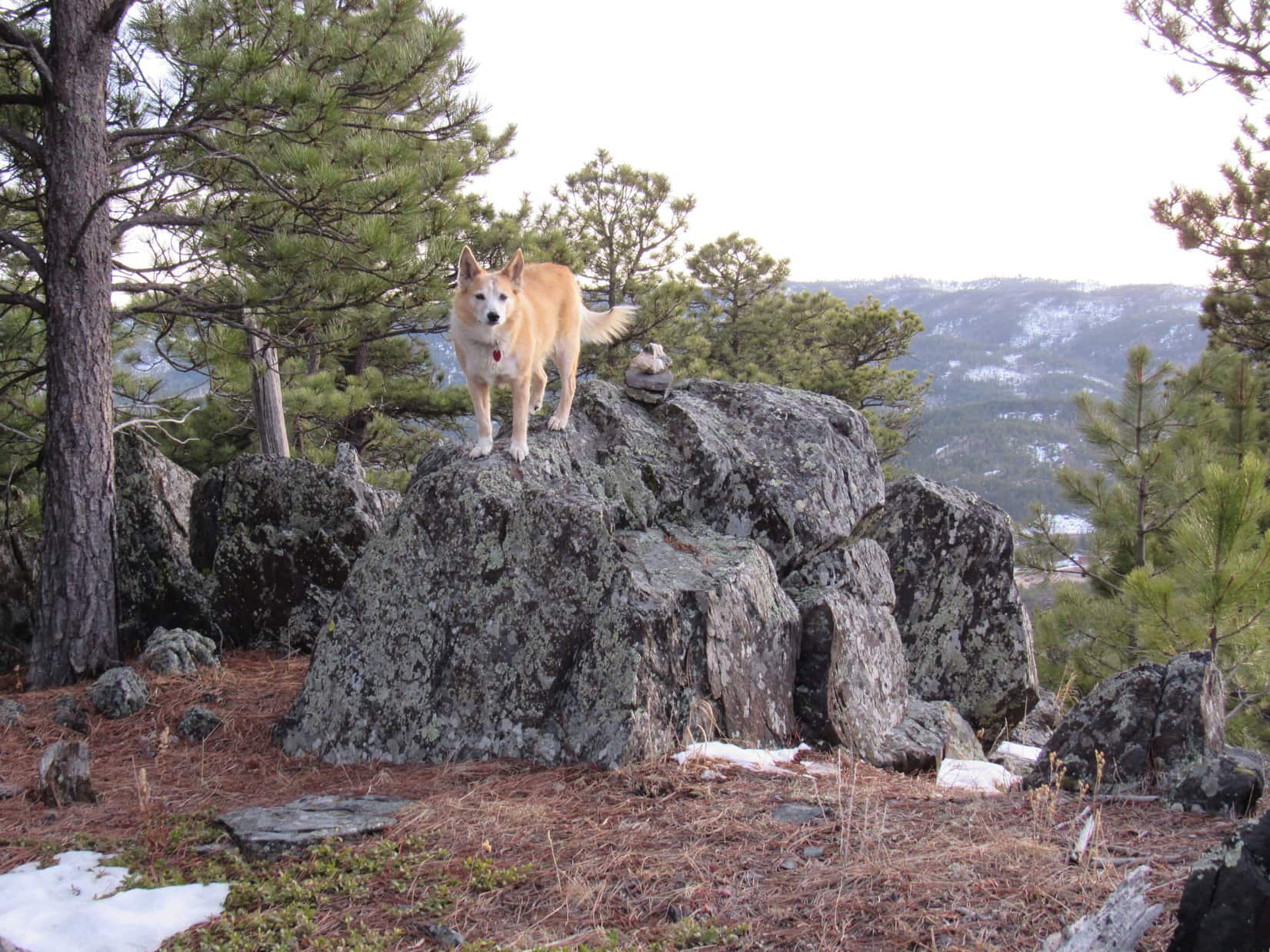
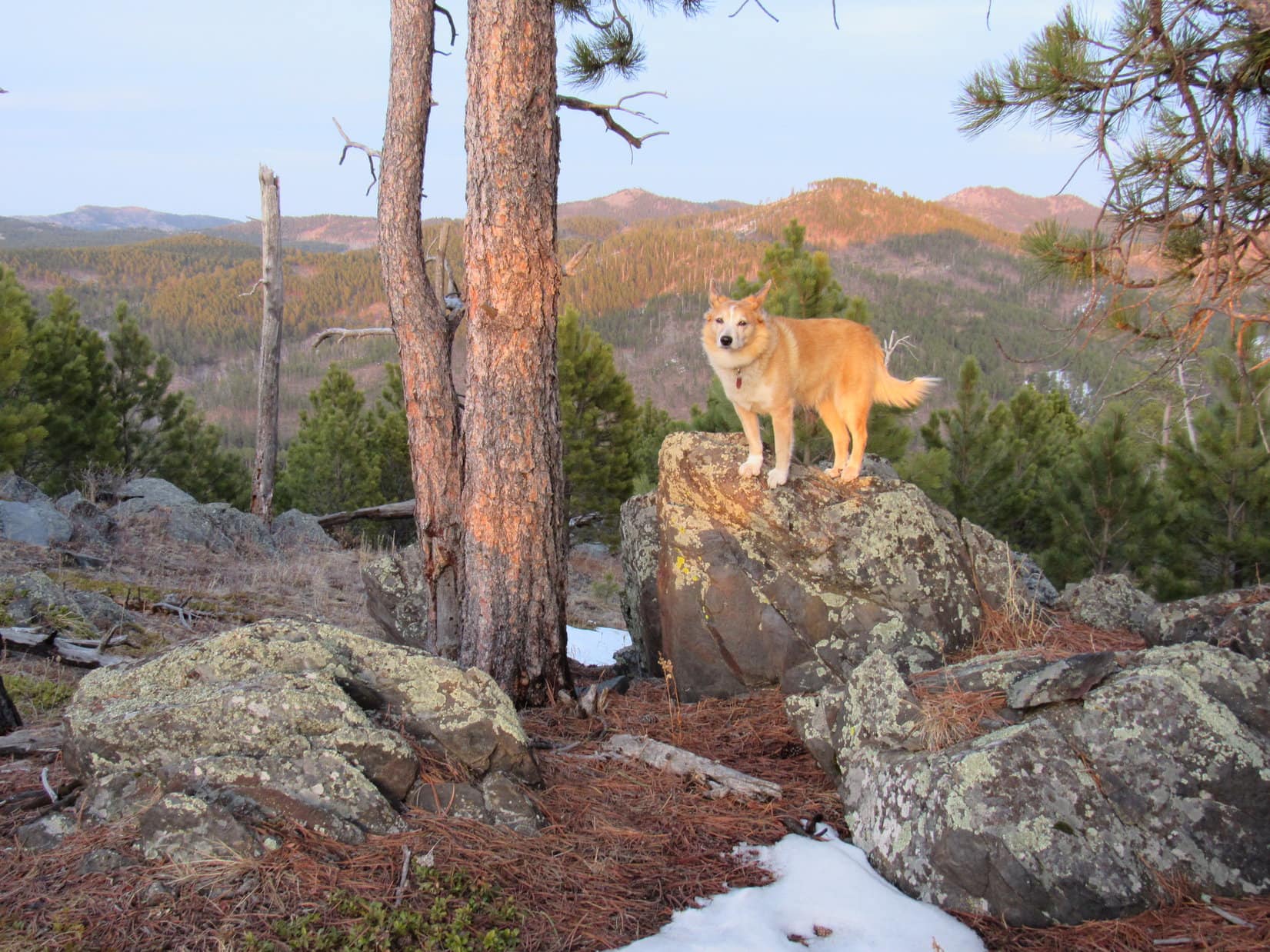
Black Hills, SD Expedition No. 272 – Centennial Trail No. 89: Iron Creek Horse Camp to Badger Hole (4-1-21)

8:29 AM, 32ºF, Centennial Trail No. 89, Iron Creek Horse Camp trailhead

SPHP!  Quiet!  Don’t move!  A mountain lion!

A lion!  Here at the trailhead?  Where?

SPHP glanced around.  Nothing.

Hah!  Made you look!  April Fools!

Oh, you’re a riot, silly Dingo!  C’mon, it’s a bit of a trek.  If we want to have time to climb a couple of side peaks along the way, we better get moving.

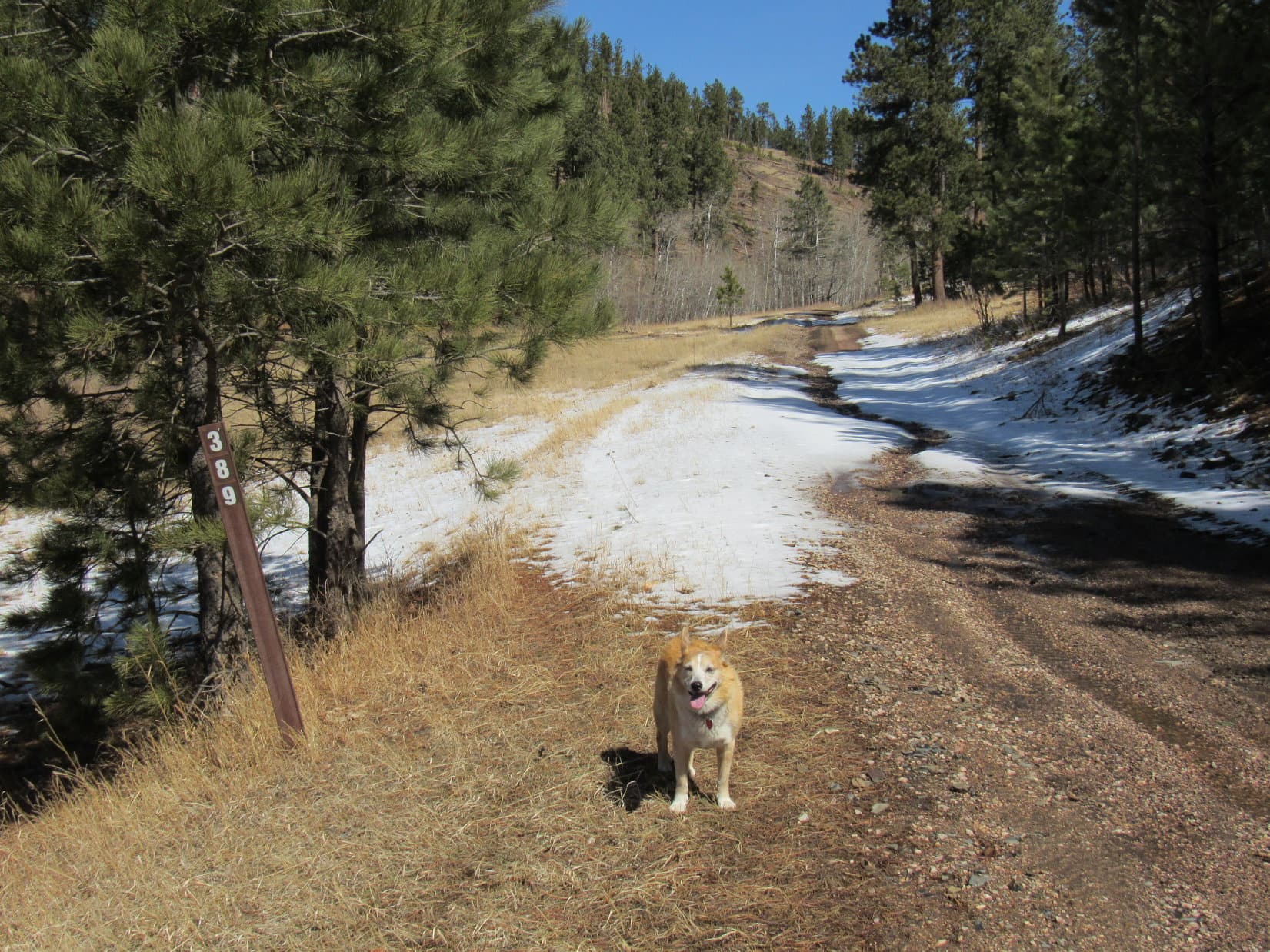
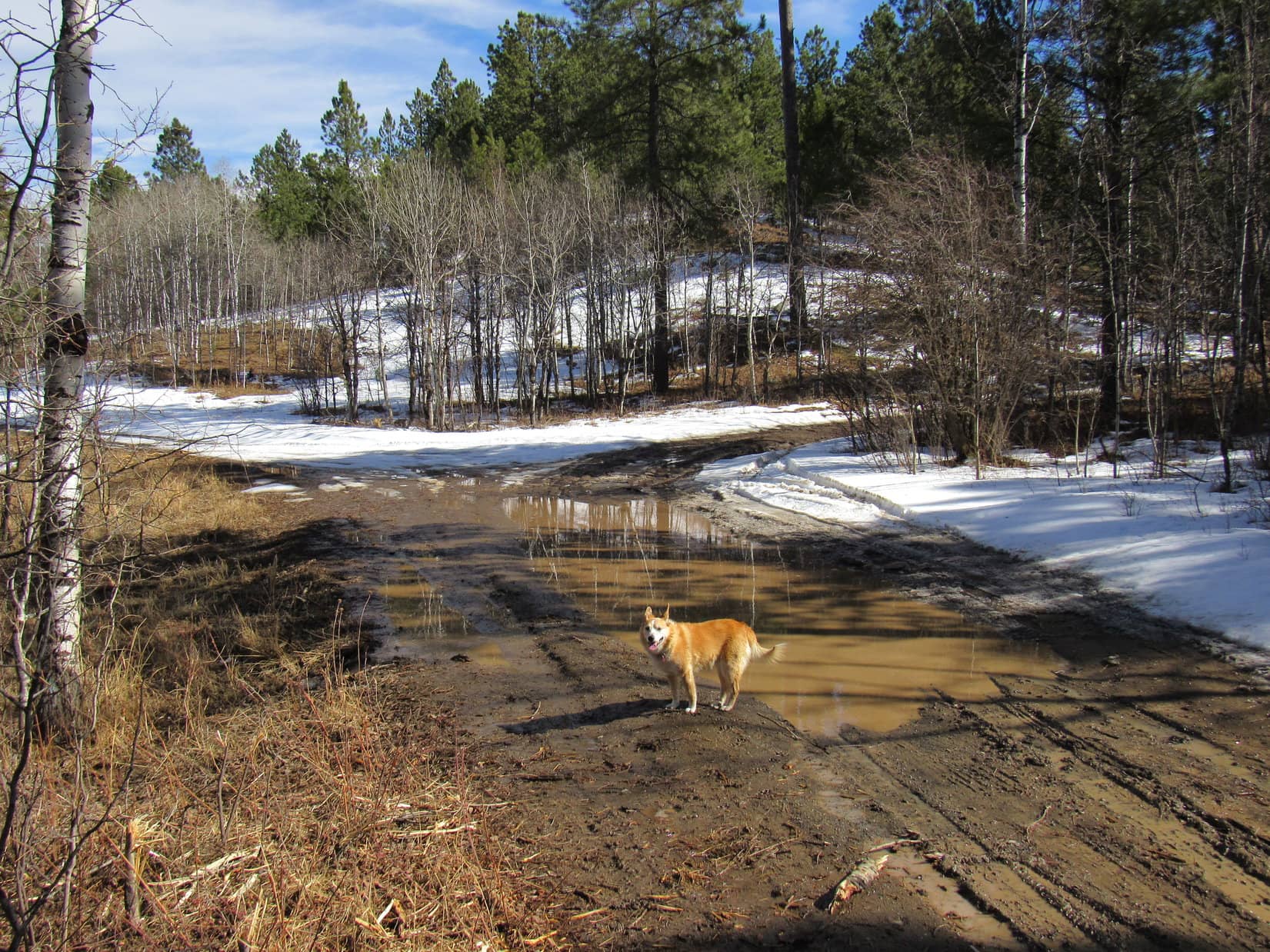
A mountain Dingo, but no mountain lions, at the Iron Creek Horse Camp trailhead. Photo looks N.

Destined for Badger Hole, Lupe left the Iron Creek Horse Camp trailhead heading S on Centennial Trail No. 89.  At least temporarily, spring had sprung!  Chilly this morning, but supposed to get as warm as a day in mid-May later on.  The trail still had a few icy stretches as Lupe followed it up a gentle valley.  Soon she was passing scenic granite formations while approaching a minor pass.

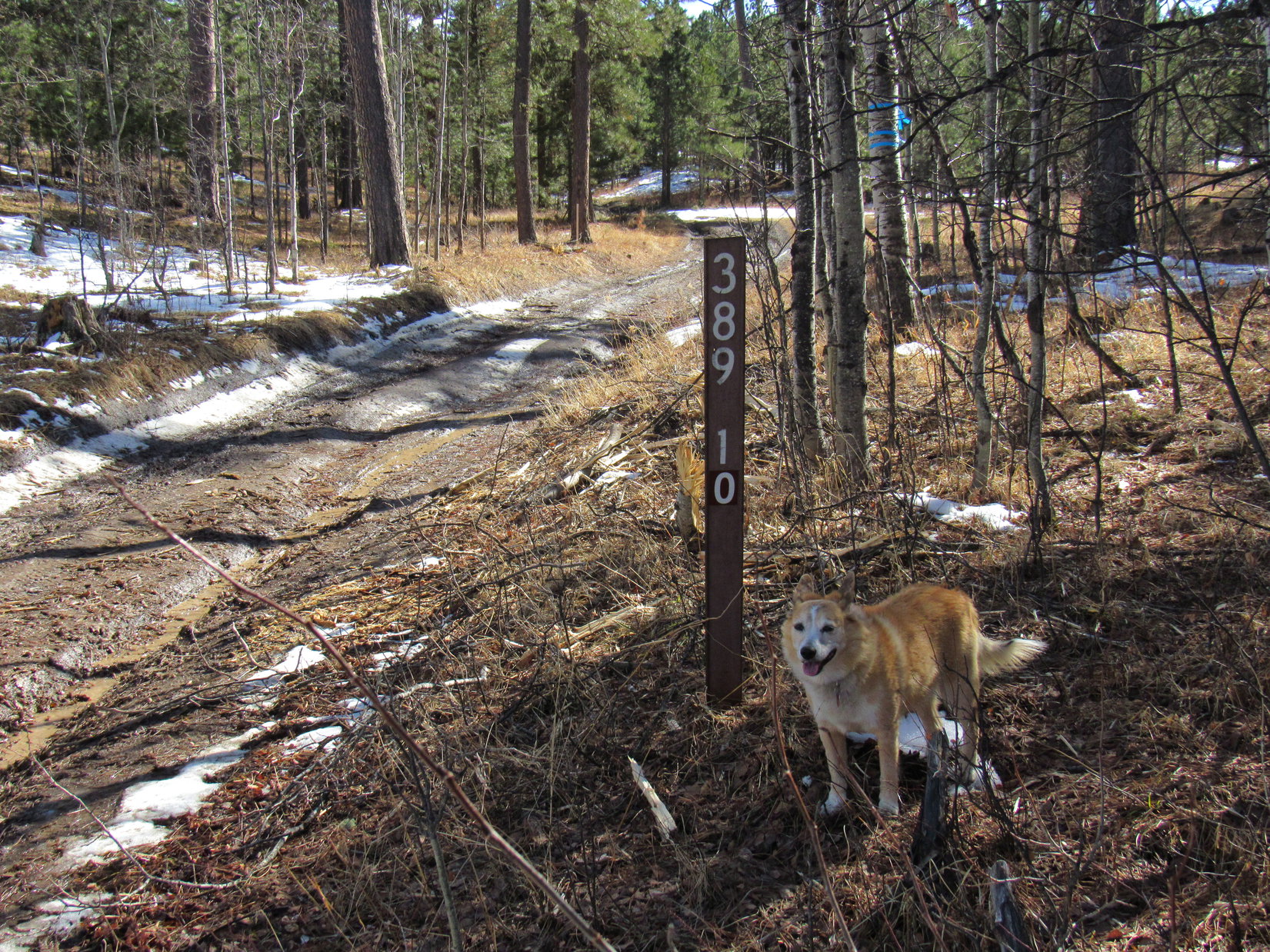
Exciting stuff! We’re hunting badgers today! This trail leads to their hole! Photo looks S.
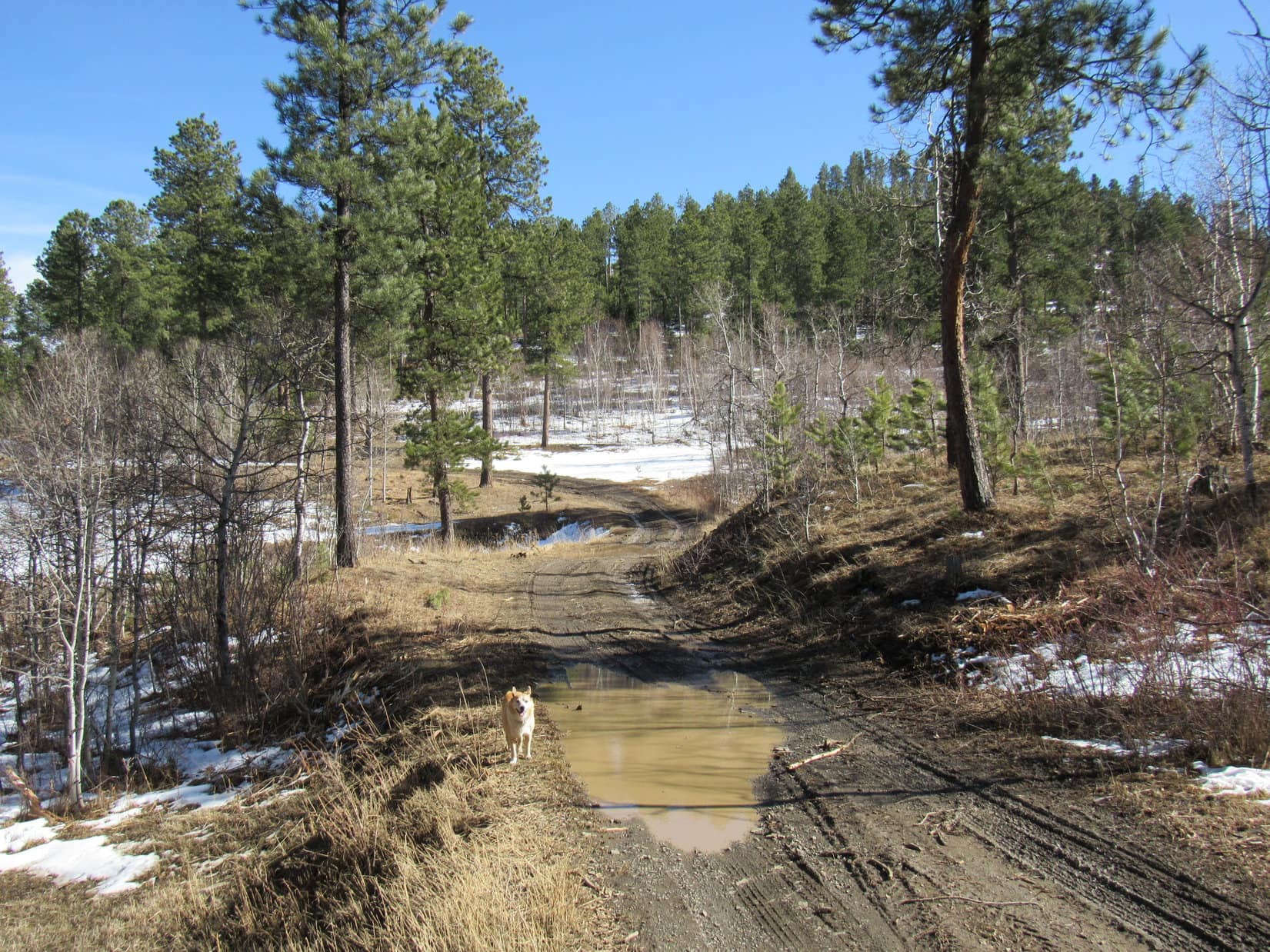
An icy stretch as the trail winds into the forest. Photo looks SW.
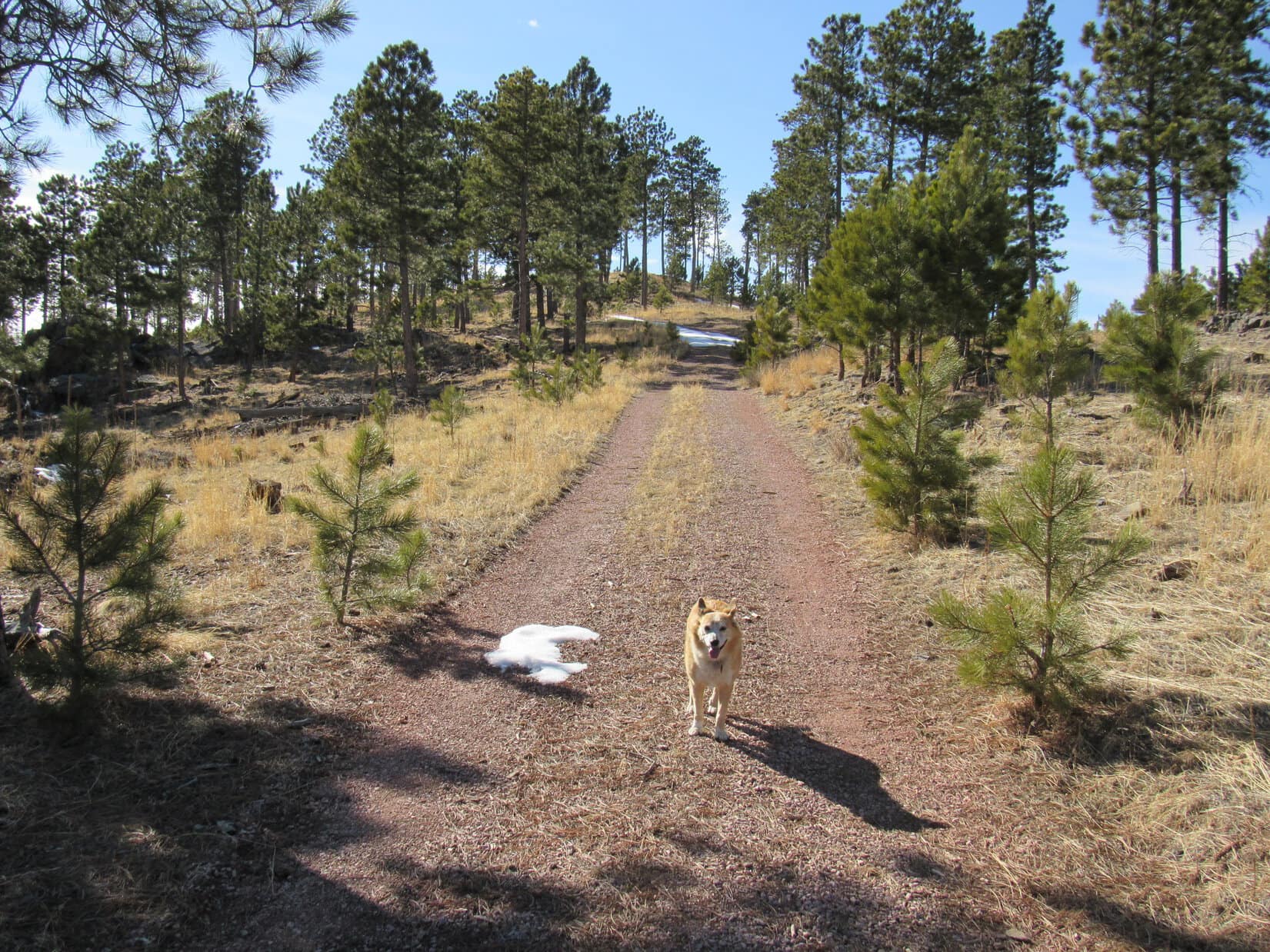
Passing granite formations. Photo looks SSE.

Beyond the pass was another gentle valley.  A side trail soon appeared on the L.  This was the spur to Centennial Trail No. 89’s official Iron Creek trailhead, which was different from the unofficial trailhead near the horse camp.  Lupe went on by the spur, sticking with the main trail.  Within a couple of minutes, the main trail turned R.  A sign said it was 7 miles to Legion Lake.

Junction with the official Iron Creek trailhead spur. (Sign on L.) Lupe kept going straight (R). Photo looks SE.
At the Legion Lake sign. Photo looks SW.

Heading SW through the forest over a little rise, the trail quickly brought Looper to Needles Hwy No. 87.  Across the highway, a closed gate over a side road could be seen a few hundred feet away.  When Lupe got to the gate, Centennial Trail No. 89 took off to the L.

Crossing Needles Hwy No. 87. Photo looks SW.
L of the gate where the trail leaves the side road. Photo looks SE.

From the gate, Centennial Trail No. 89 went up a to minor ridge offering the first somewhat distant view of the day, several forested hills.  Lupe crossed a dirt road that ran along the ridgeline, and started down into the next valley.  Passing big granite formations on the L, she arrived at “Badger Gate”, a couple of granite nodes the trail went between.

First distant views from the minor ridge. Photo looks SSE.
At Badger Gate. Photo looks S.

From Badger Gate, the trail continued down to a tiny creek, a tributary of Grace Coolidge Creek.  Off to the L (SE), a big field occupied the valley floor, but the trail didn’t enter it.  Crossing a few boards that bridged the tiny creek, Lupe had a view of the field as Centennial Trail No. 89 wound along a hillside staying in or near the trees.

Crossing the tiny tributary of Grace Coolidge Creek. Photo looks W.

The trail went up a slight rise before descending into a narrower part of the valley right on down to Coolidge Creek itself.  The stream was frozen over.  Centennial Trail No. 89 headed up the shady valley, never straying far from Coolidge Creek and crossing it twice.

Heading down into the upper Coolidge Creek valley. Photo looks SW.
By Coolidge Creek. Photo looks SW.
In the shady Coolidge Creek valley. Photo looks SW.

After the second Coolidge Creek crossing, Centennial Trail No. 89 began climbing out of the valley.  Lupe came to a region of exposed granite on the way to a broad, forested ridge.  Climbing more gradually, an old road led to a sunny open area which appeared to have been logged off some years ago.

Approaching the exposed granite. Photo looks NW.
On the broad forested ridge. Photo looks SW.
Entering the open region. Photo looks WSW.

The open region was huge!  Despite a few dips, the road went on and on, still gaining elevation.  Black Elk Peak (7,231 ft.) was in view off to the NW.  Smaller hills could be seen in almost every direction.

Didn’t expect to see so much open territory! Photo looks SSW.
Black Elk Peak (R of Center). Photo looks NW.
Looking back to the NE.

After a sunny mile or so, Centennial Trail No. 89 re-entered the forest.  The trees had been thinned here, too.  Big granite outcroppings were visible nearby.  The trail dipped going around the W side of an especially tall formation.  12 minutes later, Lupe made a discovery.

In the open forest. Photo looks N.
Heading into the dip. Photo looks SW.

SPHP!  Look!  A monster!

Oh, yeah right, Miss April Fools!

Turned out she was right!  This time the American Dingo wasn’t fooling!  The Claw was lurking just ahead.  Peak 5880 was visible beyond it.  Lupe would have to go right past The Claw, if she wanted to get there.

Peak 5880 (Center). The Claw (R). Photo looks S.

Fortunately, The Claw was acting none too lively.  It appeared to have been lurking here for so long that it had forgotten why.  Slipping past it was no great feat at all.  Soon the Carolina Dog was closing in on Peak 5880.  Centennial Trail No. 89 was heading right for it.

By The Claw, which seemed comatose.
Peakbagging time coming up! Peak 5880 (Center). Photo looks S.

When the trail got to the N side of Peak 5880, it curved SE along its base.  Peak 5880 was a chance to do a little peakbagging.  In fact, Lupe had climbed it once before only a couple of years ago.  The American Dingo left the trail where it got closest to a saddle 0.2 mile SE of the summit.

Snow, slash, and various chunks of wood left by loggers to contend with, but overall, getting up to the saddle wasn’t all that hard.  From here, Lupe enjoyed a distant view of Northeast Cicero Peak (6,240 ft.).

Off-trail, approaching the saddle. Photo looks S.
At the saddle. Northeast Cicero Peak (Center). Photo looks SW.

The climb along the SE ridge to the summit was much harder, partly since it was steeper, but mainly due to copious quantities of deadfall.  The ridge finally leveled out, though, and Lupe came to a platform of rock overlooking a last slash-filled gap leading to the summit.

Almost there! Peak 5880 summit (L). Black Elk Peak (far R). Photo looks NW.

11:58 AM, 58ºF, Peak 5880 – Lupe stood on one of the highest rocks, then it was time for a break.  Peak 5880’s cramped summit region had enough room to allow the Carolina Dog to relax practically right next to the true summit rock, but not to move around much.

Peak 5880 summit. Photo looks NNW.

Is it lunch time yet, SPHP?

Practically on the dot, Loopster!  You hungry, thirsty?

Thirsty?  Not really.  Been eating snow.  Not that hungry yet, either, but if you happen to have a chocolate coconut bar in that pack, it would go down pretty easy right about now!

You don’t say!  As always, I presume.  Well, I’ll see what I can do.

The chocolate coconut bar supply took a hit, and minor shrinkage of the Taste of the Wild supply occurred, too.  SPHP slowly munched an apple.  Off to the E were a couple of ridges Lupe had climbed once upon a time, Peak 5647 and Peak 5733, but that was about it for views due to the big pines that were providing all the shade.

Peak 5647 (L) and Peak 5733 (Center). Photo looks E.

Loop and SPHP lollygagged up by the true summit well after the apple no longer existed, but there was a limit to how long that could go on.

Not a bad spot, but never really thought we would ever be back here, did you, Looper?

Oh, it doesn’t bother me coming back to the same places again, SPHP!  A new experience every time!  You never know what might be different.

True enough, but that’s not what I meant.  This just seems like an out of the way place.  If it weren’t for Centennial Trail No. 89 bringing us right past Peak 5880, we probably would have kept busy with other stuff, and never been back.

I’m glad we’ve returned, SPHP, but maybe we ought to have a look around, since this might be it for Peak 5880 the way you talk!

Good idea!  We’re still miles from Badger Hole, so let’s do that, then head back to the trail.

Don’t listen to SPHP! If you enjoy climbing mountains, Peak 5880 is worth the side trip! Photo looks S.
Out on the short, rocky N ridge. Photo looks NE.
Summit from the start of the N ridge. Photo looks S.

After venturing out onto the steep, rocky N ridge, Lupe had to go back over the summit and downclimb a bit to explore a larger, flatter area to the S.  Not much to be seen since this region was densely forested, but Loop did get a glimpse of Mount Coolidge (6,023 ft.) to the S.  Off to the SW, Custer Mountain (6,089 ft.) and Peak 6040 were visible beyond Stockade Lake.

Mount Coolidge (Center). Photo looks S.
Stockade Lake is still frozen! Photo looks SW.
Custer Mountain (L) and Peak 6040 (Center) beyond Stockade Lake. Photo looks SW with help from the telephoto lens.

Peak 5880 had been a fun break.  Having seen what there was to see, Loopster returned to Centennial Trail No. 89 by essentially the same route she had come up.  Leaving Peak 5880 behind, the trail curved NE beginning to lose elevation.  A turn to the R (E) following a different dirt road led down to a low spot in a wide valley.

Loop was now in the upper reaches of the Little Squaw Creek valley, but so far up it that there was no sign of a creek.  Centennial Trail No. 89 went around the N side of a fenced area, turned S, and began to climb.  Lupe soon came to a pass with massive granite walls on the L (E).

Going around the fence down in the Little Squaw Creek valley. Photo looks E.
Approaching the next pass. Photo looks SSE.

The next valley, also dry, was part of the Galena Creek drainage system.  Huge granite formations E of the trail eventually disappeared as Lupe kept going.  The valley widened, and became quite grassy and flat.

Upper reaches of the Galena Creek drainage. Dry as a bone here! Photo looks S.

10 minutes from the pass, the trail divided at a well-signed junction.  The Carolina Dog had a choice.  Take the trail veering off to the L (SE), which was the shortest route to Badger Hole, or stay farther W continuing S down the valley?

Sign for the short route. Only 1.5 miles to Badger Hole this way! Photo looks SE.
The long way. 2.5 miles to Badger Hole. Photo looks S.

Any preference, SPHP?  I’d sort of like to catch a badger as soon as possible!

Oh, doesn’t that sound like fun?  A badger – Dingo fight!  However, the short route goes partway up Peak 5733, and I’d like to save that for later on the way back.  Take the long route, please.

Siding with the badger, are you, SPHP?  Giving it a reprieve?  Fine!  Just dandy!  Only temporary, I assure you.  As you wish, the long route it is!

Lupe continued straight.  The valley went on and on, soon narrowing and winding.  The Carolina Dog journeyed through both grasslands and open forest.  A micro-tributary of Galena Creek eventually materialized.  In shady regions, sometimes there was still some slushy ice or snow.

Continuing down the valley. Photo looks SE.

The American Dingo must have been nearly 1.5 miles from the last pass she’d gone over when traffic could be heard ahead.  Centennial Trail No. 89 went by a house as it reached Hwy 16A.

Near the S end of the valley. Hwy 16A just ahead. Photo looks SE.
At the house next to Hwy 16A. Centennial Trail No. 89 on the L. Photo looks NW.

Unlike the Needles Hwy much earlier in the day, Hwy 16A was busy.  Loop had to wait for a chance to cross safely.  Galena Creek was down in the ditch on the other side.  A couple of boards provided a bridge, but the creek was so small even SPHP could have just stepped across if they hadn’t been there.

Safely over on the S side of Hwy 16A. Photo looks WSW.
Crossing Galena Creek. Photo looks SE.

Once over Galena Creek, Centennial Trail No. 89 began a steady climb through a forested area.  Lupe gained 200+ feet of elevation before the trail leveled out again at a field.  Mount Coolidge (6,023 ft.) was directly ahead, not looking all that much higher.

Regaining elevation S of Hwy 16A. Photo looks SW.
Mount Coolidge (Center) from the field. Photo looks SSW.

Mount Coolidge looked so close, that SPHP considered taking it on.  Only a passing thought.  Appearances were deceiving.  The actual summit was higher than what could be seen from here.  Furthermore, it turned out that there was a deep ravine between this field and the mountain.  Upon reaching the edge of the ravine, Centennial Trail No. 89 curved SE, then E, following the upper rim of the ravine lower.

Losing all the elevation she had just regained and more, Lupe ended up down in Sheep Draw where a square stand of aspens stood enclosed within a fence.  An off-trail shortcut could have been taken directly to Badger Hole from here, but Loopster stuck with the trail as it turned SE again heading up to yet another pass.

In Sheep Draw. Photo looks E.

The last pass was a minor one.  Lupe was soon over it and down in a low spot in the next valley.  Centennial Trail No. 89 turned SW starting to climb again, but Lupe didn’t need to that way.  She had reached the spur trail to the Badger Hole trailhead, now only 0.5 mile away.

Start of the spur trail to the Badger Hole trailhead. Photo looks NE.
Closing in on Badger Hole. Photo looks ENE.

3:05 PM, 62ºF, Centennial Trail No. 89, Badger Hole trailhead

Lupe sniffed in vain.

Unbelievable, SPHP!  Take the long way you said!  You deliberately gave the badger time to escape!  What I don’t understand is how the badger managed to take even its hole with it!  Not a whiff of badger or hole left!

Sorry, Loopster!  Don’t ask me!  How am I supposed to know where the badger or its hole went?  You see the sign!  No doubt about it, this is the right place!

Well, looks like that cowardly badger is forfeiting! This is Dingo Hole trailhead from now on! Photo looks S.

Wait a minute, SPHP!  What does that other sign over by the hill say?

Badger Clark Memorial, Open 10:00 AM to 5:00 PM, Memorial Day to Labor Day.

At Badger Hole. Photo looks W.

Oh, so that’s the badger’s game, is it?  Holed up in a castle on the hill until Memorial Day, aye?

Apparently so!  See, it didn’t make any difference which route we took as far as the badger is concerned.  Busy hibernating or something until summer.

Well, phooey!  Tricky, scaredy-cat badger!  Doesn’t dare come out until I’m safely away on my summer Dingo Vacations!

Must be one brainy badger, Loopster!  Nothing we can do about it.  C’mon, Legion Lake isn’t far from here.  Let’s go have a chocolate coconut bar break there.

Nothing to take one’s mind off a slippery badger like a chocolate coconut bar!  Lupe headed NW on the road to Legion Lake, and was soon there.  The bar was devoured along the shore near the spillway.  This time the chocolate coconut bar functioned as a mere appetizer.  A healthy helping of Taste of the Wild got crunched up, too.

The chocolate coconut bar met the same fate here meant for the badger! Delicious! Legion Lake. Photo looks NW.

Strolling along the NE shore of the lake, Mount Coolidge was once again in sight.  Lupe came to a sandy beach.  Amazingly, even though most of Legion Lake was still covered with ice, a couple of crazy Canadians were out there swimming!

Mount Coolidge (Center) from Legion Lake. Photo looks SW.
Show-offs!

In no big rush, Loop and SPHP ambled on past the Legion Lake Lodge.  Closed now, but that would change.  Tourist season was due to kick off with Custer State Park’s free weekend the week before Memorial Day.

Near the Legion Lake Lodge. Photo looks SE.

3:32 PM, 60ºF, Legion Lake in Custer State Park – Getting sort of late in the day with such a long way back to the Iron Creek Horse Camp.  Better head out!  Crossing Hwy 16A, Lupe and SPHP startled a herd of deer grazing in the Legion Lake campground.

The campground was closed, but Loopster trotted through it.  No sign, but way at the far NW end was the start of the E side of the loop that went back to the trail junction where SPHP had advised the American Dingo to take the long route to Badger Hole.

Leaving the campground. Photo looks NNW.

SPHP wasn’t sure if this was even officially part of Centennial Trail No. 89.  No brown “89” wands here.  Unnumbered blue diamonds on the trees marked the route.  The trail started up a little valley, but was soon climbing toward a ridgeline on the R (NE).

Easily the steepest route of the day, except for Lupe’s side jaunt up Peak 5880.  SPHP stopped frequently to gasp for air.  Reaching the ridgeline did nothing to slow the rate of ascent as the trail began curving W.  Mount Coolidge (6,023 ft.) looked a lot higher from here.

Mount Coolidge. Photo looks SSW.

After gaining hundreds of feet of elevation, the trail began to level out as it headed SW traversing a steep slope.  The trail was just beginning to turn NW when Lupe reached its high point by a number of big rocks with tree-broken views.

Traversing the steep slope. Photo looks SW.
At the trail’s high point. Photo looks SW.

Lupe had been here had been nearly 9 years ago, sometime back in 2012.  Directly ahead, the trail started down again at a good clip.  SPHP couldn’t remember exactly where it went, maybe even up to a higher spot farther on, but one way or another it would get the Carolina Dog back to the same Centennial Trail junction she had been at earlier.

Decision time, Looper!  Want to stick with the trail, or climb Peak 5733?

If we have time, let’s climb!

Heading up a steep, rocky S ridge, SPHP was a little afraid that it might become impassable.  It didn’t.  Lupe reached a level spot where a short break was taken.  Consulting the topo map, it appeared the summit was still nearly 0.33 mile due N and 200 feet higher.
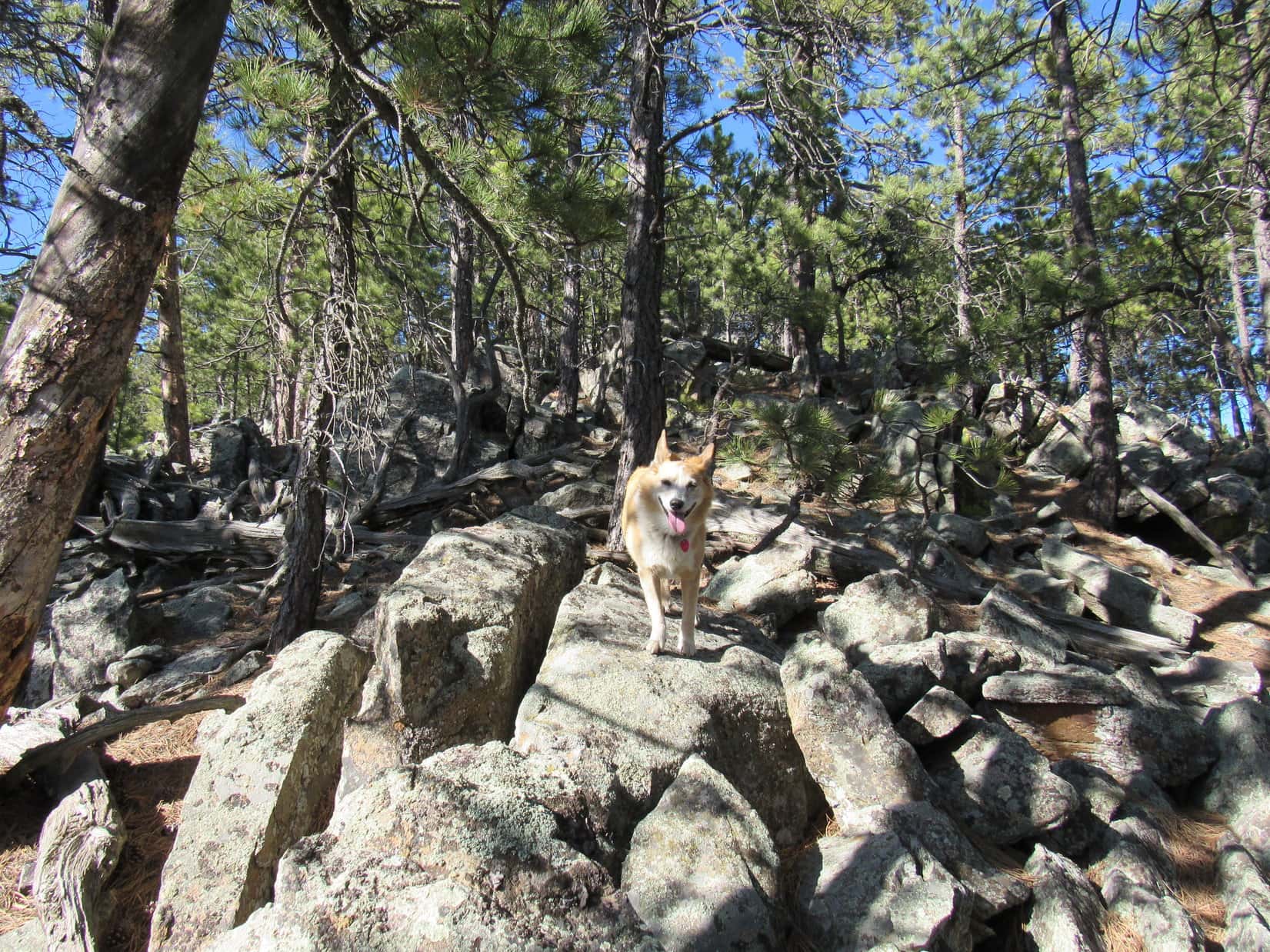
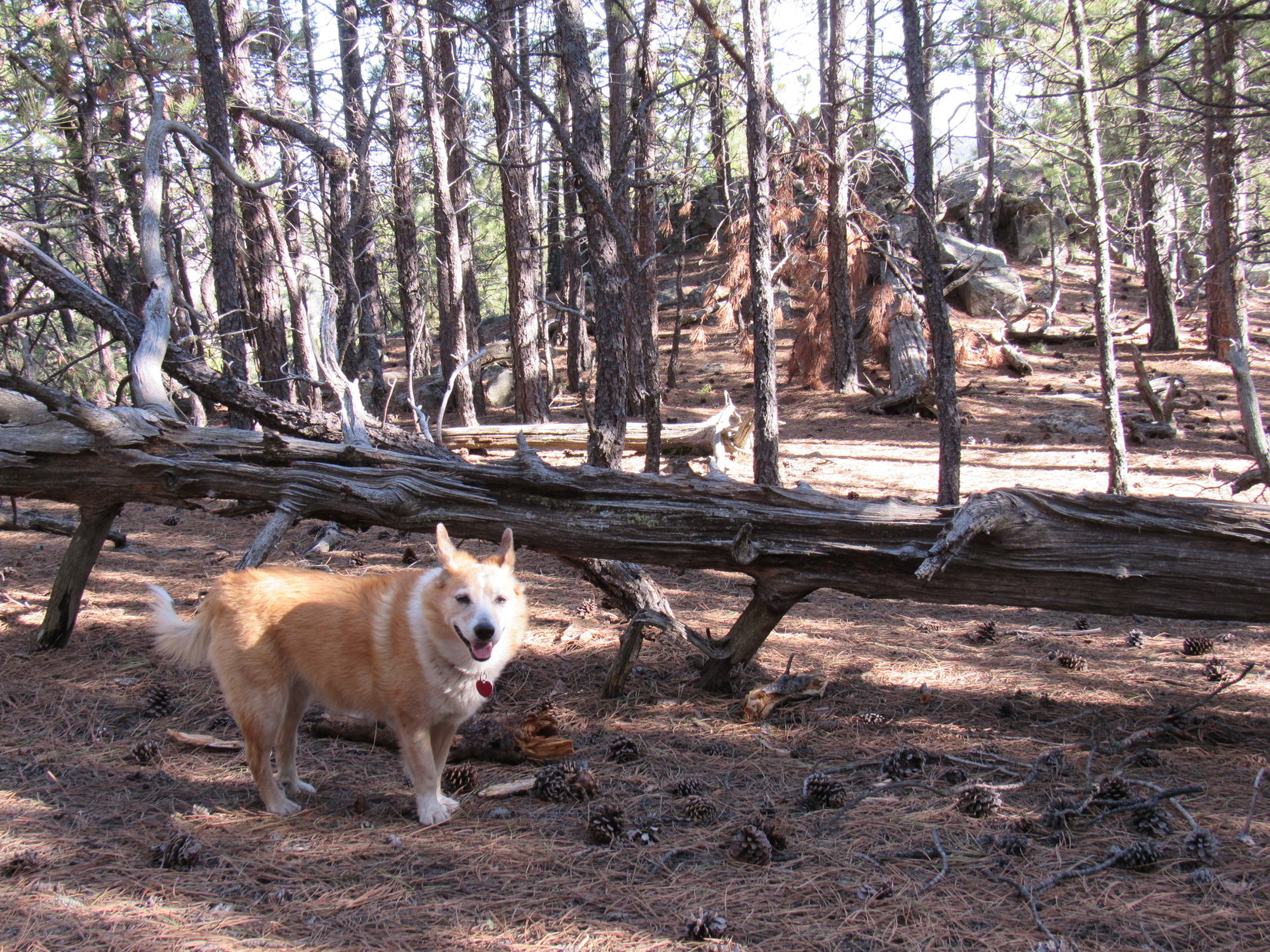
Climbing the S ridge. Photo looks N.
At the level spot where a short break was taken. Photo looks SE.

Actually farther than that the way the ridge went.  Lupe followed the ridge as it now turned NW.  She was soon approaching a significant high point that she really didn’t need to climb.  Traversing a steep, thickly forested slope, the Carolina Dog managed to skirt E of the high point to reach a saddle SW of the summit.

This saddle featured a couple of dramatic knobs of granite.  Lupe got up on one of them just for fun.
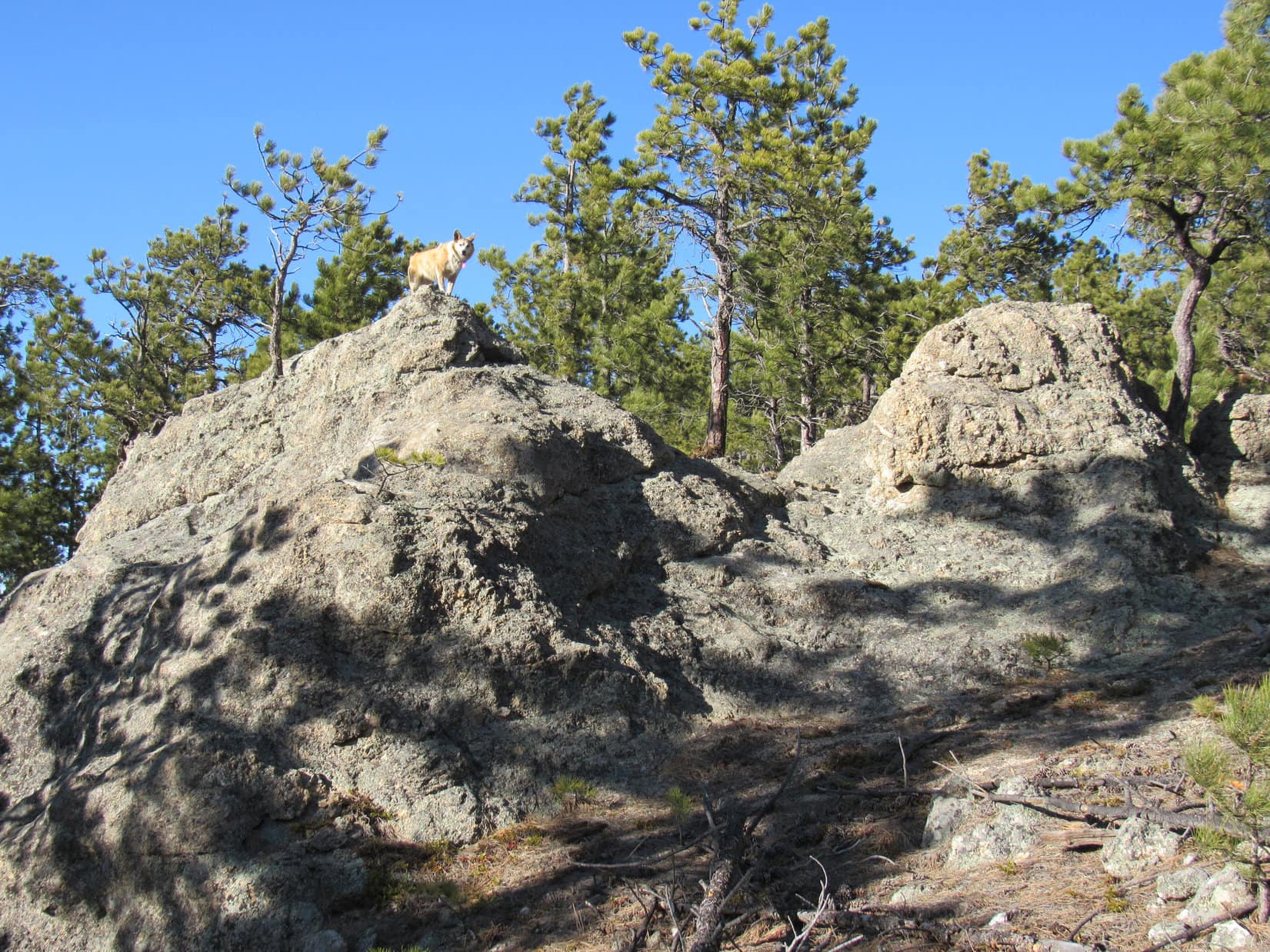
At the saddle SW of Peak 5733’s summit. Photo looks N.

Deadfall and slash!  Wasn’t that far from the saddle to the summit, but it was a typical slow trek through the wreckage.  Lupe paused for views once or twice on the way.  When she finally got to the top of Peak 5733, she leapt onto the true summit rock to claim her peakbagging success, then it was time for a break.

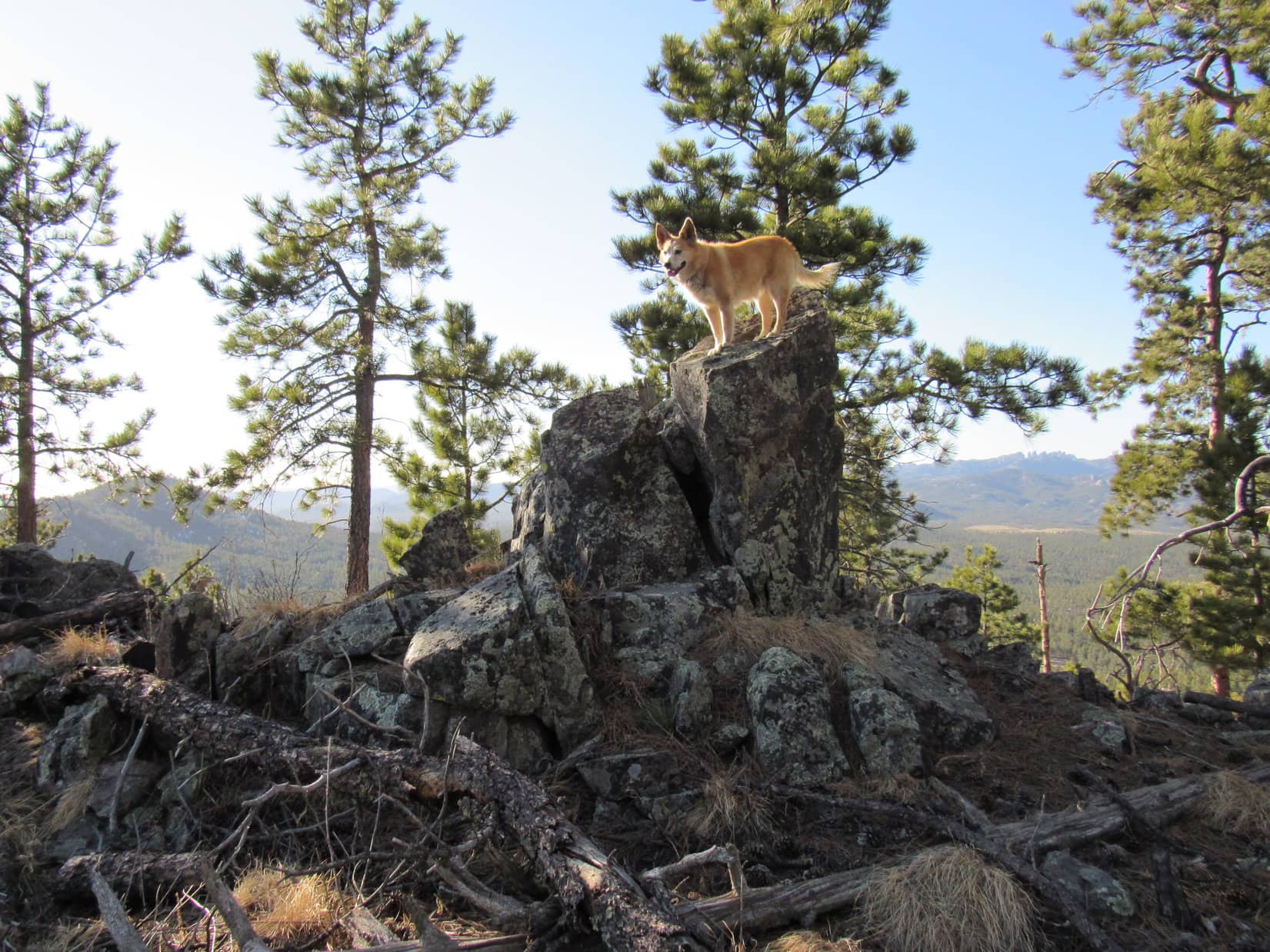
Black Elk Peak (L of Center), as seen on the way up Peak 5733. Photo looks NNW.
Success! At the true summit of Peak 5733. Photo looks WNW.
Break time.

5:14 PM, 55ºF, Peak 5733 – Breezy up here, for the first time today.  The last chocolate coconut bar and apple met their fates.  Quiet, serene.  This was another minor unnamed peak that SPHP had never expected Lupe to return to, yet here she was.

Looper and SPHP sat together for a while, taking in the big view off to the NW.  Omnipresent Black Elk Peak (7,231 ft.), plus Cathedral Spires (6,840 ft.), Little Devils Tower (6,960 ft.), Sylvan Hill (7,000 ft.) and Peak 6735, too.

To the W, Peak 5880, where the American Dingo had been only hours ago, and somewhere between here and there, Centennial Trail No. 89.

Sylvan Hill (L) and Black Elk Peak (R). Photo looks NW.
Little Devils Tower (far L), Cathedral Spires (L), Black Elk Peak (R of Center) and Peak 6735 (R). Photo looks NNW with help from the telephoto lens.
Peak 5880 (L) and Sylvan Hill (R). Photo looks NW.

Definitely going to get dark before the Carolina Dog could make it back to the Iron Creek Horse Camp.  No worries!  Reach Centennial Trail No. 89 again, and Loop would speed along having a blast on this beautiful early April evening.  Something to look forward to!

20 minutes after arriving, it was good-bye to Peak 5733.  Lupe headed down the slash-ridden NW slope.  As soon as she was below the worst of it, SPHP picked up the pace.

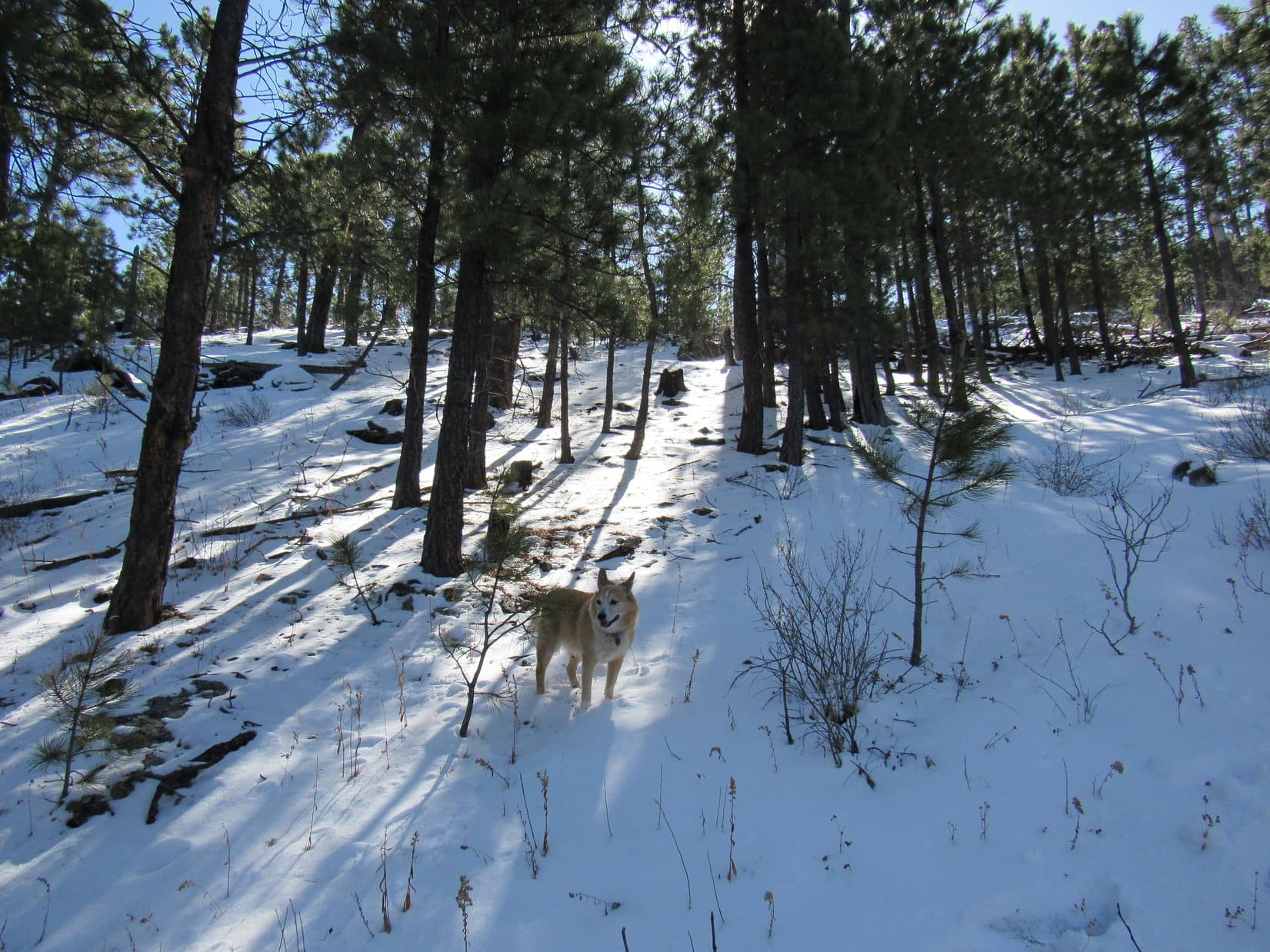
Ahead, sunlight streamed through open forest illuminating a broad, steady ramp lower.  Lovely!  Getting to the Little Squaw Creek valley where the American Dingo could pick up Centennial Trail No. 89 again was going to be a snap!  (End 8:17 PM, 39ºF)

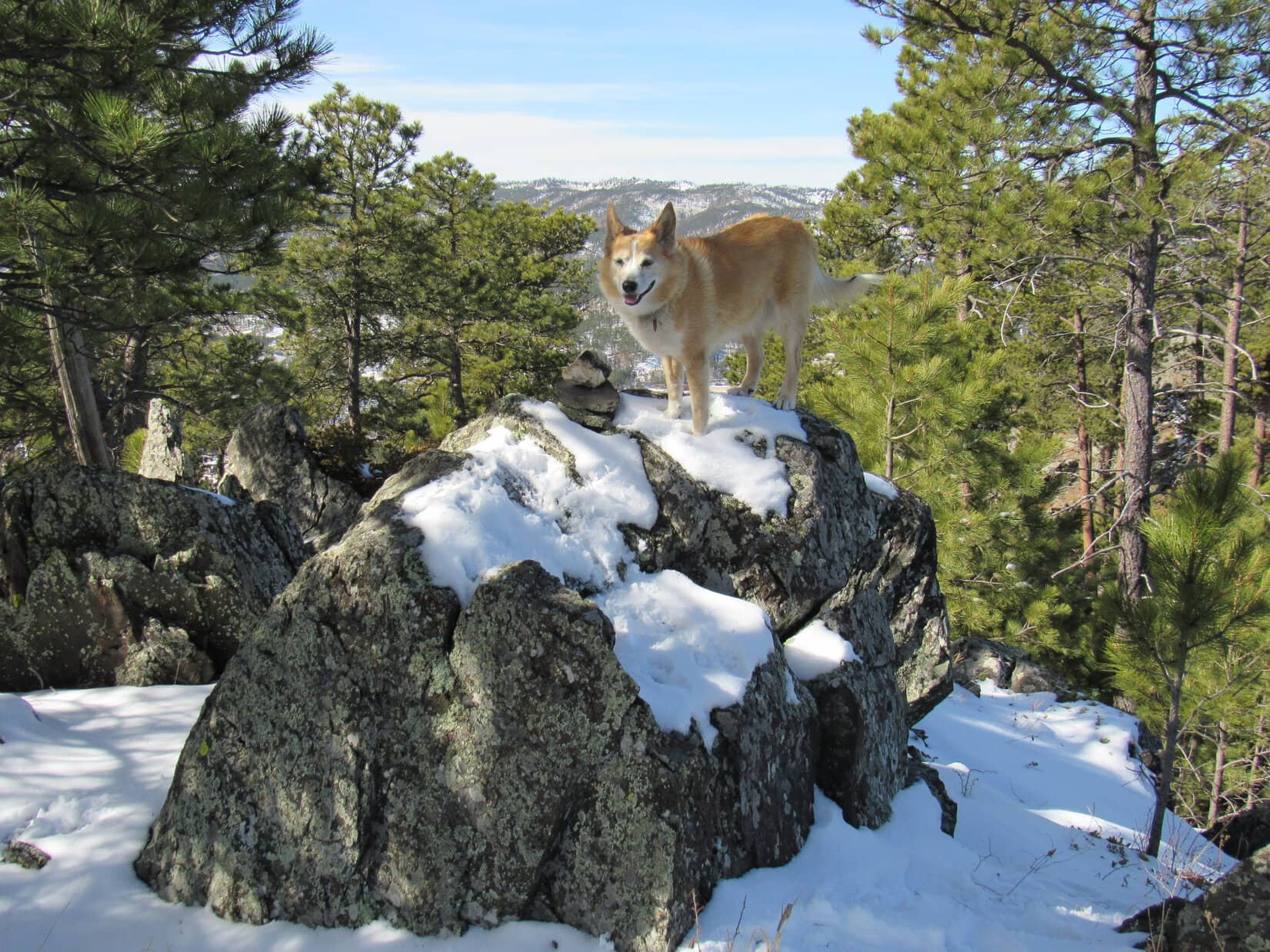
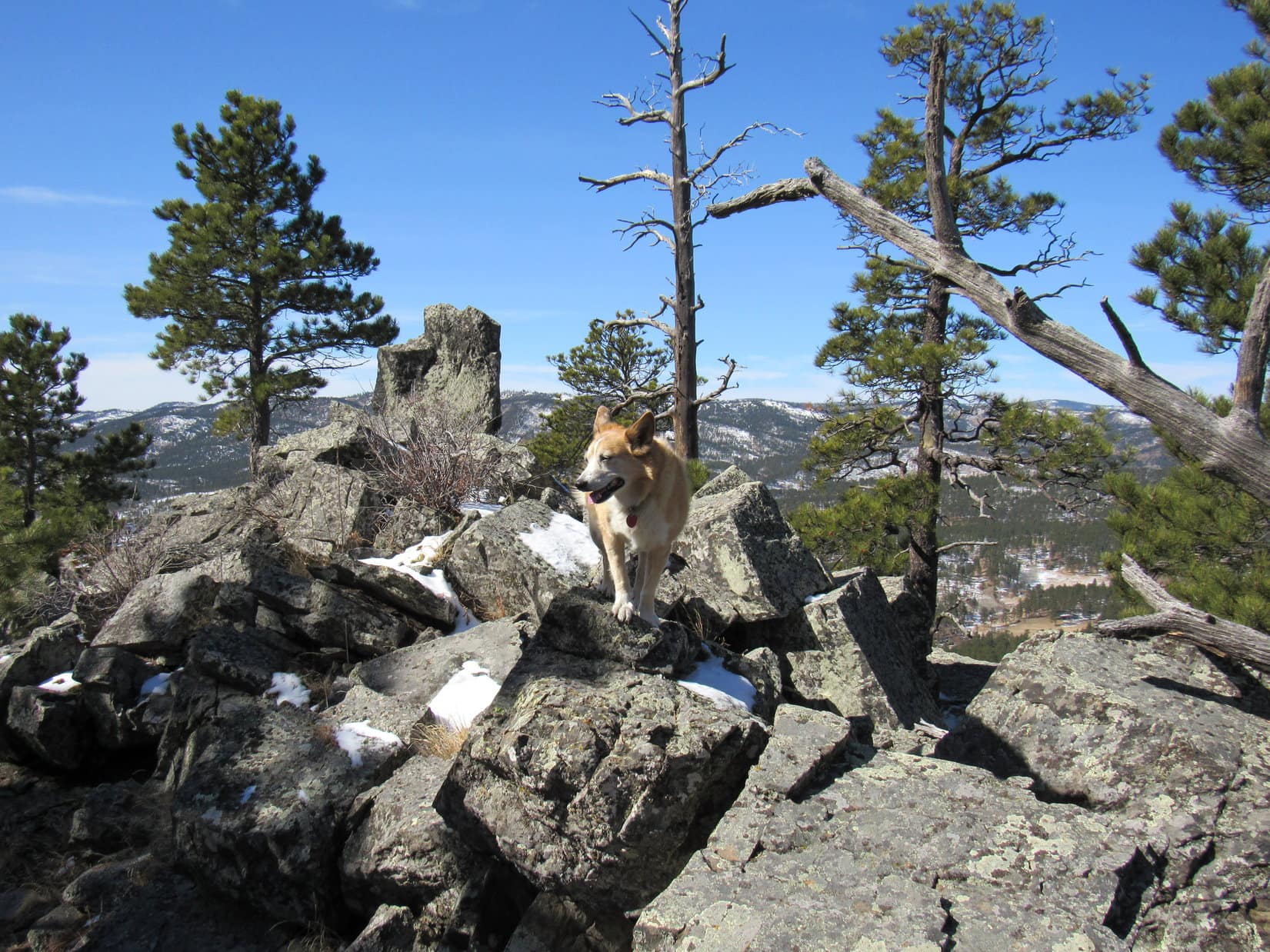
Descending Peak 5733, Black Hills of South Dakota, 4-1-21

Links:

Next Black Hills Expedition                     Prior Black Hills Expedition

Next Trail Section North

Black Hills, SD Expedition No. 249 – Centennial Trail No. 89: Big Pine to Iron Creek Horse Camp (4-20-19)

Next Trail Section South

Black Hills, SD Expedition No. 295 – Centennial Trail No. 89: Badger Hole to French Creek & Beyond to Peak 5120 (2-7-22)

Centennial Trail No. 89 Brochure & Map

Black Hills, SD Expedition No. 250 – Peak 5647, Peak 5733 & Peak 5880 (5-4-19)

Want more Lupe adventures?  Check out Lupe’s Black Hills, SD & WY Expeditions Adventure Index, Master Adventure Index, or subscribe free to new Lupe adventures!

Black Hills, SD Expedition No. 271 – Lowden Mountain, Peak 6040 & Union Hill (3-28-21)

8:52 AM, 41ºF, Newton Lake – After a roll in the grass near Newton Lake, Lupe snorted then trotted across both Deerfield Road and the Mickelson Trail.  Disappearing into the pines, she headed N up a short slope.

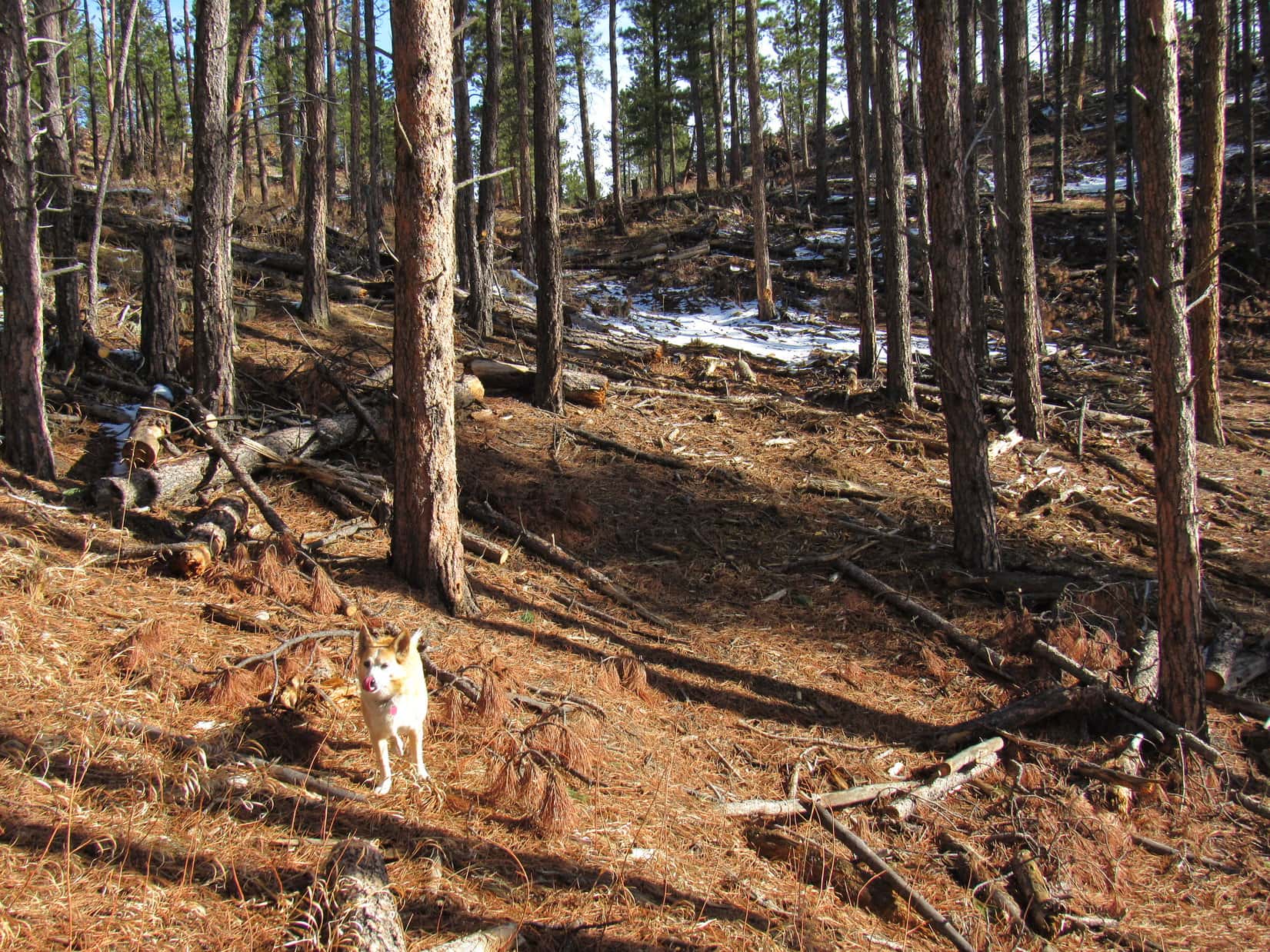
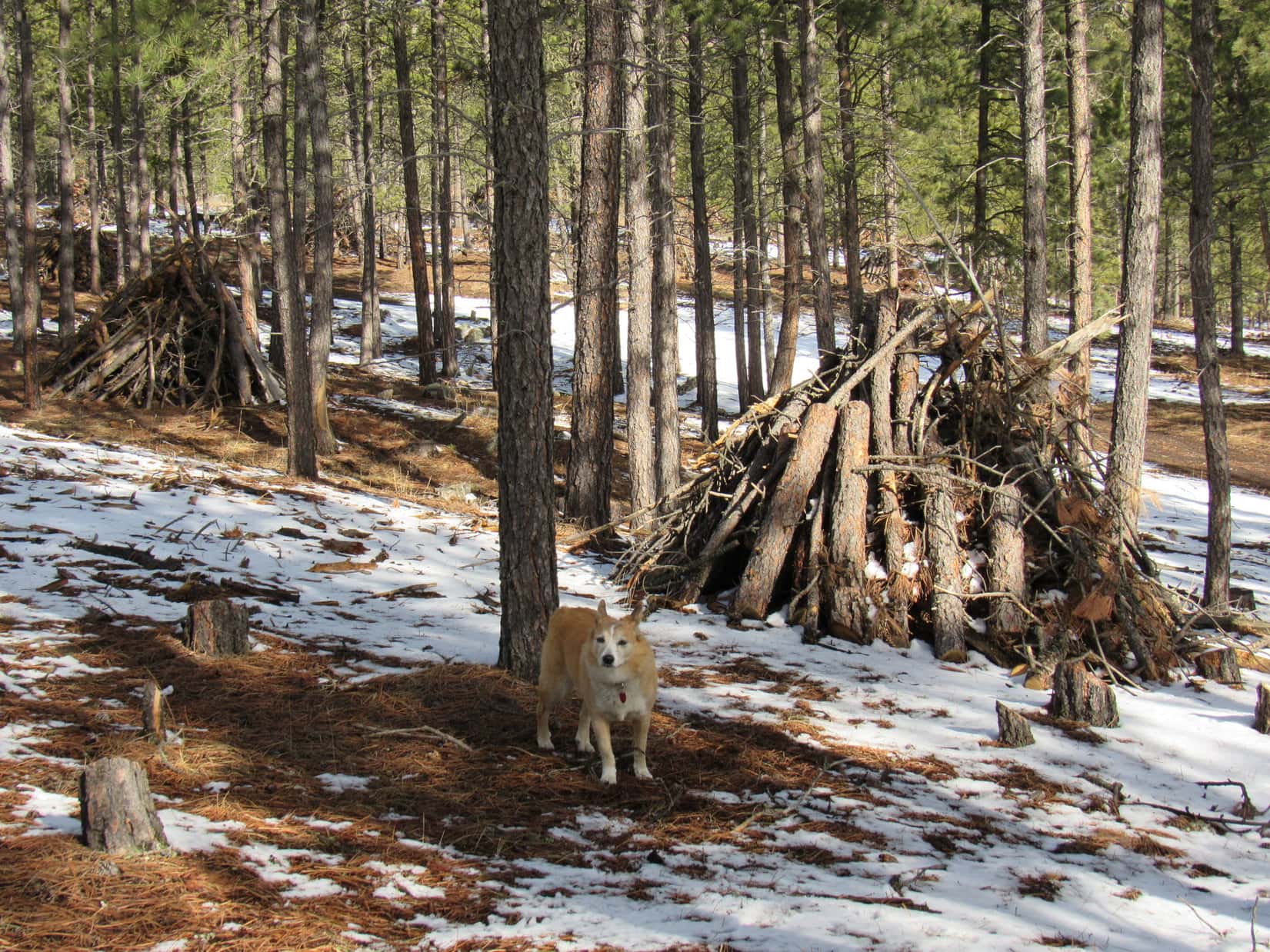
Things had changed since the last time she’d been here.  The forest had been thinned and groomed.  The Carolina Dog passed neat tipis of slash destined for burning.  Beyond the tipis, Lupe picked up USFS Road No. 389.1Q, which headed straight for Lowden Mountain (6,055 ft.).

Heading up the slope after crossing the highway. Photo looks N.
Among the slash tipis.
Lowden Mountain from USFS Road No. 389.1Q. Photo looks NNW.

At the base of the mountain was a “T” intersection with USFS Road No. 389.1B.  Abandoning both roads, Loopster started up Lowden’s S slope.  She soon began coming to rock formations along a SE ridge.  Union Hill (6,120 ft.) and a few others could be seen off to the E.  Higher up, there was even a big view to the SW.

Union Hill (L) from one of the first rock formations. Photo looks E.
Higher up, looking SSW.

The climb varied, featuring a series of rock formations, stretches of open forest, small clearings, and thickets of dog hair pines.  Initially steep, the slope eventually diminished.  Near the end, a sunny, open lane led to a collection of boulders at the top.

Someone had built a tiny cairn on the summit rock.  Lupe hopped up next to it.  Lowden Mountain (6,055 ft.)!  Oh, it was good to be back!

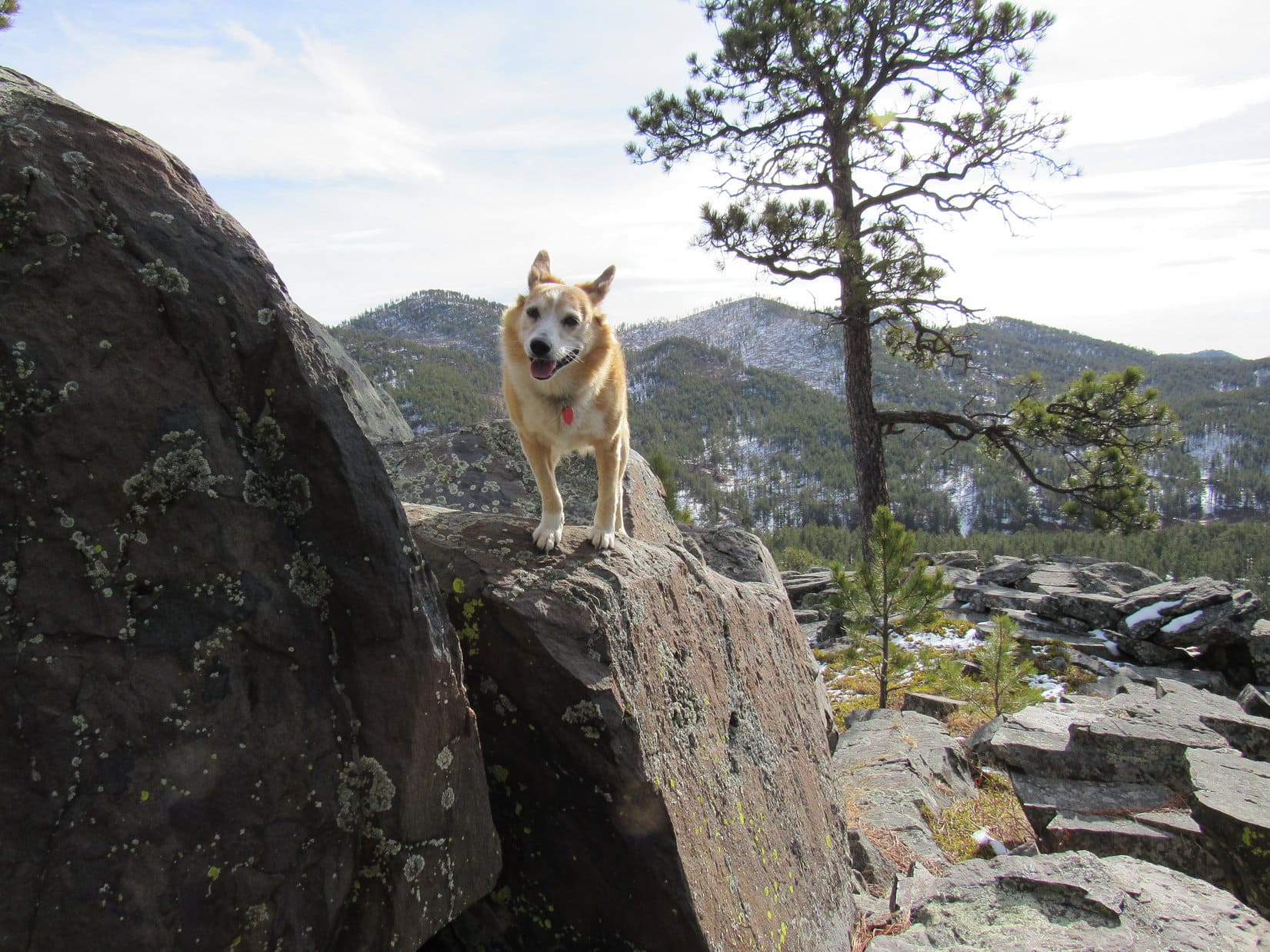
Exploring among the dog hair pines.
Near the top. Photo looks WNW.
This is it! The true summit of Lowden Mountain! Photo looks W.
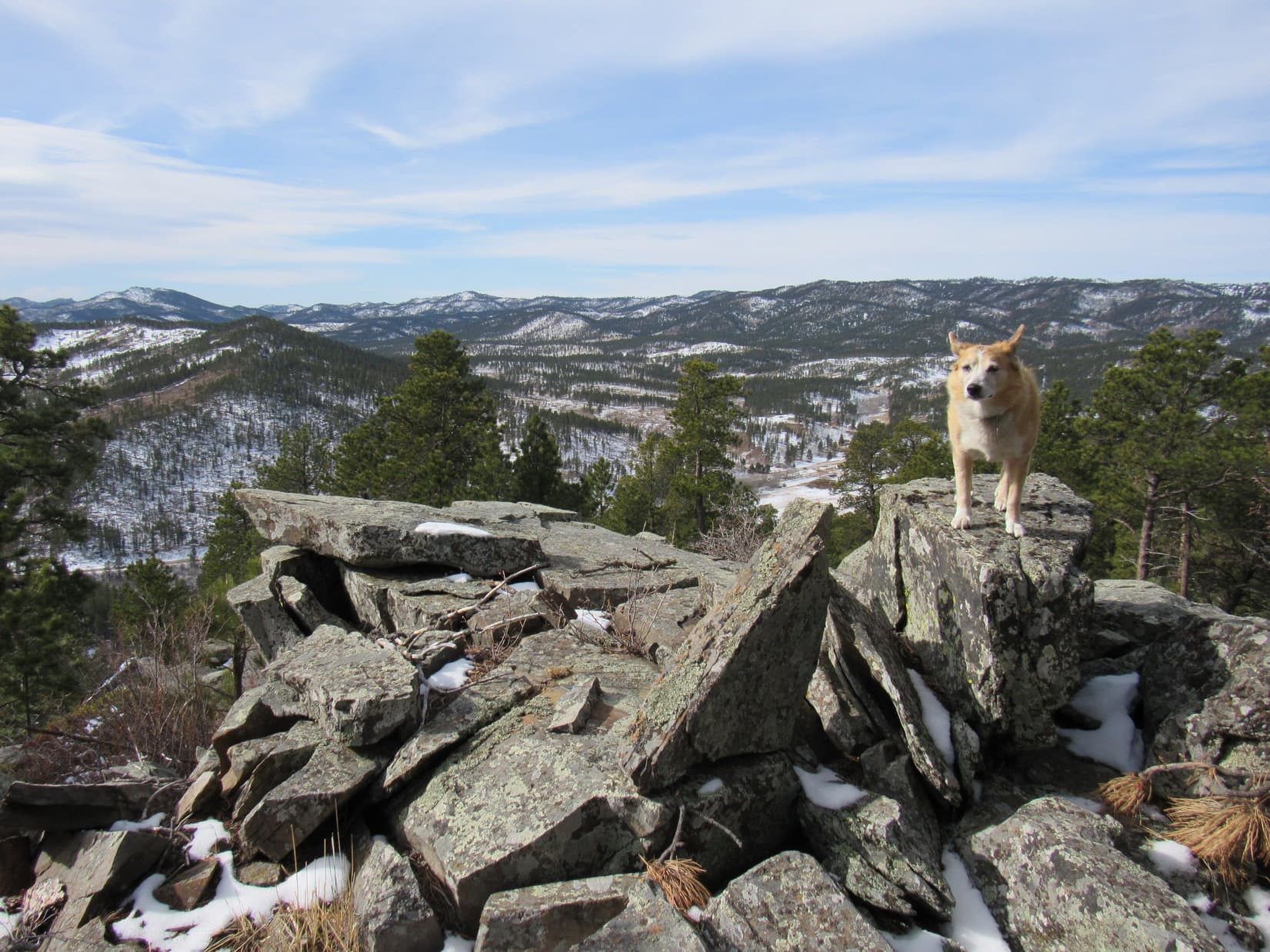
More of the summit region. Photo looks W.

A nice green patch of kinnikinnick was close to the true summit.  SPHP took off the pack and sat down.

More than 6 years since the last time we were here, SPHP!

Hard to believe it, isn’t it, Looper?  Glad we’re back!  Always liked Lowden.

We ought to have a celebration!

Umm, yeah.  What sort of celebration did you have in mind, sweet Dingo?

Got any chocolate coconut bars in that pack, SPHP?  I bet you do!

Heh.  Should have said sweet-tooth Dingo.  Yes, just so happens that I do have a few chocolate coconut bars.  Kind of early in the day for it, but OK.

On the kinnikinnick carpet. True summit beyond Lupe. Photo looks W.

The chocolate coconut bar met its match.  Lupe stayed resting on SPHP’s lap.  Two big views from here.  Black Elk Peak (7,231 ft.) was the most impressive, but False North Point (6,130 ft.), Five Points (6,221 ft.), and Union Hill were also of great interest.

On Expedition No. 270, Lupe had climbed Five Points instead of False North Point due to SPHP’s navigation errors, and Union Hill might be in the cards today.

Black Elk Peak (L). Photo looks SSE.
Union Hill (beyond Lupe) with False North Point (L) and Five Points (R) in the background. Photo looks E.

Are we going to keep up our Lowden Mountain traditions, SPHP?

Oh, I think we should, if we wind up with enough time, Loop.

I hope we do!  What else is on the agenda?

Well, remember how I messed up on our last expedition, and we never got to Peak 6040?

How can I forget?  Of 3 peaks we were going to climb, we managed to get to 1.

True dat, but we also got to Five Points as a nice consolation prize, even if it was unplanned.  Anyway, we can take another stab at Peak 6040 from here.  After that, who knows?  Redfern Mountain (6,075 ft.), Peak 6167 and Union Hill (6,120 ft.) will all be in range depending on what direction we decide to go.

Peak 6040 is the near ridge at far R. Peak 6167 (Center). Photo looks NNE.

One Lowden Mountain tradition, a visit to the somewhat lower W ridge, could be taken care of before Lupe left the mountain.  After revisiting the summit boulder, she headed NW down a 12 foot slope into another region of dog hair pines.  Forcing a way through, SPHP snap, crackled, and popped countless little branches following the American Dingo.

Although several large trees marred the views, the W ridge featured the biggest rock formations on Lowden Mountain.  Lupe always came out here to scramble around a little.  From the right spot, it was possible to obtain a distant look at Signal Knob (6,200 ft.) and higher peaks beyond.

Back at Lowden Mountain’s true summit. Photo looks W.
Out on the W ridge. Photo looks WSW.
Signal Knob (R of Center) is the low dome in the snowy field. Photo looks NW with help from the telephoto lens..

45 minutes after arriving at Lowden Mountain’s summit, Lupe was on her way down the steep N slope.  In some places the snow was nearly a foot deep, which was good because it gave SPHP some support.

The slope diminished farther down the mountain.  Lupe came to a more open stretch that was littered with deadfall.  Working her way through it, she reached USFS Road No. 389.1K.  Following the nearly level road E, then N, the Carolina Dog arrived at a junction with No. 389.1A.

Starting down Lowden Mountain’s N slope. Photo looks SSE.
On USFS Road No. 389.1K. Photo looks NNE.
At the junction with No. 389.1A.

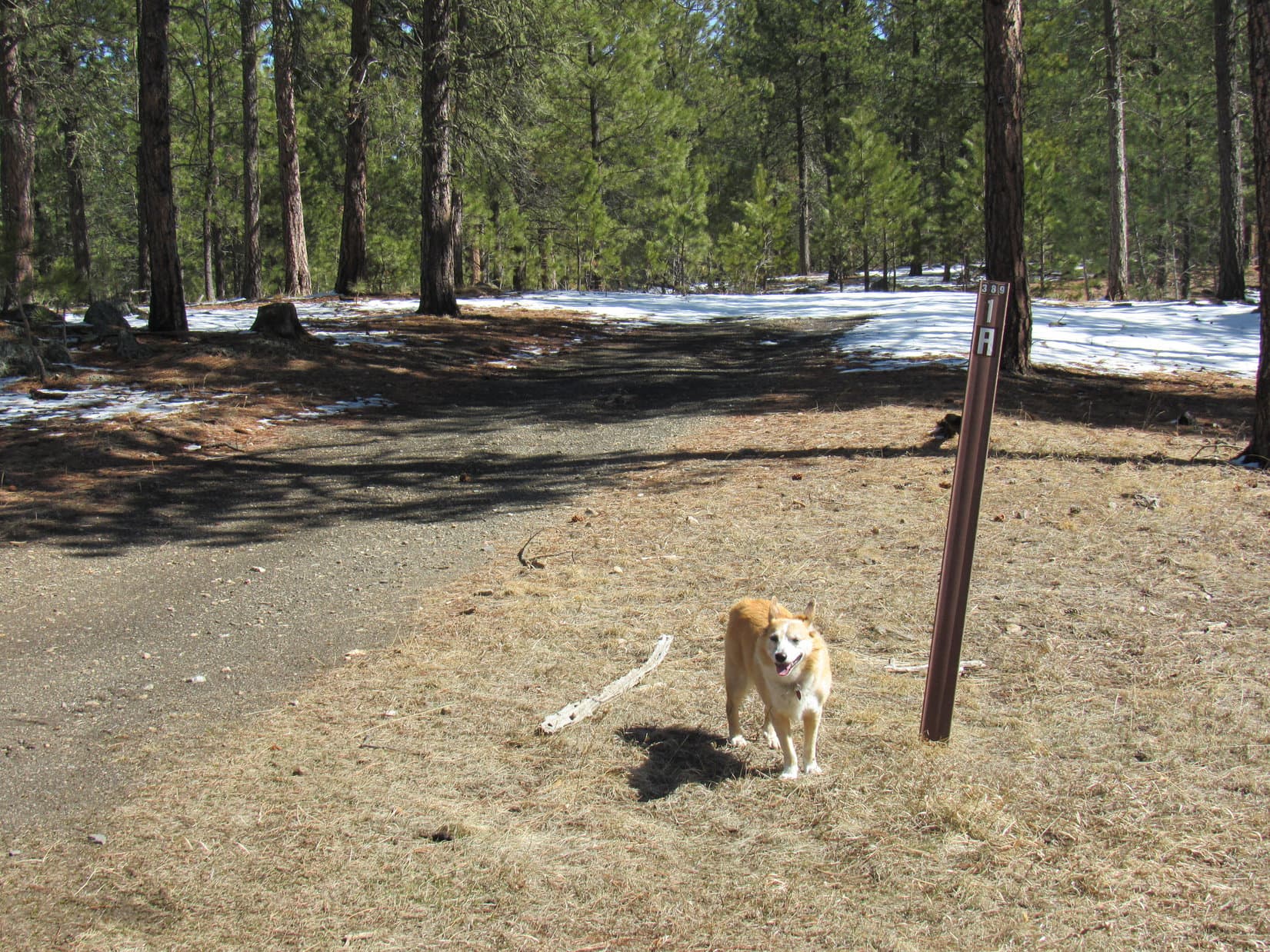
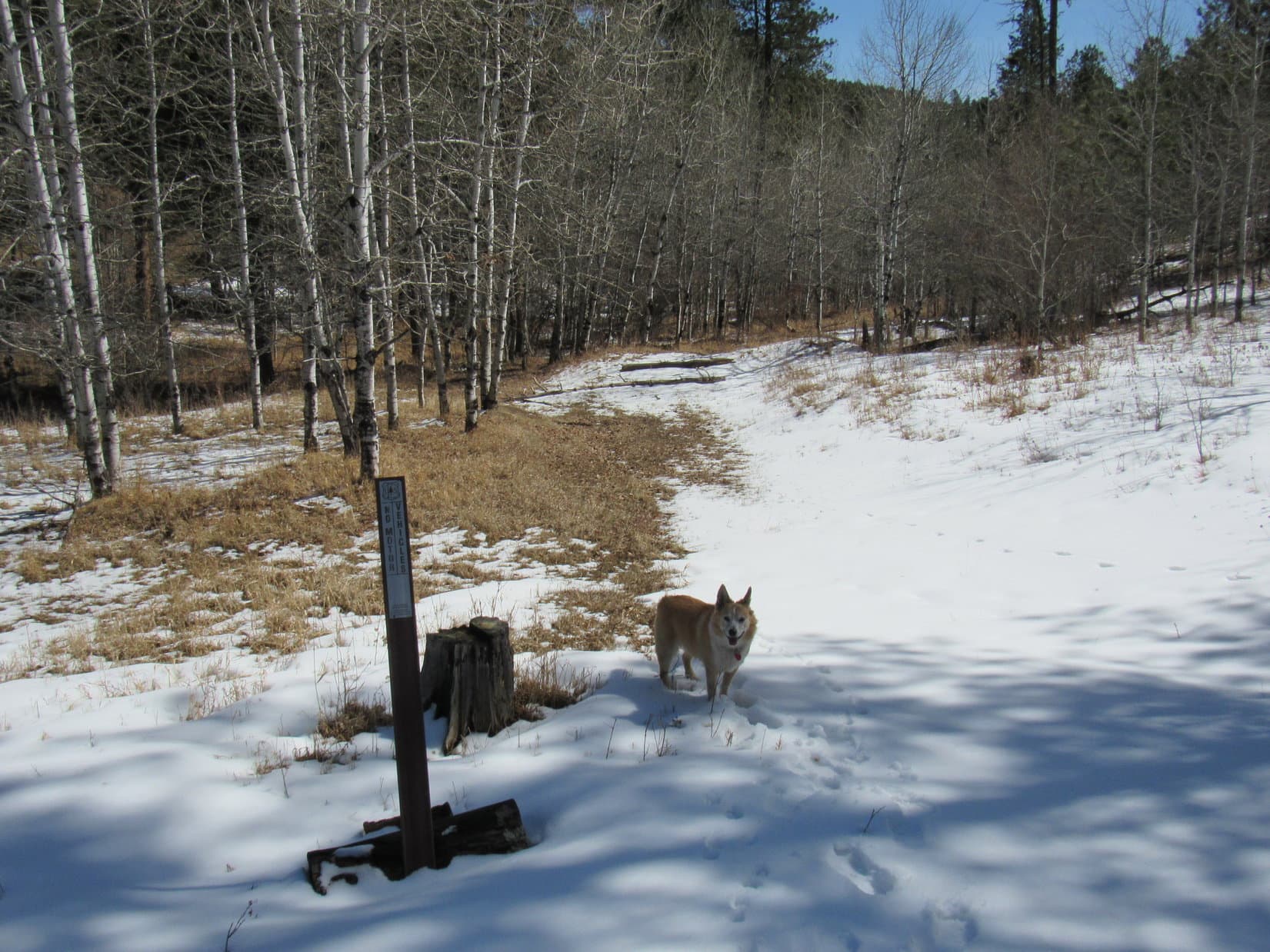
The branch of No. 389.1A that went E soon started winding downhill.  The road turned N bringing Lupe to another intersection.  Abandoned USFS Road No. 389.1L, marked only with a “No Motor Vehicles” wand, went E here disappearing into a small valley.

At the W end of abandoned USFS Road No. 389.1L. Photo looks E.

I remember this, SPHP!  Isn’t this the way to the Gold Mountain Mine?

Indeed, it is, Looper.  We’re almost there!

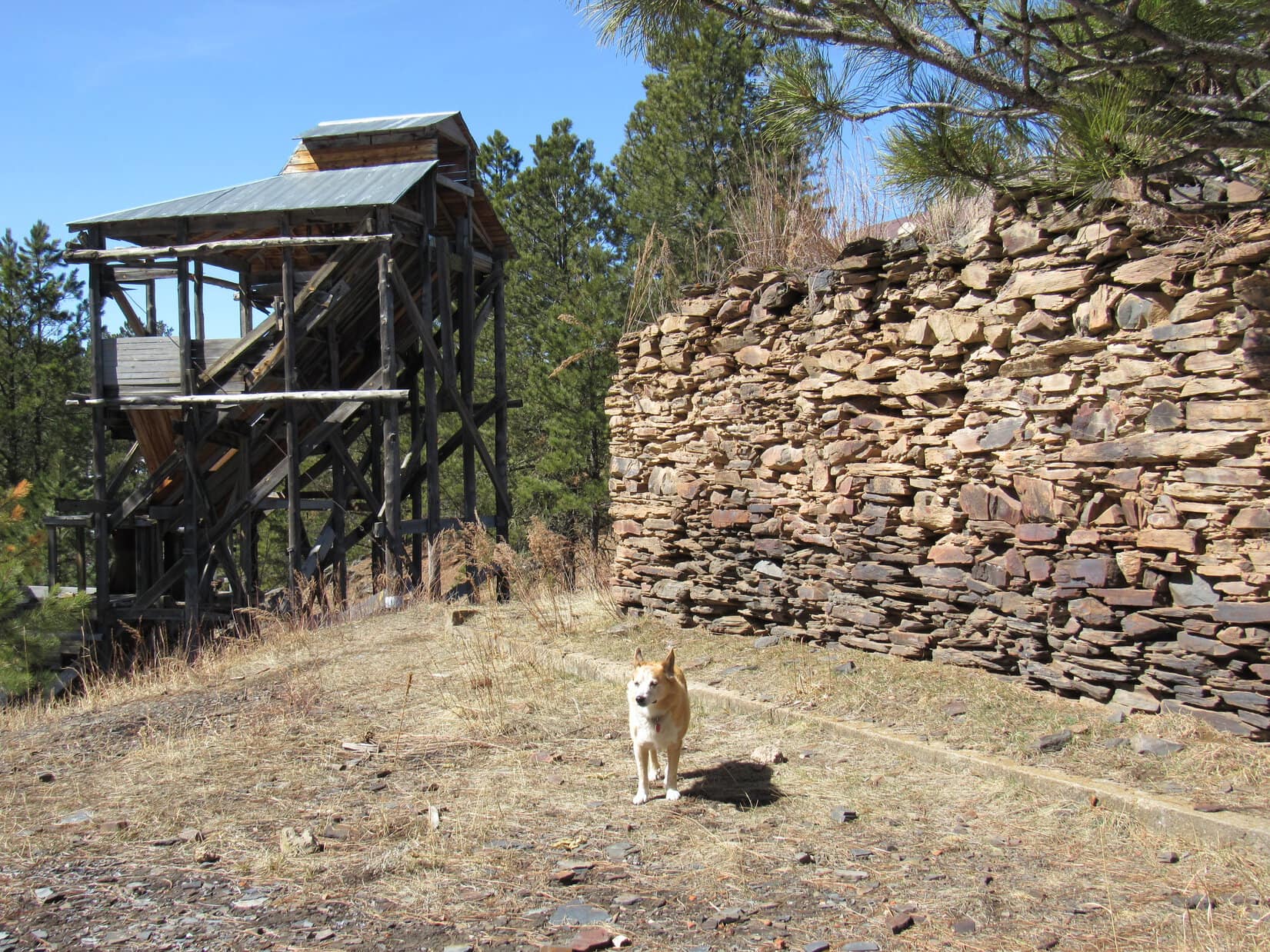
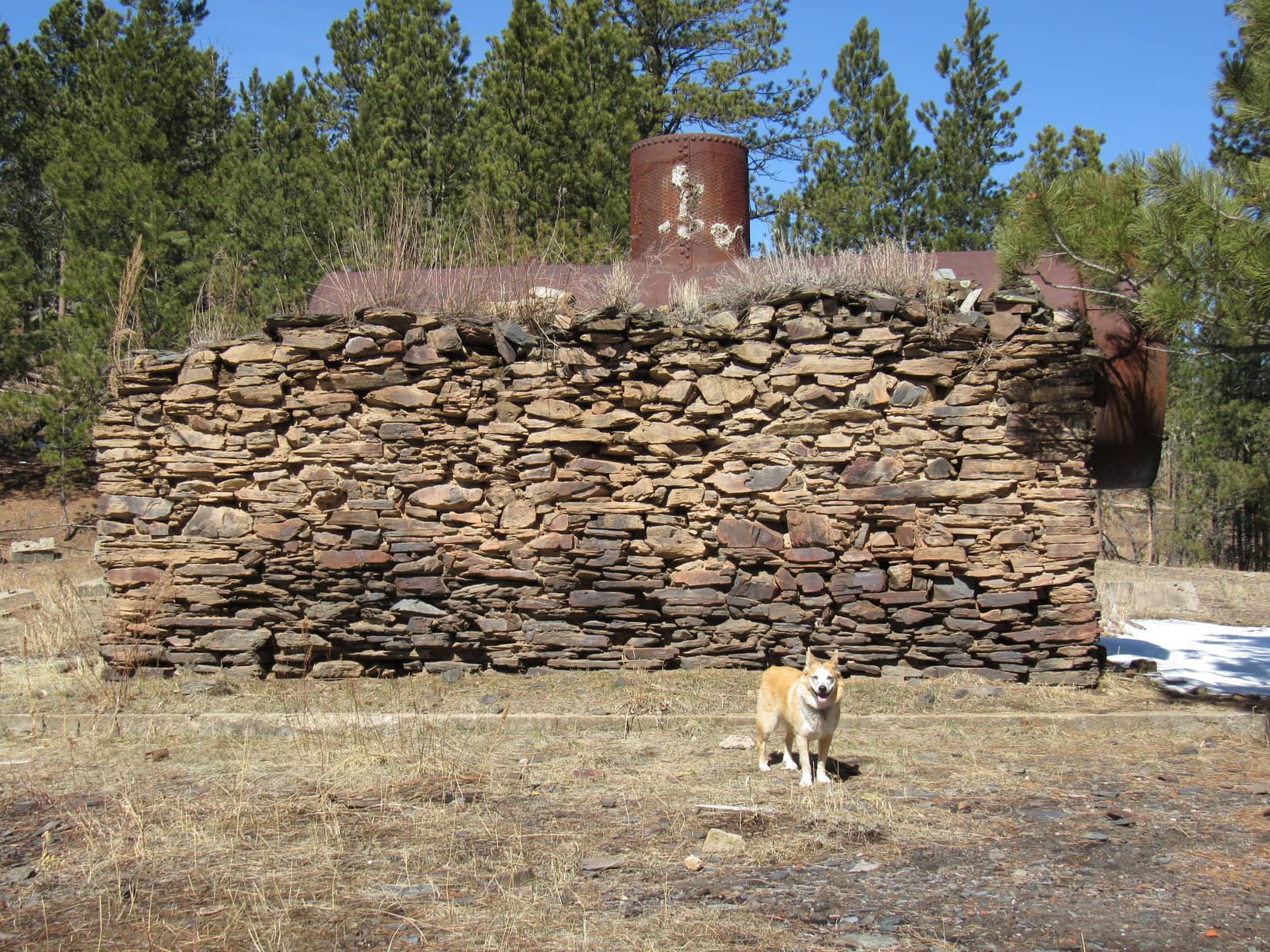
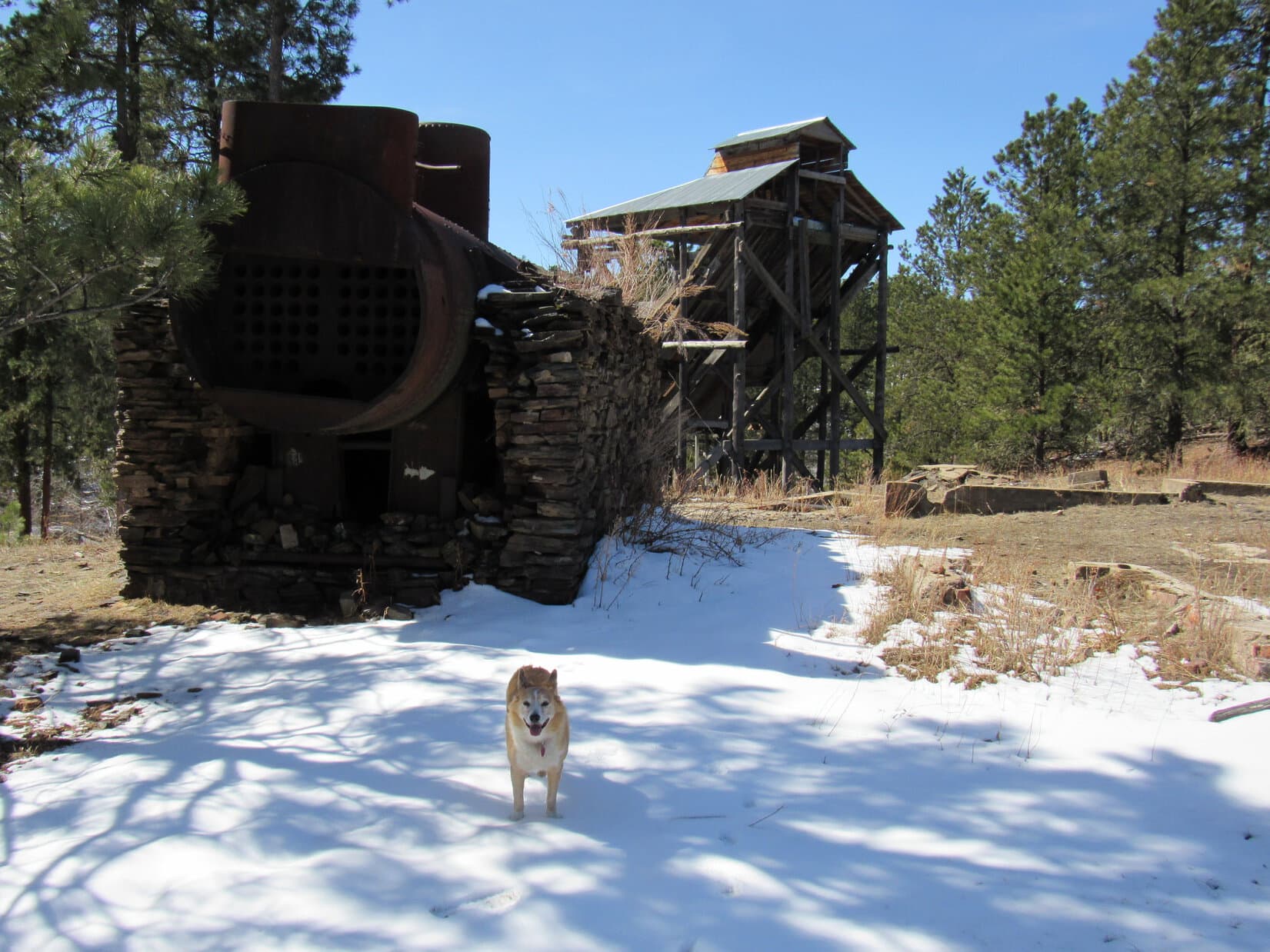
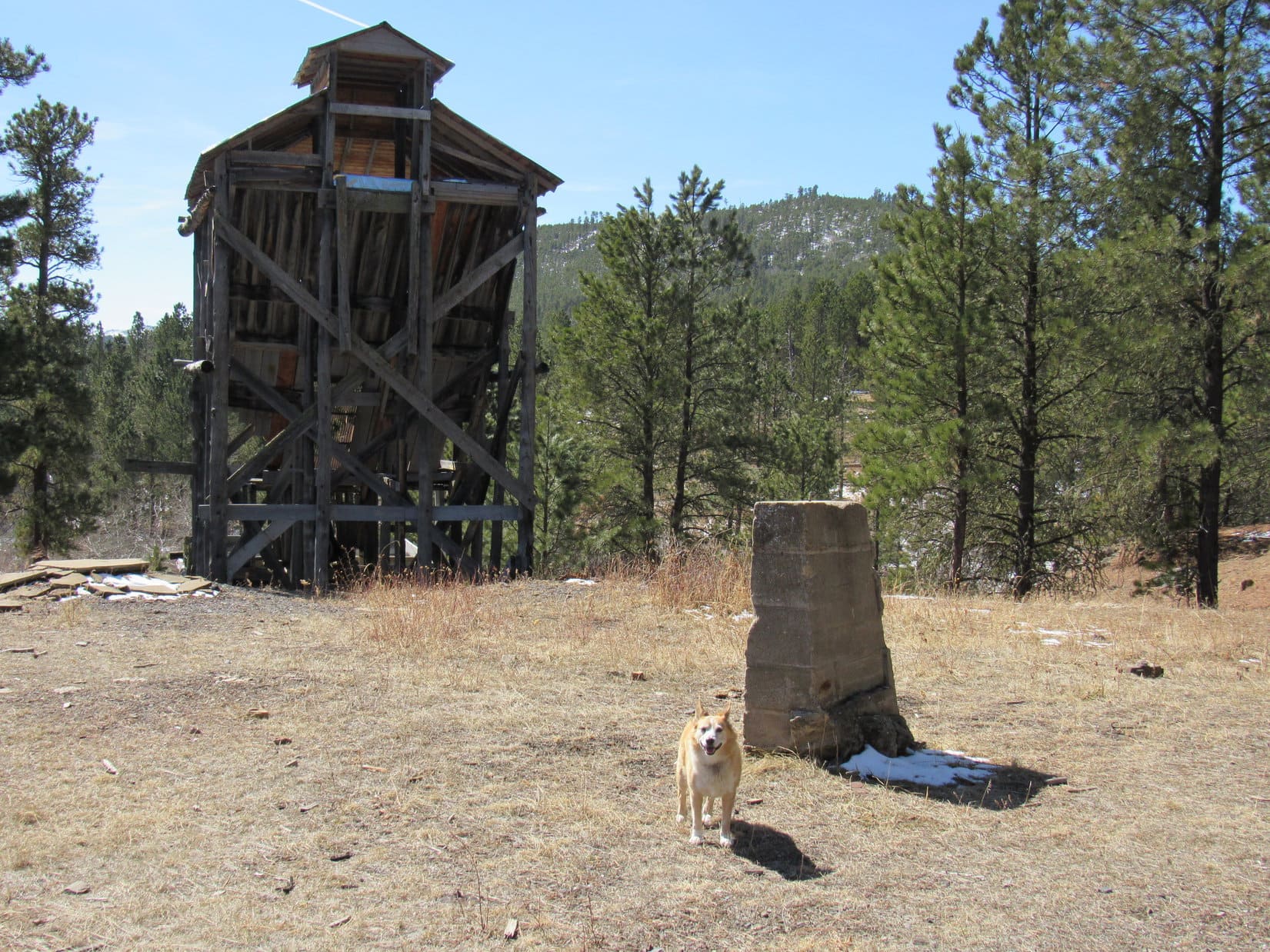
Less than 0.1 mile down No. 389.1L, the Gold Mountain Mine sat up on a hillside to the N.  Lupe went up check it out.  The main features were a big multi-story mill structure overlooking the valley, and a metal kiln or boiler supported by loose rock walls.

At the Gold Mountain Mine. Photo looks NE.

Suppose there’s still any gold laying around here, SPHP?

Not likely, Looper.  In fact, stick close to me.  Used to be a lot of broken glass, especially up by the boiler or kiln, or whatever that thing is.

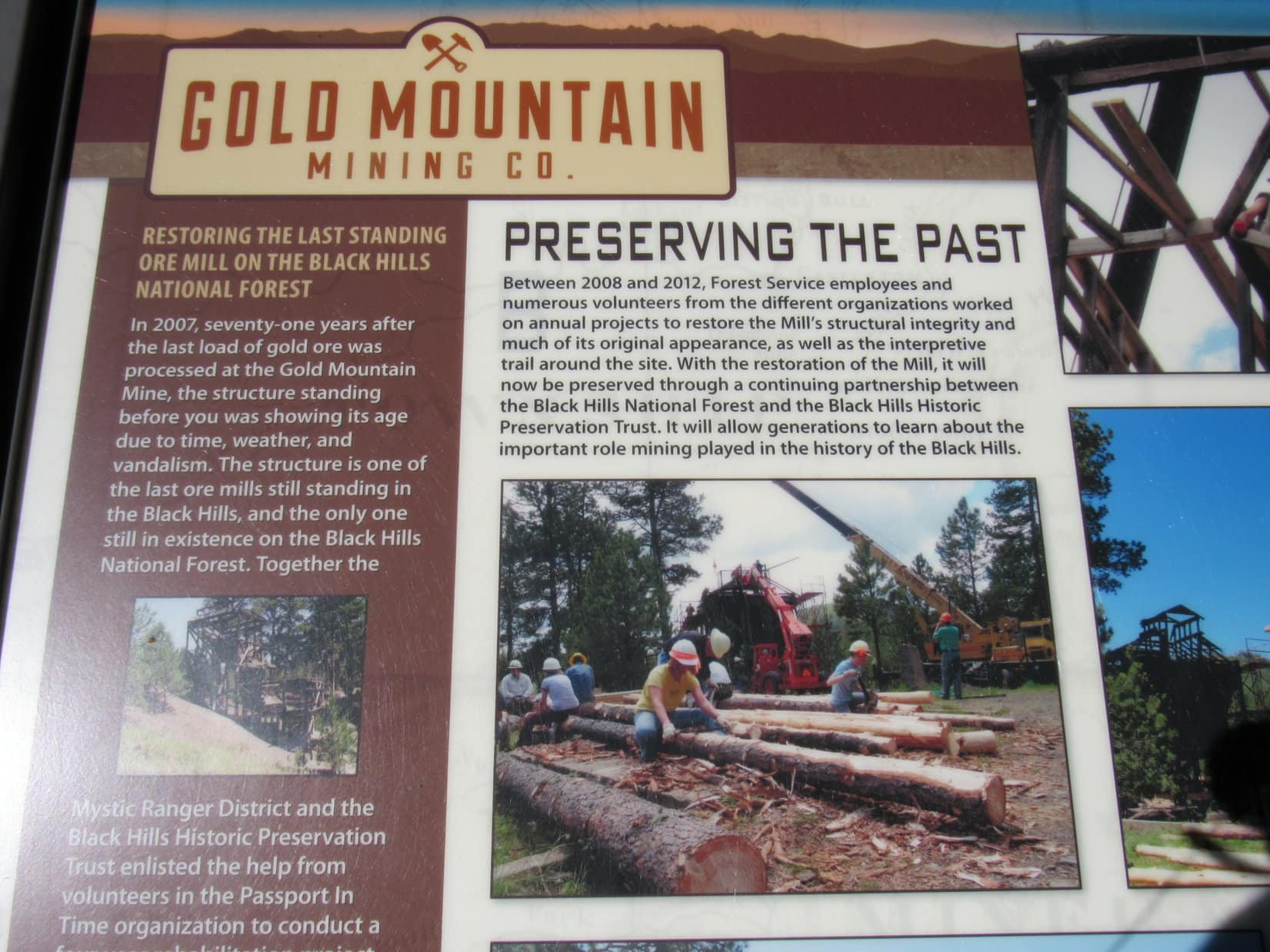
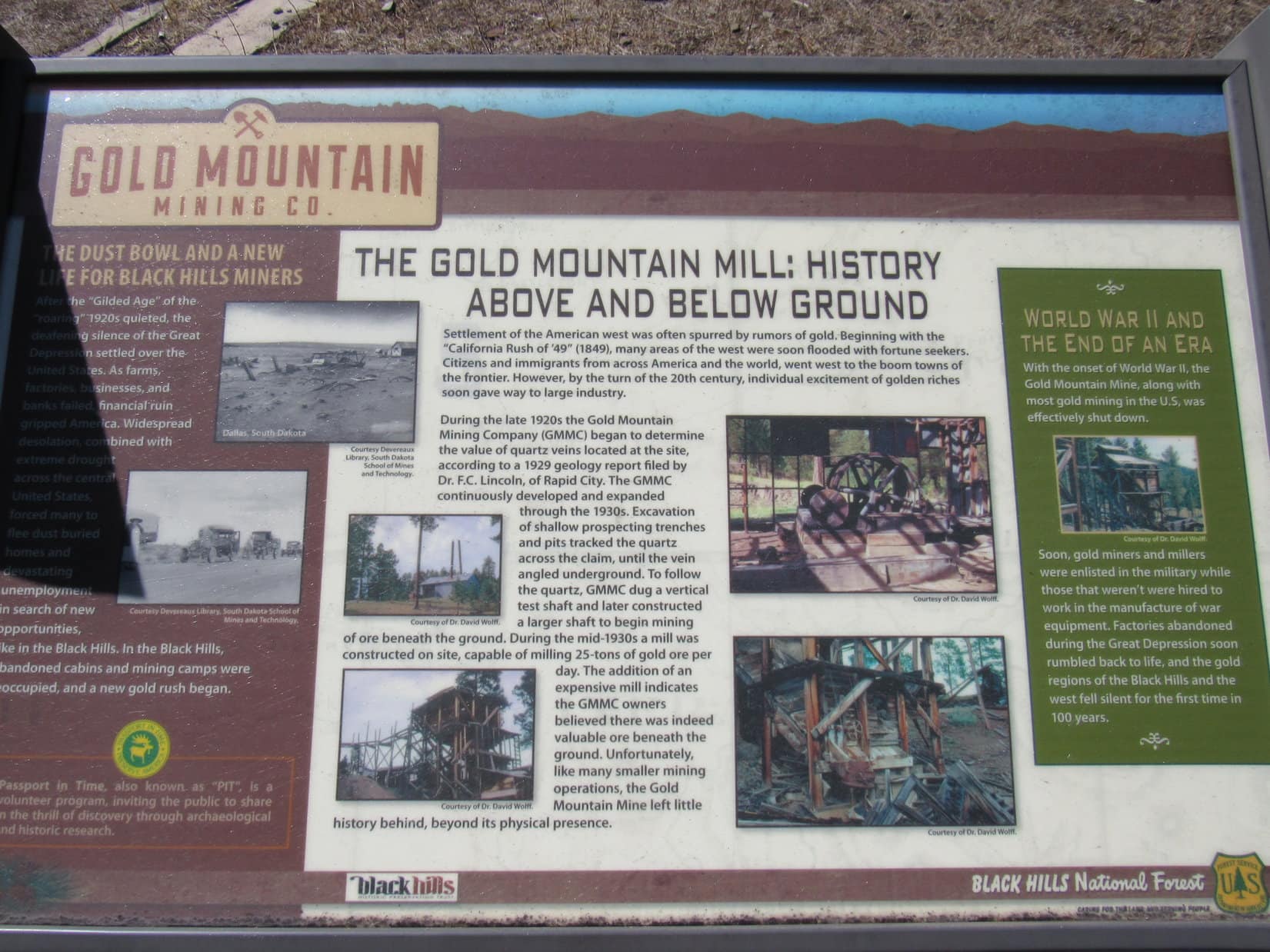
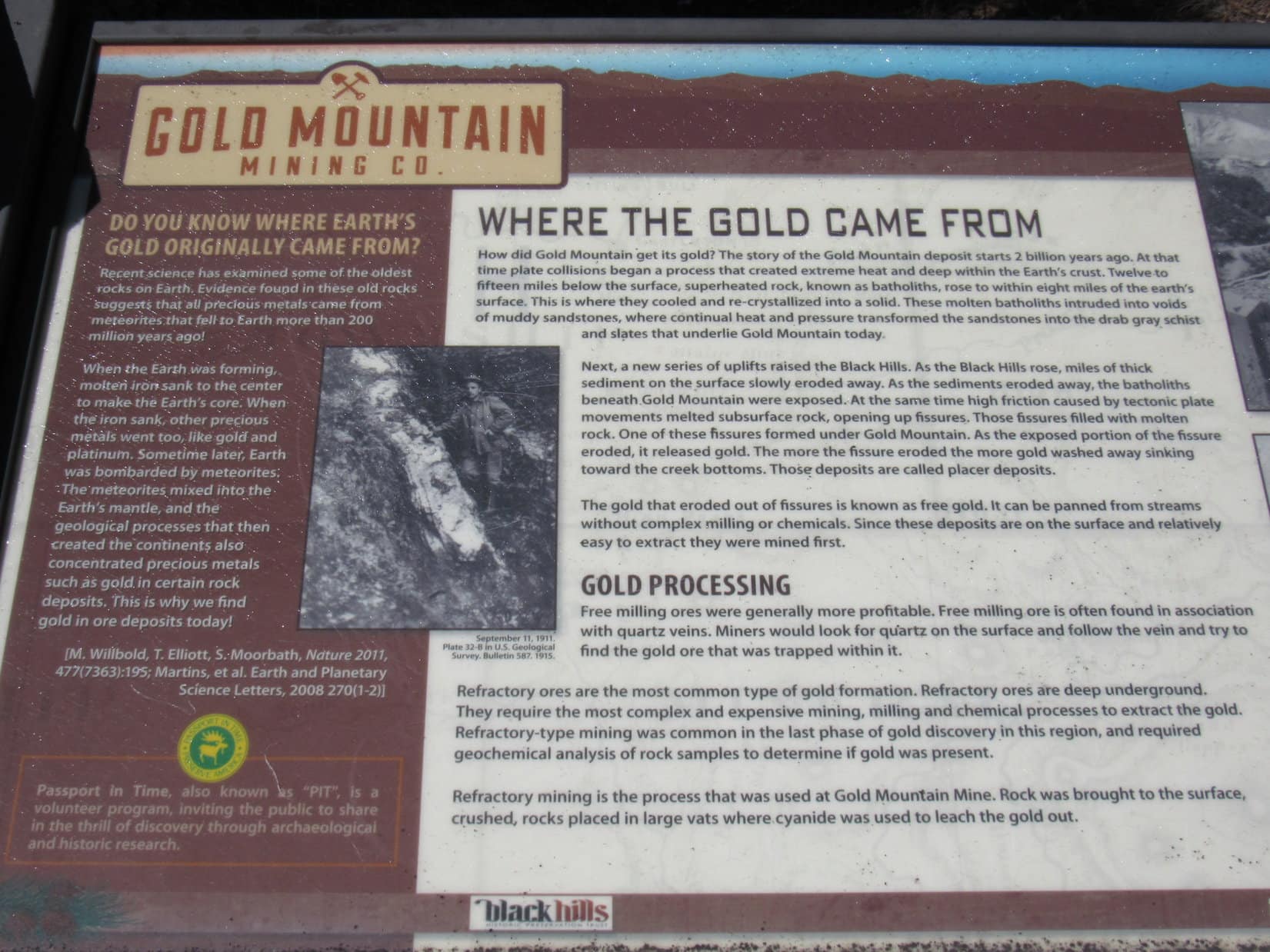
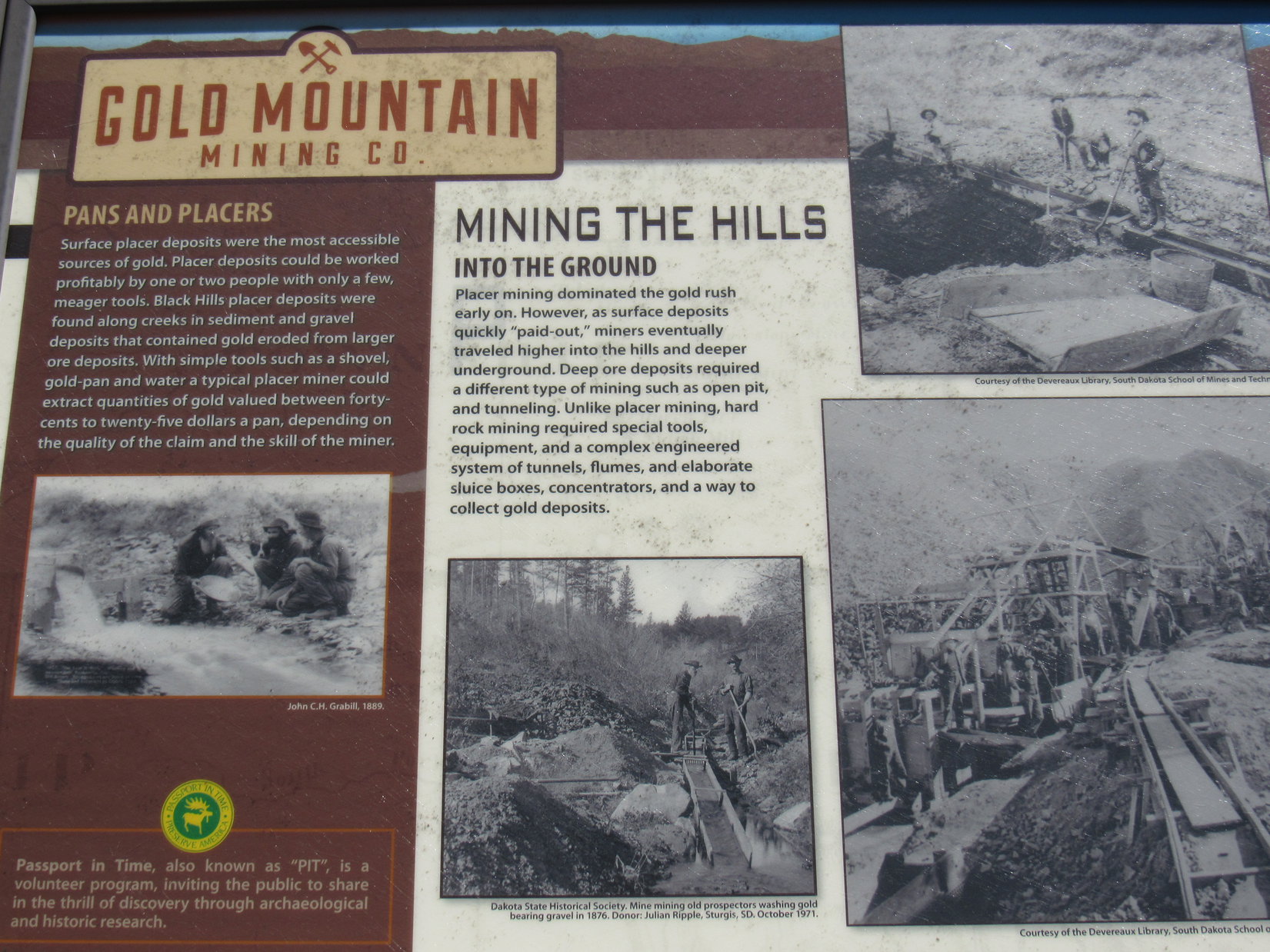
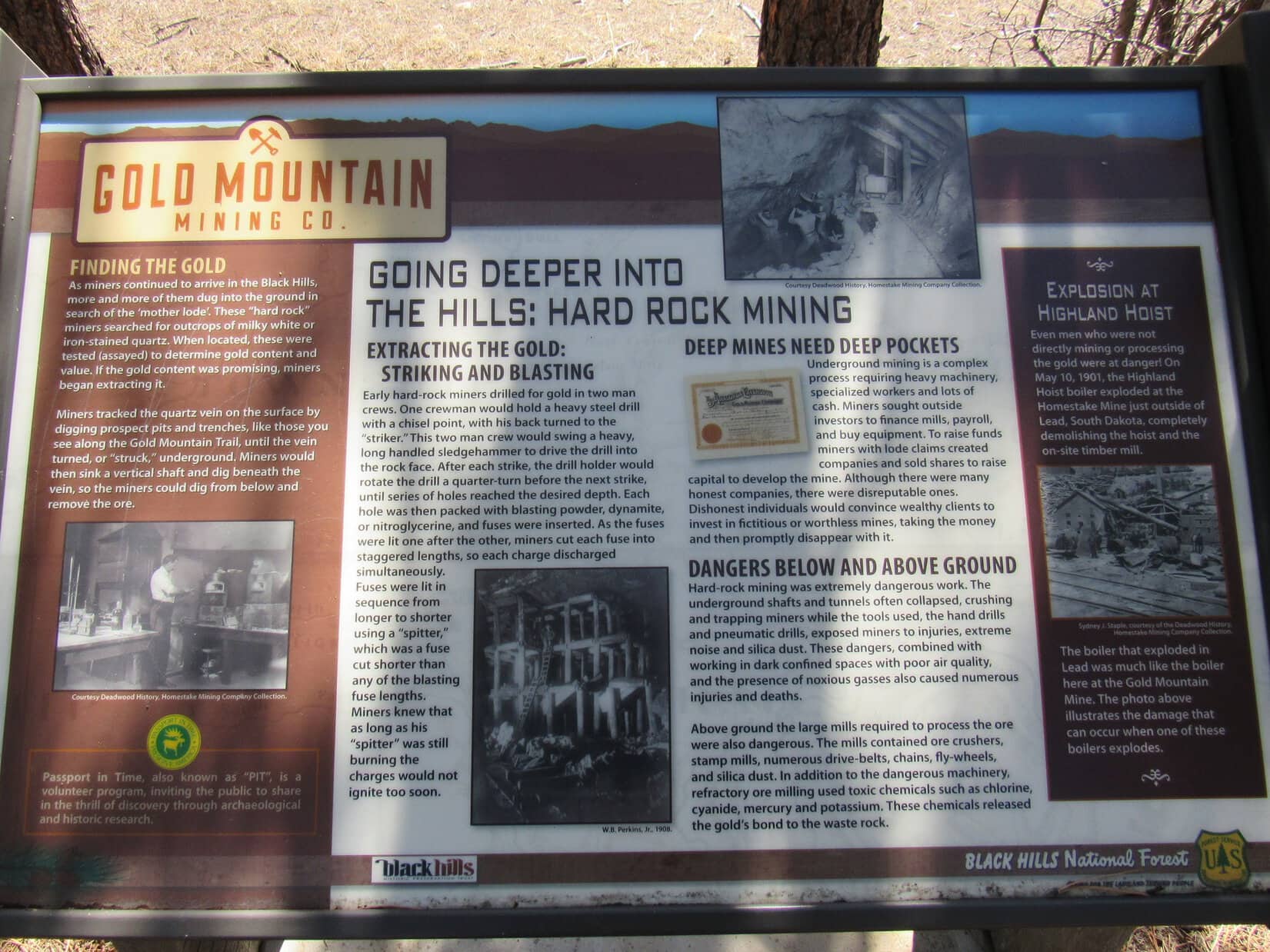
The Gold Mountain Mine had been partially restored.  At least 7 plaques were on display.  Lupe sniffed about nearby while SPHP had a look at some of them.

Preserving the past.
The Gold Mountain mill.
Another look at the mill. Photo looks NW.
Up by the boiler or kiln(?) Photo looks W.
Still some broken glass around, but not as much as there used to be. Photo looks NW.
Where the gold came from.
Pans and placers.
There used to be a bunny living in this contraption! Photo looks W.
Hard rock mining.
The Gold Mountain Mine can be seen from Lowden Mountain (R)! Photo looks SW.

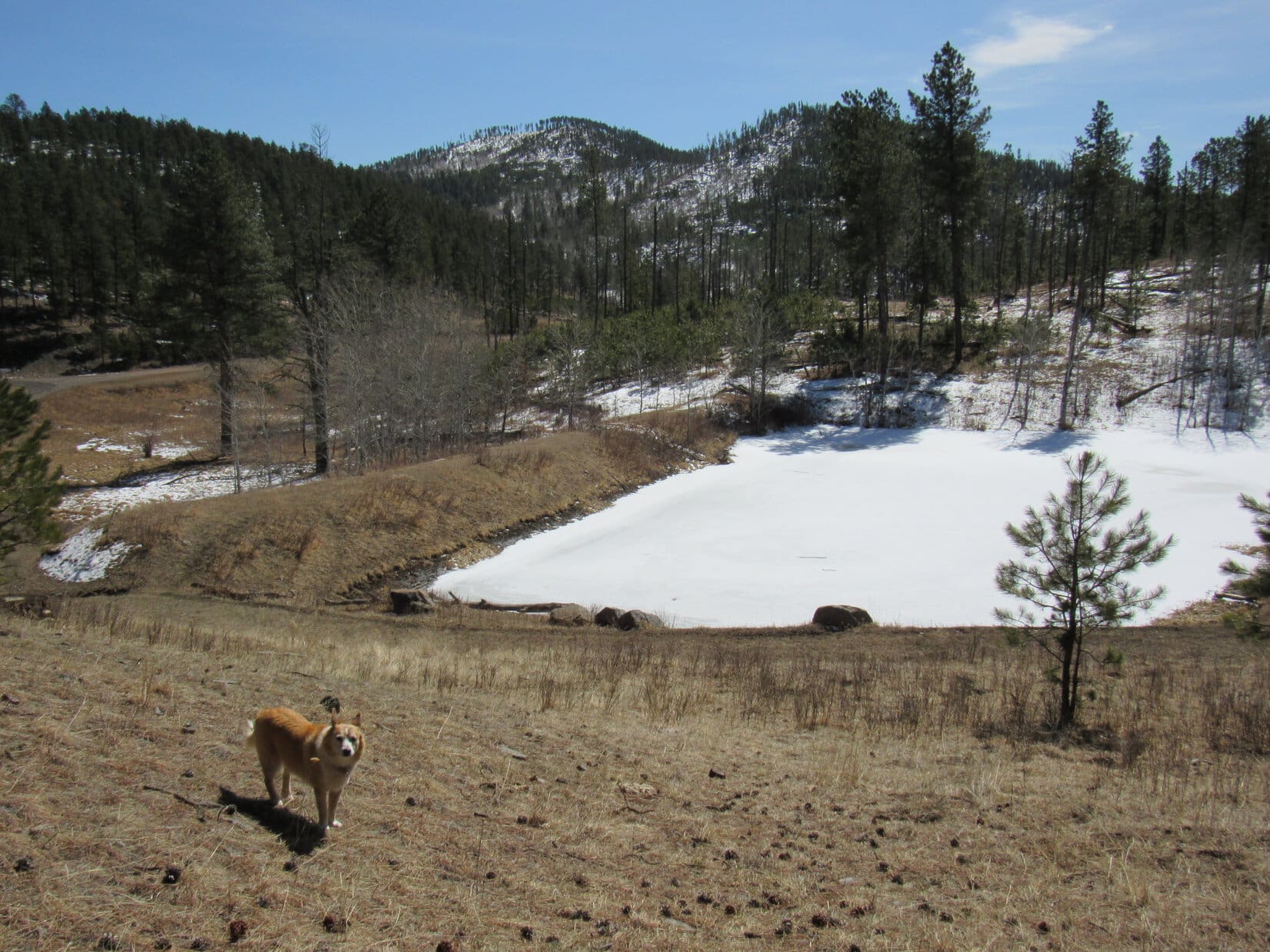
Lupe’s visit to the Gold Mountain Mine kept another Lowden Mountain tradition intact.  Always fun to see it, but Loopster was more likely to get shards of glass in her paws than nuggets of gold.  A quick visit, and SPHP encouraged the American Dingo to move along.  Down a slope to the SE was a frozen pond, and a nice view of Union Hill (6,120 ft.).

Union Hill (L of Center) from the pond SE of the Gold Mountain Mine. Photo looks SE.

Burnt Fork Road (USFS Road No. 389) was visible on the far side of the valley below the pond.  Reaching the road, SPHP turned NE following it up another valley.

SPHP!  Wait!  Aren’t we going to climb Union Hill?  We’re real close to it!

Umm, I don’t know, Loop.  Thought we better get that pesky Peak 6040 out of the way first, since we’ve never been to it before.  Don’t want to fail for the 2nd expedition running, do we?  Besides, by tagging Peak 6040 first, we can keep our options open on where to go next.

Guess we’re going this way! On Burnt Fork Road. Photo looks N.

0.5 mile up Burnt Fork Road it turned E going over a pass.  SPHP stopped to consult the topo map.

That’s odd!  Believe we’re a little N of HP5772, but the map doesn’t show the road going this way.

So, what do you propose, SPHP?

No more than 0.67 mile to Peak 6040 from here, if I’m right.  Looks like easy terrain according to the map.  Let’s just go for it!

Heading NNE through the forest, Lupe soon came to a minor high point.  A considerably higher ridge was visible to the NE.  Didn’t look all that far away.

That must be Peak 6040! Photo looks NE.

Getting to Peak 6040 was harder than it looked.  Beyond the first high spot, Lupe crossed 2 drainages, losing 30 or 40 feet of elevation both times. The terrain was easy, but the deadfall was icky.  The uphill SW slopes of the ridges separating the drainages weren’t bad, but the rest of the trek was full of it.  The NE downslopes and bottoms of the ravines were particularly clogged.

Crossing the first drainage. Photo looks NE.
On a SW upslope, a super highway by comparison. Photo looks ENE.

One more ridge and valley to go just to get to the base of Peak 6040.  This valley was deeper than the others, and also loaded with deadfall.  Lupe lost twice as much elevation.  Took a while, but once the American Dingo got across this last valley she was past the worst of the deadfall.  Only a 250 foot climb remained.

Getting there! Peak 6040 dead ahead! Photo looks NE.

Still some deadfall on Peak 6040’s SW slope, but not enough to prevent Lupe from weaving through it all without much trouble.  She was soon approaching the summit, with nice views back to the SW.

Almost there! Photo looks NW.
Along the upper rim. Union Hill (L) and Lowden Mountain (R). Photo looks SSW.

1:40 PM, 58ºF – Peak 6040’s summit region was big, grassy, and littered with deadfall.  Not too pretty!  A collection of 5 foot tall rocks stood on end near the NE edge, one of two possible true summit locations.  The other high point was NW of where Loopster came up among some low rock outcroppings.

Without bothering to go to either true summit candidate, Lupe and SPHP picked a sunny spot along the SW edge and sat down.  A cool breeze blew out of the W.

Chocolate coconut bar time, SPHP?

Absolutely, sweet-tooth Dingo of mine!

The chocolate coconut bar survived 10 seconds, followed by Taste of the Wild and water.  SPHP ate an apple.  Peak 6040’s summit might have a case of the uglies, but the views were really nice!  For half an hour, Loop and SPHP relaxed in the breeze, basking in bright sunshine.

Well, Loop, if we’re going to do anything else today, we better get with it!

Ready when you are, SPHP!

A brand new 4 foot high, 4-sided skinny stick stuck up out of the ground 20 feet N of where Lupe had been resting.  Little metal tags near the top of each side had stampings indicating that this was some sort of a survey marker.  Peak 6040’s NW high point was another 15 feet NW.  Looper got up on the highest rocks.

At the NW high point, possibly the true summit. Photo looks ESE.
Same spot. Black Elk Peak (L) and Union Hill (R). Photo looks SSE.

After visiting the NW high point, Lupe went over to the SE one where the rocks were standing on end.  The highest rock, only a few inches taller than some of the others, provided a precariously narrow perch.  Perhaps the true summit, but SPHP couldn’t tell for sure.

At the SE high point. Photo looks E.
On the skinny, possibly true summit. Photo looks SE.

Less than 2 miles away, Peak 6167 was visible to the NNE.  Might be the Carolina Dog’s next destination, but a trek through who knew how much deadfall suddenly seemed potentially ill-advised.  Nearly 2 miles of it would be horrendous.

Peak 6167 (Center). Photo looks NNE.

Peak 6040’s summit ridge extended several hundred feet farther SE.  This region was slightly lower, narrower, and more heavily forested.  Abandoning the Peak 6167 idea for the moment, Lupe explored way out to the very end before finally coming to a viewpoint.

Beyond Marshall Gulch was a terrific look at the region Loop had visited on Expedition No. 270.  False North Point (6,130 ft.), True North Point, and Five Points (6,221 ft.) were all lined up in a row.

False North Point (L), True North Point (Center), and Five Points (R). Photo looks SE.

2:43 PM, 58ºF – The Carolina Dog’s hour on Peak 6040 was over.  Lupe was back at her initial rest spot along the SW edge.  SPHP stood gazing S still trying to figure out what peaks those were in the distance between Union Hill and Zimmer Ridge (6,600 ft.).

Union Hill (L) and Zimmer Ridge (R). Photo looks S with help from the telephoto lens.

Where to next, SPHP?

Well, what do you think, Loop?  Options are Peak 6167, Redfern Mountain, and Union Hill.  Doubt we’ll have time enough to complete your Lowden Mountain traditions if we choose 6167 or Redfern.  Could probably still do it if you want to go to Union Hill, though.

Carolina Dogs aren’t fussy.  Any of these choices would have been fine with Loop.  SPHP too, for that matter.  The Lowden Mountain traditions won out in the end.  A last glance at the views from Peak 6040, and Lupe was heading back down the SW slope.

Guess we’re heading for Union Hill (R) after all! Black Elk Peak (L). Photo looks S.
Heading down Peak 6040’s SW slope. Photo looks W.

Upon reaching the valley, Lupe turned S following it lower, a maneuver that avoided most of the wretched deadfall.  She saw several deer before leaving the valley to cut SW across gentle terrain in an open forest, and soon arrived back at USFS Road No. 389 only a short distance NW of a junction with No. 389.1O.

Back on USFS Road No. 389. No. 389.1O takes off to the R just ahead. Photo looks SE.
At the N end of USFS Road No. 389.1O. Photo looks S.

No. 389.1O was a shortcut that went S up over a gentle pass.  Entering the next valley, the road turned SE going down to another intersection with USFS Roads No. 389 and No. 254.  Looper followed No. 389 SW to the base of Union Hill.

On USFS Road No. 389 again, which turns to the R at the snowy spot just ahead. No. 254 is seen veering off to the L. Photo looks SE.
Start of the last snowy stretch of USFS Road No. 389. Union Hill directly ahead. Photo looks SW.

Leaving No. 389, Lupe began her ascent of Union Hill.  Upon reaching the top of the mountain’s NE shoulder, she came to a road that wound W practically all the way to the summit.

Approaching the top. Photo looks WNW.

4:16 PM, 57ºF, Union Hill – The light was beautiful when Lupe reached the E end of Union Hill’s summit ridge.  Long and gently rounded, the ridge ran E/W, a mix of long grass and nicely-spaced tall pines.  Would have been comfortably warm out, but a gusty 10 to 15 mph breeze out of the NW made it feel a bit cool.

At the E end of Union Hill’s summit ridge. Photo looks W.

The true summit was near the W end.  Lupe paused to enjoy a gorgeous view of Black Elk Peak (7,231 ft.) and Sylvan Hill (7,000 ft.) on the way there.

Black Elk Peak (L of Center) and Sylvan Hill (far R). Photo looks S.

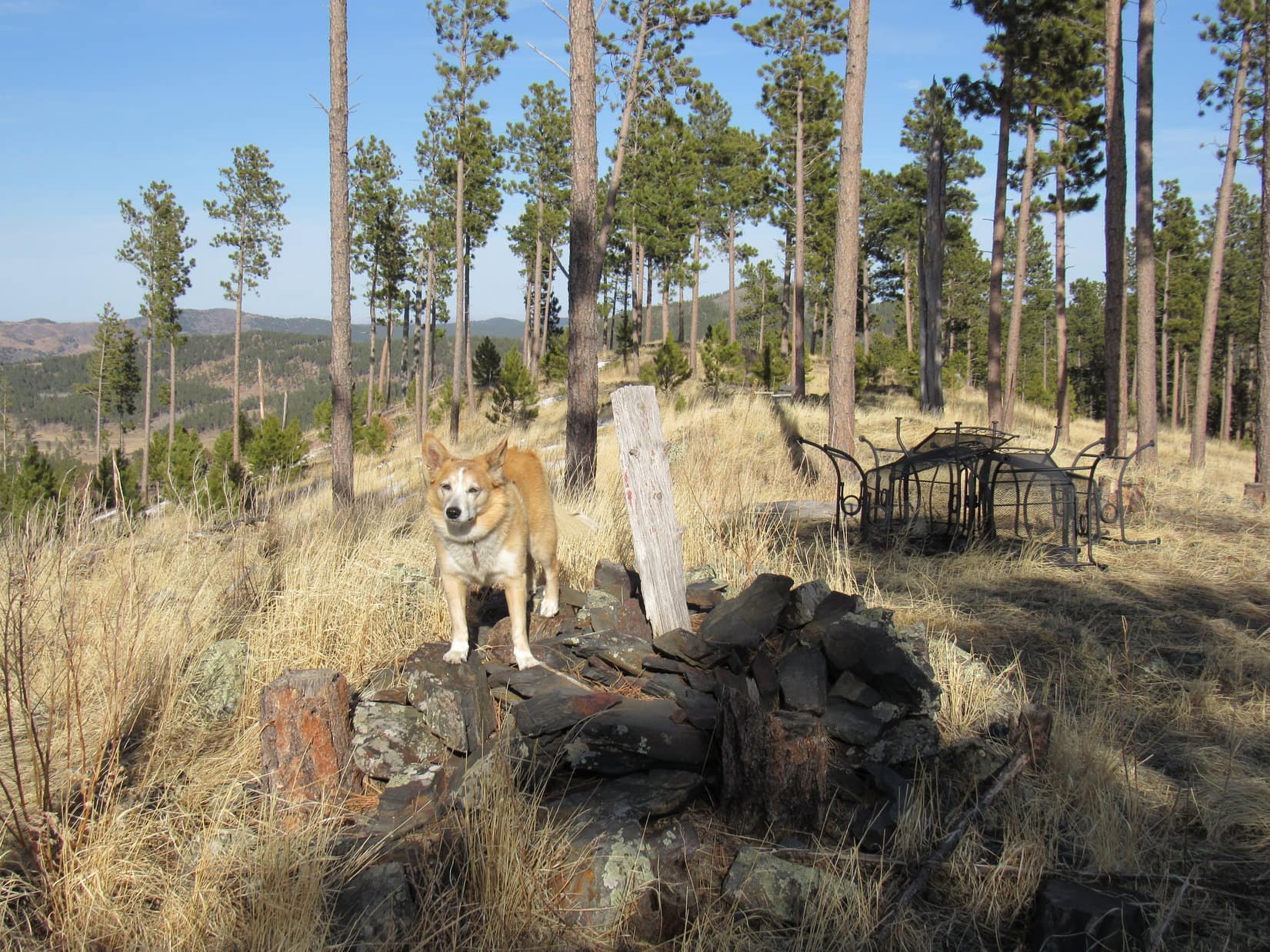
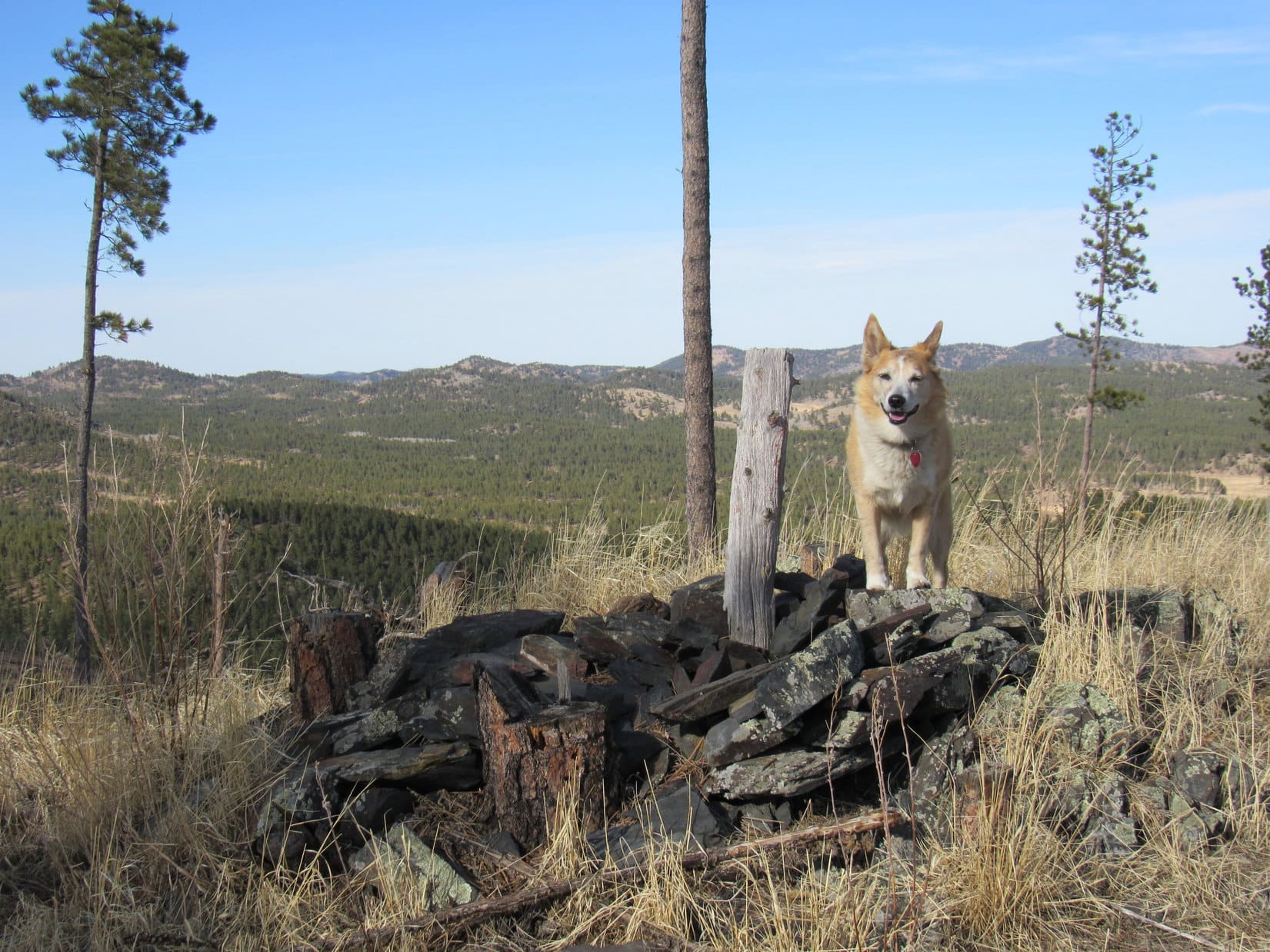
Someone had carted a bench swing and metal patio chairs up here.  The true summit, marked by a wooden post sticking up out of a loose cairn, was just beyond the chairs.  The post was clearly the same one that had been here more than 6 years ago.  Tiny bits of the peeling red paint that had been on it then still remained.

At the true summit. Photo looks E.
On Union Hill. Photo looks NNE.

After visiting the true summit, SPHP thought taking advantage of the bench swing might be fun.  Lupe hopped up next to SPHP, but leapt off a moment later.

What is that thing, SPHP?  It’s making me sea-sick!

Oh, come on!  It’s just a swing!  A rather nice amenity, if you ask me.

I’m not asking you, SPHP!  I’m telling you it makes me sick.  Besides, it’s facing into the wind, and I don’t care for that much, either.

The swing has a grand view of Peak 6040!

Been there, done that!  Why don’t we get down out of the breeze where we can ponder the fabulous view to the S instead?  By the way, we’ve made it to Union Hill (6,120 ft.), so isn’t it about chocolate coconut bar time again?  You’re holding out on me!

Peak 6040 (Center) and Peak 6167 (R) from Union Hill. Photo looks N with help from the telephoto lens.
Black Elk Peak (L) and Sylvan Hill (R) from the point of the last chocolate coconut bar’s demise. Photo looks S.

Union Hill was a great spot, but time waits for no Dingo.  Lupe couldn’t linger too long, if she intended to complete her last Lowden Mountain tradition.  40 minutes after arriving, she again stood in the breeze next to the summit post.

Union Hill true summit. Black Elk Peak (R). Photo looks SSE.

Onward!  Puppy, ho!

Union Hill’s NW slope was steepish with some deadfall, but not too bad.  The worst of the deadfall was near a saddle reached after the first leg of the descent.  Heading down into the valley to the N, Looper eventually picked up part of USFS Road No. 389.1N.

On USFS Road No. 389.1N. Photo looks NW.

No. 389.1N soon headed off in the wrong direction.  Turning W, Lupe left it, continuing down the valley.

Her Union Hill descent ended upon reaching Burnt Fork Road.  A 0.25 mile trek N brought the American Dingo to USFS Road No. 389.1L SE of the Gold Mountain Mine.  Loop paused briefly by the frozen pond before hurrying on, by-passing the mine.

By the frozen pond again. Photo looks S.

Trotting along the winding roads, Lupe retraced her morning route.  Soon she was heading up Lowden Mountain’s N slope.

6:44 PM, 50ºF, Lowden Mountain – The sun still hovered barely above the horizon when Loopster reached the summit boulder again.  Success!  All traditions complete!  Lupe had been to Lowden Mountain (6,055 ft.) in 2013 and 2014.  On both occasions she had climbed it twice on the same day, and now she had just done it again in 2021.  Only 3 days on Lowden Mountain, but 6 ascents!
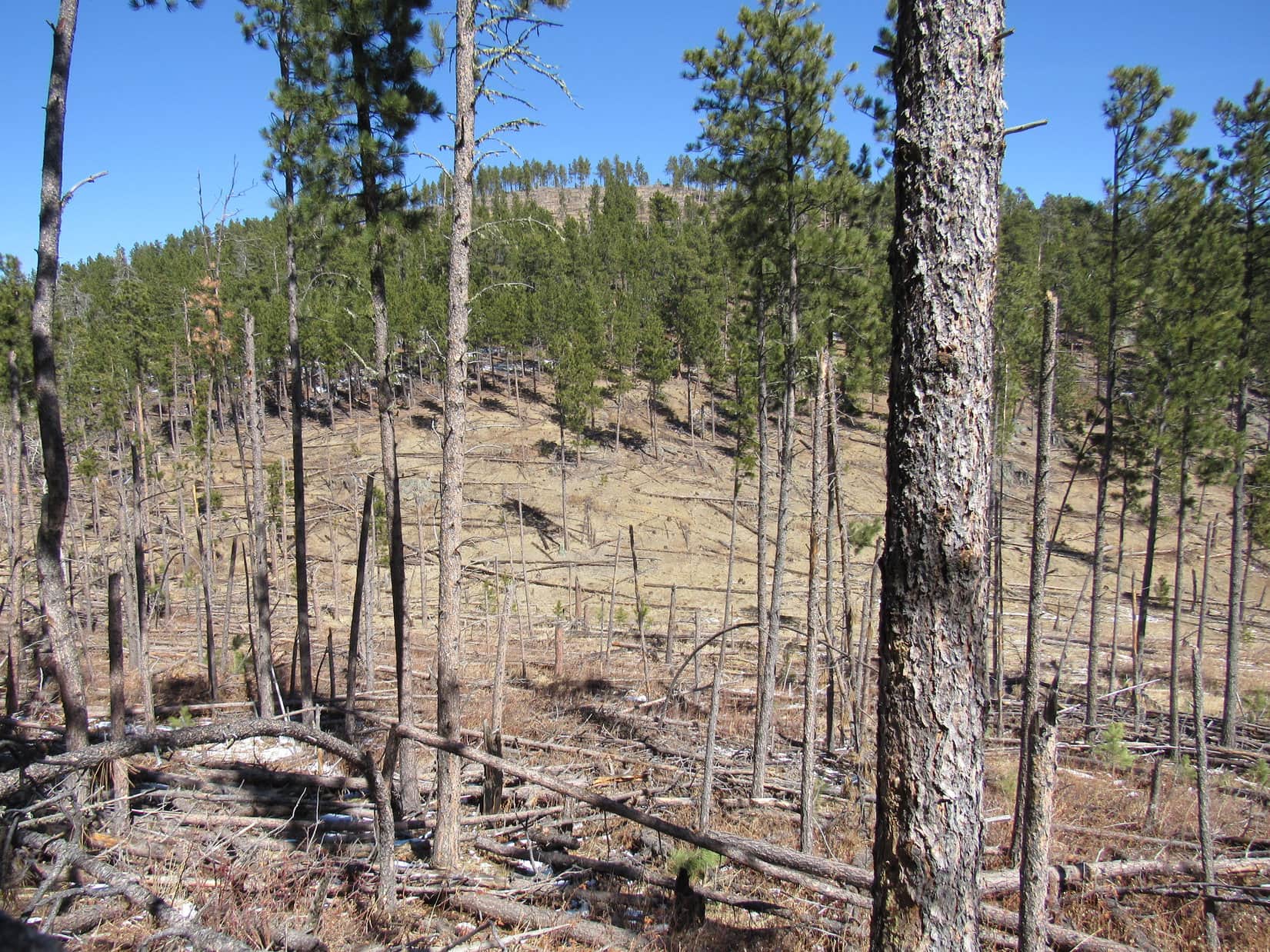
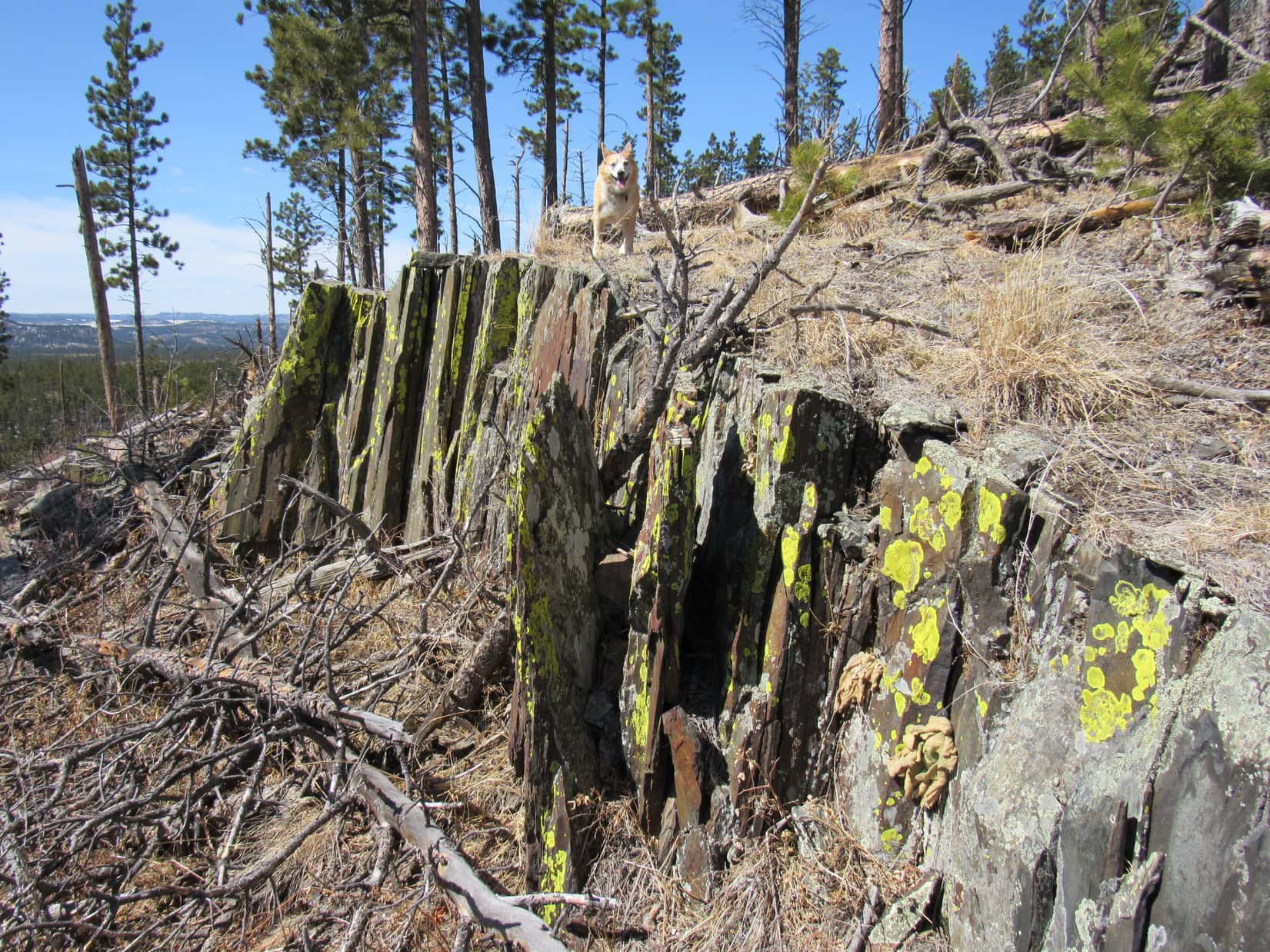
Back at Lowden Mountain’s summit. Photo looks WSW.

This was the only place where Lupe had a goofy tradition like that, yet it seemed fitting to have kept it despite the passage of so many years.  She didn’t stay long, less than half an hour.  Yet before the Carolina Dog left, the evening sun suddenly broke through the clouds.  To the E, False North Point, Union Hill, and Five Points stood all aglow.

For a few moments, Lupe did, too, high on old friend Lowden Mountain.  (End 8:09 PM, 42ºF)

Lowden Mountain, 2nd ascent of the day, Black Hills of South Dakota 3-28-21

Links:

Next Black Hills Expedition                  Prior Black Hills Expedition

Black Hills, SD Expedition No. 107 – Lowden Mountain & Union Hill (12-6-14)

Want more Lupe adventures?  Check out Lupe’s Black Hills, SD & WY Expeditions Adventure Index, Master Adventure Index, or subscribe free to new Lupe adventures!